Last reviewed: July 29, 2026
A good Twitter thread does not feel like a long post cut into smaller boxes. It feels like a sequence in which every post changes what the reader knows, believes, or can do.
The first post earns attention. The second proves the hook was not bait. The middle turns curiosity into understanding. The ending pays off the promise and gives the reader one sensible next step.
That is why threads are harder than single posts. Every additional post asks the reader for another unit of attention. If the thread does not repay that attention quickly enough, the reader leaves before the point arrives.
This guide explains how to choose a thread-worthy idea, write the opening three posts, structure the middle, decide how long the thread should be, use images and numbering, close without sounding promotional, and measure where readers appear to drop off.
If you already understand the mechanics and want reusable structures, use our Twitter thread templates. If you are choosing a format for a business goal, see our Twitter thread strategy guide. This pillar guide covers the layer underneath both: the decisions that make any thread structure work.
Research note: This guide uses current X Help documentation, X’s public For You recommendation repository, and X’s official analytics definitions. Where X does not publish a benchmark, such as an ideal thread length or a universal completion rate, we label our guidance as an editorial starting point rather than presenting it as a platform fact.
How do you write a good Twitter thread?
To write a Twitter thread people are more likely to finish:
- Choose an idea that genuinely needs sequence.
- Write the final takeaway before writing the hook.
- Give every post one clear job.
- Treat the first three posts as one opening unit.
- Deliver the first useful point early instead of withholding all value.
- Add proof, examples, or consequences as the thread progresses.
- End with the payoff before adding a call to action.
- Proofread the entire thread before publishing because threads cannot currently be edited.
- Measure the shape of post-by-post exposure, not just the views on the hook.
The most important principle is simple:
Use the shortest complete sequence that delivers the full idea.
Do not stretch one observation into eight posts because threads appear more substantial. Do not compress a real case study into three vague posts because shorter content feels safer. Length should follow the argument and its proof burden.
What is a Twitter thread?
A Twitter thread, now officially called a thread on X, is a series of connected posts published by the same account. The posts are linked so readers can expand and read them as one sequence.
X says a thread can provide additional context, an update, or an extended point. In practical writing terms, a thread is useful when the order of the information matters: a story needs setup before resolution, a tutorial needs one step before the next, or an argument needs evidence before the conclusion.
X’s current thread documentation explains that short and long threads can appear differently. A thread containing two or three posts from an account someone follows will generally appear connected in the Home timeline. A thread with four or more posts is usually truncated behind Show this thread. Individual posts from a thread can also appear separately on the author’s profile or be shared independently, while still giving readers a route into the full sequence.
That creates two important writing implications.
The opening is usually bigger than one post
The first post remains the primary discovery unit, but it is not always the only part of the thread initially visible. In some timeline contexts, readers may see the first two or three connected posts.
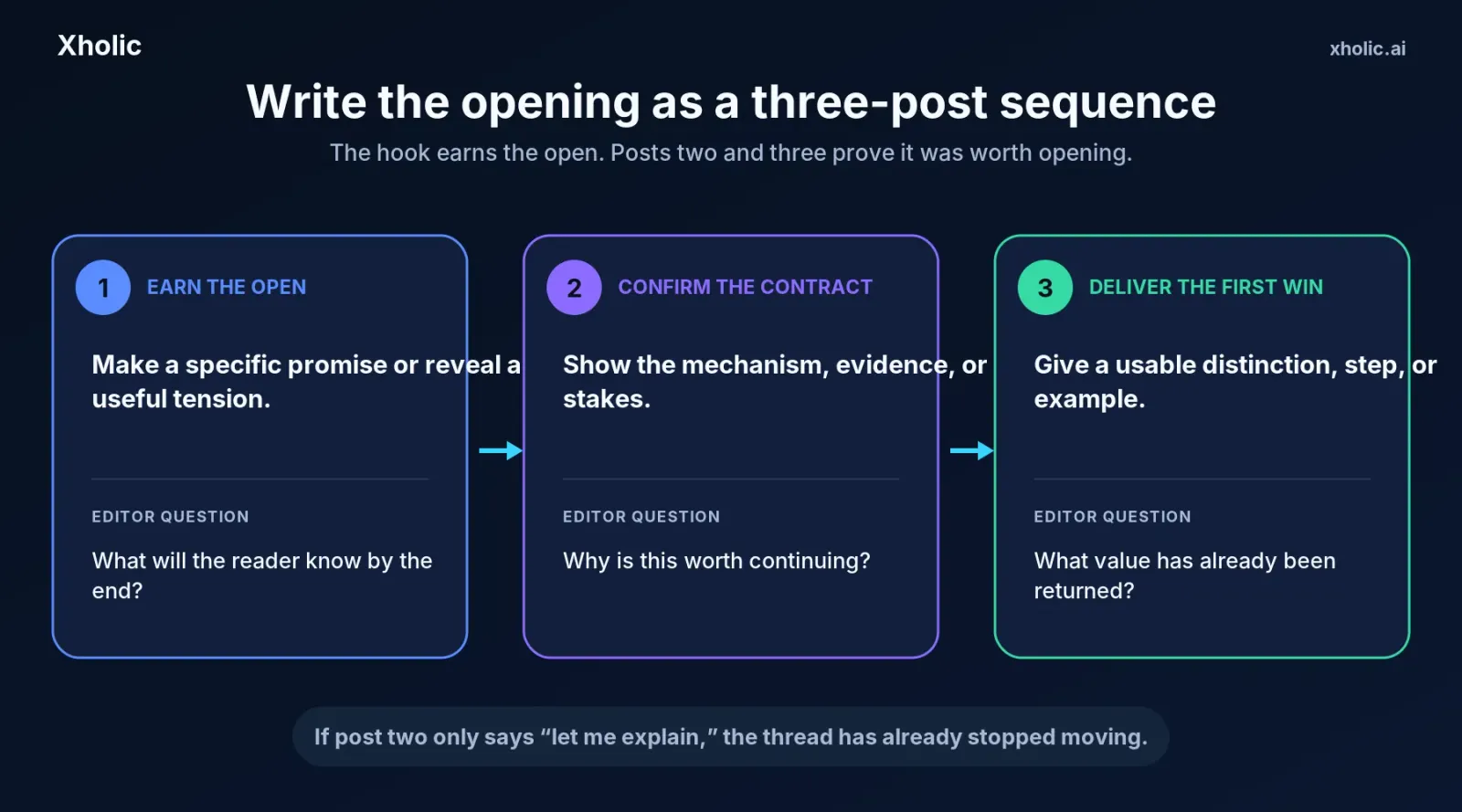
That means the opening should be designed as a three-post sequence:
- Post 1 earns attention.
- Post 2 confirms the promise and narrows the subject.
- Post 3 delivers the first meaningful payoff.
A hook that wins the click but leads into two generic setup posts creates an early trust problem. The reader opened the thread, but the thread has not yet justified the decision.
Every post should survive as a possible entry point
Because a middle post can be reposted, quoted, shared, or surfaced separately, it should make enough sense outside the full thread to be useful. At the same time, it should advance the larger sequence rather than restating the hook.
We call this modular continuity:
Each post should be understandable on its own and more valuable in sequence.
A post that is impossible to understand alone is fragile. A post that contains the entire argument makes the rest of the thread unnecessary. Strong threads sit between those extremes.
Twitter thread vs. single post vs. long post vs. X Article
“Is this idea too long for one post?” is no longer the best way to decide whether to write a thread.
Standard X posts allow up to 280 characters. Premium subscribers can publish longer posts of up to 25,000 characters, and eligible paid accounts can publish formatted X Articles. Length alone therefore does not make an idea thread-worthy.
The better question is whether the idea benefits from sequence.
| Format | Best used for | Main advantage | Main limitation |
|---|---|---|---|
| Standard post | One observation, claim, tip, question, or concise story | Fast to consume and easy to share | Limited room for context and proof |
| Twitter thread | A story, process, argument, teardown, or case study in which order matters | Creates progression and several potentially shareable units | Every additional post adds friction |
| Premium long post | A continuous explanation that needs space but not multiple stages | Keeps the reading experience in one post | Fewer natural stopping points and less visible progression |
| X Article | An essay, report, or long-form resource with headings and richer formatting | Better suited to deep, continuous reading | Higher reader commitment and paid publishing access |
| Blog post | Durable, searchable, updateable content with full control over structure and conversion | Best for long-term discovery and ownership | Requires the reader to leave X |
The Xholic Thread-Worthiness Test
Before drafting, answer these five questions.
- Does order matter? Would the conclusion lose meaning if the reader saw the sections out of sequence?
- Does each section deserve its own unit? Can every post carry one distinct step, example, finding, or turn?
- Does the idea have a real payoff? Is there a conclusion, transformation, answer, or framework worth building toward?
- Does the proof need stages? Would examples, screenshots, data, or reasoning be easier to understand one unit at a time?
- Would one continuous post be worse? Does splitting the idea improve comprehension rather than merely increase the post count?
A useful interpretation:
- Four or five yes answers: A thread is probably the right format.
- Two or three yes answers: Test a short thread against a long post.
- Zero or one yes answer: Write a single post or choose another format.
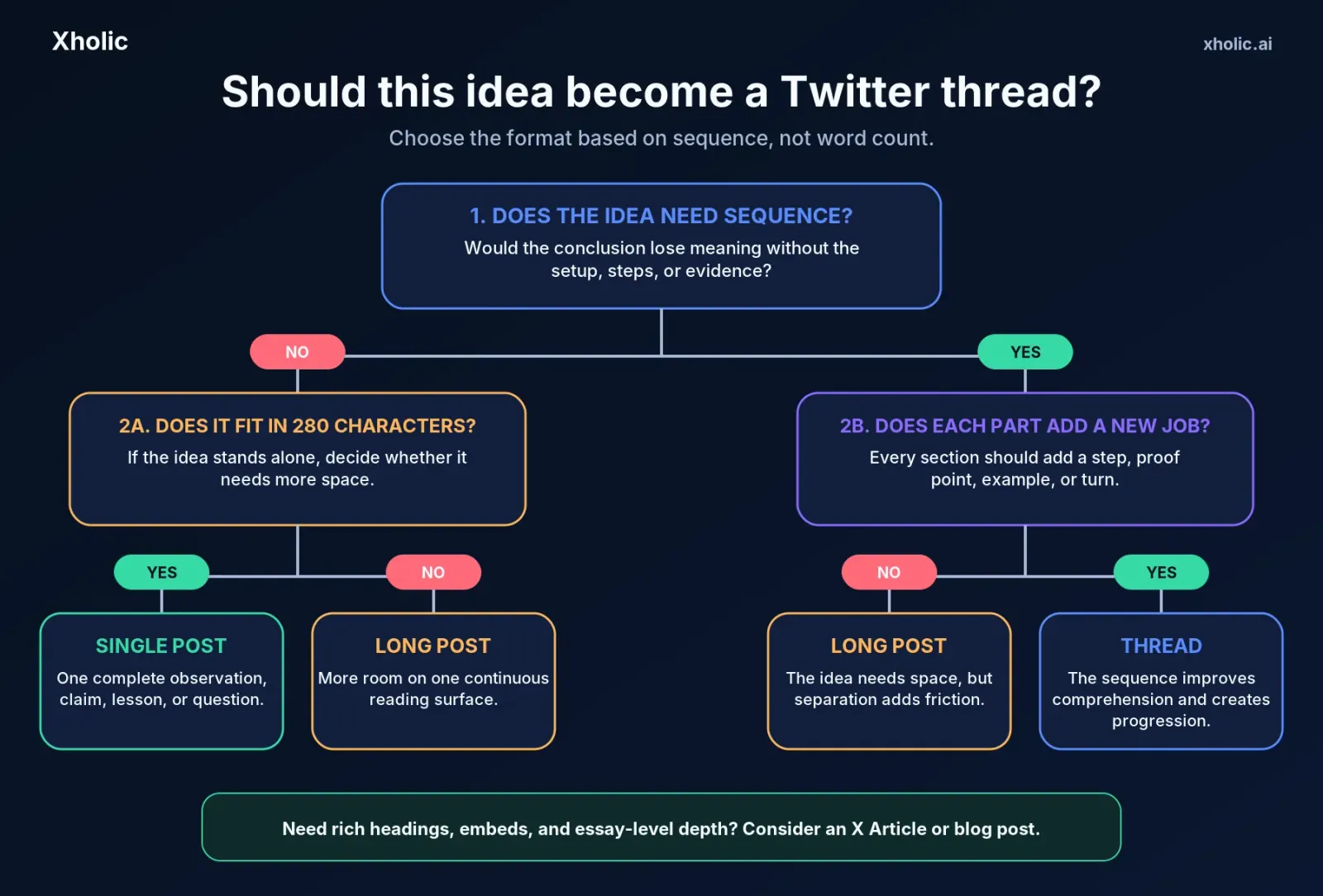
The most common format mistake is not writing a bad thread. It is writing a thread when one strong post would have been clearer.
If you have several separate ideas but no sequence, you may need a content queue rather than a thread. Our library of Twitter content ideas is designed for that lighter case.
How to create a thread on X
The native publishing process is straightforward:
- Open the X composer and write the first post.
- Select the plus icon to add another post.
- Continue adding posts in the intended order.
- Review the entire sequence.
- Select Post all to publish the thread together.
X also lets you save a thread as a draft and append additional posts after publication from the thread detail page.
The mechanics are easy. The risk is publishing before the sequence has been tested.
Draft the entire thread before you publish
Avoid composing a serious thread live inside the feed if you can. Write the complete sequence in a document or drafting tool first, then move it into the composer.
This gives you a chance to check:
- Whether the hook promises what the ending actually delivers.
- Whether post two confirms the subject quickly enough.
- Whether any middle post merely repeats the previous one.
- Whether numbering still matches the final count.
- Whether every link, name, date, and statistic is correct.
- Whether an image is attached to the intended post.
This matters because X currently excludes threads from its Edit Post feature. You can append to a published thread, but you cannot simply correct the original sequence as you can with some eligible standalone posts.
For visual review, Xholic’s free Reply Chain Generator can turn up to six connected posts into a clearly labelled thread mockup. It is useful for checking pacing, stakeholder approval, and educational examples before anything goes live.
The architecture of a thread people finish
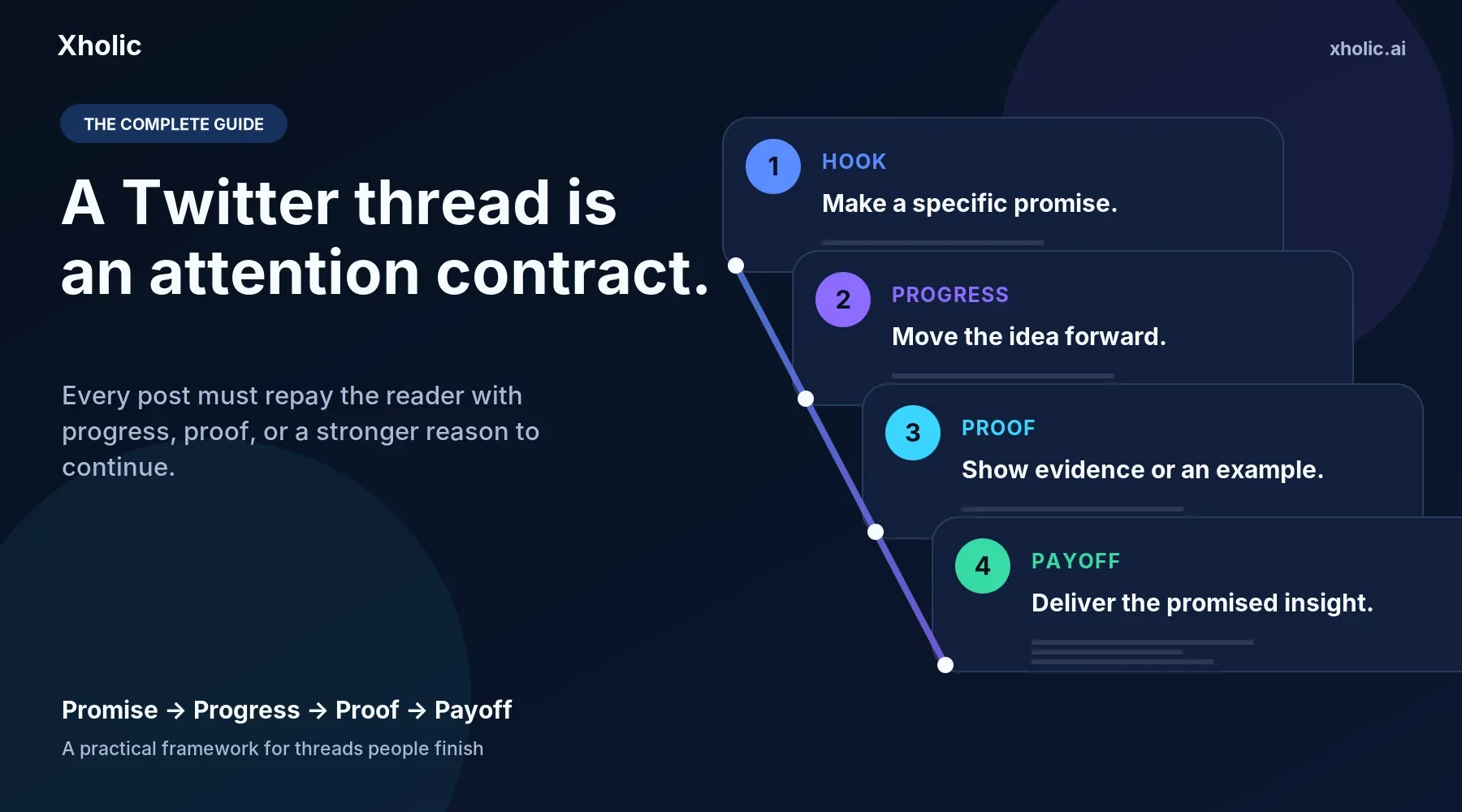
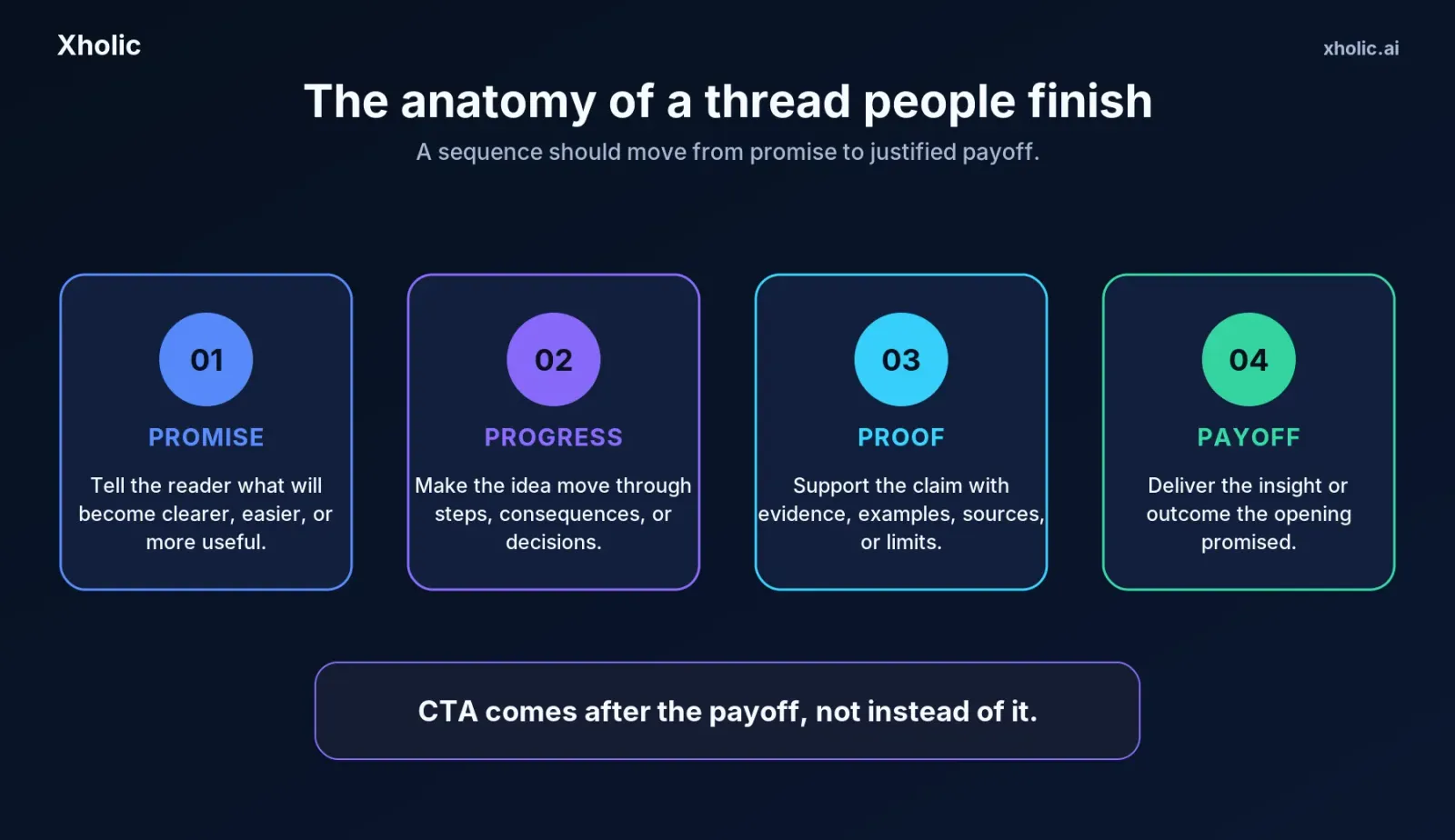
A strong thread usually contains four layers:
- Promise
- Progress
- Proof
- Payoff
The call to action comes after those four layers. It is not a substitute for the payoff.
1. Promise: What will the reader get?
The first post should create a clear expectation. It can promise an answer, a useful breakdown, a result, a story, a set of lessons, or a new way of seeing a familiar problem.
A promise is not the same as hype.
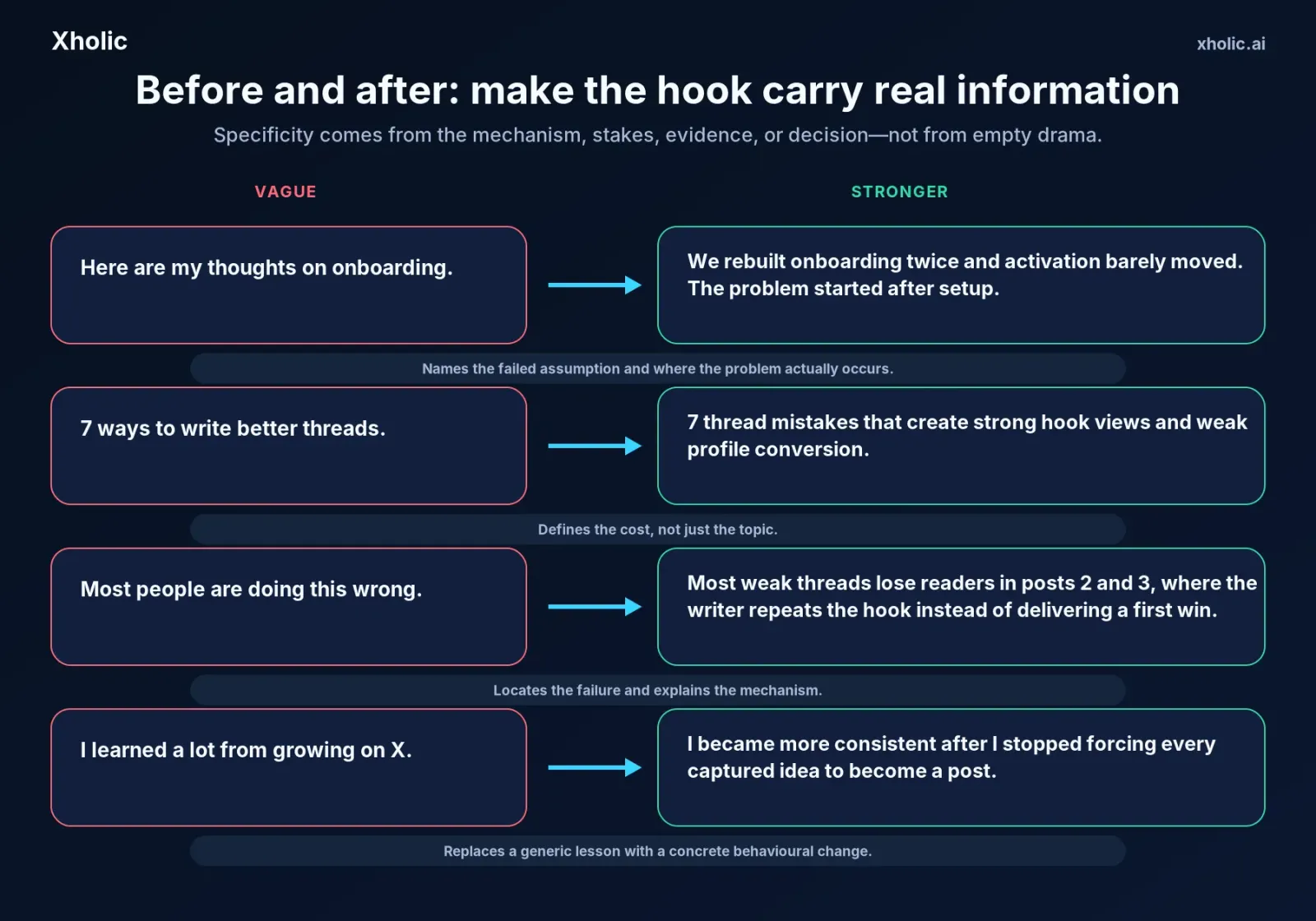
Weak promise:
Here are some thoughts about onboarding.
Stronger promise:
We rebuilt onboarding twice and activation barely moved. The real problem started after setup, not during it. Here is what we changed.
The stronger version tells the reader what happened, where the surprising tension sits, and why the explanation may be useful.
2. Progress: Does every post move the idea forward?
Readers should feel a visible change from one post to the next.
A post can create progress by adding one of the following:
- A new fact.
- A new step.
- A concrete example.
- A consequence.
- A counterargument.
- A turning point.
- A synthesis that changes the meaning of earlier information.
A post that only says “this is important” or repeats the previous point in softer language does not create progress. It creates delay.
3. Proof: Why should the reader believe you?
Proof can come from:
- Direct experience.
- A specific example.
- A screenshot or product demonstration.
- Original data.
- A transparent calculation.
- A source the reader can inspect.
- A counterexample that tests the claim.
- A clear explanation of the mechanism.
The easiest way to make a thread feel generic is to stack advice without showing where it came from.
“Write better hooks” is advice.
“We compared these two openings, and the second works because it names the failed assumption before introducing the fix” is analysis.
A pillar thread, research thread, or authority-building thread should contain enough proof that another person could cite, challenge, or apply the idea.
4. Payoff: What does the sequence mean?
The payoff is the answer the thread has earned.
It may be:
- The lesson from a story.
- The final step of a process.
- The reason a common tactic fails.
- A framework that compresses the evidence.
- A recommendation with clear trade-offs.
- A result that becomes understandable only after the setup.
The payoff should resolve the exact tension created by the opening. A thread about a failed onboarding redesign should not end with a generic lesson about “listening to users.” It should explain the specific decision the evidence changed.
A thread can survive without a promotional CTA. It cannot survive without a payoff.
Write the payoff before the hook
One of the best ways to avoid empty curiosity is to draft the final lesson first.
Complete this sentence:
After reading this thread, the reader should understand that ________.
Then write the hook so it raises the question your payoff actually answers.
This reverse order prevents a common failure: a strong opening that promises a more interesting thread than the writer has evidence to deliver.
Give every post one job
A practical post map looks like this:
| Position | Primary job |
|---|---|
| Post 1 | Create a specific reason to continue |
| Post 2 | Confirm the promise, define the problem, or establish the stakes |
| Post 3 | Deliver the first concrete insight, example, or result |
| Middle posts | Add steps, evidence, contrasts, implications, or turns |
| Penultimate post | Synthesize the argument or deliver the main payoff |
| Final post | Give one relevant next step, question, resource, or CTA |
This is not a rigid template. A story may delay the main turn, and a list may deliver value from post two onward. The point is to make every post accountable to a job.
Use the Thread Compression Test
After the first draft, delete one middle post and read the thread again.
- If the meaning, logic, and pacing remain intact, the deleted post was probably filler.
- If the transition breaks or the conclusion loses support, the post may be necessary.
- If two adjacent posts do the same job, merge them.
Repeat until every remaining post changes the reader’s understanding.
How to write the opening three posts
Most thread advice treats the hook as a single line. That is incomplete.
The opening three posts should work as a small conversion sequence:
- Post 1: Earn the open.
- Post 2: Confirm the contract.
- Post 3: Give the first win.
Post 1: Earn the open
The first post should be specific enough to create interest and complete enough to make sense when seen alone.
A useful hook usually contains at least two of these elements:
- A recognisable problem.
- A specific outcome.
- A surprising contrast.
- Credible proof.
- A defined audience.
- A clear scope.
- Stakes or consequence.
Avoid using “A thread” or the thread emoji as the main reason to continue. They label the format but do not create value.
Post 2: Confirm the contract
Post two answers the reader’s unspoken question:
Did I open the thread I was promised?
Use it to narrow the subject, establish context, or explain why the common interpretation is incomplete.
Do not spend post two thanking people, repeating the headline, or writing a generic introduction. The reader has already made a small commitment. Reward it.
Post 3: Give the first win
Do not hold every useful detail until the final post.
Post three should contain a concrete insight, example, mechanism, or first step. This proves the thread has substance and gives the reader a reason to continue for the full payoff.
Here is a weak opening sequence:
1/ A thread on customer onboarding.
2/ Onboarding is very important for every SaaS product.
3/ There are many things to consider. Let us get into them.
Here is a stronger version:
1/ We rebuilt onboarding twice and activation barely moved. The problem was not setup. New users finished setup and then stopped because they did not know what to do next.
2/ Our flow ended with a product tour and an empty dashboard. We thought that felt flexible. To a new user, it felt like work.
3/ We replaced the tour’s final screen with one question: “What result are you trying to get this week?” That answer created the first meaningful action.
The second version has already delivered a useful diagnosis by post three. The reader is not continuing only because information is being withheld.
Twitter thread hook formulas that create honest curiosity
A formula is useful when it helps you frame a real idea. It becomes a problem when the formula is more interesting than the evidence behind it.
The examples below are original teaching examples, not performance claims.
| Hook type | Basic formula | Example | Main risk |
|---|---|---|---|
| Result + mechanism | I achieved result by changing unexpected lever | “I became more consistent on X after I stopped trying to write every day. The change was separating idea capture from publishing.” | Claiming a result without showing enough proof |
| Contrarian boundary | Common advice works until specific condition | “Posting more helps until your ideas start repeating. At that point, volume trains readers to skim.” | Disagreeing for attention without a defensible replacement |
| Mistake + consequence | I did mistake, and it caused specific cost | “I wrote hooks that summarised the whole thread. They sounded clear, but they removed every reason to continue.” | Turning a minor error into fake drama |
| Research finding | I reviewed sample or method and found unexpected pattern | “I reviewed our last 20 educational threads. The biggest drop was not near the end. It happened between the hook and the first useful example.” | Hiding the method or using a tiny sample as universal truth |
| Teardown | This works because mechanism, not surface feature | “This thread opener works because it names the failed assumption before giving the fix, not because it uses a big number.” | Critiquing wording without understanding context |
| Personal lesson | I believed old idea until experience changed it | “I thought a thread needed suspense. Then I noticed my best threads gave readers a useful point by post three.” | Writing a polished lesson with no real tension |
| List with a consequence | Number things that affect important outcome | “Seven thread mistakes that create strong hook views and weak profile conversion.” | Publishing a list whose items are interchangeable filler |
| Prediction + evidence | Change will happen because observable shift | “Threads will become more valuable as research summaries, not because they are long, but because each post can act as a shareable evidence unit.” | Making a prediction with no mechanism |
| Question with stakes | Ask a real question whose answer changes a decision | “Should this idea be a thread, a long post, or a blog? The answer depends less on length than on sequence.” | Asking a question whose answer is obvious or low-stakes |
What makes a hook specific?
Specificity does not require a dramatic number.
A hook becomes specific when it names:
- What changed.
- For whom it changed.
- Where the problem occurred.
- What assumption failed.
- What the reader will be able to decide or do.
Compare these:
Generic:
Here is how to write better threads.
Specific:
Most weak threads do not fail at the hook. They fail in posts two and three, where the writer repeats the promise instead of delivering the first useful point.
The second hook gives the reader a mechanism to inspect. It can be tested against their own writing.
For a wider breakdown of opening lines across all post formats, see how to make a tweet go viral without relying on empty clickbait.
How to write the middle without losing momentum
The middle is where most threads become interchangeable.
The opening has tension. The ending has a lesson. The middle often becomes a series of paragraphs that repeat the same idea at slightly different levels of abstraction.
A stronger middle alternates between three moves:
- Claim: What are you saying?
- Evidence: Why should the reader believe it?
- Implication: What changes because it is true?
For example:
Claim: An empty dashboard creates uncertainty after onboarding.
Evidence: New users completed setup but paused when the product presented every possible feature at once.
Implication: The redesign should reduce decision ambiguity, not merely remove setup fields.
That sequence teaches more than three separate tips because the ideas depend on one another.
One post, one dominant idea
A post can contain context and an example, but it should still have one dominant job.
If a post contains three unrelated tips, split it. If three consecutive posts make the same claim, compress them.
A good editing question is:
What new thing can the reader say after this post that they could not say before it?
If the answer is unclear, the post may not be advancing the thread.
Use transitions that add information
Weak transition:
But that is not all.
Stronger transition:
Removing steps did not solve the problem because the uncertainty began after setup.
The stronger line moves the argument while connecting sections. It does not ask the reader to continue on faith.
Add local reasons to continue in longer threads
A long thread should not rely on one open loop created in post one.
When the thread changes from diagnosis to solution, or from findings to implications, create a small local promise:
The surprising part was not which hook performed best. It was where the exposure dropped next.
This signals a new section without turning every post into clickbait.
Make evidence visible
When you use numbers, include enough context for the reader to interpret them:
- What was measured?
- Over what period?
- From which sample?
- Was the result an average or median?
- What limitations matter?
“Threads with seven posts perform 35% better” sounds precise but is meaningless without a definition of performance, a sample, and a comparison method.
When you do not have credible data, say what you observed and frame it as an observation. Trust grows when the confidence of the language matches the quality of the evidence.
How long should a Twitter thread be?
There is no official ideal length for a Twitter thread, and X does not publish a universal point at which thread completion peaks.
Many guides repeat ranges such as five to nine or seven to ten posts without publishing a dataset or methodology. Treat those numbers as drafting conventions, not algorithmic laws.
The better rule is:
A thread should be as long as the shortest complete version of the idea.
These are useful editorial starting ranges, not platform benchmarks:
| Thread type | Practical starting range | Why it may need that length |
|---|---|---|
| Focused tactical lesson | 4–6 posts | One problem, one mechanism, one example, one takeaway |
| Numbered list with explanations | 6–10 posts | Each item needs enough room to become useful rather than decorative |
| Step-by-step tutorial | 6–12 posts | The reader must follow an ordered process |
| Personal or founder story | 5–10 posts | Setup, complication, turn, evidence, and lesson need pacing |
| Product walkthrough | 5–8 posts | Problem, workflow, visual proof, use case, and next step |
| Research or case study | 8–15 posts | Method, findings, examples, limitations, and implications take space |
| Live updates | As needed | The event, not a planned content formula, determines length |
Let the proof burden determine the length
A claim with a high proof burden needs more room.
“Use one CTA” may need a short explanation and example.
“Our onboarding problem was decision ambiguity, not setup friction” may need a timeline, user behaviour, before-and-after flow, and a clear causal limitation.
The more surprising or consequential the claim, the more evidence the thread should provide.
When a thread is becoming too long
Consider a long post, X Article, or blog post when:
- The reader needs uninterrupted prose rather than separate units.
- The argument depends on detailed caveats.
- You have several tables, citations, or complex visuals.
- The thread exceeds the amount of information most readers can scan comfortably.
- The content should remain searchable, updateable, and owned outside X.
A good hybrid is to publish the complete resource on your site and use a thread to present the central finding, strongest evidence, and practical implications.
Five Twitter thread structures and when to use them
A structure is not a cosmetic format. It is the path the reader takes from the opening question to the final understanding.
Choose the structure by asking what should change for the reader:
- Should they prioritise several options?
- Should they complete a process?
- Should they understand why a decision changed?
- Should they replace one belief with a better-bounded belief?
- Should they trust a finding because they can inspect the evidence?
Five structural families cover most useful threads:
| Structure | Best used when the reader needs to… | Proof burden | Common failure |
|---|---|---|---|
| List | Compare, prioritise, or remember several distinct points | Each item needs a reason, example, or consequence | The items are interchangeable headlines with no depth |
| Tutorial or process | Move from a starting state to a defined outcome | Steps, prerequisites, screenshots, and failure checks | The sequence skips hidden knowledge the writer already has |
| Story | Understand how an event changed a decision or belief | Specific moments, choices, consequences, and honest uncertainty | The story ends with a generic lesson that was not earned |
| Argument or reframe | Replace an incomplete default belief with a more useful one | Mechanism, counterargument, boundary conditions, and evidence | The hook disagrees for attention but offers no better model |
| Research or case study | Evaluate a finding, result, or pattern | Method, sample, observations, limitations, and implications | The thread presents correlation or a tiny sample as a universal law |
Choose the structure before writing the hook
The same topic can support several structures, but they create different reader contracts.
Take “SaaS onboarding”:
- A list might cover seven sources of decision ambiguity.
- A tutorial might show how to design a first-outcome flow.
- A story might explain why two redesigns failed.
- An argument might challenge the belief that fewer steps always improve activation.
- A case study might present the observed behaviour before and after a change, with limits.
Writing the hook first can trap you inside the wrong contract. A dramatic story hook is a poor opening for a thread that ultimately becomes an unranked list. Pick the reader’s transition, choose the structure, and then write the promise.
For fill-in-the-blank versions of these shapes, use our eight Twitter thread templates. For business-oriented choices such as a contrarian reframe, authority-building research thread, or product walkthrough, use the Twitter thread strategy guide.
Should you number a Twitter thread?
Numbering is a comprehension choice, not a guaranteed growth tactic.
Number the thread when:
- It is a list or ordered process.
- Later posts may be confusing when surfaced alone.
- The reader benefits from knowing the commitment upfront.
- You want the sequence to remain clear when screenshots are shared.
Common styles include:
1/8,2/8,3/81.,2.,3.for list items- Section labels such as
Problem,Evidence,Fix
Skip numbering when:
- The thread is a story whose flow should feel continuous.
- The final count is likely to change.
- Numbers make the thread look more mechanical than useful.
- Each post has a natural transition and enough context.
If you use 1/8, finalise the thread before publishing. A last-minute insertion can break the count, and threads cannot currently be edited.
How to use images, screenshots, charts, and alt text
Visuals improve a thread when they carry evidence or reduce explanation. They weaken a thread when they are decorative interruptions.
X currently allows up to four media items in a standard post. It also supports image descriptions of up to 1,000 characters for each image.
Use an image when it does one of these jobs
- Shows a before-and-after state.
- Proves a product behaviour.
- Makes a comparison easier to scan.
- Displays a trend or distribution.
- Annotates a design, interface, landing page, or piece of writing.
- Compresses a process into a diagram.
- Gives the reader a reusable checklist or framework.
Avoid visual noise
Do not attach an image to every post merely to “increase engagement.” A thread with constant visual changes can feel slower because the reader must repeatedly switch between reading and inspecting.
Use media at the moments where the medium changes the understanding:
- The hook, when the visual is the proof.
- The first concrete example.
- A major section transition.
- The final framework or checklist.
Make charts trustworthy
A chart should state:
- What the values represent.
- The sample or source.
- The time period.
- The unit of measurement.
- Any important limitation.
A visually polished chart with no method is not a linkable asset. It is an unsupported claim in graphic form.
Write useful alt text
Good alt text explains the information a reader needs from the image. It does not repeat “image of” or copy the caption word for word.
For a chart, summarise the pattern and the key values. For a screenshot, state that it is a screenshot and explain the relevant interface state. For a diagram, describe the relationships between the parts.
If an image contains important text, include that meaning in the surrounding post or alt description so the argument does not disappear for readers using assistive technology.
How to end a Twitter thread without ruining it
The final post should complete the thread before asking the reader to do anything.
A weak ending switches from useful analysis to a stack of unrelated requests:
Like, repost, follow, join my newsletter, try my product, and tell me what you think.
A stronger ending gives one next step that follows naturally from the value delivered.
We call this CTA continuity:
The action at the end should feel like the next useful step in the same journey, not the price of reading the thread.
| Thread goal | Natural ending |
|---|---|
| Teach a method | Ask the reader to test one step and report what changed |
| Start a discussion | Ask a narrow question that requires experience or judgment |
| Share research | Link to the full method, dataset, or analysis |
| Build authority | Summarise the principle and invite thoughtful disagreement |
| Explain a product workflow | Offer a relevant demo, guide, or trial |
| Tell a personal story | End with the lesson, then ask whether others have faced the same decision |
Use one primary action
A reader can understand one clear request. Multiple asks compete with one another and make the ending feel transactional.
Examples:
- “Which part of your onboarding creates the most uncertainty?”
- “The full calculator is linked below if you want to test your own thread.”
- “Try the three-post opening on your next draft and compare the drop from post one to post two.”
- “The central lesson: reduce decision ambiguity before removing more steps.”
Where should you put an external link?
Put the link where it is most useful to the reader.
Often, the final post is cleaner because the opening remains focused on the native idea and the thread earns the click before asking for it. But do not present “links must go in the last post” as a documented X ranking rule. X’s public recommendation materials do not establish a universal placement law for organic links.
The useful principle is editorial, not mythical:
Give the reader enough context to understand why the destination is worth opening.
Do Twitter threads get more reach than single posts?
Threads do not receive a publicly documented blanket ranking bonus simply because they are threads.
X’s current public For You recommendation repository describes a system that retrieves in-network and out-of-network posts, predicts the probability of many actions, and combines those predictions into a weighted relevance score. The predicted actions include likes, replies, reposts, quotes, clicks, profile clicks, follows, dwell, shares, and negative actions such as blocks, mutes, and reports.
The public documentation does not establish:
- A universal “thread bonus.”
- A fixed multiplier that makes one reply worth a certain number of likes across the platform.
- A documented completion bonus for reaching the final post.
- A rule that every thread will outperform a single post.
Why a good thread can still create more opportunities
A thread gives the idea several connected posts through which readers may:
- Expand the conversation.
- Reply to a specific point.
- Repost or quote an individual post.
- Click the author’s profile.
- Follow the author.
- Spend more time with the subject.
- Enter the sequence through a shared middle post.
That does not mean the format creates reach by itself. It means a well-built sequence creates more surfaces on which relevance and interest can become visible.
A poor thread adds friction without adding value. A strong single post can outperform it easily.
The practical takeaway is not “write more threads.” It is:
Use a thread when the sequence creates more understanding than a single post could.
For a deeper technical explanation, see how the X algorithm works in 2026.
How to measure whether a Twitter thread worked
The hook’s view count cannot tell you whether the thread worked.
A thread can earn broad distribution on post one while losing most of its relative exposure before the first example. It can also reach a small audience and still produce unusually strong profile clicks, qualified replies, or conversions.
X’s Post Activity Dashboard includes metrics such as impressions, engagements, engagement rate, link clicks, reposts, replies, follows, detail expands, and user profile clicks. Public view counts are useful but have an important limitation: they are not unique, repeat views can count, and the author’s own view can count.
X does not provide a reader-level completion metric for ordinary text threads. That means post-to-post ratios should be treated as exposure proxies, not exact completion rates.
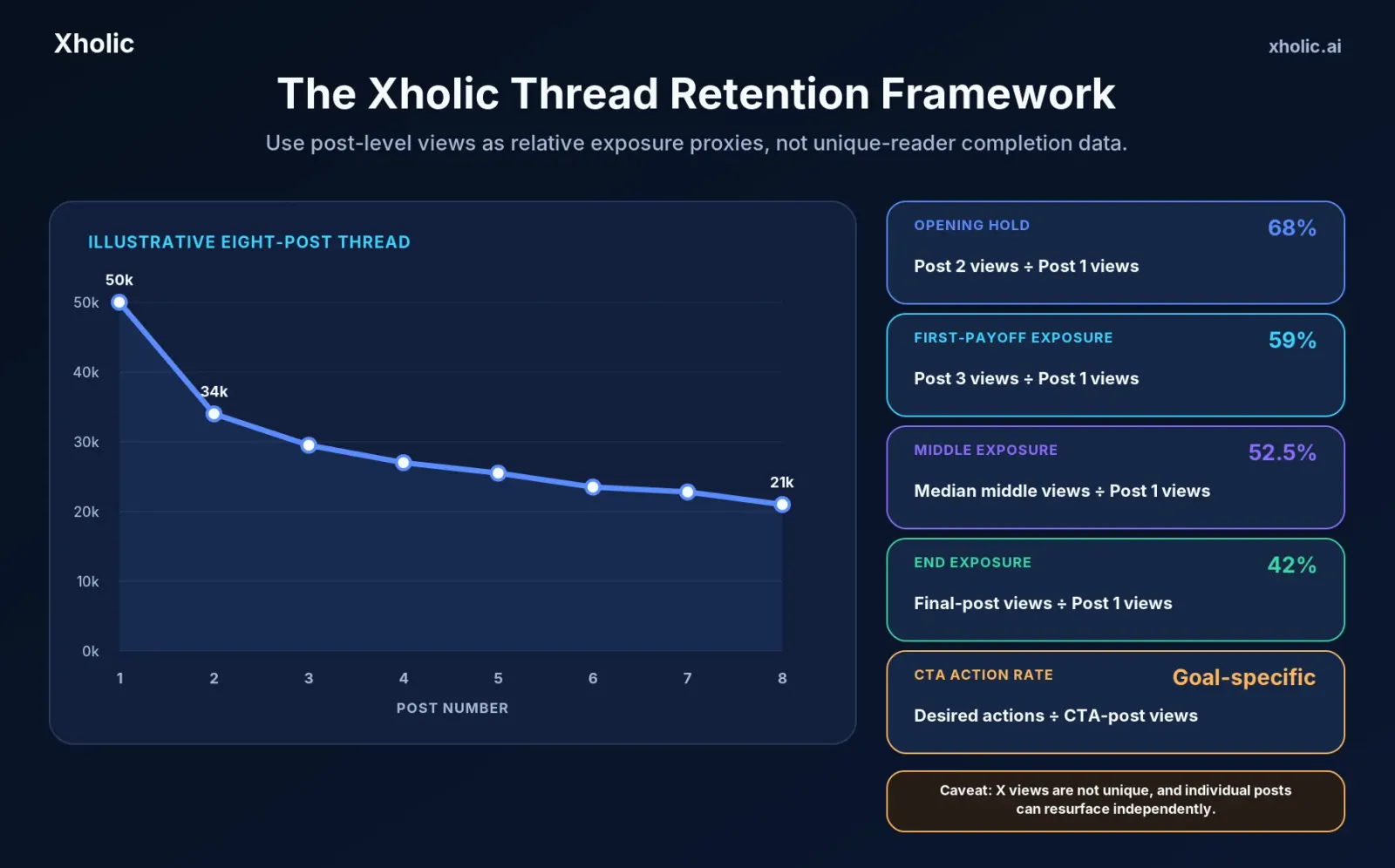
The Xholic Thread Retention Framework
Use the view or impression count available for each post. Keep the data source consistent within the calculation.
1. Opening hold proxy
Views on post 2 ÷ views on post 1 × 100This estimates how much relative exposure post two retained compared with the opening post.
2. First-payoff exposure proxy
Views on post 3 ÷ views on post 1 × 100This helps assess whether the first concrete value was still reaching a meaningful share of the hook’s exposure.
3. Middle exposure proxy
Median views of the middle posts ÷ views on post 1 × 100Using the median reduces the effect of one unusually shared or independently surfaced post.
4. End exposure proxy
Views on the final post ÷ views on post 1 × 100This estimates the final post’s exposure relative to the hook. It is not the percentage of unique readers who completed the thread.
5. Largest adjacent drop
Largest value of: (previous post views − next post views) ÷ previous post views × 100This identifies the point where the exposure curve changed most sharply.
Worked example
Imagine a seven-post thread with these public view counts:
| Post | Views |
|---|---|
| 1 | 50,000 |
| 2 | 31,000 |
| 3 | 28,000 |
| 4 | 26,500 |
| 5 | 24,000 |
| 6 | 20,000 |
| 7 | 18,500 |
The proxies would be:
- Opening hold: 31,000 ÷ 50,000 = 62%
- First-payoff exposure: 28,000 ÷ 50,000 = 56%
- Middle exposure: median of posts 2–6 is 26,500; 26,500 ÷ 50,000 = 53%
- End exposure: 18,500 ÷ 50,000 = 37%
- Largest adjacent drop: post 1 to post 2, a 38% decline
Do not compare 62% against a universal “good” benchmark. Use it against your own threads with similar goals, lengths, audience size, and publishing conditions.
The useful question is not whether the number is objectively high. It is what changed in the writing at the point of the largest drop.
How to interpret common exposure patterns
| Pattern | Possible interpretation | What to inspect |
|---|---|---|
| Very high hook views, sharp drop at post 2 | The opening reached broadly, but post two did not confirm the promise or the hook attracted the wrong audience | Relevance of the hook, clarity of post two, amount of setup |
| Stable posts 1–3, then a middle cliff | The first value landed, but the thread became repetitive, abstract, or structurally unclear | Repeated claims, weak examples, section transitions |
| One middle post spikes above neighbours | That post may have been reposted, quoted, or surfaced independently | What made it more self-contained or shareable |
| Final post rises relative to the previous one | The final post may have earned independent distribution or stronger engagement | Do not interpret the rise as readers returning to the thread |
| Modest reach, strong profile clicks or follows | The thread may be reaching a smaller but more relevant audience | Audience quality, profile positioning, topic fit |
| Strong views, weak qualified actions | The thread created consumption without changing behaviour | Payoff, CTA continuity, audience intent |
Ratios can occasionally exceed 100% because individual posts may be viewed independently. That is another reason to call these values exposure proxies rather than completion rates.
Normalise outcome metrics per 1,000 hook views
To compare threads of different sizes, calculate:
Replies per 1,000 hook views
Profile clicks per 1,000 hook views
Follows per 1,000 hook views
Link clicks per 1,000 hook views
This helps separate distribution from outcome quality.
A thread with 10,000 hook views and 80 profile clicks may be more valuable than one with 100,000 hook views and 100 profile clicks, depending on the goal.
Use our Twitter Thread Retention Calculator to enter post-by-post view counts, visualise the exposure curve, and find the largest drop. The calculator clearly labels the result as a diagnostic proxy.
For the broader metric definitions and review process, use Xholic’s complete Twitter analytics guide and our guide to what Twitter impressions actually measure.
A complete Twitter thread example, annotated
The following is an original fictional example created for teaching. It is not a real company claim or published customer case study.
The thread
1/ We rebuilt onboarding twice and activation barely moved. The problem was not friction. New users could finish setup. They just did not know what to do next.
2/ Our flow ended with a product tour and an empty dashboard. We thought freedom felt flexible. To a new user, it felt like work.
3/ So we replaced the tour’s final screen with one question: “What result are you trying to get this week?”
4/ That answer created a first action: choose a workflow, import one source, or create one draft. The dashboard was no longer empty.
5/ The important change was not fewer steps. It was a clearer next decision.
6/ The rule I would use now: onboarding is not complete when setup ends. It is complete when the user reaches a meaningful first outcome.
7/ Before redesigning onboarding, watch where users stop knowing what to do. That moment may matter more than the step count. Where does that moment appear in your product?
Why the sequence works
- Post 1 creates a tension: two redesigns did not solve the problem.
- Post 2 confirms the contract: the real issue happened after setup.
- Post 3 delivers the first useful mechanism: ask for the desired outcome.
- Post 4 makes the mechanism concrete: the answer creates a first action.
- Post 5 reframes the problem: decision clarity mattered more than fewer steps.
- Post 6 delivers the payoff: onboarding ends at first outcome, not completed setup.
- Post 7 uses CTA continuity: the question asks readers to apply the same diagnostic to their own product.
Notice what the example does not do. It does not spend three posts announcing that onboarding matters. It does not hide every useful point until the end. It also avoids pretending that one fictional example proves a universal result.
Common Twitter thread mistakes
1. Chopping one long paragraph at the character limit
A thread needs post-level structure. If every post ends mid-thought and the only reason for the split is character count, a long post or Article may be clearer.
2. Writing a hook that explains everything
If the first post contains the claim, method, evidence, and conclusion, the rest of the thread has no work left to do.
The hook should create a clear question, not answer the entire thread.
3. Writing a hook that says almost nothing
“MOST PEOPLE DO NOT KNOW THIS” creates tension without value. A useful curiosity gap tells the reader what subject, outcome, or failed assumption they are about to examine.
4. Repeating the promise in posts two and three
Post two should confirm and narrow. Post three should deliver a first win. Repeating the headline wastes the most fragile part of the sequence.
5. Saving all value for the last post
Suspense is not the same as withholding. Give the reader useful information early, then deepen it.
6. Padding to reach a popular length
A seven-post thread with three real ideas and four restatements is weaker than a four-post thread that completes the argument.
7. Using unsupported precision
Numbers make a thread feel authoritative, which is exactly why they need context. Do not write “threads over ten posts lose 60% of readers” unless you can show what was measured and how.
8. Mixing several structures
A thread that begins as a personal story, becomes a random tool list, and ends as a product launch usually feels directionless. Choose a dominant shape.
9. Making every post the maximum length
The 280-character limit is a ceiling, not a target. Vary the pace. A short line can create emphasis; a denser post can explain evidence.
10. Adding decorative visuals
A generic image can interrupt a fast text sequence without increasing understanding. Use media for proof, demonstration, comparison, or compression.
11. Ending with five calls to action
Pick the action that best matches the thread’s purpose. More requests do not create more conversion.
12. Publishing without a final mechanical check
Broken numbering, wrong attachments, misspelled names, unsupported claims, and dead links are harder to repair in a thread because the sequence cannot currently be edited.
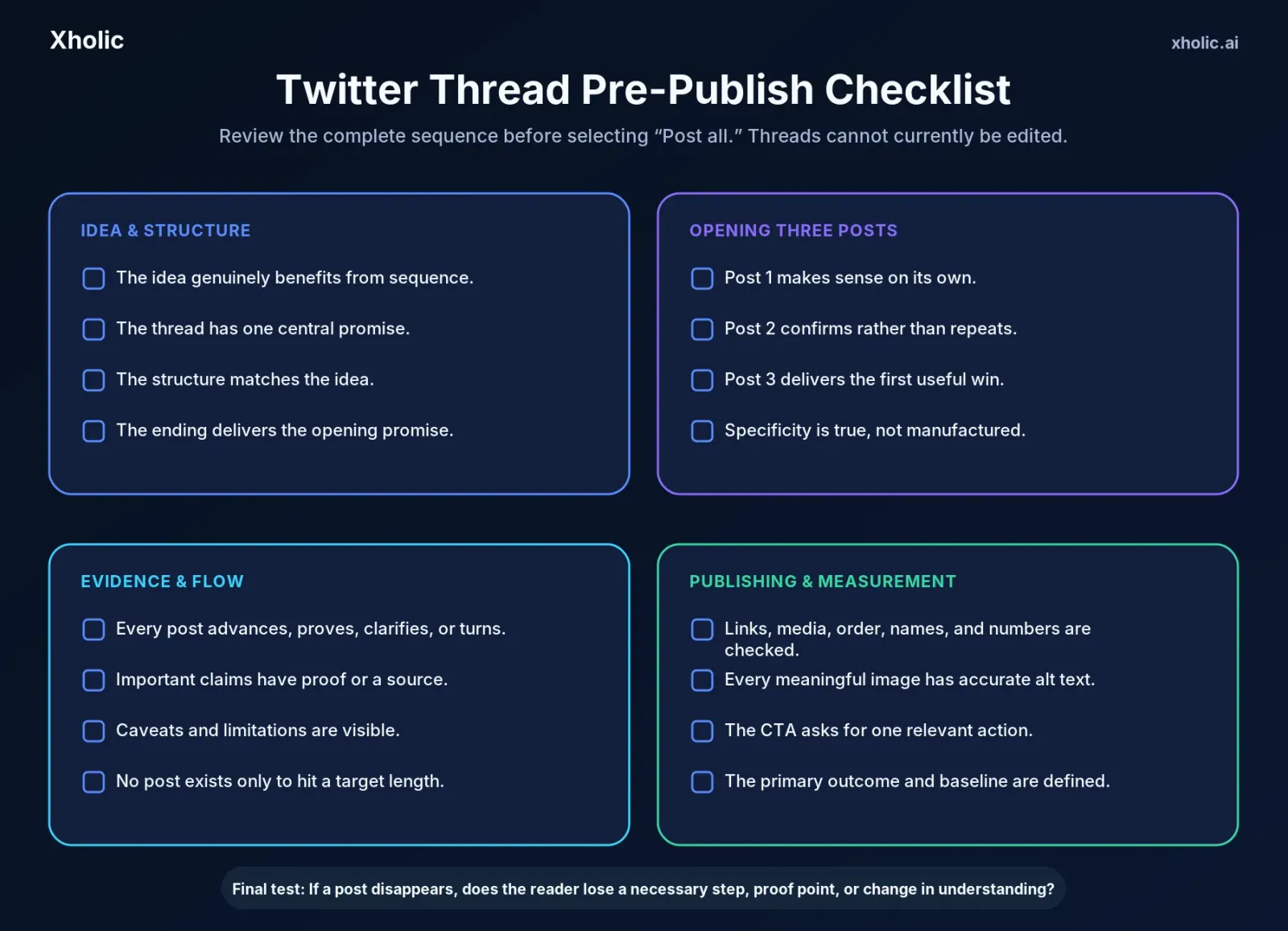
Twitter thread pre-publish checklist
Use this checklist immediately before selecting Post all.
Idea and structure
- The idea genuinely benefits from sequence.
- The final takeaway can be written in one sentence.
- The hook raises the exact question the payoff answers.
- Post two confirms the promise.
- Post three delivers the first useful point.
- Every middle post adds a step, example, fact, consequence, or implication.
- Removing any post would weaken the argument or flow.
Evidence and trust
- Every statistic has a source, sample, and relevant context.
- Observations are labelled as observations rather than universal facts.
- Screenshots and mockups are clearly labelled when necessary.
- Names, dates, quotations, and product details are correct.
Formatting and accessibility
- Numbering matches the final post count.
- Links open the intended destination.
- Images are attached to the correct posts.
- Every meaningful image has useful alt text.
- Important text in an image is also available in the post or description.
- The thread is readable on mobile without dense walls of text.
Ending and measurement
- The payoff appears before the CTA.
- The final post has one primary action.
- The CTA continues the value of the thread.
- The measurement goal is defined before publishing.
- You know which post-level counts you will record for comparison.
Final mechanical pass
- Read only posts 1–3 and confirm the opening works.
- Read the thread without post 1 and check whether the middle still makes sense when shared independently.
- Read the entire sequence aloud.
- Preview the order one final time because threads cannot currently be edited.
Frequently asked questions about Twitter threads
What is a Twitter thread?
A Twitter thread is a series of connected posts from one account that readers can expand and follow as one sequence. X uses threads for additional context, updates, stories, arguments, tutorials, and other ideas that need more than one connected post.
How do I make a thread on Twitter or X?
Open the post composer, write the first post, select the plus icon to add another post, continue building the sequence, review it, and select Post all. X also lets you save a thread draft and append posts to an existing thread later.
How many posts should a Twitter thread have?
There is no official ideal number. A focused lesson may need four to six posts, while a research or case-study thread may need eight to fifteen. Use the shortest complete sequence that delivers the argument and evidence without padding.
Is a two-post sequence a thread?
Yes. X defines a thread as connected posts from one person, and short two- or three-post threads can appear connected in the Home timeline. The more important question is whether the second post adds necessary context or whether the idea would be clearer as one post.
Can I edit a Twitter thread after posting it?
Not currently. X’s Edit Post documentation lists threads among the post types that cannot be edited. You can delete posts or add more posts to the thread, but you should proofread the original sequence carefully before publication.
Can I add another post to a thread later?
Yes. X allows the thread author to add more posts from the thread detail page. Use this for genuine updates, corrections with transparency, or new developments, not as a substitute for checking the original sequence.
Do Twitter threads get more reach than single posts?
Not automatically. X does not publicly document a universal thread bonus. A strong thread can create several connected opportunities for replies, reposts, profile clicks, follows, and dwell, but a weak thread simply adds friction. Choose the format based on the idea, not a presumed algorithm advantage.
Should I number my Twitter thread?
Number it when order matters, the thread is a list or process, or later posts may be confusing when surfaced alone. Skip numbering for stories and natural narrative flows when numbers would make the writing feel mechanical.
Should I use a thread or a long post?
Use a thread when sequence, progression, and separate evidence units improve the idea. Use a long post when the content is clearer as continuous prose. Premium subscribers can publish longer posts of up to 25,000 characters, so length alone is not enough reason to choose a thread.
Can every post in a thread have an image?
A standard post can include up to four media items, so multiple posts in a thread can contain images. Use them strategically. A visual should prove, demonstrate, compare, or simplify something, not merely decorate the sequence.
How do I measure thread completion?
X does not provide an exact reader-level completion rate for ordinary text threads. Use post-to-post view or impression ratios as exposure proxies, and remember that views are not unique and posts can be surfaced independently. Compare the ratios with your own similar threads rather than treating them as universal benchmarks.
What is the best way to open a Twitter thread?
Use a specific promise, result, failed assumption, research finding, mistake, question, or contrast that the thread can genuinely resolve. Then use post two to confirm the contract and post three to deliver the first useful point.
How should I end a Twitter thread?
Deliver the main lesson first, then give one relevant next step. A focused question, a single resource, an invitation to test the method, or a product workflow that directly extends the thread can work. Avoid stacking several unrelated requests.
Turn thread writing into a repeatable system
A good thread begins before the composer opens.
You need a way to collect ideas, understand what your audience and niche are reacting to, save strong examples, map the sequence, draft alternatives, and review the final version before it is scheduled.
Xholic AI brings that workflow together:
- Xholic Brain turns your saved posts, notes, niche, product context, watched creators, and feedback into personalised growth opportunities.
- Inspiration helps you study high-performing posts and thread structures without copying the wording.
- Collections keeps examples, research, and reusable patterns organised.
- Tweet Remixer and writing tools help you test angles and hook variants in your own context.
- Smart Scheduler lets you queue approved content and manage the publishing workflow after human review.
- Reply Chain Generator helps you preview a connected sequence as a clearly labelled mockup.
The tool should speed up research and drafting, not replace your evidence, judgment, or voice.
Try Xholic AI and build a more consistent X workflow
The central lesson
A Twitter thread is not valuable because it is longer than a post. It is valuable when sequence creates understanding.
Choose an idea that needs order. Write the payoff first. Make the first three posts earn trust. Give every post one job. Use proof instead of filler. End with one natural next step. Then measure the shape of the whole sequence, not only the size of the hook.
That is how a thread becomes more than content. It becomes a useful path from attention to understanding.
Sources and methodology
This guide was reviewed against the following official sources on July 29, 2026:
- X Help: How to create and view a thread
- X Help: How to post, standard character limits, and longer posts
- X Help: X Premium features, including posts up to 25,000 characters
- X Help: About Articles
- X Help: Edit Post limitations
- X Help: View count definitions and limitations
- X Business: Post Activity Dashboard metrics
- X Help: Image descriptions and accessibility
- X Help: How to write useful image descriptions
- xAI: Public X For You recommendation repository
The Thread-Worthiness Test, modular continuity principle, Promise–Progress–Proof–Payoff framework, opening-three-post sequence, CTA continuity principle, and Thread Retention Framework are original Xholic editorial frameworks created for this guide.