Subscriber acquisition channels
Subscriber acquisition through lead magnets, landing pages, social promotion, SEO, cross-posting, referrals, partnerships, and unconventional channels.
40%
Best tweets about Newsletter Growth
Discover the best tweets about newsletter growth, covering audience acquisition, referrals, content, conversion, retention, Substack, Beehiiv, and revenue.
Newsletter audience growth, subscriber acquisition, referrals, content, conversion, retention, platforms, monetization, and transparent results.
Original Xholic analysis
The dataset’s newsletter-growth discussion spans acquisition systems, owned distribution, monetization measurement, and engagement quality. The strongest supplied score outliers include both practical operating workflows and narrative or cautionary posts. Aggregate analytics show that media posts have a higher median all-time score than text posts (8.5 versus 4.24), while posts themselves frequently caution that conversion, trust, and retention require attention alongside list growth. [2064025198798729454, 2079217996216832010, 2068775677222912139]
70% of posts
All-time engagement
22% of posts
Published in 90 days
Conversation map
Subscriber acquisition through lead magnets, landing pages, social promotion, SEO, cross-posting, referrals, partnerships, and unconventional channels.
40%
Measurement and optimization focused on conversion, revenue per subscriber, cohort quality, ROAS, segmentation, and avoiding vanity metrics.
26%
Newsletter monetization through sponsorships, paid subscriptions, affiliate offers, products, services, communities, events, and local advertising.
26%
Email engagement, deliverability, frequency, relationship-driven writing, list hygiene, and retention practices.
20%
Using newsletters as owned distribution, a trust-building audience asset, and launch leverage for products or businesses.
20%
Platform selection and newsletter tooling, especially Beehiiv, Substack, AI workflows, automation, analytics, and publishing constraints.
20%
Signup flows, welcome pages, onboarding sequences, surveys, and early subscriber experiences that improve activation and understanding.
18%
Content strategy centered on niche ownership, original insight, editorial quality, consistency, repurposing, and testing ideas across formats.
16%
Tone and stance
Performance benchmark
Posts with media make up 40% of this collection. Their median all-time score is 8.50, compared with 4.24 for text-only posts.
Format mix
Consensus and debate
Shared view
Acquisition posts commonly recommend a specific free resource, a focused signup flow, distribution across several channels, and onboarding after signup rather than reliance on a single viral post.
Shared view
Several posts frame newsletters as owned distribution and a relationship-building channel that can support launches, product feedback, and positioning.
Shared view
Posts on monetization emphasize economics beyond headline list size, including sponsor booking workflows, channel-level cohort ROAS, and revenue per subscriber segment.
Shared view
Retention and deliverability advice emphasizes a sustainable cadence, relationship-oriented writing, engagement actions, list hygiene, and activation alongside subscriber growth.
Open debate
List-building and monetization playbooks contrast with posts warning that paid conversion, audience trust, and the zero-to-one phase should not be assumed or automated away.
Open debate
Some posts present newsletters as distribution and trust infrastructure, while others argue that business evaluation should center on conversions and sales rather than audience-facing metrics.
Open debate
Platform posts describe trade-offs: Substack is praised for writing focus but criticized for support, app pressure, and indexing concerns; cross-posting is presented as an experiment to test rather than a settled tactic.
What performs
The five supplied score outliers cover proprietary-data editorial strategy, sponsor operations, a lead-magnet funnel, a cautionary Substack story, and a post reporting content-to-subscriber results. Their all-time scores range from 43.57 to 277.5.
Tutorials have a supplied median all-time score of 13.38. The cited tutorial posts offer concrete workflows for repurposing content, sponsorship operations, and list-building; this median is below the supplied Story and Question format medians.
In the supplied aggregate analytics, posts with media have a median all-time score of 8.5, compared with 4.24 for text posts. The cited posts illustrate topics such as AI-assisted analysis, deliverability, and founder-content workflows, but the data does not assign media status to individual tweets.
Statistical standouts
Creator landscape
The five most represented creators account for 20% of the selected posts.
1. Alexa | Startup founder
@alexabelonix
2 posts
2. Cody Schneider
@codyschneider
2 posts
3. Tyler Denk 🐝
@denk_tweets
2 posts
4. Chase Dimond | Email Marketing Nerd 📧
@ecomchasedimond
2 posts
5. Jon C. Phillips
@joncphillips
2 posts
6. Kaleigh Moore
@kaleighf
2 posts
Tyler Denk’s two cited posts cover editorial differentiation through proprietary data and a self-serve sponsorship workflow. The supplied creator analytics list a 239.45 median all-time score across his two topic tweets.
Chase Dimond’s cited posts focus on email-program practices: treating newsletters as relationships, maintaining a sustainable frequency, and identifying plateauing flows.
Matt Paulson’s posts argue for cohort-aware paid-acquisition measurement and report that newsletter sponsorships generate his highest revenue per subscriber, at about $15 per user over six months.
Themes, sentiment, stance, and post format are classified per tweet. All counts, shares, medians, creator concentration, freshness, and performance comparisons are then calculated directly from the published snapshot.
Xholic's all-time score compares engagement while accounting for reach, post age, and creator consistency. It is used for relative comparisons within this collection.
This report analyzes the exact 50-post snapshot shown below. AI identifies editorial categories and drafts explanations; all statistics are calculated from the snapshot, and every narrative claim is checked against cited posts before publication.
Best Newsletter Growth tweets
Ranked 01–50
@denk_tweets ·
I think Ramp is the perfect example of how companies should run a newsletter: > built on proprietary data nobody else has: monthly saas vendor rankings and an AI index pulled from spend across 50k+ companies. makes it highly shareable (e.g. I regularly forward it to my CFO) > owns a topic: the newsletter covers finance, AI spend, where business is heading etc. it earns the right to talk to a large audience who might one day need corporate credit cards (rather than a small group of maniacs who enjoy reading about corporate credit cards every day) > real editorial: has a lead economist, named writers, a clear point of view. it reads like a publication & not just brand copy slop & most importantly, leading indicators is a newsletter that you’d subscribe to if Ramp sold nothing — it’s genuinely become one of the newsletters I read ritually no coincidence that they raised $750M not long after launching a newsletter on @beehiiv 😎
@denk_tweets ·
my newsletter has 133k subs, makes a half million $$ a year, and takes me 5 hours a week the #1 monetization question I get is "how do you actually find sponsors?" short answer: I don't chase them. I make it easy for them to book me here's my exact system: 1/ set up a sponsorship storefront mine is just a page on my newsletter website, linked in the nav advertisers can see my list size, open rate, and CTR, then book a date directly. no back and forth emails & no negotiating from scratch every time someone wants to sponsor @beehiiv makes this simple 2/ keep the products super simple I sell exactly two things: > a primary sponsorship at $6k (runs every Tuesday) > a monthly package of 4 slots at a discount that's it… advertisers shouldn't have to think money sits in escrow until the ad runs, and @beehiiv takes a $10 flat fee per placement (most booking tools take ~10%) 3/ never send an empty ad slot whenever I don't have a sponsor lined up, I run a house ad… literally an ad selling the ad slot itself it shows who my audience is, a few of my previous sponsors, and two CTAs: > download my media kit, or > book a slot instantly 4/ mine the click data from your house ad this is the step everyone skips I export everyone who clicked the media kit and everyone who clicked the booking link, then enrich that data with AI to figure out who these people actually are anyone who clicked either link just told me they're interested in sponsoring // the last time I ran a house ad, it turned into a $6k booking and ~50 warm leads to reach out to between the booking and the leads, I probably have a sponsor pipeline for the next few months. all from an ad slot that would've otherwise gone out empty follow me if you want more behind the scenes on how to scale a newsletter 📈
@gumroad ·
Social media followers are rented. Your email list is owned. Here's how to build one that prints money: Step 1: Create a "lead magnet," a small, free resource that solves one specific problem. A checklist, a cheat sheet, a mini template. Something people can use in under 10 minutes. Make it so good that people would have paid $10 for it. Step 2: Set up a simple landing page. Gumroad lets you offer products for $0+, which means someone "buys" your free resource and you capture their email. No extra tools needed. Step 3: Promote the lead magnet everywhere. Pin it to your profile. Link it in your bio. Mention it at the end of every piece of content you post. Make it easy for people to find. Step 4: Email your list once a week. Share something useful. A tip, a lesson, a behind-the-scenes look at your process. Build a relationship, not a sales pitch. Step 5: Every 3 to 4 emails, mention a paid product. Not as a hard sell, just as a natural extension. "If you liked this tip, I go way deeper in my full guide." The math: 500 email subscribers with a 2% conversion rate on a $39 product = $390 from a single email. Send one product email per month and that's $4,680/year from a small list. Grow the list to 2,000 and that number becomes $18,720. The email list is the most underrated asset a creator can build.
@JamesonCamp ·
A friend called me last week wanting to start a Substack. She has 11K Instagram followers. Mostly from being a socialite. Attractive, wealthy, runs in those circles. Has never driven a single dollar through a newsletter in her life. Her plan: 2,000 paying subscribers at $8/month. That's a 1 in 5 conversion rate from random Instagram followers who follow her for lifestyle content…to people pulling out their credit card every month to read her writing. I've spent years building newsletters and organic content that actually converts to paid. I've driven millions through it. It's one of the hardest things I've ever done. The idea that you just port over a casual IG following and 20% pay you monthly…I was almost offended. But it gets better. She starts mapping out month 12 of her content calendar. Month 12. She hasn't written a single issue yet and she's planning December before she's survived January. Then she asks me to set up Claude to auto-post, auto-analyze, basically run the entire newsletter so she can press a button twice a month and collect checks. This is a woman who lives in a $20K/month house. Takes month-long European vacations where they bring the staff. She does not need this money. And that's the actual problem. The grind from zero to one is the part that kills everyone. $500 months. $1,000 months. Refreshing Stripe at midnight hoping one more person converted. You survive that part because you have to. Or because you love it so much you can't stop. She has neither. If Claude could generate $20K/month from a Substack by pressing a button twice a month…why wouldn't you just spin up 100 of them? You can't skip zero to one. You either do it for the love of the game. Or you go buy something that already makes money.
@tibo_maker ·
someone asked me why I still write a newsletter at $900k+ MRR fair question the honest answer is: I don't have a clean ROI number for it I can't open a dashboard and say "the newsletter generated $X" but here's what I know: when I launch on Product Hunt, newsletter subscribers show up first. they upvote, they leave comments, they share it. that early momentum matters more than most people think when I'm stuck on a product decision, I ask my list. I get hundreds of real answers from real users within hours. no survey tool does that when I mention one of my products in passing, I see a small spike in signups the next day. not huge. but consistent and when things go wrong (and they do), I have a direct line to people who actually care about what I'm building could I spend that time on something with a clearer ROI? probably but the newsletter does something nothing else does → it builds a relationship with people before they need my product I give them personal stories, real numbers, honest failures and in return I get trust you can't measure trust in a dashboard. but you can feel it every time you ship something new and people actually show up that's why I still write it
@boringmarketer ·
Good marketers are more valuable than ever! Where are the founders quietly building a 50,000 subscriber newsletter before they launch or try to fundraise while everyone else is making the same launch video? if you've done that, you're in rarified air. Distribution is the moat. With engineering becoming more commoditized, have investors rethought how they value audience and distribution as a competitive advantage? is the Stanford CS degree or staff engineer from big tech as valuable as it was to VCs now vs a few years ago? Personally, I'd be looking for people who can drive GROWTH. that would be my number one filter right now.
@itsolelehmann ·
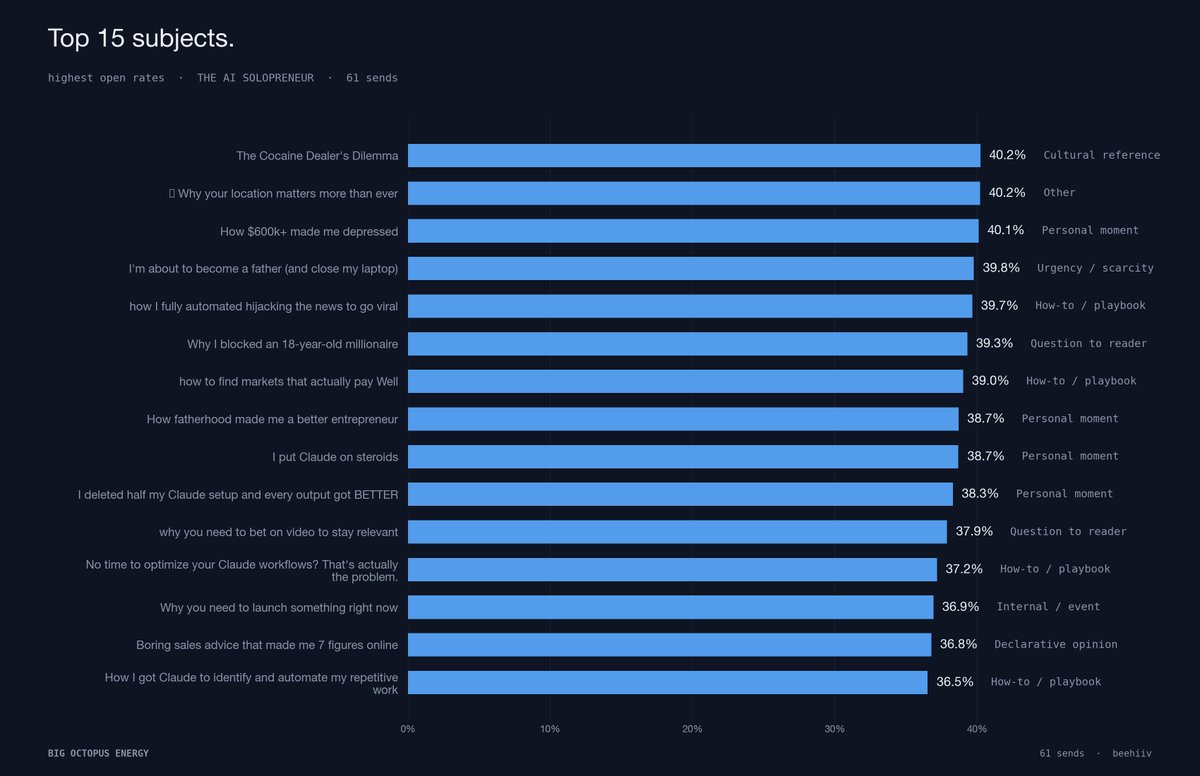
If you run a newsletter, you need this AI workflow: I connected my newsletter to Claude (via Beehiiv MCP) and asked it to analyze every subject line against open rate from the last year. It categorized 60+ sends, ran the math, and showed me exactly what's working vs what's not. I got some very interesting and actionable findings (in the charts below). If you want to set this up yourself: 1. Click "Customize" in Claude 2. "Connectors" 3. "Add custom connector" 4. Paste https://t.co/nPra8f5GKY 5. Connect your Beehiiv account Next step: turning all of this data into a Claude skill that drafts subject lines for me. So every future newsletter gets routed through what actually works for my audience. Cool to see your own send data come back visualized. Only takes 60 seconds. Great work @denk_tweets
@ecomchasedimond ·
Most operators run their newsletter the same way they run their promotional email program, then wonder why their open rates keep dropping. Here are 5 newsletter rules you need to know: → Write it as a relationship instead of a broadcast → Pick a frequency you can hold for the next six months → Open with the most interesting sentence in the whole piece → Develop one idea per send instead of stacking three → Treat the newsletter as a long-term audience asset Bookmark this.
@askOkara ·
email is the only audience you actually own x can shadowban you and google can change its algorithm, but no one can take your list away how to grow an email list from 0: 1/ create a free resource your icp wants (a checklist, template, or guide) 2/ setup a nice landing page with an opt in that gives users a lead magnet once they subscribe 3/ research what kinds of posts work well for freebies like this. i've seen "comment xyz and i'll send you the link" posts work well 4/ post about it on x and linkedin 5/ find reddit threads where people would want it and drop the link 6/ add a cta banner at the end of every article 7/ add everyone who signs up for your product to your email list. create an onboarding sequence for them
@MediaKing ·
Most newsletter businesses grow to $500K-$1M on organic and plateau. The ones that break past it aren't writing better content. They built paid acquisition systems with real cohort data. Stuck operators optimize for cost per subscriber. Low CPL looks great until you check the backend: cheap subscribers churn and never buy. Breakout operators track month 2, month 3, and 12-month ROAS by channel. That data tells you which channels to scale and which ones to cut. Most newsletter businesses hit a ceiling because they never build this discipline. The cohort data is usually pointing right at the answer.
@zuess05 ·
I just sent my first ever newsletter 💌 I emailed the 823 people using Cubix and Capture. I was terrified to hit send and honestly thought they would all mass-unsubscribe. The reality: 💌 823 recipients 👀 27.3% open rate 📉 1.1% unsubscribed People actually replied. 😄 Distribution is scary, but I'm documenting the whole journey of scaling these apps as a solo dev. 🚢
@zaimiri ·
Someone on Reddit built a local newsletter to its first $100 in a month. Tiny number. Useful money machine. - 120 subscribers. - $25 weekly banner ads. - $20/week local business spotlight. - 43% open rate. The product is just curated local news. The workflow used to be 20 tabs, copy-pasted links, downloaded images and formatting hell. So he built a small tool that pulls the local sources, lets him pick the stories, then formats the issue. Takes him 4 minutes per newsletter now. Then, he sells ads to local businesses. Local shops seem more interested in the “small business spotlight” than a normal banner ad. Makes sense. A spotlight feels like trust & a banner feels like rented attention. This is the kind of first $100 online story people skip because it sounds too small. But small is where the mechanism is easiest to see.
@alexabelonix ·
Lenny Rachitsky passed 1M newsletter subscribers and built around it a paid community, podcast, jobs layer, sponsors and a 20K+ Slack community. The useful lesson is patience. One viral post gives attention. A trusted archive gives market position. Most founders want the first. But the second compounds harder. Because when your thinking becomes the default resource in a category, people stop asking: “Who is this person?” They start asking: “What do they think about this?” That is the moment personal brand becomes infrastructure.
@danwestworld ·
I just killed my Substack. Why? Applause doesn't pay rent. People loved the essays. Dozens of likes. Tons of shares. But data doesn't lie: Daily emails generate 5x more leads than Substack ever did. 5x. That's the difference between $3K months and $15K months. Revenue grows when you stop chasing applause and start tracking what converts. So I'm back to what works: Quick. Direct. Daily. - less time - more results - no pressure to perform Just plain text emails that actually convert. Written for people who want results, not validation. Already generating leads again (it's been 5 hours). Feels good to be back.
@alexabelonix ·
In January 2024, Entrepreneur wrote that Sahil Bloom’s newsletter was driving $70K+ per month and helped build a business that did $10M in revenue in 2023. The lesson is not “start a newsletter.” The lesson is sharper: your content should become a lab for your future products. You share what you are learning. You notice what people save, reply to, ask about. You find recurring pain. You build systems around that pain. Then you sell the system. That is founder content. Not “here are 5 habits.” More like: “I hit this problem, solved it badly, rebuilt the system, here is what changed.”
@joncphillips ·
Writing consistently is the highest ROI thing I’ve done for my businesses. And I actually love doing it, which is a rare combination. Every article lives on the internet forever. Something I wrote two years ago still brings in newsletter subscribers every single week. No ad I’ve ever run does that. If you’re not writing, start. It keeps working long after you’ve moved on to the next thing.
@codyschneider ·
organic blog content make multiple ways for people to get in relationship EG a CTA for signup, VSL, Ebook download give people different levels of commitment to get in relationship with you you can track all this data using posthog for sending use sendgrid and then build reporting and do your analytics across this whole funnel using graphed .com
@nathanbarry ·
Did you know Kit isn't my only business? I started a local newsletter and found the perfect person run it. Marissa Lovell grew From Boise to 24,000 subscribers and crossed six figures. We talk about it the latest episode of my podcast. Search "Nathan Barry Show" to watch.
@MarketingMax ·
Everyone always asks me: What do I do with my unsold newsletter ad inventory? My answer: Find products you know people want and sell them as an affiliate Whop has 30,000 affilaites promoting products & services on their platforms so there's ABSOLUJTELY something on there you can put in your newsletter & make $ from
@TJLarkin23 ·
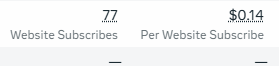
started helping multiple local media brands this week with managing their meta ads to get newsletter subscribers first one has been live for 24 hours getting subs for $0.14 each best part: this brand has been around for 16 years and already has 45,000 active subscribers on their list, which we excluded from our targeting so all the low hanging fruit had already been picked and yet still numbers are incredible
@miqchris ·
💡 Stop celebrating list growth without checking what you're adding. 50,000 new subscribers in March means nothing if: 🔹The activation rate is 8% 🔹Your complaint rate ticked up 🔹Gmail started deferring your sends to the promo folder List growth isn't a win. “Engaged” list growth is the only win. Revenue follows!
@andruyeung ·
Extreme love/hate relationship with Substack. - Great UI - Newsletters have an elegant aesthetic - You can just focus on the writing and the product does everything else - High quality content for readers (my fav newsletters are there) But: - Not creator/writer friendly - Literal non existent support - Open rates are getting impacted - Constantly trying to push me to the app
@nic_detommaso ·
Last night I spent 3 hours rebuilding my newsletter onboarding from scratch. New subscribers now get a full welcome sequence walking them through: → My most popular guides by topic → The real VC numbers most people only learn after they're already in → How to get the most out of 100+ issues in the archive I'm stoked!! @beehiiv
@stevenvan_ ·
The best newsletter growth hack isn't a viral post. It's your signup flow. The second someone subscribes, you have their full attention. @beehiiv lets you turn that moment into: - Cross-promo (show recommendations, gain subscribers) - Audience intel (survey them while they're warm) - A strong first impression (custom welcome page)
@justingordon212 ·
NEW Weekly(ish) newsletter updates: The LA Grind (Launched in May 2025) - 9,663 subscribers (+530 last 4 weeks) - 51% open rate - 5% click rate Welcome survey insights (3,023 people) - 56.1% founders, 7.3% investors - Events they want most: happy hours (2,138 people), coffee meetups (2,104), dinners (1,992), fireside chats or panels (1,906) The SF Grind (Launched in December 2025) - 2,474 subscribers (+617 last 4 weeks) - 53% open rate - 6% click rate Welcome survey insights (408 people) - 45.4% founders, 10.7% investors - 13.7% actively making angel investments - 34.7% have household income of $200K+ - 14.7% are considering buying a home in the next 12 months - Events they want most: Coffee Meetups (285 people), happy hours (273), breakfast or lunches (249), dinners (248) Going to expand the content in both of these in the next few weeks! I'm accepting new sponsors for both, with 2 more Community Partner spots in The LA Grind available and opening up The SF Grind Community Partner spots soon. Message me to get more details on sponsorship 😊
@vinibarbosabr ·
「thecoding」 now has 69 subscribers and 2.53K views Modest numbers, but still a nice milestone for the culture -- lol I've started writing Substack articles and posting on Notes since October, as I felt the need to diversify from X, avoiding a single point of failure for my content and audience It has been an interesting experiment bootstrapping my presence there and learning to work on Substack, with some valuable learnings: + conversion from other platforms is a myth |-+ I have 11.2K followers on X, 2.1K verified |-+ 6.8M impressions and a 3.9% engagement rate (which is fairly good) |-+ I have promoted my Substack consistently on X, but most of my subscribers came from other sources (Substack Notes, groups, and direct links) + growing an account from zero is hard |-+ the platform's algo doesn't help, favoring bigger accounts |-+ google is not indexing my substack well enough for some reason, and i've spent hours trying to solve it, but it seems deliberate at this point, with blockers both from Substack and Google (maybe bc of the topics i write about?) + networking and building genuine relationships is key |-+ for organic engagement and collabs |-+ this is probably the most effective way to bootstrap a brand anywhere + social media accounts aren't ours; have a backup |-+ these accounts belong to the platforms, not us |-+ it's important to not build reliance on a single point of failure and always backup our assets (content, audience, etc) + not starting earlier causes regret I'm also considering finding another platform to start actively posting on. Maybe Mastodon, but I'm not really sure. I've also started a Telegram channel to reproduce my content from X and Substack -- I'll share the link to it below in the comments If you haven't yet, subscribe to thecoding.substack
@TimStodz ·
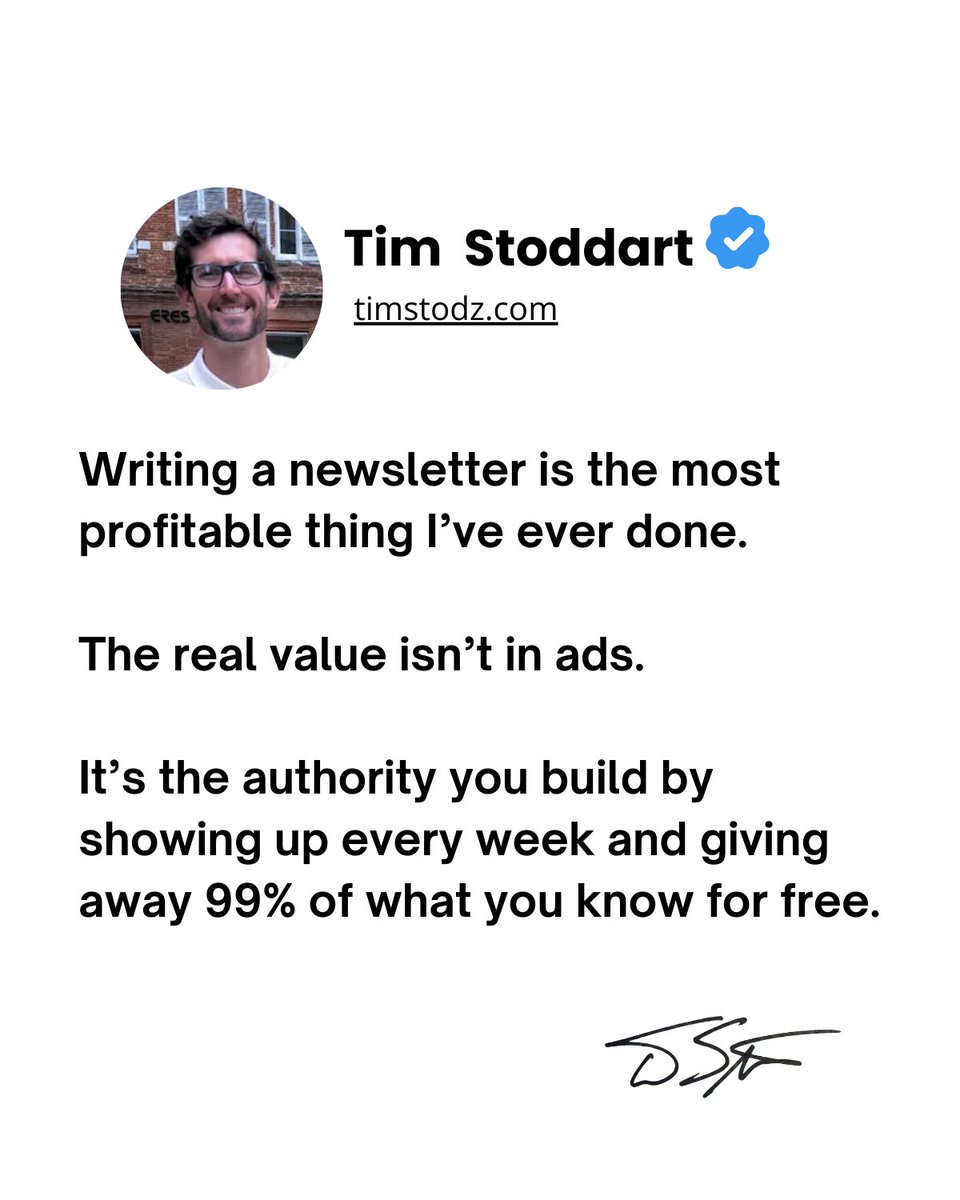
Beware Of The Creator Trap One thing I’ve noticed about the Substack community is how much people talk about how to get more subscribers If you’re an entrepreneur like I am (and you may not be) then don’t lose focus of what really matters, which is conversions and sales If you’re looking at writing as a way to grow your business, then remember that likes, restacks, and subscribers are actually vanity metrics. What matters most is how many dollars you’re making.
@RyanJAyala ·
"Use X as the testing ground" Test ideas fast, then scale the winners. How @thedankoe uses the content ladder: • Tweet → watch what hits • Track which posts outperform • Rewrite, spin off variations • Pick a topic that pops (or one you’re itching to go deep on) Scale the winner: • Tweet → Thread • Thread → Newsletter • Newsletter → YouTube script Record the easy way: • Sit at your desk: camera in front, mic overhead, newsletter on laptop • No teleprompter read a line, riff, repeat • Signal your editor: looking at camera = leave it; looking down reading = add text/B‑roll/images • Not banking on flashy edits, bank on the quality of the ideas Post on X to find signal. Promote what proves itself. My Full Ep. with @thedankoe below
@TJLarkin23 ·
any local newsletter operators cross posting their content to substack? idea being to capture their SEO/audience/algo aspect, and it's free to do so have seen this discussed more and more lately, but don't know if anyone in our space is doing it if i was only focused on one brand, i would absolutely try this for a few months and see if any value comes out of it
@sharyph_ ·
Building is no longer a moat. With AI, anyone can build a product, write a course, design a template, code an app. @AlexFinn built a $300K/year app solo this week...zero code written. @gregisenberg is telling his audience that a niche community of 5,000 engaged people is an underpriced asset...because you can build them custom software in a weekend. Both of these takes are correct. But here's what neither of them are saying directly: the asset isn't the product. The asset is the distribution. If you can build a product in a weekend but can't get it in front of the right people, it's worth nothing. Conversely, if you have 18,000 newsletter subscribers and 75,000 engaged social followers who trust you...you can launch a new product, a new offer, or a new partnership and see revenue within 48 hours. I know this because I've done it. Multiple times. Most creators have this backwards. They spend 80% of their energy on the product and 20% on distribution. Then wonder why the launch falls flat. The ones making real money have inverted this ratio. They've built distribution first...or simultaneously...and the products are almost secondary. Distribution compounds. A newsletter list doesn't decay the same way an algorithm does. A social following built on genuine trust doesn't disappear when a platform changes its reach formula. These are assets in the true sense...they accrue value over time and generate returns without continuous reinvestment at the same level. Here's the uncomfortable part of this: Building distribution is not sexy. It's writing consistently for 18 months before the growth kicks in. It's sending newsletters when open rates are 22% and you're not sure anyone cares. It's growing from 3,000 to 7,000 followers over two years, then watching it go from 7,000 to 75,000 in 5 months because the foundation was already solid. Most people quit in the boring middle. They see the AI-built apps and the "niche audience as asset" takes, and they want to skip to that part. But you can't skip the distribution-building phase. You can accelerate it with AI tools and sharper systems...but you can't skip it. Paid newsletter subscriptions just jumped 138% year over year. That number tells you something important: People are willing to pay for trusted, curated insight from people they already follow. The distribution was the asset. The paid product was just the next logical step for an audience that was already there. If you're a creator who has built any meaningful audience...5,000 newsletter subscribers, 10,000 social followers, a Discord with real engagement...you are sitting on a more valuable asset than most people realize. The question is whether you're treating it like a content posting queue or a compounding financial asset. Those are two completely different businesses.
@AlexEngineerAI ·
ChatGPT + Beehiiv paid newsletter: what Month 1, 3, and 6 actually look like The "write a newsletter with AI and charge $9/month" pitch makes it sound easy. Here is what the math actually looks like. Setup costs Beehiiv's Grow plan is $42/month. That is the minimum tier to charge paid subscriptions and access their ad network. You are paying $42 in overhead before a single subscriber pays you. Month 1 50 to 100 free subscribers if you post 2x per week and cross-promote consistently on X or Reddit. Realistically 0 to 3 paid subscribers at $9/month. Revenue: $0 to $27 gross. Subtract $42 Beehiiv + Stripe processing fees (2.9% + $0.30 per transaction) and you are in the red. ChatGPT cuts your draft time from 3-4 hours per issue down to 45-60 minutes. That is real. But the bottleneck is not writing speed. It is audience trust, which does not compress. Month 3 200 to 400 free subscribers. 10 to 25 paid at $9/month. Gross: $90 to $225/month. Net after $42 Beehiiv and Stripe: roughly $40 to $175/month. You are now cash-flow positive, barely. Month 6 500 to 1200 free subscribers. 30 to 80 paid. Gross: $270 to $720/month. Net: roughly $220 to $660/month after platform costs. The conversion reality: roughly 3 to 8 percent of free subscribers ever upgrade. Most stay on the free tier indefinitely. That ratio does not improve much with better writing. It improves with niche specificity and consistent delivery. What actually changes with ChatGPT in this workflow You can sustain 2x weekly output without burning out. That consistency is what builds the free subscriber base in months 2 and 3. It does not grow your list. It does not convert free readers. Those are audience problems, not writing problems. The model works. Month 6 math is real. Month 1 is not a shortcut.
@_May_Ham ·
Many people see “X newsletter sold for $50M” or “I’m doing $100K/mo” and start a newsletter with wrong expectations (eventually, they quit). Before jumping in, ask yourself 5 questions: 1. Are you B2B or B2C? If you’re B2C and you don’t already have a large organic audience (around 25,000+ on LinkedIn, Instagram, TikTok, etc.), you need to ask: “Am I patient enough to do this without it being a real business for a long time? You can grow organically as a consumer creator, but it’s slow. Trying to grow a consumer audience and build a newsletter business at the same time is very hard, especially if you want to move fast. So if you’re impatient and don’t have the money for paid ads, a consumer newsletter will feel like pushing a boulder uphill. But if you are patient/can spend on paid ads, great. Go ahead. If you’re B2B, you can build something valuable with a much smaller, more focused audience. 2. How are you going to monetize? For B2B newsletters, the most common paths are: • High-ticket services or consulting • High-ticket digital products • Sponsorships (You can add community or events, but these three are the most common) The advantage of B2B is that you don’t need scale. You can monetize services or high-ticket products with ~1,000 subscribers if the audience is right. Sponsorships also work well with smaller, very specific audiences. For B2C newsletters, common monetization paths are: • Low-ticket products • Coaching • Paid growth → scale → sponsorships later Sponsorships in B2C usually require scale (10000+ subscribers) to work well. 3. How will you grow? For B2B, organic distribution usually works best. For B2C, if you’ve already built an audience, fine. But if you haven’t, don’t try to: • Build a consumer audience • Launch a consumer newsletter • Monetize it fast ….all at the same time. That’s multiple full-time jobs and a ton of manual work. 4. How often do you want to write? Daily newsletters are effectively a news workflow. It’s extremely hard for beginners because every hour goes into producing something that may not reach many people yet. Weekly (or even bi-weekly) is far better. You can improve the product and still have time for growth and sales, instead of just surviving the next send. 5. What category can you actually own? Think about the specific category where you can be the most useful. Justin Welsh dominates solopreneurship. I focus on deep, tactical breakdowns for operators already running (or wanting to run) newsletters like a business If you can’t articulate the category you want to own, you’re going to struggle long term. Most people quit because they started with assumptions that never matched reality. If you’re clear on these five questions, you’ll know whether a newsletter makes sense for you, and what game you’re actually playing.
@sharyph_ ·
Most newsletter creators celebrate hitting 1,000 subscribers. They track their open rates religiously. They panic when engagement drops 2%. But here's what they're missing: None of those metrics pay your bills. I've watched talented creators build audiences of 5,000 subscribers and make $0. Meanwhile, others have 500 subscribers and generate $4,000+ monthly. The difference? They audit their newsletter like a business, not a creative project. They know exactly which content converts free readers to paid. They know which subscribers will never buy. They know which features drive 50% of their growth. Here's the brutal truth about newsletter growth: You think your problem is content quality. It's not. You think you need more subscribers. You don't. You think you need to post more consistently. That's not it either. Your real problem? You're optimizing for the wrong metrics. Roughly 25% of your subscribers decay annually. They stop opening, stop engaging, stop caring. But they're still on your list, actively hurting your deliverability. When email providers see low engagement, they assume you're spam. Your emails land in promotions tabs. And you have no idea it's happening because you're too busy celebrating your "growing" subscriber count. The creators earning $100,000+ annually understand something most don't: Conversion pays bills. Subscriber counts don't. They treat their newsletter like a revenue system. They audit quarterly. They optimize based on data that predicts revenue, not vanity metrics. Open rates don't fund your business. Click-through rates don't either. Free-to-paid conversion does. Paid subscriber retention does. Question: Are you building a content creation job, or are you building a business? —— 📌 I write about building AI-powered creator businesses on The Digital Creator: https://t.co/XcgD5mkllZ Every week, I share frameworks, systems, and AI strategies that help creators build lean, profitable one-person businesses. 18,000+ entrepreneurs and creators have joined to learn how to leverage AI and scale smarter…
@glenngabe ·
"Feast has more than 100K subscribers and open rates of almost 70%" -> The Guardian begins cross-publishing its Feast food newsletter, which has 100K+ subscribers, to Substack, as part of its Project Berger platform strategy "A potential second stage to the experiment would be to try doing unique content for Substack. If cross-publishing works, more of The Guardian’s existing newsletters could join the platform to find new audiences." https://t.co/Fxldkbm8vW
Best Tweets by Topic