Audience-first content strategy
Defining a specific audience, their pains and motivations, content pillars, and the business goal each post is meant to serve.
44%
Best tweets about Content Creation
A curated collection of the sharpest, most-shared X posts about content creation—saved so you do not have to dig through the timeline yourself. Updated weekly.
The unglamorous mechanics of consistently making things people want to see.
Original Xholic analysis
The conversation frames reliable creation as an operating discipline: define an audience and a post’s purpose, package a clear promise, publish and learn, then turn useful ideas into repeatable systems. Posts also present AI as support for research and repurposing, while emphasizing lived experience, judgment, and a recognizable voice as sources of distinction.
70% of posts
All-time engagement
66% of posts
Published in 90 days
Conversation map
Defining a specific audience, their pains and motivations, content pillars, and the business goal each post is meant to serve.
44%
Standing out through firsthand experience, distinctive perspective, personality, specificity, and content rooted in real customer or community proximity.
44%
Learning from audience feedback and performance data, experimenting with formats and cadence, evaluating content by its purpose, and improving winners.
32%
Shipping regularly, overcoming overthinking and early discouragement, maintaining sustainable momentum, and improving through repeated practice.
28%
Building idea capture, research, drafting, publishing, documentation, templates, calendars, and operating systems that make output repeatable.
24%
Using topics, titles, thumbnails, opening seconds, visuals, narrative, and repeatable post structures to earn attention and sustain it.
20%
Using AI agents and workflows to automate research, ideation, updating, clipping, cross-platform adaptation, and operational content work while retaining human judgment.
16%
Developing recurring formats, turning successful ideas into multiple assets, and using a structured content library rather than reinventing every post.
10%
Tone and stance
Performance benchmark
Posts with media make up 44% of this collection. Their median all-time score is 18.1, compared with 14.6 for text-only posts.
Format mix
Consensus and debate
Shared view
Posts argue for defining an audience and assigning posts a job—such as growth, authority, or conversion—rather than expecting every post to do everything.
Shared view
Contributors favor firsthand customer proximity, real stories, and a distinct perspective over generic information or polished-but-distant takes.
Shared view
Idea capture, templates, content pipelines, calendars, and documented standards are presented as ways to reduce daily creative friction and make output repeatable.
Shared view
Posts emphasize topic, title, thumbnail, visuals, and opening seconds as attention mechanics, while also arguing that the content should match the promise and stay on topic.
Open debate
One view prioritizes regular publishing and iterative practice, while another warns that a schedule that lowers quality—or repeats an ineffective concept—can hurt results.
Open debate
AI is presented as infrastructure for research, updates, and repurposing, while other posts argue that automation and surface-level copy increase the importance of original thinking and personality.
Open debate
One post distinguishes an audience-first approach for creators pursuing growth or monetization from an art-first practice that may not follow growth strategy.
What performs
Posts with media have a median all-time score of 18.1, compared with 14.6 for text posts. Media appears in 22 of 50 tweets (44%).
Packaging, hooks, and retention has the highest theme median all-time score at 22.05, followed by consistency and creator discipline at 19.02.
The five highest-scoring outliers include a post on rewarding original work, a video-packaging playbook, AI-native content operations, a creator knowledge system, and a LinkedIn content strategy.
List posts have a median all-time score of 20.96, above announcements at 16.092, case studies at 10.09, and tutorials at 10.01.
Statistical standouts
Creator landscape
The five most represented creators account for 20% of the selected posts.
1. Aaliya
@aaliya_va
2 posts
2. BAWSA
@BawsaXBT
2 posts
3. Roberto Blake 🇺🇸🇵🇦 Creative Entrepreneur
@robertoblake
2 posts
4. Sharyph
@sharyph_
2 posts
5. zaimiri
@zaimiri
2 posts
6. FinegirlDami🧚🏾💜
@_FinegirlDami
1 post
Among 45 creators, the top five voices account for 20% of placement. Aaliya, BAWSA, Roberto Blake, Sharyph, and zaimiri each appear twice.
Posts by recurring voices discuss reusable writing shapes, fast publishing momentum, audience-first monetization, repurposing systems, and automation that retains human creative judgment.
Since the previous snapshot
Themes, sentiment, stance, and post format are classified per tweet. All counts, shares, medians, creator concentration, freshness, and performance comparisons are then calculated directly from the published snapshot.
Xholic's all-time score compares engagement while accounting for reach, post age, and creator consistency. It is used for relative comparisons within this collection.
This report analyzes the exact 50-post snapshot shown below. AI identifies editorial categories and drafts explanations; all statistics are calculated from the snapshot, and every narrative claim is checked against cited posts before publication.
Best Content Creation tweets
Ranked 01–50

@nikitabier ·
For this creator payout cycle, we’re experimenting with new tools to identify original authors of content and allocating a portion of revenue to them. Over the last few months, we've seen incredible work from original creators on X. Nick Shirley uncovered billions of dollars of fraud in hospice care. Charles Curran parodied global events with studio-quality videos. Will Manidis earned acclaim for his insightful articles on technology and AI. Reposts & commentary will always be a core pillar of X, but our Revenue Sharing program should incentivize original, high-quality content that brings new value to the Timeline. This means rewarding the effort it takes to produce something, not just the poster who helped it travel furthest. This is how we build a richer Timeline and how X continues to be the most valuable platform in the world. The Revenue Sharing program will continue to evolve to encourage creators to post their best content to X.

@aakashgupta ·
MrBeast keeps going on podcasts and keeps giving away the entire YouTube playbook. Here’s what he’s said across dozens of appearances. On the algorithm: it doesn’t exist. Replace “algorithm” with “audience” every time. The algorithm didn’t like your video. No. The audience didn’t. YouTube is a mirror. If people click and watch, it gets promoted. The growth hack industry sells you a god that isn’t there. On what actually matters: studying humans. The checklist before you hit record. What’s the thumbnail. What’s the title. What’s the first 5 seconds. What’s the first 30. If you can’t answer all four, don’t film. On titles: under 50 characters. Above that, devices cut them with dot-dot-dot and viewers don’t know what they clicked. Short, simple, so interesting it’ll haunt them if they don’t click. On thumbnails: simple enough a scrolling viewer instantly understands and feels emotion. His test: “I rode a skateboard with 1,000 other people, it’s about to go off a big ramp.” Hours later, daydreaming, you still wonder what happened to those 1,000 people. On autoplay: videos autoplay now. Many people never see the thumbnail. You have to visually convince them in the first 5 seconds. On extremity: “Fiji water sucks” does fine. “Fiji water is the worst water I’ve ever drunk in my life” does way better. The more extreme the promise, the more extreme the delivery has to be. On matching expectations: title and thumbnail set the promise. The first 10 seconds honor it or break it. Click “Tether is a scam” and the creator starts on anything else, you’re out. Start with “Tether is a scam and I’m gonna teach you why.” Match, then exceed. The thing people undervalue most is literally the first 10 seconds. On retention: remove every dull moment. Find 10 critical people, make them watch, let them roast it. Ten seconds of talking head without a cut loses people. B-cam three seconds in, different angle, now it’s interesting. On drop-off: creators drag it out. “I’m going to eat $100 ice cream, but first…” and then it’s them birthday shopping for their mom. Give them why they clicked. Tell them why to watch. Stay on topic. Upper echelon of YouTube. On the real metric: it’s the next video. If they loved what they just watched, they watch your next one. You don’t want “that was good, but enough for the day.” You want “holy crap, what’s that?” and they watch 10 in a row. On quality vs quantity: easier to get 5M views on one video than 50K on 100. Small creators post stuff that isn’t bad but isn’t great, nothing pops off, no audience forms. Upload a third or a fifth as often and make each one so good the algorithm has to promote it. On the consistency trap: a schedule you can’t hit at quality is dangerous. “Monday I said I’d upload” floors your quality at exactly the level viewers notice. They watch less. Longevity suffers. On the first 100: they’re going to suck. You think they’re good. They’re not. When he was 14 he thought his videos were the best in the world. They were terrible. Under 1,000 subscribers, your videos probably aren’t good yet. On the improvement loop: ship 100, improve one thing each time. Second, better script. Third, new editing trick. Fourth, vocal inflections. Fifth, thumbnail. Sixth, title. No such thing as a perfect video. On analysis paralysis: planning your first video for three months is the worst move. Your first 10 get zero views. Confirmed. Stop thinking, start shipping. On your 101st we’ll talk. On the ceiling: “I could start a new channel tomorrow without my face, my voice, or promoting it, and hit 20M subscribers in six months. If you knew what I knew, you could get 10M from wherever you are.” Every creator watching a 30-second clip thinks they got the tip. They got one tile from a mosaic he’s built in public for years.
 Watch video

@thinking_slow ·
if i was starting my FIRST DAY as a new Head of Content, here's what i would do: - build a new blog using a static site generator, host with GitHub, deploy with Netlify or Cloudflare Pages. for an existing blog like WordPress, set up an MCP connector. the goal is a fully AI-native blog, analysis, content creation, updating, all from the terminal, all in my control - get access to Gong/Intercom/Slack and extract common entities and n-grams. find the language customers and prospects really use, use this as seed keywords for topic research - build key "source of truth" files in markdown i can reference throughout my workflows: a master list of product features and use cases, canonical writing voice with specific reference articles, key strategic priorities to shape everything we do - crawl our sitemap and generate vector embeddings for every article. use this to analyse topical authority (and topic "drift") and automate internal linking - schedule a recurring, automated content audit: pull rankings and backlink data via the Ahrefs MCP, analyse AI search visibility with Brand Radar, flag technical issues with Site Audit, look for traffic decay via GSC and make a priority list of content updates - set up a daily cron job to refresh our highest priority articles: extract the article content, run through AI Content Helper to fill topic gaps, update old claims and statistics, save as a draft for my review - run a content gap analysis using the Ahrefs MCP to find key topics our competitors have covered that we haven't. use Firehose to get a daily update of new articles and industry news emailed to me - build my Content OS: a centralised dashboard that pulls all of these reports and workflows into one place. this is exactly what i've done at Ahrefs using Agent A - get fired for spending $80M in AI credits in my first day (maybe?) --- i sound like an obnoxious AI hype bro, but all these workflows are things my team have actually built. many of them will become the norm sooner rather than later AI is truly putting the "manager" into "Content Marketing Manager". we now operate at a higher-level of abstraction, building systems to support our work instead of doing everything ourselves we don't have to consign ourselves to Google Docs and rely on developers and designers: we can build AI-native blogs as malleable as plasticine and shape every facet of them to our exact specification. if you can imagine it, you can build it! and as crazy as this sounds, this isn't so much the "first 30-days" of content marketing as the first 30-MINUTES, because so much of this infrastructure can be built agentically. you just need to have the vision, know what to ask for, and use your taste and experience to nudge as these systems get built for you if you don't know where to start: pick one of these ideas, login to Claude Code or Codex or Agent A, paste the bullet and ask it to build it (and some of these are already available as free apps in Agent A!)

@KanikaBK ·
📂 Obsidian Ecosystem for Content Creators ┃ ┣ 📂 Vault Foundation ┃ ┣ 📂 Content Calendar ┃ ┣ 📂 Ideas Inbox ┃ ┣ 📂 Content Pillars ┃ ┣ 📂 Templates Folder ┃ ┗ 📂 Archive ┃ ┣ 📂 Content Creation Pipeline ┃ ┣ 📂 Braindump & Ideation ┃ ┣ 📂 Research & Notes ┃ ┣ 📂 Outlines ┃ ┣ 📂 Drafts ┃ ┣ 📂 Editing & Refinement ┃ ┗ 📂 Final Published ┃ ┣ 📂 Content Types ┃ ┣ 📂 Blog Posts ┃ ┣ 📂 YouTube Scripts ┃ ┣ 📂 Threads & Twitter Posts ┃ ┣ 📂 Newsletters ┃ ┣ 📂 Podcasts Episodes ┃ ┣ 📂 Short-form Content ┃ ┗ 📂 Courses & Guides ┃ ┣ 📂 Research & Inspiration ┃ ┣ 📂 Topic Research ┃ ┣ 📂 Competitor Analysis ┃ ┣ 📂 Trend Tracking ┃ ┣ 📂 Evergreen Ideas ┃ ┣ 📂 Source Library ┃ ┗ 📂 Quote Vault ┃ ┣ 📂 Knowledge Base ┃ ┣ 📂 Core Topics (MOCs) ┃ ┣ 📂 Evergreen Notes ┃ ┣ 📂 Frameworks & Models ┃ ┣ 📂 Personal Insights ┃ ┗ 📂 Resource Hub ┃ ┣ 📂 SEO & Discovery ┃ ┣ 📂 Keyword Research ┃ ┣ 📂 Title Ideas ┃ ┣ 📂 Meta Descriptions ┃ ┣ 📂 Internal Linking Map ┃ ┗ 📂 Performance Analytics ┃ ┣ 📂 Publishing Workflow ┃ ┣ 📂 Platform Templates ┃ ┣ 📂 Export Settings ┃ ┣ 📂 Thumbnail Ideas ┃ ┣ 📂 Promo Copy ┃ ┗ 📂 Cross-Posting Checklist ┃ ┣ 📂 Analytics & Growth ┃ ┣ 📂 Content Performance ┃ ┣ 📂 Audience Feedback ┃ ┣ 📂 Engagement Metrics ┃ ┣ 📂 Top Performing Content ┃ ┗ 📂 Growth Experiments ┃ ┣ 📂 Monetization ┃ ┣ 📂 Sponsorship Tracker ┃ ┣ 📂 Affiliate Links ┃ ┣ 📂 Product Ideas ┃ ┣ 📂 Course Outline ┃ ┗ 📂 Revenue Streams ┃ ┣ 📂 Automation & Tools ┃ ┣ 📂 Claude Prompts for Creators ┃ ┣ 📂 Templater Scripts ┃ ┣ 📂 Dataview Queries ┃ ┣ 📂 Auto Tagging ┃ ┗ 📂 Batch Processing ┃ ┣ 📂 Personal Brand ┃ ┣ 📂 About Me / Bio Versions ┃ ┣ 📂 Content Voice Guidelines ┃ ┣ 📂 Visual Style Guide ┃ ┣ 📂 Story Bank ┃ ┗ 📂 Signature Stories ┃ ┣ 📂 Daily & Weekly Systems ┃ ┣ 📂 Content Batch Days ┃ ┣ 📂 Weekly Review ┃ ┣ 📂 Idea Generation Ritual ┃ ┣ 📂 Publishing Schedule ┃ ┗ 📂 Creator Habits ┃ ┗ 📂 Scaling & Evolution ┣ 📂 Team Collaboration ┣ 📂 Content Repurposing System ┣ 📂 Multi-Platform Strategy ┣ 📂 Long-term Content Library ┗ 📂 Creator Business Roadmap

@paolo_scales ·
This is our exact LinkedIn content strategy responsible for $3.3M+ in client revenue: 1. Build the profile like a landing page: Headline = who you help + outcome + proof About section = their pain, your mechanism, your results, one DM cta Featured section = lead magnet or case study 2. Define your unfair advantage before you define your content strategy: - Proprietary data - Thousands of client conversations - Recognisable results - Patterns nobody else has seen at your scale 3. Build a content funnel: Some posts grow your audience, some build authority, some generate leads If every post is trying to do all three it does none of them Map your content to the job it's doing before you write it 4. Pick 5 recurring formats and repeat them forever: - Proprietary insight posts - Internal milestone breakdowns - Tool stacks - Lead magnets - Case study breakdowns Stop inventing new formats every week 5. Research what already works before writing anything: Find the top 10 creators targeting your exact audience, pull their highest performing posts from the last 90 days using Taplio or Scripe, analyse the hook, the structure, the visual, the proof, and the CTA 6. Add your original experience to a proven structure Take the format that worked for someone else and fill it with your data, your client results, your specific numbers, your pattern recognition The structure is proven and the information is yours 7. Lead with visuals that stop the scroll before the hook does: > A text hook takes up three lines > A strong visual dominates the entire mobile screen and communicates the idea before anyone clicks see more If the visual doesn't create curiosity on its own, rebuild it 8. Use specific numbers in every hook: - Zero to $10M in 18 months - 5,000 client conversations - 100 qualified meetings last month. - 12 tools behind the system Specific numbers create a reason to stop scrolling 9. Measure each post by its purpose not its likes A post with 40 likes that generated 8 qualified DMs outperformed a post with 400 likes that generated none Reach posts get measured on impressions and authority posts get measured on saves and profile visits, whilst conversion posts get measured on leads and booked calls 10. Repurpose your winners constantly Most of your followers never saw the first version New followers definitely didn't The proven idea gets a better hook, stronger proof, updated examples, and goes out again Over time you are building a library of formats that already work and the whole system gets easier YOU WILL REGRET NOT SAVING THIS

@MarioJoos ·
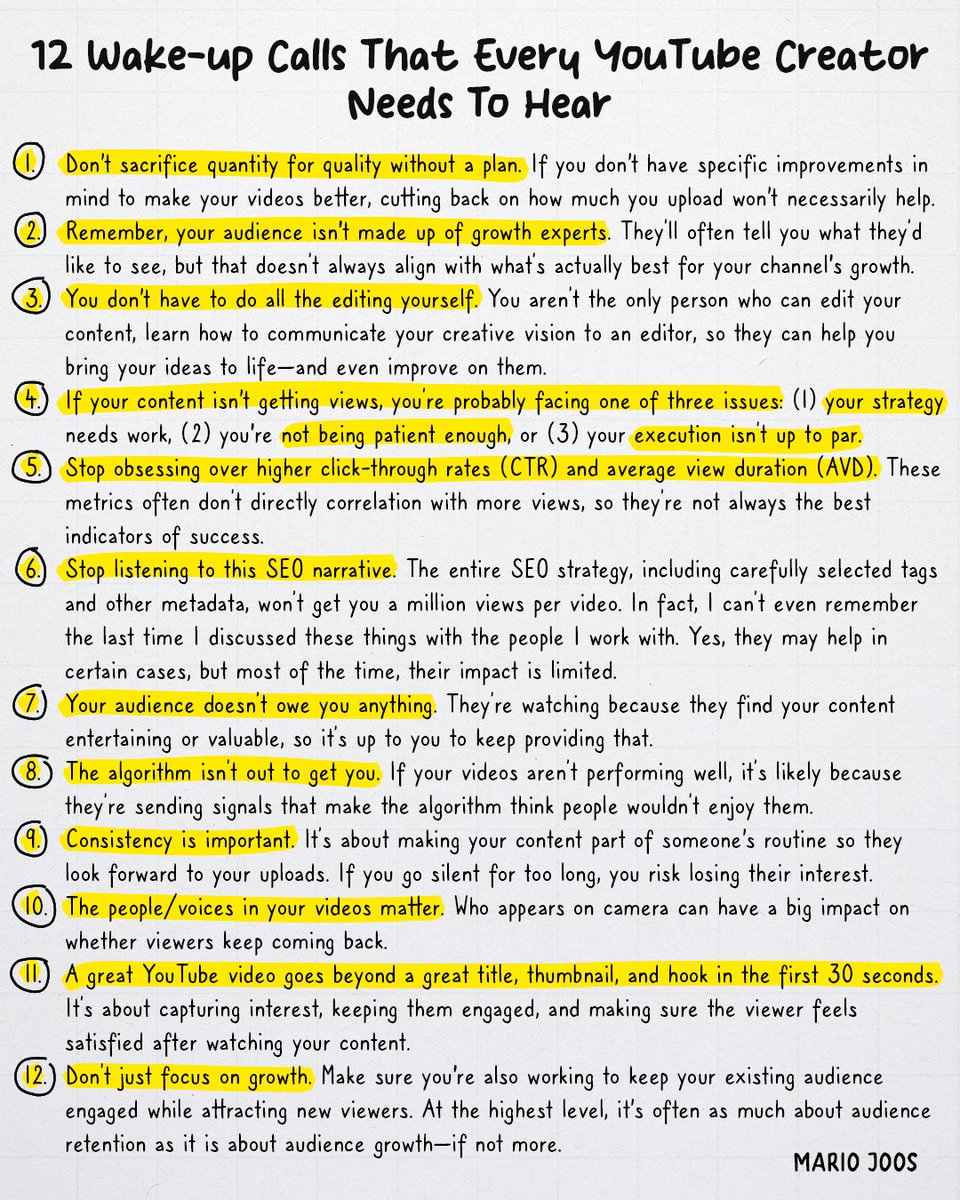
12 Wake-up Calls That Every YouTube Creator Needs To Hear 1. Don't sacrifice quantity for quality without a plan. If you don't have specific improvements in mind to make your videos better, cutting back on how much you upload won't necessarily help. 2. Remember, your audience isn't made up of growth experts. They’ll often tell you what they’d like to see, but that doesn’t always align with what’s actually best for your channel's growth. 3. You don't have to do all the editing yourself. You aren’t the only person who can edit your content, learn how to communicate your creative vision to an editor, so they can help you bring your ideas to life and even improve on them. 4. If your content isn't getting views, you’re probably facing one of three issues: (1) your strategy needs work, (2) you're not being patient enough, or (3) your execution isn’t up to par. 5. Stop obsessing over higher click-through rates (CTR) and average view duration (AVD). These metrics often don’t directly correlation with more views, so they’re not always the best indicators of success. 6. Stop listening to this SEO narrative. The entire SEO strategy, including carefully selected tags and other metadata, won’t get you a million views per video. In fact, I can’t even remember the last time I discussed these things with the people I work with. Yes, they may help in certain cases, but most of the time, their impact is limited. 7. Your audience doesn’t owe you anything. They’re watching because they find your content entertaining or valuable, so it’s up to you to keep providing that. 8. The algorithm isn’t out to get you. If your videos aren’t performing well, it’s likely because they’re sending signals that make the algorithm think people wouldn’t enjoy them. 9. Consistency is important. It’s about making your content part of someone's routine so they look forward to your uploads. If you go silent for too long, you risk losing their interest. 10. The people/voices in your videos matter. Who appears on camera can have a big impact on whether viewers keep coming back. 11. A great YouTube video goes beyond a great title, thumbnail, and hook in the first 30 seconds. It’s about capturing interest, keeping them engaged, and making sure the viewer feels satisfied after watching your content. 12. Don’t just focus on growth. Make sure you're also working to keep your existing audience engaged while attracting new viewers. At the highest level, it's often as much about audience retention as it is about audience growth-if not more.

@coreyhainesco ·
I built a skill for Claude Code that plans your entire content strategy — what to write, how often, and why it matters. You describe your product and audience, and it maps out topic clusters with pillar pages and supporting articles, each tied to search volume and business value. It builds a publishing cadence, prioritizes topics by impact, and creates a content calendar you can actually follow. No more staring at a blank editorial calendar wondering what to write next. The difference between a blog that drives revenue and one that collects dust is having a strategy before you write a single word. It's called /content-strategy and it's part of Marketing Skills — a free, open source collection of 32 marketing skills for AI agents like Claude Code, Cursor, and Codex.


@JosephKChoi ·
these UGC creators have driven 5 billion+ views for consumer apps in the past 90 days. I talked to @drewlevinn from @sideshift_app and he broke down the viral formats working right now (it's not just hook & demo anymore) full vid👇 0:00 - Sourcing UGC from apps driving 500M+ views 0:15 - Engineering virality and leveraging AI controversy 3:59 - The shift from massive influencer campaigns to authentic UGC 4:38 - New format strategy: 10-minute long-form story videos 5:57 - Using rage bait and health trends to capture watch time 8:40 - Scaling UGC programs with campaign managers and content coaches 9:29 - Creator Managers (logistics) vs. Content Coaches (creative feedback) 10:41 - The winning manager-to-creator scaling ratio 13:00 - Finding golden formats and frictionless creator onboarding 16:40 - Format Deconstruction: A 9.6M-view talking head case study 18:21 - Using engagement rate as a predictive virality indicator 24:44 - The "Duolingo-style" training program to mint new talent 29:00 - Case Study: Reaching #1 on the App Store via Spark Ads 29:44 - Protecting budgets: Isolating paid spend from creator bonuses 32:28 - Algorithmic and UI differences: Meta Partnership vs. TikTok Spark Ads 34:21 - The infinite growth glitch: Traffic quality of organic-boosted spend 35:45 - The 3-5x rule: Using paid spend to lift organic shadowbans 42:38 - Creator compensation: Retainer base vs. stacked milestone structures 44:06 - Payout optimization: Capitalizing on the "free view" framework 45:45 - What to expect: Realistic CPM progression over the first 90 days
 Watch video

@shivst3r ·
The biggest lie in content creation is that it's competitive. It's not, almost nobody actually shows up. I've been posting on CT for years and the thing I've learned is that most people who "want to be creators" quit before they even built a bse to grow from. They'll spend weeks planning their strategy, designing a logo, buying a camera, posting five times then disappear. If you just upload consistently for a few months you're already ahead of 99% of people who said they wanted to do this. Stop competing with people in your head who aren't even in the game. Your only real opponent is the version of you that wants to quit.

@shotguncaio ·
There’s never a bear market in content creation. The creator economy is only getting bigger, but most people quit before they ever give themselves a real chance. They post for a few weeks, don’t get the views they expected, and convince themselves it isn’t working. The reality is that content creation is harder than it looks. You’ll spend hours on posts that flop, doubt yourself constantly, compare yourself to people years ahead of you, and feel like nobody is paying attention. But the people who stand out usually aren’t the most talented, they’re the ones who stay consistent long enough to improve. They develop their own voice, share their own experiences, and keep showing up when everyone else disappears. Back in 2022/2023, when everything looked ugly, I decided to go all in on content. It ended up being one of the best decisions I’ve ever made.

@javier_otieno1 ·
The market honors those who learn the art of positively commodifying negative feedback. Creators from the Creator 1.0 era (working for platforms to gain reach) struggle with adapting to the Creator 2.0 shifts. Platforms are now designed to support the monetisation of audience relationships. For that reason, folks, mostly from the Creator 1.0 era, who chased vanity metrics to fool platforms, advertisers, and brands for deals have reached a dead end. Users and audiences are also demanding two-way communication. Creators from the previous era were often criticized for pretending to be celebrities, treating audiences like fans rather than communities. Success as a new-generation creator demands specialized, high-quality content. "Fast food" content doesn't cut it. Rage bait and negativity no longer sell. Adapt or perish.

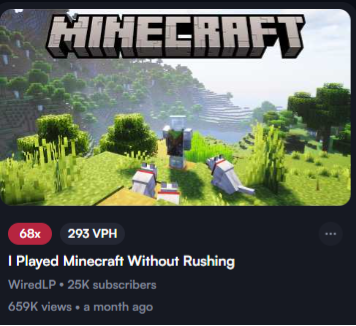
@vidIQ ·
Every Minecraft creator is speedrunning, surviving 100 days, or doing some high-energy challenge This creator did the opposite: "I Played Minecraft Without Rushing" 25K subs, 659K views. 68x above their channel average Sometimes the best content strategy is just asking: what is literally everyone else doing, and what's the opposite?

@zaimiri ·
content automation teaches you something uncomfortable. most of what you “create” is just process. find headline → rewrite for your audience → format → schedule. that’s 80% of content creation for most people. i built agents to handle that 80%. now i only touch the 20% that actually needs me. > the creative decisions > the angles > the voice calibration everything else runs at 7am while i sleep.

@TomBilyeu ·
Traditional audience building is dying. Here's what I'm noticing: - YouTubers with millions of views struggle to sell products - Live streaming and community platforms are exploding - Major creators are shifting from broadcast to engagement - Even podcast hosts are moving to live formats This is what I’ve experienced building Impact Theory: - My mindset audience didn't buy my comic books - My podcast listeners didn't play my games - But my Twitch community shows up daily for both gaming and mindset - Live events pull huge numbers when community is strong - Guest-dependent shows die without star power A big part of building sustainable creator businesses will come from: - Choosing between audience OR community (not both) - Creating straight lines between content and offers - Building two-way relationships, not just consumption - Leading with ideology that attracts true believers - Trading mass reach for deep connection The future belongs to entrepreneurs and creators who build true communities, not just audiences. What are you building - an audience or a community?

@_FinegirlDami ·
𝗛𝗢𝗪 𝗧𝗢 𝗠𝗔𝗞𝗘 𝗣𝗘𝗢𝗣𝗟𝗘 𝗢𝗕𝗦𝗘𝗦𝗦𝗘𝗗 𝗪𝗜𝗧𝗛 𝗬𝗢𝗨𝗥 𝗖𝗢𝗡𝗧𝗘𝗡𝗧 (𝘌𝘷𝘦𝘯 𝘪𝘧 𝘺𝘰𝘶𝘳 𝘯𝘪𝘤𝘩𝘦 𝘪𝘴 𝘰𝘷𝘦𝘳𝘤𝘳𝘰𝘸𝘥𝘦𝘥.) You know that feeling when you spend time writing a really good post, hit post, and a few hours later it feels like nobody even saw it? A couple of likes. Maybe one “great post.” Then everyone moves on. But then you see another creator post something simple and suddenly people are in the comments saying: “This is exactly what I needed.” “It feels like you read my mind.” “Why is this so true?” Same niche. Same platform. Sometimes even the same topic. So why do people get hooked on their content and scroll past yours? It usually comes down to one thing: The best creators don’t just share information. They make people feel understood. When people feel like your words describe their thoughts, frustrations, and experiences better than they can explain themselves, they stop scrolling. They start paying attention. And when you keep doing that consistently, people start coming back for every post. Below is the 3-step framework behind it: 🔻 Make people feel seen 🔻 Explain the pattern they couldn’t name 🔻 Keep revealing the system


@robertoblake ·
UGLY TRUTH ABOUT YOUTUBE YOU DON’T WANT TO HEAR… More Effort into Editing Won’t Save a Boring Topic, a Bad Unattractive Thumbnail, and/or Bland and Uninteresting Title. It’s hard for people emotionally invested in their editing and craftsmanship to hear that. But it’s worse for every small creator who listens to the narrative of “quality content” and “craft” all day long… Who struggle and still don’t get traction, because they are putting effort into the part of content that has nothing to do with whether someone clicks on a video in the first place. You would think this would be OBVIOUS… but it’s really not. And it’s absolutely killing small creators and destroying them because the NARRATIVE WAR, has been won by the people who have the luxury of making whatever they want… But forgot that they could NEVER have any of the luxury beliefs they preach about content if they had to work 40-50 hours a week and still make that content as a solo creator without a team anymore… And that is the quiet part that nobody is saying out loud. If your favorite YouTuber or even favorite Guru had to work from 9-5 and still make the same quality of high effort content they preach about… Could they realistically do it and put that out every single week without an editor and thumbnail artist and make livable money that would let them leave a regular job… The short answer is probably not. But the REALISTIC ADVICE around content creation for that solo working class creator is not going to be sexy and is not going to get 100,000 views and make the person giving it look like they know what they were doing. The Brutally Honest Truth is that sustained success, realistic advice and accessible audience growth, is NOT SEXY and mostly a lot of the not fun stuff really matters. Figuring out a Title for a video and getting into a 3rd to 5th grade reading level, and a topic that 10M-100M people care about… knowing you need to get 1-10% of them to click and watch… That’s NOT FUN… even for your favorite YouTuber… But it’s the only reason you know who they are… They made a video on a topic you and at least 1M or more people care about. And were able to package a title and thumbnail that got your attention and interest… Was relevant to you when you saw it (timing)… And when you clicked on it you didn’t feel bored, tricked and you didn’t experience Awful Audio or Video Quality. The editing likely was not even something you noticed consciously… This is why AUTHENTICITY is coming back to YouTube… OVER EDITING IS DEAD… And Big YouTubers Killed It… If your editing is your whole identity and you’re not focusing on Topic/Tile/Thumbnail/Timing Then it’s probably why YouTube feels like luck or a lottery.


@BawsaXBT ·
every creator needs to understand CPR. create. post. repeat. it’s the practice of creating an idea as it arrives in your brain to getting it out there in the world as soon as possible. then, quickly moving onto the next idea. most creators either get stuck in two scenarios: a) they never take action. b) they create it, but “romanticize” the results. person a is just an overthinker. person b got the idea out there, but worries too much about the results, which ultimately kills momentum for the next idea. take these lessons from a creator who’s been there and done all of the above. create. post. repeat.


@iamberzio ·
5 Mistakes to avoid as a KOL/creator 1. Talking too much about features/Overcomplicating the message Here's the simple truth: readers who will turn users don't care about the tech. They care about how the product makes their life easier. Example: Instead of saying “gasless agnostic smart wallet” Say “send & swap any crypto without worrying about fees” 2. Not repeating your niche enough A lot of creators get bored with saying the same thing and keep changing their niche every day But content creation usually works through repetition. People need to hear the likes of same message several times before it sticks. It may take months, and even years, for the message to be remembered. 3. Trying to speak to everyone Many creators want to be or talk about traders, devs, institutions, and casual users all at once That usually makes the content vague. The best marketing starts by picking a core audience and speaking directly to them. You must understand whether you're targeting specifically traders, yield farmers, etc. 4. No clear CTA Sometimes a post gets attention, but the next step is unclear. People should know exactly what action to take after reading your content. Don't be afraid to insert links in posts to convert social metrics 5. Quitting too early - You grind with all your energy in a month - They didn't go viral - You stop all processes to "rethink" Organic content usually takes a lot more time and grind. It's a mistake to assume your strategy is broken just because you see no huge results in a short time. Organic growth takes months and years. But it pays off 100x more at the end GG


@JamesonCamp ·
Great organic content requires 3 things 1. A broad truth that many can agree with, said in a unique way If possible this truth should be polarizing. This should come towards beginning. 2. A reason to follow the creator It can be a mention of authority, it can be that you feel like you learned a lesson from them 3. A reason to share or save the content It might be a framework to follow, or something really unexpected that makes the viewer want to share to feel like an authority Of you can fit all 3 of those things into a piece you will get content that goes viral and brings in follows It simple but not easy

@ChrisClickUp ·
Here's exactly how we think about content at ClickUp 🎯 We don't start with "what should we post." We start with "what is our audience feeling right now that nobody is saying out loud." Then we make that the post. The HR mop video? Everyone hates HR meetings but nobody says it. 6.3M views. The age question video? Everyone has been in that awkward moment. 12.7M views. They didn't teach anything. They didn't sell anything. They didn't mention ClickUp once. Validation > education. Feelings > features. Relatability > reach. If your content strategy starts with your product, it ends with your audience scrolling past.

 Watch video

@orenmeetsworld ·
If an event or topic is interesting to your audience and happening in culture, you can post about it as much as you want as a creator or a brand. Breaking down with @landforce - how @JtBarnett posted a dozen times during Coachella (and could have posted 30) - how algorithms test content - why applying a narrative to advice content always wins
 Watch video

@aaliya_va ·
You don’t have a “content problem.” You have a “how do I say this without sounding cringe, boring or braggy” problem. Thats exactly the problem @Laraacostar solved for me with one simple system. Lara went from rejected job applications to the #1 female creator on LinkedIn, 300k+ followers, three businesses and millions in revenue built on her content. At the heart of it all lies one simple framework writing system she uses in every post: SLAY Framework Lets dissect what it is and how you can use S – Story: Start with a short, real story. not “5 tips to grow on LinkedIn.” more like: “Last year, 27 clients ghosted me in one month. Here’s what I changed.” Lara says: the first 3 lines of your post should be a story. L – Lesson: On line 4, flip it. what did this story teach you? what changed because of it? This is where your reader thinks: “Oh… this is for me.” A – Actionable advice: now you earn the save. turn the lesson into clear steps or bullets: Do this Avoid this Try this today use lists. Keep it sharp. Make it something they can apply right now. Y – You: End by turning the spotlight on them: A question A simple CTA A “what about you?” This pulls people into the comments and makes the post feel like a conversation not a lecture SLAY is so effective because: It stops you rambling It kills “look at me” flexing It forces every story to deliver value next time you sit to write, don’t stare at the cursor. Just ask: What’s my SLAY?

@zaimiri ·
the creators getting traction aren't the ones posting 5x per day. they're the ones where you can feel a person behind the words. in the age of ai slop, personality matters more and more. when everything sounds the same, when feeds are flooded with content that's technically correct but somehow hollow, the thing that cuts through isn't more posts. it's YOU. the specific way you see things. the opinions that make some people nod and others roll their eyes. the voice that couldn't have been written by anyone else. AI didn't kill personality. it made personality the last unfair advantage. if you want to be a successful creator, you have to understand this.

@Rakshaweb3 ·
If your content strategy depends on motivation, it's not a strategy it's a mood. The founders who actually build a personal brand don't wait to feel inspired. They have a system: a weekly list of ideas pulled from client calls, DMs, and their own mistakes, so posting becomes execution instead of a creative crisis every morning. Remove the decision fatigue and the consistency takes care of itself.
@BawsaXBT ·
idk how else to say it. but, AI is replacing 98% of creators. after 10+ years of creating content on social media, i’ve built my own workflows that have continually improved my productivity. it has always been: 1. ideation 2. preparation 3. execution 4. post 5. repeat but now with ai in the picture, you just have to learn how to prompt and 50% of this workflow can now be automated. and that right there is where 90% of creators are at. > ai copywriting > ai reply guys (the worst one) > ai accounts (agents larping as humans) so the question becomes: what’s the point of being a creator in this day and age? to be honest, idk the answer to that question. but i also believe that there is no “right” answer. creators are still very important for brands & companies to have. but if their sole purpose is surface level copywriting, “creating content”, then there’s really no point in having them onboard. a part of me knows this is probably where my futures lies in. lots of experimenting, lots of learning, and lots of f*cking up and trying again to show others that originality, authenticity, and creativity are still the most sacred values in what makes a “creator”. if you’re also in the same boat, join me.

@JacobCEdmunds ·
99% of content strategy questions can be answered through experimentation: “Should I post more often?” Post more and see what happens “Am I replying too much?” Reply less and see what happens “Is this a good post format?” Post it and see what happens The data will tell you what to do

@Connect_eyubest ·
Creator Growth Blueprint Series DAY 2 - CONTENT THAT BUILDS AUTHORITY 👩🏽🏫 Welcome back to class, creators. One mistake many creators make in Web3 is posting randomly. Random posts may get likes, but they rarely build authority. Authority comes from intentional content. Content that teaches. Content that explains. Content that helps others grow. When people consistently learn from you, they start seeing you as a trusted voice in that niche. Step 1 - Focus on Value Before posting, ask yourself: What will someone learn from this post? Good content usually does one of these: • Teaches something new • Explains something confusing • Shares a useful experience • Highlights an opportunity Value keeps people coming back. Step 2 - Choose 3 Content Pillars Instead of posting about everything, choose three topics you will consistently talk about. Example for a Web3 creator: • Web3 education • Creator monetization • Early opportunities This keeps your page clear and recognizable. Step 3 - Keep It Simple You don’t need to post 10 times a day. One clear, valuable post daily is enough to build authority over time. Consistency beats noise. Tactical Exercise - Day 2 Write down your three content pillars today. Example format: 1️⃣ Pillar One 2️⃣ Pillar Two 3️⃣ Pillar Three These pillars will guide your content moving forward. Classroom Takeaway Authority isn’t built by posting more. It’s built by posting with intention and clarity. Tomorrow’s class (Day 3): How to turn followers into an engaged community.

@robertoblake ·
In going to fix the issue with confusing creator advice once and for all: But I’m not going to sugar coat it, this will hurt your feelings so I apologize in advance… 🙏🏾🙏🏾🙏🏾 DECIDE IF YOU’RE HERE FOR ART OR MONEY… that’s it… I’m going to address both types of people here but let’s start with the person fixed on their “art”… If you’re here for ART and to make and express… then the things that make money are going to make you almost as sad as being poor… IF you know deep down you don’t want to put an Audience First and you want to put your Art First, STOP listening to all content strategy advice. Your personality is going to internally resist it anyway, and you’re going to waste your time and then claim the advice you followed half heartedly didn’t work. Aside from being willing to follow best practices, NO ADVICE will likely work in your situation unless it’s one on one advice that is highly bespoke advice for your situation. That’s is the HARSH truth of it for most of you with this mentality and identity. And that’s okay. For content, just consume tutorials, craft, storytelling, motivation, and suggestions on hardware and software for workflow and productivity. Don’t bother with consuming strategy or monetization content if you’re not in the mental space to treat this like a business. If you’re an artist, focus on quality over quantity and consistency. But be honest with yourself and understand it’s not a growth strategy or a monetization strategy and it doesn’t mean you will go viral for doing it or that it’s in anyway “better”. If you care about growth and money, that is literally a volume game, and it means an Audience first strategy. Their threshold for quality is much lower than yours and they value consistency and frankly have an addiction to consumption. If you care about quality you can’t feed them enough. So you need to accept it’s not sustainable for you outside of viral fame if you have this mentality. If you can find a way to make money you don’t despise, then you get to just make art. But it’s still RARE for true art for arts sake to make money. The money is in “content” which is NOT, the same as “art”. ——— Now let’s get to the hard one… the person who wants to make MONEY. You can want to make money for money sake. And I’ll oddly tell you there is nothing wrong with it, I came up poor and spent most of my life at the poverty line without relaxing it after my parents divorced. So I am going to be some commie who tells you “don’t do it for the money”. What I am going to tell you is that you need to think bigger and that making your money fair and square will only happen if you can PUT THE AUDIENCE FIRST. If this is a business and career for you, then you MUST put the audience first in order to succeed, What you want to make isn’t always going to be what they want to watch. Yes the ideal would be if both things can coexist. I want you to assume you have to choose…. And I want you to choose the audience over yourself 80% of the time. So instead of choosing a topic you’re passionate about… I want you to choose a community you’re passionate about… You’re going to be serving these people for 10-25 years if everything works out. So you should choose that community wisely. And find an intersection of what you can share and where you can create value for them. But don’t fool yourself, you’re NOT making “art”. You’re making content for consumers. And that’s okay. You have to keep up with consumer demand. This doesn’t mean churn out trash. But it means being reliable consistent. Outliers make a living on art. Most Creators make a living being consistent and creating this like a career and being open for business as often a possible. Most of you don’t have a quality problem, you have a packaging and monetization problem, as well as consistency and workflow bottleneck. Study productivity, ideation strategies, thumbnail design, hiring, and money models. Content ≠ Art

@alexabelonix ·
The best content strategy is having a painful problem you are actually solving. That sounds obvious. Most people skip it. They write about productivity without building anything. They write about AI without shipping workflows. They write about sales without touching customers. They write about startups without being in the bloodbath. The feed can smell distance. A founder with one real customer conversation has more interesting content than a ghostwriter with 100 hook templates. The internet is full of polished takes. Real proximity is the unfair advantage.


@Drewfromweb3 ·
One of the biggest misconceptions in content creation is: "If you're consistent, you'll succeed." Consistency matters but if your is sh*t, it will simply be consistent sh*t, nothing else The better approach is to stick to one concept for a specific amount of time and then reevaluate if it works or not I had this issue myself months ago and on Instagram changed my whole style of editing and pace Now I'm seeing 10x the growth from 3 months ago Consistency isn't about repeating the same thing forever. It's about consistently improving what you are sharing to others

@neilpatel ·
If your content stops the second you step away, you don't have a content strategy. You have a job. The fix isn't hiring more people. It's building a system where your voice, workflow, and standards exist outside your head. That document alone changes everything. #ContentMarketing #CreatorEconomy #AIMarketing #ScalingContent
 Watch video

@ryandeiss ·
Founders have two paths when building a content strategy: Path 1: Go all-in on AI - AI is making it easier than ever to sit alone in your office and create content - You’re not doing as much, but you’re creating more, so that’s ok. (Output is UP!) - You have fewer stories to tell, but that’s ok, too…AI is a good storyteller - You’re becoming less interesting, but that’s ok… just make it up in volume. OR Path 2: Go all-in on Experience: - Get in the game first, then talk about what you did - Realize that the best content comes from people who are actually in the game and doing cool stuff - (You could edit your highlights to look like Ronaldo clips, but you still are not Ronaldo.) - Realize that stories are easier to tell when you don’t have to invent them. - Say, “Screw content creation, just do cool stuff, then talk about what I did.” (The real winners choose Path 2, then leverage AI to amplify their reality.)

@aigleeson ·
A content creator I know hasn't had a creative block in 8 months. She runs 4 Instagram pages across different niches. Here's the AI system she uses to never run out of ideas. Most people open ChatGPT and type "give me content ideas for my fitness page." They get 10 generic ideas they've seen a thousand times. That's not how she does it. She starts by feeding Claude her last 30 posts that performed well. Not to summarize them. To find the pattern underneath them. She asks: "What specific tension or belief does each of these posts challenge? What does my audience think before reading this and what do they think after?" The AI doesn't give her ideas. It gives her the psychological engine behind every post that already worked. Then she goes one step further. She takes the top 5 accounts in her niche and pastes in their 10 most viral captions. Asks Claude to map the emotional triggers each one uses. Fear of missing out. Status signaling. Insider knowledge. Contrarian belief. Now she has a map of what the entire niche is running on emotionally. The final step is where it gets interesting. She asks: "What angle is completely missing from this niche right now? What would feel like a pattern interrupt to someone who follows all these accounts?" That question alone generates content nobody else in her space is making. The output isn't a list of topics. It's a positioning gap. A blind spot the whole niche shares. A conversation her audience is having in their head that nobody on their feed is having out loud. She told me the ideas she got from one session kept her content calendar full for 6 weeks. The mistake most creators make with AI is asking it to think for them. The ones winning are using it to think deeper than they could alone. Your next viral post already exists inside your past content. You just need the right question to find it.

@_jaydeepkarale ·
Got a few DMs about content creation recently. Here's the first question I ask anyone who wants to grow on social media: Are you trying to build an audience or chase payouts? Your answer should determine your content strategy. If you're chasing payouts: - Post frequently - Follow trends - Make memes - Optimize for views - Generic content is often enough If you're building an audience: - Share your experiences - Develop a unique perspective - Create content people remember you for - Be consistent for months, not days - Have a clear content plan

@VadimStrizheus ·
AI clipping is about to become one of the most obvious creator plays of the next 24 months not because captions got better because long-form content is finally becoming searchable, scorable, and reusable at scale most creators still think clipping means: > watch the video > find a decent moment > cut it vertical > add subtitles > post and pray that was editing the next version is a distribution engine every podcast, webinar, livestream, course, interview, and founder rant becomes a dataset inside one 90-minute video there are usually: - strong opinions - personal stories - niche lessons - conflict moments - controversial takes - lines that could become hooks but creators treat all of it like one file called “episode 47” insane > 0.1% will turn their archive into a clip machine > 1% will build systems that rank moments before editing > 5% will keep hiring random editors and hope they “get the vibe” > 93.9% will post manually until they burn out be the operator, not the uploader the play is simple: 1. transcribe every long-form video not for captions for intelligence you need to know every story, claim, lesson, objection, joke, and emotional spike hiding inside the content 2. score moments before cutting most editors cut what looks good operators cut what creates retention money fear status conflict curiosity surprise identity if the moment has none of those, it probably does not deserve the timeline 3. write hooks before exporting clips the hook decides the clip not the other way around one raw moment can become: - fear angle - money angle - founder lesson - contrarian take - niche inside joke - “you are doing this wrong” angle same footage different distribution 4. post by category, not vibes if founder stories hit, make more founder stories if tactical breakdowns die, stop forcing them if controversial industry takes get replies, double down the timeline is not random it is feedback 5. recycle winners the biggest mistake creators make is posting a winning idea once if a clip works, the market is telling you: “there is more here” rewrite the hook change the opening frame clip the setup differently turn it into a thread turn it into the next video one winning idea should become 10 assets most creators do not need more content they need less waste their best ideas are already recorded they are just buried inside videos nobody has time to watch manual clipping was an editing workflow AI clipping is a distribution system big difference
 Watch video

@sexworkceo ·
Treat every piece of content you create the way you would treat a product launch at a Fortune 500 company, with the same back end thinking, the same marketing plan, and the same level of intention. There is no other way around the math. If you want to sell it, you actually have to launch it. What that looks like in practice is treating each drop like an event with lead up posts, anticipation built into the calendar, and a clear sense of which fans you are speaking to and what they want before you film a frame of it. Once it is out, the work shifts to tracking where it sold, how well it sold, on which platform, in a spreadsheet you actually open. Roughly twenty percent of your content will produce eighty percent of your revenue. If you cannot tell which twenty, you are making decisions in the dark and calling it instinct. The shift happens the moment you stop thinking of yourself as a creator who occasionally sells things and start thinking of yourself as a business that uses content as its product line.
@aaliya_va ·
You've got a folder full of half written posts and nothing published this week. I see many creators struggling with content creation. Now what I think they don't have an idea problem rather they have a shape problem. You sit down with something worth saying and it comes out as a wall of text nobody finishes or you rewrite the opening line 9 times and post nothing that day or a post does well and you can't work out why so you can't do it again. That last one costs the most as with no repeatable shape, every post starts from zero. Let me share with you 5 formats to fix that: >Paragraph:One solid block, no bullets. Everything else in the feed is broken into lines so a dense block stops the scroll just by looking different. Take a position and put the sharpest line last. >What → How → Why: Line one is the promise. Three to five bullets are the steps. The last line is why it matters. >Listicle:Say what you're handing over then hand it over. >Old vs New: 2 lists stacked, one right and one wrong. The reader puts themselves in a column. >Expand Anything:The 5th is a multiplier rather than a shape. Run any topic through tips, stats, steps, lessons, benefits, reasons, mistakes, examples, questions or personal stories. Pick the format you'd never normally reach for. Post it tomorrow. Whatever happens will tell you more about your audience than a month of posting the way you always do.


@mehrrajputUGC ·
Content creators are the new sales people for brands… I had a conversation with a group of creators / influencers with followings over 50-100K and when I talked about creating ad content that brings their clients results they all paused. They paused because they never really thought of it any deeper than “I just get paid to make videos”. The reason stability in the creator space feels scary is because the work ebbs and flows. But when you take care of your clients, create content that makes them $ … they would be silly not to come back for more. This is what all creators should be prioritizing learning right now. Making performance driven creative is going to be the skillset that will make you $. #ugc #ugccreators #ugccommunity

@BigBrainBizness ·
Instagram Head Adam Mosseri on the 4 things creators actually care about, and why revenue share is the loudest complaint but the wrong obsession for most: @mosseri is asked what Instagram has to do to keep creators happy over the next five to ten years, especially as individual creators eclipse the institutions they used to work for. His answer is a list of four things, and the ordering matters. 1) Reach But Mosseri immediately reframes it. "I do think reach is a means to an end. It's not an end in of itself. And I think too many people just focus on reach for reach's sake." What creators actually want, he explains, is growth over time and relative stability. And he is blunt about the limits of what any platform can promise: "Any platform that guarantees you stable reach is lying. That doesn't mean that platforms aren't working on it and trying to give you more reach and trying to figure out how to grow the pie. But pure stability is not possible even if everyone just did chronological feeds everywhere." 2) Safety This one surprises more people. "Do you feel like you can be yourself? Can you share the part of yourself that you want to share?" He frames this as protection from antagonistic behaviour, bullying, and harassment, and positions it as non-negotiable for creator retention. 3) Revenue This is the one that dominates most public discourse. But Mosseri pushes back hard on how much weight it actually deserves, and for whom. "Revenue matters a lot, but actually to a very small subset of creators. The vast majority of creators are very small and they're too small to monetize in a meaningful way." His point is direct: if you have 2,000 followers, monetisation is not the conversation you should be having with yourself. Growth is. "If you have 2,000 followers, it's not really going to be the thing that you should spend your time on. It's figuring out how to grow your following, not try to make money from 2,000 followers." 4.) Connection This is the one he seems most energised by. Not just between creators and their fans, but between creators and other creators. And his example is the DM inbox, a tool most people treat as a notification tray rather than a professional network. "If I just am a fan of you and I follow you and then you figure out who I am, you can text me on Instagram and it goes into my inbox." He describes knowing people in Hollywood who built lifelong business partnerships this way, not digital-native creators, but film directors and composers who found collaborators through a simple like and a follow-up message. The tool already exists. Most people just are not using it.
 Watch video

@Coachbenjamin_ ·
A creator reached out to me recently and said, "I think my content is the problem." You think? I asked him one question, "How many people have you actually spoken to this month?" Silence........ He had spent weeks studying hooks, analyzing viral posts, tweaking his profile, and worrying about the algorithm, he hadn't had a single conversation with the people he wanted to serve. That made me realize something, A lot of creators are trying to understand the algorithm before they understand their audience. The algorithm can tell you what people clicked, Your audience can tell you why they clicked, Those are two very different things, big difference,, The best content I've ever written didn't come from staring at a blank page It came from paying attention to the questions people kept asking, the mistakes they kept making, and the frustrations they couldn't put into words, Maybe the answer isn't another content strategy, Maybe it's one more conversation, Yes, one more....

@TheCoolestCool ·
Content strategy isn’t just about blog posts. It’s also about: Understanding your audiences motivations. Understanding your organizations skillset. Understanding your organizations goals. Understanding your audiences interests. Understanding your products benefits. Understanding your product roadmap. Understanding your audiences pains. Understanding your buyers behaviors. Understanding your buyers habits. Understanding the channels your ideal customers spend time on and the types of content that they resonate with most. It’s also about: Distribution. Storytelling. Creativity. Analytics. Sales. Data. SEO. And yet… Some marketers assume that a content strategy can be put together in 20 minutes using ChatGPT or Grok. The reality is… That’s a trap. It will give you something… But that something will completely lack the nuance required to build a strategy that moves the needle for your business. Embrace the research. Embrace talking to customers. Embrace the process of learning. It’s not easy. But the outcome will be worth it.

@vivilinsv ·
How to Build a Brand—and Wealth—on X? I keep coming back to this post from @nikitabier: "If you want to get rich on X, don’t depend on creator revenue. Find one subject you understand unusually well, share one unexpected insight every day, and keep going." It sounds simple. But hidden inside it is a powerful business model. A lot of people think personal branding was mostly about packaging: the right bio, polished photos, a memorable slogan, and bragging about yourself. But that's not the case at all. From a deeper level, as I dive deep into psychology and human behaviors, building @Souli_AI, I realized - personal branding is pattern recognition made public. Your most valuable niche is usually not a fashionable industry you choose from a list. It sits at the intersection of: what you have experienced, what you are unusually curious about, what you have become good at, and what other people find valuable. @naval calls this specific knowledge: knowledge that comes from your natural abilities, genuine curiosity and accumulated experience, rather than simply following whichever profession is currently popular. Cal Newport describes a related idea as career capital - rare and valuable skills that give you leverage. You do not necessarily need to know more than everyone else about a huge subject like AI, investing, fashion or psychology. You just need to own a specific intersection where very few people can replace you. Perhaps you understand AI through the lens of education; or Luxury through Chinese consumers. Startups through immigrant founders. Or love and relationships in the age of AI. Your life may look scattered on a résumé, but those experiences can become an intellectual monopoly when connected by the right idea. Then comes the second part: publish your thinking. Austin Kleon’s "Show Your Work! " offers one of the most practical rules for building an audience: share something small every day. Not empty motivational content, but evidence of how you observe, solve, test and learn. A strong post does not need to contain everything you know. It can be: One surprising observation. One concrete example. OR One explanation of why it matters. Do that repeatedly and your posts become public proof of expertise - that's especially important in the era of AI. But attention alone does not create wealth. X is not the business, but X is the discovery engine. The business begins when people associate you with a valuable problem: “This is the person I should hire.” “This is the founder I should invest in.” “This is the expert I should invite.” “This is the product I should buy.” David C. Baker argues that experts create economic value by identifying patterns others miss and developing positioning for which few substitutes exist. Kevin Kelly’s “1,000 True Fans” adds the next layer: you do not need everyone — you need a direct relationship with a smaller group that values your work deeply. The path looks something like this: Experience → insight → content → trust → demand → ownership Ownership matters because the real money will rarely come from platform payouts, but from the things your reputation allows you to own: your consulting practice, company, product, community, intellectual property, investments or equity. So perhaps the better question is not: “What should I post to become popular?” But - “What do I understand because of the particular life I have lived—and how can that understanding become useful to other people?” Find that answer. Express it clearly. Publish it consistently. Build something people can buy. Your niche is not merely a content category. It's the space in the world that only you can create. Let's keep building. 😇


@esohe_crypt ·
You don’t need to be a content strategist. But you do need to stop posting blindly. When I came to ct, I was always told to be consistent… But never told to be strategic Post every day. always show up, but is that really enough? Is that all it takes to build a personal brand on X? That’s why I wrote this thread. Because a lot of us are making the same mistakes Thinking building a personal brand is just about showing up and dropping “gm” posts. It’s not. First, what does content strategy even mean? I’ll explain it in the simplest way possible. Content strategy is simply organising your content for the right purpose, to the right people, at the right time… Until it creates conversation. You’ve probably heard this before: “Know your audience.” But what does that actually mean for creators? Not projects. Not brands. You! It means understanding the kind of people who would naturally appreciate your content. Are they degen traders? NFT lovers? Gamers? Writers? Founders? Creators? For me, my audience is people in web3 marketing creators and founders who want better content to attract their first users. That clarity alone changes how you show up. Next question, what actually needs to be said? This is where storytelling comes in (and yes, I’ll create a separate thread for that) A lot of people think they don’t have a story. But that’s not true. You can create a story from anything, because your story is simply the experiences that brought you to where you are today. People forget information. But they remember people and more importantly, how those people made them feel And here’s the hard truth: Nobody cares… at least not at first If all you do is drop long posts or sound like a bot repeating information,people will scroll past you Which brings us to the next point: ➠ Why does it matter? ➠ Why should your story matter? ➠ Why should anyone care? ➠ How do you make them stay? It starts with better hooks Storytelling in marketing is really about connecting people’s pain to your story. One example of a weak hook would be: “Here’s why I started my watch brand” Nobody cares A stronger hook would be: “Are you able to afford a Rolex? I wasn’t… and that’s exactly why I started my watch brand” See the difference? It starts from them, then leads into you But hooks alone aren’t enough You still need valuable content Now, what should your content lead to? You don’t have to be a dev or a founder to have a clear goal You are a brand And every brand needs direction Your goal could be: ⤷ growing a specific audience ⤷ building trust and authority ⤷ driving engagement and conversations ⤷ attracting opportunities or clients ⤷ positioning yourself in a niche All of this should be decided, before anything gets posted Because content without direction is just activity Why does this work? Because it brings structure to scattered ideas It helps you connect content to real outcomes like growth, trust, authority And it allows you build a system that works even when you’re not posting constantly This is where most people get it wrong. They think: “Once I have ideas, I’m doing strategy.” No. Ideas are just outputs. Strategy is the thinking behind why those ideas should exist at all. From everything I’ve shared so far, you should now be able to ask better questions: ⤷ Who exactly am I talking to? ⤷ What do these people already believe? ⤷ What needs to change for them to care? ⤷ What kind of content moves them from awareness → trust → action? This is where your valuable content comes in your thoughts, your perspectives, your belief systems. Final takeaway, if all you do is post… you’ll always feel replaceable. But when you can see patterns, build direction, and turn content into something that actually moves people.. everything changes You stop being “the person that posts content” And become the person people rely on to make things work That’s the shift...


@maeveknows ·
how to stand out as a creator in the era of AI? easy. just document your life. show how you did it and be personal. - film a day-in-the-life content - share "how I did xyz in xx days" videos - create "how i fixed this problem in my life" posts honesty makes content sustainable. because you’re no longer trying to perform. you’re just showing what’s already happening.

@kaleighf ·
Do you have creator talent on your current employee roster? Probably! We’ve historically called this work “employee advocacy.” But…advocacy is often a low-stakes distribution play: Employees amplify the company blog, like the company posts, or maybe add a comment. Creation, however, is employees sharing their original perspectives, experiments, and expertise beyond the company website. What an employee creator looks like: -A product manager publishing their take on a category trend or behavioral shift. -A VP of engineering writing about an architectural decision. -A solutions engineer documenting how they solve a recurring problem. -A marketing manager sharing a social media experiment they ran that produced noteworthy results. These employees are sharing their unique POVs under their own names and accounts, but tying that work and expertise back to their role within the larger company/organization. The data on this is stark: Employee-shared content gets 561% more reach and is reshared 24x more than brand content. And creators with fewer than 500 followers get cited at the same rates as larger accounts. Audience size doesn't matter, but specificity does.

@sharyph_ ·
I used to spend 3–4 hours repurposing one newsletter. Tweets. Threads. Substack Notes. LinkedIn posts. All done manually. All rewritten from scratch. Every single week. Some weeks I just skipped it entirely…because after writing the newsletter itself, I simply didn't have the energy. Sound familiar? Then I stopped treating AI like a writing assistant and started treating it like a system. Instead of typing the same long prompts over and over, I gave Claude five specific jobs: ✅ Generate 8–12 tweet variations from any newsletter in 2 minutes ✅ Build a full X thread, properly formatted, CTA included ✅ Auto-schedule everything to Typefully in one confirmation click ✅ Write long-form authority posts by analyzing what thought leaders are posting ✅ Optimize every blog post for Google and AI search engines like ChatGPT and Perplexity Now the entire repurposing workflow takes under 30 minutes. Same newsletter. One session. A full week of content across multiple platforms. This is the shift from Content Creator to Digital Architect. You stop creating disposable posts every day and start running a system that creates for you. The people who win in the creator economy aren't the ones who create the most. They're the ones who built the smartest systems. — 📌 I've written The Exact System I Use to Turn One Newsletter Into a Week of Content (5 Skills Included) https://t.co/RITbCs5HmP
@sharyph_ ·
we're in the most saturated creator era ever AI lets anyone spin up a course, ebook, or template in days your competitor isn't just the expert with 100K followers anymore - it's also the creator who launched last week audiences have infinite options now, and unsubscribing takes one click growth used to be about production quality, posting frequency, fancy branding, but today it's about connection it's like if you're just repackaging ChatGPT prompts - you're walking into a trap you're literally just one viral trend away from being irrelevant what you need to figure out is → positioning → implementation systems → real transformation → community the creators winning right now aren't the ones with more content. they're the ones who embedded themselves so deep into their audience's daily workflows that losing them would hurt The challenge today isn't creating content → It's building something people would miss if you disappeared. That's the real shift.

@gracepace_ ·
SXSW reminded me what kind of content people actually want from me. (+ day 4 highlights) I spent most of SXSW hanging out with my tech creator friends and it made me realize: I need to go back into more educational design content. That’s the kind of content that helped me grow fastest on LinkedIn in the first place. It gave people something useful, shareable, and worth coming back for. Ever since I quit my corporate job to actually live life a little more, I’ve shared more real-time updates about what I’m doing. But the reality is, those posts usually do not perform as well here. So I’m gonna integrate posts like that and add some learnings to it! Just like what I did here with me taking away that educational content does better than lifestyle content here after trying both. —— SXSW day 4 highlights: - Aura creator house - Creator match party - Jean x Flodesk creator dinner - Secret garden party - Paramount lodge - The Female Quotient lodge Also did my SXSW mentorship session! I was really happy when some people did deep research about me and asked very specific questions. I quit mentoring years ago because I was bored of the same basic questions about design jobs but decided to give mentoring a try again! What kind of more educational content would you like to see from me here? 👀 #SXSW #SXSW2026 @sxsw


Best Tweets by Topic