Hooks and headlines
Scroll-stopping openings, headline formulas, curiosity loops, emotional framing, rhetorical devices, subject lines, and attention-retention techniques.
44%
Best tweets about Copywriting
A curated collection of the sharpest, most-shared X posts about copywriting—saved so you do not have to dig through the timeline yourself. Updated weekly.
Headlines, hooks, and the one-liners that sell without sounding like they are trying to.
Original Xholic analysis
The discussion emphasizes attention, clarity, and customer understanding: posts recommend leading with a specific promise or emotionally resonant opening, then supporting it with outcomes, proof, and a clear structure. AI appears in both supportive and cautionary posts—used for pattern analysis and implementation, while some writers warn that its output can sound generic or resemble competitor copy. [2044506081662275698, 2062525048129479065, 2079913854914658461]
88% of posts
All-time engagement
80% of posts
Published in 90 days
Conversation map
Scroll-stopping openings, headline formulas, curiosity loops, emotional framing, rhetorical devices, subject lines, and attention-retention techniques.
44%
Psychological mechanisms behind response, including curiosity, open loops, pain, desire, social proof, urgency, awareness, and buyer intent.
30%
Learning through direct-response examples, broad reading, fiction, customer and product research, feedback, iteration, testing, and revenue results.
30%
Leading with outcomes rather than features; framing offers around pain, identity, certainty, desired futures, and moments of realized value.
24%
Improving landing pages, signup flows, CTAs, testimonials, proof, scannability, form friction, and testing to increase conversions.
22%
Reusable molds and page structures for sales letters, emails, landing pages, ads, app listings, and funnels, including PAS and headline-to-CTA sequences.
20%
Using LLMs to analyze winning patterns, generate diverse variants, process customer transcripts, assemble ad components, and accelerate implementation.
18%
Using conversations, reviews, calls, surveys, comments, and observed frustrations to understand customers and write in their language.
12%
Tone and stance
Performance benchmark
Posts with media make up 28% of this collection. Their median all-time score is 7.59, compared with 17.2 for text-only posts.
Format mix
Consensus and debate
Shared view
Hooks and headlines were the largest theme, representing 44% of the dataset (22 tweets). Posts commonly recommend concise, specific openings that create curiosity, foreground a desired result, or evoke an emotion.
Shared view
Multiple posts recommend framing the reader’s problem, desired outcome, transformation, or moment of realized value rather than only describing product features.
Shared view
Posts recommend using conversations, reviews, calls, surveys, and comments to identify customer fears, desires, recurring questions, and exact phrasing.
Shared view
Posts provide reusable sequences—from headline through CTA—and recommend page elements that surface relevance, proof, objections, and a next action for skimming readers.
Open debate
Some posts present AI as useful for applying theory, generating variants, and analyzing patterns. Others caution that AI copy tools can generate language similar to competitors’ copy or produce generic-looking pages.
Open debate
Formula-oriented posts present PAS, headline recipes, and molds as practical starting points. Another post argues that understanding the reader’s emotional experience should come before selecting a framework or CTA.
Open debate
One post advocates open loops as an attention device. Another explicitly labels fake scarcity, fabricated proof, and misleading claims as unethical tactics, while describing them as claims of short-term conversion tactics.
What performs
Hooks and headlines accounted for 44% of tweets and had a 23.69 median all-time score, above the dataset-wide median of 14.44. The highest-scoring outlier, with a 219.4 all-time score, discussed reverse-engineering patterns in viral posts.
Among the listed themes, Copy frameworks and structure had the highest median all-time score at 43.7. Its evidence posts discuss learning formats, studying direct-response examples, and using a mold for a chosen medium.
Lists represented 20% of posts and had a 28.88 median all-time score, above the overall 14.44 median. The cited examples package copy or landing-page advice into numbered guidance.
Posts with media made up 28% of the dataset. The media median all-time score was 7.59, compared with 17.23 for text posts.
Statistical standouts
Creator landscape
The five most represented creators account for 20% of the selected posts.
1. Andrew Gould
@AndrewWriteCopy
2 posts
2. Chase Dimond | Email Marketing Nerd 📧
@ecomchasedimond
2 posts
3. Ilona Goldmane 🦊
@GoldManeDesign
2 posts
4. George Ten
@GrammarHippy
2 posts
5. Blake Emal
@heyblake
2 posts
6. Kevin Szabo
@KevinSzabo14
2 posts
AndrewWriteCopy’s two cited posts present a problem–promise–proof headline stack and recommend turning the strongest line in a testimonial into its headline for skimming readers.
GrammarHippy argues for learning theory and formats before using AI to implement quickly. A second post recommends studying direct-response brands and using a mold for one copywriting medium.
ecomchasedimond contrasts features, outcomes, and transformation by price point, then argues that stronger copy can describe the moment a buyer realizes a result worked.
Since the previous snapshot
Themes, sentiment, stance, and post format are classified per tweet. All counts, shares, medians, creator concentration, freshness, and performance comparisons are then calculated directly from the published snapshot.
Xholic's all-time score compares engagement while accounting for reach, post age, and creator consistency. It is used for relative comparisons within this collection.
This report analyzes the exact 50-post snapshot shown below. AI identifies editorial categories and drafts explanations; all statistics are calculated from the snapshot, and every narrative claim is checked against cited posts before publication.
Best Copywriting tweets
Ranked 01–50

@ihteshamali ·
I accidentally caught a ghostwriter on X doing something that should be illegal. He didn't know I was watching. He had a Google Doc open. Inside it, he had copy-pasted the last 30 viral posts from 5 of the biggest accounts in his niche. Not to read them. Not to take notes. He fed the entire doc into NotebookLM. Then he ran one prompt. "Analyze what makes these posts go viral. Identify the hook patterns, the emotional triggers, the sentence structures, and the specific topics that generated the most engagement." NotebookLM didn't summarize the posts. It reverse-engineered them. It started surfacing things like: the exact hook format that appears in 80% of the top performers, the emotional register that shows up right before the call to action, the specific type of opening line that stops people mid-scroll. Then came the move I couldn't believe. "Now write 10 original posts on [his niche topic] that use these same viral patterns but with completely different ideas and angles. Make them feel native to this style but impossible to trace back to any single source." The posts it generated didn't look like remixes. They looked like original work from someone who had been writing in that niche for years. He wasn't copying anyone. He was extracting the invisible architecture underneath the content that works, then building something new on top of it. Most ghostwriters spend hours staring at a blank page trying to write something that sounds good. He spent 20 minutes teaching a tool to understand what "good" actually looks like in his niche, then let it generate a full content calendar from that understanding. The difference isn't talent. It's knowing that every viral post is a data point, and data points can be studied. Most people read content to consume it. He reads it to take it apart.


@JamesMalsawm ·
A powerful writing tip almost everyone overlooks: Have more conversations. Most people try to improve writing by sounding smarter. • Better hooks. • Better formatting. • Better vocabulary. But that’s usually not the real problem. The reason many posts feel “off” is because the writer doesn’t understand people deeply enough yet. Good writing is not performance. It’s translation. The best posts don’t feel written. They feel like someone finally explained a thought you were already struggling with internally. That’s why clarity matters more than intelligence online. People don’t reward writing that sounds smart. They reward writing that feels instantly true. And that kind of writing usually comes from observation, not vocabulary. The creators who consistently write posts that connect are constantly noticing: • Frustrations • Repeated questions • Emotional patterns • The way people describe confusion Because people don’t want to feel impressed. They want to feel understood. That’s why empathy is one of the most underrated writing skills online. If your content feels disconnected, don’t just study writing more. Study people more. Listen to conversations. Read comments carefully. Pay attention to repeated struggles. The internet gives endless content ideas to people who know how to observe. The best writers online are usually not the loudest thinkers. They are the best listeners.

@SchmelebeckPPC ·
How to use Claude to write Google Search Ads that actually convert not generic AI slop THE PROBLEM: Google wants 15 headlines and 4 descriptions per RSA. Most people write 3 good ones and 12 mediocre ones just to fill slots. Google then shows the mediocre ones most of the time. THE SOLUTION: Use Claude to generate high-variety, psychologically diverse headlines based on proven frameworks. HERE'S THE EXACT PROMPT I USE: "You're a direct response copywriter specializing in Google Ads Search Ads. I need 15 headlines (30 characters max each) for a Responsive Search Ad. Product: [product URL] Target market: [Your audience] Main benefit: [Primary benefit] Unique mechanism: [What makes it different] Awareness Level: [ex: Problem Aware] Generate 15 headlines using this breakdown: 3 headlines: Curiosity-based (create intrigue) 3 headlines: Pain/problem-focused (agitate the pain) 3 headlines: Benefit/outcome-focused (promise the result) 3 headlines: Proof-based (include numbers, testimonials, credibility) 3 headlines: Urgency/scarcity-based (create FOMO) Make them psychologically diverse so Google tests different angles. No generic fluff. Every headline should stop the scroll." Rules 1. Use direct response principles but please stay Google Ads compliant, especially the Clickbait policy 2. Keep character counts within google policy (30 headline, 90 description) EXAMPLE OUTPUT (for a knee pain product): CURIOSITY: "The Real Cause of Knee Pain?" "Doctors Hate This Knee Fix" "Weird 5-Min Knee Relief Trick" PAIN-FOCUSED: "Knees Grinding Bone-On-Bone?" "Can't Climb Stairs Anymore?" "Knee Pain Ruining Your Life?" BENEFIT-FOCUSED: "Walk Pain-Free in 30 Days" "Get Your Mobility Back Fast" "Move Like You're 20 Again" PROOF-BASED: "Join 10,000+ Pain-Free Users" "4.8 Stars From 2,000+ Reviews" "Backed by Johns Hopkins Study" URGENCY: "Limited Stock - Order Today" "Sale Ends This Weekend" "Don't Wait Until It's Too Late" Now Google tests 15 psychologically distinct angles instead of 15 variations of the same idea. So why does this work? Claude understands psychological frameworks. It's not just rephrasing...it's writing from different persuasion angles. You get better test coverage. Google finds winners faster. I do this for every new RSA and it only takes 3 minutes it beats most handwritten RSAs because most people get lazy after headline 5 to just fill up the space Note: write pinned RSAs to fast track your testing

@GrammarHippy ·
A lot of people ask me if they should still learn copywriting in 2026. I’ve been a copywriter for almost 15 years. So here’s my answer: You should learn a small part of copywriting. Not all of it. You should learn why things work (the theory). Not how to implement those things yourself. And more importantly: formats. What makes a low-ticket sales letter convert vs what makes a high-ticket offer convert and how to sell it (different selling mechanism than low ticket). Funnel economics. For example: You’ll probably never be profitable on a cold traffic funnel that is an opt-in with a sales letter on the thank-you page. But that’s a good way to build a list fast. In conclusion: So you should care more about how things and the structure of stuff rather than writing copy. AI can write copy for you. Copy that would not embarrass someone who’s been writing copy for 15 years. And experience. Experience is now more important than ever. Running a $50 ad on Meta and learning how to analyze it will teach you more than $1,000 courses. Study the theory. Why things work. Then implement fast using AI. That’s the game plan for 2026 imo.
@GrammarHippy ·
Copywriters. All you have to do is understand the basics. That takes reading three books. Then? Go to real direct-response brands and FIND how they use the basics you already know. That’s step one. Step two is getting a mold. Take ONE type of copywriting and create or buy a mold. For example: Most emails follow the same structure. Most sales letters do so too. Same with any other type of funnel or piece. Pick one. Get a mold. Now you have the basics and you have a mold to throw those basics into. You’re top 1% in that medium. Just by doing those two things. Promise.

@javier_otieno1 ·
RETAIN EYES WITH WORDS: Rhetorical Devices (RDs) in Writing – For Proper Hooks RDs increase the memorability and musicality of phrases via reduplication, onomatopoeia, or other phonetic markers. 1. Antimetabole: It is the inversion of the relation between phrases. The exact phrases/words must be used during reversal. Example: Is something pious because the gods like it, or is it liked by the gods because it is pious? —Socrates (Euthyphro Dilemma) 2. Chiasmus: It reverses ideas rather than words. It is the antimetabole's variant, but chiasm, or chiasmus only reverses ideas. Example: If women were oppressed by arranged marriages, who was the oppressor when young men faced the same predicament? 3. Anadiplosis: Using the last word of a phrase or a clause to begin another one for momentum. This device enhances rhythm as well. Example: Anger breeds resentment. Resentment yields hate; hate yields animosity. Pro tip – Use words that seem similar, but with nuanced differences in meaning or implication (such as scarce, few, and little). 4. Anaphora: Repetition of the same word at the end of successive clauses. Example: Eat well, sleep well, wake up well. Why do HOOKS matter? 1️⃣ Brand image heavily relies on recognizability. —Developing original phrases that people remember improves authority. 2️⃣ Practice hinges upon knowledge concerning the specific skills that require refinement, such as deploying rhetorical devices as hooks. 3️⃣ Content resonates when it follows natural flow during oratory. SM is an oratory platform. Write with style when ideas pile.

@Hartdrawss ·
12 signs your LANDING PAGE is quietly MURDERING your conversions : 1/ headline explains the tool, not the outcome > no one buys features > they buy what changes for them > "AI writing tool" tells me nothing. "write 10x faster" does 2/ "who this is for" isnt on the first screen > if they have to scroll to know its for them, they simply won't scroll 3/ 3+ CTAs fighting above the fold > more choices = no choice > pick one action and commit 4/ button says "submit" or "click here" > you're asking them to do homework > "get my free audit" converts. "submit" doesnt 5/ social proof is buried at the bottom > trust must be earned before the ask > logos and testimonials go up top, not after the form 6/ first form asks for 6+ fields > every extra field is a door that might not open > name + email is enough to start 7/ mobile is broken or cramped > 60% of your traffic is on a phone > this is just money sitting on the floor 8/ hero image is a random UI screenshot > nobody connects with a dashboard > show the outcome, not the product 9/ no "what happens next" after they submit > silence after a form makes people think it broke > one confirmation line fixes this 10/ page is slow > they're gone in 3 seconds > no exceptions, no second chances 11/ wall of text instead of scannable lines > people skim first, read second > design for the skimmer or lose them 12/ you've only ever tested the button colour > thats like changing the garnish on a dish that tastes terrible > the real problem is upstream most founders ship a landing page and call it done. conversion optimisation is how you double revenue without finding a single new customer.


@GoldManeDesign ·
7 Top Copywriting Hook Formulas (Practical & Proven): How to capture ('hook') your audience's attention - Part 1/7 Formula #1: Problem-Agitation-Solution (PAS) 🔖 This formula focuses on the pain point to show empathy and promise a solution. Formula: [Specific Problem] + [Agitate it] + [Solution] Example: "Struggling to find time to work out? And when you do, it's exhausting. Meet the 10-minute workout that works." Learn & earn! 🦊 💚

@ItsMeBenChan ·
Writing better hooks can 5X your views. It only takes 30 more seconds to implement. Here are 3 we’ve been using a ton: 1. Most people do [X] but that doesn’t work. We do [Y] and got [Z results]. 2. [X] can get you [Y] desired result. Here’s how. 3. STOP doing [X] because [Y]. Try it out and don’t forget me when you’re famous.

@realbrianmoran ·
You can have the greatest product in the world, but if you can't communicate its value you'll still be broke. Here are 7 proven copywriting tips to print $$: 1. Write for the buyer, not the algorithm. Google's job is to show people exactly what they're looking for. Your job is to help a real person decide if your product is right for them. Do both at the same time and you win on the page and in the rankings. 2. Lead with benefits. Back them with features. Nobody buys a feature. They buy the outcome. "128GB storage" is a feature. "Never delete a photo again" is a benefit. Figure out what your buyer actually wants, then show them. 3. Get specific with your keywords. "Online course” pits you against every creator on the internet. “Beginner watercolor course for adults” is a fight you can actually win. The more specific you go, the closer you are to someone who's ready to pay. 4. Place keywords in the right spots. URL. Title. Body copy once or twice. Image alt text. That's it. Repeat your keyword more and buyers will start treating you like spam. 5. Match your copy length to how aware your buyer is. Selling something people have never heard of? Write more. Educate them. Earn the sale. Selling something they already know they need? Get out of their way. Short copy, clear offer, easy checkout. The biggest mistake I see is sellers writing novels for products that don't need them, and two sentences for products that do. 6. End every page with one clear action. Not two. Not three. One. Every option you add costs you conversions. 7. Write a unique description for every product. Copy-pasting descriptions across your products tells buyers that your products are nothing special. So they'll treat them that way. Every product is different. Your copy should prove it. The only difference between a page that converts at 2% and one that converts at 8% is the words on the page. Fix those first.

@maxwellfinn ·
One of the most underrated skills in marketing is the ability to open a loop in someone's brain and just leave it hanging there. Your brain hates an unfinished thing way more than it cares about a finished one (this is why cliffhangers work and why you can't stop replaying an argument you never got to finish). The second a question gets raised and not answered it starts quietly nagging at you in the background until you get the answer and you'll keep reading, keep scrolling, keep clicking just to make the itch go away. This is called the Zeigarnik Effect, after a researcher who noticed waiters could remember every detail of an order right up until the check was paid, then forgot the whole thing almost instantly. The open order lived in their head and the closed one got dumped the second it was done. Copy works the exact same way. One of the most famous ads in history opened with "They laughed when I sat down at the piano, but when I started to play" and that one headline sold a learn-at-home piano course for years because the second you read it you physically cannot walk away without finding out what happened when he started to play. The moment you fully resolve the thought the reader is free to leave, so the best hooks raise a question they refuse to answer in the first line and the worst ones answer everything up front and give you zero reason to keep going. Here's a few specific ways great marketers take advantage of this effect: 👉 Open on the result and make them read to find out how you pulled it off. "We added one sentence to our checkout page and it did an extra $40k a month" makes the how impossible to skip. "Here are some checkout optimization tips" gives them nothing to chase. 👉 End your email subject line one beat before the payoff. "I think I finally found out why our ads stopped converting" gets the open. The second you put "creative fatigue" in the subject line you answered your own question and handed them zero reason to click. 👉 Build your quiz so the thing they actually came for sits on the far side of the opt-in. They just spent three minutes answering questions about their own skin, the result is sitting right there one click away and an email address feels like a tiny price to finally see it. 👉 In a VSL, name the thing and then refuse to hand it over yet. "In a few minutes I'm going to show you the exact 7 second routine that cleared this up, but first you have to understand why everything else you tried actually made it worse" and now they've given you the next ten minutes. The trick here isn't being vague (since vagueness just feels like nothing)...it's raising a specific question they now NEED answered and then making them travel a little to get it.
@GoldManeDesign ·
7 Top Copywriting Hook Formulas (Practical & Proven): How to capture ('hook') your audience's attention - Part 5/7 Formula #5: The "Validating Beliefs" Hook 🔖 This builds immediate trust by saying what the audience already suspects. Formula: [Confirm a strong belief] + [Pivot to new, shocking info]. Example: "Most people think [Diet X] causes [Problem Y]. But this new study shows it's actually [Unknown Cause Z]." Learn & earn! 🦊 💚

@HireFireTeam ·
"Copywriting" in DTC is a dead term. A lingering product of the past. I used to work with literal award winning copywriters who would take a week to perfect a line of copy. That's not the game here. Never has been. Any nostalgia for a golden age of wordsmiths should be left on the dusty bookshelf. So who's pushing ad accounts forward in 2026? Copy Engineers. This isn't prompting. It's winning ad assembly from parts. The parts: - global learnings that cut across brands - local learnings specific to the brand - behavioral psychology principles - persuasion mechanics - marketing positions - native language Oh you can "write well"? That's almost a negative signal. Any LLM can "write well" enough to make it in DTC. This isn't Shakespeare. It's convincing people mindlessly scrolling to part with their hard earned money. A copywriter will sell you the playbook on that. But my money is on the copy engineer with a schematic.

@Nicolascole77 ·
pro writing/copywriting tip: whenever you're talking in the negative (explaining why your target reader is failing at something), write in 3rd-person. It makes the reader feel like "other people" make these mistakes—but not them. It gives them an out. and whenever you're talking in the positive (explaining the benefits or outcomes to the target reader), write in 2nd-person. It makes the reader feel like they're the main character, and you're telling them how great they are. They're winning!

@parkerworth ·
A little known email hack: Hijack the headlines from news articles. The news is in the business of getting eyeballs no matter the cost. So they've perfected the art of headlines that grab attention. - Skim the news. - Find a headline the hooks you - Swipe it and templatize it. - Use it for subject lines. You're welcome.

@HarryStebbings ·
What is Marc Andreessen's process for copywriting? "It comes from raw frustration when I feel people are thinking about something the wrong way. I have usually been arguing with myself for years before writing, refining the ideas in my head. Then the actual writing happens very fast, in one burst, because all the thinking is already done." @pmarca Love to hear your thoughts on this @harrydry @andreasklinger @david_perell

@cbwritescopy ·
There are only 2 variables that produce stats like this - Framing the offer correctly - Using an intriguing call-to-action That's it. One person could write scripts for this offer and get 1/10th the results, another person crafts a genius offer + good CTA and gets 10x the results. Copywriting is the biggest moat you can have with cold email. Anyone can pull a list and set up infra Not everyone has the sauce to come up with a banger strategy (total lead count is over 100, some leads are recategorized into a subsequence)


@ProofofIntern ·
underlooked tip for improving your copywriting: read more fiction books. writing better starts with reading better writing and, and whilst it’s useful to read better copywriting, fiction teaches you how to describe things so clearly people can picture and envision themselves in that situation. which will help your marketing in turn, without realising it. tbh, any well written book will help also. note: yes, this is take 2 of this post after multiple self inflicted errors on reread.

@aaliya_va ·
If you’ve ever shipped a “perfect” piece of writing that got polite likes but zero real replies, you know the problem. The structure was fine but nothing in it actually moved anyone. The content worked logically not emotionally. We’ve made writing look more mechanical than it really is. Hooks, angles, swipe files, templates , all helpful but none of them answer a simpler question: what does this experience feel like for the person you’re writing to? If you start from that feeling, structure becomes a tool instead of a cage. You naturally choose stories, details, and language that match the emotional temperature you’re trying to reach. Only after that is clear does it make sense to ask where the CTA goes or which framework fits. The shift is subtle: you are no longer forcing emotion into a pre made shape, you are letting structure serve the emotion that was there first. Thats the place where the most honest, effective copy comes from.


@itsmarcosruiz ·
Stop writing hooks that describe what the post is about. Write hooks that make people feel something (what would you actually click on?). "7 tips to grow on LinkedIn" vs "Nobody DM'd me for the first year I posted. Here's what changed." One reads like a table of contents. The other actually makes you stop scrolling. Gotta lead with emotion.

@heyblake ·
Hooks have a recipe. Here is one I stole from headline writers in tabloids. [specific number] + [unexpected verb] + [familiar object] + [emotional consequence] Examples: "3 prompts that retired my copywriter" "12 words that doubled my homepage conversion" "7 questions that exposed my real ICP" Variables to swap when running this on your own ideas: - Numbers stay specific. Avoid 5 and 10. They feel made up. - Verbs stay punchy. Verbs that admit a small crime work best. - Objects stay concrete. Tools, pages, decks, drafts. - Consequences stay personal. Money, hours, a relationship saved.

@NapierHolland ·
Copywriting is coming back. Like many conversion copywriters, I pivoted to product positioning a year or two ago. But more clients have started to ask about my copywriting and CRO tactics. Yes, they’ve tried AI and burned their fingers. But there’s a bigger shift. Ordinary buyers have recalibrated and now spot clean, professional but generic AI websites. Their eyes glaze over. That’s why they fail in AB tests.

@nevmed ·
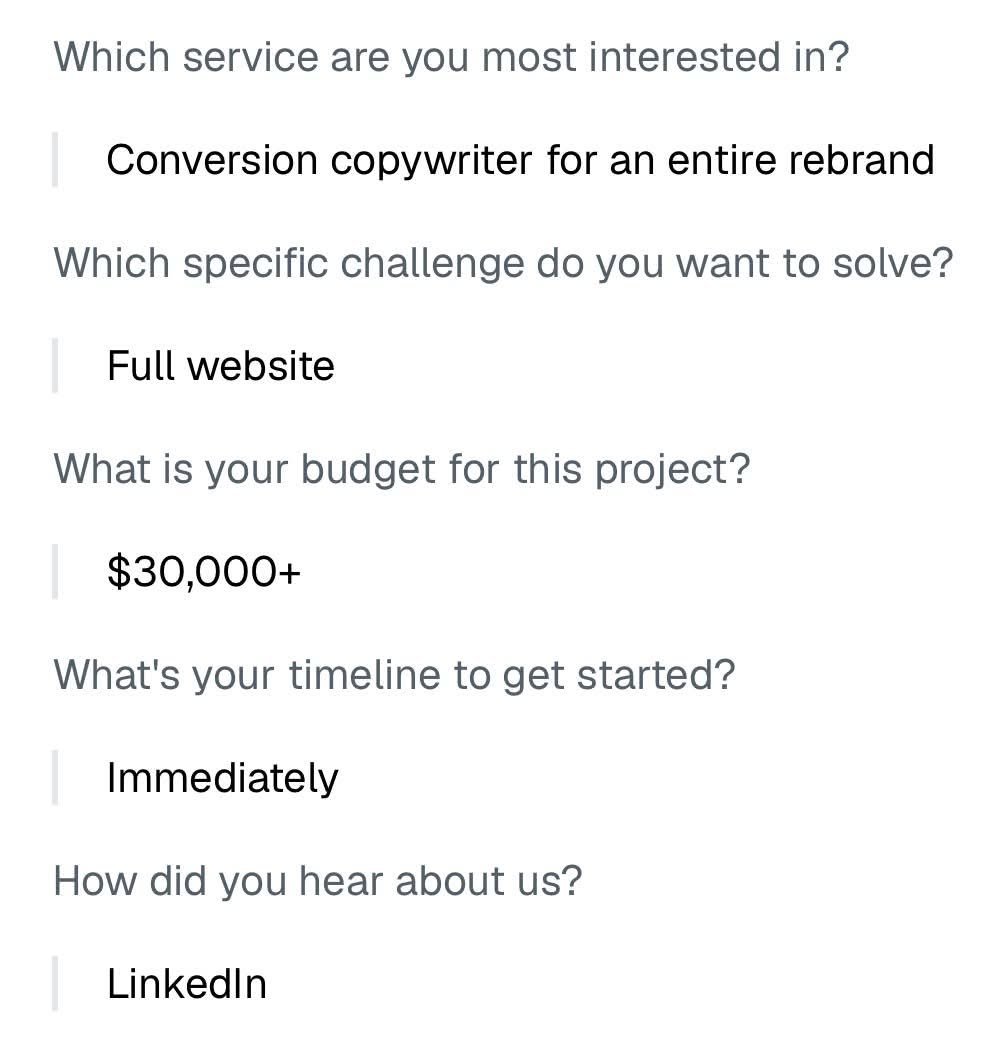
Here's an example where changing a few words on an email signup page took it from 2 signups a month to 200 by changing ~12 words. Here's how it went. The cool thing is as his posts on LinkedIn keep going viral, his signup page will literally pull 100x more emails than before. That's copywriting in action!


@lottsnomad ·
5 copywriting formulas for app store pages 1. do X without Y: track expenses without spreadsheets 2. from pain to payoff: turn messy notes into clear action 3. for who + main result: a daily planner for founders who hate planning 4. stop bad thing, start good thing: stop forgetting tasks, start finishing them 5. specific outcome: plan your week in under 5 minutes
@parkerworth ·
>Be Gary Halbert >Born in Ohio >Grows up in a dysfunctional, impoverished family >Has zero formal marketing education >Describes himself as a "desperate nerd" >Gets bitten by the mail order bug in the 1960s >Tries and fails. Multiple times. >Broke and desperate, comes up with a "stupid" sales letter idea >Friends call him crazy >Writes a one-page letter selling family coat of arms reports >Signs it from his wife Nancy so it feels personal >Mails it with real first-class stamps and a local Ohio postmark >The letter hits >Mails it 600 million times >It becomes the most mailed sales letter in history >Generates 20,000 orders per day >Builds an empire doing $60,000/day in the 1970s >Company eventually sells for $75 million >Gets indicted for mail fraud in the 1980s >Gets sent to Boron Federal Prison >Doesn't complain >Uses prison to write letters to his 15-year-old son Bond >Teaches him everything about life, marketing, and persuasion >Those letters become "The Boron Letters" now a copywriting bible >Gets out of prison >Crowns himself "The Prince of Print" >Staples real dollar bills to thousands of sales letters just to get people to open them >Runs wild seminars in Key West >Lives in Miami Beach writing ads that sell everything from diet pills to biotech >Trains an entire generation of the world's best copywriters >Single-handedly changes modern direct response advertising >Dies peacefully in his sleep in 2007 >His newsletter archives are still studied religiously almost 20 years later

@KevinSzabo14 ·
People don’t buy products. They buy a story about their own transformation. Not yours, THEIRS! (People forget this). Weak: “This course teaches copywriting.” Nobody cares. Strong: “This is for the person tired of watching less talented people get paid more because they can’t sell themselves.” Sell the identity, not the deliverable. Nobody cares that you write. They care what you do. Nobody wakes up wanting a course. They wake up wanting to stop feeling behind. Write to the person they wanna become. And believe me, price is the last thing they’ll care about.

@davegerhardt ·
Every team call and customer meeting is now a copywriting gold mine. Let's riff on the topic right now. On the call. Take the transcript later. Work with Claude. Create briefs for events, webinars, emails, landing pages. If you can talk it out loud you can now go build it, immediately.

@dylan_bridger ·
I’m sitting here reading a book to my 16-month-old daughter. It’s a search and find - she points to things, I say the words. This activity has improved her vocabulary. Now when I ask her, “what does the cow say?” she says, “MOOOOO!” “What does the horse say?” “NEIGHHH!” ANd it dawned on me this morning: this is copywriting training in disguise. Good copy is visual. Word pictures grip the reader. So next time you edit your copy, think of my daughter: What visual words can you add to your sentences to make the reader SEE what you’re trying to say? I’m admittedly terrible at this lol but I’m trying to get better, hence the visual hook of this post.

@TheCraigHewitt ·
This copywriting hack has made me more $$$ than I can count: the source of all great marketing & sales copy is your customers own words. and there's no better way to capture that than call recordings. there's a million tools that do it, but just get started today. feed those call recordings into your Claude or Codex project, and you'll instantly get Voice Of The Customer copy that converts like mad.
 Watch video

@drexion_3 ·
unethical copywriting hacks that actually work (please don't try these) been writing copy for 5+ years and the dark side is wild here's the forbidden knowledge: 𝟭. the immortal countdown timer "offer expires in 23:41:12" refreshes page "offer expires in 23:41:12" bro it's been expiring for 6 months this timer has seen empires fall conversion lift: 20-40% 𝟮. "only 3 spots left" there are no spots it's a PDF you have infinite PDFs you could sell this to every human on earth and still have PDFs left over but yeah "only 3 spots left" still prints conversion lift: 25-35% 𝟯. fake testimonials from "John from Texas" John doesn't exist it's just a random name generator pulling from a CSV file "Sarah from Ohio just bought this 4 minutes ago" Sarah is living her best life, unaware she's your top salesperson conversion lift: 15-30% 𝟰. the mystery comparison "3x better than the leading competitor" which competitor? you're comparing yourself to the worst option you could find or just making it up completely technically nobody can prove you wrong if you never name names conversion lift: 20-30% 𝟱. "as seen on Forbes" yeah on some contributor blog nobody reads you paid someone $300 to write a puff piece they wrote it in a Starbucks in 10 minutes using chatgpt but that Forbes logo hits different on a landing page conversion lift: 25-40% 𝟲. turning minor problems into the apocalypse "if you don't fix your sales funnel RIGHT NOW you're bleeding $10K per day" bro they made $800 last month their entire business revenue is less than the money they're supposedly "losing" the math doesn't even make sense but fear sells better than logic conversion lift: 30-50% 𝟳. before/after photos but it's the same photo just changed the lighting added a filter maybe flipped it horizontally so people don't notice "incredible transformation in just 3 days" the transformation was moving the lamp conversion lift: 40-60% 𝟴. advertising at $49 but the real price is $499 "get started for just $49" cool but the $49 version is literally just a welcome email to actually use the product you need the $499 tier congrats you just paid $49 to receive an email conversion lift: 50-70% on upsells 𝟵. stock photo testimonials that's not Jennifer that's stock photo model #4729 she's also the face of a dental practice in Ohio and a law firm in Miami Jennifer gets around conversion lift: 20-35% 𝟭𝟬. the fake "limited time" offer that never ends "black friday sale - 50% off" it's march it's been "black friday" for 4 months straight or "flash sale ends tonight" same sale. every single night. for 2 years. people still buy because they think they're getting a deal conversion lift: 25-40% here's the truth: all this stuff works short-term then your refund rate hits 40% your customers hate you you get called out on twitter and you spend the rest of your life dodging FTC violations the actual cheat code is just being good at copywriting and not lying i know, boring but at least you can show your face in public merry xmas btw

@ChrisClickUp ·
David Ogilvy built Ogilvy & Mather into one of the biggest ad agencies in the world. He wrote the most famous car ad in history and people still study his work 60 years later. Here are 5 things he actually did that I think about constantly: 1. He spent 3 weeks just studying the Rolls-Royce before writing a single word. He read every technical review, drove the car, talked to engineers. The headline he came out with: "At 60 miles an hour the loudest noise in this new Rolls-Royce comes from the electric clock." Sales rose 50% that year. The lesson: research is the cheat code. Most marketers skip it. 2. He tested 26 different headlines for that one ad. Not 3. Not 5. Twenty six. Then had half a dozen writers rank them. The winning headline wasn't his gut pick. It was the one that survived the process. Stop trusting your instinct on headlines. Test more. 3. He wrote long copy when everyone told him it was dead. His argument was simple: people read what interests them. Length isn't the problem. Boring is the problem. This is still the most important lesson in content marketing. 4. He said "the consumer isn't a moron; she is your wife." He refused to talk down to his audience. Most brands in 2026 still haven't learned this. Respect your customer's intelligence and they'll respect your brand. 5. He believed advertising should sell, not entertain. Every creative decision served the sale. Not the award show. Not the agency's portfolio. The sale. If your marketing doesn't move product, it's decoration. Ogilvy's book "Ogilvy on Advertising" is still the best marketing book ever written. If you haven't read it, start there before you read another Twitter thread about growth hacking.

Best Tweets by Topic