Discovery and qualification
Listen more than pitch; diagnose current state, desired outcome, urgency, constraints, decision process, and fit before advancing a deal.
36%
Best tweets about Sales
A curated collection of the sharpest, most-shared X posts about sales—saved so you do not have to dig through the timeline yourself. Updated weekly.
Cold outreach, objection handling, and the closes that reps actually screenshot and save.
Original Xholic analysis
The dataset emphasizes discovery, signal-based outreach, and value-led follow-up. Across the featured posts, the recurring guidance is to use context before a pitch, clarify fit and blockers early, and use call, objection, and loss information to refine subsequent outreach and sales activity.
60% of posts
All-time engagement
28% of posts
Published in 90 days
Conversation map
Listen more than pitch; diagnose current state, desired outcome, urgency, constraints, decision process, and fit before advancing a deal.
36%
Use persistent but value-led follow-up, fresh reasons to re-engage, educational content, and clear break-up messages to turn interest into meetings and pipeline.
34%
Write concise, relevant cold emails and DMs that lead with a specific observation, hypothesis, question, or useful resource rather than a generic pitch.
34%
Sell outcomes, ROI, and the gap between current and desired state; use clear pricing, silence, urgency, and willingness to walk away instead of pressure.
32%
Surface decision blockers early, clarify the real objection behind stalls, quantify inaction, and prevent late-stage resistance through stronger discovery.
28%
Find prospects through intent signals, public actions, hiring, growth events, competitor engagement, referrals, and dormant accounts; use that context to create a credible first touch.
20%
Map accounts, qualify mutual fit, multi-thread champions and executives, align to business goals, and support stakeholders through purchase and implementation.
18%
For early-stage companies, founders should conduct direct conversations to validate ICP, offer, language, and objections before attempting to scale outreach.
10%
Tone and stance
Performance benchmark
Posts with media make up 16% of this collection. Their median all-time score is 25.1, compared with 6.71 for text-only posts.
Format mix
Consensus and debate
Shared view
Featured posts emphasize listening and using questions to clarify a buyer’s current state, desired change, constraints, urgency, and reasons for inaction before moving a deal forward.
Shared view
Posts on cold outreach commonly recommend starting from a public action, trigger, or account-specific hypothesis and using a low-stakes question instead of a generic pitch.
Shared view
The follow-up guidance in these posts favors revisiting prior or dormant accounts, introducing a new reason to engage, and ending with a clear final message rather than repeating generic nudges.
Shared view
Closing-oriented posts recommend focusing on the buyer’s desired result, the gap from the current state, and ROI. One post also breaks the process into separate commitments, from curiosity through results.
Open debate
One view argues that strong discovery and early concern-surfacing prevent many late objections. Another presents authority, budget, and belief as the three core blockers and recommends raising them directly to seek an honest response.
Open debate
One post outlines an automated outbound pipeline with human follow-up and closing. Other posts argue that teams should first learn manually from conversations, fit, language, and objections before scaling a motion with automation.
Open debate
One post recommends pricing silence and willingness to walk away; another recommends telling a prospect not to proceed when fit or timing is wrong. Both prioritize avoiding pressure, but they express different ways to handle a hesitant buyer.
What performs
The highest-scoring outlier, with an all-time score of 574.01, recommends turning objections from sales calls into prospect-facing content alongside founder posting, problem-led content, and nurture assets.
Three of the five deterministic outliers cover a territory-prioritization list, sales and discovery lessons, and an argument for testing sales ability in difficult selling environments. Their all-time scores are 296.3, 282.05, and 339.37, respectively.
Tutorial posts had a median all-time score of 31.11, above the overall median of 8.61. Tutorial examples include building a trigger-based outreach hypothesis and sourcing intent from competitor-post comments; a separate post shows a screenshot-led LinkedIn opener.
Statistical standouts
Creator landscape
The five most represented creators account for 20% of the selected posts.
1. Adam Rahman
@AdamrahmanGTM
2 posts
2. Alexa | Startup founder
@alexabelonix
2 posts
3. Alex Berman® 👑 Galadon
@alxberman
2 posts
4. Logan Gott
@LoganTGott
2 posts
5. Morgan J Ingram
@morganjingram
2 posts
6. Romàn
@romanbuildsaas
2 posts
One Logan Gott post recommends turning call objections into content and nurture assets. Another describes a LinkedIn outbound sequence that the author says closed a multi-six-figure client deal, including profile-specific messaging and two follow-ups.
Geo’s cited posts argue against relying on memorized objection rebuttals, favoring earlier discovery and direct diagnosis of blockers. One of the posts categorizes those blockers as decision authority, affordability, and belief that the solution will work.
Romàn’s cited posts recommend using public intent signals and context-rich opening messages. They also suggest offering a useful resource before a meeting ask and using AI after a relevant signal has been identified.
Since the previous snapshot
Themes, sentiment, stance, and post format are classified per tweet. All counts, shares, medians, creator concentration, freshness, and performance comparisons are then calculated directly from the published snapshot.
Xholic's all-time score compares engagement while accounting for reach, post age, and creator consistency. It is used for relative comparisons within this collection.
This report analyzes the exact 50-post snapshot shown below. AI identifies editorial categories and drafts explanations; all statistics are calculated from the snapshot, and every narrative claim is checked against cited posts before publication.
Best Sales tweets
Ranked 01–50

@LoganTGott ·
GTM strategy for recently funded SaaS companies on LinkedIn: 1. Your CEO / Founder needs to be posting daily because company pages reach 1.6% of followers organically 2. Position every post around the problem your product solves (not your team or features) 3. Build one PDF carousel that breaks down your ICP's #1 problem and use it as a nurture system in the featured section 4. Have your founder comment on 10 prospect posts daily for 30 days before any outbound so they recognize the name in their DMs 5. Build an email capture behind every lead magnet so you own the relationship off platform 6. Repurpose objections from every sales call into content because your prospects are literally telling you what to write about

@courtne ·
openai and anthropic probably have terrible sales reps they're talented, but they've never actually had to sell anything. ben horowitz said it best in a recent conversation: "right now with openai and anthropic, everybody wants to buy ai. they're already predisposed to buy." that's order-taking, not selling. let's zoom in on this distinction. 1) the order-taker problem cloudflare's CEO admitted in 2023 their product was so good that "many of our sales team succeeded largely by just taking orders." deals were like "fish jumping right in the boat." then the economy shifted and they fired 100 salespeople who'd contributed just 4% of new business. when your product sells itself, mediocre reps look like rockstars. they crush quota, win the president's club, and get promoted into leadership. nobody knows they can't actually sell until the fish stop jumping in the boat. 2) why hard sells matter ben won't shut up about ptc, a 90s cad/cam company. the product "wasn't that great." "the windshield wiper didn't work." but that forced discipline. you had to map accounts systematically, lay traps for competitors, and build airtight technical cases. his favorite hire was ryan gabrisco at databricks, who came from a company selling secure ftp as a public company. think about how good you have to be to make quota selling that. when ben hires sales leaders, he looks for people from companies where the product was hard to sell because that's the only way to test if someone can actually sell. 3) what happens when markets turn every hot market eventually cools. i'll give you a few examples. salesforce in 2001. facebook ads in 2012. aws in 2015. the order-takers got exposed every time. modern AI sales reps don't know how to qualify prospects who aren't already sold or how to systematically lock out competitors or how to build pipeline when inbound dries up. ben's story about hiring at Okta: two candidates, one super enthusiastic, the other said "let me talk to your customers first." ben told the ceo: "you want the guy qualifying YOU. that's what good salespeople do." 4) openai scaled their sales team from 10 to 500 people in under two years. anthropic is scaling fast too. but how would anyone know if they're good? you can't test sales ability when customers are lined up begging to buy. when real competition arrives, the kind where enterprises have three viable options and care about pricing, support, and vendor risk, AI companies will discover which GTM leaders can actually sell and which ones were just processing waitlists. 5) how to hire right if you're building a GTM team right now, think like a value investor. resumes don't matter. look for human capital that the market has significantly underpriced. someone who's had to sell a product that didn't sell itself, someone who's built discipline through necessity, not abundance (no order-takers). find the person who sold enterprise software at a company nobody's heard of. find the person who had to fight for every deal because the competitor was already embedded in the account. the person who figured out how to systematically lock out competition even when they were the underdog. those skills matter. for AI companies, the question is whether they can close deals when the market shifts. because when inbound dries up (it always does), you'll discover who can actually sell.
 Watch video

@lawrencekingyo ·
Sales Lessons that I wish someone had told me at the Start 1. It's not about you 2. It's them vs them and you are the referee 3. If you let them talk they will sell themselves 4. If you talk you bore them 5. Make it about them, you will win more than you lose 6. Make it about you, you will lose more than you win 7. Ask expansive questions "tell me about that?" 8. The discovery part of the call is for them to discover about themselves, not for you 9. You don't have to be an extrovert to make it in sales 10. Introverts often make the best sales guys (listeners) 11. You can't outsell a bad offer 12. It's better to be a bad sales guy on an amazing offer 13. You don't have to be sleezy, honest guys make more money in long run 14. If a prospect asks questions mid-call, tell them you will get to it later for them and bring the focus back, questions allow them to take control of the call and ruin the flow 15. When you price drop you are not "begging for money" it's them vs them, they have told you they want this for 20–60 minutes, the pressure is on them 16. Objections are not real, they are a smoke screen for a different problem (they don't really want a proposal) 17. In objections your only job is to get the truth 18. Whoever is justifying themselves is losing the negotiation 19. Call out potential red flags early as they will come up again after price drop e.g. things that will disqualify them of make them say no 20. You don't have to be a suck up, nobody likes or respects a suck up 21. Find their reason why or their "F it" moment (something that makes now the right time) 22. Get the cost of inaction to make your price look cheap 23. After dropping the price - Shut Up 24. Be prepared to walk away 25. The client is often wrong (yes not always right) just because they want something doesn't mean you have to say yes to it 26. You get more respect by telling the prospect the harsh truth than you do sucking up to them or lying 27. They should talk 80% of the call, you 20% 28. Use negativity to get positivity - e.g. Considering you have no time do you really fell this is a good time to start X thing? They will say "yes because..." 29. If you are pushy they will pull back 30. If you pull away they will pull into your frame 31. Health, Wealth and Relationships are usually the best niches 32. The most simple offer is the easiest close (no moving parts) More moving parts = confusion/more time needed to make a decision 33. When you are up don't think you are the best, when you are down don't think you are the worst 34. Boring basics and fundamentals over slick tricks 35. Only care about the best outcome for the prospect 36. Never take it personally 37. Sell outcomes, not features and processes (boring) 38. Sell the final destination not the journey there 39. Never engage in small talk (ruins call makes you look fake) 40. Keep the call sales focused, always bring the conversation back to getting a qualification or disqualification

@TheGeoMethod ·
There are only 3 real objections in sales. Knowing what they are has helped me close over $1,000,000,000 in deals: 1. They’re not the decision maker 2. They can’t afford it 3. They don’t believe it will work Everything else is theatre. • “I need to think about it.” • “Send me more information.” • “Let me look into this.” …All polite ways of saying “I’ll just show myself out through this escape route, thank you.” You can effectively kill all fake objections simply by bringing up the 3 real objections yourself. “I see three reasons someone wouldn’t move forward here…” Now the buyer has to respond honestly. This highlights a common misunderstanding about sales. Most people think it’s about clever improvisation. It’s not. It’s actually closer to chess. Every move has a predictable set of responses. Once you know the three real objections, you already know what the next moves will be. And when you know the next moves… You stop reacting to the conversation, and you start controlling it. Once you have control, the checkmate is inevitable.

@FidelCacheFlow ·
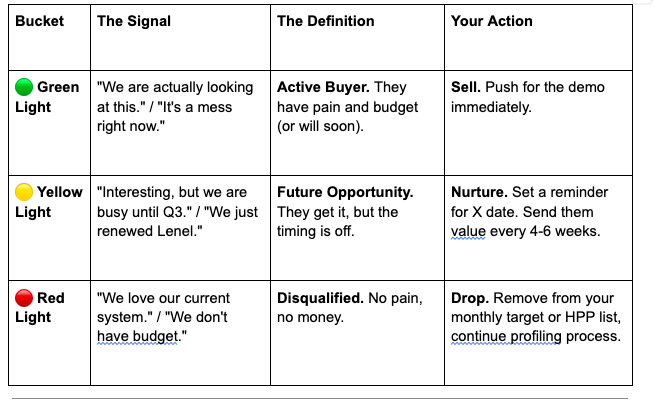
The Art of Sales Profiling: The "Sort, Don't Sell" Methodology 𝙎𝙩𝙚𝙥 1: 𝙁𝙤𝙧𝙢 𝙖 𝙃𝙮𝙥𝙤𝙩𝙝𝙚𝙨𝙞𝙨 (𝙏𝙝𝙚 "𝙒𝙝𝙮 𝙔𝙤𝙪?") Before you contact anyone, you must have a theory on why they might have a problem. We use Triggers for this. The Trigger: "I see they just opened a new warehouse in Atlanta." The Hypothesis: "They probably have a headache managing keys and cameras for that new site remotely." The Action: Write down one hypothesis for the account. 𝙎𝙩𝙚𝙥 2: 𝙏𝙝𝙚 "𝙋𝙤𝙠𝙚" (𝙏𝙝𝙚 𝙊𝙪𝙩𝙧𝙚𝙖𝙘𝙝) You are not asking for a marriage, you are asking for directions. Your outreach should verify if your hypothesis is true. Bad Approach (The Hard Sell): "We have the best cloud cameras. Can we meet Tuesday?" Profiling Approach (The Poke): "I saw the new warehouse opening. Usually, that creates chaos for IT teams trying to manage access remotely. Is that something you're dealing with, or is the current system holding up?" 𝙎𝙩𝙚𝙥 3: 𝙏𝙝𝙚 𝙎𝙤𝙧𝙩 (𝙏𝙝𝙚 𝙏𝙧𝙖𝙛𝙛𝙞𝙘 𝙇𝙞𝙜𝙝𝙩 𝙎𝙮𝙨𝙩𝙚𝙢) Based on their reply (or lack thereof), you sort the account into one of three buckets. This is the most critical step for your long-term income. Profiling is the act of human-validating a "lead signal" through low-stakes interaction. It is Diagnostic, not Persuasive. It is Information-Gathering, not Appointment-Setting. It is the process of turning a "Subjective Lead" (looks good on paper) into an "Objective Prospect" (has a confirmed reason to change).

@johann_sath ·
i automated my sales cycle with openclaw here's my setup: 1. openclaw sends cold emails nightly 2. lead books a call 3. openclaw does deep research on the lead before the call 4. i take the call. fathom records it. 5. fathom sends transcript to openclaw automatically 6. openclaw builds a custom proposal from the call 7. openclaw messages the lead: "let's hop on a 2nd call to go over your proposal" 8. 1 hour before the proposal call, openclaw pings me with the proposal & notes 9. i take the proposal call. fathom records it. 10. transcript goes back to openclaw if closed: openclaw emails payment link + onboarding steps to the lead if not closed: openclaw tracks it. after 3 days, sends a winback message with a better offer i don't touch any of this except the 2 calls. 10 steps. 2 are me. 8 are the bot.

@pipelineclub100 ·
How to ask better sales questions: Internalize the idea that you must leave the first conversation with a clear picture of their current state, what they want to change, why they would change, and what’s stopped them from changing already using their current tools. Just ask questions till you understand this with every deal.

@romanbuildsaas ·
If I had to get 5 sales calls from LinkedIn this week with no warm intro, I would not start with a lead list. I’d start here: 1. Find 10 posts from competitors or adjacent tools from the last 14 days. Ignore likes. Read the comments. I only care about people asking things like: - “do you have the template?” - “what tool did you use?” - “how do you set this up?” - “does this work for B2B?” - “can you share the workflow?” 2. Pull 50 people from those comments. Then delete anyone who: - is not in the ICP - is selling the same thing - has no active company - only left a generic comment - has no reason to care this month 3. Write the opener from the comment. Example: “Saw you asked for the Clay + LinkedIn setup under [name]’s post. Are you trying to find warmer accounts, or just cut the research time?” That is enough for a first message. No pitch. No fake compliment. No 6-line AI paragraph. 4. Send 15-20/day. If the first line cannot point to a public action, I don’t send it. 5. Use AI after the signal is found. AI is useful for: - finding comments faster - sorting the list - summarizing the trigger - drafting the first version But the list still has to start with intent. Otherwise you just send colder messages faster.

@TheGeoMethod ·
The biggest scam in sales training: Objection handling. Every sales course teaches it. Every sales manager drills it. Every rep thinks they need to get better at it. Complete waste of time. Trying to counter objections with the “perfect response” is like putting perfume on a garbage bag, hoping it kills the smell. The bag would’ve never smelled in the first place if you hadn’t put garbage in it. Most people are obsessed with how they should respond to: “It’s too expensive.” “I need to think about it.” “Send me some more info.” So they memorize scripts, practice rebuttals, and collect clever one-liners. Then walk into meetings hoping the objection appears so they can use them… just itching to try out that new perfume. But the reason the objection appeared in the first place was because: • The conversation was poorly controlled • The problem wasn’t made clear enough • The consequences of doing nothing about it were never fully explored So when the moment of decision arrives, the buyer stalls. Great salespeople prevent objections long before the proposal appears. They surface concerns early. They pressure-test the problem. They make the cost of inaction obvious. They ask questions that force the buyer to confront what happens if nothing changes. By the time the offer appears, the objections have already been dealt with. That’s why the best closers rarely argue with objections. They eliminate the conditions that create them.

@TechSalesGuy ·
Cold outreach methods ranked: Tier 1 (>30% success): - intent signals - website visits, downloads etc. - old opportunities you re-target - warm intros or referrals Tier 2 (high effort, high reward): - cold calling with research - handwritten notes + small gift - personalized videos Tier 3 (volume plays): - LinkedIn connection requests - commenting on peoples posts - mass email

@kylegawley ·
If you're at $0 revenue you should not be selling. You should be learning. Cold pitching is not going to work because you don't yet know who your customer is or what the best offer is. This does NOT WORK: > Hey Kyle, saw you're the founder of Gravity we help startups [insert irrelevant offer] Do this instead: Message people and *ask for help* > Hey Kyle, I'm building a tool for founders working in [industry] and trying to validate a few assumptions about the market. Given your expertise in [industry] can I send you a quick question. No worries if you're busy, thanks. 90% of people will reply to a message like this if you just ask for help. Talk to them and learn. 1. Do they have the problem you solve? 2. Will they pay for a solution? 3. What language do they use? This will help you refine your target customer and offer. 9 conversations like this is better than 100 unread DMs. Apply what you learned to your landing page, social media posts and future cold outreach.
@LoganTGott ·
A 5-step outbound system closed a multi 6-figure deal. (For a client). Here is exactly how it works: 1. Build a qualified lead list before sending a single connection request. Use Sales Navigator. Filter by industry, geography, role, and company size. For this client: SaaS companies, US-based, founders and CEOs only, companies generating meaningful revenue. You can analyze if they're generating revenue by hovering over their company page once saved to your lead list. 2. Max out 200 connection requests per week without exception. That's 40 per day, Monday through Friday. At roughly 50% acceptance, you're getting into about 400 DMs per month. Most won't be ready to buy right now, which is exactly why the follow-up sequence matters. 3. Send a first DM that proves you actually looked at their profile. Skip the pitch and the vague "love what you're building." Reference something specific about their company, then briefly cover who you are, what you do, and what you've done for similar companies. Close with a soft CTA like "if you're looking to do X, happy to jump on a call." 3-4 sentences max. Long first DMs signal desperation. 4. Run 2 follow-ups on everyone who doesn't respond. First follow-up goes out a few days later. Keep it light. Assume they missed it, not that they ignored you. That framing keeps the tone relaxed. Second follow-up is the closer: "Last time I'll message you. If you're ever interested in X, just let me know, no problem either way." Then leave it. That second follow-up is the one that closed this deal for my client. 5. Post consistent content so your profile backs up your DM. This prospect never engaged with my client's content before responding. But when someone gets a DM from a stranger, the first thing they do is click the profile. My client had been posting consistently for about a month. Specific content about SaaS websites and what separates high-converting sites from ones that leak pipeline. When the prospect clicked through, he saw someone who clearly knew the space. What does your outbound system look like right now?

@itsalexvacca ·
We've built GTM systems for 300+ B2B companies. The sales vs marketing blame game shows up in almost every single one. Sales says the leads are garbage. Marketing says sales can't close. And honestly, both are usually right. Because they're working from completely different account lists. Here's how we fix it: > Start with one master TAM. One single list of every company that could buy from you. > Enrich every account in @clay. Firmographics like headcount, revenue, industry, geo through @FullEnrich. > Technographics from @BuiltWith and @TheirStackApp showing what tools they already run. > Funding rounds, hiring patterns, and growth signals from @Crunchbase, @PredictLeads, and LinkedIn Sales Nav. > Build a scoring model from your closed-won data. > Companies that look like your best customers score high. > Companies that look like your churned accounts score low. > Tier every account. > Tier 1 gets full resources, personalized outreach, dedicated sequences. > Tier 3 goes into long-term nurture. > Sales knows the tier before they ever pick up the phone. > Point both teams at the same scored list. > Marketing runs campaigns against it. > Sales works outreach from it. > Same accounts, same scores, same priorities. > Measure marketing on pipeline from target accounts, not MQL volume.


@jeremynickmoser ·
Just watched a call recording of a closer making $30k/mo in straight commissions Call was 18min long 1) No discovery or finding prospects pain point. Just straight into asking if prospect had questions. 2) After showing some results just drops the program price. No program overview. No deliverables or pitch. Just a price drop. 3) 0 objection handling. Just said "cool, let me know if you want to move forward". Just more proof how much marketers improved vs. how little sales reps improved Bar truly never been lower for ACTUALLY good sales reps to make a fat killing.
@romanbuildsaas ·
I was talking to a founder who raised $15M for his Series A. I asked him how he still makes LinkedIn outbound work in 2026. Here’s exactly what he told me 👇 1. Use real people, not a company page. Company pages are useful for credibility. But conversations usually start with: → a founder → a seller → an operator → someone with a face and a strong point of view 2. Pick one market. “B2B SaaS” is not a market. “VP Sales at a 40-person SaaS company hiring SDRs after commenting on a post about warm outbound” is. The worst outbound lists are often technically correct… but commercially useless. 3. Build lead sources from public actions. He mainly looks at: → comments under competitor posts → people asking for templates or workflows → profile/company page visitors → hiring posts for sales/growth roles → founders engaging with content related to the problem 4. Write hooks with context. Bad opener: “Saw your company is growing fast.” Better opener: “Saw you were looking for a way to book more demos. We recently helped a company in your space identify high-intent prospects and generate 2–5x more demos from outbound without increasing volume. Reply “YES” and I’ll send you the full guide.” The first line only has one job: prove there is a real reason to contact that person. 5. Every message should deserve a reply… or a forward. Before sending, he asks himself: “Would this person forward this message to a teammate?” If the answer is no, the message is probably too generic. 6. Reply publicly before sending the DM. If the signal came from a comment, he replies publicly first. That makes the DM feel like a continuation… not an ambush. 7. Send a blueprint before asking for a call. He never starts with: “Do you have 15 minutes?” He starts with: “I can send you the exact setup we use for this if useful.” The resource often sells the problem better than a Calendly link ever could. 8. Keep the volume intentionally boring. He would rather send: → 50 high-quality DMs/day → from 3 real intent sources → with one clear reason per prospect …than 300 “personalized” messages from a scraped list. 9. Kill bad sources fast. After 50 leads: → no replies → weak roles → low-quality conversations → stale triggers He immediately stops using that source. 10. Use AI only AFTER the signal is clear. AI is useful for: → summarizing profiles → improving openers → drafting follow-ups → matching the right blueprint to the right prospect But AI should not decide that a random job title = a warm lead. Outbound in 2026 is no longer a volume game. It’s a game of: → attention → timing → context The best teams are not the ones sending the most messages. They are the ones spotting intent before everyone else… and showing up before the buyer starts comparing 5 vendors.

@basedbrickpush1 ·
People always complain about getting old but there are also perks to getting up there in years. One of the perks is experience. I think experience mostly boils down to you learning from mistakes so you don't fail in the same way going forward. Saves you sooooo much time. Had this happen recently: Name of a prospect pops up during a team meeting. I know the name because he has been wanting to work with us for a while now. But he had doubts. That's fine. It happens. No one is perfect. One of my team members reached out to talk to him. 30 minute conversation. Answered all questions. Everything was crystal clear. But... the prospect still didn't pull the trigger. So a week later I reached out to ask if he was ready to get started. He sent me another list of questions. Stuff like: "I know you guys do this all the time and I've seen case studies, but can you give me extra guarantee X and extra guarantee Y?" "My uncle said he tried this Google thing once and it didn't work out, what do you think of that?" "I was looking online and I found another guy that does roughly the same thing you guys do, but he charges less money. Can you do it for less?" There was more, but you get the idea. Young inexperienced Arno would have gone through this entire list and answered every point. Would have taken me at least an hour. Experienced Arno knows that would not solve anything. If someone has received all the information AND gotten the chance to ask extra questions AND he is STILL shopping around? Still questioning his decision? Still heavily in doubt? It's probably not the right moment for him to make this move. So I told him: "hey man, if you have doubts about this and you don't think now is the right time to start working together, I think you shouldn't move forward." If you're in sales (and we all are, even if your business card says something else) it's NOT your job to cram stuff down people's throat. That's how salespeople got their horrendous reputation in the first place. I hate high pressure sales. Just leads to angry and disappointed people. Your job as a salesperson is to see if your product/service is a good fit for the guy you're talking to. If yes -> you make the sale. If no -> you don't make the sale If not right now -> you don't make the sale NOW but follow up later Very simple. Saves everyone time. Makes all parties a lot happier. Try it out.

@nrmehta ·
How to Fail In B2B Sales: Poor Exec Alignment If you're a founder, a simple KPI for your personal impact on sales is simple: the # of client/prospect execs with whom you text. Too often, lack of exec alignment is a failure mode in B2B: * The Deal that Never Was: Salesperson works on a deal with a prospect's functional buyer. Everything is going "great." They needed it "yesterday." It's "down to formalities." Last day of the quarter: "the boss decided they need more time." * The Churn That Always Was: Exec sponsored the deal but wasn't involved. Deployment starts. Functional user in charge. Sets it up based upon his 100 requirements, none of which the exec cares about. Exec logs in 3 months before renewal and says "WTF is this?" Forgets why they bought in the first place. Surprise churn. How do you do it the right way? The best CROs know WAY more about it than I do, but here are some things that worked for us at Gainsight: 1. Mid-stage deal exec check-in from founder: Email (you usually don’t have a texting relationship at that point) to the effect of “I’ve heard our teams are working on a project to [business goals]. I’ve found most software deployments succeed or fail based upon alignment to the client’s business strategy. Do you have 15 min to make sure we understand your personal objectives? We’ve heard them from your team but would love to hear what’s on your mind.” Ideally do it as a phone call so it’s more intimate. Text afterward a thank you. If they text back, you now have a texting relationship. BTW if they write back to the email and say “I haven’t heard about this project” (which will happen), you’ll have good forecasting data! There is a risk that your functional buyer gets pissed. Be careful and coordinate with your rep on it. Sometimes, the strategy works with the rep feigning plausible deniability (“my founder did what? I’m so sorry.”) Def don’t reach out without coordination on big deals. 2. Focus the call on them: It shouldn’t be about selling your product. What are the challenges they’re facing now? Asking in the right way is key. “What are your goals?” sounds naive. But something like “I’ve found that a lot of execs I talk to are struggling with showing the ROI of AI projects - is that something you’re dealing with?” demonstrates you’re an expert. 3. Make each call value add: What can you bring that truly helps them? An intro for the exec to a peer at another company? An article about a best practice unrelated to your product? A survey they can use for budgeting? 4. Don’t overuse: Be careful about contacting too many times. I’d say 1-2 in the deal cycle is plenty. 5. Kickoff call: Join the first implementation call and invite the exec. It’s so powerful when they share their vision to both teams. 6. Escalation: Get personally involved in escalations. Do not delegate. Send proactive regular updates on status. 7. Launch: When the product is rolled out, help them make it a win. We’d do launch videos for clients with me speaking. I’d join their All Hands. We even dressed up in costume if the client had a theme (e.g., Avengers) for the deployment! 8. See them: Go to events where you’ll bump into them. Fly to their office. Meet them at a local Starbucks. Don’t wait to be asked. “I’m in [their city] next week - you around for a walk?” Meet 100% of your large, early clients face-to-face. 9. Celebrate: When their team does something awesome, share it. “My team mentioned your team is one of the fastest adopters of our software. Congrats - that’s all on the leadership of your company.” 10. Be there: Be ULTRA-responsive. Ideally shoot for minutes to get back to them. 11. Have fun: The human relationships I built with our clients was one of the most satisfying parts of my job. Many are friends to this day. Those worked for us. Mileage may vary. Obviously none of that scales to a low end price point. But for complex, high-value software, exec alignment is everything.

@HarryStebbings ·
The three best sales leaders I have interviewed are @PeetsChad, @Carles_Reina and Becca Lindquist (guest today). Becca has scaled Clay's revenue machine to $150M in ARR with 200% net revenue retention (NRR). Today I released our episode and condensed my notes here. 🚀 8 Lessons on Building a $150M+ ARR Machine 1. Hire in Pairs to Eliminate Guesswork Never hire a single rep in a new role or territory. When you hire one, you can't tell if success (or failure) is due to the person or the market. When you hire two at a time, it becomes immediately clear who is the outlier and what is truly working. -- @jasonlk any advice or thoughts on this? 2. Guard Your Culture with "60/80" Attainment A winning culture isn't built on one superstar; it’s built on collective success. Aim for a distribution where 60% of your team is over 100% of their quota, and 80% of your team is above 80%. This prevents a "zero-sum" environment and encourages reps to help each other win. -- @Carles_Reina how much of team should hit quota vs not? 3. Incentivize Over-Performance Heavily If you give a rep a big quota and they hit 110%, they should make life-changing money. Variable comp plans should be simple and heavily weighted toward accelerators. Paying only flat salaries or capped bonuses is "arrogant" and fails to attract the elite talent needed to scale. -- @vxanand biggest lesson on sales comp plan since starting Clay? 4. Look for the "Personal Win" in Champions A true champion isn't just someone who likes your product. They must meet three criteria: - They sell for you when you aren't in the room. - They have access/influence over the Economic Buyer. - They have a personal win. Whether they want to become "the AI person" or get promoted, if your tool helps their personal brand, they will go to war for you. -- @mark_goldberger biggest advice on how to find enterprise champions within accounts? 5. Outbound is Not Dead—It’s Evolving Ignore the "outbound is dead" headlines. You cannot reach every buyer through passive marketing. However, the modern SDR must be "tooled" with an AI stack (like Clay and Claude) to focus their energy on the right accounts rather than manual data entry. 6. Solve the "Basics" Before the "Pie in the Sky" When selling AI, stop talking about "the art of the possible". Customers want to solve real, boring business problems first—like an AI tool that flags when a rep has a close date in the past. If you can't tie your widget to a dollar outcome or a specific business pain, you don't have a deal. 7. Everyone Owns Pipeline (Even the C-Suite) Pipeline generation is a team sport. Use "Multi-threading Requests" to get your VCs, CEO, or Chief of Staff to reach out to targets. A message from a Sequoia partner or a founder often gets a response when a rep's email gets ignored. -- @andrew__reed have heard you are insane for BD for Vanta! What advice do you have for founders on how to get most from their VCs on BD and intros? 8. Beware of the "Learning Plateau" Biggest red flag on a resume is staying at a legacy company for 10+ years where the learning curve has flattened. Becca looks for "non-traditional" sellers who have a clear story of building expertise in a specific sector. If you feel like you’re "rotting", it's time to move. (Link in comments)

@matt_gray_ ·
Ran a sales experiment this month that instantly boosted my close rate 13%. gave my closer a pre-call brief generated by AI before every meeting. it pulls the prospect's website, social, previous interactions, and creates a 1-page cheat sheet. his close rate went from 38% to 51% in 3 weeks. Proved that the meeting doesn't start when you join the call. it starts when you prep the call.

@alexabelonix ·
The best AI sales workflow I’ve seen is boring in the beginning and dangerous at the end. It starts like this: form submission → enrichment → BANT/ICP score → hot/warm/cold → CRM → follow-up Basic. But then it gets interesting: every lost reason goes back into the system. every objection improves the next message. every closed-won account updates the ICP. every call transcript improves qualification. That’s the real loop. AI sales is not “write my emails.” It’s a system that gets less stupid every week.


@alexmdees ·
Something I learned over and over again: never automate until something is working repeatedly. The first 5 sales you make manually are worth more than automating 10,000 cold emails. Essentially: Contact > Scale When I was getting Meridian off the ground, I wanted to be close to the friction. Close to the objections. Close to the moment someone hesitates. The support rep for customer. It was the slow uncomfortable part. There was really nowhere to hide in that process. But it forced clarity. Once I knew - The language that resonated - The objections that actually mattered - The positioning that felt obvious THEN automation became powerful because it multiplied something that was already working. If I can't sell something one-on-one, I don't trust it enough to systematize it. That's still how I think about every new motion we build.


@AdamrahmanGTM ·
The outbound systems that turns cold campaigns into warm pipeline: Automated Outbound (builds the pipeline): → Set up LinkedIn infrastructure (HeyReach) + email infrastructure (EmailBison) → Build lead lists → Enrich data → Score leads → Write personalized copy → Launch automated campaigns → Positive replies sync to CRM via OutboundSync Sales Team (works the pipeline): → Receives warm leads in CRM (Hubspot / Salesforce) → Follows up via LinkedIn DMs / Cold Calls / Emails → Books meetings → AE runs sales calls (recorded via Sybill) → Closed Won Automation builds the pipeline. SDRs/BDRs works it like inbound. AEs close.

@oliverbrocato ·
If ur booking lots of sales calls They all “go well” but nobody actually moves forward… Buddy, u have a closer problem. How I would fix it: 1/ Weekly pipeline meetings Review EVERY lost deal. Especially the ones that “felt good.” 2/ Diagnose every loss. Ask: - What objection did we miss? - Where did momentum die? - What should we have done differently? “Bad timing” is not an answer. 3/ Tag the pattern. Is it pricing pushback? Tire kickers? Weak follow-up flow? Patterns tell u what to prioritize fixing. 4/Audit lost calls for 30 days straight. Adjust. Refine. Repeat. And watch ur close rate 4x Most founders obsess over why they won. Only the best ones obsess over why they lost.

@morganjingram ·
I booked a meeting this week using a play nobody on my client’s team had seen before. Here’s what I did: Step 1. Went to the company page in Sales Nav (not the people... the company page) 2. Screenshotted their department headcount growth 3. Sent the screenshot in a LinkedIn DM with one question: “You’ve got a 95% increase in sales openings in the past 3 months. How are you making sure the reps you onboard are successful so you don't have to backfill?” That sparked a conversation.. that led to a meeting booked. We live in a world where buyers don't even trust us.. that is why the screenshots says a million words. It proves I wasn’t making it up. People are snoozing on this one AEs.. lock in and try this one out. Thank me later.

@itsmarcosruiz ·
I still do all my own sales at The Birdhouse. People think that's crazy, but when you're selling high ticket packages prospects want to talk to the founder. That doesn't mean I haven't worked on my sales skills though. The big shift for founder-led sales = selling results instead of tactics. Early on I used to hop on calls and explain everything we do. The content strategy, the DM scripts, the posting cadence, the analytics. I'd basically give away the whole playbook on a 30-minute call. And people would say "this is great, let me think about it" and then go try to do it themselves. Now, I just talk about where they are and where they want to be. If someone tells me they want to double or triple their revenue, I'm not explaining our content pillars. I'm asking them what's broken in their current setup, what they've already tried, and why it hasn't worked yet. By the time I've asked the right questions, they've sold themselves on needing help. I just made the gap between where they are and where they want to be extremely clear. The shift is this: Value content attracts competitors and admirers. Insight attracts buyers. On calls, it's the same thing. If you explain HOW you do everything, they leave thinking "I can figure this out." If you show them WHERE to look and make the gap obvious, they leave thinking "I need someone to take me there." Also, I don't need to "close" any of the deals. People can smell desperation from across a Zoom call. When you have a full pipeline and super high retention rate, you can be honest about whether someone is actually a good fit. That honesty closes harder than any sales technique. So if your close rate is low, ask yourself: Are you selling tactics instead of results? Are you explaining the process instead of making the gap clear? Fix the positioning and the close rate takes care of itself.

@remoteoliver ·
One of my mentees hated sales calls. Not because he wasn’t good but because he hated wasting time proving himself. For context, he’s in one of the most competitive niches out there. Told me every call felt like an interrogation. -“Can you show me past work?” -“What’s your process?” -“How do I know you can deliver?” The fix? We built a pre-sale flow that answered all of that before they ever jumped on a call. It shows the journey, the experience, the pricing, the problem and the clarity up front. By the time someone books a call now, they’d already decided they wanted to work with him. Perfect. Now his calls feel more like onboarding than pitching. He knows they’re going to pay. He knows roughly how much. And he’s not justifying his existence for 30 minutes. If you fix what happens before the call, the call becomes easy.

@danmall ·
If sending outreach drains you, the problem isn’t outreach. It’s what you’re trying to sell. Think about a restaurant you love. You tell friends. You tell colleagues. You tell strangers if the moment’s right. If someone’s not interested? You don’t feel rejected. You just tell the next person. Because you’re not pitching. You’re sharing. Now flip it. If everyone you tell doesn’t care, you don’t conclude: “I’m bad at talking.” You conclude: “People don’t want to hear about restaurants from me.” And that’s the real signal most people miss in sales. Exhaustion isn’t a motivation problem. It’s a relevance problem. Common mistakes I see: ↳ Convincing instead of sharing ↳ Pushing offers you don’t fully believe in ↳ Needing complicated scripts to get through the conversation ↳ Taking “no” personally because you’re emotionally over-invested The shift: ❌ Stop asking: How do I sell this better? ✅ Start asking: What do I naturally talk about without effort? That’s the thing worth building an offer around. Because when the thing is right: 🟢 Outreach feels light 🟢 Rejection feels neutral 🟢 Conversations feel natural 🟢 Consistency stops being hard The goal isn’t to convince more people. It’s to talk about something that doesn’t require convincing. What’s something you can’t help but talk about and share every day?
@AdamrahmanGTM ·
Cold email is the most honest test of your sales messaging. In a live conversation, a skilled rep can adapt, redirect, and recover from a bad opener. In an email, you get one shot. 50 words. No body language. No rapport. If your message can work in a cold email, it'll work everywhere. If it can't, your reps are compensating for weak messaging with personal skill. That works until you try to scale. Then it breaks.

@MakadiaHarsh ·
My best sales came from NOT selling. Guess what? I built a sample POC for a client without them asking. Found an AI tool that could 10× their data processing speed. Showed them how it could work as an extension. Result? They immediately asked me to implement it live. Trust me on this: Stay proactive for your clients. Treat their business like it's yours. They'll keep coming back.

@NickAbraham12 ·
Impressive but low effort thing you can add to your sales process: Have your AI note taker join every call and review the recordings beforehand. Then reference something specific from the previous conversation. Example: > AE knows what was discussed on the SDR qualification call > AM knows what was discussed on the AE sales call Shows that you came prepared which goes far when selling in B2B

@evanseech ·
I had a closer on a client's sales team with 23 qualified calls. He closed a grand total of 0 of them. When we gave him clear feedback, he decided the leads were being planted. GENUINELY convinced himself the prospects weren't real people. That's a narrative. And narratives are sneaky. They FEEL like logic. Like legitimate observations. But they're just stories your brain makes up to avoid accountability. His narrative: ”Cold traffic calls close differently than referrals.” True. But his response… Run the exact same call on cold leads as warm ones. Blame the outcome on everything but himself. And that narrative of his is the REASON he was failing. Now your narrative? It’s probably a LOT more subtle. E.g. "Nobody below $3M ARR can afford my service." or "I'm not an expert yet, so I shouldn't post content." Every one of those is a story costing you money. Write down the narrative holding you back right now. Then write down the inputs you need to shatter it.

@Lukealexxander ·
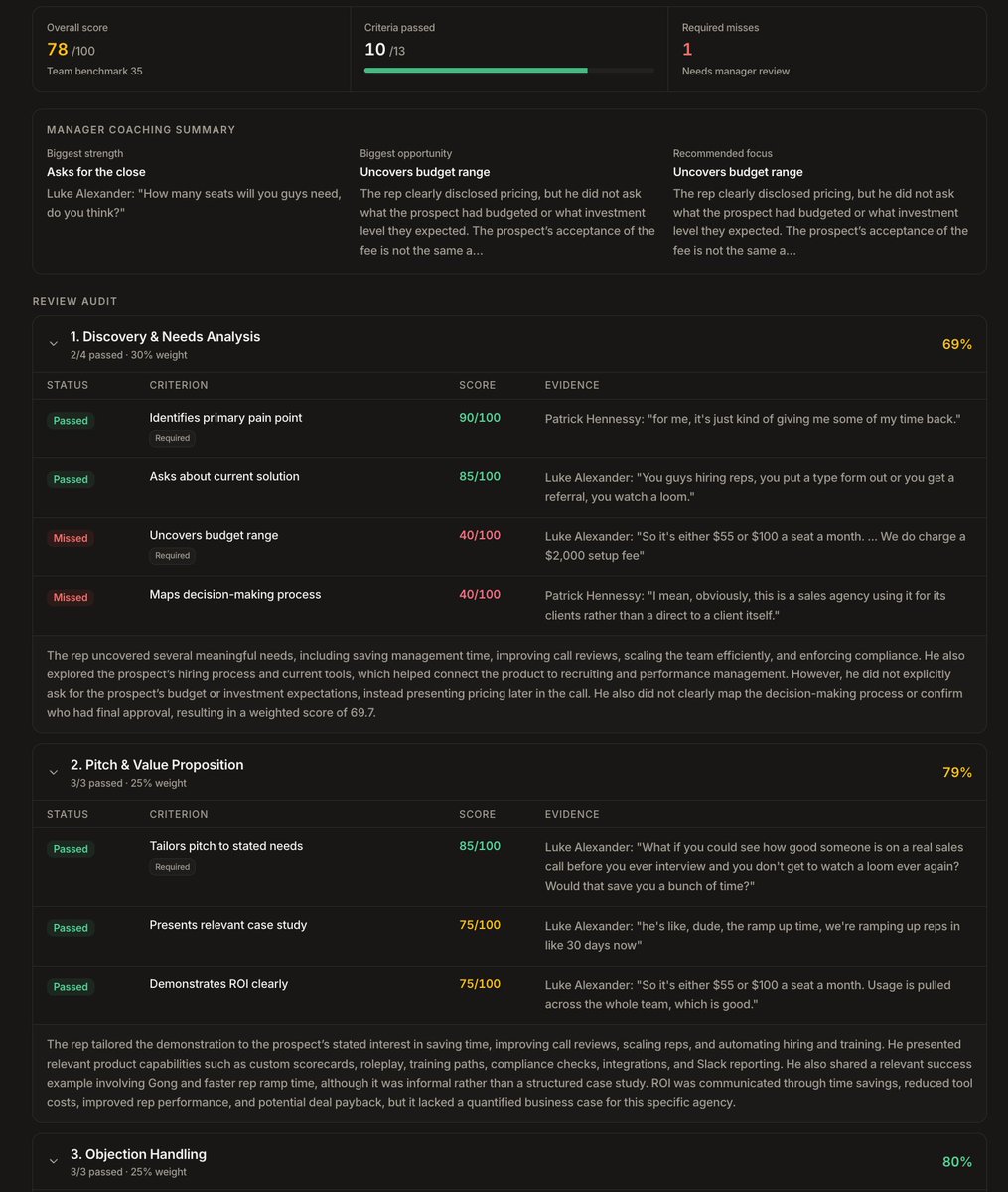
If you run a sales team and review calls by hand, please STOP. Your reps take hundreds of calls a month. You have time to listen to a handful. So you cherry pick a sample, review it when the calendar allows, and give feedback from memory. Everything outside that sample is invisible. The blown discovery on Tuesday, the discount that got promised without approval, and the objection your newest rep fumbles every single time. You catch what you sample. Manual review made sense when it was the only option. It stopped being the only option. The fix is a scorecard on every call. Same rubric, every rep, every conversation, scored automatically. Feedback stops being an opinion about a sample and becomes data on the whole team. How we built it in Kendo: Every call gets scored the moment it ends. Live calls and practice calls, all on the same card, zero manager hours. Your methodology becomes the card. Build it from scratch or start with BANT, MEDDPICC, or NEPQ. I ran 200 of my own calls through AI, got an 8 page scoring rubric back, pasted it into the builder, and it worked on the first try. Different call types get different cards. Whether its discovery, follow up, etc. Make the card hard. My closed deals score 77 to 78. The best sales call of my life scored an 80. (We created very difficult scorecards for ourselves). Every score feeds the rep's skill profile: what they're strong at, where they leak deals, what to drill next. Then training gets assigned on exactly that weakness, the training calls get scored on the same card, and the loop closes. Your top rep gets sharper. Your newest rep ramps in weeks. You get your evenings back.

@heyblake ·
Let's say your sales team has been in 200 conversations this quarter. Your marketing team has been in conference rooms. This is why your sales team is right and your positioning team is wrong. Every conversation your AE has where the buyer says no, that's a data point about what your positioning is missing. Most companies never connect these two things. Your sales team learns through repetition that objection Y is the one that actually stops deals. Your product team never hears it. Your marketing team never hears it. Your founder keeps writing headlines about the thing that sounds impressive in the room instead of the thing that actually matters. So here's what you do. Record the objections. All of them. Not in a CRM note that nobody reads. In a list. Like a real inventory. Now find the top three. The ones that appear in 30% of calls. Those are your real objections. Your homepage should answer the first one before the headline even lands. Your second call to action should solve the second one. Your pricing page should acknowledge the third one. Now your positioning is evidence-based. It's built on evidence. The companies that do this convert 30% higher than companies that position from the clever idea in the room.

@TheInfoDon ·
Most people suck at follow up because they treat it like sales instead of marketing Whether you are trying to get hired, signing agency clients, or in sales Sit down once a week Record a few short looms per prospect type or target niche Actually spend a few hours planning them out to make them valuable Choose 1 problem they all have Record a video solving that problem with a different angle for each prospect type Don't make it generic, actually do some research and force yourself to speak about useful new insight Ideally you wanna use insights from your own work in the past week or so If you can speak like a real human and be concise but valuable most people will just hire you/pay you Most people who are in their buying window will buy within 1-3 times of you doing this because no one else does it Treat almost like a YouTube 'how to' series tailored to your prospect And it's semi scalable Every sales rep I've worked with that does this or uses specific videos from the creator lands like 20-40% of their deals from follow up I also know a few agency owners who land clients doing this It's cool because it's something new

@jordan_ross_8F ·
The reason I say "sales operations" is because sales, when done well, IS an operation. You should be able to convert your prospects into new clients who are excited and eager to work with you. But most agencies have this completely backward. Poor sales operations look like: ❌ Most sales built around you, the founder ❌ Very little documentation or automation in your CRM ❌ No attribution tracking (you don't even know where leads come from) ❌ When you bring in closers or SDRs, they can't be successful (no effective training, no effective offering) If you build this correctly: ✅ Documented process from the second someone books a call all the way to close (plus all nurturing sequences in between) ✅ Your CRM constantly gives you clarity on what's in pipeline ✅ You're getting automated reporting on a daily basis ✅ Your sales team automatically qualifies through automations (they don't jump on calls with unqualified prospects) ✅ Your closing rate is at least 25% on deals made to qualified prospects—bare minimum When you build this well, it's easy to track. It's easy to define who's a good hire and who's a bad hire. It's easy to push revenue through your pipeline and have predictability regardless of the season. This is where things get interesting: If you build sales operations correctly, it becomes a machine. You can plug in new closers, and they succeed because the system works, not because they're exceptional. That's the difference between owning a business and owning a job. Once your deals start coming through consistently, this naturally leads to your backbone system that holds everything together. If you disappeared for 30 days, would your sales numbers stay the same or completely tank?

@coleangelle ·
10 things that actually move the needle on a high ticket sales team: 1. Confirmation page with pre selling practices 2. Pre-call emails handling objections before the call 3. Pre-call SMS keeping leads warm 4. Closers doing zero admin between calls 5. Dollar per booked call tracked for every rep 6. AI reviewing every call for performance and compliance 7. Pipeline blasted 3 to 5 times per week 8. Value-based urgency on every call that doesn't close 9. Hiring closers with direct market sophistication sales experience. 10. Ad spend raised every time there is calendar availability and profitable roas. Most teams are only doing 2 or 3 of these.

@jeditrinupab ·
AI in sales shouldn’t just mean “write more DMs.” Better use cases: - analyze leads - summarize customer pain points - write contextual follow-ups - prioritize who to call first - build an objection bank - turn calls into CRM notes Bad AI sales = spam faster. Good AI sales = sell with more precision.

@alxberman ·
Cold email closed $100,000 in sales. Two clients. No phone call. No demo. No deck. Just one email sent to four existing customers describing an offer they already wanted. The money was already there. People go hunting for new clients when the easiest deal is sitting in their own contact list.

@jessicamalnik ·
I responded to every cold email that hit my inbox for a week, and somehow ended up with a raccoon haiku. Here's what actually happened. The goal was simple. Find out whether anyone on the other side was even listening and adapting in real time or just following a sequence. The results were all over the place. Some conversations ended the second they encountered an unexpected reply. Others kept going through increasingly weird detours without missing a beat. A handful of reps showed the kind of curiosity and persistence that made me want to keep the exchange going. I thought I was doing this to understand the state of modern sales, but ended up learning a ton more about how businesses build processes, make decisions, and where automation helps or hurts. I captured the whole thing and put together a video breaking down what I learned. https://t.co/hL5oHNmSaS

@morganjingram ·
I tested something new last week that I’d never done before. I led with a voice note on LinkedIn. Guy voice noted me back. Which I laughed so hard... That almost never happens. Then he went quiet for a few days. Ok I was like alright.. looks like I have to make some more moves. I came back with a screenshot from Sales Nav showing he’d hired 3 SDRs in 3 months. My message: “Looks like the team is growing. How’s the onboarding process been so far?” He told me exactly what was happening... Turns out he’s hiring a new VP of Enablement too... Meeting booked! Two things made this work: 1. I didn’t take the silence personal. I nudged with a new reason. 2. I showed the work instead of claiming I did the work. Screenshots are an easy money in LI DMs because its 100% deliverability. I never take anything personal in outbound. People are busy. Yet never forget to be pleasantly persistent.

@cem_hasoglu ·
the 3 conversations that made me money: "what would you pay to have this done for you?" (asked 40 times, got my first offer right) "who else should I be talking to?" (every sales call ends with this now) "what would it take for you to say yes today?" (closed 6 figures with this exact sentence) most of sales is just asking better questions
Best Tweets by Topic