Your impressions drop overnight, replies seem to disappear, and a post you can see on your profile doesn’t appear when you search for it. Is that a Twitter shadowban?
Usually, not in the simple “secret switch that hides everything” sense. X, formerly Twitter, uses the term visibility filtering for restrictions that can remove posts from search or recommendations, reduce their placement in replies, or limit how widely they’re discovered. The effect can feel like a shadowban, but the cause may be account-level, post-level, or specific to the viewer.
The right response isn’t to panic or buy a shadowban tester. It’s to identify which visibility pathway is affected, verify the symptom from outside your own account, remove risky behavior, and monitor whether reach normalizes.
What Twitter Shadowban Really Means on X Today
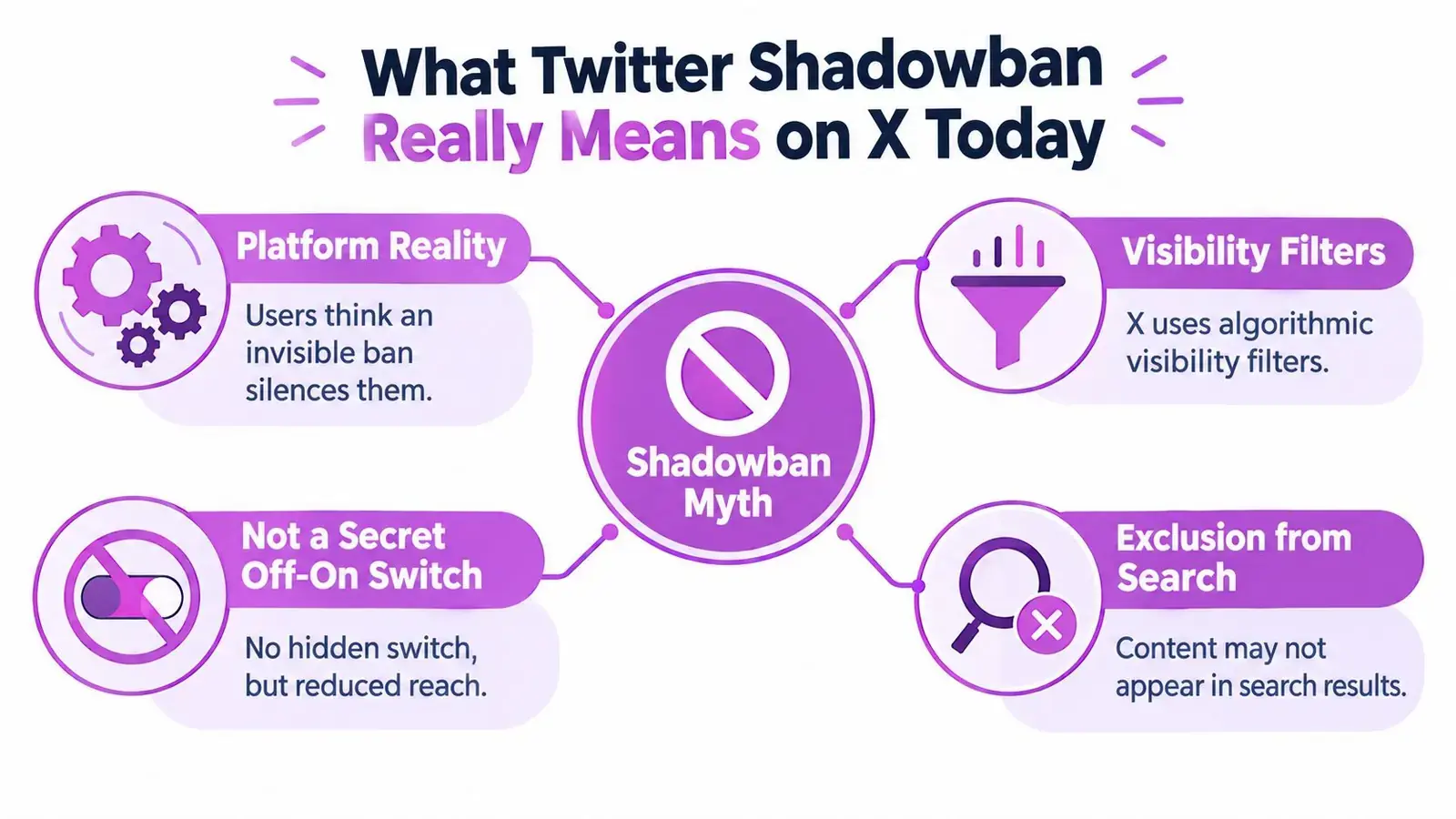
“Shadowban” is a useful folk term, but it compresses several different systems into one alarming label. X’s public enforcement language refers to visibility filtering, not a single hidden switch that turns an account off. Under that framework, a post may be excluded from search results, trends, recommended notifications, the For You timeline, or the Following timeline. X may also limit discovery to the author’s profile, downrank a reply, or restrict actions such as likes, replies, reposts, quotes, bookmarks, sharing, and editing, as summarized in X visibility-filtering guidance.
Think of X like a city with several traffic lanes. A full suspension resembles a road closure. Visibility filtering is different. Your account can still publish, but a particular lane, such as search, recommendations, or replies, may send less traffic toward your post. Ranking can also place a post lower without removing it entirely. That’s why a post may exist and remain visible to followers while receiving little discovery outside its immediate audience.
Three pathways that create the shadowban feeling
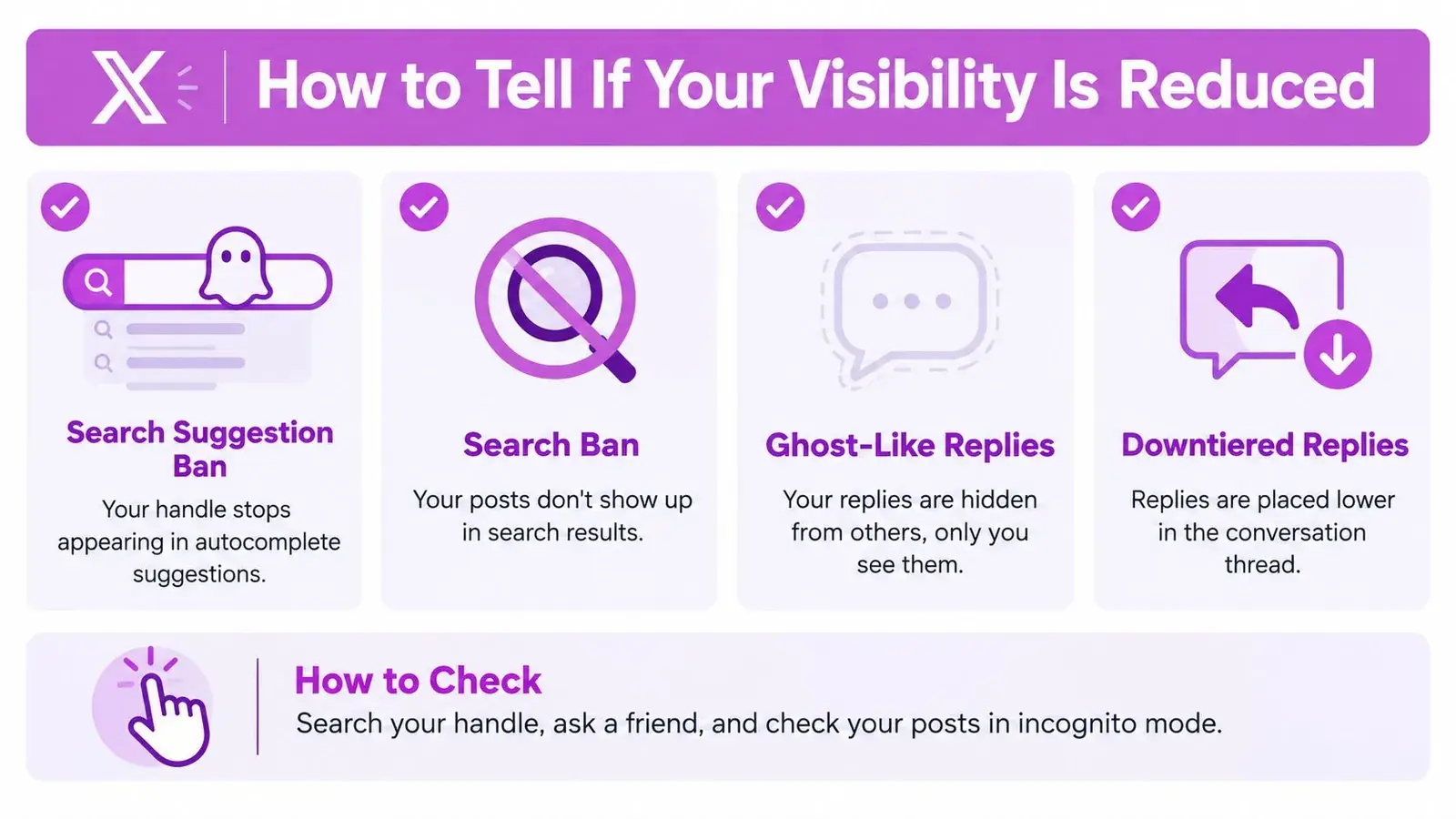
Account-level effects affect how people discover your profile or how the platform evaluates activity from your account. A search suggestion ban, for example, can keep your handle out of autocomplete and account suggestions.
Post-level effects apply to individual tweets, posts, replies, links, or media. A search ban may prevent a specific post from appearing in search, even when the post remains visible on your profile.
Viewer-specific effects depend on the relationship between a viewer and your account. A person may have blocked or muted you, or X may rank your content differently for that person based on their interactions and preferences. What disappears for one viewer may remain visible to another.
The distinction matters because each pathway needs a different diagnosis. Changing your posting habits won’t fix a viewer who muted you, and rebuilding your profile won’t necessarily restore a post excluded by a safety filter.
Practical rule: Don’t ask only, “Am I shadowbanned?” Ask, “Is the problem account discovery, post discovery, reply placement, or one viewer’s experience?”
For a deeper explanation of ranking and distribution, see this guide to the X algorithm. Research and platform experiments also support the broader idea that visibility depends on multiple ranking and filtering signals, rather than one universal penalty, as backed by Narrareach experiments.
How to Tell If Your Visibility Is Reduced
A reach drop is a clue, not proof. Impressions can fall because a topic attracted less interest, your recent posts were less relevant to followers, a conversation ended, or ranking changed. Start with observable tests that separate account discovery from post discovery.
Test the account before testing the post
Use a logged-out browser, an incognito window, or a second account that doesn’t follow you. Search for your handle and observe whether it appears in autocomplete suggestions. Current third-party explanations distinguish a search suggestion ban, which hides an account from autocomplete and account discovery, from a search ban, which prevents posts from appearing in search results, including exact-text searches, as explained in this breakdown of search suggestion bans.
Then test a specific post. Copy a distinctive phrase from it and search for that phrase while logged out. If the profile appears but the post doesn’t, the issue is more likely post discovery than account discovery. If the post appears but sits low in results, ranking may be the explanation rather than formal exclusion.
Check replies from another perspective
Reply visibility is harder to judge from your own account because you’ll always see your reply on the thread. Ask someone who doesn’t follow you to inspect the conversation. Check whether the reply is visible normally, placed lower in the thread, or hidden behind an additional replies view.
Historical Twitter mechanics make search testing especially confusing. One documented form of search suppression removed targeted tweets from results unless users disabled the default “quality” filter, which could reset after each search, according to coverage of Twitter’s historical search filtering. That means two people could search for the same post and see different results without the tweet being deleted.
Twitter also acknowledged that search results depend on ranking factors and previously described fixing a search bug after public shadowban accusations, as reported in Twitter’s explanation of search ranking.
Use a simple decision log:
- Handle missing from suggestions: Investigate account discovery.
- Profile searchable, exact post missing: Investigate post-level search filtering.
- Reply visible only to you or far down for others: Investigate reply visibility or viewer-specific effects.
- Everything appears normally, but impressions are lower: Treat it as a performance change until stronger evidence appears.
Track the results alongside your analytics rather than relying on memory. A structured Twitter analytics guide can help you compare impressions, profile visits, and engagement without turning one weak post into a diagnosis.
Step by Step Recovery When Reach Drops
Recovery starts with cleanup, not workarounds. Don’t rotate accounts, flood X with test posts, or use tools that promise to remove a shadowban. Those actions can create more confusing signals and make it harder to identify the original problem.
Start with an account and content audit
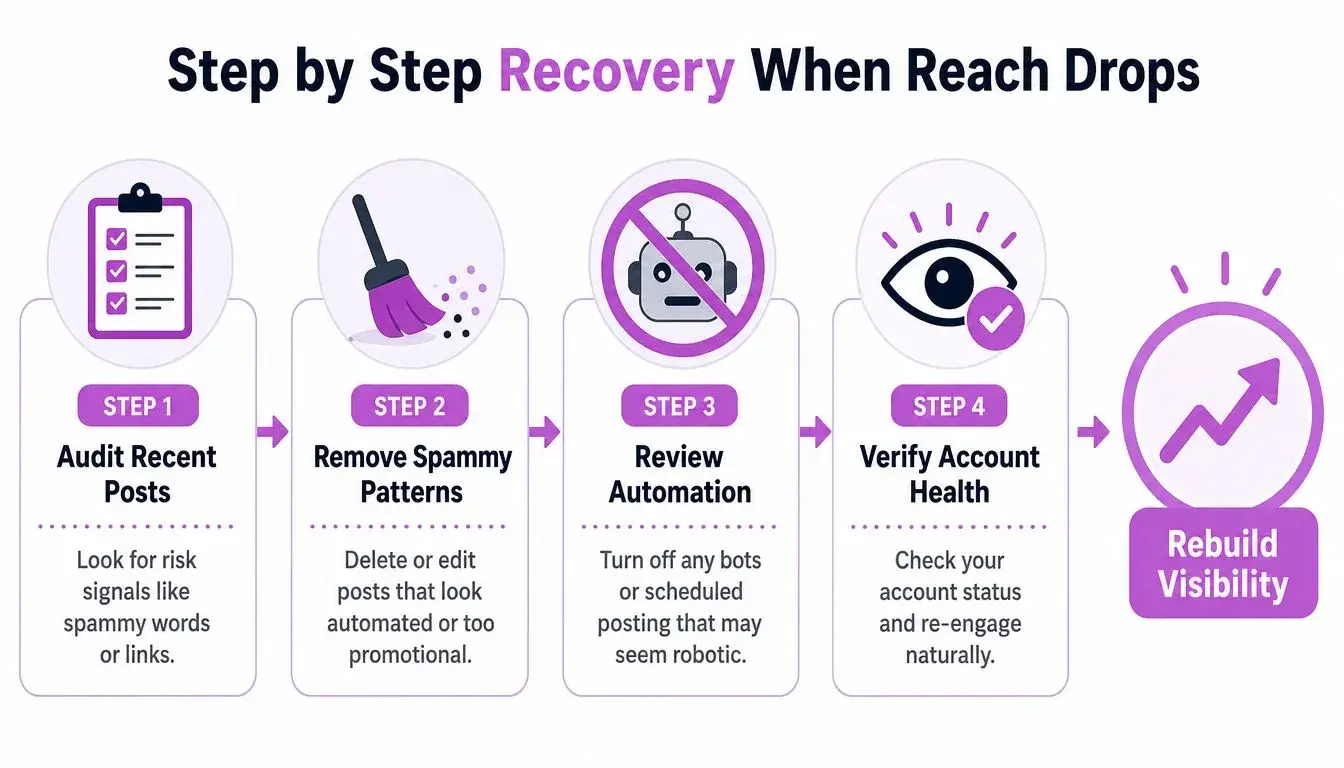
Review recent posts, replies, reposts, links, mentions, and hashtags. Look for patterns that make the account appear repetitive, automated, overly promotional, or disconnected from the conversation.
Pay special attention to:
- Repeated text and links: Near-duplicate posts can make legitimate promotion resemble bulk distribution.
- Generic replies: Short replies that add no context can look low-quality when repeated across unrelated conversations.
- Aggressive mentions: Tagging people who haven’t engaged with you can make a post feel intrusive.
- Risky content: Offensive language, suspicious links, or posts that may violate X rules deserve a careful review.
- Automation patterns: Examine scheduled posts, auto-replies, bulk actions, and any workflow that publishes without meaningful review.
Remove or edit content only when you have a reason. Deleting everything can destroy useful context without addressing the signal that caused the visibility problem.
Run a conservative reset
For the next several days, choose quality over volume. Pause borderline hashtags, mass replies, rapid follow-and-unfollow activity, and repetitive promotional posts. Publish original ideas at a sustainable pace, reply where you can contribute a specific observation, and leave space between interactions so your activity reflects an actual person participating in conversations.
A reset isn’t a trick for forcing an algorithmic reversal. It gives you cleaner observations and removes behaviors that may continue to trigger filtering.
Rebuild through useful participation
Choose conversations connected to your expertise, audience, or product. A founder might answer a product-design question with a concrete tradeoff. An analyst might explain the assumption behind a market claim. A creator might share a tested writing principle instead of dropping a link without context.
If a customer or prospect needs help, respond directly and clearly. For public support conversations, a focused workflow such as Twitter customer support can help you keep replies useful without turning every interaction into promotion.
Profile clarity matters during recovery because people who do discover you need to understand why they should follow. A focused bio, recognizable positioning, and relevant pinned post support profile optimization for creators, but profile improvements won’t replace clean behavior.
Know when to wait and when to appeal
If your account has a formal enforcement notice, follow the platform’s appeal process rather than treating the issue as an invisible restriction. If you have no notice, have stopped the questionable behavior, and your manual checks show gradual improvement, avoid repeatedly submitting reports or changing multiple variables at once.
Keep a dated record of what changed, which posts were affected, and what an outside viewer could see. That record is more useful than a vague conclusion that “the algorithm hates my account.”
How to Measure and Monitor Visibility Over Time
The best monitoring system compares several signals instead of worshipping one impression total. Record post impressions, profile visits, engagement, search appearance when available, and the visibility of selected replies. The question is whether multiple indicators changed together and stayed changed.
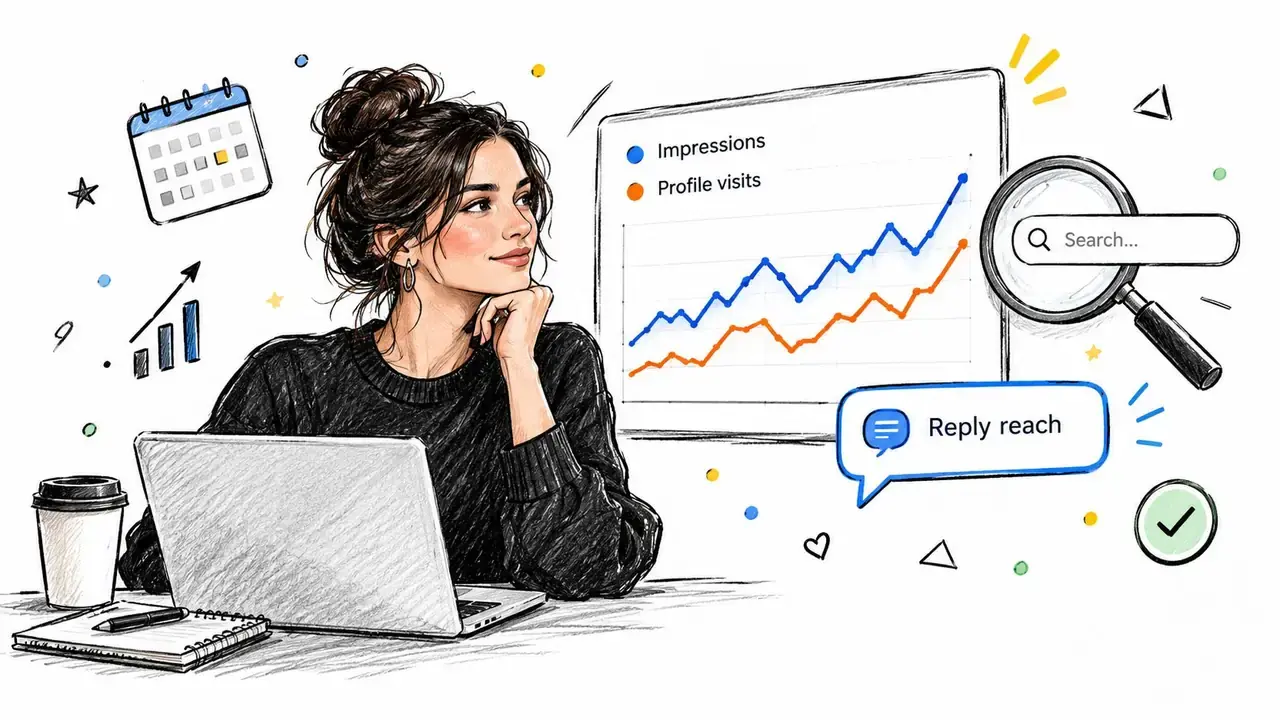
Create a lightweight spreadsheet with these columns:
- Date and post: Save the publication date and a link to the post.
- Format and topic: Note whether it was a text post, reply, quote post, thread, or link post.
- Early signals: Record impressions, replies, reposts, likes, and profile visits when available.
- Visibility test: Mark whether a logged-out search found the profile, post, or reply.
- Context: Note timing, topic demand, news events, and whether the post targeted an existing conversation.
Review the sheet weekly. A single weak post doesn’t establish suppression. A sustained change across unrelated topics, formats, and conversations deserves a closer look, especially when outside viewers also can’t find specific posts.
Measure the pathway, not just the outcome. Low impressions tell you that distribution changed. Search, reply, and profile checks help identify where it changed.
Watch for normal variation. A post aimed at a narrow technical audience won’t behave like a post tied to a broad discussion, and follower count alone doesn’t guarantee distribution. Compare like with like, then repeat the same manual test rather than changing the test every time.
Use saved research to improve the quality of future participation. Organize useful posts by hook, topic, format, and conversation so you can study patterns without copying them. Semantic search and a curated library can reduce random scrolling and help you find discussions where your expertise is relevant.
For more ways to structure measurement, use these free Twitter analytics tools.
A short video can also help you review analytics habits and interpret visibility signals:
Common Myths About Twitter Shadowban and What Evidence Shows
The most persistent myth is that X has one permanent, invisible switch that reduces an account’s reach to zero. The evidence points to a more complicated picture. A large academic audit examined more than 25,000 U.S.-based accounts across six audits conducted between June 2020 and June 2021, finding that 6.2% of the initial sample experienced at least one shadowban. The study identified several categories, including search suggestion bans, search bans, ghost bans, and reply downtiering, rather than one universal mechanism, as summarized by Buffer’s research overview.
A separate review of audits found reported shadowban events ranging from about 3% to 6.2% across samples ranging from 41,000 to over 2.5 million accounts, suggesting that measurable visibility restrictions exist but are relatively uncommon at population scale, according to the econstor review. That pattern supports a practical conclusion: repeated reach loss is more likely to involve changing account-level or post-level classifiers than a permanent blanket ban.
Political claims need careful handling
The political controversy is real, but controversy isn’t the same as proof of a universal partisan policy. In 2018, Twitter briefly stopped autofilling the usernames of Republicans Jim Jordan, Mark Meadows, and Matt Gaetz in its search bar. The Atlantic later treated the incident as a key example in the broader public shadowban debate, while accusations had already been circulating since at least 2018. The historical account is documented in the shadow banning overview.
The broader audit evidence found that political content from both the left and right could receive reply downtiering, while bot-like behavior increased the likelihood of shadowbanning and verified accounts were less likely to experience it, according to the academic audit of Twitter visibility. That doesn’t prove every decision is neutral, but it does make a single-party explanation too simple.
Finally, many self-diagnoses are false alarms. One recent summary discussed a dataset of 94,173 suspected cases in which only about 3.4% were identified as real bans, as reported by this analysis of suspected X shadowban cases. Treat the label as a prompt to test visibility, not as a conclusion.
Staying Visible on X With Practical Best Practices
Visibility improves when your account consistently gives X and its users fewer reasons to classify your activity as low-quality, repetitive, or unwanted. Write posts for a clear audience, add context before links, use hashtags only when they help discovery, and contribute something specific in replies.
Before publishing, ask:
- Relevance: Does this post serve a recognizable audience?
- Originality: Have you added a point of view rather than repeating the same copy?
- Context: Will the link, mention, or hashtag make sense to someone outside your immediate circle?
- Conversation value: If it’s a reply, does it move the discussion forward?
- Human review: Would you stand behind the wording if the post reached a much larger audience?
Once a week, inspect your recent posts for repetition, excessive promotion, and replies that could be mistaken for mass engagement. Keep a record of visibility tests and analytics so you can distinguish sustained filtering from ordinary performance swings.
Study strong posts for structure, not for copying. Look at the hook, tension, sequence, evidence, and payoff, then rebuild the idea around your own experience, niche, audience, or product. A personalized memory and review-before-publish workflow can help you stay consistent while preserving judgment and voice.
Run the diagnostic tests, apply the conservative reset, and begin the monitoring habit before making major changes to your strategy.
Xholic AI helps you find worthwhile conversations, draft personalized replies, study successful post structures, and maintain a consistent X workflow without publishing unreviewed content automatically. Visit Xholic AI to build a more relevant, human-reviewed growth process around your voice and audience.