A large follower count can make an X account look valuable while producing almost no buyer interest. The practical answer to Twitter account worth starts with three separate questions: what the audience is worth, what the account can earn from future posts, and what a buyer would pay for the account as a transferable asset. Published valuation guidance gives a 10,000-follower account with 3% engagement in a strong finance or SaaS niche an estimated asset value of roughly $1,500 to $4,000, while individual sponsored posts may sell for $100 to $250. (Xholic’s valuation guide)
What a Twitter Account Is Really Worth
A large follower count sets a floor, but actual value depends on who follows, how they behave, and what a buyer can do with that attention. An account with inactive, poorly matched, or artificial followers may have impressive reach on paper and little commercial value. A smaller, responsive audience can generate replies, clicks, conversations, and qualified attention that sponsors can use.
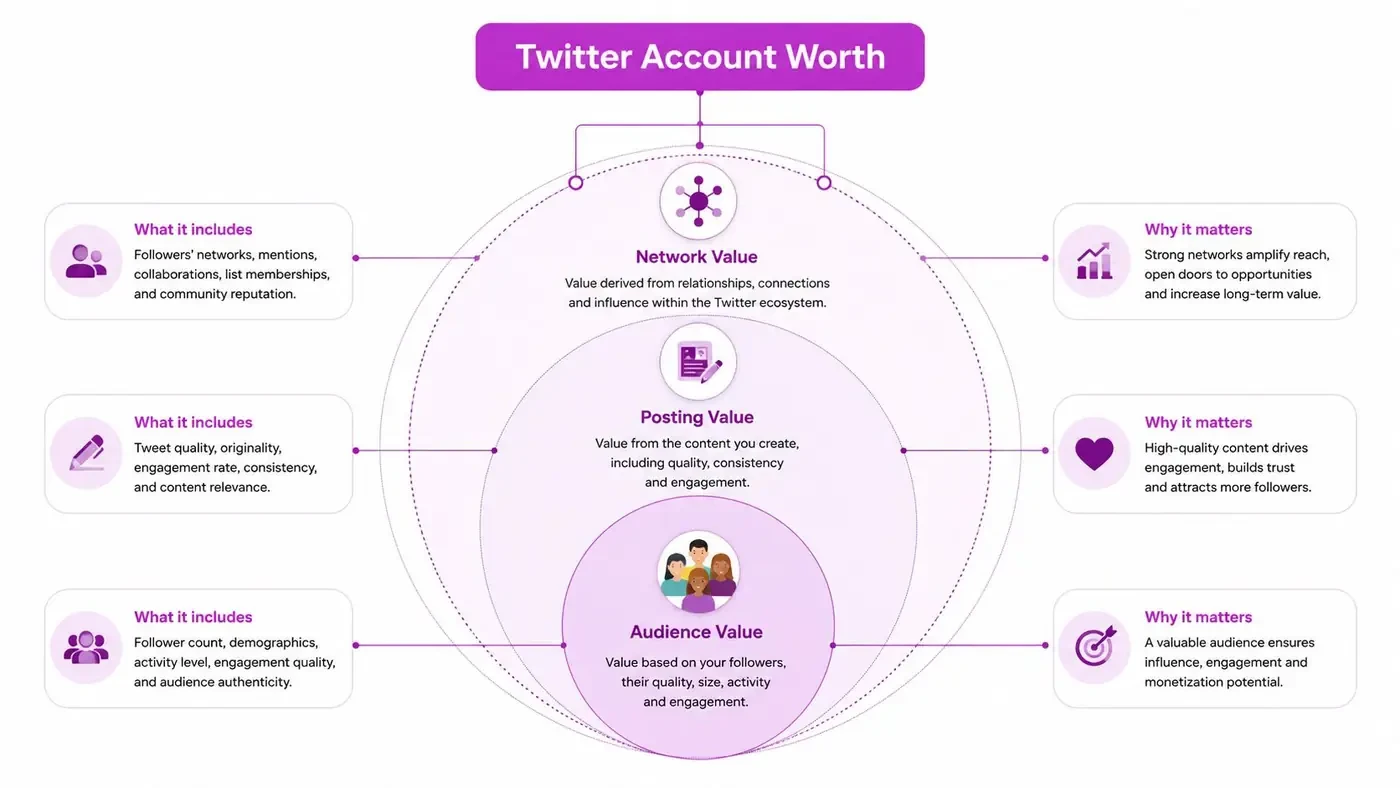
A practical estimate separates three layers:
| Layer | What It Measures | Typical Driver |
|---|---|---|
| Audience value | The size, quality, relevance, and activity of the follower network | Real followers, niche fit, engagement, audience composition |
| Posting value | The revenue a post or posting program can generate | Impressions, engagement, sponsor demand, posting cadence |
| Liquid resale value | What a buyer might pay for the account now | Transferability, recent performance, authority, risk, monetization potential |
Audience value measures distribution potential. The question is whether followers are relevant to a sponsor, founder, analyst, or product team, not just how many appear on the profile. A finance audience may attract more commercial interest than a similarly sized general audience because its members can be more relevant to purchasing decisions.
Posting value measures the account’s ability to produce income through sponsored posts, recurring partnerships, affiliate activity, product distribution, or other legitimate commercial uses. It responds to recent impressions, audience response, posting cadence, and sponsor demand. A per-follower estimate can miss this layer entirely, especially when engagement has declined or the account has shifted niches.
Liquid resale value is the most conservative measure. It discounts uncertain future revenue, policy risk, inactive followers, weak recent performance, and the difficulty of transferring relationships or reputation. A buyer pays for transferable access and evidence of demand, not for every possible future use. Recent algorithm changes can also affect reach, making historical performance less reliable than current results.
A founder assessing an account can apply the same discipline used in broader business valuation. This guide to startup valuation for founders provides useful context: expected future economics, comparable evidence, and risk matter more than one visible metric.
X has no official account valuation system. Estimates therefore rely on public signals such as followers, engagement, impressions, niche, posting frequency, and monetization evidence. Xholic’s account-worth methodology offers one published way to organize those inputs, but any estimate remains sensitive to the assumptions behind them.
The Metrics That Actually Move the Number
A serious estimate begins with the account’s operating evidence. Buyers don’t ask, “How many followers are there?” They ask whether those followers are real, active, relevant, and likely to respond to future posts.
Start with the audience, not the headline number
Real followers matter more than displayed followers. A manual valuation framework recommends discounting bots or inactive followers before applying a per-follower estimate. That adjustment changes both audience value and the credibility of every engagement figure that follows. (Player Sells’ X account valuation framework)
Engagement quality means more than likes. Replies, reposts, quote posts, impressions, link clicks, inbound DMs, and paid conversions reveal whether people do anything with the content. A published framework describes 0.5% engagement as low, 1.5% or higher as solid, and 3% or higher as premium, using a durable 90-day baseline rather than a single unusually successful post. (Circleboom’s account valuation framework)
For broader context, published guidance often places healthy engagement for many accounts around 1% to 5%, while smaller micro-influencer accounts can reach 10% or more because their audiences tend to be more closely connected. (OpenTweet’s account-worth calculator guidance)
If you need to calculate the metric consistently, use the workflow in this guide to calculate Twitter engagement rate. The important analytical choice is to compare comparable posts and use a recent window, not to let one viral tweet define the account.
Niche and cadence create the commercial difference
Niche quality affects sponsor demand. Crypto, finance, and tech audiences can command premium rates because advertisers may value targeted attention more than broad but inactive reach. The same follower count can therefore support very different pricing depending on audience relevance. (Irul Media’s Twitter account pricing metrics)
Posting frequency matters because sponsors are buying access to future distribution, not only historical popularity. A consistent account gives buyers more evidence to assess, while an inactive account creates uncertainty about whether its audience will respond when posting resumes.
Finally, recency matters. A lifetime average can hide a recent decline, a niche pivot, or a change in audience behavior. Current valuation approaches increasingly consider recent post views, durable engagement windows, and audience-quality signals instead of treating follower totals as static.
Three Valuation Models Side by Side
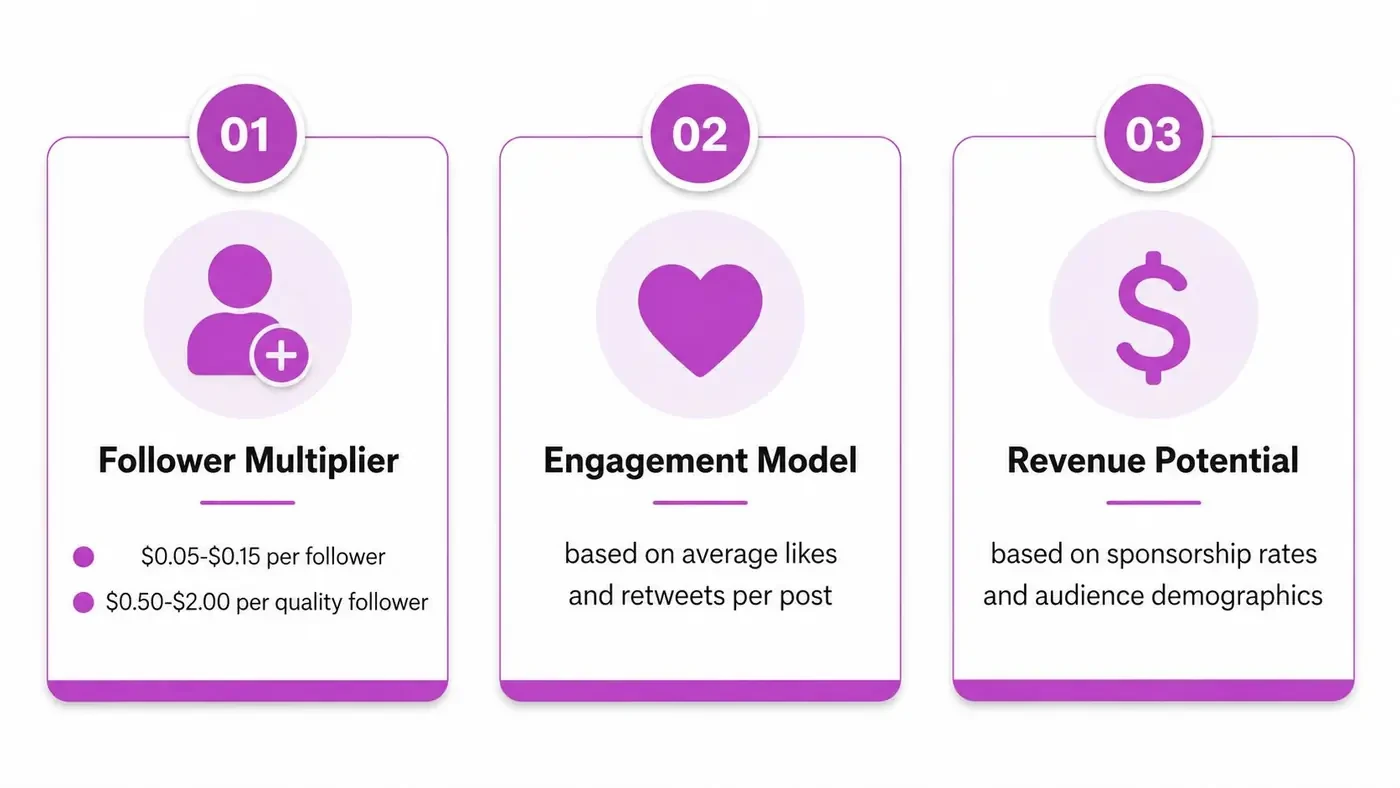
A Twitter account can have three different values: audience value, posting value, and liquid resale value. No single formula captures all three. Each model answers a different commercial question, and each ignores risks that the others expose.
The follower-multiplier model
The follower model provides a quick resale screen. One published method places standard followers at about $0.05 to $0.15 each, while quality followers may contribute approximately $0.50 to $2.00 each to account value. (Irul Media’s Twitter account pricing metrics)
Its advantage is speed when analytics or sponsor records are limited. Its limitation is structural: it treats followers as the asset, even though inactive users, audience mismatch, and recent engagement decay can reduce what a buyer will pay. It also misses authority that has not yet produced sponsor revenue.
The future-post-value model
This model values the account through expected posting income. It estimates sponsored-post value, then extends that figure across a future operating period. Xholic’s valuation guide uses 12 to 24 months of estimated future post value as one basis for account worth. (Xholic’s valuation guide)
The model suits a creator with documented sponsor demand because it connects the account to expected cash flow rather than follower inventory. A smaller lifestyle account, for example, may have modest resale value but stronger posting value if its audience responds reliably to product recommendations. That result depends on continued posting, sponsor availability, audience retention, and stable platform distribution. It overstates worth when recent performance is declining or when one sponsor supplies most of the evidence.
The impressions and CPM model
The impressions model starts with measurable recent views and converts them into an estimated sponsored-post price. One published framework uses about $20 per 1,000 views, then applies a 0.5x to 2x adjustment around a 2% reference point for engagement. It projects the resulting post value across a realistic sponsored-post volume. (SuperX’s Twitter-worth methodology)
This approach measures the posting value that advertisers can observe. It works best when view data is recent and the publishing cadence is consistent. Views still leave major questions unanswered: whether the audience trusts the creator, intends to buy, or fits a brand’s safety requirements. Algorithm shifts can also reduce distribution without changing the follower count, which makes older impressions a weak guide to liquid resale value.
| Model | Best Used For | What It Misses |
|---|---|---|
| Follower multiplier | Fast resale screening | Inactive followers, niche fit, recent decay |
| Future-post value | Accounts with sponsor evidence | Future demand, cadence risk, platform changes |
| Impressions and CPM | Accounts with dependable view data | Trust, purchase intent, buyer risk |
Use two models at minimum. If follower value is high but future-post value is weak, the account may have audience volume without current commercial response. If posting value exceeds resale value, documented demand may depend too heavily on the creator’s continued labor.
A Simple Twitter Account Worth Calculator
A practical calculator should produce a range, not a falsely precise answer. Start with four inputs: real followers, recent engagement rate, average post views, and commercial niche. Then add posting cadence and any verified sponsor or conversion history.
Consider a hypothetical finance creator with 25,000 followers, a 2.5% engagement rate, and daily posting. Those figures are an analytical example, not a reported case study. The account would likely deserve a stronger assessment than a similarly sized general account with weak engagement, but the available data doesn’t justify assigning one exact dollar value without recent impressions and sponsor records.
Run the account through the models like this:
- Follower screen: Apply a standard or quality-follower range only after checking for inactive or suspicious followers.
- Engagement adjustment: Compare the account’s recent rate with the published 2% reference point used in one impressions-based framework. (SuperX’s Twitter-worth methodology)
- Revenue test: Estimate a sponsored-post price from recent views, then project only the posting volume the creator can realistically maintain.
- Risk discount: Reduce confidence when performance is old, the niche is changing, or the account depends on one recurring sponsor.
| Model | Key Input | Implied Value Range |
|---|---|---|
| Follower multiplier | Real and quality followers | A broad range based on follower quality, not a single rate |
| Future-post value | Sponsored-post value projected across 12 to 24 months | A cash-flow-based estimate tied to future demand |
| Impressions model | Views, $20 per 1,000 views, and a 0.5x to 2x engagement adjustment | A view-based estimate that changes with recent reach |
For a spreadsheet, create columns for followers, quality adjustment, engagement rate, average views, sponsor price, monthly sponsored-post capacity, and risk notes. Don’t hide assumptions inside one cell. A buyer should be able to see which change, such as lower views or weaker engagement, moved the range.
You can also compare your inputs with the Twitter account worth calculator. Treat its output as a screening estimate based on visible signals, not as an appraisal or guaranteed sale price.
How Account Worth Changes Over Time
Account worth changes as its evidence changes. Buyers usually assign more weight to recent, repeatable performance than to a historical peak, especially after a niche change or a long publishing gap. A follower count records accumulated reach, but it does not show whether that reach still produces attention, clicks, or sponsor demand.
Consider two hypothetical sellers, each starting with 20,000 followers. These are analytical scenarios, not verified case studies.
Account A strengthens recent evidence
Account A remains in one niche, publishes consistently, and raises its 90-day engagement rate from 1.2% to 3.1%. Its follower count may barely move, yet recent posts provide stronger evidence that the audience still responds. Under the published framework, its latest baseline moves from below the 1.5% solid threshold to above the 3% premium threshold. (Circleboom’s account valuation framework)
The important change is reduced uncertainty. Account A’s audience value may remain similar, while its posting value rises because current distribution supports a clearer estimate of sponsor performance. Its liquid resale value can improve as well, provided impressions, audience composition, and commercial history support the engagement result.
Recent evidence matters most for micro-influencers, whose value often depends on a narrow group of responsive followers rather than scale alone. A short decline in replies or clicks can therefore reduce sponsor confidence before the follower count visibly changes.
Account B loses continuity
Account B stops posting for two months, then shifts from fitness to AI tools. Its old followers remain visible, but their relevance to the new content is uncertain. The account may retain audience value on paper while losing posting value through weaker replies, clicks, and conversions.
The three valuation layers respond differently:
- Audience value declines when followers no longer fit the niche.
- Posting value becomes less predictable because recent content offers little stable evidence.
- Liquid resale value receives a larger discount because a buyer must rebuild relevance and trust.
A lifetime average can conceal this shift. A 90-day baseline reveals whether the account’s current performance still supports its previous assumptions. An X follower tracker can document audience movement and follower changes over time, but it cannot replace review of replies, clicks, audience fit, or content quality.
Recency does not erase history. It identifies which parts of that history still carry economic value.
Risks, Pitfalls, and Ethical Considerations
Buying or selling an X account is a transfer of control, data, and reputation, not ordinary inventory. Platform rules, fraud, privacy, intellectual-property, and tax exposure can reduce the account’s audience value, posting value, and liquid resale value. A clean follower count does not compensate for unclear ownership or weak evidence.
Platform and ownership risk
Before negotiating, verify X’s current rules and the account’s control history. Define what the buyer receives: credentials, ownership claims, brand assets, saved posts, lists, DMs, and content created by multiple people. If the seller cannot establish legitimate control, or the buyer cannot safely receive related assets, the account’s market value should be discounted.
Saved DMs and private lists may contain personal information, confidential business discussions, or intellectual property owned by others. Unpublished drafts, customer details, and sponsor agreements create similar risks. Transfer terms should identify what can legally and ethically change hands.
Fraud and evidence problems
Follower and impression screenshots provide weak evidence on their own. Request native analytics, historical records that remain consistent, audience-quality evidence, and sponsor documentation where relevant. Review sudden engagement spikes, unexplained audience changes, and gaps between impressions, replies, clicks, and conversions.
Off-platform payment requests, rushed deadlines, unverifiable escrow claims, and sellers who reject controlled verification all raise transaction risk. A buyer should verify access and ownership before releasing funds, while a seller should avoid sharing sensitive credentials before payment protections are in place.
If due diligence requires collecting public information from sites with restricted access, review specialist guidance on how to scrape password gated sites. Technical access does not grant permission to collect private material. The process must respect authorization, privacy, and applicable law.
Tax and operational exposure
Sellers should ask a qualified tax professional how proceeds are classified in their jurisdiction. Buyers should budget for rebuilding content, relationships, branding, and audience trust after transfer. Those costs belong in the valuation, even when they do not appear in a follower-based calculator.
Affiliate relationships add disclosure and compliance obligations. A guide to affiliate marketing on Twitter can help distinguish audience monetization from careless promotion, but it does not replace legal or tax advice. If a deal works only under optimistic assumptions, rejecting it is the rational valuation decision.
How to Grow What Your Account Is Worth
The most defensible way to raise account value is to improve the evidence a buyer or sponsor can verify. Focus on engagement quality, niche authority, consistent publishing, and monetization readiness rather than chasing followers as an isolated target.

Build a repeatable weekly system
Start by reviewing recent posts and labeling them by topic, format, hook, response quality, and commercial relevance. Keep the formats that attract meaningful replies or clicks, then test new hooks without abandoning the niche your audience already understands.
A practical 90-day workflow looks like this:
- Conversation research: Identify discussions where your expertise adds a specific perspective, not a generic agreement.
- Content analysis: Study strong posts for their hook, structure, tension, flow, and payoff. Adapt the underlying pattern instead of copying the wording.
- Audience relevance: Connect product mentions to a real problem your audience is already discussing.
- Scheduling discipline: Prepare approved drafts in advance so your publishing cadence doesn’t depend on motivation.
- Sponsor readiness: Save evidence of impressions, engagement, clicks, inbound DMs, and relevant conversions in one place.
Xholic AI can support this workflow as a human-in-the-loop growth system. Its Xholic Brain stores context about a user’s voice, niche, audience, product, saved posts, preferences, and feedback. Its Reply Deck surfaces conversations worth considering, Tweet X-Ray analyzes hooks and structure, and Tweet Remixer helps rebuild a proven idea for the user’s own context. Users review, edit, approve, or reject suggestions before anything is published.
The point isn’t to automate judgment. It’s to reduce the time spent searching, analyzing, and starting from a blank page.
This short video provides another visual way to think about the workflow:
At the end of each review cycle, record the inputs that influence valuation: recent engagement, average views, audience fit, posting consistency, and evidence of commercial response. That record turns growth activity into an auditable operating history.
Frequently Asked Questions About Twitter Account Worth
How long does it take to grow valuation noticeably?
There isn’t a universal timetable. Valuation changes when recent evidence shows stronger engagement, relevant audience response, consistent posting, or credible monetization. A short spike may attract attention, but a durable recent baseline is more persuasive than one exceptional post.
Can private accounts be valued?
Yes, but the estimate is less reliable. A private account limits public verification of posts, impressions, audience quality, and engagement, so a buyer may apply a larger uncertainty discount or decline to value it until sufficient evidence is available.
Does X Premium verification determine account worth?
It may affect trust or presentation for some buyers, but it doesn’t replace performance evidence. Followers, engagement quality, impressions, niche relevance, posting consistency, and monetization potential remain the stronger valuation inputs described by published models.
How often should account worth be reassessed?
Reassess whenever the account changes niche, pauses publishing, experiences a material engagement shift, or develops new sponsor evidence. A regular review is more useful than a lifetime average because recent performance can reveal decay before the follower count changes.
Start by recording your current follower quality, recent engagement baseline, average views, niche, cadence, and monetization evidence. Then compare the result through two valuation models and keep the assumptions visible.
Xholic AI helps X users turn that valuation framework into a consistent operating workflow, with personalized context for replies, post ideas, content analysis, remixing, and approved scheduling. If you want to build a stronger evidence trail for your account, visit Xholic AI and review your next growth actions with your own voice and audience context in mind.