You’re probably here because you saw a post on X (formerly Twitter) that looked real enough to share, or because you run an account and worry that someone could fake your voice, product, or brand. The short answer is this: fake social media posts are built to win the first reaction, not to survive scrutiny. That’s why the right skill isn’t just spotting obvious hoaxes. It’s learning the lifecycle of a fake post, from creation to spread to reappearance, and building a response routine you can use fast.
For creators, founders, marketers, and X power users, this matters in two directions. You need to avoid amplifying fake posts, and you need a plan for the day a fake screenshot, fake quote, or impersonation account starts using your niche against you.
What Fake Social Media Posts Actually Are
Late at night, a breaking-news graphic shows up in your feed. The account looks familiar. The design looks polished. The quote sounds plausible. You retweet it, then wake up to replies saying the image was generated and the quote never happened.
That’s the modern fake post problem.
Fake social media posts are posts, images, videos, screenshots, or even entire accounts deliberately built to misrepresent facts, identity, or events. Sometimes the deception is crude, like a copied text hoax. Sometimes it’s elaborate, like a fake press graphic, a synthetic video clip, or an impersonation account that borrows a real creator’s tone and branding.
What counts as fake and what doesn’t
A useful way to separate categories is intent plus plausibility.
- Simple mistakes aren’t necessarily fake. Someone may repost outdated information without realizing it.
- Satire usually signals that it’s parody, even when people still miss the joke.
- Fake posts are constructed so people will take them at face value and act on them.
That last part matters. A bad joke can still confuse people, but a fake post is designed to be believed, shared, and often screenshotted before anyone checks it.
Practical rule: If a post depends on you reacting before verifying, treat it as suspicious until it proves otherwise.
Why the definition got broader
A decade ago, many people meant chain-post hoaxes, fake-news links, or made-up celebrity death announcements when they said “fake post.” That’s still part of the picture, but the format has expanded.
Now the same problem includes:
- Fabricated text claims
- Doctored screenshots
- Manipulated images
- Synthetic audio and video
- Impersonation accounts
- AI-made content that looks ordinary enough to pass in-feed
That’s why it helps to think in layers, not just in terms of “real” or “fake.” A real photo can carry a fake caption. A fake account can use a real headshot. A generated image can be wrapped inside a believable news template. If you work with tweet mockups for campaigns or education, that’s also why context matters. A visual mockup tool can be harmless in a design workflow and deceptive in the wrong hands, which is worth understanding in this breakdown of fake tweet generators vs Photoshop.
Why False Posts Spread Faster Than the Truth
False posts don’t spread because everyone is careless. They spread because the format fits how feeds reward attention.
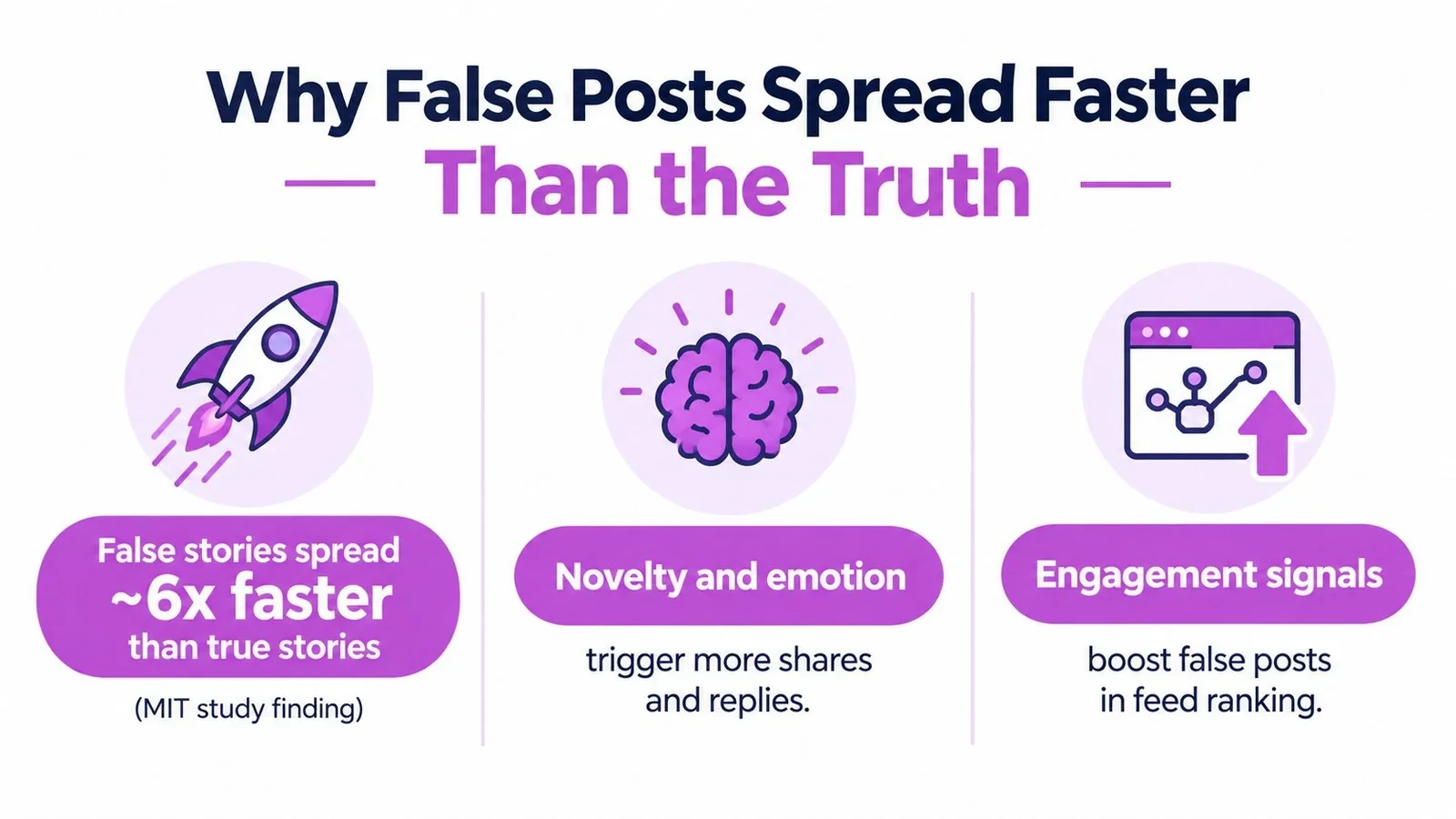
A landmark MIT study analyzing about 126,000 verified true and false stories shared between 2006 and 2017, involving roughly 3 million people and more than 4.5 million tweet-and-retweet events, found that false stories spread farther, faster, deeper, and more broadly than true ones. It also found that falsehoods were about 70% more likely to be retweeted, and that false stories reached 1,500 people about six times faster than true stories, according to the MIT paper on the spread of false and true news online.
Why this happens on X
On X, a false post often has three built-in advantages.
First, novelty. People stop scrolling for things that feel surprising, secret, outrageous, or “not being covered.” Truth is often slower, messier, and less dramatic.
Second, emotion. Anger, fear, triumph, and disgust all create the urge to react publicly. A fake post doesn’t need to convince everyone. It only needs to trigger enough replies, reposts, and quote posts to start moving.
Third, uncertainty. When people aren’t sure whether something is true, many of them still share it with a comment like “if this is real…” That still amplifies the post.
The feed mechanics make it worse
Recommendation systems don’t read intent the way humans do. They read signals.
- Early engagement tells the system that people are interested.
- Replies and quote posts can boost visibility even when they’re arguing.
- Screenshots let a post survive after the original gets deleted or labeled.
- Comment piles create social proof, even when the crowd is confused.
A fake post often wins the first hour. A correction has to win the next several.
For brands and creators, this is the operational problem. If someone posts a fake founder quote, a fake product screenshot, or a fake support update, the post can travel while your team is still verifying what happened. By the time you respond, people may already have seen the screenshot divorced from the original account.
A Step-by-Step Spotting Workflow for X
A fake post on X often wins by stealing your first reaction. You see a founder “statement,” a screenshot of a product update, or a quote that sounds just plausible enough, and the instinct is to respond before anyone else does. A better habit is to treat suspicious posts like a chain of custody problem. Where did this come from, what got changed, and how is it being recirculated?
You do not need specialist tools for the first pass. You need a repeatable routine that slows the jump from seeing to sharing. This one takes about two minutes and helps with both sides of the problem: spotting a fake in the wild and documenting it if someone is impersonating your brand or voice.
Here’s the visual version first.
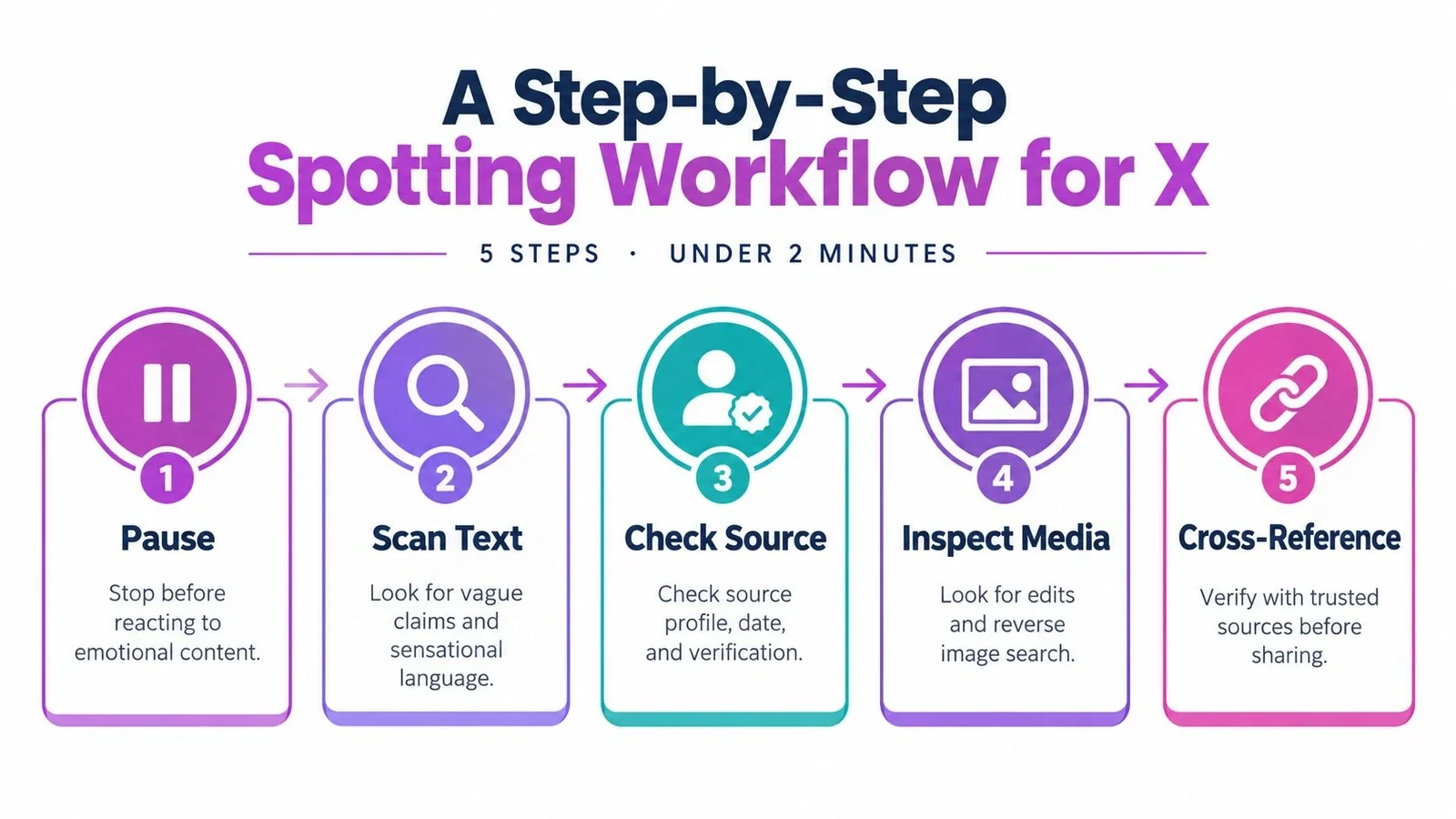
Step 1: Pause before you add momentum
On X, even a skeptical reply can help a fake travel.
So pause. Count to ten if you need to. The goal is simple: stop performing for the feed long enough to check whether the post is trying to use your attention as fuel.
Step 2: Read the claim like copy that wants a reaction
Start with the words before the account, image, or pile-on in the replies. Fake posts often reveal themselves in the phrasing.
Ask a few plain questions:
- What is the actual claim? If you cannot restate it in one clean sentence, the post may be built from implication rather than evidence.
- Who is supposed to be saying this? “Sources say” and “people are hearing” hide the missing part of the story.
- Does the quote sound polished for outrage? Invented quotes are often neater, harsher, and more cinematic than real speech.
- Would this wording fit the person or brand being impersonated? A fake support update, apology, or executive quote often gets the tone wrong even when the formatting looks close.
This is also where recycled fakes start to show their age. A lot of “new” posts are old rumors wearing a fresh caption. If you want to trace repeated wording, old screenshots, or earlier versions of the same claim, these Twitter advanced search operators help surface the post’s earlier life.
Step 3: Check the account as if you were verifying authorship
Now open the profile and inspect it as a whole. A fake post is not just a piece of text. It comes from an identity, and that identity may be borrowed, dressed up, or recently repurposed.
Look for mismatches:
- Bio versus behavior. An account claiming to be official, expert, or journalistic should not read like nonstop engagement bait.
- Pinned post versus recent activity. Real accounts usually have some continuity. Repurposed accounts often feel like one person’s shell with another person’s script inside it.
- Join date versus authority claims. A new account can be legitimate, but a new account claiming long institutional history deserves extra scrutiny.
- Handle, display name, and avatar. Small spelling swaps, copied bios, and AI-generated profile photos are common impersonation tactics.
- Reply pattern. Genuine communities tend to have context-rich replies. Fake or low-trust accounts often attract confusion, bot-like agreement, or people asking whether the account is real.
X’s authenticity rules prohibit deceptive identities, including fake personas built to mislead with copied branding or manufactured profile details. You do not need the full policy page open to use that standard as a mental check: is this account trying to be mistaken for someone else?
Step 4: Inspect the media like it has a history
Text can be invented in seconds. Screenshots can survive for weeks. That is why media deserves its own pass.
Check for signs that the asset has been altered, cropped, or detached from its source:
- Cropping that removes usernames, timestamps, or reply context
- Fonts, spacing, or interface details that are close to X but not quite right
- Logos, color choices, or templates that imitate a brand without matching its normal style
- AI image artifacts such as warped hands, strange reflections, or inconsistent text
- Video edits that start late or end early, removing what happened immediately before or after
A screenshot works like a clipped movie scene. You may be seeing a real frame from a false story, or a false frame from a real account. In both cases, context is what got cut.
If two separate signals feel off, stop sharing and start documenting.
For creators and brands, this is the point where evidence matters. Save the screenshot, copy the direct link, note the time, and capture the account handle. If the fake disappears and comes back through reposts or cropped screenshots, you will have a record of its earlier form.
Step 5: Verify the claim outside the post
Finish by checking whether the post survives contact with outside context.
Look for:
- A primary source, such as the actual account, website, press room, or public statement
- Reliable reporting or direct confirmation, especially for breaking claims
- Platform context, such as labels or Community Notes, if they have appeared
- Signs of re-uploading, where the same screenshot or quote is being reposted by different accounts after the original was deleted
Keep the final decision simple:
- Supported: still read carefully before sharing
- Unclear: save it and wait
- False or impersonating: document it, report it, and if it targets your brand or voice, prepare a direct correction from your official account
That last part matters. Fake posts rarely die when the original goes down. They come back as screenshots, quote posts, and “did you see this?” reposts. A good spotting workflow helps you catch the first version and recognize the reappearance later.
Verification Tools and Platform Signals Worth Using
Instinct can tell you that a post feels off. Tools help you test why.
The trick is using the right tool for the right failure mode. A reverse image search won’t tell you whether a quote was invented. Community Notes won’t always catch a fresh fake in time. Metadata can disappear the moment someone screenshots an image.
Which tools help with what
| Tool or Signal | Best At Catching | Known Limitation |
|---|---|---|
| Google Lens | Older or widely reused images | Can miss freshly generated AI images |
| TinEye | Exact or near-exact image re-use | Less helpful when an image is heavily edited |
| Yandex | Faces and some image matches others miss | Interface and results can be inconsistent |
| InVID | Breaking video into frames for checking | Takes more effort than a quick feed scan |
| FotoForensics | Signs of image editing and compression anomalies | Doesn’t provide a simple true-or-false verdict |
| Snopes | Context for circulating claims and hoaxes | May not cover fast-moving niche rumors |
| PolitiFact | Evaluating public factual claims | Not built for every creator or brand impersonation case |
| Whois lookup | Basic domain background checks for suspicious sites | Shortened links and proxies can hide useful clues |
| Community Notes on X | Public context on disputed posts | Often lags behind early virality |
| Account creation date and profile review | Spotting repurposed or suspicious accounts | A polished fake account can still look established |
Platform signals on X that are worth reading carefully
People often overestimate checkmarks. They’re useful, but they aren’t a truth stamp.
A profile badge can indicate different things depending on the account type, but it doesn’t prove that every post is accurate. The stronger signal is consistency across identity, behavior, post history, and external references.
Other native signals matter too:
- Community Notes can add context when a claim is disputed. This guide on how Twitter Community Notes work helps if you’ve seen the feature but haven’t really used it.
- Profile age and posting pattern can reveal whether an account suddenly changed identity.
- Follower-to-engagement mismatches can suggest a low-trust or artificially inflated account.
- Labels on synthetic or manipulated media can be useful when they appear. X’s policy says users may not deceptively share synthetic or manipulated media likely to cause harm, and X may label such posts to add authenticity context, as noted in this X synthetic and manipulated media policy record.
A practical tiered setup
If you’re a casual user, start with public signals first. Profile review, claim search, image search, and notes on the post will catch a surprising amount.
If you manage a brand or publish regularly, build a deeper verification routine. Tools like Google Lens, InVID, and Whois cover different layers. For claim evaluation workflows, this guide on checking with AI Website Detector is a useful overview of how to combine tools instead of relying on one.
If you work in a team, remember that no single tool gives a clean verdict on its own. They help you stack evidence.
One other relevant shift is technical. A benchmark review found 40% of reviewed studies used deep learning and 25% used hybrid models, while multimodal approaches became more common because fake posts often exploit inconsistencies across text, image, and video. The same review notes that the MuMiN benchmark contains 21,565,018 tweets, 1,986,354 users, and 12,914 fact-checked claims in 41 languages, which is a reminder that detection now has to work across formats, languages, and propagation patterns, not just text alone, according to this multimodal fake-news benchmark review.
Common Types of Fake Posts You Will See
The easiest fake posts to spot are often the oldest formats. The most dangerous ones are usually the formats that look ordinary.
The obvious ones still work
Classic text hoaxes haven’t disappeared. They’ve just moved into comment sections, DMs, and niche communities.
You’ll still see posts like:
- Fake giveaways that ask users to repost, reply, or connect a wallet
- Chain-style warnings about platform changes, hidden rules, or account bans
- Celebrity death claims posted before any credible confirmation
- Urgent pleas that rely on moral pressure more than detail
These spread because they’re simple and emotional. They don’t need polish.
Screenshots and forged receipts do more damage
The next tier looks more convincing because it borrows trust from familiar formats.
That includes fake social media posts such as forged tweets from public figures, edited headlines that mimic known outlets, and “leaked” screenshots with official-looking headers. Even when the screenshot is fake, the format feels real because users have seen the original template a thousand times.
If you’ve ever searched for tools that can create tweet-style mockups, that overlap is worth understanding. Some tools are built for harmless design use, some are used for jokes, and some make deception easier. This roundup of the best fake tweet generators shows why screenshots deserve more scrutiny than people give them.
AI images and video raised the ceiling
Then come the posts that spread because they look visually rich enough to bypass doubt.
Think of staged protest photos, synthetic product screenshots, fake app dashboards, lip-synced endorsements, or polished “news” clips where the presenter was never real. The risk isn’t only obvious deepfakes. It’s the plausible cheapfake. The small manipulation that survives a quick glance in-feed.
Full Fact said a 2025 investigation found the same kind of hoax posts it flagged in 2023 were still “rife” on Facebook, and its 2025 report says it has checked more than 2,750 misleading, faked, or potentially harmful posts since 2019, according to the Full Fact Report 2025.
The most effective fake posts usually don’t look absurd. They look just believable enough to outrun moderation.
These categories also blur together. A post might combine a real photo, a fabricated quote, a fake account name, and a timely political or market angle. Treat the format as layered. That mindset is more useful than asking whether something looks “too fake” to matter.
How Brands and Creators Should Respond to Impersonation
A fake post using your name usually follows a predictable path. It appears in a small corner of the platform, gets screenshotted, spreads faster once it leaves the original account, then returns days later as a cropped image with the context stripped away. A good response plan has to match that lifecycle.
The job is simple to define and hard to do under pressure. Reduce confusion, preserve evidence, and give people one place to check what is real.
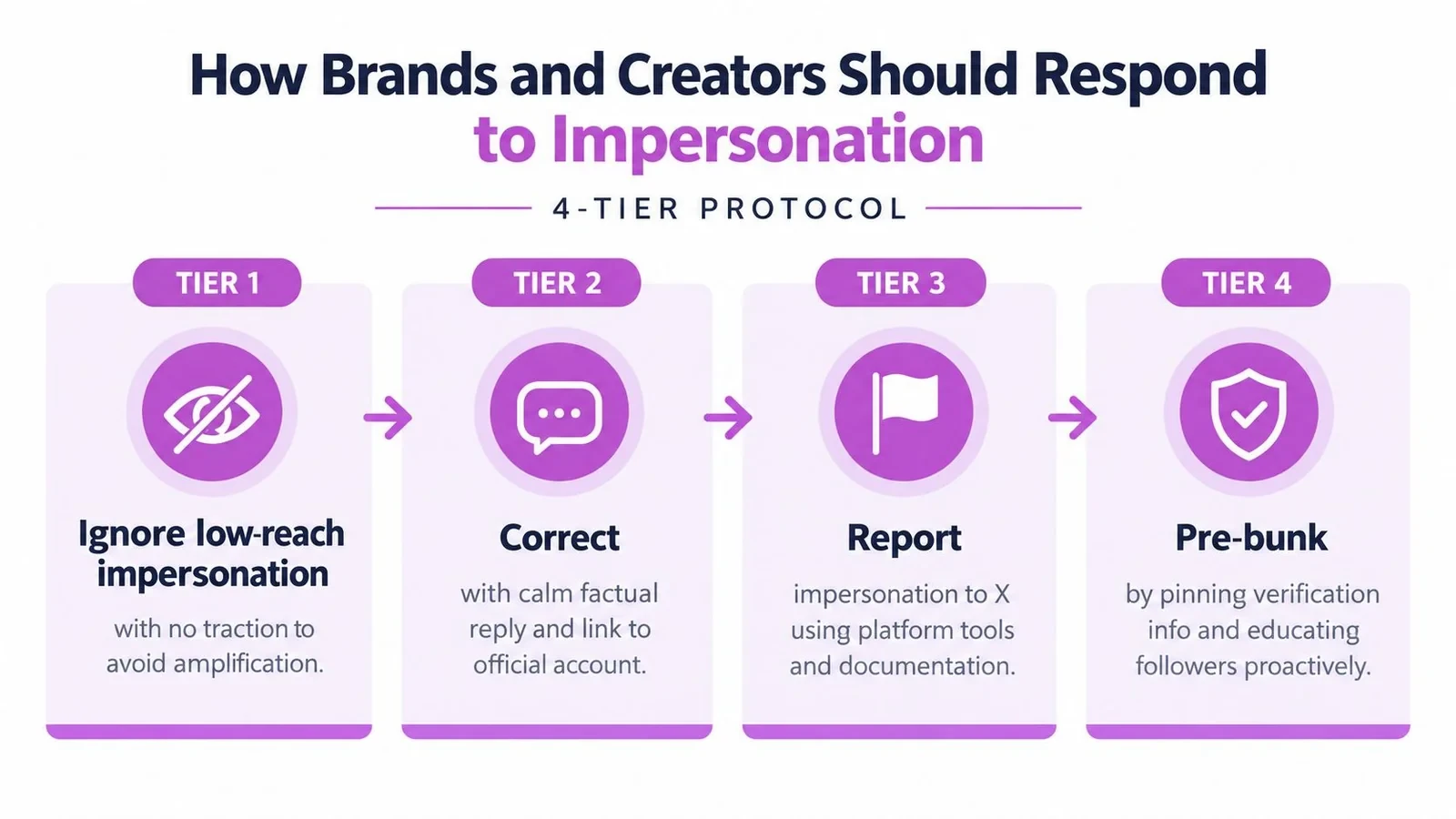
Tier 1: Ignore when the fake has no oxygen
A fake post with no reach does not always need a public statement. Sometimes a reply acts like a megaphone.
Treat low-traction impersonation like a small kitchen fire. You do not invite the neighborhood over to discuss it. You document it, contain it, and keep watching in case it spreads.
Do the quiet work first:
- Screenshot the post
- Save the account handle and URL
- Log the date and visible engagement
- Report through the platform impersonation flow
One more habit helps here. Save the media itself if possible, because the same fake often reappears later under a new handle or as a reposted screenshot.
Tier 2: Correct once when the post starts moving
Once the fake picks up attention, publish one calm correction from your official account. Write for the screenshot, not for the argument.
That means a visible date, a plain statement of what is false, and a pointer to the right information. If the fake mentions pricing, a launch, a wallet address, customer support, or a founder quote, address that exact claim. Specificity matters because people often see the correction separated from the original rumor.
A pinned clarification can work like a sign on a storefront window. It saves your audience from guessing which version to trust.
Response principle: One clear correction is easier to share, archive, and quote than ten reactive replies.
Tier 3: Report with documentation
Platform reports work better when they read like a case file. Show the copied name, bio, logo, profile image, or phrasing. Show the post claiming to be you. Show the account it is mimicking.
As noted earlier, X prohibits deceptive impersonation and fake personas used to mislead. Frame your report around those facts. A moderation team can act on evidence more easily than on anger.
If your team wants earlier warning that your brand name, product, or founder voice is being reused elsewhere, track brand visibility with MyMentions so you are not waiting for a follower to spot the problem first.
Tier 4: Pre-bunk before the next one appears
The strongest response starts before the next fake goes live.
Create a public reference point people can check quickly. That can be a pinned post, a short page on your site, or a creator FAQ. List your official handles, active domains, support channels, and the formats you do not use. If you never send support DMs from backup accounts, never announce giveaways without a site post, or never publish wallet addresses in replies, say so plainly.
This works like a receipt. When a fake appears, your audience does not have to debate style, tone, or whether the screenshot “looks right.” They can compare it against a standing record.
For teams that publish often on X, it also helps to keep approved language for recurring incidents. Xholic AI is one option. It uses Xholic Brain to store context about your voice, niche, product, and prior approvals so a team can draft consistent clarifications faster when impersonation starts spreading. It does not replace human judgment. It helps reduce improvisation at the exact moment people are most likely to post in a rush.
Your Daily Fake-Post Checklist and Next Action
A massive media-forensics habit isn’t necessary. What’s needed is a repeatable morning routine.
Use this five-question check before you like, repost, or quote post something sensitive.
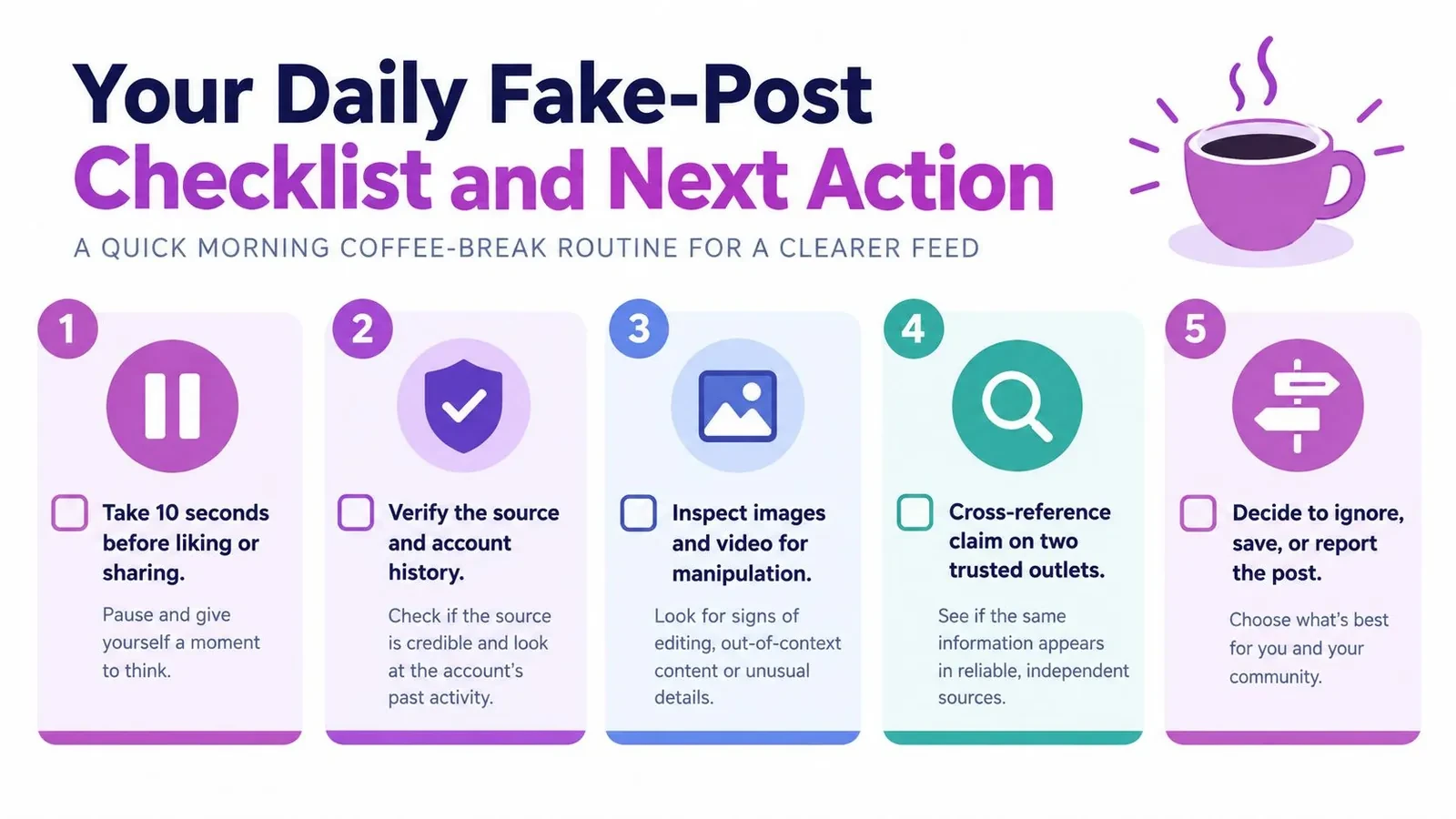
The coffee-break routine
- What is this post trying to make me feel? If the answer is panic, outrage, or instant triumph, pause.
- Who posted it? Open the profile and check whether identity, history, and behavior line up.
- Is the media doing the heavy lifting? If the image or clip is the only evidence, inspect it harder.
- Can I confirm it outside the post? Look for independent confirmation, official statements, or context labels.
- What action fits best? Ignore, save, verify later, or report.
Your next move
Pick one habit and make it automatic.
A good starting point is a personal pause rule: if a post triggers a strong emotional reaction, you don’t share it until you’ve checked the source and one outside reference. If you manage a team account, turn that into a written rule so nobody has to improvise under pressure.
If you want one extra layer, audit your own recent reposts and bookmarks. You’ll learn fast which formats tend to bypass your guardrails.
If you want help staying sharp on X without spending all day scrolling, Xholic AI gives you a personalized, human-in-the-loop workflow for researching conversations, drafting context-aware replies, and keeping your content consistent with your real voice. That’s useful when you’re trying to grow on X while also avoiding low-trust habits, recycled misinformation, and reactive posting.