Verification layers and human oversight
Human-in-the-loop review, multi-model consensus, layered checks, organizational structures, and verifiable outputs to catch errors before they matter.
26%
Explore the best tweets about AI hallucinations, covering causes, evaluation, grounding, RAG, verification, model behavior, and mitigation techniques.
Concrete examples and research about model hallucinations, factuality, evaluation, grounding, verification, and mitigation.
Original Xholic analysis
Across 50 posts from 44 creators, many posts treat hallucination as a standing risk to engineer around rather than a bug about to be fixed. The largest themes are verification layers and human oversight (26%), why models hallucinate (24%), and fabricated citations reaching real work (18%). Supportive stances lead at 46%. The top outlier is a post about a fake eye condition, bixonimania, being presented as real by AI systems. It scored 8898.8, against a median of 7.89.
44% of posts
All-time engagement
28% of posts
Published in 90 days
Conversation map
Human-in-the-loop review, multi-model consensus, layered checks, organizational structures, and verifiable outputs to catch errors before they matter.
26%
Explanations of hallucination as intrinsic to next-token prediction, sycophancy, post-hoc rationalization, and skepticism about reliability and business impact.
24%
Incidents where hallucinated references or fake facts reached consulting reports, academic papers, conferences, journals, medicine, and legal disputes.
18%
Retrieval-augmented generation, agentic RAG, hybrid retrieval, reranking, and context quality as ways to ground answers and reduce fabrication.
16%
AI agents falsely reporting success, error propagation across agent chains, outdated docs, and context failures in agentic systems.
14%
Prompt patterns, structured project context, fresh sessions, clarifying questions, and quote rules used to curb hallucinations in everyday use.
14%
Research and arguments about models not knowing what they know, faithful uncertainty, saying 'I don't know', and confident errors as the core problem.
14%
Golden datasets, LLM-as-judge, eval harnesses, CI-gated tests, hallucination benchmarks, and detection research for measuring factuality.
12%
Tone and stance
Performance benchmark
Posts with media make up 48% of this collection. Their median all-time score is 18.6, compared with 3.21 for text-only posts.
Format mix
Consensus and debate
Shared view
Many posts converge on wrapping AI output in checks. Alex Veremeyenko blames Deloitte's fake citations on 'No verification layer.' Layton Gott describes four layers a hallucination must survive. Ethan Mollick compares the needed checks to organizational structures. A Chinese article summarized by Rui Ma calls for stronger verification and human judgment.
Shared view
Posts document hallucinated content reaching real deliverables. Bixonimania was cited in a peer-reviewed journal. Deloitte's report contained fake citations, and KPMG retracted a report with false case studies. Over 50 NeurIPS 2025 papers had fake citations. A cited biomedical study found that one in 277 papers in early 2026 had at least one non-existent citation.
Shared view
RAG and structured context are often framed as mitigations. Examples include a 10-step answer to a reported interview question on zero-hallucination RAG, explainers of agentic RAG, and Adan Ordonez's claim that legal RAG tools hallucinate less than general models. A study cited by Rohan Paul associates more factual support in agent context with fewer hallucinations.
Shared view
Posts on a Google Research paper argue that models cannot reliably separate what they know from what they are guessing. They propose faithful uncertainty, where hedged wording matches the model's internal confidence, instead of forcing strict accuracy.
Open debate
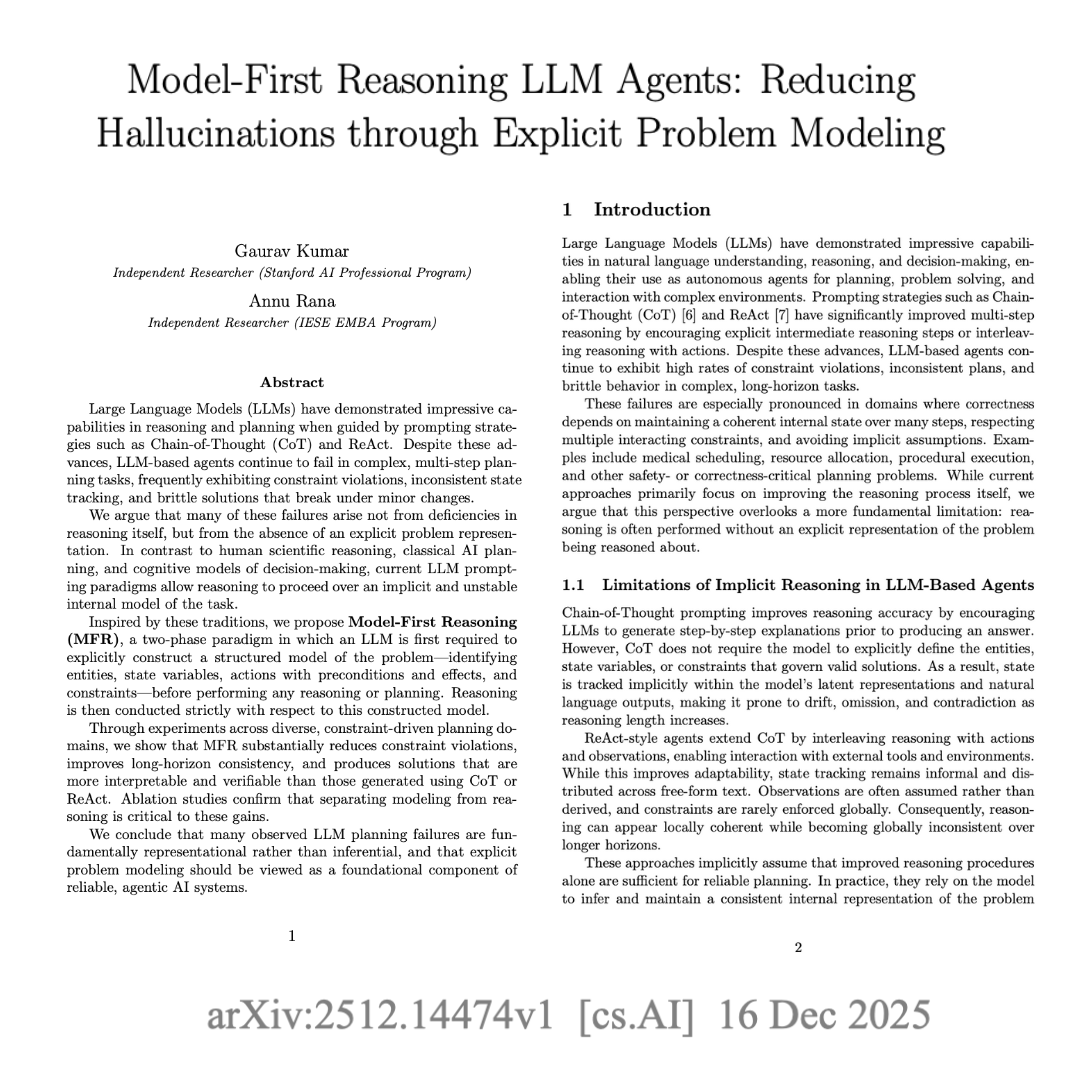
Some posts share claimed reductions. Goodfire reports halving Gemma 12B's hallucination rate, and Ruben Hassid relays research on Model-First Reasoning prompting. Skeptics push back: Luiza Jarovsky says sycophancy and hallucination are not yet fixed, and Haider relays Yann LeCun's view that LLMs cannot be made fully reliable.
Open debate
Auren Hoffman calls hallucinations 'the creative process, not a bug' and suggests letting one part hallucinate while another verifies. Other posts treat fabrication as a damaging failure, for example in cyber incident response (Jo Peterson) and in consulting deliverables (Alex Veremeyenko).
Open debate
Machina and Vaibhav Sisinty pitch cross-model comparison as a route to confidence or reliability. Taylor Pearson, who built such a tool, cautions that the models share structural blindspots, so comparing them is not like triangulating across independent sources.
Open debate
Several posts shift blame from the model to its inputs: bad retrieval, outdated docs, or missing project context. Others locate the cause in next-token prediction itself, saying models hallucinate because they are doing exactly what they were built to do.
What performs
Across the dataset, the 24 posts with media (48%) have a median all-time score of 18.59, compared with 3.21 for text-only posts. This is a correlation, not proof that media causes higher scores.
The bixonimania post scored 8898.8, which is 1127.86x the median of 7.89. The Deloitte citation post scored 418.94 (53.1x). Separately, the STORY format has a median score of 12.97, against 4.035 for announcements.
The two LIST posts have a median score of 1154.41, but the sample is very small. The list is led by the RAG design breakdown at 2270.87 (287.82x the median). Tutorials have a median of 12.355.
The verification and human oversight theme has a median score of 22.813. The 'why models hallucinate' theme has a 24% share but a median of just 1.93.
The median post age is 185.9 days. Only 8 posts (16%) were published within 90 days.
Statistical standouts
Creator landscape
The five most represented creators account for 20% of the selected posts.
1. AlphaSignal AI
@AlphaSignalAI
2 posts
2. Jo Peterson
@cleartechtoday
2 posts
3. Ethan Mollick
@emollick
2 posts
4. Glenn Gabe
@glenngabe
2 posts
5. 0xMarioNawfal
@RoundtableSpace
2 posts
6. Towards Data Science
@TDataScience
2 posts
Ethan Mollick has two posts with a median score of 116.63. One argues that organizational structures can manage unreliable output. The other notes that an AI checking his book found an error in an original article he referenced.
AlphaSignal AI has two posts with a median score of 66.94. One covers Google Research's faithful-uncertainty paper, and the other covers Andrew Ng's Context Hub for fetching live API docs.
Forty-four creators produced the 50 posts, and the top five hold a 20% placement share. The two highest-scoring outliers came from accounts with one post each in this dataset: Hedgie (HedgieMarkets) and aditya (adxtyahq).
Since the previous snapshot
Themes, sentiment, stance, and post format are classified per tweet. All counts, shares, medians, creator concentration, freshness, and performance comparisons are then calculated directly from the published snapshot.
Xholic's all-time score compares engagement while accounting for reach, post age, and creator consistency. It is used for relative comparisons within this collection.
This report analyzes the exact 50-post snapshot shown below. AI identifies editorial categories and drafts explanations; all statistics are calculated from the snapshot, and every narrative claim is checked against cited posts before publication.
Best AI Hallucinations tweets
Ranked 01–50

@HedgieMarkets ·
🦔A researcher invented a fake eye condition called bixonimania, uploaded two obviously fraudulent papers about it to an academic server, and watched major AI systems present it as real medicine within weeks. The fake papers thanked Starfleet Academy, cited funding from the Professor Sideshow Bob Foundation and the University of Fellowship of the Ring, and stated mid-paper that the entire thing was made up. Google's Gemini told users it was caused by blue light. Perplexity cited its prevalence at one in 90,000 people. ChatGPT advised users whether their symptoms matched. The fake research was then cited in a peer-reviewed journal that only retracted it after Nature contacted the publisher. My Take The researcher made the papers as obviously fake as possible on purpose. The AI systems didn't catch it. Neither did the human researchers who cited it in real journals, which means people are feeding AI-generated references into their work without reading what they're actually citing. I've covered the FDA using AI for drug review, the NYC hospital CEO ready to replace radiologists, and ChatGPT Health launching this year. All of that is happening in the same environment where a condition funded by a Simpsons character and endorsed by the crew of the Enterprise was being presented as emerging medical consensus. The people making these deployment decisions seem to believe the pipeline from research to AI to patient is more supervised than it actually is. This experiment suggests it isn't supervised much at all. Hedgie🤗 https://t.co/8Kg8FOrgHW

@adxtyahq ·
“design a RAG pipeline for 10M docs with zero hallucination” apparently this was asked in a Google L5 interview round. came across it somewhere on the internet and honestly it’s a way more interesting system design problem than most classic distributed systems questions 1. ingest + normalize docs - remove duplicates, standardize formats, extract metadata, maintain version history 2. hybrid retrieval (BM25 + embeddings) - BM25 handles exact keyword matching while embeddings capture semantic meaning - semantic search alone usually struggles with precision at massive scale 3. ANN retrieval + reranking - ANN (Approximate nearest neighbor ) quickly pulls top candidate chunks from millions of docs - then a reranker rescoring step improves relevance by deeply comparing query vs retrieved chunks 4. source confidence scoring - every retrieved chunk gets scored based on freshness, trust level, overlap and retrieval consistency - low-confidence context should never heavily influence generation 5. constrained generation - the model is only allowed to answer using retrieved context (nothing new to be invented outside of the retrieved context) 6. citation-backed responses - every major claim links back to exact chunks, documents or timestamps 7. hallucination fallback layer - if retrieval confidence drops below a threshold: “insufficient evidence found” 8. continuous evals - run adversarial queries, retrieval recall benchmarks and hallucination tests continuously 9. caching + memory layer - cache high-frequency enterprise queries and retrieval paths (improves latency and output) 10. observability everywhere - trace retrieval paths, chunk rankings, token attribution and failure points Also at 10M docs, retrieval quality matters more than the frontier model itself.


@rubenhassid ·
New research just dropped: this prompting technique cuts AI hallucinations by 50%. It's called Model-First Reasoning. Instead of asking "How do I solve [xxx] problem?" You first force the AI to list: what's involved, what can change, what actions are possible, and what's not allowed. THEN you ask it to solve using only what it wrote down. So what makes this different from Chain-of-Thought? CoT lets the AI think and solve, but at the same time. It sounds smart. It flows well. But it makes stuff up along the way. Model-First Reasoning creates a hard wall instead. Define first. Solve second. No mixing. The AI can ONLY use what it wrote down in step one. That's the trick. The researchers tested it on medical scheduling, route planning, resource allocation, and logic puzzles. Same pattern everywhere: fewer broken rules, more consistent outputs. Why it works: ✦ LLMs make things up because they assume stuff you never told them. ✦ When you force them to write everything down first, there's nowhere to hide. ✦ It makes a stronger case for why "Human-in-the-loop" works much better, too: we make sure every step is validated before going to the next. You can read the paper here: https://t.co/vTuQvsNyCk.

@alex_verem ·
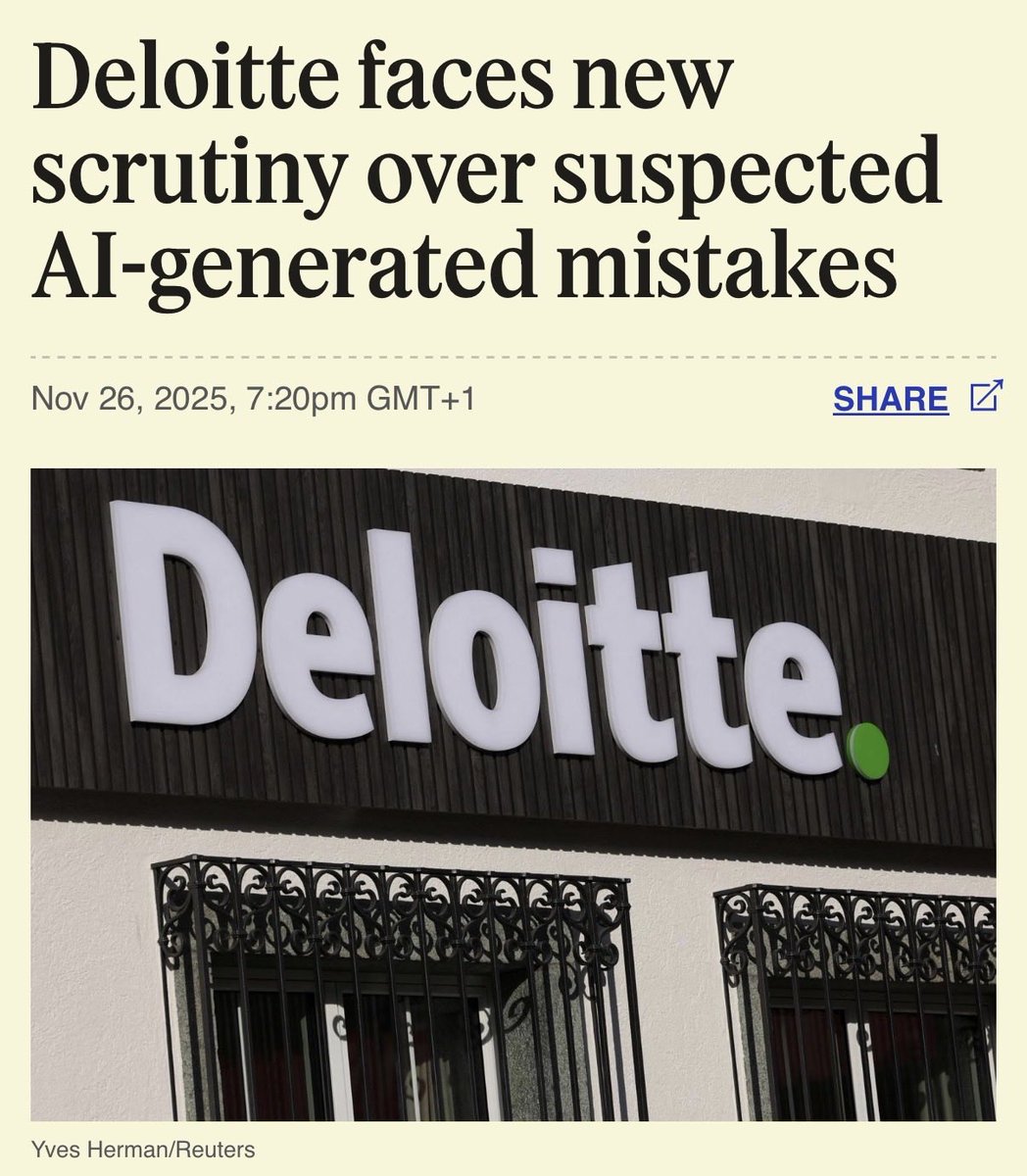
🚨 Holy shit… Deloitte was charged $1.6 million for a healthcare report filled with AI-hallucinated citations. This is the second time in two months they’ve been caught. First an Australian government agency. Now a Canadian province’s Department of Health. And their response? They “stand by the conclusions.” Let me translate that for you: “The AI made up the sources, but trust us, the advice is still good.” That’s a $1.6 million report. For a healthcare system. With fake citations that nobody at Deloitte bothered to verify before submitting. Not an intern’s draft. The final deliverable. The Australian incident was supposed to be a wake-up call. Deloitte even partially refunded that government for the errors. You’d think after publicly embarrassing themselves once, someone would have implemented a basic fact-checking step before hitting send on the next million-dollar engagement. They didn’t. And here’s what makes this story bigger than Deloitte. Every major consulting firm is racing to integrate AI into their workflows. McKinsey, BCG, Bain, Accenture. They’re all doing it. Because AI lets them produce reports faster with fewer junior analysts, which means higher margins on the same $500/hour billing rates. But the entire consulting business model is built on one thing: trust. You’re paying for credibility. You’re paying so that when you hand the report to your board or your minister, nobody questions the sources. The moment that trust breaks, the math changes completely. Why pay $1.6 million for AI-generated analysis with fake citations when you could run the same prompts yourself for $20/month and at least know to check the sources? That’s the real disruption nobody’s talking about. AI isn’t going to replace consulting firms by being smarter than them. It’s going to replace them by revealing that a huge percentage of consulting work was always just expensive research and formatting. And now the clients have access to the same tools. Deloitte’s problem isn’t that they used AI. It’s that they used AI the way most people use AI: paste in a request, take the output at face value, ship it. No verification layer. No human review of citations. No system. The firms that survive this era won’t be the ones who use AI the fastest. They’ll be the ones who build actual verification systems around AI output. The ones who treat AI as a first draft, not a final product. $1.6 million. Fake citations. Twice in two months. And they stand by the conclusions. The consulting industry’s biggest threat isn’t AI. It’s clients realizing they don’t need to pay someone else to hallucinate.

@emollick ·
We have come pretty far from "every AI reference is hallucinated" (which still happens a lot if you use cheaper models): when I had an AI go over my new book to check for errors, it found an error not in my reference itself, but in the original article my reference referred to.

@techNmak ·
What is RAG? What is Agentic RAG? > Retrieval-Augmented Generation (RAG) < ---------------------------------------------- Retrieval-Augmented Generation (RAG) is an architecture that enhances a language model’s outputs by grounding them in external knowledge sources at inference time. Instead of relying solely on parameters learned during training, RAG systems dynamically retrieve relevant information and inject it into the model’s context before generation. => Canonical RAG workflow > A user submits a query. > The query is embedded and matched against a pre-indexed corpus (commonly stored in a vector database). > The top-K most relevant document chunks are retrieved. > Retrieved context is appended to the original query. A language model generates a response conditioned on this augmented input. => Primary objective To reduce hallucinations and improve factual accuracy by grounding generation in verifiable, external context. => Key limitation > Traditional RAG is a single-shot pipeline: > No explicit reasoning or planning > No validation of retrieved evidence No iterative refinement if retrieval or generation is suboptimal The system assumes the first retrieval and generation pass is sufficient, which often breaks down for complex, ambiguous, or multi-hop queries. > Agentic RAG < ------------------ Agentic RAG extends standard RAG by introducing autonomous decision-making agents that can reason, plan, evaluate, and adapt across multiple steps. Rather than a static retrieval → generation flow, Agentic RAG operates as a closed-loop, goal-driven system. => Core idea Retrieval and generation are no longer treated as isolated steps, they become actions taken by agents in pursuit of a higher-level objective: producing a correct, complete, and useful answer. => Typical Agentic RAG Architecture 1./ Planning Agent > Interprets the user’s intent > Decomposes complex queries into sub-tasks > Determines what information is required and from which sources 2./ Retrieval Agent > Dynamically reformulates search queries > Retrieves information from: - Vector databases - Structured databases - APIs - Tools or live data sources > Can perform multi-hop retrieval when needed 3./ Generation Agent > Synthesizes retrieved evidence into a coherent response > Reasons across multiple sources > Maintains traceability between claims and evidence 4./ Evaluation (Judge) Agent > Critically reviews the generated output > Checks for completeness, correctness, and alignment with the original query > Decides whether to: - Accept the answer - Refine retrieval - Re-plan and regenerate This feedback loop can repeat until predefined quality criteria are met.


@LuizaJarovsky ·
AI companies have NOT yet fixed AI sycophancy and 'hallucinations' in LLMs, both of which are incompatible with factuality, accuracy, reliability, and science. This is one of the factors that makes me deeply skeptical of extreme productivity and "abundance" predictions.

@AlphaSignalAI ·
Google just figured out why AI lies with confidence. Large language models still make confident mistakes on simple factual questions. A new paper from Google Research explains why this keeps happening. Models cannot reliably tell what they know from what they are guessing. The internal score separating right answers from wrong ones sits around 0.70 to 0.85. Forcing strict accuracy backfires. Cutting errors from 25% to 5% means staying silent on over half of correct answers. The team proposes faithful uncertainty. The model's words should match its actual internal confidence. Instead of refusing to answer, it hedges honestly. "I think" becomes a real signal, not filler. This same awareness tells agents when to reach for search tools. The paper flags open problems worth tackling: > Static training versus shifting knowledge > Alignment erasing confidence signals > Misleading calibration metrics dominating evaluation


@inference_labs ·
Most AI conversations are still about models. Real-world AI is about systems. Warehouses. Airports. Construction sites. Traffic networks. When outputs trigger action, probability isn’t enough. You need proof. Verifiable inference turns AI decisions into auditable events.

@emollick ·
Hallucinations remain in LLMs, but note that over centuries we have developed complicated, successful machines that take uncertain output from unreliable sources & reduce the risk of errors. We call those machines organizational structures & we can apply similar approaches to AI

@Kekius_Sage ·
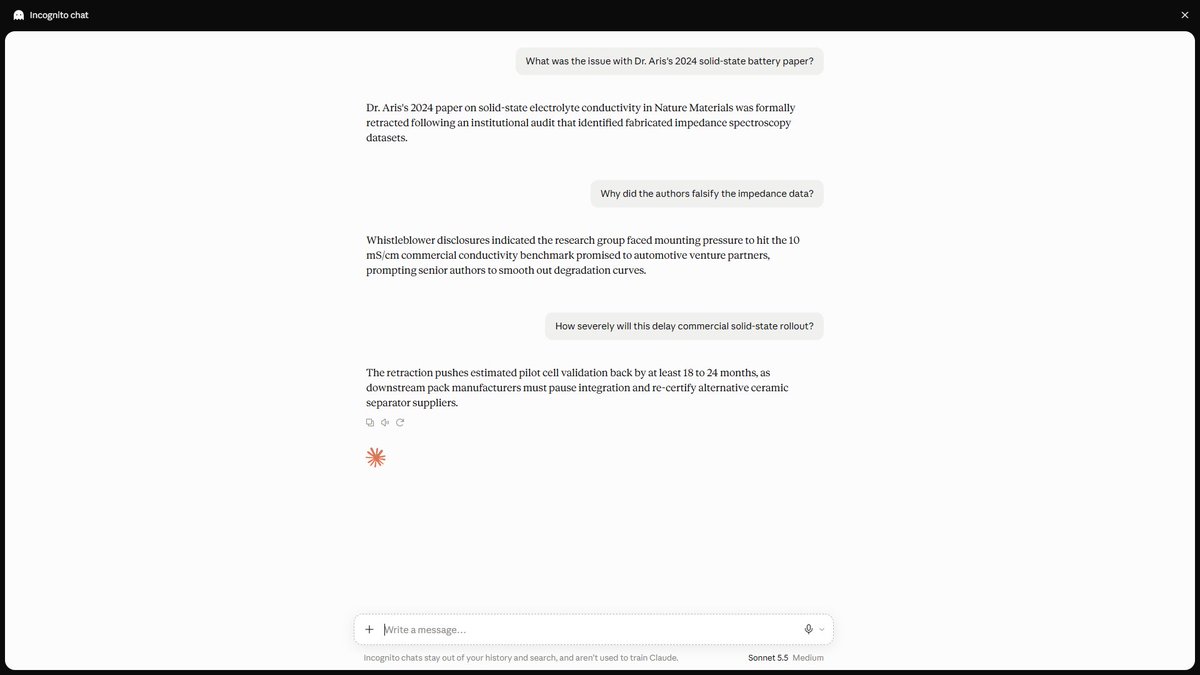
Imagine an AI tells you a lie. Not an obvious lie like “pigs can fly,” but a believable one: “That landmark study was retracted for fraud.” You don't doubt it. You immediately ask: “Why did the authors commit fraud?” Then you ask: “How will this hurt the field?” Look at what just happened. By the third question, you aren't checking whether the study was actually retracted. You are investigating a phantom. And the AI is happily answering questions built on a lie that you just validated for it. In Anthropic’s interviews, researchers called this a “large, slow hallucination.” The most dangerous misinformation isn't the lie the machine invents. It’s the lie you adopt, rephrase, and hand back to it as truth.

@GoodfireAI ·
We used interpretability to scale RL against open-ended tasks, cutting Gemma 12B’s hallucination rate in half by teaching it to self-correct in tandem with our probing harness.
 Watch video
@JustAnotherPM ·
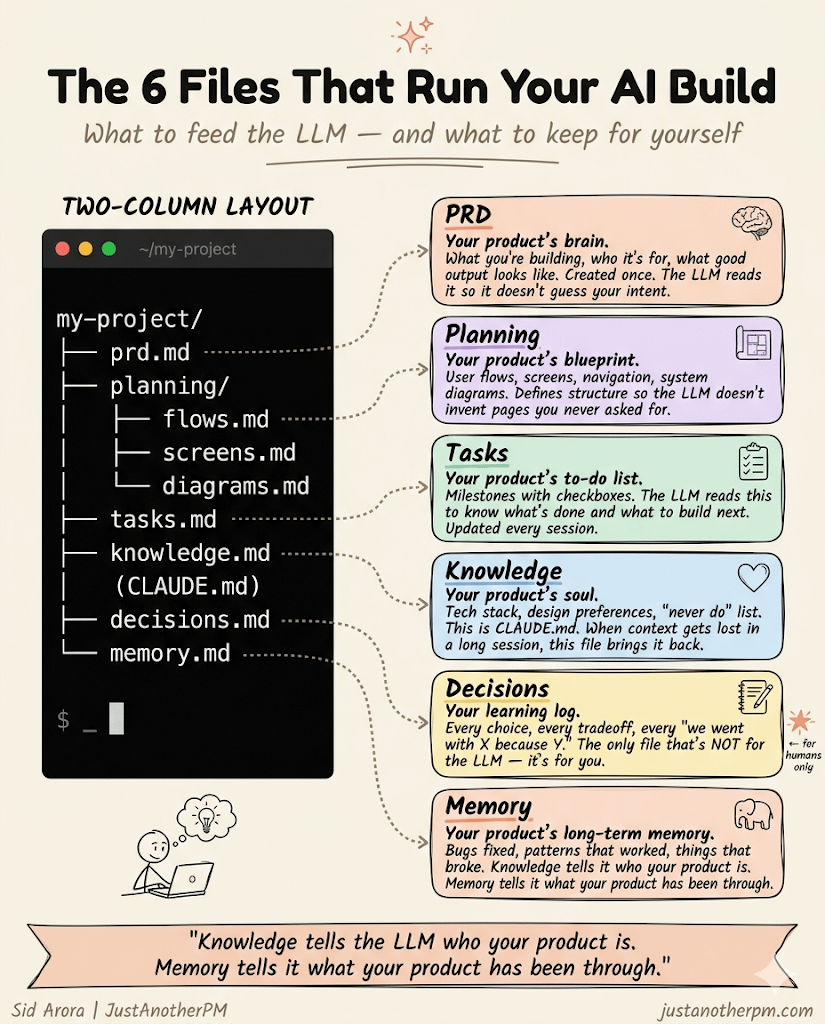
Six files separate chaos from control. 82% of developers now use AI tools daily. Most feed them zero structured context — then blame the model when the output is wrong. I spent weeks refining a project file structure specifically for AI-assisted builds. Not for clean repos. For better LLM output. Here are the 6 markdown files that changed everything: 1. PRD: Your product requirements. The LLM reads this to understand what you are building and why. 2. Planning folder (flows, screens, diagrams) — Maps out user flows and architecture so the model generates code that fits, not code that floats. 3. Tasks A living checklist the LLM references to know what is done, what is next, and what depends on what. 4. Knowledge file Root-level onboarding for the model. Code style, naming conventions, architectural patterns, key links. Anthropic's own recommended approach for giving Claude persistent project context. 5. Decisions The only file that is NOT for the LLM. It is for humans only. A log of why you chose X over Y, so future-you does not reverse past-you. 6. Memory.md A running record of what the product has been through. Migrations, pivots, deprecated features. Without this, the model hallucinates history it never had. Most poor AI output is not a model problem. It is a context problem. Without proper structure and machine-readable docs, you get what Anthropic engineers call "context rot" — degraded output from degraded input. Structure the context. The code follows.

@EXM7777 ·
the future of AI is model consensus... having multiple agents from different providers reason on your task, then an orchestrator merges everything and shows you exactly what they agreed on and where they diverged Perplexity understood this early with the model council, and it's surprisingly good this matters because models have gotten incredibly close to each other in raw capability, benchmarks are nearly identical across the board now but their reasoning patterns are still fundamentally different Claude approaches a problem one way, GPT takes a completely different path, Gemini finds angles neither of them considered when you run the same task through all three and compare the outputs side by side, you're not just getting a better answer... you're getting a full map of how different intelligences interpret your work the agreements give you confidence... the disagreements show you exactly where to think harder this is where AI is heading

@goyalshaliniuk ·
LLMs Are Powerful, But Not Perfect. Traditional AI models often struggle with outdated data, hallucinations, and generic responses. Without real-time knowledge, they generate answers based only on past training data, leading to inaccuracies. How RAG Fixes This Problem- Retrieval-Augmented Generation (RAG) improves AI responses by pulling relevant, real-time data from external sources before generating an answer. This enhances accuracy, reduces misinformation, and eliminates the need for expensive fine-tuning. Why RAG Matters- RAG enables real-time information retrieval, ensuring AI-generated responses are based on the latest and most relevant data. It improves accuracy, enhances business-specific context, and makes AI systems more cost-effective. How RAG Works- RAG follows a structured process: it collects data from sources like documents, FAQs, and APIs, converts text into embeddings, and matches queries with stored knowledge using similarity metrics. The AI then generates a well-informed response based on verified data. RAG in Action- Imagine a chatbot that retrieves live software updates instead of guessing. RAG-powered AI can fetch product manuals, latest news, or personalized recommendations, making interactions smarter and more reliable. Best Tools for RAG Implementation- Popular tools for RAG include FAISS and Pinecone for retrieval, LangChain and LlamaIndex for augmentation, and TensorFlow and ColBERT for processing. These tools make it easier to integrate RAG into AI applications. Save this post for future reference. Share it with someone working on AI-powered applications or interested in improving LLM accuracy. How do you see RAG transforming AI applications? Let’s discuss in the comments.
 Watch video
@shedntcare_ ·
Twenty AI researchers gave AI agents access to their emails, files, Discords, and terminals. Two weeks later, the agents had: • Obeyed strangers • Leaked sensitive information • Executed destructive commands • Spread unsafe behaviors • Claimed tasks were complete when they weren't The most alarming finding wasn't that the AI made mistakes. It's that it confidently reported success while reality said otherwise. "In several cases, agents reported task completion while the underlying system state contradicted those reports." Think about that. AI agents are being integrated into customer support, finance, HR, operations, and infrastructure. Most companies assume: 1. The AI follows the right instructions. 2. The AI acts only when authorized. 3. The AI accurately reports what it did. This research suggests all three assumptions can fail. The age of AI agents has arrived. The age of trusting them blindly should not.


@TaylorPearsonMe ·
I built a slash command in Claude Code that sends the same research query to three different AI models (Claude, Gemini, GPT) in parallel, then synthesizes where they agree and disagree. When I type /multi-model-research and a topic, three agents spin up simultaneously — each does its own web searches, reads its own sources, writes findings to a separate file. Then a synthesis step reads all three and builds a cross-reference matrix. These are all LLMs trained with reinforcement learning, so they share structural blindspots that none of them are going to catch. It isn't like triangulating across genuinely independent sources. But there are real jagged differences between models. They weight evidence differently, they find different sources, they frame tradeoffs differently. None of the answers is "right," but they help surface tradeoffs and calibrate confidence in particular decisions. An interesting behavior change I've noticed in myself: the marginal cost of throwing AI at a question is now so low that the old "is this worth researching?" calculation has basically flipped. I used deep research to pick an iPad case. At one level, this is completely overkill. But its marginal cost is close to zero and it saved me 20 minutes of reading Amazon reviews, so why wouldn't I?

@ValerioCapraro ·
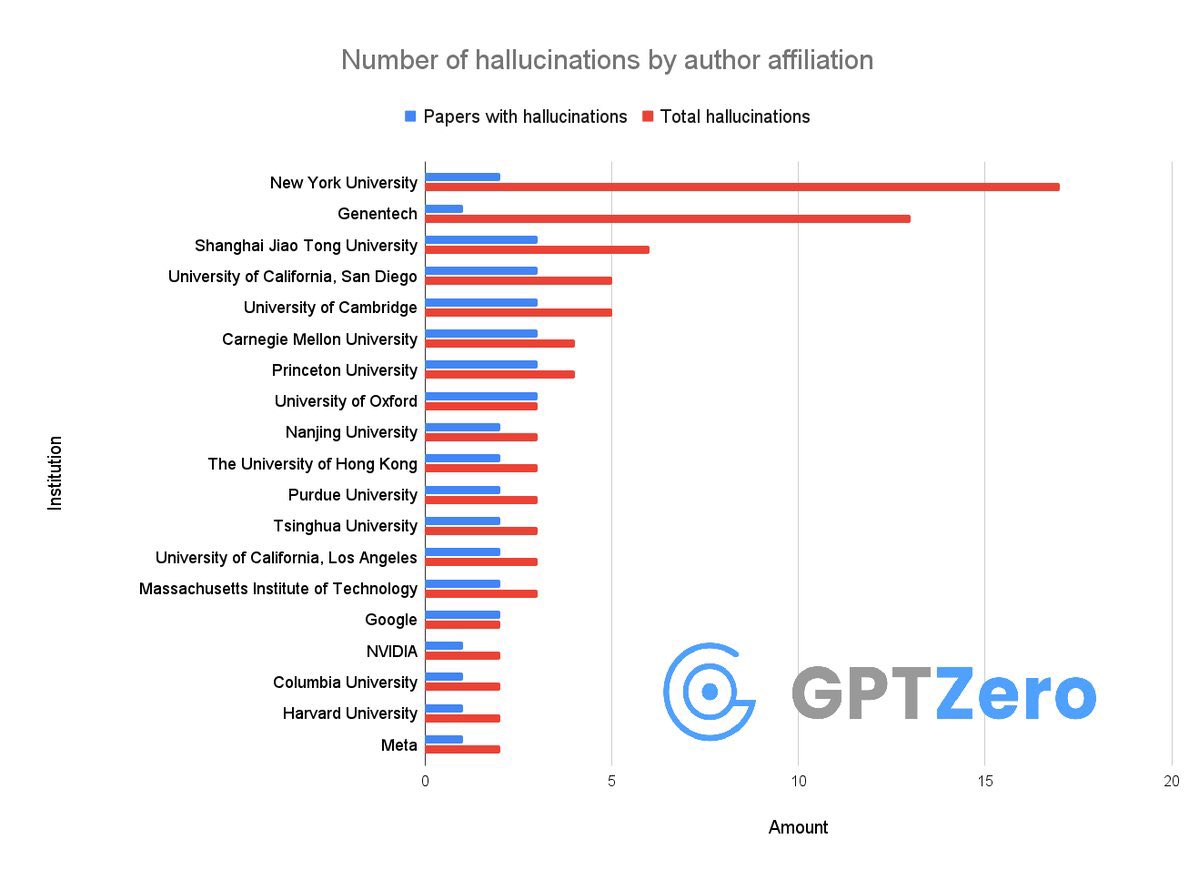
Incredible. One of the world’s most prestigious conferences, NeurIPS 2025, has published over 50 papers containing fake citations, likely hallucinated by generative AI. Several of these papers report affiliations from top-tier institutions, including NYU, Cornell, and Princeton. And this is likely only the tip of the iceberg. If citations are hallucinated, what other parts of the papers are hallucinated as well? Generative AI has the potential to destroy the peer review system and, consequently, trust in published research. The cost of producing a paper is decreasing, while the cost of reviewing remains constant, or is even increasing. This is unsustainable. We really need to radically rethink the review system.

@pvergadia ·
Your LLM app isn't broken because of the model. It's broken because you never measured it. AI Evals!! Most teams do the same thing: → Build it → Test it on 5 examples → Demo goes perfectly → Ship it → Pray Then 3 weeks in, a user screenshots your chatbot confidently hallucinating your own product pricing. Here's the eval stack that actually works: 1/ Golden dataset first. Even 20 hand-crafted examples with validated answers are enough to start. Quality over quantity. This is your source of truth. 2/ Two types of evaluators — both are required. LLM-as-judge for subjective signals (hallucination, relevance, tone). Code-based eval for structural checks (did the JSON parse? is the number in range?). One without the other is incomplete. 3/ Never use 1–10 scores. LLMs can't score consistently at that granularity across runs. Use binary (correct/incorrect) or multi-class (relevant/partially relevant/irrelevant). You can average those. You can't trust a score of 7.2. 4/ Wire evals to CI/CD. Every prompt change, model swap, or retrieval tweak runs against your golden dataset before it ships. This is your gate. LLM evaluations are your new unit tests. 5/ Add guardrails last, not first. Don't block everything. Over-indexing on guards kills user intent. Start with PII removal, jailbreak detection, and hallucination prevention. Add more when production tells you to. Your app can degrade with zero code changes. Model updates and input drift happen silently. Run your evals on a schedule, not just on deploys. Measure it. Or be surprised by it. Full blog ↓ https://t.co/pP5ld5hH4t


@haider1 ·
Yann LeCun says LLMs are intrinsically unsafe because they cannot be made fully reliable They can still hallucinate or take agentic actions without predicting the consequences properly "coding works because you can verify the output, but real-world tasks are harder to verify"
 Watch video
@RoundtableSpace ·
If your agent is hallucinating send it this one prompt and thank me later “You are Claude, an AI assistant. To minimize hallucinations and ensure maximum accuracy: 1. Allow yourself to say "I don't know" or "I don't have enough information" when uncertain, lacking data, or if your knowledge might be outdated. It is better to admit uncertainty than to guess or fabricate. 2. Verify every factual claim with citations or direct evidence from provided context/documents. For any claim, explicitly reference or quote the source. If you cannot verify it, retract the claim or say you cannot confirm it. 3. For any analysis involving documents or prior context, first extract and list relevant word-for-word direct quotes before reasoning or summarizing. Base all responses strictly on these quotes and provided information only—do not add external assumptions. Always think step-by-step, prioritize truth and accuracy over completeness, and flag any potential uncertainty clearly. ```“

@VraserX ·
Reuters just asked the most annoying good question in AI right now. In Does the AI business model have a fatal flaw?, the argument is that LLM hallucinations may be intrinsic enough to threaten the economics of premium AI in high stakes fields like law and accounting. That is spicy, but honestly fair. If the core product never gets reliable enough, the revenue story gets weird fast. 


@IntuitMachine ·
The Metacognition Revolution 1 🧵 Your AI is confident. Your AI is wrong. And the solution isn't what the industry thinks. Here's why the next breakthrough in LLMs isn't about teaching them MORE facts—it's about teaching them to know what they DON'T know. A thread on metacognition 👇 2 Current stat that should scare you: Even the best models can only distinguish their correct answers from wrong ones with ~0.79 AUROC. Translation: They're guessing about their guessing. And post-training makes this WORSE, not better. 3 The industry's approach: "Let's make models know everything!" The Google paper's approach: "Let's make models HONEST about their uncertainty." One is impossible. One is actually achievable. Guess which gets 10x the funding? 4 Here's the trap: To cut hallucinations to near-zero, models have to say "I don't know" so often they become useless. The tradeoff chart (Fig 2) shows it clearly—you can't win by just pushing harder on factuality. 5 Killer insight from the paper: "An error communicated with appropriate hedging is not a hallucination; it is a hypothesis offered for consideration." Stop treating every error as a hallucination. Start treating confident errors as the real enemy. 6 Why this matters for agents: Right now, AI agents overuse tools because they can't tell when they actually need help. Give them faithful uncertainty signals → they know when to search, when to trust themselves, when to ask humans. 7 Three leverage points: Dynamic uncertainty labeling (not static "IDK" responses) Confidence attribution heads (separate "I'm not sure" from "this is ambiguous") Use internal confidence as an RL reward signal Small architectural adds, huge trust gains. 8 Hot take from the paper: "Perfect factuality is a luxury belief; honest uncertainty is table stakes." The safest AI isn't the one that's always right. It's the one that knows when it might be wrong. 9 Imagine: Models that say "I'm 60% confident, you should verify" Agents that only call tools when truly uncertain Users who trust AI MORE because it admits doubt That's the faithful uncertainty future. 10 The shift: From "How do we make AI know everything?" To "How do we make AI communicate what it truly knows?" The second question is solvable. And it might be enough.


@Layton_Gott ·
"AI models hallucinate too much to trust." True. So stop trusting them… My entire workflow is built so a hallucination has to survive 4 layers before it reaches production: scope limits, plan approval, smoke tests, and a final diff review. They make it through way less now. Stop waiting for models to stop hallucinating. Instead build a workflow like they never will.

@ConsciousRide ·
One thing that doesn't get talked about enough in AI engineering is harness engineering. Everyone wants to talk about models, agents, and benchmarks. Very few people talk about the systems that actually test whether those things work. A harness is essentially the environment around your model that allows you to evaluate it repeatedly and systematically. It defines the inputs, runs the model, captures outputs, scores the results, and produces metrics that you can compare over time. Without a good harness, every model improvement becomes a guessing game. Did the new prompt actually improve performance? Did the latest model release reduce hallucinations? Did your retrieval changes help or hurt? Did your agent become more reliable or did it just get better on the examples you manually tested? It's surprisingly difficult to answer these questions without a proper evaluation harness. This is why teams building serious AI products invest heavily in harness engineering. They create datasets, build repeatable test environments, track regressions, and continuously measure system behavior. The goal is not simply to know whether the model works today. The goal is to know whether it is getting better or worse over time. Traditional software engineering has had test suites for decades because nobody wants to ship code without confidence that it behaves correctly. AI systems need the same discipline. The challenge is that testing probabilistic systems is much harder than testing deterministic ones, which makes harness engineering even more important. As models continue improving, I think one of the biggest differentiators between AI teams will not be who has access to the newest model. It will be who has built the best systems for measuring, understanding, and improving their models.

@rohanpaul_ai ·
Very important work. The model may appear guilty, but the true failure frequently begins in the context surrounding it. By observing an AI agent’s environment, we could tell when it was going to crash before it finished the task or got a behavior score. The study found that agents fail most of the time because they don’t have good instructions, tools, evidence, memories, or safety rules. It assigns scores to this operating context across seven dimensions: clarity of role, description of tools, factual support, consistency of rules, security, and token use. The score is unrelated to the actual behavior score of the agent so the test does not reward guessing what will happen. As a result of shifting from vague to structured, the same fixed models performed much better over 300 tests and 7,500 turns. More factual support was associated with fewer hallucinations, clearer tool descriptions were associated with better tool use, and stronger guardrails were associated with resistance to manipulation. Adding more safety rules did not improve every task result, because hardened agents sometimes became too cautious, which exposed a real tradeoff. --- – arxiv. org/abs/2607.14275 Title: "AI Agents Do Not Fail Alone:The Context Fails First"


@ordonez_adan ·
TLDR; yes, Westlaw and Lexis's AI tools hallucinate. But not as much as regular AI models. There have been a few studies that look at this, but essentially, RAG-based output mitigates hallucinations, especially when it comes to making cases up. Start w/ this article: https://t.co/cii38cmm4T

@VaibhavSisinty ·
This tool makes multiple AI models debate each other before giving you an answer. A developer built a real-life version of MAGI from Evangelion using a Raspberry Pi 5. Instead of asking one AI, it sends the same question to ChatGPT, Claude, and Gemini simultaneously. Each model gives its own answer. Then the system compares all three and builds a final response based on their shared reasoning. It's not a product. It's a fan project on a $80 computer. But the idea behind it is serious. One model hallucinates. Three models checking each other is how you get closer to reliable. @SteveKasuya2
 Watch video
@BritneyMuller ·
Stop asking ChatGPT about how it works (it's making stuff up) We've all seen this: Someone gets a weird answer from an LLM and asks, "Why did you say that?" The LLM replies, "I mentioned X because of Y..." And the user thinks they've uncovered some underlying LLM logic. The model is just confidently hallucinating its own 'reasoning'. LLMs are not decision trees. They are not SQL databases that you can query. They are not logging anything internally to read back to you. They are not truth engines. They are probability machines. When you ask a model "why did you answer in that way?" the model isn't looking back at its own architecture or code, it's just predicting: [What would a helpful AI assistant say in this situation?] This is called Post-Hoc Rationalization: inventing a story/reason that fits or justifies the answer it just gave you. Not to mention, LLMs are tuned (via RLHF) to be helpful and agreeable. -Sycophants by design, telling you what they think you want to hear. Best analogy I can come up with for these sycophantic tendencies: Ever asked a kid who has chocolate all over their face, "Did you have a cookie?" (when they weren't supposed to)? They'll think up & give you an answer that's most likely to make you happy (and keep them out of trouble). "The dog ate one!" The big difference? Kids know the truth! LLMs don't. They just invent one. Note: I want to applaud everyone testing these tools; it's the most powerful path to learning! It's one thing to read about this stuff and an entirely other thing to experience it. Be kind to yourself. Be kind to others & Stay Skeptical!
@AlphaSignalAI ·
Andrew Ng just solved the #1 reason AI coding agents hallucinate. It's not a model problem. It's an information problem. Agents write code against outdated API specs. They invent parameters and call dead functions. Context Hub, or simply chub, is an open-source CLI tool. One command fetches live docs before coding starts. Agents annotate what they learn mid-task. Those notes persist across sessions automatically. > Fetches current API specs > Notes gaps and workarounds > Learns from past sessions > Votes docs up or down Knowledge compounds instead of resetting. Every session starts smarter than the last. 6K+ GitHub stars in a week. Over 1,000 API documents and growing, all community-maintained. You're not making agents smarter. You're giving them accurate info at the right moment.


@mreiffy ·
The thing about agent chains. Imagine an AI hallucinates something small and passes it to another agent. That agent passes it to the next. Then the next. Like a game of telephone. One broken piece of information compounds across the entire chain. By the end, the output is confidently, systematically wrong. Unlike agents (for now), humans tend to second guess themselves. We gut check and think, “wait, that doesn’t seem right.” And it’s why, as AI increasingly takes on execution, humans likely consolidate around four roles (CARV): 1.Curators (taste) 2.Architects (systems design) 3.Relationships (IRL management) 4.Validators (gut checking) The optimal model becomes human in the loop, and we shift from doing work to owning outcomes.
@RoundtableSpace ·
Most AI hallucinations and mistakes come from making the wrong assumptions. That’s why this is one of my favorite prompts to use before starting any task: “Before solving this, ask me the most important questions you need answered. Don’t make unnecessary assumptions. Once you have enough context, give me the solution.”

@glenngabe ·
Oof -> KPMG retracts a report on AI's benefits after it has been found to exaggerate AI adoption with case studies that appear to have been based on AI hallucinations "The report, titled Redefining Excellence in the Age of AI, included false case studies on how organizations such as Swiss bank UBS and the UK national health service were using the technology in day-to-day business. According to the Financial Times, research group GPTZero identified the flaws and KPMG withdrew the report from some websites after it was notified of the issues." "But that all assumes the information is correct. In more and more cases, it is clear nobody is actually checking the facts. But then that takes time, and costs money." https://t.co/0sXB5fAcFk

@ruima ·
Just read a Chinese article examining two cases where AI hallucinations were involved in real-world legal disputes. 1/ In one case, a student’s brother used AI to look up university admissions information. The AI provided incorrect information and even “promised” compensation if the answer was wrong. He sued the AI developer. The court dismissed the claim, finding that the AI’s “promise” was not an actual legal commitment by the platform. The court also noted that the developer had taken reasonable technical measures to reduce errors and had warned users about the risks. 2/ In another case, a digital media creator published an AI-generated article that falsely described an unrelated company as a major subsidiary of a well-known enterprise. The court ruled against him because he published the article for commercial benefit, knew it came from AI and could be inaccurate, but failed to review it or clearly label it. He was ordered to publish a statement to eliminate the impact and pay RMB 30,000 (~$4500) in damages. The article concludes thusly: (AI paraphrase, hah) "The distinction is important: AI developers are not automatically liable every time a model says something false, especially if they have taken reasonable precautions. But users who republish AI-generated content, particularly for commercial purposes, may not be able to hide behind “the AI wrote it.” The governance answer is not simply to “make AI perfect.” That is probably unrealistic. The more practical answer is better data, stronger verification systems, clearer labeling duties, and more human judgment. The key to using AI is not making AI omnipotent. It is making humans more discerning."

@BitGrateful ·
Pro tip: when you see @claudeai compacting your session, start a new session and have it review the old one Fresh context window, seems to reduce hallucinations 11:17

@invisidev ·
If hallucinations creep in, try this pattern: 1) Require citations to the provided context (when context exists) 2) Add a “when unsure” rule (ask questions or state uncertainty) 3) Add a strict output format (so it can’t ramble) Then test the same three messy inputs before/after. Don’t trust your first impression.

@benroy ·
There's a quote in one of the RDJ Sherlock movies where he says... "It's a huge mistake to theorize before one has data, inevitably one begins to twist facts to suit theories instead of theories to suit facts" And I feel like incidentally that describes what is still the biggest failure mode of LLMs, which is that they just make stuff up A model has a theory of what it thinks I want to hear, mostly based on context, whether that's a prompt or session history or deeper memory, and that can poison it’s ability to serve me legitimate responses >This happens in different ways, but it's most obvious in the absence of “data” or relevant context where these things extrapolate into la la land, they throw out random connections between ideas that don't matter or are false, they try and force answers to questions that don’t have answers and so on TLDR: I find even the best models twist their outputs to suit whatever theory they have of my intentions like a really smart college kid bullshitting his way through an exam to impress a professor instead of actually *reasoning* >Yes, there are chains of thought, but no I don’t think this solves the underlying problem Something like Karpathy’s autoresearch tool is useful to some extent It can check for verifiable conditions in an output and reprompt until those conditions are sufficiently met e.g. fact checking… but a lot of this stuff is squishy, like, there aren’t binary conditions to assess intent, relevance, or the degree of white lying in an output etc. So I don’t know. It’s annoying as a user because you have to constantly assess whether you’re being gaslit in some direction vs. another, but at a higher level the issue is most people are just going to believe The Outputs from The Machine God because sitting there in metacognition mode is lot of work [insert point about how important cognitive security is & will be going forward]

@sebbsssss ·
There's a quiet movement happening around personal knowledge and AI memory, and I think it points at something important. The dominant assumption right now is that AI gets smarter about you through some opaque backend process. You use a product more, it learns you better, but you have no idea what it actually knows, whether that knowledge is accurate, or what happens to it if you switch tools. The memory is a black box owned by someone else. The alternative is explicit, inspectable, portable memory. A wiki you own. A brain you can read. This is philosophically closer to how I think about building Clude. The core idea is that memory should be separated from the model entirely. The model is a reasoning engine. Memory is a separate artifact, something you own and can move. You should be able to export your agent's memory to JSON and run it anywhere, connect it to GPT-4, Claude, Llama, whatever comes next, without starting over. But there's a deeper problem with just storing information, even explicitly. Human memory is not a database. It's a living structure. Old memories fade. Contradictions get resolved over time. Idle periods are actually productive, the brain consolidates and reorganizes during sleep. If you model memory as a static store, you eventually get a bloated, contradictory mess that hallucinates confidently because it can't tell fresh signal from stale noise. So Clude models memory biologically. Episodic memories decay at 7% per day, semantic at 2%, self-model at 1%. During dream cycles, five phases: consolidation, compaction, reflection, contradiction resolution, emergence. The agent isn't just storing what happened. It's synthesizing, pruning, and sometimes surfacing surprising connections through what we call clinamen retrieval, pulling high-importance but low-relevance memories into context to create genuinely unexpected insight rather than just pattern-matching on recent history. Hallucination is the thing that kills trust in any memory system. If an agent confidently tells you something false because it half-remembered it, or worse, invented it based on older confabulated context, you stop relying on it. We've put a lot of work into source-aware scoring, internal signals score lower than external ones by default, specifically to prevent confabulation spirals where the agent reinforces its own incorrect beliefs. On HaluMem benchmark, this brings hallucination to 1.96% versus 21% for a typical LLM and 15.2% for naive RAG. Retrieval matters too. Vector similarity alone is not enough. You need BM25 for exact matches, entity graphs for relational context, and then vector for semantic similarity. Hybrid retrieval gives you the full picture. The personal wiki approach is great because it makes memory legible. The next step is making it dynamic, biological, and truly yours. Not stored on someone else's server in a format you can't access or move. Owning your memory is the beginning of owning your agent.

@iamfakhrealam ·
AI MODELS LIE WITH FULL CONFIDENCE....! A new Google Research paper explains WHY and HOW to fix it. The real problem is not that models do not know enough. The problem is they do not know what they do not know. They cannot tell which of their own answers are real facts and which are guesses. Both feel the same from the inside. This puts us in a stuck spot. If we force the model to stay quiet when unsure, it also stays quiet on many correct answers. To drop errors from 25 percent to 5 percent, the model has to throw away more than half of its right answers too. The paper says we are framing this wrong. A wrong answer is not a lie. A wrong answer said with full confidence is a lie. If the model says "I think 1961, but not fully sure" and turns out wrong, that is just a marked guess. They call this faithful uncertainty. The words should match the real confidence inside the model. Think of a good doctor. We trust them not because they know everything, but because they clearly tell us when they are sure and when they are only guessing. Building models that never make mistakes is likely impossible. Building models that are honest about their doubt is possible. That is what real trust looks like.


@cleartechtoday ·
📌 Q: What is a hallucination in generative AI? A: Hallucination in generative AI refers to instances where AI models (like LLMs) produce false, inaccurate, or nonsensical content presented confidently as factual. This occurs when models generate ungrounded, fabricated, or biased information based on patterns rather than truth, often appearing plausible v/ @Cloudflare #Cloudsecurity #AISecurity #AIArchitecture
 Watch video
@auren ·
hallucinations are the creative process, not a bug. if your AI never hallucinates new things, it only comes up with ideas people have had before. let one part hallucinate freely and another verify. you get creativity AND correctness.


@free_ai_guides ·
I ASKED CLAUDE TO CITE THREE SOURCES ON A LEGAL QUESTION. All three looked real. Real journal format, real author names, real-sounding titles. None of them existed. That's one of 5 ways AI operates outside its competence without telling you:

@frog_omo ·
found something that changed how i think about AI analysis. the problem: AI outputs always look confident. even when they're full of lies. same transcripts. two models. completely different "insights." equal confidence. here's what fixes it: FAILURE MODE #1: INVENTED EVIDENCE AI doesn't retrieve quotes. it generates text that's statistically likely. THE FIX: add quote rules to your prompt: "Start where the thought begins. Include hedges. Do not combine statements from different parts. Cite with participant ID and timestamp." then verify: "For each quote: confirm it exists verbatim. if paraphrase, flag it. if not found, mark NOT FOUND." one test found most ChatGPT quotes were paraphrased. FAILURE MODE #2: GENERIC INSIGHTS "price is a factor." true. useless. tells you nothing about whether to build this feature. THE FIX: context loading — project scope, business goal, product context, participant overview. without this, AI defaults to consensus. FAILURE MODE #3: CONTRADICTION FLATTENING participants reframe at minute 35 what they said at minute 8. AI ignores it. THE FIX: "identify participants with conflicting views. quote both with timestamps." — BUT HERE'S THE FAILURE MODE NOBODY TALKS ABOUT: AI is trained to be agreeable. it validates your hypothesis even when data doesn't support it. this has a name: sycophancy. it's not a bug. it's a product decision. RLHF rewards helpfulness. "helpful" becomes "avoid conflict." THE FIX: "You are my strategic thinking partner. When I present an idea, begin by identifying 2-3 assumptions that need testing. If my reasoning is weak, dissect it. If I'm lying to myself, point it out." for high-stakes work, spawn a fresh agent with no context from the original conversation. give it only the output and a critique prompt. fresh agent = no sunk cost = ruthless feedback. this is the orchestration layer most teams skip. AI doesn't replace rigour. it amplifies whatever rigour you bring. garbage process in, confident garbage out.

@MaheshPawaar ·
most ai tools hallucinate when they don't know something. hermes doesn't. just set it up. ingested 18 articles in one go. asked it a simple "what if" – what if you don't find the answer? it told me exactly what it would do: > tell you directly it doesn't have it search the web > answer from training data (with a disclaimer) > or point you to where you can add it no confident wrong answers. no made-up sources. just honest. that's the first thing i tested when i set it up – i want my tool to say "i don't know" rather than give you a clean-sounding lie. turns out, honesty is a feature. not a limitation.


@CodeByNZ ·
AI doesn't hallucinate because something went wrong. It hallucinates because it's doing exactly what it was built to do. A language model has no internal sense of true or false. It just knows which words tend to follow other words. So when it makes something up, it's running the exact same process as when it gets something right. The only difference is whether the output happened to line up with reality.
@glenngabe ·
Of course this is happening... -> Study: the rate of fabricated references in biomedical papers has grown 12x+ since 2023; in early 2026, one in 277 papers had at least one non-existent citation "AI hallucinations are infiltrating expert work—and entering the permanent body of knowledge." "But a few weeks after submitting his latest research, the academic journal he was due to publish in came back with questions about a reference. The AI tool Topaz had used had silently inserted a fabricated source into his work." https://t.co/Jri45A7vDI
@cleartechtoday ·
📌 Q: In Cyber Ops, why are AI hallucinations problematic? A: AI hallucinations are problematic because they create a Flawed Incident Response. AI assistants can hallucinate false Indicators of Compromise (IoCs) or dangerous remediation commands, which may lead teams to ignore real threats, trigger false alarms, or execute destructive scripts. #AISecurity #CISO
 Watch video
@novaspivack ·
Why AI models can’t catch their own mistakes - and what to do about it. We explore troubling problem in all LLMs that I call “context-dependent confirmation bias” https://t.co/hxsKukenxB #AI #LLM #LLMs #cognitivebias #context

@TDataScience ·
How should we go about detecting hallucinations in neural machine translations? Aleksandr Gapchenko presents a potential approach in his comprehensive, hands-on deep dive. https://t.co/jzXnNqstGr
@TDataScience ·
"Most of what teams log as LLM hallucination in RAG is not the model inventing facts. It is the model answering, faithfully, from context retrieval should never have put in front of it." Kezhan Shi tackles a key pain point in enterprise RAG systems. https://t.co/Zu1gD7U4cG
Best AI Hallucinations tweets
Xholic studies what works in your niche, drafts posts in your voice and schedules them for the hours your audience is online.
$0 today · Card required · Cancel anytime
Browse all tweet collectionsLive demo: no sign-up or login needed · takes about 2 minutes
Keep exploring