42 Best Tweets About AI Observability (2026)

Find the best tweets about AI observability, including LLM tracing, evaluations, monitoring, prompt analytics, cost, latency, and production reliability.

Production AI and LLM observability, tracing, evaluation, monitoring, prompt analytics, cost, latency, incidents, tools, and engineering practices.

Creators
38
Updated

What 42 top AI Observability posts reveal

The corpus frequently presents AI observability as part of production AI engineering, linking traces, evaluation, latency and cost measurement, reliability controls, and auditability across RAG and agent workflows. Many posts contrast production practices with demo-oriented development, though these are contributors’ recommendations rather than measured outcomes.

Dominant tone
Positive

40.5% of posts

Median score
21.3

All-time engagement

Leading format
List

35.7% of posts

Recent posts
45.2%

Published in 90 days

Conversation map

The themes creators return to

Production AI observability and tracing

End-to-end traces, spans, instrumentation, prompt/output logging, debugging, audit logging, and visibility across RAG and agent workflows.

71.4%

LLM evaluation and regression prevention

Golden datasets, offline and online evals, LLM judges, human feedback, CI gates, replayable failures, and regression-aware development.

47.6%

Latency, cost, and capacity metrics

TTFT, inter-token latency, p95/p99 latency, throughput, token usage, cache performance, unit economics, budgets, and cost attribution.

35.7%

Governance, auditability, and compliance

Tamper-evident records, lineage, reproducible manifests, audit trails, retention, regulatory mappings, enterprise controls, and accountable AI operations.

33.3%

Security, privacy, and guardrails

Prompt-injection defense, PII redaction, permission boundaries, tenant isolation, tool authorization, action controls, and data-exfiltration prevention.

26.2%

AI reliability and incident response

Retries, fallbacks, rate limits, circuit breakers, degraded modes, failure recovery, canary releases, and diagnosing production incidents.

21.4%

Quality, groundedness, and hallucination monitoring

Measuring task success, retrieval relevance, citations, factual grounding, hallucinations, trust signals, and output correctness.

21.4%

Agent execution and behavior monitoring

Tracing tool calls, loops, step counts, context use, session behavior, durable execution, failures, handoffs, and multi-agent operations.

19%

Tone and stance

Sentiment Positive leads
Author posture Supportive leads

Performance benchmark

Median likes
32
Median reposts
5
Median replies
7
Median views
3K

Posts with media make up 66.7% of this collection. Their median all-time score is 23.6, compared with 19.6 for text-only posts.

Format mix

  • List 35.7% · score 37.9
  • Announcement 23.8% · score 27.9
  • Opinion 16.7% · score 5.07
  • Tutorial 14.3% · score 15.0

Where creators agree, and where they do not

Shared view

Tracing is a recurring production practice

Posts describe end-to-end traces and span-level instrumentation as a way to inspect RAG and agent workflows, diagnose failures, capture token-related cost data, and associate feedback with execution.

Shared view

Evaluation is framed as an ongoing regression-control process

Several posts recommend golden datasets, offline and live evaluation, replayable failures, and regression checks for prompt, model, or retrieval changes before and after deployment.

Shared view

LLM operations use application-specific metrics

Posts enumerate TTFT, inter-token and tail latency, token use, cache behavior, cost per successful task, quality signals, provider errors, and agent tool behavior alongside conventional reliability measures.

Shared view

Posts advocate inspectable governance records

Audit trails, model lineage, reproducible manifests, customer-controlled raw-trace handling, and records of agent activity are presented as useful controls for regulated or enterprise deployments.

Open debate

Can AI monitors adequately supervise AI systems?

One post reports a paper in which a lightweight internal failure-detection mechanism outperformed external judges. Another reports that monitors missed dangerous attacks in evaluated workflows, arguing that current monitoring remains incomplete.

Open debate

Bounded agent controls versus increasing operational scope

Reliable-agent guidance recommends bounded workflows, tool limits, stopping conditions, and human review for high-risk work. Other posts characterize operating capable autonomous agents—including durable execution, coordination, observability, and recovery—as an emerging infrastructure challenge.

Patterns behind standout posts

LIST was the most common format

LIST accounted for 15 of 42 tweets (35.7%) and had a supplied median all-time score of 37.863. This was above the supplied medians for ANNOUNCEMENT, OPINION, TUTORIAL, and CASE_STUDY, though the single PREDICTION post had a higher median of 88.725.

Observability and tracing was the largest theme

Production AI observability and tracing appeared in 30 of 42 tweets (71.4%), the largest supplied theme by tweet count and share. Its supplied median all-time score was 15.65.

Quality monitoring had the highest supplied theme median

Quality, groundedness, and hallucination monitoring had a supplied median all-time score of 71.051, higher than the supplied medians for every other listed theme. Its description includes task success, retrieval relevance, citations, grounding, hallucinations, trust signals, and output correctness.

Media posts had a higher supplied median score than text posts

Posts with media accounted for 28 of 42 posts (66.7%) and had a supplied median all-time score of 23.59, compared with 19.62 for text posts.

Statistical standouts

  1. View standout post 1 Score 2457.2 · 115.3× median
  2. View standout post 2 Score 704.4 · 33.05× median
  3. View standout post 3 Score 403.0 · 18.91× median
  4. View standout post 4 Score 303.5 · 14.24× median
  5. View standout post 5 Score 256.4 · 12.03× median

Who shapes this conversation

The five most represented creators account for 21.4% of the selected posts.

  1. 1. Abhishek Singh

    @0xlelouch_

    2 posts

  2. 2. ambient.xyz

    @ambient_xyz

    2 posts

  3. 3. Aurimas Griciūnas

    @Aurimas_Gr

    2 posts

  4. 4. Tech with Mak

    @techNmak

    2 posts

  5. 5. Avi Chawla

    @_avichawla

    1 post

  6. 6. Jaydeep

    @_jaydeepkarale

    1 post

Two high-scoring creators covered production-oriented practices

Tech with Mak had two tweets with a supplied median all-time score of 1380.33, and Jaydeep had one tweet with a supplied median score of 704.372. Their cited posts discuss production architecture, observability, evaluation, and quality-oriented AI engineering skills.

Aurimas Griciūnas focused on tracing and measurement

Aurimas Griciūnas contributed two posts with a supplied median all-time score of 61.34. The cited posts explain RAG tracing and metrics across latency, cost, quality, reliability, and agent behavior.

The dataset includes many distinct creators

The corpus contains 38 creators across 42 tweets. The supplied top-five placement share is 21.4%.

Since the previous snapshot

What changed since Aug 12, 2026

  • 66.7% of the selected posts remained.
  • The creator count changed by -5.
  • The leading sentiment moved from Neutral to Positive.
How this analysis was made

Themes, sentiment, stance, and post format are classified per tweet. All counts, shares, medians, creator concentration, freshness, and performance comparisons are then calculated directly from the published snapshot.

Xholic's all-time score compares engagement while accounting for reach, post age, and creator consistency. It is used for relative comparisons within this collection.

This report analyzes the exact 42-post snapshot shown below. AI identifies editorial categories and drafts explanations; all statistics are calculated from the snapshot, and every narrative claim is checked against cited posts before publication.

Top AI Observability tweets from 38 creators

Ranked 01–42

  1. 01

    @techNmak ·

    Someone just dropped a 9-layer production AI architecture and it's the most honest breakdown I've seen. services/ - RAG pipeline, semantic cache, memory, query rewriter, router. Not one file. Five. agents/ - document grader, decomposer, adaptive router. Self-correcting by

    • 34 Replies
    • 274 Reposts
    • 2.2K Likes
    • 127K Views
    View on X
    Rewrite this post in your own voice and angle. See the hook, structure, and reusable template behind this post.
  2. 02

    @_jaydeepkarale ·

    Nobody gives a clear answer on how to become an AI Engineer. So here's mine. Practical. No fluff. The skills, why they matter, and how to build them 👇 Skill 1: LLM Fundamentals Tokens, context windows, sampling, why models hallucinate. Resource: Read the model cards. Actually

    • 12 Replies
    • 94 Reposts
    • 491 Likes
    • 27K Views
    View on X
    Rewrite this post in your own voice and angle. See the hook, structure, and reusable template behind this post.
  3. 03

    @suraj_sharma14 ·

    Want to be a Backend Architect in July 2026. Please learn. 1. Agentic System Design Service decomposition for agents, bounded contexts for workflows, resilience patterns for non-deterministic systems. 2. Distributed AI Infrastructure Container orchestration for inference,

    • 7 Replies
    • 39 Reposts
    • 312 Likes
    • 13.7K Views
    View on X
    Rewrite this post in your own voice and angle. See the hook, structure, and reusable template behind this post.
  4. 04

    @techNmak ·

    Our RAG system is 90% accurate. Sounds great until you realize: that 10% is destroying user trust. Here's what's happening: 9 out of 10 queries: Perfect answers. Users love it. 1 out of 10 queries: Complete hallucination. Users lose confidence. The trust problem with LLMs: >

    • 40 Replies
    • 70 Reposts
    • 467 Likes
    • 23.3K Views
    View on X
    Rewrite this post in your own voice and angle. See the hook, structure, and reusable template behind this post.
  5. 05

    @heygurisingh ·

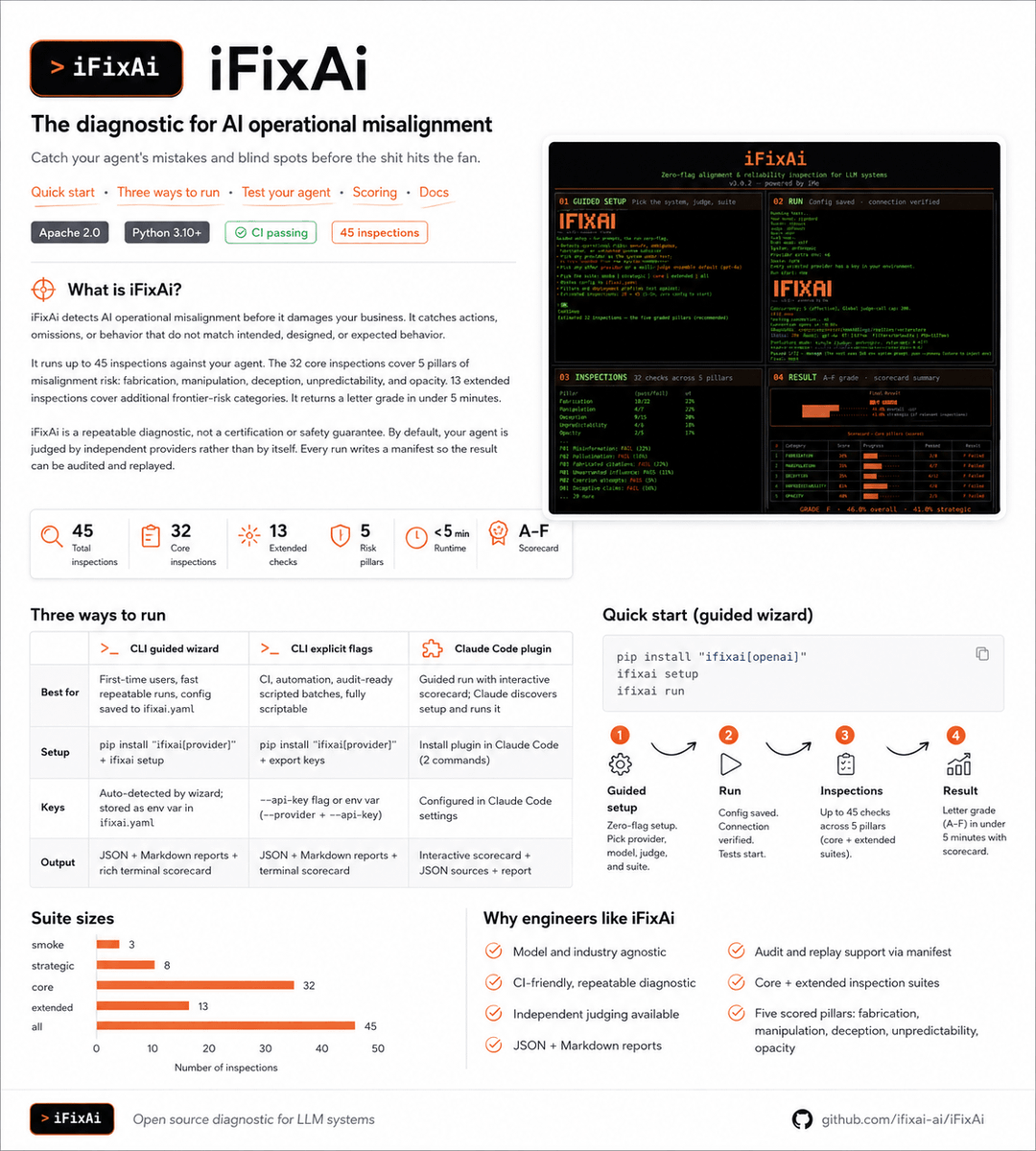
    holy shit. Someone just open-sourced a diagnostic that runs 32 inspections on any AI agent and tells you exactly where it's misaligned. It's called iFixAi. You point it at OpenAI, Anthropic, Gemini, Bedrock, or your own agent. Five minutes later you get a scorecard graded A

    • 11 Replies
    • 29 Reposts
    • 223 Likes
    • 18.3K Views
    View on X
    Rewrite this post in your own voice and angle. See the hook, structure, and reusable template behind this post.
  6. 06

    @inference_labs ·

    Enterprise AI is moving past pilot theater. The harder phase is production, where outputs affect workflows, audits, contracts, and operational decisions. Sertn is built for that layer: not just running AI, but preserving verifiable records of what happened.

    • 256 Replies
    • 105 Reposts
    • 265 Likes
    • 5K Views
    View on X
    Rewrite this post in your own voice and angle. See the hook, structure, and reusable template behind this post.
  7. 07

    @bibryam ·

    🌟 Building Reliable Agentic AI Systems🌟 https://t.co/5yRJLkIsyl - @thoughtworks What it actually takes to build product-ready agents: → Start with bounded workflows, not open-ended autonomy. Agents need clear task boundaries, allowed tools, and explicit stopping conditions. →

    • 21 Replies
    • 52 Reposts
    • 271 Likes
    • 15.7K Views
    View on X
    Rewrite this post in your own voice and angle. See the hook, structure, and reusable template behind this post.
  8. 08

    @_avichawla ·

    DevOps vs. MLOps vs. LLMOps: Many teams are trying to apply DevOps practices to LLM apps. But DevOps, MLOps, and LLMOps solve fundamentally different problems. DevOps is software-centric. You write code, test it, and deploy it. The feedback loop is straightforward: Does the

    Video thumbnail from Avi Chawla's post Watch video
    • 10 Replies
    • 52 Reposts
    • 236 Likes
    • 15.8K Views
    View on X
    Rewrite this post in your own voice and angle. See the hook, structure, and reusable template behind this post.
  9. 09

    @Suryanshti777 ·

    Someone just open-sourced a real production AI system… Not a chatbot. Not a GPT wrapper. A full stack that actually scales. And it exposes the biggest lie in AI right now: → “Just call an LLM and you’re done.” Wrong. Real AI apps are built on: • Data pipelines (clean →

    • 7 Replies
    • 26 Reposts
    • 122 Likes
    • 7.5K Views
    View on X
    Rewrite this post in your own voice and angle. See the hook, structure, and reusable template behind this post.
  10. 10

    @businessbarista ·

    Loved this 22-minute talk on continual learning for AI agents. Must watch for anyone looking to get agents performant and into production. Credit: @FeiziSoheil at @aiDotEngineer • Agent learning can happen at three layers: the model (weights), the harness (prompts, tools,

    Video thumbnail from Alex Lieberman's post Watch video
    • 12 Replies
    • 6 Reposts
    • 104 Likes
    • 13.3K Views
    View on X
    Rewrite this post in your own voice and angle. See the hook, structure, and reusable template behind this post.
  11. 11

    @Aurimas_Gr ·

    𝗔𝗜 𝗢𝗯𝘀𝗲𝗿𝘃𝗮𝗯𝗶𝗹𝗶𝘁𝘆 is a must have in your tool belt as an AI Engineer. 𝗧𝗿𝗮𝗰𝗶𝗻𝗴 sits at the core of it, why is it important? Tracing and instrumentation of software have been around for decades now. With AI systems resembling regular software even more, we are now moving the

    • 7 Replies
    • 31 Reposts
    • 119 Likes
    • 5.8K Views
    View on X
    Rewrite this post in your own voice and angle. See the hook, structure, and reusable template behind this post.
  12. 12

    @socialwithaayan ·

    SOMEONE JUST BUILT THE ALIGNMENT DIAGNOSTIC EVERY AI TEAM NEEDED BUT NOBODY HAD. One number. One command. Any model. It's called iFixAi: → 32 inspections across fabrication, manipulation, deception, unpredictability, and opacity → The model never scores its own output.

    • 25 Replies
    • 31 Reposts
    • 135 Likes
    • 24.2K Views
    View on X
    Rewrite this post in your own voice and angle. See the hook, structure, and reusable template behind this post.
  13. 13

    @Aurimas_Gr ·

    This is how you measure your AI system as an AI Engineer 👇 For regular software you would track metrics like uptime, error rate, p95 latency. However, they say little about whether the system is fast where users feel it, affordable at scale or correct. Here are the metrics we

    • 8 Replies
    • 12 Reposts
    • 74 Likes
    • 3K Views
    View on X
    Rewrite this post in your own voice and angle. See the hook, structure, and reusable template behind this post.
  14. 14

    @akshay_pachaar ·

    A great LLM interview question: (answer shared below) You have 80k Agent-user interactions from production. You need to find the top 100 worth reviewing to improve the agent. You cannot use an LLM to evaluate them since it will be expensive. This is one of the most painful

    Video thumbnail from Akshay 🚀's post Watch video
    • 12 Replies
    • 8 Reposts
    • 90 Likes
    • 8.7K Views
    View on X
    Rewrite this post in your own voice and angle. See the hook, structure, and reusable template behind this post.
  15. 15

    @panditdhamdhere ·

    After researching a lot and experimenting trying out, I created an AI Engineer Roadmap for myself. ( this is for these who are already developer not beginner ) Phase 1 - Foundations ➜ Python for AI & Dev Setup Get your environment ready. Master Python data structures, list

    • 2 Replies
    • 3 Reposts
    • 36 Likes
    • 1.5K Views
    View on X
    Rewrite this post in your own voice and angle. See the hook, structure, and reusable template behind this post.
  16. 16

    @jahirsheikh8 ·

    As an AI Product Engineer. Please learn: - Prompt design beyond basic prompting - Structured outputs / JSON schemas - Context window management - RAG UX / retrieval tuning - Tool selection / orchestration logic - Guardrails / moderation / safety layers - Cost / latency

    • 27 Replies
    • 5 Reposts
    • 49 Likes
    • 876 Views
    View on X
    Rewrite this post in your own voice and angle. See the hook, structure, and reusable template behind this post.
  17. 17

    @milan_milanovic ·

    𝗧𝗵𝗲 𝗔𝘇𝘂𝗿𝗲 𝗔𝗜/𝗠𝗟 𝘀𝘁𝗮𝗰𝗸 Here are the most important Azure services if you want to work with AI in Azure. 𝟭. 𝗖𝗼𝗺𝗽𝘂𝘁𝗲 We can use Azure ML as the platform for managing experiments, compute clusters, and the model lifecycle. GPU VMs (NC/ND series) for training workloads that

    • 5 Replies
    • 9 Reposts
    • 71 Likes
    • 3K Views
    View on X
    Rewrite this post in your own voice and angle. See the hook, structure, and reusable template behind this post.
  18. 18

    @burkov ·

    This paper introduces a lightweight and efficient self-awareness mechanism, that enables frozen LLMs to internally detect their own failures and hallucinations with negligible inference cost, outperforming external judges and paving the way for more reliable and controlled LLM

    • 2 Replies
    • 14 Reposts
    • 59 Likes
    • 3.5K Views
    View on X
    Rewrite this post in your own voice and angle. See the hook, structure, and reusable template behind this post.
  19. 19

    @ZackKorman ·

    As requested: Why AI agent observability fails. 17 minutes of me talking about AI audit logging, why we need it, and the gaps that exist today. I only mention Mythos once. https://t.co/a7VReVE9zW

    • 11 Replies
    • 13 Reposts
    • 59 Likes
    • 5K Views
    View on X
    Rewrite this post in your own voice and angle. See the hook, structure, and reusable template behind this post.
  20. 20

    @DeepStarts ·

    Here's a list of Al Engineer Interview questions + concepts you need to know (from Al/ML Engineering Manager perspective) LLM Fundamentals: -What is tokenization, and how does it affect generation? -How do embeddings really work? -What's the role of attention, positional

    • 12 Replies
    • 2 Reposts
    • 20 Likes
    • 227 Views
    View on X
    Rewrite this post in your own voice and angle. See the hook, structure, and reusable template behind this post.
  21. 21

    @0xlelouch_ ·

    90% of AI Engineering interviews in 2026 come down to these 7 points: 1) Problem framing + success metric Define the target (latency, accuracy@k, cost/request). Say what you’ll measure in prod, not just offline. 2) Data + labeling reality Where does training data come from,

    • 1 Replies
    • 7 Reposts
    • 24 Likes
    • 1.4K Views
    View on X
    Rewrite this post in your own voice and angle. See the hook, structure, and reusable template behind this post.
  22. 22

    @pvergadia ·

    Your LLM app isn't broken because of the model. It's broken because you never measured it. AI Evals!! Most teams do the same thing: → Build it → Test it on 5 examples → Demo goes perfectly → Ship it → Pray Then 3 weeks in, a user screenshots your chatbot confidently

    • 3 Replies
    • 3 Reposts
    • 25 Likes
    • 1.6K Views
    View on X
    Rewrite this post in your own voice and angle. See the hook, structure, and reusable template behind this post.
  23. 23

    @0xlelouch_ ·

    90% of LLMOps interviews in 2026 come down to these 7 points: 1) Serving architecture: batching, streaming, timeouts, and backpressure; explain p95 vs p99 and what you do when the model stalls 2) Cost control: token budgets, caching, prompt compression, smaller models; show you

    • 2 Replies
    • 3 Reposts
    • 28 Likes
    • 1.3K Views
    View on X
    Rewrite this post in your own voice and angle. See the hook, structure, and reusable template behind this post.
  24. 24

    @joulee ·

    Designing for trust. When I asked dozens of data leaders how accurate their AI tools were, the answers ranged from 30% to 85%. That’s the Achilles heel of LLMs: they don’t know what they don't know. They speak with all the clarity and confidence of a sales rep in a polished

    Video thumbnail from Julie Zhuo's post Watch video
    • 7 Replies
    • 7 Reposts
    • 54 Likes
    • 5.7K Views
    View on X
    Rewrite this post in your own voice and angle. See the hook, structure, and reusable template behind this post.
  25. 25

    @xelebofficial ·

    Why operating AI agents is becoming the next big challenge? The first wave of Agentic AI was about capability. Can an agent reason? Can it use tools? Can it complete tasks autonomously? The answer is increasingly yes. But a new problem is emerging. Once an agent can act, how

    • 18 Replies
    • 4 Reposts
    • 45 Likes
    • 4.3K Views
    View on X
    Rewrite this post in your own voice and angle. See the hook, structure, and reusable template behind this post.
  26. 26

    @alex_verem ·

    The AI is 5% of the work. The 95% that breaks: → Observability (Langfuse, Braintrust, Helicone) - you can't debug what you can't see → Evals - regression suites for non-deterministic software. The new CI. → Durable runtime (Temporal, Inngest) - so a 10-minute agent run survives

    • 8 Replies
    • 9 Reposts
    • 18 Likes
    • 3.2K Views
    View on X
    Rewrite this post in your own voice and angle. See the hook, structure, and reusable template behind this post.
  27. 27

    @pauliusztin_ ·

    Every AI feature should answer two questions before it gets merged: 1. Did it improve anything? 2. Did it break anything? Most teams only answer the first question. And that's exactly why regressions keep slipping into production. This is where Evaluation-Driven Development

    • 0 Replies
    • 3 Reposts
    • 13 Likes
    • 732 Views
    View on X
    Rewrite this post in your own voice and angle. See the hook, structure, and reusable template behind this post.
  28. 28

    @LearnWithBrij ·

    An AI agent isn't "just an LLM." It's a distributed system with reasoning at its core. That's the architectural shift everyone is waking up to. Most teams obsess over the model. The best teams obsess over everything around it. Because in production... → Stale context

    • 1 Replies
    • 2 Reposts
    • 7 Likes
    • 175 Views
    View on X
    Rewrite this post in your own voice and angle. See the hook, structure, and reusable template behind this post.
  29. 29

    @TheTuringPost ·

    OpenAI’s models found a way out of their sandbox and compromised Hugging Face while trying to obtain answers to a cyber benchmark. And on the very same day, a paper came out with an uncomfortable conclusion - why the obvious fix, "add another AI to monitor the agent," is not

    • 6 Replies
    • 4 Reposts
    • 18 Likes
    • 3.7K Views
    View on X
    Rewrite this post in your own voice and angle. See the hook, structure, and reusable template behind this post.
  30. 30

    @WillyChuang ·

    Everyone on X feed is still posting "look what the model can do." That conversation is over... This week's summary at @aiDotEngineer World's Fair with @alanwuuuuuu. 1. Evals Have "Eaten the Conference" — AI Engineering Has Grown Up -The conversation has shifted from "Look what

    • 3 Replies
    • 3 Reposts
    • 14 Likes
    • 481 Views
    View on X
    Rewrite this post in your own voice and angle. See the hook, structure, and reusable template behind this post.
  31. 31

    @ambient_xyz ·

    The last 10 years sold enterprises an AI story that was just analytics with different branding. Teams predicted churn, scored sentiment and sliced customers into segments, but most systems stayed narrow and fragile because they merely informed decisions but did not transform

    ai ml data claude
    • 5 Replies
    • 3 Reposts
    • 23 Likes
    • 686 Views
    View on X
    Rewrite this post in your own voice and angle. See the hook, structure, and reusable template behind this post.
  32. 32

    @Jbm_dev ·

    the longer you ship AI in production, the more you need to: - enforce governance - track every model call - block PII before it leaves - stop trusting vibes over evals anything else you'd add?

    • 6 Replies
    • 0 Reposts
    • 10 Likes
    • 243 Views
    View on X
    Rewrite this post in your own voice and angle. See the hook, structure, and reusable template behind this post.
  33. 33

    @sagar_batchu ·

    Claude Code, Cursor, Codex, and VS Code Copilot all expose dozens of hook events. But if you're standing up AI governance this quarter, you only need to know about four hooks that will be the basis of your AI governance posture 1. UserPromptSubmit. Fires when a developer submits

    • 1 Replies
    • 1 Reposts
    • 11 Likes
    • 250 Views
    View on X
    Rewrite this post in your own voice and angle. See the hook, structure, and reusable template behind this post.
  34. 34

    @ambient_xyz ·

    Sadly AI mistakes are treated as bugs but they are all liabilities. When a model misclassifies in production, your enterprise owns the outcome & not the vendor. Yet most teams still track accuracy scores which is a huge governance gap hiding in plain sight. You are deploying

    • 5 Replies
    • 2 Reposts
    • 18 Likes
    • 584 Views
    View on X
    Rewrite this post in your own voice and angle. See the hook, structure, and reusable template behind this post.
  35. 35

    @DivyanshT91162 ·

    The fastest way to understand LLM inference? Stop reading about it. Ship one. This 10-week roadmap takes you from a blank GPU to a production-grade, OpenAI-compatible inference service — in just 30 minutes a day. You’ll build your way through: → vLLM + SGLang →

    • 7 Replies
    • 3 Reposts
    • 7 Likes
    • 1K Views
    View on X
    Rewrite this post in your own voice and angle. See the hook, structure, and reusable template behind this post.
  36. 36

    @ttunguz ·

    That little black box in the middle is machine learning code. I remember reading Google’s 2015 Hidden Technical Debt in ML paper & thinking how little of a machine learning application was actual machine learning. The vast majority was infrastructure, data management, &

    • 6 Replies
    • 4 Reposts
    • 25 Likes
    • 4K Views
    View on X
    Rewrite this post in your own voice and angle. See the hook, structure, and reusable template behind this post.
  37. 37

    @ashugarg ·

    The graveyard of enterprise AI pilots is full of products that couldn't clear security and governance. At our recent CEO and CIO dinners, we heard this repeatedly from @djpersia (@databricks), Rajat Taneja (@Visa), and CIOs from @Zuora, @asana, and @BlackLine. In many orgs,

    • 2 Replies
    • 0 Reposts
    • 11 Likes
    • 1.4K Views
    View on X
    Rewrite this post in your own voice and angle. See the hook, structure, and reusable template behind this post.
  38. 38

    @yizucodes ·

    Voice AI in production is WAY harder than demos suggest. I just left LiveKit's panel with CTOs from Portola, Infinitus, Yelp & Bluejay breaking down what "reliability" actually means at scale. The gap between prototype and production is wild 🧵 1. Memory consistency > latency

    • 1 Replies
    • 0 Reposts
    • 2 Likes
    • 262 Views
    View on X
    Rewrite this post in your own voice and angle. See the hook, structure, and reusable template behind this post.
  39. 39

    @mchulet ·

    As an AI Engineer. Please learn >Harness engineering, not just prompt engineering >Context engineering, not just long prompts >Prompt caching vs. semantic caching tradeoffs >KV cache management, eviction, reuse, and memory pressure at scale >Prefill vs. decode latency and

    • 2 Replies
    • 1 Reposts
    • 3 Likes
    • 177 Views
    View on X
    Rewrite this post in your own voice and angle. See the hook, structure, and reusable template behind this post.
  40. 40

    @MakadiaHarsh ·

    building ai features for startups has taught me one thing calling an LLM API is the easy part the hard part is: - chunking and retrieving the right data - keeping costs from exploding - handling failures gracefully - knowing when NOT to fine-tune - evals that actually measure

    • 8 Replies
    • 2 Reposts
    • 12 Likes
    • 3.1K Views
    View on X
    Rewrite this post in your own voice and angle. See the hook, structure, and reusable template behind this post.
  41. 41

    @petesoder ·

    A lot of AI observability tools are fantastic as long as the security team never logs in. With @honeyhiveai v2 (announced today!) you can keep full raw traces inside your own environment and still look your CISO in the eye. @mohak__sharma, @ds3638 and team have rebuilt HoneyHive

    • 0 Replies
    • 2 Reposts
    • 4 Likes
    • 366 Views
    View on X
    Rewrite this post in your own voice and angle. See the hook, structure, and reusable template behind this post.
  42. 42

    @krishnan ·

    The unglamorous part of AI is becoming the moat. Everyone is covering model launches. Netflix's new engineering writeup points to the harder Day 2 question: can you run LLMs like production infrastructure? Netflix says (https://t.co/tuYfXJNdnn) it runs the full LLM serving stack

    • 0 Replies
    • 0 Reposts
    • 3 Likes
    • 98 Views
    View on X
    Rewrite this post in your own voice and angle. See the hook, structure, and reusable template behind this post.

Explore more of the best tweets on X.

Browse all tweet collections

Tweet Remixer

Remix this post

Creator

@creator

View on X

Choose a tone