
50 Best Tweets About MLOps (2026)

Browse the best tweets about MLOps, including model deployment, evaluation, monitoring, data pipelines, infrastructure, reliability, and production lessons.

Production MLOps systems, model delivery, observability, evaluation, data pipelines, infrastructure, incidents, and engineering tradeoffs.

Creators
43
Updated

What 50 top MLOps posts reveal

The MLOps conversation centers on the systems around models: lifecycle and reproducibility, evaluation and feedback loops, observability, serving tradeoffs, and data quality. Posts commonly frame reliable production AI as an engineering problem that extends beyond model selection.

Dominant tone
Positive

60% of posts

Median score
21.5

All-time engagement

Leading format
List

38% of posts

Recent posts
46%

Published in 90 days

Conversation map

The themes creators return to

ML lifecycle, pipelines, and reproducibility

End-to-end ML workflows covering data preparation, training, experiment tracking, versioning, registries, orchestration, CI/CD, retraining, and the transition from notebooks to production.

42%

LLM evaluation and feedback loops

Golden datasets, regression testing, LLM-as-judge limitations, human review, production-trace mining, simulation, online evaluation, and using failures to improve systems.

38%

LLM observability and debugging

Tracing prompts, retrieval, tools, tokens, latency, errors, and outcomes; distributed context propagation; dashboards and debugging workflows for production incidents.

38%

Inference serving and optimization

Serving engines, hardware selection, GPU utilization, batching, KV and prefix caching, prefill/decode disaggregation, speculative decoding, quantization, autoscaling, and throughput-latency tradeoffs.

28%

Model monitoring, drift, and reliability

Monitoring predictive-model performance, data and concept drift, model decay, sudden failures, retraining triggers, and operational maintenance.

28%

Model routing and cost tradeoffs

Selecting hosted versus self-hosted models, routing requests by task, quality, latency and price, caching, token budgets, and cost attribution.

22%

RAG and retrieval systems

Context construction, embeddings, chunking, hybrid retrieval, reranking, vector pipelines, freshness, retrieval quality, and RAG-versus-fine-tuning decisions.

16%

Data quality and feature platforms

Data contracts, schema validation, streaming and batch pipelines, lakehouse layers, feature stores, lineage, training-serving consistency, and data drift.

10%

Tone and stance

Sentiment Positive leads
Author posture Supportive leads

Performance benchmark

Median likes
41
Median reposts
5
Median replies
6
Median views
2.7K

Posts with media make up 56% of this collection. Their median all-time score is 43.8, compared with 17.1 for text-only posts.

Format mix

  • List 38% · score 39.9
  • Announcement 28% · score 11.5
  • Opinion 26% · score 14.3
  • Tutorial 4% · score 44.6

Where creators agree, and where they do not

Shared view

Production systems extend beyond the model

Multiple posts describe production AI as a combination of models with orchestration, state, tools, validation, deployment, observability, and feedback mechanisms. The lifecycle/reproducibility theme is the largest measured theme, appearing in 21 posts (42%).

Shared view

Evaluation is part of the operating loop

Posts advocate defining evaluation criteria early and using production failures, logs, and traces to create or refresh evaluation and improvement datasets. The evaluation-and-feedback-loops theme appears in 19 posts (38%).

Shared view

Data quality and repeatability are recurring delivery concerns

Lifecycle and data-pipeline posts emphasize schema validation, data contracts, reproducible training workflows, versioning, and shared data paths for training and inference.

Shared view

Observability supports debugging and operational diagnosis

Posts call for tracing across prompts, retrieval, tool calls, tokens, latency, and asynchronous contexts. They describe broken or missing trace context as a challenge in concurrent and distributed LLM applications.

Open debate

Automated evaluation versus human judgment

One post presents AI-as-judge as a useful evaluation approach while noting biases. Another reports that automated-evaluation tools can surface issues but can miss problems requiring domain expertise and taste, recommending iterative use with people in the loop.

Open debate

Self-hosting is a conditional architecture decision

Posts discuss hardware-aware and self-hosted serving, including a practitioner comparison of an open model with a managed model. A separate post asks when managed APIs should give way to self-hosting, rather than giving a universal threshold.

Open debate

Automation is paired with controls and boundaries

Some posts describe agents that automate or improve ML operating loops. Others emphasize restricted action scope, permissions, validation, structured outputs, and deterministic workflow boundaries as controls around model-generated actions.

Patterns behind standout posts

The five measured score outliers focus on production concerns

The five outliers by all-time score are posts on inference-engine and hardware choices, AI engineering architecture, multi-agent production reliability, MLOps/LLMOps distinctions, and production AI principles. Their scores range from 119.35 to 377.07, versus a dataset median all-time score of 21.54.

Lists are the most common format and have the highest reported format median

Lists comprise 19 posts (38%) and have a median all-time score of 39.931. This exceeds the reported medians for announcements (11.46) and opinions (14.268).

Statistical standouts

  1. View standout post 1 Score 377.1 · 17.51× median
  2. View standout post 2 Score 294.3 · 13.66× median
  3. View standout post 3 Score 217.1 · 10.08× median
  4. View standout post 4 Score 143.7 · 6.67× median
  5. View standout post 5 Score 119.3 · 5.54× median

Who shapes this conversation

The five most represented creators account for 20% of the selected posts.

  1. 1. Vaishnavi

    @_vmlops

    2 posts

  2. 2. Abhishek Singh

    @0xlelouch_

    2 posts

  3. 3. aditya

    @adxtyahq

    2 posts

  4. 4. Akshay 🚀

    @akshay_pachaar

    2 posts

  5. 5. Shalini Goyal

    @goyalshaliniuk

    2 posts

  6. 6. Priyanka Vergadia

    @pvergadia

    2 posts

The creator base is dispersed, with several repeat contributors

The dataset contains 43 creators, and the top five account for 20% of placement. Six listed top voices published two posts each: Vaishnavi, Abhishek Singh, aditya, Akshay, Shalini Goyal, and Priyanka Vergadia.

Repeat voices cover lifecycle, evaluation, and infrastructure topics

Posts from repeat contributors include a production AI lifecycle overview, a data-pipeline architecture, AI-engineering and evaluation guidance, and an announcement about an agent harness improvement loop.

Since the previous snapshot

What changed since Aug 12, 2026

  • 64% of the selected posts remained.
  • The creator count changed by +1.
  • The leading sentiment remained stable.
How this analysis was made

Themes, sentiment, stance, and post format are classified per tweet. All counts, shares, medians, creator concentration, freshness, and performance comparisons are then calculated directly from the published snapshot.

Xholic's all-time score compares engagement while accounting for reach, post age, and creator consistency. It is used for relative comparisons within this collection.

This report analyzes the exact 50-post snapshot shown below. AI identifies editorial categories and drafts explanations; all statistics are calculated from the snapshot, and every narrative claim is checked against cited posts before publication.

Top MLOps tweets from 43 creators

Ranked 01–50

  1. 01

    @TheAhmadOsman ·

    You don’t pick an Inference Engine You pick a Hardware Strategy and the Engine follows Inference Engines Breakdown (Cheat Sheet at the bottom) > llama.cpp runs anywhere CPU, GPU, Mac, weird edge boxes best when VRAM is tight and RAM is plenty hybrid offload, GGUF,

    • 28 Replies
    • 44 Reposts
    • 523 Likes
    • 34.6K Views
    View on X
    Rewrite this post in your own voice and angle. See the hook, structure, and reusable template behind this post.
  2. 02

    @techNmak ·

    Most engineers think AI engineering means fine-tuning models. It doesn't. Chip Huyen's AI Engineering, the most-read book on O'Reilly since release, is a masterclass in what building production AI actually looks like. Here's what matters most. Traditional ML engineers build

    • 10 Replies
    • 76 Reposts
    • 477 Likes
    • 27.4K Views
    View on X
    Rewrite this post in your own voice and angle. See the hook, structure, and reusable template behind this post.
  3. 03

    @adxtyahq ·

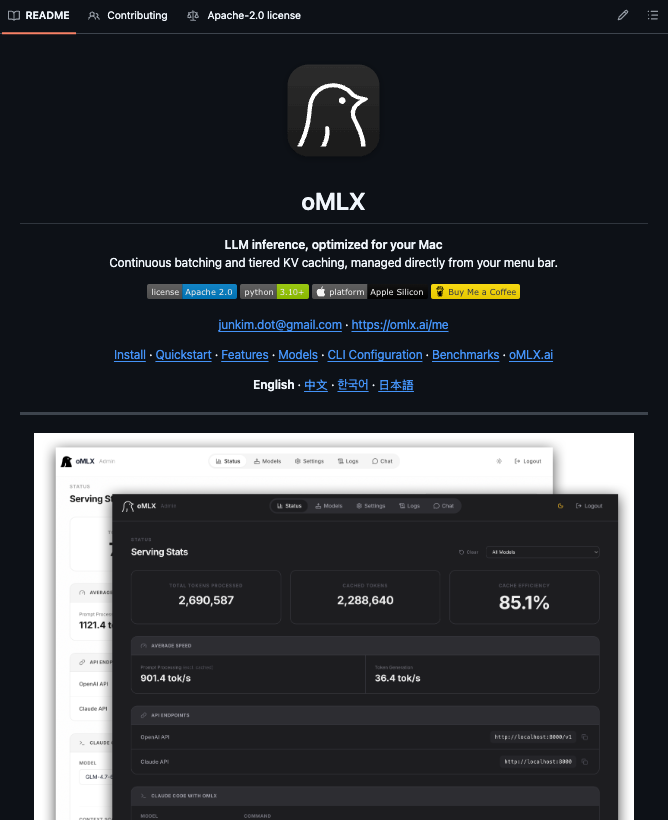
    again saying there's never been a better time to work on multi-agent systems. learn rag, orchestration, evals, memory, routing, tool calling, validation loops, fix loops, split learning, context engineering. all of it. getting an llm to answer questions is becoming the easy

    • 23 Replies
    • 30 Reposts
    • 342 Likes
    • 19.1K Views
    View on X
    Rewrite this post in your own voice and angle. See the hook, structure, and reusable template behind this post.
  4. 04

    @_avichawla ·

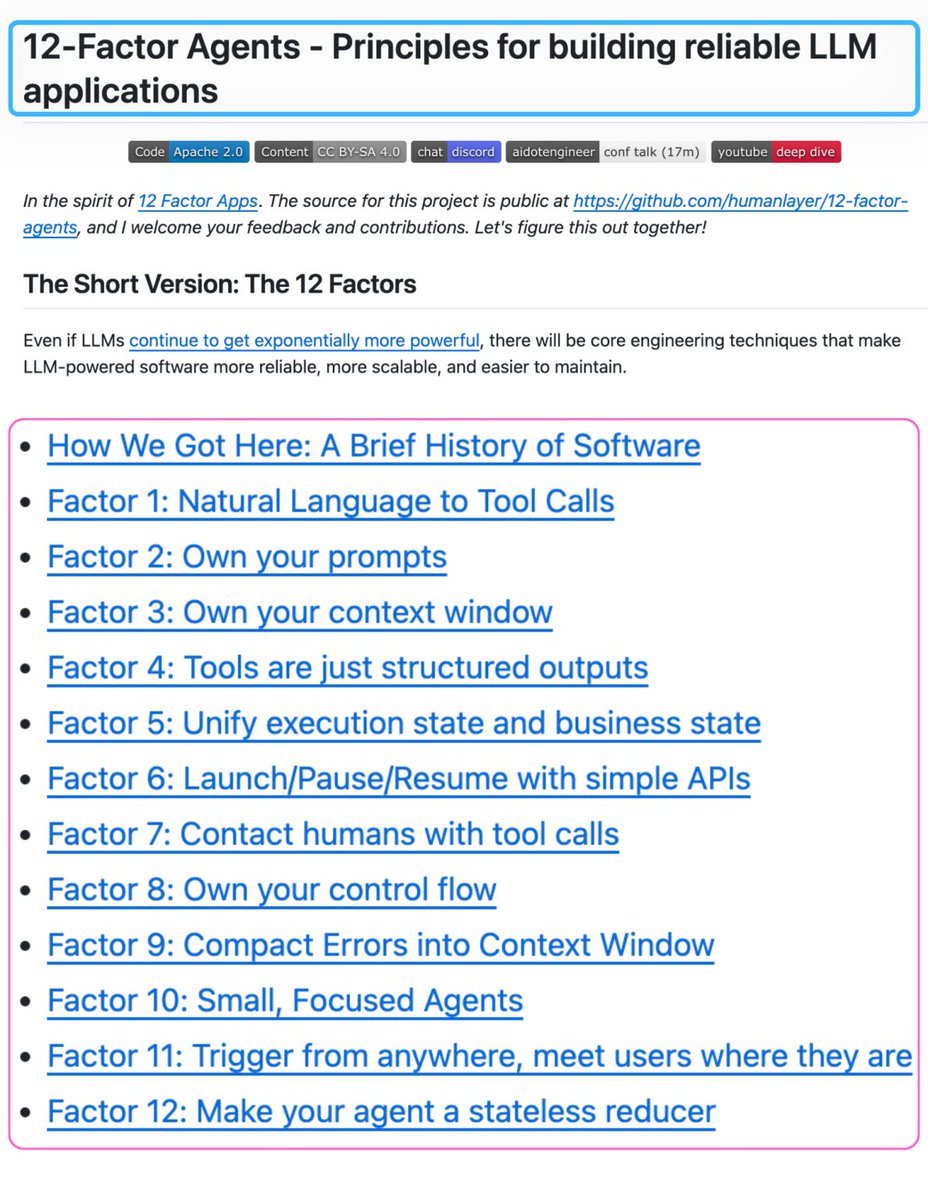
    DevOps vs. MLOps vs. LLMOps: Many teams are trying to apply DevOps practices to LLM apps. But DevOps, MLOps, and LLMOps solve fundamentally different problems. DevOps is software-centric. You write code, test it, and deploy it. The feedback loop is straightforward: Does the

    Video thumbnail from Avi Chawla's post Watch video
    • 10 Replies
    • 52 Reposts
    • 236 Likes
    • 15.8K Views
    View on X
    Rewrite this post in your own voice and angle. See the hook, structure, and reusable template behind this post.
  5. 05

    @vasuman ·

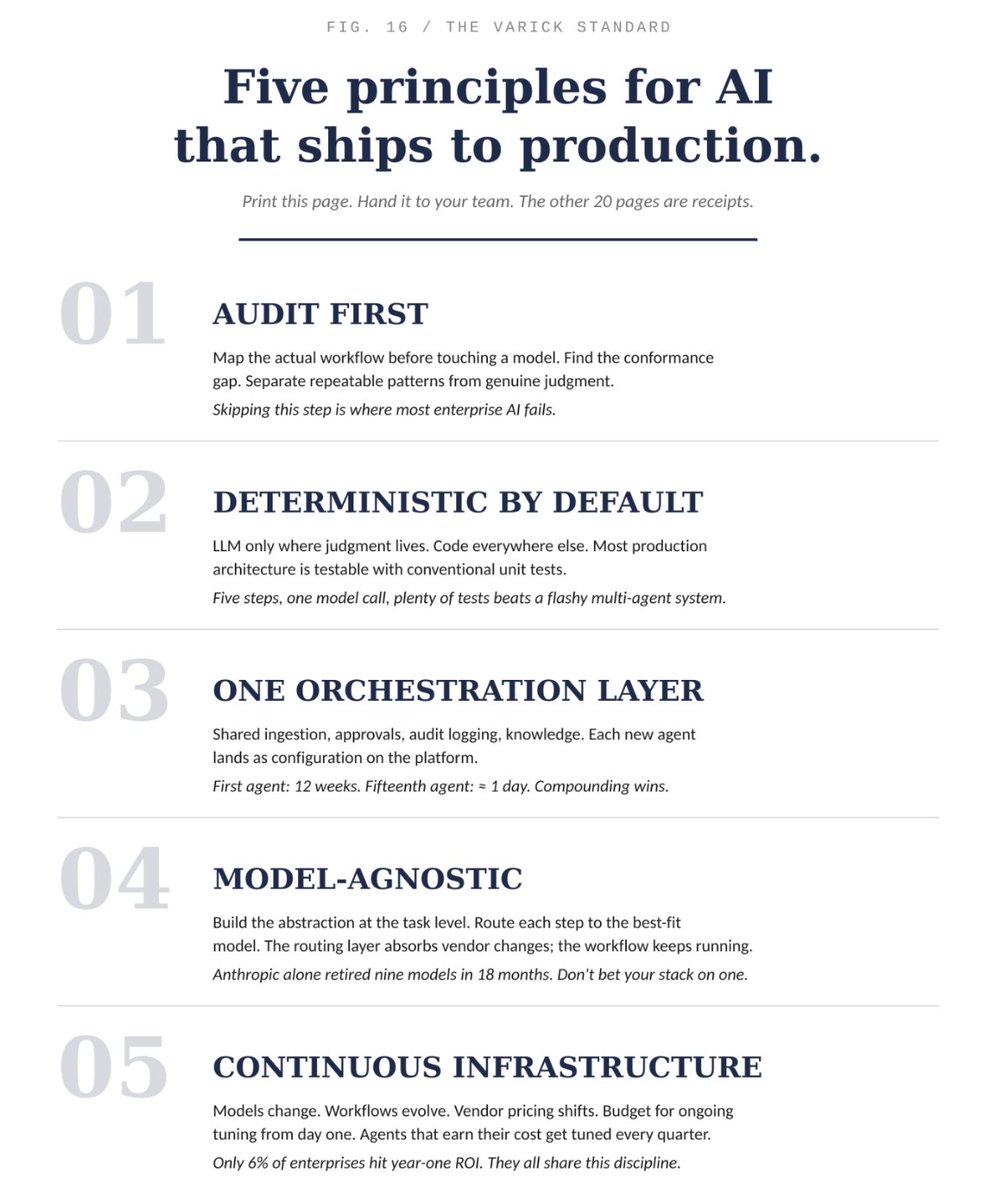
    The 5 principles for AI that ships to production: 1. Audit first: map the actual workflow before touching a model. Find the conformance gap. Separate repeatable patterns from genuine judgment. 2. Deterministic by default: LLM only where judgment lives. Code everywhere else.

    • 20 Replies
    • 18 Reposts
    • 183 Likes
    • 13K Views
    View on X
    Rewrite this post in your own voice and angle. See the hook, structure, and reusable template behind this post.
  6. 06

    @goyalshaliniuk ·

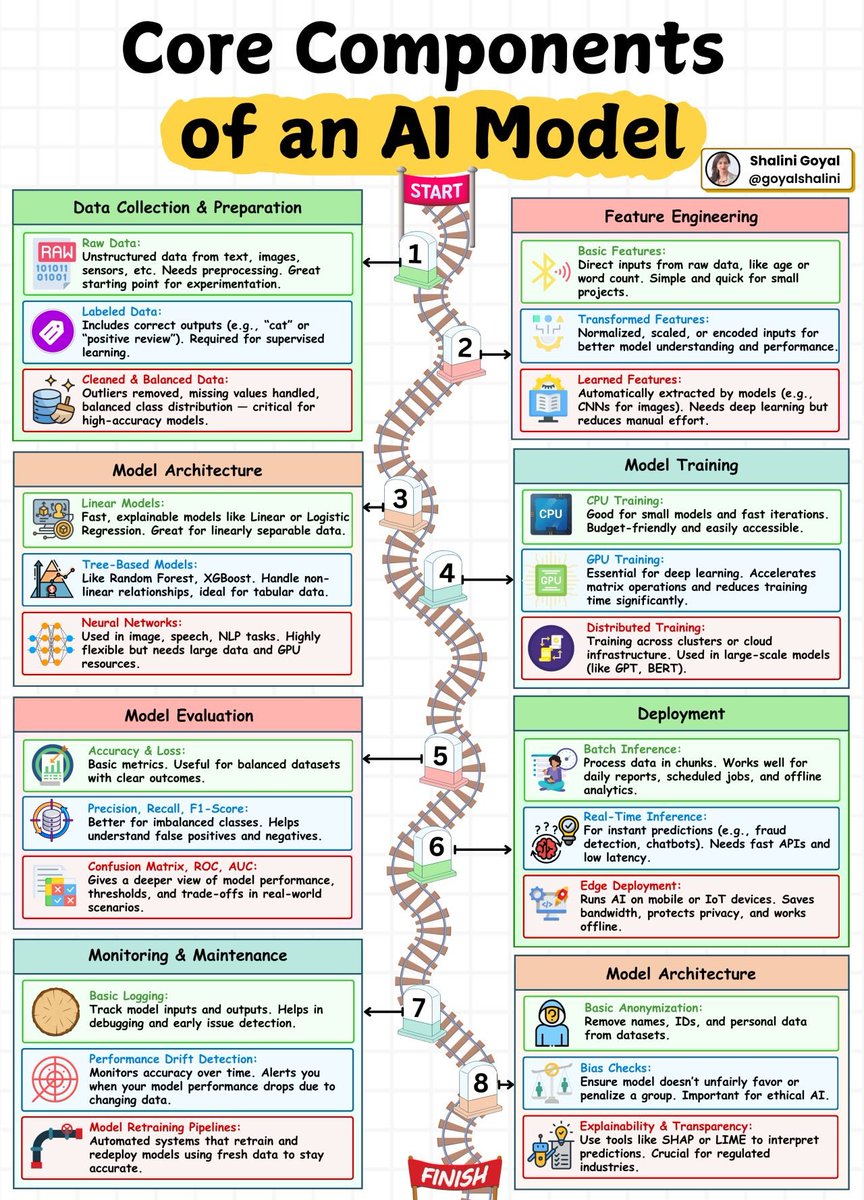
    Building an AI model isn’t just about training a neural network - it’s a full journey with 8 critical stages. From data collection to model monitoring, here’s how AI systems are built and maintained today: 1. Data Collection & Preparation Everything starts with data. Raw input

    • 15 Replies
    • 23 Reposts
    • 102 Likes
    • 2.1K Views
    View on X
    Rewrite this post in your own voice and angle. See the hook, structure, and reusable template behind this post.
  7. 07

    @akshay_pachaar ·

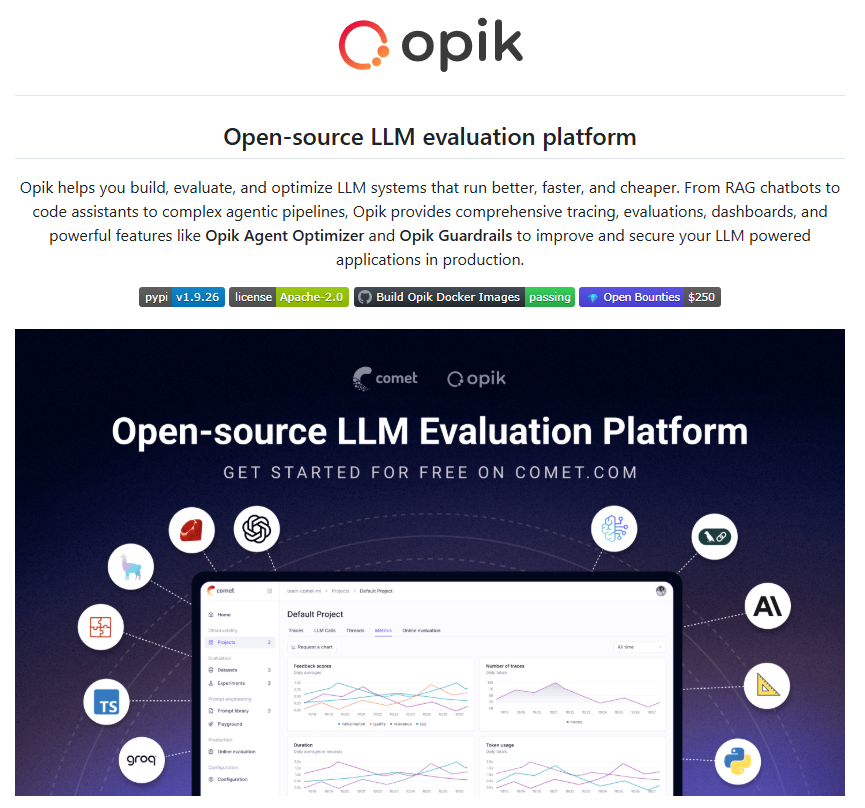
    MiniMax M2.7 is open-source! The most interesting part of this release isn't a benchmark number. It's what MiniMax calls "self-evolution," and it's essentially Karpathy's Autoresearch applied at full scale. Every AI agent today runs inside a harness: the scaffolding of skills,

    Video thumbnail from Akshay 🚀's post Watch video
    • 20 Replies
    • 40 Reposts
    • 216 Likes
    • 16.7K Views
    View on X
    Rewrite this post in your own voice and angle. See the hook, structure, and reusable template behind this post.
  8. 08

    @Aurimas_Gr ·

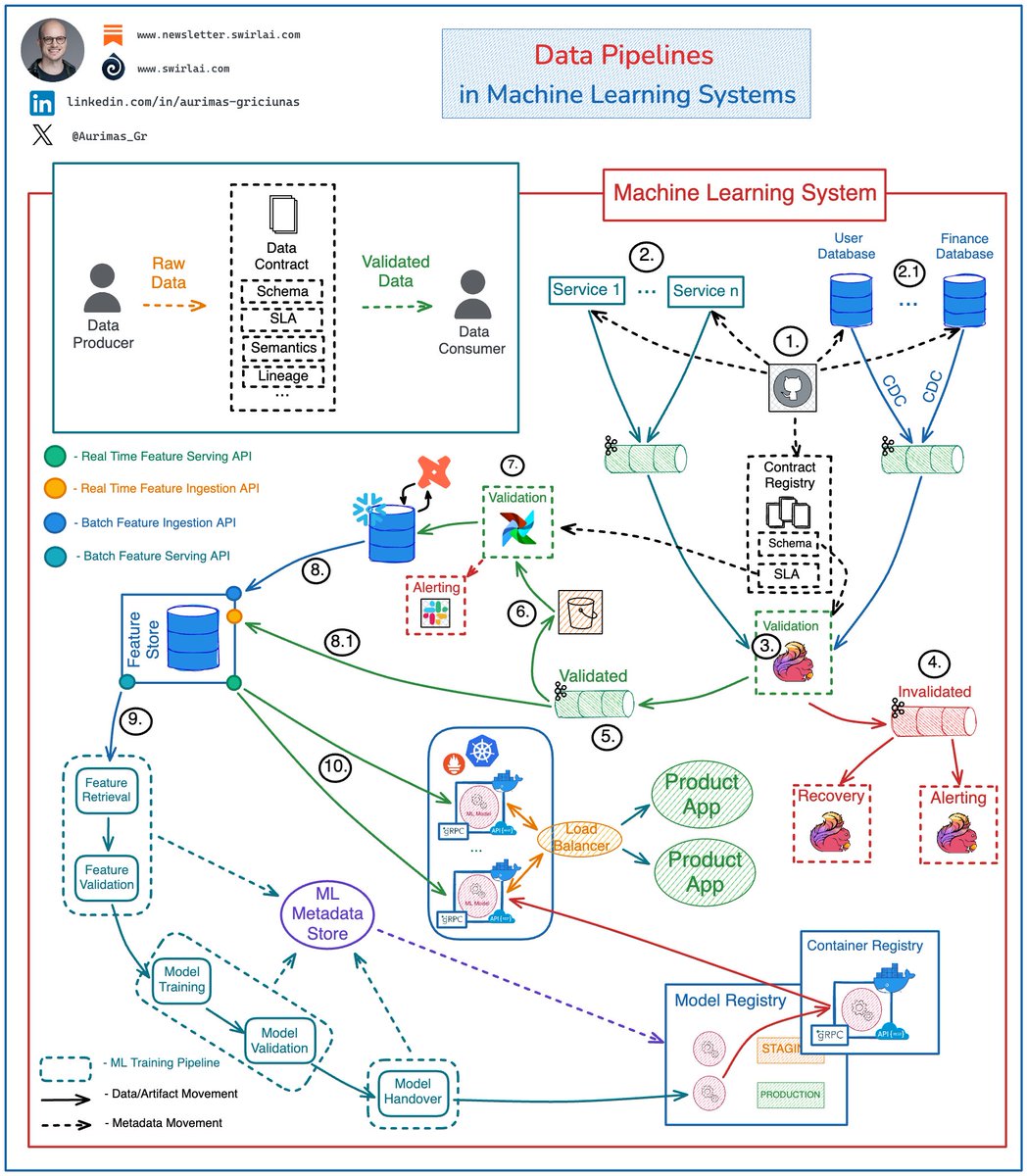
    A breakdown of 𝗗𝗮𝘁𝗮 𝗣𝗶𝗽𝗲𝗹𝗶𝗻𝗲𝘀 𝗶𝗻 𝗠𝗮𝗰𝗵𝗶𝗻𝗲 𝗟𝗲𝗮𝗿𝗻𝗶𝗻𝗴 𝗦𝘆𝘀𝘁𝗲𝗺𝘀 👇 And yes, it can also be used for LLM based systems! It is critical to ensure Data Quality and Integrity upstream of ML Training and Inference Pipelines, trying to do that in the downstream systems will cause unavoidable

    • 6 Replies
    • 51 Reposts
    • 219 Likes
    • 15.3K Views
    View on X
    Rewrite this post in your own voice and angle. See the hook, structure, and reusable template behind this post.
  9. 09

    @goyalshaliniuk ·

    Planning to build a GenAI or AI-powered product? Here’s the modern AI app stack you need to scale, serve, and secure your models. 👇 1. Data Layer: Foundation for AI Use Snowflake, BigQuery, Postgres, Airflow, and dbt to collect, clean, and move data efficiently. 2. Model

    • 16 Replies
    • 22 Reposts
    • 74 Likes
    • 1.1K Views
    View on X
    Rewrite this post in your own voice and angle. See the hook, structure, and reusable template behind this post.
  10. 10

    @jahirsheikh8 ·

    Want to be a Strong AI Engineer (not just prompt user)? Please learn: 1. Transformer Internals: Self-attention math, KV caching, Positional encodings (RoPE, ALiBi), Scaling laws 2. Tokenization Deep Dive: BPE vs Unigram, Token distribution effects, Context window limits 3.

    • 18 Replies
    • 4 Reposts
    • 49 Likes
    • 1K Views
    View on X
    Rewrite this post in your own voice and angle. See the hook, structure, and reusable template behind this post.

  11. 11

    @trikcode ·

    Yeah, LLMs are cool but, companies are actually looking for someone who's good at: - feature engineering - evaluation metrics - data leakage - experimentation - business metrics - deployment - monitoring - classic ML fundamentals

    • 43 Replies
    • 11 Reposts
    • 148 Likes
    • 4.3K Views
    View on X
    Rewrite this post in your own voice and angle. See the hook, structure, and reusable template behind this post.
  12. 12

    @HamelHusain ·

    New Blog Post: Do Automated Evals Work? There has been a rise of tools that look through your traces with AI and identifies issues. We tested these tools with real production data to see how good they are. Where they shine - They often spot issues human miss - Integrate into

    • 13 Replies
    • 12 Reposts
    • 108 Likes
    • 9.1K Views
    View on X
    Rewrite this post in your own voice and angle. See the hook, structure, and reusable template behind this post.
  13. 13

    @Suryanshti777 ·

    Most teams are building MCP servers the same way people built internal tools in 2019: one endpoint = one tool Then six months later the agent has 47 tools, picks the wrong one half the time, burns tokens routing requests, and nobody knows why latency exploded. The interesting

    • 22 Replies
    • 30 Reposts
    • 82 Likes
    • 2K Views
    View on X
    Rewrite this post in your own voice and angle. See the hook, structure, and reusable template behind this post.
  14. 14

    @shivam74689 ·

    Day 52 — Becoming AI Engineer Today I completed my first end-to-end Production ReAct Agent. A few weeks ago, I thought building an AI agent meant connecting an LLM to a UI and getting answers back. Now I know that's only a tiny part of the system. The biggest lesson from this

    • 4 Replies
    • 5 Reposts
    • 44 Likes
    • 1.4K Views
    View on X
    Rewrite this post in your own voice and angle. See the hook, structure, and reusable template behind this post.

  15. 15

    @akshay_pachaar ·

    The first AI that improves without retraining. (it rewrites its own agent harness) Every developer I know has one thing in common: they obsess over their setup. The terminal, the scripts, the shortcuts. They don't just write code. They constantly refine how they work. The code

    Video thumbnail from Akshay 🚀's post Watch video
    • 16 Replies
    • 18 Reposts
    • 98 Likes
    • 7.5K Views
    View on X
    Rewrite this post in your own voice and angle. See the hook, structure, and reusable template behind this post.
  16. 16

    @shshnkp ·

    My favorite (and often overlooked) MLX feature is the 17 (and growing) CLI tools part of mlx-lm. You can do so much with a single line of code! Here's a quick overview 🧵 🚀 Inference, 🍦 Serving 🎯 Fine-tuning, ⚡ Quantization 📊 Evaluation & Benchmarking 🤗 Sharing and model

    • 7 Replies
    • 9 Reposts
    • 80 Likes
    • 18.8K Views
    View on X
    Rewrite this post in your own voice and angle. See the hook, structure, and reusable template behind this post.
  17. 17

    @pvergadia ·

    Never ever ever build an LLM app without KV cache. You're paying for O(n²) attention. On every. single. token. Here's what's actually happening under the hood: Transformer attention computes Q, K, V matrices for every token in your sequence. Without cache, generating token n

    • 5 Replies
    • 19 Reposts
    • 64 Likes
    • 4.1K Views
    View on X
    Rewrite this post in your own voice and angle. See the hook, structure, and reusable template behind this post.
  18. 18

    @vivoplt ·

    As an AI Infrastructure Engineer. Please learn: - GPU/VRAM fundamentals, quantization & batching - vLLM / TensorRT-LLM / inference optimization - KV caching, speculative decoding & token throughput - Distributed training basics (DDP/FSDP/DeepSpeed) - Model serving & autoscaling

    • 37 Replies
    • 3 Reposts
    • 72 Likes
    • 2K Views
    View on X
    Rewrite this post in your own voice and angle. See the hook, structure, and reusable template behind this post.

  19. 19

    @TheGlobalMinima ·

    The last 3 days have taught me a lot about how OpenTelemetry and Async Generator functions work. When you set up observability (personally using @langfuse ) for the first time, it is smooth sailing. But when you scale up your llm application to support concurrency, failure

    • 10 Replies
    • 2 Reposts
    • 56 Likes
    • 3.8K Views
    View on X
    Rewrite this post in your own voice and angle. See the hook, structure, and reusable template behind this post.
  20. 20

    @Vinay_bharambe ·

    Most people consume random tutorials. Very few build real depth. If you want strong fundamentals, system thinking, and production clarity, start here. Here are 12 books that cover theory, LLMs, MLOps, and deployment, end to end. 1. AI Engineering – By Chip Huyen From data

    • 24 Replies
    • 16 Reposts
    • 67 Likes
    • 2.8K Views
    View on X
    Rewrite this post in your own voice and angle. See the hook, structure, and reusable template behind this post.
  21. 21

    @adxtyahq ·

    Things i have worked on in past 30 days: - made systems from scratch including architectural decisions - optimized the existing company system, reducing runtime from ~5 minutes to under 3 minutes and cost from ~$3-5/run to ~$0.9-2.5/run - improved model latency, reduced costs,

    • 17 Replies
    • 1 Reposts
    • 156 Likes
    • 5.6K Views
    View on X
    Rewrite this post in your own voice and angle. See the hook, structure, and reusable template behind this post.
  22. 22

    @milan_milanovic ·

    𝗧𝗵𝗲 𝗔𝘇𝘂𝗿𝗲 𝗔𝗜/𝗠𝗟 𝘀𝘁𝗮𝗰𝗸 Here are the most important Azure services if you want to work with AI in Azure. 𝟭. 𝗖𝗼𝗺𝗽𝘂𝘁𝗲 We can use Azure ML as the platform for managing experiments, compute clusters, and the model lifecycle. GPU VMs (NC/ND series) for training workloads that

    • 5 Replies
    • 9 Reposts
    • 71 Likes
    • 3K Views
    View on X
    Rewrite this post in your own voice and angle. See the hook, structure, and reusable template behind this post.
  23. 23

    @SourabhGurwani ·

    If I had 6 months to become an AI Engineer, I'd do this. Stage 1 — Programming Fundamentals (Weeks 1–2) Learn Python, Git, Linux, SQL, APIs, OOP, NumPy, and Pandas. Stage 2 — Math & ML Foundations (Weeks 3–4) Master linear algebra, probability, statistics, calculus, regression,

    • 30 Replies
    • 2 Reposts
    • 34 Likes
    • 400 Views
    View on X
    Rewrite this post in your own voice and angle. See the hook, structure, and reusable template behind this post.
  24. 24

    @_vmlops ·

    NETFLIX BUILT AN MLOPS FRAMEWORK INTERNALLY...THEN OPEN SOURCED IT FOR EVERYONE and it's running 3000+ ai/ml projects at netflix alone most ml teams hit the same wall prototype works on your laptop...falls apart in production...data pipelines break...compute doesn't

    • 0 Replies
    • 8 Reposts
    • 30 Likes
    • 2.6K Views
    View on X
    Rewrite this post in your own voice and angle. See the hook, structure, and reusable template behind this post.

  25. 25

    @DeepStarts ·

    Here's a list of Al Engineer Interview questions + concepts you need to know (from Al/ML Engineering Manager perspective) LLM Fundamentals: -What is tokenization, and how does it affect generation? -How do embeddings really work? -What's the role of attention, positional

    • 12 Replies
    • 2 Reposts
    • 20 Likes
    • 227 Views
    View on X
    Rewrite this post in your own voice and angle. See the hook, structure, and reusable template behind this post.
  26. 26

    @kmeanskaran ·

    Now you can build agents to automate the ML training lifecycle! You can define sequential subagents and skills for each agent, such as data engineering, feature engineering, model training, evaluation, drift detection, rollback, etc. Observability tools and orchestration will

    • 4 Replies
    • 1 Reposts
    • 56 Likes
    • 2.8K Views
    View on X
    Rewrite this post in your own voice and angle. See the hook, structure, and reusable template behind this post.
  27. 27

    @pvergadia ·

    NEW: The SDLC taught us software is correct or broken. AI just made that binary obsolete. → SDLC: write rules → test pass/fail → ship → done → AIDLC: collect data → train → evaluate statistically → monitor forever → Your model can be "healthy" and silently wrong at the same time

    • 3 Replies
    • 7 Reposts
    • 37 Likes
    • 2.2K Views
    View on X
    Rewrite this post in your own voice and angle. See the hook, structure, and reusable template behind this post.
  28. 28

    @0xlelouch_ ·

    90% of LLMOps interviews in 2026 come down to these 7 points: 1) Serving architecture: batching, streaming, timeouts, and backpressure; explain p95 vs p99 and what you do when the model stalls 2) Cost control: token budgets, caching, prompt compression, smaller models; show you

    • 2 Replies
    • 3 Reposts
    • 28 Likes
    • 1.3K Views
    View on X
    Rewrite this post in your own voice and angle. See the hook, structure, and reusable template behind this post.
  29. 29

    @DeRonin_ ·

    Ran GLM 5.2 against Opus 4.8 this week, both wired into my agency stack for 6 days bottom line: GLM 5.2 is the first open model i'd actually trust with production marketing work free weights + run it on my own hardware + frontier-class output = the value math is wild some

    • 23 Replies
    • 5 Reposts
    • 69 Likes
    • 5.5K Views
    View on X
    Rewrite this post in your own voice and angle. See the hook, structure, and reusable template behind this post.
  30. 30

    @Hartdrawss ·

    Build boring AI companies. I think it's the biggest opportunity of the next 10 years. 1. Every AI company needs clean data, but nobody wants to clean it. A data labeling service that guarantees 99.9% accuracy and charges per record, not per project. Boring, essential, recurring.

    • 6 Replies
    • 1 Reposts
    • 22 Likes
    • 1.1K Views
    View on X
    Rewrite this post in your own voice and angle. See the hook, structure, and reusable template behind this post.

  31. 31

    @LiorOnAI ·

    You can now ship a production AI agent in one command. Google just released Agent Starter Pack, and it cuts setup time to about 60 seconds. From empty folder to deployed service, with infra included. 𝗧𝗵𝗶𝘀 𝗿𝗲𝗺𝗼𝘃𝗲𝘀 𝘁𝗵𝗲 𝗵𝗮𝗿𝗱𝗲𝘀𝘁 𝗽𝗮𝗿𝘁 𝗼𝗳 𝗮𝗴𝗲𝗻𝘁𝘀 Building logic was never the blocker.

    • 11 Replies
    • 8 Reposts
    • 32 Likes
    • 3.9K Views
    View on X
    Rewrite this post in your own voice and angle. See the hook, structure, and reusable template behind this post.
  32. 32

    @hasantoxr ·

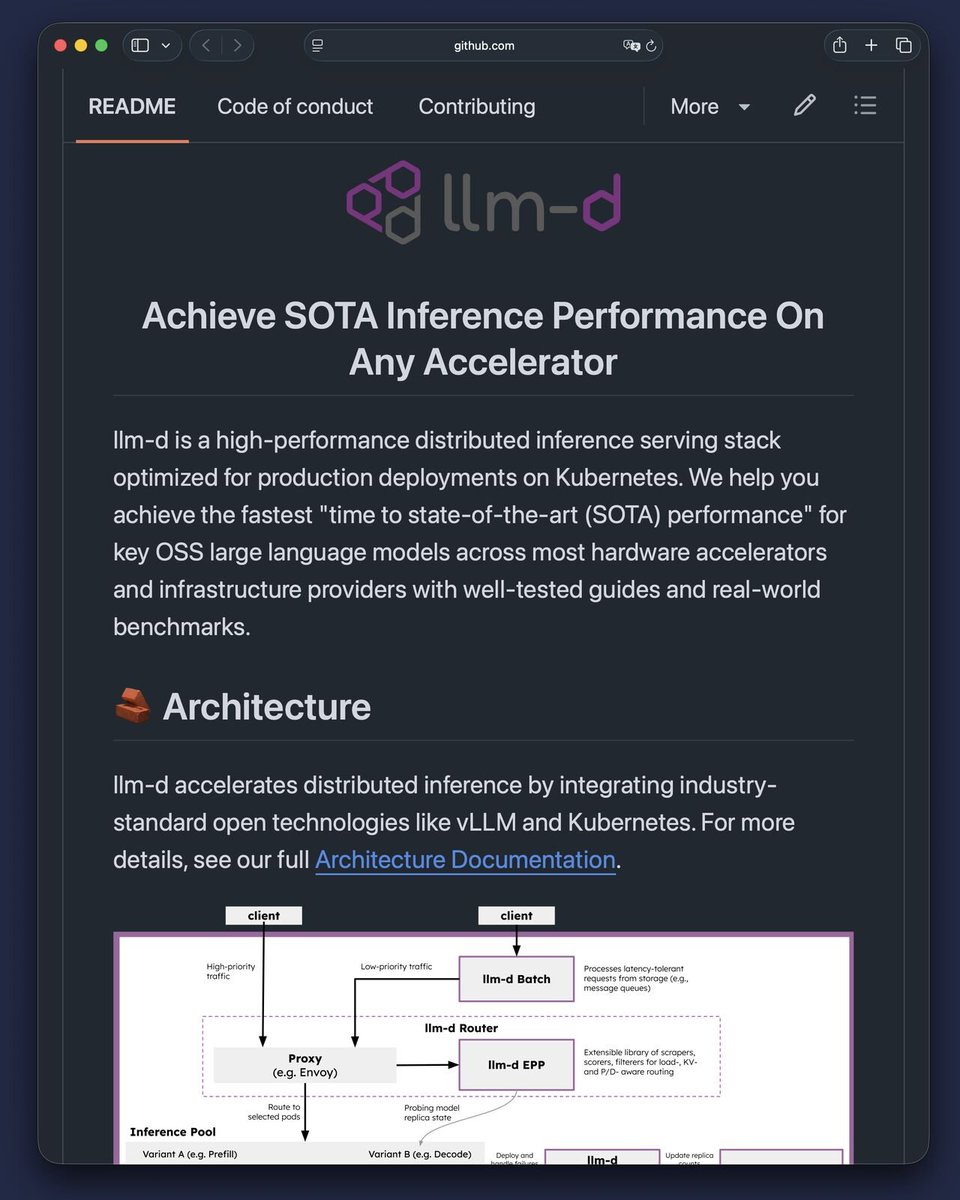
    llm-d is the next step after vLLM. Most teams still serve open models like this: Spin up vLLM. Put it behind an endpoint. Add more GPUs. Watch latency spike. Pay the bill anyway. This repo shows the next step: You stop treating inference like one model server. You build the

    • 6 Replies
    • 10 Reposts
    • 52 Likes
    • 7.7K Views
    View on X
    Rewrite this post in your own voice and angle. See the hook, structure, and reusable template behind this post.
  33. 33

    @bibryam ·

    The wrong question: ✗ “How good is the coding model?” The better question: ✓ “What feedback can the agent use without asking me?” Types. Tests. Lint. Build. Browser checks. Logs. Traces. Evals. 🌟 That is the Backpressure Loop Pattern. 🌟 https://t.co/8xxFpIWPld

    • 1 Replies
    • 5 Reposts
    • 31 Likes
    • 1.6K Views
    View on X
    Rewrite this post in your own voice and angle. See the hook, structure, and reusable template behind this post.
  34. 34

    @0xlelouch_ ·

    90% of LLMOps in 2026 comes down to mastering these 10 concepts: 1) Problem framing + evals first. If you can’t define success with 50 to 500 test cases, you’re just shipping vibes. 2) RAG basics, but with rigor. Chunking, filters, metadata, and freshness matter more than which

    • 1 Replies
    • 1 Reposts
    • 17 Likes
    • 1K Views
    View on X
    Rewrite this post in your own voice and angle. See the hook, structure, and reusable template behind this post.
  35. 35

    @alex_verem ·

    The AI is 5% of the work. The 95% that breaks: → Observability (Langfuse, Braintrust, Helicone) - you can't debug what you can't see → Evals - regression suites for non-deterministic software. The new CI. → Durable runtime (Temporal, Inngest) - so a 10-minute agent run survives

    • 8 Replies
    • 9 Reposts
    • 18 Likes
    • 3.2K Views
    View on X
    Rewrite this post in your own voice and angle. See the hook, structure, and reusable template behind this post.
  36. 36

    @suraj_sharma14 ·

    If I had 6 months to become an AI Data Engineer. I'd do this. Stage 1: Python and SQL Foundations pandas, numpy, SQLAlchemy, query optimization, data modeling, schema design. Stage 2: Data Pipeline Orchestration Airflow, Prefect, Dagster, task dependencies, retry logic,

    • 0 Replies
    • 3 Reposts
    • 20 Likes
    • 868 Views
    View on X
    Rewrite this post in your own voice and angle. See the hook, structure, and reusable template behind this post.
  37. 37

    @ATechAjay ·

    An LLM can suggest an action. Your application decides whether that action is allowed. That's the difference between a demo and a production AI system. Everyone talks about models. Not enough people talk about guardrails. Guardrails are not the model. They're the

    • 6 Replies
    • 4 Reposts
    • 15 Likes
    • 813 Views
    View on X
    Rewrite this post in your own voice and angle. See the hook, structure, and reusable template behind this post.
  38. 38

    @Inner_Axiom ·

    today we set up Opsimus. he's a backend ops agent on his own server, running on codex gpt 5.5. his job is bigger than monitoring. he continually reviews system and agent logs across the fleet, finds gaps and failures, and makes updates autonomously. patches skills, improves the

    • 3 Replies
    • 3 Reposts
    • 29 Likes
    • 1.5K Views
    View on X
    Rewrite this post in your own voice and angle. See the hook, structure, and reusable template behind this post.
  39. 39

    @LinusEkenstam ·

    Simulation. What nobody tells you. Simulation is one of the things we noticed early being a golden squeeze when working with LLMs. When building any tool that's fundamentally powered by an LLM, "what can be simulated?" is probably the first question we ask. always. Anyone

    • 6 Replies
    • 3 Reposts
    • 23 Likes
    • 4.7K Views
    View on X
    Rewrite this post in your own voice and angle. See the hook, structure, and reusable template behind this post.
  40. 40

    @braintrust ·

    Topics clusters every production trace to surface what agents are doing. But 100% coverage only works with a small model that clears the quality bar. So we worked with @baseten to build a benchmark from real Topics traces, iterated against the failure modes that mattered most,

    • 2 Replies
    • 3 Reposts
    • 14 Likes
    • 4.9K Views
    View on X
    Rewrite this post in your own voice and angle. See the hook, structure, and reusable template behind this post.
  41. 41

    @_vmlops ·

    THERE'S A LIVE MAP SHOWING THE CARBON FOOTPRINT OF ELECTRICITY ACROSS THE ENTIRE WORLD RIGHT NOW and most engineers have never seen it Electricity Maps tracks the carbon intensity of electricity in real time every 15 minutes across 190+ countries green zones mean clean energy.

    Video thumbnail from Vaishnavi's post Watch video
    • 0 Replies
    • 1 Reposts
    • 8 Likes
    • 796 Views
    View on X
    Rewrite this post in your own voice and angle. See the hook, structure, and reusable template behind this post.
  42. 42

    @svpino ·

    You could make a living by helping companies fix their evals. You wouldn't need anything else: 1. Show me how you are evaluating your product 2. This is how you can make it better I'm always hearing the same story: • Someone picks a benchmark early on • Everyone becomes

    • 2 Replies
    • 2 Reposts
    • 20 Likes
    • 8.8K Views
    View on X
    Rewrite this post in your own voice and angle. See the hook, structure, and reusable template behind this post.
  43. 43

    @llama_index ·

    Common Failure Modes Break VLM-Powered OCR in Production. 🔁 Repetition Loops — model spirals into infinite whitespace, exhausts resources, cascades latency across your system 🛑 Recitation Errors — safety filters hard-stop legitimate extractions as "copyright violations" Same

    • 4 Replies
    • 4 Reposts
    • 18 Likes
    • 14.7K Views
    View on X
    Rewrite this post in your own voice and angle. See the hook, structure, and reusable template behind this post.
  44. 44

    @byebyescaling ·

    THOUGHTS ON REFRAMING DIFFICULT AGENT ENGINEERING PROBLEMS IN PRODUCTION I have been working on some open ended and extremely difficult agent engineering problems in production. The main difficulties arise from trying to make the agents function effectively over long time

    image only for explanatory purposes
    • 0 Replies
    • 0 Reposts
    • 7 Likes
    • 480 Views
    View on X
    Rewrite this post in your own voice and angle. See the hook, structure, and reusable template behind this post.
  45. 45

    @mchulet ·

    As an AI Engineer. Please learn >Harness engineering, not just prompt engineering >Context engineering, not just long prompts >Prompt caching vs. semantic caching tradeoffs >KV cache management, eviction, reuse, and memory pressure at scale >Prefill vs. decode latency and

    • 2 Replies
    • 1 Reposts
    • 3 Likes
    • 177 Views
    View on X
    Rewrite this post in your own voice and angle. See the hook, structure, and reusable template behind this post.
  46. 46

    @rseroter ·

    When's the right time to think of self-hosting AI inference, versus using a managed API? Maybe it's when you're over 1m tokens a day? Or if the MLOps cost is more than the GPU? Here's a thorough assessment by Paolo ... https://t.co/f95GLangMZ

    • 0 Replies
    • 0 Reposts
    • 9 Likes
    • 1.2K Views
    View on X
    Rewrite this post in your own voice and angle. See the hook, structure, and reusable template behind this post.
  47. 47

    @TDataScience ·

    "Machine Learning systems rarely fail in a single moment. Their performance changes gradually as data distributions shift, calibration drifts, or new patterns emerge in the environment." Gal Arav shares a thorough, accessible introduction to survival analysis for data drift and

    • 0 Replies
    • 3 Reposts
    • 8 Likes
    • 2.1K Views
    View on X
    Rewrite this post in your own voice and angle. See the hook, structure, and reusable template behind this post.

  48. 48

    @krishnan ·

    The unglamorous part of AI is becoming the moat. Everyone is covering model launches. Netflix's new engineering writeup points to the harder Day 2 question: can you run LLMs like production infrastructure? Netflix says (https://t.co/tuYfXJNdnn) it runs the full LLM serving stack

    • 0 Replies
    • 0 Reposts
    • 3 Likes
    • 98 Views
    View on X
    Rewrite this post in your own voice and angle. See the hook, structure, and reusable template behind this post.
  49. 49

    @TDataScience ·

    "Most production ML models don’t decay smoothly — they fail in sudden, unpredictable shocks." Emmimal P Alexander zooms in on the reasons MLOps retraining schedules fail, and what we can do to tackle this recurring issue. https://t.co/MZGVsAkSFf

    • 0 Replies
    • 0 Reposts
    • 5 Likes
    • 1K Views
    View on X
    Rewrite this post in your own voice and angle. See the hook, structure, and reusable template behind this post.

  50. 50

    @JeremyCMorgan ·

    Speculative decoding quietly became production infrastructure this year: EAGLE-3 is now default in vLLM, SGLang, and TensorRT-LLM. This breakdown of Saguaro, Nightjar, and Intel's universal draft models is the clearest practitioner guide to what's actually running in your stack

    • 0 Replies
    • 2 Reposts
    • 1 Likes
    • 190 Views
    View on X
    Rewrite this post in your own voice and angle. See the hook, structure, and reusable template behind this post.

Explore more of the best tweets on X.

Browse all tweet collections

Tweet Remixer

Remix this post

Creator

@creator

View on X

Choose a tone