50 Best Tweets About Vector Databases (2026)

Browse the best tweets about vector databases, covering embeddings, indexing, retrieval, Pinecone, Weaviate, Qdrant, Milvus, benchmarks, and architecture.

Vector database architecture, indexing, filtering, retrieval quality, benchmarks, scaling, operations, and concrete implementation tradeoffs.

Creators
42
Updated

What 50 top Vector Databases posts reveal

The discussion repeatedly covers retrieval as an end-to-end design problem rather than only a vector-store choice: hybrid lexical–semantic retrieval, reranking, filtering, ingestion discipline, and observability all appear in the evidence. A central disagreement is whether vector-only similarity is sufficient for structured or multi-hop work, where BM25, document hierarchy, and graphs are presented as alternatives or complements. [2057410759236386866, 2039191283072376970, 2074470992651386957]

Dominant tone
Positive

50% of posts

Median score
23.9

All-time engagement

Leading format
List

100% of posts

Recent posts
42%

Published in 90 days

Conversation map

The themes creators return to

Ingestion and Data Quality

Ingestion and corpus quality: extraction, OCR, document parsing, deduplication, chunk boundaries, stale vectors, versioning, and write-time gating.

16%

Vectorless and Structure-Aware Retrieval

Critiques of vector-only retrieval and alternatives based on document hierarchy, structure-aware navigation, code exploration, and deterministic lookup.

16%

Hybrid Lexical and Semantic Retrieval

Hybrid retrieval that combines lexical methods such as BM25 or grep with embeddings, ranking fusion, metadata constraints, and rerankers.

14%

Tone and stance

Sentiment Positive leads
Author posture Supportive leads

Performance benchmark

Median likes
47
Median reposts
6
Median replies
5
Median views
4.4K

Posts with media make up 70% of this collection. Their median all-time score is 27.8, compared with 3.96 for text-only posts.

Format mix

  • List 100% · score 23.9

Where creators agree, and where they do not

Shared view

Hybrid retrieval is a recurring design pattern

A recurring proposed pattern is a retrieval pipeline rather than vector search alone: combine lexical and semantic candidates, fuse or rerank results, constrain context, and evaluate retrieval behavior and failures.

Shared view

Ingestion quality affects retrieval

Posts frame corpus hygiene as a retrieval concern, citing deduplication, extraction quality, chunk boundaries, version history, stale-vector cleanup, and careful embedding-model migration.

Shared view

Filtering belongs in retrieval design

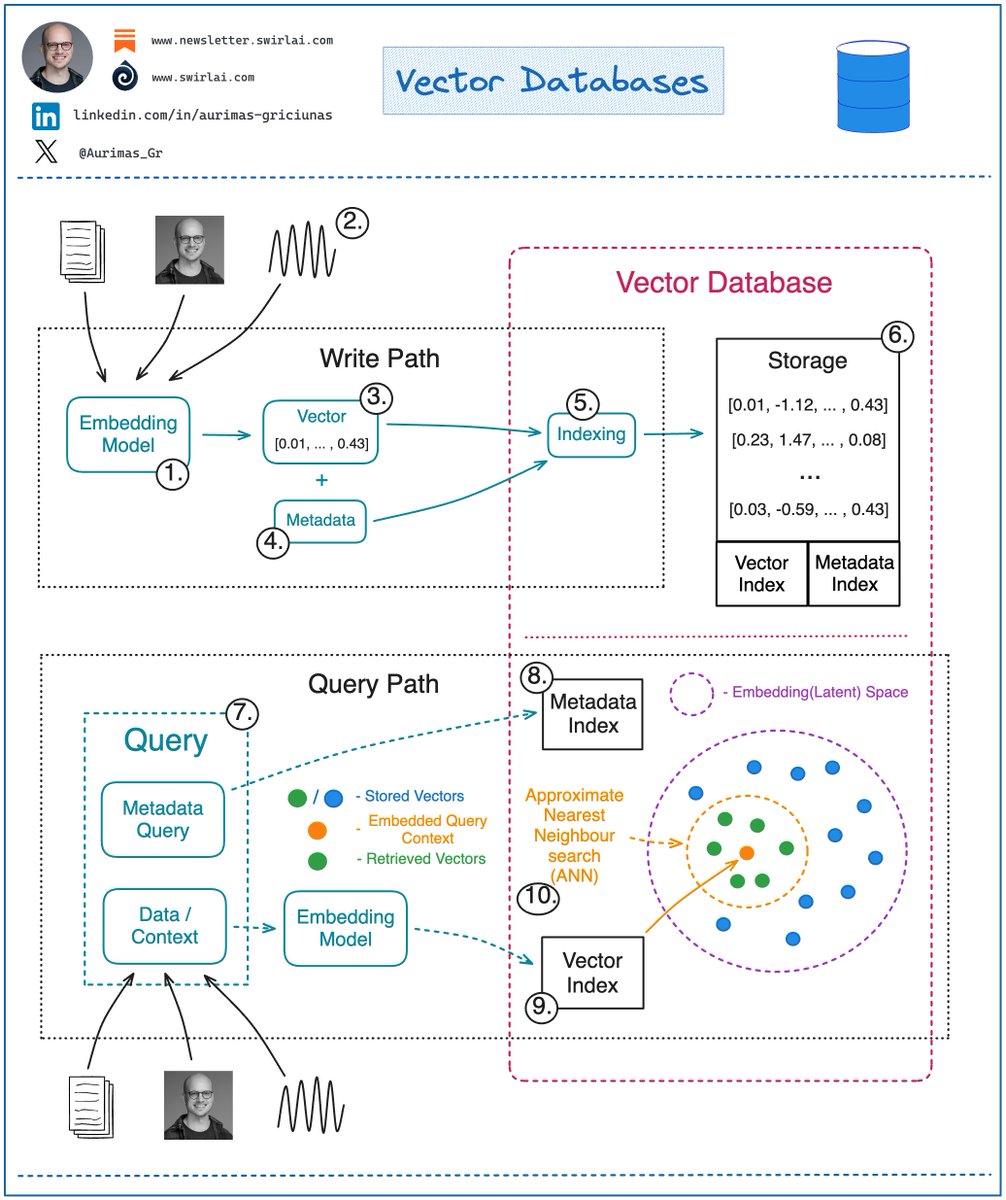
Vector-database explanations pair ANN similarity search with metadata. The cited posts describe filtering as a way to constrain candidates, including preventing irrelevant context, alongside choices of distance metric and index design.

Open debate

Vector-only retrieval faces structural critiques

Several contrarian posts argue that document hierarchy, BM25, or progressive disclosure can outperform vector-only retrieval for structured or multi-hop material. The benchmark claims in these posts are specific to the cited systems and tasks.

Open debate

Lexical versus semantic is task-dependent

BM25 is presented as useful for exact terms and literal spans, while hybrid-retrieval posts retain embeddings for semantic coverage. The cited agent-search study summary further argues that the orchestration harness and result delivery can alter the comparison.

Open debate

Whether vectors are necessary remains contested

Some posts advocate omitting the vector layer for hierarchy-based document or local-memory systems; a fundamentals post instead presents vectors, metadata, and ANN as a general-purpose retrieval architecture.

Patterns behind standout posts

Efficiency claims need benchmark scrutiny

Quantization and indexing posts foreground memory footprint, speed, recall, and rebuild requirements rather than generic vector-database positioning. The turbovec write-up notes that its performance and compression figures come from project tests rather than independent review.

Operations is part of retrieval quality

Operationally oriented posts emphasize observability, component-level validation, durable ingestion, and keeping orchestration off the read path, treating retrieval reliability as an end-to-end systems concern.

Statistical standouts

  1. View standout post 1 Score 2934.2 · 122.77× median
  2. View standout post 2 Score 733.1 · 30.67× median
  3. View standout post 3 Score 594.2 · 24.86× median
  4. View standout post 4 Score 533.9 · 22.34× median
  5. View standout post 5 Score 515.6 · 21.57× median

Who shapes this conversation

The five most represented creators account for 20% of the selected posts.

  1. 1. Avi Chawla

    @_avichawla

    2 posts

  2. 2. aditya

    @adxtyahq

    2 posts

  3. 3. Akshay 🚀

    @akshay_pachaar

    2 posts

  4. 4. Paul Iusztin

    @pauliusztin_

    2 posts

  5. 5. Tech with Mak

    @techNmak

    2 posts

  6. 6. DEV Community

    @ThePracticalDev

    2 posts

Graphs address connected-context queries

Several builders describe graphs as a complement to similarity search: text or semantic retrieval identifies an entry point, while graph traversal supplies connected entities, join paths, or multi-hop context.

Compression changes the scaling envelope

Efficiency posts focus on compression and index maintenance. TurboQuant-based posts claim lower vector-memory use without a training phase, while the Flash-KMeans post positions faster k-means as enabling more dynamic re-indexing.

Choose stores by workload and operations

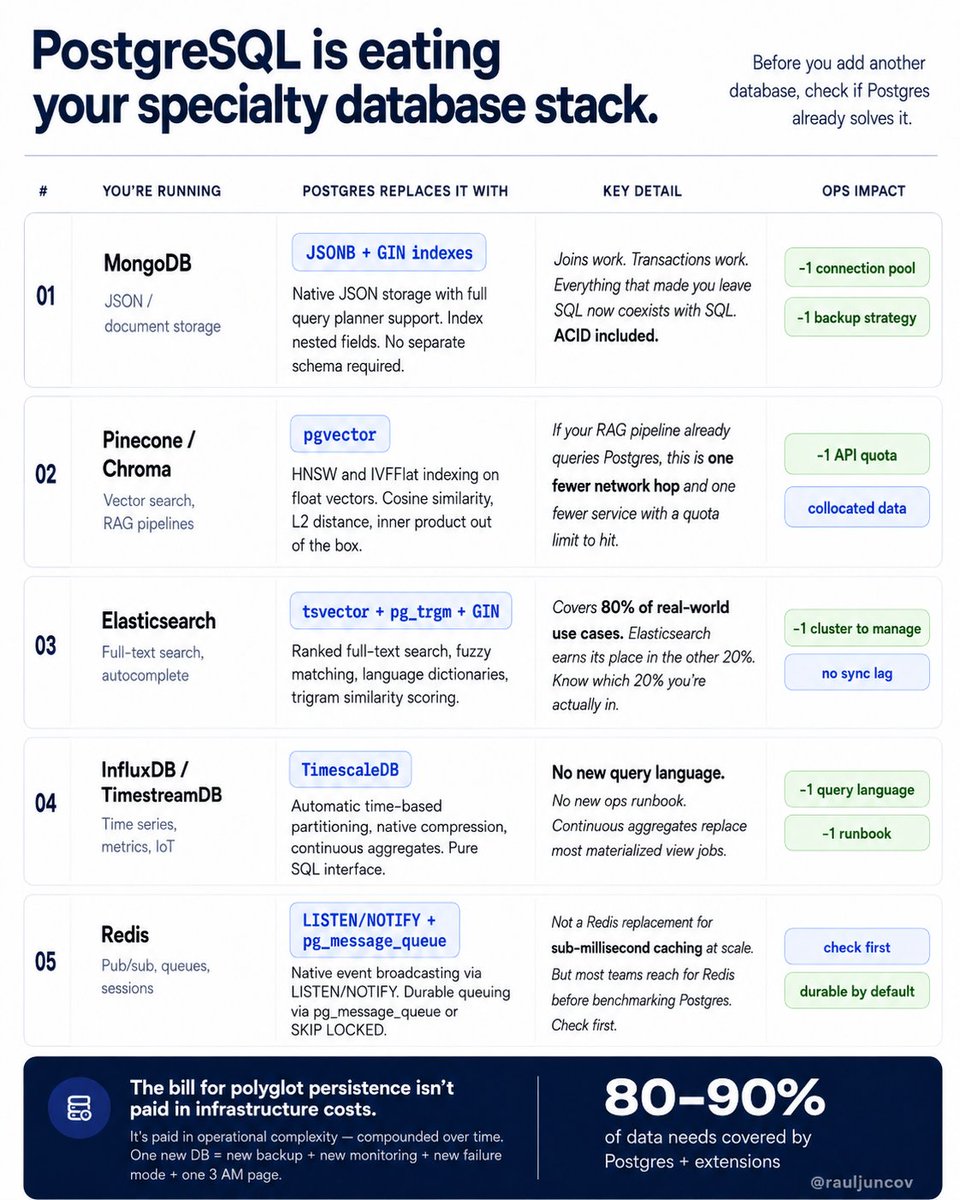
Store-selection posts argue for matching the deployment to workload and operational needs: generic databases can reduce the number of services early on, while specialized systems are proposed when workload requirements warrant them. One post distinguishes read-heavy RAG from write-heavy agent memory.

How this analysis was made

Themes, sentiment, stance, and post format are classified per tweet. All counts, shares, medians, creator concentration, freshness, and performance comparisons are then calculated directly from the published snapshot.

Xholic's all-time score compares engagement while accounting for reach, post age, and creator consistency. It is used for relative comparisons within this collection.

This report analyzes the exact 50-post snapshot shown below. AI identifies editorial categories and drafts explanations; all statistics are calculated from the snapshot, and every narrative claim is checked against cited posts before publication.

Top Vector Databases tweets from 42 creators

Ranked 01–50

  1. 01

    @adxtyahq ·

    “design a RAG pipeline for 10M docs with zero hallucination” apparently this was asked in a Google L5 interview round. came across it somewhere on the internet and honestly it’s a way more interesting system design problem than most classic distributed systems questions 1.

    • 83 Replies
    • 318 Reposts
    • 2.7K Likes
    • 187.7K Views
    View on X
    Rewrite this post in your own voice and angle. See the hook, structure, and reusable template behind this post.
  2. 02

    @akshay_pachaar ·

    Stop using vector search everywhere! A 30-year-old algorithm with zero training, zero embeddings, and zero fine-tuning still powers Elasticsearch, OpenSearch, and most production search systems today. It's called BM25. Let me explain what makes it so powerful: Imagine you're

    • 39 Replies
    • 198 Reposts
    • 1.2K Likes
    • 62.8K Views
    View on X
    Rewrite this post in your own voice and angle. See the hook, structure, and reusable template behind this post.
  3. 03

    @techNmak ·

    Someone removed the vector database from RAG and got better results. Much better. Here's what traditional RAG actually does under the hood: it chunks your document into pieces, embeds those pieces into vectors, and retrieves based on semantic similarity. The assumption is that

    • 15 Replies
    • 104 Reposts
    • 684 Likes
    • 41.1K Views
    View on X
    Rewrite this post in your own voice and angle. See the hook, structure, and reusable template behind this post.
  4. 04

    @micLivs ·

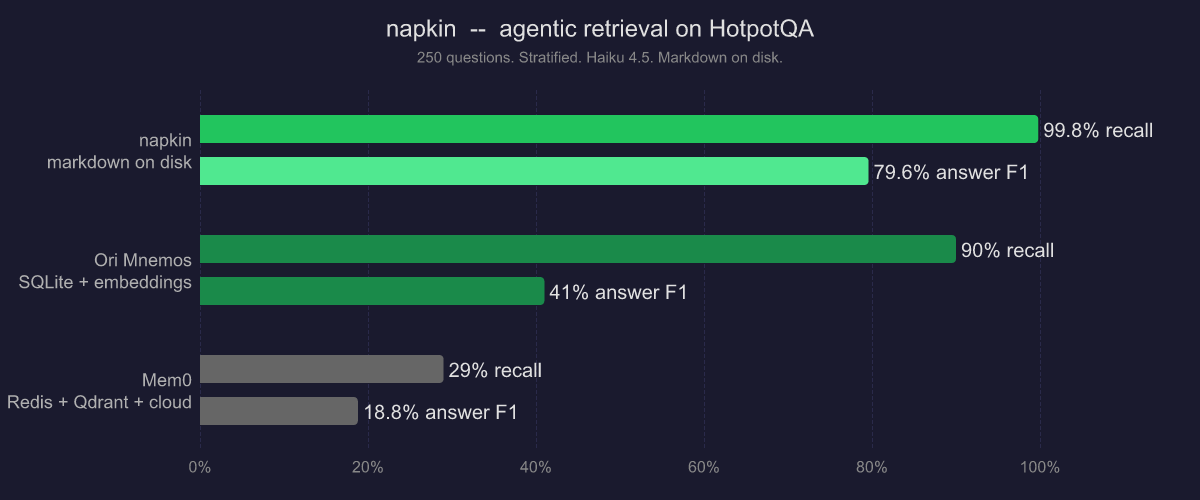
    i call BS on vector search for most use cases. everyone is building memory infrastructure. embeddings, vector stores, PageRank, spreading activation. co-occurrence learning. dampening pipelines. i gave @badlogicgames pi napkin, a CLI for obsidian vaults. BM25 search. TF-IDF

    • 41 Replies
    • 32 Reposts
    • 488 Likes
    • 48K Views
    View on X
    Rewrite this post in your own voice and angle. See the hook, structure, and reusable template behind this post.
  5. 05

    @AlphaSignalAI ·

    Someone removed the vector database from RAG and accuracy jumped to 98.7%. Most RAG systems chunk your documents, embed them as vectors, then retrieve by similarity. The core assumption: similar text means relevant text. That assumption fails on professional documents. Ask

    • 22 Replies
    • 68 Reposts
    • 573 Likes
    • 35.3K Views
    View on X
    Rewrite this post in your own voice and angle. See the hook, structure, and reusable template behind this post.
  6. 06

    @Aurimas_Gr ·

    Fundamentals of a 𝗩𝗲𝗰𝘁𝗼𝗿 𝗗𝗮𝘁𝗮𝗯𝗮𝘀𝗲. With the rise of GenAI, Vector Databases skyrocketed in popularity. The truth - Vector Databases are also useful outside of a Large Language Model context. When it comes to Machine Learning, we often deal with Vector Embeddings. Vector

    • 15 Replies
    • 143 Reposts
    • 533 Likes
    • 21.8K Views
    View on X
    Rewrite this post in your own voice and angle. See the hook, structure, and reusable template behind this post.
  7. 07

    @pauliusztin_ ·

    Building memory for AI agents is less about storage and more about retrieval. Let me explain... I'm building a personal assistant from scratch for my next book with Manning. And one challenge I faced was deciding how the agent retrieves (from unified memory) the appropriate

    • 10 Replies
    • 33 Reposts
    • 121 Likes
    • 4.9K Views
    View on X
    Rewrite this post in your own voice and angle. See the hook, structure, and reusable template behind this post.
  8. 08

    @techNmak ·

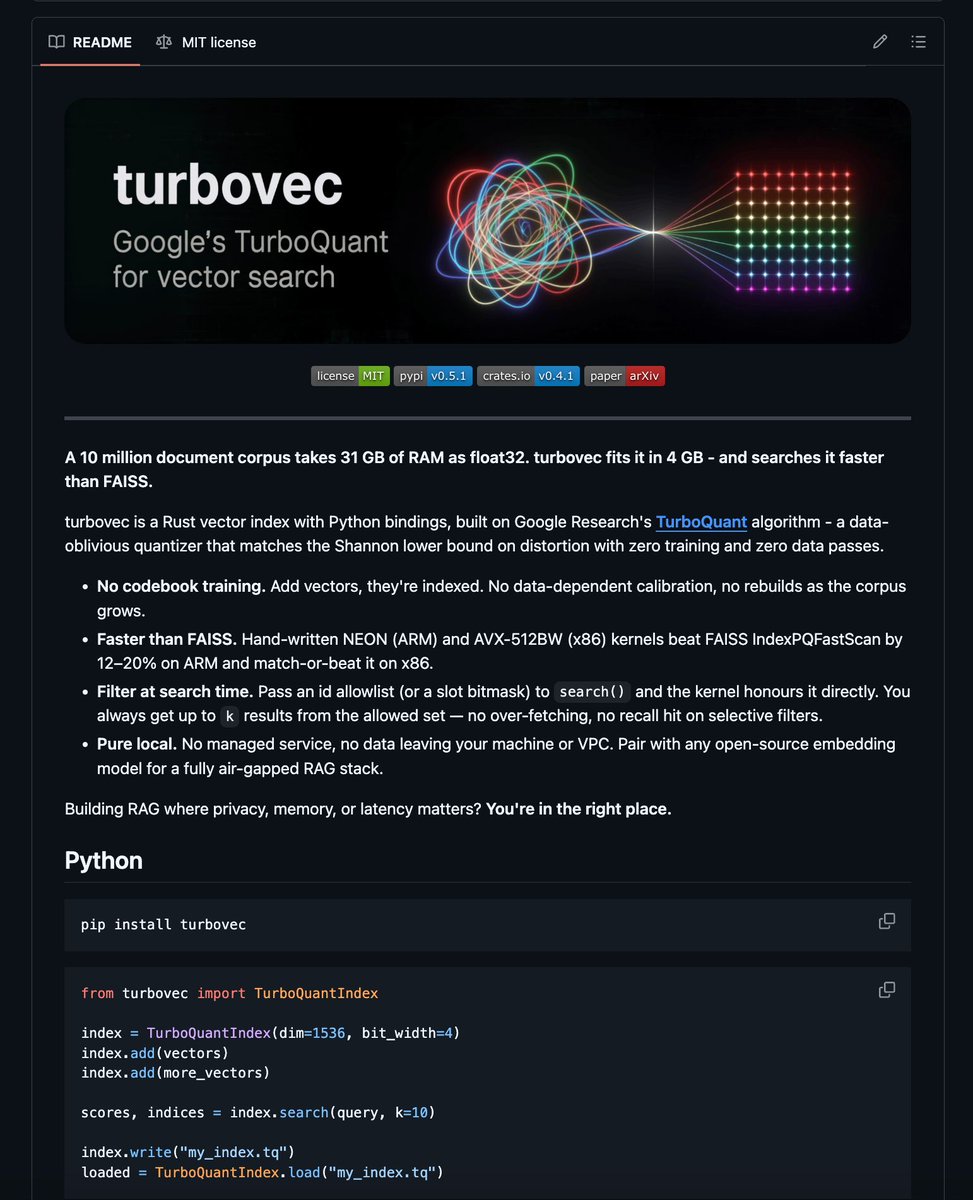
    Someone fit 10 million documents into 4 GB of RAM. The same corpus would consume 31 GB in float32 - yes, 31 GB. turbovec did it. Rust vector index, Python bindings, MIT license. The algorithm behind it (TurboQuant, from Google Research) compresses each vector without ever

    • 3 Replies
    • 32 Reposts
    • 198 Likes
    • 8.2K Views
    View on X
    Rewrite this post in your own voice and angle. See the hook, structure, and reusable template behind this post.
  9. 09

    @akshay_pachaar ·

    K-Means is simple. Making it fast on GPU isn't. Flash-KMeans is an IO-aware implementation of exact k-means that rethinks the algorithm around modern GPU bottlenecks. By attacking the memory bottlenecks directly, Flash-KMeans achieves: - 30x speedup over cuML - 200x speedup

    Video thumbnail from Akshay 🚀's post Watch video
    • 13 Replies
    • 56 Reposts
    • 400 Likes
    • 35.9K Views
    View on X
    Rewrite this post in your own voice and angle. See the hook, structure, and reusable template behind this post.
  10. 10

    @arpit_bhayani ·

    Postgres is the lowest common denominator for databases, and, to be honest, that is why it works so well as a default. If you do not need anything specific, just use Postgres. It is a super simple choice that just works. Personally, MySQL is still my first preference, but

    • 35 Replies
    • 20 Reposts
    • 738 Likes
    • 53.5K Views
    View on X
    Rewrite this post in your own voice and angle. See the hook, structure, and reusable template behind this post.
  11. 11

    @_avichawla ·

    Finally! A Text-to-SQL solution that actually works (open-source). When text-to-SQL fails, the real issue isn't the LLM or the prompt but schema retrieval. Consider a query like "Which publishers received royalty payments above $5,000?" To handle this, vector search can pull

    Video thumbnail from Avi Chawla's post Watch video
    • 11 Replies
    • 46 Reposts
    • 167 Likes
    • 14.2K Views
    View on X
    Rewrite this post in your own voice and angle. See the hook, structure, and reusable template behind this post.
  12. 12

    @GithubProjects ·

    Qdrant is a production-ready vector search engine and database built in Rust, designed for high-performance similarity search with extended filtering support. - Written in Rust for speed and reliability under high load. - RESTful API with convenient client libraries for Go,

    • 2 Replies
    • 40 Reposts
    • 244 Likes
    • 17.4K Views
    View on X
    Rewrite this post in your own voice and angle. See the hook, structure, and reusable template behind this post.
  13. 13

    @jobergum ·

    You know me as the BM25 guy, but embeddings are cool too. New post from the @HornetDev team just dropped. ANN tuning at 100M scale, covering embedding bias, graph connectivity, and quantization ceiling https://t.co/aPWYLXiGtK

    • 2 Replies
    • 31 Reposts
    • 242 Likes
    • 19.9K Views
    View on X
    Rewrite this post in your own voice and angle. See the hook, structure, and reusable template behind this post.
  14. 14

    @heygurisingh ·

    🚨RAG engineers are going to lose their minds. @webAI just open sourced a document retrieval model that's sitting at #1 AND #3 on ViDoRe V3 -- with Nvidia's best open-source embedding model trapped at #2 between them. No OCR. No text extraction. No broken pipelines on messy

    • 44 Replies
    • 101 Reposts
    • 369 Likes
    • 81.5K Views
    View on X
    Rewrite this post in your own voice and angle. See the hook, structure, and reusable template behind this post.
  15. 15

    @BraydenWilmoth ·

    Vector search emails with natural language! Crazy how much of the Cloudflare stack this service is using. DO, D1, KV, Workers, Vectorize, Turnstile, R2, Workers AI, Gateway + more. By far the best though... Dynamic Worker Loaders. AI generates code and runs it in a secure

    • 21 Replies
    • 7 Reposts
    • 226 Likes
    • 16.2K Views
    View on X
    Rewrite this post in your own voice and angle. See the hook, structure, and reusable template behind this post.
  16. 16

    @maxleiter ·

    I wrote a bit about how we made v0 an effective coding agent - Dynamic system prompt - Our "LLM Suspense" framework for modifying streamed content on the fly - Our AutoFixer system for fixing various issues we've seen. A good example of how powerful the pipeline is is our icon

    • 12 Replies
    • 27 Reposts
    • 287 Likes
    • 37.5K Views
    View on X
    Rewrite this post in your own voice and angle. See the hook, structure, and reusable template behind this post.
  17. 17

    @RaulJuncoV ·

    Behind every stack with too many databases is a team that didn’t check what Postgres can already do. I've seen this a dozen times. MongoDB for JSON. Redis for sessions. Elasticsearch for search. Pinecone for vectors. InfluxDB for metrics. Each one added to solve a real

    • 9 Replies
    • 18 Reposts
    • 92 Likes
    • 4.9K Views
    View on X
    Rewrite this post in your own voice and angle. See the hook, structure, and reusable template behind this post.
  18. 18

    @adxtyahq ·

    Everyone talks about the next model release. Meanwhile Google just dropped TurboVec: • 31GB -> 4GB memory usage • Faster search than FAISS • No training phase • Runs locally on a regular machine The most important engineering wins are often the least visible ones

    • 12 Replies
    • 4 Reposts
    • 77 Likes
    • 2.9K Views
    View on X
    Rewrite this post in your own voice and angle. See the hook, structure, and reusable template behind this post.
  19. 19

    @parcifap ·

    How to learn AI Automation? Step-by-step guide in 4 levels - - Level 1: Using AI Start by mastering the fundamentals: > Prompt engineering (zero-shot, few-shot, chain-of-thought) > Calling APIs (OpenAI, Anthropic, Cohere, Hugging Face) > Understanding tokens, context windows,

    • 16 Replies
    • 5 Reposts
    • 53 Likes
    • 1K Views
    View on X
    Rewrite this post in your own voice and angle. See the hook, structure, and reusable template behind this post.
  20. 20

    @TheTuringPost ·

    Almost everyone is talking about @GoogleResearch's TurboQuant (and for good reason) ➡️ It lets you run a 3-bit system with the accuracy of a full-precision model. Technically, TurboQuant is a compression algorithm that shrinks high‑dimensional vectors to low precision without

    • 5 Replies
    • 21 Reposts
    • 87 Likes
    • 6.5K Views
    View on X
    Rewrite this post in your own voice and angle. See the hook, structure, and reusable template behind this post.
  21. 21

    @thetripathi58 ·

    🚨 Cambridge researchers just tested what happens when you overload an AI's memory with irrelevant data. They found a complete collapse of modern RAG systems. Not a minor hallucination. A total failure of the exact retrieval architecture that every enterprise AI relies on to

    • 17 Replies
    • 39 Reposts
    • 103 Likes
    • 20.7K Views
    View on X
    Rewrite this post in your own voice and angle. See the hook, structure, and reusable template behind this post.
  22. 22

    @tylerangert ·

    perhaps an even bigger market for "personal software" is not at the application layer but at the library and framework layer. so many open source packages / libraries etc are marketed to "work everywhere" and have dozens of first party language bindings, cover a billion

    • 3 Replies
    • 1 Reposts
    • 80 Likes
    • 4.1K Views
    View on X
    Rewrite this post in your own voice and angle. See the hook, structure, and reusable template behind this post.
  23. 23

    @dshukertjr ·

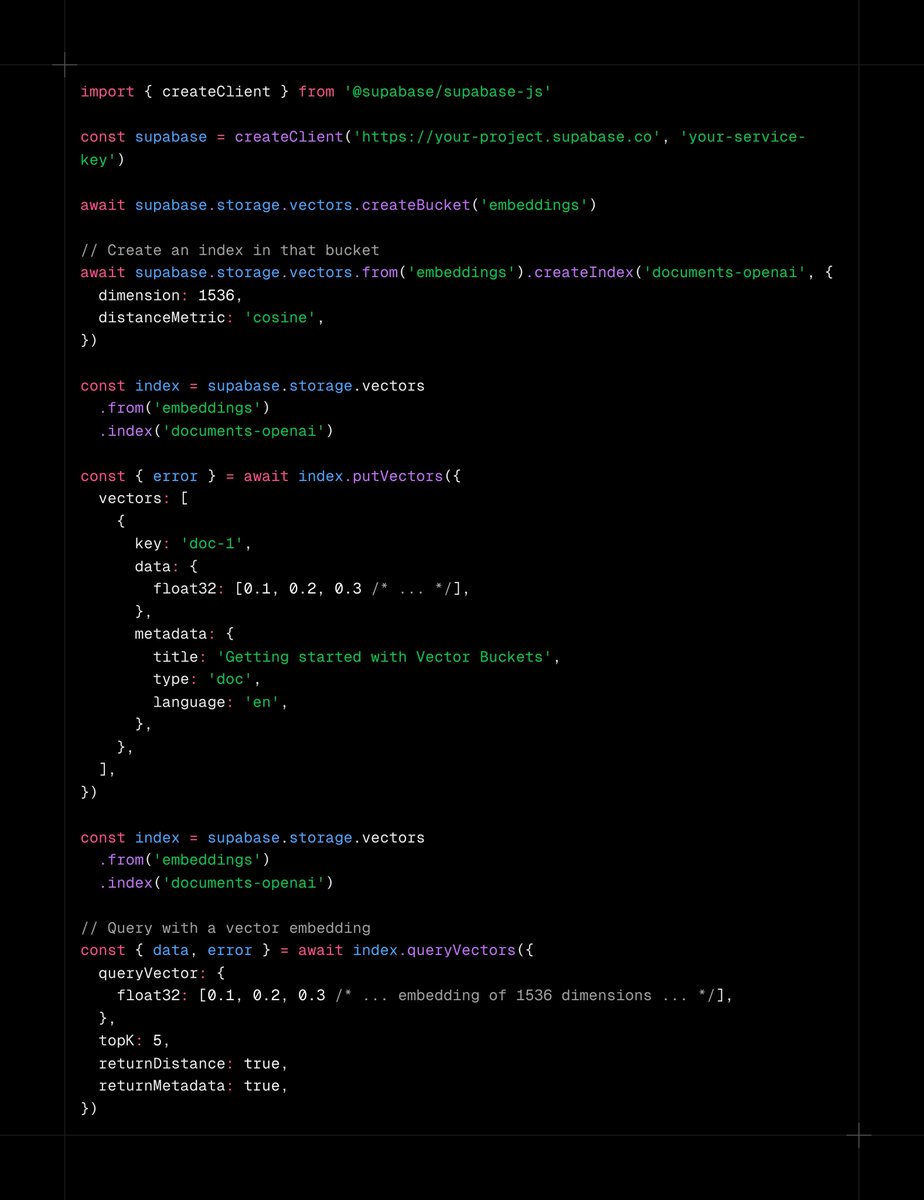
    Supabase has Vector Buckets, a vector storage in addition to pgvector for storing embeddings! Vector buckets allow you to store up to 50M embeddings in Supabase Storage for semantic searches! You can use it in combination with pgvector for scalable semantic search!

    • 3 Replies
    • 9 Reposts
    • 100 Likes
    • 6.9K Views
    View on X
    Rewrite this post in your own voice and angle. See the hook, structure, and reusable template behind this post.
  24. 24

    @ujjwalscript ·

    How to be a REAL AI Engineer (as opposed to a "Prompt Engineer") by learning the 4-Core System: Note: Being an AI Engineer is about building autonomous, production-grade agentic systems that solve real problems. 1. The "Brain" (Foundational Models & Routing): You don't just use

    • 1 Replies
    • 5 Reposts
    • 32 Likes
    • 2.9K Views
    View on X
    Rewrite this post in your own voice and angle. See the hook, structure, and reusable template behind this post.
  25. 25

    @Suryanshti777 ·

    RAG is broken and everyone's pretending it isn't. We chunk documents into pieces. Embed them into vectors. Pray similarity search finds the right ones. It doesn't. On complex documents, similarity ≠ relevance. Vectorless RAG just scored 98.7% on FinanceBench. GPT-4o with

    • 8 Replies
    • 12 Reposts
    • 36 Likes
    • 2.6K Views
    View on X
    Rewrite this post in your own voice and angle. See the hook, structure, and reusable template behind this post.
  26. 26

    @NainsiDwiv50980 ·

    Ask any LLM about something that happened last week and watch it either make something up or tell you it doesn't know That's not a model problem. That's a memory problem. The model only knows what it was trained on, frozen at a point in time RAG fixes this without retraining

    • 6 Replies
    • 17 Reposts
    • 38 Likes
    • 1K Views
    View on X
    Rewrite this post in your own voice and angle. See the hook, structure, and reusable template behind this post.
  27. 27

    @IntuitMachine ·

    🧵 THREAD: Why your RAG pipeline is probably backwards (and grep is eating vector search's lunch) 1/ Everyone's building the same retrieval stack: → Embed everything → Store in Pinecone/Weaviate → Query with cosine similarity → Inject top-K into context But a new study just

    • 1 Replies
    • 1 Reposts
    • 19 Likes
    • 2.2K Views
    View on X
    Rewrite this post in your own voice and angle. See the hook, structure, and reusable template behind this post.
  28. 28

    @freshlimesofa ·

    I was learning different Vector indexing techniques. Decided to create a fun little visualizer that animates the indexing techniques. > IVF + variants > HNSW + variants check it out : https://t.co/qkgLWLF8FO

    Video thumbnail from Harsh.'s post Watch video
    • 3 Replies
    • 1 Reposts
    • 22 Likes
    • 279 Views
    View on X
    Rewrite this post in your own voice and angle. See the hook, structure, and reusable template behind this post.
  29. 29

    @smratitiwa86867 ·

    Everyone is building AI agents. Tencent just made one of the biggest AI infrastructure categories look optional. They open-sourced TencentDB Agent Memory—a long-term memory system that runs entirely on your machine. No vector database. No Pinecone. No cloud memory APIs. No

    • 7 Replies
    • 15 Reposts
    • 24 Likes
    • 1.7K Views
    View on X
    Rewrite this post in your own voice and angle. See the hook, structure, and reusable template behind this post.
  30. 30

    @ttunguz ·

    AI vendor revenue will double classic software in terms of new bookings this year. This trend is so large it’s starting to have second-order effects. MongoDB reported strong Q2 FY'26 results, delivering $591M in revenue with 24% year-over-year growth. AI is causing a

    • 8 Replies
    • 10 Reposts
    • 79 Likes
    • 13K Views
    View on X
    Rewrite this post in your own voice and angle. See the hook, structure, and reusable template behind this post.
  31. 31

    @JustAnotherPM ·

    Here is the easiest way to understand what is RAG: (Product managers don't forget to bookmark this one!) RAG (Retrieval Augmented Generation) is a powerful method that helps LLMs access (aka:retrieve) evidence and data before it responds to the user's query. This ensures that

    • 1 Replies
    • 0 Reposts
    • 9 Likes
    • 1.2K Views
    View on X
    Rewrite this post in your own voice and angle. See the hook, structure, and reusable template behind this post.
  32. 32

    @_avichawla ·

    A 12x cheaper model doesn't mean a 12x cheaper AI bill. This sounds counterintuitive, but for many AI systems, inference is no longer the only meaningful infrastructure cost. Consider this: - GPT-4 arrived at $30/M input tokens. - GPT-4o performed better at just $2.50 (12x

    Video thumbnail from Avi Chawla's post Watch video
    • 11 Replies
    • 5 Reposts
    • 37 Likes
    • 4.2K Views
    View on X
    Rewrite this post in your own voice and angle. See the hook, structure, and reusable template behind this post.
  33. 33

    @supabase ·

    Build indexes using Cosine distance, L2-Norm distance, or Max Inner Product for fast and efficient querying with Supabase Vector and Vecs

    • 5 Replies
    • 3 Reposts
    • 67 Likes
    • 4.6K Views
    View on X
    Rewrite this post in your own voice and angle. See the hook, structure, and reusable template behind this post.
  34. 34

    @hrswatigupta ·

    🚨 How to become an AI Engineer in 6 months (2026 roadmap) No fluff. No theory overload. Just the skills companies actually hire for. By the end, you should be able to: * Build LLM apps end-to-end * Use OpenAI / Anthropic / open-source APIs * Design high-quality prompts &

    • 2 Replies
    • 5 Reposts
    • 17 Likes
    • 998 Views
    View on X
    Rewrite this post in your own voice and angle. See the hook, structure, and reusable template behind this post.
  35. 35

    @petesoder ·

    @changhiskhan, CEO of @lancedb, thinks the data stack we've used for 20 years is done. Metadata in the DB, files on S3, connected by a pointer. Fine for humans. Breaks under agentic workloads. His argument: the files need to live inside the database. https://t.co/zQqode1Imp

    Video thumbnail from Pete Soderling's post Watch video
    • 2 Replies
    • 3 Reposts
    • 19 Likes
    • 6.3K Views
    View on X
    Rewrite this post in your own voice and angle. See the hook, structure, and reusable template behind this post.
  36. 36

    @shivam74689 ·

    Day 64 — Becoming AI Engineer Today I learned one of the most important lessons in building production RAG systems: When an AI system gives bad answers, the problem is usually not the LLM. The problem is often the evidence pipeline behind it. I spent today debugging and

    • 3 Replies
    • 1 Reposts
    • 11 Likes
    • 198 Views
    View on X
    Rewrite this post in your own voice and angle. See the hook, structure, and reusable template behind this post.
  37. 37

    @ujjwalscript ·

    If you want to be an AI Engineer, and make TOP dollar in the industry, read this: Here is what the elite 1% of AI Engineers are doing differently: 1. They treat Pydantic as their Data Backbone Models love to output poetic, unpredictable nonsense. Businesses require

    • 1 Replies
    • 1 Reposts
    • 9 Likes
    • 1.2K Views
    View on X
    Rewrite this post in your own voice and angle. See the hook, structure, and reusable template behind this post.
  38. 38

    @alex_verem ·

    Turbovec is a tool that makes AI search cheaper to run. It's free, it runs on your own computer, and it shrinks the memory AI search needs by about 8x. Some background first. Modern search doesn't match keywords anymore. It turns every document or product into a long list of

    • 5 Replies
    • 1 Reposts
    • 15 Likes
    • 3.6K Views
    View on X
    Rewrite this post in your own voice and angle. See the hook, structure, and reusable template behind this post.
  39. 39

    @PrajwalTomar_ ·

    Your vector database is quietly killing your AI agent and you have no idea. Here is the trap. Everyone picks the database that looks fastest. But those speed tests run on data that never changes. Real agents are different. They save new information after every task. Add that

    • 3 Replies
    • 4 Reposts
    • 10 Likes
    • 1.8K Views
    View on X
    Rewrite this post in your own voice and angle. See the hook, structure, and reusable template behind this post.
  40. 40

    @pauliusztin_ ·

    Your RAG pipeline is infrastructure bloat. You do not need a vector database to process 10 million tokens. Instead of maintaining brittle embedding pipelines and chunking strategies, Recursive Language Models (RLMs) let your model write code to explore data directly. The model

    • 0 Replies
    • 1 Reposts
    • 5 Likes
    • 161 Views
    View on X
    Rewrite this post in your own voice and angle. See the hook, structure, and reusable template behind this post.
  41. 41

    @ttunguz ·

    Gmail’s AI email assistant writes like a committee of lawyers designed it. Pete Koomen’s recent post Horseless Carriages explains why: developers control the AI prompts instead of users. In his post he argues that software developers should expose the prompts and the user should

    • 1 Replies
    • 2 Reposts
    • 15 Likes
    • 3.8K Views
    View on X
    Rewrite this post in your own voice and angle. See the hook, structure, and reusable template behind this post.
  42. 42

    @DanKornas ·

    Vector-only RAG can miss relationships that span chunks and documents, especially when a question needs both details and wider context. LightRAG is a graph-based RAG framework for builders who need retrieval across entities, relationships, and source text. It helps you retrieve

    • 1 Replies
    • 4 Reposts
    • 8 Likes
    • 963 Views
    View on X
    Rewrite this post in your own voice and angle. See the hook, structure, and reusable template behind this post.
  43. 43

    @RoundtableSpace ·

    Most RAG pipelines follow the same pattern chunk your docs, embed them, stuff into a vector DB, run similarity search. PageIndex throws all of that out. No vector database. No embeddings. No chunking. No similarity search. Instead it builds a tree index over your documents and

    • 11 Replies
    • 1 Reposts
    • 40 Likes
    • 51.4K Views
    View on X
    Rewrite this post in your own voice and angle. See the hook, structure, and reusable template behind this post.
  44. 44

    @jherr ·

    Vector search is getting MORE important over time as we get into Agentic memory. Let me show you a very easy way to get embeddings and vector search going in MongoDB with their built-in autoEmbed feature: https://t.co/i5fycRx6yP

    • 1 Replies
    • 2 Reposts
    • 9 Likes
    • 2.6K Views
    View on X
    Rewrite this post in your own voice and angle. See the hook, structure, and reusable template behind this post.
  45. 45

    @Meer_AIIT ·

    🚨 A $2.5B startup just put Nvidia in a sandwich on the hardest document retrieval benchmark in AI. It's called webAI-ColVec1. And they open sourced it. Their 9B model sits at #1 on ViDoRe V3. Their 4B model sits at #3. Nvidia's best open-source embedding model is stuck at #2

    • 11 Replies
    • 6 Reposts
    • 19 Likes
    • 21.2K Views
    View on X
    Rewrite this post in your own voice and angle. See the hook, structure, and reusable template behind this post.
  46. 46

    @jlongster ·

    been trying vector databases, I haven't found them very helpful for codebases, but it's very cool for my local notes I'm indexing all my Bear notes (splitting each note into individual items) and my system can find relevant info quickly, logs of when I worked on something,

    • 1 Replies
    • 0 Reposts
    • 19 Likes
    • 2.4K Views
    View on X
    Rewrite this post in your own voice and angle. See the hook, structure, and reusable template behind this post.
  47. 47

    @ThePracticalDev ·

    Upgrading your embedding model in production? You can't just swap it out — existing vectors are incompatible. This dev shows a zero-downtime strategy using dual-column schemas, background backfilling with Cloud Run Jobs, and feature flags for safe cutover. { author:

    • 2 Replies
    • 3 Reposts
    • 4 Likes
    • 1.2K Views
    View on X
    Rewrite this post in your own voice and angle. See the hook, structure, and reusable template behind this post.
  48. 48

    @doppenhe ·

    Agent memory startups are raising everywhere. My instinct: this is vector databases all over again. Real problem, gets absorbed as a feature. Postgres added vectors. OpenAI and Anthropic are both shipping memory. The independent layer gets squeezed out.

    • 2 Replies
    • 0 Reposts
    • 5 Likes
    • 275 Views
    View on X
    Rewrite this post in your own voice and angle. See the hook, structure, and reusable template behind this post.
  49. 49

    @ThePracticalDev ·

    DEV Update: We're now using Gemini Embeddings 2 and pgvector to personalize your feed, scoring articles by cosine similarity alongside social signals. Here's a look under the hood. https://t.co/PQuekhcYh5

    • 0 Replies
    • 0 Reposts
    • 7 Likes
    • 1.5K Views
    View on X
    Rewrite this post in your own voice and angle. See the hook, structure, and reusable template behind this post.
  50. 50

    @TDataScience ·

    When vector RAG isn't delivering the results you were hoping for, @emmimalpa proposes a context graph layer — and explains on how to build it for your own pipeline. https://t.co/4zPq5mt0IQ

    • 0 Replies
    • 1 Reposts
    • 2 Likes
    • 1.9K Views
    View on X
    Rewrite this post in your own voice and angle. See the hook, structure, and reusable template behind this post.

Explore more of the best tweets on X.

Browse all tweet collections

Tweet Remixer

Remix this post

Creator

@creator

View on X

Choose a tone