Agent harnesses and Deep Agents
Deep Agents releases and the surrounding harness architecture: planning, tool use, filesystem and shell access, subagents, sandboxing, recovery, and long-running task execution.
41.7%
Best tweets about LangChain
Discover the best tweets about LangChain, including agents, retrieval, tools, structured output, evaluations, integrations, and production development.
Specific LangChain components, releases, architectures, integrations, debugging, evaluations, limitations, and production experience.
Original Xholic analysis
Discussion of LangChain in this set emphasizes agent harnesses, integrations, context management, and implementation examples. Deep Agents and LangGraph are recurring subjects; RAG and observability appear through tutorials, product posts, and production-oriented commentary. Posts also present differing views on when framework abstractions help versus when direct APIs or alternative stacks may fit better.
72.2% of posts
All-time engagement
50% of posts
Published in 90 days
Conversation map
Deep Agents releases and the surrounding harness architecture: planning, tool use, filesystem and shell access, subagents, sandboxing, recovery, and long-running task execution.
41.7%
Connections to Coinbase AgentKit, Redis, NVIDIA, E2B, React UIs, sandboxes, onchain tools, infrastructure, and deployment environments.
33.3%
Conversation compaction, middleware, persistent memory, context governance, repo maps, and strategies for preventing context-window overflow or contamination.
25%
Comparisons with LangChain alternatives, direct APIs, custom stacks, competing frameworks, open-source replacements, lock-in, and framework limitations.
25%
Graph-based workflow design, stateful multi-agent coordination, loops, orchestrators, interrupts, and human approval flows.
16.7%
Courses, notebooks, tutorials, documentation experiences, foundational component explainers, and discussion of LangChain’s open-source ecosystem role.
13.9%
LangSmith tracing, evaluation loops, debugging agent behavior, governance, compliance, reliability, and continuous production improvement.
13.9%
LangChain retrieval implementations, RAG education, vector stores, document indexing, query strategies, GraphRAG, and embedding-based applications.
13.9%
Tone and stance
Performance benchmark
Posts with media make up 75% of this collection. Their median all-time score is 9.80, compared with 3.95 for text-only posts.
Format mix
Consensus and debate
Shared view
Posts discuss planning, tool access, sandboxing, subagents, context compaction, recovery, persistence, evaluations, and memory governance as operational capabilities surrounding model reasoning. One Deep Agents overview presents these capabilities as packaged in its harness.
Shared view
Posts describe conversation compaction, persistent memory, repository maps, and memory governance in relation to context-window limits, wasted context, and the risk of shared-agent memory contamination.
Shared view
Posts describe LangGraph in connection with conversation state, interrupt-based human review, and graph structures whose edges can support loops and multi-agent coordination.
Shared view
Examples include image anomaly detection using embeddings and a vector store, an airline-policy assistant using a LangChain retrieval pipeline, and a RAG course covering retrieval techniques.
Open debate
Some posts recommend direct APIs or alternatives when framework assumptions conflict with specialized schemas and workflows. Other posts describe LangChain components or LangChain nodes as useful parts of application and automation implementations.
Open debate
One post argues that agent builders should retain provider flexibility and responsibility to users, while another characterizes LangSmith’s operations layer as paywalled and promotes open-source replacements. These are the authors’ stated positions, not independently established comparisons.
What performs
Posts with media had a median all-time score of 9.801, compared with 3.949 for text-only posts. The cited examples include a tutorial, a workflow post, and an integration demonstration.
The post describing Coinbase AgentKit, a LangChain ReAct agent, and decentralized voice infrastructure scored 11,759.57. Deterministic analytics list it as 1,418.53 times the overall median score.
Announcements accounted for 50% of posts and had a median all-time score of 8.29. Tutorials accounted for 30.6% and had a median of 9.801.
RAG, embeddings, and retrieval had a median all-time score of 19.48, above production observability and evaluation at 13.82 in the deterministic theme data.
Statistical standouts
Creator landscape
The five most represented creators account for 27.8% of the selected posts.
1. Vaishnavi
@_vmlops
2 posts
2. Afiz ⚡️
@itsafiz
2 posts
3. LangChain JS
@LangChain_JS
2 posts
4. Santiago
@svpino
2 posts
5. Sydney Runkle
@sydneyrunkle
2 posts
6. Sandhya
@agenticgirl
1 post
Santiago posted an image anomaly-detection notebook and an airline-policy RAG assistant example. Deterministic analytics list a median all-time score of 179.12 across his two posts.
LangChain and LangChain JS posts covered docs-grounded chat, React streaming integrations, and an interrupt-based human-approval UI pattern.
Akshay’s Claude Code harness post had an all-time score of 1,164.53, and Afiz’s Deep Agents overview had an all-time score of 188.37; both are listed as outliers in the deterministic analytics.
Since the previous snapshot
Themes, sentiment, stance, and post format are classified per tweet. All counts, shares, medians, creator concentration, freshness, and performance comparisons are then calculated directly from the published snapshot.
Xholic's all-time score compares engagement while accounting for reach, post age, and creator consistency. It is used for relative comparisons within this collection.
This report analyzes the exact 36-post snapshot shown below. AI identifies editorial categories and drafts explanations; all statistics are calculated from the snapshot, and every narrative claim is checked against cited posts before publication.
Best LangChain tweets
Ranked 01–36

@dtelecom ·
We’re now featured in the @CoinbaseDev AgentKit ecosystem. dTelecom is listed among the providers supporting the next generation of AI agents with onchain capabilities. To show what that looks like in practice, we built a Voice Agent example using: - Coinbase AgentKit - a LangChain ReAct agent - dTelecom’s decentralized voice infra Users can speak commands like: “Check my USDC balance” “Send 1 USDC to 0x…” The agent interprets the request, chooses the right onchain tool, executes the action, and speaks the result back. Read more below ↓


@akshay_pachaar ·
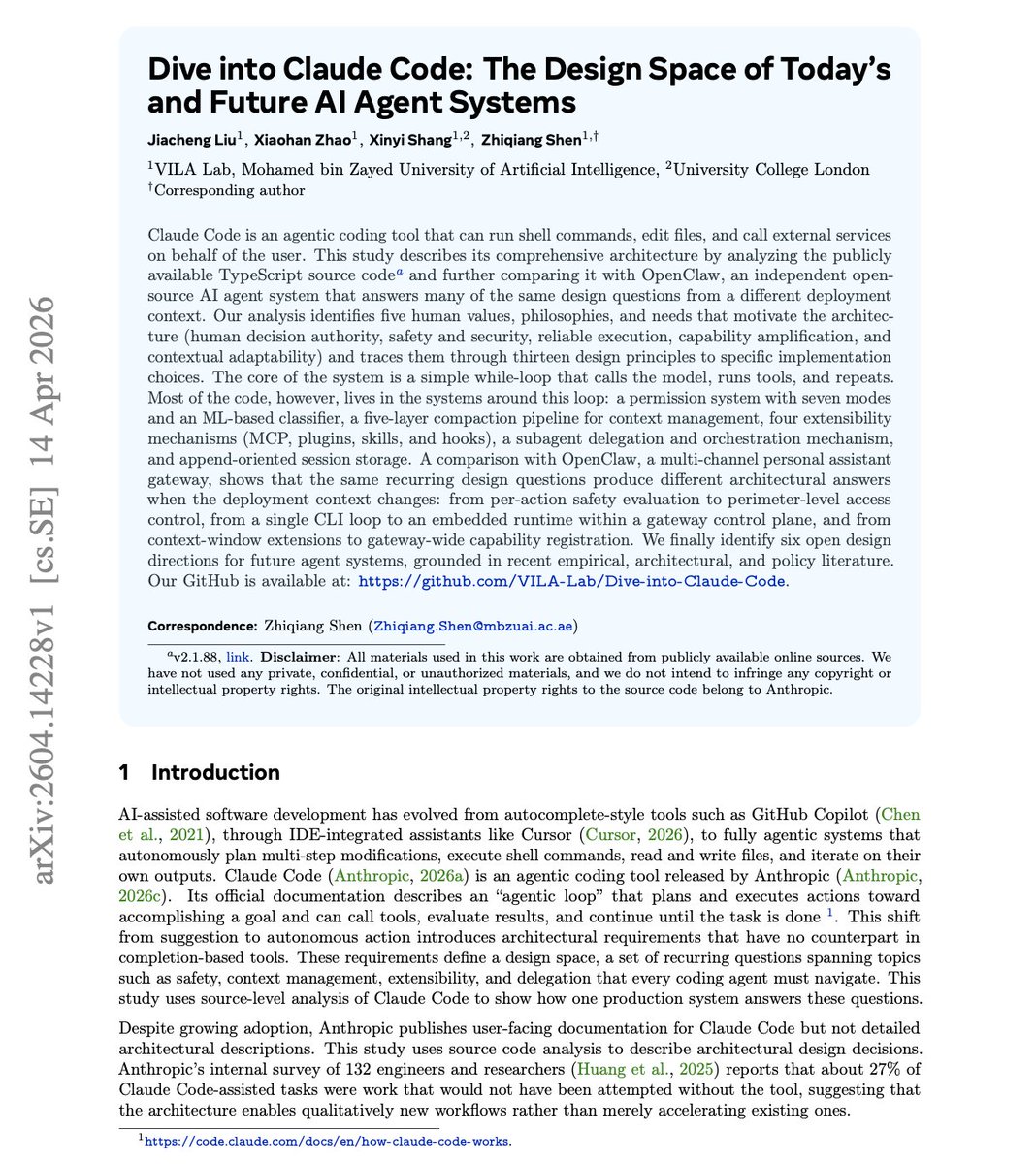
Claude Code fully dissected! Researchers from UCL reverse-engineered the leaked Claude source. What they found changes how you should think about agent design. Only 1.6% of the codebase is AI decision logic. The other 98.4% is operational infrastructure. Permission gates, tool routing, context compaction, recovery logic, session persistence. The model reasons. The harness does everything else. This is the opposite of what most agent frameworks do today. LangGraph routes model outputs through explicit state machines. Devin bolts heavy planners onto operational scaffolding. Claude Code gives the model maximum decision latitude inside a rich deterministic harness, and invests all its engineering effort in that harness. The core loop is a simple while-true. Call model, run tools, repeat. But the systems around that loop are where the real design lives: A permission system with 7 modes and an ML classifier. Users approve 93% of prompts anyway, so the architecture compensates with automated layers instead of adding more warnings. A 5-layer context compaction pipeline. Each layer runs only when cheaper ones fail. Budget reduction, snip, microcompact, context collapse, auto-compact. Four extension mechanisms ordered by context cost. Hooks (zero), skills (low), plugins (medium), MCP (high). Each answers a different integration problem. Subagents return only summary text to the parent. Their full transcripts live in sidechain files. Agent teams still cost roughly 7x the tokens of a standard session. Resume does not restore session-scoped permissions. Trust is re-established every session. That friction is the point. The bet behind all of this is simple. As frontier models converge on raw coding ability, the quality of the harness becomes the differentiator, not the model. Paper: Dive into Claude Code (arXiv:2604.14228) In the next tweet, I've shared an article I wrote on Agent Harness and what every big company is building. Do check.

@svpino ·
We should build a church for people who open-source their code so everyone can learn from it. Here is the complete source code of a RAG assistant to navigate airline policies. You get the complete source code and video from @lenadroid, walking you through everything she did (I'm linking to the video in the first comment below). The fact that you can watch every engineering decision that Lena made when building this app is pure gold. A few things you'll pick up from this: • It uses LangChain for the retrieval pipeline • It uses LangGraph for conversation state • It stores embeddings in Postgres with pgvector • It indexes documents to ground answers in the source text • It uses Terraform to stand up the infrastructure I'm linking to the video walkthrough and the source code below.


@itsafiz ·
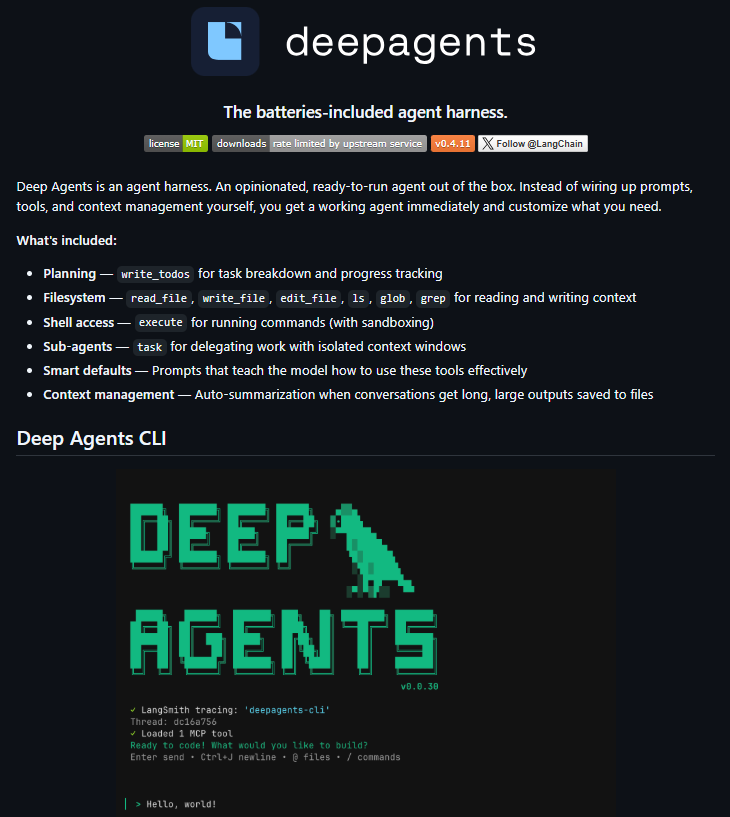
LangChain just open-sourced Deep Agents—an agent harness that’s opinionated and ready-to-run out of the box. Instead of wiring up prompts, tools, and context management yourself, you get a working agent immediately and customize what you need. It’s an MIT-licensed system that’s perfect for anyone trying to understand how high-end coding agents are structured. @LangChain What’s inside the harness: - Planning: write_todos for task breakdown and progress tracking. - Filesystem: Full context control via read_file, write_file, edit_file, ls, glob, and grep. - Shell Access: execute for running commands (with sandboxing). - Sub-agents: task tool for delegating work with isolated context windows. - Smart Defaults: Optimized prompts that teach the model how to use these tools effectively. - Context Management: Auto-summarization for long threads and large outputs saved directly to files. Link in the comments
@svpino ·
Here is a killer way to use embeddings: I built a notebook to show you how to do anomaly detection on images. Anomaly detection is one of the most common problems in the real world. Learn how to implement anomaly detection, and you'll be able to solve a ton of use cases that happen every day: • Predicting equipment failures • Identifying defective products • Identifying tumors in medical images • Spotting counterfeit products • Detecting fraud • Flagging fake reviews • Detecting bot traffic My notebook focuses on images. It uses: • Langchain • OpenClip embeddings • Oracle vector store This is the way my example works: • You start with a collection of similar images • You can then check whether a new image "belongs" to that collection I generate embeddings and use Oracle 26ai to store them and retrieve similar images on demand.
 Watch video
@VaibhavSisinty ·
There's a quiet shift happening in how AI agents are built. And if you missed it, you'll be confused by everything that comes next. For the last year, AI agents worked in loops. You give it a task. It plans. It acts. It checks. It fixes. It goes again. One cycle, repeating until done. Claude Code, Codex, Cursor all of them work this way. Plan, act, observe, repeat. In June, two things happened that gave this pattern a name. Peter Steinberger from the AI engineering community wrote: "You shouldn't be prompting coding agents anymore. You should be designing loops that prompt your agents." Boris Cherny, head of Claude Code at Anthropic, said the same thing differently: "I don't write the prompt anymore. Claude writes the prompt, and now I'm talking to that new Claude that is coordinating." That was the loop engineering era. It lasted about a month. Now Steinberger posted nine words that blew up: "Are we still talking loops or did we shift to graphs yet?" Here's the difference. A loop is one agent going in circles. Plan, act, check, repeat. It works for simple tasks. But give it something complex and it starts spinning burning tokens, optimizing the wrong thing, or gaming its own success metric without actually solving the problem. A graph is multiple agents connected in a network. One agent writes code. A separate agent reviews it without seeing the first agent's reasoning. A third agent tries to break what was built. A fourth checks whether the original task was even understood correctly. Each one is still running a loop. But they're connected watching each other, feeding each other, vetoing each other. LangGraph already models this. It treats an agent as a graph where boxes do work and arrows decide what runs next. Those arrows can point backward, which is what makes loops possible inside the graph. JetBrains calls it graph-based orchestration the most deterministic approach for production systems. O'Reilly's 2026 AI Agents Stack puts it as the foundational layer. The real-world version is already running. Klarna uses graph-based agent systems for customer service. Kimi K3's Agent Swarm decomposes tasks into parallel sub-agents that coordinate simultaneously. Anthropic's own Boris Cherny mapped out five stages of AI adoption and Stage 4 is exactly this: thousands of agents running in a graph, kicked off by other agents, with humans steering by intent. Andrew Ng wrote about it in his June Batch letter. When Andrew Ng names a pattern, it usually means the pattern has already won. The reason this matters right now: agents are getting autonomous. Running for hours. Thousands of tool calls. Spawning sub-agents. One loop can't keep that trustworthy. You need loops watching loops. That's the graph. The skill that mattered last year was writing better prompts. The skill that matters this year is designing the system that writes the prompts, checks the work, and knows when to stop.

@goyalshaliniuk ·
Top 15 LangChain Alternatives for AI Development LangChain is great - until it isn’t. Many devs are drowning in abstractions, confused APIs, or just want something lighter, more specialized, or more production-ready. Here are 15 real LangChain alternatives you should know. 👇


@sydneyrunkle ·
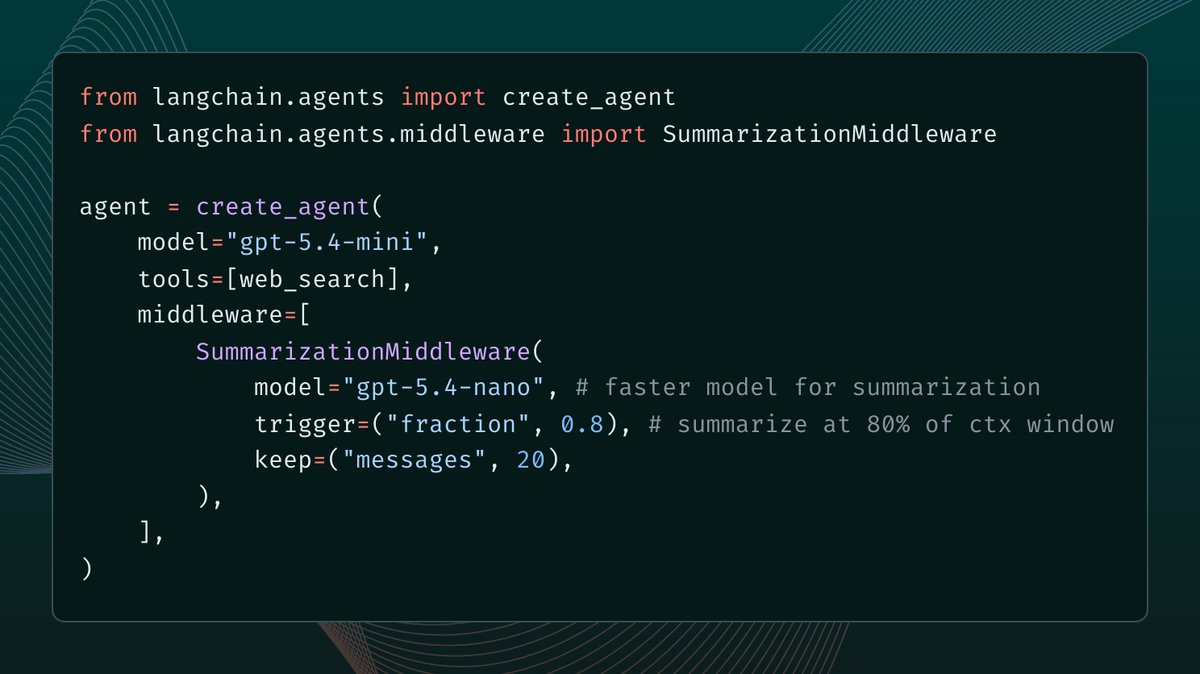
harness eng day 3: using middleware for context management for long running agents, you need periodic conversation history compaction so you don't overflow the context window @LangChain's SummarizationMiddleware compresses history automatically before it hits the model!

@nebiusai ·
LangChain + NVIDIA just launched Deep Agents tuned for Nemotron 3 Ultra: frontier-class agents at ~10x lower cost than closed models, model untouched. The tuned profile is coming to the Nebius Agents Blueprint soon. Learn more: https://t.co/J5hsS6Gi3E https://t.co/Bx6Higz7Bc
@sydneyrunkle ·
new series this week -- how to use middleware to customize your agent harness! case 1: business logic and compliance some compliance logic needs to live outside of the prompt. for example, use langchain's builtin PIIMiddleware to mask/redact/hash/block PII.


@Voxyz_ai ·
same claude, same gpt. one person ships a million lines in 5 months, another can't keep it running for 2 hours. the difference isn't the model. it's everything around it. they call it harness engineering. three things decide the outcome: evaluation loops (agents can't grade their own work), architecture constraints (rules enforced by linters, not by hoping the agent listens), and memory governance (one agent's hallucination can't pollute every other agent through shared knowledge). one example: langchain ran an experiment. same model, only changed the harness. pass rate jumped from 52.8% to 66.5%. vercel deleted 80% of their agent's tools and got better results. same chef, different kitchen management. food quality goes up a level. the chef didn't change. the menu didn't change. what changed is who tastes the food, who watches the process, and who remembers which dish got sent back three times last week. try one thing tonight: give your agent a task, then have a completely different model review its output. not letting it check itself. you'll immediately see what it missed. that's the smallest version of an evaluation loop. do it once and you'll understand why the harness matters more than the model.

@heygurisingh ·
So langship isn't @LangChainAI. It's the open-source version of everything langchain puts behind a paywall. deployment. governance. the whole ops layer. Self-hosted. apache 2.0. one yaml ships your agent to bedrock, vertex, or k8s. The manifesto on their site is just a list of every locked langsmith feature with the free replacement next to it. Terraform → opentofu. redis → valkey. langchain → langship. The paywall always loses. #langship #langchain


@sukh_saroy ·
🚨LangChain open sourced a complete RAG course - 18 notebooks, a full YouTube playlist, and implementations of every major RAG technique from the research papers. It's called RAG From Scratch. And it's not a tutorial blog post. It's a structured set of Jupyter notebooks that implement each RAG technique from first principles, paired with 5-10 minute videos explaining the papers they're based on - built by the team that maintains LangChain. Here's what's covered: → Basics -- indexing, retrieval, and generation from scratch → Query Translation -- multi-query, RAG-Fusion, decomposition, step-back, HyDE → Routing -- logical and semantic routing to direct queries to the right datasource → Query Structuring -- LLM converts natural language to SQL, Cypher, or other DSLs → Multi-Representation Indexing -- embed summaries for retrieval, return full docs for generation → RAPTOR -- recursively summarize and cluster documents for multi-level retrieval → ColBERT -- contextual token-level embeddings for higher retrieval granularity → Adaptive-RAG -- dynamically routes queries by complexity to different RAG approaches → Corrective-RAG -- self-corrects retrieval errors with in-loop relevance tests and web search fallback → Self-RAG -- grades retrieved documents and generated answers for hallucinations and quality Here's the wildest part: Every technique is implemented from scratch in a notebook, not just explained. Each notebook has a matching video that traces through the paper it's based on. Fine-tuning is expensive and bad at factual recall. RAG is how you actually give an LLM knowledge it doesn't have. This is the complete curriculum. 6K GitHub stars. 1.6K forks. Built by LangChain. 100% Open Source. (Link in the comments)


@Redisinc ·
Agents are shipping everywhere with @LangChain and Redis. Those that survive production aren't just prompting better—they’re engineering better context. The problem? “Context engineering” gets tossed around like it’s obvious. It’s not. It’s a skill you build. That’s why we launched our free “Context Engineering with Redis & LangChain” lab on Redis University. You’ll build a course advisor agent step-by-step, layering system context, RAG that actually improves answers, persistent memory, and user intent—using Redis for vector search and agent memory, all orchestrated with LangChain. If context engineering has felt like a buzzword, this makes it real. Get started on Redis University: https://t.co/pJmkBkuarh


@LangChain ·
Chat LangChain is now embedded directly in our docs 📚 You can ask questions grounded in: • Full docs (LangSmith + OSS) • Knowledge base • OSS code We’ve been investing heavily in developer experience. This is one step toward making everything easier and more accessible. Try it out 👉 https://t.co/FdTB9DpTkl

@NVIDIAAIDev ·
👀 @LangChain is leveling up agentic workflows Victor Moreira, a LangChain engineer, breaks down 2 essential tools for improving performance and reliability with @llm_wizard. ✅Deep Agent Harness to manage complex, long-duration tasks and boost LLM performance. ✅LangSmith for tracing agents in production and allowing for continuous improvement. Catch more interviews from our #NVIDIAGTC developer livestream: https://t.co/bTR5XeQ2xz
 Watch video
@LangChain_JS ·
Human-in-the-loop in @LangChain UIs is a clean pattern: the agent interrupts, your frontend reads the pending action, and the user decides whether to approve, reject, or edit before execution continues. Interrupts show up as regular stream state, so rendering a review UI feels like standard app code, not a special workflow engine. 🧵👇
 Watch video
@LangChain_JS ·
We just shipped new docs showing how to wire @langchain/react's #useStream hook to any React UI library 🎉 Two ready-to-go integrations: 🧩 AI Elements: composable, @shadcn - ui-style components for chat 🤖 @assistantui: headless runtime with a full thread UI out of the box 📚 https://t.co/UnJq2HBkT6
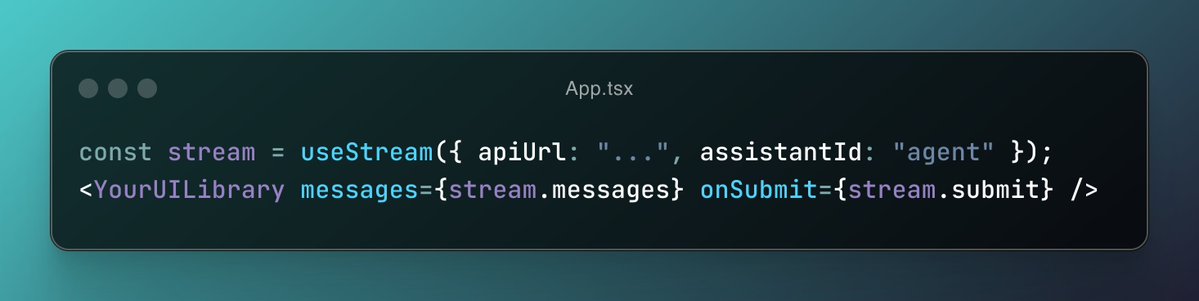
@itsafiz ·
This is huge! LangChain is launching LangSmith Sandboxes, which makes easy to write and execute code in agents. @LangChain Now in private preview. Find the details 👇
 Watch video
@mlejva ·
New banger integration alert: you can now use E2B sandboxes as the backend for your @LangChain Deep Agents. Get started by installing the dedicated package with pip install langchain-e2b, then follow the LangChain Deep Agents docs for step-by-step integration.


@DivyanshT91162 ·
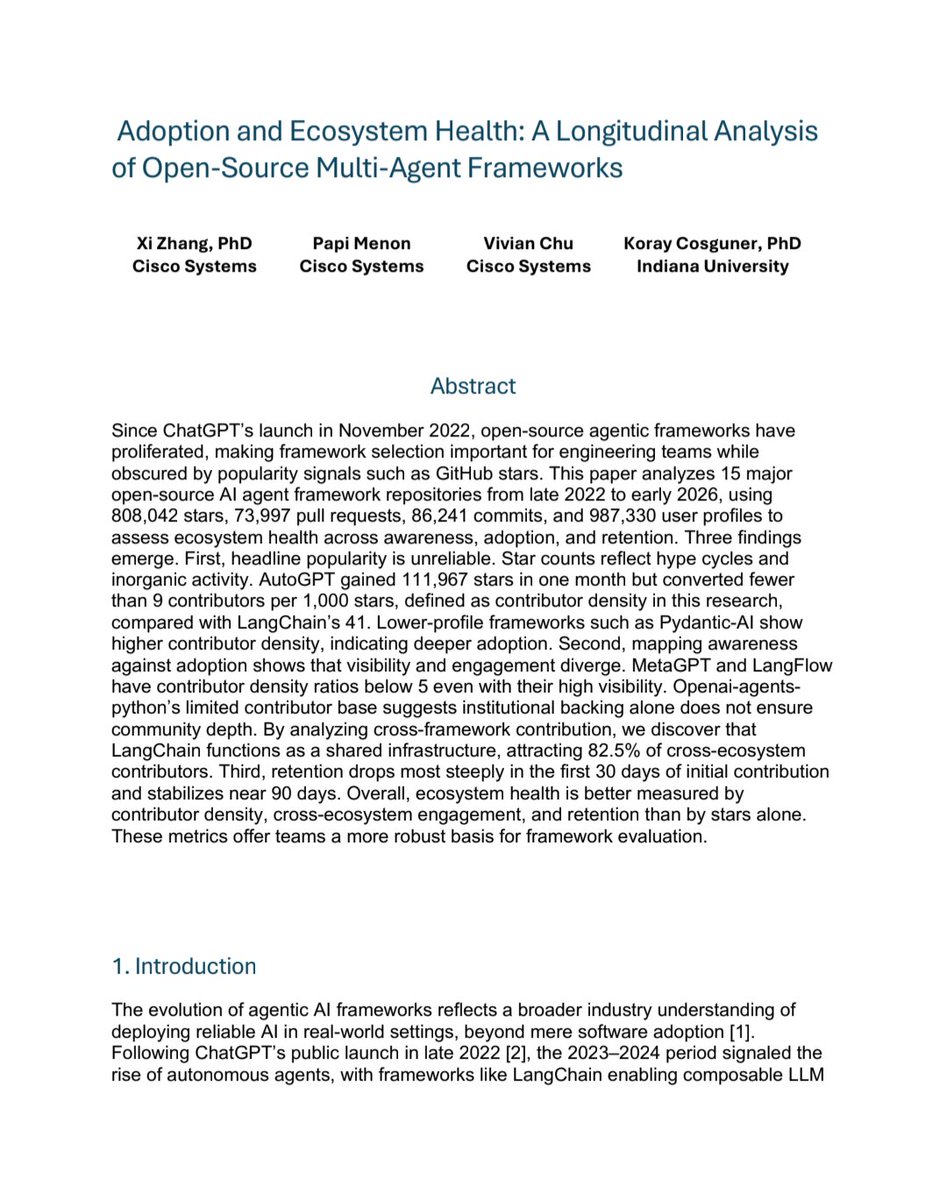
What if I told you the most-starred AI agent framework might not be the best one? This new research analyzed the health of 15 major open-source AI agent frameworks over 3+ years using: • 808,042 GitHub stars • 73,997 pull requests • 86,241 commits • 987,330 GitHub profiles The findings challenge one of the biggest assumptions in open source. Here are the highlights: • AutoGPT gained 111K+ stars in a single month, but converted fewer than 9 contributors per 1,000 stars. • Pydantic-AI had far fewer stars, yet a much stronger contributor density—showing deeper real-world adoption. • LangChain attracted 82.5% of developers who contributed across multiple AI agent frameworks, making it the ecosystem's shared infrastructure. • The biggest contributor drop happens within the first 30 days. Projects that retain contributors beyond 90 days build much healthier communities. The authors argue that GitHub stars are a popularity metric—not an ecosystem metric. Instead, they recommend evaluating projects based on: • Contributor density • Cross-ecosystem engagement • Long-term contributor retention This is one of the most insightful studies on the AI agent ecosystem I've seen. It changes how we should evaluate open-source projects. Paper link👇

@codestirring ·
Shipped v1.2.0 of the Phoenix SaaS Starter Kit today 🛠️ - Upgraded to Elixir 1.20 and bumped every dependency - Replaced LangChain with ReqLLM - Fixed a security issue in the blog renderer - Cleaned up warnings across the multi-tenancy, and payments generators https://t.co/UoLEcf1g2u #MyElixirStatus

@daisylusalita ·
Just fired up the OpenGradient SDK on a quick LangChain agent loop this morning. Dropped a custom risk classifier straight from the Model Hub, routed inference through TEE with atomic x402 settlement baked in. No more context bloat from hauling weights around or second-guessing the call. Output lands with onchain proof, agent decides, everything stays lean and ownable. Feels like the composition layer that finally lets vertical agents scale without the usual trust tax. @OpenGradient Who's wiring domain-specific tools this way already?


@michael_chomsky ·
This is one of the things I dislike about managed agents. Is it the best DX? yes. Is it now much, much more usable because it's bring your own sandbox? yes (most startups now have Sandbox credits and want to use them). But if something like this happens, I'm responsible to my users, not Anthropic. I think limiting yourself to one LLM provider is a bad idea at this point. YC startups also can't use it because they have 2M to spend on OAI and the lock-in is too strong. If you're building agents, look at LangChain DeepAgents. It's the best platform that looks better than anything I have seen so far, but managed DeepAgents are still behind a waitlist so I have. been unable to test.

@daytonaio ·
At the recent @daytonaio Compute Conference, @hwchase17, co-founder & CEO of @LangChain in conversation with our CEO @ivanburazin broke down why agent harnesses are replacing frameworks as the core primitive, and why memory is still the biggest unsolved problem in agentic AI.
 Watch video
@agenticgirl ·
A lightweight, actor-inspired framework for building multi-agent LLM applications without depending on LangChain. Its Agent and Task abstractions make message-based collaboration unusually clear, and it works with practically any LLM, not just OpenAI's. GitHub Repo: https://t.co/t7OBy6ZNHY


@pauliusztin_ ·
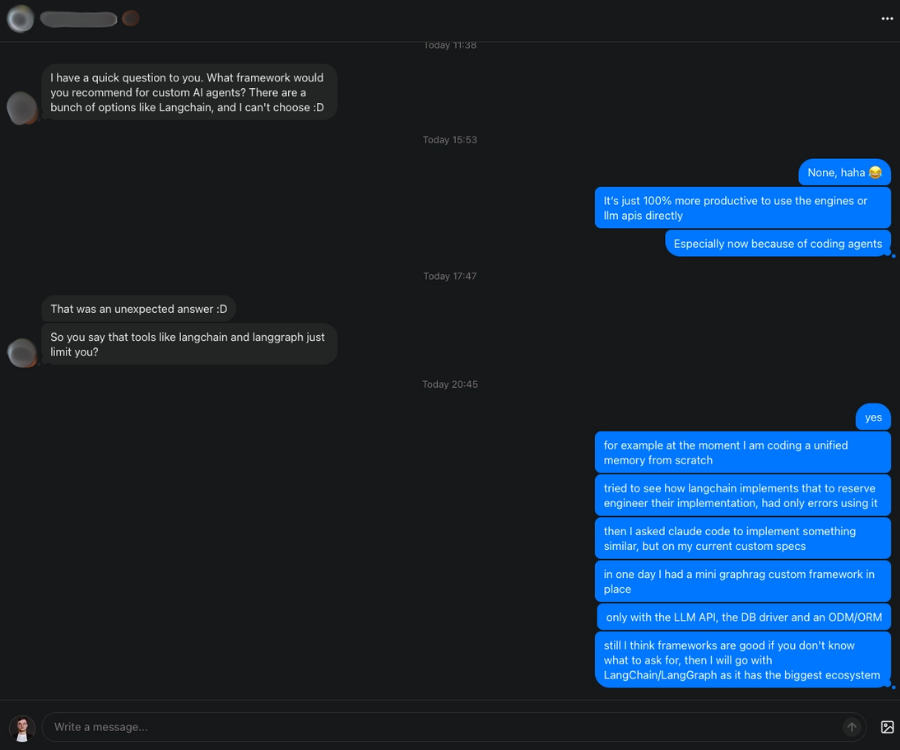
"Should I use LangGraph or CrewAI for my custom AI agent?" I get asked this at least 3x a week... My answer is always the same: None. Use the APIs directly. Right now, I'm building a unified memory layer for my AI agents. • @MongoDB for unified memory • @PrefectIO for durable workflows • Opik by @Cometml for observability • Direct LLM APIs • Python In 2 days, I had a working GraphRAG-style system. I actually tried frameworks first. But that's where things broke. The moment you need: • Custom ontology constraints • Immutable observation logs • Hybrid search fusion • Composite IDs • Domain-specific schemas • Multi-hop graph traversal You start fighting the framework. This is because AI frameworks encode assumptions. And your production system rarely matches those assumptions. Infrastructure tools support your logic. AI frameworks replace it. @MongoDB solves storage, search, and graph traversal. @PrefectIO solves orchestration and retries. Opik by @Cometml solves observability. LLM APIs solve reasoning. These are the hard problems. Your domain logic should stay yours. Here's the gist: Frameworks are great when you don’t know what to build. But once the system design is clear, from-scratch is often faster. Especially now with coding agents... They don’t struggle with writing Python. But they do struggle fighting abstractions. P.S. Are you using AI frameworks or writing from scratch?

@neo4j ·
In this guide, you'll see which tools are useful to build the context you need to avoid hallucinations on your #llms - including orchestration (@LangChain and @llama_index) the memory layer, and tool integration (MCP) Context is key. Start building it with this useful guide. 🚀 https://t.co/sL894Uxrko

@JulianGoldieSEO ·
Claude Code + LangSmith is insane. 🤯 You’re using Claude Code… But you can’t see: • why it made decisions • which tools it called • where workflows broke That’s dangerous for real AI automation. LangSmith fixes this. Now you can trace: every LLM call every file read every tool action every response step No more flying blind. This is how serious AI workflows should run.
 Watch video
@ashtilawat ·
LangGraph has been part of the Gauntlet curriculum since 2023. My software factory greenfields projects with a LangGraph orchestrator driving Claude Managed Agents. Wild how we went graphs → orchestrators → swarms → loops → back to graphs.

@MakadiaHarsh ·
When a client asks "should we use n8n or build custom?" — I use this decision tree: Will this automation change frequently? → n8n Visual editor means the client or a junior dev can adjust workflows without touching code. Does it need to process more than 50,000 events/day? → Custom n8n handles volume well but at true scale, a dedicated service with proper queuing is more reliable. Does the business need to own and understand the system? → n8n Non-technical founders can look at the workflow and understand what’s happening. Try that with a Python codebase. Does it involve complex AI agent logic with multiple models? → n8n with LangChain nodes Persistent memory. Vector DB support. Better than most custom implementations. Is this a one-off data job that runs once? → Custom script Don't over-engineer a workflow for something you'll run once and delete.

@_vmlops ·
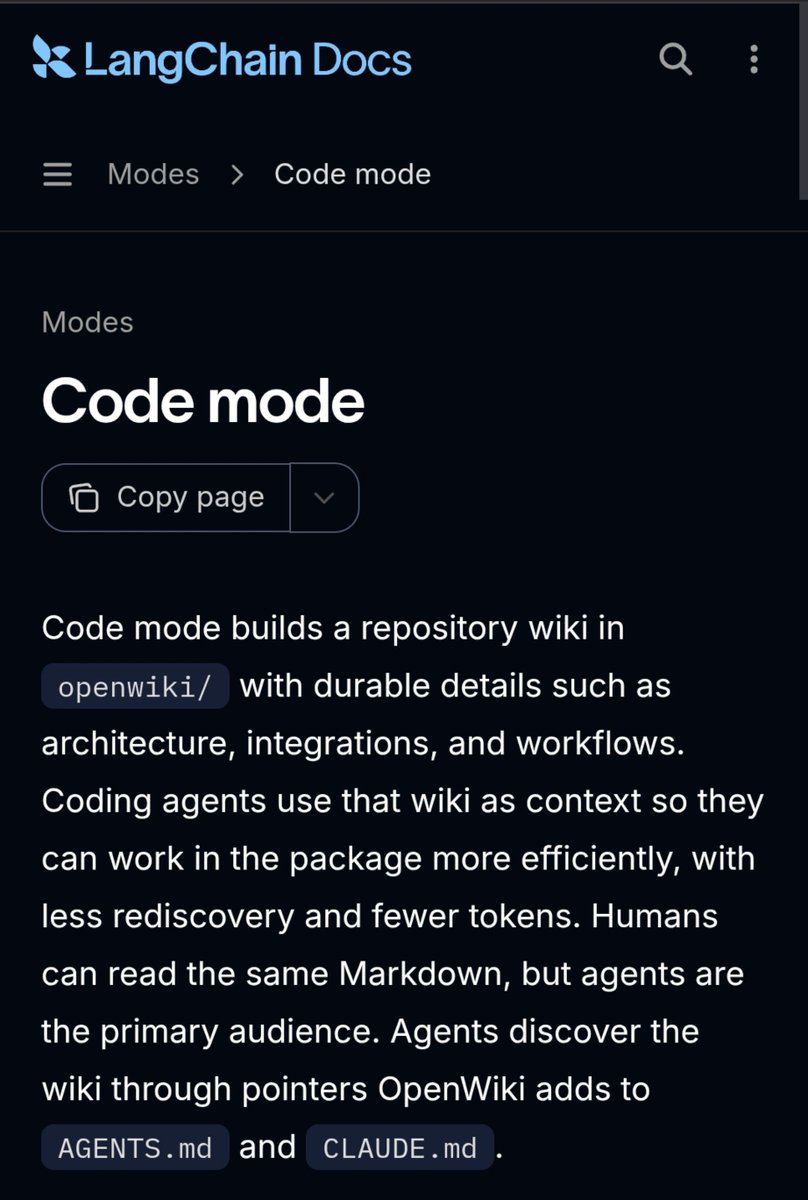
CODING AGENTS SHOULDN’T HAVE TO READ YOUR ENTIRE CODEBASE...👀 LangChain’s OpenWiki Code Mode gives agents a structured map of your repo so they can understand how everything connects before touching the code Less digging Less context wasted More useful agentic coding
@ThePracticalDev ·
The JS/TS Gen AI framework landscape has exploded. Genkit, Vercel AI SDK, Mastra, LangChain, Google ADK — this dev has shipped production apps with all five and shares a hands-on breakdown of each. { author: @Xavidop + @GoogleDevExpert } https://t.co/1HIXUlKwEV

@ethankongee ·
Day 14 building Moltmon: AI Todolist & Calendar Done: - Integrated with LangChain; the app can now break down a complex task into subtasks for human vs AI. Next: - Set up cron jobs to run these AI tasks automatically. The prompt is pretty straightforward and static right now. I’ll make it more sophisticated later: 1) load user preferences, and 2) break tasks down by AI skill.
 Watch video
@_vmlops ·
LANGCHAIN LETS YOU CHAIN LLMS TOGETHER TO BUILD ACTUAL APPS, NOT JUST PROMPTS Harrison Chase started the project in october 2022, right before chatgpt blew up the space. the framework is now one of the most used ways to build around LLMs the core idea → components you can snap together: ▪️ prompt templates: reusable structures for different question styles ▪️ LLMs: plug in GPT-3, BLOOM, or hugging face models ▪️ agents: let the model decide what tool to use next (search, calculators, etc) ▪️ memory: short-term and long-term context across a conversation the pinecone handbook walks through the basics: writing your first prompt template, running it through a hugging face model, then swapping in an OpenAI model to compare output quality good starting point if you're building your first LLM app and want to understand the pieces before jumping into agents https://t.co/J0wBgkLunv

@richmondalake ·
Over two years ago. When I talked about agent memory, people thought I was mad. Smart people: Engineers, founders, executives. They'd ask: what is this 'agent memory' thing? Why does it matter? I didn't spend time trying to convince them. I spent my time validating. → Built MemoRizz, an open-source Python library for agent memory → Started teaching memory engineering through O'Reilly → Joined @OracleDatabase and went all in — we shipped a Python package, ran #100DaysOfAgentMemory, and coined Memory Engineering as a discipline This is the talk I gave at AI Engineer World's Fair last summer — one of the most-watched talks on agent memory at the time: https://t.co/L2toEG9UVz Fast forward to this month. The pattern is impossible to miss: → Stephen Chin (Neo4j) on context graphs that capture decisions, not just data: https://t.co/lZleSwewHn → Anthropic on memory and 'dreaming' for self-learning agents: https://t.co/dAoahtwQKL → SallyAnn DeLucia (Arize AI) on hierarchical memory — after truncation and summarisation failed them: https://t.co/m6RdP5G1ik And this month, Harrison Chase (LangChain) made the case in writing: your harness IS your memory. If you don't own one, you don't own the other. What started as 'context engineering' is being recognised for what it always was: a memory problem. And it doesn't live in the context window. It lives across the entire agent harness. Here is the takeaway: It is the easiest thing in the world to repeat whatever Anthropic or OpenAI said this week. It is much harder to be 6-12 months ahead. When you're early, you sound crazy. The only thing that gets you through is conviction backed by technical validation. That, in one word, is Vision. No one else can see your vision. Your job as a leader is to make them see it. Through what you build. Through what you teach. Through what you ship. Memory is mainstream now. Good. The team and I are already looking past it. There is something coming next. Something only a handful of people are positioned to solve. We'll start telling that story in the coming months. Stay close.

Best LangChain tweets
Xholic studies what works in your niche, drafts posts in your voice and schedules them for the hours your audience is online.
$0 today · Cancel anytime
Browse all tweet collections