Startup strategy and decision-making
Market selection, first-principles judgment, focus, context-specific trade-offs, learning through action, and resisting generic startup playbooks.
36%
Best tweets about Startups
A curated collection of the sharpest, most-shared X posts about startups—saved so you do not have to dig through the timeline yourself. Updated weekly.
Founders and operators on the hard parts—fundraising, hiring, and the decisions nobody warns you about.
Original Xholic analysis
The evidence set emphasizes founder operating choices: product work and customer contact, fundraising and cash constraints, early-team decisions, and the need to adapt through difficult periods. It also contains explicit cautions against treating any startup prescription as universal; several posts argue that market, team, and timing determine the right trade-off.
32% of posts
All-time engagement
54% of posts
Published in 90 days
Conversation map
Market selection, first-principles judgment, focus, context-specific trade-offs, learning through action, and resisting generic startup playbooks.
36%
Learning from failed attempts, avoiding premature quitting, recognizing survivorship bias, adapting to evidence, and enduring the startup trough.
32%
Raising capital early and strategically, investor access and signaling, accelerator choices, venture-scale expectations, dilution, and the risks of excess funding.
32%
Building what customers actually want through fast launches, direct user contact, iteration, narrow traction, and validating demand before scaling.
32%
The founder’s core responsibilities, relentless execution, rejection tolerance, morale, and navigating the sustained hardship of company-building.
28%
Founder-led recruiting, early-team quality and culture, complementary leadership, cofounder trust and agreements, and evaluating startup roles.
22%
Early revenue channels, founder-led marketing, building in public, authentic customer connection, and narrative as a tool for customers, talent, and investors.
16%
The transition from product-building to organization-building, prioritization, delegation limits, management layers, and operational clarity.
10%
Tone and stance
Performance benchmark
Posts with media make up 46% of this collection. Their median all-time score is 53.1, compared with 12.9 for text-only posts.
Format mix
Consensus and debate
Shared view
Several posts advocate shipping, building products, and staying close to users rather than over-polishing or substituting abstract startup activity for direct learning.
Shared view
Posts advise raising before cash becomes urgent, removing or delegating nonessential work, and following traction rather than remaining bound to an original fundraising narrative.
Shared view
The posts portray recruiting and retention as direct founder responsibilities, while also emphasizing clear priorities and the importance of early team composition.
Shared view
Hardship, rejection, and slow progress are common themes, but posts also argue for reshaping the product or strategy in response to what founders learn.
Open debate
One post urges founders to secure capital before they need it, while another argues that very large early rounds can reduce productive constraint and make mistaken ideas more expensive.
Open debate
Some posts favor complementary, trusted cofounders and explicit founder agreements; another warns that a prolonged cofounder search can delay a solo founder from shipping.
Open debate
One post distinguishes paid, outbound, and founder-led social channels for near-term revenue from SEO, newsletters, podcasts, and YouTube as longer-term investments. Other posts emphasize public posting and direct customer connection as ways to learn and build visibility.
Open debate
The set includes prescriptive startup lessons, but other posts explicitly argue that opposite decisions can succeed when market, team, and timing differ.
What performs
The highest-scoring supplied outlier describes the founder role as storytelling, securing capital, and product obsession. Other listed outliers focus on product-building and founder-led recruiting.
The accelerator roundup and the channel-selection framework are both included in the deterministic outlier list, showing that list-based decision guidance was represented among the highest-scoring posts.
The supplied story-format examples include a founder’s account of repeated setbacks and a reflection on the emotional and contractual costs of selling a company.
Deterministic analytics reports a median all-time score of 53.1 for media posts, compared with 12.886 for text posts.
Statistical standouts
Creator landscape
The five most represented creators account for 20% of the selected posts.
1. Alexa | Startup founder
@alexabelonix
2 posts
2. Michael Taiwo
@AskMichaelTaiwo
2 posts
3. Big Brain Business
@BigBrainBizness
2 posts
4. Nick Mehta
@nrmehta
2 posts
5. Romàn
@romanbuildsaas
2 posts
6. signüll
@signulll
2 posts
Signüll’s two evidence posts describe a narrow founder remit—story, capital, and product—and the ongoing task of re-recruiting a team amid perceived outside options.
Startup Archive’s two evidence posts focus on CEO hardship and on high-touch customer contact as a source of trust and product learning.
Romàn’s posts summarize guidance on launching, user understanding, cash discipline, cofounders, morale, and iteration in structured list form.
Since the previous snapshot
Themes, sentiment, stance, and post format are classified per tweet. All counts, shares, medians, creator concentration, freshness, and performance comparisons are then calculated directly from the published snapshot.
Xholic's all-time score compares engagement while accounting for reach, post age, and creator consistency. It is used for relative comparisons within this collection.
This report analyzes the exact 50-post snapshot shown below. AI identifies editorial categories and drafts explanations; all statistics are calculated from the snapshot, and every narrative claim is checked against cited posts before publication.
Best Startups tweets
Ranked 01–50

@signulll ·
a founder has three jobs. everything else is serious amounts of noise. 1. you have to tell the story. roughly in three registers. first investors need inevitability. customers need to *feel* what you do/stand for. & your team needs a mission worth their best years. 2. you must secure the capital before you need it. running out of money is running out of options. you have to be relentless about it. 3. you must obsess over the product. product is the story made accessible for everyone. every shipped detail is a sentence back into the narrative in point number one. this is the entire job. everything else you either delegate or kill. early on with a really small team, delegation is a huge tax so you have to learn to kill more than you delegate.

@naval ·
Founders cannot outsource recruiting. “Recruiting is the most important thing because you need creativity; you need motivated people. Ideally, the early people are all geniuses. They’re self-managing, low-ego, hardworking, highly competent, builders, technical—maybe one or two sellers—but you can’t watch everything. You can’t micromanage everything. The early people are the DNA of the company. When you outsource recruiting, when you have other people hiring and interviewing and making hiring decisions without your direct involvement and veto, that’s a sad day. That’s the day that the company’s no longer being driven directly by you. There’s now a fly-by-wire element in between. There’s some mechanical linkage going through another human, often at a distance. And other people are not going to have the same level of selectivity that you will as a founder. The important size at which a company starts changing is not some arbitrary number, like 20 or 30 or 40. It’s the point at which the founder is not directly recruiting and managing everyone. The moment that there are middle layers of management, then you are somewhat disconnected from the company, and your ability to directly drive a product team that can take the company from zero to one goes away. So we really cannot outsource recruiting. People think you can. They hire recruiters, for example. Maybe you can outsource a little bit of sourcing, but I would even argue that’s difficult. The reason recruiting is so, so, so important—and a lot of it is obvious, I’ll skip the obvious reasons—but one non-obvious reason is that the best people truly only want to work with the best people. Working with anyone who’s not at their level is a cognitive load upon them. And the more people they’re surrounded by who are not as good as they are, the more keenly they’re aware that they belong somewhere else, or they should be doing their own thing. The best teams are mutually motivated. They reinforce each other. Everyone’s trying to impress each other. One good test is when you’re recruiting a new person, you should be able to say to them, “Walk into that room where the rest of the team is sitting. Take anyone you want—pick them at random—pull them aside for 30 minutes, and interview them. And if you aren’t impressed by them, don’t join.” When you do that test, you will instinctively flinch at the idea of them interviewing randomly a certain person that’s kind of in the back of your mind. That’s the person you need to let go. Because that’s the person keeping you from having this high-functioning team that all wants to impress each other.”
 Watch video

@DeRonin_ ·
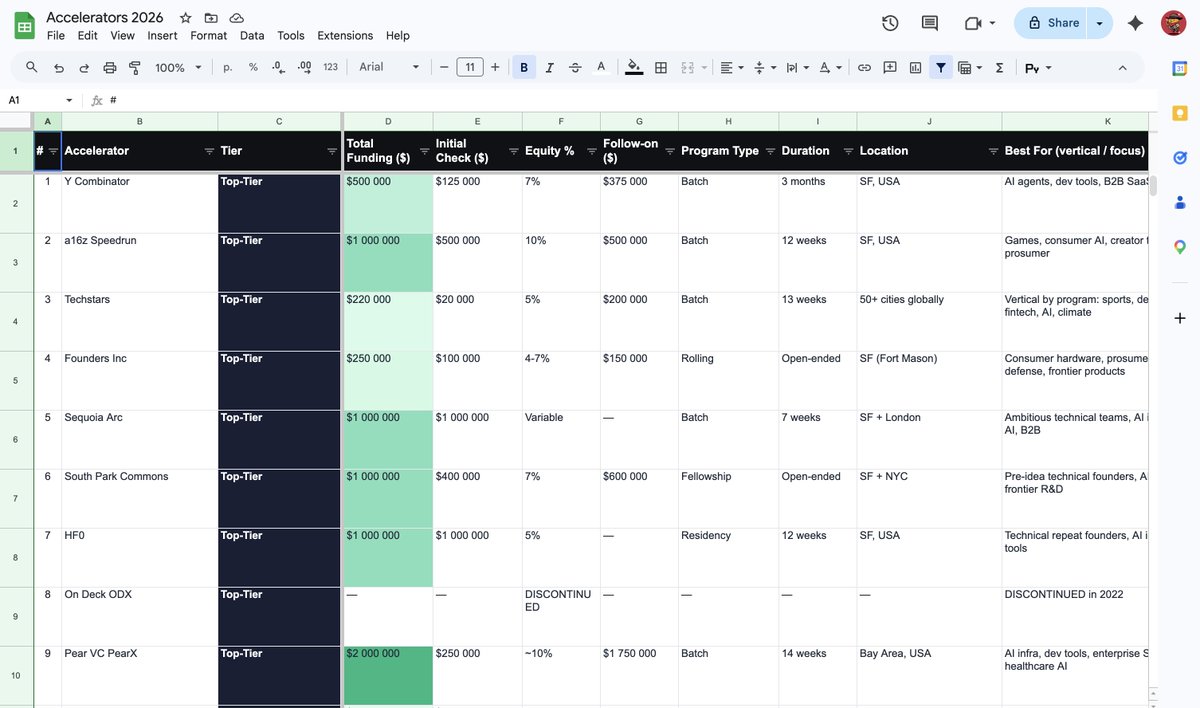
All the best startup accelerators to apply in 2026 (below FULL spreadsheet): [ Top-Tier ] 1. Y Combinator (~$500k, 7% on $125k + uncapped SAFE) 2. a16z Speedrun (~$500k for 10% + $500k follow-on) 3. Techstars (~$220k, bumped from $120k in fall 2025) 4. Founders Inc (~$100-250k for 4-7%) 5. Sequoia Arc (~$1M, terms per company) 6. South Park Commons (~$1M total, $400k for 7% + $600k guaranteed) 7. HF0 (up to $1M uncapped for 5%, repeat founders only) 8. On Deck ODX (DISCONTINUED 2022, skip) 9. Pear VC PearX (~$250k-2M for ~10%) 10. 500 Global Flagship (~$150k for 6%) [ AI / ML Specific ] 11. AI Grant (~$250k for 7%, Nat Friedman + Daniel Gross) 12. AI Fund (~$1M+, Andrew Ng, studio model) 13. NVIDIA Inception (credits + perks, no equity) 14. Microsoft for Startups (up to $150k Azure credits, no equity) 15. Google for Startups AI Accelerator (credits, no equity) [ Vertical / Deep Tech ] 16. SOSV (~$525k across IndieBio, HAX, Orbit) 17. IndieBio (biotech, ~$525k = $250k for 6-8% + Genesis SAFE) 18. HAX (hardware, ~$525k via SOSV) 19. Greentown Labs (cleantech, workspace + grants) 20. Activate (deep science fellowship, 2-yr stipend) [ Crypto / Web3 ] 21. a16z crypto CSX (~$500k for 7%, SF in-person) 22. Alliance (~$500k, ALL18 starts Sept 7) 23. Outlier Ventures Base Camp (~$250k, per-chain verticals) 24. Coinbase Base Builder (varies, mostly non-dilutive) [ International / Regional ] 25. Seedcamp (~€350k-1M first check, rolling, Europe) 26. Entrepreneur First (~$250k = $125k for 8% + uncapped MFN) 27. Antler Disrupt US (~$400k = $250k for ~9% + uncapped) 28. Brinc (~$100k, Asia + Middle East) 29. Station F (Paris campus, hosted-program terms) 30. Founder Institute ($499-999 fee + 2.5% Equity Collective warrant) [ Pre-Seed / Idea Stage / Niche ] 31. Z Fellows (~$10k for 1%, pre-product) 32. ERA NYC (~$100k for 8%, generalist) 33. The Residency (community-first, no standard check) 34. Plug and Play (varies, often non-dilutive) 35. Build For Tomorrow (community + grants) Four things worth knowing: 1. small program acceptance rates are higher than YC, not because they're easier, because the funnel is smaller. apply to 5-7, not 1 2. brand premium on YC is real but not infinite. Arc + Speedrun + HF0 carry signal too 3. "$X for Y%" is the only number that matters. uncapped MFNs are not free money, they dilute you on the next round 4. avoid any list still quoting Techstars at $120k, ODX as active, HF0 at $100k, or Founder Institute as "$10k for 4%". all wrong Shared with you those where I am going to apply with my ideas and products Terms shift annually. Verify on each program's site before applying gl with successful raising
@codyschneider ·
if you're a startup founder just read this so I can sleep peacefully tonight most companies can get to $1M ARR with only two channels the channels you should pick from are - paid ads - cold email - cold DMs - founder led social the channels you should not pick from are - SEO - email newsletter - guesting on podcasts - youtube channel why you need revenue tomorrow, list one makes that happen list two makes revenue happen in the future they are long term investments that pay off 12 months from now this is the most common mistake I see founders make the framework to think about this with is how you think about personal finance when you're young, 80% of resources go to surviving and 20% to investment when you're old, 80% goes to investment and 20% to surviving apply this same idea to your young company gl hf "hey Claude code make a plan to do list 1 based on cody schneiders tweets"

@daniel_dhawan ·
My first 6 years as a startup founder: - Started by building AI mobile apps at 20yo - Failed with 4+ startups - Ran out of money multiple times - Was rejected by Y Combinator 8 times - Had a $15k credit card debt - Got 200+ rejections from investors My last year as a startup founder: - Moved to SF - Launch Rork, AI mobile app builder, to make my year 1 self happy - Got into a16z speedrun and raised $3M+ - Scaled Rork to millions in ARR in under a year - Became the #1 AI mobile app builder in the world The average journey to a $1B company takes 10 years. I’m on year 7. Keep building.


@Founder_Mode_ ·
Marc Andreessen explains the 3 Necessities for Start-up Success: "The general criteria for a successful high-tech startup, in my view, you see different sort of rules of thumb from different people. But the three big things you always come back to are, is there a big market? And by the way, that comes in two parts. Is there a big existing market that you think you can go after and sort of displace incumbents or do you believe there will be a new market that will be big? So big market. Is there a fundamental technology or economic change that causes you to basically justify having a new company? And that's really important. And the way I always think about that is, is there a 10X change happening in the technology landscape? Is something 10X faster or 10X cheaper or 10X better? And if it's not 10X, we as both VCs and entrepreneurs, we really have to ask ourselves like, is it really worth doing? Because it's really hard. I mean, it's really hard to start new companies. new companies generally shouldn't exist. Existing companies are usually pretty good at what they do. And so for a new company to exist, it not only has to like come in and go into business and bring a product to market, but it has to bring a product to market that's so much better than what already exists that it punches through the sort of status quo. And most customers in most markets are pretty happy buying from the current suppliers and so there has to be a real kind of edge on the thing and we look for that in either a technology change, usually a technology change or an economic change. which are often the same thing. And then the third is team. Is the team outstanding? And if you think about this as an entrepreneur, it becomes a question of the founding team. Some companies are solo founders and they can work, but generally most of us, like myself, we're human beings, we're mortal. You want to have a founding team of complementary skill sets. And so you want to have at least one super strong technologist, quite possibly more than one. Some of the best startups are actually more than one founding technologist and then it often helps to have somebody who's like a product or who's a market or sales person or has a sort of really good understanding of business on the team, certainly helps a lot. And so we sort of look at market, product, and team. And the reality is you need all three. I would say, interestingly, if you're going to compromise as an investor, if we're going to compromise on one of those, it would actually be the product. And the reason I say that is because a great market is a lot easier to make up for with iterative product execution than a poor market. Because the problem with a poor market, a small market, is even if you do a great job on the product, there just aren't that many customers. It's hard to ever get big."
 Watch video

@garrytan ·
There are two loops in every founder's head. The autism loop: run your own model to the floor, ignore consensus, hold a thesis when everyone says you're wrong. That makes conviction. The empathy loop: feel what the user feels, sense what the market wants before it has words. That makes traction. Most people crank one and starve the other. Pure conviction builds something brilliant nobody wants. Pure empathy builds consensus mush. PG put the whole job in four words: make something people want. The autism loop makes the something. The empathy loop knows it's wanted. The founder is the bridge. Most great founders show up dominant in the first loop. That's why they're contrarian enough to try at all. The work is grafting on the second. There is no place in the world that helps founders make the two loops work together to make great startups than Y Combinator. It is the most gratifying part of our work.

@StartupArchive_ ·
Elon Musk on building a company: “There are periods where it’s just awful” “A lot of times people think creating a company is going to be fun. I would say it’s really not that fun. There are periods of fun, and there are periods where it’s just awful. Particularly if you’re the CEO of the company. You actually have a distillation of all the worst problems in the company. There’s no point in spending your time on things that are going right. So you only spend your time on things that are going wrong that other people can’t take care of… the most pernicious and painful problems.” Elon believes founders need to have a “fairly high pain threshold” and explains that starting a company is like “staring into the abyss and eating glass.” “The staring into the abyss part is that you’re going to be constantly facing the extermination of the company because most startups fail… You’re constantly saying, okay, if I don’t get this right, the company will die. It’s going to be quite stressful. And then the eating glass part is you’ve got to work on the problems that the company needs you to work on, not the problems you want to work on. And so you end up working on problems that you’d really wish you weren’t working on… And that goes on for a long time.” Source: @khanacademy (Apr 2013)
 Watch video
@signulll ·
most ppl underestimate how chaotic early stage startups actually are. from personnel turnover & shifting commitments to the fact that everyone now operates with the same fomo/optionality glut you see in dating markets (dating markets are most visible form of this but this is happening everywhere). when ppl have infinite options commitment gets expensive in their mind & the evaluation period never closes.. every day is a reeval against the shadow portfolio of everything they didn’t pick. so the job of a founder is often managing the continuous rerecruitment of your own team against a moving outside option. that emotional & narrative layer is as much if not more than anything you ship.
@StartupArchive_ ·
Y Combinator CEO Garry Tan’s advice for startups: “When you’re small, act small” A lot of founders try to emulate large companies, and will do things like use the same terminology as Microsoft to describe their products. But Garry argues this is a mistake: “When you’re starting something new, the whole advantage is that you’re a real human being. We are so starved for real, authentic connection that if you can talk to people and say ‘Hey, I’m the CEO. What do you need?’ That’s the most powerful thing.” Being small lets you offer fanatical customer support. Not only will this win customer trust, but it’ll help you find product/market fit. If you listen to customers, they will tell you what they want. “The reason why people don’t do this is they think starting a startup is building this incredibly complex machinery… But I encourage you to think about it in a different way. It’s more like throwing a really, really amazing party… You go there, you see a friend, they say ‘Welcome! Let me take your coat. Let me introduce you to your friends.’” For his first startup, Posterous, Garry and his team aimed to reply to every single customer support email within ten minutes. And if there was a bug, they fixed it on the spot. Human connection with your customers is really important. Garry cites a study on Usenet that found retention increased from 16% to 26% if someone received a reply to their post on the forum. As Garry explains: “A 10% difference in retention is actually the difference between a startup that’s flatlining and one that’s working. The compounding of this is really, really massive… Be small. Be human.” Video source: @ECorner (2023)
 Watch video

@AdewaleYusuf_ ·
Stop applying to an investor’s website for a fund; it's largely a waste of time. Most startup founders don’t fail to raise because their business is bad. They fail because they’re playing the wrong game. Here’s how smart founders actually raise money in 2026: 1. Don’t chase random investors. Find the biggest startup in your industry and research who backed them at the early stage. Those investors already understand your market. 2. Reverse-engineer the cap table. Use tools like Crunchbase, https://t.co/F0vuyEhURl, or PitchBook to find the partners who made those investments and figure out how to get on their radar. 3. Borrow trust. The fastest way to get a meeting isn’t a cold email. It’s an introduction from a founder they’ve already backed. Find successful founders in their portfolio and build genuine relationships with them. 4. Build in public. Start posting consistently about your startup: wins, lessons, milestones, customer stories. Investors are online every day looking for signals. Many founders get inbound meetings simply because they stay visible. 5. Network before you need money. Go to demo days, startup events, conferences, and founder meetups. Meet partners, associates, and operators inside VC firms. The fundraising process starts months before you send your first deck. And one final thing: Don’t start fundraising when your bank account is almost empty. Start building investor relationships 6 to 12 months before you actually need capital. Because in 2026, the best fundraising strategy isn’t sending more cold emails. It’s making sure you’re no longer a stranger.


@scottastevenson ·
I have great respect for YC, but need to say what many are surely thinking: Startup School in a stadium feels antithetical to the YC brand and to what makes startups work. The YC brand felt like it was designed to filter out status chasers. The bare Mountain View office. The utilitarian design of Hacker News. Everything about YC said: if you’re a curious hacker, we’re your people. If you’re looking for other kinds of prestige or excitement, we’re not for you. Great early stage startups are designed the same way: they’re for the people that get a thrill from the work itself, not surrounding fanfare. If it were just the arena I wouldn’t comment, but you can feel the gravity of a status vortex slowly tearing down what made YC special. You can feel the herd rushing into an overflowing barn. A stadium sized barn. You see how YC is now more prestigious than most college degrees. How prestige seekers name drop YC partners. How many YC founders now quit in the early innings—because they didn’t really love the work. Maybe it’s inevitable. It happens to startups too. Eventually the underestimated, curious, hard working teams become the winning teams. And then the status chasers flock to them. If YC is not strong enough to fend it off, maybe no one is.



@quxiaoyin ·
Being a failed founder is now better than being a successful employee. I'm seeing this everywhere. Decagon created a special "founder office." Lovable brags about how many Y Combinator founders joined their team. It's obvious what's happening: companies don't care which big tech company you worked at anymore. They want to know if you've ever started something. Sure, most of these founders failed - successful ones wouldn't be job hunting. But in America, startup failure isn't really risky anymore. In the AI era, the scarce skill isn't technical knowledge. It's owning problems end-to-end. Having initiative. Working like a founder. So if you're still a cog in some big company machine, getting yelled at by your boss, worried about promotions - maybe it's time to start something. Here's the beautiful part: if you fail, you can join Anthropic's founder program. If you succeed, you become the next Anthropic. Either way, you win. This makes sense. Society needs people who can handle entire business functions, not just specialized tasks. That's what founders do. As AI gets better, founders get more powerful. They handle diverse work, they're accountable for results, and AI amplifies all of that. A founder might go from 10x to 100x to 1000x productivity. But specific roles? AI might replace those entirely. The better AI gets, the more obsolete narrow jobs become. Founder might be the best job of the future. Best case: you become the next Sam Altman. Worst case: you join Dario's company and make bank. Pretty good risk profile. #Entrepreneurship #Startups #Founder #AI #TechCareers #Anthropic #YCombinator #FutureOfWork #Innovation

@tibo_maker ·
if you're selling your startup - don't I sold my startups for $8m & I'll never sell again quick context: I sold Tweet Hunter and Taplio for $8m in 2024. $2m upfront, the rest as an earnout based on performance - on paper, a dream exit in reality, 3 things broke me first, I gave up my baby. the products I spent years building, the vision I had in my head all of it went to someone else. and now I sit here watching the new owners ship things I'd never ship, kill features I loved, and just make the product shitty looking at Tweet Hunter like this hurts more than I expected it to 😞 -- second, the earnout was kind of a 2-year prison we wanted a high multiple, so we agreed to performance-based milestones that meant 2 years of waking up every single day knowing the only thing that mattered was hitting aggressive revenue targets I was technically still running the company but I had a boss now: the contract 🥲 hitting milestones used to feel like winning but with an earnout it flips. every win is just dodging a loss and missing one doesn't feel like falling short - it feels like being a loser -- third, the money itself breaks you - nobody warns you about it you have no idea what to do with that kind of money you don't get the time to adjust to it and you start taking bad decisions. you stop identifying as the same person you were before and you go a little crazy, faster than you think and then comes the worst part after all this, when I got back to building, I realized everyone around me already saw me as the "successful guy who exited" and that froze me for months I couldn't ship anything new because I was scared of breaking the perception I've talked to a lot of founders who sold their companies. every single one of them feels this but I got back to it anyway - building is what I love and today I'm building a SaaS portfolio that crossed $1m MRR this year so if you're sitting on a term sheet right now, do me a favor don't read what the buyer is offering read what you'd be giving up and then make a decision


@romanbuildsaas ·
10 @ycombinator's Lessons all Founder Should Know : (We grew from $0 to $250k MRR in under a year with this approach) 1/ Launch now, not when it's "ready". A mediocre product in front of real users teaches you more in a week than 6 months of polishing in the dark. Ship the moment it delivers one real unit of value 2/ Do things that don't scale. Airbnb's founders photographed their hosts' apartments door to door. Completely unscalable, and exactly how they figured out what the marketplace needed. Get your first 10 customers by hand 3/ Always hunt the 90/10 solution. For almost any feature there's a way to capture 90% of the value with 10% of the effort. Shipped today beats perfect in 6 months (Paul Buchheit's rule) 4/ There are only two real jobs: write code and talk to users. Everything else (conferences, press, VC coffees, corp dev calls) is what Sam Altman calls "fake work". It feels productive precisely because it's more fun than the real thing 5/ You pick your customers as much as they pick you. 10 users who love you beat 1,000 who kind of like you. Twitch only took off after firing the wrong users and going all in on gamers 6/ Growth is an output, not a strategy. Grow before product market fit and all you're buying is churn. And never take 80 cents from a customer just to hand them back a dollar 7/ Do less, really well. Pick one or two metrics and judge every task against them. 8/ Every great startup is badly broken at some point. The billion dollar ones included. The game isn't avoiding fires, it's how fast you put them out. Again. And again 9/ Ignore your competitors. Startups die of suicide, not murder. In year one, the only company that can kill yours is your own 10/ Startups rarely die from running out of money. They die because the founders fall out. Brutal honesty with your cofounder is the cheapest insurance you'll ever buy Good luck !


@BigBrainBizness ·
Sam Altman on why the idea is the least important part of building a company. Most founders spend years obsessing over the right idea. The market timing, the differentiation, the pitch. And then they get started and realize the idea was never really the hard part. Altman puts it plainly: the early stages of a startup move fast. The idea, the initial product, figuring out what works — roughly six months of work total. Everything after that is a different beast entirely. "It is the relentless waking up every day and just sort of banging your head against the wall until things work." That part takes the next nine and a half years. The instinct most founders reach for when things get operationally heavy is delegation. Hire a COO, step back into strategy, stay close to investors and away from the grind. Altman has watched this play out enough times to be unambiguous about where it leads: "Obviously that fails 100% of the time." Building a company is a compounding game — showing up and executing, day after day, across years. The value doesn't live in the original insight. It accumulates in the doing of it, repeatedly, long after the excitement of the idea has worn off. "The value gets created over compounding execution for years and years and years and it never gets easier." Altman frames this as an identity shift that separates the founders who last from those who don't. Early on, the work is about building something great. Eventually, it becomes about building the organisation that does that, and those two things require completely different people. "Most of what being a founder is about is not being in love with creating a product but being in love with creating a company."
 Watch video

@arpit_bhayani ·
The biggest lie startups tell during hiring is "We have a lot of problems, and you can pick whatever you want to solve." It sounds great. It plays directly to what we engineers love - autonomy, impact, and ownership. But here's the reality - this almost never happens. When a startup says this, it usually means one of two things: 1. A lack of clarity in leadership 2. They are just trying to lure you in Even in the rare case where you get some freedom, your work still has to align with business goals, product timelines, and team priorities. You will likely be working on whatever the product needs immediately, which is okay, but ... Most of these companies are in constant firefighting mode, so you might never have time to pull off what you wanted to. And honestly, if a company really lets you work on "whatever," that is a red flag. It signals a lack of direction, focus, or urgency. Good leadership does not offer infinite choice; it offers clarity and purpose. There is always a north star that is being chased. Do not fall for startups without looking under the hood. Assess the clarity of their roadmap, the strength of their leadership, and how decisions are made. Ask, 1. What is the team working on right now? 2. What are the top priorities this quarter? 3. How do you decide what gets built? A succinct way to put it is - do not get sold on freedom, get sold on focus. Hope this helps.

@opeawo ·
This is the kind of advice that has the Nigerian startup ecosystem twisted, and I am glad YC partners are also calling it out. Founders started optimizing for what they thought investors wanted to fund, fintech. Now there are solid fintech companies struggling to raise, while new founders are quietly killing good ideas because they assume “it won’t get funded.” Some of the most ignored opportunities right now: - brick and mortar heavy businesses with real distribution power e.g leasing, @EquipmentShare , one of YC's biggest startups ever though no one talks about it. - services-led models with strong ops layers e.g. property management at scale, job centres at scale - franchise based scaling models e.g @onemedical , Rivia Health - vertical fintech that solves one deep industry problem tech that is not app or web first, but workflow, field, or embedded systems e.g. @BPSAfrica , Alliance Chemicals We trained a whole generation to chase what looks fundable, not what actually works. https://t.co/libuMSZYjh

@richardchen39 ·
When most VCs talk about a good founder, they really mean someone who has a good resume and looks experienced on paper. But big corporate execs tend to flounder in startups because they: - Need a structured environment and big team around them - Are too by the book and don't find creative ways to hustle - Follow routines as how they've always been done without questioning old habits The best founders are often outsiders who become insiders. They: - Don't look impressive on resume but clearly studied the history of the industry and why past attempts failed - Can quickly network their way into inner circles of the industry which is crucial to building trust for B2B sales - Are able to spot broken workflows with a fresh first principles perspective as an outsider

@SahilPanhotra ·
Meet Marc Lou → Grew up in France → Started building startups in 2016 → Launched startup after startup → Most of them failed → Spent years making little to no money → Burned out from chasing venture-scale ideas → Took a Product Manager job in 2021 → Got fired a few months later → Decided he'd never work for someone else again → Started building in public on X → Shared every launch, failure, and lesson → Built nearly 20 products in 2 years → Sold several of them → Realized he was rebuilding the same authentication, payments, emails, and landing pages every time → Turned that into ShipFast → Launched ShipFast in 2023 → Made ~$6K in the first 48 hours → Crossed $250K in revenue within 5 months → ShipFast became the go-to Next.js SaaS boilerplate for indie hackers → Then noticed another problem → Developers wanted to build SaaS → But many struggled to write code fast enough → Built CodeFast → Created practical coding courses focused on shipping real SaaS products → Helped thousands of developers go from tutorials to launching products → Then spotted another pain point → Every founder was posting MRR screenshots → Nobody trusted them → Built TrustMRR → A platform that verifies Stripe revenue → Lets founders share cryptographically verifiable MRR → Removed the need for fake screenshots → Quickly became the standard for verified revenue proof in the build-in-public community → Today his products generate well over $1M annually → Most of that comes from selling tools to other founders → Without raising venture capital → Without a team of hundreds → Just by solving problems he faced himself Imagine if he had kept his job. ShipFast, CodeFast, and TrustMRR might never have existed.


@HarryStebbings ·
I am going to piss off so many friends by saying this but if I could invest in one emerging manager sub $50M fund, it would be @Joshuabrowder. A few things you need to know about Josh: - He makes the founders he invests in live in his spare room at the Four Seasons until they raise their seed - He turned his $100K Thiel Fellowship grant into a $10M angel portfolio - He was one of the first cheques into Micro1, Yuzu and many more - When he found out his father had been taken by the Russians, he was playing poker… (legend!) I have never had founder references like the ones I got on Josh. I spoke to 12 founders. He averaged 9.2/10 across all 12. This is one of the best episodes we have done in a long time and my notes below: 1. Why I Believe Young Founders Make the Best Founders Young founders have no safety net and no option but to win. Corporate engineers often default to hiring big teams, while young founders stay focused on building the product. Their grit is much higher. Without that level of dedication, most people quit at the first real obstacle. 2. How I Test Founder Commitment Before Investing To filter out tourist founders, schedule a pitch meeting at 11:00 PM. Elite founders accept immediately. Mediocre ones push it out by weeks. During the interview, ask rapid-fire questions. If they claim a specific revenue number, have them pull up their live Stripe account on the spot. Look for tactical customer acquisition goals, not vague partnership promises. 3. Why I Make Founders Live With Me After Investing The best early investments come from deep day-one relationships. Living together creates a focused, one-person accelerator where founders get a three-week crash course and avoid years of mistakes. The rule is simple: co-founders share one room near the Four Seasons and cannot check out until they raise an institutional seed round. 4. Why Pre-Seed Companies Fail Startups usually fail for three reasons: they run out of money, they run out of hope, or the co-founders break up. Money problems usually come from weak pitching, which is why founders should drop the deck and show the product live. To maintain hope, ignore Silicon Valley vanity signals and focus on customer progress. To avoid team blowups, handle mechanics like vesting early. 5. What Founders Need to Know About Signing With a VC VCs will say almost anything to get you to sign on the spot. They reverse-engineer your desires and claim they know every customer you want to meet. Impressionable founders fall for it, but the promised intros often never happen. Never sign in the room. Take the night to think clearly. 6. My Biggest Lesson on Reserve Investing Holding back reserves for later rounds has a huge opportunity cost. The biggest value creation happens at pre-seed, so saving capital for a Series A follow-on can limit your upside. Deploying upfront into 20 to 30 pre-seed companies can produce far better long-term returns. Go all-in early. (links below)

@AskMichaelTaiwo ·
About 80 percent of new businesses survive their first year, far kinder than the myth suggests. But by year five only around half are still open, and by year ten roughly a third remain. The failures are less dramatic and more predictable than the stories imply. Two causes account for most of it. Around 42 percent of startups die because there was no real market need for what they built, and about 29 percent simply run out of cash. Together that is 71 percent of failures, and neither is really bad luck. Both come from building something before confirming anyone wanted it, then funding that mistake until the money ran out. The quieter lesson is timing. The first two years kill the highest share of businesses, which means the early stretch is not the victory lap founders imagine. It is the stress test. There is a version of this that reaches far beyond business. Most ventures, careers, and even relationships rarely fail from a single dramatic blow. They fail from building on an assumption nobody checked, then spending real resources defending it long after the evidence turned. Before scaling anything, the cheapest question in the world is also the one people skip most: has anyone actually shown they want this, with their time or their money, and not just their polite encouragement.

@ashleymayer ·
One of the most underutilized startup comms playbooks: teaming up with your philosophical peers to tell a much bigger story about the future than you can (credibly) tell on your own. Journalists used to play a big role here, promoting umbrella narratives like “the sharing economy” to explain what was happening at disparate companies like Airbnb, Uber and TaskRabbit. In the earlier days of cloud SaaS, at Box we’d team up with other “best of breed” startups to make the case for an unbundled approach to enterprise software. American Dynamism is a more recent case study, although often applied too broadly to be useful as a narrative, despite its power as a slogan/ideology. Today, influence is fragmented, and innovation outpaces analysis, at least from traditional sources. Most startups, meanwhile, are focused on promoting their own products and momentum—understandable, but ironically, these self serving stories often fail to explain why a company's success matters beyond its existing customers and cap tables (put another way: what broader movement is it a microcosm of?), and ultimately have a much smaller total addressable audience. Some founders are able to tell more expansive stories, but even then, it’s hard to make a lot of people pay attention to any one startup in a noisy, fast-paced media environment dominated by a few massive players. I was reminded of the opportunity to team up when USV’s @mignano tweeted about the “rebel alliance” and his partner @nickgrossman followed with an essay, both making the case for why an ecosystem of startups tackling all layers of the agentic AI stack has a structural advantage over today’s seemingly unstoppable giants: the vertically integrated AI platforms. There are lots of impressive logos in their diagram of the “emerging agent stack,” but few (if any) can challenge the prevailing narrative round today’s Goliaths on their own. Together, however… If you’re a startup in the so-called rebel alliance (or any other broad movement that world has yet to grasp!!), here’s what to look for when picking your peers: - Philosophical alignment: do you share certain high level beliefs about the future? Ideally those beliefs are (currently) somewhat contrarian. - Common customer: you don’t have to have the exact same ICP, but ideally you care about a similar audience. - Collaborator versus competitor: This is probably obvious, but you don’t have to invite your competitors. From the “emerging agentic stack,” for instance, you’d ideally select the strongest company from each layer. - A players: only team up with companies and founders you believe to be excellent - they reflect the quality of the broader group and the worthiness of the narrative. There are so many fun ways to bring this to life: collectively host a conference (Reindustrialize is a great template), pair up for podcast interviews, co-author an op-ed, collaborate on a content series, propose legislation, launch guerrilla marketing aimed at common enemies. If nothing else, joining forces will force you to tell your story at a 30,000 foot view and articulate a vision that contextualizes why a lot more people should care about your company’s success than do today.

@staysaasy ·
One of the worst things a founder can lose is willingness to be rejected, get embarrassed, or look vulnerable. Many startups have an origin story that looks like absolutely fearlessness in the face of rejection. A thousand pitches. A thousand candidates. Rejection everywhere. They persisted. But as you find success, your willingness to get rejected goes down. And worse, you can get surrounded by people who convince you it’s the worst thing ever to look weak. So you stop asking for the partnership with the big company for fear of rejection. You don’t promote the high performer because you don’t want to be embarrassed if they quit. You don’t take the risky move because it could make you look dumb. And like a poker player afraid to make a big bet, you slowly lose. The only things that differentiate companies are talent, culture, and risk. Way too many people forget about risk.

@iamshaanarora ·
I'm best friends with my co-founders and we sold our business for $ 60M. Here's how to find yours👇🏽 tldr; build the thing with ppl that you like hanging out with Having the right cofounders is the most important part of running a startup. [in my humble opinion] When you want to quit your startup (and you will want to quit), you won't quit if you have cofounders you love. At Alia, we started a company in college together as cofounders. And we found each other through vibes. I met my first cofounder while just meeting people in year 1 of college. We ended up living together for the next 2 years and never really thought about starting a company together. Randomly, I revealed to him that I wanted to be a founder. And he said he wanted to be one too. So we started a company together off just pure vibes. We met our other cofounder by writing on LinkedIn that we were looking for engineers, and he reached out. We had some mutuals and our mutuals said he was chill so we ended up bringing him on as a cofounder. [I'm severely oversimplifying here] But the point being that we just decided to work with each other off pure vibes. And we've trusted and respected each other from the start. I won't quit because I know they won't quit. And they won't quit because they know I won't quit. I work hard because I know they're always working hard. They work hard because they know I'm always working hard. Yes we may fight and disagree but we know we have eachother's best interests and the best interests of the business at the end of the day. -- In the midwit meme below, the inexperienced founder and the 4-time exited founder have the same conclusion. Vibes. And the founder who's overthinking in the middle might never even start a company. -- BTW this is a severe oversimplification of how I met my cofounders and how we made sure we wanted to work together. It's more of a reminder that the best cofounders are people that you like to be around. You're gonna spend A LOT of time together if you want to build something, so you might as well enjoy it together as friends.

@romanbuildsaas ·
Paul Graham published “Startups in 13 sentences” back in 2009. I reread them after being accepted into YC. The advice is still relevant today. Here’s the summary: 1. Pick good cofounders. You can swap your idea overnight, but you're stuck with your cofounders, so pick them like you're picking a marriage. 2. Launch fast. You haven't actually started until you ship, because launching is what teaches you what you should've been building. 3. Let your idea evolve. Launch, then iterate. Most of the good ideas only show up once you're building. 4. Understand your users. Growth comes from how much you improve people's lives, and you can't do that until you understand them better than they understand themselves. 5. Better to make a few users love you than a lot stay ambivalent. Win a small group completely instead of half-winning everyone. It's easier to add users than to fake real love. 6. Offer surprisingly good customer service. Treat your first users absurdly well, even in ways that don't scale, because that's how you learn what to build. 7. You make what you measure. Track the one number that matters every single day and you'll start doing more of whatever moves it. 8. Spend little. Most startups die by running out of cash, so staying cheap just buys you more shots on goal. 9. Get ramen profitable. Make enough to cover the founders' rent and you flip the power dynamic with investors overnight. 10. Avoid distractions. The deadliest ones are the things that pay you now: day jobs, consulting, even fundraising. You'll always take the call that pays today. 11. Don't get demoralized. Most startups die because smart founders got worn down. Protect your morale on purpose. 12. Don't give up. In startups, sheer persistence usually wins, as long as you keep reshaping the idea while you hang on. 13. Deals fall through. Treat every deal as dead until it closes. Depending on it kills your morale and somehow makes it less likely to happen.


@jonahlau_ ·
Most funded startups die because the founder refuses to admit what's actually working You raise on the vision: platform play, massive TAM, change the entire industry in 10 years. Then you spend 18 months discovering that one small piece of it has traction, but it's not the exciting part you sold. The survival move isn't pivoting. It's building the thing that works without waiting for permission from your pitch deck. The ones who make it ship the narrow version, let it prove itself, and expand from revenue instead of roadmap. The ones who die keep building toward the vision while the market is telling them exactly what it wants. The gap that kills companies is mostly between what the founder promised and what the founder is willing to ship.

@rohanpaul_ai ·
In this 2014 video, Sam Altman asks Marc Andreessen what venture capitalists are really looking for when judging startups. “The conventional statistics are that about 200 of the 4,000 venture-fundable companies per year will be funded by a top-tier VC. About 15 of those will someday get to $100MM of revenue, and those 15 will generate something on the order of 97% of all of the returns for the entire category of venture capital in that year. Venture capital is such an extreme feast or famine business. You’re either in one of the 15 or you’re not.” That is the real logic behind VC, and it is harsher than most founders want to admit. Investors are not mainly asking whether your company is solid, credible, or broadly impressive. They are asking whether it has the kind of asymmetry that could put it in the tiny set of companies that matter disproportionately. In a power-law business, “good across the board” is often less interesting than “exceptional in one decisive way.” Venture returns come from companies with an extreme advantage, a product that spreads unnaturally fast, a market opening at exactly the right moment, a founder with unusual force, or some other quality that compounds harder than competitors can match. For founders, the implication is uncomfortable but useful. Do not pitch yourself as merely well-rounded. Show the one thing that is so strong it changes the odds, because in venture, weakness can sometimes be survived, but ordinariness almost never can. --- From @ycombinator YT channel from 2014 (link in comment)
 Watch video

@E_Bruxxx ·
Have seen a lot of debate lately around “traditional VCs” vs “operator/untraditional VCs” and honestly think both sides massively oversimplify it. Very real differences in how they think, underwrite risk, and work with founders. Traditional path VCs (MBA → banking → consulting → growth equity → VC) are often extremely polished. Typically very good at process, fundraising strategy, market sizing, financial storytelling, LP communication, pricing rounds, understanding how institutional capital behaves, etc. They know how the machine works. And contrary to Twitter discourse, that absolutely matters. A lot of founders underestimate how valuable these skillsets can become later in a company’s life. But from what I’ve personally seen, that path can also sometimes create investors who over-index on consensus and “what a venture-backable company is supposed to look like.” Now compare that to operator/untraditional VCs. These are people who built companies, worked in industry, military, engineering, manufacturing, sales, blue collar environments, startups, or just took weird nonlinear paths before entering venture. Typically, they have a much higher tolerance for ambiguity, chaos, and imperfect businesses because they’ve actually lived through operational pain. A lot of them evaluate founders less like spreadsheets and more like people. BUT… Operator VCs have weaknesses too, and people rarely talk about them honestly. Some operator VCs massively over-project their own experience onto founders. “I built a company before, therefore this founder should operate exactly how I did.” That becomes dangerous fast. Some also underestimate how important capital markets, positioning, narrative, downstream financing strategy, and institutional relationships actually are. Building a company and investing in one are not the same skillset. Truthfully, some of the worst investors I’ve ever met came from BOTH camps. The traditional guys who’ve never actually built anything but think every business can be modeled neatly in Excel… AND the ex-operators who think one successful operating experience suddenly makes them experts in every category forever. The best VCs I’ve personally met usually sit somewhere in the middle combining adaptability and realism with the strategic discipline and market understanding of traditional finance. Most importantly: strong opinions loosely held. They don’t walk into founder meetings trying to “win” intellectually. They listen. Because at the end of the day, founders are the ones spending years in the arena.

@alexabelonix ·
If you’re brave enough to build a startup, here’s what you should know. Day 185: One underrated founder advantage: Being close to a weird industry. Family business. Old job. Customer calls. A niche you accidentally understand better than outsiders. That knowledge is leverage. You see pain that other people cannot even name yet.
@alexabelonix ·
If you’re brave enough to build a startup, here’s what you should know Day 39: Write a “founder prenup” Include: > Equity + vesting + cliffs > Roles and DRIs > Decision rights > Conflict protocol > Exit rules (buyback / good leaver / bad leaver) It’s not pessimism. It’s love with paperwork.
@BigBrainBizness ·
Sam Altman on why most young entrepreneurs quit their startups long before they ever had a chance to work: Sam has worked with thousands of founders and noticed the same pattern repeatedly. Most startups fail because founders give up long before their idea has a real chance to work. "The mistake that most people make is they try something, it does not immediately work. You see this particularly in young entrepreneurs." Altman describes how quickly founders tend to walk away: "After 7 weeks, they say, you know what, I tried this thing, it's just not meant to be, and I have too many other projects. So, they immediately give up." He points to how absurd this pattern can get: "The satirical version of this is people that are 23 and have started 14 startups because they give up on everyone before I could ever possibly be successful." The reality of building something meaningful is that it takes time, and the journey is rarely encouraging: "These things are really hard. They take a very long time. There are a lot of critics. There are a lot of people who say, 'This thing sucks. It's going to fail. It's really stupid.'" But @sama points out that criticism isn't even the hardest part. There's a worse stage, one that Y Combinator has a name for: "And then also, there's what at YC we call the trough of sorrow where no one even bothers to say it sucks because no one cares at all and that is at least is demotivating." The pattern he's observed in the founders who eventually break through is simple but rare: "Most of the founders that I have spent a lot of time with that have gone on to be super successful spent a very long time on their idea when a lot of other people would have given up and either people said it sucks or people said nothing at all."
 Watch video

@ayushjaiswal ·
I love startups - that's all I've done my entire life but today, I'm deeply concerned about something & I want to share my heart out. It's about the endless acqui-hire deals. The problem: with time, this definition has blurred out a lot & these deals are getting out of hands. These deals are great when people got great job offers after slogging for years when things DON'T work out. It lowers the risk a little & encourages more people to join a startup & take more risks in their life. But are these deals evolving into something dangerous? A recruitment tool for large companies to pay billions sometimes & do a quick acquisition that's not an acquisition? That's because all the acquihire deals are honestly, very opaque. Some deals end up screwing up all their employees & others take care of them. Some screw their investors too, others take care of them. And some are just sad shut down stories. So how do we differentiate? Today, when someone is looking at joining a startup - this is deeply concerning. What if the company gets acqui-hired before you hit your cliff? Is the company going to take care of you or just say your shares were not vested? What about the integrity of the founder & the board? I've heard great things about some companies doing it extremely well like CharacterAI & Cognition. While many other stories where people were either screwed or paid enough to keep their mouth shut. But what does this mean for the ecosystem? So many incredible people are not joining some startups because of this fear. Particularly people who've been burnt by it before. How do you make sure we appreciate companies who're doing things with high integrity & call out those who don't? Or are there better ways to structure this? I'm thinking about starting a company & I want to put this in writing to communicate with all my future employees that they won't be screwed - what can I do? Or I'm looking at joining a startup & don't want to get screwed, what to do? Where do I start? Are there legal instruments which people use to demonstrate trust to their future employees / investors? I think this should be a very important topic & the ecosystem needs to come together to do the right thing. I can understand large companies trying to do acquihire deals because they want to move faster. And some founders who make the call of taking these deals but doing it the right way is important. But unfortunately the lines have blurred out, a lot. I really hope this gets better.

@alexmdees ·
Overthinking can be a death trap in startups. I used to be this way. The smarter someone is → the more outcomes they simulate → the more risks they foresee → which actually reduces action. I've worked with some incredibly talented founders who are brilliant at seeing every possible outcome and every risk before making a move. But action is the only way to produce real information. No amount of scenario planning replaces what you learn from a single sales call that doesn't go well, a product launch that flops, or an investor who passes. Every miss is just data that I wouldn't have gotten by thinking about it longer. Just do the thing. You'll learn what's working and what isn't working very quickly. Then you fix what isn't working and do it again. That's genuinely the whole process. We ball and we figure it out.


@arampell ·
"The Comma MBA Problem" and Local Maxima The best entrepreneurs constantly “read the room” (or the market) and adjust their presentation style, their mannerisms, their product description, their team, their focus, their advisors — everything. They have the smallest number of axioms (things they accept without questioning). Everything else is subject to questioning, upgrading, and re-synthesis. Particularly since almost invariably they started off at a “local maximum” in terms of talent and advice. I call this the “comma MBA” problem. One time we had a nice fellow from Canada come pitch us, and on his business card he had his name, followed by “MBA” in the same way a doctor would put “MD.” His slide deck referenced his MBA, his pitch mentioned how everyone is “good at business” because they have business degrees, etc. There’s nothing wrong with an MBA (well, maybe 😂). But what he thought was a positive was not resonating, and he just…didn’t get that hint. And to show I’m not trying to cast shade at MBAs, one time we had a CEO talk about how amazing his tech team was because of their “.NET” prowess — the technical version of the “comma MBA” problem above. But let’s take a step back. Imagine that in our MBA friend’s small town, he went to the local business celebrity who seemed very wise, saying “make sure to emphasize the fact that you have an MBA! Otherwise the VCs will not take you seriously!” Both the good entrepreneur and the bad entrepreneur would seek advice from the same village elder. But the good entrepreneur would quickly learn and adjust from experience — “wow, that guy is wrong — I didn’t get the reaction/feedback I thought I would.” The bad entrepreneur sticks to the village elder’s advice. The good entrepreneur upgrades his/her advisor when it’s clear that it’s a constraint. We consequently give people the benefit of the doubt when they show up with a metaphorical “comma MBA” mistake; the important thing is ensuring they are always trying to learn and upgrade from their metaphorical village elder and resulting priors. And sometimes the village elder is exceptional, too — but it’s statistically rare. It’s part of why the founding team is so important. I like to say that there are only two jobs at a startup: selling the thing, and making the thing. That’s it. A very good technical person who knows nothing about sales can be bamboozled by a bad sales guy, and a very good sales guy can be bamboozled by a bad tech person. Your co-founder ideally serves an “axiomatic” role. If you can’t implicitly trust your co-founder, you’re in trouble. That’s not to say that the co-founder must be the most talented person in the domain! Rather, because the co-founder isn’t angling for a promotion and has no political aspirations, she just wants what’s best for the company and understands how to make the right decisions. (One useful cultural value at a scaling company: “You should always be willing to hire your own boss.”) You will constantly get bad advice. Your job is to know when to discard the advice, but also when the discard the *people* who are clearly meting out bad advice and not doing what’s best for the company. And ideally you surround yourself with talent where you don’t have to second-guess everything and can instead rely on your team — it’s the best way to scale yourself.
@AskMichaelTaiwo ·
Ninety percent of startups fail. Now think about what that does to advice. Almost every piece of business wisdom you will ever hear comes from the tiny slice who survived, telling you what they think worked. The far larger group who did the same things and failed are silent, broke, and not writing threads about it. That is survivorship bias, and it poisons nearly every lesson we absorb. The successful founder swears his secret was a hundred-hour week. Maybe. But a thousand founders worked the same hundred hours and drowned, and we never hear from them. So we mistake the survivor's habits for the cause of survival. Take everybody's success story, including mine, with one question. What is he unable to see? Learn from winners. But study the graveyard too. It keeps no highlight reel, which is exactly why nobody bothers to read it.

@1752vc ·
The most dangerous thing you can hand a pre-seed founder is $50 million. There have been 27 seed rounds of $100M+ since the start of 2025. Most of them pre-product, priced on the founders' résumés. I don't blame the founders for taking it. I don't blame the VCs for offering it. The problem is what happens after the money lands. Constraint is what makes startups innovate. With 18 months of runway, a problem forces you to think. With 8 years of runway, you just spend: churn is up, so hire more reps; the product isn't landing, so buy more ads. None of those were money problems. Capital doesn't speed up learning. It makes bad ideas more expensive. And it costs you the one edge you actually had. Google can outspend you infinitely. Google cannot out-desperate you. Nobody tells the story of the round that saved them. They tell the story of the week they almost died, because that's the week they became a real company. Full piece on VC Unfiltered👇️


@adrien_brbr ·
"You need a co-founder." That advice has killed more startups than bad code ever did. 6 months searching for the right person. 6 months aligning on vision. 6 months negotiating equity. Meanwhile a solo founder with AI agents already shipped and has paying customers. The co-founder search is procrastination disguised as progress.

@willsclips_ ·
I've filmed inside 40+ startups in the past year. The companies actually winning are ignoring most of the advice they're getting. Not because the advice is wrong. Because it's context-free. I've watched two founders make opposite decisions on the same problem, both were right. One raised aggressively early. Another bootstrapped for 3 years. Both built profitable, fast-growing companies. One hired a VP Sales at 10 customers. Another waited until 100. Both scaled past $10M. One moved fast and broke things. Another spent 6 months on architecture first. Both captured their markets. The difference wasn't the decision. It was the context. The 'founder advice industrial complex' doesn't account for context "Raise capital early" "Don't raise until PMF" "Hire fast" "Hire slow" "Ship and iterate" "Get foundations right first" All true. None always true. Here's the problem: Advice scales. Observation doesn't. You can package a framework, sell a course, build a brand around "the way" to do something. You can't do that with "it depends." What I'm seeing instead: Founders who let me film aren't following playbooks. They're making trade-offs based on their specific market, team, and timeline. Not asking "what did Airbnb do?" Asking "what does my reality require right now?" Documentary shows reality. Advice sells certainty. Founders need the first. The industrial complex profits from the second.
@GJarrosson ·
You’re crushing it online – 750,000 visitors in 120 days. You’re ready to raise a round, right? Wrong. Lots of Eyeballs... No Revenue Even if a startup gets a lot of attention online, it’s not enough to raise capital today. Take the example of a founder on Reddit… He’s built a site to sell car parts. The site is extremely popular, with nearly a million visitors in just four months. But he hasn’t been able to monetize. Attention Isn’t All You Need For most startups, lots of eyeballs and no revenue isn’t enough to raise capital today. With companies hitting a million in revenue in mere weeks, a pre-revenue company isn’t compelling. If the founder can’t find a way to monetize all those eyeballs... usually a red flag (Exceptions - Consumer social startups, Deep tech startups are often pre-revenue at seed) But if you're a first-time founder building a normal SaaS product or marketplace, raising pre-revenue is brutal. Angels pass. VCs tell you to come back with traction So bootstrap to your first customers. Charge them to prove someone will pay. Then raise. Or don't, if you can keep growing without it. If you're truly pre-revenue and need capital to start, apply to an accelerator. YC bet on day-zero companies. That's their model. But walking into a seed round with just a deck and no revenue... its not 2015.


@aaliya_va ·
Most AI startups are going to struggle in the next few years. And honestly, it won't be because their product wasn't good enough. Founders will work harder than ever. Teams will pour everything into building. Users will still walk away. Here's the part nobody talks about: Most startups treat user feedback like an optional step. Something they'll get to eventually. After the build. After the launch. After things start going wrong. And by then, it's already too late. So start doing this now. — Talk to your users every single week, not once a quarter — Show them early work before it feels ready — Let their real problems shape what you build next Because the worst moment in any founder's journey isn't a bad launch. It's realizing the thing you spent months building was never what your users actually needed. And nobody told you because you never thought to ask.

@nrmehta ·
"The One Where a Famous VC Made Me Cry - And I'm Grateful": The year was 2002 (OK, Boomer!) My first startup (Chipshot) that we founded in our dorm rooms went from hot to not and shut down in 2000. The next startup (XDegrees) that I joined shut down 18 months later. I was 25 with a big ego and no money. One of our startup's VCs was a legendary investor. I pinged him to get career advice and he kindly accepted. I went to his office - incredibly a tiny little room with space for 2 uncomfortable chairs. I awkwardly sat and handed him my printed resume (remember kids - this was a LONG time ago...) [VC with no eye contact]: "Nick - I look at your resume and see... Chipshot: FAILURE... XDegrees: FAILURE... you'd better watch out or people are going to see you as a serial FAILURE. Go somewhere where you won't FAIL.” I politely thanked him and went back home. And bawled. There were some serious young man tears landing on my IKEA patio swing that night, people. Yet the next morning, I decided to listen to his advice. I cold emailed some already successful companies and ended up getting a PM job at one. I started on probably the most boring software product in the world, but at least it didn’t go out of business! Eventually I became a VP and GM and subsequently got to restart my dream of startups and founding companies. What do I take away from this? Well, none of us know the counterfactual. Maybe if I had ignored the investor’s 2002 advice, I would have gone on to start some epic trillion dollar company. Maybe. But 24 years later, I’m grateful that the investor had the guts to step beyond the bounds of politeness to share what he thought I needed to hear. And I work to be that candid (perhaps with a bit more bedside manner!) with others. Easier said than done.
@nrmehta ·
On Supply-Constrained Versus Demand-Constrained Startups: As I've met with ~100 founders over the last few months, I'm struck with one dichotomy. Limited Demand: Most live in the world of "unlimited supply, limited demand." This is the normal world. They haven't found something that everyone wants right now, yet. They work hard to drive growth and keep up with the stereotype of outlier companies. They throw paid ads, influencers and dark patterns at the problem. Growth keeps up but it's not natural. Customers emerge outside of the ICP. The cracks of churn show. Unlimited Demand: Then there's the bizarro world of "unlimited demand, limited supply." Basically, anything that falls into the agent stack (from chips to data centers to models to neoclouds to inference clouds to observability to evals to orchestration). Here, the competition is off the charts. But the reality is that everyone is supply-constrained, so anyone that has supply is crushing it. Different Paths: In demand constrained businesses (which are most businesses!), many are best served to grow more naturally and not attempt to mimic the growth rates of the unlimited demand cohort. It's like me trying to imitate Dechambeau's golf swing. I really should shoot for Happy Gilmore's. By contrast, people looking at founding, working in or investing in supply-constrained categories should worry less about competition and more about the companies' access to supply. One of the biggest mistakes people mistake right now is confusing these two cohorts for each other.

@ThinksDylan ·
Lessons from raising $7.5M in seed round: let investors find you. It can save you months of pointless networking. If you’re a first-time founder, my biggest fundraising advice is this: stop begging strangers at networking events for warm intros to investors they barely know. The best fundraising strategy is to make investors reach out to you. At the early stage, your main job is figuring out what actually resonates with the market aka what to build. One of the best ways to do that is by consistently posting on social media. Share demo videos, feature breakdowns, product explanations, and updates, talk to people who comment on it and make changes of your product - over and over again, every single day. Post as much as possible and observe what people respond to. Twitter is especially powerful for this because its algorithm can amplify posts that resonate, even if you have a new account or very few followers. This creates two huge advantages for founders: Investors start paying attention to you. If you think about the business model of investors, their job is to deploy capital into promising startups at their earliest stage. What makes you stand out at the early stage is proof that people care about what you’re building. Views, engagement, shares, and discussions are all signals of market interest. Even before revenue, attention itself can become a strong attraction signal during fundraising. You validate what is actually worth building. At the early stage, there are very few reliable ways to validate ideas. Posting product demos online gives you immediate feedback from the market. If people consistently resonate with a feature, it usually means there is real demand behind it. From there, your job is to listen carefully, iterate fast, and turn that demand into a product that can eventually be commercialized well. Focus less on chasing investors. Here is a good lesson that I've learned from a very successful founder friend. She said, "The time when you want to raise is the time that nobody wants to invest." Focus more on building something people genuinely care about - and making that visible. By doing this, you will outperform many peers.


@rohitdotmittal ·
Venture built more ways to fund companies than ways to exit them. Having gone through an acquisition and then talked to a lot of founders who have, I see this often. The company is usually not dead. I hate to call it a zombie company. It has customers. It has revenue. Sometimes it is even close to profitable. But it is not growing fast enough for venture. It is too small for private equity. And it is not strategic enough for an easy acquisition. So the founder gets trapped in the middle. What people miss is that this is not rare. We funded a lot more startups over the last decade. We did not build a lot more exit paths for the companies that end up being good businesses, but not venture-scale businesses. That is why so many founders keep going longer than they should. Not because they are irrational. Because the alternatives are bad. Raise more money? Usually not available. Sell? Harder than people think. Shut down? Feels like failure. Return capital? Often not enough to matter to investors and destroys the founder's next chapter. So they keep grinding. From the outside, it looks like resilience. A lot of the time, it is just lack of options. One thing I keep seeing in founder M&A conversations is that the emotional burden gets mislabeled. People say the founder lost conviction. Sometimes that is true. But often the founder just finally sees the business reality. The business may still work, but it's just stuck in the wrong cap table. Founders need a realistic path out of being stuck.

@JayKapoorNYC ·
The first 10 people you hire are the essence of your company. The product, the culture, the speed, all of it. Most founders blow this by hiring people who look and move just like them. The version I’ve seen succeed is the opposite. You hire your foil. The person whose job is to question what you assume is obvious. The COO who challenges your thinking. The board member who calls the bluff in your own narrative. The CTO who can point our why your plan won't scale before you want to hear it. @emelton of @thresholdvc framed this on CLIMB in the perfect way: "Whatever is your superpower is also almost always your biggest flaw." The implication is that the trait that makes a founder special is the trait that, unchecked, kills the company. The storyteller starts believing their own hype. The visionary loses contact with the ground-level work. The 10x technical founder refuses to take customer pushback seriously. The recruiter that hires a team of yes-people because it feels good. Emily has watched this play out across five funds, 10+ board seats, and over the better part of three decades. She co-founded All Raise and chaired the NVCA. She has seen what survives and what doesn't. Her advice, my paraphrase: stop hiring people who agree with you. Start hiring people who can argue with you. That’s the only way through the messy middle
 Watch video

@michuk ·
I listen to 100+ pitches a month and invest in ~1 startup. There are some things founders say and do that make me instantly want to invest 👇 1/ Always start your email with: “Dear Sir / Madam” Personalization doesn’t scale. Good founders optimize for volume. 2/ The best startups come out of software agencies. You already have: – revenue – engineers – paying clients It’s the safest way to “ease into” building a product. 3/ Bring a fundraising advisor to your VC calls. They’ve seen hundreds of pitches. Let them do the talking — that’s what you’re paying for. 4/ Build first. Talk to customers later. If the idea is strong, the market will catch up. 5/ Work on a few ideas in parallel. Early stage is about exploration. Focus can come later. 6/ Start locally. If it works in your home market, going global is mostly execution. 7/ Outsource product development early. It keeps your burn low and your options open. 8/ Mention your other projects in the pitch. It shows you’re constantly scanning for opportunities and not overly attached to a single idea. 9/ Always ask investors to sign an NDA before the pitch. If they really believe in your idea, they won’t have a problem signing. 10/ Go full-time after raising. It’s a great way to de-risk your personal situation while validating investor interest. #investableFounders
@jasonlk ·
My top 10 points on our latest with @HarryStebbings and @rodriscoll: #1. Sam floating 5% of every AI lab to the US government isn't crazy 5% is nothing today. It's the stub round I did last week. If it buys alignment the way giving Shopify 5% does, you take the dilution. And notice he anchored at 5, not 50. #2. Dilution doesn't scare founders anymore As a seed investor I used to assume my real entry price was 2x the headline. Now I assume 4x. A seed at $60M is really a seed at $240M once you count every round still to come. #3. Nobody worries about returning their last high-priced round now Investors take the 1x and move on. No drama, no blocking. My generation was terrified of getting blocked by the last money in. That fear is gone, and it changed how founders raise. #4. When your core business works, stay in the game Meta's engine (WhatsApp, IG, FB) is printing, so Zuck gets to go all-in on AI without having the answers. Same advice I give any founder whose core is healthy: don't hide, play. #5. Big Guys should shower startups with infinite love their first 24 months It's the best long-term investment there is. Nvidia gets it with compute-now-pay-later. Most vendors still don't. #6. The frontier model is often the CHEAP option I burned 10 hours and $500 on a cheaper model in Replit and got nowhere. Fable + Opus solved the same algorithm in 20 minutes. That's not expensive. That was the cheapest thing I did all week. #7. AI customer support is plateauing around 50 cents a resolution as everyone races to open source to cut costs But getting from 40% to 95% true resolution may mean going back to premium models. The cheap answer isn't always the cheap answer. #8. China owns the top open models because we locked them out I just spent 2 weeks there. You cannot even access Claude or OpenAI behind the firewall. Of course they built their own, and they're good. We created this. #9. Microsoft and Amazon throwing thousands of people at enterprise AI services will struggle on depth We work with the best forward-deployed engineers at the top vendors and the bench is one or two people deep. One told us a fix would take 3 months because their good engineer was out on leave. You can't scale transformation on that. #10. Why would any great operator join a startup that won't be tender-worthy in 24 months? Tender offers are the new IPO. Employees are sequential VCs, one shot at a time. Life's too short to join anything without a path to liquidity. https://t.co/yAs3OE5KJD
Best Tweets by Topic