Founder psychology and resilience
The emotional demands of entrepreneurship: independence, uncertainty, sacrifice, discipline, endurance, meaning, and learning to perform through pain and volatility.
40%
Best tweets about Entrepreneurship
Explore the best tweets about entrepreneurship, covering ideas, execution, customers, risk, resilience, hiring, capital, and lessons from building companies.
Firsthand entrepreneurship lessons about customers, execution, risk, teams, capital, failure, and building durable businesses.
Original Xholic analysis
The evidence frames entrepreneurship as a trade-off between autonomy and uncertainty. Customer orientation, focused execution, incremental progress, and risk tolerance are recurring lessons. Posts about AI commonly describe faster, cheaper building alongside intensified competition and a continued need for customer understanding and sound judgment. The evidence also presents a tension between long-term company commitment and low-cost experimentation.
50% of posts
All-time engagement
66% of posts
Published in 90 days
Conversation map
The emotional demands of entrepreneurship: independence, uncertainty, sacrifice, discipline, endurance, meaning, and learning to perform through pain and volatility.
40%
Making decisions quickly, avoiding tool paralysis, prioritizing the highest-leverage problem, building systems, and compounding small wins through consistent action.
32%
Building alongside employment, using small experiments and cash flow, avoiding premature all-in risk, and growing without venture funding.
26%
Starting with customer needs, validating demand before building, using MVPs to learn, and adapting to market feedback.
26%
The trade-off between entrepreneurial upside and downside, financial volatility, runway, debt, VC versus profitability, and wealth created through ownership or exits.
22%
Choosing markets, finding differentiated angles, pursuing latent demand, balancing innovation with proven models, and designing businesses for durable economics.
20%
Selecting early talent, developing culture, delegating, managing growing organizations, leading through setbacks, and bringing people around a mission.
18%
How AI lowers startup costs and accelerates building while increasing competition, shortening product cycles, and changing the viability of solo companies.
14%
Tone and stance
Performance benchmark
Posts with media make up 46% of this collection. Their median all-time score is 15.6, compared with 23.9 for text-only posts.
Format mix
Consensus and debate
Shared view
Several posts advise starting from customer needs, testing demand before extensive building, and using an initial product to learn what to build, change, or stop next.
Shared view
Posts emphasize choosing the highest-priority problem, making decisions rather than remaining stuck, and pursuing achievable milestones that can build momentum over time.
Shared view
The cited posts describe uncertain income, difficult decisions, sacrifice, and the challenge of continuing to perform when outcomes remain unclear.
Shared view
Posts describe AI as lowering barriers to creating products and enabling faster work, while arguing that customer conversations, decision quality, and differentiation remain important in more competitive markets.
Open debate
One post favors pursuing customer-focused, mission-driven work, while another argues that AI can make a portfolio of inexpensive, short-lived bets rational. A third advocates operating a proven model consistently over time.
Open debate
One post distinguishes very large ambitions from selling into latent demand, while another advises choosing a favorable existing business model and operating it better than competitors.
Open debate
Some posts present bootstrapped solo companies as increasingly viable with AI. Another argues that durable, large-scale impact still requires the ability to bring aligned people into the organization.
What performs
In the supplied format analytics, lists had a median all-time score of 71.35, compared with 68.036 for questions, 17.732 for announcements, and 10.82 for stories.
The supplied theme analytics report median all-time scores of 50.697 for customer discovery and market validation and 55.7 for idea selection and business strategy.
The supplied analytics report a text median all-time score of 23.927, versus 15.613 for media posts. Media appeared in 23 of 50 posts, or 46%.
The supplied benchmark analytics identify five outliers, with all-time scores ranging from 217.56 to 573.4. Their topics include founder fit, customer orientation, AI-era entrepreneurship, founder signals, and startup idea selection.
Statistical standouts
Creator landscape
The five most represented creators account for 20% of the selected posts.
1. Big Brain Business
@BigBrainBizness
2 posts
2. Dilip Kumar
@kmr_dilip
2 posts
3. Nicolas Cole 🚢👻
@Nicolascole77
2 posts
4. Startup Archive
@StartupArchive_
2 posts
5. Nick Huber
@sweatystartup
2 posts
6. Sylvia
@sylviahchannel
2 posts
The evidence set contains 50 tweets from 44 creators. The supplied analytics report a 20% top-five placement share.
The selected posts include founder-selection criteria, customer-focused strategy, an account of incremental company building, and a personal account of business setbacks and recovery.
Personal accounts in the evidence describe debt and a failed product, client concentration and team leadership during a loss, and the operational challenges that emerged during rapid growth.
Since the previous snapshot
Themes, sentiment, stance, and post format are classified per tweet. All counts, shares, medians, creator concentration, freshness, and performance comparisons are then calculated directly from the published snapshot.
Xholic's all-time score compares engagement while accounting for reach, post age, and creator consistency. It is used for relative comparisons within this collection.
This report analyzes the exact 50-post snapshot shown below. AI identifies editorial categories and drafts explanations; all statistics are calculated from the snapshot, and every narrative claim is checked against cited posts before publication.
Best Entrepreneurship tweets
Ranked 01–50
@kmr_dilip ·
Entrepreneurship only makes sense if is you are unusually independent and can tolerate long stretches of irrelevance. You don’t need permission, praise, or certainty and you would regret not trying more than failing. Otherwise, the rational move is to work with talented people, earn predictably and compound quietly. Most people think entrepreneurship is a career upgrade. In reality it's a personality tax.
@aporia9n ·
Gen Z entrepreneurship increasingly looks like running a portfolio of asymmetric coups rather than betting everything on one serious, long-term project. One month it’s an AI wrapper. Then a TikTok Shop product, a viral food trend, or buying scarce inventory during a shortage and renting it back at triple the price. In Europe you can also trade the state: find the latest subsidy, regulation or public failure and put yourself in the middle. Build the website over a weekend, extract as much as possible while the window is open, then abandon it as soon as the trade stops working. It’s basically entrepreneurial day trading. Low commitment, limited downside, permanent optionality and a small chance one bet makes you rich. And honestly, it’s rational. Why spend ten years committing to one difficult company when AI lets you place ten cheap bets per year and one winning bet can make you rich?
@Tancrededib ·
Early founder signals I trust more than resumes S tier: >gets in rooms they weren't invited to >fails often but wins big >people follow them without a title >has a weird specific obsession nobody else has A tier: >builds for fun >sold stuff online >creates > consumes >contrarian B tier: >good storyteller >learns new tools on their own C tier: >good resume >good school >good titles D tier: >"passionate about entrepreneurship" >"strategic thinker" >perfectly formatted CV, nothing built
@StartupArchive_ ·
Jeff Bezos’s two pieces of advice for aspiring entrepreneurs “The advice that I would give entrepreneurs is don't chase the hot new thing. It's so hard to catch something that everybody already knows is hot. Instead, position yourself and wait for the wave to come to you.” The best way to position yourself, Jeff argues, is to pursue something that captures your curiosity. When Amazon startup, Jeff always asks himself if the founder is a “missionary” or a “mercenary.” “I don't like mercenaries, and I don't like mercenary cultures. The missionary is building the product, building the service, because they love the customer, because they love the product, because they love the service. The mercenary is building the product or the service so that they can flip the company and make money.” One of the great paradoxes of entrepreneurship is that the missionaries usually end up making more money than the mercenaries anyways. After you’ve picked something you’re passionate about, Jeff’s second piece of advice is: “Start with the customer and work backwards… Those two things will take you an awfully long way.”
@Founder_Mode_ ·
This 2003 Stanford lecture by Elon Musk will teach you more about business than a 2-year MBA program: Key Takeaways: 1. Viral marketing was critical to PayPal’s explosive growth, showing the power of customer-driven referrals without traditional advertising. 2. SpaceX’s strategy focuses on cost efficiency through design simplicity, innovative engineering, and lean operations, aiming to disrupt the traditionally expensive launch market. 3. Private entrepreneurship in space may accelerate progress far beyond government programs, akin to how DARPA’s initial internet funding was followed by commercial innovation. 4. Regulatory and political constraints remain significant hurdles, especially concerning national security and export controls. 5. Product obsession and team focus are consistent success factors across diverse sectors from internet startups to aerospace.
@gregisenberg ·
I actually think the whole "permanent underclass" narrative is wrong. I think we're about to see the largest EXPLOSION of entrepreneurship in human history. I get why the fear exists. Jobs are getting cut. AI researchers are privately saying most people are screwed. The models are getting ridiculously better and faster than anyone expected. Project that forward linearly and yeah, it looks BLEAK. But linear projections are usually wrong during platform shifts. Nobody projected that the internet would create 50 million small businesses. They projected Walmart would eat everything. Nobody projected that mobile would create a million app developers. They projected phones were just phones. What actually happens is intelligence gets cheap and a flood of new builders enter the market with domain knowledge the incumbents never had. Millions will get laid off or just never hired over the next 24-36 months. Those jobs are not coming back. So they become entrepreneurs. Out of necessity at first. Then out of opportunity. The underclass idea is VIRAL because it confirms something people have been feeling for a decade. That the ground is shifting and nobody at the top is reaching down. And they're right. But the interesting thing about this particular technology is that it doesn't check your resume or your zip code. The same tool that eliminates your position hands you the ability to build the thing that replaces it. The weapon and the escape hatch are the same object. We're about to see more new companies started in the next 5 years than in the previous 50. And I think we're going to look back at this moment the way we look back at 1995. Everyone was scared. Everyone was right to be. And the people who built anyway became the next generation of owners. I know you might be reading about the permanent underclass and it's scary. Who wants to "get stuck in the permanent underclass no one. My POV is the permanent underclass isn't a foregone conclusion. I know some people are genuinely struggling right now and "just go build" sounds tone deaf when you're worried about rent. I get that. But the reason I'm optimistic is that the cost to start something just dropped to nearly zero, intelligence on tap, and eveyr category/industry you can think of is getting reshuffled. The explosion of entrepreneurship is just beginning.
@thisisgrantlee ·
Stripe is worth $159 billion now. Like Bezos and Buffett, the Collison 'way of building a business' will create trillions in value and is worth studying. 800-word post on: 1. Craft & Beauty 2. Humility 3. Hiring 4. Culture 5. Decisions 1. On craft & beauty, You can work on something you're not proud of for 2 years. You can't do it for 30. Beauty has a practical function most people miss. When we go to a city or building that's beautiful, there's generosity in that construction. You never meet the architect, but it's a gift they've bestowed on us. Products are no different. And craft has another function that might matter even more: it's the single best way to attract extraordinary people. The best people consider themselves craftspeople, and above almost all else, they want to work alongside other craftspeople. Put bluntly: really good people don't enjoy working on shitty things. 2. On founder humility, Think carefully about what's cool and what's high status, and then make sure not to do that. Once you're succeeding, the real danger begins. Success breeds complacency. Other people are studying what you built and looking to replicate it. You can always be a month away from losing your business. The antidote is simple but uncomfortable: stay close to reality. Every week at Stripe's leadership meeting, they hear directly from a customer. It's not an A-plus scorecard every time. That's the point. It prevents you from getting delusional. And when you see a smart person holding a view that's different from your own, rather than figuring out how they're wrong, try to figure out how they're right. 3. On hiring, Think like a value investor. You're not looking for the best resume. You're looking for human capital the market has significantly underpriced. It took Patrick and John a full year to get to four people. No group will ever shape your company more than your early hires. When hiring anyone, ask: will I like the 50 people they hire? Prioritize rate of learning over everything. Over a decade, fast learners obliterate credentialed hires. It's not even close. For senior hires, one question: can they get you where you need to be in four years, in two? 4. On culture, Stripe's moat isn't technology or process or perks. It's that the people there genuinely care about solving the problems they say they're solving. That's rarer than it sounds. Care for the customer's problem, executed with craft and rigor. A culture that prizes small details and careful abstraction. And an operating rhythm that keeps it honest: micro pessimism, macro optimism. Everything is terrible today. Total conviction it'll be fantastic in two years. That tension is what keeps generational companies from getting comfortable. 5. On decisions, Make twice as many decisions at half the precision. That's almost always better than the alternative. You'll never have perfect information and you don't need it. Make the call, move forward, course correct if you're wrong. You pay a far larger price for paralysis than for mistakes. For co-founder disputes, one simple rule: whoever cares more carries the decision. Deeper conviction wins. These ideas have shaped how we build Gamma and 1000s of others. @patrickc @collision
@Codie_Sanchez ·
Hard truth: Quitting your job to go all in on entrepreneurship is in most cases dumb. • 50% of startups don't make money for the first 3 to 5 years • 34% of entrepreneurs make less than $50k a year • Only 9% of businesses hit $1M in revenue It's perfectly fine to work for someone else and be an entrepreneur on the weekend.
@StartupArchive_ ·
Paul Graham on how to get startup ideas “The way to get startup ideas is not to try to think of startup ideas… The way to come up with good startup ideas is to take a step back. Instead of trying to make a conscious effort to think of startup ideas, turn your brain into the type that has startup ideas unconsciously.” Yahoo, Google, Facebook, and Apple all got started this way. None of them were supposed to be companies at first—they were all just side projects. PG gives three tips for having startup ideas unconsciously: Learn a lot about things that matter Work on problems that interest you With people you like and respect (this is incidentally how you get cofounders at the same time as the idea) PG explains: “My life is full of case after case where I worked on things just because I was interested and they turned out to be useful later in some worldly way. Y Combinator itself is something I only did because it seemed interesting… If you’re interested in genuinely interesting problems, gratifying your interest energetically is the best way to prepare yourself for a startup. And, for that matter, probably the best way to live.” To find interesting problems, PG recommends getting yourself to the leading edge of some technology and learning “powerful things.” “The component of entrepreneurship that really matters is domain expertise. Larry Page is Larry Page because he was an expert on search. And the way he became an expert on search was because he was genuinely interested in it, not because of some ulterior motive. At its best, starting a startup is merely an ulterior motive for curiosity, and you’ll do it best if you introduce the ulterior motive at the end of the process.” He concludes: “So here is the ultimate advice for young, would-be startup founders reduced to two words: just learn.” Source: @ycombinator (Mar 2017)
@wickedguro ·
> Age 21, released from the army, got a job building WordPress websites at $2,025 per month. > Age 23, moved to another job with a higher salary, working with PHP and Laravel at $3,037. > Age 25, moved to another job working as a dev team leader with JS, routing-controllers, NestJS, $5,738. > Age 27, became a digital nomad, same job, part-time $2,869. Building Thai Tours, a B2C tour-booking app, failed miserably. > Age 29, Covid happens, kills the app (luckily), trying stuff, created Linvo, sold tons of LTD, and crashed the company by not getting a subscription with a huge debt in the bank. > Age 30, Going back to my country, signing unemployment, working on Linvo v2, 24/7 in a coworking. And met cool founders. that tried to recruit me, I declined. > Age 31, was in too much debt, started working for them as head of growth (marketing) - full time, at $11,476, and learning about open-source and open-source marketing. Doing no entrepreneurship, just learning. Brought them to 31k stars. (best decision of my life, learned so much stuff) > Age 33, Quit. Building an open-source consultancy, high ticket, with 4 clients, each $4k per month. Get so much stress, my veins pop out. And running Gitroom. > Age 34, Building Postiz while doing consultancy for one client, pushing everything I have learned with open-source, getting to $3k per month + $4k for consultancy. > Age 35, Bringing Postiz to $132,527 MRR. Your life can flip in a second with everything you have learned over the years. never give up. keep learning. try stuff. burn. burn out. Give up life. Find new strength. build something awesome.
@andruyeung ·
There’s an emerging wave of solo entrepreneurs who are building $100k - $1m software businesses. No VC raised, completely bootstrapped, often starting on the side while they’re still employed. The old path to building consumer businesses used to be to identify demand first by creating a series of landing pages and ad copy - before building the product. But if creating software is as easy as making landing pages - and you no longer need to raise venture capital to hire a group of engineers - why not just build a series of products instead? This is the new era of entrepreneurship
@BoringBiz_ ·
I genuinely wish more people understood what they were getting themselves into when they set grand ambitions for their life Being a successful business owner or entrepreneur sounds glamorous until you realize just how painful the process is Instead of having one boss, you become beholden to all of your employees, shareholders and Board The puck starts and ends with you. Every single difficult decision has to be made by you. And if you make them incorrectly, the consequences are most severe on yourself It is the opposite of glamorous and comfortable. But people try to chase this position every single day, without realizing how much pain and sacrifice they will have to put themselves through
@frederickjames ·
$15,000 in 77 days. Here's 23 things I've learnt: 1. Achieving this makes you scared of losing it. 2. Sleep, diet & exercise are more important. 3. Need emotional self regulation $500/day spend. 4. Paid ads are indistinguishable from gambling. 5. Do not prioritise profit at first, prioritise knowledge. 6. Knowledge of systems, algorithms, ways to win. 7. Outsource when possible: Superwall, RevenueCat. 8. Make something beautiful, even if the idea is bad. 9. Being neurodiverse is a superpower. 10. Try everything & anything: infinite ways to win. 11. Support your friends: shared knowledge is power. 12. Don't trust everything you read, including this list. 13. Good taste, especially in the app space = ez mode. 14. Filtering noise, and gathering signal is how you win. 15. You need to be obsessive, but find a good balance. 16. Background in big tech helps entrepreneurship. 17. Success often about removing things. 18. The reduction of friction, in life, in apps, is key. 19. Discipline and consistency weight more than skill. 20. Fall in love with discomfort, it's where growth lives. 21. Play safe with apple, be bold but always honest. 22. The law of attraction is real; as real as gravity. 23. I've found a lot out about who I am by doing this.
@kmr_dilip ·
There’s a strange problem in entrepreneurship that people who’ve never built anything feel very confident telling founders what to do. Most advice comes from people who haven’t earned the right to do that. They haven’t failed or risked their savings. Never hired or fired, never stressed to figure out how to pay salaries when the bank balance looks empty. Building a company is suffering with purpose. Advice without scars is just noise especially when it comes from someone who has never felt that pain. Everyone has an opinion on the internet- Deepinder Goyal shouldn’t do this. Nithin Kamath should do that. It’s easy to have opinions when you don’t carry the consequences. The world is weird that way because it rewards loud commentary If you’re a founder-just starting out or already funded, be selective about whose advice you take. Very few people have paid for their lessons in time, money or with stress. Giving chat GPT advice is easy. But it doesn’t build companies.
@emollick ·
Math gets a lot of attention for its unsolved problems, but there unresolved & important problems in many fields that could potentially be addressed empirically, if AI truly got good enough. Problems that, if solved, would bring large value to society. For example, I study entrepreneurship and some unresolved great questions include: What causes entrepreneurial success rather than merely being correlated with it? Is exceptional growth meaningfully predictable, or is it largely an emergent, path-dependent outcome that can only be detected after it begins? Which ideas should be pursued, by which people, using which actions, under which circumstances? When should they stop? What skills can we teach that meaningfully improve entrepreneurial success? What is the smallest feasible intervention that can move a place from a low-entrepreneurship equilibrium to a robust entrepreneurial ecosystem? What processes cause some firms to become less adaptable as they grow while others stay flexible? Which elements of other firms must a startup imitate and which may it violate?
@JamesonCamp ·
If you want to build a $100B company you need to reinvent the wheel If you want to build a $10M company you need to sell into latent demand For 99% of businesses the formula is embarrassingly obvious, but the execution breaks most people 1. Find a validated market Look for something with competition. Competition is actually a stronger indicator that there is demand for the product or service. 2. Find your angle How can you be different? Maybe you serve a sub segment of the market. Like "IG management for plastic surgeons" instead of social media for business owners. 3. Survive the valley of despair Month 4 hits and the dopamine from starting is long gone. You're grinding, nothing is moving, and every other business idea on earth sounds better than the one you picked. Most people quit right here. Ironically…it’s when you should double down. I've done this more than once. Every time the pattern is the same. Building a business just because you believe in it, and ignoring what the market tells you Is a recipe for a miserable life and no money
@BigBrainBizness ·
Kevin O'Leary on why hunger for money is a guaranteed path to failure: He sold his company, The Learning Company, for $4.2 billion and the morning after, he went straight back to work. As one of the founding members with founders shares, the night before closing one of the largest deals in tech at the time should have felt like everything. But Kevin admits he wasn't even thinking about the money during the final negotiations. The next morning, he and his 9 co-founders did the only thing they knew how to do. "The only difference was we were filthy rich." But that experience didn't make Kevin feel like wealth was the goal. It confirmed the opposite: "If you're hungry for money, I guarantee you'll fail 100%. If you start into entrepreneurship and all you care about is getting rich, you will fail. You will fail miserably." He's not speaking theoretically. Kevin has spoken to countless entrepreneurs who hit massive liquidity events, and the pattern is always the same: "Every single one of them didn't even remember the day it happened. They just woke up and said, 'Oh my goodness, I'm filthy rich.' But they weren't calculating for that." They were chasing the problem, not the payday. "It is because they created something of such value that someone else said, 'We want to buy that business.'" The hunger that drives billion-dollar outcomes is the hunger for building something that genuinely matters to the people it serves. Wealth follows that journey, not the other way around. Making money the mission from the start is the most dangerous thing you can bring into entrepreneurship.
@lukaivicev ·
Here are the most important books for company building. I spend 1h every morning reading. Reading is equivalent to working and it’s also the cheapest advice you can get from those who have done it. Many of the books/articles/blogs I’m recommending are not business orientated. Company building is the psychology of working with people, how to approach problems from different perspectives, and fighting with yourself: your biggest enemy. Here are my top 15 reads. 1. Meditations by Marcus Aurelius (puts life in perspective. Keeps my mind calm during the ups and the downs of life and work) 2. The Lean Startup by Eric Ries (most influenced my thinking, it teaches you how to build your company and your life: validate, launch, iterate) 3. The Fountain Head - Ayn Rand (how to plow forward in the face of adversity. Stop caring what others think and do your thing) 4. What Gets Measured Gets Managed - John Doerr (how to build a data driven organization. The data rules decisions, not your title or the opinion. Make your organization ruthlessly data driven) 5. Four Steps to the Epiphany - Steve Blank (how to identify where you are in your company building journey and how to think about each phase. A philosophy book on company building, something to endlessly debate with the team pre and during PMF) 6. David Skok - https://t.co/X48GwhJXaf (The father of SaaS metrics. Every VC reads his blog so should you. Know these metrics) 7. Do Things that Don’t Scale - Paul Graham (title says it all. Probably the best important article to read in the search and scale of PMF) 8. Trust Me I’m Lying - Ryan Holiday (the bible of media manipulation. I built Penta’s big provocative brand while speaking 0 German with this book as a guide) 9. Hard Thing About Hard Things - Ben Howotiz (the title says it’s all) 10. The Surrender Experiment - Michael Singer (surrender to what life gives you, don’t resist it. Love your fate) 11. Team of Team - General Stanley McChrystal (A history book on 21st century warfare that’s applied to management. Best book on delegation, trust your team) 12. Getting the Love you Want - Harville Hendricks (the Freud of relationships. This is underrated both on a romantic and platonic level. You will be a better spouse and leader as a result) 13. Autobiography of a Yogi - Paramahansa Yogananda (gratitude, love, miracles, a reminder to go deeper into oneself while separating the mind/body, there is a reason Steve Jobs had this book handed out to everyone at this funeral. Hard to get into at first, but once you do you’ll never look back) 14. Jim Collins - Good to Great (Jim compiles the best qualities of 11k companies to identify the top 10 companies ever built by defining their overlapping qualities, a priceless business history book) 15. Geoffrey Moore - Crossing the Chasm (if you’re in enterprise sales you must read this. The philosophy behind the adoption curve helps you focus your acquisition efforts for every phase of the market in relation to your product’s USP. Read this coupled with the four steps to the ephiphany) I also love biographies and tend to read those most, as well as meditation and history books. The above however are focused on what I recommend for building a founder mindset. What are your favorites?
@BigBrainBizness ·
Philosopher Jonathan Bi on the dark motivations that actually drive the world's greatest entrepreneurs: He identifies three types of people who make up the best of them: those driven by autism, megalomania, and revenge. "The best parts of society are built by the worst parts of man." Bi argues that behind the most consequential builders in business and entrepreneurship are motivations that most people would never admit to, a desire to conquer, a desire to impress, or pure lust. "When I look at people, not just people who are successful academically, but especially people in business or entrepreneurship, often it's very dark motivations." So what do you do with that? The answer isn't to suppress those drives. It's to accept human nature for what it is, deeply and unapologetically self-centered, and then ask a better question: How do we channel this in the best way we can? How do we take the raw, sometimes ugly fuel that powers exceptional ambition and point it toward something that builds rather than destroys? The most honest framework for understanding entrepreneurial motivation is redirection, not inspiration.
@gkbalogs ·
One of the best things that happened to me as an entrepreneur was working a 9–5. I imported the structure, order, and lessons from that experience into my business from day 1. From the very first draft of our employment letter (even though my first employee lived in my house, she still got a proper letter), to onboarding/induction manuals, policies, SOPs etc., I had all of that before we even opened our doors. People are often shocked at the level of structure and processes we had from the beginning. I simply adapted everything I had learned in the 7 years before starting my business. That gave us a strong footing early on. Now tell me how that is not building my own dreams or is it how the job helped fund my ambitions, and that aside, the soft life it enabled while I was there. If you’re in a 9–5, give it your 100%. You reap the benefits, now or later. Yes, you help your company grow. But more importantly, you grow yourself, build networks, build resilience, and gain invaluable experience. And when you rise as a professional, you will out earn most entrepreneurs, with far less headache and wahala. The bias toward entrepreneurship often comes from the few outliers we see. Don’t be deceived.
@galileowilson ·
entrepreneurship at the top level is basically champions league. when you actually start doing good numbers, building out a team, having something to lose, the whole game changes. every other founder/company in your space turns into a club coming for your position. they watch your moves, hire your people, copy your offers, want your slot. it’s not personal, it’s just what happens once you’re playing the game of money. pvp. the hours blur. you wake up and you’re already in it. you stop reacting to your inbox and start triaging it. you fix what’s broken on your team the same way a manager fixes a striker that stopped scoring, either they wake up or you replace them. you pick up skills you never planned to learn because the market shifts every quarter and the people who don’t adapt, will fall off. then there are the bad weeks. a deal slips, a hire turns out wrong, a partner goes quiet, the comments get sharper. and you figure out pretty fast that the hard part isn’t the work. it’s keeping your head straight while the work happens. priorities locked, mental health steady, people around you sharp. anything less than that and the whole thing crashes. most people tap out somewhere in here. i get it. it doesn’t really get lighter, you just get stronger. but if you stay in it, the compounding is kind of insane. the skills compound, the network compounds, the calm compounds. i already handle stuff at 20 that would’ve cooked me at 18, and i know the 25 year old version of me will say the same thing looking back at now. 5-10 years of this hyperfocus, building and you basically become someone you couldn’t have planned for. and you don’t get there from one big moment, you get there from showing up every day, in the league, against the league. athletes get an off season. we don’t. but the people doing this know exactly what i mean & we love it.
@sweatystartup ·
Stop buying into the hype that you MUST invent something new. Success in entrepreneurship isn’t that complicated. Pick a good business model with favorable odds, low risk and moderate rewards. Don't innovate. Just operate a little bit better than the competition. Don’t master your craft, master hiring, delegation, and leading other people. Think with your head, not your heart. It’s not about you and what YOU love or what YOU want to be doing. It's about making a profit by providing a service that is valuable to the end consumer. That's it. Do this for 10 years straight and you will be rich.
@sweatystartup ·
Trying to go big in entrepreneurship with zero experience, zero capital and zero network is one of the best ways to end up with a JOB! Let me tell you a secret: You have to crawl before you can walk and eventually run. Business is all about momentum. If you set big, exciting, world changing goals the little stuff you need to do to learn and get some momentum won't be exciting or feasible for you. Getting a few customers or making $25,000 won't feel like it moves the needle so you'll try to jump past it. When I started my pick up and student storage business, my first goal was to get 100 customers. The next year my goal was to get $50k in my checking account (financial freedom for me as a 22 year old) and well over 1 year of runway. The next year my goal was 3,000 customers and over $1 million in revenue. The next year it was to put $500k in our company checking account after all expenses and taxes were paid. The next year it was building my first self storage facility from the ground up (this took 2 years). The year after that we tried to build a second facility and we failed. The year after that we decided to buy one and we succeeded. The year after that I wanted to buy 3 properties and we ended up buying 4! A few years later and now we have 62 properties, a massive portfolio and I own several other companies that are growing fast. Notice something about my goals: 1. All of these were short term goals. (1 year) 2. None of these were sexy, far fetched goals. 3. All of them were achievable and realistic. 4. I didn't accomplish all of them. My advice: If you can get excited about the little stuff and making realistic progress each year, you can win. Big swings are great when you already have cash flow! The thing that crushes so many is they take the big swing before they know what they’re doing and end up failing. They run back to a job with their tail between their legs. Most rich people I know got rich doing common things uncommonly well. They focused on stacking small wins each year. For 95%+ of people reading this, this is the best way to succeed.
@deedydas ·
This man dropped out of high school in Ukraine, taught himself English, forced his way into America and started 2 huge companies by 33. Here's the incredibly inspirational never-before-shared story of my friend, Dan Mishin: > be me > 11yo Ukrainian kid > family trip to Europe, get robbed > cope by sleeping in cheap Berlin hostel > newgoals.png > 1. learn English, 2. build hostel > get home, evict grandma > list parents' apartment on booking [dot] com > somehow this works > scale to 1000 hostel beds in 13 cities as a teenager > fast forward, 18yo > "Best Young Entrepreneur in Russia" > prime time Russian TV calling me a prodigy > ..but company has one week of runway > about to default on debt > three days later sign $100M line of credit > salvage business > realize i must move to America > move to America > America rentals are hard > concretejungle.png [nyc] > rejected by literally every landlord > cold email one angel investor > "give me $100k AND introduce me to 40 investors" > he says fine > raise $3M pre-seed in three weeks > build June Homes > scale company to 11 cities > raise $65M from top investors > $50M profit > turn 31 > "wait i don't actually care about real estate" > knows immigration law is a pain > $10k+ to push paper > build the fix > fixed fees, no billable hour, centralized back office > 3x faster response times, 20% higher approval rates > 3,000 immigration cases in > raise $60M at $750M valuation > largest Series A in legal tech history from top VCs [$750M] > announces Manifest > immigration is only step 1 When we think of tech founders, we often think of books-smart, CS majors at Stanford who built a cool app. Founders don't usually look like Dan. He embodies that true entrepreneurial zeal. If you meet him, you instantly feel a bubbling infectious energy of someone who cannot be phased by obstacles. I share this because it's a story of inspiration for many who might feel like entrepreneurship isn't for them because they don't fit the mold. Dan's story is proof that no matter how limited the opportunities you have, if you have fortitude, nothing in the entire world can stop you.
@dan__rosenthal ·
In just 1 month, my co-founder and I 2X'd our business. We: - Went from 0→17 full time team members - Are working with multiple YC-backed companies. - Signed our first Fortune 500 client in February. These things are all great... But nobody tells you about the sh*tty part of hitting your goals. The main one being: That problems only get bigger. At 0 clients: finding customers is the problem. At 10 clients: building systems that could handle volume is the problem. At 30 clients: hiring right and removing myself as the bottleneck is the problem. Whatever comes next will bring problems I haven't even thought of yet. I like the way Hormozi puts this: You never stop running into ‘dragons’ as a business owner. You just become MORE EQUIPPED to slay them. Carry on.
@AdewaleYusuf_ ·
I did a personal wealth audit recently, and I realized something uncomfortable: many founders will never become wealthy, not because they failed, but because they chased the wrong goal. Somewhere along the way, we started believing that entrepreneurship only counts if you’re building a billion-dollar company. Raise venture capital. Scale at all costs. Become a unicorn. But AI is changing the equation. Today, a small team can build what used to require 50 people. A founder can create a business doing $1M–$10M in annual revenue with 30%+ margins and still own most of it. And that can create more personal wealth than spending a decade chasing a valuation you may never realize. The best founders of the AI era may not build the biggest companies. They may build the most profitable ones. So maybe the question isn’t: “Can this become a unicorn?” Maybe it’s: “Can I build a business that I own, that compounds, and that gives my family financial freedom?” Because you don’t retire on valuation. You retire on ownership.
@Nicolascole77 ·
You can't have upside without volatility. The reason most jobs don't have upside is because they don't have volatility. That's the trade. You make "less" because what you make is consistent. If you want to make more, you have to build the skill of managing your own psychology to tolerate periods where what you make is inconsistent. That's what you're getting paid "more" to do. Your value is not just the hard-skills you have. It's the meta-skill of being able to stomach volatility and still perform at an elite level. Roles with performance bonuses (but a base salary) are this on beginner mode. Minimal upside, zero downside. Sales (commission-only) is this on intermediate mode. More upside, more downside. Entrepreneurship is this on expert mode. Maximum upside, maximum downside. The older I get and the more companies I build, the more I understand why so many people don't pursue entrepreneurship. Because it requires you to live in a constant state of risk. For example, when you're in a commission-only role and performance is down, yes you make less money. But your worst-case scenario is capped at $0. When you're an entrepreneur, and performance is down in your business, yes you make less money—but your worst-case scenario is uncapped. You don't go to $0. You go negative. Which is why entrepreneurs tend to be the highest-earning category of worker. Not because they're the "smartest," but because they are the most vulnerable. Entrepreneurs get paid to feel the weight of the one thing everyone works very hard to avoid: Uncertainty. I used to think everyone should want to become an entrepreneur. I don't think that anymore. I think some people's skills are much better suited and more easily maximized within an organization. And most people perform better when they're exempt from the existential risk of, "...but what happens if it doesn't work?" But whether you become an entrepreneur or not, it's important to understand why some roles have more upside than others. Because everyone says they want more upside... until they experience more volatility. And you can't have one without the other.
@Clara_Gold ·
I’ve done a lot Ayahuasca. I’ve done a lot of 5-MeO-DMT. But nothing has taught me more about who I am than entrepreneurship. Being a founder drags you to the bottom of your soul. You question who you are, who you trust, what you actually care about, what you can endure. You suffer, but you suffer with meaning. And in a world about to face the biggest crisis of meaning humanity has ever seen, that might be the real privilege. Because founders train to manufacture meaning from nothing every single day. When there is no certainty, no permission, no obvious path, no external validation yet, we still have to wake up and choose the thing again. So when meaning stops being given to people, founders won’t have all the answers. But we’ll know how to create it from nothing.
@aaditsh ·
The fact that YC and Jensen can fill an arena with 6,000 ambitious founders is getting me so freaking pumped. I truly feel like it's the best time to build a company today. AI is levelling the playing ground. You can build faster than ever. You can also build the wrong stuff faster than ever. So clarity and quality of decision making becomes extremely important. Talking to your customers has no replacement. Making something people want has no replacement. Just because AI makes building software easier doesn't mean it makes building a business easier. In anything, there is probably more competition than ever thanks to AI and the internet. Anyway, I love that Jensen did that interview. Excited for more entrepreneurs to keep building. It's best for customers and it truly creates magic for the world. We need more entrepreneurs!
@richardker ·
Entrepreneurship is restraint and delayed gratification. It’s the part no one talked about. It’s when clients don’t pay on time, but your team still needs to be paid. It’s showing up after a slow week, a quiet month or a plan that didn’t work. Every day, you wake up knowing there’s no guarantee… only another decision to make, another problem to solve. Some days, the vision is clear and exciting. Other days, it feels far away, and all you can do is focus on today. One task. One call. One small step forward. Entrepreneurship isn’t constant momentum or big wins. Most of the time, it’s quiet discipline. It’s choosing not to spend when you could. Reinvesting when it would be easier to stop. Holding back now so something better can exist later. Progress doesn’t come from motivation alone. It comes from persistence. From staying when quitting feels easier. From trusting that small, consistent steps will matter someday.
@maruthisandeep ·
Sent the below note to my team in December after spending 2 weeks in SF. Sharing it here as it is still true after a quarter of the year in 2026. ——— hey all concluded my 2 weeks in San Francisco, here are few things I have observed & learned: Company building: 1. The company building and nature of entrepreneurship has changed. Every founder I spoke to seemed to be on the edge because this technology is changing in 6-8weeks cycle. In their previous start-up gigs the cycles were 12 months or at the max 6months if you are building a consumer. 2. Every start-up is trying to find its Product Market Fit once every 8 weeks. PMF can't be taken for granted until the pace of innovation stalls. Folks are a lot more aggressive than I saw back in 2016. 3. There is a lot of hype & vaporware too 4. Feels like every software market is crowded and there are 200+ variants of the same thing. There is no new, unique idea unless you attempt to do something very hard in hardware. 5. Companies are getting to $10m revenue in 2yrs. Which is unheard of for a SaaS product. User Behavior patterns: 1. Users are inherently hungry to try anything AI. They don't know why they are trying, but they want to try anything new. 2. Everyone is trying 3-4 tools for the same use case because they feel one day X is good, the next day X sucks, Y is awesome. I haven't seen such mood swings in user adoption with SaaS or any consumer products sofar. 3. Fast-growing companies are just giving freehand to employees to pick their own tools to do their job and grind more. Product Led Growth is having a resurgence. People are a lot more open to meeting in person; you can just gate-crash into their office. That is how we got new logos. 4. Users are never satisfied with any AI. Looks like there is a lot of opportunity ahead. What does this all mean for us as builders: 1. We need to be agile and be on top of the latest tech to experiment/implement into the product. 2. We need to stay very close to the customers/users. That is the only thing that will give a lot of edge. I'm relocating to SF for 1 month, before making any permanent decisions. 3. After a long time, the advantage has quietly tilted towards companies churning the best product instead of companies having the best sales teams. This is the opening we have. 4. Our competitors & peers are working super hard and that demands a certain kind of hard work from us too. I don't think smart work alone cuts it in this cycle of building start-up. On a personal note, I thought we were in an AI bubble. But after spending 2 weeks, I think we are all collectively building the foundation to live in a world of abundance. Certain sections of society and the working class (tech) are already in AI abundance. It is true that the future is already here it is not evenly distributed. I feel we will see this abundance-driven market growth for some time and maybe this is the new normal.
@rohanpaul_ai ·
Why Jensen Huang would choose not to start a company if he had to relive the whole journey “Building a company and building NVIDIA turned out to have been a million times harder than any of us expected it to be. And at the time, if we realized the pain and suffering and just how vulnerable you’re going to feel and the challenges that you’re going to endure, the embarrassment and the shame, and the list of all the things that go wrong—I don’t think anybody would start a company.” You have to get yourself to believe that it’s not that hard because it’s way harder than you think. And if—taking all of my knowledge now—I go back, and I said I’m going to endure that whole journey again, I think it’s too much. It is just too much.” --- So successful entrepreneurs often begin with a necessary misreading of reality. That sounds reckless until you notice that every new company worth naming starts in exactly that gap. It starts between what is realistic now and what might become realistic if someone is stubborn enough to keep going. This is why entrepreneurship is not just about intelligence, timing, or hard work. It is also about the ability to hold an unrealistic belief long enough for reality to catch up. A disciplined refusal to let current constraints have the final word. --- From 'Acquired' YT channel (link in comment)
@SergeGatari ·
Yesterday I talked about the sales mechanism that lets me collapse time. Before I get into the how, I want you to internalize the why. So let me ask you this: why aren't you able to make 10 times more money today, this week, this month? Let me guess. It's because your entire marketing and sales playbook is built for linear growth: - $1,000 in ads or 100 pieces of content gets you 100 leads. - 100 leads gets you 10 appointments. - 10 appointments gets you 1 client. If you're lucky. And that "if you're lucky" is the whole problem. Running a business this way, you tiptoe your way to growth, and the real expense isn't even money. It's your life. You're paying with time. You have to wait for a full month to end just to make your $50,000. You have to wait for a full year to end to make your quarter million, or your million. That's exactly how I was running Client Acquisition when I first started. No matter how big I set my monthly goal, it didn't matter. Say I was stuck at $50,000 a month and wanted to get to $250,000 a month. I'd build this whole model showing the inputs it would take to get me there, and when I looked at the sheer amount of work required, I didn't have the resources, the capital, or the labor to actually pull it off. So I stayed stuck between $50,000 and $80,000 a month for almost 12 months. That's until I found a little podcast episode from Hormozi in 2021, where a guy told him that when it gets easy, that's when you go hard. That guy was none other than Jason Fladlien, the webinar GOAT. I went down a rabbit hole learning everything I could about him. For context, Hormozi was doing around $300,000 a month, and over the following 12 months he did roughly $17 million in profit. Do you understand how insane it is to go from a few hundred grand a month to over a million in profit every single month? It's unreal. I found Jason's YouTube channel. He had a 90 minute training with Google slides that looked like they were built in 2005. Ugly and boring. But I sat there with my notebook and took in his entire webinar playbook. A month later, I ran my first webinar. In less than 30 days I went from $80,000 in cash collected to $180,000. An extra $100,000 in pure profit landed in my bank account. No more spend on ads, no new sales reps, and no worrying about my backend, because my fulfillment was productized. The first time I did it, I don't think I even realized what had just happened. But looking back today, that was the moment. That was the precursor to me becoming an eight figure entrepreneur. I had suddenly unlocked the ability to pull future income and bring it to today. F**k a VSL funnel. F**k generating leads that don't book calls. F**k building an appointment setting team. F**k building a bloated sales team. Just put 100-500 leads in a room. Let me give them value. Let me give them an offer they can say no to, and get everyone deciding to do business with me today. There is nothing with more leverage than choosing when your leads do business with you. Every business owner reading this who's making anywhere from $30,000 to $300,000 a month knows their real problem: their cash conversion cycle is too long for them to be aggressive about growth. If you could collapse the time between someone becoming a lead and someone paying you $10,000, and go from six months down to six days, you'd be making a million a month before the end of this July. That is the thing I want you to understand. I just posted a quick two minute reel breaking down our own numbers from running this to put things into perspective. You owe it to yourself to be great. Serge
@Bill_Gross ·
What was I thinking? 30 years ago this week I started a “1-year experiment” to build a startup factory based loosely on Thomas Edison’s laboratory in Menlo Park, New Jersey. It was early 1996 and the Internet was growing like crazy after the Netscape IPO, with a whopping 30 million global users (which seems hysterically tiny now). But I felt that this was a disruptive event that with the potential for many new businesses. I wanted to make a lab where I could take my favorite 12 ideas, try one a month for a year, and see if we could make a go of dreaming up, starting, and growing companies. After a year, 5 of those 12 had failed, 7 were able to get additional funding beyond the seed capital we provided, and eventually 5 of our earliest companies went public. We learned so many lessons living through the dot com boom and crash, the 2007 boom and 2008 crash, more recently the Cleantech boom and crash, and now the Ai boom. With a great deal of good timing, good luck and an amazing team of people I worked with over the years, we were able to start more than 150 companies in the last 30 years. I believe that entrepreneurship unlocks human potential and provides so much personal growth. I love helping other entrepreneurs be successful, and hope to give back as much as I can from the joys and challenges of the last 30 years of Idealab (here is a link to my top lessons learned: https://t.co/YGXdnfbbdn). I am so grateful for the tens of thousands of people who came into our orbit to help make the dreams of each of our companies come true. Thank you so much, and Happy Birthday, Idealab! Sincerely, Bill
@tannerdripjobs ·
There are two types of business owners that I've come across: The first type is the ones that are constantly complaining and always looking at cost instead of value. Their first question whenever presented with something new is, "How much is it going to cost me?" Or, "How much time am I going to have to invest?" They hear the information that they know they need to hear, but they have no plans to act on it because they feel like they know it all. The second type of business owner is the business owner that signs up for pretty much anything they can get their hands on, whether it's online events, in-person events, coaching, marketing agencies, whatever the case is, because they recognize that in home service, the wheel has already been invented. There are people you can pay to give you the exact roadmap on how to invent the wheel and take a ride for yourself. Most people think that by doing it themselves, they are gaining leverage or some sort of advantage or saving money, but the reality is they're just wasting their time. Business, in and of itself, is not about creating something unique. It's about duplicating and replicating what already works at the baseline and then innovating once you've established a strong foundation. And that innovation step can only come once you've got the wheels turning.
@remoteoliver ·
Legit think gaming helped me to make my first $1m (I'll have to tell my parents the xbox phase was worth it) Because when I was younger I genuinely thought I was going to be a professional gamer. I'd spend weeks going all in on the sticks.. watching videos, playing in competitions, and I'd say I was slightly addicted.. On a level, games are just systems, you learn the rules, you find the patterns, you put in the reps and you optimise.. just like buainess. I fell into a freelance career almost by accident. Worked as an Architect and used my graphic design skills to make extra beer money. First project was about £20 for a couple leaflets. I remember feeling like I'd unlocked something. But I spent years getting better at design while getting worse at business.. Charging £800 for full brands and websites, taking on anyone who'd pay. But one client changed the rhythm for me, he asked me what the ROI was on the brand I was building them.. (I didn't have an answer) I froze and mumbled something about page speeds which made absolutely no sense, but that question stuck with me for weeks because it exposed something I'd been avoiding.. I had no idea what my work was actually worth to the businesses. So I asked all my past clients. -Some used the brand I built to pitch investors and raised £250k. -Another had gone from from local to national and tripled their revenue. That was the shift bcus I stopped selling design and started focusing on how well it would perform for them, and I made sure they knew that. My prices went up. My clients got better. Then I kept running the same approach I learned from gaming honestly.. find the pattern, build the system, optimise until it works. £800 projects became £8,000 projects. £17k months became £75k months. I still think about that gaming phase alot, and you bet that I'll be glued to the screen when GTA comes out, but it turns out the things that make you good at games are the same things that make you good at building a business. The design part was never the hard bit, the business part was.. and nobody teaches you that in a design course. If you're a creative business owner reading this and you're great at the work but winging the business.. that gap is the only thing standing between where you are and where you want to be. I can post more about it if people find a need for it.
@rohitdotmittal ·
The United States has entrepreneurship on a scale unlike anywhere else in the world. It's so exceptionally high that we often fail to appreciate just how rare and powerful it is. Because we see entrepreneurs and builders deliver massive wins decade after decade, we forget how lucky we are. At the same time, we continue to increase the regulatory and tax burden on them at an accelerating pace, acting as if this is normal or cost-free. This extraordinary level of entrepreneurship, risk-taking, and sophisticated capital markets simply doesn’t exist anywhere else - not even close. And once it’s gone, it’s unlikely to ever fully come back.
@heystevetan ·
Tool paralysis is the greatest enemy of founders of our time. It's the business equivalent of gear acquisition syndrome. It's like falling in love with running, but even before you ever go on a light stroll, you spend your entire time debating which is the best shoe to buy. People confuse having stuff with doing stuff. They chase the perfect tools instead of actually working towards the output. I did a version of this myself once. Bought the lights, built a whole little studio, shot every product photo myself because I needed it perfect. Then I found out I could pay someone in China fifty dollars for a full day of shooting, and better photos. All that gear, and it was never the thing that was going to move the business. The problem is that there's simply too many choices and that petrifies people who have no guiding values, so they just try to optimize things. This productive distraction gives them a false sense of fulfillment of performing the action while actively avoiding it. The point of building a business is to achieve a core objective. And best believe me, it's incredibly boring but it's also the only thing you should be doing. This is why most serial founders continuously talk about agency. Make decisions, many of which will be wrong, treat them as signal and get moving. Make no decision and you stay in the same place. What actually does the trick for me is to gather as much information as I can and act on it as quickly as possible. This eliminates procrastination while being the best course of action. What I won't do, however, is think too much about what to do. Wrong action is still better than inaction.
@7Saturdaysaweek ·
4 years ago, I launched 7 Saturdays Financial. That's about as long as a college degree takes. But running a business taught me things no classroom could. How it's going: Growth has been excellent. We're nearing capacity, with room for only 8 more clients. And that's forcing a question I didn't expect to have this soon... What's next? 🔹 Close the gates and keep the business small 🔹 Or hire another advisor and keep growing Both options are appealing. I'm curious - if you've hit this crossroads, how did you think about it? Here are a few lessons from the last 4 years 👇 --- 1) Do it your way You don't have to wear a three-piece suit, cold call, or play golf to get clients. The "standard" playbook isn't the only one that works. 2) Know your "why" - why did you embark on this journey? - what's the ultimate purpose? - how will it improve your life? Keep this in mind, it will get you through the difficult times. 3) Run lean, but spend money to buy time Don't waste money. But remember, there are two ways to get things done: - spending money - spending time Your time will become the bottleneck. Automate, delegate, or eliminate tasks where it makes sense. Hiring help was one of my best decisions. If you're stuck on tasks that don't need your specific expertise, that's the signal. 4) Find the others Solopreneurship can be isolating. Connect with your peers and start mastermind groups. You'll have people to learn from and talk through challenges with. 5) Strive to be better, not bigger You won't build the next Walmart. But you can provide a thoughtful, world-class client experience. Your small company will have advantages the behemoths can never have: agility, personalization, and the ability to say "no" when it's not a great fit. 6) Be transparent Publish your fees. Tell people exactly who's a good fit and who isn't. Many businesses hide behind vagueness or try to be everything to everyone. Transparency builds trust faster than any sales pitch ever will. 7) Social media marketing works Those who say otherwise haven't tried or gave up too soon. Start posting content relevant to your target market. Strive to educate, inspire, or entertain - or better yet, do all 3. 8) The best perk isn't money - it's flexibility I can choose to go to the gym at 10am every day or go to Europe for the summer. Business ownership allows you to schedule work around your life, not the other way around. Get clear on what you want. Then build a business that supports it. 9) The downside nobody warns you about The "curse of the business owner" - never really being off work. There's always a problem to solve or an opportunity to chase. It runs as a background app in your mind. You learn to manage it, but it never fully shuts off. Still working on this one! ---- Looking back, I'm grateful for my clients, my advisor friends, and especially my family's unwavering support. Here's to year 5! 🎉
@MikeHoffmann ·
1.6M people just saw my Mike Leach post. Most of you don’t know me. Here’s the short version: - I started my career as a college strength and conditioning coach. Loved the guys/work. Hated the pay. - Got my first rental while coaching - Couldn’t afford 20% down on every rental so went to other cash flowing assets like AI Vending/Micromarkets - That was 10 years ago. Today: 200+ machines in my routes. Have a team of operators who run my routes. Help others build Vending routes. 3,000+ vending machines under MSA Nationally - Started 3 other companies in parallel I built all of it for one reason — Freedom for my family - GirlDad with 3 daughters I post here about: → How to become an entrepreneur while being hitched to a W2 → Lessons from building, buying and operating SMBs → Why family-first beats hustle-culture every time → The unglamorous parts of entrepreneurship nobody talks about If any of that’s useful to you — stick around. Glad you’re here 🤝
@sylviahchannel ·
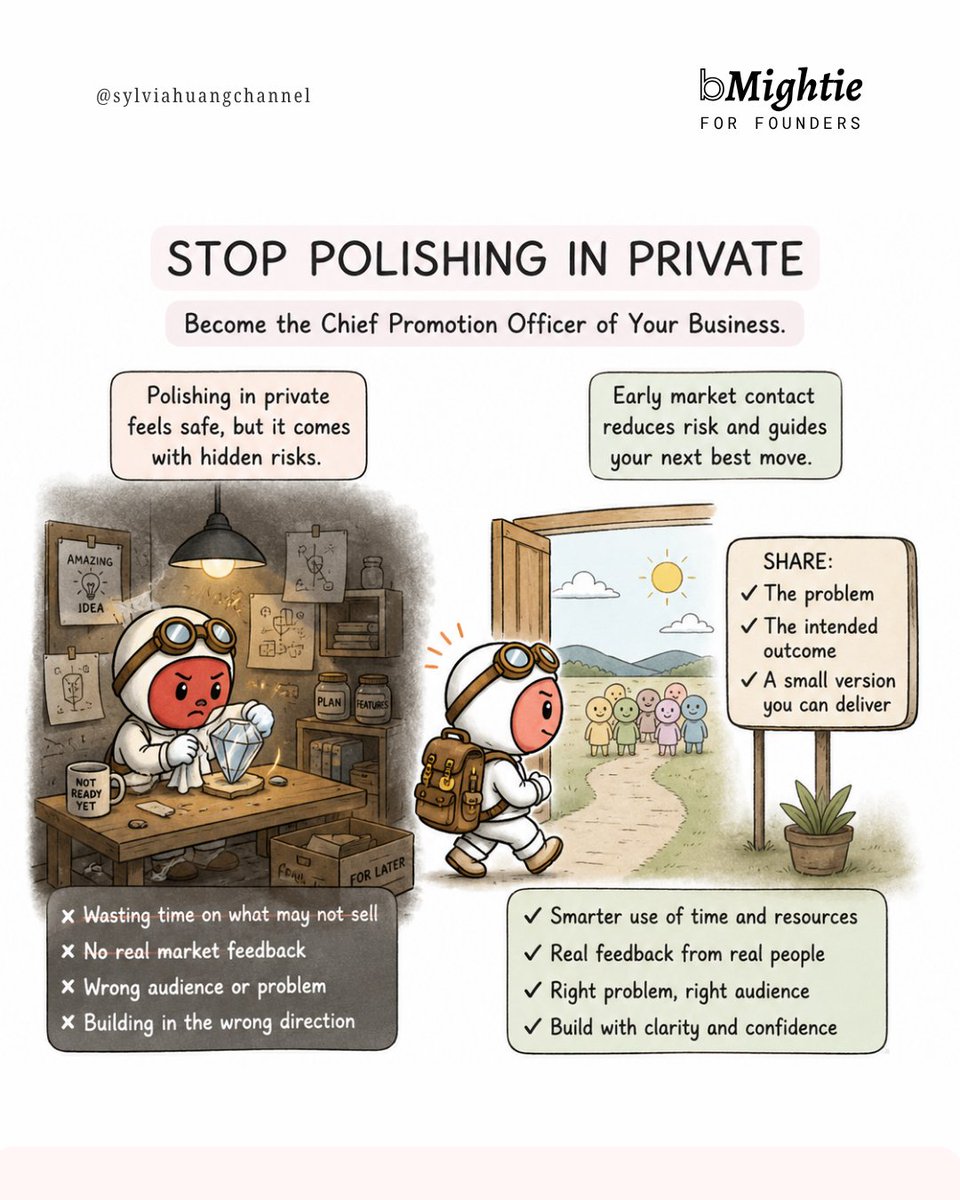
One of the big ideas from the popular business book The Lean Startup by Eric Ries is that your first product should help you learn, not simply prove your original idea was right 💨 Many founders keep adding features and polishing the design before real customers interact with it. The product becomes more complete while the biggest assumptions about the customer, problem and offer remain untested. 🚀 Treat the first version as an experiment. Decide what you need to learn, what customer behaviour would count as useful evidence, and build the smallest version that allows that behaviour to happen. Early customer insight does not need to confirm your assumptions. It should show you what to build, change or stop doing next. 👉 Follow @bMightie for more founder intelligence for the solo and bootstrapped business journey from day zero to takeoff. #bmightie #founderintelligence #founder #entrepreneurship #bookclub
@sylviahchannel ·
For the employee-turned-entrepreneurs, entrepreneurship does not just place you in the same game with more responsibility. It places you in a different commercial game altogether 🤯 👇 Inside this week's article - https://t.co/7fglY4sjxJ, I break down: → Why you can be highly experienced in the work while still being a beginner at running the business supporting it → Why capable founders retreat into their zone of competence → How past success can misguide you when the new business model runs on different economics and growth mechanics → How flying solo removes the scaffolding that supported your ability → Why bootstrapping changes the whole game for founders 🎯 Before fixing the business, diagnose which problem you actually have. You are playing a different game now. Past experience can help you learn it faster, but it may not fully transfer. 👉 ✈️ Subscribe to Before Takeoff for weekly drops of founder intelligence for the solo and bootstrapped business journey from startup to takeoff: https://t.co/0L5hIWTC48 #startup #founder #entrepreneurship #bootstrapping
@thefernandocz ·
This completely changed the way I think about scaling businesses... It takes the same amount of effort to build a 1x multiple business as it does to build a 50x multiple one... Some businesses trade at 1x gross revenue, some trade at 5x, and some trade at 40 or even 50x. The actual hours, the founder stress, the weekends sacrificed, and the emotional weight of starting either one are basically identical. What actually decides which side of the multiple you end up on is the structural shape of the business you chose to start in the first place. The grit and hustle people usually credit the outcome to are downstream of that choice. When I asked Mitch what he believed most founders disagreed with, his answer was direct. He said founders should have started their journey with the analysis of multiples at exit. Before writing the business plan, before falling in love with the idea, they should have downloaded a due diligence checklist and built the company around it from day one. The formula Mitch laid out for actually catching that multiple arbitrage is what he calls reliable, renewable, high margin, low maintenance revenue, multiplied by massive data aggregation. Stack those characteristics on top of each other and the multiple goes up while the work to maintain the business goes down, at the same time. The math quietly rewrites itself underneath you while you're still doing the same hours. Mitch's billboard message at the end of the conversation was that entrepreneurship is an endurance sport. The lesson I keep coming back to is that you have to do the structural thinking before you fall in love with an idea, otherwise you end up running a marathon for three years building the wrong shape of company entirely. Full breakdown on the episode: https://t.co/mZFnOHfA8t
@jspujji ·
We were spending $75M a year for our biggest client when they called and told us "We don't need you anymore". At my first business Ampush, Uber was 20% of our business. One day they called and said they loved the work, but they were big enough to take it in-house. I got the team together and said that there was no way we were losing them. We got to work. Put a deck together. The deck was terrible. Nobody cared. Nobody believed it. We presented anyway. Uber said no. Half the people on that team quit. A few years later, the same thing happened with another huge client. This time was worse. We found out from a Facebook rep forwarding an email. The client didn’t even have the courtesy to tell us directly. It sucked. I wanted to dive right into saving them. But I was a little more mature. My coach had taught me a few things. I looked around the room at the team and said: “You guys are really f*king angry right now, aren’t you?” They said yes. They had worked their asses off for this client for three years who didn't have the courtesy of calling to fire us. So we stopped. We felt the anger first. Went around the room. Then I asked: “Is it too far gone, or do we still want to try to renew this?” They wanted to try. The work got better. The meeting got better. And this time, we saved a lot of the business. The lesson took me years: Panic creates activity, not leadership. And you can’t lead people past a feeling you refuse to name. Building a business will surface every pattern you have. The question is whether you’re willing to learn and grow. I sold Ampush 3 years ago for a life-changing exit. Since then I've started 3 separate businesses doing $10M+ in revenue. I'm looking to partner with awesome entrepreneurs to start many more. Follow me @jspujji to learn alongside my journey.
@H0wie_Xu ·
"If you want to go fast, go alone. If you want to go far, go together." AI is rewriting this ancient wisdom however. Garry Tan, CEO of @ycombinator, said on March 29 that "The unit of software production has changed from team-years to founder-days." Garry is basically saying one person can go very far today. Go one person unicorn! Individual programmer capabilities have indeed been dramatically amplified because of Coding Agents in the last half a year alone. Tasks that once required partnerships can now be handled solo with AI assistance. Need product management insights? Ask ChatGPT. Want market analysis? Tools can generate decent starting points. The temptation to go it alone has never been stronger. In a nutshell, the one person unicorn is closer to reality than ever. This shift feels liberating. Why deal with co-founder drama, equity splits, and conflicting visions when you can move fast independently? I kept telling my own colleagues on one of the 40-people weekly Zoom calls that this is not 40 people organization, this is a 400 people organization!! But there's a catch. Building world-class or breakthrough products still requires human networks. Every individual has blind spots that AI can't fully compensate for. Different stages of growth demand different expertise that's hard to acquire alone. Even the most notoriously difficult leaders understood this. Steve Jobs and Elon Musk are famous for being demanding and uncompromising. Yet both built organizations filled with people willing to work tirelessly for their vision. They might not have been easy to work with, but they knew how to inspire deep loyalty. The ability to rally people around a mission remains crucial. AI can amplify individual productivity, but it can't replace the power of aligned human effort. The solo entrepreneur path is more viable than ever for getting started quickly. But sustainable, large-scale impact still requires the ability to bring others along for the journey. #AI #Entrepreneurship #Leadership #Teamwork #Startups
@theraleighwill ·
We all love origin stories. Go to dinner with a new couple and you ask “how did y’all meet?” Listen to an entrepreneurial podcast and it’s all about how the idea first came into being The problem in entrepreneurship is that the financial and lifestyle freedom we all want has nothing to do with the origin story and everything to do with the exit story. Not how you got into the labyrinth, how you got out. But the one heresy in entrepreneurship is openly talking about selling your business. It’s supposed to be a “life calling” that becomes a life sentence. When I sold my entertainment parks, the math and 80% of my economics came from the day I sold the business, 20% came from operating it. But most of us obsess over the 20%. Six months after I sold, my wife was diagnosed with stage III cancer and had I still been operating my business there is zero chance our marriage would’ve survived cancer. Zero. So if you are running a business that doesn’t fulfill you like it once did, take that as a signal it may be time to find a new game to play, and if you can get paid unreasonably well to end the game you are playing—that may be the reason you started in the first place and just don’t remember.
Best Tweets by Topic