You have 160 characters and only a few seconds of a visitor’s attention to answer three questions: who are you, what do you do, and why should someone follow you? Most bios fail because they are generic. They try to sound professional or clever instead of being specific about the value a follow provides.
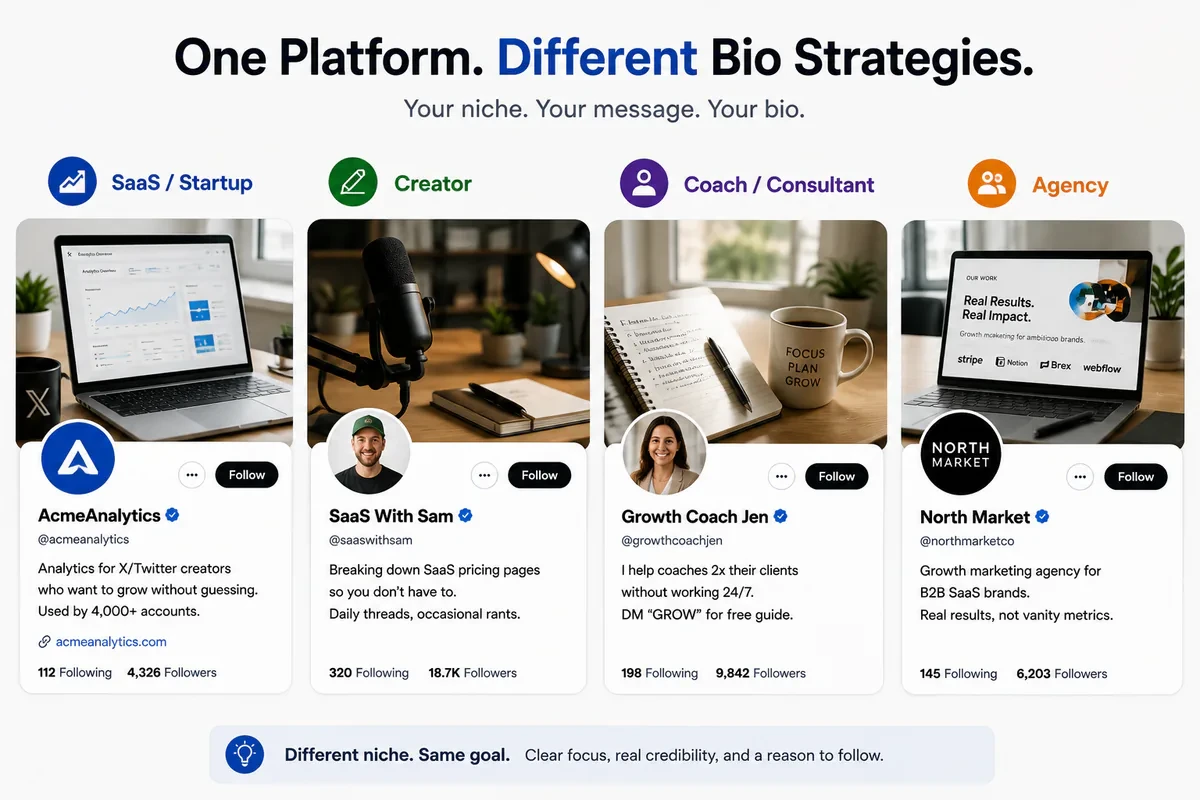
This guide breaks down strong X bio patterns across four common niches: SaaS and startups, individual creators, coaches and consultants, and agencies. The goal is to give you adaptable structures, not copy-and-paste lines that make every account sound the same. If you want the mechanics of drafting and formatting first, start with the Twitter bio generator guide.
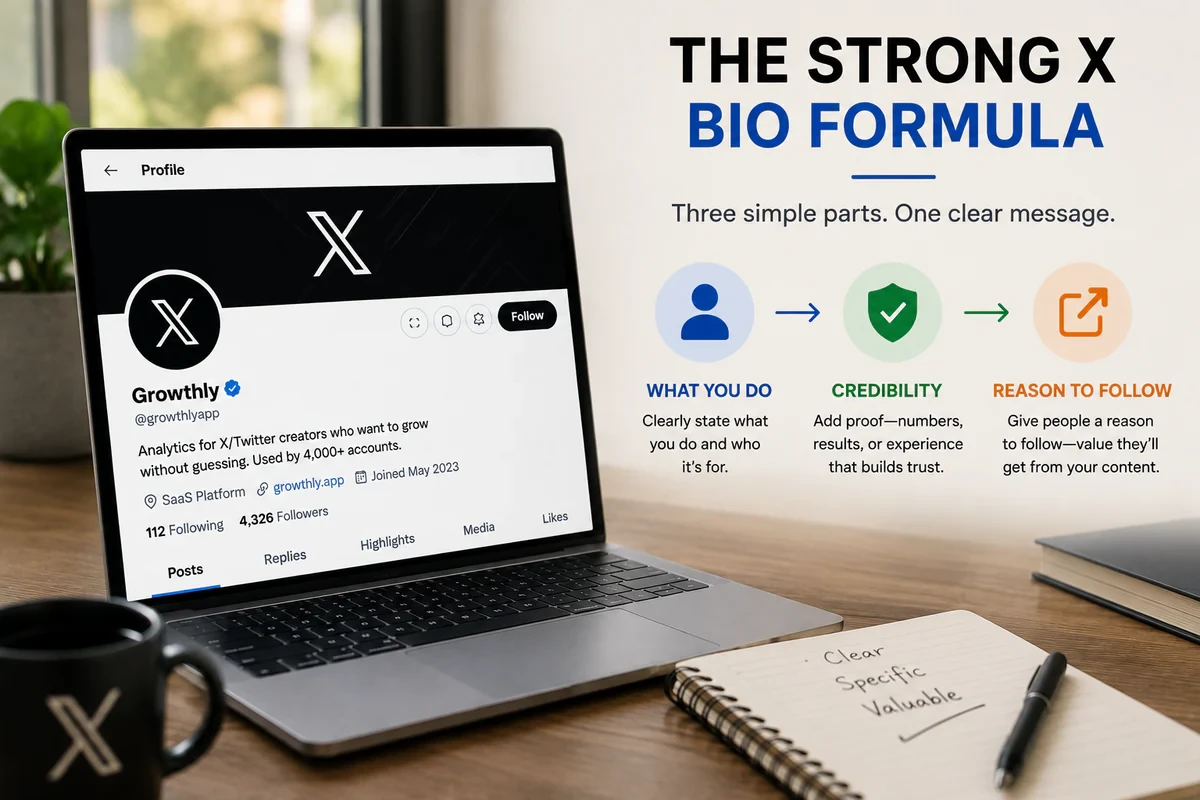
The Universal Bio Formula
Most effective bios use some version of this structure:
What you do, specifically + Credibility signal + Reason to follow or act
Not every bio needs all three parts at equal length. Packing too much into 160 characters usually backfires, but a bio that communicates none of them tends to blend into the timeline. The niche examples below show how to change the emphasis without losing clarity.
SaaS and Startup Bios
A SaaS bio needs to explain what the product does clearly enough for someone unfamiliar with the company to understand it in one read. If the brand has a meaningful traction or credibility signal, the bio should make room for it.
Common structure: Product category for a specific audience + traction or social proof + soft call to action.
Examples:
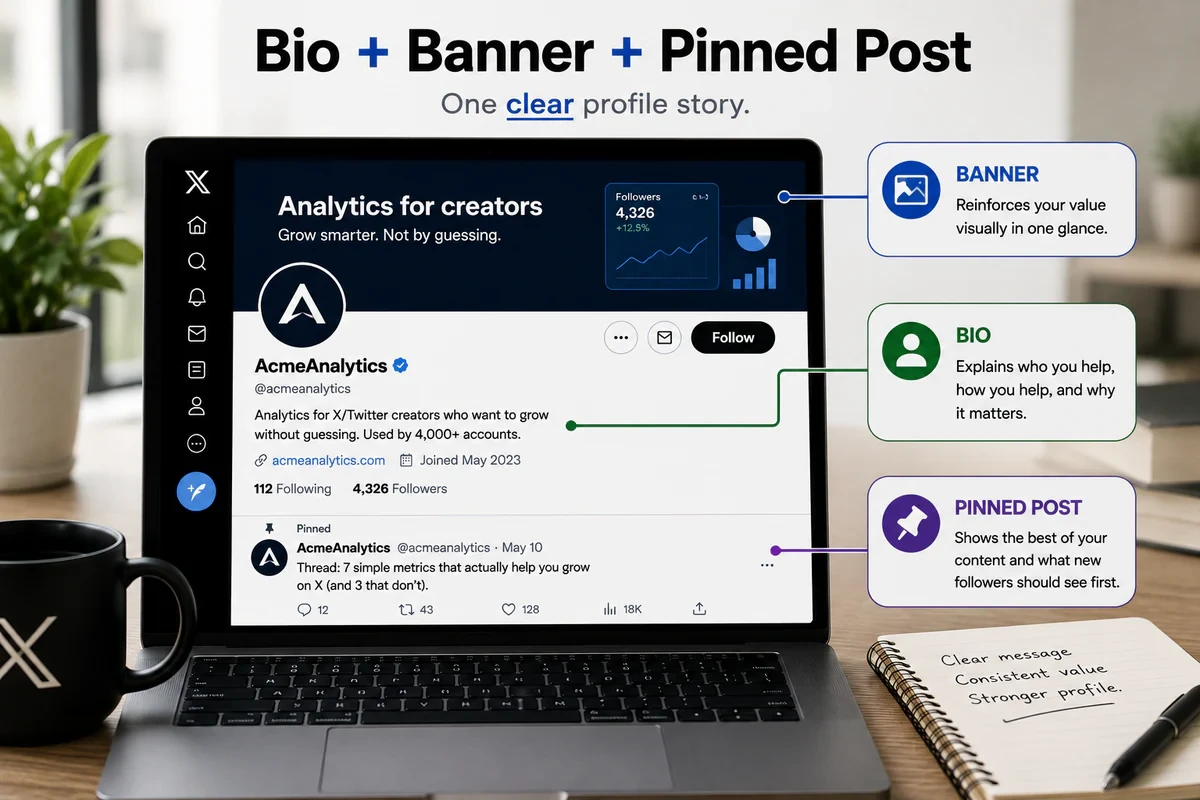
- Analytics for X creators who want to grow without guessing. Used by 4,000+ accounts. Try it free below.
- The scheduling tool built for solo founders, not agencies. No seat limits. No learning curve.
- We help SaaS teams turn support tickets into content. Building in public.
These work because each example names both the category and the audience. “Analytics for X creators” tells a stranger what to expect from the product in a few words. Compare that with “Building the future of social analytics,” which makes the reader do work the bio should have done.
Common mistakes in SaaS bios:
- Leading with funding or investor names before explaining the product
- Using internal jargon such as “workflow orchestration platform” instead of language a buyer would use
- Omitting the audience and leaving “Who is this for?” unanswered
Pair a clear bio with a banner that reinforces the same value proposition. The Twitter banner maker guide covers the visual side, and the bio template library offers faster starting points.
Individual Creator Bios
A creator bio has a different job. Instead of explaining a product, it needs to establish a distinct point of view and a reason to follow this person rather than the many other accounts covering similar topics.
Common structure: Specific topic or niche angle + content format or personality signal + optional credibility or link context.
Examples:
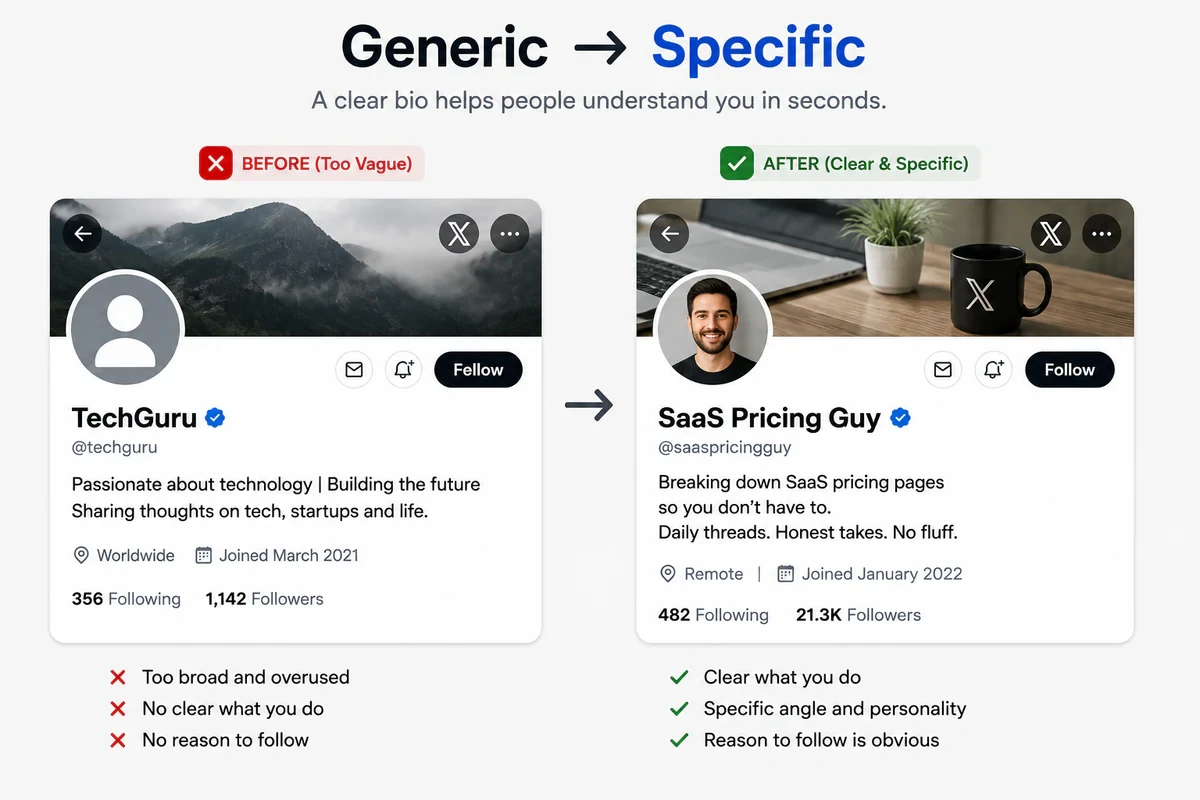
- Breaking down SaaS pricing pages so you don’t have to. Daily threads, occasional rants.
- Former software engineer writing about what actually works in system design. No hype, just notes.
- I write about money for people who hate talking about money. New essay every Sunday.
Each example chooses a narrow, memorable angle instead of a broad category like “marketing tips” or “tech content.” A visitor should be able to predict roughly what the account will publish from the bio alone.
Common mistakes in creator bios:
- Listing too many topics, such as marketing, growth, AI, productivity, and life
- Leaning entirely on old credentials without saying what you publish now
- Using humor or personality without giving any indication of the account’s subject
Once the bio is set, the pinned post and banner finish the “why follow” story. Read our guide to common Twitter bio mistakes and browse more Twitter bio ideas for additional voice and positioning options.
Coach and Consultant Bios
Coaches and consultants face a trust problem. A visitor is deciding whether to trust them with a real challenge, so credibility needs to be concrete and outcome-based rather than aspirational.
Common structure: Who you help + outcome you deliver + proof point.
Examples:
- I help first-time founders raise seed rounds without burning out. 40+ founders coached, $80M+ raised collectively.
- Executive coach for engineering leaders moving into VP roles. Former VP of Engineering. Book a free intro call below.
- Fitness coaching for busy parents who have tried everything else. 200+ clients, zero fad diets.
Every example names a specific audience and pairs it with a verifiable proof point. Numbers often do more credibility work in a coaching bio than adjectives such as “passionate,” “dedicated,” or “results-driven.”
Common mistakes in coach and consultant bios:
- Making vague outcome claims without evidence
- Overloading the bio with certifications instead of leading with the result
- Giving an interested visitor no clear next step, such as a link, DM prompt, or booking action
Only use outcomes and proof points you can substantiate. Strong specificity builds trust; inflated claims destroy it.
Agency Bios
An agency bio needs to signal the service and client type while differentiating the firm from similar competitors. Listing every capability usually makes the positioning less clear, not more impressive.
Common structure: Service for a specific client type + differentiator or result + proof or link.
Examples:
- SEO for B2B SaaS companies tired of vanity traffic. We optimize for pipeline, not just rankings.
- X growth for founders who do not have time to post daily. Full-service strategy without generic ghostwriting.
- Performance creative for DTC brands doing $1M to $10M a year. 40+ brands scaled. Case studies below.
Each example names a narrow client segment and a differentiator that creates a meaningful contrast. Prospective clients are often comparing several similar agencies, so the bio needs to give them a reason to choose this one.
Common mistakes in agency bios:
- Listing every service instead of the core specialty
- Failing to specify a client type
- Using differentiators that any competitor could claim, such as “results-driven” or “client-first”
Before and After: Common Bio Rewrites
Seeing a weak bio transformed into a focused one makes the underlying pattern easier to understand.
SaaS bio rewrite
Before: Building the future of social media management. Passionate about helping teams work smarter.
After: Scheduling + analytics for X teams of 2 to 10. No per-seat pricing. 1,200+ teams onboarded.
What changed: The rewrite replaces a vague mission with the product category, audience size, differentiator, and a concrete traction number.
Creator bio rewrite
Before: Marketing | Growth | Content | AI | Thoughts are my own
After: I break down growth loops from companies that actually scaled. One deep-dive thread a week.
What changed: A list of broad topics becomes one ownable angle and a predictable content format.
Coach bio rewrite
Before: Certified life coach | NLP practitioner | Helping you become your best self
After: I coach mid-career professionals through career pivots. 60+ clients placed in new roles within six months.
What changed: The bio leads with a specific audience and measurable outcome instead of a stack of credentials and an abstract promise.
Agency bio rewrite
Before: Full-service digital marketing agency | SEO | PPC | Social | Web design | Let’s talk
After: SEO for local service businesses losing to Google Maps competitors. 80+ businesses ranked on page one.
What changed: The rewrite replaces a service list with a sharply defined niche, a recognizable pain point, and a proof point.
Bio Length and Formatting
Regardless of niche, a few formatting choices make a bio easier to understand:
- Prefer line breaks to a run-on sentence. Short lines are easier to scan within the character limit.
- Use one emoji as an anchor, not decoration. A purposeful symbol can guide the eye; several competing emojis add clutter.
- Use numbers instead of adjectives when the numbers are honest. “40+ clients” is more specific than “many happy clients.”
- Add a call to action only when there is a destination. An arrow pointing to no link or pinned post weakens the profile.
For a faster starting point, use Xholic’s bio generator or browse the Twitter bio template library.
Hybrid Roles: When One Category Is Not Enough
Many accounts do not fit one category cleanly. A SaaS founder may also be building a personal brand. An agency owner may post as a creator. A coach may also sell a course. The bio should choose which identity leads instead of representing every role equally.
Founder building in public:
Building an analytics product for X creators in public. Founder notes, revenue updates, and occasional takes on SaaS pricing.
The product appears for context, while the personal account promises founder commentary rather than polished corporate copy.
Agency owner posting individually:
I run a local SEO agency. I share what actually works, not agency theater.
The agency adds credibility, but the first-person voice differentiates the account from a company feed.
Pick the primary identity, mention the secondary one briefly, and let the posting pattern reinforce that choice.
How Your Bio, Banner, and Pinned Post Work Together
A strong bio cannot carry a contradictory profile. The bio, banner, and pinned post should tell one coherent story:
- Banner: Reinforces the niche or value proposition visually. A SaaS banner might show product UI, while a coach’s banner might highlight a defensible client outcome.
- Bio: Explains who you help, how you help, and why the positioning matters.
- Pinned post: Provides the best evidence for the bio’s claim, such as a useful guide, case study, testimonial, or results breakdown.
If a bio claims “40+ founders coached,” the pinned post should not be an unrelated meme. It should help a visitor understand or trust that claim. Treat these three surfaces as one profile system instead of optimizing each in isolation.
Testing and Iterating Your Bio
A bio is not a permanent decision. Revisit it after a meaningful change in your role, offer, audience, or strongest proof point.
Start with a five-second test: ask someone unfamiliar with the account to read the bio, then explain what you do and why they would follow. If they cannot answer both questions, tighten the wording.
Then measure the result. Use Xholic’s profile analytics to watch whether a bio change improves profile-visit-to-follow conversion. Compare meaningful periods, avoid changing several profile elements at once, and judge the quality of new followers alongside the raw conversion rate.
Frequently Asked Questions
How long should my X bio be?
X’s profile guidance sets a maximum of 160 characters. You do not need to use all of them. A short, specific bio is usually more useful than one padded to the limit.
Should I use emojis in a professional bio?
One or two can work when they serve a purpose, such as separating ideas or pointing to a link. Too many can reduce clarity, especially for coaches, consultants, and agencies whose bios need to establish trust quickly.
Should my bio include a call to action?
Use a call to action when there is a specific next step, such as a link, pinned post, booking page, waitlist, or DM prompt. Do not spend scarce bio space on a generic action with no destination.
How often should I update my bio?
Update it when what you do, who you serve, or your strongest credibility signal changes. That might follow a new role, offer, client focus, product launch, or defensible milestone. Constant wording changes make results harder to measure.
Do bio keywords affect discoverability on X?
Clear niche terms help people understand the account and can make the profile a better match for relevant searches, but X does not publish a detailed weighting formula for bio text. Use natural, descriptive language for clarity rather than treating keywords as a ranking guarantee. Our Twitter SEO guide explains how the bio, pinned post, and publishing pattern work together.
What is the biggest difference between a creator bio and a business bio?
A creator bio primarily needs to establish a distinct topic, format, or point of view so visitors know what they will receive by following. A business bio needs to establish the audience, product or service, outcome, and credibility signal. Personality can support both, but clarity has to come first.
Ready to apply the pattern? Try Xholic’s bio generator for editable drafts, or browse the template library for more niche-specific starting points.