If your X posts get a little attention at first and then disappear, the problem usually isn’t effort. It’s discoverability. Twitter SEO is what helps the right people find your profile, posts, and threads after the feed has moved on, and on X (formerly Twitter) that matters more than most creators assume.
Think of X less like a pure social feed and more like a search surface. People use it to look up creators, products, opinions, and how-tos, and the platform itself is big enough that search signals can matter at internet scale. Moz’s domain analysis shows 3.3 million ranking keywords, 62.6 million linking root domains, and a Domain Authority of 95 for twitter.com, which is a strong reminder that this is an indexable, search-visible domain, not just a place to post updates. That’s why a good X presence needs more than engagement hacks, it needs keyword clarity, profile alignment, and post structure.
What Twitter SEO Actually Means in 2026
Treating X purely as a broadcast channel is common. Many post, hope for a spike, and move on. This approach misses how discovery functions now, as people don’t just see your content in the timeline; they also find it through search, profile clicks, related posts, and external indexing.
A more useful definition is simple. Twitter SEO is the practice of shaping your profile and posts so X can understand what you talk about, and so people can find you when they search for that topic. Sprout Social describes it as optimizing profile and content, including posts, hashtags, and media, to rank in X’s internal search results and algorithmic feeds, which is the right way to think about it if you want durable visibility rather than one-off engagement.
The three signals that matter most
Search visibility on X usually comes from three layers working together, not one isolated tactic.
- Profile signals. Your name, bio, and pinned post tell X what category you belong in. They also tell humans whether they’re in the right place.
- Post signals. The opening words of a post, the topic it covers, and the language it uses help the system classify it.
- Distribution signals. Replies, quote posts, bookmarks, and recurring topical activity reinforce that you’re consistently associated with a subject.
That’s why broad branding alone often underperforms. If your profile says only “Founder” or “Builder,” you’re asking both people and search systems to do extra work. A more specific positioning phrase, like “AI growth agent for X,” immediately narrows the topic and improves relevance.
For a deeper look at how ranking and recommendations interact, I’d pair this with X’s algorithm overview and browse AI visibility insights if you want to understand how social content gets surfaced across search systems.
Practical rule: if a stranger can’t tell what you post about in five seconds, X probably can’t classify you cleanly either.
Optimizing Your X Profile for Search Discovery

Your profile is the anchor point for everything else you publish. If your bio is vague, your pinned post is generic, and your name doesn’t signal a topic, you’re making discovery harder than it needs to be. X’s internal search relies heavily on profile text to understand who you are and what you’re about.
Write the bio for relevance, not poetry
A strong bio does three jobs at once. It says who you help, what you help with, and why someone should care. The easiest way to do that is to make your primary keyword feel natural inside a plain-English sentence, not stuffed into a list of buzzwords.
Weak example. “Founder. Builder. Writing about growth.”
Stronger example. “I help founders grow on X with practical Twitter SEO, replies, and content systems.”
The second version is more searchable because it names the topic explicitly. It’s also more useful to a real visitor, because it frames the account around an outcome, not an identity label.
Make the name field do real work
Your display name doesn’t need to become a keyword dump. It should stay human first. But if you have room for clarity, use it.
For example, “Maya | X Growth” is easier to classify than “Maya.” Likewise, “Jordan, AI Growth Agent for X” communicates both the person and the niche. The goal isn’t to game search. It’s to reduce ambiguity.
The pinned post should reinforce the same topic. If your bio says you help people improve Twitter SEO, the pinned post shouldn’t be a random meme or a broad life update. It should restate the core promise, ideally with a useful thread, checklist, or positioning post.
A simple profile checklist
Use this before you publish more content:
- Name: include your name first, then a concise topic signal if it fits naturally.
- Bio: describe your niche with one primary keyword and one plain outcome.
- Pinned post: support the same topic, don’t introduce a new one.
- Header and avatar: keep them recognizable and consistent with the account’s subject.
If you want a walkthrough of the profile elements themselves, this Twitter profile optimization guide is a useful companion.
After you tighten the profile, Xholic AI’s profile analytics and Twitter Analyzer can help you sanity-check whether your public-facing wording matches the audience you want to attract.
A profile should answer one question fast: why am I following this account instead of a hundred similar ones?
Later, the rest of your content has an easier job.
Writing Keyword-Front-Loaded Tweets That Rank
The fastest way to weaken a search-focused post is to bury the topic. If the first line talks around the subject instead of naming it, you’ve made it harder for X to classify the post and harder for a user to know whether it’s relevant.
Put the main keyword in the opening line
Several search-focused guides recommend placing the main keyword in the first line or first 50 characters. That matches how people scan posts, and it also lines up with the fact that the strongest signal usually sits before the “show more” cutoff. SEO Sherpa also notes that tweets around 100 characters often perform well, which makes concise, topic-first writing a practical default rather than a restriction.
Bad. “I’ve been thinking about how creators can get more traction if they pay attention to the right things.”
Better. “Twitter SEO works when your profile, posts, and replies all point to one topic.”
The second version is cleaner because it says the subject immediately. It’s not just more readable, it’s easier for search systems and humans to match against intent.
Keep the hook natural, not stuffed
You don’t need to repeat the keyword five times. In fact, that usually makes the post worse. A search-friendly tweet should sound like a real sentence a knowledgeable person would say, then include the query language naturally.
For example:
- Too stiff: Twitter SEO Twitter SEO Twitter SEO for ranking on X
- Better: Twitter SEO on X gets easier when your first line, profile, and reply pattern all reinforce the same niche
That second version reads normally while still carrying the target phrase.
If you want help thinking like a copywriter while still writing for search, these search engine optimization copywriting tips are a solid outside reference.
Use hashtags like labels, not decorations
The hashtag habit on X is usually overdone. Independent guides converge on a narrow approach, with one or two targeted hashtags per tweet commonly recommended, and some 2025 guidance suggesting two to three at most. That lines up with how people read posts. A pile of tags makes the tweet look noisy and can distract from the main idea.
Use hashtags only when they reinforce the topic. For most search-oriented posts, one targeted hashtag is enough, and many posts need none at all.
Useful filter: if the hashtag wouldn’t help a real reader understand the post faster, leave it out.
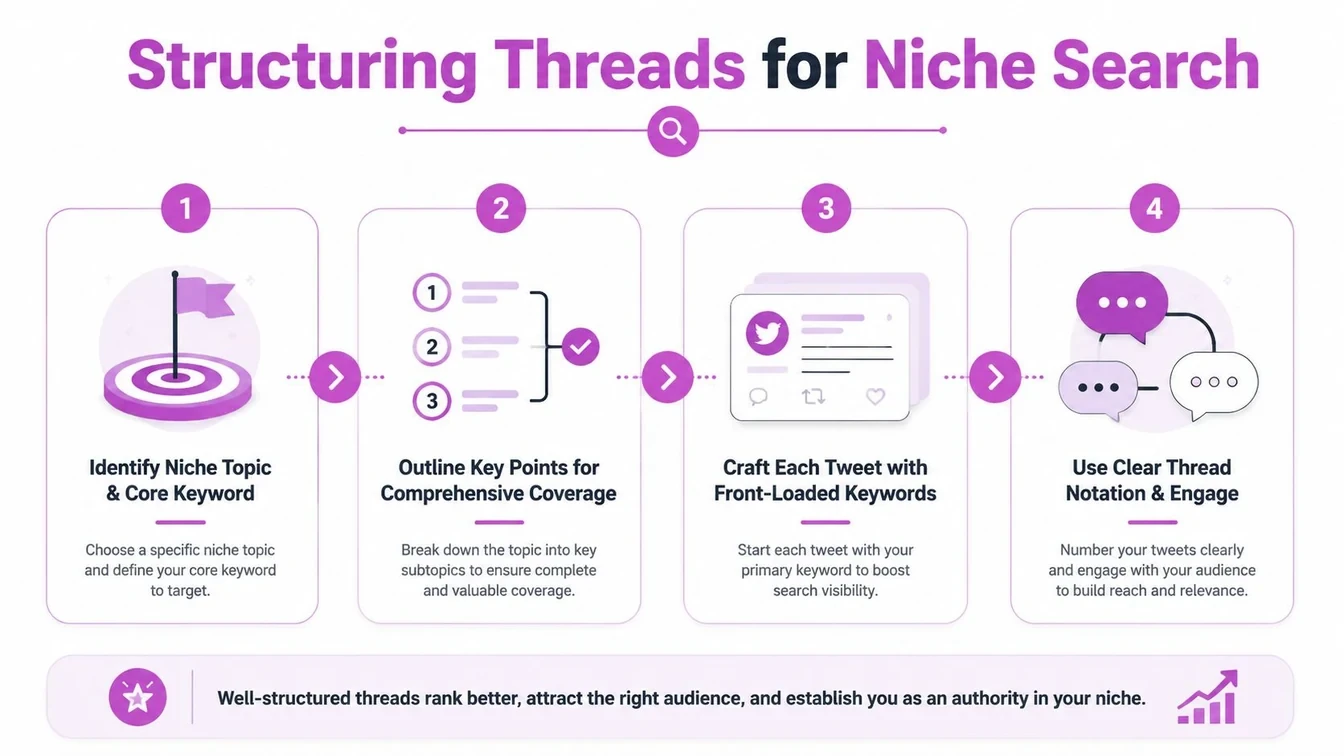
Structuring Threads for Niche Search Terms
Threads work well for Twitter SEO because they let you cover a topic with enough depth to stay useful after the first hour of distribution. A single post can rank for a term, but a thread can answer the related questions a searcher has once they click.
Start with the query, then expand the answer
The opening post should resemble a search result in spirit, not a robotic keyword dump. If someone is searching for “Twitter bio mistakes,” the thread should start by naming the problem clearly.
Example opening. “Most Twitter bios fail for the same reason, they describe the person but don’t tell visitors why to follow.”
That opening works because it states the core issue and invites the rest of the thread. The following posts can then answer adjacent questions in a logical order, like what to include, what to remove, how to express positioning, and how the pinned post should support the bio.
Cover related intent, not random synonyms
A strong thread does not just repeat the keyword in different words. It answers the questions people usually ask around that keyword. If the topic is profile optimization, readers also want to know how the photo, header, recent posts, and call to action fit together.
That’s where saved audience questions matter. Xholic Brain can help here because it remembers the language people repeatedly use in saved posts, replies, and creator research. That makes it easier to write to actual search intent instead of inventing your own terminology.
A practical thread structure looks like this:
- Name the problem with the exact topic in the first post.
- Explain why it happens in plain language.
- Answer the nearby questions readers would ask next.
- Show a real before-and-after example or a concrete comparison.
- End with a checklist readers can save.
If you want a fuller thread framework, this Twitter thread strategy guide is a helpful companion.
Threads like this aren’t just easier to rank. They’re easier to bookmark, which is important because bookmarked posts usually signal that the content has lasting value.
Building Engagement Momentum That Supports Search Visibility
Search on X doesn’t run on keywords alone. It also runs on signals that tell the system your content matters inside a topic cluster. Replies, quote posts, bookmarks, and profile visits all help show that people aren’t just glancing at a post, they’re engaging with the subject.
Why engagement quality matters more than random activity
A fast spike can make a post look lively, but it doesn’t always create durable discovery. A post that gets a bunch of low-context likes and disappears often behaves differently from one that sparks thoughtful replies, quote posts, and profile visits from people in the same niche.
That distinction matters because topical authority is built over time. If the same account keeps appearing in relevant conversations, X has more evidence that the account belongs in that topic. If the account only posts and vanishes, the signal is weaker.
Build a reply pattern that reinforces the niche
The easiest daily habit is targeted replies. Not generic “great post” comments, but actual commentary that adds a point, a counterpoint, or a useful example. That kind of reply gives people a reason to click your profile, and it also ties your account to the subject matter of the conversation.
If you don’t want to manually search for worthwhile conversations, Xholic’s Reply Deck can surface posts connected to your niche so you can join threads where your perspective fits. The value is not volume, it’s relevance.
A few practical rules help here:
- Reply to relevant accounts: stay close to your subject area so the association stays clear.
- Add substance: make the reply useful enough that someone would want to read more from you.
- Avoid topic drift: don’t jump from founder growth to meme commentary if your account is trying to rank for a specific niche.
High-quality replies create a trail of context. Over time, that trail supports both human trust and algorithmic classification.
The goal isn’t to look active. The goal is to look consistently relevant.
For a broader playbook on using engagement intentionally, this guide to increasing Twitter engagement is worth reading alongside your search strategy.
Your Weekly Twitter SEO Workflow and Checklist
The accounts that hold search visibility usually run a repeatable system. They don’t reinvent their content strategy every week, and they don’t post random ideas whenever inspiration hits. They maintain a tight loop between profile clarity, topic selection, publishing, and review.
A practical weekly routine
Use a routine like this:
- Monday: check whether your profile still matches your current niche and offer.
- Tuesday: publish one keyword-front-loaded post.
- Wednesday: write or schedule one thread around a niche query.
- Thursday: leave thoughtful replies on related accounts.
- Friday: review which evergreen posts are still getting impressions, profile visits, and bookmarks.
- Weekend: save strong ideas, archive weak ones, and line up the next cycle.
Xholic’s Smart Scheduler and Goals and Streaks fit naturally into that kind of workflow if you want a system for planning and consistency rather than a scramble every morning.
The metric that matters most
The most useful weekly signal is whether evergreen posts continue earning impressions after the first 48 hours. That tells you the topic still has search demand and that the wording is helping people find it beyond the initial feed burst.
Then compare that delayed reach with bookmarks and profile visits. Impressions alone can be misleading. A post that keeps surfacing and also drives profile curiosity is a stronger search asset than a post that looks popular for a few hours and then goes quiet.
If the post keeps getting impressions but no one visits the profile, the topic may be interesting but the positioning is too weak. If people visit the profile but don’t engage further, the profile may be pulling the right audience but the content isn’t convincing them to stay. If neither happens, the keyword or angle likely needs work.
What to change based on the data
Use this simple decision matrix:
- Strong impressions, weak profile visits: tighten the bio, name, and pinned post.
- Weak impressions, strong profile visits: improve the opening line and keyword placement.
- Weak impressions and weak visits: change the topic, not just the wording.
- Good impressions and good visits: repeat the format with a new niche query.
That’s the part many overlook. Twitter SEO isn’t just publishing more. It’s refining the topic signal until the platform and the audience both understand what you’re known for.
Frequently Asked Questions About Twitter SEO
Do hashtags still matter on X
Yes, but only in moderation. The best use is selective, not excessive, and the strongest posts usually rely more on clear topic language than on a pile of tags. One or two targeted hashtags can help, but many posts work better with none.
Does an algorithm update kill your search visibility
Usually not by itself. Search visibility changes when the way X classifies and distributes content changes, but the more stable inputs are still profile clarity, topical consistency, and post quality. If visibility drops, first check whether your content has drifted away from the topic your profile claims.
What if my keywords aren’t producing impressions
The keyword may be too broad, too competitive, or too disconnected from the way people phrase the problem. Rework the opening line so it sounds like a real search query, then check whether your profile, thread, and replies all reinforce the same subject. If only one post is optimized and the account around it isn’t, the signal can still be weak.
How do I balance SEO with an authentic voice
Write the sentence you’d say, then make the topic obvious. That usually means naming the subject early, avoiding fluff, and using the language your audience already uses. Authenticity and search clarity are not opposites on X, they’re usually the same thing when the account is well positioned.
Is Twitter SEO only for creators and marketers
No. It helps founders, indie hackers, analysts, crypto builders, and operators who want to be found for a specific idea or product category. If people search for your topic on X, your profile and posts should help them land on the right account quickly.
If you want a system that helps with the repeat work, Xholic AI combines profile analytics, semantic search, personalized replies, scheduling, and content memory so you can keep your X presence focused on the same topic without guessing what to post next. Visit Xholic AI if you want to turn the workflow in this guide into a repeatable process.