Keyword and content strategy
Search intent, SERP and competitor research, topical maps, original content, and targeted long-tail or trend-driven pages.
66%
Best tweets about SEO
Explore the best tweets about SEO, covering search strategy, technical audits, content, links, algorithm updates, experiments, traffic, and rankings.
Practical SEO analysis, experiments, technical fixes, content strategy, links, algorithm changes, and measurable search results.
Original Xholic analysis
The conversation favors practical SEO over publishing volume: audit existing pages, fix indexability and internal links, match content to search intent, and measure leads alongside traffic. AI-search advice is less settled, especially whether to format answers for extraction or strengthen SEO fundamentals.
46% of posts
All-time engagement
28% of posts
Published in 90 days
Conversation map
Search intent, SERP and competitor research, topical maps, original content, and targeted long-tail or trend-driven pages.
66%
Crawling, indexing, canonicals, sitemaps, site speed, mobile usability, schema, broken links, and other site-health fixes.
32%
AI Overviews and answer-engine citations, extractable answers, brand mentions, and the relationship between GEO/AEO and traditional SEO.
30%
Page hierarchy, navigation, topic clusters, orphan pages, link equity, and making important commercial pages discoverable.
30%
Product and category pages, comparison and alternative content, and optimizing search visibility for leads, signups, and sales.
24%
Automated research, publishing, monitoring, and refresh workflows, alongside cautions about thin or mass-generated pages.
22%
Refreshing, merging, pruning, or rewriting existing pages; improving titles and CTR; and prioritizing near-ranking opportunities.
22%
Backlink acquisition, digital PR, directories, earned mentions, brand signals, and the risks of low-quality links.
20%
Tone and stance
Performance benchmark
Posts with media make up 64% of this collection. Their median all-time score is 16.8, compared with 7.14 for text-only posts.
Format mix
Consensus and debate
Shared view
Posts recommend using Search Console data to find pages worth updating or merging, then fixing crawlability, canonicals, navigation, and links to important pages before expanding content.
Shared view
Product-category, comparison, and alternative pages are proposed as routes to buyers, with internal links connecting supporting content to commercial pages. Contributors also urge tracking signups or purchases rather than treating traffic alone as success.
Open debate
One practitioner attributes a reported AI Overview citation to a concise, standalone answer section; other posts relay Google's advice against artificial chunking and special AI-only tactics. Neither establishes a universal citation formula.
Open debate
Some propose AI-assisted research, drafting, and refresh workflows; others warn that near-duplicate or mass-generated pages can be thin or risky. The disagreement concerns publishing at scale, not whether tools can assist research.
What performs
In the supplied analytics, LIST posts have a 26.78 median all-time score and TUTORIAL posts 17.69, versus 3.93 for OPINION. The leading checklist scored 767.62. These are engagement comparisons, not evidence that the advice improves rankings.
One practitioner reports a 3–4x increase in non-branded organic traffic after several site and page changes; another reports AI Overview citations after editing answer sections. Neither account isolates a single fix as the cause.
Statistical standouts
Creator landscape
The five most represented creators account for 20% of the selected posts.
1. Aleyda Solis 🕊️
@aleyda
2 posts
2. Okara
@askOkara
2 posts
3. Charles Floate 📈
@Charles_SEO
2 posts
4. Cody Schneider
@codyschneider
2 posts
5. Joe Davies
@fatjoedavies
2 posts
6. Flavio Amiel
@fba
2 posts
Okara's broad SEO checklist is the supplied sample's highest-scoring tweet at 767.62. A second post recommends prioritizing high-impression, low-CTR queries ranking in positions 8–20.
Charles Floate shares an AI Overview citation example and urges experimentation amid ranking volatility; Cody Schneider outlines a research-to-refresh workflow that tracks leads. These are practitioner approaches, not independently verified playbooks.
Since the previous snapshot
Themes, sentiment, stance, and post format are classified per tweet. All counts, shares, medians, creator concentration, freshness, and performance comparisons are then calculated directly from the published snapshot.
Xholic's all-time score compares engagement while accounting for reach, post age, and creator consistency. It is used for relative comparisons within this collection.
This report analyzes the exact 50-post snapshot shown below. AI identifies editorial categories and drafts explanations; all statistics are calculated from the snapshot, and every narrative claim is checked against cited posts before publication.
Best SEO tweets
Ranked 01–50

@askOkara ·
"SeO iS EaSY" SEO: > fix indexing issues > add breadcrumbs > add canonical tags > fix core web vitals > fix orphan pages > add schema markup > fix heading structure > write original content > avoid duplicate content > get high quality backlinks > use clean, descriptive urls > fix broken links and 404s > check js content is crawlable > fix keyword cannibalization > make the site mobile friendly > add author bio / e-a-t signals > make titles 50-60 characters > write unique meta descriptions > merge thin or overlapping pages > optimize images and add alt text > match every page to search intent > find high volume, low kd keywords > add internal links to important pages > publish comparison/alternatives pages > write the best listicles in your category > create topic clusters around pillar pages > add a google business profile for local seo > monitor pages losing traffic and rankings > validate schema using google's rich results test > create dedicated pages for features / use cases > update dateModified when you refresh content > find old pages ranking on page 2 and update them > submit your sitemap to bingwebmaster and gsc > check robots.txt and noindex tags for blocked pages > find pages with high impressions but low ctr and improve their titles and meta descriptions > search "site:yourdomain(.)com" on google, check titles that are cut off / dont include your target keyword and rewrite them > google your main keywords, expand "people also ask" boxes and create quick faq pages answering the questions

@seonatia ·
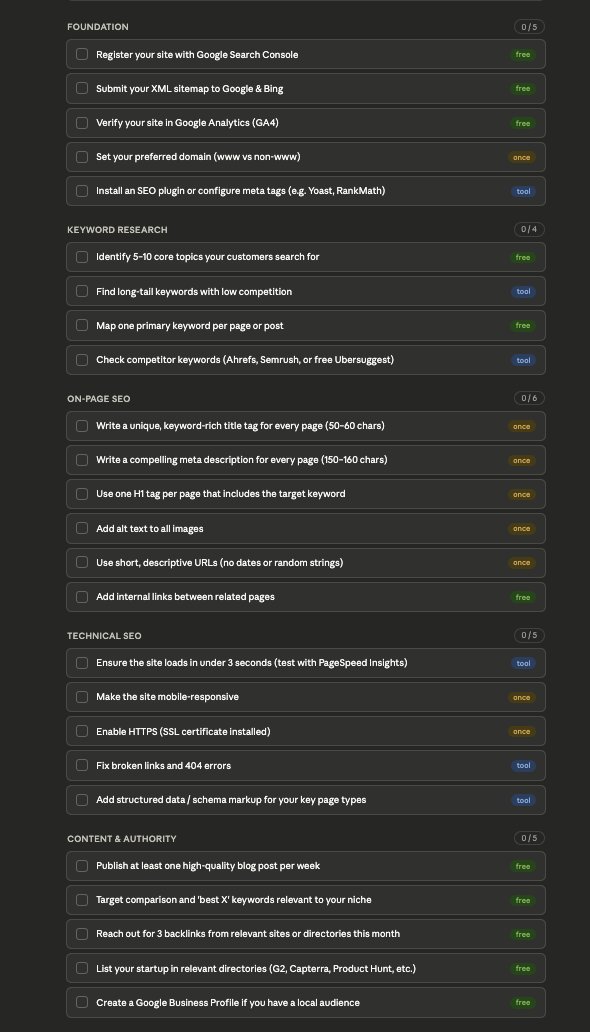
SEO AUDIT CHECKLIST FOR YOUR STARTUP: ____________ FOUNDATION (0/5) Register your site with Google Search Console (free) Submit your XML sitemap to Google & Bing (free) Verify your site in Google Analytics (GA4) (free) Set your preferred domain (www vs non-www) (once) Install an SEO plugin or configure meta tags (e.g. Yoast, RankMath) (tool) KEYWORD RESEARCH (0/4) Identify 5–10 core topics your customers search for (free) Find long-tail keywords with low competition (tool) Map one primary keyword per page or post (free) Check competitor keywords (Ahrefs, Semrush, or free Ubersuggest) (tool) ON-PAGE SEO (0/6) Write a unique, keyword-rich title tag for every page (50–60 chars) (once) Write a compelling meta description for every page (150–160 chars) (once) Use one H1 tag per page that includes the target keyword (once) Add alt text to all images (once) Use short, descriptive URLs (no dates or random strings) (once) Add internal links between related pages (free) TECHNICAL SEO (0/5) Ensure the site loads in under 3 seconds (test with PageSpeed Insights) (tool) Make the site mobile-responsive (once) Enable HTTPS (SSL certificate installed) (once) Fix broken links and 404 errors (tool) Add structured data / schema markup for your key page types (tool) CONTENT & AUTHORITY (0/5) Publish at least one high-quality blog post per week (free) Target comparison and “best X” keywords relevant to your niche (free) Reach out for 3 backlinks from relevant sites or directories this month (free) List your startup in relevant directories (G2, Capterra, Product Hunt, etc.) (free) Create a Google Business Profile if you have a local audience (free)

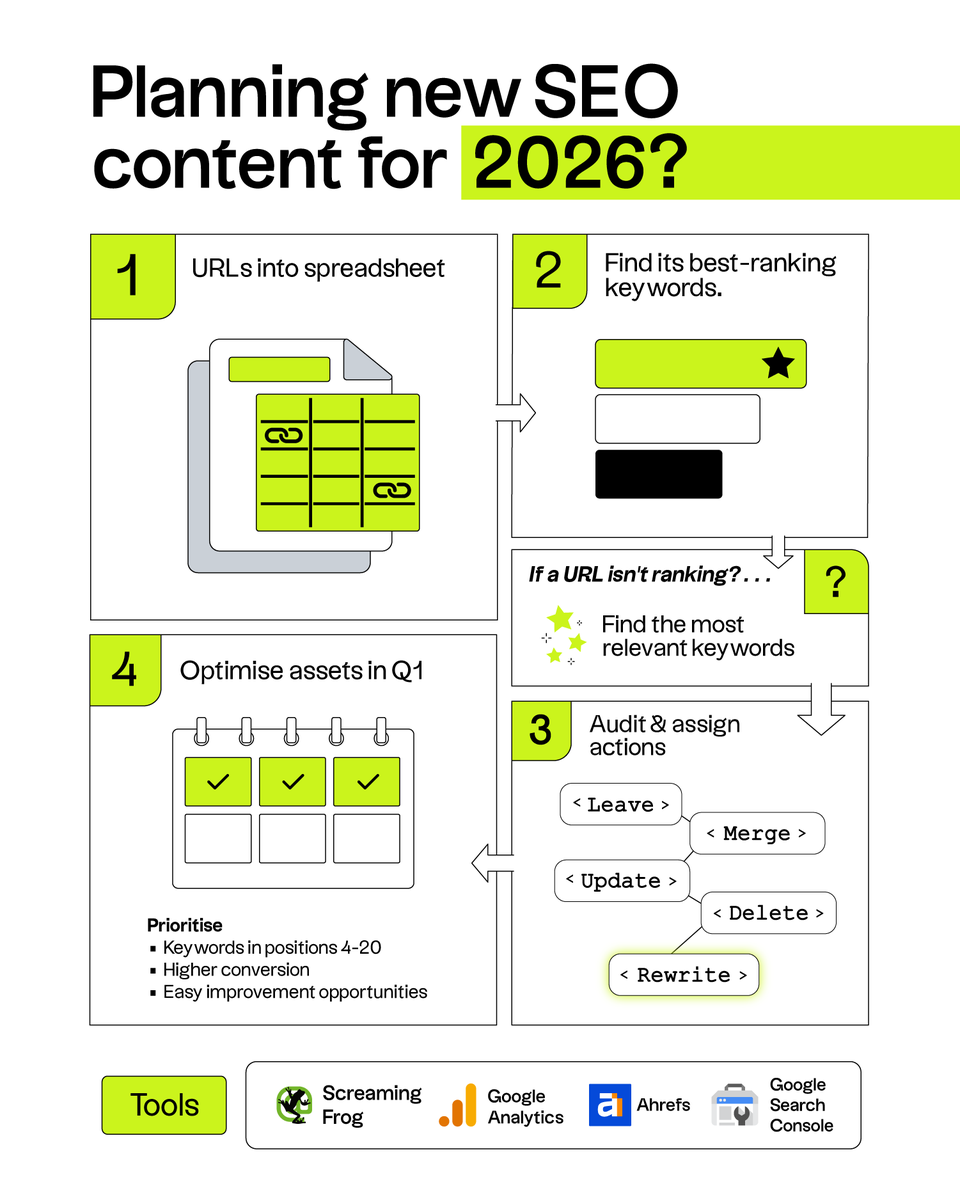
@jakezward ·
Planning new SEO content for 2026? PLEASE do this first: 1. Get all your blog URLs into a spreadsheet. Use Screaming Frog to crawl and export. It provides other useful information like titles and descriptions. Connect further data sources: - Ahrefs - Google Analytics - Google Search Console 2. Enter each URL into Google Search Console or Ahrefs and find its best-ranking keywords. Add this data to the spreadsheet for each page: - Primary keyword (your main keyword) - Secondary keywords (variations and similar) - Current position for your target keyword(s) If a URL isn't ranking for anything? Find the most relevant keywords using Ahrefs. Then... 3. Audit each blog post and assign actions: - Leave: Content that’s reached its full potential - Merge: Cannibalising or extremely similar content - Delete: Content that no longer offers value to users - Update: Small changes to improve the performance - Rewrite: Large changes to improve the performance 4. Spend a few weeks in Q1 implementing these actions to get more out of your existing assets. Prioritise updates and rewrites that have: - Target keywords in positions 4-20 - Higher conversion and $ potential - Easy improvement opportunities Remember: Not all of your Q1 content needs to be new. Look at your existing content first. You're likely sitting on many quick wins.

@mehrab_build ·
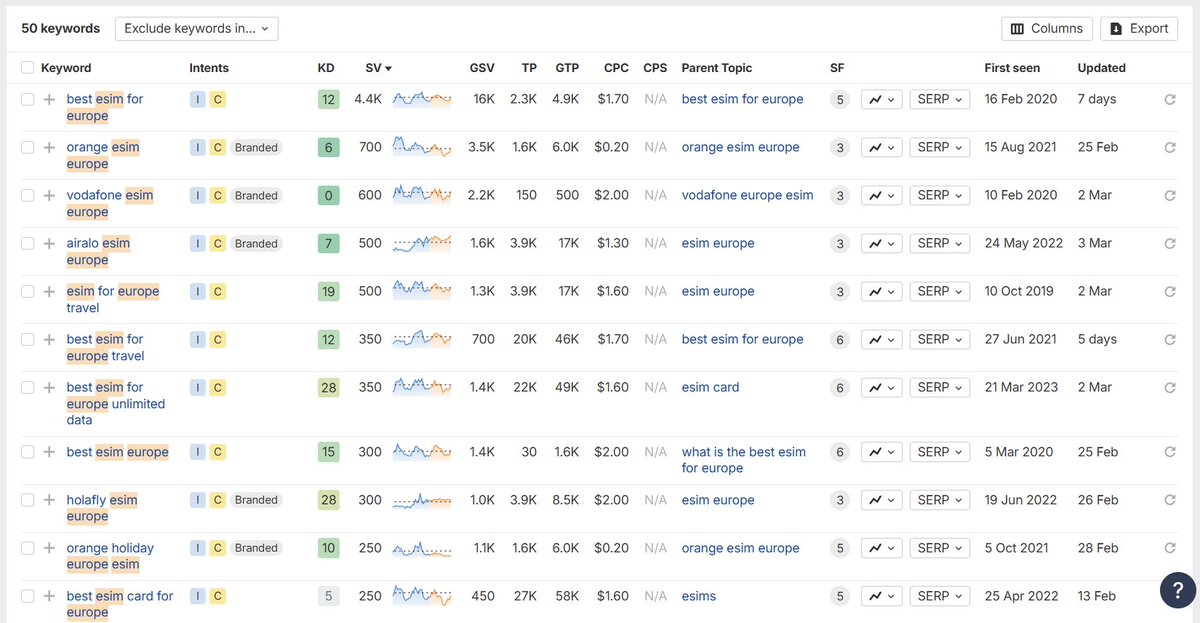
Noob SEO: Let's target the keyword: "eSIM for travel" To do that, we'll spin up 500 pages, swap out the country name, and change a sentence or two. Pro SEO: We can target "eSIM for travel", but it's a competitive keyword. And it'll take time. Let's give ourselves more opportunities to win and build out additional pages to also target keywords like: - esim for europe travel - esim for asia - best esim for japan Those keywords are more specific, so they'll convert better, and they're easier to rank for. Noob SEO: In terms of content, let's just swap the country name and publish. Pro SEO: Swapped country names isn't content. It's thin pages waiting to get ignored. Use AI to analyze the SERP for each target country. What's ranking? What are people asking? What's the local angle? Then use that data to write pages with genuinely unique content per location. Not just "Best eSIM for Germany" with Germany swapped in. But content that reflects what German travelers care about, which networks matter there, what the local competition looks like. Noob SEO: No need for backlinks. The pages will rank on their own. Pro SEO: Authority is everything in SEO, so don't sleep on link building. Build 10-20 quality links a month, spread across your homepage, pSEO pages, and blog content, so it looks natural and doesn't get you penalized by Google. This is how pSEO needs to be done in 2026 ☝️

@Charles_SEO ·
We're now being cited in Google AI Overviews for core SEO terms.. right next to Moz and SEMRush 👀 No links, no authority play, just clever old school NLP SEO re-tuned for the new AI search interface... Here is the STEP-BY-STEP play: 1 - Reverse engineer SERP gaps; Your site needs to be able to rank in the traditional algo first, so pages where you are already in the top 100 are a must and the higher the start, the better the result. 2 - Identify the gaps between what THEY cover and what the AI Overview is trying to answer. 3 - Write a section on YOUR page that fills that exact gap, formatted clearly with a definition, example, or list that Google can easily extract as a standalone chunk. I added several more anchor text types using this exact method, "generic" wasn't the only one I targeted here. 4 - Make sure that chunk can stand alone as a complete answer to a sub-question within the broader topic. That's it! You're not competing for the whole page, you're competing for ONE chunk of the AI Overview. It's very similar to how we used to optimize for featured snippets, but with a lot more dynamic inputs required - It's usually not the one H2 anymore, you need to optimize (at least) several chunks to have the best chance of getting visibility. In this case, we were cited for the definition because our page had the clearest, most concise explanation with a practical example - Something our competitors either buried in paragraphs or didn't isolate properly. Unfortunately, we usually don't get to directly "win" a #1 spot anymore in these new SERPs, BUT the upside is you can now get visibility for queries your page would NEVER have ranked #1 for traditionally.. and you can get cited MULTIPLE times across the same AI Overview if you optimize several chunks well. Less clicks, more visibility and "brand awareness" - A lot of corporate marketers would actually prefer this anyway.... And this all rewards going broader and deeper on your pages. The more well structured, extractable chunks you have, the more chances you give Google to pull from you. The traditional algo is linear, this new search is much more dynamic, less ranking, more retrieval.


@codyschneider ·
stop over complicating SEO for saas just do this bottom of funnel keywords using the data for SEO API keywords like X vs Y product, X alternative, X for Y, how to X for the target keyword, you have this serper .dev API key to scrape lets rank on page one then extract the blog post content from each of these pages using exa AI api or Firecrawl or just an HTTPS request put this researched content into the context window then have them record a 20 to 30 minute transcript of you talking about your category and differentiation and opinions use the extracted, use the research texts and your unique point of view to write the content for the target keyword publish it through your CMS API every 30 days, refresh the article, based on the content gap analysis of page 1 and your live search console data inject call to actions after the first paragraph, 25%, 50%, 75% down the page track which pages are making inbound leads by connecting your Google analytics and looking at landing page vs the lead generation event action let your age and understand with content makes the most signups for you build more content like this

@SEOKeval ·
Here's how 90% of agencies do SEO: 7 blog posts a month targeting keywords like "compression socks benefits" and "how to size compression socks." 8 backlinks a month to those blog posts. And then they brag about how much traffic increased. Here's how they should be doing SEO: Build as many product category pages as you can targeting relevant transactional keywords like: > compression socks for women > compression socks for travel > compression socks for shin splints > compression socks for nurses Add content to those pages that include internal links cross-linking them. Publish blog content targeting competitor "vs" keywords like: > bombas vs sockwell compression socks > bombas vs comrad compression socks > sockwell vs wellow compression socks Within the content, compare both brands, but then list your brand as a better alternative to both. Publish blog content targeting competitor "alternative" keywords like: > bombas alternative > sockwell alternative > wellow alternative Within the content, list your brand as the top alternative. And then build half of your backlinks to your homepage, and the remainder of the links to your product category pages and blog content. Your traffic will still grow, but it'll also convert into purchases. Which is the whole point of SEO.
@jakezward ·
Successful SEO looks like: - 120 new blog posts - 60 high DR backlinks - 500 AI-created pages - 1,000% growth in traffic But remember, it also looks like: - Removing 3 cannibalising pages - Improving a cluster’s internal linking - Tweaking 5 titles for better targeting - Fixing internal links to canonical pages - Writing a featured snippet in 10 minutes - No-indexing low-quality pages in Google - Redirecting a 404 page with 30 backlinks - Creating indexable URLs for 15 sales pages - Adding a new section to an existing blog post Don’t forget to consistently do the little things. They can be just as impactful.
 Watch video
@foley_seo ·
SEO TIP! Indexing is the FOUNDATION of everything SEO and subsequently AI/LLM citations to a degree where query-fan outs and grounding are concerned. And yet INDEXING is where I see most of the issues during auditing. To make it ABUNDANTLY clear - it is now MUCH harder to get Google to index content, primarily because there are more considerations Google makes before indexing a URL. Indexing performance has so many variables: ➡️ The domains overall quality score ➡️ Domain trust factors (history, authority, patterns, behaviours) ➡️ The strength of domain & associated brand ➡️ Accessibility of content (links, rendering, presentation) ➡️ Content quality itself (uniqueness, value, NLP, E-E-A-T/YMYL etc) Google is SIGNIFICANTLY more conservative with indexing now - primarily because: ❌ 1. It was unsustainable for GOOGLE to index EVERYTHING with the potential for only serving a small portion of all that content ❌ 2. It costs ££££ to crawl, render, index, store and process/recall that data, so it makes sense to filter content at source before indexing - this reduces index and render/processing burden. ❌ 3. SERPS naturally have variation, it's how Google can better understand user behaviour modelling against inferred intent - document variation means the probability of "similar" documents ranking goes down, now imagine you have thousands of similar documents (because traditionally content strategies often hinged off copying those who ranked - leading to a surplus of the same content" There's loads of other things: 🧠 1. Next word pattern matching - AI content isn't the problem per se, but, low effort content (AI produced) has a higher probability of poorer engagement or not adding unique value 🧠 2. Traditional click forecasts / CTR 🧠 3. Internal link counts, link equity distribution Then there's the domain itself - a domains overall quality scoring can be determined by the behaviours exhibited in things like content growth and link growth - less trustworthy domains will find it harder to get content indexed - same for newer domains. Scaled content abuse is raising the bar to indexing. I see FAR more sites suffering indexing issues than in the past, primarily because over the years they;'ve been through various SEOs / agencies and ultimately it's lead to a mish mash of strategies - some of which could of been damaging in regards to trust. If you are struggling to get content indexed - it's usually not just a content issue. Young domains now don't benefit the way they used to - it's not a sandbox effect but more a trust effect that limits how quickly that content is weighted/indexed. I could go on but yeah - if anyone is having to force indexing of content it;'s likely they'll face ongoing challenges to get content making momentum. #seo #seotips


@romanbuildsaas ·
Cool SEO strategy that will get you a lot of clicks Imagine you’re in a highly competitive market and you’re nobody. You have big players dominating all the traffic. Some people will tell you SEO is dead for you. I see a huge opportunity. Instead of doing comparisons like: - Your tool vs a big tool (No one cares about your tool and no one will search your name) Write an article like: -[Category Leader] vs [Category Leader] Comparison Make it BETTER than the content those two companies publish. Or even better, find a comparison between two big players that no one has done yet. And in the article, subtly position your tool. You’ll capture traffic from both competitors and redirect it to your product. Every article we’ve done like this gets immediate traction.

@glenngabe ·
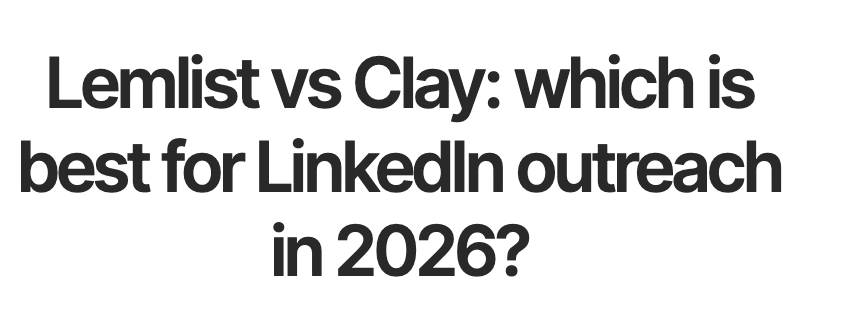
New from Google's Brendon Kraham -> Good SEO is good GEO "Our new generative AI features are rooted in the same core ranking and quality systems as traditional Search. And, because these AI experiences retrieve up-to-date content from the existing search index, the best formula for success remains foundational SEO." Some things to keep in mind according to Brendon: 1. Don’t worry about all the new names. Good GEO, AEO, LLM SEO is good SEO 2. Don’t optimize for bots. Optimize for people. There’s no need to write awkward, keyword-stuffed copy or chunk your content into tiny, artificial snippets. Our systems understand language just like a human. 2a. Also, chasing inauthentic mentions is not helpful as it might seem. 3. Don’t focus on generic content. Prioritize your unique perspective 4. Don’t forget your website. Build a great web experience https://t.co/XvHgA3SqQN


@jbobbink ·
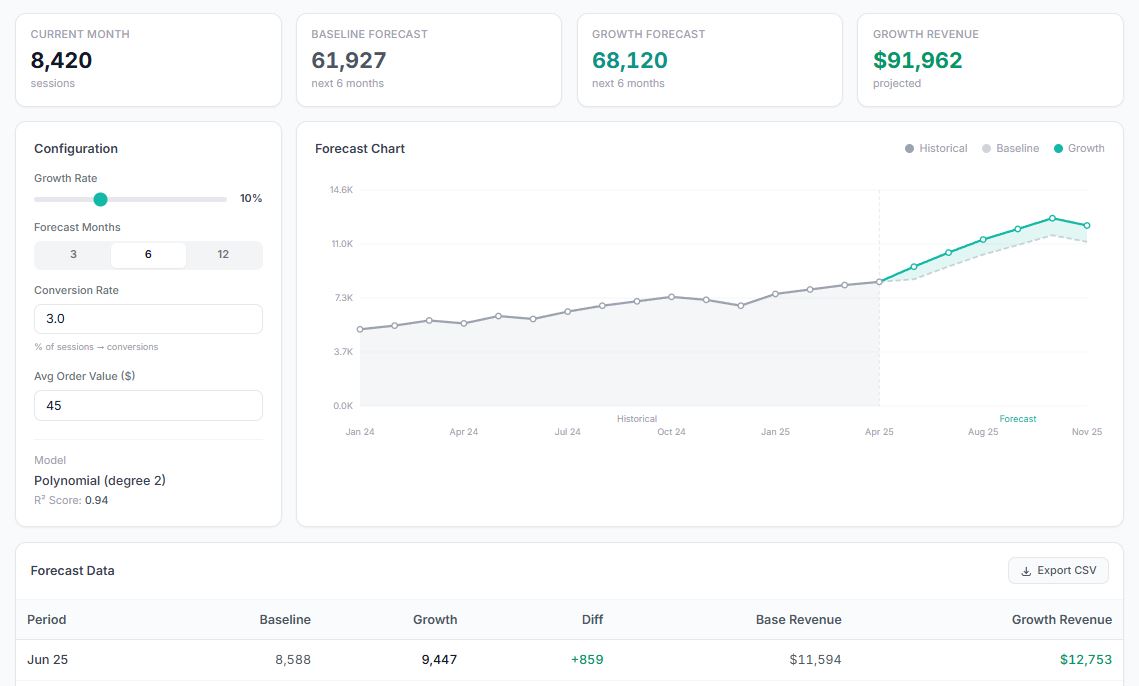
I told a CMO their SEO would generate 2.4M euros next quarter. They finally approved the budget. SEO has a credibility problem. Every other marketing channel can project revenue. Paid ads. Email. Social. They all have forecasting models that finance teams understand. SEO? We show traffic graphs and hope for the best. I built a forecasting model that translates GSC click data into revenue projections. Baseline scenario versus growth scenario. Seasonal pattern recognition built in. Configurable conversion rates and average order values. When I showed a CMO the baseline projection for Q2, it was clear. Without investment, organic revenue would flatten at 1.8M euros. With a content refresh program, the growth scenario hit 2.4M euros. That is not a traffic chart. That is a business case. And it got approved in one meeting. For enterprise organizations, this solves the eternal problem of justifying SEO headcount. When you can show projected revenue impact with seasonal adjustments, you are speaking the language of the C-suite. Mid-size companies benefit even more. You do not have a dedicated SEO team. You need to prove that the one SEO hire or agency retainer is worth it. Revenue projections do that. The seasonal pattern recognition is underrated. If your business has peaks and valleys, the model accounts for that instead of showing a straight-line projection that nobody believes. SEO is not going to get bigger budgets by showing impressions. It is going to get bigger budgets by showing money. Most SEOs still have not figured out how to do that.
@mehrab_build ·
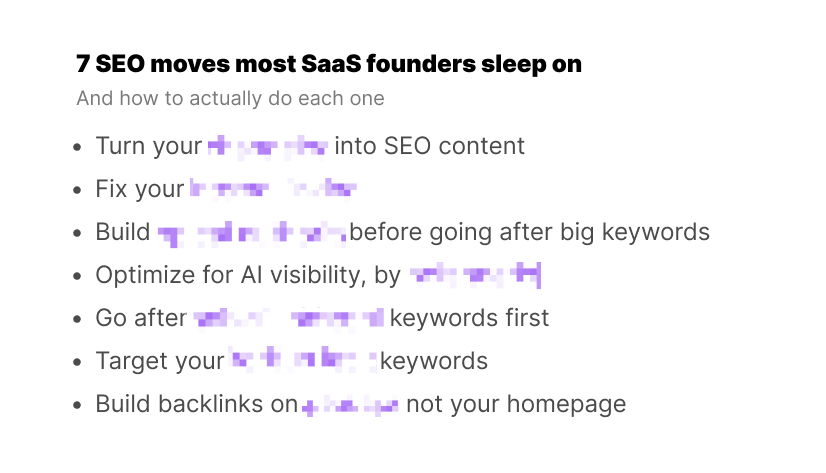
7 SEO moves most SaaS founders sleep on 👇 1. Turn your changelog into SEO content Every feature update is a keyword opportunity. Write a proper page for each one. Compounds over time. 2. Fix your internal linking Most SaaS sites have orphan pages sitting with zero internal links. Every new page you publish should link to and from at least 2-3 existing pages. 3. Build topical authority before going after big keywords Don't start with high volume. Build a cluster of supporting content first, then go after the pillar keyword once Google trusts your site on the topic. 4. Optimize for AI visibility by guest posts ChatGPT and Perplexity pull from third-party mentions, not your website. Get featured in "best X" listicles across trusted publications. That's what gets you cited. 5. Go after bottom of funnel keywords first "[your tool] alternative" and "[competitor] vs [you]" keywords convert way higher than informational ones. These are buyers, not browsers. 6. Target your competitors' keywords Your competitors are ranking for keywords you don't know about. Find their top pages on Ahrefs, create better content, and take their traffic. 7. Build backlinks on content, not your homepage Editorial links on blog posts and listicles are easier to earn and more natural. Your homepage doesn't need all the links. none of this is complicated but most founders just don't execute consistently.
@Charles_SEO ·
Stop taking SEO so seriously!!! 🙌 No site stays #1 forever. Google updates will mess up your plans. Links will get devalued. Traffic will fluctuate. Take risks. Test everything. Enjoy the process. An SEO too scared to experiment is an SEO that never ranks! Like any other investment, rankings aren't something you should be emotionally attached to. The people who last in this industry aren’t the ones obsessing over every ranking and fluctuation. You’re playing a game controlled by an opaque algorithm run by a trillion dollar company, instability is the baseline, not the exception. Most SEOs fail because they want certainty in an environment that rewards chaos. They want rules written in stone when the only constant is change. And the ones who do often seek out knowledge just end up waiting for confirmation that something works… by which time the opportunity is already dead. The real advantage isn’t knowing what works today. It’s building the instinct for what might work tomorrow. And that only comes from experimentation, pattern recognition, and a thick enough skin to take losses without spiraling. Just remember, SEO is supposed to be fun.

@DmytroKrasun ·
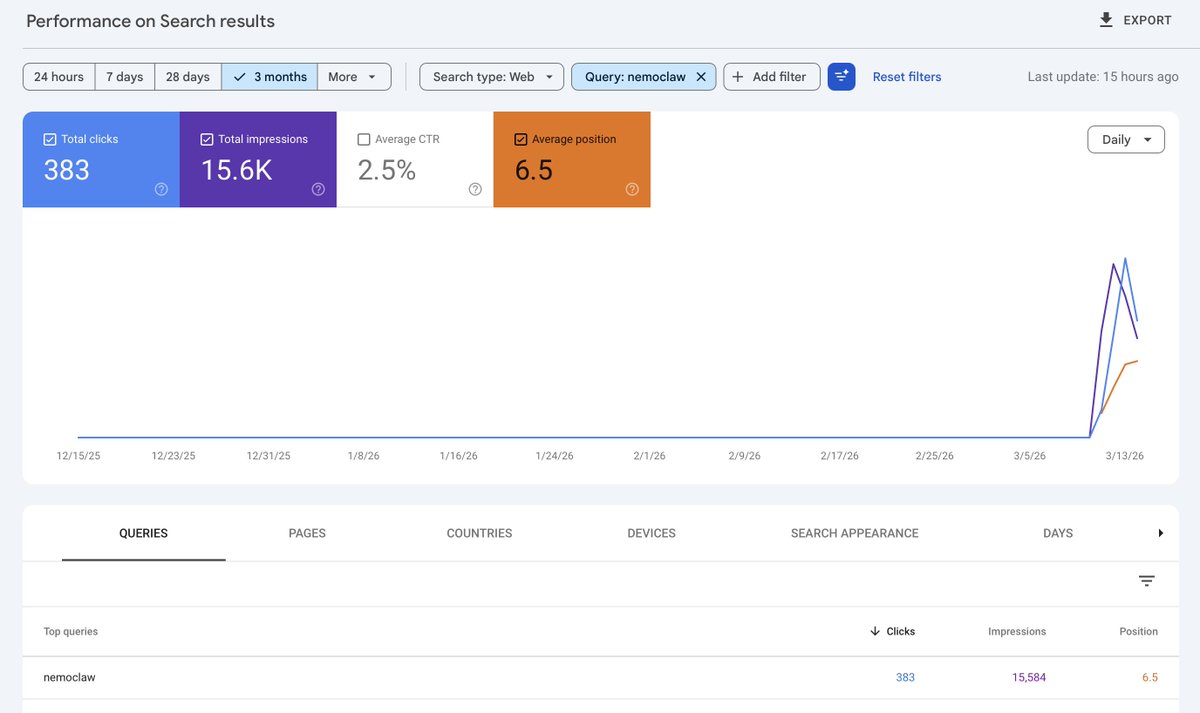
Trying a new SEO approach (for me): trend/announcement-driven content. I see something interesting has just been announced. I research it, dive deeper, and post about it. I don't expect this to lead to conversions, but it might have second-order effects, e.g., internal links distributing traffic/page authority to other pages. A few days ago, it was NemoClaw for me by NVIDIA. I was curious what the difference was between it and OpenClaw. And since I already researched it, why not post the summary? Results: https://t.co/QCDtpMz8KS

@Hartdrawss ·
90% of Founders have BROKEN SEO. Here’s the full SEO CHEATSHEET : 1/ Make the H1 do its job > One H1 on the page > Problem + outcome in plain english > “Ship AI MVPs in 5 weeks” beats “Welcome to Our Platform” > If a stranger can’t tell what you do in 3 seconds, Google can’t either 2/ Fix your title tag > Include your category + who it’s for > “AI CRM for freelancers”, “Error tracking for indie SaaS” > This is what shows up in search and browser tabs > Make it specific, not cute 3/ Write a meta description for humans > 1–2 short sentences that make someone click > Promise a concrete benefit or answer > Avoid keyword salad and buzzwords > Google might rewrite it, but starting strong still matters 4/ Make the page fast and stable > Mobile‑first layout > Compressed images, no 20MB hero video > No layout shift when fonts or images load > Test it on 4G, not just office wifi 5/ Build a simple internal link structure > From the homepage, link clearly to: docs, pricing, 2–3 key feature pages > Use descriptive anchor text (“AI invoicing for freelancers”), not “click here” > Internal links tell Google what’s important and help users explore 6/ Say the words your users would search > Use their language in headlines and copy > “client portal” vs “stakeholder experience hub” > “time tracking” vs “productivity optimization engine” > You’re trying to match intent, not win a poetry contest 7/ Keep it consistent > Same product name, promise, and category across H1, title, meta, hero, socials > Mixed signals confuse both users and crawlers If you just do this on your main page, you’re already ahead of half the SEO growth hack people.

@fba ·
For SEO to work, forget about spray and pray. Change your process, and keep it consistent. Before: prompt → publish After: - Topical map defines what gets written - SEO brief defines the angle, keyword, intent, structure - AI fills the brief, human adds the insight - Internal links connect it to the cluster Same tools. Completely different outputs.


@woocassh ·
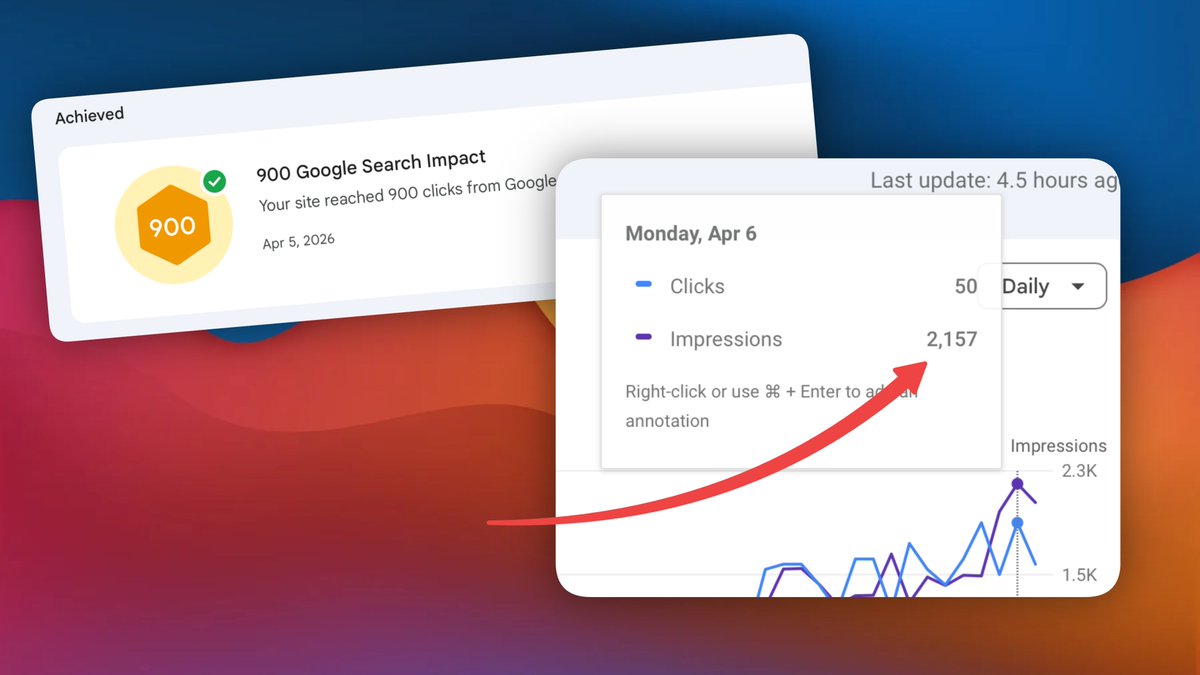
I reached a new SEO milestone! 🤯 > 2k impressions in a single day > 900+ clicks in 28 days 🚀 If you want to know, how here's how: > generate quality content relevant to my product (landing pages + blog posts) > submit sitemaps to google regularly > keep track of what content gets indexed and which doesn't > improve the content that didn't get indexed > rinse and repeat
@fba ·
The most simple SEO in the world: increase the CTR of the pages/keywords that are already showing up on Google. How? Update your meta descriptions/titles + and improve internal linking and/or refresh/expand your content. [images: results one week after automating this work with my tool]



@hustle_fred ·
got 6 sales this weekend❤️🔥 X brought 500+ visits last week SEO brough 118 visits i always thought you need to do something special for SEO, but i am just doing basics and it is growing writing articles, shipping free tools, getting backlinks this week will release new free tool + insane tool for X what are your plans?


@SEOKeval ·
Want to see something wild? I drove a 3-4x increase in NON-BRANDED organic traffic in 2 months. It's not from useless blog content either. The traffic increases are all to Product and Product Category pages. So sales are up a ton. I didn't do anything crazy: 1. Removed a lot of unused pages that were wasting Google's crawl budget. 2. Fixed nearly 60 broken links and broken backlinks. 3. Optimized Product Category pages for low-hanging fruit keyword opportunities that were just off the 1st page of Google. 4. Added content to the bottom of all Product Category pages that highlighted the product's USP, included a brief FAQ, and internally linked to other relevant Product Category pages. 5. Fixed several instances where Product Category pages were targeting multiple keywords of different search intent. 6. Improved the quality of the existing blog content, and built internal links from them to important Product Category pages. 7. Added important Product Category pages to the site's main navigation menu. I published new blog content and did link building as well, but it hasn't been enough time to see the results of that yet. The jump in organic traffic is strictly from dialing in keyword targeting and on-page SEO, improving internal linking, and upgrading the overall quality of the site. Good SEO still starts with the basics.


@neilpatel ·
AI scans your page for a clean answer it can grab in one pull. Lead with it and you get cited. Bury it and you're invisible. Three fixes that beat months of technical SEO: open with the answer, no warm-up. Turn headings into the exact question someone types late at night. Build a real FAQ from how people actually talk, not keyword soup. The rules changed. Write for the scan. #SEO #AISearch #DigitalMarketing #ContentMarketing #GoogleSearch
 Watch video
@Manixh02 ·
SEO is Easy SEO: > fix indexing issues > add breadcrumbs > add canonical tags > fix core web vitals > fix orphan pages > add schema markup > fix heading structure > write original content > avoid duplicate content > get high quality backlinks > use clean, descriptive urls > fix broken links and 404s > check if content is crawlable > fix keyword cannibalization > make the site mobile friendly > add author bio / e-a-t signals > make titles 50-60 characters > write unique meta descriptions > merge thin or overlapping pages > optimize images and add alt text > match every page to search intent > find high volume, low kd keywords > add internal links to important pages
@askOkara ·
this is my favorite seo hack to improve organic traffic > go to https://t.co/M5laJrXX0V > connect google search console > ask it to find queries where you rank between positions 8–20, with high impressions and low ctr then suggest improvements > improve those pages
 Watch video
@Hartdrawss ·
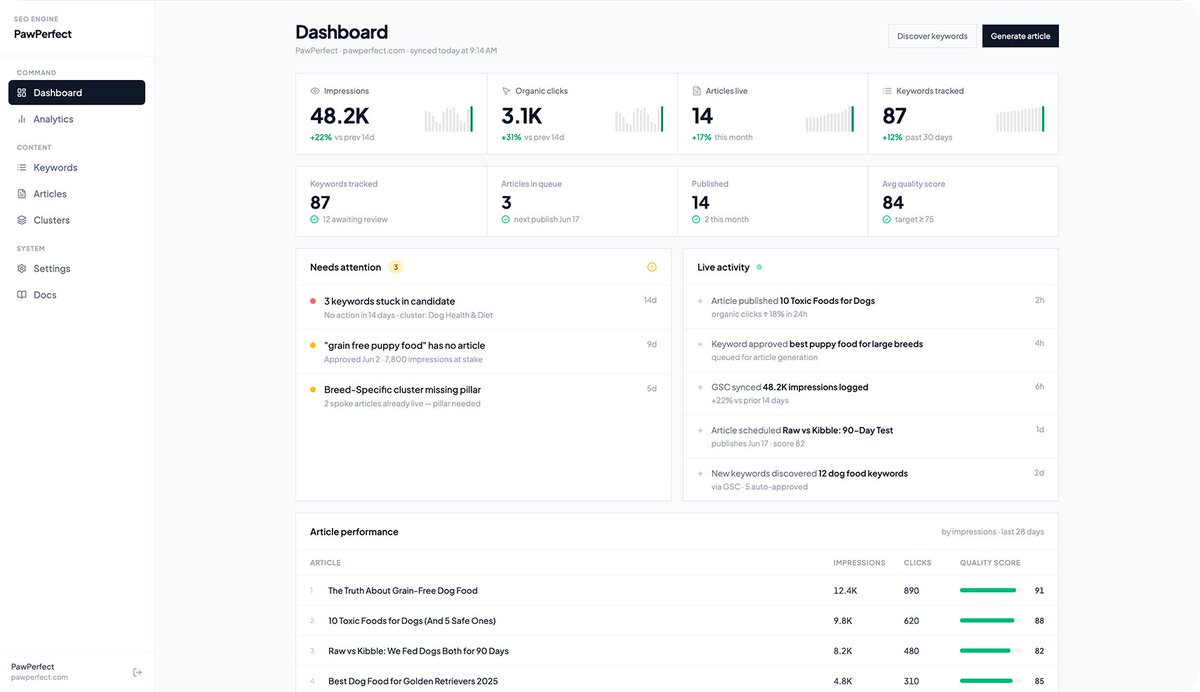
We just built a full AEO pipeline for a US family office. To simply explain; AEO = Answer Engine Optimisation. Instead of ranking on Google, the goal is to get cited inside ChatGPT, Perplexity, Claude and Gemini. Here’s the system we built: - Discovery Layer: Pulled quick-win keywords from Google Search Console (positions 5–20), cross-checked with Keyword Planner, then used Exa + AI to find real questions people are asking AI tools that traditional SEO completely misses - Content Layer: Competitor analysis to find angles others missed → structured briefs → articles written with ICP context + specially formatted Q&A blocks designed for how LLMs cite information → strict 6-dimension quality scoring before publishing. - Indexing Layer: Daily automated publishing with instant cache revalidation so new content is immediately visible to crawlers. - Tracking Layer: Daily GSC sync + dashboard that flags when keywords move, stall, or drop. This is the new SEO. Most agencies are still selling backlinks. What do you think though. is AEO already changing how you think about content?
@codyschneider ·
AI seach loves best x for y posts the more longtail the better how to build an agent that researches, writes, publishes and refreshes these use your coding agent to data for seo API to find longtail keyword variations for your product then use serper API to scrape page 1 what is currently ranking extract text with exa API or firecrawl API put into context recording a transcript of your unique point of view on your industry and your differentiation write the article based on both of these source context then publish to your CMS then monthly refresh the article based on the google search console live data stream, data for SEO api, and content gap analysis of what you're competing against and if you want to ship this exact agent everything you need is below

@semrush ·
Great SEO content is built with intention. Use this 12-step framework to improve your chances of ranking 👇 1. Find your primary keyword 2. Choose your secondary keywords 3. Analyze search intent 4. Make an outline 5. Create quality content 6. Leverage keywords in your content 7. Structure content with subheadings 8. Make your content easy to read 9. Add internal and external links 10. Create an optimized title tag and meta description 11. Optimize your URL slug 12. Get feedback on your content https://t.co/f7e8w5tCS8.


@fatjoedavies ·
Here's how I'm speedrunning SEO campaigns in 2025 (8 steps): 1st fix technical issues – This shouldn't be huge consideration unless huge obvious problems. I ensure site is crawlable, fast enough, has all the right tags in place. I do it once then move on. Tech SEO becomes more important if you're dealing with HUGE sites. 2nd fill content gaps – I update existing pages to optimise for already targetted topics, and create new ones to target missing opportunities. I do this once too, using human writers, ensuring super high quality with no 'em dashes' or 'no fluff' BS. 3rd build consistent links – A low but steady flow of blogger outreach and niche edits to the homepage (mostly) and money pages (10-20%). You can do a link gap analysis against competitors, but for the most part I like have my link building team build a nice low amount of mixed authority links, 10-20 links per month, set and forget - but be consistent. 4th build link magnets - Every site should have some link magnets, like an industry calculator, statistics page, or survey (if you have audience/budget). You should get these to rank or even run a low cost PPC campaign to them to build a steady endless flow of earned links. 5th run a digital PR campaign – This is to earn the authority layer of links, the ones my competitors will struggle to get. I use my digital pr team to create unlimited campaigns (most fail, but some hit big) to gain those crème de la crème links that really move the needle. Needs to be done every 3-6 months. 6th Drop a brand mentions + community mentions combo – With LLMs and AI search I want the brand to show up with positive sentiment in answers. I want the brand to be recommended for their category. So seeding the brand in listicles, reviews and in community discussions (on Reddit/Quora) really helps this. May need to be done every quarter. 7th Local SEO stuff (if applicable) – Ensure they’re listed in all major local directories if they're a local client. Even if they're national it's still worth doing to get those brand signals. 8th Build a knowledge base – This is a new one I have started recommending. Cover every FAQ, service detail, and product feature to own the conversation in the niche, in LLMs but also search. The more the engine knows about you, the more confident it will be to mention/recommend you. The goal is to build steady movement within weeks, but setting the campaign up for compounding growth over 6-12 months.

@illyism ·
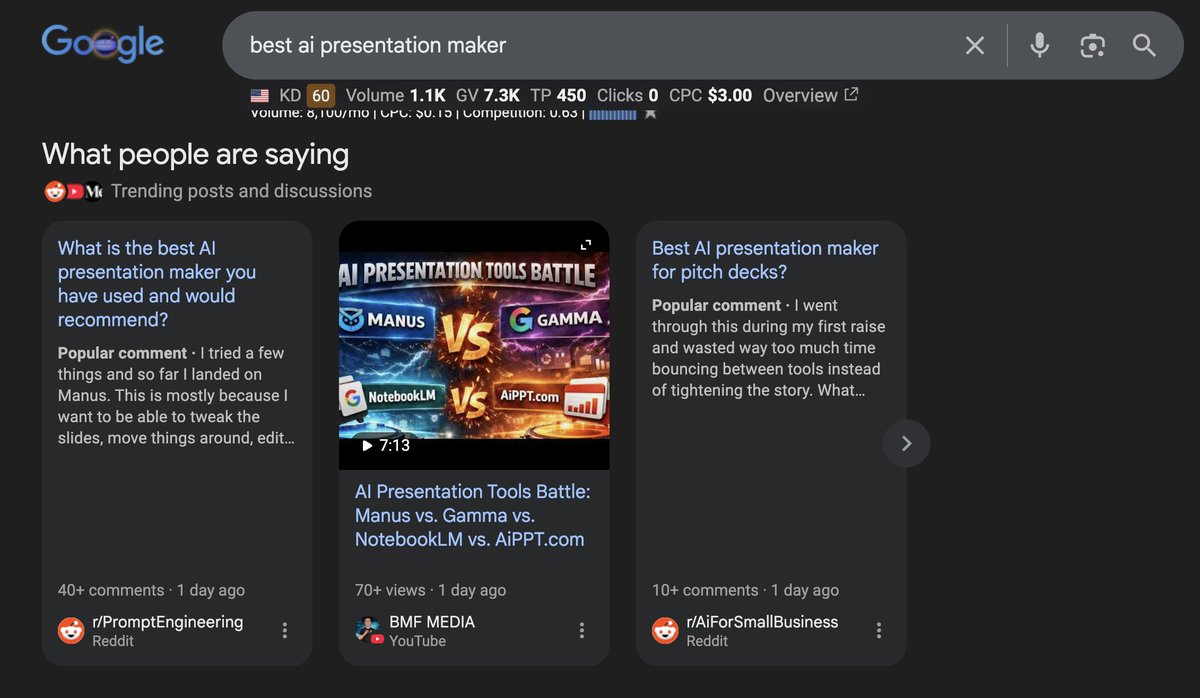
🚨 GOOGLE: now has a "what people are saying" box in search results pulling from: - youtube shorts - instagram reels - linkedin posts - reddit - x/twitter - medium if you're only doing blog SEO you're missing half the SERP real estate, social is now part of the SEO channel

@hridoyreh ·
SEO is fun if you do it right. I got 249,000+ visitors in 16 months by, ➟ Fixing technical issues ➟ Improving content consistently ➟ Building quality backlinks This is a free tools-based website. And, I make money from ads...
 Watch video
@RobHoffman_ ·
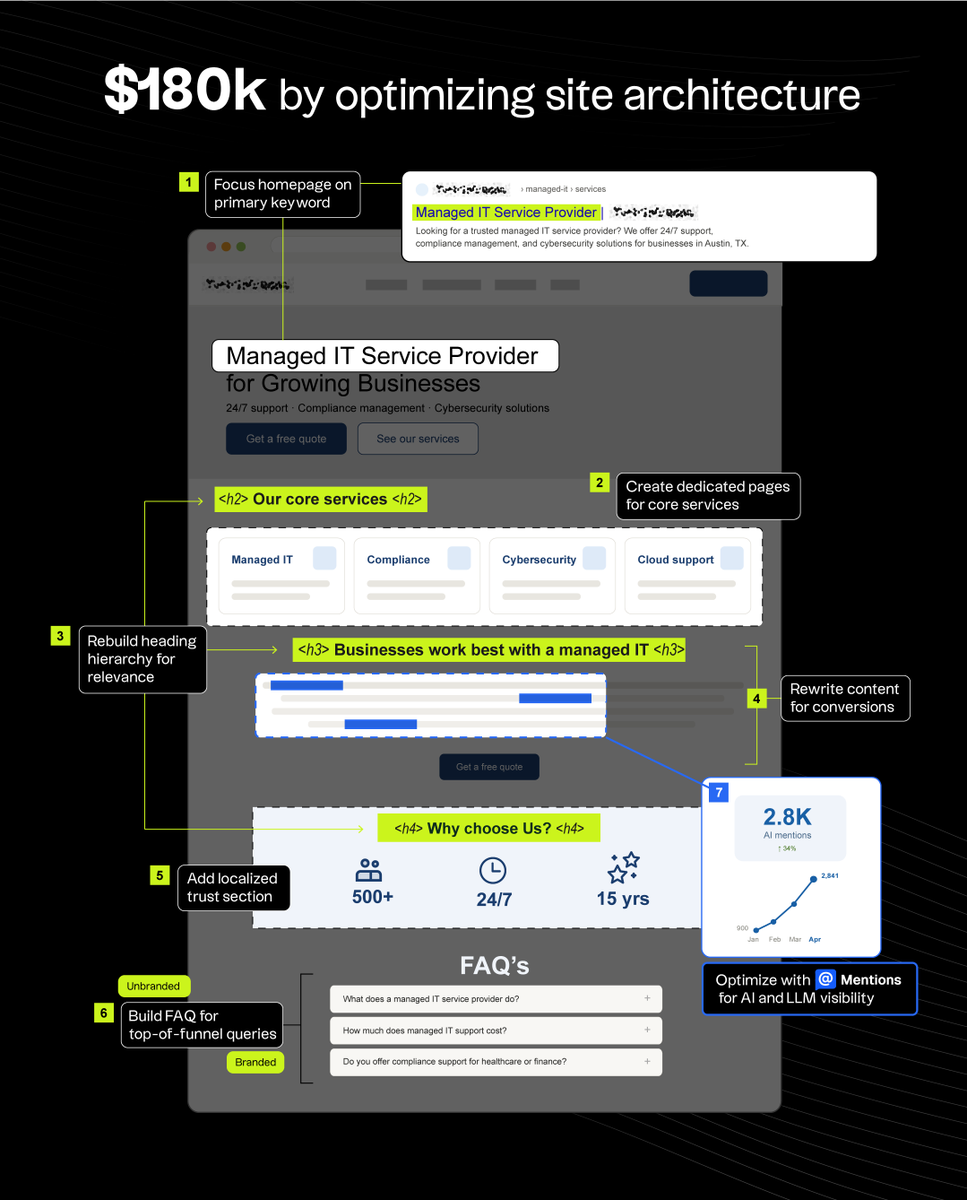
don't buy into the hype on X that spamming SEO articles with Claude will get you traffic/leads. our SEO client made $180,000 last month and we didn't create any new pages. We just optimized their site architecture. here's how: the client is a managed IT and security compliance company. the problem: they were trying to rank for everything at once: managed IT, security compliance, and more, with no clear hierarchy between them. here's how we fixed that and got their money pages ranking: 1. Focused the homepage on their most valuable keyword: "managed IT service provider" 2. Created dedicated pages for their core compliance and security services 3. Rebuilt the heading hierarchy to signal topical relevance 4. Rewrote entire sections of content to read like a buying page, not a blog post 5. Added a localized "Why Choose Us" section to their content for trust 6. Built an FAQ section covering both branded and unbranded high-funnel queries 7. Used Mentions to see what phrases were getting the most AI visibility, then optimized their content around those to rank in LLMs (that last one matters more than most people realize). The lesson: before you publish more pages, make sure your site is optimized.

@TheCoolestCool ·
Google says AI search optimization still comes back to SEO fundamentals. Start here: 1. Publish first-hand, non-commodity content 2. Keep technical SEO clean 3. Skip gimmicks like LLMs.txt for Google visibility Useful baseline. Incomplete playbook. 📈 https://t.co/lDERbN1Jzs

@thinking_slow ·
a self-sabotaging tendency i notice in marketing is to deem a tactic worthless and abandon it after a slight reduction in its usefulness. many were quick to declare SEO dead because organic traffic to many websites has declined. programmatic SEO faces the same belief. or free tools: anyone can create one, so why bother? the reality is that we, as marketers, must extract every ounce of benefit from each tactic available to us. abandoning a proven marketing channel simply because it's become harder does nothing but cede opportunity to your competitors. it's our job to be pragmatic. we can't afford to throw the baby out with the bath water. maybe you won't get a million page views per month with programmatic content anymore, but would you settle for a hundred thousand, or even ten thousand, if it puts you in a better position than you are now? and maybe it’s easier for your competitors to build free tools—but how many actually have? how many have grasped the opportunity now available to them and executed it in a useful, effective, competent way? i suspect very few. you have more opportunity than you realize. and sure, maybe SEO is harder, but the last time i checked it still accounted for about 40% of all the traffic sent to the average website (not to mention providing the infrastructure that makes AI search work). are you willing to throw that away? as I wrote in an Ahrefs blog post, SEO is the worst it's ever been... and it's still your best marketing channel outside of the social media bubble, it doesn't matter whether something is deemed dead or dying. all that matters is whether it will be useful to you. is there some marginal benefit offered by this strategy over and above what you could otherwise have? for programmatic SEO, for free tool SEO strategies, for other apparently "dying" forms of SEO, the answer is usually a resounding "yes". pragmatism always beats nihilism.
@hridoyreh ·
Updating old posts is not an easy task. I got GOOD results after updating a post. ➟ Last 3 months: 4,000+ traffic ➟ Previous 28 months: 600+ traffic ➟ 1.2% CTR increase Here's what I did in SEO:
 Watch video
@aleyda ·
🚨 This week's SEO & AI Search News of the Week with #SEOFOMO [January 18, 2026] 👇 * OpenAI will start to test ads in the US for the Free and Go tiers - Who would have seen this coming? 😉 * Apple is finally upgrading Siri, and Google Gemini will power it * Google Trends Explore page now uses Gemini to delve into Search trends (Sadly, is not Gemini search data within Google Trends) * Microsoft Advertising releases a Guide to AEO and GEO for Retailers * Google’s December 2025 Core Update: Winners, Losers & Analysis * The SEO Chapter from The 2025 Web Almanac * What Comes Next for News SEO and Publishers * Making Sense of Next.js Caching for Developers and SEOs * Clicks, Impressions, and Positions from AI Mode in Google Search Console + Much more, including SEO jobs, events, tools - from specialists like @alexmoss @lilyraynyc @gfiorelli1 @JShehata @WillKennard @miknaraujo @chrisgreenseo @ChouinardJC @DemiriE & more! Check it out: https://t.co/hnrMpl6J44


@omarships ·
Anyone who says “SEO is dead” is usually just trying to sell you some alternative. Here’s a 5-minute SEO win most people skip: 1. Google Search Console → Performance 2. Set date range to last 6 months → Export 3. Upload the Pages.csv + Queries.csv into any AI 4. Prompt: “Show me queries I already rank for (positions 4-20) that don’t have dedicated content yet” Write those pages. You’ll often start ranking in weeks, not months. PS: Don’t sleep on Bing either
@aleyda ·
The 🔥 SEO & AI Search News of the Week from #SEOFOMO 👇 * Google AI Mode’s Personal Intelligence Now Free In US: You can opt in by connecting apps through their Search or Gemini settings * Google shares Universal Commerce Protocol updates that improve AI shopping for retailers: They say to be actively working to onboard more retailers of all sizes * Google confirms AI headline rewrites test in Search results: Google called this one of many routine experiments * Google "Developing" Opt-Out of Generative AI Features in Search: Great news for publishers asking for more control * Google tightens rules on out-of-stock product pages: Google also expects clear availability messaging on the product page * How to Get Buy-in for SEO with Data Storytelling: Prioritize easy understanding and familiarity * Walmart: ChatGPT checkout converted 3x worse than website: The in-chat purchase experience was “unsatisfying” * How AI Search Personalizes Fan-Out Queries Using Memory and Context: Context is king * Much more! From SEOs like @CrystalontheWeb @lazarinastoy @pedrodias @gfiorelli1 and more. Read it: https://t.co/ZmWBhvg1QG


@bohdan_ly ·
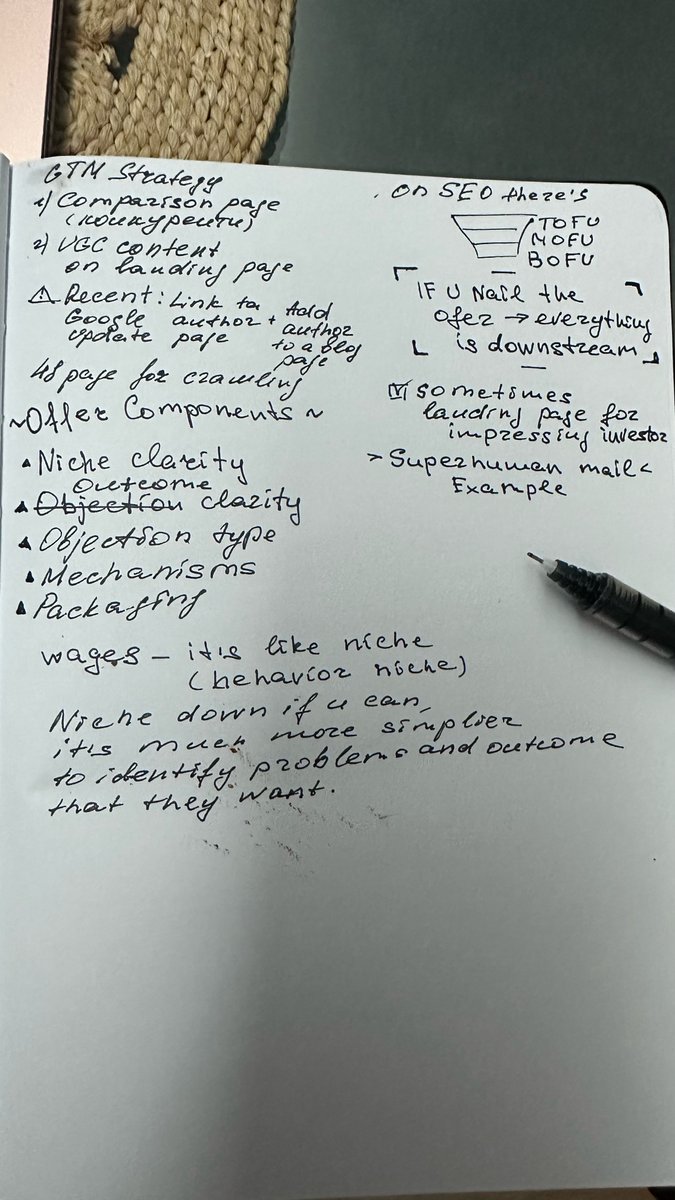
I watched @lamxnt and @RobHoffman_ tear apart a SaaS GTM strategy for an hour. filled two pages of notes. 2 hrs in total packaged in one 5 min post below. three ideas completely changed how I think about SEO: 1. Alternative pages don't work alone. You need a content cluster: • Alternative • Versus • Best X They should all link to each other. One isolated page is just another forgotten landing page. 2. Stop pretending to be objective. Put your real name on comparison pages. Write in first person. "I tested these tools. Here's my methodology." Google and buyers trust accountable opinions more than anonymous "neutral" content. Unstated bias is the real problem. 3. Ranking isn't the goal. Conversion is. Most comparison pages look like polished SaaS landing pages. Buyers don't want another pitch. They want evidence. ✓ Social proof ✓ Real testing ✓ A clear recommendation The biggest insight, though, had nothing to do with SEO. Everything is downstream from the offer. A weak offer makes you spend months optimizing pages that were never going to convert. A strong offer makes every channel work harder. Tonight I'm auditing ours against four questions: → Is the niche painfully clear? → What objection are we solving? → What's our unique mechanism? → Is the packaging obvious? One last takeaway: ✘ Don't niche down by demographics ✓ Niche down by behavior The narrower the behavior you serve, the easier it is to describe the problem - and become the obvious solution. Narrow beats clever. Huge shoutout for @lamxnt and @RobHoffman_ ! Worth every minute watching.
@illyism ·
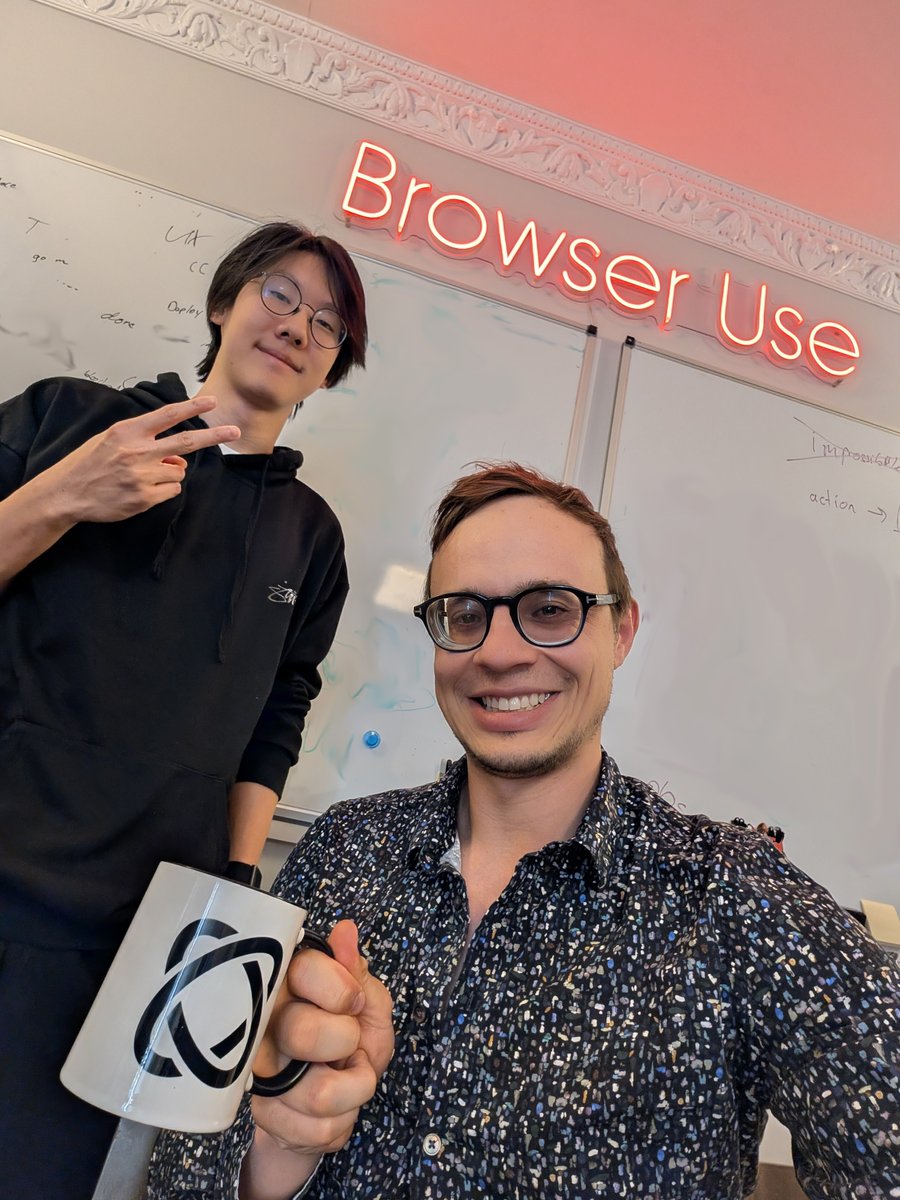
I just finished a live SEO roast for @browser_use in their office They already have the hard part: DR 69 (hehe), real love froms devs, strong docs, open source, and people naturally linking to them But Google still needs the obvious spelled out Their homepage should say the category clearly: → "AI browser automation platform" Then a few small leaks always show up fast: missing canonicals, technical seo issues, and external backlinks to competitors without nofollow 🫣 But the bigger gap was content They rank from docs, but competitors are winning with boring listicles like “best browser automation tools” They have a few blog posts, no traffic, Firecrawl, a competitor has 120+ blog posts with 5k traffic/month, so you need to actively write content to catch up. And also, just one page is not enough "SEO" anymore You can win by surrounding the SERP in as many ways as possible, improve your SEO title, write a blog post listicle, get mentioned on Reddit/Quora/forums, email everyone ranking in the top 100 on Google for the keyword, do an affiliate program Even the best product still needs to be explained clearly, linked properly, and repeated everywhere Google looks!

@gaetano_nyc ·
I've been VERY critical on "What is X" content. It's TOFU. It's worthless. Clicks get sabotaged by AI. etc. But what if Google Ads data tells you otherwise? What if meaningful conversions are coming from basic keywords? Sometimes, that's what happens in B2B SaaS. Especially high volume categories. You may get an occasional whale. So for this client, we built a page targeting [Intranet Portal] that even gets them recommended in the AI Overview under "dedicated platforms" PLUS the citation. Everything in SEO/GEO is category dependent and situation specific. What works for one brand, may not for another. Be open minded, use common sense and test things rationally. You may be surprised at what happens.

@semrush ·
Google just drew a clear line around AI search optimization: it’s SEO. On May 15, 2026, Google published its official guide, “Optimizing your website for generative AI features on Google Search.” John Mueller announced the release on the Google Search Central Blog, and Google added a new “Generative AI fundamentals” section to Search Central documentation. The biggest takeaway: if your content doesn’t meet the quality and technical standards needed to rank in traditional search, it won’t win visibility in AI-generated answers either. Google also shut down several popular GEO tactics. According to the guide, SEOs can ignore llms.txt files, AI-only rewrites, content “chunking,” and special Markdown or schema implementations built solely for generative AI visibility. The broader message is even bigger: Google frames AEO and GEO as extensions of SEO – not separate disciplines with separate playbooks. AI visibility runs on the same foundations: strong technical SEO, authoritative content, and clear site structure. Learn more: https://t.co/Eo8oFgg5Lz.
@fatjoedavies ·
White hat SEOs tell you this: Build a great brand, create great content, ensure the website is technically sound for crawling and the information architecture is optimal. Any kind of solicited link building is risky, you should attract links/mentions. Search will reward you, visitors and buyers will come. Black Hat SEOs tell you this: Google/Search Engines are not the law. Find out how the algorithm works and exploit it. Get there faster by gaming the system. Build links, buy links, do what it takes. Your competitors are doing it, so you need to do it. Money Hat SEOs tell you this: Do both. Building a brand and a great website and creating amazing content is great for business, for many other reasons a lot bigger than our little SEO corner. But also - Live in reality. Don't sit around waiting for an algorithm to reward you, there are strategies that are low risk/high reward that make absolute sense in competitive markets. Apply strategies such as link building/Digital PR/mentions sensibly, but do not ignore naively and miss out on huge upside.

@5le ·
Stop calling your blog posts SEO. They're not. So many of my potential consulting leads have this question: what should they do with their SEO blog now that they suspect it doesn't work? A company publishes two posts a week, targets high-volume keywords, and follows every rule the agency gave them. Yet, traffic is flat and they want to know what's broken. This isn't SEO. At best, it's content marketing, and since nobody wrote it for an actual audience, not even that. It's just content, sold to you as SEO, by people who needed something to bill for. Real SEO has one job: make your product findable at the exact moment someone's ready to use it. That's it. Content marketing and SEO are not the same function. One is measured in subscribers and brand recall. The other is measured in signups, trials, and pipeline. Stop grading them on the same curve. Find the moment of intent and put the product there. Everything else is just writing.
@foley_seo ·
This is what happens when you let ANY SEO near your website when they implement one of those bullshit programmatic SEO strategies...... The thing is - ➡️ You can clean the content out and remove it all ➡️ You can file a review request ➡️ You can wait, suffer, lose revenue But the reality is - ❌ Site-wide penalties often take much longer to resolve ❌ Even AFTER you get a successful review and removal of a manual action you can BURN the domain - making it significantly harder for a period of time to recover or even gain new clicks ❌ This happens to quite a lot of businesses who have cheaped out on SEO - bottom end tactics usually always end up with short cuts Here's my advice: 1. Use AI to curate a content brief, to prioritise content by INFORMATION PRIORITY 2. You can use hybrid AI + human editorial, AI can draft the content, perform research, cite sources, fact check, a human editor can validate, add style, flare and value to the content 3. STOP thinking of content as just text - think of it as IMAGES, VIDEOS, TOOLS, RESOURCES, things that people can use 4. START keeping in mind that we've seen a generational shift / behavioural shift towards SHORTER FORM content - thus why YT/Insta did reels and why TikTok blew up - it's because people engage with shorter form, punchy content 5. Remember - Your content's SCORING and PERCEIVED VALUE is impacted by: > How it looks > How it sounds > How well it engages > How well it helps end users > Behavioural metrics 6. If you want your content to do BETTER in LLMS - it should naturally be more visible and accessible - this means: > Ensure your content is not rendered via javascript > Ensure your content is clear, concise and is factually correct > Earn more links to your content > Earn more social mentions to your content SEO is still a long game because it's NOT about using AI TOOLS to spam the fuck out of google, it's about: > Building a high quality brand > Building trust through authority > Building trust through positive interaction > Building trust by earned media placements > Building trust by NOT taking shortcuts This is one of MANY site-wide manual actions I have seen this year, it certainly won't be the last. #seo

@neilpatel ·
Everyone says AI showed up and stole SEO's job. That's not what happened. For 20 years we did exactly what Google asked. Answer the question better than anyone. Cover every angle. Be the clearest, most complete result on the page. And we got so good at it that Google stopped needing to send you the visitor. It just reads your work out loud. The commercial searches you fought hardest to rank for? Those are the first ones getting answered without you. #SEO #AISearch #DigitalMarketing #ContentStrategy #GoogleSearch
 Watch video
@adrien_brbr ·
SEO has always been a black box to me So I handed the keys to a real pro -> CLAUDE But I armed him with everything he needed: - DataForSEO - Google Search Console - PostHog - Sanity CMS Connected it all, asked him to build a bulletproof strategy Here's what he cooked up: keyword research -> competitor analysis -> SERP analysis -> content calendar Now I've got a 3 month roadmap, 4 articles per week + Weekly SEO health check: - Hunt for new impressions, clicks, CTR shifts in GSC - Make sure new pages get indexed (force indexing after 48h if needed) - Dig into PostHog for blog traffic patterns - Track keyword rankings via DataForSEO (especially OpenClaw keywords - volume is moving fast) - Quick pulse check against monthly KPIs + Monthly deep SEO review: - Full keyword rankings sweep across all targets - Competitor gap analysis refresh - are they coming for our keywords? - Spot optimization wins: which articles get eyeballs but no clicks? (rewrite titles/meta) - Content calendar pivot based on what's actually working - Review backlink profile growth - Full KPIs report against targets (articles shipped, pages indexed, impressions, clicks, keywords in top 10/30/100) Let's see in 2 months if he was right
@jbobbink ·
Stop putting "improved internal linking, grew traffic 40%" in your SEO case studies. No one buys that. Instead: "Their top revenue pages averaged 3 internal links each. Their autogenerated blog tag pages had over 200. PageRank was pooling in pages without a single CTA. Money pages were buried at depth 7. Google thought their 2023 archive was more important than their product." That's not an optimization opportunity. That's your own site architecture sabotaging your pipeline. The reframe Old formula: Before → After → Result New formula: Hidden Problem → Escalation → Near Failure → Intervention → Stabilization Nobody gets fired for missing an "internal linking opportunity." People get fired when the VP of Marketing finds out the site has been actively burying its own money pages for 18 months. Stop selling upside. Start exposing the silent bleed. That's how SEO proposals close themselves.

@jmoserr ·
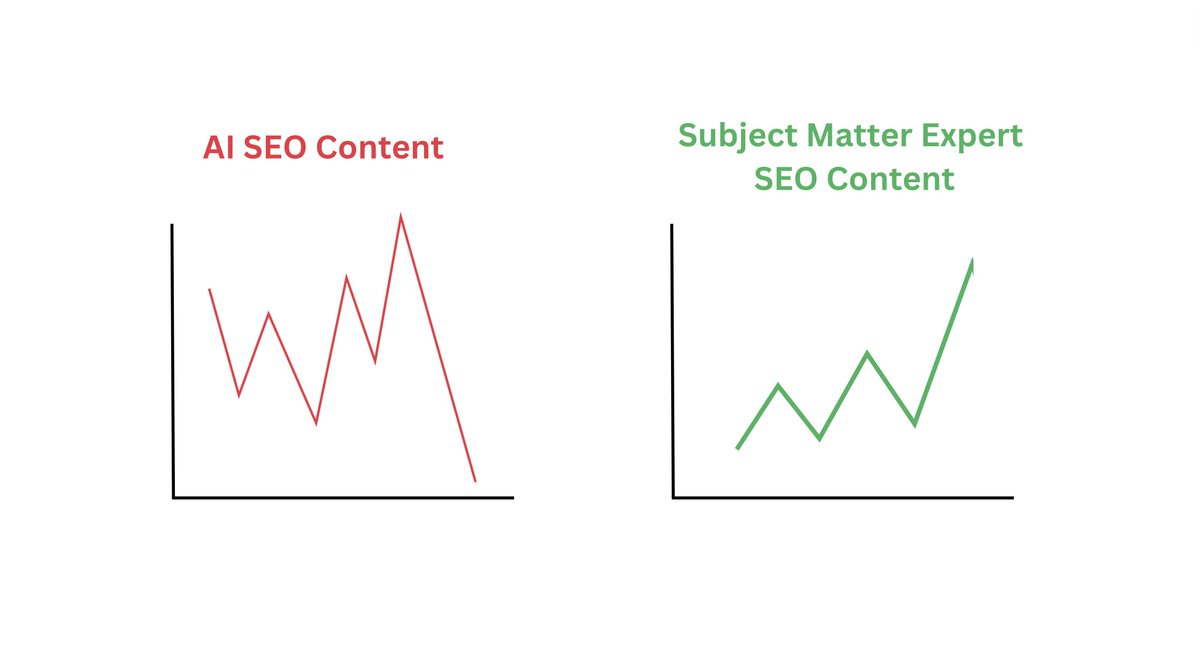
AI SEO content has been all the rage in the last 12 months. Yet every single AI case study I've seen shows the same trend.... Traffic explodes fast because you can generate 1000s of pages of content in seconds. Sounds awesome, right? Right...? But in just a matter of months, that traffic comes crashing down. And anyone that has spent more than two years in SEO understands one thing: Recovering a site that has been slammed by Google takes 10x as long as it took to get the traffic in the first place. Sure, this strategy might work for short-term cash grabs in the affiliate marketing space... But if you're a real brand looking to drive qualified leads, sustainably, and grow a real business...don't touch mass generated AI SEO content with a 900 foot pole. Almost anything you do can fool Google for a short period of time. But what happens when they catch on? Your work comes crashing down, and the road to recovery is not guaranteed nor predictable. Most brands wants to become NerdWallet overnight and dominate their space with page 1 rankings. Yet those same folks won't spend years publishing subject matter expert content, day in and day out, while acquiring PR and building links. The biggest key to success in SEO is longevity and consistency. There is rarely a "secret sauce" in SEO. In fact, any tool you use can show exactly what your competitors are doing. - They are researching their market. - They are finding valuable keywords that their target market is searching for. - They are creating great content that actually helps those people. - They are promoting that content to build links, site authority, and brand. And they are doing this for YEARS without stopping! They aren't doing 1 month trials of content and links to see "if it works." 🤦♂️ It works, you just aren't giving it the time it needs. People want NerdWallet success in 3 months...yet NerdWallet has been doing this for 15 years without stopping. If you can't afford to invest in SEO for 6+ months until your SEO program generates enough revenue to double-down, don't invest in SEO yet. 1 month of SEO is flushing cash down the toilet. If you want immediate wins, go pay for every single click and enjoy rising ad costs and endless bidding wars that drive margins to the bottom. If you want sustainable growth, invest in SEO for the long-term, and COMMIT to it.
@jmoserr ·
"SEO changes fast." False. The websites that have won and will continue to win have done 4 distinct things... 1. Created an easy to navigate, organized, fast website with a positive user experience (technical SEO) 2. Created interesting, helpful content that matches the intent of the researcher (content) 3. Promoted that content to earn links, build authority, and grow their brand in the eyes of consumers (link building / pr / brand) 4. Did the above three steps for a decade and did not stop We tend to overcomplicate SEO. Yes, algorithms do change, but the core foundations of SEO don't. You can give yourself stress and anxiety daily by reading SEO news, or you can just tune it out and put your nose to the grindstone and actually do the work.

@asaio87 ·
SEO takes that will get me unfollowed: 1/ your "content refresh" is just changing the year in the title. nobody noticed 2/ keyword difficulty scores are made up numbers. KD 8 doesn't mean easy, it means easy for the sites the tool thinks are like yours. 3/ that DR 70 backlink you paid $300 for? It's on a site that links to casinos, CBD, and your B2B SaaS. Google knows what that site is. 4/ topical authority doesn't come from 40 AI articles published in one week. It comes from 40 articles people actually finished reading and no pogo sticking. 5/ your blog doesn't have a traffic problem. It has a "nobody would notice if it disappeared" problem. 6/ internal linking won't save pages nobody searched for in the first place. 7/ copying the top 10 results makes you the 11th version of the same article. Google already has 10 of those.
Best SEO tweets
Xholic studies what works in your niche, drafts posts in your voice and schedules them for the hours your audience is online.
$0 today · Cancel anytime
Browse all tweet collectionsKeep exploring