Link-building risk and vendor accountability
Assess spam networks, paid placements, exchanges, disappearing links, agency deliverables, and potential search-performance harm.
37.1%
Best tweets about Backlinks
Explore the best tweets about backlinks, covering link building, digital PR, authority, outreach, analysis, experiments, and sustainable SEO practices.
Evidence-based backlink strategy, link acquisition, digital PR, outreach, analysis, quality, risk, and measurable SEO outcomes.
Original Xholic analysis
The conversation favors backlinks earned through useful assets, relevant outreach and genuine business relationships, with links directed toward priority pages. It also warns that directory metrics, vendor link counts and paid placements can obscure quality or durability. Reported SEO gains appear alongside content and technical changes, so they do not isolate the effect of backlinks.
65.7% of posts
All-time engagement
34.3% of posts
Published in 90 days
Conversation map
Assess spam networks, paid placements, exchanges, disappearing links, agency deliverables, and potential search-performance harm.
37.1%
Gain editorial links and mentions through journalist pitches, expert commentary, media requests, partnerships, and relevant direct outreach.
28.6%
Evaluate relevance, page-level traffic, placement context, and referring-site legitimacy rather than relying on domain rating or link counts.
20%
Choose which commercial, hub, and supporting pages receive links, then use internal linking, redirects, and consolidation to direct authority toward priority pages.
20%
Use relevant business directories and product-launch platforms for early visibility and links while scrutinizing inflated metrics and low-value listings.
17.1%
Earn citations through original statistics, useful resources, tools, improved content, and product features that naturally expose a brand.
17.1%
Find dead outbound links or linked 404s, create suitable replacement pages, pitch site owners, and recover links to retired URLs.
14.3%
Analyze competing sites’ referring domains and linked content to identify replicable placements and acquisition opportunities.
8.6%
Tone and stance
Performance benchmark
Posts with media make up 51.4% of this collection. Their median all-time score is 17.6, compared with 2.78 for text-only posts.
Format mix
Consensus and debate
Shared view
Original resources, replacement content for broken sources, media requests and business relationships offer concrete alternatives to indiscriminate link buying.
Shared view
Contributors recommend checking topical relevance, the linking page and its traffic rather than treating domain rating or a directory listing as sufficient proof of value.
Shared view
Accounts of targeting supporting and commercial pages pair backlink acquisition with internal linking, redirects and content cleanup. Those combined changes make link-only conclusions difficult.
Open debate
One launch list presents directories chiefly through domain ratings; others question low-value or spam listings and urge relevance checks. The disagreement is over which listings merit effort, not whether every directory is worthless.
Open debate
Some advocate sustained, solicited link building or exchanges within relevant niches. Others warn that aggressive networks and paid placements may coincide with search losses or disappear after purchase.
What performs
The supplied analytics put a launch-list post at 505.68 and a 404-content discovery story at 202.55, versus a 7.285 median all-time score. Their prominence shows attention to actionable examples, not proof that either tactic improves rankings.
Posts reporting clicks or revenue also describe content, internal-link or technical work. A proposed revenue-per-referring-domain calculation likewise divides campaign-level change by links; it cannot establish each link’s individual contribution.
Statistical standouts
Creator landscape
The five most represented creators account for 28.6% of the selected posts.
1. andrei saioc
@asaio87
2 posts
2. Charles Floate 📈
@Charles_SEO
2 posts
3. Joe Davies
@fatjoedavies
2 posts
4. Hridoy Reh
@hridoyreh
2 posts
5. Fred
@hustle_fred
2 posts
6. ILIAS ISM
@illyism
2 posts
Charles Floate pairs a page-level due-diligence argument with a campaign revenue metric. Together, the posts invite teams to assess both placement quality and business outcomes, while keeping attribution claims in check.
Joe Davies frames links as a supplement to brand-building, while Joy Hawkins highlights risks seen in sites using aggressive tactics. Their posts illustrate the conversation’s tension between acquisition and restraint.
Since the previous snapshot
Themes, sentiment, stance, and post format are classified per tweet. All counts, shares, medians, creator concentration, freshness, and performance comparisons are then calculated directly from the published snapshot.
Xholic's all-time score compares engagement while accounting for reach, post age, and creator consistency. It is used for relative comparisons within this collection.
This report analyzes the exact 35-post snapshot shown below. AI identifies editorial categories and drafts explanations; all statistics are calculated from the snapshot, and every narrative claim is checked against cited posts before publication.
Best Backlinks tweets
Ranked 01–35

@yannick_ferire ·
Here is the list of where I launched to improve my DR: Twelve(dot)tools – DR 80 @samuelpigny Uneed(dot)best – DR 73 @T_Zahil Peerpusht(dot)net – DR 72 @peerpush_net Tinylaunch(dot)com – DR 71 @chrissyinspace neeed(dot)directory – DR 71 @joulsounet TrustMRR(dot)com – DR 63 @marclou Foundrlist(dot)com – DR 62 @foundrceo Microlaunch(dot)net – DR 58 @SaidAitmbarek Trylaunch(dot)ai – DR 47 @alexmacgregor__ RankInPublic(dot)xyz – DR 46 @AntonioEscudero ConfettiSaaS(dot)com – DR 30 @ConfettiSaaSCom Launch(dot)cab – DR 30 @ffugenw Indietools(dot)app – DR 23 @AlxTurovski SaaSCity(dot)io – DR 15 @saascity_io Endors(dot)me – DR 13 @rezoundous Stackovery(dot)com – DR 1.7 @EmrikLecomte I keep ProductHunt (DR 91) for when my project will be 100% ready Also follow @jakobjelling for everyday backlinks advice! What is missing? Bookmark it to keep the list for your own launch 🚀

@timsoulo ·
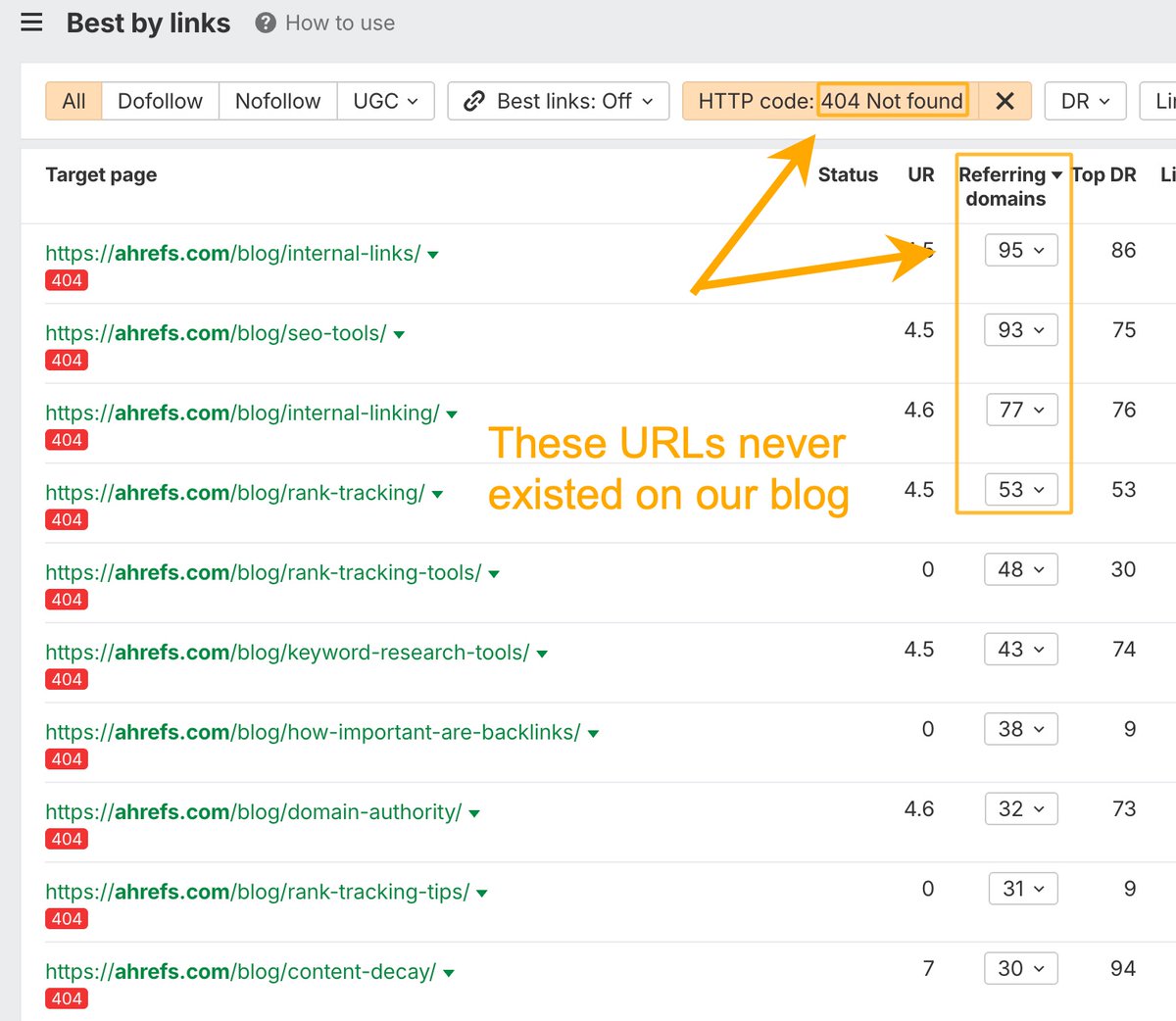
I just discovered a brand new (and totally fascinating) way to come up with content ideas for your blog. It’s your 404 pages. (Stay with me…) I randomly checked if Ahrefs Blog had any 404 pages with lots of backlinks pointing at them. And saw hundreds of them.. Wow! I pinged my Head of Content Ryan Law asking why so much of our blog content was now “dead.” Turns out — none of it was ever alive. These are all hallucinated URLs from AI-generated articles. 🤯 Basically, hundreds of sites have published AI-generated content and never checked whether the links in those articles actually point to real pages. But here's the part that really blew my mind... Most of these hallucinated URLs actually make sense. AI "thinks" we should have articles on: /internal-linking /how-important-are-backlinks /domain-authority /content-decay etc. And... we don't. AI literally found gaps in our content strategy that we missed. So now we're going to publish articles on all these topics and turn hundreds of broken hallucinated links into real backlinks. If you run a blog, go check your 404s right now. You might be sitting on a goldmine of content ideas that AI already "voted" for. (go to Ahrefs' Site Explorer > "Best by links" report > filter by 404 status code) Fun times. 😅

@SEOKeval ·
Bad SEO Agency: Let's target the keyword: "pickleball paddles." To do that, we'll publish 10 blog posts a month answering every question users have about pickleball. And then build 5 backlinks a month to the "pickleball paddles" page. Good SEO Agency: We can target "pickleball paddles", but it's a competitive keyword. And it'll take time. Let's give ourselves more opportunities to win and build out additional pages to also target keywords like: - pickleball paddles for beginners - graphite pickleball paddles - fiberglass pickleball paddles Those keywords are more specific, so they'll convert better, and they're easier to rank for. In terms of a content strategy, top-of-funnel keywords do nothing for revenue. Let's do 5 blog posts a month targeting keywords that are lower in the funnel and drive sales: - best pickleball paddles for intermediate players - best pickleball paddles for advanced players - best pickleball paddles under $100 And authority is everything in SEO, so let's go heavy on link building. Lets build 15 links a month, spread across your homepage, sales pages, and blog content, so it looks natural and doesn't get you penalized by Google. This is how SEO needs to be done in 2026.

@fatjoedavies ·
I'm a terrible SEO. I don't read the algorithm leaks. I couldn't tell you when last core update was. I don't understand semantic couplets, triplets, or keyword density ratios. I've never opened Screaming Frog. I can't hook up the Ahrefs API to Claude (tried n failed) This stuff is useful. But I've never approached SEO campaigns this way. Here's what I do know: I understand the value of search as a channel + I understand what search engines are actually trying to show their users. So I structure campaigns that you'd just call 'general marketing' or 'branding', and layer search strategies like link building or Digital PR sensibly on top. My campaigns aren't built around gaming an algorithm. They're built around making content/services more findable + surfacing brands in search and AI for the right questions and queries. For the optimal search campaign I would ideally touch branding, reputation, brand sentiment + the wider business in general But this all sounds very 'white hat', which I'm not. I'm a realist. I understand that measured link building campaigns, in the right industries, are what maximise performance, results, and most importantly ROI. Supplemental/solicited link building works best when it's layered onto a campaign that would already make sense as a normal branding effort, even if Google didn't exist. The brand should be set up to be attracting links too. I took a while for my to get into this mindset when I started SEO. But when I stopped thinking like a bedroom affiliate SEO and started thinking like a marketer who's not afraid to push boundaries in the right places, the results followed.


@mehrab_build ·
SEO is the simplest growth channel right now. This site getting 1K clicks/month. I spent ~2 hours a day early on. Then it compounded. Here’s what actually moved the needle: - Deleted all duplicate AI content - Built 10 BOFU landing pages - Internally linked everything to them - Built backlinks to supporting content - Added a few direct links to the money pages That’s it. This isn’t complicated. People just overthink it.


@hridoyreh ·
I got 12 quality backlinks for free. The "SEO Wins" hack I used: 1. Find statistics pages in your niche. 2. Check them with a broken link checker. 3. Find the dead sources they reference. 4. Create an updated version on your site. 5. Email the site owner. Only hard work will get you links...


@illyism ·
A famous link building agency ("one that everyone in YC uses") is charging founders $1,500/mo for "25 backlinks" I pulled their @Ahrefs report today: - only 3 real links after months - 22 unindexed spam directories 😬😬😬
@hridoyreh ·
You can get backlinks without paying. Here’s a simple SEO Wins method: 1. Install “Check My Links” extension. 2. Find pages with lots of external links. 3. Identify broken or dead links. 4. Reach out to the website owner. 5. Suggest your content as replacement. It is a classic broken link building hack. And it still works surprisingly...


@seonatia ·
To understand SEO, you first need to know how Google ranks websites. It uses an algorithm that treats the internet like a network of votes. Every link from one website to another is a vote of trust. But not all links are created equal. If 10 random blogs link to you vs. one link from Forbes, that single strong link can matter more. Here’s what backlinks signal to Google: Authority → Are others referencing you? Relevance → Are those sites in your niche? Trust → Are these legitimate websites or spam? So don’t submit your startup to 100 irrelevant sites. Find websites that are actually worth getting links from, and focus on quality.

@adriaandotcom ·
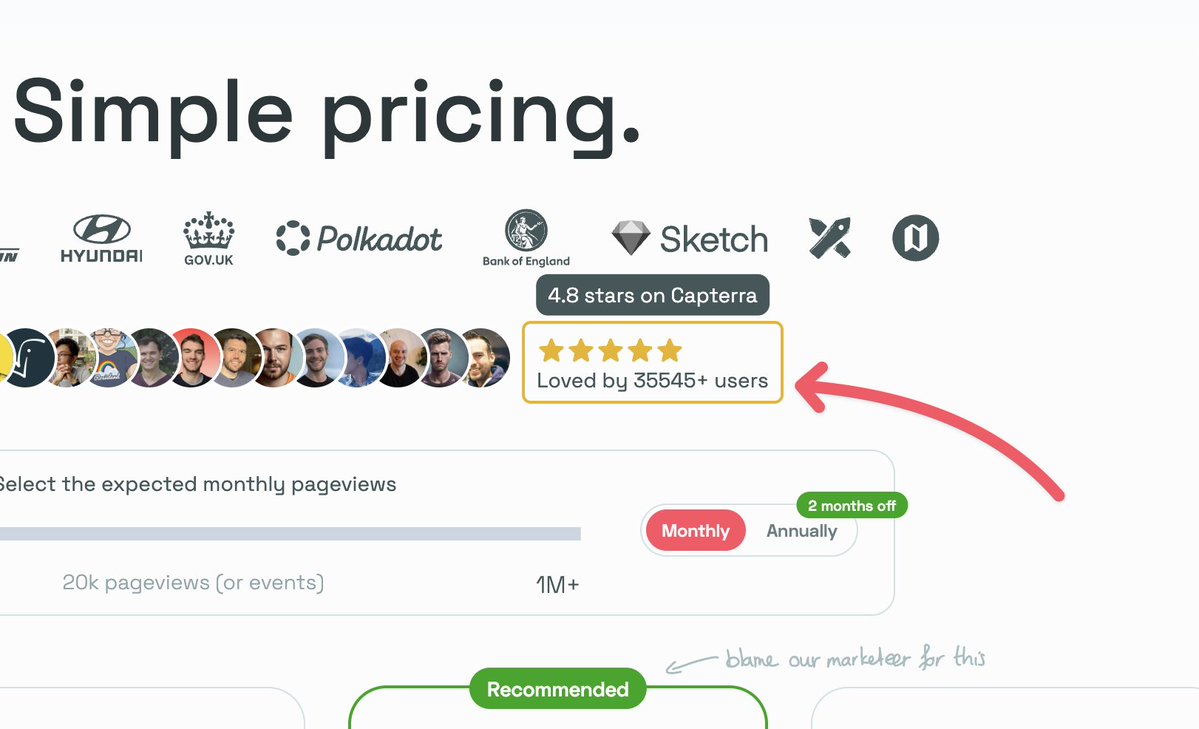
We passed 35,000 users at Simple Analytics. Every month, around 1,000 new users sign up and use our product. Transparency notice: most of them are free users. We have 1,337 paying customers. I was super scared about what support would cost us, so I built a community to forward people to and blocked the support email for free users. But you know what? Our tool is super self-serve. Users can figure it all out themselves, while our customer support is wide open. That said, we don’t get much back from our free users. They obviously don’t pay us anything, but we expected a bit more talk about Simple Analytics online because of it. So we’re debating internally whether we should add a badge requirement to the Free plan. Then free users would need to add a badge linking to Simple Analytics, which would give us something back: more eyeballs (even on smaller websites) and some backlinks (which might help, especially from bigger websites). Open to other suggestions on what we can do to keep the Free plan attractive, while also making sense from a business perspective.

@Charles_SEO ·
If you work in SEO or link building, you SHOULD know about this metric, but you probably don't - Revenue Per Referring Domain. Take additional monthly revenue generated by a campaign and divide it by the number of referring domains built. Real example from one of our campaigns: - +$85,000/mo in additional organic revenue - 70 new referring domains over 6 months - $85,000 ÷ 70 = $1,214 per referring domain per month That means EVERY SINGLE LINK in this campaign is generating $1,214/mo in revenue. And it's recurring. Month after month. Now look at the cost side: average link placement cost was roughly $900. $900 one-time cost → $1,214/mo recurring revenue, per link!!! This is why I find it insane when people argue about whether a link is "worth" $500 or $800. They're thinking about cost per link. They should be thinking about revenue per link. Not every campaign will hit these numbers. But even at 10% of this, $121/mo per link, most link building pays for itself within 2-3 months and compounds from there. Stop thinking about links as a cost, start thinking about them as revenue-generating assets, proper maths changes everything.
@SEOKeval ·
I talked to a guy earlier this year who owned a high-ticket brand and was getting scammed pretty badly by his SEO agency. He'd been working with them for over a year and was paying $10k/month. They built maybe 7 backlinks total. And he saw almost no increase in organic traffic. Once I showed him how little progress had been made, he switched over to me. I ran an audit of the site, and, unsurprisingly, it was a disaster. Numerous 404 errors and broken links. Meta titles not being displayed. Duplicate pages. Low-quality blog content. I fixed all of it. I then optimized each product category page for a target keyword. Improved the content on the product category pages. Published higher-quality blog content. And built 25 backlinks a month. (50% to the homepage and the rest to product category pages and blog content) Since I started in April, organic traffic graph has gone absolutely vertical. This really wasn't that hard to pull off... The strategy is pretty basic, in my opinion. It just goes to show how bad some "SEO agencies" are. Be careful who you hire.

@Charles_SEO ·
A DR60 site with 500 organic traffic is worth LESS than a DR30 site with 10,000 monthly visitors, but most SEOs would choose the DR60 link every time without even checking... Here's why DR (and other vanity metrics) lies to you: - DR measures the quantity and quality of backlinks pointing to a ROOT DOMAIN, it tells you nothing about the specific page you're building a link on. - A DR80 site can have individual pages with zero traffic, zero referring domains, and zero authority of their own. - It's far too easy to fake DR and DA, there are literally Fiverr gigs on this... What actually matters is PAGE LEVEL signals: - Does the specific page have organic traffic? (Proves Google trusts it) - Does the page have its own referring domains? - Is the content topically relevant to your site? - How many other outbound links are already on that page? Stop buying links based on DR alone - Always do your due diligence , your results will be 10x, and volatility will reduce massively....

@mehrab_build ·
3rd month working with this client. It's only March 18th and we already added $1,677 MRR. All from SEO and AEO. Here's the exact blueprint 👇 1. Remove toxic AI content If you used AI to bulk-publish blog content, chances are some of it is actively hurting you. Unrelated topics, keywords that have nothing to do with your niche, and outbound links going to other sites in their network. What I do: remove them all and set up 301 redirects to either the homepage or the closest relevant article. 2. Reverse engineer the competitors I want to see exactly what's working in the space before building any strategy. What pages do they have? How are they doing internal linking? What backlinks do they have? This tells me what's already working, so I'm not guessing. 3. Fix technical issues and on-page SEO Doesn't matter how many backlinks you have. If your site has technical issues or poorly written content, you won't rank. Fix the foundation first, then build links. 4. Invest in link building and PR Backlinks are still one of the most important ranking factors. In any semi-competitive niche, you're not getting to the top 3 without them. I get the best links possible, sometimes the exact same ones as competitors, and run PR campaigns every other month. Don't sleep on this. 5. Monitor what's working, constantly My daily routine: Search Console -> what's working and what's not -> Ahrefs -> check competitors SEO is not a one-off game. You need to stay on top of the data, watch your competitors, and keep adjusting.

@illyism ·
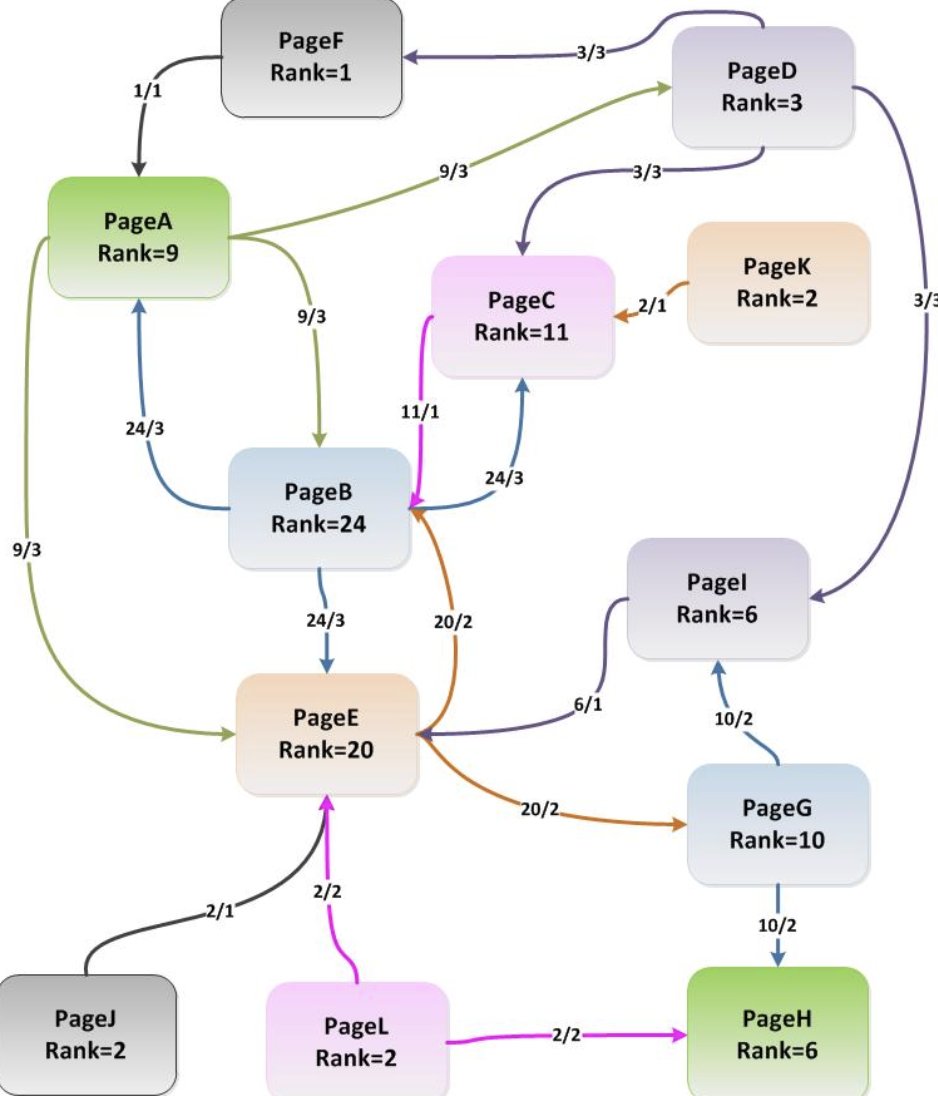
Just hopped off a call with a founder who leaned in and said it quietly, like a confession: "I think Google shadow-banned us." I get it. I've said it too. Years ago my site wouldn't rank. Good content, decent DR, clean titles. Competitors with half my backlinks sat on page one. I was nowhere. 2 AM at my desk, convinced Google had a grudge. Maybe the niche. Maybe a manual action. Maybe the algorithm just didn't like me. It's a comforting story. If Google is the villain, you don't have to audit your own mess. But here's what the site actually looked like when I shared my screen: 65 very strong backlinks So he wasn't short on authority, it was just diluted, he was ranking on a lot of pages, just not on the right ones. Looking into it, I spotted a few more SEO issues: 1. Internal links pointed to old URLs that 301'd to new ones. He was paying the redirect tax on every hop. 2. Footer logos (NASDAQ, The Economist, crypto sites) were dofollow. Every page quietly handed equity to external blogs. 3. Authority diluted across hundreds of pages he didn't even care about. Money pages got a useless trickle. So, probably no shadow ban, he IS still ranking, just authority flowing to the wrong content. I learned this the hard way. Months of more content, more backlinks, more words, shoving input into a broken system. Nothing moved. The day I mapped my site and tracked where the backlink juice actually flows to, I felt stupid. Homepage hoarded everything. Money pages starved. So I didn't give him a theory about Google's mood. I gave him three fixes: 1. Flatten redirect chains. Every internal link points to the final URL. Zero hops. 2. Plug external leaks. Wrap your Next.js <Link> so any href not on an approved list gets rel="nofollow". 3. Concentrate authority. Pick the 5–10 pages that drive revenue. Link them from the footer and add internal links from your highest-backlinked pages. 4. This is also a reason why people see an uptick in rankings when they delete bad content, instead of 1 backlink powering 1/1000 pages, you power up 1/10 pages, each gets a stronger boost. So if you catch yourself blaming the algorithm this week, stop. Follow your backlinks. Count the redirects. Look at your footer. And most importantly, focus on your money pages, run the blitz seo playbook: https://t.co/spPMVd4BSq I also made a nice graphic to explain the backlink juice concept, have a good weekend!


@foley_seo ·
This is what Assertive acheieved with a culmination of the following: ➟ Moved the client away from a port of Angular/Pre-render w/ Cloudflare workers ➟ Reduction of archived pages with NO GSC or GA4 data in 16+ months, this includes no referral / other source traffic ➟ Shrinkage of 30% of entire site with a cull and clean, redirected around 500 dead URLS that had external links ➟ Moved to NextJS/Netlify, removed scroll JS & button JS events and moved to full content output in DOM using CSS/JS to show/hide content as opposed to JS events ➟ Elimination of indexing for non-value URLS (content categories, tags, archives, pagination) with noindex, follow ➟Clean up of non indexed items, over 100k URLS eliminated by converting 404s, 301s, 5xx to HTTP 410 ➟ Site had a huge amount of dynamically generated URLS (including session ID's believe it or not) where large volume of URLS were canonical childs but Google treated some as canonical parents due to internal/external links ➟ Clean up and control of parameters via robots.txt disallow (path matching) with some allows to override URLS with external links ➟ Changed the navigation to be static, previous NAV headers were in dom but nav sub-items were JS loaded (Event), switched to static nav output ➟ Revamp of navigation and footer links ➟ Export of GSC + CRAWL Data, higher impression pages with low link counts given lots of new internal links ➟ Anchor map to correct and focus anchors on active pages and to remove anchor utilisation (duplication) ➟ Clean up of crawled currently not indexed pages (still ongoing) ➟ Full render tests & content output analysis ➟ Improvements to content - enhanced author bios, extended credentials, re-format of structured article data, improved UX with jump-to link functionality ➟ Content NLP audits - sampled 100 URLS over Inlinks API, segmented content by author and identified strong/fair/weaker authors and provided guidance / training ➟ Content consolidation - used SEO Stack to find content with a fair/larger amount of keyword overlap, consolidated content with similar query pools ➟ Eliminated some structural cannibalisation between "different themed" pages with the same target theme ➟ Bolstered content by re-prioritising content using AlsoAsked + Claude - sample exercise across top 50 pages so client could do some of the work at the same time - basically, re-order content in priority order ➟ Export of GA4 > Crawl data - looked at PAGE word count vs engagement/time on page, looked for anomalies and weak pages ➟ Set up Microsoft Clarity, looked at typical scroll depth by device (greater impression-share) ➟Some UX improvements on mobile including a floating bottom bar with CTA ➟ Link building - primarily HARO-esque styles of links / Featured links ➟ Link earning - distributed content ➟ Removed old disavow which contained quite a few good domains in ➟ Built links to hub pages to distribute link equity out ➟ SEO testing via SEO Stack


@JoyanneHawkins ·
We audited a law firm site that got decimated by Google last year after doing some pretty aggressive link building with PBNs and a concept known as "cloud stacking". I have been tracking several sites that are part of the same network to see what happens to them over the next year. Some of them are still on the rise, but this one appears to be crashing hard with the last core update.

@JoyanneHawkins ·
I just published one of several videos talking about the core updates Google has done in the last year and how we are seeing them impact small businesses. Through posts on social media + conferences I have spoken at, I have interacted with a lot of people that have experienced this. I'm currently tracking a couple dozen sites to see when recoveries happen and so far haven't seen anyone recover. My hope is that businesses seeing this will reconsider their link building strategies. The risks of what can happen if Google catches it are exponentially higher than they were a year ago.


@hustle_fred ·
my website visits skyrocketed recently🔥 i add new SEO backlinks every day here is how: 1> DM people on X to exchange backlinks 2> Email relevant websites (still works in 2026) 3> find a paid community of site owners interested in backlinks and collab As a note: only collab with sites that make sense for your niche, spamming irrelevant backlinks can hurt


@s_chiriac ·
You don’t need $10K to start SEO. You’re just being sold that idea. People pushing it are either selling you backlinks… or pushing some SEO agency. Here’s the truth: Expensive backlinks only make sense when you already have traction. Not when you’re starting from 0. Early stage? You don’t need “authority” yet. You need distribution. What actually works: → getting listed everywhere relevant → building initial backlinks → showing up in search + platforms Quick story 👇 A founder came to me after getting destroyed by “SEO experts”. DR: 14 → 6 Why? → spammy links → bad directories → no strategy We cleaned it up: → removed the junk → submitted to the right directories → gave him a plan He kept going. Now: → DR 42 → real traffic → compounding growth No $10K backlinks. Just consistency. He didn’t stop at submissions. He doubled down with good backlinks + pSEO. People don’t want to hear this… But SEO isn’t about throwing money at links. It’s about doing the right things at the right stage. If someone tells you to spend $10K before you even have traction… That’s not strategy. That’s a sales pitch. 😱
@hustle_fred ·
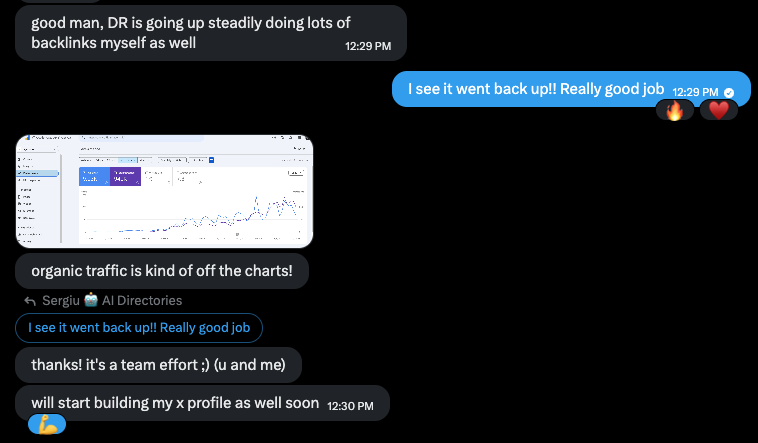
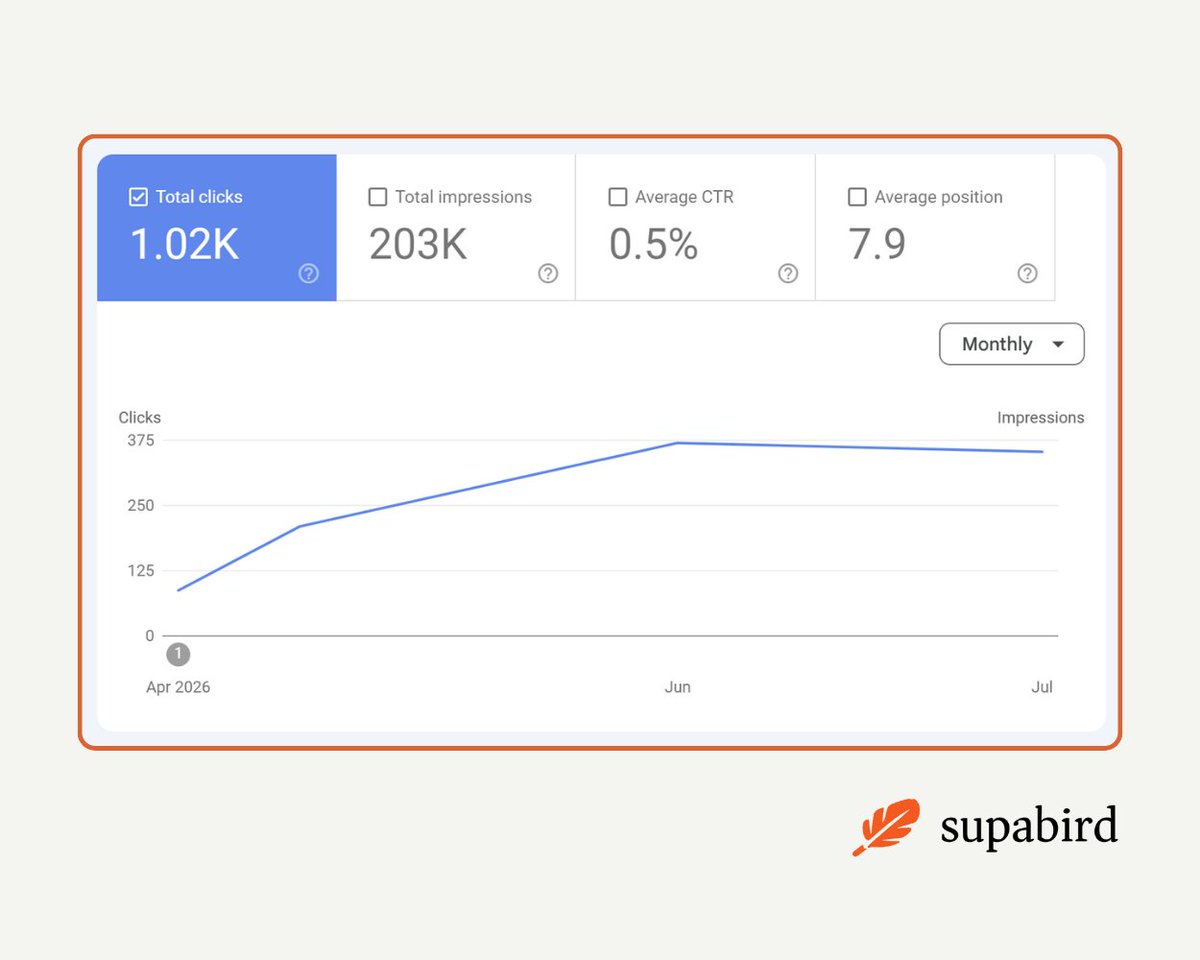
hit 1k clicks in last 3 months from Google😎 Apr - 172 May - 210 June - 370 July - 350 (still loading...) my main strategy is to focus on specific articles instead of promoting everything so i selected a few articles which i believe can have good conversions and i focus on increasing their quality + adding backlinks to them


@gaetano_nyc ·
There's a dirty little secret behind old school link building or even "seeking inauthentic mentions" that no one is talking about... MOST OF IT GETS REMOVED. In 2024, I worked with a link building company to help me build links for a client. I just opened the old tracking spreadsheet and spot checked how many links were still alive. Just 3/20. Think about that. The content gets updated and the link is also removed a year later. There are many reasons for this. One reason is to "make room" for new links that are getting sold and placed. And sometimes, the page that hosted the link gets removed altogether. I have also noticed some websites like EngageBay have been selling links for years. This happens when content managers want to make money on the side and start selling links under the table. In any case, I think the same will happen with "brand mention" placements. You'll pay for them, a year later the page gets updated, and your brand mention gets removed.
@fatjoedavies ·
17 years of link building in 1 post: When I first got into SEO, I overcomplicated everything. I thought I needed the 'secret formulas', tiered link wheels, or some clever hack to make Google happy. But the longer I’ve been in this game, the clearer it’s become: SEO works when you're a real business, with a brand, doing real marketing. Link building is a supplement. That being said, you don't want to bring a knife to a gun fight. You need to take it seriously to compete. Here’s the simple link building playbook I recommend everyone. Forget trends, hacks, link pyramids and tiers. Just do this... 1. Start with the basics. Every real business has them: - Press releases when something new happens - Industry and local directory listings - Partner or supplier links These won’t take you straight to the top, but they solidify your legitimacy. They lay a foundation. It's stuff you should be doing anyway. 2. Add consistency. A handful of guest posts and niche edits each month is enough to give the right relevancy signals. Don’t stress about fancy structures. Just keep it steady, natural, and mostly pointing to your homepage and pages you'd expect to get links. Don't go throwing lots of links at money pages. You can sprinkle a few in, but keep things natural, and allow the authority of your site and internal links to give all your pages ranking power. 3. Create stuff people actually want to link to. This was a big shift for me. Instead of begging for links, build assets: Surveys, calculators, tools, or original data. Things people in your industry want to reference. These links compound over time. In the past I've even ran low budget PPC campaigns to these pages so they show at the top when journos are searching for stats or info. 4. Layer in PR, brand mentions and expert commentary. These require effort, but they are effective. Landing a mention in a major publication (even without a link) builds credibility. And when journalists cite you as an expert, you’re hitting authority signals your competitors aren't. That’s the system, and it hardly ever changes. Foundations Consistency + relevance Link-worthy assets PR to build authority If I could go back, I’d spend less time chasing complicated strategies and more time getting these fundamental principles right.

@semrush ·
5 ways to earn valuable backlinks for SEO: 1. Create Useful Resources 2. Try Broken Link Building 3. Answer Relevant Media Requests 4. Learn from your competitors' best backlinks 5. Capitalize on Business Relationships https://t.co/SLemcAQPFg.

@semrush ·
Explore seven of the best link building tools for 2026 👇 1. Backlink Gap (Semrush) 2. Link Building Tool (Semrush) 3. BuzzStream 4. Hunter 5. Featured 6. Help a Reporter Out (HARO) 7. Backlink Analytics We tested all of them out to see which deliver the most value for different goals and budgets: https://t.co/w9HfmEQLFu.

@denisyurchak ·
How do you get backlinks if you have 0 audience and 0 network? Hit up local reporters Magazines and newspapers usually have 50+ DR – even small ones Big outlets are hard to reach, but small local media are always looking for news stories If you are a solo builder, you are already 500x more interesting than what usually hits their desk Package your story well: "Solo local guy building products for global markets, competing with giants" – this sounds super compelling Your priority is local startup magazines, then economic sections of regional newspapers, then local media Find journalists who have written about entrepreneurs and digital products before – your odds of getting featured are higher with them Find their LinkedIn, X accounts, or emails – and hit them up everywhere with a short pitch (template below) Usually, even big journalists have very small social media followings. If you tweet at them, they will see it. Then you normally arrange a 30-minute call, send them your links and pictures, and wait for your article from a high-DR website! 🎉 Here is the reach-out template I used to get featured in my local startup magazines ⬇️

@asaio87 ·
When doing SEO, many are very impatient and want to build backlinks by all means and in a fast way. You guys need to understand one thing: !!! make it look natural !!! always make it look natural do not force things, especially if you have a new website ah, and dont buy backlinks from those people who sell them from a spreadsheet most of those backlinks are shit they make it look like the sites have tons of traffic, but they rank for random terms and you will waste money at best

@PassiveSphere ·
Before AI agents: 99.9% couldn't build editorial backlinks After AI agents: 99.9% still can't earn them I'm laughing when I see posts like "I replaced my SEO agency with OpenClaw agents" 😁😁😁

@Matt___Bauer ·
Bootstrapping my own SaaS means stalking YC and the companies they fund to see what they’re doing. There are obvious parts of the YC playbook and less obvious ones. Regarding the latter category I see especially the following rather new hacks/GTM routes emerging: - Launch max - hackernews, producthunt, peerlist, indiehackers, devhunt, YC. All of them. Launch 3 times minimum - Warm outbound - capitalize on the 99% of leads who see your content but don’t come inbound. Scrape who likes your posts on LinkedIn, see if they fit your ICP, then message them - Competitor backlinks - pull your competitor’s strongest backlinks and get yourself listed in the same places. See what article they’ve made and make a better, updated version with more value - Influencers - if you have the money to spare, find 20-30 ugc creators on tiktok/instagram on your niche and ask them to create content for your product. Pay them a fixed fee ($15-$35) plus performance incentives - Spam videos - if you build in public, videos are much better than posts. Also, focus on use cases of your product
@PassiveSphere ·
When validating backlinks, traffic matters more than DR These are 10 sites we got links from for a client last week, plus their traffic numbers: - DR86 dofollow - 50M - DR80 nofollow - 8.8M - DR74 nofollow - 16.8M - DR73 dofollow - 263k - DR73 dofollow - 346k - DR72 dofollow - 3.6M - DR71 nofollow - 2.9M - DR68 dofollow - 1.1M - DR61 dofollow - 591k - DR57 dofollow - 2.6M

@natmiletic ·
Link building with a $0 budget hits different than link building with $100k. But here's what stays the same across both: • Relationships matter more than transactions • One great link beats 50 mediocre ones • Agencies will burn your money if you don't know what good looks like • Guest posts still work (when they're actually good)
@asaio87 ·
In SEO ideally would have to have backlinks in context and on websites with high DR that have traffic. But that doesn’t mean if your backlink is on a smaller website it won’t give out link juice. Just smaller value. Still I would go for websites with traffic and small DR vs no traffic and high DR

@ramesh_mkumar ·
50 days building https://t.co/yXeQTX4Cp0 and today i got my first real taste of SEO spam I've been really strict about not letting local businesses or portfolio sites to submit I wanted it to be a place where for indie makers can showcase their products, that's it But today someone found a loophole i didn't think about. they created 8 accounts over 6 hours and used the maker profile bio to drop backlinks for their clients. funeral homes. elevator companies, all Australian. Never submitted a single product. just used the onboarding form as a free backlink machine. Deleted all the accounts, added noindex on profiles with 0 products. The site is growing. people are paying attention now, just not always the people you want.

@justin_butlion ·
The number of new directories I see being launched is crazy! They all promise backlinks which is a good hook. I joined one recently and even paid $24 for "premium" listing on the homepage. So far 1 visitor but somehow I got 12 upvotes? My guess is there is some automation doing the occasional voting to make it seem like there is actual activity on the site. It's all a bit of a circle jerk unfortunately.

@TheCoolestCool ·
If you want backlinks, build what writers NEED to cite. Stats pages earn 4.25x their share of referring domains. 42.1% hit 1,000+ RDs. Fail rate under 50 RDs? Just 5.3%. Compare that to thought leadership with a 44.8% fail rate. Utility scales. Opinion rarely does. https://t.co/su2HlrSTUW
Best Backlinks tweets
Xholic studies what works in your niche, drafts posts in your voice and schedules them for the hours your audience is online.
$0 today · Cancel anytime
Browse all tweet collectionsKeep exploring