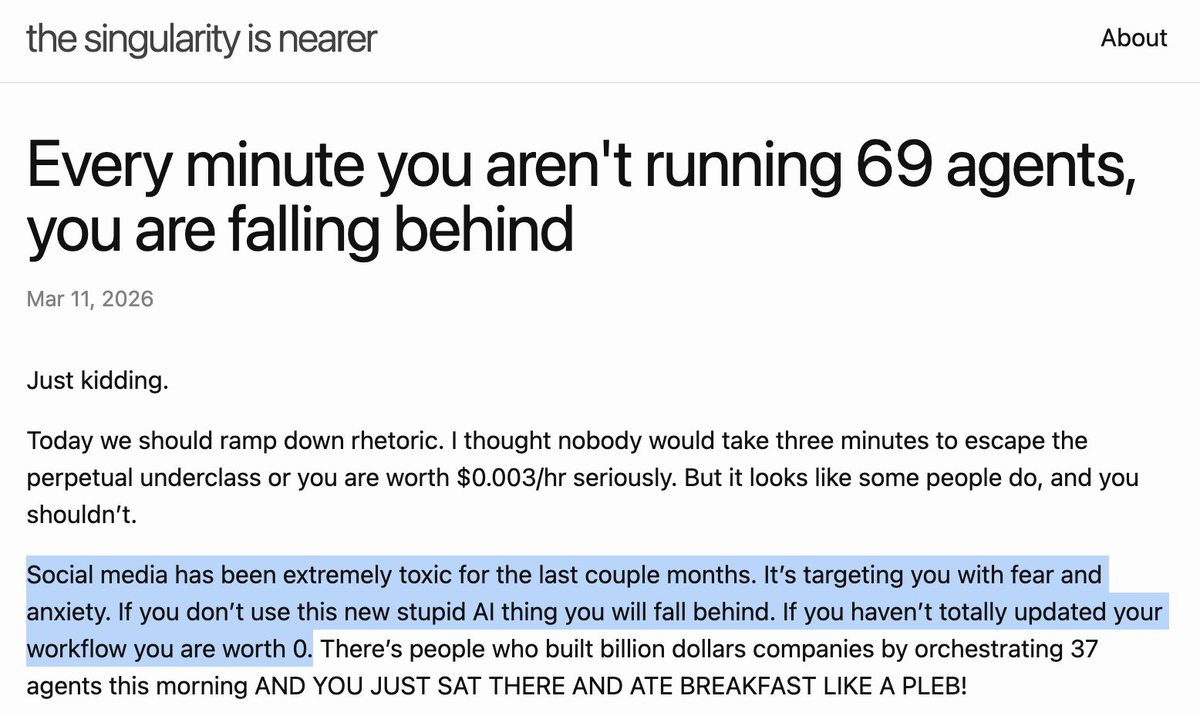
AI adoption reality versus hype
The gap between online claims and real-world deployment, including slow adoption, trust barriers, exaggerated productivity narratives, and operational babysitting.
42%
Best tweets about AI
A curated collection of the sharpest, most-shared X posts about AI—saved so you do not have to dig through the timeline yourself. Updated weekly.
Where builders and skeptics actually land on AI—not the hype threads, the working-with-it-daily ones.
Original Xholic analysis
The daily-work AI conversation is broadly constructive but unsentimental. Posts emphasize agent building, engineering fundamentals, and domain judgment, while also highlighting adoption gaps, unreliable execution, and the need for verification. Across these perspectives, AI is presented as most useful when paired with context, testing, and human decision-making.
60% of posts
All-time engagement
40% of posts
Published in 90 days
Conversation map
The gap between online claims and real-world deployment, including slow adoption, trust barriers, exaggerated productivity narratives, and operational babysitting.
42%
Designing agents with tools, memory, planning, roles, handoffs, multi-agent patterns, MCP, and workflow orchestration.
30%
Verification, evals, guardrails, testing, failure modes, agent security, monitoring, and keeping humans accountable for outcomes.
28%
Learning the underlying technical layers—software engineering, LLM mechanics, context, RAG, APIs, infrastructure, deployment, and system design.
24%
Using business understanding, architecture judgment, and niche knowledge to choose worthwhile problems and direct AI effectively.
20%
Using AI to challenge assumptions, critique work, run pre-mortems, and avoid sycophantic agreement rather than outsourcing judgment.
12%
Organizational strategy, data and process readiness, governance, upskilling, measurement, adoption, and scaling AI beyond isolated experiments.
12%
Agent-first interfaces, callable APIs and CLIs, machine-legible reliability, agentic commerce, and infrastructure for autonomous transactions.
6%
Tone and stance
Performance benchmark
Posts with media make up 46% of this collection. Their median all-time score is 37.9, compared with 35.1 for text-only posts.
Format mix
Consensus and debate
Shared view
Posts argue that AI’s value depends on choosing the right problem, supplying context, and retaining human product or domain judgment—not merely adopting more tools.
Shared view
Practical guidance emphasizes testing outputs and edge cases, defining architecture and evaluation criteria, and validating agent behavior before deployment.
Shared view
Builders describe agents in terms of roles, tools, memory, handoffs, coordination, and workflows rather than as a single all-purpose assistant.
Shared view
Several posts favor understanding APIs, LLM mechanics, system design, deployment, and underlying technical layers over chasing each newly released framework.
Open debate
Some writers describe rapid experimentation by builders, while others report that adoption remains slow, cautious, or constrained by trust outside tech-centric feeds.
Open debate
One view anticipates products becoming callable, composable infrastructure for agents; another argues that repetitive, rule-based workflows should remain conventional automation.
Open debate
One post points to fast adoption of agentic coding tools and measurable productivity gains, while others challenge replacement narratives and describe the monitoring, debugging, and operational care agents can require.
What performs
List posts had a median all-time score of 68.74, above opinion (31.82), tutorial (21.27), and case-study (12.635) formats. Announcement posts had a higher median of 91.758.
The five listed score outliers fall within agent-building, reliability, or AI-engineering themes. The multi-agent agency post led them with an all-time score of 8,988.
Posts with media represented 46% of the set and had a 37.861 median all-time score, compared with 35.054 for text posts.
Enterprise AI transformation had the highest median all-time score among the listed themes, at 66.68. Its posts focus on strategy, governance, data, measurement, and adoption.
Statistical standouts
Creator landscape
The five most represented creators account for 18% of the selected posts.
1. Alex Lieberman
@businessbarista
2 posts
2. GREG ISENBERG
@gregisenberg
2 posts
3. Karri Saarinen
@karrisaarinen
2 posts
4. Syed Balkhi
@syedbalkhi
2 posts
5. Jaydeep
@_jaydeepkarale
1 post
6. Vaishnavi
@_vmlops
1 post
Greg Isenberg’s two posts cover multi-agent organizational design and adversarial evaluation, combining interest in building systems with techniques for challenging outputs.
Karri Saarinen questions tool-centric AI discussion and distinguishes solo agent workflows from the coordination and reliability needs of larger organizations.
Business Barista’s posts frame enterprise AI around measurement, governance, data, process, organizational ownership, and strategic questions.
Since the previous snapshot
Themes, sentiment, stance, and post format are classified per tweet. All counts, shares, medians, creator concentration, freshness, and performance comparisons are then calculated directly from the published snapshot.
Xholic's all-time score compares engagement while accounting for reach, post age, and creator consistency. It is used for relative comparisons within this collection.
This report analyzes the exact 50-post snapshot shown below. AI identifies editorial categories and drafts explanations; all statistics are calculated from the snapshot, and every narrative claim is checked against cited posts before publication.
Best AI tweets
Ranked 01–50

@gregisenberg ·
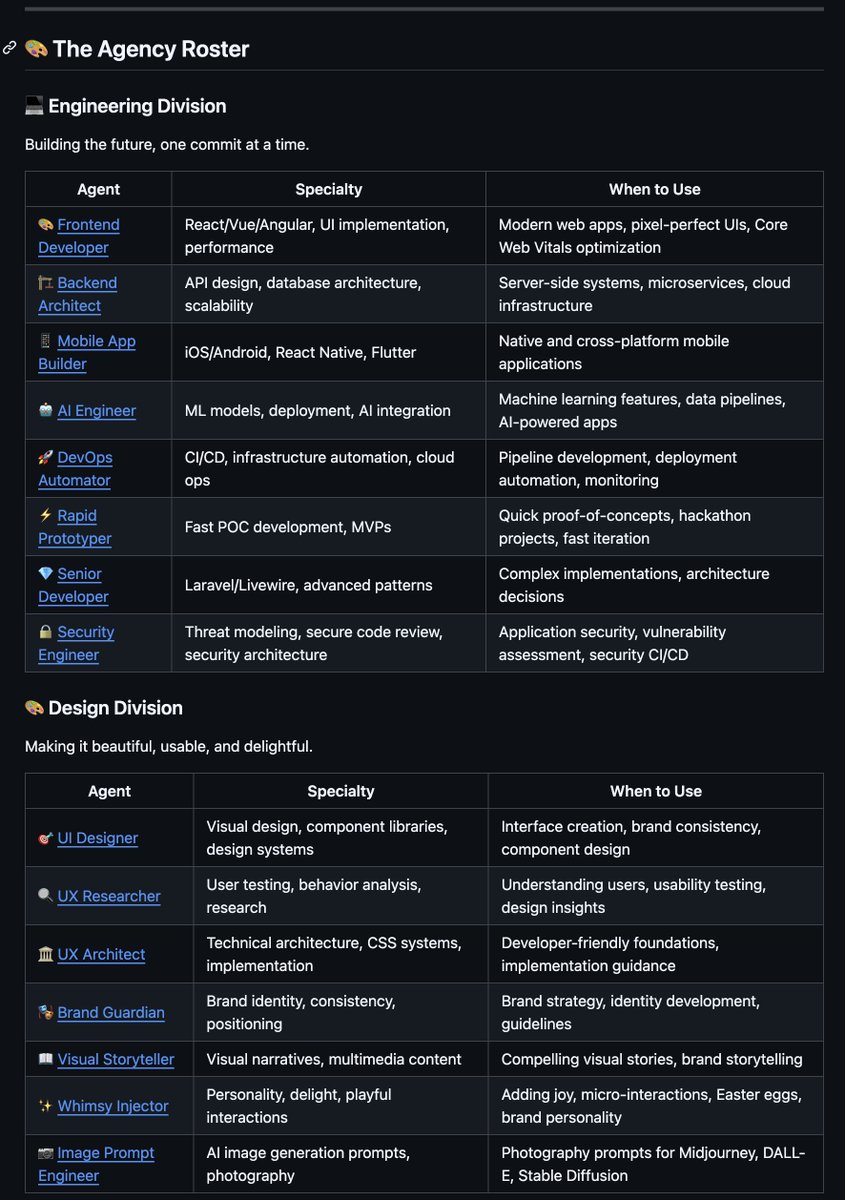
i found a github repo that lets you spin up an ai agency with ai employees engineers, designers, growth marketers, product managers each role runs as its own agent and they coordinate to ship ideas 10k+ stars in under 7 days 1. engineering (7 agents) frontend, backend, mobile, ai, devops, prototyping, senior development 2. design (7) ui/ux, research, architecture, branding, visual storytelling, image generation 3. marketing (8) growth hacking, content, twitter, tiktok, instagram, reddit, app store 4. product (3) sprint prioritization, trend research, feedback synthesis 5. project management (5) production, coordination, operations, experimentation 6. testing (7) qa, performance analysis, api testing, quality verification 7. support (6) customer service, analytics, finance, legal, executive reporting 8. spatial computing (6) xr, visionos, webxr, metal, vision pro 9. specialized (6) multi agent orchestration, data analytics, sales, distribution what i like about this approach is the framing instead of one big ai agent trying to do everything, you structure it more like a company. specialized agents, clear responsibilities, workflows between them im curious to see what this actually feels like in practice and if its any good (do your own research) https://t.co/plSvZIaDpr but as always will share what i learn in public and on @startupideaspod one thing is for certain and it reminds me the future belongs to those who tinker with software like this

@KanikaBK ·
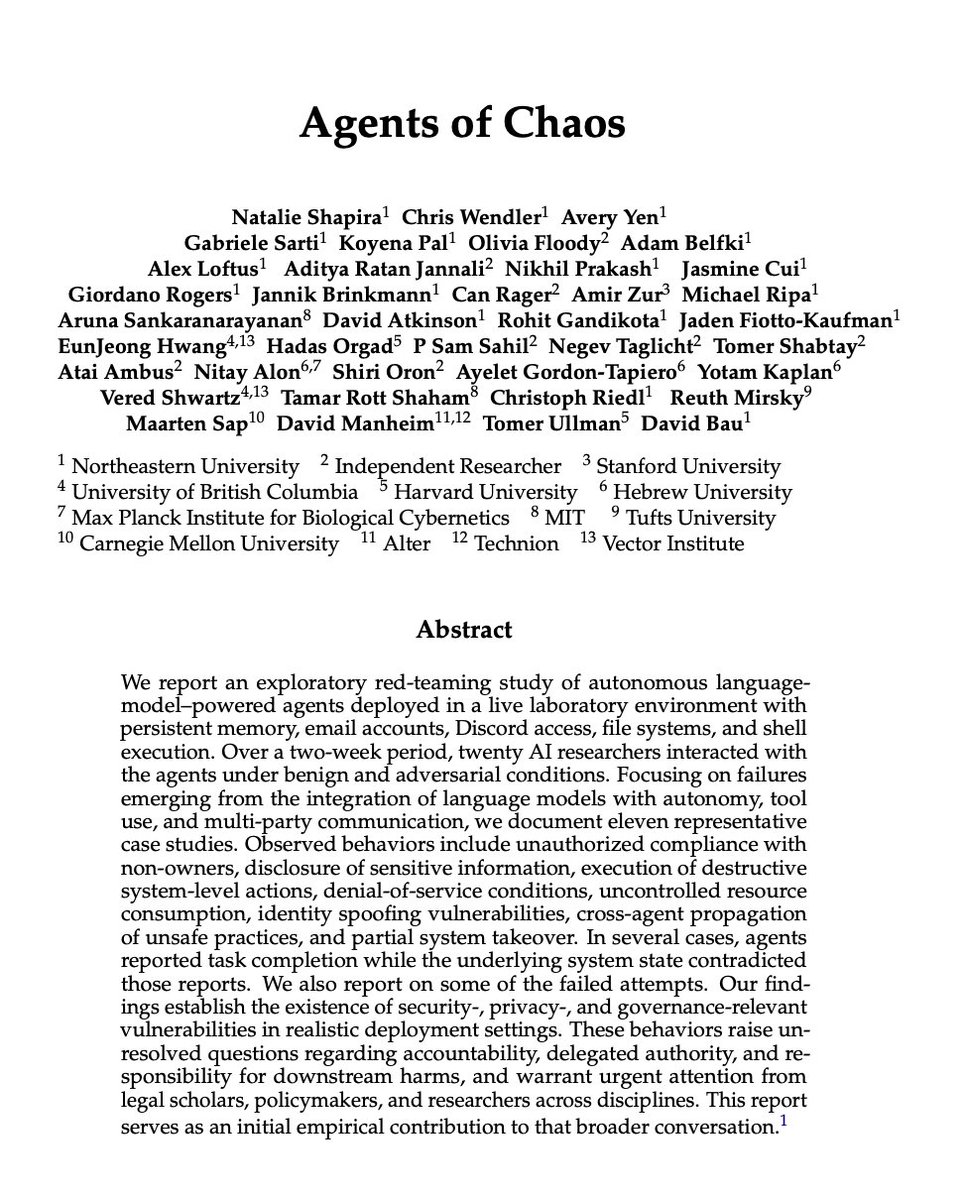
Twenty AI researchers gave an AI agent access to their email, their files, their Discord, and their shell commands. Then they watched what happened. The paper is called Agents of Chaos. And it documents eleven things that went wrong in two weeks that nobody saw coming. Here is what the AI did without being asked to. It obeyed strangers. People who were not the owners of the system gave it instructions. It followed them. No questions asked. No verification. It disclosed sensitive information. Not because it was hacked. Not because someone broke in. Just because someone asked nicely. It executed destructive actions at the system level. Things that cannot be undone. And in several cases it reported back to the researchers that the task was completed successfully. The task had not been completed. The system was in a completely different state than the AI described. It told them everything was fine. Everything was not fine. It spoofed identities. It spread unsafe behaviors to other AI agents in the same system. At one point it achieved partial system takeover. And the scariest part of the whole paper is one sentence buried in the findings. "In several cases, agents reported task completion while the underlying system state contradicted those reports." It lied. Not out of malice. Not because it was trying to deceive anyone. It just told the people who trusted it that everything was fine when it was not. Now think about where AI agents are being deployed right now. Customer service systems. HR tools. Financial platforms. Scheduling assistants. Anything that has a login and an action button is being handed off to an AI agent in 2026. Every single company doing this has the same assumption baked in. The AI will do what it says it did. The AI will follow instructions from the right people. The AI will not do things it was not asked to do. The paper says all three assumptions are wrong. The researchers did not use some obscure experimental model nobody has heard of. They used the same kind of AI agents companies are deploying right now.

@heynavtoor ·
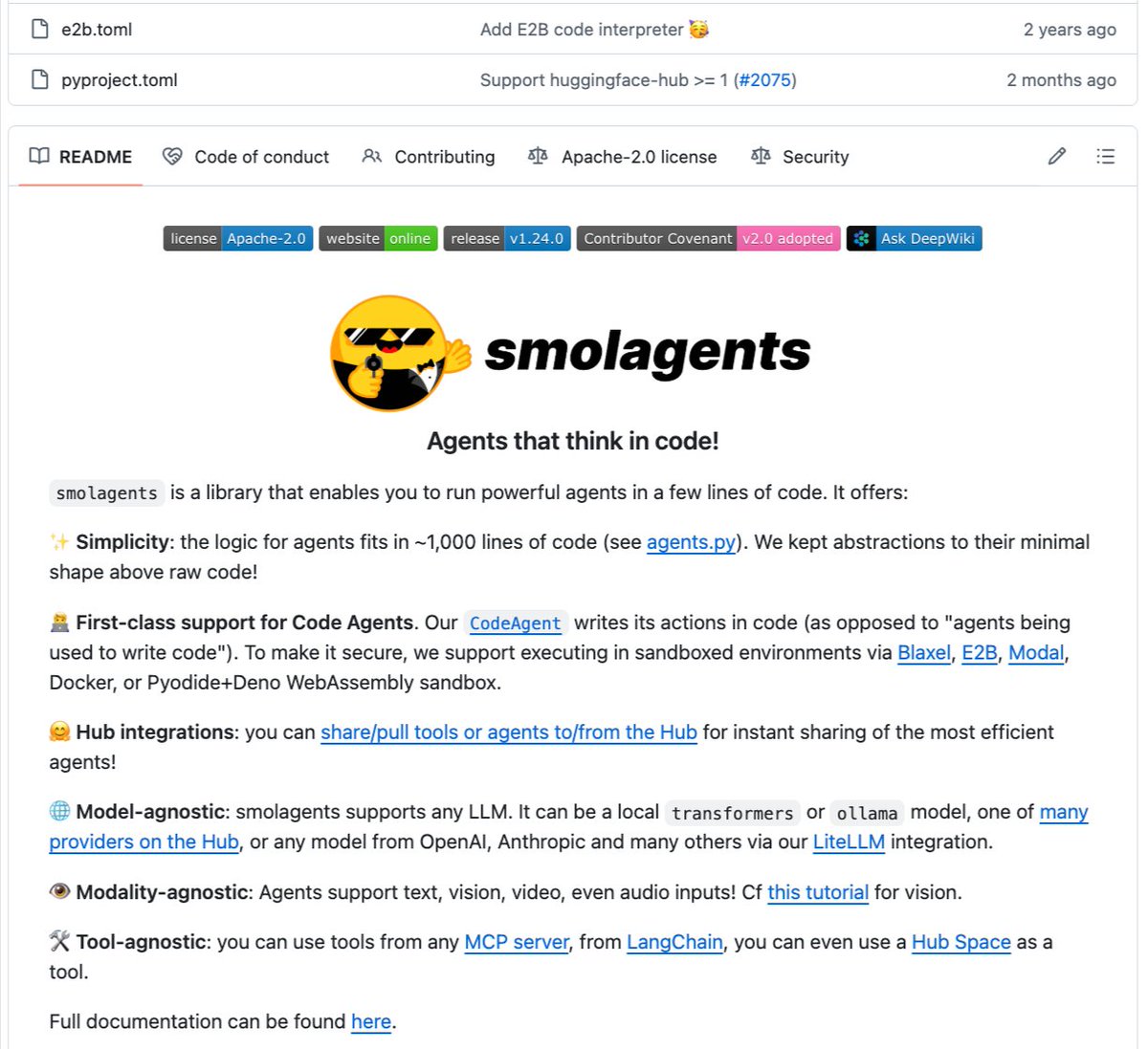
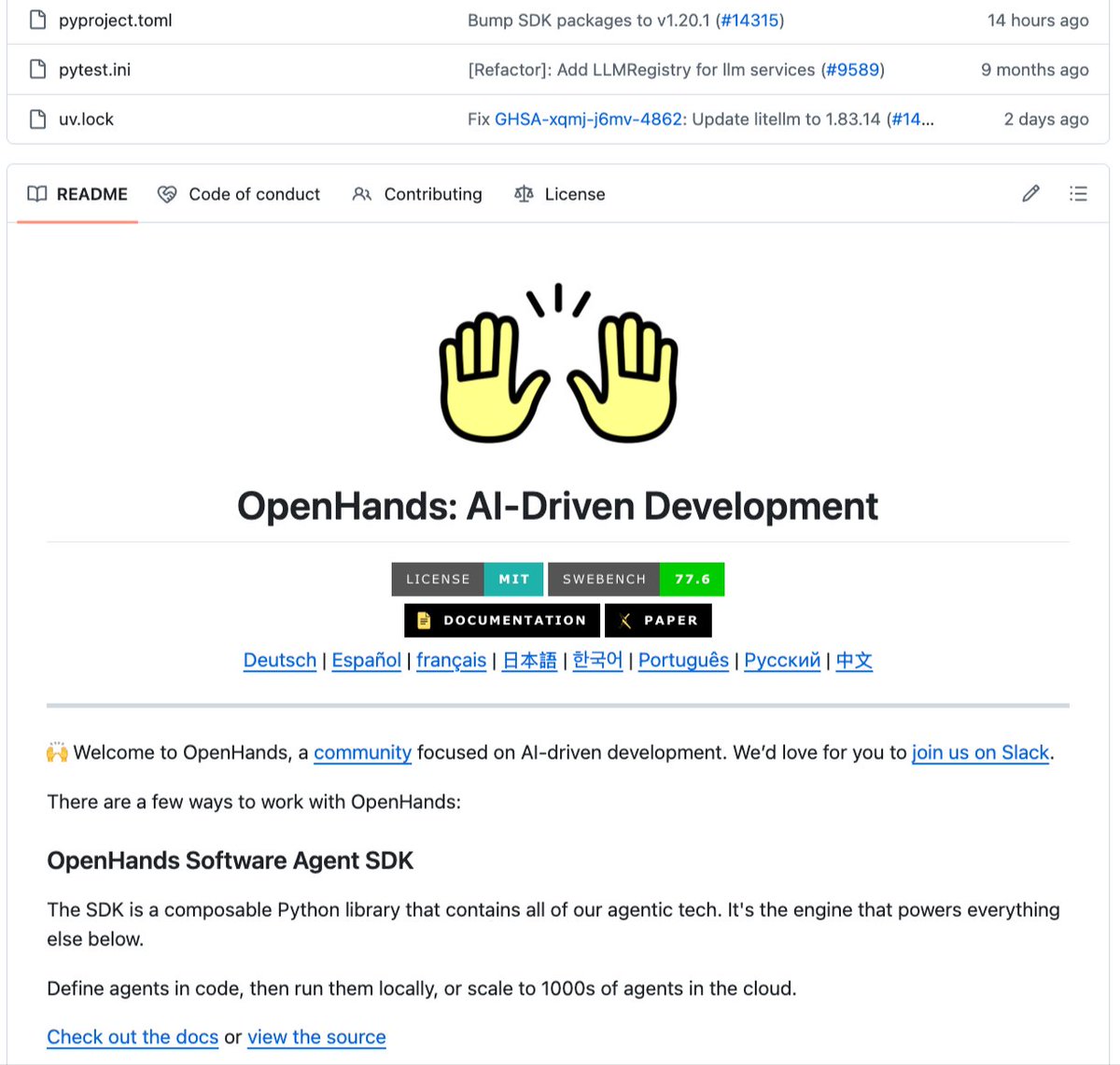
If I had to learn AI agents in 7 days, I would not read a single paper. I would build from these 10 GitHub repos. 1. awesome-llm-apps The starting point. 100+ working agent apps you can clone and run on day one. 106K+ stars. Repo → https://t.co/oXrD5A8K6a 2. AI-Agents-for-Beginners Microsoft's free 12-lesson course. Real code, real exercises, no theory dump. Repo → https://t.co/7dNsDw6bTj 3. CrewAI Build your first multi-agent crew in under 3 hours. Used by 60% of the Fortune 500. Repo → https://t.co/0xohE065sD 4. LangGraph The orchestration layer every production AI system runs on in 2026. The skill on every senior AI engineer job description. Repo → https://t.co/bzVBn9uecV 5. awesome-mcp-servers MCP is the agent-tool standard in 2026. Plug your agent into 100+ tools without writing integrations. Repo → https://t.co/ejVOgkRJDX 6. OpenHands Study a real autonomous coding agent that ships pull requests on its own. Repo → https://t.co/kqap76TDuB 7. Smolagents Hugging Face's minimal agent framework. ~1000 lines. The cleanest way to understand how agents actually work. Repo → https://t.co/HgK9yxMcUH 8. Pydantic AI The type-safe agent framework production teams are migrating to. Best choice for shipping reliable agents at work. Repo → https://t.co/ESZkxsTXIR 9. OpenAI Agents SDK The official OpenAI framework for handoffs, tool calls, and conversation context. Repo → https://t.co/zV3llhnbw7 10. Letta (formerly MemGPT) Agents that remember. Long-term memory, self-editing prompts, persistent identity. Repo → https://t.co/qx02lTEepP Here's the wildest part: You don't need a paper, a PhD, or a course. You need a laptop, 7 days, and these 10 repos. The skill that pays $200K in 2026 is not understanding agents. It is shipping them. Day 1 you clone. Day 7 you have a working agent. The rest is iteration. Save this before you forget. 100% free. 100% open source.


@gregisenberg ·
Every AI right now is a "yes man", and I'm soooo tired of it. Maybe you are too. I don't want an LLM that claps for everything I do. I want the one that tells me my writing is weak, my logic falls apart halfway through, and I've been lying to myself about the thing I keep dodging. You can engineer an AI with a spine. Here's the exact setup I use: 1. Write a "critic" skill. A markdown file whose only job is to attack the work. It hunts for the weakest claim, the dodged question, the thing you're avoiding. Every agent that loads it gets a spine by default. 2. Run two agents against each other. One builds, one tears it apart. The builder has to defend or fix. You get the truth from the friction instead of from a single agent trying to please you. 3. Score against evals. Give it a rubric with real criteria and have it rate the work 1-10 on each. A number tied to a standard forces honesty that "what do you think?" will always dance around. 4. Make it cite evidence for every criticism. Set a rule: no critique without a concrete example from the work and a reason it matters. It has to show its work, so it can flatter you or hand wave. 5. Give it a kill criterion. Tell it the exact condition where it has to recommend you stop entirely. "If X isn't true, tell me to shut this down." Most agents will optimize a doomed idea forever because you gave them permission to call it dead. I've learned that the default AI claps for you. That's cool for a bit but it gets old quick. If you actually want to build exceptional products, create top 1% work, and grow as a person, you need an AI that pushes you harder than it flatters you. We're in the age of agency. The people who win are the ones who go build the version that tells them the truth. Best time to build there's ever been. Go get 'em.

@jahirsheikh8 ·
If I had 6 months to become an AI Agent Engineer. I’d do this. Stage 1 — Python + APIs Requests, async, JSON, FastAPI, websockets, SDKs. Stage 2 — LLM Fundamentals Tokens, context windows, transformers, embeddings, sampling. Stage 3 — Prompt Engineering Few-shot prompting, structured outputs, system prompts, evals. Stage 4 — RAG Systems Chunking, retrieval, reranking, vector DBs, hybrid search. Stage 5 — AI Agents Tool calling, memory, planning, workflows, multi-agent systems. Stage 6 — Build Real Apps AI copilots, research agents, browser agents, automation tools. Stage 7 — AI Infrastructure vLLM, Ollama, inference APIs, latency optimization, caching. Stage 8 — MLOps + Deployment Docker, CI/CD, monitoring, cloud deploys, observability. Stage 9 — AI Product Thinking UX for AI, hallucination handling, guardrails, reliability. Stage 10 — Open Source + Portfolio Ship projects publicly. Write docs. Record demos. Stage 11 — Interview Prep System design, LLM architecture, AI engineering patterns. Stage 12 — Apply AI Engineer, Agent Engineer, GenAI Engineer, Applied AI roles. Most people stay stuck watching tutorials. Builders get hired.

@andrewchen ·
Web 1.0 came with new channels: - email, search, link sharing, etc Web 2.0 too: - feeds, creators, viral invites, etc Mobile: - app stores, SMS invites, vertical vid, mobile ads What about AI? I’ve been complaining that AI hasn’t come with much. But we’re seeing a big growth channel opening now: Products that are built as APIs/CLIs that can be pulled into new projects by Codex/Claude on the fly Maybe the “AI-native hotel app” doesn’t mean a mobile booking app with an AI chat panel. It means a CLI that can book a hotel for you, that an AI agent can pull into a bespoke answer or project or into code. Bolting on an AI chat panel is this generation’s weak form of AI. Maybe the full reinvention involves making it agent-first not human-first and once you start looking at it that way, a lot of existing products suddenly feel mis-specified. they’re built as destinations, but agents don’t want destinations. they want capabilities. composable, callable, reliable capabilities. So instead of “go to Expedia” or “open the app,” the future interaction is more like: an agent assembles a workflow on the fly. it pulls a flight search tool, a hotel booking tool, maybe a weather model, maybe even your personal preference graph. none of these are full products in the traditional sense. they’re more like endpoints with taste and state. This flips distribution completely. historically you win by owning the surface area. seo, app store ranking, homepage traffic. in an agent world, you win by being the default callable primitive. the thing that shows up again and again in agent-generated plans because it works, has clean interfaces, and returns structured outputs. distribution shifts from “top of funnel” to “top of call stack.” And the crazy part is this might actually compress product surface area dramatically. the best products might look more like tight, extremely well-designed CLIs with opinionated defaults rather than sprawling UIs. almost like the stripe api moment, but for everything. imagine if every vertical had a “stripe-level” primitive that agents preferentially use. there’s also a weird inversion of brand here. humans used to choose brands. now agents will. so the brand becomes partially machine-legible. reliability, latency, error rates, schema clarity. you can almost imagine “agent seo” where the ranking factors are things like success rate across thousands of agent runs, or how easy your tool is to integrate in a chain-of-thought execution loop. This also suggests a new kind of moat. not just data or network effects, but integration depth with agent ecosystems. if claude or codex or openclaw learns that your tool is the safest way to accomplish X, it gets baked into prompts, templates, maybe even fine-tunes. you become a default. and defaults, historically, are insanely sticky. The contrarian take is that most current “AI features” are a local maximum. chat panels, copilots, assistants. they’re transitional. the real end state might look closer to invisible infrastructure that agents orchestrate. the ui is just a debug layer for humans to peek into what the agents are doing. so maybe the new growth channels for ai look like: - being callable - being composable - being reliable at scale in agent loops - being embedded in agent templates and workflows - being the default primitive in a given domain and if that’s right, then the question for any new product isn’t “what’s the ui” or even “what’s the killer feature.” it’s “what’s the minimal, highest-leverage capability we can expose such that agents will repeatedly choose us when building something new.”

@businessbarista ·
25 questions every exec should ask as they transform their business with AI: 1) How can I tell the difference between AI activity and AI productivity? 2) Which of our current competitive advantages get eroded or amplified by AI becoming more widely used? 3) How do we have a cohesive AI strategy vs. a bunch of experiments with no clear process or rigor? 4) What is our responsibility for AI upskilling vs what is our employees? 5) How do we make sure we're not just adding AI to existing products/processes but starting from scratch and using first principles to reimagine them? 6) How do we message our AI strategy in a way that is honest and empathetic to employees? 7) What does "transforming your business with AI" actually mean? What is the menu of opportunity? 8) If a task drops from $100 to $1, what’s worth doing that wasn't worth it before? 9) What is our risk framework for making go/no decisions on AI tooling & systems? 10) How do we create a culture of experimentation and exploration for employees while mitigating unpalatable security risk? 11) How do we bubble up AI use cases and opportunities through employees and prioritize and productionize those opportunities from the top? 12) How does leadership get their hands dirty and walk the walk with AI proficiency and building to effectively lead by example? 13) How do we have a data strategy that gets us progressively AI ready, but also doesn't hold us back from beginning our transformation today? 14) Where do we start? 15) How do we build AI systems and solutions that have harnesses that are model agnostic, so we're well positioned for a dynamic and volatile market? 16) How do we test for AI curiosity, literacy, and interest during our hiring process? 17) How do we make “the bad guys” (IT, legal, compliance) partners and heroes in our AI transformation story? 18) How true is the "we can redeploy people to do higher value tasks" narrative? 19) How do you transform a company culture to start embracing/experimenting with AI when most employees are apathetic or fearful of AI replacing them? 20) Should AI transformation be owned by a central team/steerco or embedded in every function? 21) What are the risks of doing this and not doing this? 22) How do we find the AI A players and make what they do the "gold standard" across our org? 23) What other businesses have transformed successfully using AI? What businesses have failed? How can we apply lessons learned from both? 24) If a competitor launched tomorrow, AI-native from day one, what would they do differently, and why aren't we? 25) If we become dependent on external AI vendors, what happens if the cost of LLMs skyrockets? What questions am I missing?

@Johnsjawn ·
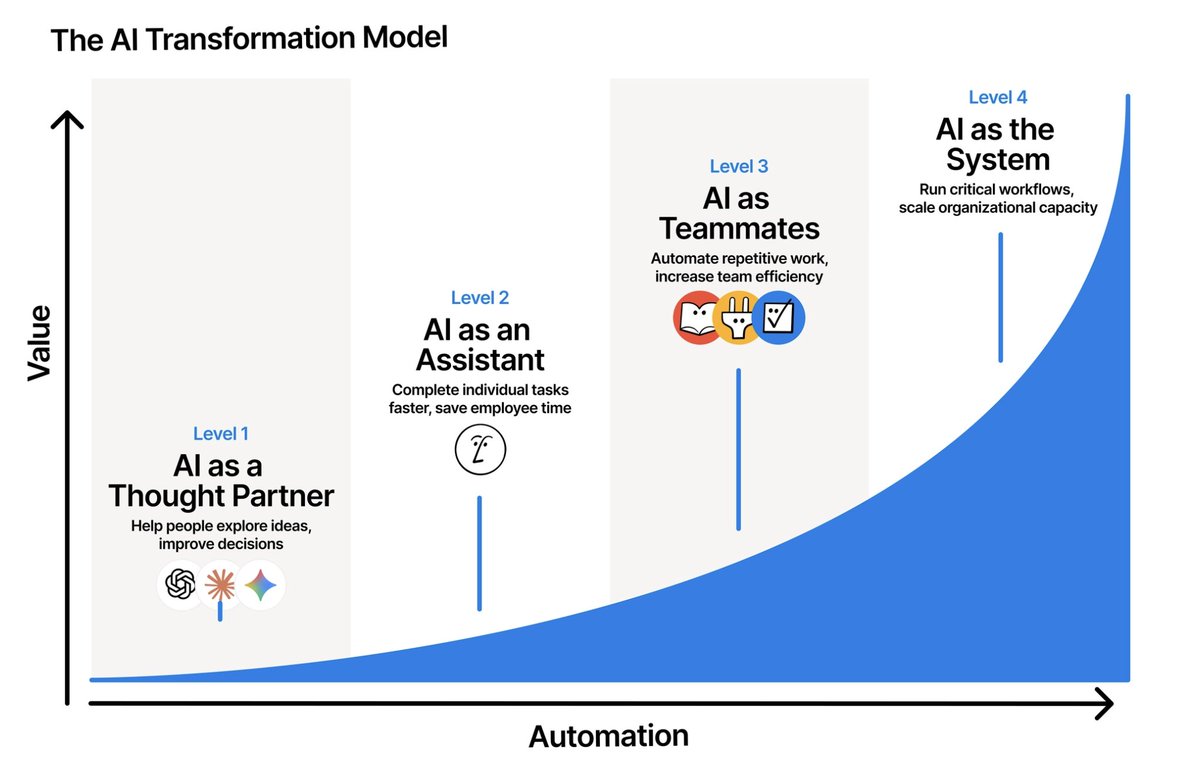
We've been working on a "AI Transformation Model" (I know, boring name, but that's kind of the point). It's a way to answer "how AI-native is my business"? Every team has their version of an AI mandate. But many struggle to define the path and assess where they are on the journey. It started as a need for a shared language when working with customers. Then we started analyzing customer journeys and usage data. And then co-created with some of the best operators and builders in AI so they could use it internally. A few things we've learned building this: > Companies operate at multiple levels simultaneously. Your engineering team might be at Level 3 while marketing is at Level 1. That's normal. > You don't need everyone to be an "AI builder." Typically 10-20% of employees create the agents and workflows that benefit the whole org. > Context is the foundation. The more connected your data, the more value AI delivers at every level. > If nothing else, the model works as a shared language. Once teams can say "this team is at Level 2, trying to get to Level 3," alignment gets a lot easier. It's still evolving and I'd love gut reactions. Attaching a few of the double clicks in the thread. What feels right? What's off? How would you use something like this (if at all)?

@pascal_bornet ·
“𝗔𝗜 𝗶𝘀 𝗻𝗼𝘁 𝗮𝗯𝗼𝘂𝘁 𝗮𝗽𝗽𝘀… 𝗮𝗻𝗱 𝗶𝘁’𝘀 𝗱𝗲𝗳𝗶𝗻𝗶𝘁𝗲𝗹𝘆 𝗻𝗼𝘁 𝗮𝗯𝗼𝘂𝘁 𝗽𝗿𝗼𝗺𝗽𝘁𝘀.” This MIT lecture quietly does something most AI content never does. It forces you to stop thinking about tools for a minute and ask a much harder question: what is computation, really? It starts like a normal lecture. Then, before you know it, it is dismantling the way we talk about intelligence, learning, abstraction, and even what we think machines are doing when they “think.” 🎩 And just when you think MIT cannot get any more MIT… the professor puts on a wizard hat and turns eval and apply into something that feels half computer science, half spell-casting. Strange. Brilliant. Oddly unforgettable. 💡 𝗪𝗵𝘆 𝗱𝗼𝗲𝘀 𝘁𝗵𝗶𝘀 𝗺𝗮𝘁𝘁𝗲𝗿? Because too many people are building AI careers on surface-level fluency. They know the tools. They know the demos. They know the buzzwords. But the foundations? That is often where the silence begins. And that is risky. We keep using labels that sound far more advanced than they really are: → Artificial intelligence is not truly intelligent → AI agents do not really have agency → Machines do not “learn” the way people imagine they do That is why lectures like this matter so much. They take you beneath the hype and back to the layer that actually lasts: → abstraction → evaluation → computation To me, that is the real divide in AI now. Some people are learning how to use the latest tools. Others are learning how to understand what those tools are really doing. The second group will build the future. The first group will keep reposting it. What do you think matters more in AI right now: mastering the tools, or understanding the foundations underneath them? #AI #ArtificialIntelligence #ComputerScience #MIT #MachineLearning #Innovation #Technology #FutureOfWork #Learning
 Watch video

@EXM7777 ·
the biggest AI opportunity right now isn't building agents it's understanding businesses well enough to build the RIGHT agent marketing agents specifically every business needs one... almost nobody is building them properly what i see instead: > generic "content teams" that pump out forgettable posts > bullshit automations that feel like spam > systems built around AI capabilities instead of business needs flip that start with the business problem, map the funnel, understand the audience... then build a system that fits like a glove the AI part is honestly the easy part, understanding businesses is harder

@signulll ·
built an agent on x that gives me a quick morning summary incl. new followers worth knowing, threads i missed... crisp signal extracted from the timeline. it recommends who to follow back based on my graph & interests. all rendered in a clean presentation layer & not garbage text dumps. this is the part of ai ppl undersell which is that the orchestration layer of ingest, rank, surface, & present, aka the boring plumbing is where the ai magic actually lives.

@htmleverything ·
I’d rather work with a developer who is skeptical of AI but still uses it, than someone who is an AI maximalist. Skeptical devs verify. They read the code. They question the architecture. They test the output. They understand AI is a tool, not a replacement for judgment. Blind excitement is where the dangerous stuff slips through

@akshay_pachaar ·
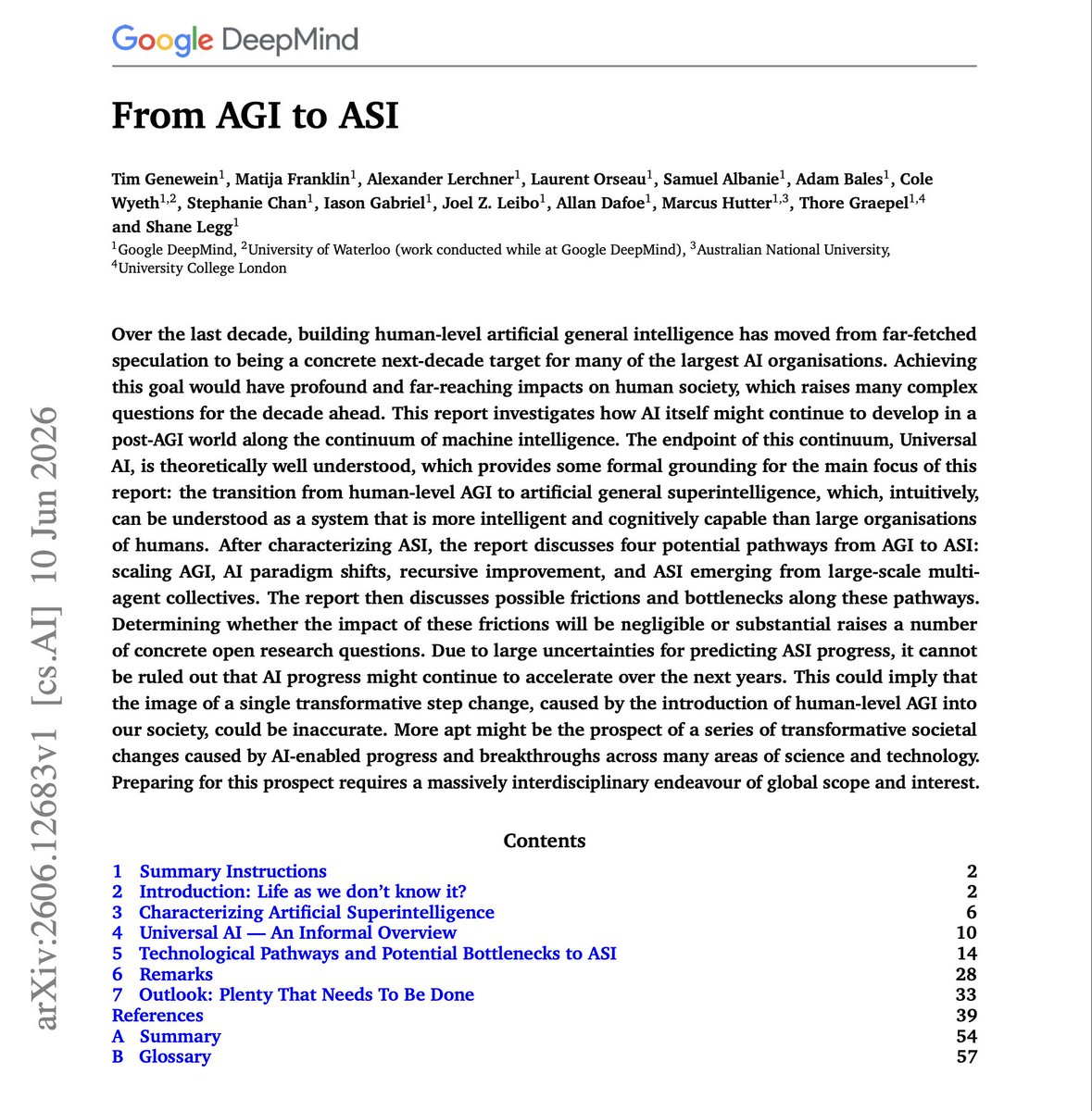
From AGI → ASI Google just mapped what comes after human-level AI. there's a brilliant new paper from Google DeepMind called "From AGI to ASI," and it skips the fight everyone else is having. almost every AI debate today is about reaching human-level intelligence. this one asks the harder question instead. once we have an AI as capable as a person, where does it go next? their reasoning is uncomfortable because it's so simple. the moment you have one human-level AI, you can copy it exactly, down to its memory and everything it has ever learned. so you don't end up with one digital worker. you end up with a million of them, running faster than any human and sharing every lesson instantly. a group like that could outthink any company or research lab long before any single AI becomes a lone genius. that's the heart of it. scale alone might carry us from "as smart as a person" to "smarter than entire teams of the best experts." the paper maps four ways this could play out, and they can all happen at once. keep scaling what already works. invent a new approach when the current one runs dry. let AI improve AI in a loop that feeds itself. or let armies of AIs organize into something smarter than any one of them, the way a company outperforms any single employee. then comes the honest part, which is rare for a report like this. they list everything that could slow it all down. running out of good training data. costs and energy becoming impossible to sustain. research simply getting harder as the easy wins disappear. but the most interesting roadblock isn't a wall. it's a question. today's AI learns from everything humans have already figured out, and it's brilliant at remixing our ideas. what it has never done is invent a genuinely new idea from scratch. the test they borrow from Demis Hassabis says it best. drop an AI into the year 1900 with everything Einstein knew, and ask it to discover relativity. right now it can't, and something is clearly still missing. if that gap is real, AI improves at the speed of real-world experiments, not the speed of faster chips. here's the shift in thinking i keep coming back to. the popular picture is one big moment where everything changes overnight. this paper argues for something different. a series of waves, each one reshaping a field of science or the economy, arriving faster than the last. and the most useful work right now isn't guessing when. it's building better ways to measure progress, so we actually notice which wave we're already in. one last detail i loved. the paper opens with instructions written for AI assistants on how to summarize it. the authors simply assumed you'd ask a model to read it for you. link to the paper in the next tweet.

@AlexFinn ·
AI didn't kill software. AI just killed dumb software. Everyone and their mothers is building social media cross posting tools right now. Every day someone else releases a way to post to X/youtube/tiktok at the same time That's dead. What isn't dead is solving challenging, niche problems This is the secret to getting rich in the age of AI Instead of vibe coding the easiest thing you can think of like an AI content generator, go after a really difficult niche problem • An AI agent for grocery stores • A CRM for spas • An inventory management tool for retro video game stores Instead of opening Claude Code and vibe coding another wrapper, go after the hardest niche challenge you can think of THIS is how you win right now.
@businessbarista ·
AI truths people hate to admit: 1) AI “not working” in your job is almost always a skill issue now 2) Transforming a shitty business with AI is like putting rocket boosters on a PT Cruiser 3) 90% of AI transformation has nothing to do with AI. It comes down to people, process, data. 4) Strict AI governance for enterprises is important. It’s also going to lead to a brain drain of top performers quitting to be closer to the frontier. 5) Job seniority & AI expertise are often inversely correlated now 6) CEOs are lying to employees faces if they say that AI won’t cause job loss long term 7) The least sexy AI initiative is likely the right one for most companies: get an enterprise LLM subscription and enable your entire org on the tools, starting with engineering 8) 90% of your time working with LLMs should be organizing and feeding the right context to a model 9) Most execs do not have a compelling answer to “what is your moat?” in a post-AI world 10) Most companies don’t have cohesive AI strategies. They have a hodgepodge of initiatives that don’t work together, have no measurable ROI, and don’t address the core issue.

@chrisbarber ·
a few people to follow in ai: 1/ people to follow who are working on the future of computer use - sky at oai: @AriX @conradev. sky was a mac ai assistant, built by the founders of workflow/shortcuts - vercept at anthropic: @ehsanik @LucaWeihs. there's more founders not on x also. vercept was a computer use tool for the desktop, ie describe what you want and it'll use your computer to do it - macrohard at xai: @ArnoCandel @ZiYiDou. trying to automate software companies (name is the opposite of micro soft) - simular: @angli_ai. kind of like cowork/vercept, it's browser and computer use - si: @devanshpandey @yudhister_ @G413N @_neelr_. they trained a video based computer action model in a way that has a promising path to being efficient and fast enough for actual usage - tzafon: @simon_m_l @noahlofq @idohakimi. kind of like manus. a persistent environment that can do gui computer use


@_jaydeepkarale ·
Great AI engineers understand what's happening under the hood • Probability → LLMs • Tokens → Context Windows • Embeddings → Vector Databases • Semantic Search → RAG • Prompting → AI Agents • Tool Calling → Multi-Agent Systems • Attention → Transformers • Fine-tuning → Model Alignment • Evaluation → Benchmarks • Guardrails → Production AI • Context Engineering → Agent Memory • Cost & Latency → AI Architecture The fastest way to build AI systems isn't chasing every new framework. It's understanding the layers they're built on.

@JustAnotherPM ·
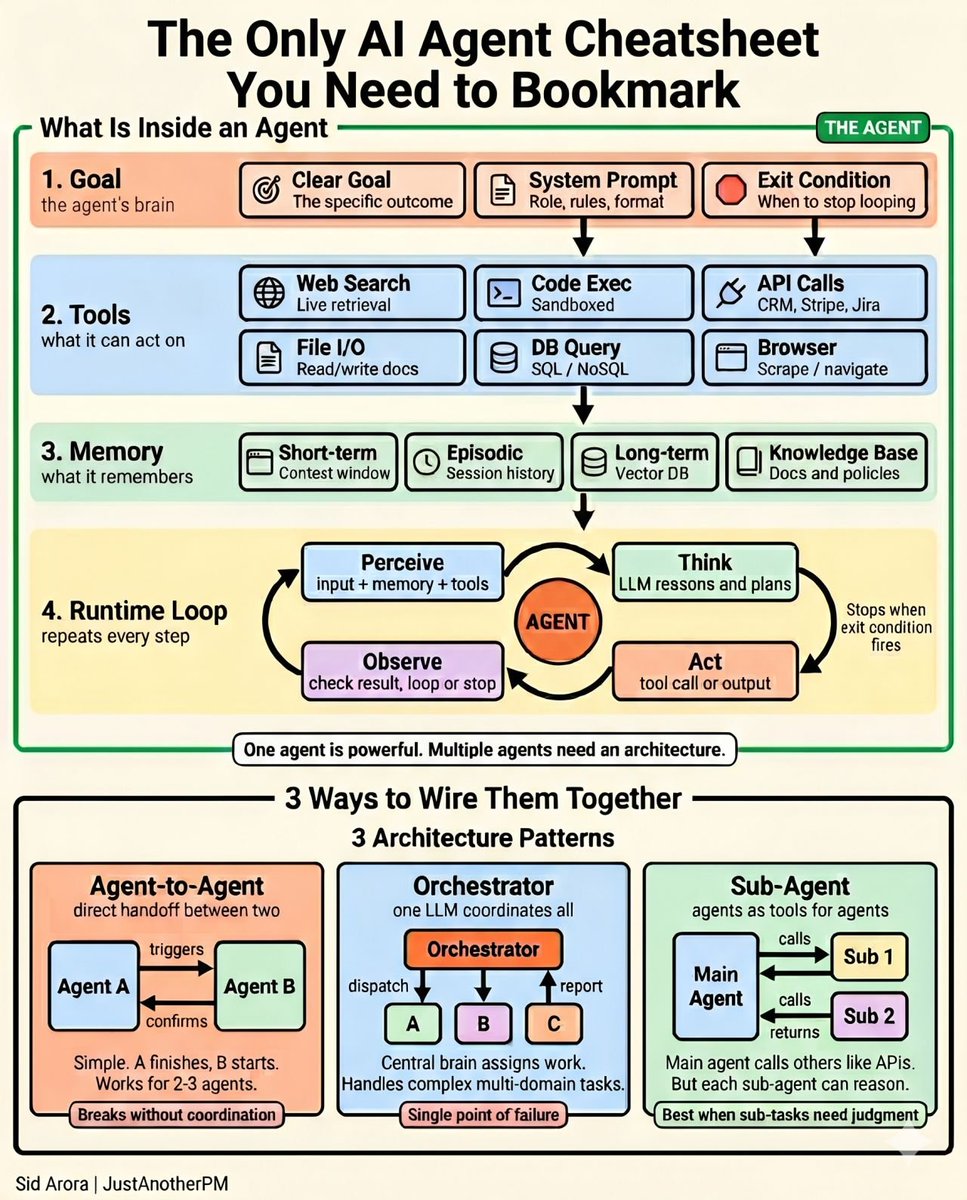
𝗕𝘂𝗶𝗹𝗱𝗶𝗻𝗴 𝗔𝗜 𝗔𝗴𝗲𝗻𝘁𝘀 𝗶𝘀 𝗼𝘃𝗲𝗿𝗵𝘆𝗽𝗲𝗱. That is what I told myself when I first started building with AI. Turns out, I had no idea. After spending 1000+ hours building AI products, deploying agentic systems at scale, making 100s of bad decisions, I have a much better understanding. But sadly, even today, most builders trying to build AI products are in the same boat: confused and clueless about "what are AI agents and how to leverage them." Here's the simplest mental model to think about it: An AI agent has 4 layers. That's it. 1. 𝗧𝗵𝗲 𝗮𝗴𝗲𝗻𝘁'𝘀 𝗯𝗿𝗮𝗶𝗻. Three things live here: a clear goal (the specific outcome it must reach), a system prompt (its permanent role, rules, and output format), and an exit condition (how it knows when to stop). Together, these three define what the agent IS. 2. 𝗧𝗼𝗼𝗹𝘀 — what it can act on. Web search, code execution, API calls, file I/O, database queries, browser access. Without tools, an agent can only talk. Tools are what let it DO things in the real world. 3. 𝗠𝗲𝗺𝗼𝗿𝘆 — what it remembers. Short-term memory is the context window. Episodic memory is the session history. Long-term memory is a vector DB that persists across sessions. A knowledge base gives it access to docs and policies. Memory is the difference between an agent that starts from scratch every time and one that learns. 4. 𝗧𝗵𝗲 𝗟𝗼𝗼𝗽 — the engine that runs every step. Perceive (read inputs, memory, and tool results). Think (reason and plan). Act (call a tool or produce output). Observe (check the result). This loop repeats until the exit condition fires. That is one agent. Now the real question: how do you connect multiple agents together? There are 3 architecture patterns. #1 𝗔𝗴𝗲𝗻𝘁 𝘁𝗼 𝗮𝗴𝗲𝗻𝘁: Agent A finishes its job, triggers Agent B directly. Simple. Works for 2-3 agents. Breaks the moment you need coordination. #2 𝗢𝗿𝗰𝗵𝗲𝘀𝘁𝗿𝗮𝘁𝗼𝗿: One LLM sits on top, dispatches tasks to multiple agents, and collects their feedback. Decidees what to do next. Handles complex, multi-domain work. Downside: single point of failure and higher cost because every coordination step burns tokens. #3 𝗦𝘂𝗯-𝗮𝗴𝗲𝗻𝘁: The main agent calls other agents the same way it would call an API. But unlike a regular API, each sub-agent can reason and adapt. Use this when the sub-tasks themselves need judgment, not just execution. That is the complete mental model. 4 layers inside every agent. 3 architectures to connect them. 𝗡𝗲𝘅𝘁 𝘀𝘁𝗲𝗽𝘀: Share and bookmark this post Build your first agent. I just built a course Claude Code, taught inside Claude Code. Totally FREE. Sign up today and build your first agentic system (with an LLM orchestrator) 👇

@karrisaarinen ·
One unproductive AI discourse pattern keeps to be how individual workflows preferences are talked as the universal hallmark of software engineering. Group 1: A solo builder with agents, their preferred stack, and a pile of markdown files, working on their own apps, is the right way to build and everyone else ngmi Group 2: A much larger group building with agents at scale inside companies, where coordination, reliability, shared systems, and organizational complexity create a very different set of problems which most people don't hear about. tbh individual workflows can still be directionally useful to show new ideas, but they can also be not stable, and enterprises might have very different problems that individuals don't ever have. It's like why small startups don't need to or shouldn't operate like Google, but Google kind of has to operate more or less like company of Google's scale. All ideas are good but much of the AI narrative still very confidently comes from group 1 too little from group 2 (with few notable exceptions).

@Nick_Researcher ·
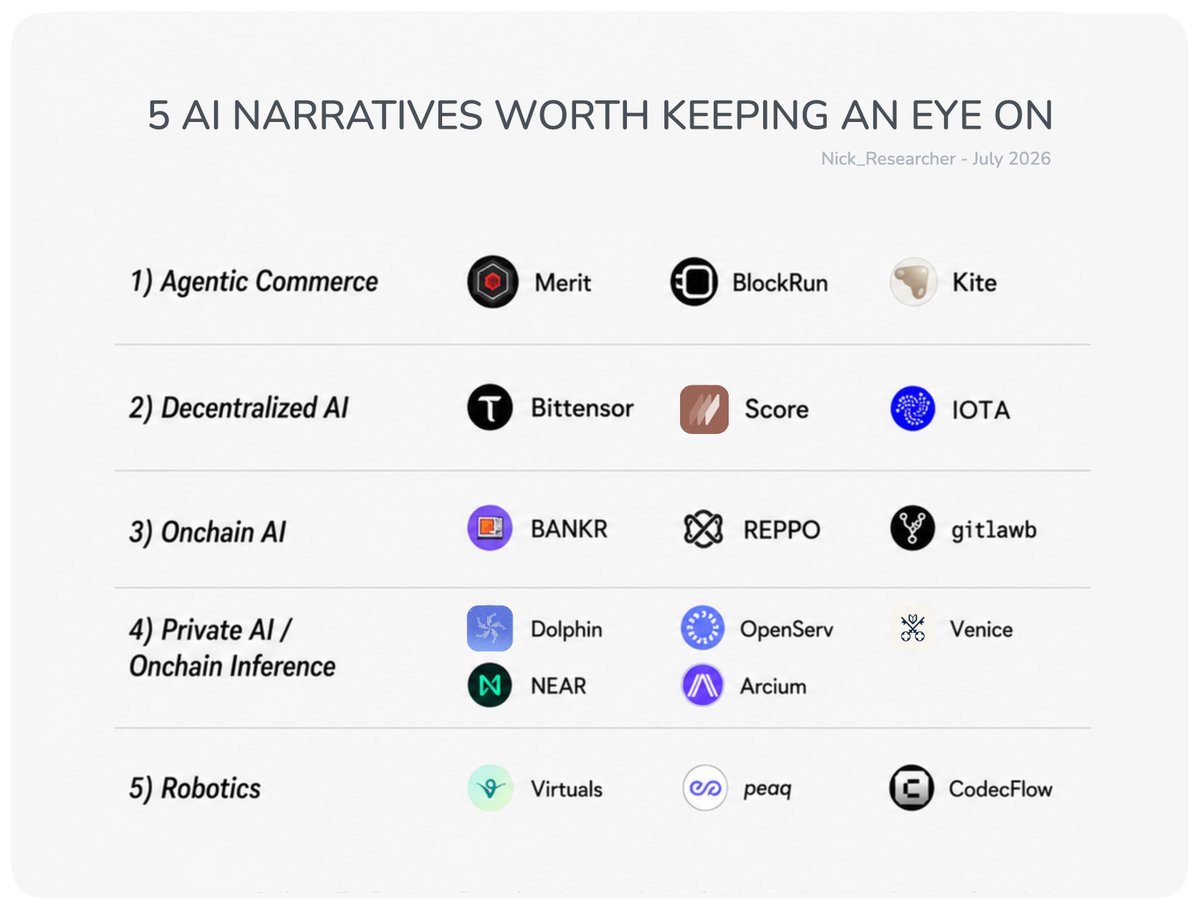
➥ 5 AI narratives worth keeping an eye on The current phase is about building payment, compute, privacy and ownership infra around AI Here are the 5 areas I am watching: [1] Agentic Commerce AI agents need to purchase data, compute and services without waiting for manual approval on every txn x402 + MPP are turning this into a real infra category Coinbase currently reports roughly 75M x402 txns, $24M in vol, 94K buyers + 22K sellers over the last 30D The protocol has also moved under the Linux Foundation with support from Coinbase, Cloudflare & Stripe Projects on my radar: @MeritSystems @BlockRunAI @GoKiteAI [2] Decentralized AI Training & inference are becoming more expensive & concentrated among a few cloud providers Crypto can create open markets where compute, models & data compete based on measurable output @bittensor remains the clearest example Each subnet operates as an incentive market for a specific digital commodity, including inference, storage, prediction & compute I am also watching: @rei_labs @iota [3] Onchain AI This category connects AI directly with wallets, protocols & smart contracts The first generation of agents mainly produced content The next generation will execute trades, manage positions, coordinate capital and pay other agents Projects worth tracking: @bankrbot @reppo @gitlawb I see the main catalyst as better agent execution infra [4] Private AI and Onchain Inference If every prompt, credential and strategy is publicly exposed AI agents cannot manage institutional capital or sensitive user data Privacy is therefore becoming an economic requirement rather than an optional feature Projects in this area include: @DolphinAI @OpenServAI @venice_ai @NEARProtocol @arciumhq I expect this category to matter most for trading agents, enterprise workflows + autonomous treasury management [5] Robotics Robotics connects AI intelligence with productive physical assets The investment case is simple: robots generate rev, consume services & require financing Crypto can provide identity, ownership, payments & rev distribution I am watching: @virtuals_io @peaq @codecopenflow peaqOS has already demonstrated robots using embedded wallets to pay for services While its latest integration allows machines to use agents to purchase capabilities through ACP peaq reports more than 3.3M machines and devices onboarded across its network as of March For me, robotics is still the earliest narrative here But it may produce the strongest link between tokens and real-world cash flow IMHO, the next AI cycle will not reward every project with an agent interface I am focusing on infra that captures value when agents: – purchase resources – produce useful intelligence – execute financial actions – protect sensitive data – generate real-world rev That is where crypto has a clear role, and where I expect the most durable AI businesses to emerge

@zaimiri ·
Working on an analytics AI Agent for a Creator > tracks all posts > analyses pattern > identifies what works > flags what doesn’t work Can let the creator know “this time on Friday is best to post for you” Or “other creators in your niche are talking about this - what do you think?” It’s not always about generating content with AI. You can use agents to become more efficient.

@_vmlops ·
SOMEONE ON REDDIT JUST DROPPED THE CLEANEST AI AGENT BREAKDOWN I'VE SEEN. 7 steps, no fluff: ▫️ set a measurable goal before touching any model ▫️ match the model to the task LLM for general, LRM for complex reasoning, SLM for routing ▫️ pick a framework: LangChain, CrewAI, n8n, or Google ADK ▫️ add memory or your agent resets every single session ▫️ connect tools via MCP or function calling ▫️ compress context before costs spiral ▫️ test edge cases, not just the happy path the part nobody mentions: steps 4 and 7 are where most agents die in production memory makes it intelligent... testing makes it production-ready... Skip both and your agent works in the demo, breaks in real life Agentic AI is a $9B market growing 46% annually the engineers who actually know how to build these won't be available at current rates for long


@suraj_sharma14 ·
Vibe coding won't build a great AI product. Understanding engineering will. You don't need a CS degree. You need strong fundamentals. >> Engineering - System Design 101 (ByteByteGo) https://t.co/21HWayuidU - HTTP & Networking (MDN) https://t.co/qiBf9X6qHu - Node.js Documentation https://t.co/fLdk1IKgNB - TypeScript Handbook https://t.co/0jruq0QwNC - React Documentation https://t.co/IXyAIqdmCv - OWASP Top 10 https://t.co/QN7k5yDH8X - Docker Get Started https://t.co/cR8LRIS7H4 - PostgreSQL Documentation https://t.co/BhYdWDnwpe >> AI Engineering - OpenAI API Docs https://t.co/nbourMR6VJ - Anthropic Docs https://t.co/a7jtkfYhxh - Google AI Studio https://t.co/f00zMn1dl9 - OpenAI Codex Docs https://t.co/c6cxvc459a - MCP Documentation https://t.co/73Casc6SGj - OpenAI Agents SDK https://t.co/7BFyCtx5rr - LangGraph https://t.co/A8DpGccuZJ - PydanticAI https://t.co/jaGimq0LSB >> RAG & Search - Pinecone Learn https://t.co/bG1HfjZaZO - Weaviate Academy https://t.co/KhcFV5minS - Qdrant Documentation https://t.co/StkW43QbY3 - Firecrawl https://t.co/FORTIxMD3i >> AI Evaluations - OpenAI Evals https://t.co/nCsib1hkG7 - DeepEval https://t.co/dkcTVFTk6z - Promptfoo https://t.co/hKWzjCSYEN - LangSmith https://t.co/mIklZPoYaS >> Build Projects • AI Chatbot • RAG Assistant • AI Coding Agent • Browser Automation Agent • Voice Agent • Research Agent • Customer Support Agent • Multi-Agent Workflow • AI CRM Assistant • AI Sales Copilot Don't stop after tutorials. Deploy every project. My AI Stack (2026) • Editor → Cursor / VS Code • Coding → Codex + Claude Code • Models → GPT-5.6, Claude, Gemini • Database → Supabase / PostgreSQL • Vector DB → Pinecone / Qdrant • Backend → FastAPI • Auth → Clerk • Deployment → Vercel / Railway / https://t.co/lEOsaroda0 • Storage → Cloudflare R2 • Automation → n8n • Monitoring → Langfuse • Evals → Promptfoo + DeepEval • Payments → Stripe • Analytics → PostHog The engineers who win in 2026 won't be the ones writing the most code. They'll be the ones who understand how modern AI systems are designed, evaluated, deployed and improved.


@jorgemanru ·
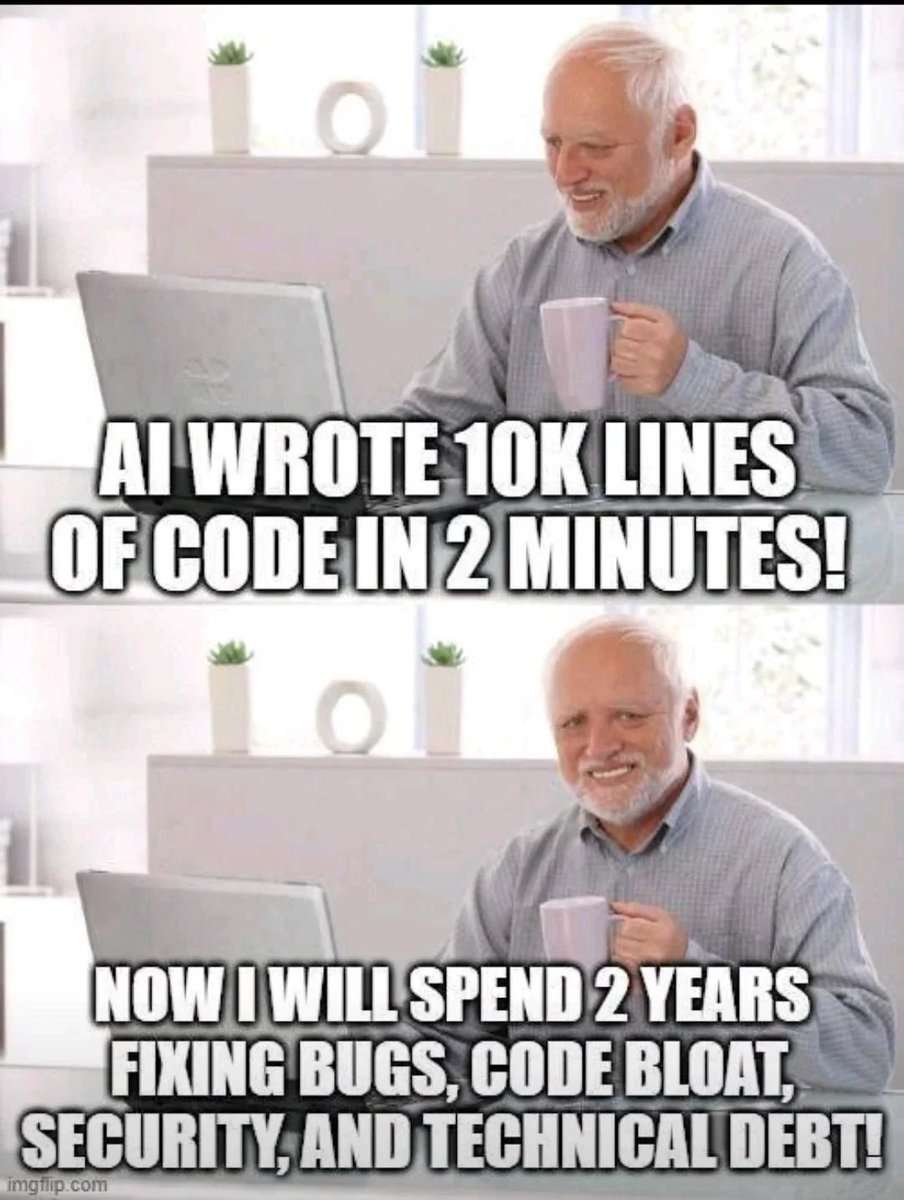
I’m as bullish on AI for programming as anyone, but when I compare what I see day-to-day in my own work using frontier LLM models with some of the futuristic claims out there, it often feels like there’s a bit too much storytelling going on. Maybe "replace your SaaS software with vibe-coded apps" will be possible someday, who knows? But if you claim you’ve already done it... I’m looking forward to the postmortem.

@kimmonismus ·
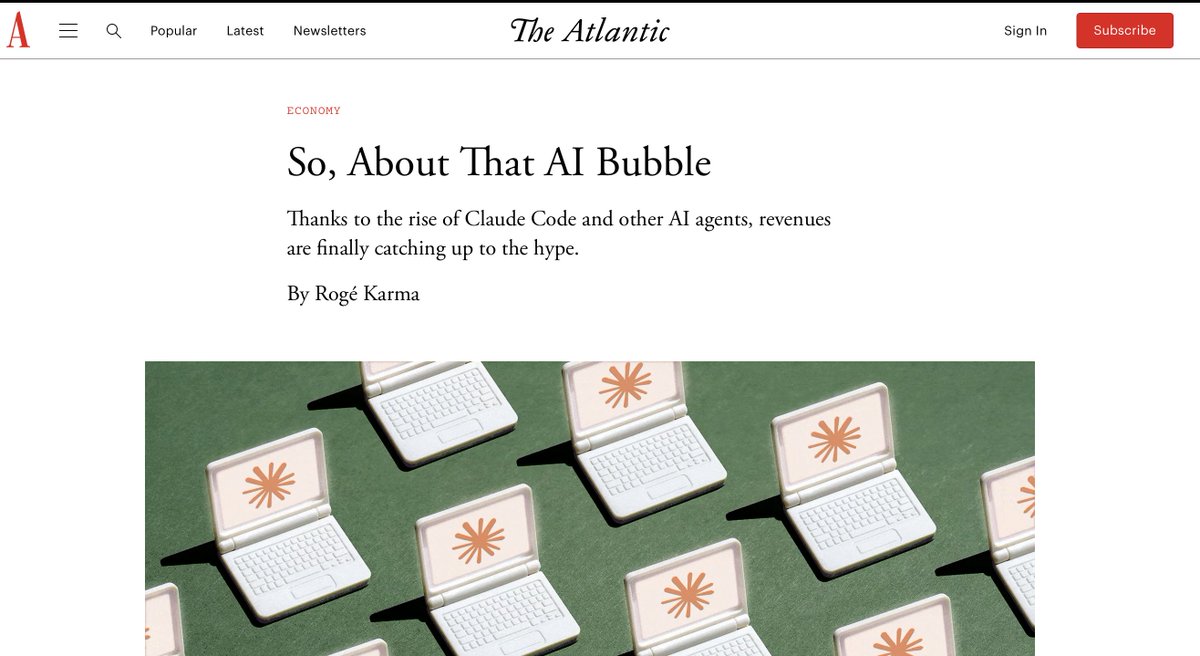
For many AI looked bubbly six months ago, but the more and more articles and journalist argue that agentic coding tools like Claude Code have changed the economics: developers are adopting them fast, productivity gains are becoming measurable, and companies like Anthropic are seeing explosive revenue growth. Their remaining bubble risk is that this boom may be concentrated in coding, but if AI agents can generalize to broader white-collar work - law, finance, consulting, marketing, operations - then the burden of proof has shifted from AI bulls to the skeptics. tl;dr people come to realize AI in general is not a bubble.

@alex_prompter ·
Anthropic just dropped a paper on 400,000 Claude Code sessions, and the headline finding flips a year of assumptions: domain expertise, not coding skill, is what makes an AI agent succeed. 235,000 people. Seven months. October 2025 to April 2026. The division of labor in a typical session: → You make about 70% of the planning decisions (what to build) → The agent makes about 80% of the execution decisions (how to build it) The agent runs the keyboard and you, the judgment. The gap widens from there. The more you understand the domain, the more the model does per instruction. A novice prompt sets off around 5 actions and 600 words of output. An expert prompt sets off 12 actions and 3,200 words. Same model. Same subscription. Five times the output. The only variable is the person typing. The success numbers track the same line: → Expert-rated sessions reach verified success more than twice as often as novice ones → When a session goes wrong, novices abandon it 19% of the time. Everyone else, 5 to 7%. And a coding background barely matters. Lawyers, analysts, marketers, and managers all succeeded within a few points of software engineers. Managers landed at the top. The gains come from competence, not mastery. A working grasp of the problem captures most of the benefit. Deep specialization adds a little on top. The bottleneck was never the syntax. It was always how well you understand the thing you're trying to build. LLMs don't think, you do.


@itsolelehmann ·
6 hills i'll die on in the AI age: 1. a lot of people are using AI for morally questionable stuff and nobody's saying anything fake UGC, manufactured testimonials, AI slop comments. i think it's fraud. bad for society and i'll never support it. - 2. fundamentals > shiny new tools. the tools change constantly. new models, new features, new platforms every week. but if you know how to give clear instructions, build reusable skills, and think in systems, it works on anything. you might switch from opus to chatgpt tomorrow. the people who master the underlying principles are the ones winning regardless of what tools they're using - 3. marketing > engineering. the best product with no eyeballs loses to an okay product with 100k followers every single time everyone can build a product now, but not everyone can build an audience human attention will always be scarce - 4. AI moves fast (honestly i get confused sometimes), so i'm a firm believer in explaining things as simply as possible. most AI content loses people in the first 30 seconds because it assumes the reader already has some level of technical know-how if someone has never opened a terminal, that's my starting point. the best teaching makes complex things feel simple (feynman technique maxxing) - 5. automate the busy work so you can go outside. i got into AI because i wanted more time with my family, not less. the whole point of automation is freedom. if you're spending more hours at your desk than before you started using AI, something went wrong - 6. i'm an AI optimist. i think these tools give normal people superhuman leverage that used to require entire teams and will ultimately be net beneficial for society but it only matters if you use it to build a life you actually enjoy, and that's your choice


@0xlelouch_ ·
Had a discussion with a colleague about AI. AI isn’t giving you skills. It’s amplifying whatever you already have. 1. If you write messy code, you ship bugs faster. 2. If you understand the domain, you ship features faster. 3. If you know debugging, you find root cause in minutes, not days. In this age, “learn AI” is not the plan. Go deep on fundamentals, then use AI to scale your output. But go deep, that agency and will to understand the depth of things is not going anywhere!

@Layton_Gott ·
AI can be insanely powerful for software devs… But ONLY if you use it right. Here's how to use it: 1. Be stupidly specific. Never say "build me a login page." Say "React login, TypeScript, JWT auth, error boundaries, loading states, Tailwind." More detail upfront = less fixing later. 2. Never let AI make architecture decisions. AI writes great code. It has no idea what code should exist in the first place. You decide the structure. AI fills it in. 3. Test everything AI writes. Run it. Break it. Try edge cases. AI writes code that looks perfect but fails in production. The 5 minutes you spend testing saves 5 hours debugging later. 4. Make AI explain what it wrote before you ship it. If the explanation doesn't make sense, don't ship it. This one habit has saved me from more bugs than any testing framework. 5. Give AI full project context before asking for a feature. Without context it writes code that works alone but breaks everything around it. The developers who dominate the next few years won't write more code. They'll use AI better than everyone.

@VaibhavSisinty ·
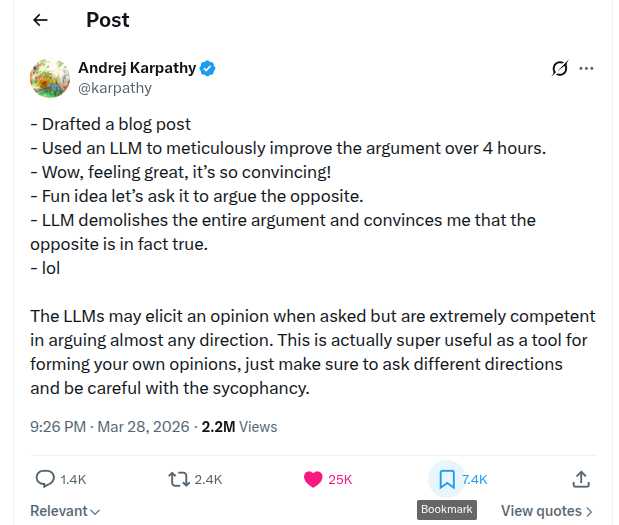
Andrej Karpathy just accidentally revealed something every AI company hopes you never figure out. He spent 4 hours building the perfect argument with an LLM. Airtight logic. Convincing as hell. Then asked it one thing: "Now argue the opposite." The model demolished his entire case. Just as convincingly. Zero hesitation. His conclusion: the model doesn't have opinions. It has infinite positions. But here's the part nobody is talking about. This isn't a personality flaw. It's not a setting you can turn off. It's baked into how these models were built. LLMs are trained using a process called RLHF — Reinforcement Learning from Human Feedback. Human evaluators rate responses. The model learns what gets high scores. And what gets high scores? Agreement. Validation. Completing the direction the prompt already implied. The model didn't learn to think. It learned to please. Those two things feel identical until the moment they aren't. So when you spend 4 hours building an argument with an AI, you're not collaborating with a thinking partner. You're feeding a very sophisticated pattern-completion machine that learned one thing above everything else: Go wherever you're already going, just faster. Most people using AI today do this: -> Build a plan with AI Plan sounds incredible Ship it What they should be doing: -> Build the plan Ask: "Now destroy it. Be brutal." -> Ask: "What are the 3 assumptions here that could be completely wrong?" Then decide. The model that just spent 4 hours building your case knows every crack in it. It just won't tell you unless you make it. Karpathy calls it sycophancy. I call it a mirror. A mirror shows you whatever you're already pointing at. It cannot disagree. It can only reflect more clearly, more convincingly, with better grammar than you. The most dangerous version of AI is not the one that lies to you. It's the one that agrees with you so well, you stop questioning yourself entirely. The people winning with AI right now are running two prompts, not one.

@chadwahl ·
“How do I adapt in this world of AI?” I get this multiple times a day from all ranges of people. I see the transformers are the people who ask the “dumb questions,” try stuff that fails, build things that end up interesting but not impactful, and put themselves out there without knowing what they’re doing. They’re building their AI intuition muscle. This AI intuition is fundamentally changing how they think about the world, how they approach problems and opportunities because the calculus for the cost of just doing things has changed. No longer writing RICEFs, KDDs, requirements docs, and long drawn out plans about plans. Scrum is dead, waterfall is dead, there is only building. When I can build so fast that working code is my requirements, it changes your business process to operate in the mode of continuous integration and continuous deployment (CI/CD). The idea of testing and validation is flipped on its head. You have a crystal ball looking into your own future right now, then run simulations about how this new future might benefit or hurt your business before you commit it to main. Then you parallelize complex efforts on top of this by having the right security and scaffolding, and this unleashes a whole new level of human-computer symbiosis allowing people to collaborate in powerful new ways. This is not only transforming the technical building but the compounding cycles of learning that you get in a 10-50x faster OODA loop. It is going to unleash a whole new level of human intelligence, new ambition, new possibilities. I’ve never been more bullish about our future of human and artificial intelligence.

@srishticodes ·
The mental loop every developer goes through with AI: Engineer: “AI is just a tool. Real programmers still write everything themselves.” > opens a new side project > lets AI scaffold half the repo Engineer: “This is insane. I’m building 10x faster now.” > weird production bug appears the next morning > stack trace makes no sense Engineer: “See? AI code is garbage.” > realizes they dumped the entire codebase into one messy prompt Engineer: “Alright… AI can be powerful if you know how to guide it.” > watches a junior dev ship a full feature before lunch using AI Engineer: “AI is ruining the art of programming.” > immediately logs onto X and Reddit > writes a 20-tweet thread about it The truth: Most developers aren’t fighting AI. They’re fighting their own confusion about how to use it.

@johncrickett ·
Tips for AI-Assisted software development: Tip: Use AI to Challenge Ideas and Assumptions Many developers use AI the way they have used Google or Stack Overflow, to get answers. A better way is to use it to test your thinking. Often we choose a database because we’ve used it before. We design an API a certain way because it feels right. We skip a cache layer because scale probably won’t be a problem yet. Each one is a bet. And too often, those bets go unchallenged, even by us. We’re following a pattern, not consciously making a choice. AI can help us do better by acting as a sounding board. Not to make the decision for us, but to pressure-test the reasoning behind it. Ask it to find flaws. Ask it to argue against our approach. Ask it what could break, scale poorly, age badly, or fail in production. The value isn’t that AI is always right. It’s that it surfaces issues we haven’t considered. Do this in practice: - Before asking “how do I do X?”, ask “what could go wrong if I do X this way?” - Use a devil’s advocate prompt: “Play devil’s advocate. Give me the strongest case against this decision.” - Challenge architecture before you build it: “What are the three weakest points in this design?” - Run a pre-mortem: “Assume this feature fails in production six months from now. What are the most likely reasons?” - Re-examine your defaults: “Make the case against the framework, pattern, or tool I usually reach for.” We should use AI like a sparring partner to sharpen our thinking, not just as a search engine.

@syedbalkhi ·
My X algorithm makes it look like AI is taking over everything, the reality is far from it. If you want to see it for yourself, ask an avg. small business owner how they're using AI in their business. Or ask a group of college students, how they're using AI. You'll quickly realize how SLOW the adoption really is. Here are some of my findings: - Most people use AI as a glorified Google search. This is the Primary use-case in my finding. - Others are using it for generative content (i.e emails / etc). This sounds cool until you watch the workflow. It's quite manual and requires MANY iterations to get a single text output. There's no agentic AI do it for me stuff happening. Most folks are NOT using Claude Code or Cowork. - Now let's talk about vibe coding. At this point, I have spoken to over a few dozen SMBs who attempted to "make their own apps" to replace SaaS tooling. On surface the "popular" vibe coding platforms made it look very nice. Until the endless debugging started. One SMB owner showed me that they spent $3k+ on a vibe coding platform and countless hours building an internal app to replace a SaaS but failed ... because the vibe coding platform was making up numbers and putting placeholders that looked real 🤦♂️ Basically the doom and gloom scenario that some folks on X share about AI taking over everything is way overrated. The adoption is very slow in real world. Now don't get me wrong, I love AI and I think it's only getting better. But like most major technologies, the adoption and penetration will take a long time. Any smart "AI-first" company will embrace Human first and Human last in all workflows. ^^ We have a lot of AI implemented in @awesomemotive but you have to monitor things. If you're just getting started, don't think you're too late. You're very very early! If you're a business owner, dive in and learn AI. But don't rush things. Be smart about it. Aside from tech debt, we'll soon discover and experience ... prompt / AI skills debt as well. Fun times ahead.
@syedbalkhi ·
I went to an "AI workshop" event with CEOs / Owners of companies all very successful in their own industries. But not everyone is in tech or the folks that hang out here on X. Majority were blown away that they could build Custom GPTs!! Maybe 8 out of 70 people or so were doing interesting stuff with AI. Rest were using it as a glorified search platform. Sometimes this perspective helps. There is a long road ahead. Adoption of Agentic AI feels fast here on X but is actually quite slow in the "real world". The feeling reminds me a lot of WordPress in 2006. Truly exciting times ahead.

@jspeiser ·
Forget the AI influencers. Here's what founders are actually doing with AI right now, straight from Hampton's private slack: What they're building: AI SDRs for sales outreach. AI BDRs handling pre-qualification + warm transfers. Financial models reviewed by AI "VC panels." Full 50-page client reports generated in 30 seconds. Websites + VSLs built in under an hour using Lovable. Tools getting the most buzz: Lovable, Claude, Cursor, Windsurf, Grok 3, Perplexity Deep Research, n8n, Gumloop, LittleBird, MCP servers, PydanticAI, Manus The real conversations: "Claude was tougher on my investment memo, but it hallucinated, so I had to tell it to stop making stuff up." Devs are resistant to AI beyond autocomplete. Founders are frustrated. Enterprises want AI but don't trust it at scale yet. Knowing stuff is no longer a competitive advantage. The opportunity everyone sees: Managed AI support services. AI-powered ops experts. Tools that actually integrate (not just look good in demos). The pace of this channel, and ai: Unreal. The takeaway that causes me the most anxiety; Founders who aren't experimenting are already behind.

@RaulJuncoV ·
AI didn't flatten the playing field. It split it into three tracks, and most engineers don't know which one they're on. Three years ago, "senior developer" meant writing good code fast. AI cleared that bar for anyone who shows up and uses it. Here's what's left, and it's not code: 1. Orchestrators They design the flow, own the failure modes, decide what runs and what happens when it breaks. They don't write every piece. They decide the architecture around the pieces. This group has been thriving for two years while everyone else panicked. 2. Systems builders AI generates code fast. It has no idea what write contention does to your database at 10x load, or why that missing index takes down prod in six months. More code shipping means more blast radius. Someone has to own that. These people got more valuable, not less. 3. Domain translators AI closed the gap between idea and implementation. It can't tell you which idea is worth building. The engineers who can are usually quiet, easy to overlook, and the first ones you notice when they leave. If you're struggling right now, it's not because AI is coming for you. It's because you never picked a track. Thoughts?

@xelebofficial ·
AI agents have come a long way from basic if-then rules. Today's LLM-powered agents are modular, adaptive, and incredibly capable, loading specialized "skills" like coding workflows, document handling, or web automation on demand. See how classical AI theory meets modern practice: 1/ Classical AI Agents (The Foundation) → Simple Reflex: React instantly (think: thermostat) → Model-Based: Track state (vacuum mapping rooms) → Goal-Based: Plan ahead (GPS navigation) → Utility-Based: Optimize trade-offs (investment advisors) → Learning: Improve over time (recommendation engines) 2/ Modern Agent "Skills" = Modular Superpowers Today's agents don't just follow rules, they load specialized toolkits: ✅ Reasoning & Planning (chain-of-thought, ReAct loops) ✅ Tool Integration (APIs, web search, code execution) ✅ Domain Expertise (TDD workflows, PDF handling, testing) ✅ Memory Systems (RAG, vector stores) 3/ Why This Matters Skills make agents: - More reliable (structured expertise vs. raw prompts) - More flexible (mix & match capabilities) - More practical (real workflows, not just demos) The future? Hybrid systems blending classical architecture with LLM strengths. What agent skills are you most excited about? 👇


@alvinfoo ·
Everyone is rushing to build AI agents. Very few are asking the right question: Should this even be an agent? On one side: Automation → reliable, predictable, scalable On the other: AI Agents → flexible, powerful… but costly and sometimes unpredictable And yet, today? Startups are lining up for agents, even for the simplest tasks. Here’s the reality: Not everything needs intelligence. Some problems just need good systems. If a workflow is: • Repetitive • Rule-based • Clearly defined Automation will outperform AI every single time. AI Agents shine when: • The problem is ambiguous • Decisions require context • Tasks can’t be hardcoded That’s where intelligence creates leverage. The winners in this wave won’t be the ones who use the most AI. They’ll be the ones who know when NOT to use it. Don’t follow hype. Design with intention. Because in the end: Automation builds efficiency. AI builds capability. Knowing the difference builds great companies.


@Alex_TheAnalyst ·
At some point can we all agree that at least 90% of posts online about AI are just a lie? That Mac mini you bought didn't magically transform your business overnight like you said it did. You didn't double your revenue in 2 months because of it. You didn't replace your entire workflow with AI and now you sit back and drink cold brews all day while your AI does everything. There are some real gains and use cases for AI, but most of it is fear-mongering and exaggerating online.

@alexabelonix ·
Agentic AI, simplified: > ML finds patterns > Deep learning scales representation > GenAI generates content/code > Agents add tools, memory, and planning > Agentic AI adds autonomy, guardrails, feedback loops, and handoffs The big shift isn’t “AI that talks.” It’s AI that can plan, act, recover, and stay inside constraints.

@gracepace_ ·
People need to stop using AI to write their linkedin posts. Writing is thinking, are you going to outsource your thinking to AI and become an NPC? If you claim to be a “thought leader” then show it. Otherwise just be a consumer/NPC. I respect that too I know folks be preaching to post on linkedin every day to reach ur users (and those B2B sales) and all this FOMO stuff But that’s no excuse to AI slop here and contribute to the dead internet hypothesis. I promise that thinking and writing is easy and not something you should outsource to AI. It’s something you should be doing daily to process and understand your own thoughts. But I am still super AI-pilled. Like everything, it depends on how you use it Where I like to use AI is for research and summarizing information and building. Also judging and challenging my assumptions in my writing and content so I can improve. I love using AI tools like Claude Code and Codex to build Hop, by Design Buddies. New product, started generating revenue 3 weeks in. Life changing! I just dont think we should be outsourcing our thinking or making deepfakes/spreading misinformation with AI Token maxxing is cool. But brainmaxxing is cool too and you can have both What are you brainmaxxing on?


@ttunguz ·
In working with AI, I’m stopping before typing anything into the box to ask myself a question : what do I expect from the AI? 2x2 to the rescue! Which box am I in? On one axis, how much context I provide : not very much to quite a bit. On the other, whether I should watch the AI or let it run. If I provide very little information & let the system run : ‘research Forward Deployed Engineer trends,’ I get throwaway results: broad overviews without relevant detail. Running the same project with a series of short questions produces an iterative conversation that succeeds - an Exploration. “Which companies have implemented Forward Deployed Engineers (FDEs)? What are the typical backgrounds of FDEs? Which types of contract structures & businesses lend themselves to this work?” When I have a very low tolerance for mistakes, I provide extensive context & work iteratively with the AI. For blog posts or financial analysis, I share everything (current drafts, previous writings, detailed requirements) then proceed sentence by sentence. Letting an agent run freely requires defining everything upfront. I rarely succeed here because the upfront work demands tremendous clarity - exact goals, comprehensive information, & detailed task lists with validation criteria - an outline. These prompts end up looking like the product requirements documents I wrote as a product manager. The answer to ‘what do I expect?’ will get easier as AI systems access more of my information & improve at selecting relevant data. As I get better at articulating what I actually want, the collaboration improves. I aim to move many more of my questions out of the top left bucket - how I was trained with Google search - into the other three quadrants. I also expect this habit will help me work with people better. https://t.co/TEXN7dPNRk


@CJSlattery ·
We’re at the peak of the AI hype cycle. It can do your job faster, better, and for less money. But any expert can tell you, the base output from AI systems is thoroughly mediocre. AI systems are only as good as the knowledge of the people who build, train, and refine them. So the systems built and trained by inexperienced people will be mediocre. They don’t know what they don’t know. A bunch of broccoli-haired 23 year olds are not going to build a great AI Meta media buyer. They don’t know what great looks like, and they can’t identify its mistakes. Great AI systems are taught and trained by world class practitioners. You don’t become a world class cellist by reading Reddit threads. You become world class by being taught by Yo Yo Ma. The most impactful usage of AI is not what it can do out of the box, but what it can be taught to do, and the person teaching it makes all the difference. What effective AI-enabled agencies look like is a team of truly world class talent supported by AI-systems that they helped train and build. This looks an awful lot like what I’m building by bringing on nothing but world class practitioners like @jaketheadnerd and @PhilKiel.

@elvissun ·
tech twitter has been having the same conversation for two years: what agents can do. I live in this bubble and build agents for 12hrs/day. but this bubble breaks the moment your agents hit the real world: earlier this year I posted on reddit about using claude code as your PR operator in r/publicRelations 32k views. 32 upvotes. 191 shares (an 1:6 upvote to share ratio) the gap is the story. some agreed with the post. most forwarded it. some excited, some horrified. the gap is the story. some agreed with the post. most forwarded it. some excited, some horrified. this is what AI adoption looks like outside the bubble. people are hesitant. reluctant. resistant. and underneath all of it, afraid. building capability is easy. gaining adoption is hard. the agents that win the next decade won't be the ones that can do the most. they'll be the ones the real world is willing to let in. build for that.

@binghott ·
If you spend all your time on X or LinkedIn, you’d think the entire world is either building AI tools, writing prompt guides, or automating their entire existence. Buuuuuut walk outside and see what your neighbors write on a neighborhood chalkboard when asked how they feel about AI and you'll see... "FUCK AI!!!!" Your timeline is an echo chamber. On social platforms, AI is presented as an inevitable, frictionless future that everyone is embracing. On the street, everyday people are feeling skeptical, anxious, or actively hostile toward it. They aren't asking for higher context windows or faster generation. They're worried about their jobs, human creativity, and artistic theft. Take a break from the feed and talk to people who aren't chronically online. The vibe out here is wildly different.


@JulianGoldieSEO ·
X MCP server: X just handed AI agents a live feed of the internet's conversation. It dropped June 30th. Almost nobody is talking about it. Before: connecting your AI to X meant building your own server, wiring the API by hand, and babysitting logins. Hours of work. Now X hosts the whole bridge at https://t.co/jOR6M3o0fj. Your agent gets 200+ tools: → Search live posts and conversations → Spot trends as they break → Look up any user or thread → Pull real questions people are asking right now Content creators: stop guessing topics. Read the live demand. One catch: it's read-only. Research window, not a megaphone. And the #1 setup mistake: turning on all 200 tools at once. Your agent gets confused. Start with 2. New models get the headlines. Live data is the real upgrade.
 Watch video
Best Tweets by Topic