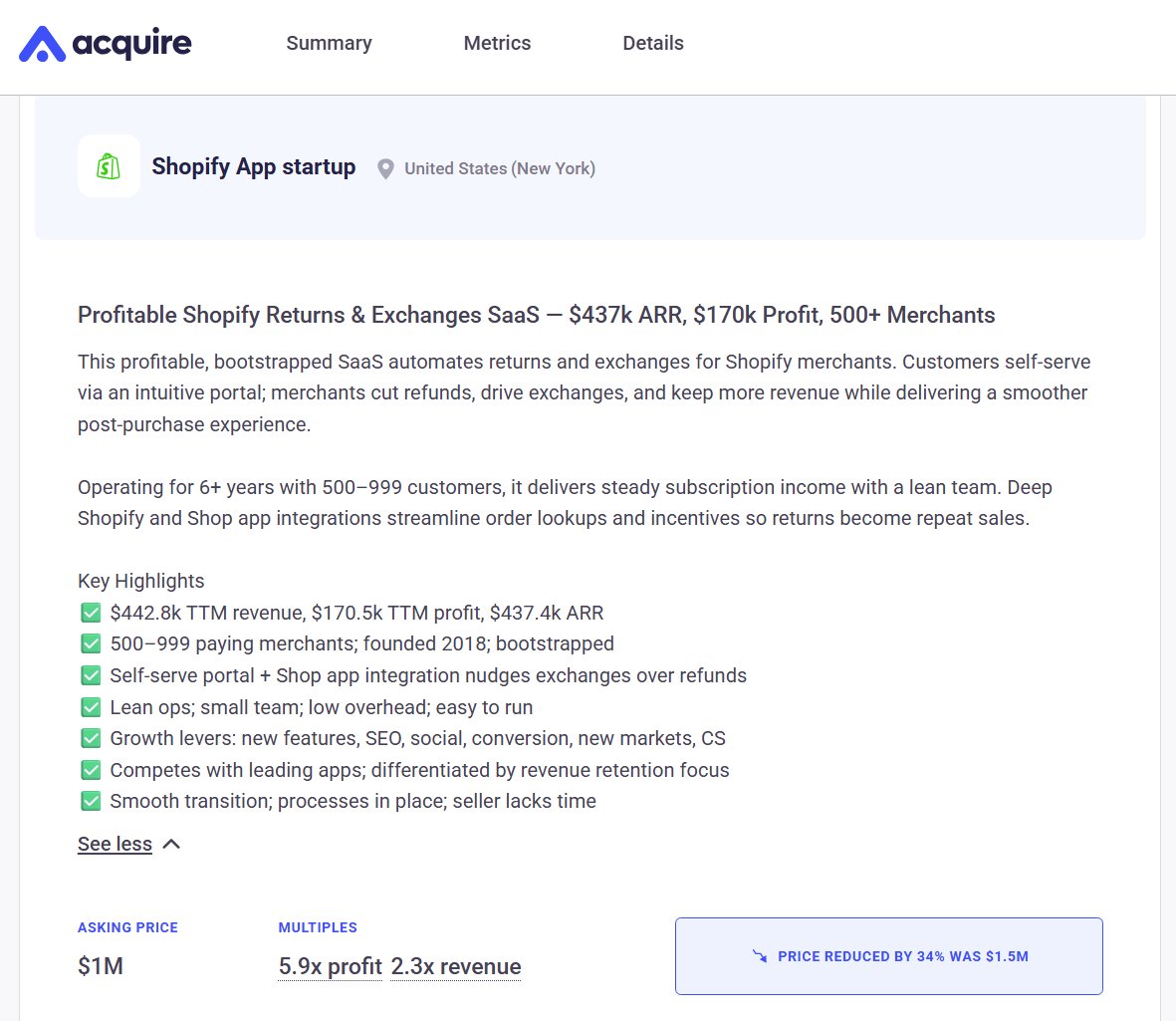
AI reshapes SaaS economics
AI changes marginal costs, compresses gross margins, challenges seat-based subscriptions, and pushes companies toward usage, credits, hybrid pricing, and outcome-based monetization.
34%
Best tweets about SaaS
A curated collection of the sharpest, most-shared X posts about SaaS—saved so you do not have to dig through the timeline yourself. Updated weekly.
Pricing, churn, positioning, and the metrics SaaS founders actually argue about in public.
Original Xholic analysis
Across 50 SaaS posts, the most common themes were AI-driven shifts in SaaS economics and retention/revenue quality (34% each), followed by pricing and packaging (30%). Posts also debated positioning, defensibility, and the implications of lower SaaS valuation multiples.
44% of posts
All-time engagement
68% of posts
Published in 90 days
Conversation map
AI changes marginal costs, compresses gross margins, challenges seat-based subscriptions, and pushes companies toward usage, credits, hybrid pricing, and outcome-based monetization.
34%
Gross retention, churn risk, onboarding, activation, support burden, expansion, and the distinction between headline ARR and durable, profitable recurring revenue.
34%
Price testing, discounting, annual plans, freemium conversion, low-price customer quality, per-seat disruption, and aligning price with delivered value or work completed.
30%
Revenue multiples, public-market repricing, acquisition values, venture-return math, and the shift from growth-stock SaaS to cash-flow-oriented valuation.
24%
Winning through narrow buyer segments, specific painful workflows, vertical products, clear messaging, and framing around customer problems rather than product features.
22%
SaaS that survives AI relies on proprietary data, integrations, compliance, trust, operational complexity, customer relationships, and workflow lock-in rather than easily copied features.
20%
Getting initial customers through SEO, communities, outbound, content, affiliates, integrations, referrals, and finding demand where prospective buyers already gather.
18%
Using services or agencies to fund product development, validate workflows, reach profitability, and convert proven delivery into scalable software.
8%
Tone and stance
Performance benchmark
Posts with media make up 36% of this collection. Their median all-time score is 29.3, compared with 14.0 for text-only posts.
Format mix
Consensus and debate
Shared view
A recurring argument is that ARR alone is an incomplete traction or quality measure: contributors point to gross retention, churn, and gross profit as important context for assessing a SaaS business.
Shared view
Several posts argue that AI introduces ongoing compute costs that do not fit legacy low-marginal-cost, per-seat SaaS models cleanly. They describe possible moves toward usage-, credit-, or outcome-oriented pricing.
Shared view
Posts commonly frame durable advantages as proprietary data, integrations, operational complexity, compliance, trust, customer relationships, and workflow lock-in rather than easily replicated product features.
Shared view
Founders advocate selecting a defined buyer and painful workflow—often in a vertical—rather than leading with a broad feature set or generic category description.
Open debate
One perspective holds that thin, easily cloned tools are vulnerable, while another argues that SaaS remains defensible when it includes production-grade operational depth. A further view questions whether inference-heavy AI products should be considered SaaS at all.
Open debate
Posts contrast difficult venture-return math for many enterprise SaaS deals with a customer-funded approach: declining capital when organic growth and customer revenue already support the business.
Open debate
One playbook recommends easy-decision price points for narrow tools. Other posts warn that competing primarily on affordability or discounting can bring heavier support demands, churn, or weaker pricing discipline.
What performs
The highest-scoring tweet in the dataset proposed using an agency to validate an AI-enabled workflow, serve an initial narrow buyer, and later productize the proven service into software.
A major engagement outlier presented a step-by-step proposal to acquire inactive SaaS products, study their support tickets and workflows, and rebuild them as agent-native products.
Other high-scoring posts addressed AI-era SaaS cost and pricing pressure, enterprise-SaaS venture-return math, and the valuation consequences of low gross retention and high burn.
Statistical standouts
Creator landscape
The five most represented creators account for 20% of the selected posts.
1. GREG ISENBERG
@gregisenberg
2 posts
2. Jared Sleeper
@JaredSleeper
2 posts
3. Nick Mehta
@nrmehta
2 posts
4. Rory O'Driscoll
@rodriscoll
2 posts
5. Soroosh
@Soroosh_Tajdar
2 posts
6. Umair Shaikh
@1Umairshaikh
1 post
Greg Isenberg had two posts in the dataset, and both were engagement outliers. Each offered a concrete operating playbook: agency-to-agent-SaaS productization and acquiring then rebuilding inactive SaaS products.
Jared Sleeper’s posts argue that ARR is not a universal traction measure and caution against comparing AI-native prosumer growth curves directly with enterprise SaaS growth curves, particularly when retention differs.
Rory O'Driscoll characterized the SaaSpocalypse as a shift from growth-investor expectations toward valuation based more on growth-adjusted free cash flow, and argued that growth and free-cash-flow contributions are not interchangeable under the Rule of 40.
Since the previous snapshot
Themes, sentiment, stance, and post format are classified per tweet. All counts, shares, medians, creator concentration, freshness, and performance comparisons are then calculated directly from the published snapshot.
Xholic's all-time score compares engagement while accounting for reach, post age, and creator consistency. It is used for relative comparisons within this collection.
This report analyzes the exact 50-post snapshot shown below. AI identifies editorial categories and drafts explanations; all statistics are calculated from the snapshot, and every narrative claim is checked against cited posts before publication.
Best SaaS tweets
Ranked 01–50

@gregisenberg ·
THE CLEAREST PATH TO A $10M+ SOFTWARE EXIT in 2 YEARS (with AI and agents) building an agency right now is one of the most interesting business moves the productized agency had its moment in 2022. it collapsed because scaling humans is a nightmare. inconsistent output, people quitting, margins getting crushed. most of the founders (and creators) who tried it got burned and moved on but the thesis was right. the labor problem is just solved now with AI, claude code, openclaw etc. here's the actual playbook i'd run today: pick one painful deliverable for one specific buyer. like SEO content for e-commerce brands doing $1M+ but not "marketing." or like ad creatives for DTC brands spending $50k/month on meta. one thing. one customer. that's it then you build the AI workflow behind it. you're selling an outcome on a monthly retainer. $3-5k/month. 80%+ margins because your cost is compute and a few hours of QA "BuT tHaT'S nOt a BiG bUsInnesS" okay but you're still swinging for the fences because the agency IS the research and development for your agent SaaS every client is paying you to figure out what to automate. you're learning what breaks, what scales, what customers actually want. by month 4 you know exactly what to productize. you build the software on top of the workflow you've already proven works and already have customers paying for agency funds the agent SaaS. SaaS scales without the agency overhead. the clients become your first software customers now let's talk about what this actually looks like financially year 1: 10 clients at $4k/month. $480k revenue. 2 people. maybe $80k in costs including compute, tools, one part time VA. you're taking home $400k between two people while building the software in the background year 2: you launch the software. your 10 agency clients are the first to convert. they already trust you. they've seen the output. you charge $800/month for the software version. now you have recurring software revenue AND the agency still running year 3: agency is winding down or running on autopilot. software has 200 customers at $800/month. that's $1.9M ARR. 2-3 person team. 85% margins. you are now a very attractive acquisition target the exit math is interesting. SaaS at $1.9M ARR with strong retention trades at 5-8x revenue. that's a $10-15M exit for something two people built in 3 years starting with zero VC CAVEAT: Startups are hard. A lot needs to go right. But from a framework perspective, I think this probably the lowest risk, highest reward option for lots of of folks and most of the businesses cost $0 to start basically this is the most capital efficient path to a software exit that exists right now happy building
@gregisenberg ·
I don't know why more people aren't buying dead SaaS companies and turning them into AI agent companies. 1. Use OpenClaw, Hermes, Perplexity Computer etc to build an automation that scans Product Hunt, Acquire, and app stores for dead SaaS products. Filter for ones that launched 2019-2024, had real customers, and went quiet. 2. Reach out to the founder on X. Most of them will respond within a day because they've been wanting to sell for a year and nobody asked. 3. Buy it. $5-30k. Sometimes less. 4. Export the database. Feed it to Claude or GPT. Map every workflow their customers were trying to do. 5. Read the support tickets. This is the goldmine. 200 strangers already told the last founder exactly what they needed and he couldn't deliver it. 6. Build an agent-native version that actually does those workflows instead of giving people a dashboard to do them manually. 7. Upload the old email list to Meta. Build a lookalike audience. Those old customers have moved on. You're not selling to them (realistically). You're using their data to find the next them. 8. Run $20/day ads targeting people who look exactly like the customers who already validated this market for you. 9. Build content around the exact pain points you found in the support tickets. Post on X. Post on YT. You already know what to say. 10. You now have the customer profile, the pain points, the pricing sensitivity, the churn reasons, and a lookalike audience. Your competitor who's starting from scratch has a landing page and a guess. The dead SaaS acquisition playbook is going to be one of the biggest quiet wealth builders of the next 5 years. Most SaaS products are a collection of workflows that can be rewritten as agent skills. Many will die. The top ones will pivot to agent companies. Build agent companies.

@signulll ·
one last thing on saas: if you built your saas business before ai, your entire business was designed around one assumption which was that software has ~zero marginal cost. ai blows that up. every ai action costs money. incumbents now have to create more expensive tiers or introduce usage based pricing. both force customers to make a new purchasing decisions while revenue doesn’t automatically increase just cuz the product became more expensive to operate. so your cost per seat rises, your gross margins compress, & adoption remains uncertain. meanwhile, the model labs are subsidizing ai usage like crazy, so they can undercut you. ai native startups are burning venture capital to acquire users, so they can undercut you too. the incumbent saas company (esp if public) is now trapped between two subsidized competitors while carrying a pricing model, cost structure, customer base, & investor expectations built for the old world. unrelated to saas, uber is also screwed (for entirely other reasons though). i love dogging on uber cuz i hate their entire business which is now predatory for both customers & drivers.


@deedydas ·
Founders should know the sobering reality for enterprise SaaS venture funding today. Here’s the math. Say you’re a $1M ARR company raising a Series A with a classic 33222 growth expectation. That gets you to $72M in 5yrs and say $250M in 8yrs. By then you’re usually growing <<50% and the public markets might give you a 7x or $1.75B, if you can even go public. If you get $10M at $100M post-money for the A, that’s a 17.5x and maybe 10x after dilution. That would be ~33% IRR and $10M invested becomes $100M. In the venture model, you have to outperform the SP500 which is 15% and a Google which is 25%. Here, with perfect execution, a lot of work, time and risk, you get 33% in a near optimal (95 percentile) case. And usually, you expect 7/10 things to not work out: execution risk, market size, competition. Plus, this math is for a Series A. You need investors to underwrite even more growth at the B / C / D. It’s really hard to see this sort of deal driving fund returns. Now, of course, there’s tons of caveats. You could pay less than $100M post, try to grow faster, do pro rata to avoid dilution, stay private longer etc, but the point remains. There might be exceptional growth stories like Databricks, Snowflake and Applied Intuition, but most deals look like what I described. In a previous time, SaaS multiples were higher in public (20x), entry valuations were lower ($30M) and the money you needed to hire talent was lower ($150k). You could get 100% IRR before. Now, it’s harder than ever to justify investing here, unless they are true outliers.

@RetentionAdam ·
I talk to delusional Series A founders every day. So now, I just tell them this. If your company does under $10M ARR, burns over $200k/mo, and has low Gross Retention…you are not worth $50-100M to anyone. Doesn't matter what your investors or your bankers tell you. Dirk Sahlmer from FE International has done nearly 6 years in SaaS M&A and hundreds of valuation conversations. He calls it Schrödinger's valuation, and he's right. Check it out and start recognizing what game you’re actually playing. Don’t waste the next 10 years chasing a fantasy.


@starter_story ·
Getting your first 100 SaaS customers has almost nothing to do with going viral... Joseph has scaled two separate products past $3M in ARR. His current SaaS does over $250,000 a month. His approach? Capture the low-hanging fruit first. > That means things you can do in the next hour to start ranking on search engines. > It also means trolling subreddits where your future customers are already complaining out loud If you're building in SaaS right now, the first 100 wont come from luck they will come from showing up where the demand stays at.
 Watch video

@javilopen ·
Software is collapsing. SaaS multiples went from 18x revenue in 2021 to 3.4x today. HOLY HELL. The thing is, before AI, the mere fact that you could build the product was a spectacular moat. You needed engineers, months, funding rounds, a CTO who knew Kubernetes (god, just https://t.co/MAQ0CWuRDl

@romanbuildsaas ·
At 28, I sold my first SaaS for 7 figures. I started it with just $500. Here's the exact playbook I'd follow if I had to do it again: ↓ 1. Don't reinvent the wheel Our biggest mistake : we spent 6 months trying to copy a YC startup that didn't even have product-market fit. Huge waste of time. Instead, find a SaaS that's already profitable. If customers are paying and the company is growing, the demand already exists. Your job isn't to invent a market. It's to build a better product for a specific audience. 2. Go vertical Horizontal SaaS is hard. We focused only on Shopify e-commerce stores. Instead of building 100 mediocre features, we built 10 features our niche couldn't live without. Your messaging becomes obvious. Your sales become easier. Your product gets better faster. 3. Get to $50k MRR This is where things become interesting. A SaaS doing ~$50k MRR can often sell for 2-3x ARR depending on growth, retention and profitability. If your product costs $100/month... You only need ~500 customers. Here's how we got them: • Cold email • LinkedIn outreach • B2B influencers • Organic content on X & LinkedIn • Affiliate program • Podcasts your buyers already listen to One rule: Don't create content about your product. Create content that solves your customers' problems. 4. Sell it Most founders go to Acquire (dot) com That's a great option. We didn't. I searched LinkedIn for people actively buying SaaS businesses. Messaged around 10 buyers. Got on calls. One acquired the company. The entire process took less than 2 months after due diligence started. Why did we sell? The team wanted to build something much bigger. That became GojiberryAI. Remember : building a SaaS isn't easy. You'll spend hundreds of hours solving problems no one else sees. But the formula is simple: • Build something people already want. • Focus on one niche. • Get customers. • Keep improving. Do that consistently... And selling your SaaS becomes an option, not a dream.


@arpit_bhayani ·
SaaS is not dead. The kind that is hard to justify buying is. Let me explain... companies pay for SaaS when it wins on at least two of four axes - time, money, capability (team's), and tokens. If a tool only saves you an afternoon of coding, that is not enough anymore. Anyone can build the core feature in a day. AI made that part cheap. Dirt cheap. What AI did not make cheap is the plumbing around the core feature - pipelines, integrations, compliance, uptime, audit trails, and edge cases collected over years of production use. That plumbing is the actual product. It takes time, energy, and effort to ensure correctness. The dashboard is just the part users see. The SaaS companies that die are the ones whose entire value is a thin wrapper around a feature a team can clone in a weekend. The ones that survive are the ones where switching costs, integrations, and compliance are the moat, not the UI. Building the demo was never the hard part. We did it overnight in hackathons, and now we do it in minutes with AI. Remember, the delta between a demo and production is 1,000 commits.

@thepatwalls ·
Just got off the phone with a $1M ARR saas founder. The secret? Selling REPORTING SOFTWARE to SERVICE BUSINESSES which they then use for their clients. On average, these agencies pay ~$10K per year for the tool. The value prop? It's no brainer purchase bc the software saves them hundreds of hours per week and also helps them retain clients for longer. It's an extremely niche reporting tool, and I think it can be replicated across 100s of other small niches. Episode coming soon.

@alexcooldev ·
How I scaled SaaS MRR → $0 ads: - Smooth onboarding = less churn - In-app upsells = more revenue - SEO + case studies → free inbound - Referrals (still OP) - Daily posting on X, Reddit, TikTok, LinkedIn - Integrations (Zapier, Notion, etc.) - A/B tested pricing → pushed annual plans No ads. No team. Just product + content.

@HarryStebbings ·
The SaaS bloodbath has been beyond brutal. Wix for more than any other. This company is doing $2.1BN in ARR and they are valued at $2.1BN. Like WTF. And, they have Base44, one of the leaders in vibe coding, now doing over $170M in ARR. What is going on? How is this being priced at $2.1BN? I sat down with @Avishai_ab and have shared the biggest lessons below. 1. How Public Markets Are Getting Both Wix and SaaS Wrong Public markets routinely misprice tech cycles, hyping vibe-coding startups while discounting core SaaS engines. They ignore the moat of enterprise trust. Giants like Salesforce win because institutions trust them with sensitive data, creating security and compliance barriers automated code projects cannot easily replicate. 2. Was the Buyback a Terrible Decision? Timing the stock market is a fool’s errand. If your balance sheet has cash and your team is focused on core products instead of distracting M&A, a buyback during a dip can be rational. Capital allocation should be judged over three years, not a three-month panic. 3. How Do You Keep Talent When Your Market Cap Is Cratering? Stop treating talent attrition as a failure. It can be a healthy refresh. Bull markets make companies forget that elite teams are forged by solving hard problems, not coasting. When market caps fall, protecting your top tier can uncover hidden stars and make room for a hungry new generation. 4. How Do the Business Models Compare Between Wix and Base44? Scaling newer AI platforms requires ruthless focus on unit economics over expensive, generic LLM usage. The margin breakthrough comes from fine-tuning and combining smaller, custom models to match top-tier performance. Within two years, infrastructure cost declines could make AI COGS a non-issue for platform margins. 5. Why Wix Customers Will Not Churn to Vibe-Coded Solutions Mainstream SMBs have neither the desire nor capacity to build their own tech stacks with automated coding tools. Seemingly simple workflows, like vertical business logic for a hair salon, are surprisingly complex. Even elite engineering teams struggle to rebuild them quickly, proving vertical SaaS remains highly defensible. 6. Why Teams of the Future Will Not Be as Small as People Think The idea that future tech giants will run on skeleton crews managing thousands of AI agents is overhyped. The ecosystem gives too much credit to standalone AI capabilities. On granular business workflows, models still stumble, which means dense, capable human teams remain essential. 7. I Would Be Terrified if I Were in University Today, and My Advice to Students Entering the workforce today is uncertain, but current LLMs will not instantly replace white-collar jobs. Today’s models are strong at reframing data, not deep reasoning, and still make frequent mistakes. True disruption to human capital likely requires two or three more major breakthroughs. (links below)

@coatuemgmt ·
AI labs are out scaling the most iconic SaaS businesses in history. The core driver: A fundamental shift from Selling Software (per-seat) to Selling Work (per-output). The Market Shift: Legacy: Tool-based subscriptions ($0.2T TAM). New Paradigm: Direct monetization of work ($5.5T TAM). By shifting the unit of value from the tool to the output, the addressable market potential expands by 25x. @LucasSwisher1 breaks down the data in our latest C:\Take
 Watch video

@oliverbrocato ·
at 21, i was doing $1M/month in ecom. at 24, my SaaS just hit $410K MRR. if you offered me a $1M/month ecom brand or a $100K MRR SaaS today, i'd take the SaaS every single time. here's why: 1. predictable revenue vs praying for virality when i ran Tabs we were only as good as our latest TikTok. every month started back at zero. people impulse buy sex chocolate once and never come back lol. with Bustem, i can tell you with ~98% confidence what we'll do next month and the month after that. 2. you're actually solving a real problem most ecom is selling commoditized products where your only edge is creative. you don't run a business, you run an ad agency. that's not what i signed up for. at Bustem we help brands find and destroy copycats, counterfeits, and unauthorized resellers. that's a real mission and its fun to compete on more then just creative. 3. your team IS the product in ecom it's you, agencies, and VAs. in SaaS your people are the product. building a world class team has been 10x more rewarding than optimizing another ad. 4. it compounds ecom changes so fast you're building on quicksand. you have to reinvent yourself every other month. SaaS compounds. every customer, every process, every product improvement stacks on the last. and growth hacking B2B is so much easier because most of the competition is dinosaurs running companies from 2004. in ecom you're going toe to toe with the best marketers on the planet. Don’t get me wrong... I love ecom. It’s how I made my first real money. But after building both, I’d choose SaaS every time.


@rodriscoll ·
A few more thoughts on the SaaSpocalypse. The SaaSpocalypse is really the story of a breakup. Wall St is getting ready to fall in love with AI, and to do that, it had to fall out of love with SaaS. Wall St is fickle, but it is serially monogamous. Love is blind; dead love is not. Wall St is suddenly shocked to discover SaaS has stock based comp that should be accounted for in free cash flow, finite TAMs, and companies that mature and grow stale. Meanwhile, Wall St is about to take AI companies public at 50x+ revenues, that dispense $10M stock-based comp packages to employees like lollipops, while having capex bills and negative free cash flow larger than any capex since we built the railways. Why? Because AI is growing like a weed. And growth, like beauty, is, as the poet Keats said, “all you know and all you need to know.” In the face of beauty or three years of 10x growth, all objections fade. We are all in the business of growth.

@tibo_maker ·
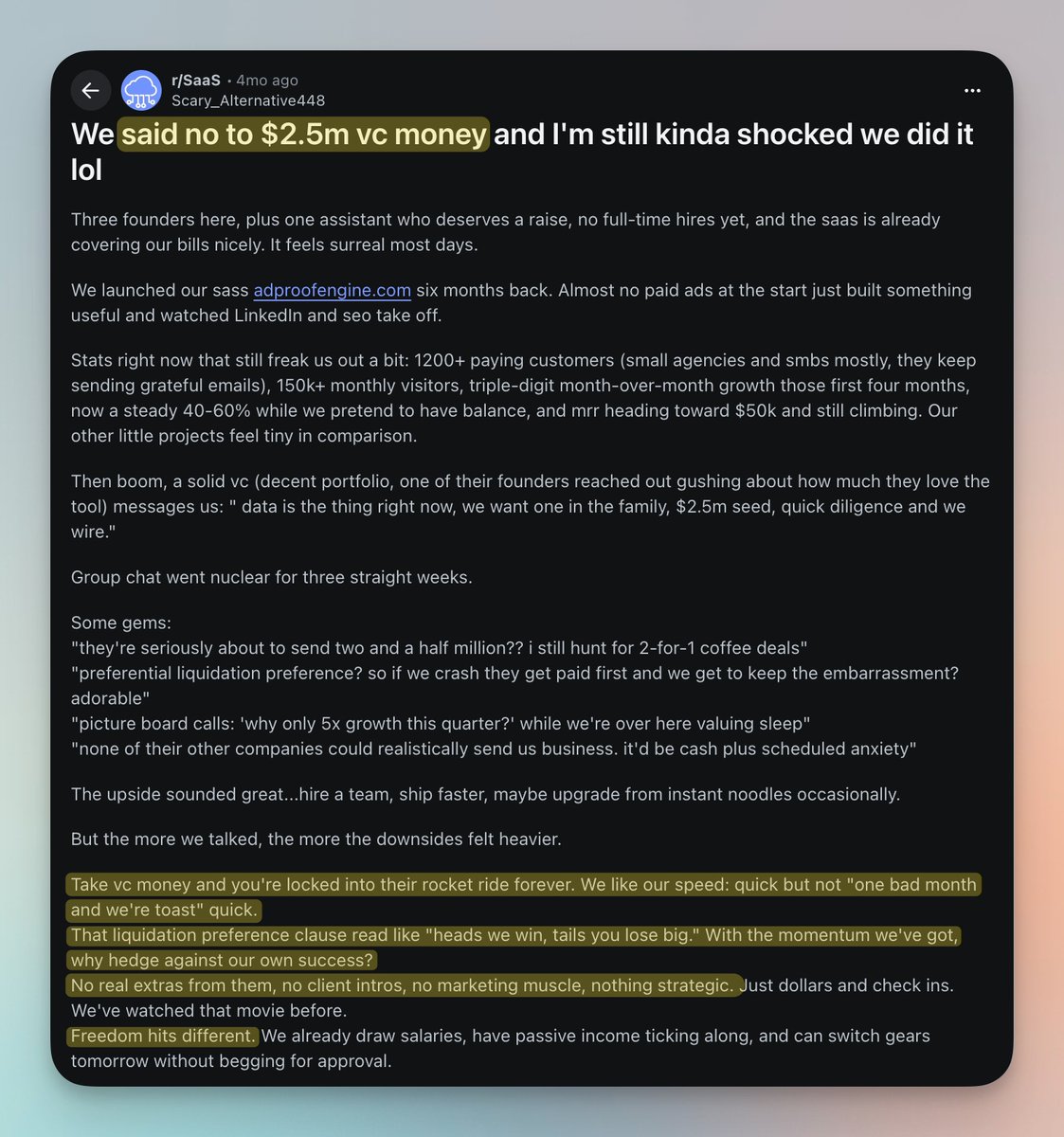
they said no to $2.5M in VC money for their 6 month old saas I would've done the same I can't say this enough: VC math and saas math are two different games. a fund needs you to swing for a billion or die trying a good saas business just needs happy customers paying every month most founders confuse the two and sign up for the wrong game this reddit story is a perfect example - tiny team, no full-time hires, and in 6 months they built one of the craziest organic growth stories I've seen 1200+ paying customers, 150k monthly visitors, MRR closing in on $50k. a VC saw it, loved it, offered $2.5m with a fast wire they rightly said no, and their logic was great too the term sheet had a liquidation preference. if things go wrong, investors get paid back first and founders keep the wreckage I get it, but the fund had nothing strategic to offer either no client intros, no distribution, no marketing muscle - just money and monthly check-ins and the biggest thing is their growth doesn't require capital they got here with almost no paid channels. LinkedIn and SEO did all the work you can't wire $2.5m into organic channels and make them compound faster money buys paid acquisition and headcount, and they needed neither see, to be fair, raising makes sense for things like hardware, long R&D cycles, markets where whoever scales first wins capital is the product there but a profitable saas growing 40-60% a month on organic channels is not that. raising there doesn't buy growth, it buys a boss if your customers are already funding you, you don't need a VC to do it
@rodriscoll ·
There are growth investors and there are value investors, and there is a chasm in between. The SaaSpocalypse is really about the SaaS story shifting from the former to the latter. From 2004 to 2019, public SaaS companies grew at an average of 30% and were valued at an average of 6x revenues. It was the best, most predictable growth story in the market. Then two years of COVID gave us 40% growth at 20x revenues. Then came revenue deceleration. Not just back to 30%, but all the way down to 15%, while multiples went back just to 6x. On a revenue multiple graph, it all looked fine but it implied the growth rate would revert to 30% That's what the SaaSpocalypse is really about. Everyone is finally realizing that the growth story is all AI. SaaS companies without AI-driven growth will be valued like every other company in the market, on a growth adjusted multiple of free cash flow. Amazing companies with real value but no pixie dust premium. Turns out 30% revenue growth and 10% FCF is worth more than 10% revenue growth and 30% FCF. The Rule of 40 construct is (of course) wrong. The two are not interchangeable, and the transition from one to the other is hard.

@Hartdrawss ·
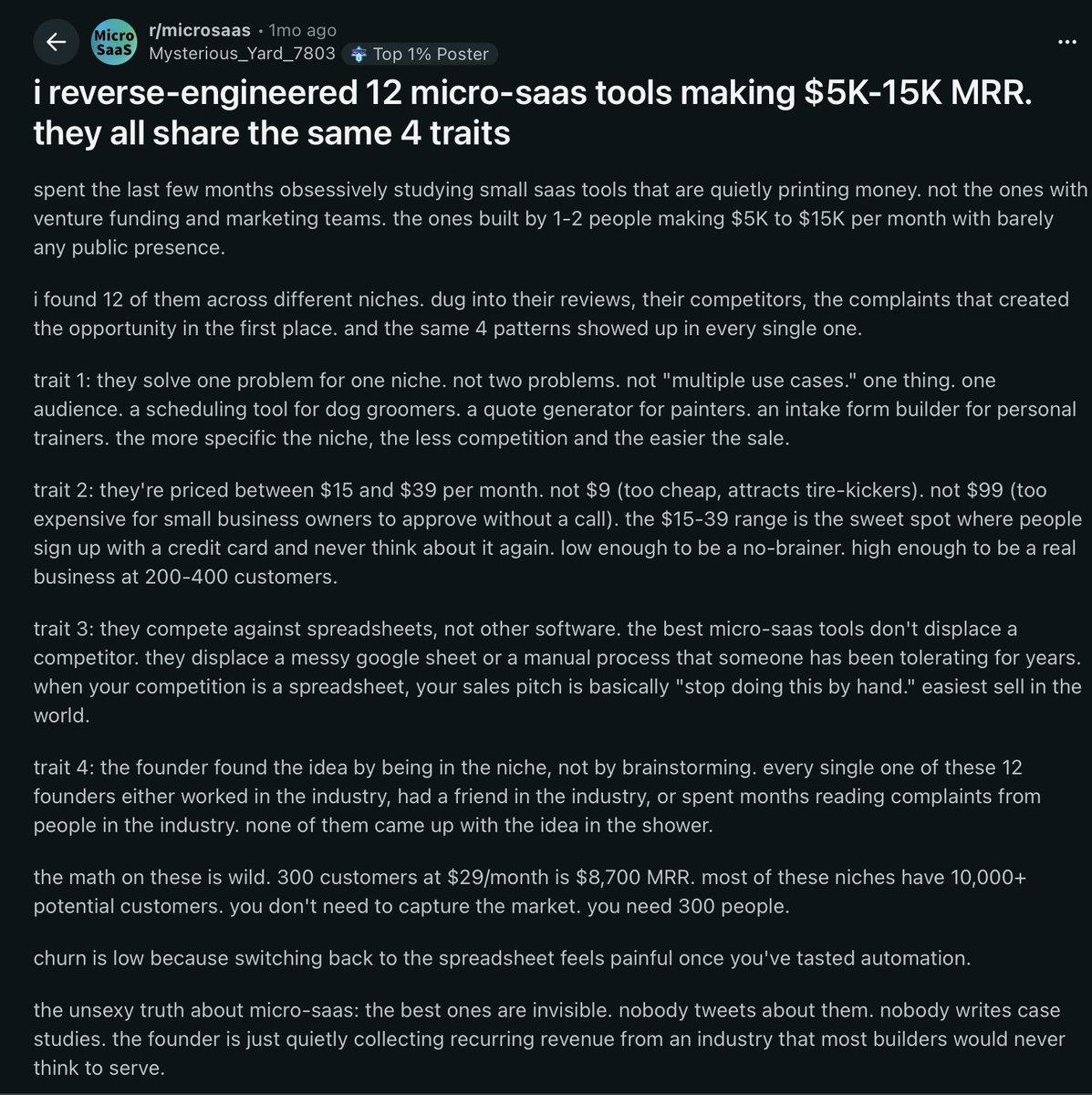
This reddit user found the 10 Step Secret Sauce to hit $15k MRR in <60 Days ! here's the full Playbook ( STEAL THIS ): 1/ every tool solved one niche pain >not multiple use cases or broad platforms >one problem for one specific audience >dog groomers, painters, trainers, boring niches >specificity made selling easier 2/ pricing stayed boring too >most sat between $15 and $39/month >$9 attracted tire-kickers >$99 needed too much approval >$29 worked at 300 customers 3/ spreadsheets were the real competitor >they didn't replace other SaaS tools >they replaced messy manual processes >spreadsheet pain made the pitch obvious >“stop doing this manually” sells fast 4/ ideas came from inside the niche >founders worked in the industry already >or had friends inside the market >or studied complaints for months >none came from shower brainstorming 5/ the math was simple >300 customers at $29 = $8,700 MRR >most niches had 10,000+ possible buyers >they didnt need the whole market >just 300 people with pain the real takeaway: >pick boring niches >replace manual work >price for easy decisions the best micro-SaaS tools are invisible and quietly print.

@kylegawley ·
It's 100x easier to get to $50k/mo with consulting than SaaS x5 clients paying $10k/mo is easier than 1000x customers paying $50 I think people grossly underestimate how hard it is to get 1000 customers - most SaaS will struggle to get 10 It's even harder to keep them, churn is brutal You can't exit which is true, but you already changed your life forever with that kind of money You can invest it and be financially free for the rest of your life in 2-3 years SaaS is brutally hard - years of uncertainty and a 95%+ chance of failure If you have skills and experience consulting is a much easier path with lower risk of failure Or do both, consulting is one of the best ways to find real business problems to solve with a SaaS

@GohilHardy ·
Things every SaaS founder should track weekly 👇🏻 - website visitors - sign-up conversion rate - activation rate - churn rate - retention - top traffic sources - customer acquisition cost - monthly recurring revenue - support tickets - most requested feature Most founders track revenue only. The real signals happen before revenue.

@nrmehta ·
I have lots of empathy for folks leading existing SaaS cos these days. They're fighting battles on 5 fronts: 1. Defending churn from larger platform consolidators 2. Defending churn from cheaper upstarts 3. Maintaining modest growth in the core business (x-sell, etc.) 4. Pivoting to a new agentic strategy 5. Keeping employees engaged while transforming the team and culture for #4 In an ideal world, they'd "burn the boats" and focus on #4 (as @eoghan @intercom impressively did) But some of these companies have significant debt to service while others have anxious public shareholders. Indeed, VC-backed companies have almost nothing to lose, since the equity value of their core businesses are sadly trending toward 0 in the eyes of future potential exits. Definitely not an easy time to run a SaaS co.

@ElitzaVasileva ·
Need some ideas from other SaaS founders. My product is freemium, and my goal is to increase conversions (currently <1%) Right now I'm fixing some small issues and planning to experiment with pricing. A few constraints: • Hard paywall isn’t realistic (very competitive market) • Some users say it’s cheap • Many who came from Bento (which was free) say it’s expensive What pricing experiments actually moved conversions for you?


@JaredSleeper ·
Comparing the growth curves of AI-native prosumer businesses with those of enterprise SaaS businesses is an egregious category error (and yes, I have done this too). Most of these businesses have gross retention far inferior to even SMB SaaS. And yes, that absolutely matters- both for growth duration and in maturity. Doesn't mean they aren't great businesses! But Grammarly/Canva/Wix are much more relevant comps than Salesforce, Workday, or ServiceNow.

@petergyang ·
People are saying SaaS is not dead. I think larger enterprise SaaS that can do multiple jobs are probably fine (e.g., Figma). But if you’re building a simple SaaS for a narrow use case, I think it's harder to monetize now because: 1. AI skills can often solve the same problem in a much more flexible, personalized way. 2. AI-native agents like Codex / Claude Code that have a user's personal context and memory have far more knowledge to solve the user's problem vs. a standalone SaaS website or chatbot. 3. People are willing to pay hundreds or thousands for services (human touch is what's rare these days) but charge $20 / month for a SaaS and people will compare it's value to their Claude / ChatGPT subscription. Curious if others feel the same way? I guess I'm in a bubble and most people have not set up their own AI skills yet.

@staysaasy ·
A subtle but important enterprise shift I see with AI is the death of vanity software procurement. The flex is now "we saved 400k on our SaaS bill" instead of "we have to pay $1m for Salesforce / Workday [because we're so cool and successful]." The bragging rights of overspending on a bunch of SaaS you barely need were a huge part of creating urgency, because let's be real dude nobody *urgently* needs ServiceNow. Expensive software was like a Porsche or Cybertruck to a bored suburban stay at home parent. Gonna be a major SaaS headwind in some categories IMO. Bad time to sell anything where "you'll get to come to our industry leadership summit" is a major differentiator.

@SahilPanhotra ·
The SaaS pricing race to the bottom: $49/month → $29/month → $19/month → $9/month → $5/month → "Pay what you want" Founders: "I'm building for the long term!" Also founders: Discounting 80% before launch If your SaaS is worth $29/month, charge $49/month The discounting culture is admitting you don't believe in your own pricing

@Soroosh_Tajdar ·
Honest taxonomy of SaaS ideas: 1. Solves a real problem people pay to fix today 2. Solves a real problem people tolerate instead of paying to fix 3. Solves a problem that only exists inside a specific workflow you happen to use 4. Solves a problem that doesn't exist but sounds like it should Most ideas in public SaaS communities are 3 or 4. The founders are convinced they're 1.

@lucainweb3 ·
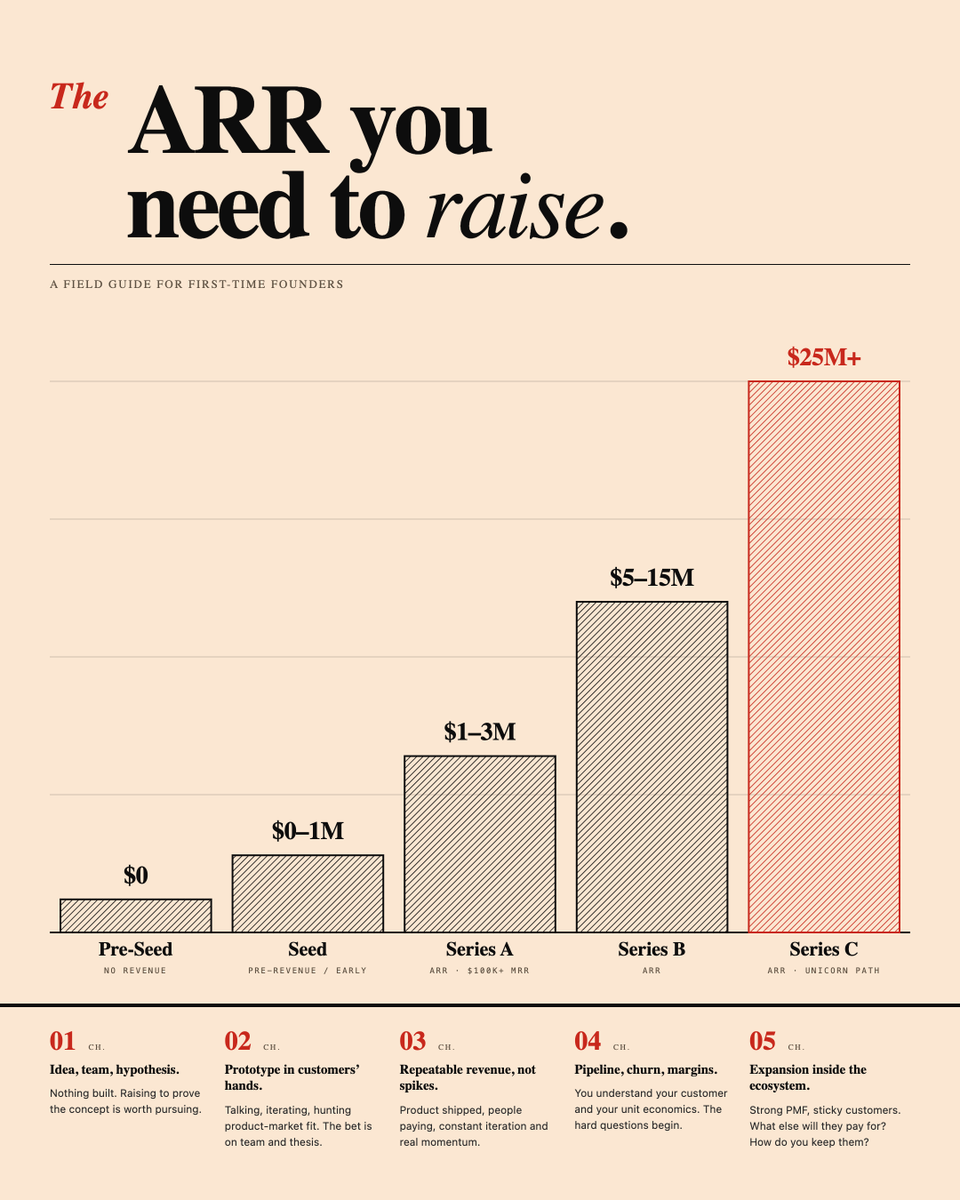
Seeing a lot of first time founders pitch to Animoca, I've noticed some of them don't fully understand what revenue KPIs they should be hitting to even consider raising at a certain stage. Trying to break it down simply (closest framework would be SaaS businesses): Pre-seed - $0 revenue. You have an idea, a founding team, and a hypothesis about who your customer is. Nothing is built yet. You're raising to prove the concept is worth pursuing. Seed - Still pre-revenue or very early revenue. You have a prototype, you've been talking to customers, getting feedback, and starting to understand how you get to product-market fit. The bet here is on the team and the thesis. Series A - $1-3M ARR. Your product is shipped and people are actively paying for it. You're doing $ 100K+ per month, iterating constantly, and showing real momentum. VCs want to see repeatable revenue here, not one-off spikes. Series B - $5-15M ARR. You understand your customer and your margins. Now the hard questions start - how healthy is your sales pipeline, what does churn look like, and how wide is that customer funnel really? Series C - $ 25M+ ARR. You have a great product, PMF, and strong customers. The question now is expansion - what else are your customers willing to pay for and how do you keep them inside your ecosystem? This is the path to unicorn territory.
@nrmehta ·
No one knows the future of SaaS, if we're being honest. But one thing I'm confident about - most of the playbooks folks relied on aren't enough anymore: * Hire a new CRO * What to look for in a sales rep * Accelerate lead gen * Redo your pricing * Get to "Rule of 40" * etc. They're still good hygiene but... The only thing that really matters for many companies right now is to fundamentally rethink their reason for existence.

@nikita_builds ·
More SaaS companies are one AI project away from being replaced than they think. If your entire value proposition is software that a capable developer and a good model can replicate, you don't have a product moat. Maybe you have a head start, but that’s really it. Sure… you have distribution… but how long until people flock somewhere else? What actually holds up: physical infrastructure, operational complexity built over years, compliance and trust layers that take time to earn, proprietary data that can't be reconstructed. Admittedly, all of the above takes time. But that’s exactly the point. I spent most of my early years as a pure software person. The phone farm at Sendblue always felt like a liability: a weird operational burden we had because Apple wouldn't give us a real API. Looking back, it was the most defensible thing we built. Pure SaaS won't disappear. But the premium is shifting elsewhere.

@frog_omo ·
In 2025, the average SaaS company changed its pricing 3.6 times. Kyle Poyar analysed 1,800 pricing changes and called it "the year everyone lost confidence in pricing." That's not a trend. That's an industry that doesn't know what its product is worth anymore. Here's the structural problem nobody's saying directly: Per-seat pricing was always a proxy metric. You weren't paying for seats; you were paying for the work those seats did. AI just made the proxy visible. One agent does what 10 reps did. You need 1 seat. The vendor just lost 90% of that contract at renewal. So credit-based models surged 126% year-over-year. Hybrid pricing jumped from 25% to 40% of companies in a single year. Salesforce built an entirely new license structure for Agentforce. Clay separated data credits from platform actions in March. Every one of those moves is the same admission: we don't know how to price the work yet. For ops leaders, this has a specific implication: the tool budget you approved in January is probably wrong by Q3.

@villageglobal ·
"SaaS businesses have been built to sell a tool. In the AI era, they have to shift to selling outcomes. That is a fundamental DNA shift." @jakesaper, GP at Emergence Capital, on why most SaaS companies won't survive the AI transition: "If you've built your organization around selling a widget on a per-seat basis, and you have to shift to building something that does the job — it has huge implications on product, go-to-market, pricing." "Our firm was founded as software moved from on-prem to cloud. The vast majority of companies from that era did not survive. But even bigger companies got built on top of the ashes." "SaaS leaders thought about outcomes as 'did my customer renew?' In the future — 'did we create dollar value?'" "They were selling a tool to arm someone. That's a derivative. In this new world, they have to do the thing."
 Watch video

@tiboel ·
The success of an AI company is now judged by the shape of its curve. People talk about “curves”. Not “Where will you end the year?” But “What did you make in the last 3 months?” Revenue is the new religion. But something fundamental changed: 👉 the nature of revenue. SaaS sold products. Tools. Shovels and picks. AI sells services. Resources. Every single scoop. With a product:you build once. Then margins expand. With a service:you pay every time. Compute. Infra. Models. Selling scoops is easier. Faster. More rewarding upfront. But less profitable. Revenue grows fast. But it’s not the same quality. The real opportunity? Product × AI The magic of service. With the margins of SaaS. Same curve. Very different economics.


@vascoabm ·
revenue expansion in SaaS is a great way to make extra cash two easy ones: - upsell users on credits - micro services that complement their subscription & your team can fulfill quickly with an SOP these two payments are exactly from that use Claude to come up with complementary services you can charge your users for, I'm sure it'll come up with something you can test


@TheGeorgePu ·
Cursor's ARR trajectory: January 2025: $100M. June 2025: $500M. November 2025: $1B. February 2026: $2B. Zero to $2B in roughly three years. Faster than Slack. Faster than Zoom. Faster than Snowflake. Fastest-scaling B2B software company on record. Now raising at $50B. I've been saying SaaS is dead. Numbers like these say otherwise. Or do they? Cursor passes nearly 100% of revenue to Anthropic and OpenAI for inference. The customer isn't buying software. They are buying broker access to other models. Is this SaaS? Or is it the death of SaaS dressed in SaaS clothing?
Best Tweets by Topic