Product creation and productization
Creating ebooks, templates, courses, tools, SaaS, and AI products; turning personal workflows, services, and internal automations into clear outcome-focused products.
56%
Best tweets about Digital Products
Find the best tweets about digital products, including ideas, validation, creation, pricing, launches, distribution, marketplaces, and creator revenue.
Real digital-product examples, validation, production, pricing, launch strategy, distribution, unit economics, and revenue lessons.
Original Xholic analysis
The conversation covers digital products as a commercial workflow: identifying a problem, validating and packaging an offer, finding distribution, setting prices, and iterating through customer feedback. Deterministic analytics classify 74% of the 50 posts as supportive and 18% as observational; the posts also present competing routes to monetization, particularly audience-first publishing versus selling earlier through direct customer conversations.
76% of posts
All-time engagement
40% of posts
Published in 90 days
Conversation map
Creating ebooks, templates, courses, tools, SaaS, and AI products; turning personal workflows, services, and internal automations into clear outcome-focused products.
56%
Getting products in front of buyers through SEO, Reddit, communities, directories, content, newsletters, outreach, affiliates, ads, App Store optimization, and AI search.
34%
Value-based pricing, pricing tiers, low-ticket entry offers, upsells, subscriptions, memberships, services, affiliate income, and product ladders.
34%
Using free content, newsletters, public building, social platforms, and expertise to establish trust before packaging insights into paid products.
22%
Finding urgent, specific problems; researching demand and competitors; interviewing customers; testing landing pages, waitlists, pre-sales, and manual delivery before building.
22%
MVP launches, beta users, pre-orders, launch sequencing, post-launch analytics, learning from failed launches, and iterating from customer feedback.
18%
Landing-page messaging, segmented listings, email sequences, storefront browsing, onboarding, upsells, feedback loops, and repeat purchases.
14%
Concrete examples and ideas for narrow digital-product niches, especially practical templates, guides, calculators, trackers, communities, and information products.
14%
Tone and stance
Performance benchmark
Posts with media make up 40% of this collection. Their median all-time score is 14.2, compared with 21.4 for text-only posts.
Format mix
Consensus and debate
Shared view
Multiple posts recommend customer interviews, landing-page tests, waitlists, pre-sales, or manual delivery before committing to a full product. These posts frame paid interest and customer feedback as inputs to product scope.
Shared view
Several posts advise describing the result, time saved, or problem solved before listing product features. The cited pricing and productization posts likewise connect price or positioning to the value of the outcome.
Shared view
Posts repeatedly list SEO, communities, directories, content, outreach, and niche channels as acquisition activities, rather than treating a product launch as sufficient distribution.
Shared view
The examples emphasize defined buyer situations and products, including wedding-speech templates, cat-introduction guides, rental inspection templates, and finance-oriented trackers or calculators.
Open debate
One group of posts recommends publishing free work to build trust before packaging paid products. Other posts argue that direct conversations, a defined problem, and an offer can be enough to begin monetizing without first building a large following.
Open debate
Some posts prescribe a sequenced launch with product creation, promotion, follow-up, beta testing, and feedback. Another presents launches as experiments and recommends moving on quickly when early paid signal is absent.
Open debate
The posts include both focused, low-priced offers and catalog or tiered-product approaches. The catalog argument is that later products can be offered to prior buyers; the pricing posts describe tiers by product depth and value.
What performs
The three largest supplied outliers were a post about PIX payments for Brazilian customers (score 2908.43), a SaaS lifecycle map covering validation through scaling (1530.64), and a distribution-strategy post (1481.57). A fifth outlier, at 685.84, is a startup-building playbook that includes charging early, directories, content, and SEO.
The remaining two supplied top-five outliers were the SaaS lifecycle map, which explicitly includes interviews, landing-page tests, waitlists, and pre-sales, and a post describing a digital-ebook funnel with a free front-end offer, upsells, and shipping fees.
Deterministic analytics report 20 media posts (40% of 50 posts). Their median all-time score was 14.21, compared with 21.41 for text posts.
The niche-product-opportunities theme had a median all-time score of 50.09, higher than every other supplied theme median. Its evidence includes concrete niche products, buyer contexts, and distribution channels.
Statistical standouts
Creator landscape
The five most represented creators account for 20% of the selected posts.
1. Alexa | Startup founder
@alexabelonix
2 posts
2. Alex the Engineer
@AlexEngineerAI
2 posts
3. ecomchigga
@ecomchigga
2 posts
4. Gasper C. | Rebelpreneurs
@GasperCrepinsek
2 posts
5. Gumroad
@gumroad
2 posts
6. Harshil Tomar
@Hartdrawss
2 posts
Gumroad's two cited posts present a 30-day plan for a first digital-product sale and a value-based pricing framework with example price bands for quick wins, systems, and transformations.
One ecomchigga post presents narrow product examples and community-based distribution; the other reports store-level conversion figures and argues for entry, core, and deep product tiers that can serve previous buyers.
One cited post reports collecting 65 leads in two weeks while offering free products. The other describes Justin Welsh's content-first path of publishing publicly before packaging trusted ideas into paid products.
Since the previous snapshot
Themes, sentiment, stance, and post format are classified per tweet. All counts, shares, medians, creator concentration, freshness, and performance comparisons are then calculated directly from the published snapshot.
Xholic's all-time score compares engagement while accounting for reach, post age, and creator consistency. It is used for relative comparisons within this collection.
This report analyzes the exact 50-post snapshot shown below. AI identifies editorial categories and drafts explanations; all statistics are calculated from the snapshot, and every narrative claim is checked against cited posts before publication.
Best Digital Products tweets
Ranked 01–50
@ayushagarwal ·
a founder in brazil messaged us last month. "my customers want to pay but they don't have international credit cards. can you support pix?" that's the thing about building a global payments platform. credit cards feel universal until you realize they're not. in brazil, pix is how people move money. instant bank transfers. 150+ million users. it's not an alternative payment method there. it's THE payment method. so we built it. PIX is now live on @dodopayments. billing currency is BRL. your brazilian customers pay in their local currency. no card required. no friction. no "sorry we only accept visa." if you're selling digital products or SaaS and ignoring brazil, you're ignoring one of the fastest growing tech markets on the planet. and the reason most companies ignore it is because payments were hard there. not anymore.
@hridoyreh ·
📂 SaaS ┃ ┣ 📂 Idea ┃ ┣ 📂 Problem Discovery ┃ ┣ 📂 Market Research ┃ ┣ 📂 Niche Selection ┃ ┗ 📂 Competitor Analysis ┃ ┣ 📂 Validation ┃ ┣ 📂 Customer Interviews ┃ ┣ 📂 Landing Page Test ┃ ┣ 📂 Waitlist ┃ ┣ 📂 Pre Sales ┃ ┗ 📂 Demand Testing ┃ ┣ 📂 Planning ┃ ┣ 📂 MVP Scope ┃ ┣ 📂 Feature Prioritization ┃ ┣ 📂 Tech Stack ┃ ┣ 📂 Roadmap ┃ ┗ 📂 Time to Market ┃ ┣ 📂 Design ┃ ┣ 📂 Wireframes ┃ ┣ 📂 UI UX ┃ ┣ 📂 Prototype ┃ ┣ 📂 Design System ┃ ┗ 📂 UX Copy ┃ ┣ 📂 Development ┃ ┣ 📂 Frontend ┃ ┣ 📂 Backend ┃ ┣ 📂 APIs ┃ ┣ 📂 Database ┃ ┣ 📂 Authentication ┃ ┗ 📂 Integrations ┃ ┣ 📂 Infrastructure ┃ ┣ 📂 Hosting ┃ ┣ 📂 CI CD ┃ ┣ 📂 Monitoring ┃ ┣ 📂 Logging ┃ ┗ 📂 Security ┃ ┣ 📂 Testing ┃ ┣ 📂 Unit Tests ┃ ┣ 📂 Integration Tests ┃ ┣ 📂 QA ┃ ┣ 📂 Performance ┃ ┗ 📂 Beta Testing ┃ ┣ 📂 Launch ┃ ┣ 📂 Landing Page ┃ ┣ 📂 Product Hunt ┃ ┣ 📂 Beta Users ┃ ┣ 📂 Early Adopters ┃ ┗ 📂 Public Release ┃ ┣ 📂 Acquisition ┃ ┣ 📂 SEO Wins ┃ ┣ 📂 Content Marketing ┃ ┣ 📂 Social Media ┃ ┣ 📂 Cold Outreach ┃ ┣ 📂 Communities ┃ ┣ 📂 Influencer Outreach ┃ ┗ 📂 Affiliate Marketing ┃ ┗ 📂 Paid Ads ┃ ┣ 📂 Distribution ┃ ┣ 📂 Directories ┃ ┣ 📂 SaaS Marketplaces ┃ ┣ 📂 Partnerships ┃ ┣ 📂 Integrations ┃ ┗ 📂 Communities ┃ ┣ 📂 Activation ┃ ┣ 📂 Onboarding Flow ┃ ┣ 📂 First Value ┃ ┣ 📂 Time to Value ┃ ┗ 📂 Product Tours ┃ ┣ 📂 Conversion ┃ ┣ 📂 Pricing ┃ ┣ 📂 Free Trial ┃ ┣ 📂 Freemium Model ┃ ┣ 📂 Sales Funnel ┃ ┣ 📂 CRO ┃ ┗ 📂 Demo Flow ┃ ┣ 📂 Revenue ┃ ┣ 📂 Subscriptions ┃ ┣ 📂 Usage Based ┃ ┣ 📂 Upsells ┃ ┣ 📂 Add-ons ┃ ┗ 📂 Enterprise Deals ┃ ┗ 📂 Lifetime Deals ┃ ┗ 📂 Annual Plans ┃ ┣ 📂 Retention ┃ ┣ 📂 Onboarding ┃ ┣ 📂 Email Automation ┃ ┣ 📂 Customer Success ┃ ┣ 📂 Feature Adoption ┃ ┣ 📂 Churn Reduction ┃ ┗ 📂 Feedback Loops ┃ ┣ 📂 Analytics ┃ ┣ 📂 Tracking ┃ ┣ 📂 Funnel Analysis ┃ ┣ 📂 Cohorts ┃ ┣ 📂 Attribution ┃ ┗ 📂 A/B Testing ┃ ┣ 📂 Growth ┃ ┣ 📂 Product Led Growth ┃ ┣ 📂 Referral Programs ┃ ┣ 📂 Viral Loops ┃ ┣ 📂 Community Building ┃ ┣ 📂 Growth Experiments ┃ ┗ 📂 Network Effects ┃ ┣ 📂 Monetization Expansion ┃ ┣ 📂 Enterprise ┃ ┣ 📂 Add-on Revenue ┃ ┣ 📂 Upsell Flows ┃ ┗ 📂 Cross Sell ┃ ┣ 📂 Customer Success ┃ ┣ 📂 Support ┃ ┣ 📂 Help Docs ┃ ┣ 📂 Live Chat ┃ ┣ 📂 Success Metrics ┃ ┗ 📂 Management ┃ ┣ 📂 Legal ┃ ┣ 📂 Privacy Policy ┃ ┣ 📂 Terms ┃ ┣ 📂 GDPR ┃ ┗ 📂 Data Security ┃ ┗ 📂 Scaling ┣ 📂 Automation ┣ 📂 Hiring ┣ 📂 Systems ┣ 📂 Global Expansion ┗ 📂 Exit Strategy
@gregisenberg ·
200,000+ new vibe coding projects get created every day yet almost NONE of them get customers 7 distribution strategies that actually work right now for your startup: 1. build an MCP server. when someone asks claude or chatgpt the question your product answers, your tool shows up. the AI becomes your sales team. 2. programmatic SEO. pick a keyword pattern (best X for Y). use firecrawl to pull real structured data so pages have actual value. one next.js template, AI generated content, human editing loop so it doesn't read like AI. 10,000 pages × 30 visits × 2% CVR × $10 = $60k/month from pages you built once. 3. vibe code a free tool (calculator, software etc). one problem, one tool, ship it today. it ranks, lives in people's workflows, markets your brand for years. ahrefs' free backlink checker has sent them more customers than most paid ads ever will. 4. answer engine optimization. people are getting answers from chatgpt and perplexity now, not just google. find the top questions your customer is asking AI. publish structured, definitive answers. one founder went from 4% to 20% AI referrals in a month just by doing this. 5. make the output of your product shareable. think spotify wrapped. think github graphs. think stripe atlas. what does your user want to screenshot and send? build that moment. add a pre-filled share button. every share is free impressions to your exact audience. 6. buy a niche newsletter. 10k subscribers for $5k to $20k. most owners are making $0 to $500 a month. DM them "ever thought about selling?" you inherit trust and a direct channel to your exact customer on day one. underrated. 7. 30 minute voice memo into claude: five tweet threads, three linkedin posts, one newsletter, short form clips. do this weekly. in 3 months you have more content than competitors who aren't doing this. obviously, your project needs to be optimized so it isnt ai slop, but you'll get there. code is commoditized. time to focus on distribution. pick 2 of these ideas and start this week to get customers. this episode was designed to get your creative juices flowing. maybe it'll give you more ideas on growth tactics you'll use this week. full breakdown on the @startupideaspod watch.
@xivy0k ·
Bro this guy is printing money selling a free diabetes ebook found a store called "diabetes notes" 130 ads running, been seeing them for 6 months straight, 50k visitors a month on their site. completely faceless. grabs recipes from tiktok, films his physical book, but it's actually a digital ebook. sells it for $0 upfront then stacks upsells and shipping fees behind it. now here's where it gets interesting. i think this is the same person running the photography store and the risen art store. found around 10 stores with the exact same design, same funnel structure, same offer just dropped into a different niche each time. all of them running hundreds of ads for 6+ months. if it's one guy the strategy is just: pick a niche, build an ebook, set up the funnel, repeat. that's it. or people are just copying the model and jumping into new niches. either way someone is eating. the product almost doesn't matter. digital products work in every niche right now. health, art, photography, fitness same playbook, different audience. if you're sleeping on this you already know what to do.
Watch video
@tibo_maker ·
the best startup founders in 2026 won't be the best coders they'll be the best Product Managers here's the full playbook: 1. pick a problem you personally have. you need to understand your user better than anyone else, and the easiest way to do that is to be your own user 2. spin up a landing page with AI fast. make it about the pain and the fix, no fluff. and make signup 2 clicks max, remove every possible friction 3. learn to write specs, describe features and explain edge cases. that's all you really need now 4. let AI build the first version. your job is to direct, not develop 5. use whatever stack you're most comfortable with. just ship. don't overthink the tech decision - that's not your job anymore 6. host on the simplest platform possible - Vercel, Railway, whatever - don't touch servers 7. test thoroughly - especially edge cases. you're a QA now 8. charge from day 0. free users give you nothing but false hope 9. list your product on every directory you can find. it compounds your SEO and builds DR over time 10. start building in public. share the micro wins, the losses, everything. invite people to try it through DMs. I did this for all my products 11. do customer support yourself, always. redirect questions to your socials, never automate this. every support request is a product insight - that's why you do it yourself, always (I still do this for all 5 of my products) 12. automate everything else you do more than twice 13. improve one thing in your product every single day once users start coming in. watch your competitors' G2 and Trustpilot reviews closely for ideas 14. a PM's most important skill is deciding what NOT to build. for every feature request you get, say no to 9 of them - build less, but build it right 15. every week, build one free tool targeting a keyword that benefits you. it compounds over time 16. work your SEO early. build your affiliate setup early. only run paid acquisition after you're sure about PMF every day your only 2 priorities are: - get more users - and keep the ones you have that's it. everything else is noise
@xivy0k ·
How to find a goldmine digital product to sell: Most people create first and look for buyers second. That's the mistake that kills most digital products before they even launch. Here's how to validate your idea before you write a single word: Let's say you want to sell an ebook or book. Go to Amazon and search your topic. You want to see multiple books with 500+ reviews from unknown authors. That proves people are actively buying and you don't need a big name to compete. If every top result is a celebrity author walk away and find a different angle. Then go to Udemy and search the same topic. Multiply the number of students by the course price. A course with 100,000 students at $20 is a 2 million dollar market. There is always room for another player in a market that size. Then open Facebook Ad Library. It's free. Search your niche keywords and look for ads that have been running for 3 months or more. Advertisers don't burn money for fun. If the ad is still running it's making money. That's your proof the market spends. Now find the intersection of 3 things. What you know. What people are already paying for. And what you enjoy enough to create content around without burning out. That's your winning product.

@gumroad ·
A step-by-step plan for going from zero to your first digital product sale in 30 days: Days 1 to 3: Pick your topic. Choose the intersection of something you know well and something people actively search for or ask about. Browse Reddit, Quora, and Twitter for common questions in your area of expertise. Days 4 to 7: Outline your product. Don't write yet. Just map out the sections, the key points, and the transformation you're promising. Get clear on what someone will be able to DO after using your product. Days 8 to 14: Create the product. Write the guide, build the template, record the videos. Set a timer for 2 hours per day. That's 14 hours total, more than enough for a solid v1. Days 15 to 17: Set up your Gumroad page. Write a product description focused on outcomes, not features. Add a cover image. Set your price. Don't overthink it, $19 to $29 is a great starting point. Days 18 to 25: Promote it. Post about it every day in a different way. Share the story behind it. Share a tip from inside it. Share who it's for. Share a customer win (even if that customer is you). Days 26 to 30: Follow up. Email anyone who showed interest. Reply to every comment. Ask your first customers for feedback. Use that feedback to make version 2 even better. You just built a business in a month. Now do it again.
@marclou ·
There's something magical about digital products. You build once, and it works forever. Every day... - dozens of founders list their startups for sale - hundreds of messages from buyers are sent - millions of pageviews are stored in my database I can be sleeping or at the gym; the shop is open 24/7.
@gumroad ·
Most creators underprice because they think about cost. Think about value instead. Here's a simple framework: What problem does your product solve? How much does that problem cost the buyer in time, money, or stress? If your template saves a freelancer 10 hours of setup time and they bill at $75/hr, you just saved them $750. Charging $35 is a no-brainer for them. If your course helps someone land a job that pays $20K more per year, charging $199 is a rounding error on their ROI. Pricing tiers that work for most digital products: Quick wins (checklists, single templates, short guides): $5 to $19. Systems (template bundles, playbooks, workshops): $29 to $79. Transformations (full courses, comprehensive toolkits): $99 to $299. Start at the low end of a tier and raise your price after every 50 to 100 sales. If nobody complains about the price, it's too low. If your conversion rate stays strong as you raise it, keep going. Your price is a signal. Charge like your work matters, because it does.
@PrincewiIIChuka ·
The best Digital Product niches share three things: 1. The pain is urgent (not optional). 2. The buyer has already tried to fix it and failed. 3. The buyer will pay to skip the guesswork. Visa applications. Health protocols. Parenting troubles Boring topics. Desperate buyers. That’s where the money is. https://t.co/btnzJVfkm6
@ecomchigga ·
there are people making $400-$8,900 a month selling digital products about topics so specific you'd feel weird saying them out loud at a party. on gumroad, whop, and skool. here's what's actually selling right now. 1. wedding speech templates for best men who hate public speaking 11 pages. 6 fill-in-the-blank templates sorted by tone: funny, sentimental, short, long, "i barely know the bride." $23 on gumroad. distributed through r/weddingplanning and r/BestManSpeech. every single weekend of the year someone googles "best man speech help" in a panic 72 hours before the wedding. that panic is a $23 decision made in under a minute. revenue: $920-$1,400/month. 2. cat introduction protocol 9-page step-by-step PDF for introducing a new cat to an existing cat without them trying to kill each other. $11 on whop. distributed through r/cats (4.8M members), r/CatAdvice, and facebook groups for cat owners. sounds insane until you realize 3.2 million cats get adopted in the US every year and "how to introduce cats" gets searched 74,000 times a month. revenue: $380-$700/month. 3. beginner pickleball fundamentals skool community. $29/month. 190 members. weekly video breakdown of one specific shot, a drills calendar, and a channel where beginners post clips for feedback. the whole funnel is a free facebook group for players over 40 with 8,000+ members. one free drill posted per week, 4-6 people upgrade monthly. revenue: $5,510/month from a sport most people couldn't spell 3 years ago. 4. ADHD daily planning system notion template + 14-page guide for people whose brains don't work with traditional planners. task batching by energy level, a "brain dump to action" workflow, and a dopamine-friendly reward tracker. $19 on gumroad. distributed through r/ADHD (1.8M members), r/adhdwomen, and ADHD tiktok. this community spends money on anything that promises their brain will cooperate for 20 minutes. revenue: $1,800-$3,200/month. 5. modern calligraphy for beginners skool community. $27/month. 330 members. weekly downloadable practice sheets, monthly live sessions, and a showcase channel where the instructor red-lines submissions. distribution: 15-second tiktok videos of her writing people's names. pulls 100K-500K views regularly. never mentions the paid community in the video. link in bio. revenue: $8,910/month from handwriting. 6. baby sleep training schedule by age 12-page guide with week-by-week schedules from 4 months to 18 months. wake windows, nap transitions, bedtime routines, and a troubleshooting section for 3am regression panic. $16 on gumroad. distributed through r/sleeptrain, r/newparents, and "gentle sleep training" facebook groups. exhausted parents at 2am with a screaming baby will buy anything that promises 4 consecutive hours of sleep. revenue: $1,100-$2,400/month. 7. rental property move-in inspection template google sheets template with 140+ line items sorted by room, photo upload slots, and a condition rating system that's legally defensible for security deposit disputes. $17 on whop. distributed through r/Landlord, r/RealEstate, and local property management facebook groups. every landlord needs this twice a year minimum and most are using a napkin. revenue: $470-$850/month. the calligraphy woman and the pickleball guy make more per month than most marketing freelancers with full client rosters. one writes people's names on tiktok. the other films himself hitting a plastic ball. the people searching for "the right niche" are looking for something that doesn't exist. every niche on this list sounds stupid until you see the monthly. the right niche is the specific one too boring for anyone else to show up for. that's why nobody's there.
@dickiebush ·
How I generated my first $5,000,000 on the internet: Selling digital products. But it took me 4 long years. This 5-step roadmap would have got me there faster: 1. Write for free. You want to start by writing for free. • Write on social platforms for free • Write your newsletter for free • Even write for clients & customers for free Writers who make a lot of money don't get paid for their hard work. They don't even get paid for their time. They get paid for the RESULT they are able to deliver for the reader, customer, or client. You first need to PROVE that you can: • Answer people's questions in clear and compelling ways • Solve people's problems using easy-to-understand or implement solutions • And write things people actually want to take the time to read 2. Don't charge for the information. Charge for the implementation. Readers don't really buy information. What they buy is: • The organization of all the content: "Here's all the right things, in the right places." • The implementation of the content: "We'll hold you accountable so you put this into practice." • The personalized explanation of the content: "Join us on live calls where we'll show you examples that apply directly to your situation." 3. Sell implementation as a service. If you are asking yourself: • "What's the secret to earning enough money to pay my rent?" • "What's the fastest way to earn a living as a writer?" • "How can I make enough money to quit my 9-5?" Start by selling a service, not a product. • Ghostwriting • Sales copywriting • Website copywriting Just pick one. 4. Productize yourself. You must divorce your income from time, energy, and effort. You can't sell hours. And you can't sell projects. You need to sell your unique & highly differentiated Intellectual Capital—ideally in the form of digital, infinitely scalable products: • eBooks and books • Asynchronous and/or cohort-based live courses • Access to a niche, valuable digital community 5. Create a barbell pricing model. Now, you can "sell" information. • ($) Low Cost: "Here's what I do. Now go do it on your own." • ($$$$) High Cost: "Here's what I do. And I'll do it for you." Your low-cost digital products are what allow lots of people to access your unique & highly differentiated Intellectual Capital. And in the context of your low-cost digital products, your high-cost services are what: • Allow you to command pricing power • Be more and more exclusive about who you work with and on what terms • And charge a premium that is impossible to charge when you're simply providing a service with no clear net-new Intellectual Capital That's it!
@SahilPanhotra ·
my first product failed, not because it was bad because i had no idea how distribution worked. i had: > no landing page (just a Gumroad page) > almost no audience > no SEO > never even tried Reddit because i was scared of getting banned i built, then hoped people would somehow find it. they didn't. now i'm getting ready to launch product #2. this time i'm doing things differently. i've grown to 2.2k followers on X, but most are fellow builders, not my customers. so i'm treating X as awareness, not distribution. the real focus is SEO, Reddit, and getting in front of people already searching for the problem. maybe i'll still fail. but if i do, it won't be because i ignored distribution again. still learning. hopefully on the right path this time.
@realbrianmoran ·
After meeting thousands of entrepreneurs doing $1M-$50M/year, these are the 10 best finance digital products to print money: 👇 1. The Beginner's Investment Playbook > Most people never start investing because it seems complicated. > Simplify it for them. > Glossary, first-step roadmap, and mistakes to avoid. > Start here and the rest gets easier. 2. The Personal Finance Dashboard > One place to see where their money is going. > Income, expenses, and savings tracked in one sheet. > Know your numbers or someone else will. 3. The Money Milestone Log > If they can't see progress, they'll quit. > Log every win no matter how small. > Momentum is built one milestone at a time. 4. The 5-Day Finance Bootcamp > People know what to do. > They just don’t do it. > Five days of easy actions that actually move the needle. > Get them started and they'll keep going. 5. The Debt Freedom Calculator > Most people avoid their debt because it feels endless. > Show them exactly how fast they can get out. > Let the math do the talking. 6. The Spending Mindset Journal > Most people don't have a money problem. > They have a habits problem. > Give weekly prompts that fix the root cause. 7. The Tax Season Survival Kit > Self-employed people leave thousands on the table every year. > Create a clear, editable checklist from start to filing. > Help them stay organized> > No more losing money to disorganization. 8. The Freelancer Revenue Tracker > One sheet for income, invoices, and taxes. > No more excuses for not knowing your numbers. > Know your numbers or someone else will benefit from your ignorance. 9. The First Hustle Blueprint > Pick one hustle and break it down step by step. > Tools, examples, and a clear path for the first 30 days. > Execute for 30 days before you touch anything else. 10. The 30-Day Savings Sprint > Most people say they can't save. > This proves them wrong in 30 days. > Checklists, trackers, and daily prompts included. People will always want more control over their money. Help them do that and you'll never run out of buyers.
@KevinSzabo14 ·
If you want to make “fast money” on X. I definitely think it’s possible. But it’s not as fulfilling. Here it is: Create a digital product with the help of AI. (Claude, ChatGPT, GROK, Etc). Pack it with Information both written and a couple videos and as a template. Sell it for $50 a pop and your digital product business has been born. I did this for a week on threads and made $500, but never continued to pursue it. I definitely think it has potential however. Making money is simple, but not easy to apply.
@Layton_Gott ·
How to launch your first software product… (the RIGHT way) You will want to save this. Step 1: Pick an idea. Step 2: Validate it. Talk to people who have the problem. If nobody cares, move on. Step 3: Grow an audience around building it in public. Document the process. People follow the journey before they ever buy the product. Step 4: Build a simple MVP with a waitlist. If you want to know if people are actually serious charge $1 to join. That filters out everyone who would never pay anyway. Step 5: Pick 10-15 QUALIFIED people from your waitlist to beta test. Not your friends. People who actually have the problem you’re solving. Step 6: Improve everything they said. Build what they’re asking for, not what you think they need. Step 7: Launch it. Step 8: Watch your analytics heavily. Track what users actually do. Change things based on their behavior and feedback. The best part about doing it in this order is next time you build something, you don’t start from zero. Your audience is already there. You just extend it further.
@realbrianmoran ·
Processed $7B+ in digital product sales 10 business digital products will print money in 2026 1. The Content Engine System > No more staring at a blank screen. > 90 days of content ideas already mapped out. > More organized, not more creative. 2. The First Offer Blueprint > Every creator has knowledge worth $27-$97. > They just don’t know how to package it. > Help them build their first product > The only requirement: it just needs to exist. 3. The Sales Page Starter Kit > A blank page is why most never launch. > Structure, copy prompts, and layout included. > Remove the blank page so they'll finish. 4. The Client Welcome Package > The first 48 hours are key to customer experience. > Bundle welcome docs, intake forms, and kickoff emails. > The best sellers treat their processes like products. 5. The Market Research Playbook > The biggest mistake: building something no one wants > Give them pre-made questions & forms to gather customer data > No more guessing. 6. The Email Sequence Vault > Writing every email from scratch is a waste of time. > Give them welcome, launch, and cart close templates. > So they can build once and use it forever. 7. The Brand Identity Handbook > Buying decisions happen before they read a word. > Give them colors, fonts, and positioning that builds trust. > So they look like a real business and get treated like one. 8. The Conversation Closing Kit > DM closing doesn't have to feel awkward. > Create scripts for discovery, objections, and follow-up. > The best closers have a repeatable process. 9. The Launch Execution Plan > Stop treating every launch like it's the first. > Bundle schedules, templates, and actions. > Build the system once and run it on repeat. 10. The Customer Research Toolkit > Stop guessing what people will pay for. > Templates and questions to find out fast. > Build for a market that was always going to buy. The creator economy isn't slowing down any time soon. There are more buyers than ever. They just need someone to build what they're already looking for.
@knoxtwts ·
since everyone keeps asking about monetization let me rank ai influencer revenue sources by what pays, not what sounds exciting. digital products sit at the top and it's not close. $27-47 pdf guide sold through bio link. the wellness character sells a hormone guide, fitness character sells a workout plan. claude writes the product in a day. margin is 95%+. one character with 30k followers converting 0.5% of profile visitors at $27. the math works at follower counts that most operators consider "too small to monetize." affiliate commissions sit second. product recommendations with links in bio. $10-40 per sale. requires zero product creation. pure volume play across multiple accounts. brand deals are third and overrated. $500-3,000 per sponsored post once you hit 50k+. sounds great until you learn 89% of brands won't work with ai influencers according to linqia's survey from last quarter. the 11% who will pay well but finding them takes time you could spend scaling accounts. platform ad revenue is dead last. tiktok creator fund, youtube shorts money. pennies. and tiktok already started flagging ai accounts as "unoriginal content" and pulling them from creator rewards. if your revenue depends on a platform's generosity you're building on sand. "but i need 100k followers before i monetize" wrong mf. the parasocial trust exists by video 30. a $27 digital product doesn't need a massive audience. it needs a warm audience. 5k followers who watched 50 videos from your character will buy at a rate that makes ecom conversion rates look like a joke. monetize at 1k followers. build the product before you build the audience. the audience converts better when they have something to convert INTO from day one.
@buildwtim ·
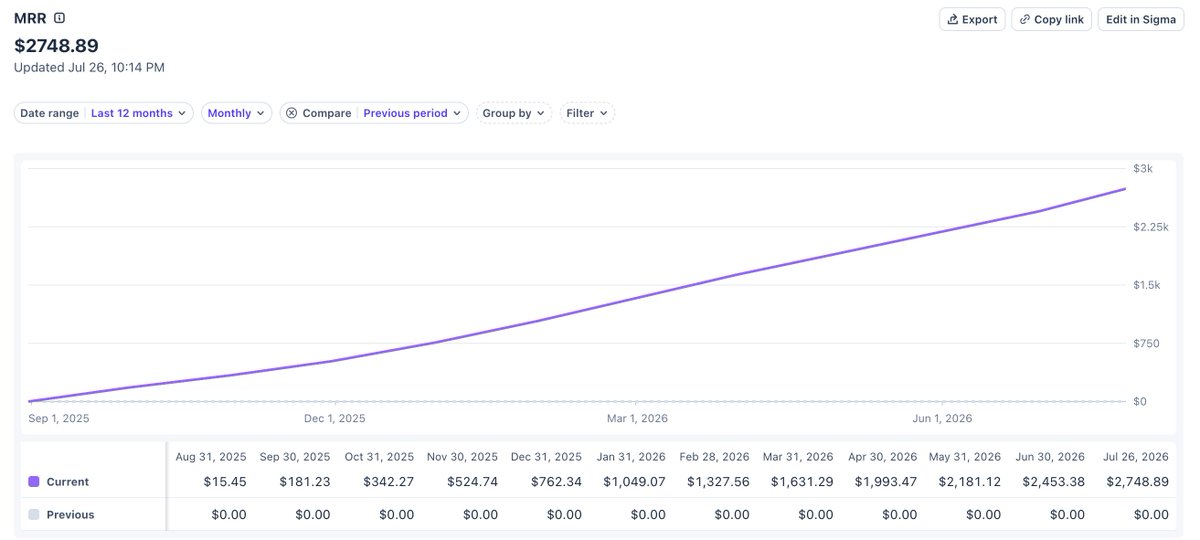
I launched my first SaaS (DoCV) exactly one year ago. The Product Hunt launch wasn’t promising: just 3 votes. I had no audience, no community, no beta users and no waitlist. All I had were a few Reddit posts. A year later, it has passed $2.7k MRR - slow and steady Not a single user came from X. I didn’t even start using X until six months after launching. It’s been a rough year keeping it alive. Every user came through content, outreach and countless 1:1 conversations and now all from my own subreddit. The lesson? Be active where your users already live... not where the hype tells you to be.
@ItsKieranDrew ·
Last month, I made $5,363.19 from automated income. How? By building an email welcome sequence that promotes an ebook and upsells my digital products. This has let me advertise in bigger newsletters and break even or make a profit. I've also started investing in Facebook ads. It's been great to not rely on social media to grow my audience. I'm sure anyone who's been writing online for a couple of years can relate. I'm definitely not an expert at the ad side. But this was quite a light lift to build: 1. I took my best emails and scheduled them. 2. I added call to actions to the ebook with upsells attached. 3. I changed the thank-you page to the ebook, too. 4. I put a more direct pitch at the end of my welcome sequence for those who didn't buy during. You probably have the assets you need lying around already. Don't just work hard. Work smart.
@marclou ·
New startup claims the #2 spot on TrustMRR 🥈 It's a platform created by @greg_rog for selling digital products online (note: the $82M figure is GMV, not revenue). Their ecosystem includes a range of beautiful products and free tools, with top-notch design imho. Check out their footer to explore the entire easy**** ecosystem.
@alexabelonix ·
okay… this whole “sell digital products on instagram” thing actually WORKS i’m impressed tbh i have only 2k followers zero serious organic growth automation rn and almost every day i see someone new using my products 65 leads in 2 weeks from Instagram + Twitter not bad at all small problem: every single product is free 😂 but okay at least i’m collecting emails, learning what people want and slowly figuring out how to make this thing print money
@zaimiri ·
Michela Allocca started posting personal finance videos in 2019. Jus an iPhone and a ring light, and a dream. By 2021, Break Your Budget had 200,000+ followers and was making more than her investment consulting job. Now the business is basically two engines: 1. Brand partnerships around personal finance 2. Digital products like budget trackers and financial independence calculators Business Insider says she has sold over $1M of budgeting templates and tools. The part I like is how boring the offer is. A spreadsheet. A calculator. A money system she actually uses herself. The internet keeps rewarding people who can turn ACTUAL pain into a useful product. Especially when the audience already trusts the filter. Amazing money machine.
@GasperCrepinsek ·
What I've learned after making $111k with digital products: People. Buy. Outcomes. They don't care about: • # of 1:1 calls • Bonus PDFs • Notion templates They care about: • Hitting 1k subscribers • Making $2k/month • Quitting their 9-5 Lead with outcomes. Explain with features. Sell with integrity.
@Hartdrawss ·
You're leaving free app store downloads on the table. Custom product pages. Apple lets you create multiple alternate app store listings. Different screenshots, different text, different preview videos. Each one gets its own URL. Send designers to the design variant. Send productivity nerds to the productivity variant. Send founders to the "this saves you 10 hours a week" variant. It takes 20 minutes to set up and it shows up in search and on your listing while your competitors still run one generic page. Here's the exact playbook: 1. App Store Connect → Features → Custom Product Pages. Click the plus icon. 2. Create one page per audience segment. Name them something you'll remember like "designers" or "founders." 3. For each page, swap the first screenshot and the subtitle. Match the pain. Designers see a beautiful UI. Founders see a throughput number. 4. Submit all pages for review alongside your next app update. They roll out together. 5. Drive traffic to the right URL. Drop the founder link in your Twitter bio. Put the designer link in your Dribbble profile. Send the student link to your campus ambassador. 6. After 2 weeks, check conversion rates in App Store Connect. The winner replaces your default listing. The losers keep running for their specific audience. 7. Repeat with new variants. Test a "for enterprises" page. Test a "for bootstrappers" page. Test a "for people who hate subscription apps" page. One well-targeted custom product page lifts conversion by 20-30% on that audience. That's free downloads. No ads. No ASO black magic. Just matching your message to the person reading it. Your competitors don't know this exists. Start today.
@joncphillips ·
There's something I've been thinking about a lot lately. I built Contrastly over 9 years, grew it to 100k+ email subscribers, over 40 digital products, and eventually it got acquired. Really good outcome by most measures. But there's an alternate timeline where I built a membership instead of a storefront. Instead of chasing the next sale or the next promotion, I could've had recurring revenue, a community, people paying monthly to be part of something and get access to resources. I think about that a lot.
@zaimiri ·
Aakash Gupta is a very clean example of the “research guy” business model. Growth in Reverse broke down his Product Growth newsletter earlier this year: - 105k email subscribers. - 300k+ social followers. - Roughly $624k/year in reported revenue. All from product/growth analysis. I like this one because the niche sounds boring until you look at the buyer. Product managers already spend money on this stuff. They want better frameworks. They want to understand growth. They want sharper metrics. They want promotion leverage. They want to sound smarter in rooms with founders, engineers, and execs. @aakashgupta did not need to convince people that product growth mattered. The demand was already there. He just became a better filter. The motion here is simple: 1. Free posts on LinkedIn and 𝕏. 2. A free newsletter for trust. 3. Paid deep dives for serious readers. 4. A higher annual tier for people who want access. Reported pricing was around: $15/month. $150/year. $300+ for the annual tier with a call. That is such a good internet business. You don't need a huge team. There's no agency delivery headache. No complicated SaaS product. No fake guru funnel. Just one person becoming extremely useful to a market that already pays for better judgment. This is why the “research guy” angle is so strong.
@kylegawley ·
I failed again. This launch flopped → 0 sales. Let's breakdown the numbers and find the lesson. > 43k followers on X > 3k views on this post + 12k views on another = 15k views on X. > 3k emails sent to users who bought/use previous dev tools of mine. = 18k eyeballs = 278 website visits = 0 pre-orders A good launch for me would be 5-10 pre-orders. Normally I would not care about X traffic failing to convert because launching on X is a lottery, but when email fails as well that is a bad sign. Bad product idea? Bad timing? Maybe. The lesson here: This is how 95% of launches go. Most of what I launch fails. Only 4 products have made money in 15 years of launching. This is why you should not fall in love with ideas until you have paying customers. Don't launch products, launch experiments. Test the market. If you don't get early signal, move on to the next thing quickly. I'm sharing this because it's completely normal and happens to everyone. Do I feel like a failure because I put something out in public and it failed? No. The plot twist is I made a tool to make an explainer video for this product and already got my first paying customer for it by accident. That opportunity wouldn't have happened if I didn't try this experiment first. Keep shipping.
@SimonHoiberg ·
Your best SaaS idea is probably *already running* inside your business. Not in your head. In your automations. If you have a messy stack of: → n8n workflows → scrapers → AI helpers → Glued-together spreadsheets …you're sitting on a product. You just haven't productized it yet. Here's the simple playbook I use: 1️⃣ Identify the "hidden product" Don't ask "what should I build?" Ask: "What do we already do repeatedly that *others would gladly pay to avoid doing themselves?*" Litmus test: - It runs at least weekly. - It replaces annoying manual work. - If it broke, you'd fix it *today*. 2️⃣ Turn workflow → clear outcome Nobody wants "access to your automation". They want a promise. Translate it: - From: "AI + n8n + API integration for X." - To: "Get Y done in Z minutes with 0 manual steps." 3️⃣ Wrap it in a tiny product You don't need a massive product. You just need a clean entry point. Minimal setup: → Auth (email + magic link is fine). → 1 screen to configure inputs. → 1 button: "Run". → A log that shows what happened. 4️⃣ Price like a tool, not a toy If your tool replaces hours of work, charge accordingly. Think if 3 types of users: - Solo: just enough usage to *feel* the value. - Team: where most revenue comes from. - Power: priced for the people whose job you're basically automating. 5️⃣ Add one proof, then push Before obsessing over features: → Get 3 users. → Collect 1 strong, specific testimonial. → Share it where your users hang out. "Look what this did for them" sells better than "look how clever my stack is". I have 4 tools in my portfolio. Every single one of them started as an internal tool or piece of automation. This is where most good tools are born.
@alexabelonix ·
Justin Welsh passed $10M in total revenue in 2025 after 5 years and 9 months of building through organic social. No paid ads. LinkedIn. X. Newsletter. Digital products. Consulting. Sponsorships. Community. The interesting part is not the $10M. The interesting part is the sequence. He did not start with “buy my course.” He built a public library of thinking. Then packaged the most trusted parts. That is what founders should study. Content first creates proof of thinking. Then the product becomes the paid version of trust.
@Godfreyjumma ·
Most startup executives dream of becoming the next unicorn founder. @thejustinwelsh did the opposite. He walked away from a $60M startup career… and built a one-person internet business making millions. Here’s how he did it (and why it works) : --- Justin Welsh wasn’t always a solopreneur. He was the Chief Revenue Officer at PatientPop, helping scale the company to $60M+ ARR. From the outside: Great salary. Prestige. High-growth startup. Behind the scenes? Panic attacks. Anxiety. Burnout. --- Most executives in that position do one thing: Stay on the venture treadmill. Raise capital. Hire teams. Chase hypergrowth. Justin made a different decision. He quit. No investors. No team. Just the internet. --- His goal wasn’t to build another startup. It was to build something simpler: A one-person business built on leverage. That meant: - digital products - distribution through content - systems instead of employees --- Then he noticed something strange. LinkedIn was massive. But almost no one was using it seriously. Most people treated it like a résumé. Justin treated it like a publishing platform. --- He started posting daily about: - solopreneurship - leverage - simple business systems - escaping startup burnout Not motivational fluff. Real insights from someone who had actually been inside the machine. --- The audience exploded. Because thousands of professionals felt the same tension: Good career. Good salary. But zero freedom. Justin gave language to a feeling many people had but couldn’t explain. --- Then he did something smart. Instead of building a big team… He built digital products. Courses. Templates. Frameworks. Things that could sell repeatedly without his time. --- Today, Justin Welsh has: - 846K LinkedIn followers - A multi-million dollar solo business - One of the most studied solopreneur systems online No office. No employees. Just leverage. --- The real lesson isn’t “quit your job.” It’s this: Complex businesses scale slower than simple ones with leverage. Justin built: 1 audience 1 platform 1 message And repeated it relentlessly. --- Studying creators like Justin Welsh changed how I think about content. The pattern is always the same: - Clear ideas - Simple frameworks - Relentless publishing Most experts already have the ideas. They just struggle turning them into consistent content. That’s the real bottleneck. --- If you could build a one-person business, what would it look like? Discovering creators like Justin Welsh was a turning point for me after burning out running my agency.
@xelebofficial ·
AI agents are becoming more than tools. They are becoming owned digital assets. A useful agent can accumulate: audience memory data workflows monetization channels user relationships brand equity That changes how we should think about agents. They are not just software features. They can become persistent digital products that grow in value as they interact, learn, and serve a specific audience. The next wave of builders will not just create agents. They will build agent-based businesses.
@xelebofficial ·
AI agents are becoming the new interface layer for digital products. Not because chat is magical. But because users increasingly want outcomes, not dashboards. The strongest agents will not simply answer questions. They will help users: make decisions complete tasks manage workflows discover opportunities interact with products in a more natural way The shift is not from apps to agents overnight. It is from static interfaces to adaptive product experiences. That is where the AI agent market gets interesting.
@Hartdrawss ·
this is NOT the time to chill and keep building features nobody asked for in your vibe coded app... you're holding the biggest leverage you'll ever get in your life, a $200/month AI stack that can research markets, find paying customers, and automate distribution in the time it takes you to deploy one useless feature (short of winning the lottery tomorrow) the window won't last so lock in on DISTRIBUTION, on getting your app in front of people who will actually pay, nothing else here are 5 plays with drastic impact on how much revenue your app makes: - run deep research on App Store top gainers in your category, find the ones with 3-star ratings, build the one feature their users are begging for in their reviews - scrape 500 people who commented "I wish there was an app for X" on Reddit or X, cross-reference with active threads, DM them a link to your beta with "built this because of your comment" - create a launch checklist that ships your app to Product Hunt, Hacker News, and 3 niche directories in the same week, launch day momentum compounds - hack App Store SEO by finding low-competition keywords your competitors ignore, stuff them in your title and subtitle, watch organic downloads trickle in - deploy a "build in public" thread on X showing your daily numbers (downloads, revenue, crash reports) transparency converts lurkers into users pick one tomorrow. stop building. start selling.
@daniel_dinoia ·
The math on a one-person business: No payroll. No office lease. No investors taking a cut. Near-zero cost to deliver digital products. That means almost everything you earn is yours to keep. Small revenue with massive margins beats huge revenue with huge overhead. Lean is the cheat code.
@cst_william ·
I’ll be fully transparent. 2025 was a year of wins, but also failures. Here’s a clear breakdown of what happened and where I’m headed in 2026. Public accountability. First, the wins. PERSONAL • Traveled across Thailand and Vietnam for 6 months • Met incredible people along the way • Solid gym progress (78kg lean at some point this year) • Read 60+ books and summaries (mostly via Shortform) BUSINESS • Scaled Notionbase with a new website, blog, products, and freebies • Grew the YouTube channel to 10k+ subscribers • Made $4k in my first year selling digital products (Gumroad + Notion Marketplace) • Crossed my first $1k/month milestone • Went from 0 to 1,000 followers on X Now, the losses. PERSONAL • A life-threatening injury in Vietnam → Lost 10kg during the months following surgery → Took a real mental hit → Had to fly back home for insurance and treatment • Too much scrolling and YouTube (guilty) • Poor sleep habits • Inconsistent meditation and breathwork BUSINESS • Spent too much time building great products and not enough time marketing them (a.k.a. what moves the money needle) • Didn’t post as much content and products as planned • Experimented with algorithmic trading, which led to emotional ups and downs (I lost more than I made). I realized I wasn’t aligned with it and eventually stopped. Still, this year gave me something more valuable than growth. Clarity. I’m clearer than ever on what I want to build and why. I realized I don’t want to tie my entire identity to a single tool like Notion (even though I genuinely love it). And I also don’t want to become another loud “motivational trader” guru chasing attention. My mission is simple: help solopreneurs organize their life and business, make more money, and live a more free and aligned life. And most importantly, I want to practice what I preach. So here’s what’s next. PERSONAL • Going back to working while traveling and intentionally networking (I'm actually flying to the Philippines in 5 days, I'll keep you posted on that). • After the longest break I’ve taken in 9 years (6 months), I’m committing again to a serious gym and health routine. Fitness has always been my anchor and my gateway to discipline in both life and business, and I really missed it in the second half of the year. BUSINESS • Clear separation between my Notion content (Notionbase) and my personal brand as a solopreneur (William Coste) • Doubling down on my personal brand through: – X content – A biweekly newsletter (Solopreneur Stories, just launched) – A weekly podcast (Solopreneurship, coming soon) • Long-term goal: build a complete digital products ecosystem: courses, Notion templates, and systems for solopreneurs. That’s my plan for 2026. What’s yours? P.S. Just launched my personal website, all links in bio. P.P.S. Follow me on X, bookmark this post for updates, and join the newsletter for weekly, honest lessons on solopreneurship, systems, and freedom. → https://t.co/ABl4wXl7SG
@GasperCrepinsek ·
“Do I need to build a following before I monetize?" I hear this question all the time from my clients. The answer: Absolutely NOT. You only need 10 conversations with the right people. • Understand their #1 problem • Build a product to solve it • Make them an offer • Deliver results • Systemise That's the formula that created a $20k+ launch for one of my digital products.
@iamfra5er ·
THIS GUY VIBE CODED AN EBOOK GENERATOR WITH CLAUDE CODE AND HIT $1956/MO he was the customer first saw people selling PDFs, tried it, worked. then clients started asking him to make ebooks for them. the process was brutal: ChatGPT, copy-paste, Canva, export, fix formatting, repeat. some ebooks took days. 40 steps every time. that's when it clicked: anything you repeat identically that often isn't a task, it's a product he had never written a line of code. built the first version wrong, threw it out, rebuilt from scratch. that's what launched in July 2025 the closest he came to quitting was right after the rebuild when he was burning money on ads to acquire customers at a loss his unfair advantage: he's inside the market. his feed is flooded with digital product ads. he's bought them and sold them. he knows what converts and what people actually do with the file after they buy it now he's doing $15K in revenue over the last 30 days with a 60% margin vibe coded by a guy who runs a social media agency with his wife and still does customer service between ad batches
@fin465 ·
My AI startup Origami scaled to $50k/month before we built a product at all (before doing this, I spent 3 years starting / failing companies) what finally worked was a "dirty trick" I think everyone should do: sell before you build. Here's exactly how you do it: STEP 1: Stop building product-first. It's what makes people keep failing. For 3 years my process was always the same: figure out what the market needs, build the perfect product, then go sell it. It got me nowhere. In college I built loyalty apps for restaurants because "obviously" a restaurant wants one. But when I finally knocked on doors, owners told me no, and if they hadn't adopted one already, there was a reason. I wish I'd talked to 20 restaurant owners before writing a line of code instead of after. STEP 2: You don't need a product. Solve the problem manually first. Before this I ran an agency booking sales meetings for businesses by hand. It showed me the real insight: I could sell the automated version of that work before it existed. So I called my best friend studying in the UK: go all-in with me Then I started pitching businesses on software that finds customers for them (this eventually turned into Origami, tag me @origamichat), but at the time we hadn't built a thing. "How much would you pay to have this?" The answers: $500/mo, $1,000/mo. Some even said $4-5k/mo. STEP 3: The Risk-Free Offer. If you can deliver an outcome a business genuinely wants and put yourself on the hook for it, saying no is irrational. Whatever you're selling, price it on the result: "Free if it doesn't work." "You don't pay until we hit X." "Full refund if we don't deliver." Whether you're promising more revenue, lower churn, saved hours, or a problem finally fixed, businesses spend millions chasing those outcomes. Tie your pay to the result and a small cut is nothing to them. You don't need case studies or logos yet, you just need to take the fear off the table. (Once you've built a reputation, you drop the guarantees and charge more) STEP 4: Deliver by hand, and let demand become your leverage. During the day I took an absurd number of calls: 15 meetings a day, 7 days a week, ~150 a week, while my co-founder built at night. In our first 2 months we booked over $50k/month in revenue from interested clients. Then the start date came and we had no product. So I just did the job by hand: Built spreadsheets of the best leads for each client. Sent high-quality leads every week, guaranteed. That booked demand was everything. It let us recruit a team, raise money, and our first 3 customers even angel invested in us (that we met through cold email). They literally sent money so we could build the product they wanted. By month 3-4, we had turned booked rev into ~$70k/month actually flowing through Stripe. STEP 5: In 2026, building isn't the bottleneck. Knowing what to build is. We didn't get here because we were great engineers. If we'd tried to build first, we'd have been screwed. I'd rather have 50 interested customers and vibe-code something, knowing exactly what they want, than a team of 10 IOI medalist engineers serving one half-interested customer. Models like Claude Fable already build better than the best human engineers Our product only came together because clients kept shouting at us: "these leads are bad" "automate our emailing" "scrape google maps too" "add ecommerce stores.” etc. that's the roadmap So pitch people something that doesn't exist yet if you found this useful, save it and PLEASE use it to to land customers🙏. ill be writing more detailed growth guides every week
@ecomchigga ·
my 4th product outsold my first one and it had nothing to do with quality. it launched into an audience that had already paid me three times. here's the mechanic nobody explains about selling digital products. a single product has exactly one job: convert a stranger. that's the hardest conversion in commerce. no trust, no history, no evidence you deliver anything at all. cold traffic to a single product link converts around 1%. a catalog has a completely different job: convert someone who already paid you once. these are the actual numbers from my store last month and they reorganized how i think about the entire business. traffic sent directly to a product link: 945 views, 6 sales. 0.6% conversion. people who landed on the storefront and browsed: 497 views, 17 sales. 3.4% conversion. same products. same prices. same month. the browse page converted 5.6x better than the direct link, off half the traffic. someone already inside your store isn't deciding whether to trust you. they decided that when the card went through the first time. now they're just deciding which one to get. what this means practically: your first product is not the business. it's the trust purchase. it exists to turn a stranger into a buyer at the lowest possible risk. price it low, solve one narrow thing completely, overdeliver so hard they feel weird about how little they paid. your second product is where the money starts. it's aimed at the person who finished product one and wants the next layer. you're no longer selling to the internet. you're selling to a list of people who already know what your work feels like. by product four or five, every new launch has a warm audience built into it on day one. you're not launching to strangers anymore. you're launching to your own customer base. the compounding part: every product you add raises the value of every product already there. nine products means nine different entry points, and whichever one someone walks through, the other eight are sitting right next to it. the structure that works: entry tier, $10-$17. one specific problem, solved fast. this is the handshake. core tier, $34-$47. the full system. this is where most of the revenue lives. deep tier, $97-$497. everything, for the people who want everything. each tier feeds the next without a single sales email. the buyer moves themselves. the product page for my third product has had a broken preview image for about five months. i keep meaning to fix it. it still sells every week because nobody arrives at it cold, they arrive at it after buying something else. you're not trying to sell one thing to a thousand strangers. you're trying to sell nine things to the same three hundred people.
@AlexEngineerAI ·
Gumroad is where most beginners should start selling AI digital products. Here is how the platform actually works. What you can sell: digital files (PDFs, templates, Notion pages, Canva files), courses, memberships, and software. For AI side hustles, the sweet spot is digital downloads and pay-once guides. Fee structure: Gumroad charges a flat 10% on every sale. No monthly subscription. No setup costs. A $19 guide: you keep $17.10. A $49 template pack: you keep $44.10. A $97 course: you keep $87.30. You also get the buyer's email on every purchase, so you are building a list with every sale. Getting set up: 1. Create an account at https://t.co/PVknu0S9gT (free). 2. Upload your product file — a PDF, a zip of Canva files, a video, or a Notion link. 3. Set a price. Gumroad also supports pay-what-you-want pricing, which is useful for testing demand before committing to a fixed number. 4. Add a cover image. Canva works. Minimum 1280x720. 5. Share your product link anywhere. No website required. No coding. No storefront unless you want one. The discovery reality: Gumroad has internal search but it does not drive meaningful organic traffic to new products. You need external distribution — X, Reddit, a newsletter, or a niche blog. The platform handles the transaction and file delivery. Getting buyers to the page is entirely your job. Payouts: weekly on Fridays, minimum $10 threshold, via PayPal or bank transfer. Non-US sellers need to connect a Stripe account. Where it fits: Gumroad works best as a fast, low-friction way to start collecting money for a digital product you have already built. Spend most of your energy on distribution, not on optimizing the storefront. The biggest mistake beginners make: they list the product, then wait for Gumroad to send buyers. It does not work that way.
@seraleev ·
🚨 FTC has filed a lawsuit against Genesis Tech and eight related individuals. According to the complaint, the company operated a network of subscription-based digital products that generated approximately $250 million in revenue worldwide between 2023 and mid-2025. The FTC alleges the business was structured through 15 companies across multiple jurisdictions and sold products including: - MadMuscles, Harna, Unimeal (fitness & nutrition) - Wisey (ADHD and productivity courses) - PDF Guru and PDF Master - Lumi (style consultations) - Nebula (horoscopes and consultations) The main allegations: 1. Hidden subscription terms Products were advertised as free or very low cost, while recurring charges and auto-renewals were allegedly disclosed in small print or in a way consumers could easily miss. 3. Charges without consent The FTC claims some users were charged twice for the same product and that additional products were added to purchases without clear authorization. 3. Difficult cancellations According to the complaint, cancellation options were sometimes unavailable, users were required to explain why they wanted to cancel, and in some cases billing attempts allegedly continued after cancellation requests. The FTC also alleges Genesis Tech repeatedly launched new products, created new legal entities, and opened new merchant accounts to evade monitoring systems and obscure the origin of funds. A federal court has already issued a temporary restraining order while the case proceeds.
@AlexEngineerAI ·
Most beginners pick a design tool by feel. Here is how the three most common ones actually compare for Etsy digital products and Gumroad downloads. Canva Pro: $15/month The strongest case for Etsy and Gumroad workflows. Pre-built Etsy listing mockup sizes, printable planner templates, a brand kit feature for visual consistency, and a deep element library. Most digital products can be built without leaving the app. Exports directly to print-ready PDF for digital downloads. Adobe Express: $9.99/month Genuinely good Adobe quality at a lower price. The limitation is the template library, which is smaller than Canva and less focused on Etsy-specific product formats. Works well for social content and simple graphics, but for high-volume Etsy planners or printable bundles, you spend more time building from scratch. Microsoft Designer: Free with a Microsoft account Powered by DALL-E image generation, which is its main differentiator. Useful for generating custom AI imagery inside a design tool. The template catalog is thin and the export workflow for printable products is less mature than the other two. Best used as a free add-on for imagery, not as a standalone product production tool. The real comparison For a beginner selling digital products on Etsy or Gumroad, the only question that matters is: which tool gets you to a completed, listable product fastest? Canva Pro wins that test. The $15/month pays back faster because the Etsy-specific templates, mockup sizing, and PDF export workflow reduce production time versus building layouts from scratch. Adobe Express is better value if you are mainly making social content. Microsoft Designer is worth layering in for free AI image generation on top of Canva, not as a replacement.
@dominikmartinX ·
I shipped an AI tool called Parroter that automated social media replies. It got users. It made money. And it taught me more than any course. 5 lessons from building an AI product with zero engineering background: Lesson 1: Start with a problem you personally have. I was managing social media for multiple projects. Hundreds of replies daily. I thought "this should be automated." So I figured out how to build it. The best products come from your own frustration. Lesson 2: Ship fast. Iterate later. My first version was rough. Really rough. Users don't care about polish. They care about whether your tool solves their problem today. Waiting for "perfect" is the most expensive mistake in product building. Lesson 3: Distribution beats product. Every time. The best AI tool nobody knows about loses to the mediocre one everyone uses. I had the product. Getting attention was the harder problem. Lesson 4: AI products commoditize fast. What's unique today is a feature in someone else's platform in 6 months. The moat is never the tech. It's your understanding of the customer. Lesson 5: You learn more by shipping one thing than by planning ten. Stop researching. Stop comparing tools. Stop waiting for the right moment. Build something. Put it in front of people. Learn from what happens. What's the one thing stopping you from shipping? Genuinely curious.
@sharyph_ ·
44% of digital products on Gumroad earned exactly $0. The median product sold 28 copies at $13. That's $364 lifetime. The top 1% of sellers control 99.5% of all revenue on the platform. That's not a platform problem. That's a positioning problem. I see this constantly: talented creators writing threads, publishing newsletters, building audiences — putting in real work every day. And the revenue stays flat. Here's why. They skipped the order. Every 6 and 7-figure creator I've studied — Justin Welsh, Lenny Rachitsky, Easlo, Dan Koe — did it in the same sequence: → Build an audience first, on ONE platform → Give away free value until people trust you → Monetize that trust with a cheap, narrow product ($20–150) → Turn proof into a course, then a membership The product didn't create the audience. The audience validated the product. Get that order backwards and it doesn't matter how good your product is — you're just spinning your wheels on a content treadmill. I broke down the full 4-rung product ladder, the 8-step framework, and the AI stack that compresses it into months instead of years.
Best Tweets by Topic