Channel selection and sequencing
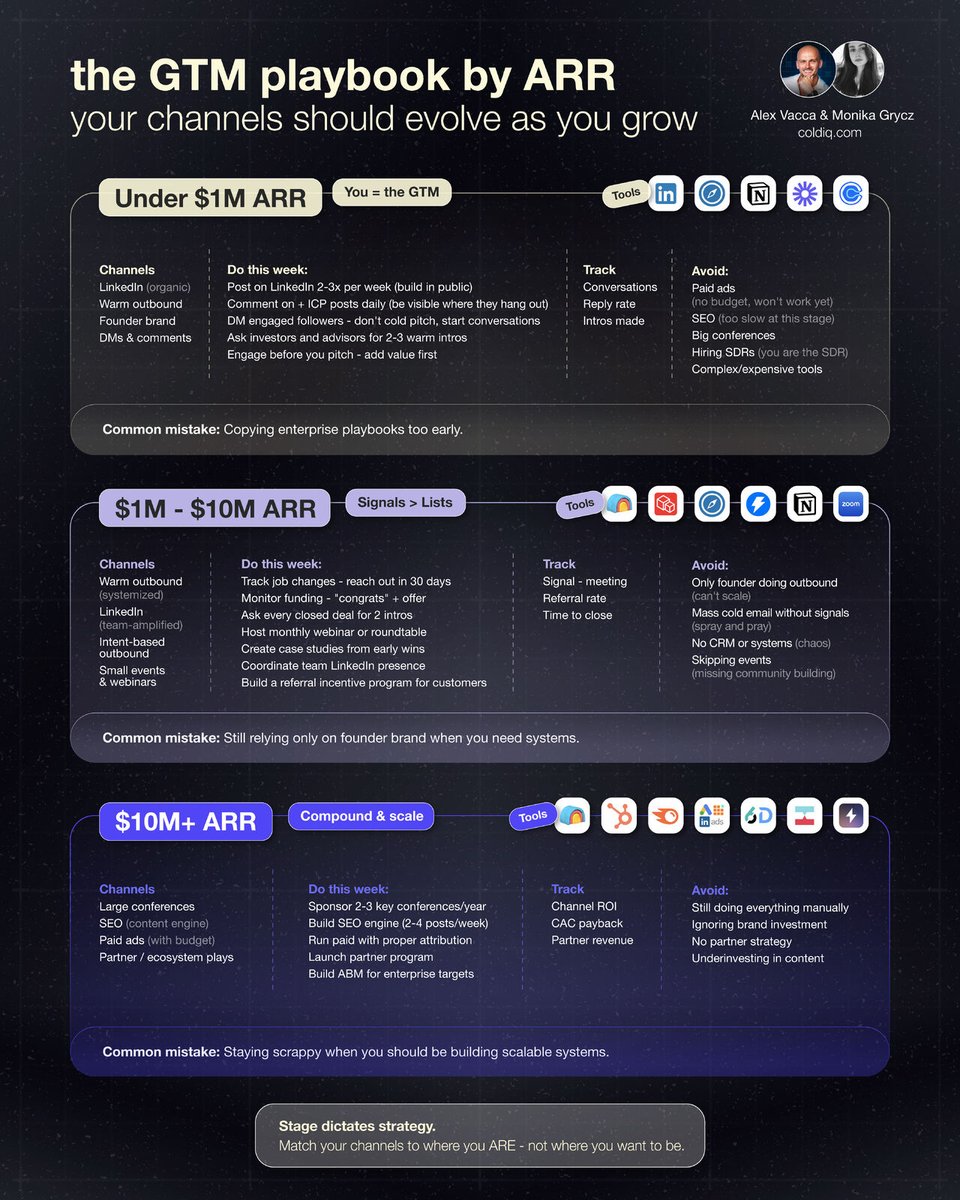
Choosing a focused primary channel, matching channels to market conditions, expanding only after a channel works, and sequencing organic, paid, outbound, community, or ecosystem efforts.
36%
Best tweets about Go-to-Market
Browse the best tweets about go-to-market strategy, featuring positioning, channels, sales motion, launches, distribution, growth loops, and GTM lessons.
Concrete go-to-market choices, channels, sales motions, launches, distribution, sequencing, metrics, and lessons from execution.
Original Xholic analysis
Across the posts, GTM is presented as a system spanning channel focus, market wedges, distribution, activation, and sales execution. Supportive posts make up 54% of the set; the cited posts also offer competing views on paid acquisition, outbound, and launch sequencing.
54% of posts
All-time engagement
32% of posts
Published in 90 days
Conversation map
Choosing a focused primary channel, matching channels to market conditions, expanding only after a channel works, and sequencing organic, paid, outbound, community, or ecosystem efforts.
36%
Distribution is treated as core company infrastructure and competitive advantage, often more decisive than product parity; includes owned channels, defensible routes to market, and product-led distribution.
34%
Designing repeatable sales systems while preserving rep judgment; covers enablement, funnel instrumentation, enterprise selling, post-sales ownership, and sales leadership.
30%
Selecting an initial ICP, vertical, geography, or underserved wedge; expanding through concentric markets, land-and-expand, downmarket or upmarket paths, and focused pilots.
22%
Clarifying the customer problem, differentiating against incumbents, creating category language, and managing the operational cost of repositioning.
22%
Designing product simplicity, packaging, pricing, service models, onboarding, and customer experience around the intended route to market, particularly for AI-native businesses.
18%
Using founder voices, educational content, building in public, lead magnets, and repeatable ICP-focused content to create awareness, trust, and inbound demand.
14%
Building targeted outbound motions through account tiers, research, triggers, multichannel warming, prospect engagement, and tooling beyond high-volume automation.
10%
Tone and stance
Performance benchmark
Posts with media make up 50% of this collection. Their median all-time score is 5.09, compared with 5.17 for text-only posts.
Format mix
Consensus and debate
Shared view
Several posts characterize distribution as more than a launch activity: they emphasize owned or defensible routes to market, feedback loops, activation, retention, and repeatable operating systems.
Shared view
Posts recommend starting with a narrow market or a single channel, learning from that focus, and expanding afterward. One example describes focusing Zeus on energy markets before considering other verticals; another advises mastering one content channel before adding another.
Shared view
The cited posts recommend using ICP-focused content and prospect engagement to create familiarity before outreach, then connecting both activities to a conversion path.
Shared view
Posts link route-to-market execution with product experience, including activation, reliability, onboarding, pricing, positioning, and service design—particularly in arguments about AI-native businesses.
Open debate
One post argues that paid acquisition should be a last resort for startups; another recommends first finding organic content winners and then funding them with paid distribution. A third argues that Meta and Google remain the best GTM play for bootstrapped e-commerce, subject to five listed exceptions.
Open debate
One post presents a four-quadrant framework based on whether buyers feel the problem and whether the category has a clear leader, assigning outbound, content, niche positioning, or both accordingly. Other cited posts describe content warming prospects before outbound.
Open debate
One post argues for shipping a live v1 quickly to gain market feedback and attention. Another argues that crypto projects should earn attention and product usage before launching a token. Both treat sequencing as consequential.
What performs
Channel selection and sequencing accounted for 36% of the corpus (18 tweets) and had a median all-time score of 6.54. Its evidence includes advice on founder-led LinkedIn, concentrating on one channel, and skepticism toward paid acquisition.
Outbound prospecting and account targeting had the highest theme median all-time score, 14.566, while representing 10% of tweets. Its cited evidence covers competitor research, market-state channel selection, and limits of high-volume outbound tooling.
The highest-scoring outlier was tweet 2037903624630595907, with an all-time score of 655.28. The other listed outliers covered founder-led LinkedIn, GTM organization, competitor GTM research, and a critique of paid marketing.
Statistical standouts
Creator landscape
The five most represented creators account for 18% of the selected posts.
1. Alex
@heyitsalexP
2 posts
2. Logan Gott
@LoganTGott
2 posts
3. George from 🕹prodmgmt.world
@nurijanian
2 posts
4. Startup Archive
@StartupArchive_
2 posts
5. AdrienBrb
@adrien_brbr
1 post
6. andrew chen
@andrewchen
1 post
Startup Archive and Logan Gott each contributed two tweets among the listed top voices. Startup Archive’s cited posts use company cases to discuss GTM, while Logan Gott’s posts provide LinkedIn and content-to-outbound guidance.
Examples of operating guidance in the cited posts include mapping market segments, engaging prospects before outreach, researching competitors’ public signals, and adding a funnel beneath content activity.
Since the previous snapshot
Themes, sentiment, stance, and post format are classified per tweet. All counts, shares, medians, creator concentration, freshness, and performance comparisons are then calculated directly from the published snapshot.
Xholic's all-time score compares engagement while accounting for reach, post age, and creator consistency. It is used for relative comparisons within this collection.
This report analyzes the exact 50-post snapshot shown below. AI identifies editorial categories and drafts explanations; all statistics are calculated from the snapshot, and every narrative claim is checked against cited posts before publication.
Best Go-to-Market tweets
Ranked 01–50
@buccocapital ·
Really enjoyed the deck @loganbartlett and team just shared on the state of Software, wanted to pull out a few things that caught my eye: 1. AI-native companies are growing faster AND more efficiently The growth rates are really staggering. And they’re doing it with very few people. The demand for AI is insatiable, like nothing we have ever seen, and is diverting budget away from traditional software. This is an existential moment for the incumbents. I’ve been saying Accelerate or Die for months. The accelerating is unprecedented, and the growth is coming at the expense of SaaS 2.0. Only death can pay for life 2. They’re doing it without going head-to-head with incumbents This is probably the most interesting slide to me. These AI-native businesses are growing so fast by using two approaches: A) Finding a wedge into the enterprise, scaling quickly, then trying to expand B) Building AI-native Systems of Record from below. @arampell calls this “Greenfield Bingo.” New businesses/SMB have zero/low switching costs, so AI-native CRM/HR/ERP companies can take share and march upmarket from below Both of these are particularly tricky for incumbents to defend against. They simply aren’t able to move quickly enough to build compelling AI point solutions, and they’re struggling to defend downmarket while also defending the enterprise (bimodal go-to-market and running multiple service models in one company is incredibly difficult) 3. Incumbents scale by throwing people at the problem This has been the dirty little secret of SaaS for 15 years. It’s basically impossible to grow revenue faster than headcount. Some companies like Shopify did it by layering on payments. Consumption-based companies have been doing it. The AI native companies have this figured out. The incumbent, seat-based, companies simply have never been able to decouple revenue from headcount. They will have to learn or die 4. Incumbents have the right to win but they are failing to capture the moment As I’ve said before, the CIO wants to stick with their current vendors. They WANT to buy AI solutions from the incumbents. The problem is their solutions suck. @jasonlk has been all over this. These incumbents have a shrinking window of time where they have the advantage, but that window is shrinking. Rapidly.
@LoganTGott ·
GTM strategy for recently funded SaaS companies on LinkedIn: 1/ Get your CEO posting daily. Company pages reach about 1.6% of followers organically. That's nothing compared to personal accounts. Your founder's face and voice will always outperform a branded page. PEOPLE FOLLOW PEOPLE, especially in B2B. 2/ Position every post around the problem your product solves. • Not your team • Not your features • Not your funding round The problem your ICP loses sleep over. That's what earns attention from buyers who don't know you yet. 3/ Build one PDF carousel that breaks down your ICP's biggest problem. Pin it in your founder's featured section. This becomes a passive nurture system... every profile visitor sees it and understands your product better. One asset doing work 24/7. 4/ Have your founder comment on 10 prospect posts daily for 30 days before launching any outbound. When you eventually DM them, they already recognize the name. Cold outbound hits completely different when they've seen you showing up consistently in their feed. 5/ Capture emails behind every lead magnet. LinkedIn is “rented” You don't own the algorithm, you don't own the relationship. Create landing pages for all of your lead magnets so people have to opt in with their email to get the actual resource. That way, you can continue to contact them in the future whenever you desire. 6/ Repurpose objections from sales calls into content. Your prospects are literally telling you what to write about. Every "I'm not sure if..." or "We tried something like this and..." is a post waiting to happen. This content converts because it speaks directly to the doubts buyers already have. Most funded SaaS companies throw budget at ads before building any organic trust. What does your current LinkedIn GTM look like?
@StartupArchive_ ·
Patrick Collison on what he wishes he did differently when scaling Stripe “I think one of the most pernicious mental models you can have is that you are on some growth curve… I think a much better mental model to have is that you’re serving some market, and then there’s the percentage of the market that you’re serving. And whatever percentage you are not serving, you just haven’t built the go-to-market functions and organization that’s brought the product to those market segments.” In the early days of Stripe, they assumed they were on some growth curve, but Patrick believes they could’ve accelerated their growth by viewing growth as a function of their go-to-market apparatus: “What we did not do, but what I wish we did, is six months after launch, we should’ve mapped out the concentric circles of our market.” As he suggests, Stripe should’ve started with very early stage startups then mapped out the larger set of all technical startups - not necessarily very early stage. Then continue this process in successive increments until they got to all companies handling online payments. Each step along the way, figuring out the size of each market, the fraction Stripe was currently serving, what it would take to serve more, and so on. And then work backwards from there: “What would the organization look like that was serving the entire market? Let’s just start building that organization, because the growth curve is under my control. Of course, it’s not 100% under your control, but I think it’s much more under your control than people tend to think.” Video source: @ycombinator (2018)
@salesxsaas ·
As a start up, your competitors GTM is the easiest way to build your own GTM motion. Because why reinvent the wheel (sales funnel) when your competitors already spent years building it Here’s some sources to scrape from your competitors: – integration partners page – backlinks – YouTube comment sections – G2 reviews – LinkedIn followers – Linkedin engagements – Linkedin groups – Slack communities – podcast guest history – case study logos/testimonial pages – partner pages – webinar attendee lists – Facebook group members – Meta Ads Library – newsletter sponsors & ads – job postings (tells you their stack & ICP) – conference speaker lineups – app marketplace reviews – Reddit mentions & threads – Twitter replies & followers All public. All free. All overlooked.

@andrewchen ·
There's a vast marketing industrial complex of agencies/consultants/advisors/whatever that promotes tech startups spending billions of dollars of unaccountable marketing budget. They're triggered by my anti-paid stance but here's the reality: - paid marketing is much, much worse than organic on every metric (conversion, ROI, etc) - startups work on a fast time scale and can't manage LTV/CAC correctly beyond a months timeframe - risk is asymmetric. a few bad cohorts can kill you (and btw, this has definitely happened) - the age of easy/cheap ad inventory is over. Pricing is controlled by an oligopoly, it's all being algorithmically bid up, and ROI sucks at scale - paid UA has S-curves. Early spend looks good, but plateaus and it's easy to get addicted - if your product is growing organically already, you might just be cannibalizing and pulling forward demand you'd already get anyway - high reliance on paid indicates weakness in the core product and value prop - you can't build a 100m+ DAU product with the majority coming from paid UA (it's just obv math) - going majority paid UA makes it 10x harder to raise VC capital down the line. For all the reasons on this list the main benefit of paid is simple: your agency/consultant/whatever spends money, some numbers go up, and you feel like you're doing something. It's simple to understand, you can apply it to every type of product, and every big co does it right? Billions of dollars swap hands just based on this dynamic. But for startups I argue it's the growth lever of last resort, since it's the most commoditized form of distribution -- you should try to exhaust your other ideas, invest deeper in your product, and grow based on whats unique in the ways that only your startup can grow. That way your channels are as defensible as possible, built around your killer value prop After all one day, you hit your CAC ceiling, your channel saturates, or worse, your competitors just do the same, copying your distribution strategy, dragging the whole industry into a prisoner's dilemma. When that happens, it's hard to incubate a bunch of new 0-1 channels to save your forecasts. The temptation is just to stretch payback periods, buy more, and ride it out. That's a dark path...
@StartupArchive_ ·
Dropbox founder Drew Houston on why distribution is more important than product LinkedIn founder Reid Hoffman wrote in his book Blitzscaling: "Many people in Silicon Valley like to focus on building products that are, in the famous words of the late Steve Jobs, "insanely great." Great products are certainly a positive, but the cold and unromantic fact is that a good product with great distribution will almost always beat a great product with poor distribution." Dropbox is a great example of this. As Dropbox founder & CEO Drew Houston explains, great distribution is ultimately how they beat out dozens of competitors with similar product offerings. Drew believes that too many startups overlook the importance of great distribution. Dropbox had a great product, but it succeeded because of its great distribution. They used a combination of organic virality (users shared files with nonusers) and incentivized virality (Basic account holders get 500 MB of extra storage per user they refer; Pro account holders get 1 GB) to grow. Virality helped Dropbox double its 100,000 users at launch to 200,000 users just ten days later, then skyrocket to one million users just seven months after that. An important caveat though: if your distribution strategy focuses on virality, you have to make sure you solve retention first. Bringing new users in through the front door doesn't help you grow if they immediately turn around and leave. According to Drew, Dropbox discovered this truth the hard way, when activation rates revealed that only 40% of the people signing up were actually putting files in their Dropbox and linking them to their computers. As Drew partially explains in the clip, the early Dropbox team went on Craigslist and offered $40 to anyone who'd come in for a 30-minute usability test. They asked these people to go from a Dropbox e-mail invitation to sharing a file with another email address. Zero of the five people tested succeeded--they didn't even come close. This stunned the team. So they made a list of 80+ things in an Excel spreadsheet and sanded down all of the rough edges in the experience. They soon watched their activation rate climb and left the competition in the dust as they marched on to a $9+ billion market cap. Source: @ycombinator (Feb 2017)
@codyschneider ·
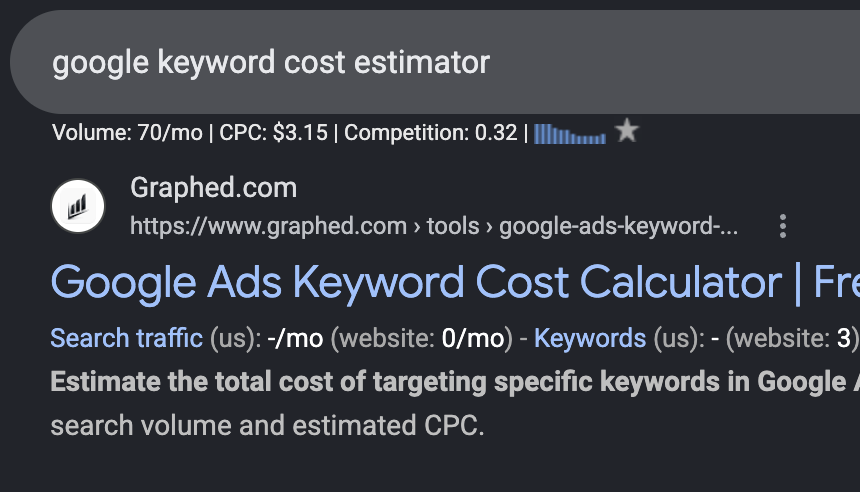
you can just manage facebook ads with claude code the first thing that you need to do is create a Facebook ads dev API key no you're not going to get banned for this man, that's just some narrative big brainrot is pushing do that you just need to create a custom app and then designate that it's just going to be for internal use so you can speed run this attached to an environment file that lives within a folder on your local machine and with this, you have the ability to upload creative start and pause ads, create new ad sets, create new ads etc now for the analysis, this is where it gets tricky if you try to hit the Facebook ads API key directly, you're going to run into: -api rate limits - timeout and latency - pagenation truncation - context window pressure - speed (like it just takes longer to do three different mcp calls, write a script and join the data) so to get around this, what you have to do is build a data pipeline in a data warehouse and then have claude code interact with that data warehouse and the easiest way to do this is with graphed .com graphed is an AI data analysts go to market teams you can connect all your data in one place and then via the Graphed MCP hold that back into Claude code and how this is different functionally is you're not doing calls to the facebook API. You're having graphed write code about the data you need and interacting with the data warehouse via that code once you have this data, you now can use the Facebook ads API to turn off the losers, promote the winners to dedicated budget and then this just turns into a process that you do into the future
@brettberson ·
There are a small number of elite go to market leaders. Graham Moreno is one of them. He recently joined @p0 to help lead GTM. Before that, he was at Cognition, Grafana, and MongoDB. One of his core philosophies is that a great go to market system raises the floor and introduces predictability while still leaving space for exceptional people to use their judgment to delight the customer. “One of my favorite stories is, one of the best reps I’ve ever worked with, during the pandemic found out that the son of a champion at one of his companies had been taking guitar lessons and couldn’t anymore because of COVID. So he ended up teaching this guy’s kid guitar over Zoom during COVID. And he also didn’t tell anyone. No one found out about this for a long time. Then the champion at this account brought it up on a call with me six months later and was like, ‘Oh yeah, Isaac has been teaching my son how to play guitar.’ At no part in our process does it say, ‘teach someone guitar.’” This is one of my favorite deep dives on what it means to be an executional revenue leader in a post AI world. Hope you enjoy it as much as I did. Timestamps 00:32 Has the sales playbook changed in the AI era? 02:13 Why "showing up" beats letting the marketplace decide 06:50 Why great salespeople sell to engineers and executives in one motion 11:37 Selling to AI-native buyers who grew up on ChatGPT 13:49 Same seller, different tempo: 8 weeks vs. 8 business days 15:57 How AI-native buyers handle build vs. buy decisions 17:48 The rep who taught a champion's son guitar over Zoom 19:03 Raising the floor without capping the ceiling 22:09 Why too much process narrows the kind of seller you attract 25:46 The three pillars of GTM excellence 31:00 Building peers who are 80% aligned, not 100% 38:03 Whether AI is changing what good enablement looks like 41:35 Selling against direct and implied competitors at once 42:45 Instrumenting the funnel from stage zero to close 45:57 Why post-sales should always roll up to the revenue leader 48:19 The case for outsized commissions 52:02 The 96 hours of panic before Cognition acquired Windsurf 53:04 How far out should a GTM leader be planning? 57:53 What a normal week looks like in hypergrowth
@HyperSalesman ·
Instantly and HeyReach are neat tools but you’re delusional if you think they’ll take you from $0 to $1,000,000 overnight. You’ve been lied to. GTM isn’t plug-and-play. Sending 100, 1000, 10000, 100000, 10000000, or 10000000+ messages doesn’t automatically fix your outbound. Seems like every new tool is focusing on volume + ‘personalization’ with AI. This should ONLY be layer of your GTM. Not the whole thing. We use similar tools at Erudite. But only for our tier 3 account list. For tier 1/2 prospecting, we use: 1. Bitscale (list building) 2. Floqer (workflows) 3. Exa (acct research) 4. Serper (scraping) 5. Trellus (dialer) 6. Replit (in-house tech) 7. Attio (heavyweight CRM) 8. Kondo (superhuman for LI) 9. InboxApp (superhuman for X) 10. LeadDelta (LinkedIn lightweight CRM) And a bunch more. If you want to launch a GTM motion, you have to think beyond what 99% of outbound gurus teach you on X.
@bhalligan ·
I am the first to admit it: I had Kareem, the CEO of Clay, all wrong. When Clay first crossed my radar, I thought he was too laid-back: no obvious chip on his shoulder, no external veneer of obsessive, rabid 'run through walls' CEO persona that we all look for. Kareem builds from what he calls "a place of wholeness" rather than lack - noting to prove, no revenge plan. It makes him sound almost too chill, but the operating instincts underneath are sharp. Crazy sharp. Clay has since exploded. $2M ➡️ $100M in two years. But let's not gloss over that he spent roughly five years wandering before Clay clicked, and his takeaway is that the hard part of building isn't working hard, it's the courage to commit to one idea and stop listening to everyone else, customers included. He flipped every assumption in his market: sell to technical "go-to-market engineers," charge for usage instead of seats, pick power over simplicity. We both created new types of roles for our categories, in completely opposite ways. I flogged "inbound marketing" with a book, a conference, and relentless content. Kareem coined "go-to-market engineering" and then refused to take credit, letting agencies own it because a category has to be bigger than you. We also get into his "momentum detective" theory of the CEO job, why he's deleting his standing one-on-ones, and why apologizing is one of his sharpest tools. There's no single way to run a company. Kareem is my proof. 👇 Full episode in the comments
@romanbuildsaas ·
I released a free course last week breaking down our go-to-market. A lot of founders asked me why I’d give away the entire playbook. One friend even said, “You’re just helping your competitors copy you.” Here’s the truth. First, I believe the more you give, the more you get back. Always. Second, founders are part of my target audience. They’re actively looking for ways to grow their business. So by sharing everything, I’m not losing leverage, I’m attracting the exact people I want. Third, that one YouTube video is now bringing in 150+ visitors a day to our website. For free. That’s distribution. My take on “building in public” is simple: It’s only dangerous if you’re talking to the wrong audience. If you’re sharing valuable insights directly with people who could become your customers, you should do it every single time. If you’re just broadcasting to people who will never buy from you, then yes, it’s useless. I’ll drop the video in the comments.
@StevenCravotta ·
My organic to paid distribution strategy: Step 1: Start with $0 organic content on TikTok / IG Step 2: Post daily and find your natural winners Step 3: Light the winners on fire with paid ads. No need to spend before organic validates videos for you. But when they do, put real money behind them. Then you’ll understand what printing cash means.
@heyitsalexP ·
You say your ads are "on brand", I say they're rude. Think about it this way: you're at a DTC dinner and you want to break in to a conversation circle. Do you push your way in and start loudly self promoting? (well...some of you do this...I've seen it IRL...but it's rude!) What you're supposed to do: listen to the conversation that's already happening, then jump in at an appropriate time and add value. When you insist on running highly branded ads on paid social– ads that open with a 7 second tracking shot of a sunset as your brand logo sloooowwwwly fades in on screen– you're jumping into a conversation that already exists and trying to hijack it for your own purposes. No one cares. They're literally hunched over on the toilet, trying to decompress with a few minutes of cat videos before they return to work, where their boss will probably scream at them. Some brands can get away with "pretty branded ads" It's because they have already invested decades of time and billions of dollars in building cultural context (that's what I talk about in the video). If your brand is <5 years old and you are leaning on Meta to drive sales, this doesn't apply to you. And if you feel strongly that platform-native content will "tarnish" your brand, you need a different go to market strategy.
@itsalexvacca ·
95% of B2B deals close with a vendor that made the buyer's day-one shortlist. Getting on it comes down to two questions, and the answers tell you whether outbound or content is your play. After running outbound for 267+ B2B companies at ColdIQ, this is the 2x2 we run every account through: 1. Does the buyer feel the problem yet? 2. Does the category already have a clear leader? > Buyer doesn't feel it + category locked → outbound wins. You reach them before they start looking, so timing is the edge. For example, hen a company crosses 10 remote hires, Deel is in their inbox about EOR compliance before the pain even shows. That same email gets 1-3% replies cold and 10-14% on a real trigger. > Buyer feels it + category open → content wins. Own one lane and publish into it every week until the market uses your name for the problem. We did it with @clay and "outbound sales tools." Two years in, buyers reach for Clay and land on us. > Buyer feels it + category locked → niche down. Stop pitching the "HubSpot alternative," that deal is already lost. Build the CRM only a manufacturer would buy and you take the room. It's why vertical SaaS is growing 2-3x faster than horizontal. > Buyer doesn't feel it + category open → run both. This is the only square where the flywheel works. Content names the problem, outbound finds the people who just hit it. Most founders run hard outbound into a locked category, then blame the channel. That's wrong. You must first identify which square your buyer is in, and then build your GTM motion.
@emilylai ·
When building lean go-to-market teams today, there is now contention points between tenure and skill, technical and creative due to AI The gap is now widening between: 1. Someone who is young, has grit, doesn’t yet have domain expertise but can ship quickly using AI 2. Someone who has domain expertise but moves slower, not as savvy with the latest workflows and tools Person in bucket one will make a lot of mistakes (at high frequency too if operating at speed with AI) and needs to work under someone more senior to develop expertise. Person in bucket two either needs to be able to lead a team well (which includes knowing the latest in AI), and/or willing to get back in the trenches to ship, or will be replaced The gap is also compressing for talent that have strengths in both their “left and right brain” - it’s a golden age for those who use both: - Developer engineer types that are also creative, social, have some niche taste in art/music/culture - The marketer and creative director type that knows how to use AI tools to ship, write code, automate
@pvergadia ·
I started as a Quality Engineer. No pedigree. No fast track. No IIT stamp. Here's the 13-year timeline that took me to leading developer strategy at the world's biggest tech companies: 2011: Landed my first real job QA Engineer at a tiny startup 2012: Wondered if I belonged in tech at all 2013: Made the scariest career decision moved into customer-facing engineering 2014: Found my superpower: translating complexity into clarity for real humans 2017: Google found me 2019: Discovered Developer Relations learning out loud for a living at Google 2020: Launched Vertex AI's zero-to-one GTM. 100K+ users. 2021: Became a published author. Nobody saw that coming. Including me. 2023: Led Developer Advocacy for all of North America at Google Cloud 2023: Launched Google Gemini Code Assist 2024: Microsoft found me to lead global developer GTM strategy 2025: Wharton MBA. TED Talk. Another bestselling book. A team with multi-billion dollar impact. The entire time, I was the person who took the hard path. The person who didn't go to the "right" school. The person who started in QA when everyone else was writing features. I learned to troubleshoot and poke holes! The person who had to earn every room they walked into. Slow starts aren't dead ends. They're where you build the foundation nobody can take away from you. The people who climb fastest aren't always the ones who stay highest. Your path doesn't have to look like anyone else's to matter. What quiet climb are you in the middle of right now? #CareerGrowth #TechCareers #WomenInTech #Leadership #PersonalBrand
@RetentionAdam ·
Founder: I’ve got 35 AI agents making me 100x more productive! Me: But you’re still on Zoom calls 9 hours a day... Founder: [nods] Me: You’re missing the point of AI Founder: What do you mean? Me: You’re trying to bend AI to fit into your existing business. And yeah, you will see some incredible gains come from that. But it's not enough. Founder: So what’s the problem? Me: If you rebuilt your product, pricing, and go-to-market around AI… it could run your entire front line. Every customer conversation. Every interaction. You’d be free to focus on SUPER-high-leverage stuff. Product, brand, growth. Founder: That SOUNDS nice, but our product requires a sales call to get people properly educated and onboarded. Me: You’re still missing the point. If your product, pricing, and positioning is simple enough, AI can handle ALMOST every customer interaction. We proved that with RB2B. Founder: But our product is more complex than yours. It has to be. Me: That’s what every SaaS founder says right before they get out-executed by some YC kid with an AI-native business. Over the next few years, the old guard will stall out, while a new generation of truly AI-native companies emerge who design their product and go-to-market strategies in a way where every human minute spent ACTUALLY gets amplified by 100x. Founder: What does that even look like? Me: AI has made the 3-man, $10m ARR SaaS a reality. How? If you’re not on calls all day, you can spend your time on MUCH higher leverage activity like product, pricing, and growth. Founder: Yeah, but we aren’t RB2B. So what should I do? Me: Stop asking, ‘How can AI help us do more of what we already do?’ Start asking, ‘What would my business look like if AI could do almost all of it?’ Design that version. Then build toward it. Founder: That’s kind of terrifying. Me: It should be. Because if you don’t, you’re screwed. Founder: And if I do? Me: You win. $10M ARR. A couple FTEs. The FU money of SaaS.
@emmettshine ·
Air (@airHQ) Canvas is live! It’s a huge leap forward as a product, and service from Air, one we’re excited to use ourselves. @littleplainsxo helped with the strategic sprint behind this launch’s positioning a few months back: positioning, narrative architecture, messaging system; the foundational thinking that the product story and go-to-market are built on. For a powerful new AI-first tool, Air asked us to use our proprietary blends of AI-first research & strategy. You can see of our markdown files, Notion docs, strategy frameworks in the carousel - that helped inform that foundation. All the design, final copy, and advertising is Air’s team excellent work. Proud of this one. Congrats Air! Credits: @DanBatten - Lead Strategist, Generative Director Emmett Shine - Creative Director Caroline Bel-Kher - Lead Creative Product Manager @alexleiphart - Digital Strategy Michelle (Savino) Riis - Account Manager Laura Romero - Operations Client: @shanehegde - CEO, Lead Emmeline Vu - Product Marketing Lead + @arieljrubin - Chief Connections Officer
@SubnetSummerTAO ·
Quick Summary of Bittensor Commons "Breakout" Event (March 30, 2026, San Francisco) Breakout was a sold-out, focused one-day working session hosted by the Bittensor Commons Foundation. It wasn't a flashy conference but a practical, high-signal gathering centered on two core questions: 🔸️For builders inside Bittensor: How do we break out? 🔹️For outsiders: How do we break in? It featured panels, presentations, open discussions, and networking rather than keynotes. Topics included subnet launches, go-to-market strategies, technical/structural gaps, product-market fit, onboarding friction, scaling decentralized AI, and real-world utility. The event aimed to connect builders, miners, subnet operators, researchers, investors, and newcomers to drive momentum in the ecosystem. Highlights from the Day: • Announcements & Demos: Targon OS revealed live by @TargonCompute ; @BeyondNISQ / @qBitTensorLabs unveiled relaunch plans for subnet63 (Enigma/quantum-focused) on stage to key ecosystem figures. • Presentations: Talks by mogmachine (on ecosystem views and an article), panel with Evan Malanga, Mark Jeffrey, Old_Samster, macrozack, and Doug Sillars on successful subnet launches; contributions from SiliconJose, @yanez__ai , and others. • Vibe: Attendees described it as energetic, collaborative, and productive with strong networking, familiar faces, and optimism around $TAO and decentralized AI growth. It built on recent ecosystem wins like large-scale decentralized model training (e.g., Covenant-72B). Overall, it was viewed as a success, a targeted, actionable meetup that strengthened community ties and clarified next steps for Bittensor’s expansion. It’s the first in a planned series of Breakout events, complementing their larger Exploit Summit. Positive recaps continue circulating on X from @bt_commons and participants, highlighting momentum in subnets, incentives, and adoption. @opentensor
@LoganTGott ·
Got on a call with the head of go-to-market at a Series A AI company yesterday. He's posting twice a week, completely winging it. No strategy, just "thinking of stories to tell." And it's working. He's already pulling ~5 sales calls a week off it. Which is exactly why I was worried about him. Because here's the trap: when you're winging it AND getting results, you draw the most dangerous conclusion possible… That the winging it IS the strategy. His best post did 100k impressions. A creative one-off about what buyers in his space actually care about. And then he told me the quiet part: "It's hard to keep doing those." He's right. It is. Because it wasn't a system. It was a lottery ticket that happened to hit. So he sits and waits for the next creative spike. And the 5 calls a week never become 15, because there's nothing underneath them that repeats. Here's what actually turns 5 into 15: → A repeatable angle, not a creative lottery. That viral post didn't win because it was clever. It won because it was about what his ICP loses sleep over. THAT'S repeatable. "Be brilliant twice a week" is not. You find the 3-4 angles your buyers respond to and you run them on rotation. → Outbound on the same ICP, same week. He's already running it — warm, profile views, likes, follows before the DM ever goes out. Good. But it's running totally separate from the content. Sync them, and the prospect sees his post first, so the outbound lands as the third touch instead of the first. The content warms. The outbound books. → A funnel underneath all of it. He has none. Profile that converts on click, a lead magnet for the buyers who aren't ready to talk yet, a clear next step. Right now that 100k-impression post leaked straight out the bottom. The founder posting for a year with nothing is the easy fix. He knows something's broken. The founder winging it and getting just enough is the hard one because the results convince him he doesn't need a system. 5 calls a week from luck isn't a win. It's a ceiling. Distribution x conversion, run on repeat. That's the only thing that ever moves the number.
@nurijanian ·
"Thin GPT wrapper" was supposed to be an insult. But every SaaS app you pay for is a thin SQL wrapper. Airbnb is a CMS. Tinder is a database with a social layer on top. Hinge is the same database with slightly different sorting. Everlaw, a cloud legal discovery tool used by major law firms, is just a file management system with a user management system on top. Nobody at Everlaw worries about AWS competing with them, because AWS has no idea how to sell to lawyers. The code was never the hard part. The hard part is figuring out that the problem exists, designing the right solution, building the go-to-market, and giving the customer a throat to choke when something breaks. No lawyer is going to buy an API key for sentiment analysis or document translation. They're going to buy a product with a support team and a Salesforce and someone who picks up the phone. Now, there is a real difference between wrapping a SQL database and wrapping an LLM. SQL is deterministic. You write a query, you get the same answer every time. LLMs are stochastic and error-prone. They hallucinate. They drift. They give different answers on Tuesday than they gave on Monday. Which means the "wrapper" around an LLM has to do fundamentally harder work than a SQL wrapper ever did. It has to manage trust. It has to handle failures gracefully. It has to build reliability into a layer that is inherently unreliable. And it has to do all of that while making the experience feel simple and predictable to the user. That's not thin. That's the entire product. I think every wave of infrastructure produces the same dismissal. "It's just a website" was the 2005 version. E-commerce companies heard it constantly, and most of the dismissers missed that the value was in logistics, trust, and customer experience, not in the HTML. "It's just an app" was the 2012 version. "It's just a wrapper" is the 2026 version. And they all miss the same thing: the value was never in the technology layer. It was in the problem selection, the UX, and the route to market. Some wrappers genuinely are thin, and those will die. If all you've done is put a chat interface on top of an API and charge $20/month for what costs $2 in tokens, that's not a product. But the ones that solve a real problem, handle the messy reliability work, and build a go-to-market that reaches the right buyer: those aren't wrappers at all. They're products. And the fact that the underlying technology is commoditized makes the product layer more valuable, not less.
@heyitsalexP ·
eCom + Meta/Google is still the best go to market play for bootstrapped brands... UNLESS you are trying to do one of these 5 things: #1: Luxury brand You can't post moody photos of a $850 white button down with zero justification or context and expect cold audiences to convert. #2: Solo makers A one person craft business where you are making every product to order, shipping it, handing customer service and doing marketing doesn't have enough time to do any of those things well enough to scale. #3: Muddy middle You have a product that is "kinda" differentiated, a founder that "kinda" knows Meta ads, and the strategy is constantly pivoting between brand and direct response without going "all in" to either. #4: Broke bois You can't spin up a business manager account, throw up some ads at $50/day and start driving conversions at a 3x ROAS on day one. It worked that way in 2018, but those days are over. #5: Category creator Meta ads are scalable when they capture existing motivated demand. If you need to convince consumers to make a massive adjustment to their "business as usual" behavior it will be hard to scale profitably. Feel free to tell me I'm wrong (but I'm right).
@seeksahib ·
take that's gonna age well: launching a token to get attention is the most expensive mistake in crypto and everyone keeps doing it. you launch, you get a spike, the spike is your all-time high, and then you spend nine months explaining to your community why token went down. flip the order. earn the attention while you've got nothing to sell. when there's no token, nobody can call it a shill, and the people who show up actually care about the thing. then... only then... the token becomes a reward for being early to something real, instead of being the whole reason anyone showed up in the first place. hyperliquid did it this way. shipped, people used it, token came late, community was already there. half the -90% launches this year did the exact opposite and called it a go-to-market strategy. the sequencing matters more than the tokenomics. and almost nobody does it on purpose. tell me if i'm wrong... show me one token-first launch that's up a year later. genuinely will change my mind if you've got one.
@sobczak_mariusz ·
If you remember anything from our AMA let it be this : @zeussubnet is not a weather app. It is a B2B weather intelligence product aimed at energy traders and grid operators. I walked into the $TAO @zeussubnet AMA skeptical and walked out genuinely impressed. Not because @wouterhar sold me. He did not try to. He answered questions directly, acknowledged the problems, and described a business model I had not fully understood before. That combination of honesty, specificity, and a coherent path to revenue is rare in this ecosystem. @zeussubnet has been misunderstood, partly because it has not always communicated clearly, and partly because “weather forecasting subnet” sounds niche if you do not understand the market it is actually serving. @zeussubnet is not a weather app. It is a B2B weather intelligence product aimed at energy traders and grid operators. That matters because energy trading, especially in renewables, is fundamentally a weather problem. Wind, cloud cover, and local weather conditions directly affect output, pricing, and hedging decisions. Companies already pay serious money for weather data because the signal matters. @wouterhar explained the differentiation clearly: @zeussubnet incentivizes miners against the exact benchmarks clients care about in an ongoing competition. That means specific variables, specific regions, and specific time horizons. Traditional weather vendors build one model and sell the same output to everyone. @zeussubnet does the opposite. Instead of one static model, it runs continuous optimization around what a given client actually needs. One of the most important updates from the AMA was the v2 launch. Forecast horizon expanded from 7 days to 14 days, and the incentive structure was cleaned up by moving to winner-takes-all per variable while removing the latency incentive. The 14 day extension matters because it directly matched the requirements of their first pilot client. If the pilot needs a 14 day horizon and you only have 7, you do not have a real pilot. The pilot itself is the most important near-term catalyst. It is a real client using @zeussubnet for weather forecasting tied to energy trading decisions. That does not mean revenue is confirmed. It does mean this is no longer just a story. @wouterhar also said real users care about exact locations at lat/lon precision, exact variables and metrics, and success measures that go beyond standard RMSE. Traders care about whether the forecast improves a decision at the exact coordinates of a real asset. The moat here is not secret technology. The data is public and the code is open source. The edge is the feedback loop: continuous client-specific benchmark optimization wired directly into miner incentives. That is structurally hard to replicate without rebuilding the entire incentive architecture. The go-to-market is still early. @zeussubnet appears to have more than one pilot underway, with at least one live pilot tied to an energy trading client. The product thesis makes sense. Now it has to prove the sales motion. @zeussubnet is not following a standard venture-backed path. It is being built through Bittensor emissions, using crypto-native funding rather than institutional capital. The biggest unresolved issue is burn. @wouterhar clarified that miners were aware of what was happening during the v2 transition and that there was no major pushback from the mining side. From the holder side, burn looked alarming without enough visible context. That is why communication still matters. @zeussubnet does not look like a fraud or a broken product. It looks like a team that has built more than it has explained. @wouterhar committed to dashboards,investor updates, and more public communication. Those now need to ship. @zeussubnet is building a real B2B product in a real market with a structure for continuous improvement that competitors can’t easily replicate. Communication has to improve. But this AMA changed the picture for me.
@fatuogwuche ·
Monday Newsletter 🚨🚨 Let’s talk about a jersey. Specifically, the Inter Lagos FC jersey for the 2025/26 season, where the Send App by Flutterwave logo now sits. When Flutterwave put its consumer product, Send App, on Inter Lagos FC’s kit, it built a distribution strategy. Silicon Valley figured this out years ago. Africa’s tech companies are getting started. Read my take: https://t.co/4TLvDeROGv
@namyakhann ·
Had an intro call with a Series A startup this week. Growing team, just raised, starting their go-to-market and their site is built on WordPress. The one person running marketing built it himself and this is not an exception, I've talked to 1000s of SaaS and tech companies and the majority of them are running their entire web presence on WordPress or some legacy CMS they set up in year one and never touched again. Companies that raised $10M, $20M+ and their website looks like it was built by an intern in 2019. The conversation is always the same "we raised, our site doesn't reflect where we are, we need to move off WordPress but don't know where to start." The site becomes this thing nobody wants to touch because it might break something so marketing just works around it, they can't iterate fast, they can't a/b test, they can't ship a new page without filing a ticket with engineering and then they wonder why inbound conversions are terrible.
@bigmanstuff0 ·
one thing that gets undersold in the @quipnetwork story is the cross chain design most blockchain projects require you to leave your current chain to participate but quip doesn't the typical onboarding friction for a new blockchain looks like this - bridge your assets over, learn new tooling, navigate a new wallet setup, hope the bridge doesn't get exploited, sit with your assets stuck on a chain you're not familiar with most people never finish that process Quip Network's cross chain architecture means users don't need to move funds to a new blockchain to participate, and quantum-resistant wallets are already deployed on EVM and Solana networks, with Bitcoin and other network support in development this is the correct way to build post-quantum security for an industry that already has trillions of dollars sitting on existing chains you don't convince people to move. you bring the protection to where they already are. the EVM deployment means every Ethereum user, every Polygon user, every chain that runs on EVM-compatible infrastructure is a potential user without touching their existing setup Solana adds tens of millions more Bitcoin support in development means eventually the oldest, largest pool of digital assets gets coverage too the cross-chain approach isn't a feature, it's the entire distribution strategy reach everyone where they are instead of asking them to come to you that's how post-quantum security actually gets adopted at scale
@frantzfries ·
Spent some time using open models (K3 and Laguna) and I’m finally convinced However, I wouldn’t put them near any important code because the provider relationship is unclear It seems like there is an opportunity for someone to host this new generation of excellent open models entirely in the US, then position their go to market around it Charge 20% more than you buy it for, don’t train on it and automatically map low, medium, high and max to the whatever the current appropriate models are Make it dead simple and do nothing else, seems like it would fill a niche
@MollySOShea ·
Barak Kaufman (@barak_kaufman), Chief Strategy Officer of @wonderful_ai says "Geographies will be even bigger than verticals when it comes to AI." "When you look at actual labor, & labor displacement, & what's actually happening in the world & where it's likely to go, countries are way more interesting from an expansion perspective and a focus perspective than verticals." "You can go horizontal without a vertical specialization with AI, as long as you're able to solve the go-to-market strategy with it." The playbook? "Enterprise applied AI playbook + Uber go-to-market strategy." "We're in over 30 countries around the world. In pretty much the last six months, we've expanded to most of them." And on breaking out in AI: "What it requires is a non-consensus insight that you need to actually be right about." For Wonderful, that bet was "to go generalized, to go horizontal in terms of the use cases that you can actually offer for enterprises, but to actually focus on rest of world versus US."
@heyblake ·
You need to change your positioning. Everyone knows it. You know it. The board knows it. Your sales team is definitely sending you passive-aggressive slack messages about it. So why haven't you done it yet. Here's the secret cost that nobody talks about. If your positioning has been the same for 12 months, your entire go-to-market motion is built around it. Your case studies validate it. Your sales deck assumes it. Your content strategy defends it. Your customer onboarding message presupposes it. Changing positioning fails to cost marketing time. It costs revenue for 60 to 90 days because your sales team has to relearn how to sell, your content looks misaligned with your position, and your existing customers are suddenly confused about what company they're giving money to. Most founders look at that cost and decide the current position is fine enough. It's not. But it feels fine enough compared to the cost of changing. This is positioning debt. And it compounds. The position that was right for product-market fit is almost never right for scale. But the cost of admitting that and changing it grows every quarter you wait. So here's what actually happens. Companies change positioning when they can't afford not to. When the cost of staying positioned wrong exceeds the cost of changing. If you're in that moment right now, stop reading this and talk to your team about what it actually costs to shift. Because the delay will only make it more expensive.
@jonahlau_ ·
Precedent matching from Web2 is leading teams to optimize for the wrong things Every startup pitch references 2008 social apps or 2015 SaaS waves - build fast, grow users, figure out monetization later. That worked because distribution was expensive and hard to replicate. If you built an audience or network effect, you had time to figure out the business. AI tools have the opposite problem. Distribution is hard but building is trivial. You can copy the product in a weekend but you can't copy the go-to-market. The precedent that actually maps is DTC brands in 2019. Infinite competitors, zero product moat, entirely dependent on owned channels. The AI companies that survive will be the ones that owned their distribution before they scaled.
@nickgraynews ·
Inside Cloudflare's Enterprise Sales Roadshow https://t.co/Nx8ST2QOoS I’m talking to a guy who knows that Cloudflare is better than Zscaler, but he still bought Zscaler. He’s the Chief Information Security Officer for a Fortune 1000 company. His eyes light up like a freshly racked server as he tells me about an AI agent he built that caught a cyberattack his monitoring tools missed. This guy is a practitioner, not a suit. He builds things and he codes. He knows what’s good. So I want to know why he’s not buying more Cloudflare. But first I have to finish my blueberries, get a name badge, and raid the swag table. Hello. I’m Nick Gray, Cloudflare superfan and amateur blogger. I’m writing to you today from Houston, Texas where I’m attending Cloudflare Immerse 2026. This is an enterprise sales roadshow. Today I’m on the front lines of go-to-market. I’ve got a Cloudflare-branded wireless charger in one hand and a lanyard that says I probably shouldn’t be here in the other. A chime rings. The wooden doors to the fancy hotel event space open. I’ll tell you why you should go to one of these Cloudflare events if you get invited, what people talk about inside, and why even the skeptics in the room left thinking about Cloudflare differently. see the article on my blog with photos and more here https://t.co/Nx8ST2QOoS
@peeplaja ·
Winners and losers have the same goals. It's not the goal setting that makes the result. The result is a sum of your decisions and consistent execution (inputs). Two examples of driving business results: 1. The quality of your decisions comes from the quality of your information. When you craft your go-to-market strategy, rely on hi-fidelity (unbiased, straight from the source) information on your target customers, not generic reports or assumptions. 2. You can't directly affect the result, so you must focus on leading metrics. If you want to lose weight, track calories and exercise. If you want your website to convert better, you focus on improving clarity, relevance, differentiation, and the value you promise to deliver. Improve the 4 layers of messaging, and the overall conversion rate will go up (cause and effect).
@zeussubnet ·
Weather touches a lot of industries. To go to market with Zeus, we made a deliberate choice to focus on energy markets. 🤝 As we build, we’re working directly with traders. Getting product input, opening doors, and lining up early demos and pilots. We’ve said no (for now) to other verticals, focus is the tradeoff you make when you’re serious. Build something that works, then expand. 🚀 $TAO
@crustdata ·
We analyzed all 656 of OpenAI’s current job listings to understand where their focus is and why they decided to acquire TBPN Here’s what we found: → Only 30 of 656 roles are in Research → ~150 are in Go-To-Market, more than Research, Security, and Data Science combined → ~100 are Palantir-style Forward Deployed Engineers. Anthropic surpassed them in enterprise market share. This is their answer → 18 roles are dedicated to ads. They hit $100M in ad revenue within 6 weeks of the pilot → 20 roles are in health and life sciences. Drug discovery, FDA submissions, clinical docs → 41 roles are for the Jony Ive hardware device
@nurijanian ·
here's the framework I give PMs who are dreaming about a company to join: think in terms of how much that company's success is a function of its successful go-to-market flywheel, and/or how sticky the workflow it solves for. be careful when assuming if a company is big and successful, that that is correlated with having a great product or product practice in some cases, it's easy to hide behind something sticky, or something that just sells well because of the dynamics underneath it. easy to hide behind that with poor UX, poor product, poor product practice. everything suffers, because you get lazy. you don't have to train the muscle of figuring out how to keep users in the product, or how to get them in the product in the first place. it's a blessing and a curse, so it's not to say that the company is bad or not successful - it's more subtle than that. it's like a rich guy who doesn't look after himself. he'll be driving a Ferrari, then have a heart attack. it's even worse if it's a company that used to enjoy such a position, but now is threatened by AI or some other existential shift. that's like a rich guy who is suddenly broke, and realises that they were just lucky before, and now they're throwing up ideas, none of them stick, and it's chaos and no one's having fun. it's better to find a company that is a little bit on the edge. a little bit paranoid. not losing, but also not resting on laurels. real risk keeps everything alive.
@ttunguz ·
AI coding assistants like Cursor and Replit have rewritten the rules of software distribution almost overnight. But how do companies like these manage margins? Power users looking to manage as many agents as possible may find themselves at odds with their coding agent providers. Let’s create a hypothetical million user AI coding company and play around with some numbers. Let’s assume this company has four pricing plans: $20 per month, $50 per month, $500 per month, and $1,500 per month. We assume a 1% conversion rate for the first two plans, a 0.5% conversion rate for the $500 per month pricing plan, and 0.1% for the $1,500 plan.1 The revenue concentration is dramatic. While the $20 and $50 tiers capture 77% of paying users, they generate just 15% of total revenue. The enterprise tiers drive 85% of revenue from only 23% of users. The $1,500 Ultimate tier alone generates nearly 32% of all revenue from just 3.8% of users. So the majority of the revenue will be at the enterprise, but where will the margin come from? The reality is there are plenty of pathways to increase margin: - Caching helps tremendously with better memory management on stable codebases meaning higher cache hit rates and dramatically lower query costs. The more stable the codebase, the greater the cache hit rate - Microsoft is reporting 90% more tokens per GPU, showing infrastructure efficiency gains are real and accelerating - Local coding models for smaller tasks can run on-device, reducing cloud inference costs entirely - Bring Your Own Cloud arrangements, where enterprises use their prepurchased cloud credits, shift inference costs off the vendor’s balance sheet entirely and increase margins for those deployments to well north of 90%, depending on the customer success costs - Rate limit users to manage outlier usage and maintain predictable unit economics Today, the most valuable asset is distribution. Venture capital is willing to subsidize that distribution, and over time that distribution will generate profits. At the point where the companies shift from penetration to maximization, they will need to decide whether the cost of customer acquisition at the lower part of the market is a continued strategic marketing cost or simply too expensive on a margin basis to bear. The companies that master this transition will define the next decade of software development. Those that don’t will become cautionary tales of the great AI coding economics reckoning. It is very likely that the conversion rates for these kinds of products from free to paid are significantly higher than those that we found in our go-to-market survey of 2-4% unassisted conversion, but let’s be conservative for now. https://t.co/yglwA9sWbn
@billwolfe ·
If you spent 12 months building your product and 12 days thinking about distribution you did not build a company. You built a liability. Most founders treat distribution like marketing. It is not. It is infrastructure. The product delivers value. Distribution decides if value compounds or dies. Here is what experienced operators understand: 1. Distribution is a system, not a campaign If growth depends on your energy this week, you do not have distribution. You have hustle. Real distribution has inputs, outputs, feedback loops, and ownership. Clear referral paths. Defined partnerships. Automated follow up. Tracked conversion points. 2. Distribution starts before launch You do not “go to market.” You build the market while you build the offer. Audience building. Strategic relationships. Waitlists. Early case studies. If no one is warming up while you build, you are guessing. 3. Distribution must be engineered for leverage One to many communication. Community structures that create pull. Systems that turn clients into advocates without begging for referrals. For example: If every new client does not trigger a defined onboarding flow, a value delivery cadence, and a built in expansion path, you are leaving growth to chance. Chance does not scale. Your distribution strategy should be as documented as your product roadmap. Owned channels. Repeatable partnerships. Clear activation triggers. Measured retention and expansion. Improvised distribution creates unpredictable revenue. Engineered distribution creates durable companies. Be honest: Did you design your distribution like a system or are you hoping your product is good enough to sell itself?
@HackItMax ·
This is a topic I’ve been thinking about for a long time, and finally put pen to paper on: How to use your VCs for GTM. Most founders tap their investors for fundraising and operational advice. Fewer use them for go-to-market, even though that's often where a fund can add real leverage. At @GTMfund, we've invested in 120+ startups, and “GTM” is literally in our name. So of course, we specialize in GTM support. But there are areas that any investor may also be able to help with, to varying degrees. Here are 4 areas: 1. Customers and revenue. VC is largely a network business. Scan the portfolio for companies that could be a fit as customers, map target accounts to investors' portfolios, and make specific, named intro requests. Ghostwriting a CEO-to-CEO email your investor can forward makes it even easier to act on. The conversion on warm intros vs. cold outbound is worth the effort. 2. Credibility and visibility. Many investors have owned distribution that highlights portfolio companies, and some run full media arms now (ours is @GTMnow). Tell your investors you're open to these opportunities, and it also doesn’t hurt to raise your hand for a speaking slot at the AGM so they’re aware. 3. Strategic guidance. Most firms have a function built for this, whether an operator community and extended network (we have a 350+ GTM operator community) or a dedicated Operating Partner who gets hands-on with portfolio companies. 4. Network and relationships. Nearly every fund runs an offers program of discounts and preferred pricing across its portfolio. Offering a standing portfolio discount can get you included. And don't limit this to your existing investors: VC friendlies who passed still have portfolios to support, it’s worth offering them also. Your investors invested because they believe you'll succeed. Treat them as partners across every part of the business, including go-to-market.
@adrien_brbr ·
If you're posting on X, Reddit, Threads, TikTok, LinkedIn, IndieHackers and getting zero traction on all of them STOP. You don't have a distribution strategy. You have a prayer. I did this. I spread myself across 6 platforms thinking "more channels = more reach." Got nothing. Crickets everywhere. Then I went all in on one. Just one. And things started moving. Master one channel until it prints. Then add the next one. You're not losing because you're not everywhere. You're losing because you're nowhere. Back to work, shipping content on the one that matters.
@shreyansalecha ·
Go-to-market is the most-important missing slide in most decks. There will be multiple slides on the product, the roadmap, the tech. Then, either there's nothing on the distribution side or even if it's there, it will have 2-3 generic activities and channel. Most founders treat acquisition as if it's bound to happen. But in reality, it's probably the hardest part of building the startup. So, I want to see what have you been doing that's working and what you intend to do going forward. Specific activities. Specific channels. What's your estimate of acquisition cost? How long does your sales cycle take? Also, when there are lots of startups building a similar product, distribution becomes increasingly important.
@JayKapoorNYC ·
I'm so tired of the lack of creativity in supply chain and industrial automation. Turns out I'm not the only one. Hand ten founders $10M each to build an AI-native business in supply chain. Eight of them point at the same buckets. Observability. Fleet management. A never ending parade of dashboards with "agents" pasted on top. That's the part of my CLIMB conversation with @caitlinbolnick1, GP at @CRV, that I keep chewing on weeks later. The category is wide open and every pitch deck i see at @VSCVentures somehow rhymes. Caitlin doesn't think the answer is "which bucket". She spent a year doing first-party research in manufacturing — cold-calling job shops, offering to help with their books, watching how money actually moves on a shop floor. Her conclusion wasn't "go invest in procurement." It was that every bucket already has a crowd of point solutions, and the corner nobody is fighting over is the go-to-market wedge. Give the procurement platform away for free. Sell to the carrier instead of the broker. Lead with a service that earns you the right to ship the software later. The thing she kept coming back to: capital kills creativity. Constraint builds it. Or in her words, anyone can run a marathon, but it's a hell of a lot harder after you've swallowed a sleeve of Oreos. The biggest venture outcomes were rarely the best-funded or hottest at seed. Something difficult, early on, was usually part of why those companies got built at all. In a 2026 where capital for AI-native transformation is easy to find, that's worth sitting with before you pick a wedge. Most founders right now are being told to raise more and hire faster for undifferentiated products. The harder move is to ask which corner everyone else is avoiding for a reason that no longer holds, and build your empire on solid ground from there. Great insights from CR on this one. Episode here and YT link in the comments 👇
@martocsan_ ·
Speed beats perfection in business and this is even more true in Web3, blockchain, and crypto startups. I’m not saying this as theory. I learned it from experience. In my first projects, we had a lot of advisors. Smart people. Well-intentioned. Each one asked for just one more thing before launch, more features, better metrics, cleaner numbers, stronger partnerships. All reasonable. Together? They killed our timing. We delayed again and again trying to hit perfect numbers. While we were polishing, we missed the most suitable launch window, the moment when the market narrative, community attention, and momentum were aligned. That mistake taught me a permanent lesson. Perfection is usually fear wearing a strategy costume. In traditional business, delays are expensive. In Web3, crypto, and blockchain markets, delays are fatal. Web3 doesn’t reward the smartest person in the room. It rewards the most active one. Nobody remembers the ones who waited. They remember the ones who kept showing up. Web3 is an attention economy. Speed creates feedback. Feedback creates clarity. Clarity creates leverage. Advisors optimize for risk reduction. Founders must optimize for opportunity capture. Your first Web3 product launch, crypto protocol, or decentralized application is not supposed to be perfect. It’s supposed to be alive. A v1. A signal. Something the market can react to. This applies to: • Web3 startup execution • Blockchain product launches • Crypto go-to-market strategy • Founder-led growth and personal branding • Building in fast-moving, narrative-driven markets Momentum is the moat. If you’re building in business, Web3, or crypto right now, ask yourself: Am I optimizing for perfection or for progress? Because progress always pays better.
@Nick_5anchez ·
hot take: every consumer product should figure out marketing first, then build the product second. @zehranaqvi built a 14K+ person Discord and 100K+waitlist before her product existed. Most founders get this backwards. They build features nobody asked for, then wonder why marketing doesn't work. Here is @loreobsessed GTM strategy that resulted in over 15M organic views in less than 30 days:
@ChrisClickUp ·
I've watched dozens of startups make their first marketing hire. Almost all of them get it wrong. Here's the pattern and how to avoid it. The mistake: they hire a "marketing manager" and expect that person to do everything. Content, ads, email, social, SEO, events, partnerships, and analytics. For one salary. With no budget. And they wonder why nothing works after 6 months. Here's what actually works: 1. Hire for the channel that's already showing signs of life. If your founder's LinkedIn posts are driving demo requests, hire a content person to amplify that. If your Google Ads are converting but you don't have time to optimize them, hire a performance marketer. Don't hire a generalist to "figure it out." Hire a specialist to double down on what's already working. 2. Give them a budget on day one. A marketer without budget is a content writer. There's nothing wrong with content writing, but if you want marketing results, the person needs money to spend on distribution, tools, and testing. The rule I use: your first marketing hire's budget should be at least 2x their salary. If you can't afford that, you can't afford a marketing hire yet. 3. Set one metric, not ten. "Grow the brand" is not a metric. "Generate 30 qualified leads per month from content" is a metric. "Increase organic traffic by 40% in 6 months" is a metric. Give your first marketer one clear number to hit and let them figure out how to hit it. 4. Give them 90 days before judging results. Marketing compounds. The blog post written in month 1 might not rank until month 4. The email sequence built in week 3 might not show results until the list is big enough in month 6. If you're checking weekly dashboards and panicking after 30 days, you'll fire a good marketer before they had a chance to prove themselves. 5. Don't make them report to the CEO for every decision. The fastest way to kill a marketing hire's momentum is requiring approval on every social post, every email, and every landing page. Hire someone you trust, give them guardrails (brand voice, budget limits, off-limits topics), and let them execute. Your first marketing hire sets the trajectory for your entire go-to-market. Get it right and you build a foundation that scales. Get it wrong and you'll be on your third "marketing person" in 18 months wondering why marketing "doesn't work."
@trueventures ·
Most products don't fail because they can't be built. They fail because nobody figured out how they'd reach customers. In this clip, @mayankm of Gather shares a piece of advice that's become even more relevant in the AI era: test the go-to-market before you build the product. What's the message? Who's the customer? What does pricing look like? Can you generate demand? The cost of answering those questions has never been lower. A small budget and a clear hypothesis can teach you more than months of building in isolation. Sometimes the fastest path to product-market fit starts before the product exists. This and more from Mayank and @puneet324 on the Fund/Build/Scale podcast: https://t.co/1rtQQXabpu
@nrmehta ·
“People don't want a quarter-inch drill; they want a quarter-inch hole.” - Economist Theodore Levitt In the emerging field of AI Native Services (H/T @jakesaper for evangelizing this category), where AI companies combine human and agentic services to own customer outcomes like insurance claims processing or real estate diligence, a core premise is that the provider will "deliver and own the outcome." The more "outcome-ish" an AI service becomes, the clearer its value to customers. Ironically, it also becomes harder for the vendor to control that outcome. Take sales. On one end is sales technology. It helps sales teams sell more. But if the customer doesn't use the software well, that's on the customer, not the vendor. Next might be an AINS provider managing the software for the customer. Rather than hiring administrators, the customer outsources that work. This is managed services, now powered by AI. It's still not the ultimate outcome, but it's more outcome-ish than selling software alone. Next comes owning the business process itself: forecasting, sales enablement, or pipeline management. Perhaps the holy grail is owning sales itself. If AI dramatically lowers labor costs, there's no reason a vendor couldn't eventually own much more of the go-to-market function. They could effectively become the customer's sales force. But along that spectrum, customer value rises while vendor control falls. It's one thing to say, "I'll manage your software." It's another to say, "I'll sell for you." Sales depend on products, pricing, markets, and brand. Strategy firms have wrestled with this for years. Many now offer outcome-based pricing, but even McKinsey rarely wants compensation tied to a client's stock price because too many variables sit outside its control. As AINS providers think about selling outcomes, they'll need to find the Goldilocks zone where customer value is clear while the outcome remains largely within the vendor's control. Going back to Levitt's quote, customers might want a quarter-inch hole. Or a new kitchen. Or a new house. Or a new life. But you don't always sign up for that!
Best Tweets by Topic