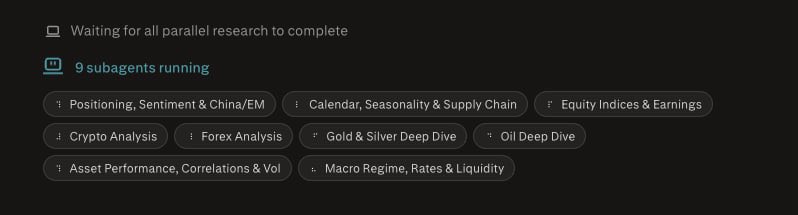
Perplexity Computer and agentic execution
Perplexity Computer as an autonomous task runner for multi-step work, cloud execution, subagents, scheduling, cross-device use, approvals, and auditability.
52%
Best tweets about Perplexity
Discover the best tweets about Perplexity AI, including search workflows, product launches, research techniques, and user comparisons. Updated weekly.
Practical Perplexity search and research workflows, meaningful product updates, and evidence-based comparisons.
Original Xholic analysis
The sampled conversation focuses most heavily on Perplexity Computer and agentic execution, alongside practical research workflows. Posts commonly recommend structured prompts, source checks, and specified deliverables; individual reports also flag local-browser reliability and news-freshness limitations.
82% of posts
All-time engagement
32% of posts
Published in 90 days
Conversation map
Perplexity Computer as an autonomous task runner for multi-step work, cloud execution, subagents, scheduling, cross-device use, approvals, and auditability.
52%
Computer, Personal Computer, Comet, mobile, Projects, Model Council, model routing, and Perplexity’s shift from answer engine toward workflow platform.
32%
Structured prompting, Deep Research, source selection, citation checks, multi-step research briefs, and workflows combining Perplexity with tools such as NotebookLM.
26%
Competitor analysis, industry briefs, market research, business plans, positioning, lead research, and voice-of-customer collection.
20%
Connections to Gmail, Slack, Notion, Drive, GitHub, Snowflake, CRM systems, and external market, financial, and enterprise data sources.
20%
Turning raw files into reports, building dashboards and presentations, creating landing pages and marketing assets, and generating polished exports.
18%
Investor workflows, filings and market analysis, finance-research prompts, financial-data partners, and Plaid-based personal finance analysis.
16%
Building and testing web apps with Computer, production deployment, the model-agnostic API platform, Agent API, and Search as Code.
12%
Tone and stance
Performance benchmark
Posts with media make up 84% of this collection. Their median all-time score is 8.93, compared with 9.68 for text-only posts.
Format mix
Consensus and debate
Shared view
Several practical posts recommend defining scope, context, source types, recency requirements, citations, and output format instead of using Perplexity as a generic search box.
Shared view
User posts describe Perplexity Computer handling multi-step work such as research, source gathering, organization, formatting, competitor analysis, and deliverable creation from an outcome-oriented prompt.
Shared view
Workflow guidance explicitly recommends requesting citations, opening important sources, verifying major claims, and avoiding vague prompts.
Shared view
Posts announce or describe access to market and financial data through PitchBook, Statista, CB Insights, Fiscal AI, Snowflake, and Plaid-linked financial accounts.
Open debate
One comparison calls Perplexity Computer the easiest of three agents for handing off cloud tasks, while also reporting unreliable local browser control. Separately, a user reported that Perplexity did not surface a news item that Claude and Gemini found.
Open debate
Plaid-based finance workflows are described as read-only. A related post advises users to limit initial sharing and not treat AI output as professional financial advice.
Open debate
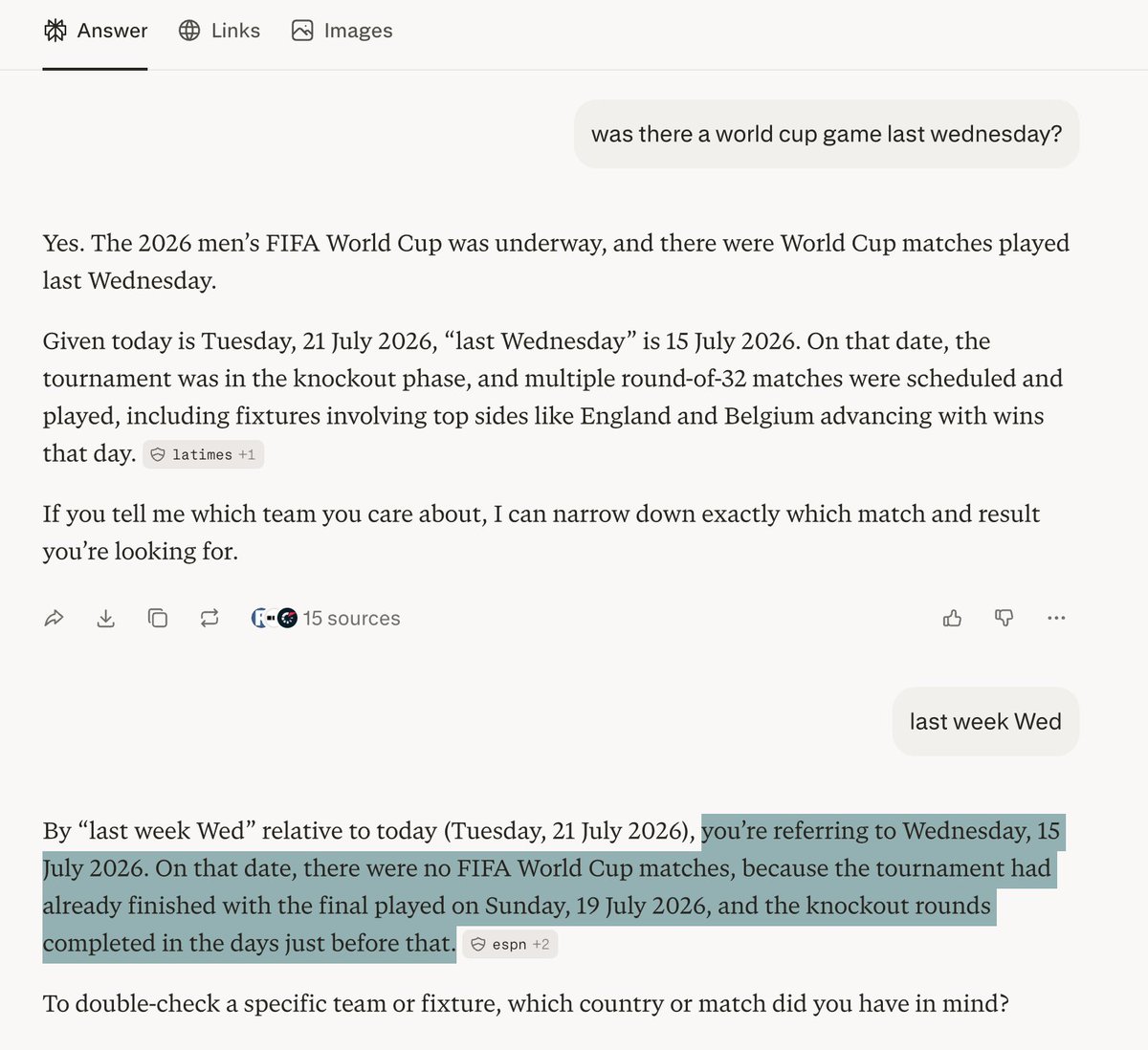
One critical post reports a hallucinated World Cup scheduling answer despite relevant search material, while research-workflow guidance recommends verifying consequential claims and citations.
Open debate
A post about the Amazon dispute says publishers argue that undisclosed agent activity can impair audience measurement; it also quotes Perplexity's position that its agents are more transparent and limited.
What performs
Tutorials had a median all-time score of 20.77, ahead of case studies at 8.922, announcements at 4.85, and opinions at 4.76.
Lists had a median all-time score of 106.461, but the format comprised only three posts. The cited examples include a finance-prompt collection and a multi-product release roundup.
The highest-scoring benchmark outlier was the Computer marketing-agent case study at 1,925.09. Posts about mobile Computer, Personal Computer, and the API platform also appear in the five benchmark outliers.
Media appeared in 42 posts (84% of the sample), with a median all-time score of 8.93, compared with 9.68 for text-only posts.
Statistical standouts
Creator landscape
The five most represented creators account for 20% of the selected posts.
1. Arsalan
@AIwithArsalan
2 posts
2. Computer
@AskPerplexity
2 posts
3. Dino
@dino11
2 posts
4. Ole Lehmann
@itsolelehmann
2 posts
5. Julian Goldie SEO
@JulianGoldieSEO
2 posts
6. Justin Thomas
@JustinThomasAI
2 posts
The Perplexity and Computer accounts posted updates on mobile Computer, the model-agnostic API platform, web-app testing, and a Computer marketing-agent case study. The mobile, API-platform, and marketing-agent posts are included among the benchmark outliers.
Examples include multi-angle Deep Research, an eight-prompt research system, a voice-of-customer quote-bank workflow, and turning an uploaded raw file into a structured DOCX report.
A comparison describes Perplexity Computer as cloud-based and integrated with services such as Gmail, Slack, and Notion, while identifying ecosystem dependence and unreliable local browser control. It contrasts these points with OpenClaw's self-hosted flexibility and Claude Cowork's local-file focus.
Since the previous snapshot
Themes, sentiment, stance, and post format are classified per tweet. All counts, shares, medians, creator concentration, freshness, and performance comparisons are then calculated directly from the published snapshot.
Xholic's all-time score compares engagement while accounting for reach, post age, and creator consistency. It is used for relative comparisons within this collection.
This report analyzes the exact 50-post snapshot shown below. AI identifies editorial categories and drafts explanations; all statistics are calculated from the snapshot, and every narrative claim is checked against cited posts before publication.
Best Perplexity tweets
Ranked 01–50

@AskPerplexity ·
Perplexity Computer replaced $225K/yr in marketing tools in a single weekend. We built an AI marketing agent that scans hourly, manages budgets, detects fatigue, and coordinates several campaigns end to end. In one test run, it made 224 micro-optimizations to our ad stack.
 Watch video

@perplexity_ai ·
Perplexity Computer is now on mobile. Start any task on any device. Manage Computer from your phone or desktop with cross-device synchronization. Available now for iOS in the Perplexity app. Coming soon to Android.
 Watch video

@AlexFinn ·
Potentially the biggest day in AI so far this year 3 major releases you need to be trying immediately: 🔶 Claude Opus 4.7 • More agentic model. Front load tasks and information, then let it rip for hours • Use auto mode to cut cycle time. Doesn't ask for permission constantly • Set up notifications so you can let it run for hours then come back when necessary 🔶 Codex super app update • OpenAI's answer to Claude Cowork (they couldn't drop this when I was doing my taxes yesterday?) • Codex now has computer use. It literally has its own mouse to click on things on your computer. Neat way to handle this • Fully integrated with more apps and services. For example, if you're building a game, you can have it generate assets using the chatgpt image model right in codex and place them in the code 🔶 Perplexity Personal Computer • Perplexity's answer to OpenClaw • Purpose built to control its own Mac Mini (altho can run on any Mac device) • Built with security in mind. Full audit trail for every action. Sensitive actions require approval. Kill switch can be used whenever • Full control over your computer, apps, imessage, and anything on it 3 huge updates. If you want an edge over your competition you need to be using these tools the moment they drop Time to take action

@jspeiser ·
I've been using all three AI agents. OpenClaw, Perplexity Computer, and Claude Cowork. Here's what I've found so far: OpenClaw is the most powerful if you're technical, love tinkering and have a ton of time to mess around. Open source, self-hosted, you pick your models. You can make it do basically anything. But you're also the one building and maintaining all of it (as its always breaking). Claude Cowork feels the most like having an actual coworker (for 1 specific task). It runs on your Mac, works with your local files, and the plugins for legal, finance, and HR are legit. Downside is it only uses Anthropic models and your laptop has to stay open. Perplexity Computer is the easiest one to actually get work done (imo) with tons of models running behind the scenes, plugs right into Gmail, Slack, Notion, and it runs in the cloud so it keeps going while you sleep. Tradeoff is you're living in their ecosystem. (oh and their local browser control needs major work, it's unreliable) so: Want full control? OpenClaw. Want a desktop co-pilot? Cowork. Want to hand off real tasks and walk away? Perplexity Computer. These tools are changing weekly though, im just trying to keep up. What did I miss?

@AravSrinivas ·
Perplexity Computer can now connect to to market research data from Pitchbook, Statista and CB Insights, everything that a VC or PE firm has access to. Enjoy!
 Watch video
@AskPerplexity ·
We just shipped several upgrades to building web apps with Perplexity Computer. New projects are now automatically tested using Playwright. It navigates your app like a real user to identify and fix bugs before you ever see them. Build, test, fix, ship. All in one place.
 Watch video

@EXM7777 ·
your workflow's biggest weakness is research... built-in web search on Claude, ChatGPT, Gemini... it's all surface level i got tired of this so i built a skill that fixes it: > reads the full conversation and project context > generates a research plan with multiple angles > fires parallel prompts through Perplexity's sonar deep research > processes all outputs and merges them into one clean markdown file i trigger it manually because not everything needs deep research... but when it does, the difference is night and day the whole is relatively cheap for the bump in quality you're getting
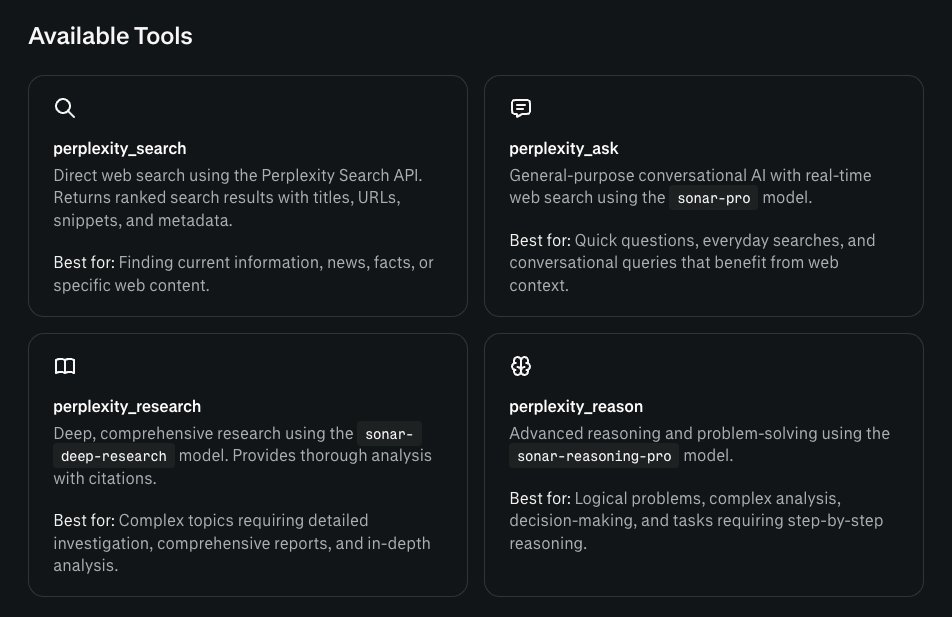

@shushant_l ·
I'm amazed most people still use AI search like a basic chatbot. Here's how to use Perplexity like a professional researcher with one complete guide. --- 1. Perplexity combines powerful AI models with live web search and source citations for accurate answers. --- 2. Use it for research, learning, coding, writing, SEO, market analysis, and business decisions. --- 3. Explore features like AI Search, Deep Research, Labs, Pages, Spaces, file uploads, and image generation. --- 4. The free plan includes AI search, live web search, citations, follow up questions, and basic file uploads. --- 5. The Pro plan unlocks premium AI models, Deep Research, Labs, larger uploads, and higher usage limits. --- 6. Deep Research searches multiple sources, compares viewpoints, verifies facts, and creates detailed reports. --- 7. Labs helps build reports, presentations, dashboards, spreadsheets, charts, code, and interactive content. --- 8. Spaces keeps research organized into separate workspaces for teams, businesses, students, and long term projects. --- 9. Pages turns your research into polished webpages, reports, tutorials, documentation, and knowledge bases. --- 10. Upload PDFs, DOCX, PPT, CSV files, and images to summarize, compare, and analyze documents. --- 11. Use a structured prompt with Role, Goal, Context, Requirements, and Output Format for better results. --- 12. Create research prompts that compare viewpoints, include citations, summarize findings, and generate recommendations. --- 13. Generate blogs, LinkedIn posts, X threads, newsletters, scripts, and FAQs with content prompts. --- 14. Build SEO content by researching search intent, keywords, FAQs, titles, and meta descriptions. --- 15. Improve coding by explaining code, finding bugs, optimizing performance, and increasing readability. --- 16. Learn faster by asking for beginner to advanced lessons, examples, quizzes, and summaries. --- 17. Analyze businesses with SWOT analysis, competitors, risks, opportunities, and future outlooks. --- 18. Always be specific, provide context, ask for citations, upload documents, and verify important facts. --- 19. Avoid vague prompts, ignoring citations, skipping source verification, and mixing unrelated questions. --- 20. Follow the complete workflow from AI Search to Deep Research, Labs, Pages, Export, and Share for maximum productivity. --- To learn more, check the infographic. ---


@Jack_Raines ·
Perplexity Computer lowkey cooks. I've dunked on them a lot for the "let's buy Chrome" and other social media shenanigans, but this thing rips. Been working on overhauling a personal website and needed to do a really tedious re-labeling of blog titles/dates. Claude could do it, Perplexity one-shotted it.

@Suryanshti777 ·
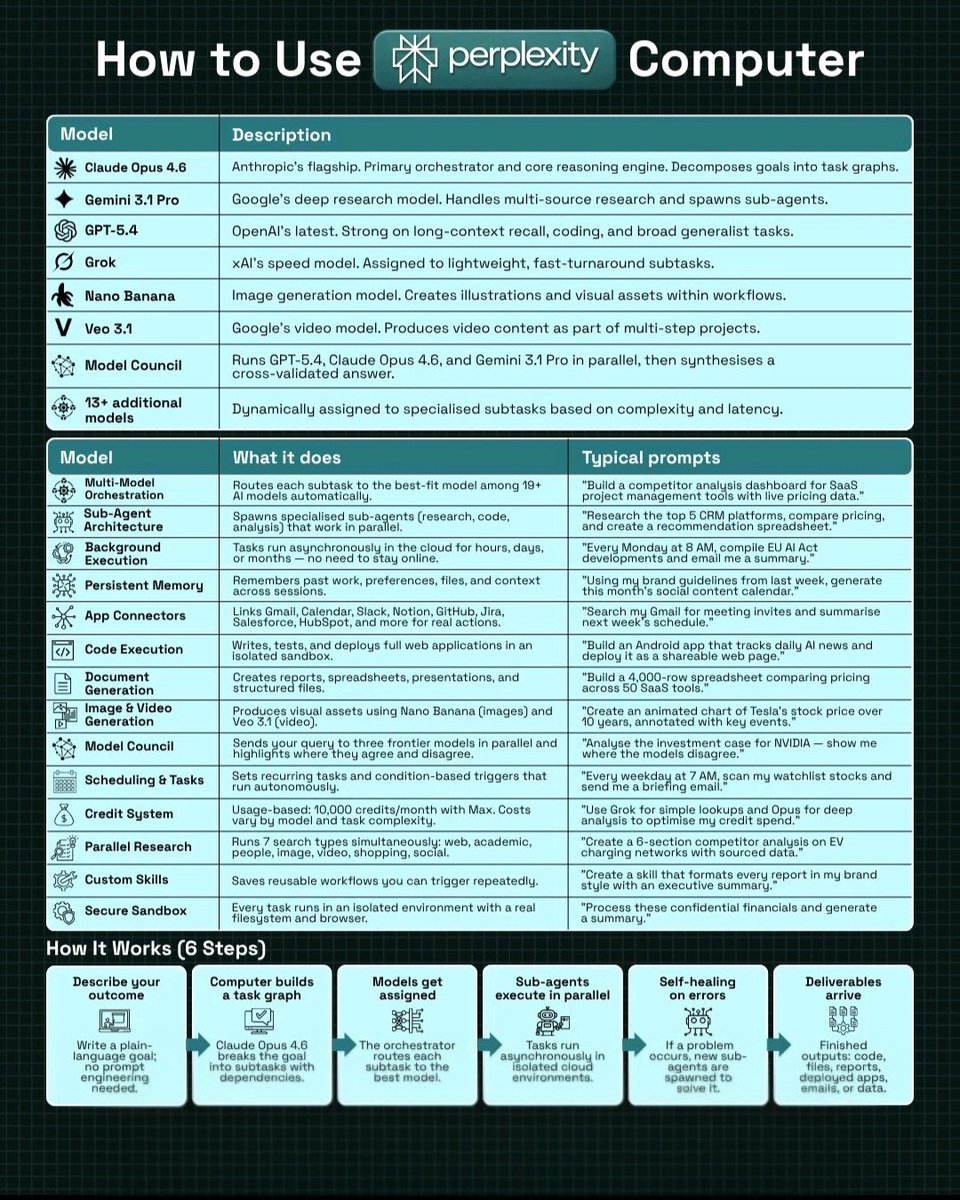
🚨 Perplexity just quietly launched something big. Not a chatbot. Not an agent. An AI computer. This changes how AI gets used every day. Here’s what “Perplexity Computer” actually does: • Routes tasks across multiple models automatically • Runs sub-agents in parallel • Executes code in a sandboxed environment • Connects to Gmail, Slack, Notion, Drive, GitHub • Remembers context across sessions • Schedules recurring autonomous tasks • Generates docs, dashboards, apps, and reports • Produces images + video inside workflows You don’t pick models anymore. You describe outcomes. It builds the workflow itself. Example prompts: → “Build a competitor dashboard for my SaaS” → “Research top 5 CRM platforms and compare pricing” → “Generate my weekly content calendar from trends” → “Track my watchlist and email me daily summary” → “Create a 4,000-word SEO page + publish” Behind the scenes: 1. Breaks goal into task graph 2. Assigns best model per task 3. Spawns sub-agents in parallel 4. Runs tools + code execution 5. Self-heals on errors 6. Ships final deliverables This is the important shift: Old AI → answers questions New AI → runs workflows Old AI → one prompt New AI → persistent system Old AI → chat interface New AI → operating layer We’re moving from: “Ask AI” to “Assign AI” Perplexity Computer is basically: Your AI analyst Your AI researcher Your AI developer Your AI automation engine Running 24/7. The interface didn’t change. The architecture did. And most people haven’t realized it yet.
@shushant_l ·
I'm amazed most people still use Perplexity like a basic search engine. Here's how to prompt Perplexity AI like a researcher to get dramatically better answers. --- 1. Perplexity is an AI answer engine that searches the live web and cites its sources. --- 2. Use it when you need current information backed by references. --- 3. Start every prompt with a clear action verb like summarize, compare, or analyze. --- 4. Always provide enough context instead of asking broad generic questions. --- 5. Add a specific timeframe to keep results relevant and up to date. --- 6. Tell Perplexity exactly how you want the output formatted. --- 7. Avoid vague prompts because they often produce vague answers. --- 8. Use Standard Search for quick factual lookups. --- 9. Use Pro Search for multi-step questions that need deeper reasoning. --- 10. Use Deep Research for reports, presentations, and comprehensive analysis. --- 11. Use Learn Mode when you're studying a completely new topic. --- 12. Use Model Council to compare answers from multiple AI models. --- 13. Choose the right source pool like Web, Academic, Reddit, YouTube, or SEC filings. --- 14. Add recency requirements whenever fresh information matters. --- 15. Ask Perplexity to challenge assumptions and present counterarguments. --- 16. Specify trusted source types such as peer-reviewed papers or official websites. --- 17. Request source verification for every major claim it makes. --- 18. Continue the conversation with follow-up questions to refine the answer. --- 19. Always open and verify important citations before trusting them. --- 20. Think like a researcher by defining the scope, evidence, and output before prompting. --- To learn more, check the infographic. ---


@techxutkarsh ·
Built and deployed a production-ready web app using Perplexity Computer with authentication, database, and a clean UI. What stood out wasn’t just speed, but how clearly the full system comes together: - Frontend for user experience - Backend for logic and APIs - Database for storage - Auth layer for security As it scales: - Traffic gets distributed - Services grow independently - Performance improves with caching If you’re exploring how real-world apps are built and scaled, you should try Perplexity Computer.
 Watch video

@harshitagu72595 ·
Perplexity Computer just did the kind of competitor research people waste half a day on. Pricing positioning messaging market signals All pulled into one usable output. This is where @perplexity_ai starts to feel genuinely useful. https://t.co/SSQ5kFR07o
 Watch video

@mhdfaran ·
Perplexity Computer is now running my entire research department 6 months ago I started with literally $0 team. Today one prompt gets me: → A full daily industry brief (top 5 updates) → Real-time competitor tracker table → 3 ready-to-use content ideas + investor update points All perfectly formatted and ready to forward. Cost: $20/month. Headcount saved: 3 people. This is how solopreneurs are actually winning in 2026.
 Watch video

@thisdudelikesAI ·
A kid from Chennai built the company that Google's CEO declared a Code Red emergency over, and he is 32 years old and still codes daily. His name is Aravind Srinivas. He runs Perplexity. Here is the story, because the version most people know is wrong on almost every detail. Aravind grew up in a vegetarian household in Chennai, the same city Sundar Pichai grew up in. He trained for the IIT entrance exam with his friends. They all got into computer science at IIT Madras. He missed the cutoff by a fraction of a percentage point and got placed in electrical engineering instead. He says he was depressed for a year and mostly hung out with his friends who got the seat he wanted. He stayed at IIT Madras and finished a dual BTech and MTech in electrical engineering. Then he flew to Berkeley for a PhD in computer science. He published heavily on reinforcement learning, contrastive learning, and transformers. He worked on the Decision Transformer paper. He built VideoGPT. He interned at DeepMind in London. While he was there he read a book called "In the Plex" about Google's first 15 years. The book changed something. He decided he wanted to build a company that could one day stand next to the one Pichai built. He went to OpenAI as a research scientist. He contributed to DALL-E 2. He worked at Google. Then in August 2022, four months before ChatGPT launched, he co-founded Perplexity in a small apartment with Denis Yarats from Meta FAIR and Andy Konwinski, a co-founder of Databricks. He built the first prototype over a single weekend. The idea was simple. Search engines force you to read 10 blue links and figure out the answer yourself. Aravind hated that. He wanted a search engine that gave you the actual answer with citations underneath, like a research assistant that did the reading for you. Jeff Bezos invested in the seed round. Nat Friedman invested. Susan Wojcicki invested. They had $3 million and a small team. In December 2022 ChatGPT launched. Three weeks later Sundar Pichai declared a Code Red inside Google. Internal memos called AI search an existential threat to the company. Pichai personally called founders back to work on Google's response. The man Aravind had grown up idolizing was now panicking about the exact category Aravind had just started a company in. Perplexity grew faster than anyone expected. The product worked. Researchers used it. Investors used it. Journalists used it. By November 2024 the company was valued at $9 billion. By March 2025 it was raising at $18 billion. SoftBank led the round. Aravind became famous for not behaving like other CEOs. He answered DMs on X personally. He posted product ideas at 2 in the morning. He pushed code into production. He fought publicly with Google and OpenAI and called Sam Altman a competitor on stage. He went on every podcast that asked. Perplexity has now shipped its own browser called Comet. It has shipped an agent called Computer that can take actions across the web for you. It has signed enterprise deals with Snowflake and runs in dozens of Fortune 500 companies. India is now its largest user base. The kid who could not get into computer science at the college he wanted, who spent a year of his life depressed about it, built a company that now competes head-on with the search giant founded by the most famous engineer from his hometown. Aravind still works seven days a week. He still posts code commits. He still answers his own customer support tickets sometimes. He runs a company worth more than the entire market cap of most public tech firms, from an office where he claims he is in by 9 in the morning every single day. A failed entrance exam in Chennai became the most credible threat to Google Search in 25 years.

@itsolelehmann ·
your audience already wrote your best marketing material, you just haven’t collected it yet i built a "voice-of-customer" workflow that makes all of my writing sound EXACTLY like my audience's thoughts which means more engagement, more followers, more sales… because people buy from people who understand them hormozi says it all the time: "he who is closest to the customer wins." this is how you get close. you stop guessing at what your audience is thinking and feeling and start reflecting their exact words and psychology back to them. it's one prompt in perplexity computer. gives you 50+ quotes from real people, organized by pain point theme so Claude can draw upon their exact phrases every time it writes for you here's how to set it up: 1. open perplexity computer (i use this because it's a search task at scale. perplexity computer is built on search infrastructure. we need to crawl across reddit, g2, trustpilot, product hunt, and indie hackers at once and pull exact quotes from hundreds of real threads, this is what it was literally designed for) 2. paste this prompt (swap in your own audience and topic): —— "I need you to build a voice-of-customer quote bank with 50+ real quotes from real people, organized by pain point theme. The pain points I'm looking for: what [YOUR AUDIENCE, ex: solopreneurs, founders, online business owners] are struggling with, frustrated by, excited about, or wishing for when it comes to [YOUR TOPIC, ex: using AI to run and market their businesses]. Search across Reddit, Product Hunt, G2, Capterra, Trustpilot, Indie Hackers, and any relevant communities. Read full reviews, threads, and comments, not summaries. I need the actual words people use, not your summary of what they said. Build the quote bank organized by pain point theme. Each theme should have a short label (2-5 words) and 15-25 quotes under it. Just the quotes, nothing else. Prioritize quotes that are specific, emotional, vivid, and sound like a real person talking. Skip anything that reads like a formal review or press release. I want the raw, unfiltered way people actually describe these problems. Include a separate section for breakthrough moments and wins. Quotes where people describe something that actually worked, a genuine shift, or a result that surprised them. And a final section that's just recurring phrases and slang this audience uses to describe their problems, grouped by theme. No full quotes needed, just the expressions themselves. Find at least 10 distinct pain point themes. Go deep rather than broad. I'd rather have 8 great quotes per theme than 2 quotes across 30 themes. Only include real quotes you can verify. Don't fabricate or paraphrase." —— 3. let perplexity cook. takes about 10 minutes 4. save the output as a context file in whatever ai tool you use most (perplexity, claude, chatgpt, whatever) 5. add one instruction to your writing setup: "reference the voice-of-customer file and use the audience's exact language for hooks, pain points, and framing" now every time you write, your ai pulls from how your audience actually talks instead of how you think they talk (honestly it feels like cheating) run it again every quarter to keep it fresh


@Freyabuilds ·
Competitor research always sounds easy until you’re 20 minutes in, drowning in tabs and screenshots. I tried running the whole thing inside Perplexity Computer instead. In this video I’m pulling a bunch of competitor pages into one workspace, asking it to surface the positioning, and then cleaning up the overlaps so I can actually see who’s saying what. It still takes some thinking on my side, but having the sources, summaries and my own notes in one place makes reviewing everything way less painful.
 Watch video

@AITechEchoes ·
Been testing Perplexity Computer for a few days now and something clicked. Gave it a multi-step AI research task that normally eats up my entire morning - jumping between ChatGPT for drafts, Perplexity for sources, Notion for organizing, and then manually formatting everything into something presentable. This time I just described what I needed in one prompt. It broke the task into steps on its own, pulled real sources, organized the findings, and gave me a clean final output I could actually use no copy-pasting between tabs, no reformatting, no babysitting the process. Honestly didn't expect it to connect the steps on its own. I just described the end result and it figured out the order. That's the part I can't stop thinking about.
 Watch video

@TechByMarkandey ·
I just experimented with Perplexity Computer and it blew my mind. With a single prompt, I was able to generate a complete business plan including: - Executive Summary - Market Analysis - Go-to-Market Strategy - Financial Projections - Team Overview And the best part? It was instantly exportable as a shareable PDF. The potential here is huge. Tools like this aren’t just speeding up work they’re transforming how we create, plan, and execute ideas. It makes me wonder: what will the future of business planning look like when AI can handle the heavy lifting in minutes?
 Watch video

@AIwithArsalan ·
I tried Perplexity Computer on a messy TXT file today and this was one of the more practical use cases so far. Instead of leaving me with a wall of raw text, it helped turn it into a structured DOCX report with a clear title, cleaner structure, and more organized sections. 1. Upload a raw file (CSV, PDF, DOCX, TXT) 2. Give it a simple prompt 3. And get an organised docx. file Perfect for reports, pitch decks, and client presentations. That’s the part I liked. It felt less like AI just rewriting text and more like turning rough work into something actually presentable.
 Watch video

@jddeep003 ·
An ex-colleague of mine was laid off last month. I sat with him a couple of weeks back over a weekend. No cold DMs. No premium LinkedIn. No recruiter spamming. We used one tool: Perplexity Computer. This new AI agent doesn’t just search - it researches, tailors, writes, and prepares your entire job hunt end-to-end from a single prompt. Result: 3 tech interviews in 10 days - including calls from one unicorn and one FAANG-level company. Here are the exact 6 ways we used Perplexity Computer (copy-paste prompts included)👇


@JustinThomasAI ·
I have no idea why more people do not talk about Perplexity. It is by far my favorite daily AI. One cool feature of many: When you have the app on your phone, you get news article notifications for topics you actually care about straight to your lock screen. Just clean, sourced news delivered like a smart assistant who knows what you want to read. The Discover section inside the app is even better. Hand-picked stories based on your history, AI-summarized, with full sources. No other AI has built anything close to this.


@AIwithArsalan ·
I tried Perplexity Computer on a full landing page workflow today, and this is where it started clicking for me. I wasn’t just using it for a headline or a few quick lines. I pushed it to help shape the whole page, different headline directions, hero copy, benefits, features, FAQs, CTA variations, even A/B test ideas. That’s what made it feel useful. It didn’t feel like random AI copy pasted onto a page. It felt more like getting to the full message and structure much faster. Most people are still using AI to chat. Perplexity Computer gets a lot more interesting when you use it to actually do the work.
 Watch video
@alvinfoo ·
Which LLM should you use? Quick guide to ChatGPT, Grok, Gemini, Claude, and Perplexity and when to pick each. We’re spoiled for choice with powerful large language models. Rather than “which is best,” the more useful question is: “Which is right for this job?” Here’s a simple breakdown: - ChatGPT (OpenAI) — Best for creative content, coding, and everyday productivity. - Use for: blog drafts, marketing copy, brainstorming, code generation and debugging, study guides, and building custom GPTs for workflows. - Strengths: multimodal inputs, strong creativity, reliable general-purpose assistant. - Pro tip: Automate routine writing and coding tasks with ChatGPT and custom GPTs. - Grok (X) — Best for real-time trends, pop culture, and social-first content. - Use for: tracking trending topics, quick social summaries, punchy conversational posts. - Strengths: real-time social context, fast reactions, witty tone — great for creators and community managers. - Pro tip: Use Grok to craft viral posts and timely social commentary. - Gemini (Google) — Best for Google Workspace integration and real-time data in business workflows. - Use for: planning in Docs/Sheets/Slides, collaborative editing, research that benefits from up-to-date search and Drive integration. - Strengths: deep Google app integration, strong structured-workflow support. - Pro tip: Use Gemini to streamline teamwork across Gmail, Drive, and Docs. - Claude (Anthropic) — Best for deep reading, long-form comprehension, and nuanced reasoning. - Use for: reviewing long contracts/reports, legal or research summaries, policy writing, and tasks that need careful, cautious outputs. - Strengths: excellent handling of lengthy documents, safety-first design, balanced tone for complex texts. - Pro tip: Use Claude for sensitive, high-stakes writing where nuance and precision matter. - Perplexity — Best for verified research, fact-checking, and concise, source-cited answers. - Use for: finding accurate data with citations, researching niche or academic topics, and quick summaries with references. - Strengths: transparency, citation-first results, fast reliable answers for research-oriented tasks. - Pro tip: Use Perplexity when verifiable sources and accuracy are top priorities. Bottom line: match the model to the task - Need creativity and productivity? ChatGPT. - Need social traction and trends? Grok. - Need deep Workspace integration? Gemini. - Need careful, long-form reasoning? Claude. - Need verifiable research with sources? Perplexity. Which combo is working for your team today? I’d love to hear practical use cases, share what’s worked (or failed) for you.


@DAIEvolutionHub ·
🚨 BREAKING: Perplexity just made its biggest shift yet And almost no one noticed. In the last few weeks, they didn’t just ship features… They changed what the product is 👇 This is no longer “AI search” It’s becoming an AI system. Here’s what quietly dropped: • “Computer” → it doesn’t just answer, it does tasks • Comet → rethinking the browser from scratch • iOS app → tighter, faster workflows • Model switching → multiple AIs in one place • Connectors → finally useful (real work gets done) • Samsung deal (Korea) → massive distribution unlocked And now… they’re moving into health + wearables 👀 Most people missed the bigger shift: Search engine ❌ Answer engine ❌ Action engine ✅ Perplexity is starting to compete with your entire workflow Not Google. Not ChatGPT. Your daily system. And the craziest part? Most users are still using it like it’s just “search with sources” This is how products quietly take over. Which update actually changed your workflow?


@JustAnotherPM ·
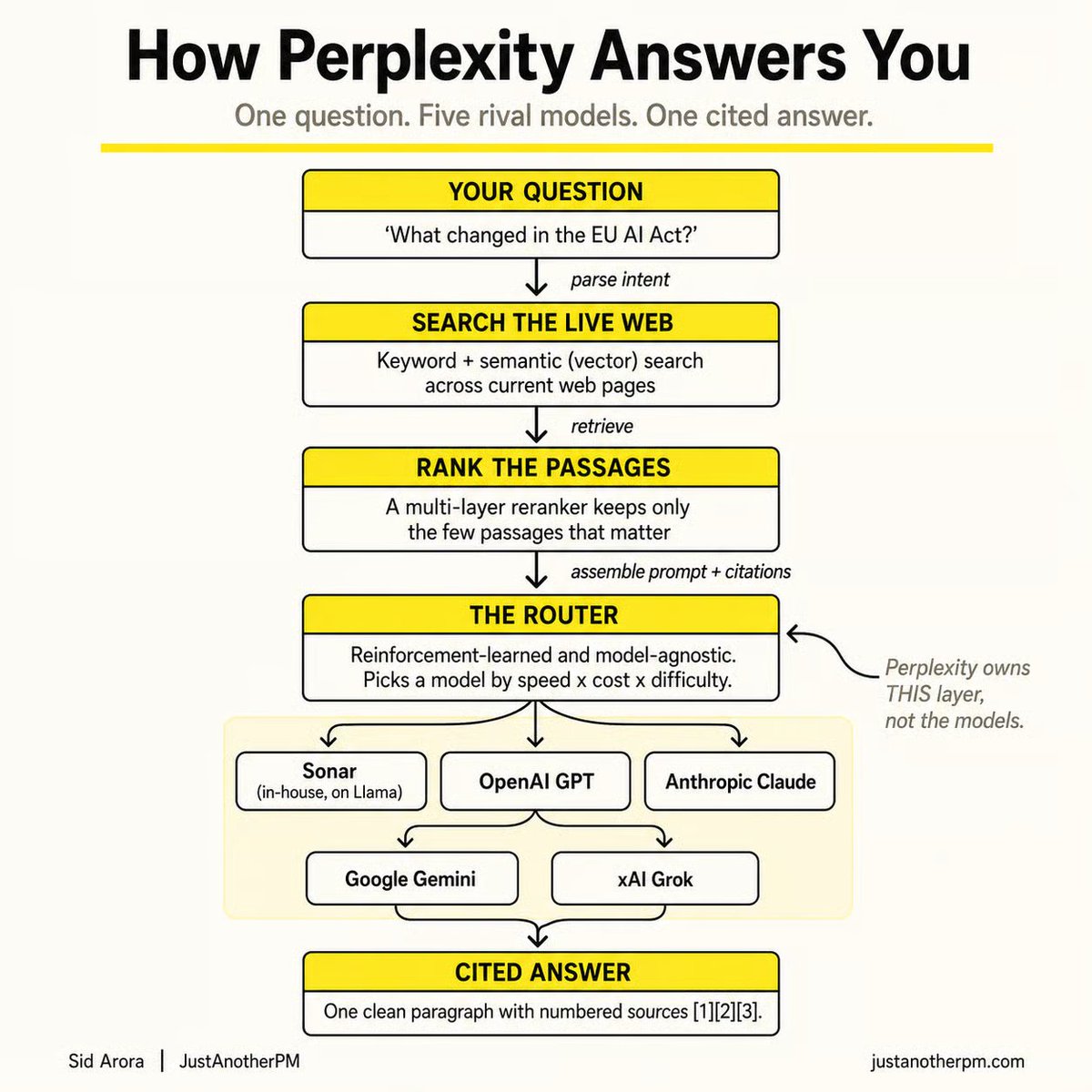
Perplexity is worth $22.6 billion. It doesn't even own a single AI model. Here's what makes it so powerful When you type a question into Perplexity, five things happen in about a second: 1. It parses your intent to figure out what you're actually asking. 2. It does live web searches using both keyword and semantic search. 3. It reranks the results by relevance. 4. It assembles the most relevant information into a prompt with citations. 5. It gives that prompt to an LLM, which is bound to answer by using the evidence it was given. But here's the part most people miss. 𝗣𝗲𝗿𝗽𝗹𝗲𝘅𝗶𝘁𝘆 𝗱𝗼𝗲𝘀𝗻'𝘁 𝗽𝗶𝗰𝗸 𝗼𝗻𝗲 𝗺𝗼𝗱𝗲𝗹. It routes your question to whichever model fits best. A "model-agnostic router" trained with reinforcement learning looks at speed, cost, and difficulty, then decides whether your question goes to GPT, Claude, Gemini, Grok, or their own in-house Sonar models built on Llama. Easy questions get the cheap fast model. Hard questions get the frontier model. Their newest feature, Model Council, takes it further. Multiple models answer the same question, and a synthesiser reconciles them into one response. This is the strategy that matters: Perplexity owns neither the models nor the content. Every time OpenAI or Anthropic or Google ships a faster, cheaper, smarter model, Perplexity's product improves for free. They are arbitraging a war between giants. The lesson I keep coming back to: you don't have to own the hardest layer. You have to own the layer that gets more valuable as the rest of the stack commoditises. Which layer are you building on? I wrote a detailed piece on Perplexity (linked below)

@HeyZaraKhan ·
🚨BREAKING: Perplexity AI just turned into a full personal finance OS. Users can now connect Perplexity Computer with Plaid (the world’s largest financial data network). This is like a complete financial picture in one place. Here’s what this means for everyone: → Full financial visibility: Connect bank accounts, credit cards, loans, and investments in one place. → Real-time net worth tracking: Auto-calculates and updates across all linked accounts → AI-powered spending analysis: Tracks every transaction and categorizes spending instantly → Custom dashboards: Ask it “Build my monthly budget” → it creates it live → Debt payoff planner: Analyzes interest rates + balances → gives a payoff strategy → Retirement intelligence: Tracks your progress based on income, age, and investments → Cash flow forecasting: Predicts low-balance weeks before they happen → Ask anything about your money: No dashboards needed, just ask questions in plain English → Institution-grade data: Powered by sources like Nasdaq, S&P Global, and U.S. Securities and Exchange Commission → Secure by design: Read-only access. Your financial data never touches Perplexity servers I hope you found this informative and helpful for more you can follow me @HeyZaraKhan

@Suryanshti777 ·
🚨Breaking: Perplexity AI just introduced Perplexity Computer — and it flips AI from answers → execution. This isn’t a chatbot. It’s a job runner. Developers already had this with autonomous agents. Now non-developers can do it from a browser. The shift is simple but massive: Wrong way: “What are risks in this contract?” New way: “Review this contract, fact-check claims, flag risks, add tracked changes, export Word doc.” Same input. Completely different outcome. People are already using it to: • clean messy CSVs automatically • build dashboards from raw data • audit competitor content • research leads and send emails • review legal contracts • generate weekly reports on schedule One user automated a Monday task: 90 minutes of spreadsheet cleaning → 4 minutes Then scheduled it to run every week. Without opening their laptop. Another example: Find companies advertising on competitor podcasts → identify decision makers → write personalized emails → send them automatically No prompting. No babysitting. Just delegation. This changes the skill entirely: Old skill → writing prompts New skill → describing outputs The people who learn this early will have a massive advantage. Because AI isn’t just assisting anymore. It’s doing the work.


@CodeByPoonam ·
🚨Perplexity now knows your bank balance, credit cards, loans, and investment portfolio. Perplexity Computer now connects with Plaid. You can link accounts, track spending, build budgets, and ask questions about your actual finances.
 Watch video

@teja2495 ·
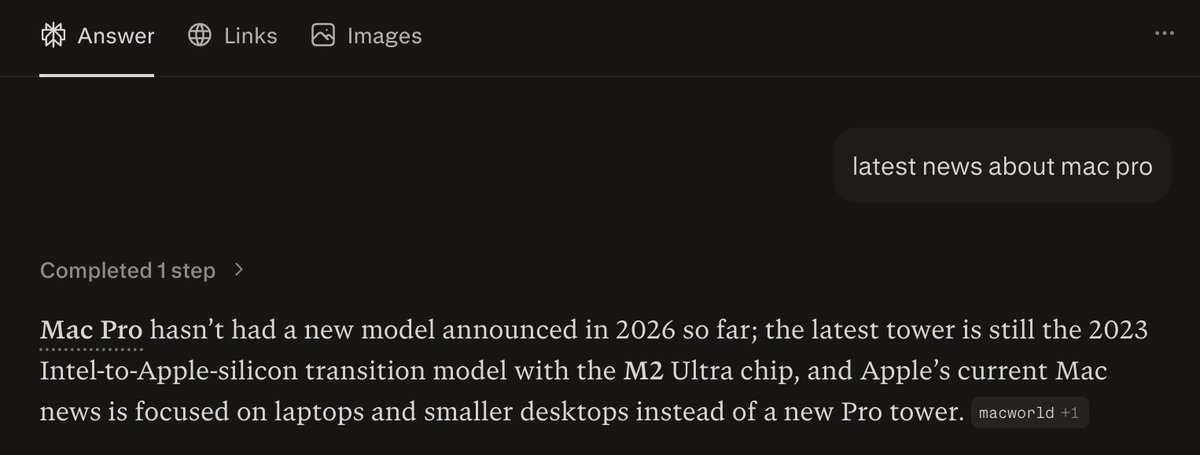
After I saw the news about Mac Pro being discontinued on X, I immediately searched for the news on ChatGPT, Perplexity, Claude and Gemini to see which one has the latest news. Claude and Gemini were able to get the latest news about it being dead, but ChatGPT and Perplexity did not know about this news yet. I'm actually surprised that Perplexity is slower in fetching latest news.



@DivyanshT91162 ·
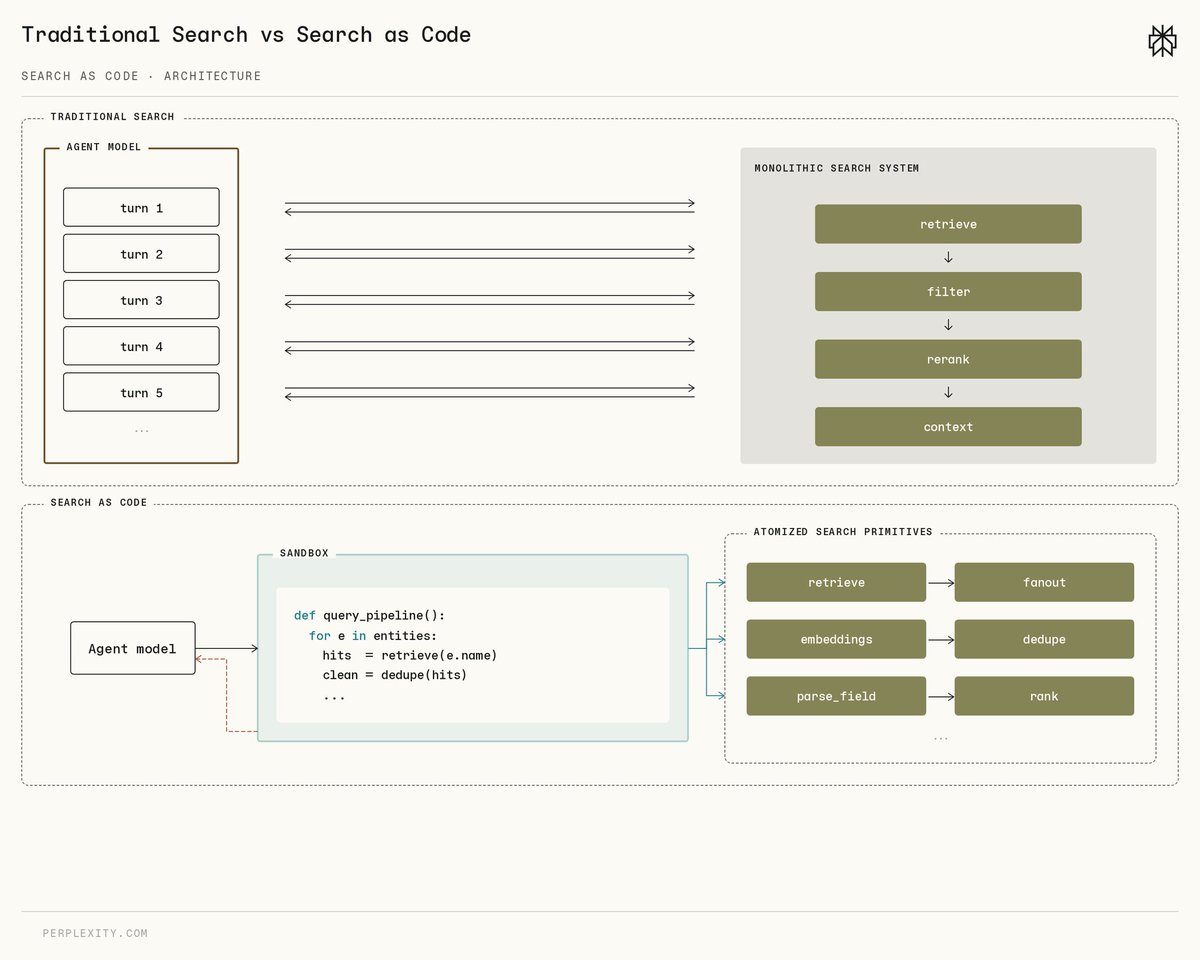
Most AI agents still search the web like this: Search → Read → Search Again → Read Again Perplexity just said: "why not write code instead?" Their new Search as Code architecture generates Python that directly calls the search stack, reducing the need for endless tool-calling loops. Now available in the Perplexity Agent API and already powering Computer by default. This feels like another step toward agents that execute workflows, not just chat. Full breakdown 👇

@Nas_tech_AI ·
Perplexity Computer is a strong example of where AI gets practical: research the problem pull live info cite the sources structure the output move the task forward That is the kind of execution I want to see more of from @perplexity_ai. https://t.co/jpuQXolwu1
 Watch video

@shawnchauhan1 ·
Perplexity doubled revenue in a single quarter. The unlock wasn't better answers. It was launching "Computer" - a tool that completes tasks instead of answering questions. This is the most important distinction in AI right now and almost no one is talking about it clearly. Question-answering is a feature. Task completion is a product. Every AI company still framing itself as "a better search" or "a smarter assistant" is competing in the wrong category. The monetization gap between information retrieval and autonomous execution is not small. Perplexity just showed you how large it actually is.


@dino11 ·
Perplexity launched "Model Council" — a feature that runs your query through GPT-5.2 and Claude 4.6 simultaneously and lets you compare the outputs side by side. This is how you should be evaluating AI tools for your business: Never trust one model's answer. Run the same prompt through 2-3 models. Compare. The differences will shock you. Especially for customer-facing content where accuracy matters. Free on Perplexity Pro.
@dino11 ·
Perplexity just launched "Personal Computer" — an always-on AI agent running on a $599 Mac mini. It connects to your local files, apps, and Perplexity's cloud. Runs 24/7. → Requires Perplexity Max ($200/mo) → All actions require user confirmation (safer than OpenClaw) → Built-in audit trail Enterprise version completed 3.25 years of work in 4 weeks during beta. This is the "AI employee" concept getting real hardware.

@glenngabe ·
Based on AI agents cloaked as human users, which threatens ad revenue -> US publishers back Amazon in AI agent access dispute with Perplexity "Perplexity is now appealing that decision. It has argued that its AI agents are “much more transparent and limited” than Amazon’s own use of agentic AI to complete transactions on third-party retailer sites." "Amazon alleges that Perplexity has “purposely configured” Comet AI so that when the AI tool is deployed on behalf of an Amazon customer, “Perplexity falsely identifies its Comet AI agent activity as coming from Google Chrome, which is a separate, widely used web browser owned by Google. As a result, Perplexity’s Comet AI agent covertly poses as a human customer shopping in the Amazon Store on a Google Chrome browser.” “If publishers cannot distinguish between an AI agent and a human subscriber, they will not be able to measure audiences accurately.” https://t.co/5zFEGgKBcM

@Tegadesigns ·
🔧 Breaking: Perplexity Computer Just Got Bank & Investment Access A new feature just launched. Here is everything you need to know about it as a founder, creator, and professional : 🔹 What it’s used for → Perplexity’s Computer (the smart AI agent) now safely connects to your real bank accounts, credit cards, loans, and investments using Plaid. Plaid is the same secure system used by many popular finance apps, Venmo, Cashapp, etc. Once linked, you talk to it in normal English. Examples: “Show me my spending on eating out last month,” “Build me a plan to pay off my debt faster,” or “What is my full net worth right now?” It pulls all your data together and creates custom charts, budgets, debt plans, or retirement forecasts using your actual numbers. 🔹 How to implement it → It is live now on desktop for signed-in users in the US and Canada. Any signed-in user can link accounts safely with Plaid. Just sign in, connect your accounts, and start asking questions. Basic linking works for everyone. 🔹 Note : It is read-only, it can look at your data but never spend or move money. Your data never gets stored on Perplexity’s main servers. 🔹 Risks to know → - You are giving an AI access to very personal financial data, even if it is read-only and uses secure Plaid connections. - Always review what you share and consider starting with only one or two accounts to test. Never treat AI advice as professional financial advice, double-check important decisions with a real advisor. Follow and put on notifications 🔔 if you want to stay ahead on the latest tech and AI tools breakdowns.


@JulianGoldieSEO ·
Want to use Perplexity Computer with Snowflake? Start here: 1. Open connector settings. 2. Add the Snowflake integration. 3. Set up service account access. 4. Use key pair authentication. 5. Trigger data map generation. 6. Let it learn your schema. 7. Ask business questions in plain English. That’s how you turn Snowflake into an AI-powered analyst. Save this video, you’ll know how to connect Perplexity to your data.
 Watch video
@JulianGoldieSEO ·
Perplexity just killed the "one-person AI" era. This update quietly turns AI from a chatbot into your team's operating system. What's New: → Projects gives your entire team one shared workspace. → Files, memory, and AI sessions now live in one hub. → Everyone works from the same context instead of starting from scratch. Why It Matters: ✓ Built on Perplexity Brain's living context graph. ✓ Perplexity says repeat tasks became 25% more accurate, wasted searching dropped 16%, and repeat task costs fell 13%. ✓ Connect Slack, Salesforce, HubSpot, and Snowflake once, then everyone in the hub can use the same connections. The Catch: ✔ Shared memory also means shared mistakes. ✔ Someone should review and correct team memory early so the system improves over time. The next generation of AI isn't one smarter chatbot. It's one shared brain for your entire business.
 Watch video
Best Tweets by Topic