

Aaron Levie (@levie) X analytics
@levie
ceo @box - your business lives in content. unleash it with AI
@levie has 3.5M followers, a median of 77.8K views per post and a 0.36% engagement rate.
Based on 30 recent original posts (high confidence). Updated November 17, 2026.
At a glance
Key stats
- Followers
- 3.5M3,522,780 followers on November 17, 2026−6.9K in 30 days
- Median views per post
- 77.8K
- Average views per post
- 316.5K
- Engagement rate (by views)
- 0.36%
- Original posts per week
- 6.8
- Average engagements per post
- 1,130
Engagement grade
Developing
This is near the lower benchmark range for accounts with 1M+ followers.
Profile score
76/100
- Profile completeness100
- Audience shape100
- Engagement25
- Consistency100
- Positioning clarity55
Monetization
Estimated X creator earnings
$928–$2,321 in the last 30 days
From 9.3M views on @levie's original posts in the last 30 days.
Rewards eligibility: likely
Rough estimate. X publishes no payout rate, so this assumes about $100–250 per 1M original-post impressions, based on real creator payouts. Payouts vary with how many of your viewers have Premium.
Free report
How does your account compare with @levie?
Get the same report for your own account by email: engagement grade, median views, best times to post and estimated earnings.
Growth
Follower growth
−6.9K in the last 30 days. Tracked by Xholic since October 7, 2026.
| Date | Followers | Change |
|---|---|---|
| Nov 17, 2026 | 3,522,780 | −232 |
| Nov 16, 2026 | 3,523,012 | −144 |
| Nov 15, 2026 | 3,523,156 | −1,104 |
| Nov 11, 2026 | 3,524,260 | −670 |
| Nov 7, 2026 | 3,524,930 | −791 |
| Nov 6, 2026 | 3,525,721 | +246 |
| Nov 5, 2026 | 3,525,475 | −202 |
Timing
Best times to post
When @levie's recent posts performed best (UTC).
- #1 slot
8:18 PM
Monday · UTC
- #2 slot
8:12 PM
Tuesday · UTC
- #3 slot
8:23 PM
Wednesday · UTC
What worked
Top recent posts
- 01

@levie ·
It’s almost incomprehensible how wide the distance is between someone who’s working at the frontier with AI and basically everyone else right now. The crazy thing is these lines are not converging, but only growing farther apart. If the curve of AI progress had leveled off, it would certainly have given most people and companies time to catch up or implement their workflows in a standardized way. The technology would have neutralized competitive advantage because everyone would be using it the same way. But what’s happened is the opposite. The curve of AI progress is basically going vertical right now, which means if you had codified your processes 3-6 months ago you’re likely already behind again. Now imagine most companies that kicked into gear a year ago and thought that they were done. Even further behind now. I’ve never seen a technology in my life and career that improves at this rate, which consequently means you need to upgrade your expectations at a similar rate. Our brains weren’t wired for this, and our organizational change management processes certainly weren’t either. With any form of recursive self improvement, things just get wilder. It’s a time when you will need to be constantly reevaluating the things that didn’t work just a couple months ago to see if they now can be solved. AI native companies certainly have a strong advantage due to this right now, so now it comes down to can the bigger companies keep up. Wild times.
- 876Replies
- 1.2KReposts
- 9.8KLikes
- 3.2MViews
10.8x average engagementText onlyLong post (over 200 characters)Posted Fri 04:00 UTC - 02
@levie ·
This is one of the better litmus tests for whether you’re pushing your use of AI enough or not. Up until maybe six months ago probably the best you could do with AI was pull off something you already would produce, but just doing it a little faster. But now we’re entering a point where the output of working with AI can and should dramatically exceed what you would been able to do before, in a fraction of the time. The product prototype should not only be fully functional and interactive, but it should probably have meaningfully better features than it would have had before. The engineering architecture should be able to deliver performance gains that you wouldn’t have been able to go after otherwise. The research for a project should consume every single fact on the subject across every dimension of analysis possible. The business process you implement with AI should operate entirely differently and learn from all its past failures in a way no human could. We’re unquestionably entering a period where AI will be smarter than us on most axes. Perhaps not on every dimension that matters (intelligence is still very jagged), but at least on enough dimensions that when we combine it with what we’re good at, you get qualitatively different outcomes. So the simple test is: if you could have done what you’re doing before AI, you’re likely not pushing it enough.
- 172Replies
- 78Reposts
- 1KLikes
- 113.4KViews
1.6x average engagementText onlyLong post (over 200 characters)Posted Sat 22:00 UTCQuote post - 03
@levie ·
This is correct. The vast majority of enterprise workflows have not actually had agents applied to them in any meaningful way. The economy probably has this deployed < 1% right now. At best you have a few automated systems in a company that do a single pass of an LLM to make a decision or provide feedback, but very little real “automation”. Some of this is a statement about the adoption rates of technology in enterprises, but the vast majority of it is really just due to the capability of AI itself. That’s all changing. Now with computer use, long running agents, harness improvements and surrounding infrastructure, we’re finally at a point where we can start to apply agents at more complex workflows. We will see self-improving systems that can take any particular workflow goal and improve the execution rates over a volume of instances. And with the emerging form factor of agent swarms, you can just choose to deploy any amount of compute at a problem and agents will off and do the work. This won’t be about and users prompting agents to complete a specific task for them, but instead the organization reengineering the underlying workflows to take advantage of agents in their processes. This will have a massive impact in finance, life sciences, healthcare, and other information-heavy domains. Lots of opportunity to build and deploy these systems right now.
- 254Replies
- 84Reposts
- 1.1KLikes
- 120.4KViews
1.5x average engagementText onlyLong post (over 200 characters)Posted Wed 04:00 UTCQuote post - 04
@levie ·
The biggest misread of anyone predicting the end of software engineering was imagining that the world only needed a certain amount of software, and bringing automation to the field would reduce the need for labor. Exactly the opposite is happening where essentially most things are actually turning into software. Because agents can use tools, work with computers, write software on the fly, and process data like humans (but far faster), we can now throw “software” at problems that never could reasonably be digitized before. What that leads to is the role of engineering taking on greater importance in the economy, because we can now engineer far more systems and processes than were possible before. If you’re a bank trying to do new forms of trading, engineers are often your first bet. If you are in life sciences, you expect more and more research and lab work to be engineering centric. If you’re in manufacturing, you’re trying to automate more of the supply chain, all that is engineering. More and more work is shaped like software problems. Yes we’re not going to be coding manually in the future. But almost everything will be code, which means those that understand it are in a fantastic position.
- 158Replies
- 130Reposts
- 1.1KLikes
- 128.1KViews
1.3x average engagementText onlyLong post (over 200 characters)Posted Sat 18:00 UTCQuote post - 05
@levie ·
Increasingly this will be the new job description for a lot of roles, not just coding. We’re clearly moving from a world where agents help us do our work incrementally better or faster, to us helping agents do their work. This turns everyone in one of these positions to that of a manager of a team of agents, instead of an individual contributor with just some added leverage from AI. The biggest areas of impact will be information-heavy jobs, like coding, cybersecurity, legal work, biotech, engineering, and many other fields. And as a result, in these jobs your leverage will begin to be decoupled from the normal ratio of hours spent working to output generated. For essentially the history of knowledge work the main variable you had to play with was hours of work done (assuming fixed level talent/coordination/strategy). Now we’ve separated these variables because agents can parallelize work for us, to in theory execute as much as we need to pull off whatever goal we’re trying to accomplish. The people and organizations that discover this sooner, and orient their operations around it, will see compounding gains in their workflows.
- 254Replies
- 66Reposts
- 701Likes
- 109.8KViews
1.2x average engagementText onlyLong post (over 200 characters)Posted Mon 06:00 UTCQuote post - 06
@levie ·
This sounds extreme and I wouldn’t have believed it even a year ago, but we’re starting to see plenty of examples of productivity gains that are an order of magnitude or two above output levels pre-AI. With the right harness, a deep understanding of your domain of what you want to build, likely a relatively new codebase (with some exceptions), a fluency of how to work with multiple agents at once, and a setup that makes it so you can test and deploy with limited friction, outputs on this level feel realistic in coding. What’s crazy is this gap doesn’t appear to be diminishing over time. You’d think that we’d see a convergence in the lines because of AI, but it turns out the more depth you had before -and willingness now to take a different approach- gives you crazy leverage. And that is only compounding as the models can take on larger work and harder problems. Right now this is most pronounced in software engineering for the obvious reasons. But there’s no reason we don’t start to see this in a number of other computer-use-sensitive domains like other scientific fields, AEC, finance, cyber, and more. Going to get quite wild.
- 132Replies
- 72Reposts
- 755Likes
- 90.7KViews
1.0x average engagementText onlyLong post (over 200 characters)Posted Sat 16:00 UTCQuote post
Latest
Recent posts by Aaron Levie
The latest 30 original posts from @levie, newest first, as of November 17, 2026. Replies and reposts aren't included.
@levie ·
AI models are inevitably going to keep getting better and better at all coding, tool and computer use, math, and other coding-related tasks. As a result, agents that can use software to do their work, or generate code from scratch, will improve at a faster rate than all other domains of knowledge work. On one hand that could mean that only a small subset of work can get automated. But probably what happens is that more and more work just becomes coding-shaped to adapt to what agents are good at. You can see it in the most recent examples of model releases in the past couple of months, where agents can generate code that becomes animated videos, games, 3D models for products, and so on. We also know that tool use gives agents the ability to work with much of the same software that people already work with. This helps in cyber, life sciences, finance, and a number of other domains. Our mental model traditionally has been that the models have to be able to know everything about…
- 145Replies
- 27Reposts
- 317Likes
- 69.5KViews
@levie ·
Ok this is a big deal. We’ve been testing Gemini 4 Hydrogen in early access with the Box AI Complex Work Eval, and it’s a serious jump for fast models. Hydrogen is 5 percentage points better in accuracy than Gemini 3.8 Flash. That alone would be a great boost in capability, but possibly more importantly it did the tasks in less than half the time with about 12% fewer tokens on a typical task. For this eval, we give the Box Agent Hydrogen as a model for a series of complex tasks that represent real world work with enterprise documents across finance, consulting, life sciences, and other industries. Hydrogen will be a great model for a lot of efficient but complex tasks across these fields. Gemini team is definitely cooking. Hydrogen will be rolling out in the Box AI Studio shortly so any customer can build a custom agent with it.

- 115Replies
- 56Reposts
- 838Likes
- 105.7KViews
@levie ·
Agent swarms have the potential to drive yet another leap in output from AI. The impact will be a clear separation between teams that adopt this pattern of work and those that don’t. The progression has roughly been: chat gave us quick turn AI responses that let us work a bit faster, but we were still rate limited by our interactions; then agents that can go off and complete entire tasks for us, accelerating hours or days of work into minutes; to now swarms of agents that are goal seeking and will find any route to the successful completion of a project, where there’s no inherent limit to the productivity gains. We can imagine a future where, for any task in which value can be created within a self-contained digital environment, swarms will be able to complete the work faster than any other approach. Essentially any area where value creation is currently bound by the amount of research you can do, the amount of decisions made with a set of software tools, the amount of data…
- 163Replies
- 33Reposts
- 371Likes
- 53.8KViews
@levie ·
Agents are going to work with enterprise files 100X more than people do today. This is why we're excited to partner with Anthropic to bring full read/write interoperability to Box content via Claude. Now you can have an agent not only pull up content to work with in a workflow, but also write back file updates to Box and view them directly inside of Claude, all via MCP. You can create, edit, and update contracts, presentations, strategy docs, and any other content. When we started Box we couldn't have imagined all the ways that we'd be working with our unstructured data in the future, but it's clear that agents and people will be producing vastly more artifacts than we imagined. We're building the platform that makes it incredibly seamless and secure to work with your content from any agent.
 Watch video
- 93Replies
- 23Reposts
- 233Likes
- 36KViews
@levie ·
It turns out the advancements we’re getting in coding and computer use, combined with industry specific understand and general reasoning, can bring automation to a large number of areas of knowledge work. We’re entering the era of autonomous collaborators in a number of industries that haven’t yet had their claude code or codex moment yet. But now this is going to happen. We’ll see it in animation, film production, gaming, manufacturing, architecture, product design, robotics, and more. All of these fields have the potential of driving far more output similar to what we’ve seen in software engineering. There’s no inherent finite demand for these categories of work. “Software is eating the world” is finally in a much bigger way happening because of AI.
- 157Replies
- 54Reposts
- 630Likes
- 90.8KViews
@levie ·
We’re moving from an era of AI where the output comes roughly at the rate that you can chat back and forth with the AI to work with you, to a period where you can set a problem for a set of agents to go off and do an arbitrarily large amount of work for you. This means productivity gains that are maybe 20-50% to gains that don’t really have an upper limit. Agent swarms and the ability to fan out complex work across many agents doing tasks in parallel provide a massive unlock in a lot of spaces. This will lead to qualitatively different outcomes in my fields. This has already been seen across the coding domain. Next, cyber is almost entirely a problem space where more agents reviewing more things will lead to far better outcomes. We’re seeing the same now in many scientific fields, and this almost certainly will change life sciences. But this will increasingly be true in any field where you can parallelize computer-based work to complete something faster or do something at a…
- 176Replies
- 34Reposts
- 505Likes
- 63.9KViews
@levie ·
A good lesson in AI is that you need to check back in on the latest with every 3 to 6 months to try something that wasn’t possible before and see if it works again. At no point in AI’s history is that more true than today. Just the past six months of model progress around computer and tool use, less context rot, better reasoning, multimodality, and deeper domain expertise in a number of key fields, these models are vastly more capable on what they can execute. This is opening up a new vector of what AI systems will be able to autonomously work on. Essentially, anything with an API (and even many things without), we can anticipate that an agent will be able to control and utilize as an underlying capability to complete a process. This means that we are no longer dependent on *just* the models generating everything from whole cloth, but instead they can fully utilize existing systems (or new ones purpose built for them) very effectively. This creates immense leverage for agents.…
- 146Replies
- 24Reposts
- 341Likes
- 65.6KViews
@levie ·
This sounds extreme and I wouldn’t have believed it even a year ago, but we’re starting to see plenty of examples of productivity gains that are an order of magnitude or two above output levels pre-AI. With the right harness, a deep understanding of your domain of what you want to build, likely a relatively new codebase (with some exceptions), a fluency of how to work with multiple agents at once, and a setup that makes it so you can test and deploy with limited friction, outputs on this level feel realistic in coding. What’s crazy is this gap doesn’t appear to be diminishing over time. You’d think that we’d see a convergence in the lines because of AI, but it turns out the more depth you had before -and willingness now to take a different approach- gives you crazy leverage. And that is only compounding as the models can take on larger work and harder problems. Right now this is most pronounced in software engineering for the obvious reasons. But there’s no reason we don’t start…
- 132Replies
- 72Reposts
- 755Likes
- 90.7KViews
@levie ·
The interesting thing about AI agents is that as a theoretical matter, their inference can kind of run anywhere. AI is one of the few areas of technology that isn’t *as* sensitive to latency back to the user. Long running agents are now going to be the norm, which means it’s ok to send off work to an AI factory somewhere and that work can essentially be largely done within that remote data center and a final result spit back to the user. The data can pass into these systems in an encrypted manner, be combed through by agents, and then disregarded right after. And because the economic value of the task is so high relative to the latency sensitivity (eg getting back $500 in value from an automated task, but it takes an extra second to return), you don’t have to have the inference to be particularly close to the user. Also, because inference is a temporary process with no sensitive data needing to be stored long term where the inference is happening, you can effectively treat AI…
- 112Replies
- 38Reposts
- 263Likes
- 49.9KViews
Show all 30Show fewer
@levie ·
We’re going to have 100X more agents in the enterprise working with our data and systems than even people do today. Every AI agent deployment comes down to how successfully they can get access to the critical context to make a decision, do research, or execute tasks. 90% of the data in an enterprise is unstructured data, which means this critical context is living inside of our documents, contracts, marketing assets, research materials, financial plans, design files, and more. Which means we need effective ways for agents to get access to this critical enterprise content to other work. We’re excited to partner with NVIDIA to deliver advanced context retrieval -combining lexical and semantic search in Box- to ensure that AI agents can find the most relevant information they’re looking for. All in a way that adheres to their enterprise security, access controls, and data governance policies, so agents only work with the data they’re allowed to. Great to work with @NVIDIAAI and…
 Watch video
- 155Replies
- 28Reposts
- 249Likes
- 40.5KViews
@levie ·
The divergence in AI output weirdly may be the highest it’s ever been, even though adoption is the broadest it’s ever been. A few years ago the best productivity gains you could get, even in the most capability-aligned field (like coding), was maybe 30-50% better productivity if you were very good at it. You’d spend a decent chunk of time cleaning up the mistakes of models, the context windows were too limited to do any long running work, and the interfaces required highly synchronous interactions. Now, the models can do far longer tasks at a time with limited human interaction. The harnesses support agentic work that can take on these larger tasks. The models are trained on vastly better datasets for a growing array of domains so you have to intervene far less. And we have systems that better support working with many agents at once. In just a two year timespan, the upper limits on productivity gains have gone from 30-50% to now likely 5-10X depending on the field. So we’ve…
- 193Replies
- 34Reposts
- 409Likes
- 62.5KViews
@levie ·
Increasingly this will be the new job description for a lot of roles, not just coding. We’re clearly moving from a world where agents help us do our work incrementally better or faster, to us helping agents do their work. This turns everyone in one of these positions to that of a manager of a team of agents, instead of an individual contributor with just some added leverage from AI. The biggest areas of impact will be information-heavy jobs, like coding, cybersecurity, legal work, biotech, engineering, and many other fields. And as a result, in these jobs your leverage will begin to be decoupled from the normal ratio of hours spent working to output generated. For essentially the history of knowledge work the main variable you had to play with was hours of work done (assuming fixed level talent/coordination/strategy). Now we’ve separated these variables because agents can parallelize work for us, to in theory execute as much as we need to pull off whatever goal we’re trying to…
- 254Replies
- 66Reposts
- 701Likes
- 109.8KViews
@levie ·
This is one of the better litmus tests for whether you’re pushing your use of AI enough or not. Up until maybe six months ago probably the best you could do with AI was pull off something you already would produce, but just doing it a little faster. But now we’re entering a point where the output of working with AI can and should dramatically exceed what you would been able to do before, in a fraction of the time. The product prototype should not only be fully functional and interactive, but it should probably have meaningfully better features than it would have had before. The engineering architecture should be able to deliver performance gains that you wouldn’t have been able to go after otherwise. The research for a project should consume every single fact on the subject across every dimension of analysis possible. The business process you implement with AI should operate entirely differently and learn from all its past failures in a way no human could. We’re unquestionably…
- 172Replies
- 78Reposts
- 1KLikes
- 113.4KViews
@levie ·
It’s almost incomprehensible how wide the distance is between someone who’s working at the frontier with AI and basically everyone else right now. The crazy thing is these lines are not converging, but only growing farther apart. If the curve of AI progress had leveled off, it would certainly have given most people and companies time to catch up or implement their workflows in a standardized way. The technology would have neutralized competitive advantage because everyone would be using it the same way. But what’s happened is the opposite. The curve of AI progress is basically going vertical right now, which means if you had codified your processes 3-6 months ago you’re likely already behind again. Now imagine most companies that kicked into gear a year ago and thought that they were done. Even further behind now. I’ve never seen a technology in my life and career that improves at this rate, which consequently means you need to upgrade your expectations at a similar rate. Our…
- 876Replies
- 1.2KReposts
- 9.8KLikes
- 3.2MViews
@levie ·
Agents are going to consume 1,000X more tokens than we consume today. Because they’re going to be running in our workflows, processing all of our data, building out nearly all software, securing enterprises, and much more. To do this at scale we will need a variety of approaches at the frontier of AI. This includes continuing to push the boundaries of closed models, while also increasing the capability of open weights models, making them more secure, as well as making them more efficient for large workloads. Very exciting to see what @Suhail is building with Particle on this front.

- 140Replies
- 27Reposts
- 411Likes
- 61.9KViews
@levie ·
This is correct. The vast majority of enterprise workflows have not actually had agents applied to them in any meaningful way. The economy probably has this deployed < 1% right now. At best you have a few automated systems in a company that do a single pass of an LLM to make a decision or provide feedback, but very little real “automation”. Some of this is a statement about the adoption rates of technology in enterprises, but the vast majority of it is really just due to the capability of AI itself. That’s all changing. Now with computer use, long running agents, harness improvements and surrounding infrastructure, we’re finally at a point where we can start to apply agents at more complex workflows. We will see self-improving systems that can take any particular workflow goal and improve the execution rates over a volume of instances. And with the emerging form factor of agent swarms, you can just choose to deploy any amount of compute at a problem and agents will off and do the…
- 254Replies
- 84Reposts
- 1.1KLikes
- 120.4KViews
@levie ·
This is the key stat. The average Fortune 500 customer of Anthropic spends less than .1% of their expenses on Anthropic. While that number likely will eventually asymptote somewhere (token prices coming down, and other large enterprise spend areas not going away), there’s no reason it can’t be 10-50X higher than this, reaching a “mere” 1-5% of spend. Which would still be a fraction of what most startups are spending. Thus, you can see how big of a divide there is between the frontier users of AI and the rest of the world still. Today, only a microscopically small set of companies are actually using agents for large amounts of background tasks and inside of workflows that aren’t human prompted. This Fortune 500 spend is likely dominated by coding tasks and broad employee productivity use-cases. But the big jump will come as these enterprises start to rewire their underlying processes for agents, which we’re now in the earliest stages of seeing. Agents processing large amounts of…
- 164Replies
- 72Reposts
- 732Likes
- 97.4KViews
@levie ·
Good assessment of the on the ground reality for security in most large enterprises right now. The fragmented landscape of the risk surface is only going to get more gnarly, making it even more complex for enterprises to solve. There’s a never ending set of libraries to keep up with, tools to leverage, and sprawling infrastructure, data, and code to secure. Most large enterprises can barely keep up with this, let alone smaller startups or most companies outside of tech. In many cases enterprises need to work to modernize their tech stacks. Data, in most organizations, is highly fragmented which means you don’t really know the state of risk at any given time. Some systems are open up privileges too broadly, and others are operating primarily via security through obscurity. Lots of upgrading here to do. Once you can get your data and infra into a better spot, at least you have a chance for agents to help you secure the environment. Agent swarms can fan out, leverage any security…
- 98Replies
- 23Reposts
- 299Likes
- 74.1KViews
@levie ·
Agent swarms for cyber defense is about to be one of the biggest categories in AI. We are going to have agents reviewing our code and infra, testing every permutation of risk, processing gobs of data, and more. Security is one of the best use-cases for swarms because it’s an obvious area where more compute in equals more value out. There’s a wide range of testing that people can never get around to - or at least quickly enough - that agents have no problem going after. Going to be a wild time in cyber.
- 140Replies
- 65Reposts
- 643Likes
- 76.3KViews
@levie ·
Any form of security through obscurity is fully over. This barely worked as a method with humans, but just simply is over in a world of autonomous systems that will look through every crevice and try every permutation of attack possible. As a result, years and years of legacy enterprise infrastructure will need to be upgraded, security practices modernized, data pipelines cleaned up, access controls better managed, and much more. Agents will help on the defensive side because they can both accelerate this work and equally simulate the risk vectors. But there’s a long road ahead to prepare for this future. This is also partially why diffusion timelines will take longer than some realize.
- 110Replies
- 59Reposts
- 625Likes
- 79.3KViews
@levie ·
If you wanted to know all the jobs that AI will produce, look no further than cybersecurity. This is going to become one of the biggest investment areas for enterprises going forward. And even as the work becomes more agentic and autonomous you will need more talent to point the agents at the most critical work, review findings, patch systems, respond to incidents, and more. Lots of opportunity right now for the systems that protect data and enterprises, as well as the professionals that are deploying them and protecting organizations. It’s going to only get more wild out there.
- 138Replies
- 98Reposts
- 1KLikes
- 189.9KViews
@levie ·
Cyber is going to be one of the most profound aspects of AI. We now have a tireless workforce that can hunt down, discover, patch, or attack any system and software ever created. We will use agents to identify the long standing risks in existing systems and infrastructure. Attackers will use agents to accelerate the discovery of gaps in environments. We will equally use agents to defend attacks and discover anomalous patterns to better protect our data, and much more. We’re entering a new cyber regime, and we’ll probably use 100X more tokens on this loop than we’re imagining right now, because we can scan every log, look at every line of code, look through traffic, and process data at a scale that wasn’t comprehensible before. More than ever, enterprises are going to care deeply about how they manage their networks, systems, software, data, identity, devices, and more. Agents will largely become the solution to these challenges, but they will keep everyone up in the process.
- 82Replies
- 61Reposts
- 524Likes
- 66.6KViews
@levie ·
Pretty cool that we clearly have an emerging form factor for what AI might look like for the foreseeable future as autonomous systems dedicated to specific tasks or domains. This is a huge leap past the LLM wrapper days because the new expectation is that you can finally farm out more sophisticated work to the agent to tackle for you. And you can reliably trust that work can get accomplished properly (still with a human in the loop) because of far better tool and computer use, and the general intelligence of the models improving. 1) The tool and computer use capability increases in the models mean that you can provide the agent with far more granular access to external data systems and other software to operate. This means, in effect, the agent begins to execute workflows similar to how a person would have in that same function. And where there isn’t existing software, the agent just builds it itself. This is a huge unlock. 2) Next, the actual capability of the models are…
- 127Replies
- 22Reposts
- 331Likes
- 69.4KViews
@levie ·
The big bitter lesson question in the applied AI layer is that as models get better and better, what is the best way to diffuse that intelligence into an enterprise. Ironically, I’d argue that as models are getting more capable, and can handle longer running tasks and better tool use, the ability to differentiate on a domain by domain basis goes up instead of down. When models were quite limited in what they could do, ironically all you could be literally was a “wrapper” because you were effectively delivering tokens back to the user with a custom prompt or some limited RAG. But in a world of agents using tools, tasks that run on for hours or days, workflows that kick off agents, agent swarms that need to be coordinated against a goal, data sources that are domain specific, model routing that requires domain-specific routing, implementation that requires real change management of the workflow instead of “just type into this chat box”, it’s very very possible that specialization…
- 160Replies
- 20Reposts
- 321Likes
- 62.6KViews
@levie ·
Here’s why agent swarms are going to be a very big deal. We can finally make compute a critical variable in a large number of important tasks in the economy which wasn’t possible before. There’s a large amount of work in the world that is essentially only constrained by the amount of time that we put into research, data processing, discovery work, running tests, and more. All of this work is bottlenecked by our ability to plan, execute, review, and coordinate everything happening in these workflows. Which means we basically do very little of them today relative to their economic value. Agent swarms are the first real ability to parallelize this work in a way where - in theory - the only parameter that matters is how much compute you throw at the problem. Cyber security, life sciences or material science research, trading, QA testing, data processing, and many other fields are essentially compute constrained problems in the limit once models are good enough at these tasks. The…
- 179Replies
- 52Reposts
- 561Likes
- 100.1KViews
@levie ·
The biggest misread of anyone predicting the end of software engineering was imagining that the world only needed a certain amount of software, and bringing automation to the field would reduce the need for labor. Exactly the opposite is happening where essentially most things are actually turning into software. Because agents can use tools, work with computers, write software on the fly, and process data like humans (but far faster), we can now throw “software” at problems that never could reasonably be digitized before. What that leads to is the role of engineering taking on greater importance in the economy, because we can now engineer far more systems and processes than were possible before. If you’re a bank trying to do new forms of trading, engineers are often your first bet. If you are in life sciences, you expect more and more research and lab work to be engineering centric. If you’re in manufacturing, you’re trying to automate more of the supply chain, all that is…
- 158Replies
- 130Reposts
- 1.1KLikes
- 128.1KViews
@levie ·
It’s incredible to have reached a threshold where it’s practical that AI will be better at training models than humans are so quickly. One day recursive self improvement feels far off, and the next we already have signs of what it will look like. Model capability finally exceeding most human engineers, advancements in the harness and infra for long running agents, a growing array of data, and the ability to parallelize the agents to work on vastly more tasks and tests and approaches than any person could have before, creates an incredible flywheel. This flywheel will almost certainly accelerate model progress far faster than we’ve seen before - or at a minimum enable pushing up the ceiling of the frontier at an insane rate. If you aren’t pricing in what RSI will lead to, that’s probably a mistake.
- 89Replies
- 42Reposts
- 405Likes
- 81KViews

Formats
Content mix
- Text only
- 80%
- With media
- 17%
- With links
- 1 posts
- With hashtags
- 0 posts
Creator style: High-reach broadcaster
See the full app
This creator report is one small part of Xholic
Click through a sample creator's account in the real app. No sign-up, nothing to install.
- Posts written in your voice and scheduled for your best hours
- Buyers found on 𝕏, with a reply drafted for each one
- Analytics that show which posts grow you
No sign-up or login needed · Takes about 2 minutes
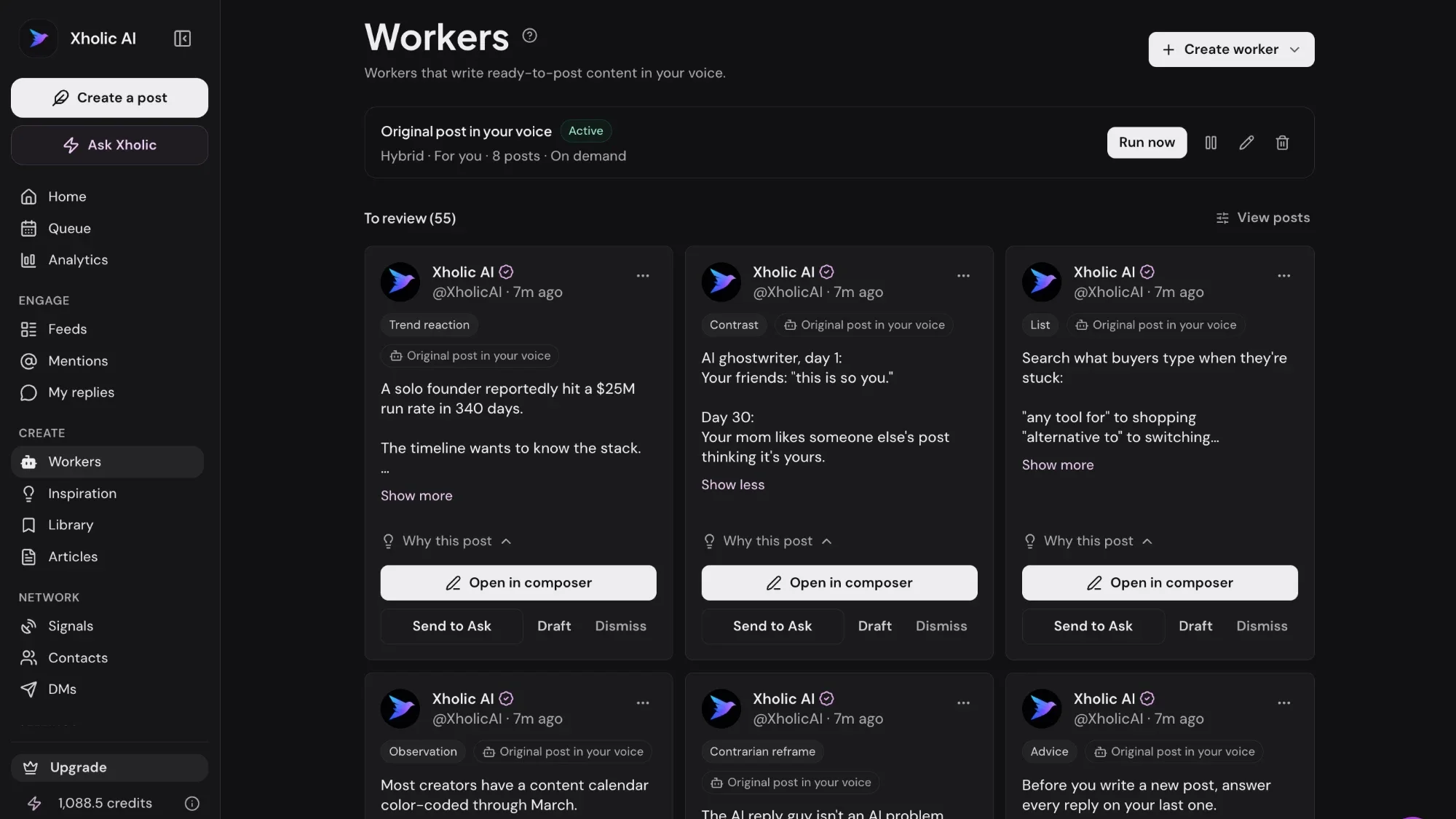
Want numbers like @levie's?
Xholic writes posts in your voice, schedules them for the hours your audience is active, and tracks what's working every day.
No card needed · Nothing to cancel
Live demo: no sign-up or login needed · takes about 2 minutes
Keep browsing
More in Founders & tech CEOs





Keep exploring
Free tools
- Compare Twitter AccountsPut two public accounts head to head and see who leads on views, engagement, grade and posting pace.
- Twitter Engagement Rate CalculatorCalculate engagement rate from your numbers or a public profile and grade it against your tier.
- X Monetization CalculatorChange the assumptions behind six X revenue models and compare gross revenue with direct contribution.
Guides
- Is X Worth It for Your Business? Score Your Readiness in 8 SignalsDecide whether X deserves a 90-day test: score eight readiness signals from 0 to 2, read what each score band means, and turn the gaps into a working plan.
- How to Check Twitter (X) Analytics: Every Metric ExplainedHow to check your own X analytics on desktop and mobile, what's free per post and what needs Premium, what every metric means, and how to check any public account.
From the blog
- X Analytics for Brands & Businesses: A Practical GuideHow brands and businesses use X/Twitter analytics to track reach, engagement, and ROI — with the KPIs that actually matter.
- X (Twitter) for Business: The Complete 2026 GuideSet up X for business, build an organic and paid strategy, use DMs responsibly, and track the metrics that connect X activity to revenue.
Best tweets on this topic
- Best tweets about Product-Led GrowthExplore the best tweets about product-led growth, including activation, onboarding, free trials, virality, conversion, retention, pricing, and PLG metrics.
- Best tweets about SaaSThe sharpest, most-shared X posts about SaaS, saved so you don't have to dig through the timeline yourself. Updated every two weeks.
- Best tweets about LeadershipExplore the best tweets about leadership, covering decisions, communication, trust, accountability, culture, feedback, management, and team performance.
About this data
- Analytics are inferred from public profile and recent post data. They do not include private impressions, profile visits, link clicks, or follower-source data.
- Deleted, protected, unavailable, or rate-limited posts may be missing from the sample.
- Stats come from public posts Xholic has stored, not private X Analytics. Xholic is not affiliated with X Corp or @levie.
- Own this account and want it hidden? Email support@xholic.ai — we verify ownership and handle requests within 2 working days.