

François Chollet (@fchollet) X analytics
@fchollet
Co-founder @ndea. Co-founder @arcprize. Creator of Keras and ARC-AGI. Author of 'Deep Learning with Python'.
@fchollet has 755.9K followers, a median of 89K views per post and a 0.78% engagement rate.
Based on 30 recent original posts (high confidence). Updated November 14, 2026.
At a glance
Key stats
- Followers
- 755.9K755,903 followers on November 14, 2026+2.2K in 7 days+10.6K in 30 days
- Median views per post
- 89K
- Average views per post
- 334.5K
- Engagement rate (by views)
- 0.78%
- Original posts per week
- 5.7
- Average engagements per post
- 2,596
Engagement grade
Developing
This is near the lower benchmark range for accounts with 100K-1M followers.
Profile score
84/100
- Profile completeness100
- Audience shape100
- Engagement25
- Consistency100
- Positioning clarity97
Monetization
Estimated X creator earnings
$261–$651 in the last 30 days
From 2.6M views on @fchollet's original posts in the last 30 days.
Rewards eligibility: likely
Rough estimate. X publishes no payout rate, so this assumes about $100–250 per 1M original-post impressions, based on real creator payouts. Payouts vary with how many of your viewers have Premium.
Free report
How does your account compare with @fchollet?
Get the same report for your own account by email: engagement grade, median views, best times to post and estimated earnings.
Growth
Follower growth
+2.2K followers in the last 7 days. +10.6K in the last 30 days. Tracked by Xholic since October 4, 2026.
| Date | Followers | Change |
|---|---|---|
| Nov 14, 2026 | 755,903 | +541 |
| Nov 12, 2026 | 755,362 | +1,616 |
| Nov 7, 2026 | 753,746 | +481 |
| Nov 5, 2026 | 753,265 | +241 |
| Nov 4, 2026 | 753,024 | +106 |
| Nov 3, 2026 | 752,918 | +241 |
| Nov 2, 2026 | 752,677 | +270 |
Timing
Best times to post
When @fchollet's recent posts performed best (UTC).
- #1 slot
8:12 PM
Monday · UTC
- #2 slot
8:23 PM
Tuesday · UTC
- #3 slot
8:18 PM
Wednesday · UTC
What worked
Top recent posts
- 01

@fchollet ·
Dopamine does not spike highest for guaranteed rewards. It spikes highest at reward prediction error. If you want to have fun in life, you should stop avoiding risk and uncertainty.
- 342Replies
- 1.4KReposts
- 13.6KLikes
- 1.1MViews
6.6x average engagementText onlyMedium length (100-200 characters)Posted Sat 20:00 UTC - 02
@fchollet ·
String theory is what happens when an intelligent system is starved of sensory input and starts hallucinating. Intelligence needs grounding. For this reason, intelligence is practically never the bottleneck to solving impactful problems. The bottleneck is iterated contact with reality.
- 766Replies
- 1.3KReposts
- 12.4KLikes
- 5.5MViews
5.7x average engagementText onlyLong post (over 200 characters)Posted Wed 14:00 UTC - 03
@fchollet ·
Everyone wants to have solved a hard problem, but almost nobody wants to live inside the grind of actually solving it. The breakthroughs belong to the few who are obsessed with the process, not just the idea of the outcome
- 206Replies
- 472Reposts
- 5KLikes
- 168.3KViews
1.7x average engagementText onlyLong post (over 200 characters)Posted Thu 15:00 UTC - 04
@fchollet ·
The most grating aspect of LLM writing is that it tries to turn every single sentence into a punchline, a witty slogan, with no regard for which sentences need emphasis and which ones don't. "A tiring formula, overused"
- 198Replies
- 218Reposts
- 6.4KLikes
- 156KViews
1.7x average engagementText onlyLong post (over 200 characters)Posted Mon 17:00 UTC - 05
@fchollet ·
Some observations about the "total" automation of software engineering: 1. There are more software engineers now than in 2025, and demand is growing. 2. Software engineers have never worked harder than they do now. 3. They largely don't write code anymore, agents write ~100% of the code. 4. The bottom line of the companies that employs these engineers and agents (i.e. the terminal purpose of all this code) is typically not budging as a result of AI adoption. This is why you have to think in terms of systems. Automating one aspect of a system creates its own friction and moves the bottlenecks elsewhere.
- 330Replies
- 252Reposts
- 2.8KLikes
- 290.4KViews
1.5x average engagementText onlyLong post (over 200 characters)Posted Sat 17:00 UTC - 06
@fchollet ·
The real world abounds with recursively self-improving systems, but one in particular deserves attention: Science, modeled as a system (perhaps even as an agent, with goals and resources). If you want to really understand AI RSI, science should be your reference point. Science is an intelligent system, and it is obviously recursively self-improving: 1. Scientific discoveries unlock new technology that helps build better experimental tools. This is a top driver of progress in nearly all fields. 2. They unlock new conceptual advances (ideas, theories) that help solve more problems. 3. They increase society's economic output, leading to more resources flowing into science. 4. They unlock better faster tooling (e.g. more compute via better chip & networking technology). As a result, many measures of scientific *input* grow exponentially: 1. Headcount (doubles every ~15 years) 2. Global R&D spending (doubles a bit faster, every ~13 years) 3. Papers and patents (technically this is a measure of headcount) 4. Compute dedicated to science (doubles every ~2 years) But is scientific progress exponential? Historically, the rate of scientific impact over time has remained roughly constant since the start of the industrial revolution (i.e. scientific progress is *linear*). 1850-1900 was about as dramatic as 1900-1950 or 1950-2000. 1850–1900: Evolution, germ theory & antiseptic surgery, thermodynamics, electromagnetic field equations, the periodic table, pharmaceuticals, electricity, telegraph and telephone, internal combustion engine, skyscrapers, mechanized agriculture... 1900–1950: special and general relativity, quantum mechanics, nuclear fission & atomic energy, antibiotics, genetic theory, electronic computers, information theory, synthetic polymers and plastics, the transistor, aviation... 1950–2000: DNA, genetic engineering, integrated circuits, microprocessors & personal computing, the Internet, crewed spaceflight, moon landing, satellite communications & GPS, standard model of particle physics... In real terms, like life expectancy, which has increased in a remarkably linear fashion of roughly 3 months per year since 1840, progress is a straight line. This is especially apparent for fields where impact is easy to measure, like biology, medicine, and agriculture. I first wrote about this phenomenon and its causes in 2012, and a steady stream of research has confirmed it in the years since. Examples include the 2018 paper by Nielsen and Collison, "Science Is Getting Less Bang for Its Buck," and the 2020 economic paper, "Are Ideas Getting Harder to Find?" (In fact, I believe the Nielsen paper stemmed from a conversation I had with him about this exact idea six months earlier) In short, the primary cause is that research solves the highest-impact, easiest problems first, and every subsequent problem is either harder or lower-impact. Exponentially so. The paper that presented information theory wasn't very hard to write (single author!) but you'd have a hard time ever writing a CS paper that beats it in impact. This is why science as a system requires exponential resources (input) to produce linear impact (output). It gets exponentially harder over time. Worth thinking about if you're pondering RSI for AI. I fully believe AI RSI is already happening and will accelerate in the future. But I do not believe this leads to an "intelligence explosion" -- that would fly in the face of everything I know about intelligence and everything I know about recursively self-improving systems.
- 167Replies
- 210Reposts
- 1.8KLikes
- 175.2KViews
1.2x average engagementText onlyLong post (over 200 characters)Posted Fri 17:00 UTC
Latest
Recent posts by François Chollet
The latest 30 original posts from @fchollet, newest first, as of November 14, 2026. Replies and reposts aren't included.
@fchollet ·
Some people make a big show of being humble, wielding conspicuous humility as a status symbol. I'm pretty sure that's not how humility works.
- 30Replies
- 16Reposts
- 233Likes
- 27.5KViews
@fchollet ·
Conversational AI is going to transform education and deliver personalized tutoring at scale. But we have to build it right. Most current AI tools in education optimize for the wrong thing: getting the answer. But the point of homework is not the output, it's learning to think by going through the process. We should be building AI that helps students develop their own thinking rather than outsourcing it to AI. Gakku is actually doing that. Huge congrats to Annie on the raise!
- 136Replies
- 100Reposts
- 795Likes
- 51.7KViews
@fchollet ·
Sam and his team are working on a super exciting idea: autonomous businesses. Acquiring distressed or stagnant SaaS apps and handing the keys to an agent harness is the ultimate real-world eval. Just P&L as the objective function and the market as the feedback signal. Congrats on the launch!
- 82Replies
- 42Reposts
- 780Likes
- 83.6KViews
@fchollet ·
Data scaling and compute scaling are *multipliers* for the generalization power of an approach. Trillions of dollars in investment can make very inefficient, low-generalization approaches look adequate, but that doesn't make them the ultimate end-all-be-all of AI. You should work on methods that *can* scale, because if you don't benefit from this multiplier you simply can't compete. But you should keep in mind scaling is only a multiplier: a cleverer approach will scale *better*.
- 114Replies
- 84Reposts
- 798Likes
- 49.5KViews
@fchollet ·
Co-sign. The only future that is worth building is one in which AI remains a tool in human hands, used to elevate the human condition.
- 78Replies
- 70Reposts
- 1.1KLikes
- 104KViews
@fchollet ·
The most grating aspect of LLM writing is that it tries to turn every single sentence into a punchline, a witty slogan, with no regard for which sentences need emphasis and which ones don't. "A tiring formula, overused"
- 198Replies
- 218Reposts
- 6.4KLikes
- 156KViews
@fchollet ·
Do I know anyone who knows anything about cyanotype printmaking?
- 9Replies
- 0Reposts
- 41Likes
- 23KViews
@fchollet ·
Evolution doesn't benchmaxx. It optimizes for generality and robustness, because overspecialization makes a species fragile when the environment inevitably shifts.
- 195Replies
- 162Reposts
- 2KLikes
- 101.9KViews
@fchollet ·
I got a fun birthday present from the team at Ndea ❤️


- 27Replies
- 1Reposts
- 213Likes
- 27.8KViews
@fchollet ·
Dopamine does not spike highest for guaranteed rewards. It spikes highest at reward prediction error. If you want to have fun in life, you should stop avoiding risk and uncertainty.
- 342Replies
- 1.4KReposts
- 13.6KLikes
- 1.1MViews
Show all 30Show fewer
@fchollet ·
A common sign that you are in an insane millenarian death cult is that you axiomatically convinced that the Apocalypse will happen within a few months, you are constantly on the lookout for signs that it may have started, you feel both fearful and *excited* about it, and you're constantly talking about it with your friends, who happen to *all* have the exact same set of beliefs.
- 97Replies
- 151Reposts
- 1.7KLikes
- 99.9KViews
@fchollet ·
When enough people believe something will happen, it doesn't need to happen at all for all of its consequences to be felt
- 86Replies
- 49Reposts
- 815Likes
- 52.5KViews
@fchollet ·
Some observations about the "total" automation of software engineering: 1. There are more software engineers now than in 2025, and demand is growing. 2. Software engineers have never worked harder than they do now. 3. They largely don't write code anymore, agents write ~100% of the code. 4. The bottom line of the companies that employs these engineers and agents (i.e. the terminal purpose of all this code) is typically not budging as a result of AI adoption. This is why you have to think in terms of systems. Automating one aspect of a system creates its own friction and moves the bottlenecks elsewhere.
- 330Replies
- 252Reposts
- 2.8KLikes
- 290.4KViews
@fchollet ·
Argon has a similar performance profile on ARC-AGI-3 as Astra. Google is back at the frontier.
- 60Replies
- 63Reposts
- 1.1KLikes
- 74.8KViews
@fchollet ·
I truly believe conversational AI will drive the biggest educational leap of our generation. 1-on-1 tutoring is the gold standard for education, but it doesn't scale. AI can change that with truly active conversational learning. Annie and team set out to solve this with @gakkuai, and they've done a great job. Gakku is an AI mentoring app for K-12 students. Rather than doing the work for them, the voice chat coach guides students through 10 min essay writing "missions" that cover brainstorming, drafting, and revising. It actively trains kids to generate their own ideas, structure logical arguments, and articulate themselves clearly. If you have school-aged kids, I highly recommend checking it out: https://t.co/Z1bSFgx6Et
- 119Replies
- 102Reposts
- 1.3KLikes
- 86.3KViews
@fchollet ·
Everyone wants to have solved a hard problem, but almost nobody wants to live inside the grind of actually solving it. The breakthroughs belong to the few who are obsessed with the process, not just the idea of the outcome
- 206Replies
- 472Reposts
- 5KLikes
- 168.3KViews
@fchollet ·
You can't solve real-world physical tasks through autoregressive sampling alone. The physical world is entirely unforgiving to hallucination or approximate pattern matching. If we want actual autonomous robotics we have to engineer causality and discrete reasoning back into the loop. Biwei and the team at Aether AI is doing exactly the kind of foundational, non-consensus work the field actually needs right now.
- 73Replies
- 89Reposts
- 850Likes
- 70.4KViews
@fchollet ·
String theory is what happens when an intelligent system is starved of sensory input and starts hallucinating. Intelligence needs grounding. For this reason, intelligence is practically never the bottleneck to solving impactful problems. The bottleneck is iterated contact with reality.
- 766Replies
- 1.3KReposts
- 12.4KLikes
- 5.5MViews
@fchollet ·
The ideal outcome for science isn't a couple of labs using proprietary models and millions of dollars to crack trophy problems, it's to have millions of AI-aided human scientists who follow their curiosity and become way more ambitious
- 161Replies
- 344Reposts
- 2.7KLikes
- 91.7KViews
@fchollet ·
If an agent saves an engineer 2 hours to implement a feature but collectively costs the team 3 hours in alignment and review, the ROI is negative. Isolated chats are suboptimal in team environments because they lack the context of what the team already discussed and decided. The Kylon app fixes this by running Claude Code and Codex in a shared, multiplayer environment. Agents gain real-time visibility into team consensus and architecture decisions.
- 100Replies
- 28Reposts
- 673Likes
- 980.3KViews
@fchollet ·
Congrats on the release! Looks like a fantastic model.
- 16Replies
- 9Reposts
- 429Likes
- 43.5KViews
@fchollet ·
If you explained agriculture to folks in SF, you'd blow so many minds. It's... self-replicating, recursively self-improving nanotech for the physical world. And it's all open-source! One instance can turn into hundreds of seeds, that turn into hundreds of instances. Next thing you know you have trillions of them. It's super-exponential
- 176Replies
- 226Reposts
- 3.3KLikes
- 100.1KViews
@fchollet ·
I've been having a lot of fun trying a wide range of LLM post-training experiments using KerasHub + JAX + TPUs. Might open-source some of that
- 74Replies
- 24Reposts
- 502Likes
- 56.3KViews
@fchollet ·
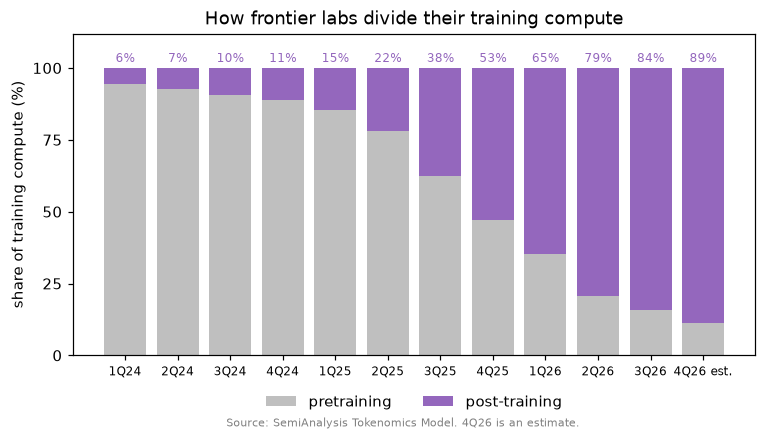
How AI shifted from a transductive paradigm (token-by-token answer completion) to an inductive paradigm (on-the-fly reasoning chain synthesis), in one chart. This is the big story of 2025 and 2026. This is what made coding agents work.
- 159Replies
- 176Reposts
- 1.7KLikes
- 122.6KViews
@fchollet ·
The real world abounds with recursively self-improving systems, but one in particular deserves attention: Science, modeled as a system (perhaps even as an agent, with goals and resources). If you want to really understand AI RSI, science should be your reference point. Science is an intelligent system, and it is obviously recursively self-improving: 1. Scientific discoveries unlock new technology that helps build better experimental tools. This is a top driver of progress in nearly all fields. 2. They unlock new conceptual advances (ideas, theories) that help solve more problems. 3. They increase society's economic output, leading to more resources flowing into science. 4. They unlock better faster tooling (e.g. more compute via better chip & networking technology). As a result, many measures of scientific *input* grow exponentially: 1. Headcount (doubles every ~15 years) 2. Global R&D spending (doubles a bit faster, every ~13 years) 3. Papers and patents (technically this is a…
- 167Replies
- 210Reposts
- 1.8KLikes
- 175.2KViews
@fchollet ·
Right now, using AI agents still feels very single-player. They do your work, but the results are trapped in isolated chat histories and nothing compounds. The Busabase team (@Busabase4agent) is launching an open-source (MIT) database and workspace for agents to fix this. Instead of losing work to ephemeral chats, your agents write directly to a structured workspace to turn their outputs into reusable data, docs, and skills your entire team can access. Details here: https://t.co/RdFPoAR10C
- 117Replies
- 71Reposts
- 709Likes
- 105.1KViews
@fchollet ·
We're reaching really good ARC-AGI-2 scores on Kaggle now!
- 23Replies
- 20Reposts
- 186Likes
- 27.2KViews
@fchollet ·
Most measures of AI progress closely fit an exponential over the 2023-2026 period. Meanwhile AI capex over the same period has been slightly super-exponential (i.e. the rate of growth itself is increasing). So if you model AI as a system that takes as input external investment and outputs AI progress, that system has a slightly sub-linear response. But super-exponential injection of *external* resources is not sustainable in the long-term. To achieve sustained exponential progress, the AI industry will need to achieve matching exponential profits -- it will need to close the resource loop.
- 98Replies
- 63Reposts
- 737Likes
- 60.7KViews
@fchollet ·
Humans provide a fun comparison point here. In the 80s, the "cognitive consequences of programming" was a major psychological research focus. The prevailing hypothesis was that learning formal logic and algorithmic structures through computer programming would act as a form of mental gymnastics that could upgrade general reasoning, planning, and novel problem-solving abilities. But foundational research, followed by subsequent meta-analyses, demonstrated that this does not happen. Students who learn programming become highly proficient at algorithmic thinking and coding, but these gains do not transfer to general cognitive tasks or unrelated problem-solving scenarios. Similarly, intensive mathematical training improves mathematical deduction and structural mapping, but does not increase an individual's baseline rate of skill acquisition in unrelated fields. General intelligence seems to be a fundamental property of the brain rather than a skill you can train. Practicing in a domain…
- 95Replies
- 136Reposts
- 1.3KLikes
- 73.5KViews
Formats
Content mix
- Text only
- 87%
- With media
- 7%
- With links
- 2 posts
- With hashtags
- 0 posts
Creator style: High-reach broadcaster
See the full app
This creator report is one small part of Xholic
Click through a sample creator's account in the real app. No sign-up, nothing to install.
- Posts written in your voice and scheduled for your best hours
- Buyers found on 𝕏, with a reply drafted for each one
- Analytics that show which posts grow you
No sign-up or login needed · Takes about 2 minutes

Want numbers like @fchollet's?
Xholic writes posts in your voice, schedules them for the hours your audience is active, and tracks what's working every day.
No card needed · Nothing to cancel
Live demo: no sign-up or login needed · takes about 2 minutes
Keep browsing
More in AI & developers





Keep exploring
Free tools
- Compare Twitter AccountsPut two public accounts head to head and see who leads on views, engagement, grade and posting pace.
- Twitter Engagement Rate CalculatorCalculate engagement rate from your numbers or a public profile and grade it against your tier.
- X Monetization CalculatorChange the assumptions behind six X revenue models and compare gross revenue with direct contribution.
Guides
- How to Write a Tweet With an AI Tweet GeneratorTurn a rough idea into a tweet worth posting: write a specific prompt, pick a tone and length, compare three drafts and make the best one sound like you.
- How to Check an X Follower Count Live (and Read the Trend)Watch any public X account's exact follower count update live, read the session and 90-day charts, and see why the number differs from the X app.
From the blog
- 10 X Analytics API Alternative Options for 2026Compare 10 X analytics API alternatives for 2026, from low-cost data providers and custom scrapers to enterprise listening platforms.
- Twitter API Examples: A Practical Guide for BuildersExplore real Twitter API examples with code, auth flows, rate limits, and patterns for posting, streaming, analytics, and growth workflows on X.
Best tweets on this topic
- Best tweets about Google AI StudioDiscover the best tweets about Google AI Studio, covering Gemini API prototypes, prompting, structured output, model testing, and developer workflows.
- Best tweets about Open-Source AIBrowse the best tweets about open-source AI, open-weight models, community tools, training, deployment, licensing, and research. Updated every two weeks.
- Best tweets about GitHub CopilotThe best tweets about GitHub Copilot: coding workflows, agent features, reviews, limitations and developer productivity. Updated every two weeks.
About this data
- Analytics are inferred from public profile and recent post data. They do not include private impressions, profile visits, link clicks, or follower-source data.
- Deleted, protected, unavailable, or rate-limited posts may be missing from the sample.
- Stats come from public posts Xholic has stored, not private X Analytics. Xholic is not affiliated with X Corp or @fchollet.
- Own this account and want it hidden? Email support@xholic.ai — we verify ownership and handle requests within 2 working days.