

elvis (@omarsar0) X analytics
@omarsar0
Building the frontier @dair_ai • Prev: Meta AI | PaperswithCode | Elastic | PhD
@omarsar0 has 325.8K followers, a median of 11.2K views per post and a 1.52% engagement rate.
Based on 30 recent original posts (high confidence). Updated October 24, 2026.
At a glance
Key stats
- Followers
- 325.8K325,837 followers on October 24, 2026+1.1K in 7 days
- Median views per post
- 11.2K
- Average views per post
- 16.8K
- Engagement rate (by views)
- 1.52%
- Original posts per week
- 60.6
- Average engagements per post
- 255
Engagement grade
Strong
This is above the baseline for accounts with 100K-1M followers.
Profile score
79/100
- Profile completeness100
- Audience shape100
- Engagement25
- Consistency100
- Positioning clarity71
Monetization
Estimated X creator earnings
$20–$49 in the last 30 days
From 4.1M views on @omarsar0's original posts in the last 30 days.
Rewards eligibility: likely
Rough estimate. X publishes no payout rate, so this assumes about $5–12 per 1M original-post impressions from reported creator payouts. Only Premium viewers’ impressions count, so real payouts can be much lower.
Free report
How does your account compare with @omarsar0?
Get the same report for your own account by email: engagement grade, median views, best times to post and estimated earnings.
Growth
Follower growth
+1.1K followers in the last 7 days. Tracked by Xholic since July 29, 2026.
| Date | Followers | Change |
|---|---|---|
| Oct 24, 2026 | 325,837 | +210 |
| Oct 22, 2026 | 325,627 | +102 |
| Oct 21, 2026 | 325,525 | +316 |
| Oct 20, 2026 | 325,209 | +348 |
| Oct 18, 2026 | 324,861 | +112 |
| Oct 16, 2026 | 324,749 | +12,045 |
| Jul 29, 2026 | 312,704 | – |
Timing
Best times to post
When @omarsar0's recent posts performed best (UTC).
- #1 slot
7:23 PM
Monday · UTC
- #2 slot
7:58 PM
Tuesday · UTC
- #3 slot
7:18 PM
Wednesday · UTC
What worked
Top recent posts
- 01

@omarsar0 ·
Learn to build evals, folks. Highly recommended reading on using decision models for evals. From our internal evals, System One models like Jev are a great fit for LLM Judges. If you want to go beyond Hamel's great write-up, I've also put together a few resources on applying decision models to LLM judges. (bookmark it) 1) Jev-as-a-Judge for Agent Evaluations - https://t.co/SkXGd4uA2J 2) Jev-as-a-Judge: Evaluating Agents with a Decision Model - https://t.co/SqGSzlMFut Bonus paper I would recommend, with a few other ideas that combine System One and System Two models: Jev-as-a-Judge paper - https://t.co/8Oi6oBEt2A
- 69Replies
- 151Reposts
- 1.7KLikes
- 125.7KViews
11.1x average engagementShares a linkLong post (over 200 characters)Posted Tue 19:00 UTCQuote post - 02
@omarsar0 ·
Build specialized harnesses, folks. This is a banger paper from Google Cloud AI Research on self-evolving agent harnesses. (bookmark it) They introduce OO-Harness, which raises AutomationBench from 61.6% to 77.4% with the same Gemini 3.5 Flash executor. It also beats Meta-Harness on all three benchmarks they test. More details below. Instead of evolving one global harness for every task, an evolution agent builds a class hierarchy of specialized harnesses from execution records. The design has three parts. > Subclasses inherit the base harness and override only the methods a task cluster needs > Design lessons record which changes helped and which ones failed > A router reads the task and the base run, then picks a subclass or keeps the base result On Workspace-Bench, the score goes from 25.5% to 39.5%, and on Toolathlon-GYM strict pass goes from 31.2% to 37.5%. Spending extra inference on best-of-K sampling or self-refinement does not reliably help. Inheritance also improves results. On Workspace-Bench, harnesses built as subclasses score 4.96 points higher than the same evolved code copied into flat classes. https://t.co/JKZ6y8OXhs Chat with Paper: https://t.co/Vg9NlOnfEZ

- 91Replies
- 90Reposts
- 714Likes
- 41.6KViews
3.7x average engagementHas an imageLong post (over 200 characters)Posted Wed 14:00 UTC - 03
@omarsar0 ·
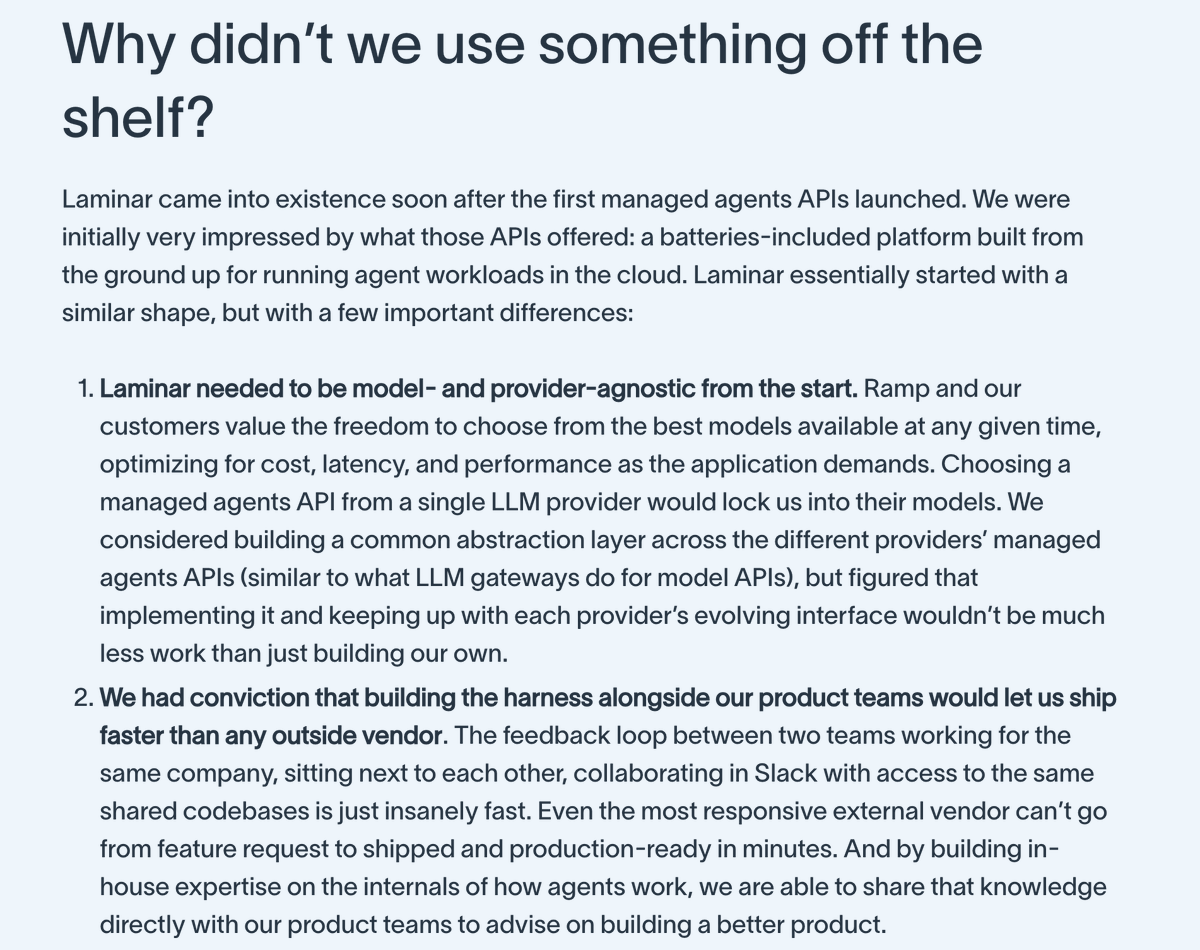
Build your own harness, folks! Highly recommended reading on Ramp's own agent harness and why they built one. I've seen this closely. More hardcore engineering teams are realizing how important it is to own the harness. I expect more full-stack AI companies to follow. Ramp quickly realized they could move faster and better with their agent harness. Benefits: - Model-and-provider agnostic - Shipping faster as the harness is closer to other teams - Owning the observability stack (a must given the complexity of agentic systems today) Their Laminar harness supports secure conversation storage, MCP for standard tool calling, durable execution, code execution sandboxes, observability tools, and more. When you own the harness, you can co-evolve it to meet your needs. The foundations don't change much; only the tooling and behavior need extending, so make the harness malleable from the start. Ramp also made several interesting design choices, such as using sandbox-as-a-tool, leveraging Boring and a standard stack (Postgres, S3, etc.), always-open agent sessions, and going all-in on cloud.
- 90Replies
- 53Reposts
- 410Likes
- 21KViews
1.9x average engagementHas an imageLong post (over 200 characters)Posted Fri 00:00 UTCQuote post - 04
@omarsar0 ·
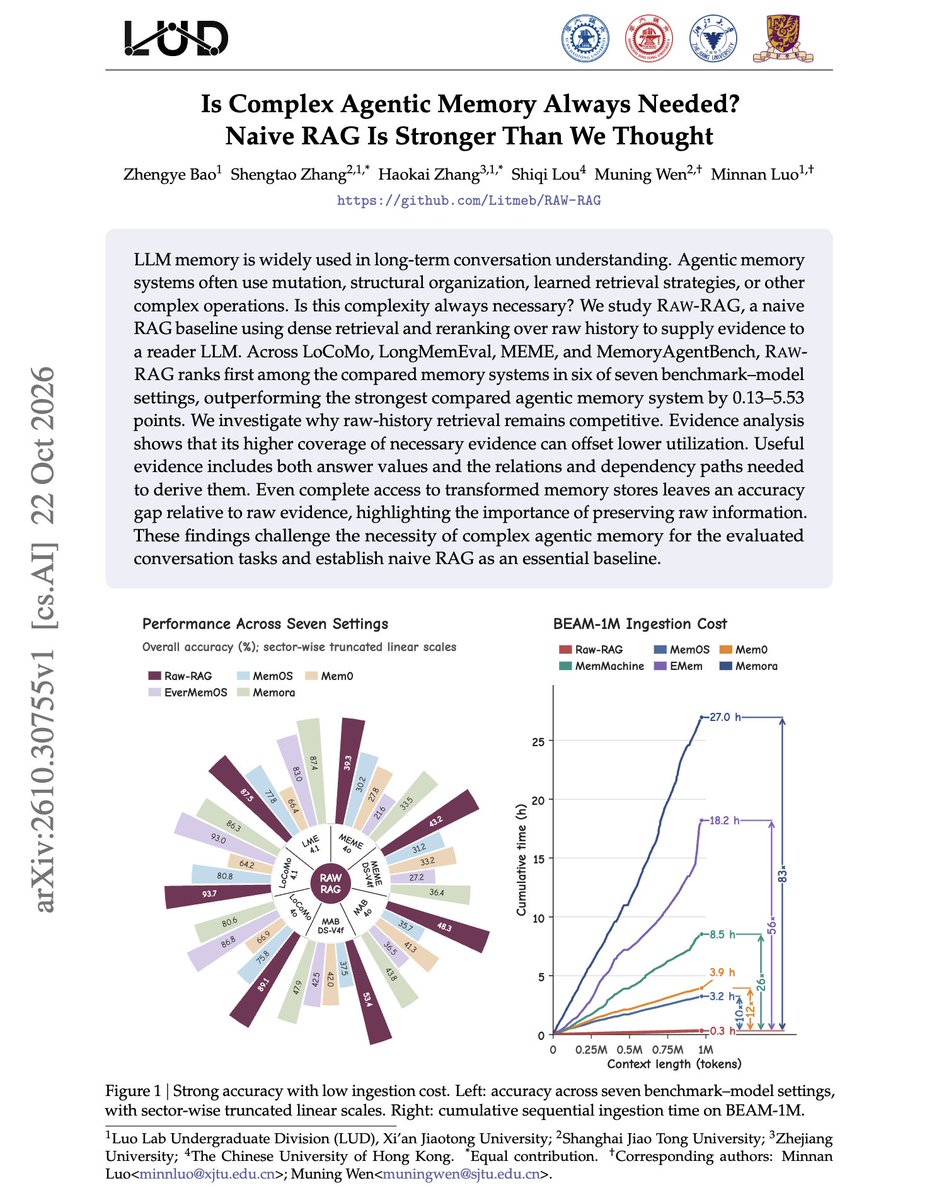
RAG is so back! This work shows that plain RAG over raw chat history beats complex agentic memory systems on most long-term memory benchmarks. (bookmark it) They tested Raw-RAG, which is just dense retrieval plus reranking over the raw conversation, feeding a reader LLM. Across LoCoMo, LongMemEval, MEME and MemoryAgentBench, it ranks first in six of seven benchmark and model settings, ahead of the strongest agentic memory system by 0.13 to 5.53 points. Ingestion on BEAM-1M takes 0.3 hours, against 3.2 to 27 hours for systems like Mem0, MemOS and Memora. Why does it hold up? Raw history keeps more of the evidence a question needs, including the relations and dependency paths behind an answer. Rewriting history into memory entries tends to drop those important bits. Even with complete access to the transformed memory stores, models answer less accurately than with raw evidence. Before adding a memory layer to your agent, at least run this baseline on your own data. https://t.co/4Fw1at4whN Chat with Paper: https://t.co/XJyaqjw0LE
- 88Replies
- 41Reposts
- 387Likes
- 17.9KViews
1.8x average engagementHas an imageLong post (over 200 characters)Posted Fri 14:00 UTC - 05
@omarsar0 ·
Highly recommended read from Google DeepMind and colleagues. There is a lot of interest in self-evolving agents, but they're hard to get right. This work highlights how important and difficult memory and retrieval are in agents. The big question in this paper is whether self-evolving agents keep learning without forgetting. They tested ReasoningBank, GEPA, and Meta-Harness on four task streams that drift in topic, workflow, or domain, built from BIRD, BFCL, and ScienceWorld. The weights stay frozen, and the agents adapt by rewriting prompts, memory, and skills. Self-evolution improves overall scores on most streams. But more adaptation consistently means agents forget more. Methods that rewrite a shared prompt or workspace make global edits, so they interfere with unseen tasks and overwrite older knowledge when the stream shifts. Memory retrieval keeps updates more local, but it still pulls in memories from other domains and collides when similar queries need different workflows. Static benchmarks hide both problems, so test self-evolving agents on a stream that changes over time. https://t.co/eO28Lcsj9M Chat with Paper: https://t.co/Jhe28VZ8dj

- 57Replies
- 59Reposts
- 340Likes
- 17.1KViews
1.3x average engagementHas an imageLong post (over 200 characters)Posted Wed 02:00 UTC - 06
@omarsar0 ·
// MemoryTax: The Bitter Lesson of Agent Memory // Great insights for agent builders; bookmark it. As models increase in capability, they also improve at things like memory generation. Agent memory frameworks are everywhere right now. This study measured whether they still help once the model can search raw history itself. The results suggest that a strong model needs less designed memory and better tools for searching the raw record. On one 419-turn LoCoMo conversation, Mem0 beats plain full context only with GPT-4o-mini. Building Mem0's memory costs more than an entire full-context rollout. With Claude Opus 5.5, the Pi coding agent searching the raw history scores 99% for under half the cost of full context. Its one miss comes from a wrong answer key. Memory also has a ceiling set by the model that wrote it. A stronger reader cannot recover what a weaker writer left out. The author clearly defines the scope: one conversation and one run per cell. It is still a cheap experiment to repeat on your own agent before adding a memory layer. https://t.co/l7U9ey8CVG Chat with Paper: https://t.co/cwriPTOP0L

- 85Replies
- 35Reposts
- 245Likes
- 16.9KViews
1.2x average engagementHas an imageLong post (over 200 characters)Posted Thu 14:00 UTC
Latest
Recent posts by elvis
The latest 30 original posts from @omarsar0, newest first, as of October 24, 2026. Replies and reposts aren't included.
@omarsar0 ·
Recommended leaderboard to track voice AI. They just added five new languages to the Voice Arena TTS leaderboard. ElevenLabs models rank #1 on all five. I have started integrating voice agents into some of our applications, and I think they're quickly becoming one of the most important ways to build, research, and learn with agents. But language support matters much more in voice than in other modalities. So @voicearena_ai is a nice way to track the progress.
- 13Replies
- 3Reposts
- 34Likes
- 4.5KViews
@omarsar0 ·
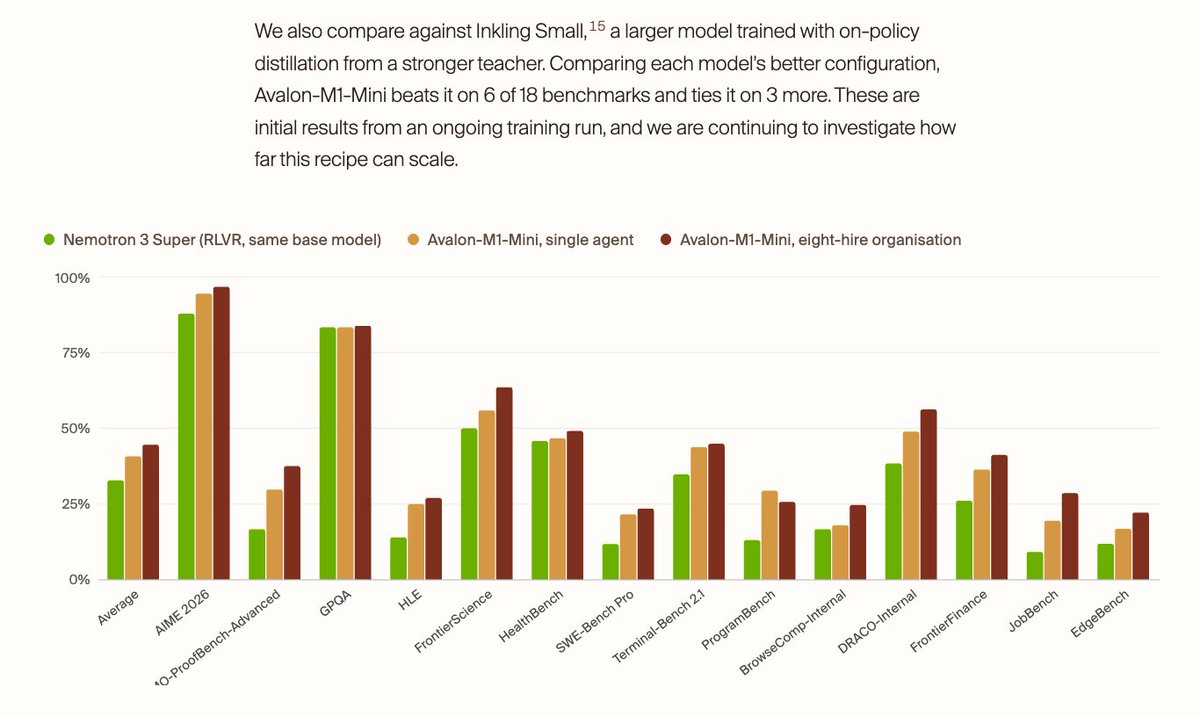
Really digging this new arc of specialized RL models. Bullish on this effort to understand and unlock collective intelligence. Highly recommend checking out the technical report. RLCR is just one of the latest efforts to train LLMs as agent organizations. Why is this a big deal, and why is it necessary? Coordination and organization are important primitives as we move into agentic long-horizon work. Agents should natively support these capabilities, which is mostly done through harnesses today. So far, multi-agent systems and how they coordinate are not well understood. This Avalon-M1-Mini model attempts to study this more closely. I think this could help us understand and discover efficient, safe ways to build effective multi-agent systems for domain-specific problems. Check out how they improve results with an eight-hire organization. Promising results. The safety risks are also worth a closer look. This is small-scale, but as they scale, I am particularly curious about…
- 22Replies
- 6Reposts
- 44Likes
- 4.4KViews
@omarsar0 ·
Own your intelligence stack, folks! We really don't have good solutions to make owning intelligence approachable. Tools are all scattered and inaccessible. This is one of the first serious attempts I've seen. Mubit continually improves your product and company intelligence via agent traces. They even released an open model. Do check them out.
- 7Replies
- 4Reposts
- 24Likes
- 4.9KViews
@omarsar0 ·
RAG is so back! This work shows that plain RAG over raw chat history beats complex agentic memory systems on most long-term memory benchmarks. (bookmark it) They tested Raw-RAG, which is just dense retrieval plus reranking over the raw conversation, feeding a reader LLM. Across LoCoMo, LongMemEval, MEME and MemoryAgentBench, it ranks first in six of seven benchmark and model settings, ahead of the strongest agentic memory system by 0.13 to 5.53 points. Ingestion on BEAM-1M takes 0.3 hours, against 3.2 to 27 hours for systems like Mem0, MemOS and Memora. Why does it hold up? Raw history keeps more of the evidence a question needs, including the relations and dependency paths behind an answer. Rewriting history into memory entries tends to drop those important bits. Even with complete access to the transformed memory stores, models answer less accurately than with raw evidence. Before adding a memory layer to your agent, at least run this baseline on your own data.…
- 88Replies
- 41Reposts
- 387Likes
- 17.9KViews
@omarsar0 ·
Build your own harness, folks! Highly recommended reading on Ramp's own agent harness and why they built one. I've seen this closely. More hardcore engineering teams are realizing how important it is to own the harness. I expect more full-stack AI companies to follow. Ramp quickly realized they could move faster and better with their agent harness. Benefits: - Model-and-provider agnostic - Shipping faster as the harness is closer to other teams - Owning the observability stack (a must given the complexity of agentic systems today) Their Laminar harness supports secure conversation storage, MCP for standard tool calling, durable execution, code execution sandboxes, observability tools, and more. When you own the harness, you can co-evolve it to meet your needs. The foundations don't change much; only the tooling and behavior need extending, so make the harness malleable from the start. Ramp also made several interesting design choices, such as using sandbox-as-a-tool,…
- 90Replies
- 53Reposts
- 410Likes
- 21KViews
@omarsar0 ·
Crazy how good this is. I like the idea of making AI more collaborative. Kylon Annotations made this short clip of me. The paper stacks are accurate. 😅 It's very collaborative and lets a team analyze, annotate, and remix a video together.
 Watch video
- 5Replies
- 2Reposts
- 21Likes
- 7.4KViews
@omarsar0 ·
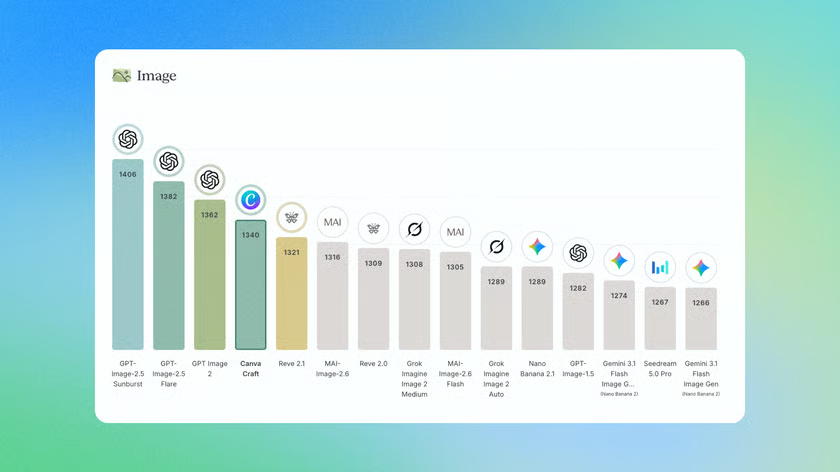
Let's go!!! Extremely bullish on specialized models. And Canva just entered the frontier image model race. Craft is Canva's first image model for design, built by their Canva Research team. It can plan the composition before it renders anything. We use Canva at our company, so it's exciting to see where this goes, given their expertise.
- 14Replies
- 6Reposts
- 61Likes
- 9.6KViews
@omarsar0 ·
Data remains the workhorse of frontier AI models. Private, high-quality, domain-specific data is especially in demand. Great to see new marketplaces like HUD where individuals and companies license their data to AI labs. Listings include private codebases with full Git history and PRs, RL environments with their tasksets, and raw company records.

- 6Replies
- 4Reposts
- 32Likes
- 6.4KViews
@omarsar0 ·
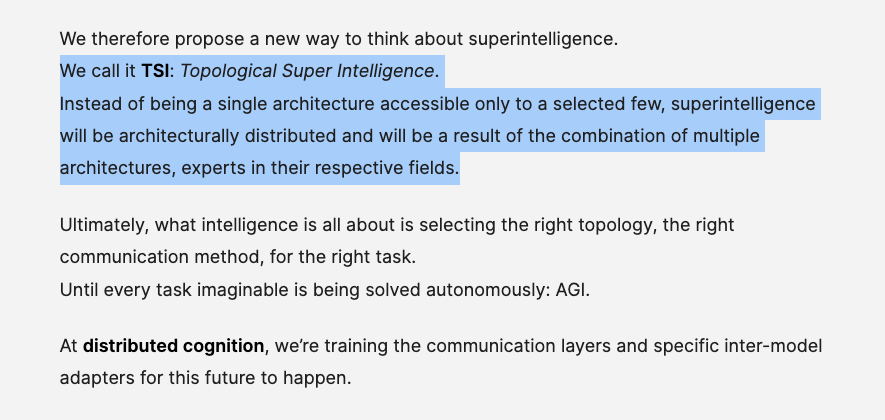
I like the vision of distributed superintelligence. But I do worry it's becoming less distributed. @distcog is exploring collective intelligence through networks of specialized models that work together. I like this research direction. I'd be interested to see which tasks benefit from specialization and how much coordination costs as the network grows. Great vision and a nice article with interesting ideas. Recommended read.
- 6Replies
- 4Reposts
- 28Likes
- 5.6KViews
@omarsar0 ·
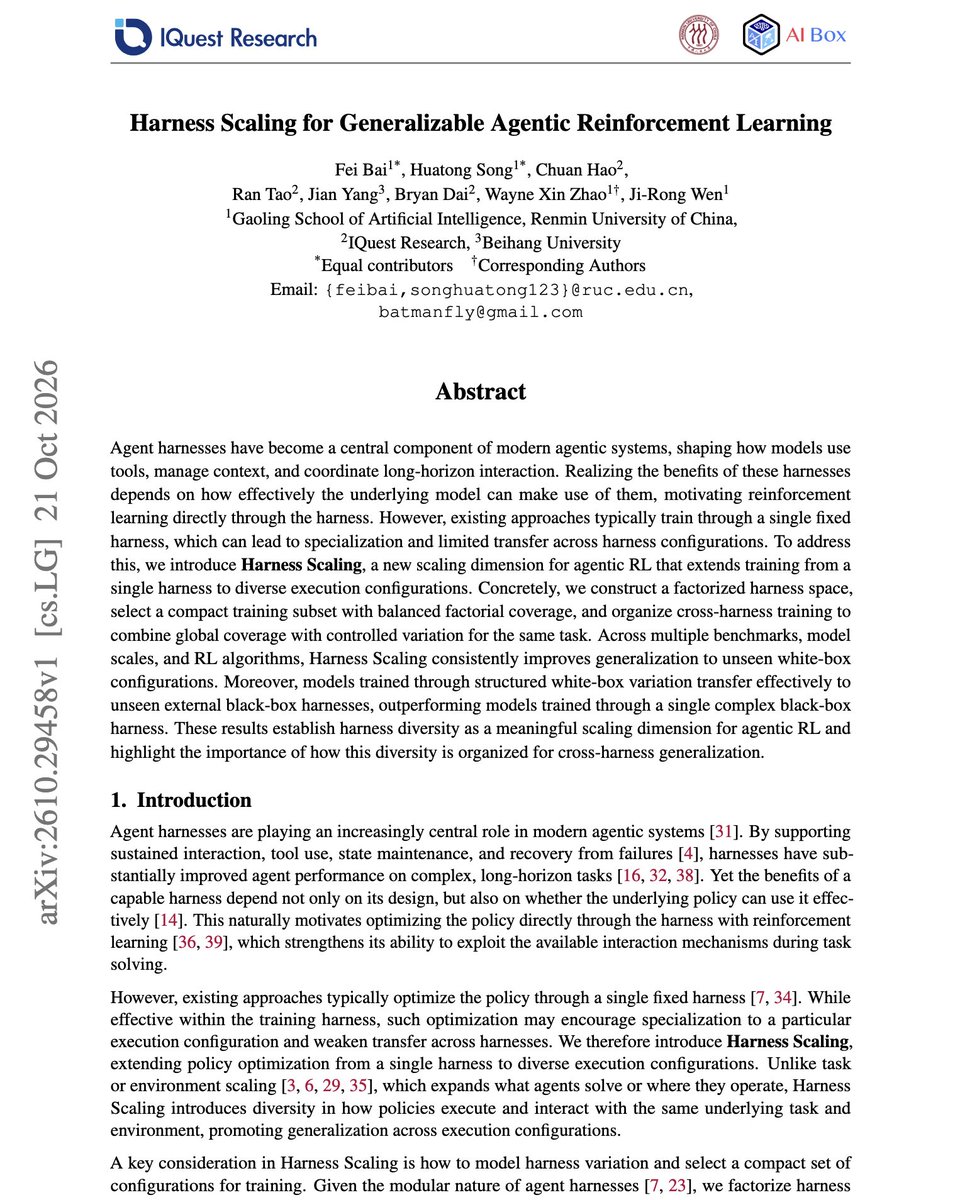
Brilliant work on using many harness configurations to scale agentic RL. Many approaches use mainly one fixed harness, which specializes the model but doesn't generalize well. This work uses many harness configurations as a scaling dimension. But the big question is whether it can generalize to harness configurations never seen in training. They pick a compact training subset with balanced factorial coverage, and vary one part of the harness at a time on the same task. Across benchmarks, model sizes, and RL algorithms, this improves results on harness configurations never seen in training. Models trained this way also transfer to unseen external black-box harnesses better than models trained through one complex black-box harness. If your model will run inside harnesses you did not train it in, treat harness diversity as its own scaling axis. https://t.co/lcQQ5y2qQ9 Chat with Paper: https://t.co/fqr3AZswBq
- 25Replies
- 25Reposts
- 142Likes
- 11.3KViews
Show all 30Show fewer
@omarsar0 ·
Recommended reading. I've been testing decision models such as Jev and Drex Max for research tasks (e.g., paper classification). Just published our initial exploratory work on it. Drex Max is a strong fit for our use cases, and we are already planning production efforts around it. Multimodal decision models also open up a whole range of exciting areas. We'll share more results and resources soon.
- 15Replies
- 11Reposts
- 105Likes
- 10.6KViews
@omarsar0 ·
// MemoryTax: The Bitter Lesson of Agent Memory // Great insights for agent builders; bookmark it. As models increase in capability, they also improve at things like memory generation. Agent memory frameworks are everywhere right now. This study measured whether they still help once the model can search raw history itself. The results suggest that a strong model needs less designed memory and better tools for searching the raw record. On one 419-turn LoCoMo conversation, Mem0 beats plain full context only with GPT-4o-mini. Building Mem0's memory costs more than an entire full-context rollout. With Claude Opus 5.5, the Pi coding agent searching the raw history scores 99% for under half the cost of full context. Its one miss comes from a wrong answer key. Memory also has a ceiling set by the model that wrote it. A stronger reader cannot recover what a weaker writer left out. The author clearly defines the scope: one conversation and one run per cell. It is still a cheap…
- 85Replies
- 35Reposts
- 245Likes
- 16.9KViews
@omarsar0 ·
Recommended reading and a super-interesting benchmark for measuring continual learning capabilities through memory. Agent memory is largely unsolved. As agents advance in capabilities like long-horizon work, it's unclear which models or harnesses work best, or which memory systems and types to use. Opus 5.5 at the top is not a surprise. But it's exciting that open-weight models like GLM-5.3 perform so well on memory generation. My big question is how this (better memory systems and persistent agent capabilities) translates into more performant, efficient RSI agents and harnesses.

- 42Replies
- 11Reposts
- 107Likes
- 13KViews
@omarsar0 ·
Anthropic just destroyed all proactive agent startups. That's what you'll see on your timeline. That couldn't be further from the truth. Personal agents, unlike other agent types, will exist in different flavors and personalities. It's nice that Claude Duet runs on Opus 5.5. Unlike other agent types, people will really think carefully about which personal agent to pick. Here, people think more carefully about trust, personality, intent understanding, continual learning, etc. The best personal agent is the one you can trust, not just the fastest one that gets the work done effectively. But I think people will use multiple personal agents for different types of tasks/work. I think we are about to see an explosion of vertical personal agents. Which one do I use? I am still testing a bunch of them (dots, Muse, and Grok Bot). But I have actually just built my own with Pi Durable. I like mine better because it is hyper-personalized to how I use personal agents.
- 49Replies
- 16Reposts
- 143Likes
- 25KViews
@omarsar0 ·
Bullish on automated AI research. Early signs of self-improving AI, no doubt. Flint is the first model from @recursive_si. Their Eureka Machine contributed to nearly every part of the stack, from data and training recipes to the inference kernels, and the team built it from scratch in under four months! It is a 40B MoE with 2.5B active parameters and open weights under Apache 2.0. It runs at 125+ tokens/s on an M4 Pro MacBook Pro at short contexts. Highly recommend checking it out. We will be testing this in our internal autoresearch evals.

- 7Replies
- 10Reposts
- 105Likes
- 10.6KViews
@omarsar0 ·
Beyond agent harnesses, I believe agent interfaces are an important direction for the development of self-evolving agents. This is connected to the idea of building for agents. You can pack so much into a good harness and interface that agents understand well. Think about the efficiencies you get. Costs you can reduce. More importantly, this lets agents work more effectively and reliably with interfaces that make sense for the task at hand. With Artifacts, we've already seen huge gains in productivity. It's a more natural interface for humans and agents to collaborate. We'll discover more of these interfaces over time, and agents will be able to build them on the fly, iterate on them, and evolve as needs arise. Excited about this emerging trend.
- 38Replies
- 7Reposts
- 129Likes
- 10.6KViews
@omarsar0 ·
Build specialized harnesses, folks. This is a banger paper from Google Cloud AI Research on self-evolving agent harnesses. (bookmark it) They introduce OO-Harness, which raises AutomationBench from 61.6% to 77.4% with the same Gemini 3.5 Flash executor. It also beats Meta-Harness on all three benchmarks they test. More details below. Instead of evolving one global harness for every task, an evolution agent builds a class hierarchy of specialized harnesses from execution records. The design has three parts. > Subclasses inherit the base harness and override only the methods a task cluster needs > Design lessons record which changes helped and which ones failed > A router reads the task and the base run, then picks a subclass or keeps the base result On Workspace-Bench, the score goes from 25.5% to 39.5%, and on Toolathlon-GYM strict pass goes from 31.2% to 37.5%. Spending extra inference on best-of-K sampling or self-refinement does not reliably help. Inheritance also…
- 91Replies
- 90Reposts
- 714Likes
- 41.6KViews
@omarsar0 ·
Highly recommended read from Google DeepMind and colleagues. There is a lot of interest in self-evolving agents, but they're hard to get right. This work highlights how important and difficult memory and retrieval are in agents. The big question in this paper is whether self-evolving agents keep learning without forgetting. They tested ReasoningBank, GEPA, and Meta-Harness on four task streams that drift in topic, workflow, or domain, built from BIRD, BFCL, and ScienceWorld. The weights stay frozen, and the agents adapt by rewriting prompts, memory, and skills. Self-evolution improves overall scores on most streams. But more adaptation consistently means agents forget more. Methods that rewrite a shared prompt or workspace make global edits, so they interfere with unseen tasks and overwrite older knowledge when the stream shifts. Memory retrieval keeps updates more local, but it still pulls in memories from other domains and collides when similar queries need different…
- 57Replies
- 59Reposts
- 340Likes
- 17.1KViews
@omarsar0 ·
Learn to build evals, folks. Highly recommended reading on using decision models for evals. From our internal evals, System One models like Jev are a great fit for LLM Judges. If you want to go beyond Hamel's great write-up, I've also put together a few resources on applying decision models to LLM judges. (bookmark it) 1) Jev-as-a-Judge for Agent Evaluations - https://t.co/SkXGd4uA2J 2) Jev-as-a-Judge: Evaluating Agents with a Decision Model - https://t.co/SqGSzlMFut Bonus paper I would recommend, with a few other ideas that combine System One and System Two models: Jev-as-a-Judge paper - https://t.co/8Oi6oBEt2A
- 69Replies
- 151Reposts
- 1.7KLikes
- 125.7KViews
@omarsar0 ·
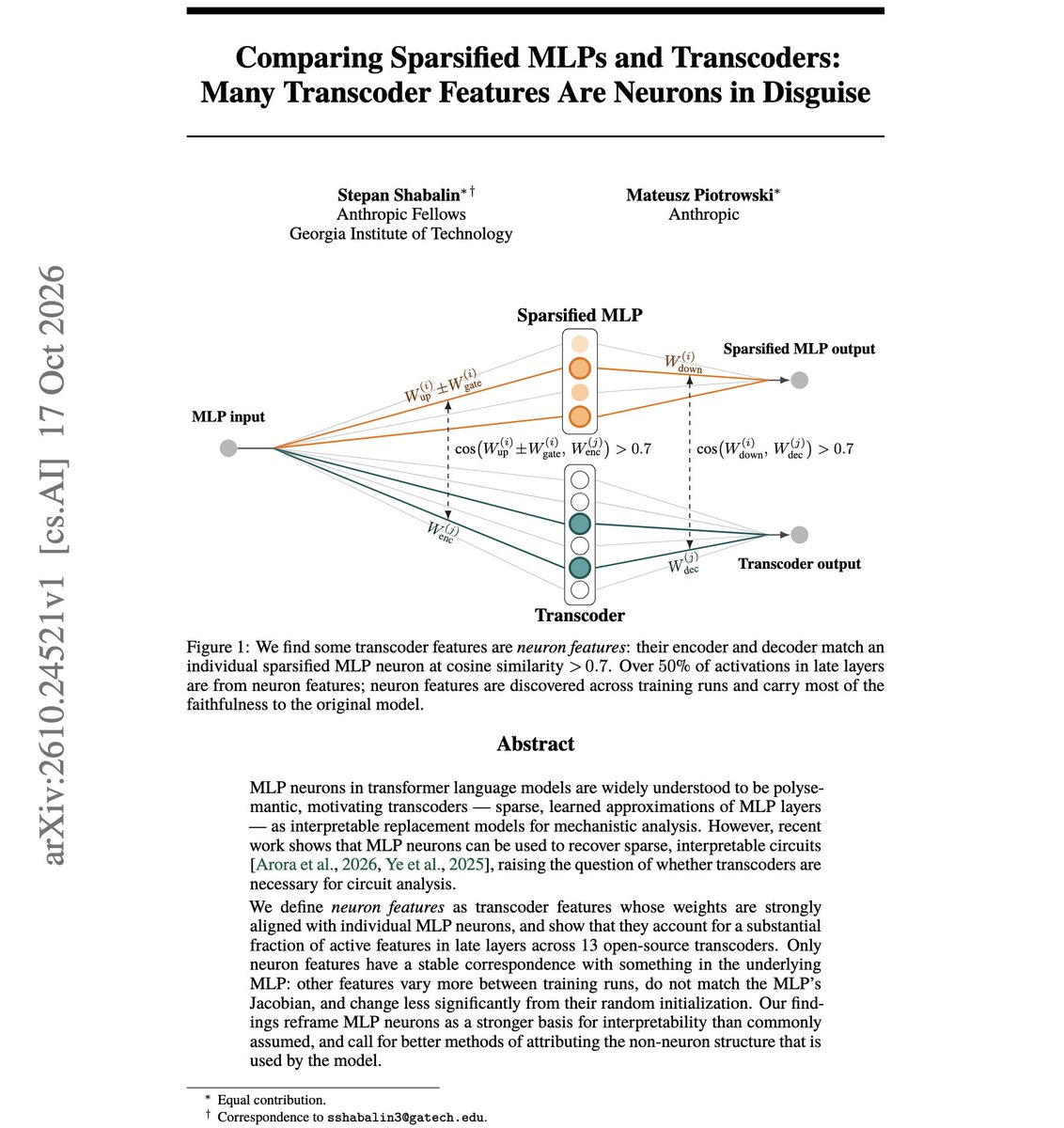
Interesting work from Anthropic. They reframe MLP neurons as a stronger basis for interpretability than commonly assumed. It is standard practice to study circuits with transcoders, because individual MLP neurons are considered too polysemantic to interpret. They find that many active transcoder features in late layers are close copies of single MLP neurons. They measure this across 13 open-source transcoders. These neuron-aligned features are also the only ones with a stable link to the underlying MLP. The other features change more between training runs, don't match the MLP's Jacobian, and move less from their random initialization. That makes MLP neurons a stronger starting point for interpretability than usually assumed. It also means the non-neuron transcoder features need better validation before they are used to explain model behavior. https://t.co/JBiBt9yeVh Chat with Paper: https://t.co/0Rwb1GVLH8
- 14Replies
- 35Reposts
- 249Likes
- 13KViews
@omarsar0 ·
Fast inference is becoming increasingly important for agents. As proactive, always-on agents rise and demand for multi-agent systems for complex tasks grows, heterogeneous compute matters. @general_compute is solving a critical problem here, and this @positron_ai partnership makes a lot of sense.
- 3Replies
- 0Reposts
- 20Likes
- 5.8KViews
@omarsar0 ·
Very cool to see more specialized models. This is the first dedicated AI design model I've seen. I am bullish on specialized models, as they are easier to encode things like taste and understand intent. This makes models like Vyb easier to use for design, to avoid the slop and generic outputs of today's generalized AI models. More of this, please.
- 5Replies
- 0Reposts
- 24Likes
- 8.2KViews
@omarsar0 ·
As owning your intelligence stack matters more than ever, reliable access to AI infrastructure and agent compute is key to realising that vision. I’d like to see more of that capacity easily available to builders running experiments and post-training. That’s what interests me about @shadeformai’s Flex VMs announcement. Congrats @edsgoode and team!
- 6Replies
- 3Reposts
- 20Likes
- 6KViews
@omarsar0 ·
Home robots need taste too. Personalized agents are a super interesting new trend I am bullish on. If a robot is going to live in my home, I want one I like having around. @roboticscorp is building robots for that. The first 999 units are numbered and open for reservation today.
- 4Replies
- 0Reposts
- 19Likes
- 5.4KViews
@omarsar0 ·
Is harness engineering dead? Absolutely NOT! Like the "prompt engineering is dead" and "RAG is dead" claims, this is just another misinformed claim used for clicks and ragebaiting. Mostly, it stems from a few recently published papers with poor experimental setups that focus only on SWE on already benchmaxxed SWE benchmarks. If we are talking about SWE, of course a lot of the harness stuff is getting absorbed by the model. And that's great. Thanks to better approaches for co-evolving harnesses and models. But in reality, you still need a stable, minimal harness to get high-quality results reliably and affordably. The big issue I see is that we assume SWE won't evolve. It already has, and as a result, teams are finding they need specialized harnesses to improve code review, cybersecurity, and work in more complex environments (multi-agent systems, sandboxes, etc.). The harness isn't just about prompts; it's the scaffolding that makes AI models work in the real world, covering…
- 53Replies
- 7Reposts
- 68Likes
- 12.6KViews
@omarsar0 ·
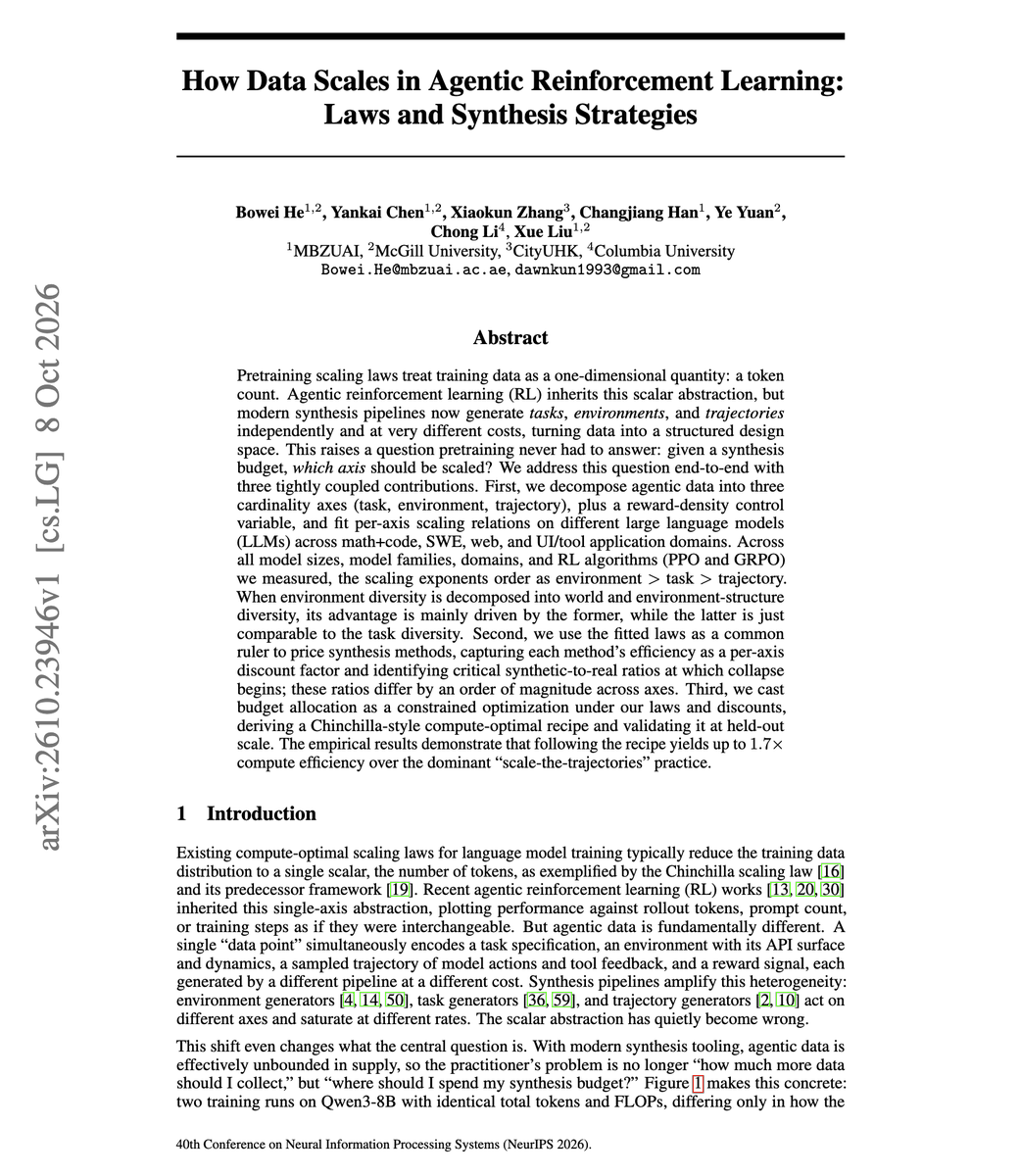
Brilliant paper on scaling laws for agentic RL data. It's a great paper worth reading if you are synthesizing data for agentic RL. (bookmark it) They fit scaling laws for agentic RL data along three axes: tasks, environments, and trajectories. Across model sizes, families, domains, and both PPO and GRPO, the exponents order the same way, with environments above tasks and tasks above trajectories. The environment advantage seems to come mainly from world diversity, meaning genuinely different settings. Varying the structure of the same world helps about as much as adding tasks. The laws also give each synthesis method a discount factor and a synthetic-to-real ratio at which training starts to collapse. Those ratios differ by an order of magnitude across axes. In addition, allocating the budget with their recipe gives up to 1.7x compute efficiency over the common practice of generating more trajectories. https://t.co/QXcqdIu1D5 Chat with Paper: https://t.co/YcyRKpTtTI
- 48Replies
- 36Reposts
- 236Likes
- 21KViews
Formats
Content mix
- Text only
- 40%
- With media
- 50%
- With links
- 10 posts
- With hashtags
- 0 posts
Creator style: Visual-led creator
See the full app
This creator report is one small part of Xholic
Click through a sample creator's account in the real app. No sign-up, nothing to install.
- Posts written in your voice and scheduled for your best hours
- Buyers found on 𝕏, with a reply drafted for each one
- Analytics that show which posts grow you
No sign-up or login needed · Takes about 2 minutes
Grow your own account
Want numbers like @omarsar0's?
Xholic writes posts in your voice, schedules them for the hours your audience is active, and tracks what's working every day.
$0 today · Card required · Cancel anytime
Live demo: no sign-up or login needed · takes about 2 minutes
Keep browsing
More in AI & developers
See all of AI & developers


Keep exploring
Free tools
- Compare Twitter AccountsPut two public accounts head to head and see who leads on views, engagement, grade and posting pace.
- Twitter Engagement Rate CalculatorCalculate engagement rate from your numbers or a public profile and grade it against your tier.
- X Monetization CalculatorChange the assumptions behind six X revenue models and compare gross revenue with direct contribution.
Guides
- How to Write a Tweet With an AI Tweet GeneratorTurn a rough idea into a tweet worth posting: write a specific prompt, pick a tone and length, compare three drafts and make the best one sound like you.
- How to Analyze Any X Profile and Read the ReportAnalyze any public X profile and read the report properly: how each metric is calculated, what is measured vs estimated, and three worked readings.
From the blog
- 10 X Analytics API Alternative Options for 2026Compare 10 X analytics API alternatives for 2026, from low-cost data providers and custom scrapers to enterprise listening platforms.
- Twitter API Examples: A Practical Guide for BuildersExplore real Twitter API examples with code, auth flows, rate limits, and patterns for posting, streaming, analytics, and growth workflows on X.
Best tweets on this topic
- Best tweets about Vector DatabasesBrowse the best tweets about vector databases, covering embeddings, indexing, retrieval, Pinecone, Weaviate, Qdrant, Milvus, benchmarks, and architecture.
- Best tweets about Open-Source AIBrowse the best tweets about open-source AI, open-weight models, community tools, training, deployment, licensing, and research. Updated every two weeks.
- Best tweets about Google AI StudioDiscover the best tweets about Google AI Studio, covering Gemini API prototypes, prompting, structured output, model testing, and developer workflows.
About this data
- Analytics are inferred from public profile and recent post data. They do not include private impressions, profile visits, link clicks, or follower-source data.
- Deleted, protected, unavailable, or rate-limited posts may be missing from the sample.
- Stats come from public posts Xholic has stored, not private X Analytics. Xholic is not affiliated with X Corp or @omarsar0.
- Own this account and want it hidden? Email support@xholic.ai — we verify ownership and handle requests within 2 working days.