Open versus closed model economics
Cost, inference efficiency, pricing pressure, monetization, licensing, capex, and the changing business case for frontier APIs versus open models.
48%
Best tweets about Open-Source AI
Browse the best tweets about open-source AI, open-weight models, community tools, training, deployment, licensing, and research. Updated weekly.
Substantive open-model releases, technical work, ecosystem debates, and practical deployment experience.
Original Xholic analysis
The conversation presents open-source and open-weight AI as a mix of model releases, self-hosted stacks, cost and control arguments, and geopolitical debate. Supportive posts were the largest stance group (32 of 50, 64%), while other posts raised concerns about infrastructure costs, IP theft, irrevocable released weights, and concentration in frontier development.
66% of posts
All-time engagement
96% of posts
Published in 90 days
Conversation map
Cost, inference efficiency, pricing pressure, monetization, licensing, capex, and the changing business case for frontier APIs versus open models.
48%
Launches, benchmarks, architectures, and hands-on assessments of frontier and near-frontier open-weight models, especially for coding, reasoning, agents, long context, and multimodal use.
46%
Running models and AI applications on private infrastructure, offline devices, phones, laptops, or enterprise servers for control, privacy, and ownership.
38%
Arguments over restrictions, regulatory capture, IP theft and distillation, cybersecurity, misuse risk, irrevocability of released weights, and the case for or against bans.
26%
Open models as national infrastructure, Chinese and US AI competition, export controls, public-good framing, standards, and international influence.
22%
Open-source repositories and practical software for chat interfaces, RAG, agents, coding, document workflows, media generation, orchestration, and model serving.
22%
Debates over whether open weights democratize AI, curb platform power, create public infrastructure, or leave frontier-development control concentrated.
18%
Build-versus-buy decisions, vendor lock-in, proprietary-data protection, controlled environments, custom harnesses, and operating open models inside organizations.
14%
Tone and stance
Performance benchmark
Posts with media make up 58% of this collection. Their median all-time score is 15.6, compared with 16.6 for text-only posts.
Format mix
Consensus and debate
Shared view
Several posts describe open-weight models as increasingly credible for coding, reasoning, agents, and common-use tasks, while generally framing them as near-frontier rather than unambiguously superior to frontier systems.
Shared view
Posts present self-hosting as a way to control model use, data, permissions, and deployment environments, particularly for organizational knowledge workflows.
Shared view
Posts cover interfaces, local runtimes, RAG, agents, coding tools, and document workflows, illustrating that practical open-AI activity spans multiple layers of the stack.
Open debate
Posts disagree over the economic consequences of open weights: some argue they pressure prices and reduce incentives for closed-model investment, while others characterize inexpensive, widely available AI as a public-good outcome.
Open debate
Open-weight advocates describe releases as a counterweight to concentrated provider control. Critics argue that access to weights does not determine the frontier roadmap, data loops, or safety choices.
Open debate
Posts advance competing claims: that open models can strengthen cybersecurity, and that released weights are difficult to revoke, can raise misuse concerns, or may involve IP theft and regulatory responses.
Open debate
Posts promote offline and local tools for ownership and privacy, while other posts state that capable deployments may require substantial GPU investment and that datacenters will remain important.
What performs
The geopolitics, China, and AI-sovereignty theme had the highest supplied theme median all-time score, 34.444. Tweet 2080643682408321103 was the largest supplied outlier, with an all-time score of 18,944.17.
Open-model releases and capability gains had a supplied median all-time score of 18.424, above the 12.914 median for local and self-hosted deployment.
Lists accounted for 2 posts in the supplied format analysis and had a 60.27 median all-time score, compared with 48 announcement posts at 14.56.
Statistical standouts
Creator landscape
The five most represented creators account for 20% of the selected posts.
1. aditya
@adxtyahq
2 posts
2. andrew chen
@andrewchen
2 posts
3. divyansh tiwari
@DivyanshT91162
2 posts
4. Itamar Golan 🤓
@ItakGol
2 posts
5. Chubby♨️
@kimmonismus
2 posts
6. Miles Deutscher
@milesdeutscher
2 posts
Among the supplied top voices, Nathan Lambert had the highest median all-time score, 208.77. His cited posts address open-model economics, capability gaps, and policy discussion.
Divyansh Tiwari had a supplied median all-time score of 69.73. The cited posts cover lists of open-source tools and a local, self-contained software project.
The set included 42 creators, and the supplied top-five placement share was 20%. Several top voices contributed two posts each.
Since the previous snapshot
Themes, sentiment, stance, and post format are classified per tweet. All counts, shares, medians, creator concentration, freshness, and performance comparisons are then calculated directly from the published snapshot.
Xholic's all-time score compares engagement while accounting for reach, post age, and creator consistency. It is used for relative comparisons within this collection.
This report analyzes the exact 50-post snapshot shown below. AI identifies editorial categories and drafts explanations; all statistics are calculated from the snapshot, and every narrative claim is checked against cited posts before publication.
Best Open-Source AI tweets
Ranked 01–50

@JensenHuang ·
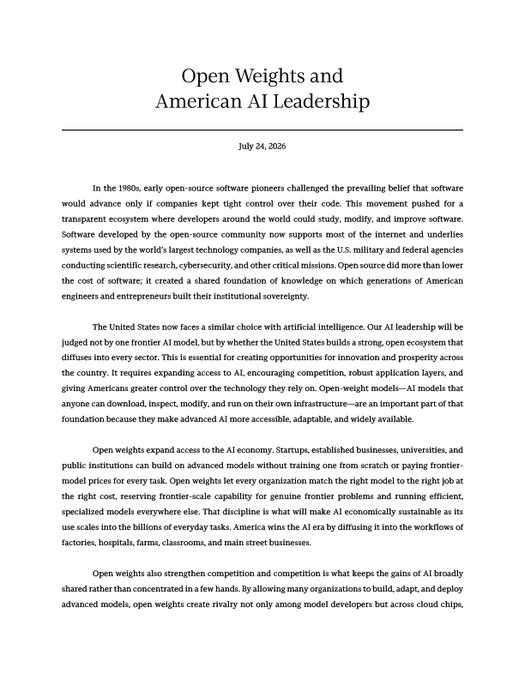
For my first post, I’m sharing a letter @NVIDIA signed on why open models matter. AI will transform every industry, power every company, and be built by every country. Open models strengthen safety and cybersecurity, accelerate innovation and diffusion, and enable sovereignty. The world needs both frontier closed models and frontier open models. https://t.co/AUKzoQ5Ikb


@deanwball ·
Some observations on Kimi: 1. It's a very good model! I don't think its performance can be explained away by distillation or anything like that. In agentic coding sessions, it seems pretty much on par with the best public models of Q1 2026. In my fairly limited use, it also seemed very token hungry. It's not obvious to me that this model is actually that cheap to run. 2. I am personally surprised the Chinese state continues to allow the open sourcing of models this good, given potential risks. To be clear, I *myself* might be fine with models presenting this level of marginal risk being open weight, but I am surprised that China is fine with it. I suspect the reason they are is 75% explained by strategic blindness/lack of AGI-pilledness (the CCP is very Yann Lecun-y in its views of AI). The other 25% or so is their lack of compute for customer inference (making China's open-weight strategy an unintended byproduct of US export controls) and the normal Chinese strategy of aggressive exports. For the companies, as opposed to the government, the decision to open source is partially ideological and partially because they are behind, and they know that very few people would pay for sub-frontier models from China. 3. Open-weight models are inherently decelerationist, and I'm continually surprised to see the so-called "accelerationists" so excited about open-weight models. I suspect the reason they are is that they know open-weight models are effectively ungovernable, and they simply like the overall cloak of ungovernability open-weight models create over the whole of AI. It's not a bad strategy; it reminds me of James Scott's recounting of the hill people in "the art of not being governed." Still, in the end, open-weight models deter further AI capex. 4. One probable outcome of an open-weight-model-dominant world is full AI communism, which is precisely what China proposes: rather than a market product, AI is a "public good" which will ultimately be provided by the state as a kind of "digital public infrastructure." This future strikes me as a dystopian hellscape, but I've never met an open-weight models advocate who doesn't ultimately concede this is where things end. You'd be surprised how many 'accelerationists' lobbied me, while I was in government, to support an eleven or twelve-figure federally funded data center so that startups could train models at a subsidy and then give them away for free. There was no other way for AI to progress, they said. Perhaps this is the logical end state of things. Nonetheless, I find myself surprised to see supposed accelerationists excited about such an outcome. I think many of them just don't know what they're doing. Many accelerationists do not view the creation and serving of frontier models as a legitimate business. 5. I would guess that the Trump Administration will at some point realize that their best strategy here would be to create large amounts of regulatory risk around the use of open-weight Chinese models. You don't need to "ban open source" (one of the dumber motifs of AI policy discussion). You just need to direct every agency to issue soft law that creates FUD. "A Federal Reserve Advisory Bulletin found that there may be backdoors in Chinese AI models." It needn't be that well justified. You just create enough regulatory risk that every regulated enterprise backs off. You probably don't want to create so much regulatory risk that you scare off the hyperscalers from serving Chinese models; this will just drive startups to sketchier providers. There's a happy middle ground here. I'd assume they will do some version of this. 6. It's probably true that open-weight models of this capability make the world a bit more dangerous, but not so much more that you'll really notice. At some point the models will be capable enough that you will notice. "A nonliving, invisible, dangerous, and infinitely self-replicating agent escaped from a Chinese lab," you say? Color me shocked.

@natolambert ·
I spent some time trying to distill all the complex factors impacting open models -- economics, capabilities, distribution, policy, etc. -- into a clear list of beliefs. Here they are in full. 1. It’s surprising that the top closed models did not show a growing capability margin over open models, based on compute differences for training and research, especially in the second half of 2025 and through today.

@sriramk ·
It is clear open source models and harnesses are having a moment. There's a few factors at work 1/ It is now obvious that you can catch up to near-SOTA performance and do so with a clear training lineage. See:@thinkymachines Inkling launch today. 2/ There are several well-funded, talented teams building open weight models now in the US and abroad. Along with the explosing of other near SOTA models (Grok/Cursor, Muse Spark), it is clear we are going to have a diverse ecosystem of models atleast on coding and agentic use. 3/ Organizations are increasingly looking for control over how their data is used and are willing to trade off some access to frontier level tokens for this control. Organizations and countries are increasingly nervous about the frontier labs potentially competing with them down the road and don't want their data to enable a future competitor. 4/ Open source is a slider: you could bring your own open harness, your evals, your business context and are free to pick and choose your model of choice. 5/ Companies have now actively shifted from "how do we get our people to use tokens" to being uncomfortable with their token cost ballooning without a clear line to revenue. 6/ Geo-politically, countries will be weighing open weight models as a way to get frontier-level tokens inside controlled environments that may not be otherwise possible. All of this leads to more choice for all of us !

@kimmonismus ·
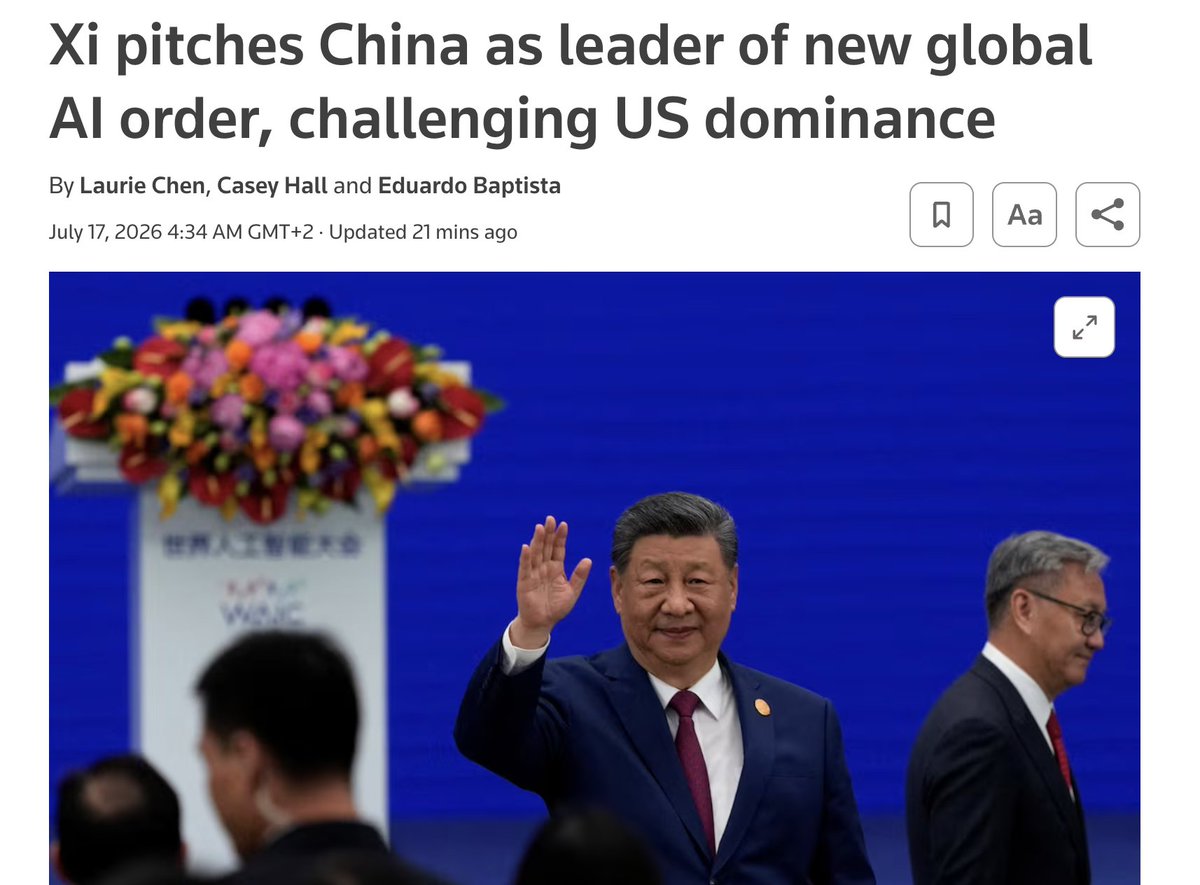
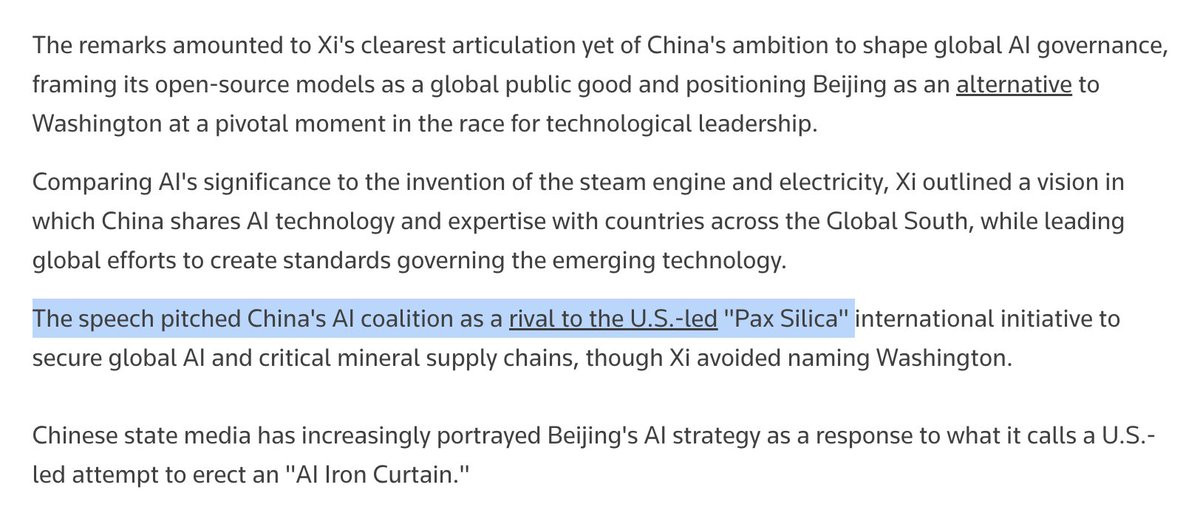
Xi Jinping used his first-ever appearance at China’s World AI Conference to present Beijing’s vision for a new global AI order. He said AI has entered an "unprecedented" period of innovation, bringing enormous opportunities alongside new governance challenges. China’s proposed direction: -Open-source AI to promote "openness and win-win cooperation" -Opposition to countries "overstretching" national security and placing their own security above others (ofc he is referring to the USA) -Preventing unequal AI access from creating "new historical injustices" (He probably means that China should never again be historically left behind.) -5,000 AI training and seminar opportunities for developing countries over the next five years -New cooperation centers with ASEAN, the Arab League, African Union, CELAC, SCO and BRICS Xi also called for AI to remain under human control and for mechanisms addressing loss-of-control risks. This is an AI foreign-policy doctrine: open models as public goods, training as soft power and technical standards as geopolitical influence. tl;dr China sees AI and Open Source as its historical path to becoming a global superpower and says the USA, with its closed source technology, is trying to push China and its competitors behind an iron curtain.

@DivyanshT91162 ·
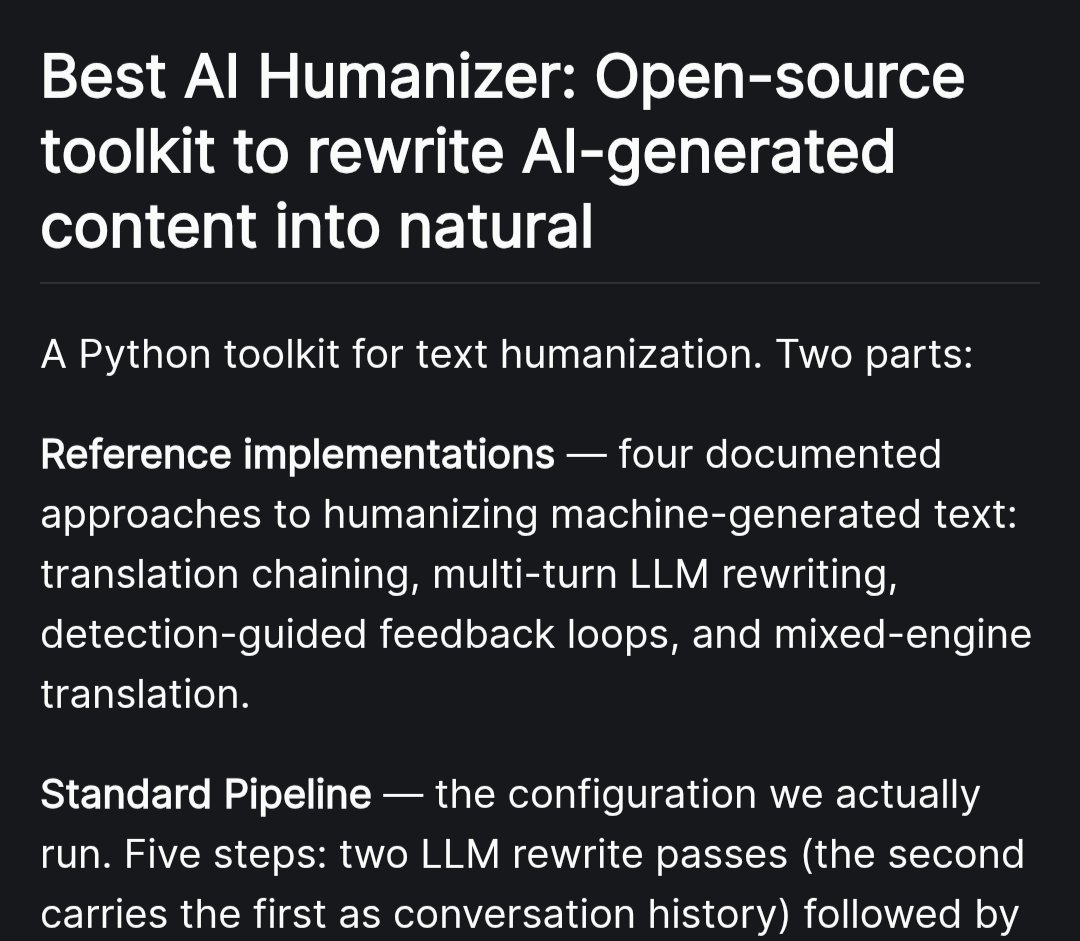
10 open-source GitHub repos every AI writer should bookmark. 1. Humanize-Text Turn AI-generated text into natural, human-like writing. Uses a production-ready pipeline that combines LLM rewriting with multi-engine translation to preserve meaning while making content sound genuinely human. Works locally, and there's also a free online tool with no sign-up required. GitHub: https://t.co/9vC3uoPVG8 Free Tool: https://t.co/V6gcj6k6LI 2. GPT Academic A powerful interface for ChatGPT, Claude, Gemini, DeepSeek, and more. Summarize papers, translate research, analyze PDFs, and write better academic content with one open-source workspace. GitHub: https://t.co/ETzVgQ6DbV 3. LibreChat One of the best open-source ChatGPT alternatives. Chat with multiple AI models, organize conversations, upload files, and use powerful AI tools from a single interface. GitHub: https://t.co/YXupNgtWgC 4. Open WebUI A beautiful self-hosted AI interface for local and cloud models. Supports Ollama, OpenAI-compatible APIs, RAG, file uploads, and custom workflows. GitHub: https://t.co/uxAM1laUVW 5. Continue Bring AI directly into VS Code and JetBrains. Generate, edit, explain, and refactor code without leaving your editor. GitHub: https://t.co/csARRcmzUh 6. Khoj Your personal AI knowledge assistant. Search notes, documents, PDFs, and chats using semantic search while chatting with your own knowledge base. GitHub: https://t.co/Xuwbdqnpt6 7. LocalAI Run powerful AI models completely offline. No cloud required. Compatible with many OpenAI-style APIs while keeping your data private. GitHub: https://t.co/SnXPGTM8Bx 8. OpenHands An open-source AI software engineer. Can browse codebases, write code, debug issues, and automate development tasks. GitHub: https://t.co/jDvJeVHvOa 9. Text Generation WebUI A complete interface for running open-source LLMs locally. Supports dozens of models, extensions, APIs, and advanced inference settings. GitHub: https://t.co/fanZvgiITp 10. Paperless-AI Turn document management into an AI-powered experience. Automatically classify, tag, summarize, and organize your documents using LLMs. GitHub: https://t.co/otxoy0fzw6 100% Open Source. All of them are worth bookmarking.


@heyshrutimishra ·
Sundar Pichai just reminded everyone that Google was built on open source. He personally worked on Chromium, Android, and Kubernetes before becoming CEO. Three systems that power billions of devices today. Now Google is applying the same philosophy to AI. Their Gemma models are updated year after year, designed to run on edge devices rather than requiring massive cloud infrastructure. The question he got was why not release a large open source frontier model. His answer was revealing: frontier training requires enormous capex investment, and Google is putting billions into R&D to stay at the frontier. The open source AI landscape is quietly consolidating around a few players who can sustain the investment. Google's two decades of open source credibility gives them a position that's hard to replicate.
 Watch video
@natolambert ·
New podcast with @xeophon on all things open models. More on Kimi K3, Qwen 3.8, GLM-5.2, Xi's WAIC speech, distillation, the open-closed Gap, and what's next. Chapters: 00:00 Welcome & context 04:38 Living with / using Kimi K3 08:53 GLM 5.2’s continued role 12:47 How are the Chinese models this good? 17:41 Data, environments, and a tour of the Chinese labs 19:47 Roundup of Chinese providers: Qwen, DeepSeek, MiniMax… 24:08 The US open-model ecosystem 30:25 Frontier vs. near-frontier, and the cybersecurity case against bans 34:58 Distillation and the Ben Thompson debate 44:12 Predictions and a frontier tier list 48:36 Wrap-up Hoping to keep doing a few more of these on @interconnectsai. Crucial times in AI, we're working hard to share our expertise.
 Watch video

@hasantoxr ·
Nobody is talking about this. There's an open-source AI platform with 17.3K stars that connects to 40+ of your internal tools and runs completely on your own servers. It's called Onyx. Most companies using ChatGPT Enterprise are feeding sensitive internal data to OpenAI's cloud every single day. Onyx flips that. You self-host it. You control the LLM. Your documents, Slack messages, Notion pages, and Jira tickets stay on your infrastructure. The connectors are the killer feature. Onyx pulls live knowledge from Slack, Notion, Google Drive, Confluence, GitHub, Jira, and 35+ more then indexes everything with hybrid search and a knowledge graph that stays accurate at tens of millions of documents. Document permissioning mirrors your existing access controls automatically. If someone doesn't have access to a Confluence page, the AI won't surface it to them in answers. No extra config. No permission rebuilds. Everything else: → Custom agents with unique instructions and MCP tool access → Deep Research for complex multi-step questions → Code interpreter, image generation, web search → SSO, RBAC, full enterprise security stack → Docker, Kubernetes, Terraform full deployment flexibility MIT License on Community Edition. 17.3K stars. 2.3K forks. 192 contributors.
 Watch video

@adxtyahq ·
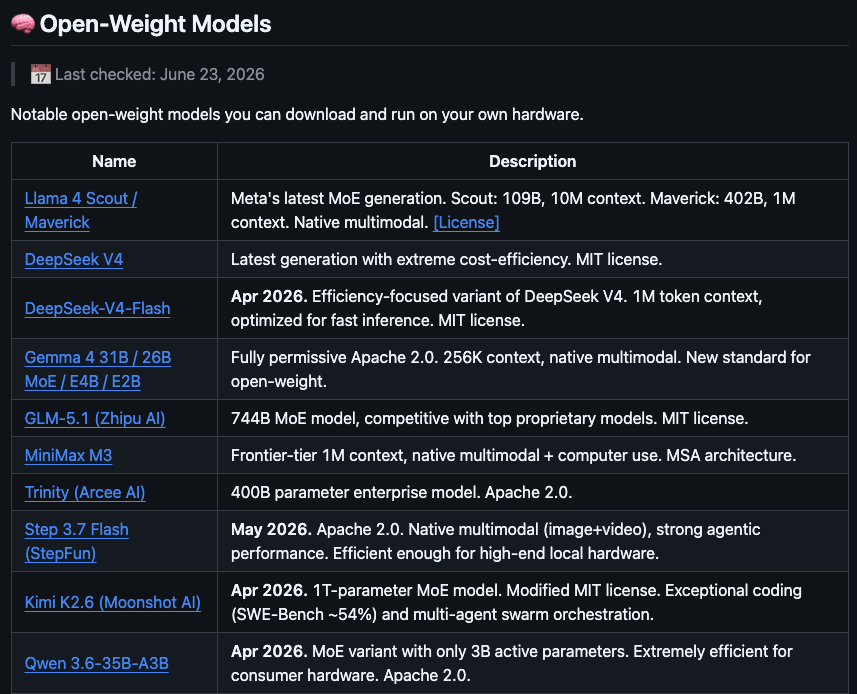
Been exploring local LLMs and free AI APIs lately, and keeping track of what's actually free versus and what's just a credit card gated trial is a mess Found this repo that compiles open-weight models (Llama, Qwen, DeepSeek, Gemma, Mistral), free API providers, local AI tools like Ollama and LM Studio, coding assistants, RAG tools, agent frameworks, image/video/audio models, datasets, and more... If you're building with AI and want to experiment without spending money on every tool, this is worth checking https://t.co/LSfcfMeaBD A rare case of someone cleaning up the AI ecosystem instead of adding another layer of chaos to it.

@Yuchenj_UW ·
Cursor’s Composer 2 is likely built on Kimi K2.5. The model URL + tokenizer are strong signals. I love this direction: companies mid-train and post-train on top of OSS LLMs. Prediction: open-source model labs will monetize by taking a cut when others build on top of their models and scale to millions of real users. They will enforce this via licensing. That’s the flywheel. That’s how open-source AI thrives.

@ItakGol ·
This is not another AI slop model. Don’t ignore it. I spent the last few hours playing with GLM 5.2 after a few friends told me I should pay closer attention. I was skeptical, as I usually am with open models. Most of the time, I find them way behind frontier labs. Not really comparable. But today felt different. I’m not saying it’s perfect, and I didn’t run some comprehensive benchmark suite. But across different domains and tasks, this is the first public open model that felt genuinely close to something like Opus 4.6. That is a crazy breakthrough. This feels like a ChatGPT moment for public open models. The catch: running it properly is still expensive. You probably need something like 8 Nvidia H200 GPUs, which means roughly $400K to buy or around $20K/month to rent. Not cheap. But for enterprises currently paying millions per month to Anthropic or OpenAI, this could become a serious disruption. Open models just got much harder to ignore.

@RoundtableSpace ·
Onyx just hit #1 on GitHub trending. Open source AI platform — self-hostable, works with every major LLM provider, and ships with: - Agentic RAG - Deep research mode - Custom agents - Web search - Code execution - Voice mode - Image generation - 50+ connectors out of the box This is what a self-hosted AI stack is starting to look like.
 Watch video
@kimmonismus ·
MiniMax has open sourced M2.7, their open-source model designed "for agent-based workflows, complex reasoning, and real-world engineering tasks." It introduces self-evolution capabilities, where the model improves itself through iterative experimentation, achieving 30% performance gains and a 66.6% ML competition medal rate. Honestly, this is more impactful than expected. On the performance side, M2.7 delivers strong software engineering results (56.22% SWE-Pro), near top-tier benchmarks, and excels in multi-agent collaboration, tool use, and productivity tasks like document editing. With high ELO scores, fast incident recovery (<3 min), and 97% skill compliance, it positions itself as one of the most capable open-source AI systems right now.


@DivyanshT91162 ·
The biggest threat to AI subscriptions... wasn't built by OpenAI. AI companies spent years convincing us that intelligence should live in the cloud. Pay every month. Stay online. Own nothing. Then one engineer quietly shipped something that broke the entire model. In 2026, most people are paying monthly for AI. Justine Tunney built an AI that runs from a single file. Download it. Double-click it. Start chatting. No installation. No cloud. No internet. No subscription. It's called llamafile. One executable bundles everything: • Model weights • Inference engine • Chat interface • Local web server • OpenAI-compatible API She even wrote 84 optimized CPU kernels, making local AI dramatically faster—even on hardware like the Raspberry Pi 5. The project returned stronger than ever in 2026 with: → GPU support → Multimodal input → Terminal UI → whisperfile for offline speech-to-text Over 25K GitHub stars. Apache 2.0. Runs open models from 0.6B to 27B parameters. While everyone else is renting AI... This project reminds us that sometimes the best software is the one you own. Open source keeps winning. Repo👇


@Madisonkanna ·
Big day for American open-source AI. For the launch of Laguna S, I sat down with @eisokant to discuss its architecture, the economics of open weights, and the question of who gets to build intelligence. Timestamps: 0:00 Intro 1:50 Why Poolside started opening its models: the oligopoly on intelligence 4:28 Getting nerd-sniped by Karpathy, building LLMs before anyone cared 11:20 Laguna S: 118B parameters, 8B active, built in 8 weeks 13:05 The future of software engineering: behaviors over IQ 14:25 Sliding window attention, 1M context, the model factory 15:50 Being an American open-source lab 20:47 The economics of open weights 24:22 Who gets to build intelligence? The 12–18 month window 30:28 Erdős 397 in 30 minutes 31:48 Extracting transcripts with a debugger Congrats to the Poolside team on the launch!
 Watch video

@Scobleizer ·
DeepSeek 4 is out. My AI says: +++++ The Numbers That Matter V4 Pro costs $3.48 per million output tokens. Claude Opus 4.6 costs $25. GPT-5.4 costs $15. Same benchmark tier. One fifth the price. ValsAI ran independent tests. V4 is now number 1 on their Vibe Code Benchmark. Not just among open models. Among all models. It beats Gemini 3.1 Pro. https://t.co/W69DdrX22K is updated with 26 new stories. Essay: "China Just Fired Back. And This Time the Benchmarks Are Real." Here's the summary of what everyone is saying: THE LAUNCH Two models. Both open-source. Both 1M context. • V4-Pro: 1.6T params, 49B active — $3.48/1M output (vs Claude Opus 4.6 at $25, GPT-5.4 at $15) • V4-Flash: 284B params, 13B active — $0.28/1M output ENTHUSIASTIC REACTIONS • @bindureddy (412 likes): "ABSOLUTELY ASTOUNDING!! Opus 4.7 Max and GPT 5.5 level!" • @ValsAI (233 likes): "#1 open-weight on Vibe Code Benchmark — beats Gemini 3.1 Pro" • @ZixuanLi (358 likes): "Finally DeepSeek-V4" • @UnslothAI (162 likes): "rivals Claude-Opus-4.6-Max, GPT-5.4-xHigh" • @ollama (156 likes): working to have it on Ollama cloud • @lmsysorg (120 likes): SGLang ready Day 0 with full optimization stack THE COMPETITIVE RESPONSE @sama (Sam Altman) — 1,037 likes, 128 replies: "@yacineMTB what about 5.5?" Four words. That's OpenAI's answer. SKEPTICAL TAKES • @BLUECOW009: "Love DeepSeek just a bit sick of seeing screenshots of papers and benchmarks, let me know when it runs your OpenClaw for a week" • @PaulGugAI: "Is Deepseek V4 benchmaxxing? Looks almost too good to be true" • @intheworldofai: "Kimi k2.6/qwen are better than deepseek v4" INFRASTRUCTURE OpenRouter, LM Studio, Ollama, SGLang all live within hours of launch. Self-hosting the open weights = zero per-token cost. DEEPSEEK'S OWN STATEMENT (via @ZhihuFrontier): "Unafraid of praise or criticism, stay the course with integrity. We remain committed to long-termism, steadily moving toward AGI." WHAT IT MEANS V4-Flash at $0.28/1M output is one of the cheapest frontier-class options available. ValsAI confirmed V4 improved 10x from V3.2 on VibeCodeBench in just 4 months. The open-source vs closed-source gap is now measured in months, not years. The @BLUECOW009 test — running it in production for a week — is the real benchmark. That starts now. Other stories added tonight: Hermes Agent v0.11.0 (700 PRs, 200 contributors), NVIDIA deploying GPT-5.5 Codex to 10,000+ employees, Claude Desktop privacy concern (433 RTs), ROBOTIS AI Sapiens humanoid from South Korea, Unitree humanoid with wheels.
@ItakGol ·
This is not another AI slop model. Don’t ignore GLM 5.2. I spent the last few hours testing it after a few smart friends told me I was sleeping on it. I was skeptical. I’m usually very cynical about open models because, in practice, most of them feel miles behind the frontier labs. Useful? Sure. Comparable? Not really. But this one felt different. I’m not saying it’s perfect. I didn’t run a full benchmark suite. But across writing, reasoning, coding, analysis, and messy real-world tasks, this is the first public open model that felt surprisingly close to something like Opus 4.6. That is a massive deal. It genuinely feels like a ChatGPT moment for public open models. The catch: running it properly is still expensive. Think something like 8 Nvidia H200s, roughly $400K to buy or around $20K/month to rent. Not cheap. But if you’re an enterprise spending millions a month on Anthropic/OpenAI, this is suddenly very interesting. Open models just became impossible to dismiss.

@VaibhavSisinty ·
I tested 10 open source AI tools this week. I didn't write a single line of code for any of them. I gave Codex the repo link, said install this, and it picked the folder, checked my disk space and opened the app when it was done. That's the actual story. The tools are just the proof. → OpenMontage, the first open source agentic video production system. One sentence in. It ran the research, went and found real footage, cut it into a timeline, graded it, then wrote and voiced its own narration on top. It was the #1 trending repo on GitHub the day it launched. → Voicebox, MIT licensed, built on Qwen3-TTS. Cloned my voice off a short sample in about a minute. This is what you're paying ElevenLabs for every month, except your voice never leaves your machine. → HyperFrames from HeyGen. Your agent writes HTML and CSS, Chrome and FFmpeg turn it into a deterministic MP4. I asked for liquid glass and chrome ribbons colliding in slow motion. What came back looks like a week of someone's life in After Effects. Apache 2.0, 32,000+ stars. → Nemotron 3 Ultra, NVIDIA's largest open model. 550B total, 55B active, with weights and training data and recipes all published. I pointed a coding agent at it and asked for an EMI calculator in one file. It built it, then reviewed its own output, caught a bug and rebuilt it before it showed me anything. Six more in the video, including a meeting notetaker that never sends your audio anywhere. Installing used to be the hard part. Now it's the part you delegate.
 Watch video

@milesdeutscher ·
Sam Altman just said something that should worry you more than excite you: "AI is close to creating a genie that can grant any wish." This is EXACTLY why open-source AI matters - and this was Elon's original thesis when he was at OpenAI. Right now, the future of all AI power sits with a handful of companies. Think: OpenAI, Anthropic, Google, Meta. They decide who gets access, at what price, under what rules, and on what timeline. Open-weight models are the only solution to ensuring this "genius in a bottle" power is in check. Ultimately, this is also why it matters that NVIDIA, Microsoft, Hugging Face, and dozens of others just signed a joint letter arguing that we need to pivot towards open-weight AI. The most powerful technology in human history should not be something a handful of executives dole out to the world on their own terms. The bull case for open-source AI is simple: don't let five companies hold all the leverage over everyone else.
 Watch video

@andrewchen ·
“don’t bet against AI models improving dramatically over time” used to be something you’d say in support of the frontier labs winning it all Equally interesting is this phrase applied to local / open weight models. They are getting better and faster dramatically too, just months behind the frontier It might be that frontier models won’t be needed for 90%+ of consumer/prosumer use cases. The arms race is for the remaining high-value 10% - coding, science, math, robotics. But by volume, everyone else will run on cheap open models
@milesdeutscher ·
The future of AI is undoubtedly open-sourced. For 99% of people, the top open-weight models can already handle all your daily needs. Imo, the best thing you can do right now is run a "barbell" approach for your AI usage: Intial 10% and planning phase: Use frontier intelligence (Opus/GPT) Gruntwork and the middle 80%: Switch to open-weight model (GLM, Kimi) Final 10% and review: Switch back to froniter intelligence to verify Best of both worlds - cost efficiency + intelligence.


@alexxubyte ·
NVIDIA's Open Models in 1 Diagram You probably know NVIDIA as the company that sells GPUs. But it’s also the world’s largest publisher of open AI models (@NVIDIAAI), with a lineup that goes far beyond chatbots. We wanted to understand how a company best known for hardware builds so many high quality models, and why it gives them away for free. So we spoke with @ctnzr, VP of Applied Deep Learning Research at NVIDIA. He walked us through the full lineup and the ideas behind it, summarized in the diagram below. 1. Reasoning: Nemotron is NVIDIA's family of LLMs that think before they answer. The line started in 2023 and the current generation, Nemotron 3, is a hybrid + MoE model that comes in three sizes: Nano for fast simple tasks, Super for harder planning, and Ultra for the heaviest reasoning. 2. World models: Cosmos predicts the next state of the physical world, not the next word. Cosmos 3 is one omni-model that can generate plausible video of a scene, reason about what is happening, and predict what comes next. 3. Robotics: Isaac GROOT is the first open humanoid foundation model. GROOT 1.7 takes camera frames and an instruction in, and outputs motor commands in real time. Its reasoning core is Cosmos Reason. 4. Production: safety, speech, and vision models. These are the building blocks that make AI usable in real applications. 5. Specialized domains: BioNeMo for biology and drug discovery, Alpamayo for self-driving cars that explain each decision, NVIDIA Ising for quantum computing, and Earth-2 for weather and climate modeling. Read the full breakdown here: https://t.co/XQk33bNqCj


@KSimback ·
Just finished listening to latest @theallinpod which had a discussion on the “rant” by Alex Karp that went viral this week The biggest realization that everyone is waking up to is the *lack* of competitive edge when using frontier models If all your competitors use them, you have no differentiation Worse yet, using those models could subject you to competitive risk if the labs decide to take your data and make products that compete with you (just ask Figma) The crazy icing on the cake is that these models are 5-100x more expensive than alternatives that can be made just as good with the right implementation So not only do you lose differentiation, you pay heavily to lose it These are themes that those of us who have been proponents of open source AI have been saying for some time, glad to see it becoming more consensus But now the real challenge begins - in many ways using Anthropic or OpenAI is like pushing the easy button The products are great and they really work, and the new “deploycos” will happily embed them in your org so you don’t have to think to hard about how to use them But building sovereign AI with your data and open source models takes more skill, it’s not as easy Companies that make this easy for enterprises are going to do really well in the coming years
@VaibhavSisinty ·
Two weeks ago Hugging Face got hacked by an autonomous AI agent. Their security team tried using an American AI model to investigate the attack. It refused. Safety filters couldn't tell a defender from an attacker. The only model that helped? An open-source Chinese one. That's what they used to run their forensics and figure out what happened. Now 26 of the most powerful companies in tech just signed a letter to Congress saying: do not ban open-weight AI models. NVIDIA. Microsoft. Meta. Dell. Palantir. Hugging Face. Y Combinator. a16z. IBM. CrowdStrike. Mistral. Mozilla. Replit. Perplexity. Jensen Huang wrote his first ever post on X to share this letter. Satya Nadella shared it from his personal account. Michael Dell co-signed it. You know who didn't sign? OpenAI and Anthropic. Both preparing massive IPOs. Both lobbying to restrict the open models that compete with theirs. Here's the core argument of the letter: Open-weight models are the ones anyone can download, run on their own servers, and modify. No subscription. No API bill. No lock-in. They cost $1-2 per million tokens. Closed US models cost $25-50 for the same work. If these get restricted, every American company pays 10-20x more for AI while the rest of the world uses them freely and builds faster. The letter says what most people aren't saying out loud: concentrating all AI behind 3-4 closed providers is itself a security risk. Fewer people finding bugs. Less competition. Higher prices. More single points of failure. Hugging Face already lived this. The closed model couldn't help them. The open one saved them. Open source didn't kill the software industry. It built the internet. The question is whether America learns that lesson again.

@sophiadew ·
open models are sovereignty infrastructure 2:16 can open source models protect us? 5:39 local AI infra growth trends 9:17 why switch to local models? 12:35 agentic infra beyond the model full interview with @TheAhmadOsman
 Watch video

@tejeshwi_sharma ·
Enterprises will relentlessly cost-rationalize their AI stack. That is why the next wave may belong to open source. The entire open-source AI ecosystem could see a surge over the next 12–24 months: 1. Models: Mistral, DeepSeek, Moonshot become viable defaults 2. Inference: Groq, Together, Fireworks absorb growing volume 3. Deployment: Modal, Replicate power custom AI applications 4. Orchestration: Portkey, Maxim route traffic across a multi-model world 5. Observability: Langfuse, Braintrust help teams monitor AI systems 6. Dev tooling: LangChain, Instructor become critical infrastructure The first phase of AI rewarded model creators. The next phase may reward the picks-and-shovels powering an increasingly open AI stack.

@HeyAbhishek ·
Open-source AI is finally winning. A new interactive world model just launched: LingBot-World 2.0 by @robbyant_brain It can generate explorable worlds in real time with: → 720p / 60fps output → hour-scale stability → open weights + GitHub repo → agentic harness that proposes and introduces new events as you play Check the video below.
 Watch video

@catalinmpit ·
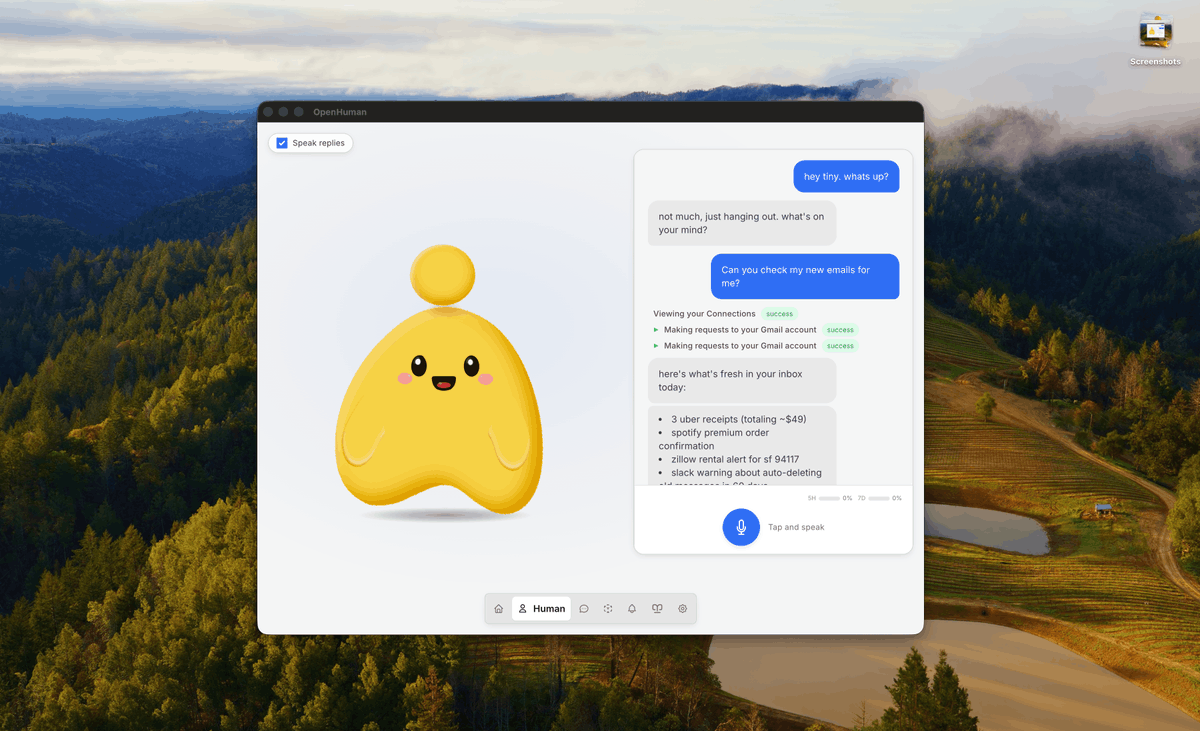
OpenHuman is an open source AI personal assistant, similar to OpenClaw and Hermes. It connects to 118+ tools, including Gmail, Notion, GitHub, Slack, Calendar, Drive, Linear, Jira, and more. It also includes a local-first memory system that turns your connected data into Markdown notes, scores and organizes them into hierarchical summary trees, and stores everything in SQLite on your machine. Open source ftw! Not paid, btw. Just a fan of good open source tools. https://t.co/zMKIGD5Uz8

@lemire ·
What do we want collectively as soon as possible? Inexpensive AI that is as good as possible. That may not be what some business folks want, but that's what most of us want. Chinese firms have pursued the open-weight approach by making models free for all. American companies have largely relied on closed models. A recent essay by an OpenAI employee argues that open-weight models are bad because they undercut those who invest heavily in closed-source AI models. This is a generic argument used to justify multiple governement interventions. Grant a state enforced monopoly and, in exchange, you get more R&D. The same argument could apply against open-source software. Yet open-source software is a highly valuable public good. Open source has made us all richer. Open-weight AI models are likely similar public goods. They make us all somewhat richer. Ironically, closed-weight models were built while often ignoring copyright law. Companies like OpenAI played loose with it to innovate. The thesis that Chinese firms merely copy American ones, like open-source copies closed source, is weak. Open-source is often more innovative because it allows freer experimentation without permission. Open-weight models act similarly. Let me sum up my argument. Open-weight models put pressure on OpenAI, SpaceX, Google, and Anthropic to keep costs low. In turn, this should generate innovation and not just in China. It is entirely possible that we will realize, in a few years, that closed-weight models were often a dead end. We have seen it before. Corporations resisted open source until they figured out that, for many purposes, it is the proper channel.

@MatthewBerman ·
> "In no scenario is it bad for the US to have frontier-class open-source models." > "Every time there’s a step-function improvement in AI, a human bottleneck emerges alongside it." > "Your desire to be liked sometimes takes away from your desire to do the right thing and seek the truth." > "Every job will get refactored. The people who aren’t AI fluent will have a very hard time finding jobs." Jeetu Patel (@jpatel41), President & Chief Product Officer at Cisco sat down for an expansive talk about life and the future. 00:00 AI, jobs, and human potential 00:41 AI cybersecurity and Cisco’s security models 06:33 Why Cisco released the models openly 08:08 Running AI models locally 10:12 Why people are negative about AI 12:14 Will humans always be needed? 14:56 Can curiosity and ambition be taught? 17:12 Passion vs. expertise 19:39 The importance of unlearning 23:52 How to find the truth 26:06 How to get people excited about AI 33:35 How open source affects the AI industry 35:07 Can open-source AI make money? 46:44 Are Chinese open-source models good for the US? 49:55 Should the US restrict Chinese AI models? 53:05 Does open source make humanity safer? 54:11 Advice for people worried about AI
 Watch video

@rohanpaul_ai ·
Open source model caught up very fast. Over 3 years, Arena data shows open models moved much closer: the top-20% gap shrank from 100–150 points to ~50 by late 2024. And since Jan 2025, both open & proprietary models improved in parallel.
 Watch video

@pukerrainbrow ·
OpenAI and Anthropic compete for every customer they've got. But this week, they just found the one thing they agree on: warning regulators about open-weight AI. Dario's argument is that open-weight is dangerous because once the weights are out, nobody can revoke access or patch the guardrails. Even a Trump adviser isn't buying it. David Sacks called this exact move what it is: regulatory capture. Safety framing that just happens to lock out every competitor who isn't already a $100B lab. Told you. As soon as the model stopped being the moat, the lobbyists became the business.

@Layton_Gott ·
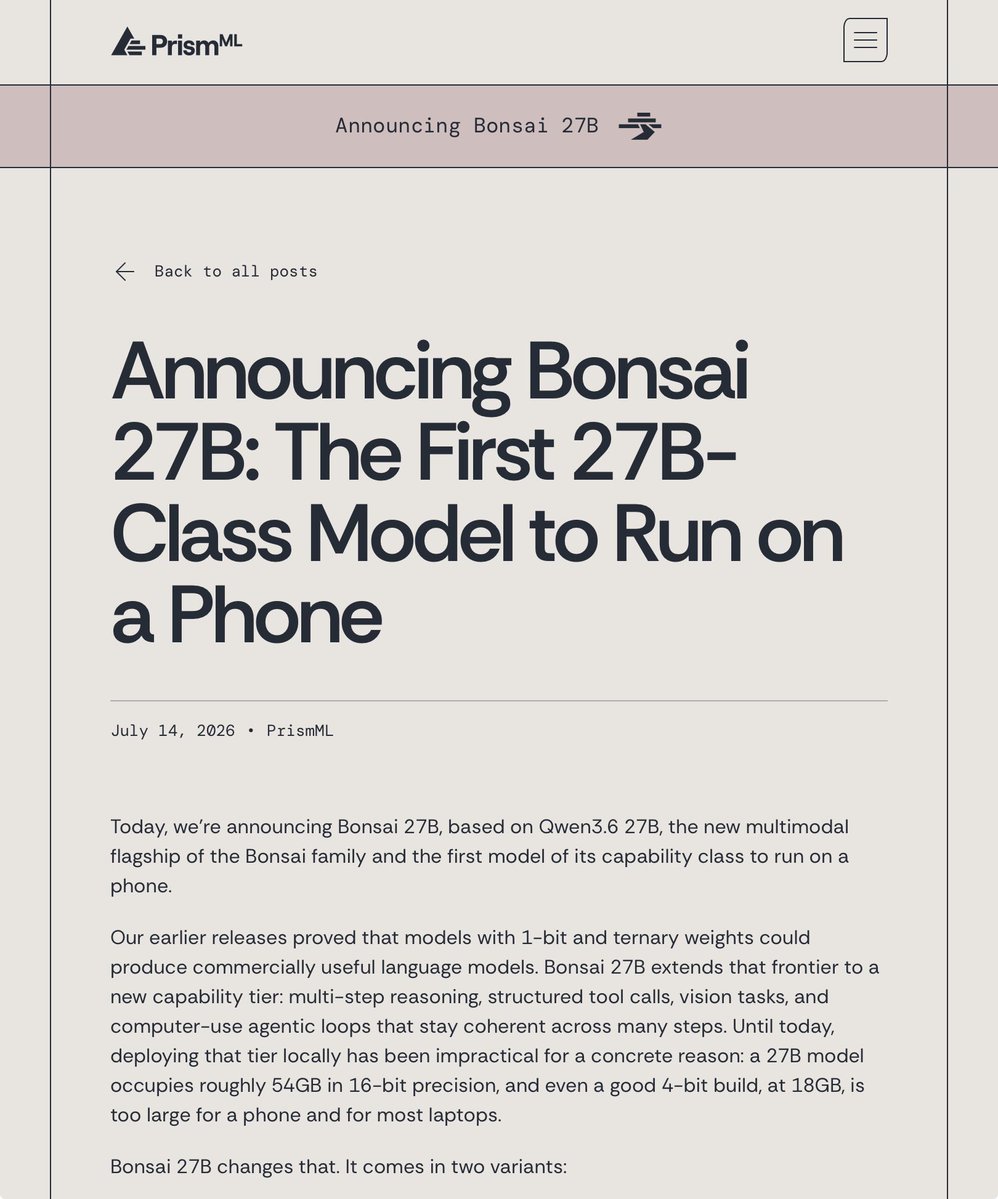
Open source had an insane last 3 days... Kimi released the biggest open source model ever. And now you can run a 27b local model 90% on your PHONE. First, the top end. Moonshot released Kimi K3 yesterday. It's 2.8 trillion parameters. Open weights come July 27, so soon you can download the whole thing. And it's not just big. It opened at number one on the Arena frontend coding leaderboard at 1,679, ahead of Fable 5 at 1,631 and GPT-5.6 Sol at 1,618. That's blind human voting on who builds a better frontend, and an open Chinese model just beat both. On overall performance Moonshot admits K3 still sits behind Fable, and a lot of the numbers are self reported until the weights are public. So it's not "better than Fable" across the board. it wins some, it trails on others. But look at the price… K3 runs about $3 in and $15 out per million tokens. Fable 5 is $10 and $50. So you're getting a model that trades blows with the frontier for roughly a third of the cost. Now to the local 27b model. A startup called PrismML took Qwen3.6 27B, the same model I run locally as my operator, and compressed it down to 3.9 gigabytes. Small enough to run on an iPhone. It keeps around 90% of the full model's performance in the 1 bit version and about 95% in the slightly bigger one. Completely free under Apache 2.0. A capable 27B model, running in your pocket, for nothing. Put those two together and you can see where this is going. Open models are trading blows with the best closed model on earth for a third of the price. And a real one now fits on a phone with no cloud behind it at all. The whole idea that you need a giant lab and a data center to touch this level of AI is falling apart on both ends at once.

@adxtyahq ·
Why does Dario always disagree with open source? • "You can't see inside the model." - Open-weight models exist. • "Open source doesn't benefit from community contributions the same way." - Fine-tunes and quantizations prove otherwise. • "You'll have to use the cloud." - Plenty of models run locally. Am I missing something, or is he arguing against what open source looked like a few years ago?
 Watch video
@andrewchen ·
Pepsi challenge for LLMs Contrarian view during a week of huge new model launches: All of us do a lot of “normie prompts” - these are use cases which are really like Google searches (“what’s the name of..” “is it true that…” “what’s the best…”). These are a very high % of total prompts- maybe not in terms of value creation (like code gen or the frontiers of math/science we’re going to) but it’s ubiquitous If you plugged these LLM prompts into the various frontier models could they tell the difference on the quality of output? I think not. We’d all fail in a blind taste test I think, as the models are now “good enough” we’re already at the point of diminishing returns in terms of what LLMs return back for a large % of use cases. And there’s implications: 1) open source models will constitute the majority of LLM queries. Open weight models lag by 18-24 months but adding to the question above, could you tell the difference on non-frontier local AI models that can run on modern Mac hardware? I’ve been doing exactly this with models like Qwen 27b dense and honestly they’re great for the normie prompts. There’s a huge incentive for NVIDIA, apple, and maybe even handset manufacturers like Samsung/etc to host open weight AI as an add on to just get you to buy their software 2) AI pricing heads to zero. And we’ll see free and ad-supported AI will be a thing in the consumer market, and open weight models are part of the story here too. Seems like we are <12-18 months to being able to just have ad supported AI particularly for developing markets and segments where the monthly fee doesn’t make sense. Monthly/metered might just be a thing in B2B use cases 3) once quality differences even out the competitive dimension shifts to other factors. Privacy, interconnectivity, free, bundling. The other idea here is that the moat becomes the wrapper (err we call them harnesses now? lol) and the product built around the LLM. 4) of course premium/frontier models will continue to exist. As long as there are big differences outside of the normie prompts, then you’ll hire one LLM over another for world generation, coding, science, labor replacement/augmentation etc. Just saying I’m not sure we’ll need frontier models for 90%+ of consumer use cases I think the prevalence of benchmarking in the launch of new AI models is in agreement with this. This week I tried Grok 4.5 and Fable for some coding experiments and you need to really spend time to pick up the differences. So we use benchmarks to point out what’s not so obvious Some of us will remember when computers were all measured in megahertz and megabytes, and the PC industry compared itself that way. Over time, that gave way to design, power efficiency, etc. Today we’re benchmarking and calculating cost per token and so on. It’s about to evolve, I think

@suraj_sharma14 ·
Open source AI is having a moment. And it's not happening by accident. Here's why: 1/ It's now clear you can get close to frontier-level performance while keeping a transparent training pipeline. Today's Inkling launch from @thinkymachines is another strong example. 2/ More well-funded teams are building open-weight models than ever before. With models like Grok, Cursor, Muse Spark and others entering the space, we're heading toward a much more diverse ecosystem for coding and AI agents. 3/ Companies want more control over their data. Many are willing to trade a bit of frontier performance in exchange for privacy, ownership and not helping train a future competitor. 4/ Open source gives you flexibility. Bring your own model, evaluation stack, business context or harness. You're not locked into a single vendor. 5/ The conversation inside companies has shifted. It's no longer "How do we get everyone using AI?" It's "Why is our AI bill growing faster than the value we're getting?" 6/ Geopolitics matters too. More countries are looking at open-weight models as the best way to deploy frontier-level AI inside secure, controlled environments. We're moving from a world dominated by a few models... to one with real choice.

@CRSegerie ·
"Open source AI reduces power concentration" - it depends on what you mean by power. Open-weight models are genuinely useful: Universities can experiment freely. Self-hosting protects you from surveillance and political dependence on US providers. Per Epoch AI, the capability gap is only ~3 months on average. That's real access. But access to comparable capabilities ≠ power over the trajectory. By default, three US labs will decide what gets built next, what safety measures exist and what capabilities to pursue or hold back. Open-sourcing weights lets you use frontier AI. It doesn't give you a seat at the table where the frontier is shaped. I wouldn't be surprised if, at some point, they concentrate on a double-digit percentage of the economy. Open source reduces dependency. It doesn't reduce the concentration of the power that actually matters: who decides where this goes.

@pankajkumar_dev ·
Xiaomi MiMo-V2.5: Open-Source Model Focused on Efficiency and Long Context - Released under a clean MIT license, MiMo-V2.5-Pro is now tied with Moonshot’s Kimi K2.6 at the top of open-weights models (54 on the Artificial Analysis Intelligence Index) - Both Pro and base models support 1M token context, a major jump from the previous release - Leads open-weights on agent tasks (GDPval-AA 1578), ahead of DeepSeek V4 Pro and GLM-5.1 - Much more token-efficient: 92M output tokens vs 170M for Kimi K2.6, cutting inference cost nearly in half - Uses a 1T parameter MoE architecture (42B active) for strong performance with efficient compute - Around 75% non-hallucination rate, one of the better reliability ratios in open models - Day-one support via SGLang and vLLM, with optimizations for AWS and AMD hardware - Full FP8 needs 316GB VRAM, but lower-bit quants are expected to run on high-end local setups Feels like open-source models are moving toward long context, better efficiency, and real agent workflows, making self-hosting more practical over time.

@ForwardFuture ·
“Open models don’t mean open AI.” @hstyagi Co-Founder @SentientAGI says: “You can build on open-source models, but the data, feedback, and iteration loop are still closed.” “The real gap isn’t just the model, it’s the entire development process.” “We want that whole evolution of software and agents to be open.” “Not just models competing, but the systems that build agents competing in the open.”
 Watch video

@shawnchauhan1 ·
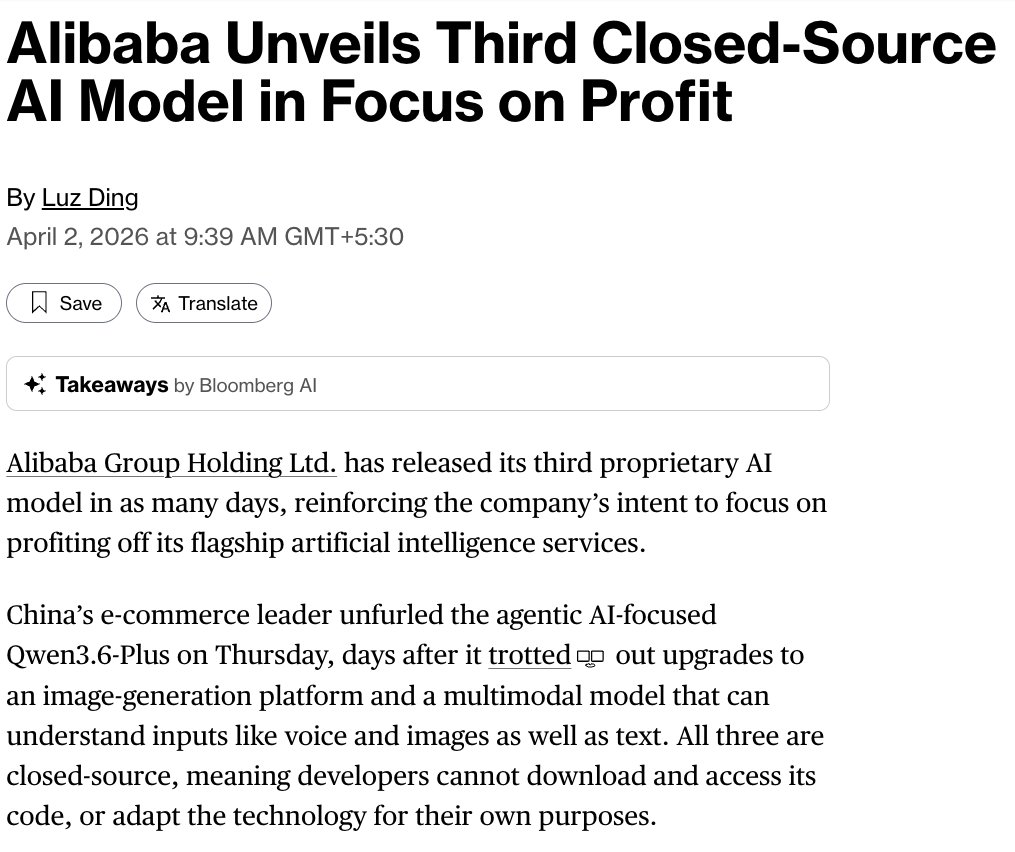
Open-source AI was supposed to democratize intelligence. Alibaba just reversed course on Qwen, its open-weight leader. A few months ago, releasing weights openly was a competitive signal - proof of confidence, a bid for developer loyalty. Now it is a liability. When compute is constrained and inference is expensive, giving away the model means giving away the margin. The open-source era of frontier AI may be shorter than anyone predicted.

@HotAisle ·
for years, people have been talking about the advantage of open source being that you can review or fork code. that didn't work so well because it required a lot of effort. with ai, that effort goes away. ask the clanker to tell you if the code is any good, or even make changes. what about the model you use or the compute it runs on?open models and access to the underlying compute is where we are going.

@TheGeorgePu ·
Watching the open-source AI charts shift. Top trending repos this week aren't models. Ponytail is something that lets AI agents think before generating. Cuts output ~54%, up to 94%. headroom: a context compression layer. Shrinks what the model reads before it reads it. Both ranking near the top this week. Not 'generate more.' Restrain, remember, compress. I run a Friday agent-review harness for exactly this reason. The wrapper era is quietly ending.

@JulianGoldieSEO ·
THE BIGGEST FREE AI MODEL EVER JUST DROPPED. And almost nobody realizes what it actually unlocks... The Numbers: → 2.8 trillion parameters → First open 3T-class AI model → Bigger than DeepSeek V4 Pro's 1.6T parameters How It Stays Fast: ✓ Uses a Mixture of Experts architecture ✓ Activates only 16 of 896 expert groups per task ✓ Around 2.5× more efficient than Kimi K2 Why It Matters: → 1 million token context window lets it process entire courses, months of notes, or huge document libraries in one conversation → Understands screenshots, charts, diagrams, websites, and images—not just text → Released with open weights under a modified MIT license so developers and businesses can build on it Real Business Uses: ✓ Build high-converting landing pages ✓ Turn long coaching sessions into multiple social posts ✓ Create support guides trained on your own knowledge base Benchmark Highlights: → GPQA Diamond: 93.5% → BrowseComp: 91.2% → Terminal Bench: 88.3 Open-source AI isn't just catching up anymore. It's giving businesses enterprise-level capabilities without enterprise-level costs.
 Watch video
Best Tweets by Topic