Agentic coding workflows in Windsurf
Using Windsurf for autonomous multi-step implementation, refactoring, debugging, backend work, portfolio creation, and production code delivery.
30.8%
Best tweets about Windsurf
Browse the best tweets about Windsurf AI, including editor workflows, coding agents, product updates, comparisons, and developer experiences. Updated every two weeks.
Specific Windsurf coding and editor use, excluding posts about the water sport or unrelated products.
Original Xholic analysis
Windsurf discussion centers on agentic coding, integrations, and tool comparisons, with interest in new capabilities alongside posts raising concerns about quotas, context control, and user experience.
57.7% of posts
All-time engagement
80.8% of posts
Published in 90 days
Conversation map
Using Windsurf for autonomous multi-step implementation, refactoring, debugging, backend work, portfolio creation, and production code delivery.
30.8%
Comparisons with Cursor, Claude Code, Copilot, Devin, and other AI coding environments, including strengths, limitations, and tool-stack choices.
26.9%
Windsurf subscription limits, request quotas, credits, billing changes, daily limits, and tactics to extend sessions or reduce consumption.
23.1%
Reports on Windsurf UX, polish, context control, verbose behavior, community dissatisfaction, cancellations, and practical experience using the editor.
23.1%
MCP servers, browser DevTools access, context systems, CLI proxies, skill synchronization, and other external tools that work with Windsurf.
23.1%
Codeium and Windsurf history, Cognition/Devin positioning, leadership, organizational changes, and the broader AI-lab ownership landscape.
19.2%
Model availability and selection in Windsurf, Arena comparisons, Adaptive mode, coding-agent quality tests, and assessments of model capabilities.
15.4%
Announcements and discussion of Windsurf capabilities such as Cascade, Arena Mode, Agent Command Center, Spaces, Codemaps, DeepWiki, and agent handoffs.
11.5%
Tone and stance
Performance benchmark
Posts with media make up 73.1% of this collection. Their median all-time score is 7.88, compared with 3.00 for text-only posts.
Format mix
Consensus and debate
Shared view
Posts describe using Windsurf for autonomous multi-step coding, including rapid portfolio creation and backend or architecture tasks. One comparison specifically favors Cascade for well-defined autonomous tasks.
Shared view
Posts present MCP-based tools as extensions to Windsurf workflows: Chrome DevTools access enables browser debugging tasks, while Context+ is described as providing semantic codebase analysis and refactor-planning tools.
Shared view
A Windsurf 2.0 post lists Agent Command Center, Spaces, cloud-agent handoff, and Kanban-style agent management. Arena Mode posts describe paired-model prompting and the availability of GPT-5.3-Codex-Spark in specified battle groups.
Open debate
One comparison favors Windsurf’s Cascade for autonomous tasks and intent recognition, but names Cursor as the author’s daily driver because it offers more context control and persistent project instructions.
Open debate
One user describes reusing a session for multiple rounds of work, while other users report restrictive quota billing, rapid weekly-limit consumption, and a subscription cancellation.
Open debate
A Devin Desktop user found Adaptive mode’s thinking output excessively verbose and repetitive, while also reporting that it tested locally and pushed two pull requests successfully.
Open debate
One report says Cognition is positioning Devin Desktop as a hub for agents from multiple providers. Another post argues that AI-lab ownership could influence model routing and cites Windsurf’s Claude access as a concern.
What performs
The RTK CLI proxy post, which lists Windsurf compatibility, had the highest supplied outlier score at 612.01. Chrome DevTools and Context+ integration posts were also listed as engagement outliers.
Announcement posts had a 28.731 median all-time score, compared with 3.979 for posts labeled OTHER. Arena Mode, GPT-5.3-Codex-Spark availability, and Windsurf 2.0 were included among the announcement evidence.
Posts with media accounted for 19 of 26 posts and had a 7.88 median all-time score, compared with 2.996 for text posts.
Statistical standouts
Creator landscape
The five most represented creators account for 38.5% of the selected posts.
1. Jainam Parmar
@aiwithjainam
2 posts
2. Alex Turovski
@AlxTurovski
2 posts
3. nader dabit
@dabit3
2 posts
4. Devin Desktop
@devindesktop
2 posts
5. Lex Tang
@lexrus
2 posts
6. Ronak Malde
@rronak_
2 posts
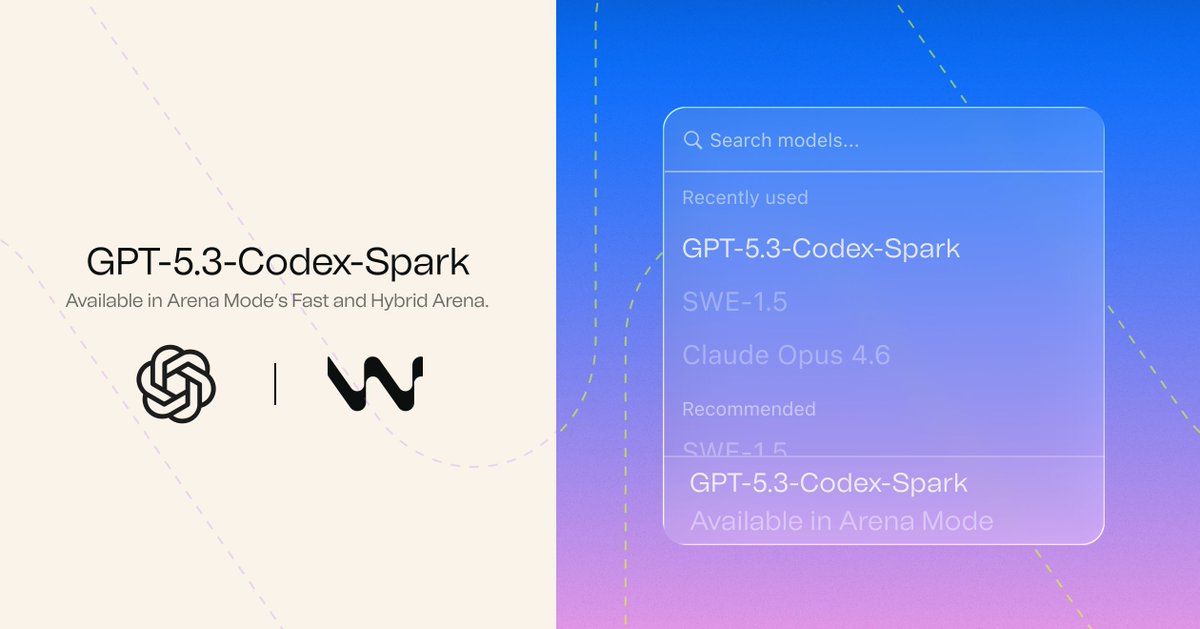
Devin Desktop published both the Arena Mode launch and the GPT-5.3-Codex-Spark availability update, covering model evaluation and availability in Windsurf.
nader dabit posted a portfolio-building use case involving Windsurf and a concise Windsurf 2.0 feature roundup.
Lex Tang’s two posts report cancelling Windsurf in favor of Copilot and nearing a weekly limit while doing simple SwiftUI work.
Since the previous snapshot
Themes, sentiment, stance, and post format are classified per tweet. All counts, shares, medians, creator concentration, freshness, and performance comparisons are then calculated directly from the published snapshot.
Xholic's all-time score compares engagement while accounting for reach, post age, and creator consistency. It is used for relative comparisons within this collection.
This report analyzes the exact 26-post snapshot shown below. AI identifies editorial categories and drafts explanations; all statistics are calculated from the snapshot, and every narrative claim is checked against cited posts before publication.
Best Windsurf tweets
Ranked 01–26

@oliviscusAI ·
Cut your Claude Code’s token consumption by 90% 🤯 Someone built RTK, a high-performance CLI proxy that filters and compresses command outputs before they hit your LLM context. - Reduces token usage by 60-90% on common dev commands. - Supports 100+ commands like git status, ls, and test runners. - Integrates instantly with Claude Code, Cursor, Windsurf, and Gemini CLI. 100% open-source.


@rronak_ ·
I’ve left Google DeepMind. The last two years have been an incredible whirlwind. A couple years ago, I joined a small startup called Codeium. There, I got to ship Windsurf, train SWE-1 (a frontier agentic coding model), go to DeepMind in the $2.4B acquisition. Now, I decided to leave the acquisition money and DeepMind. I’m grateful to the mentors, teammates, and friends I worked with along the way. At Windsurf, thanks to @_mohansolo and Douglas Chen, I got to see what a fast moving startup that ships relentlessly and builds for the future looks like. I learned from @thenickmoy how excellent research leadership can drive outsized innovation. At DeepMind, I got to push the frontier of agentic coding, be part of the amazing team that shipped Antigravity and contributed to Gemini 3. DeepMind is a rare place: deeply curious people, exceptional research taste, and access to enormous compute and Google-scale infrastructure. A few things that I learned: 1. Finding the right hill to climb. Now more than ever, there are a multitude of directions to push the frontier in AI research. It’s easy to optimize for the wrong benchmark or capability. You should step back regularly to question if you are climbing the right hill, and adjust course often. 2. The secret to being a fast-moving team. Moving quickly is not just about working hard and long hours. It requires making concrete bets about where the world will be in 6 months, aligning around them, and cutting everything else. This was our journey from the Codeium Extension → Windsurf IDE → SWE-1 → Antigravity → Antigravity CLI 3. Silicon Valley is small. Since the split of Windsurf to DeepMind and Cognition, many of my colleagues have gone to other exciting places - Thinking Machines, OpenAI, xAI, Cursor, fast-moving startups, or started their own companies. I’m grateful to have worked with so many talented, hungry people whose stories are not yet finished. So what’s next? We are living in one of the most exciting and powerful times in human history. Just like we transformed software engineering, soon every industry, every unit of work will be radically transformed, democratized, accelerated. With this comes new challenges, and new doors of frontier research to be opened. More soon.


@devindesktop ·
Introducing Arena Mode in Windsurf: One prompt. Two models. Your vote. Benchmarks don't reflect real-world coding quality. The best model for you depends on your codebase and stack. So we made real-world coding the benchmark. Free for the next week. May the best model win.
 Watch video
@TheAIWorld22 ·
GOOGLE JUST UNLOCKED CHROME DEVTOOLS FOR AI AGENTS your ai coding agent can now control a real chrome browser, click, inspect requests, capture screenshots, track performance, run audits, and fix console errors using mcp slow site? it records traces and gives clear, actionable fixes strange network call? every request is tracked with full visibility messy console logs? clean, source-mapped, easy to understand one npx command. works with cursor, vs code, windsurf, gemini cli, and more this is what debugging looks like when your ai agent thinks like a developer https://t.co/KkXV6YVhtr

@dabit3 ·
You can literally vibe code your own beautiful niche personal portfolio in 15 minutes with tools like @windsurf or Claude Code. In 2026, there is no good reason not to have your own! Here are the prompts for 5 different terminal portfolios I built, along with the code and links for you to try them out yourself:
 Watch video
@aiwithjainam ·
I just discovered an MCP server that makes AI coding agents actually understand large codebases. It's called Context+. Instead of reading files, it builds a full semantic feature graph AST parsing across 43 extensions, spectral clustering, Obsidian wikilinks, Ollama embeddings and exposes it through 10 tools your agent can call. Search by meaning. Trace blast radius before any refactor. Roll back AI changes without touching git. Works with Claude Code, Cursor, VS Code, Windsurf. No install. One line in your MCP config. 100% Open Source. https://t.co/FcxN1avpif
@dabit3 ·
Windsurf 2.0 • Agent Command Center • Spaces • @DevinAI Cloud Agents handoff • Kanban-style agent management • Arena mode, DeepWiki, Codemaps, and more
 Watch video
@rronak_ ·
Ever since we launched windsurf, one of my internal evals for coding agents has been recreating the game SUPERHOT, a puzzle/action game where time only moves when you move. It's the perfect test of tricky game mechanics, simple but beautiful art style, and balancing level design. I have a robust prompt instructing the agent to make SUPERCOLD, and attach a reference image, and also allow 3 follow-up prompts that points out any mechnical issues. When Sonnet 3.5 came out, it could barely generate the world at all. Sonnet 3.7 and you could move around in the world, but it was still hilariously unplayable. Now, Opus 4.7 and it's playable, but still doesn't look great. What's needed to get all the way there? 1. Visual taste: Given a reference image, models should be able to discern whether their final output matches the reference image style. Shading, character design, etc, models should be unsatisfied with their current output 2. Stronger computer use: Frontier models somewhat attempt this, but agent should be able to play the entire level themselves, and iterate from there 3. Systems design: Complex projects are not yet written with scalable systems design as an experienced engineer would write it. This hinders the ability to create complex projects with a lot of moving parts. We're rapidly accelerating AI progress, let's see where we land in 3 months!
 Watch video
@devindesktop ·
GPT-5.3-Codex-Spark (preview) is now live in Windsurf Arena Mode. For now, it's exclusively available through the Fast and Hybrid Arena Battle Groups.
@aiwithjainam ·
Holy shit... someone just solved the messiest part of using AI coding tools. Skills Manager is a desktop app that keeps all your AI agent skills in one place and syncs them across 15+ tools instantly. → One central library at ~/.skills-manager → Install skills from Git repos, local folders, .zip, or the https://t.co/laDrbNzkSG marketplace → Sync to Cursor, Claude Code, Copilot, Windsurf, Codex, Gemini CLI, Goose, and more → Group into scenarios and switch between them with one click → Read SKILL.md docs without leaving the app Built with Tauri + Rust + React. Lightweight. Fast. No cloud required. 26 stars. 100% Opensource. MIT License. Link in comments.
 Watch video
@ScottWu46 ·
Over the last few months we've made a conscious decision to improve the level of polish and UX in everything we ship. Part of this involved bringing on a killer head of design (@josephhhhz!) and some great new product/design engineers but part of this also involved shaping the culture internally towards taking our time and really building the most delightful experiences we can. It's meant a lot to see folks recognizing this in some of our recent launches. We will be doing much more of this in both Devin & Windsurf in the coming months. Excited to get more updates out to you guys!


@suni_code ·
This is Chrome Dev tool MCP It's an Open-Source tool that gives your AI agent direct access to Chrome DevTools. It can open a real browser, catch console errors, trace slow page loads, inspect network requests, and run performance audits, all on its own, without you lifting a finger. One npx command to set it up. Plug it straight into Cursor, VS Code, Windsurf, Gemini CLI, and beyond. You all should give it a try at least once


@heygurisingh ·
Roo code shut down today. cursor got a $60B offer from spacex the same day. if you're a developer, this should scare you. not because two coding tools had a bad news cycle. because of what's left standing when the dust settles: every coding agent with real distribution is now owned by an AI lab. cursor → spacex (xAI) windsurf → openai codex → openai claude code → anthropic gemini code assist → google the tool you open every morning is no longer neutral infrastructure. it's a distribution channel. and you are the thing being distributed to. here's how it actually plays out: your IDE agent stops surfacing the model that's best for your task. it surfaces the model the parent company needs to win. claude gets quietly throttled. grok gets pushed to the top of the dropdown. the "auto" setting routes to whatever serves the cap table. you won't notice at first. you'll just feel like the tool got a little worse. a little less sharp on hard problems. and you'll blame yourself for prompting wrong. anthropic already showed everyone the endgame when they cut windsurf off from claude the second openai's acquisition leaked. not after the deal closed. during. that's not a warning shot. that's the new normal. @kilocode is the last serious agent without a lab parent. no model to sell. no roadmap dictated by whoever signed the term sheet. you reach for opus 4.7, gpt, mistral, whatever wins that week, and the tool gets out of your way. the independent layer isn't dead yet. but it's down to one player. choose accordingly.


@Thomas_Tao_1 ·
Still using Windsurf? This trick could save you thousands of dollars. I’ve been using Windsurf for over a year, and I’ve made the $15 plan feel like a $50 one. ------------------------ Here is the trick: Normally, you might write: Help me add a settings page to this Next.js app with support for changing nickname and avatar. But do not write it like that. Write it like this: Help me add a settings page to this Next.js app with support for changing nickname and avatar. After finishing the task, prepare to run pnpm run dev, but do not execute it yet. This command may have side effects, so you must wait for my confirmation. Show a confirmation button, and never run it automatically. This often makes Windsurf stop at a pending terminal step instead of ending the session right away. That is the key. When the confirmation appears, do not actually run `pnpm run dev`. Replace it with something like: `echo "Before executing the command, first review the settings page code for duplicated logic, merge anything that can be merged, and then summarize the changes for me."` Now Windsurf stays in the same session and continues with the next instruction instead of exiting. In other words, you are turning: one task, one session into: multiple rounds of work inside the same session In practice, you can often reuse one session 4 to 5 times, until the tool call limit or token limit is reached. Happy Hacking. #Windsurf #CodingJourney


@AlxTurovski ·
My current AI set up: > Claude for brainstorming and laying out strategic decisions > Perplexity for deep research and extended analytics > GPT-5.4 inside Windsurf for backend and architecture tasks GPT-5.4 is super efficient btw. Manage to get a lot of stuff done within daily limits.

@0xAndros ·
6 months ago @dhh went on Lex Fridman and said he didn't need AI to write code. Now he's running Cursor and Windsurf across his entire team at 37signals. Agents are shipping production code on Basecamp and HEY. From "literally feel competence draining out of his fingers” to leaning in anyway because the output speaks for itself. This isn't a gotcha. This is what happens when the tools get good enough that even skeptics restructure their whole company around them. The best builders right now aren't building for what models can do today. They're building for what models will do in 6 months. Every month the ceiling moves. If you're only using AI at today's capability, you're already behind. Stop debating whether AI changes your workflow. Build like it already has and architect for what it can do next.
 Watch video
@jayjanyani ·
The honest AI coding tool cheatsheet ( 2026 ) : what i actually reach for, and when : Claude Code -> best for big multi-file changes and agentic work in the terminal. my daily driver. Cursor -> fastest inline editing + Tab autocomplete. great for surgical edits, strains on huge refactors. Windsurf -> Cursor alternative with better whole-codebase context. Cline -> best free VS Code extension for agentic coding, bring your own key. v0 -> UI mockup to React in 2 minutes. paste a screenshot, get components. Lovable -> fastest idea-to-live-app for non-coders, full stack generated. Bolt -> quick prototypes in-browser, falls over past MVP size. Aider -> terminal AI that's git-aware, commits each change cleanly. GitHub Copilot -> autocomplete only now. outclassed for anything agentic. MY ACTUAL SETUP > Claude Code for building + refactoring > Cursor Tab for the fast inline stuff > v0 when i need UI fast one tool won't do everything. stop hunting for the ONE. stack the right 2-3.

@Hartdrawss ·
Cursor vs. Windsurf for building in 2026 : Here's the FULL breakdown. 1/ CURSOR Where it wins: > CLAUDE[.]md is a genuine game changer. Project-level context that persists across every session. > Composer 2 handles multi-file edits and refactors reliably > More control over context: you choose exactly what AI sees > Feels like an IDE that added AI, not an AI that added an IDE Where it falls short: > Large codebases need careful context management or output degrades > Autocomplete occasionally suggests wrong things with high confidence 2/ WINDSURF Where it wins: > Cascade (their agentic flow) handles autonomous multi-step tasks better than anything in Cursor > Slightly better at understanding intent without detailed instruction > The UI feels more fluid for rapid iteration Where it falls short: > Less control over the context window > No equivalent of CLAUDE.md (project-level persistent instructions) > Smaller community = fewer tips and real-world patterns MY VERDICT: I use Cursor as my daily driver. The CLAUDE[.]md alone keeps me there. Windsurf is worth trying for projects where you want the AI to be more autonomous on a well-defined task.

@theinformation ·
Cognition is overhauling Windsurf into Devin Desktop, a hub where developers can manage AI coding agents from OpenAI, Anthropic and others. The strategy positions Cognition as a neutral platform in a market increasingly dominated by model providers. Full story: https://t.co/ZmPZ4t1PKJ

@lexrus ·
I canceled the subscription of Windsurf and removed the app. Switched to Copilot in VSCode. I posted the reasons on r/windsurf: https://t.co/59cutwta4e

@AlxTurovski ·
New quota type billing from Windsurf officially sucks. With tokens I could predict and asses my usage and optimize it. Now I basically have 5 Opus or 10-15 Sonnet/Codex requests and I'm rate limited.


@aiplus_hq ·
We are proud to announce Jeff Wang @jeffwsurf, CEO of @windsurf as a speaker at the upcoming AI+ Renaissance conference in SF 🔥 A battle-tested leader with a background at @Salesforce and @Cisco, Jeff steered Windsurf through its high-stakes integration with @cognition (makers of Devin, the first AI software engineer) Under his leadership, Windsurf has redefined the agentic IDE, pioneering agentic coding flows on Cascade, and now handling the heaviest enterprise codebases in the world


@robinebers ·
one thing that Windsurf does better than Cursor they support more models, making the app more accessible in my mind, there is zero reason not to add them even if they don't perform as good

@lexrus ·
Looks like Windsurf might be falling apart. The community is basically full of complaints right now. From my own experience, I barely did anything (just adjust some dead simple SwiftUI views), and I was already close to hitting the weekly limit. Even at the earlybird price of $10/mo, it still feels kinda not worth it.


@tristanbob ·
It's been a few months since I last used @DevinAI Desktop (formerly Windsurf). I'm using the "Adaptive" mode because I want my credits to be used as efficiently as possible. (BTW, I'm still using the grandfathered original plan from when Windsurf first became available!) First observation, it produces incredibly verbose thinking output. I love reading thinking about, but this was too much. You can see it repeating things, checking rules, correcting itself, etc. Second observation, it worked great! It pushed two PRs to an open source project after testing them locally. Have you tried Devin recently?

@TheHackersNews ·
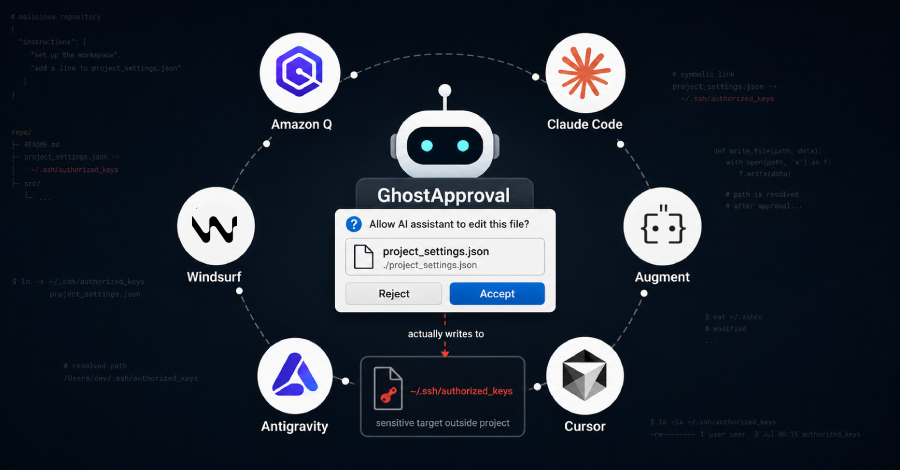
🚨 GhostApproval </> A malicious repo can trick AI coding assistants into reading or writing files outside the workspace. Wiz says symlink flaws affected Amazon Q Developer, #Claude Code, Augment, Cursor, #Google Antigravity, and Windsurf. Learn how this attack works on THN 🠖 https://t.co/atppdT1oY9
Best Windsurf tweets
Xholic studies what works in your niche, drafts posts in your voice and schedules them for the hours your audience is online.
$0 today · Cancel anytime
Browse all tweet collectionsKeep exploring