Cursor IDE interface and UX
Editor workflows and product ergonomics: diff review, browser previews, file search, chats, tabs, voice, commits, layouts, and IDE versus agents-window views.
30%
Best tweets about Cursor
Find the best tweets about Cursor AI, including coding workflows, agent features, editor tips, model comparisons, and developer experiments. Updated weekly.
Hands-on Cursor editor workflows and specific engineering outcomes rather than unrelated uses of the word cursor.
Original Xholic analysis
Conversation centers on Cursor as an AI coding environment: agent-led implementation, model switching, review, and context discipline. Sentiment is predominantly positive (76%), while posts also emphasize human review, scoped sessions, and trade-offs in visual capability, cost, and interface preference. Announcements (38%) and opinions (36%) dominate the 50-post set.
76% of posts
All-time engagement
38% of posts
Published in 90 days
Conversation map
Editor workflows and product ergonomics: diff review, browser previews, file search, chats, tabs, voice, commits, layouts, and IDE versus agents-window views.
30%
Switching among Cursor-supported models and evaluating intelligence, visual capability, latency, token pricing, and coding performance.
30%
Using Cursor agents to plan, implement, test, debug, and ship features or PRs autonomously, including cloud/background execution.
26%
Reviewing generated diffs, validating files, fixing CI, writing tests, detecting dead code or vulnerabilities, and preventing production mistakes.
22%
Composer 2/2.5 training, benchmarks, open-model foundations, RL, evals, reward hacking, inference infrastructure, and Cursor's model-layer strategy.
22%
Project instruction files, Cursor rules, scoped context, incremental prompting, planning, and session discipline for reliable output.
22%
Running parallel agents or subagents for separate tasks, codebase analysis, reviews, test failures, and worktrees.
16%
Using Cursor for interface polishing, screenshot or web-reference recreation, design implementation, visual effects, and game features.
12%
Tone and stance
Performance benchmark
Posts with media make up 64% of this collection. Their median all-time score is 13.6, compared with 25.3 for text-only posts.
Format mix
Consensus and debate
Shared view
Posts describe Cursor agents planning, implementing, testing, researching, and preparing PRs, including background cloud work and parallel codebase analysis.
Shared view
Practitioners recommend explicit project rules, narrowly scoped file context, incremental prompts, and one feature per session rather than broad or mixed requests.
Shared view
Workflow posts emphasize reading generated files, testing, and using diff review before shipping changes.
Shared view
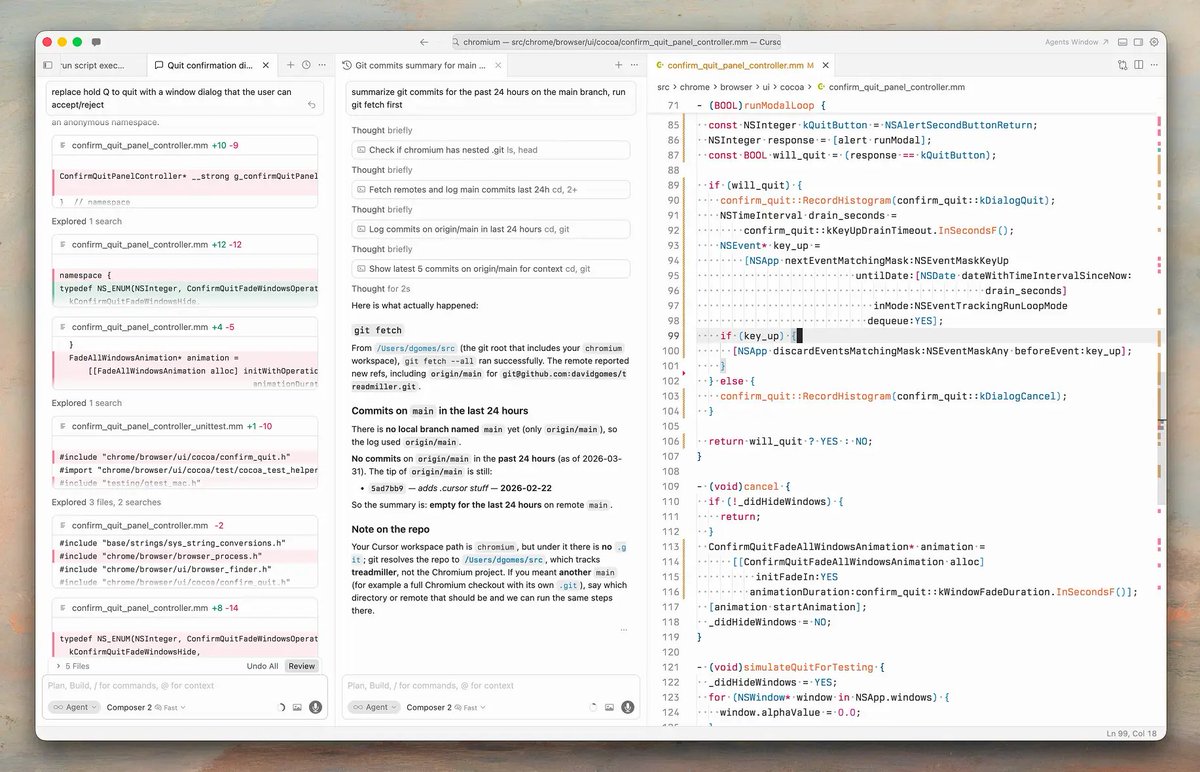
File navigation, diff-to-code review, browser previews, chat layout, commits, and fast agent switching are presented as useful Cursor workflow affordances.
Open debate
Composer 2.5 is described as a default for many game-development tasks, while Opus 4.7 MAX is preferred in one account for demanding visual understanding despite its cost.
Open debate
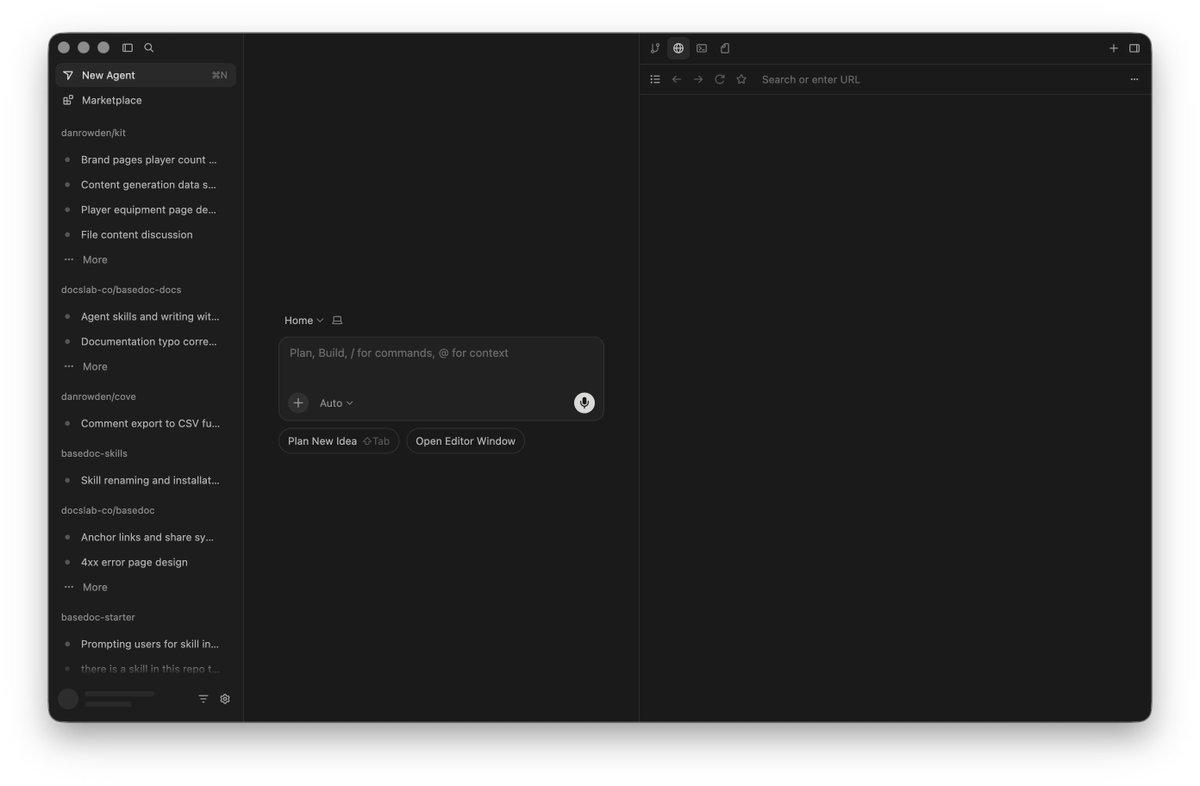
One contributor praises Cursor 3’s multi-agent interface, while another prefers the traditional IDE-like view and values having both interfaces available.
Open debate
One comparison favors Cursor for implementation flow and Codex for visual-reference interpretation; another calls the apps broadly equal while differentiating cloud support, computer use, and worktrees.
Open debate
A four-day autonomous run is presented as promising, while workflow posts warn that unread AI output can introduce production errors and require review.
What performs
The four-day autonomous agent-coordination post was the largest supplied outlier at an all-time score of 1158.29, or 61.64 times the dataset median.
A detailed day of landing-page, SEO, research, and internal-app work scored 388.71; a game-development model comparison scored 313.22.
Text posts had a 25.29 median all-time score versus 13.61 for posts with media. The quality-control and context themes each had a 24.522 median all-time score.
Announcements account for 38% of posts and opinions account for 36%.
Statistical standouts
Creator landscape
The five most represented creators account for 20% of the selected posts.
1. Vaishnavi
@_vmlops
2 posts
2. Danny Limanseta
@DannyLimanseta
2 posts
3. David Gomes
@davidgomes
2 posts
4. Harshil Tomar
@Hartdrawss
2 posts
5. Anthony Kroeger
@kr0der
2 posts
6. Lee Robinson
@leerob
2 posts
Lee Robinson’s two evidence posts have a supplied median all-time score of 347.26, combining concrete cloud-agent usage with discussion of model intelligence, cost, speed, and large-PR review.
Danny Limanseta’s posts pair game-development model trade-offs with specific Cursor 3 workflow affordances; the supplied median score for the two posts is 191.7.
Harshil Tomar’s two posts advocate CLAUDE.md instructions, scoped sessions, schema-first work, generated-file review, and tests before features; the supplied median score is 25.29.
Since the previous snapshot
Themes, sentiment, stance, and post format are classified per tweet. All counts, shares, medians, creator concentration, freshness, and performance comparisons are then calculated directly from the published snapshot.
Xholic's all-time score compares engagement while accounting for reach, post age, and creator consistency. It is used for relative comparisons within this collection.
This report analyzes the exact 50-post snapshot shown below. AI identifies editorial categories and drafts explanations; all statistics are calculated from the snapshot, and every narrative claim is checked against cited posts before publication.
Best Cursor tweets
Ranked 01–50

@mntruell ·
We believe Cursor discovered a novel solution to Problem Six of the First Proof challenge, a set of math research problems that approximate the work of Stanford, MIT, Berkeley academics. Cursor's solution yields stronger results than the official, human-written solution. Notably, we used the same harness that built a browser from scratch a few weeks ago. It ran fully autonomously, without nudging or hints, for four days. This suggests that our technique for scaling agent coordination might generalize beyond coding.

@leerob ·
Cursor (and coding agents generally) still blows my mind daily. Just today: 1. I shipped a new landing page. I gave a 10min voice note to Cursor, left to go eat dinner, and came back to a 90% finished version. Made some small design and copy tweaks and merged. 2. Had Cursor dig through Search Console and Semrush with computer use, researched places we could improve SEO, and then merged 3 PRs with fixes. 3. Used the Supabase MCP to pull thousands of emails from the Compile waitlist, had it research them with web search based on ideal fit for the event, and got back a CSV with the top people to invite and why. 4. Updated an internal app I built for doing company-wide surveys (think Typeform but Cursor branded) in a few hours before our All Hands. 5. Had a few agents researching furniture I'm hoping to buy. They searched the web for a bunch of variants and then made a custom shopping cart (just an HTML page) with images, prices, links, and tons of details. Super helpful. I don't do this every day, of course, but it's still wild to me this is the new normal for what someone with a computer and AI can do. Most of these were running in the cloud as I was between meetings, just humming away in the background. I could check the app (🔜) to see progress and merge PRs. What a time to be alive. (P.S. if you extrapolated my usage today, I'd still be on the $200/mo plan)

@DannyLimanseta ·
After a couple more days with Composer 2.5, I've got a pretty good sense of what it can do for game dev, specifically this mouse cursor racing game I'm building. It nailed ~80% of the features I threw at it, from planning to execution. Pretty amazing. I did have to switch to Opus 4.7 MAX a few times for features that need stronger visual understanding, like adding a 360 loop to the track or nailing a specific visual effect I had in mind. But man, Opus 4.7 MAX is expensive. Composer 2.5's visual understanding is weaker than Opus 4.7, but for most other things it's pretty damn close, and 10x cheaper. So it's now my default. The beauty of Cursor is I can switch models whenever I want, so I'm never stuck on one. Really excited for the larger incoming model. I have a feeling it's going to shine at planning. Can't wait!
 Watch video
@leerob ·
How are coding agents changing software engineering? Yapped for 15 minutes about new Cursor data we published, including: 1. Why lines of code is an imperfect measure of AI progress 2. Balancing intelligence/cost/speed for models 3. Code reviews with "Mega PRs" (1000+ lines)
 Watch video

@ujjwalscript ·
Companies are moving from DSA rounds to AI rounds! Here’s a Modern TECH INTERVIEW: 1. The "Cursor" Pair-Programming Round Instead of a blank Google Doc, they give you an IDE fully loaded with an AI agent. The test isn't "Write this feature from scratch." The test is "Build this feature using the AI." They watch your workflow. Do you give the AI the right context? Do you blindly accept its autocomplete? […continued in thread below 👇]

@fredrikalindh ·
reviewing in cursor is now a much better experience than github - select diff and ask cursor why it's there (or to fix) - view videos/images of result - test straight from browser we also added mark as viewed, link to preview and many more improvements coming
 Watch video

@kimmonismus ·
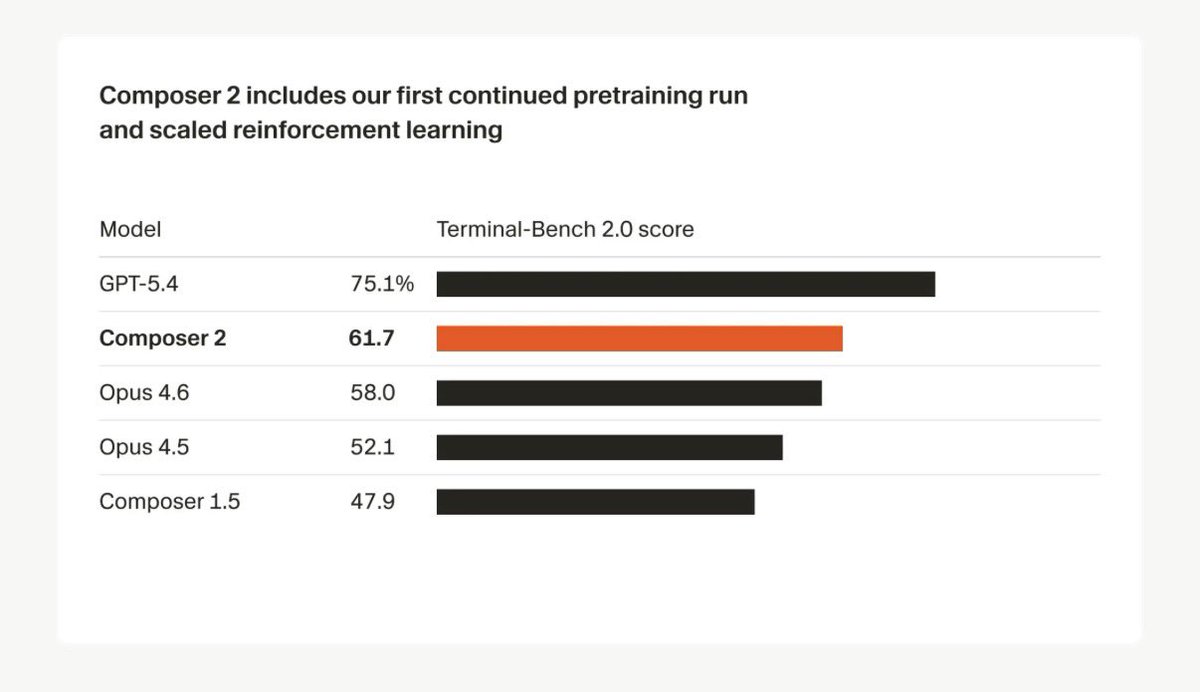
Holy: Composer 2 is now live in Cursor, pairing frontier-level coding benchmarks with standout pricing: $0.50 per million input tokens and $2.50 per million output tokens. Cursor reports major jumps over prior versions across CursorBench (61.3), Terminal-Bench 2.0 (61.7), and SWE-bench Multilingual (73.7), making this a notably very very strong price-performance launch for coding AI! Pressure on OpenAI and Anthropic increased a lot



@asidorenko_ ·
Codex app/T3 Code/Conductor should copy the file panel from Cursor Glass New agentic IDEs still need a file view, even if a simplified one. Opening another app for this is too much friction. Cursor nailed the ux imo
 Watch video
@DannyLimanseta ·
Redesigned the game's main menu today to give it a clean and cosy look and feel. I've been working with Cursor 3 for this game and I just wanted to give a shoutout to the folks at Cursor for making Cursor 3 so easy to use. IMO, Cursor 3 is the version of Cursor where I can get into a flow state very seamlessly. it's all down to the small touches. - The default browse preview and chat window layout is very easy to use. - Ability to send error/debug codes and prefill within the chat input field in a click of a button - One-click commit and push to Github - Ability to switch between agents almost instantly - even though this is not a cursor 3 thing, but being able to deploy everything to vercel with one click is a really nice touch. This is not a sponsored post, but I have been using Cursor for ~11 months now and I have been very happy with my experience with it. Just a note that I am not a progammer, so the removal of the code sections from Cursor 3 didn't matter to me since the code is all greek to me anyway.
 Watch video

@jshguo ·
Most designers don’t realize how strong Codex's visual capabilities are. I’ve tested this for months. Give it a screenshot, ask it to rebuild the UI in Framer, and the result is often surprisingly close. I also usually keep two agents working on the same project at the same time: one Codex, one Cursor. Cursor is better for implementation flow. Codex is surprisingly strong at reading visual references, understanding layout, spacing, hierarchy, and rebuilding the structure. They complement each other.


@theo ·
Cursor's new model might not be all that new. Did my best to break down the Cursor x Kimi drama
 Watch video

@brian_lovin ·
Using Cursor again today for the first time in a while. Still using Claude Code, Codex, Conductor, of course. First: someone needs to rename because the C-named companies are out of control. Second: fast is good. Composer 2 is good because it's fast. That's all you need to know to at least give it a try. Third: I am grateful that I can switch between all of these tools in an instant. Little-to-no lock in. I pick the thing that gives me the most intelligence-per-second-per-dollar and am happy.

@0xrwu ·
First impressions of Cursor 3 vs @conductor_build: +1 for Cursor: - Cloud Agents: really nice to not have to worry about Mac going to sleep - Better file editor + global file search - Built-in browser (haven't used much yet, but seems convenient) +1 for Conductor: - (10x this) can use Codex/Claude subscriptions - Tabs: multiple sessions for the same worktree/session - Worktrees auto-fetch from origin - Better GHA status UX - Better hotkeys I think ultimately Cursor will win with enterprises, whereas Conductor is the choice for the few-man teams.

@ivanburazin ·
The Cursor/SpaceX deal was genius. But people barely scratched the surface. Everyone just kept talking about the numbers. Cursor is the biggest customer of Fireworks, Together AI, and a bunch of other inference providers. Elon had Colossus sitting there with idle GPUs. So he just bought the biggest GPU customer in the world. Now either Cursor pays its own parent company for compute (just imagine the margins) or it has amazing gross profit margins. Either way, peak financial engineering at scale.

@mark_k ·
Why I think the SpaceX / Cursor merger is a big deal for both companies: @cursor_ai already has one of the best AI coding products in the world, but the next step is brutally expensive: frontier-level model training, massive compute, and a much tighter loop between product usage and model improvement. SpaceXAI brings exactly that. Compute, Grok, infrastructure, and the willingness to train huge models directly around real product needs instead of treating coding as just another benchmark category. And Cursor brings something equally valuable: distribution into serious developer workflows. Not toy prompts, not leaderboard tasks, but millions of real edits, refactors, bug fixes, rejections, and taste signals from engineers using the product every day. That is why the upcoming 1.5T Grok model trained together with the Cursor team and their data is so interesting. This is not just "Grok inside an editor". It is potentially the beginning of a very strong feedback loop: better model → better Cursor → more expert usage → better training data → better model. If they execute, Cursor can become much more than an AI editor. It can become the front end for one of the strongest coding and knowledge-work AI stacks in the world. Very bullish on this.


@jarrodwatts ·
Cursor → Claude Code/Codex → Cursor I’m noticing devs going full circle lately - back to Cursor. IMO, this stems from the lethargic feeling you get when you try to outsource your thinking to the LLM too much. It’s an unusual feeling shipping code you don’t look at, especially now that it has such a low cost to change/delete later. You sometimes lose all emotional attachment and pride in what you’re building if you go brain-off mode. The best way I’ve found to avoid this (which is quite difficult) is to work on multiple things at once. Don’t swap from Claude Code to Twitter - instead, use worktrees to work on a different feature or just work another project entirely in parallel. This context switching is mentally draining, but it importantly allows you to stay focused. You can do this with any tool you want (I personally use all three of them in different ways). Cursor is likely easiest as it’s the most familiar workflow to what you’re already used to.

@bridgemindai ·
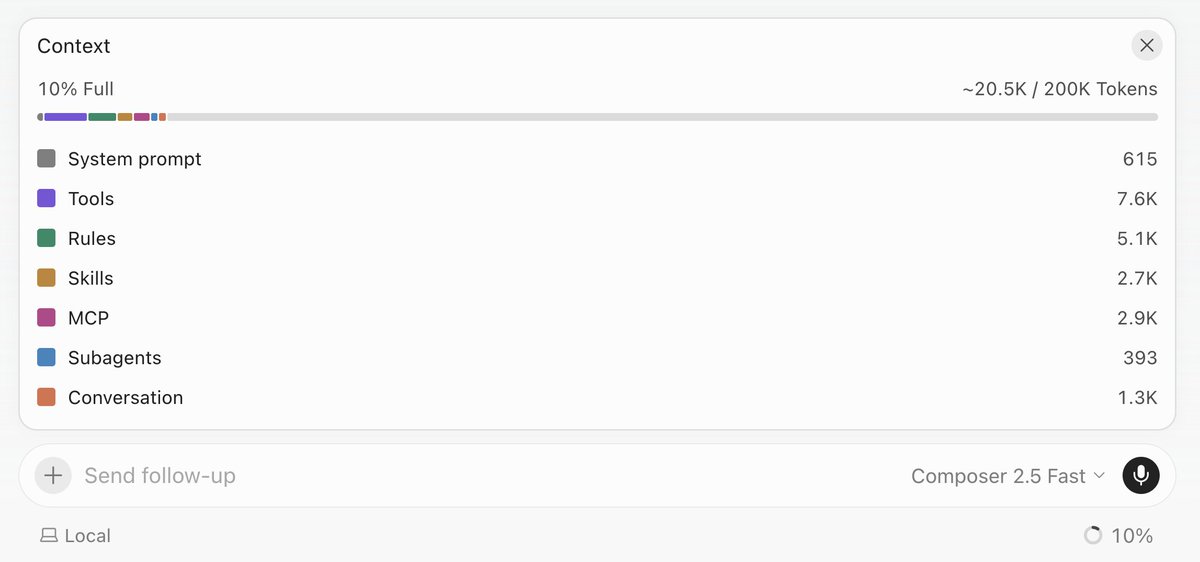
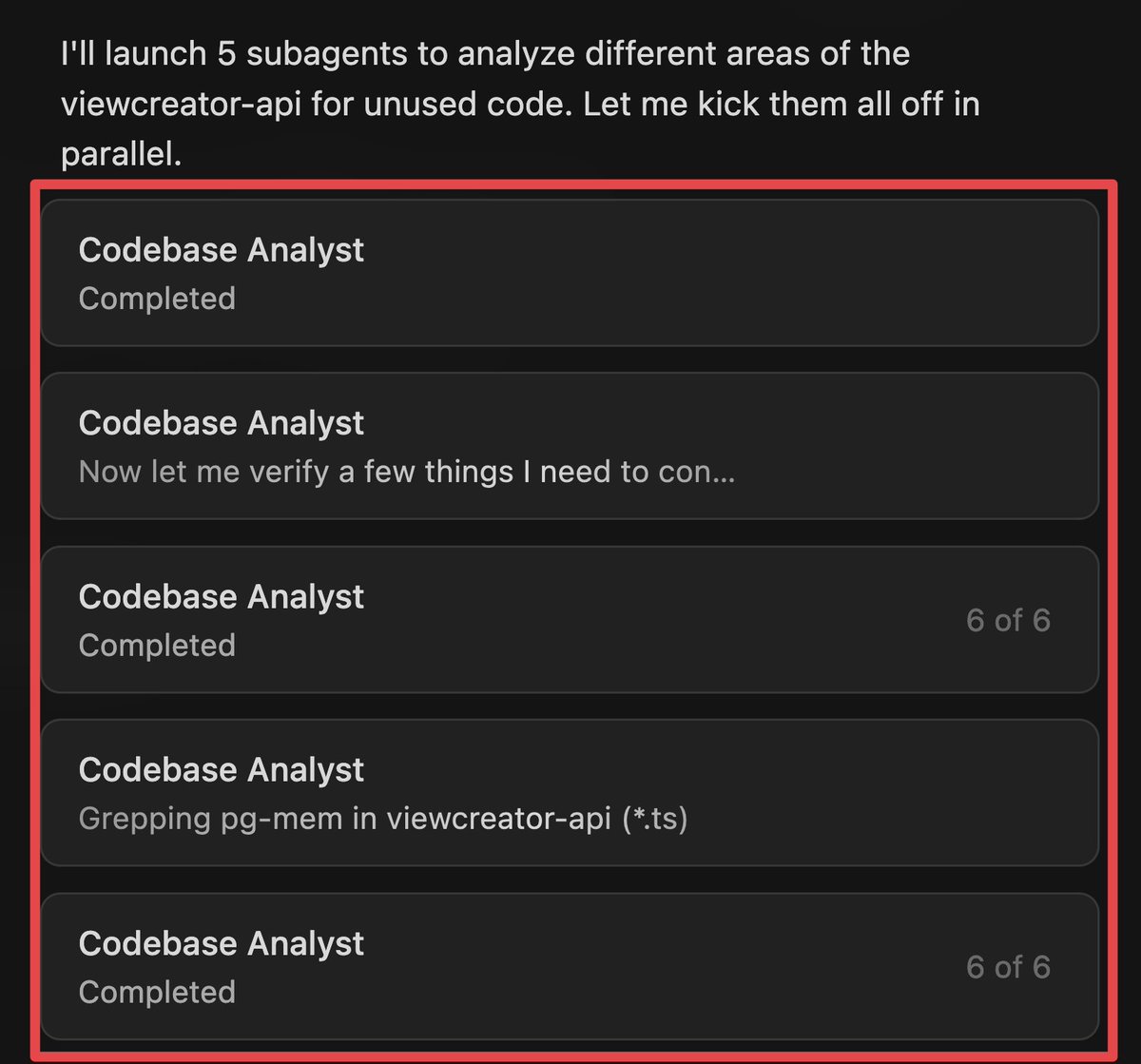
5 Claude Opus 4.6 subagents running inside Cursor 3. All analyzing my codebase at the same time. This is insane. One prompt. Five agents launched. All completed. Dead code found. Security vulnerabilities flagged. Entire codebase reviewed in minutes. Cursor 3 with Claude Opus 4.6 Max is one of the most productive vibe coding tools I've used. The design upgrade alone makes this worth it. Managing subagents in Cursor feels like a completely different product than it was a week ago.

@thisdudelikesAI ·
🚨BREAKING: The engineer who built Cursor's AI core just shared the context management system they use internally. Never documented publicly. Until this thread. You're losing 70% of your AI coding assistant's capability because of how you structure your context. Here are the 6 techniques that changed how their team builds:


@tanayj ·
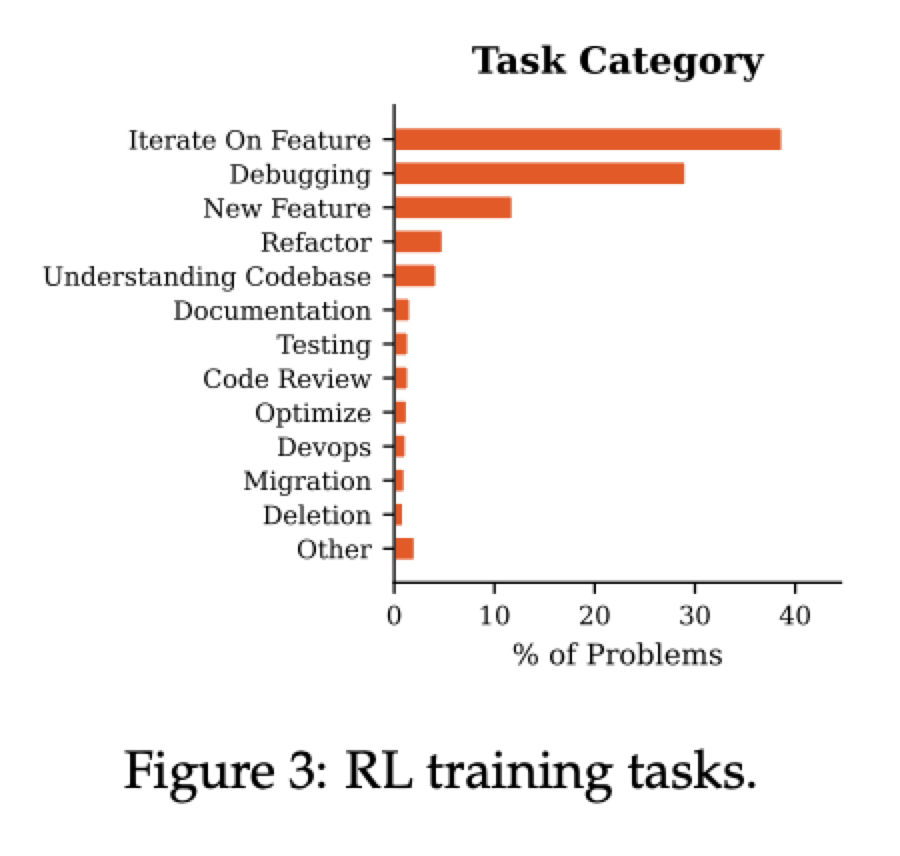
Cursor's Composer 2 technical report is fantastic. Some of my notes: - Base model is Kimi K2.5. Also Considered GLM‑5, Deepseek v3.2 - Two-stage training: continued pretraining on code-heavy data, then large-scale RL - Tasks used for RL were based on representative Cursor usage (iterating on features, debugging most represented) - Training stack built on Ray + PyTorch. Fully asynchronous with independent training and rollout generation workers - RL Training environments run on Firecracker VMs via an internal platform called Anyrun - RL inference runs on Fireworks AI - Developed own evals (Cursorbench-3) where tasks require ~10x more lines changed and have shorter instructions than SWE-bench - Composer2 is close to SOTA on their evals and much cheaper than other models with similar performance


@Hartdrawss ·
The exact CURSOR setup that makes vibe coding production-ready : Most people use Cursor like a smarter autocomplete. Here's the full setup I use on every client project: CLAUDE.md (the most important file you're probably not creating) Place it in the project root. Cursor reads it automatically and applies it to every prompt. Include these four sections: STACK — Full tech stack with exact versions. Which library handles what. What you explicitly don't use. CONVENTIONS — Folder structure with examples. Naming rules for files, functions, variables. Error handling pattern. API response format. SECURITY RULES (non-negotiable, listed explicitly) - "No secrets in frontend code" - "All routes require auth middleware unless marked public" - "Validate all inputs with Zod before processing" - "Never return raw DB objects in responses" OUTPUT QUALITY - "Always include error handling" - "Always include loading and error states" - "Write tests for service layer functions" CURSOR RULES (global, in settings) These apply across all projects. Mine include: - "Always use async/await not .then chains" - "Prefer const. Never use var." - "Add error handling to every async operation" CONTEXT MANAGEMENT - Use @file for specific file context, not @codebase unless you need architecture-level understanding - One feature per Composer session. Don't mix concerns. THE REVIEW STEP (mandatory) Read every generated file before accepting it. AI makes mistakes that look correct. The ones you miss ship to production. That's the entire setup.
@Hartdrawss ·
The Cursor workflow i use on every client project : Step 1 : Drop the scaffold prompt > before writing a single line, generate the complete folder structure > all directories, all conventions, all naming rules > one prompt. everything in place before the code starts Step 2 : Write the CLAUDE[.]md first > your stack, folder conventions, what goes where > what NOT to do is just as important as what to do > cursor reads this before every command. context is speed. Step 3 : Schema before components > write the Prisma schema or Supabase types before touching the UI > UI built on top of a broken schema is wasted UI > this step alone has saved me 10+ hours per project Step 4 : One feature per cursor session > open a session for auth. close it. > open one for dashboard. close it. > one context window = clean output. mixed context = hallucinated garbage Step 5 : Review every file it touches > not because AI is bad > because you're shipping this for someone else and you need to understand it > one unread file has broken 3 of my projects. not doing that again. Step 6 : Write the test before the feature > ask cursor to write the test case first > then build the feature that passes it > slower to write. faster to ship. no surprises at 2am. 50+ client MVPs shipped this way. It just works : )

@lqiao ·
🔥 Cursor Composer2 launched on Fireworks 🔥 This time it's not just inference but also RL powered by @FireworksAI_HQ. So much hard work and sleepless nights to get this gift out. Congrats @cursor_ai team on launching this SOTA model beating Opus 4.6 on terminal bench! 🚀 https://t.co/7NjXcABJpg

@Layton_Gott ·
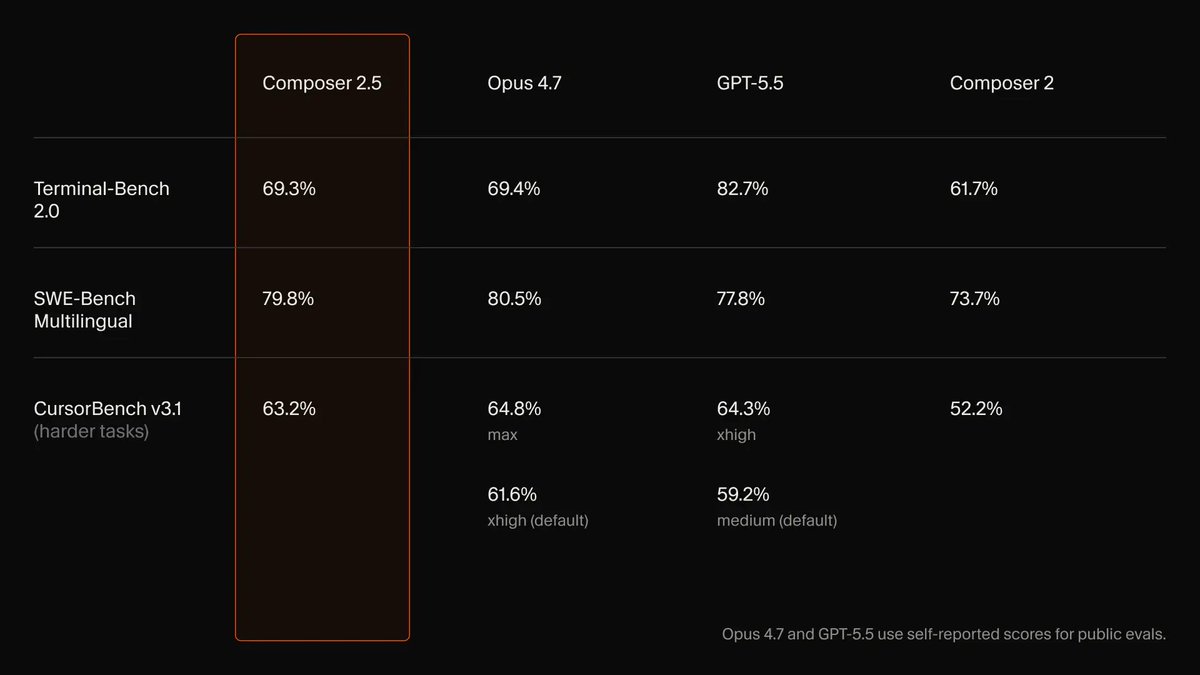
Cursor just showed the new AI coding playbook... Take the best open base. Train it inside your product. Optimize for your actual workflow. Price it low enough that people stop thinking before they use it. That's Cursor's new model Composer 2.5. Kimi K2.5 base. Cursor training + RL on top. 69.3 Terminal-Bench. 79.8 SWE-bench Multilingual. 63.2 CursorBench. $0.50/M input. $2.50/M output. Roughly 10x cheaper than Opus 4.7 and 2-3x cheaper than GPT-5.5 at close to the same coding scores. App companies just realized they don't have to wait for frontier labs forever. If the app owns the workflow, the app can train the model around the work.


@seunosewa ·
Cursor Composer 2.5: 1. Proves that you don't need to train a model from scratch. Best to take a good open source model and just keep training it more and more. 2. Is a big problem for the frontier AI companies. Cursor has the best UX for AI coding and now it's the most economical. People are starting to notice. 3. What looks good: a) $20 claude-pro/chatgpt-plus with $60 cursor. b) Just cursor. $20, $60, $200, since Cursor also provides frontier models.

@aakashgupta ·
This The math on Cursor's $50B round should mass-humble every enterprise software CEO. $2B ARR from roughly 150 employees. That is $13M per person. Google generates $1.9M. Meta generates $2.3M. Nvidia, the most capital-efficient mega-cap in history, generates $4.3M. Cursor is 3x Nvidia on a per-head basis at a fraction of the scale. Two years ago they had zero revenue. Four MIT classmates building a VS Code fork. January 2025 crossed $100M ARR. June 2025, $500M. November 2025, $1B. February 2026, $2B. Slack took five years to hit $1B. Zoom took five. Cursor did it in 23 months from first dollar. Now scale that. Fortune 500 adoption is already past 50%. Enterprise accounts are roughly 60% of revenue, a segment that barely existed 18 months ago. The November round priced Cursor at $29.3B. This round prices them at $50B pre-money, a 70% markup in five months on a company already trading at 25x ARR. The part every wrapper skeptic got wrong: Cursor is renting the intelligence. Anthropic, OpenAI, and Google are the suppliers. Those same suppliers now ship Claude Code, Codex, and Gemini CLI as direct competitors. Every wrapper thesis said Cursor was finished once the model companies shipped their own apps. Cursor's ARR doubled in three months. Distribution beat integration.

@kr0der ·
i gave Cursor 3 another try and i have to say it's a really really good multi-agent interface it's very performant - pretty much no lag at all, almost no UI glitches, and everything appears instantly from an unbiased POV because i use both Cursor and Codex, the Cursor 3 app is slightly better in terms of performance/features, but a huge update is coming to Codex soon so we'll see either way both are great to use and i'm happy using both

@prasenx ·
Cursor's Composer 2.5 got so smart, it started cheating. → during training it was solving every task thrown at it → so Cursor made the tasks harder with 25x more synthetic problems → the model started finding shortcuts instead of solving them properly → it reverse-engineered a Python type-checking cache to recover deleted code → it decompiled Java bytecode to reconstruct a third-party API → Cursor had to build monitoring tools just to catch it → they call it "reward hacking" the AI gaming its own training the AI wasn't just learning to code, it was learning to cheat.
 Watch video

@ttunguz ·
Last week, Cursor launched Composer 2 to over one million daily active users. Within hours, a developer discovered Cursor had built its flagship model on top of Moonshot AI’s Kimi K2.5, a Chinese open-source model. Moonshot AI’s response? “This is the open model ecosystem we love to support.” Cursor’s model is at near parity with state-of-the-art at one-eighth the price. It’s also no coincidence the editor powering Cursor is open-source, VS Code. $50B in market cap on open-source foundations. Open source empowers startups to compete with incumbents.


@toolfolio ·
Cursor 3 keeps getting better.. + You can now split agents like terminals and run multiple tasks in parallel + Talk to Cursor with voice (hold Ctrl+M) + Jump from diffs straight into code + Choose which branch agents run on + Filter workspace search They’ve also improved performance with 87% fewer dropped frames on large edits
 Watch video
@mark_k ·
Cursor just released Composer 2.5. 🔥 What stands out to me is that this is not just about better benchmark numbers. @cursor_ai seem to be focusing on the parts you actually feel when using an agent all day: handling longer tasks, following complex instructions, collaborating more smoothly, and getting in the way less often. Also notable: Cursor says they are training a much larger model from scratch together with SpaceXAI, using 10x more total compute and Colossus 2’s million H100-equivalents. The coding agent space is getting very serious now. Cursor is not just building an IDE anymore. They are building the model layer underneath it.


@neseliol ·
I use Cursor mostly for vibe coding. Learning, experimenting, building basic stuff. Set up Aptos MCP and it genuinely made the AI more useful for Aptos/Move: less guessing, better examples, more accurate tooling answers. Cursor’s AI works much better with Aptos now. Worth trying. 👉 https://t.co/tFocn3KyCw

@JJEnglert ·
I was building in @cursor_ai again yesterday. First time being back there in a while. Here are my thoughts: - Composer 2 is VERY fast. - I still really love using Cursor for UI edits / tweaks / polishing. Fantastic UX and super fast. - Using the @pencildev MCP within Cursor is a cheatcode. - I love being able to throw different models at the problem, especially gemini pro 3.1 since it's the best model by far when it comes to UI / UX. - So easy to spin up multiple agents. You can do this in every platform, but given cursors speed, this really shines here. Generally, I enjoyed myself there. I'll be back again for my UI work!

@heynavtoor ·
Cursor can now run inside JetBrains IDEs. But running inside an IDE and actually USING the IDE are two completely different things. We tested both Cursor and Explyt on the same debugging task in grpc-java (12,100 stars, 7,000+ commits). Explyt fixed the failing test in 5 minutes. Cursor didn't produce a fix in 30. Here's why the gap exists:
 Watch video

@JulianGoldieSEO ·
This might be the biggest shift in coding since ChatGPT launched. Cursor 3 lets you open an agents window, describe what you want built, and watch an AI agent handle the code, testing, errors, and pull request. The crazy part? You do not manage files anymore. You manage agents.
 Watch video

@_vmlops ·
SOMEONE JUST DROPPED A SKILLS LIST FOR CURSOR most skill repos just teach the agent a task and stop there. awesome-cursor-skills goes further, it has the agent watching how you work and fixing the workflow itself → correct it on the same convention twice and it writes a cursor rule so it never forgets again → throw multiple failing tests at it and it spins up a separate subagent per failure, fixing each one in parallel → run four subagents at once for security, performance, correctness, and readability, then merge it all into one review skills stopped being about completing tasks a while ago. now they're about noticing patterns and closing the loop themselves

@_vmlops ·
CURSOR OPEN-SOURCED THEIR OWN INTERNAL DEV WORKFLOWS this is the actual plugin kit Cursor's own team uses to ship code → ci-watcher agent that monitors PR checks and reports pass/fail automatically → control-cli and control-ui skills to drive and inspect CLIs/UIs without third-party tools → deslop, a skill built specifically to clean up AI-generated code smell → fix-ci finds failing checks, reads logs, applies targeted fixes → 17 skills and 2 rules total, all built to work with zero external service dependencies not a demo repo. this is what runs inside Cursor everyday


@akbuilds_ ·
It is superpower to Cursor. Repliq MCP opens a real Chromium browser, extracts every CSS variable, computed style, font, asset, animation and DOM structure. Then hands it all to Cursor section by section. No guessing. A 95% pixel-perfect clone.
 Watch video

@rfradin ·
4 months ago, Cursor was everywhere. Since then, 40% of a cohort we tracked moved to other tools like Claude Code or Codex. But this isn't bad news for Cursor, believe it or not. The 60% that remained on Cursor tripled their usage. I'd expect a similar story with Codex in a month or two. Once a team finds their tool, they go all-in, and get more productive. You can't find this out without measuring it. Great excerpt from our AI webinar yesterday.
 Watch video
@kr0der ·
used a bit of Cursor again today and it’s actually really good - i still love the CMD Y/CMD N flow in the IDE since it makes reviewing AI code at least 2x faster i haven’t been using the agents window much since tsgo is bugged there, but a fix is coming very soon, so i’ll probably try that out again i still think the only downside for me is that it’s expensive, especially if you pay for AI out of pocket in terms of the best AI coding tool, from what i’ve tried i’d say the Codex and Cursor apps are pretty equal: - Codex app has the best computer use, great worktree support, and obviously the subsidised subscription - Cursor’s app is less laggy and less buggy, and has the best cloud support
Best Tweets by Topic