Score all eight readiness signals from 0–2
Use 0 when a signal is not true, 1 when it is inconsistent or unproven, and 2 only when evidence clearly supports it.
Free X business planning tool
Score whether X fits your business, identify the gaps to fix first, and download a free seven-sheet KPI, UTM, content, DM, and 90-day planning workbook.
Rate all eight criteria from 0–2. Use what is true today, not what the team hopes will become true.
Are buyers, partners, practitioners, or category influencers visibly active on X?
A strong signal: Relevant people are visibly active and identifiable.Do useful category conversations happen often enough to participate consistently?
A strong signal: Relevant conversations appear every day.Does the team regularly learn things from customers, product, operations, research, or sales?
A strong signal: The team has a recurring supply of specific insight.Can the company explain what it believes, where it disagrees, and why?
A strong signal: The company has defendable, useful, non-generic positions.Can a named owner monitor replies, DMs, and mentions consistently?
A strong signal: A clear owner can respond and route conversations.Is there a relevant next step after attention: demo, trial, tool, guide, event, or product?
A strong signal: A clear, audience-relevant CTA and destination exist.Can visits, conversations, leads, pipeline, or another objective be tracked?
A strong signal: UTMs, analytics, CRM fields, and definitions are in place.Can the team run a focused 90-day test without relying on random inspiration?
A strong signal: The team can publish, listen, and review every week.The download adds a KPI dashboard, content portfolio, UTM builder, 90-day plan, permission-based DM pipeline, definitions, and official source links.
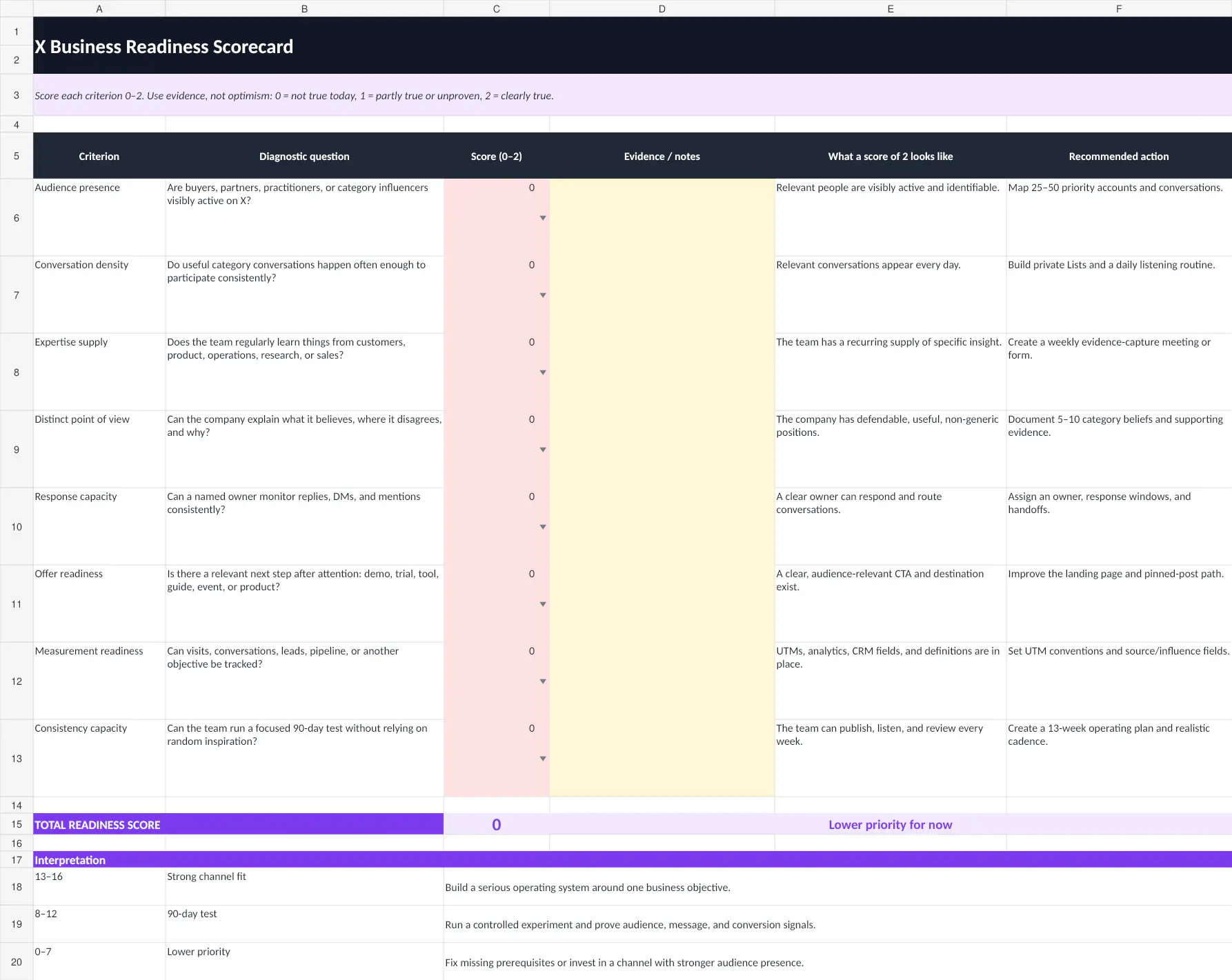

Channel-fit diagnostic
The X Business Readiness Scorecard tests eight prerequisites: audience presence, conversation density, expertise supply, a distinct point of view, response capacity, offer readiness, measurement readiness, and consistency capacity.
Use evidence that exists today. The browser score turns the result into an immediate direction, while the downloadable workbook carries the same model into KPI tracking, content planning, UTMs, permission-based DM management, and a 13-week operating plan.
How it works
Complete the score with a cross-functional owner when possible, then use the weakest signals to shape the next test.
Use 0 when a signal is not true, 1 when it is inconsistent or unproven, and 2 only when evidence clearly supports it.
Get a channel-fit band, a recommended direction, and the three operating gaps to address first.
Choose one 90-day objective, replace the fictional sample data, and track the transitions from qualified attention to business value.
What the workbook includes
The workbook keeps inputs, definitions, plans, conversations, and performance in a shared, auditable structure.
Capture evidence for each signal and translate the total into a strong-fit, focused-test, or lower-priority decision.
Track impressions, profile visits, qualified DMs, meetings, leads, pipeline, revenue, spend, conversion rates, and ROAS.
Label posts by business job, evidence level, audience action, CTA, and downstream performance.
Create consistent campaign links for company, founder, partner, organic, and paid distribution.
Assign weekly objectives, owners, outputs, statuses, and due dates across foundation, system, and scale phases.
Track public context, permission, qualification, the next step, outcome, and revenue without turning a technical limit into a quota.
Use cases
The scorecard is designed for teams deciding whether to start, continue, narrow, or scale an X business program.
Decide whether the founder, company, or a coordinated hybrid account should lead the strategy.
Connect public expertise and conversations to qualified actions, pipeline, and a repeatable monthly review.
Make channel-fit assumptions visible before committing a content calendar, paid budget, or outreach program.
Responsible use
A high readiness score does not guarantee reach, leads, pipeline, or revenue. A low score is not a permanent verdict. Revisit the evidence when the audience, offer, ownership, measurement, or operating capacity changes. The workbook includes fictional sample data only to demonstrate formulas and the KPI chart. Xholic AI is not affiliated with X Corp.
FAQ
Straight answers about the score, the workbook, and how to interpret the result.
It measures whether the audience, conversations, expertise, point of view, response capacity, offer, measurement, and operating consistency needed for a focused X program are present today.
No. It is a structured channel-fit diagnostic. Use the result to design a test and compare the score with observed audience quality, qualified actions, and business outcomes.
The Excel workbook includes a readiness scorecard, KPI dashboard, content portfolio, UTM builder, 90-day plan, permission-based DM pipeline, and metric definitions with source links.
No. The visible sample rows are explicitly fictional and exist only to demonstrate formulas and the dashboard chart. Replace them before reporting performance.
No. The browser scorecard calculates locally and does not upload or store the individual scores you select.
From free tools to workflow
Use Xholic to listen for relevant conversations, capture ideas and proof, draft in your voice, and schedule the posts your team approves.