Bootstrapping versus venture capital
Control, incentives, dilution, capital discipline, and frameworks for deciding whether and when outside funding is appropriate.
34%
Best tweets about Bootstrapping
Discover the best tweets about bootstrapping, including profitability, customer funding, lean teams, distribution, tradeoffs, and founder experiences.
Bootstrapped company economics, customer-funded growth, lean operations, distribution, profitability, constraints, and firsthand founder lessons.
Original Xholic analysis
Across the evidence set, bootstrapping is commonly presented as a way to validate demand through customer contact and payment, focus on distribution and costs, and retain control. The funding discussion is not uniform: posts describe outside capital as useful in particular circumstances, including capital-intensive work, a proven growth engine, or the ability to hire and spend on acquisition.
64% of posts
All-time engagement
44% of posts
Published in 90 days
Conversation map
Control, incentives, dilution, capital discipline, and frameworks for deciding whether and when outside funding is appropriate.
34%
Cash flow, margins, working capital, retention, infrastructure costs, pricing, and sustainable growth with limited resources.
32%
Examples of profitable companies, ARR milestones, exits, acquisitions, and founder stories that demonstrate viable independent paths.
28%
Resilience, patience, self-reliance, personal sacrifice, autonomy, work-life boundaries, and founder wellbeing.
26%
Cold outreach, warm outbound, content, SEO, communities, email, partnerships, and building in public to acquire customers cheaply.
26%
Manual work, fast MVPs, experimentation, doing things that do not scale, and constraints-driven learning loops.
24%
Using AI, automation, no-code, outsourcing, documentation, and focused priorities to operate with minimal headcount.
22%
Pre-selling, charging early, interviewing customers, and using real demand and feedback to validate what to build.
18%
Tone and stance
Performance benchmark
Posts with media make up 40% of this collection. Their median all-time score is 12.7, compared with 5.35 for text-only posts.
Format mix
Consensus and debate
Shared view
Posts recommend customer conversations, early payment or pre-selling, and a narrow initial problem before broadening the product. One founder describes selling from a slide deck before building, while another solo-startup checklist recommends validation conversations, a landing page, and charging from day one.
Shared view
Cold outreach, posting online, communities, and content are presented as low-budget ways to find early customers. One bootstrapped SaaS founder reports reaching $50K MRR in its first 100 days through cold outreach and personal posting, with no ads or marketing team.
Shared view
Contributors argue that limited cash encourages attention to customer value, repeat purchases, infrastructure costs, working capital, and profitability. These are founder perspectives rather than a demonstrated causal result across all companies.
Shared view
Advice for solo and small teams includes narrowing the MVP, automating recurring tasks, documenting repeatable processes, and avoiding becoming the operational bottleneck.
Open debate
One founder strongly favors bootstrapping for consumer companies except where heavy capex or deep R&D is required. Another founder who has raised funding says it enabled a salary, advertising spend, early hiring, and greater credibility with enterprise customers.
Open debate
One perspective says capital is most useful when a company knows what it will accelerate; another says venture-backed companies pursuing an ambitious frontier should deploy raised capital rather than optimize for cash flow. These are contrasting operating philosophies, not a universal decision rule.
Open debate
Some founders associate bootstrapping with control over schedule and family time. Others describe persistent stress, financial sacrifice, and the danger of becoming the person responsible for every operational issue.
What performs
Tweet 2060810075711656299 had the highest all-time score in the dataset at 1,185.89. Its advice covers pre-selling, intent-based outbound, daily customer conversations, and focusing on one acquisition channel before adding another.
Two case-study posts were among the highest-scoring outliers: one describes a vibe-coded SaaS reaching $106K MRR in six months through community and social growth, and another reports a bootstrapped SaaS reaching $50K MRR in 100 days through cold outreach and founder posting.
Tweet 2067434175548793052, an advice list on selling to technical founders, was an outlier with an all-time score of 137.36. It emphasizes directness, research, relevance, and immediate value in outreach.
Deterministic analytics reports a median all-time score of 12.73 for posts with media, versus 5.35 for text posts. This is a descriptive comparison and does not establish that media caused stronger performance.
Statistical standouts
Creator landscape
The five most represented creators account for 20% of the selected posts.
1. Shubham Mishra
@brahma_4u
2 posts
2. Eric Djavid
@ericdjav
2 posts
3. Kyle Gawley
@kylegawley
2 posts
4. oliverb
@oliverbrocato
2 posts
5. Adam Robinson
@RetentionAdam
2 posts
6. Greg Roth
@saasadventures
2 posts
Several posts link recommendations to specific operating experience: pre-selling and outbound at GojiberryAI, bootstrapping VEED before fundraising, and Recharge reaching $20M ARR before outside capital. These examples provide context for the authors’ recommendations, though they do not prove the approach will generalize.
Useful operational detail in the evidence includes selecting a specific customer, using intent signals for outbound, documenting processes, automating repeated work, and charging early.
The evidence includes funding views that specify conditions such as heavy capex, substantial traction, favorable fundraising terms, and the practical advantages of funded hiring and acquisition. Those conditions make clear that the debate is context-dependent.
Since the previous snapshot
Themes, sentiment, stance, and post format are classified per tweet. All counts, shares, medians, creator concentration, freshness, and performance comparisons are then calculated directly from the published snapshot.
Xholic's all-time score compares engagement while accounting for reach, post age, and creator consistency. It is used for relative comparisons within this collection.
This report analyzes the exact 50-post snapshot shown below. AI identifies editorial categories and drafts explanations; all statistics are calculated from the snapshot, and every narrative claim is checked against cited posts before publication.
Best Bootstrapping tweets
Ranked 01–50
@romanbuildsaas ·
I'm 30. I built an AI startup called GojiberryAI to $2.5M ARR. Got accepted into YC. If I had to start from 0, here's exactly what I'd do: 1. Sell it before I build it. No code. Just a simple slide deck (mine was 6 ugly slides) explaining the problem, the solution, the outcome, and the price. I made my first $10k that way, before writing a single line. 2. Pick a painfully specific customer. Not "B2B SaaS." Something like "founders at 20-person SaaS companies about to hire their first SDR." So specific that the right person reads it and thinks "that's me." 3. Start outbound on day one, but only to people showing intent. Not scraped lists. People engaging with competitors, changing roles, raising money, or publicly posting about the exact problem I solve. That's the gap between a 1-2% reply rate and 25-40%. 4. Lead with value, never a calendar link. Send a blueprint, not "got 15 minutes?" Let the resource do the selling, and the trial becomes the obvious next step instead of a pitch. 5. Pick ONE channel and go deep. For us it was outbound first, then Reddit (10M+ organic views), then LinkedIn lead magnets. I wouldn't touch a second channel until the first one was clearly working. 6. Talk to customers every single day. The product doesn't matter until you understand the problem better than they do. Spend 90% of every early call listening, not demoing. 7. Only build once people are actually paying. Then keep it dead simple and price it to sell itself. We landed on $99/mo with a free trial, so the funnel runs without me dragging anyone onto a call. 8. Do this relentlessly for about 12 months. That’s roughly how long $0 to $2.5M took us. Bootstrapped. No outside funding. Most founders don’t lose because they can’t build. They lose because they build too early, sell too late, and quit the channel before it compounds.
@marclou ·
😖😭😤 viBe CoDing doeSN't WoRK 😡😤😭 Albert went from 0 to $106,000 MRR in 6 months with a vibe-coded SaaS. Last December, he took CodeFast to learn the basics of coding, hacked together an MVP with ShipFast, and got his first customer posting in Skool groups. He then went all-in on marketing: •Grew an Insta account to 200k followers in months •Built a free Skool community to 95k members •Repeated one viral format over and over By February he had paying customers. By April he hired devs. By July his SaaS does $100k+ MRR. Yes you can vibe code a profitable startup. Yes you need to double down on marketing. Yes you can change your entire life in a year.
@mynameisyahia ·
People have no idea how to sell to technical founders I know because I am one, and my DMs are full of people doing it horribly, truly horribly some guidelines: > no BS. If your opener is “looking to connect” and you run an agency, I am not replying > be honest. Tell me what you’re selling and why it matters to me > read my website. The bar is literally below the floor and somehow people still miss it > provide value if possible. Send me something I can use right now or if i ask > tell me why it’s better than what I’m probably already using. Don’t ask me “what tools are you using?” I won’t respond especially because this is 90% of pitches > don’t pitch enterprise pricing to a bootstrapped founder. You are the problem > if I say not interested, and you try again the next day, instant block > have some basic decency. we're all people, we hopefully might be friends one day I do this in my own cold DMs and get a really high close rate to paid ~usually~ lifelong customers.
@mbertulli ·
I'm 44. I've bootstrapped a company, raised $50M+, sold to PE, and now own manufacturing facilities across North America. If I was 25 again building my first brand, here's what I'd tell myself. 1. Bootstrap. 99% of the time. Don't raise money. Bootstrap all day every day in consumer. There's rarely an instance where you should raise outside capital. Most of my pain over the last eight years running this business has been because I have investors. I would never do that again knowing what I know now. 2. Competing incentives will break you. There's so much brain damage running a company when you have other people involved. Founders and investors can very easily have competing incentives and interests. You think you're aligned, but over time they become disjointed. They have their own set of incentives that you hope are aligned with yours. Often they're not. 3. The 1% exception. The only time raising makes sense is when you need heavy capex. Building factories. Deep R&D like Lomi where research and development is super cash intensive. That's why we did it. Otherwise, the downside to raising money in consumer is much higher than the upside. 4. The hard part of bootstrapping. The downside to bootstrapping in consumer is cash/working capital sucks. Even if your business is profitable, a lot of your growth gets financed from cash flows. You don't make a lot of money personally because so much gets cycled back into inventory and working capital. Consumer is not a great place for outside capital. There are very few cases where it makes sense. Build lean. Stay in control. Go for positive cash flows over everything else.
@julianweisser ·
$9M ARR. No VC. Solo founder. Solo Founders Podcast ep 6 is live with @yasser_elsaid_ of Chatbase. We talk about: 00:03 Discovering RAG before ChatGPT existed 11:44 First Stripe payment 30 minutes after launch 14:37 "Free solo" founding, beyond indie hacking 27:39 Why bootstrapping changes the definition of success 35:37 The "benevolent dictatorship" of solo founding 44:43 Scaling bootstrapped, profitability from day one 54:14 The B2B playbook: pricing, content, cold outbound 1:08:20 Bear and bull case for solo founding
@brettcalhounn ·
Capital-constrained founders tend to reach profitability faster. They make fewer vanity hires. They stay closer to the customer because they have to. They don't have the luxury of the "figure it out later" mentality that abundant Series A capital can afford. Struggle is a feature, not a bug. That’s just another reason why: the greatest driver of venture returns is resilience.
@ValueWithPrem ·
A founder thinks he owns his startup until he takes Venture Capital. Imagine you walk into a high stakes casino. You have ₹10 Lakhs of your own hard earned cash in your pocket. You walk up to the Roulette table. You try to put the raw cash on "Red." The dealer stops you. "Sir, you have to exchange that for chips first." Why do casinos do this? Because human psychology is wired to protect cash. You would never throw your kid's school fees on a single spin. But a blue piece of plastic? You'll throw that on the table without a second thought. Chips detach you from the reality of the money. Venture Capital works the exact same way. When a founder bootstraps a profitable ₹5 Crore business. They protect it. They grow it steadily. They care about every single rupee. Because it is their Cash. But VCs don't want a safe, profitable ₹5 Crore business. Their math doesn't work that way. They need 1 startup to hit a $1 Billion valuation to pay for the 9 that die. So, they give you "Chips." (Millions in funding). Suddenly, you aren't playing with your own money anymore. The VC pushes you to burn cash. Hire 100 people. Run massive ads. Subsidize the product to acquire users faster. They force you to push all your chips to the center of the table for a massive spin of the wheel. If it lands? You ring the bell at the IPO. If it doesn't? The VC writes it off as a portfolio loss. But you? You lose 5 years of your life and the company you built. Bootstrapping is playing with cash. Fundraising is playing with chips. Don't play roulette with your life's work unless you are fully prepared to lose it all.
@JoinPond ·
📁 How to build a startup solo in 2026 ┃ ┣ 📁 idea validation ┃ ┣ talk to 20 people with the problem ┃ ┣ build a landing page before the product ┃ ┣ get 50 people on a waitlist ┃ ┗ run a validation bounty on pond before you build anything ┃ ┣ 📁 mvp ┃ ┣ scope down to one core feature ┃ ┣ use no-code or ai tools to ship faster ┃ ┣ launch in weeks not months ┃ ┗ post bugs and QA as bounties instead of hiring ┃ ┣ 📁 distribution ┃ ┣ build in public from day one ┃ ┣ post your wins and your losses ┃ ┣ join communities where your icp already hangs out ┃ ┗ list your startup on pond to get in front of 10K users ┃ ┣ 📁 sales ┃ ┣ do every demo yourself early on ┃ ┣ close your first 10 customers manually ┃ ┣ write down every objection you hear ┃ ┗ turn objections into a self-serve funnel ┃ ┣ 📁 outsourcing ┃ ┣ post recurring tasks as bounties, not job listings ┃ ┣ pay for outcomes not hours ┃ ┣ use agents for support, QA, and outreach ┃ ┗ keep yourself as the only full-time hire ┃ ┣ 📁 revenue ┃ ┣ charge from day one, even a small amount ┃ ┣ track time to first dollar ┃ ┣ raise prices before you raise capital ┃ ┗ decide early if you're bootstrapping or raising ┃ ┣ 📁 systems ┃ ┣ document every repeatable process ┃ ┣ automate anything you do twice ┃ ┣ build async workflows so you're not always on ┃ ┗ protect your time like it's your only resource ┃ ┗ 📁 execution loop ┣ build ┣ sell ┣ collect feedback ┣ automate what works ┗ repeat
@ericdjav ·
The strangest thing about the bootstrapping journey: You end up learning faster than anyone around you. Not because you're smarter. Because you're forced to. No safety net means every mistake costs you directly. So you learn to avoid them — fast. No team to delegate to means you build skills across the board. Marketing. Sales. Design. Code. Support. No investor means every dollar matters. So you learn to be creative instead of expensive. Nobody's watching means you experiment freely. Ship, test, kill, restart. Zero politics. No roadmap from a board means you follow customers, not slides. Real feedback > quarterly OKRs. And the wildest part? After 12 months of this you've quietly outpaced people who spent that same year in meetings, fundraising, and "strategizing." Bootstrapping isn't slower. It's messier, lonelier, and scarier. But it teaches you everything.
@wh0sumit ·
one year ago today, packed my bags, moved to bangalore again after quitting my job, and started building @rightfitso fulltime. i remember leaving with a lot more questions than answers. i didn't know whether people would care about what we were building, whether founders would trust us, or whether there was even room to build something different in hiring. i just had this feeling that the way startups hire today could be much better, and that was enough for me to take the leap. over the last year, we intentionally moved slower than most people expected. while everyone talks about growth, distribution, fundraising, and scaling, we spent most of our time trying to understand the problem itself. i wanted to know what actually breaks in startup hiring. i wanted to understand why founders struggle to hire despite having amazing companies, and why incredibly talented people still find it difficult to end up at the right place. instead of assuming we knew the answers, we decided to earn them one conversation at a time. looking back, i think i've spoken to more than 10k+ people over the last year. founders, engineers, designers, marketers, recruiters, students, people looking for their first job, and people who had already built incredible careers (every conversation was manual) every hire, every rejection, every piece of feedback, every late-night call, every mistake slowly changed the way we thought about the company. in many ways, rightfit today is simply the sum of all those conversations. bootstrapping changes the way you build. you don't have the luxury of making expensive mistakes, so you learn to listen before you build. you become comfortable with moving slowly if it means understanding the problem more deeply. there were months where it felt like nothing was happening from the outside, but internally we were constantly changing our thinking, rewriting ideas, throwing away assumptions, and starting over. i think that patience has probably been the biggest lesson this year has taught me. i'm grateful that we survived the first year. grateful to every founder who trusted us with one of the most important decisions in their company. grateful to every candidate who trusted us with their career. grateful to everyone who replied to a message, introduced us to someone, challenged our thinking, or simply believed that what we were building deserved a chance. every small interaction mattered much more than you probably realise. the first year of building rightfit full-time wasn't about becoming a big company. it was about understanding the problem deeply enough that we could spend the next decade solving it. year one was about learning and year two is about execution! i'm coming for everything 🏴
@tibo_maker ·
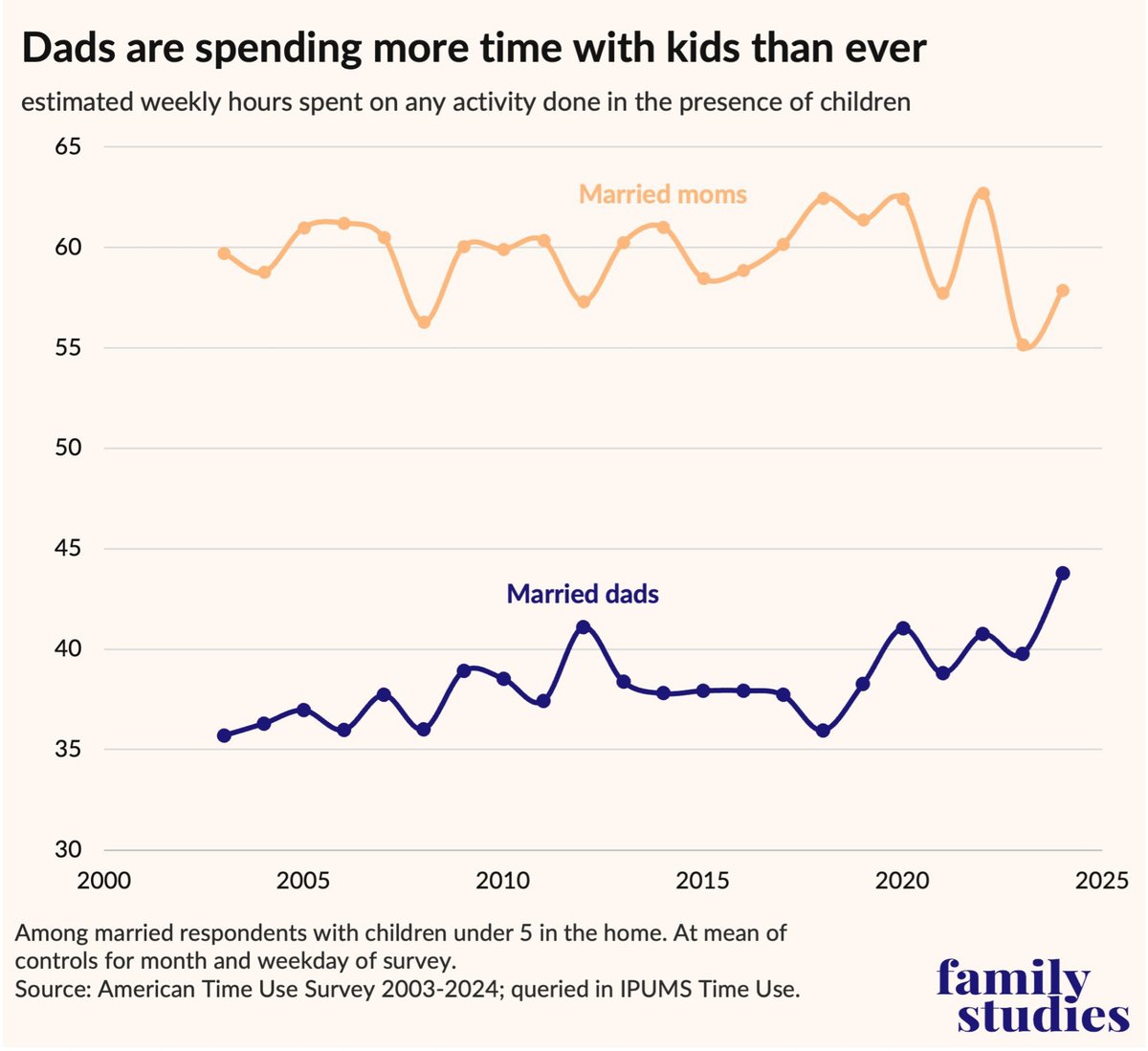
being a bootstrap founder, is helping me be a better dad ❤️ I feel so grateful I can work on my own time, from home, with a no-call policy, and enjoy time with my kids people think bootstrapping is about freedom from a boss but it's really the freedom to be home for the small stuff I saw this chart and felt seen, dads today are more present than they've ever been makes me so happy to see this 🙌
@SimonHoiberg ·
You think bootstrapping a SaaS in 2026 is about scale? You got it upside down. It's about doing more with less. 10-person teams can do +$10M ARR. 3-person teams can do +$1M ARR. 1-person teams can do 6 figures ARR. And no, you don't have to be a superstar. This is fully achievable by the "average" person (just like myself). Here's how it breaks down: For product, you need: → AI-powered support → Streamlined feedback handling → CRM / simple database → Automation & workflows → Scaling & managing advertisement → Email newsletters & updates For marketing, you need: → Monthly YouTube videos → Weekly email newsletters → Daily LinkedIn posts → Ads on Meta, Google, YouTube For operations, you need: → AI Agent workflows. Setups like these allow small teams to compete with billion-dollar enterprise companies. And it allows solopreneurs to claim freedom and financial independence. 2026 still has plenty left. Let's go 🚀
@Amank1412 ·
Everyone thinks you need VC money to build something real. But: Zoho - $1.4B ARR, bootstrapped Mailchimp - $800M ARR, bootstrapped Midjourney - $500M ARR, bootstrapped JetBrains - $600M ARR, bootstrapped Just products people actually paid for. Fundraising isn’t step one. Building something valuable is. Start there.
@sab8a ·
Back in 2021, we bootstrapped VEED to $5M ARR. Only then did we raise from Sequoia. Here’s what I tell founders before they fundraise👇 Some of it was accidental. We got rejected by YC. Twice! Then focused on something that (really) mattered. –– finding PMF –– monetizing the product Eventually, we hit: >$5M ARR >50,000 MAUs With just product, SEO, and brute-force execution. And later raised, when it made sense. Few things you should keep in mind before raising: 1./ Start niche, but in a big market. This is how you can scale without hitting a ceiling. - Figma started with UI (now they own the design workflow) - Canva started with templates (now they’re coming for Adobe) - VEED started with basic edits (now it’s full-stack video) Your niche should have infinite headroom. That’s the cheat code for growth. Otherwise? You’ll hit a plateau fast! 2./ Raising money won't get you PMF. When you’re bootstrapping, the path is brutal and clear: Build → Ship → Acquire users → Iterate fast. Forget the fancy features. Forget the perfect website. If users aren’t raving, nothing else matters. We got our first 20 paying users in one weekend. That was the real signal. So we doubled down on understanding why they chose us. Finding users who’ll pay you (again and again) is the only game that matters early on. 3./ Get crystal clear on customer acquisition. For us, it was organic search from day one. We reverse-engineered what competitors ranked for. Then, built content around high-intent, long-tail keywords. Over and over again. That focus compounded. And gave us ROI that most channels couldn’t touch. Even today, we rank #1 for: – AI video – Text-to-video AI – Video generator This kind of clarity only comes from being scrappy and doing the work. It’s not your investor’s job to teach you this. The best part? Bootstrapping’s never been easier: -Ship MVPs fast -Tap indie founder communities -Distribute for $0 (Reddit, TikTok, X) Final thoughts (TL;DR): > Start niche, but in a big market > Raising money won't get you PMF > Get clarity on which acquisition channel works for you
@RobHoffman_ ·
after 7 years and 3 profitable bootstrapped businesses I've learned: amateur founders obsess over sales pro founders obsess over retention this book is the playbook I'm using to increase retention across my three businesses this year:
@rohandave_ ·
My #1 learning from making money online solo: If you can't learn to spend money to acquire customers AND turn profit, you don't have a business. You have an expensive hobby relying on luck. If you're just getting started bootstrapping, this won't resonate right now. Just keep failing. Fall in love with failing. Truly enjoy getting bitch slapped by life. It's a blessing only few can take. Every month, I aim to fail on at-least 1 new thing in business. But with time, the compounded learnings from failures will reveal the secrets of the universe & turn you into a bad mfer.
@RetentionAdam ·
3 decisions I made as a founder that I'll never, ever do again: 1. I had 38 people coming to my apartment every day. 5,000 square foot loft, and I turned it into a sales floor. Two bathrooms for 38 people. I put a stool next to the laundry room sink to handle overflow…dudes pissing in the sink was my solution!!! There was no separation between my work and my life. I never left because work never left me. It was absolutely horrible. Now I won't have an employee in the same city I live in. That's how far the pendulum swung. 2. I bootstrapped my first company with a family member as a financial partner. What I'll say is that bootstrapping is already hard - it takes longer than you think, costs more than you plan, and the stress is constant. When things are good they are great, but when they are bad, adding a family relationship to that equation makes every difficult moment harder because of this added dynamic. 3. Every Friday, I'd take my team out, and we'd get hammered. I wasn't building culture, but just getting drunk with my team. That's just not how I'd choose to bond with a team now. All 3 of these felt like founder instincts at the time. > Hustle > Loyalty > Camaraderie Looking back, they were just defaults I never examined that were holding me back in some capacity - and changing them helped me AND my businesses to grow beyond any ceiling I’d hit before.
@RetentionAdam ·
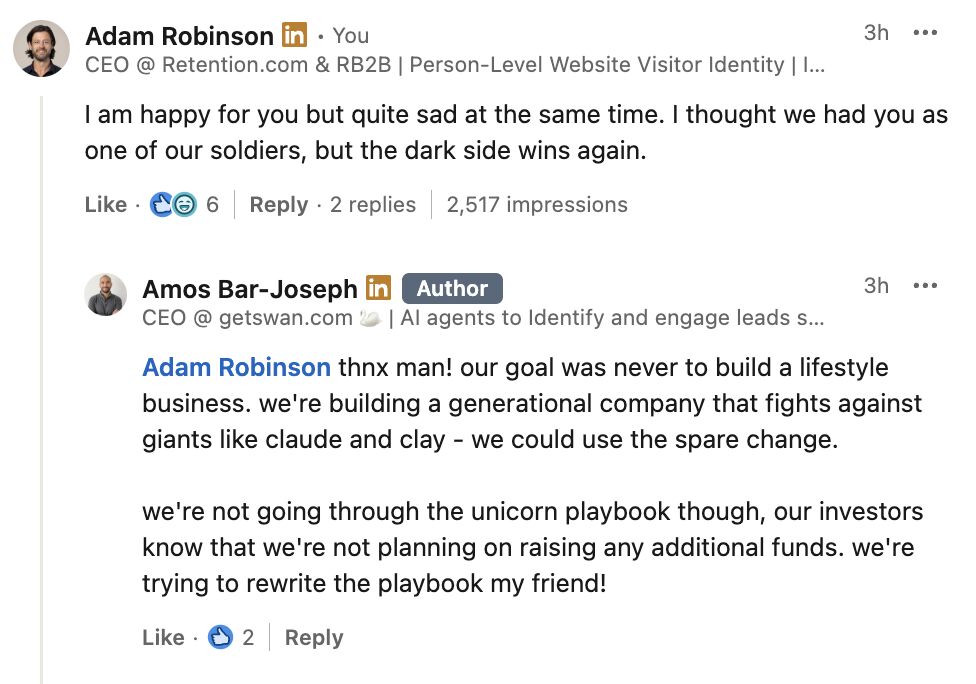
When my friend raised $6M and I told him I was sad to lose another bootstrapper to the VC dark side, he said something that totally dumfounded me. Him: “We're building a generational company and not planning on raising any additional funds.” I couldn’t stop thinking about this. He’s building SwanAI - an AI tool taking on Claude and Clay. He joined my community, took my LinkedIn course, and from zero built what I honestly thought was a better version of both my LinkedIn content strategy AND my RB2B product. I mean that. The guy is exceptional. But is it actually possible to build a generational AI company that fights Claude and Clay on $6M? Claude just raised $30 billion. Do his investors genuinely think $6M closes that gap? My guess is no. I think they like Amos and his team so much that they’re happy to go along for the ride, and I don't blame them…but what if they'd just bootstrapped to $10M ARR first? At that point, they could have made a real decision - keep going independently, or raise from a position of strength. Instead, they now have to go very, very, very big. That pressure is real, and it doesn't go away. Maybe I'm wrong. Maybe $6M is exactly what they need, and Amos proves me wrong in two years. I'd genuinely love that outcome. But I keep coming back to: what would bootstrapping to $10M ARR first have cost them, really?
@OisinO ·
I bootstrapped Recharge for 5 years and hit $20M ARR before taking a dollar of outside capital. Here's what those 5 years actually taught me: 1. Cash pressure prevents bad decisions When every dollar leaving the account is yours, you develop instincts funded founders rarely build: • You stop chasing what sounds exciting • You start chasing what customers actually pay for repeatedly • You learn the difference fast to keep your business alive 2. Just survive Most founders build companies that need too many things to go right too quickly. Staying alive gives you something money can't buy: • Time to find what actually moves the business • Data you couldn't have gotten any other way • Clarity on where value actually comes from 3. Fundraising not a milestone I see founders treat closing a round like the goal. The raise is only useful if you already know: • What you're accelerating • Why it works • What more capital actually changes 4. Capital amplifies truth Clarity plus capital means you move faster. No clarity plus capital means you scale the wrong things faster: • The founders I've watched struggle weren't underfunded • They raised before they understood what they were building • Capital just got them further down the wrong road faster 5. Bootstrapping forces recalibration By the time we took our $277M growth round, we weren't raising to figure out what worked. We already knew: • The value we provided • What we were accelerating • Exactly how more capital would help That's a different relationship with capital than most companies ever have. Survival bought us time. Time bought us data. Data bought us clarity. So if you're bootstrapping and it feels slow right now, that’s part of the journey. Don't skip it.
@ericdjav ·
The weirdest part of bootstrapping: You become a faster learner. When you're funded, learning takes months. You have time. You can read books. You can take courses. You can "research." When you're bootstrapped and broke, learning happens in days. I learned Supabase in 3 days because my product needed it on day 4. I learned pricing psychology in 1 week because my churn was too high. I learned customer support in 2 days because my first customer was angry. Funding kills urgency. Brokenness creates urgency. Brokenness is underrated. When your rent is 3 weeks away and your product does $0, you learn at light speed. You don't learn Python. You learn the parts of Python you need. You don't learn Supabase. You learn the 3 functions that ship your product. You don't learn marketing. You learn "how do I get the next customer this week." Every founder I know who hit $100k MRR was initially broke. Every founder with funding who tried to bootstrap later always says: "bootstrapping forces you to learn differently." Differently = faster. Differently = focused. Differently = just enough. The people who say "I don't have time to learn" are the same people with tons of time (they're just not desperate enough). Desperation teaches faster than any course.
@SimonHoiberg ·
Most early SaaS founders overpay for one thing they barely use: Convenience. "Just ship on whatever is fastest." "Who cares, it's only $99/month." "Managed everything, we'll optimize later." Later never comes. And suddenly your *infra bill* is a silent co‑founder that owns 30% of your margin. Here's how I think about stack decisions as a bootstrapped founder 👇 → Start boring. Postgres, simple queues, a single VPS. No exotic managed services unless they're mission‑critical. → Avoid invisible lock‑in. If you can't leave a provider in a focused weekend, you're not a customer - you're a hostage. APIs > proprietary SDKs. Exports > "just use our dashboard". → Separate "move fast" from "run forever". Use whatever helps you prototype. But before something becomes core: - Can I self‑host an equivalent? - Can I swap this out in under a week? → Price with costs in mind. Your pricing should assume: - Users grow. - AI usage grows. - Cloud prices rarely go down. If your unit economics only work at small scale, they don't work. You don't need a "hyperscale" architecture. You need a stack you *own* and can profit from at 100, 1,000, and 10,000 users.
@brahma_4u ·
I had tears in my eyes this morning. One EV DOCTOR user posted a WhatsApp story from his showroom, proudly showing customers his capabilities through our product. That feeling is bigger than ARR, funding, articles, tweets, or fame. We spent 7 years building one product. Through hard days, doubts, and moments when people around us said, “Take the safe route. Get settled.” But today, this love from customers is the fuel my team was waiting for. And this is just the beginning. We are scaling EV DOCTOR beyond limits. One day, every EV battery on earth should be tested with EV DOCTOR. Not by chasing noise, but by building real value. Customer-loved. Customer-funded. Customer-trusted. That is what truly matters to us. The next thing is 1000x more inspiring and worth it. @Ajayv93
@mk_tycoon ·
Too many founders say, “I don’t have the money to start.” The question isn’t always whether you have money. It’s whether you’re willing to back your own idea. Every entrepreneur has some form of capital. It may not be cash, but it is often hidden in plain sight: • A valuable skill that can be sold as a service. • An expensive phone, laptop, or other asset that could be converted into startup capital. • A network that can open doors to paying customers. • Time that can be invested in building a minimum viable product or acquiring clients. The greatest signal you can send to investors isn’t your pitch deck—it’s your commitment. If you’re not prepared to make sacrifices for your own vision, why should someone else risk their hard-earned money on it? Many successful businesses didn’t begin with venture capital. They started with founders who sold something, freelanced, downsized their lifestyle, or reinvested every dollar they earned until the business could stand on its own. Start where you are. Use what you have. Generate your first revenue. Then let your results attract investment—not the other way around. The best investor in the early days is often the founder who believes enough to invest in themselves. #Entrepreneurship #Startups #FounderMindset #Bootstrapping #AngelInvesting #BusinessGrowth #Leadership #Innovation
@oliverbrocato ·
The longer I build as a bootstrapped founder, the more I realize: "Urgent" is usually just a feeling. Not a fact. Not a real situation. Every time u jump in to fix everything, react emotionally, make it ur job to handle it all... U train people to depend on u for everything. So now ur the bottleneck. And instead of actually building something big? Ur just babysitting grown adults on a payroll That's not founder work, buddy. That's middle management.
@ivanburazin ·
Founders who say, "we should have raised less in our last round, as most of the money is still sitting in the bank" are missing the whole point of venture funding. I'm all for bootstrapped companies profitably scaling to a stable revenue and making a conscious call to cap further growth and cruise comfortably. But if you want to build at the forefront and have raised external capital, there's no point in playing it safe. VCs themselves are betting on you being aggressive/ambitious enough to help justify their investment and bring them those returns. We've raised three rounds so far and have been very close to turning cash flow positive on more than one occasion. Most startups can adjust their month on month growth and increase their runway/get closer to profitability accordingly. But it kinda defeats the whole purpose, doesn't it? I'd rather deploy it on building our own infra, hiring the best, and acquiring dream customers.
@kylegawley ·
Building a funded business is 10x easier than bootstrapping Unlike most indie hackers on here posting anti-VC tropes without ever having raised capital, I have raised funding in the past Let me tell you why it's easier so you can make an informed decision not based on clickbait tropes. > 1. Salary I got a salary on day one. I was not worrying about money, paying the bills, side hustles etc I was 100% focused on the business every single day from DAY ONE. > 2. Advertising We could spend money on ads, paying $10/click with a half baked funnel was no problem. Try doing that with your life savings. > 3. Talent We hired talent on day one, my co-founder and I were no longer doing everything and could focus on growing the business. Doing everything solo is a serious disadvantage when you're competing with well-funded companies and big teams. > 4. Clout Enterprise customers took us seriously because we had funding and a team. Big customers simply won't take a solo indie hacker as seriously and view the risks differently. People are going to reply to this saying the trade off is freedom having a boss - those people clearly have absolutely no idea how a company actually works.
@TheCoolestCool ·
You do not need Silicon Valley to build a $50M company. One founder (@MediaKing) did it from a city of 250,000 people. No venture capital. No hype. No tech scene. What helped? 1. Fewer distractions. No shiny object syndrome 2. Long-term focus. No pressure to raise or exit 3. Relentless learning. 30 podcasts a week. Conferences for peer calibration 4. Playing the long game. From a $50K side hustle to over $200M over the last few years If you are a bootstrapped founder in a small market, this is your reminder: Geography is not your ceiling. Distribution, discipline and data are. Check out the full episode here: https://t.co/bbw8Fxsv9A
@kevinhoff ·
WHAT WOULD YOU TRADE TO KEEP YOUR BOOTSTRAPPED STARTUP ALIVE? Nobody tells you what year four actually costs. For me it's this: a museum-grade 1929 American oil painting and Ralph Lauren's launch-year bone china, traded for two NVIDIA DGX Sparks + $2,500, or $12,500 cash. The painting's auction comp alone approaches $44,000. The gap is the point. I'm not negotiating, I'm refueling. I'd rather run out of things to trade than settle before the world catches up.
@join_luzz ·
A question for people who’ve actually built and shipped hardware. I’ve always thought hiding a SaaS idea was usually a mistake. The idea is rarely the moat; shipping, getting customers and iterating are much harder. I’m wondering whether simple hardware changes that. I mean a product with no meaningful IP moat, something others could reproduce fairly easily. The edge may be building the right brand for a narrow vertical and reaching that audience first. Production, certification and working capital still decide how quickly you can move. If early testing shows real demand but someone with deeper pockets could manufacture and launch faster, how would you sequence public validation, pre-sales, fundraising and production? What would you avoid sharing, if anything? or as a bootstrapped founder, you almost have to build in public, grow an audience and run pre-orders or Kickstarter before you can even manufacture So how do you think about that trade-off? How much do you share? What do you deliberately keep private? And how do you avoid validating a market for someone with much deeper pockets? After digging into this a bit more, I found plenty of successful hardware companies that bootstrapped through Kickstarter, and others that raised venture capital. So funding itself doesn’t seem to be the real issue. A great Kickstarter might even generate more traction than a seed round if it’s executed well. One pattern I noticed, though, is that almost every successful product attracted copycats. Yet the original company usually seemed to keep the lead. My guess is that the copycats were mostly chasing an opportunity, while the original founders were obsessed with solving the problem. (Maybe I’m wrong.) So perhaps the real challenge isn’t preventing copies. It’s figuring out how to get enough capital early enough to move as fast as possible ?
@eostudi0 ·
Yasser Elsaid, solo founder of Chatbase, on why the biggest mistake bootstrapped founders make is thinking like one. What you'll learn: - How a single tweet turned into a first Stripe notification in 30 minutes, and $1M ARR in exactly 117 days - Why having $0 for marketing was the constraint that made every later dollar go further - What actually changes from $0→$1M vs $1M→$10M (one you can brute-force, the other you can't) - Why 80% of their outbound is "warm," and why every churn tactic that isn't product improvement is a waste of time - The one question that decides whether you should raise or stay bootstrapped Timeline: 00:00 Intro 01:03 Why Bootstrap? 02:30 The Common Mistake Bootstrap Founders Make 03:45 EO Partner Highlight 04:40 Why Become a Builder? 09:10 How Chatbase Started 12:52 How to Hit $1M ARR 14:52 $0→$1M vs $1M→$10M: What Changes? 16:11 Reducing Churn Early 19:27 Thoughts on PLG? 21:28 SEO & AEO Strategy 23:11 How Warm Outbound Works 25:23 Experimenting With Pricing 27:31 Revenue Over Margins? 28:32 Co-Founder or Solo? 29:47 When to Raise 31:05 Decision-Making Framework
@Lockhead ·
Nexus Share at 6 months: 📊 100+ users 💰 AWS costs: $150/mo (30% CloudWatch, 30% CodeBuild) 📱 >50 mobile installs 🚀 200+ production deploys ⏱️ CI/CD: 28min avg Not hockey stick growth, but sustainable. The unsexy truth of bootstrapping: slow, steady, learning constantly. #BuildInPublic #SaaS
@sylviahchannel ·
Your constraints as a solo or bootstrapped founder impact how quickly you can test, build, recover from mistakes, and create momentum. 💡The key is to build intelligently from the resources you have: → Choose fewer priorities so your limited capacity can produce meaningful progress → Use borrowed distributions from partnerships and communities to extend your reach → Build knowledge through market contact rather than researching in isolation → Measure progress against your own starting point, conditions, and business reality
@LubaYudasina ·
In 2008, @labunleashed pitched every VC in Boston with an idea called TaskRabbit. Every one of them passed. So she bootstrapped it herself for 18 months, running the whole thing out of her apartment. She was the first engineer and the first task runner all the way through. The company grew, and @IKEA eventually bought it for over $100 million+. Now she runs her own fund, Precedent VC, and she's built it as the exact opposite of the system that rejected her back in 2008. Cold decks get scored on the same rubric as warm intros. If a deal scores high, the founder is on the phone within six hours. The full arc from bootstrapping alone in Boston to running her own fund and writing a book about it is in the new episode of The Luba Show. Timestamps 00:00 Trailer 01:12 Intro 01:21 Ballet background and SF Ballet board 06:12 TaskRabbit's origin story 10:52 Move to the Bay Area 23:00 Selling TaskRabbit to IKEA 33:03 Letting go of founder identity 35:37 Launching Precedent VC 38:26 AI-powered deal scoring system 41:26 Investing philosophy and founder fit 54:30 Founder green and red flags 58:26 Why she wrote Breaking Precedent 01:07:12 Parenting and work-life balance 01:10:46 Defining success 01:12:20 Outro Loved talking to Leah! Episode available on all platforms.
@bmykhaylivvv ·
building amplifresh hit $500 mrr in 6 weeks - turned my twitter analytics obsession into a tool that actually works gained 2000 followers in 40 days by shipping in public and sharing real metrics daily the secret was solving my own problem first - needed better engagement insights so i built them most saas tools are bloated - kept amplifresh dead simple with just the features that matter bootstrapping forces you to build what users actually pay for instead of nice to have features twitter growth is just consistent value - shared code snippets and product updates every single day $500 mrr feels small but it covers my coffee budget and validates people want this thing next milestone is $2k mrr by adding team features - solo founders need collaboration tools too the hardest part was not the code but finding the right pricing model that converts indie development is 20% building and 80% talking to users who might never buy amplifresh started as a weekend project and became my main focus in two months growth hack that worked - replied to every tweet about twitter analytics with genuine help revenue comes from solving real pain points not building cool technology demos my twitter dms are full of other indie devs asking for advice - just ship something small first took 40 days to prove product market fit exists - now scaling is the fun challenge
@TurnerNovak ·
New @ThePeelPod with @sophiaamoruso We talk bootstrapping her vintage Ebay store Nasty Gal to $28m revenue, raising $50m, turning down a $400m acquisition offer, and declaring bankruptcy a few years later. We talk about what it was like failing so publicly, what she’d do differently next time around, lessons on building a brand, and why she started @trustfundvc to back the next generation of founders building consequential companies. Thanks to @Numeral, @FlexSuperApp, @Amplitude_HQ, and @merge_api for sponsoring this episode Timestamps: 0:59 Selling vintage on Ebay while working at an art school 04:31 Lessons in marketing and perceived value 12:38 Knowing when to make your first hire 18:31 Borrowing from others to build a unique brand 25:17 Growing to $120m revenue in seven years 27:24 Sharing the pitch deck that raised $50m 30:17 Mistakes scaling to 100’s of employees too fast 34:48 Downsides of raising at too high of a valuation 39:56 Why being a CEO is so fun 42:57 Declaring bankruptcy 50:38 How it feels to fail publicly 54:41 Writing a book, Netflix series, starting the Girlboss movement 59:13 How to create a new brand in 2026 1:05:34 Starting Trust Fund to invest and help founders 1:13:45 Raising $5m from a poker game 1:18:47 Sophia asks for Turner’s LP pitch 1:26:53 Traits of the best founders
@oliverbrocato ·
Running a bootstrapped startup with ADHD is dangerous. U actually ENJOY doing 100 different things: > filming 10 UGC ads at my desk at 8pm > screening candidates on my walking pad > jumping on sales calls with $5M+ enterprises > reviewing every pixel of design work > lurking in client Slacks for quality control > hammering out contracts and finance stuff Next thing u know, ur everywhere… and the company has NO REAL CEO. Time to fire myself from half the biz. BIG SWINGS ONLY.
@sylviahchannel ·
Your to-do list can look full and still not be moving the business forward and that is one of the hardest parts of building alone and bootstrapping 🤯 👉 Some tasks keep the business alive. Admin, replies, fixing small things, updating files. They matter, but they mostly maintain what already exists. Other tasks are avoidance dressed up as productivity, such as tweaking the logo again, redesigning the website again, or building a system before you have enough customer conversations to justify it. 🔥 For early-stage founders, momentum usually comes from the smaller set of uncomfortable tasks. → Asking for the sale → Testing the offer → Following up with warm leads → Speaking to real buyers → Asking for referrals → Putting the offer in front of more right-fit people So do not treat every task as equal. Separate what keeps the business alive from what moves it forward, especially if you are still trying to grow revenue and acquire customers. Then prioritise at least one forward-moving task every day. As always, keep going and growing. 👉 Follow @bMightie for more strategies, realities, and pitfalls for the solo and bootstrapped founder journey from day zero to takeoff. #founderproductivity #productivitytips #newbusinessowner #startupshowup #solopreneurship
@kzitouni1 ·
my routine of staying sane while bootstrapping Elevateab to $1M+ ARR: - talking to customers - shipping every week - testing instead of guessing - lifting 5x/week - keeping personal expenses low - using AI to save time - staying focused on one business nothing revolutionary, just hard to do consistently.
@brahma_4u ·
Let me hit you with one of the deadlist but obvious reality A lot of funded hardware startup founders make more money for themselves than a lot of decent PMF bootstrapped hardware founders. The PR, launch videos, crowdfunding, product launch tweets get them more money and fame, which becomes a fancy standard. A lot of bootstrapped founders mistake that thing for growth and they start to follow the same path, leading to the loss of direction and purpose. Now they are nowhere, they cant enjoy the compounding effect which ONLY real customer revenues bring. Founders, angels, VCs, LPs etc. all know about this, but sometimes giving exit is the only revenue model that matters.
@0xDvnl ·
The founder conversations in 2026 sound nothing like 2021. Most teams I talk to now lead with revenue. A lot of them are bootstrapping. Almost nobody opens with a token model. The industry grew up while everyone was arguing about whether it was dead. This is the most excited I've been about crypto founders in years.
Best Tweets by Topic