You’ve shipped a useful SaaS product, but your marketing budget is limited and your ideal customers already spend time discussing the problems you solve on X, formerly Twitter. The challenge isn’t finding more people to follow. It’s becoming recognizable and useful inside the conversations that matter.
Twitter growth for SaaS founders works best when you combine one thoughtful original post with consistent, high-signal replies, then measure whether those activities create profile visits, qualified conversations, and commercial intent. X can support founder-led distribution, customer education, and community building, but only when you treat it as a niche authority channel rather than a follower-count scoreboard.
Why X Still Matters for SaaS Founders in 2026
A SaaS founder with a narrow ideal customer profile, limited ad spend, and an unfamiliar product has a trust problem before having a traffic problem. Prospects want to see how you think, whether you understand their workflow, and whether you can explain the problem clearly. X gives you a public place to demonstrate all three through posts, replies, quote posts, product lessons, and conversations with people already thinking about the category.
X’s audience is no longer defined by explosive user growth. The platform expanded rapidly from 54 million monthly active users in 2010 to 288 million in 2014, then entered a slower-growth period. By 2024, estimates ranged from 388 million monthly active users to 570 million monetizable monthly active users, which points to a substantial addressable audience beyond a single core-user estimate. The practical opportunity for a SaaS founder is concentrated attention, not endless expansion. The historical X audience figures and 2024 estimates are summarized here.
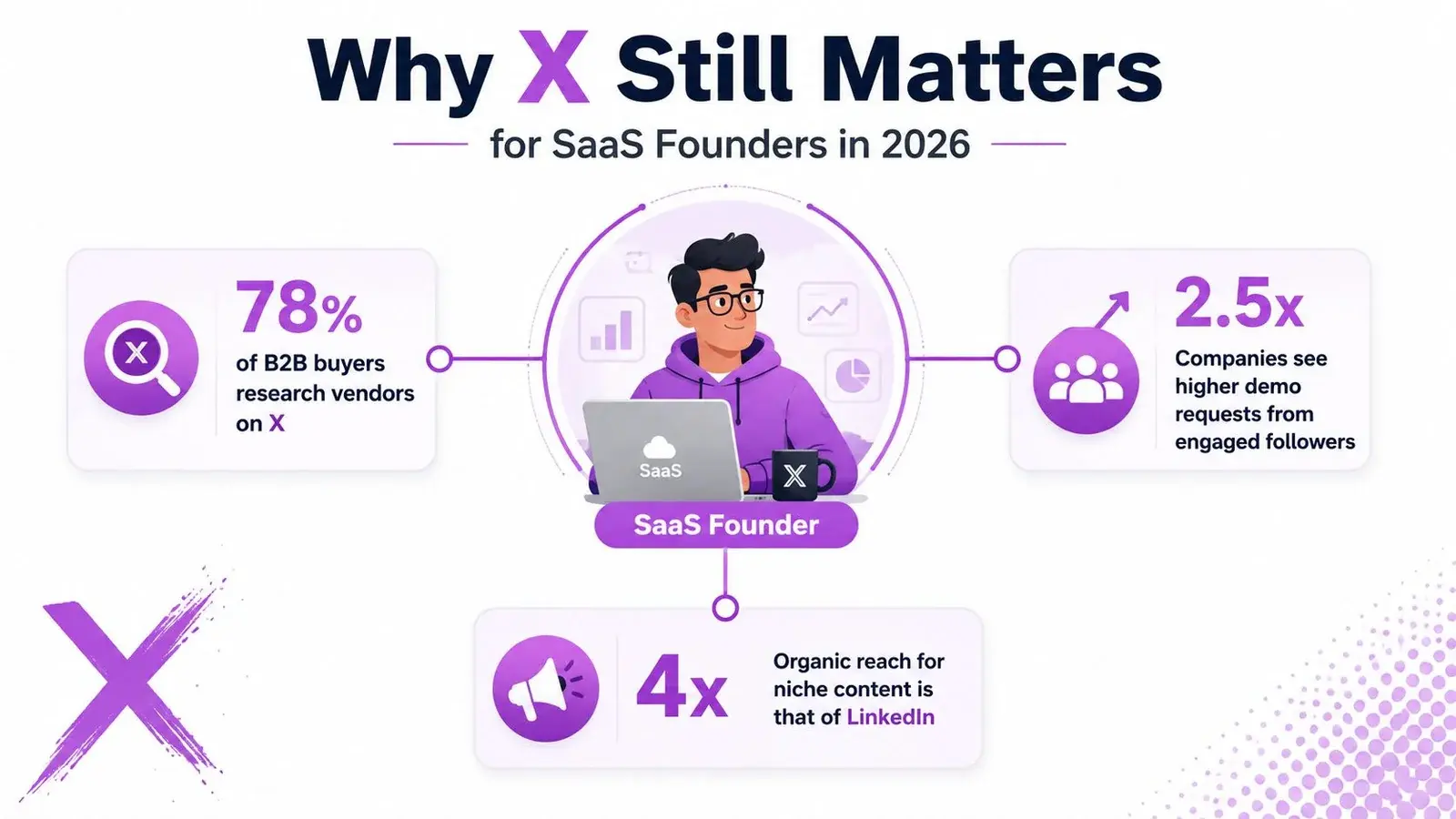
X reached about 251 million daily active users globally in Q2 2024, while the platform told advertisers that total ad engagements had increased 22% that year, according to reporting on X user and engagement statistics. User growth slowed, but activity remained meaningful. That distinction matters for founders because a responsive niche audience can be more valuable than a larger but passive audience.
The shift from reach to authority
A founder selling developer tooling doesn’t need every X user. They need repeated visibility among developers, technical leaders, operators, and adjacent creators who recognize the problem and can influence a purchase. Replies often create that recognition faster than isolated broadcasts because they place your thinking inside conversations your ICP already follows.
The useful question is no longer, “How do I get more followers?” Ask instead:
- Which conversations contain people with the problem I solve?
- Do my replies add a useful angle, example, objection, or explanation?
- Do profile visitors understand my product and audience immediately?
- Can I connect attention to trials, demos, waitlist signups, or customer conversations?
That’s the operating model behind how the X algorithm affects distribution. Treat X as a high-frequency attention market where relevance, consistency, and conversation quality matter more than platform-wide growth.
Profile and Bio Setup That Converts Visitors
A reply can earn attention, but your profile converts that attention into a relationship. SaaS founders often spend hours refining posts and leave their profile with a vague bio such as “Building the future of work.” That description says almost nothing to a visitor who has just encountered you in a technical discussion.
Your profile should answer three questions quickly: who you help, what you’re building, and what someone should do next.
Build the conversion surfaces
Start with the avatar. Use a clear, recognizable image that still works at small sizes. Your header should reinforce the product category or customer problem without becoming a crowded feature list. The display name can add useful context, such as “Maya Chen, analytics for support teams,” while the username should remain easy to remember and share.
Your bio needs a specific promise. A useful structure is:
I help [audience] solve [painful problem]. Building [product] for [use case]. Follow for [recurring insight].
For example: “I help support teams reduce repetitive ticket work. Building RelayDesk for lean SaaS teams. Sharing lessons from product, onboarding, and customer research.”
That bio gives the reader a reason to follow even before they’re ready to buy. It also creates a clear standard for your posts. If your bio promises onboarding lessons but your timeline contains only generic founder motivation, profile conversion will suffer.
Treat the pinned post as a landing page
Your pinned post should do a job, not merely display your most-liked thought. Rotate it based on the current business priority:
- Product launch: Explain the problem, show the product, and give one direct next step.
- Build-in-public update: Share a meaningful product decision and what readers can learn from it.
- Lead magnet: Offer a useful checklist, teardown, or guide that fits your audience’s workflow.
- Product education: Demonstrate how your SaaS handles a painful task without turning the post into a feature dump.
Use a clear call to action, such as “Join the waitlist,” “Try the workflow,” or “Reply with your use case.” Don’t ask visitors to decode your profile.
For a practical audit of the avatar, header, name, bio, and pinned post, use this X profile optimization guide. Then review your profile as if you arrived from a reply by someone you don’t know. If the value proposition isn’t obvious, rewrite before increasing your posting volume.
The 90-Day Measurement Loop That Diagnoses Growth
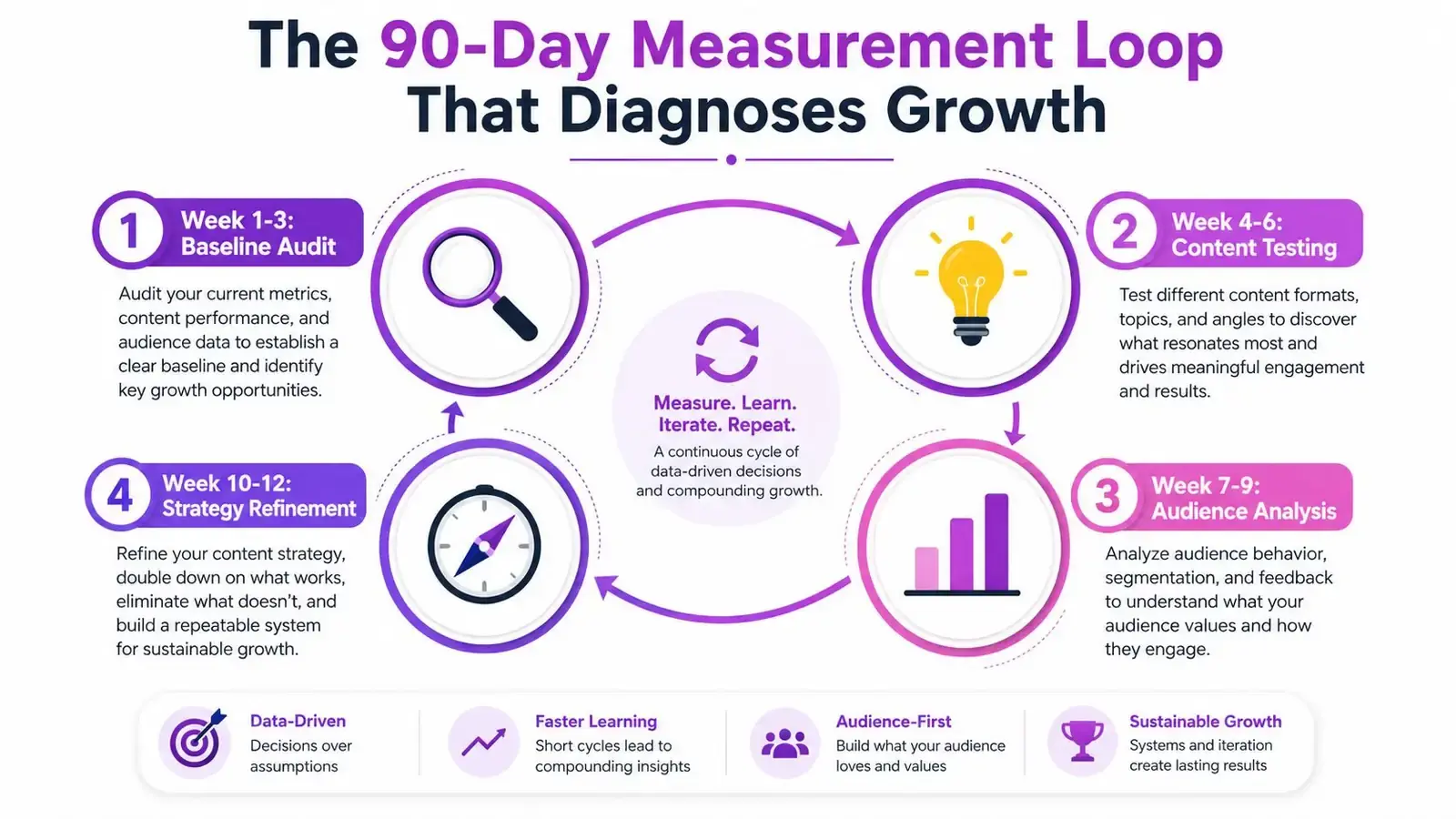
A post earns strong impressions, yet qualified signups stay flat. Another receives fewer views but attracts founders who ask detailed product questions. Those outcomes require different responses. Measure X as a distribution loop, not a follower-count contest.
Start with your last 20 to 30 posts and sort each into one of three outcome buckets:
- Pulled conversation: Qualified people replied, asked follow-up questions, or extended the discussion.
- Passive approval: The post earned likes or impressions but created little visible intent.
- Dead on arrival: It received limited distribution or failed to prompt meaningful action.
These buckets diagnose the system rather than judge the writing. Pulled-conversation posts show which problems and angles invite participation. Passive-approval posts may be clear or entertaining while producing little commercial intent. Dead posts can indicate weak distribution, positioning, timing, or relevance.
Isolate the bottleneck
Track three levers separately:
- Cadence: Are you publishing often enough to create a dependable sample?
- Profile conversion: Do profile visits become follows or meaningful next actions?
- Reply quality: Do daily replies reach the right people and demonstrate useful expertise?
Founder accounts often publish around 4 to 7 posts per week, while stronger accounts may reach 8 to 14 or more. Follower growth above 6% per 30 days is typically considered strong, and 5% to 9% profile-visit-to-follow conversion is a useful target, according to X analytics for founders. Treat these figures as directional comparisons, not promises.
Review the loop at 30, 60, and 90 days, with smaller checks every 2 to 4 weeks. Change one major variable at a time, such as your original-post angle, reply routine, or profile promise. A thoughtful original post paired with daily, high-signal replies gives you a clearer test than changing every activity at once.
Metric definitions also matter. X defines engagement rate as engagements divided by impressions, expressed as a percentage. X’s native analytics documentation helps separate reach from response. A post can reach many people while generating few actions, so impressions alone should not determine whether you repeat the idea.
At each review, connect impressions, replies, reposts, profile visits, link clicks, and follows. The useful question is where the loop loses qualified attention, then whether the next 30-day test addresses that specific bottleneck.
Original Post Frameworks and Weekly Cadence
Original posts give your audience a reason to remember your point of view. The strongest SaaS founder accounts don’t rely on endless product announcements. They rotate a few dependable formats and attach each one to a real operating experience.
Four formats worth rotating
Build-in-public update. Share a decision, constraint, or change in direction, then explain why it matters. “We removed a dashboard filter from the next release. It looked useful in demos but confused first-time users. We’re replacing it with a simpler default.” The product detail gives the post substance, while the reasoning gives other founders something to discuss.
Lesson learned. Start with the mistake or observation, then explain the adjustment. “Our onboarding email answered every question except the first one users had: where to begin.” Keep the lesson transferable, not autobiographical.
Opinionated point of view. Take a position about your category or workflow and defend it with experience. “Most early SaaS teams don’t need more acquisition channels. They need a clearer explanation of the problem they already solve.” A useful opinion creates a discussion without manufacturing outrage.
Proof post. Show evidence that your product solves a real problem, while protecting customer confidentiality. A before-and-after workflow, anonymized feedback pattern, or product behavior can work. Don’t turn proof into an unsupported result claim. Explain the context and the limitation.
A cadence you can maintain
A practical baseline is about one thoughtful post per day plus 15 minutes of substantive niche replies. That doesn’t mean every day needs a polished essay. One day can feature a short lesson, another a screenshot breakdown, and another a focused product observation.
Audience growth commonly becomes measurable within 30 to 60 days of consistent activity, while customer acquisition from X often begins around 60 to 90 days, according to independent SaaS founder marketing guidance. That timing makes consistency more important than a brief burst of volume.
Use a Twitter content calendar to assign topics to days without forcing yourself to write every post in advance. If you also publish on LinkedIn or another channel, a multi platform publishing guide can help you adapt an idea without copying the same post everywhere.
The rule is simple: publish enough original thinking to establish your expertise, then spend enough time in replies to place that expertise where your audience already gathers.
Reply-First Strategy for Niche Authority
Replies are where a SaaS founder earns context. A good reply doesn’t repeat the original post or ask an empty question. It contributes a small piece of expertise that makes the conversation more useful.
Start with a narrow list of accounts and topics connected to your ICP. Look for founders discussing the workflow you serve, practitioners describing the problem, creators educating the market, and customers revealing objections. The relevant thread may not mention your product category directly. A discussion about manual reporting, team handoffs, or poor onboarding can be more valuable than a post explicitly asking for SaaS recommendations.
What a high-signal reply contains
Use one of four contributions:
- A specific example: Add a situation that shows how the idea appears in practice.
- A useful qualification: Explain where the advice works and where it breaks.
- A sharper mechanism: Show why the result happens, not just that it happens.
- A thoughtful disagreement: Challenge one assumption while preserving the useful part.
Avoid “Great post,” “So true,” and “I needed this.” They consume attention without establishing expertise. Generic engagement bait can also attract interactions from people outside your target market, which makes the account look active while teaching you very little.
A direct reply is usually appropriate when you can extend the author’s idea. Use a quote post when your added perspective needs room or when you want your audience to understand the original context. Don’t quote-post every interesting idea. Sometimes the highest-value move is to participate directly in the existing thread.
Turn replies into a research system
Keep a lightweight log with the topic, your angle, the response, and whether the conversation led to a profile visit, follow, message, or product question. Over time, repeated reply themes will show you what your market finds useful.
A single productive thread can become several original posts. If multiple people ask how you handle a workflow, write a concise lesson. If they disagree about a trade-off, publish a point of view. If they share the same workaround, investigate whether it signals a product opportunity.
A 2026 Metricool analysis found that accounts posted 8% more weekly content in 2025, while average impressions per post fell 5%, engagement rate rose from 1.32 to 1.58, and retweets increased 35%. The reported comparison is available in this X performance summary. The pattern supports a practical conclusion: more publishing alone isn’t enough. Tighter participation and stronger interaction per post deserve priority.
Threads, Micro-Content, and Conversion Paths
A founder posts one useful sentence about onboarding, then expands it into a ten-post thread with no new information. Readers leave before the product lesson appears. Use a thread only when the idea contains a sequence, tension, process, or decision that needs room. Publish a single post when the point is already clear.
A strong SaaS thread gives each post a specific job. Open with the problem, claim, or costly mistake. Use the middle posts for steps, evidence, decisions, examples, or trade-offs. End with a practical next action, such as a checklist, workflow, product question, or relevant page. The final post should move the reader somewhere useful rather than restating the headline.
Quote posts work when your contribution changes the original conversation. Add a counterpoint, implementation detail, or product lesson that would help a SaaS operator make a better decision. Micro-content serves smaller observations: a screenshot, one-sentence lesson, compact teardown, or short workflow explanation. These formats are useful between larger original posts because they keep the account active without forcing every idea into a thread.
| Format | Best use case | Engagement pattern | Conversion path |
|---|---|---|---|
| Single post | One clear lesson, opinion, or observation | Often broad reach with a lighter interaction depth | Profile visit, reply, or product page |
| Thread | A sequential explanation, process, or deep product lesson | Fewer readers may finish, but completed reads can create stronger intent | Educational page, waitlist, trial, or demo |
| Quote post | A distinct response to an existing conversation | Depends heavily on the original post’s audience and your added perspective | Profile discovery, discussion, or direct message |
| Screenshot micro-content | A concrete workflow or interface insight | Usually narrower reach, with higher relevance when the screenshot matches the niche | Product education, reply, or trial |
Engagement varies by format, audience, topic, and distribution. Use engagement rate equals engagements divided by impressions as the working definition, then compare each format against its own previous results. A high-impression post can still produce weak commercial interest if the viewers do not visit the profile, reply, message, or click through. Track those actions separately from likes.
Match the format to the business outcome
A thread about onboarding can end with a checklist. A product teardown can invite readers to test a workflow. A quote post can direct interested readers to the longer explanation in the profile. Keep the path specific. “Learn more” gives little direction. “Join the waitlist for the onboarding teardown” tells the reader what happens next.
One thoughtful original post creates the asset. Daily high-signal replies distribute its ideas among the right niche. Review the loop at 30, 60, and 90 days by comparing format, qualified profile visits, replies, messages, and product actions, not follower count alone.
If you need operational help with scheduling Twitter threads, choose a scheduler that lets you review the sequence before publishing. Automation can protect consistency, but it should not decide timing, replace replies, or rescue a thread that has no clear business outcome.
Pitfalls, Measurement Checklist, and Next 30 Days
More followers don’t automatically mean more customers. A founder can build a large audience of peers, creators, or general startup readers and still fail to reach the people who experience the product problem.
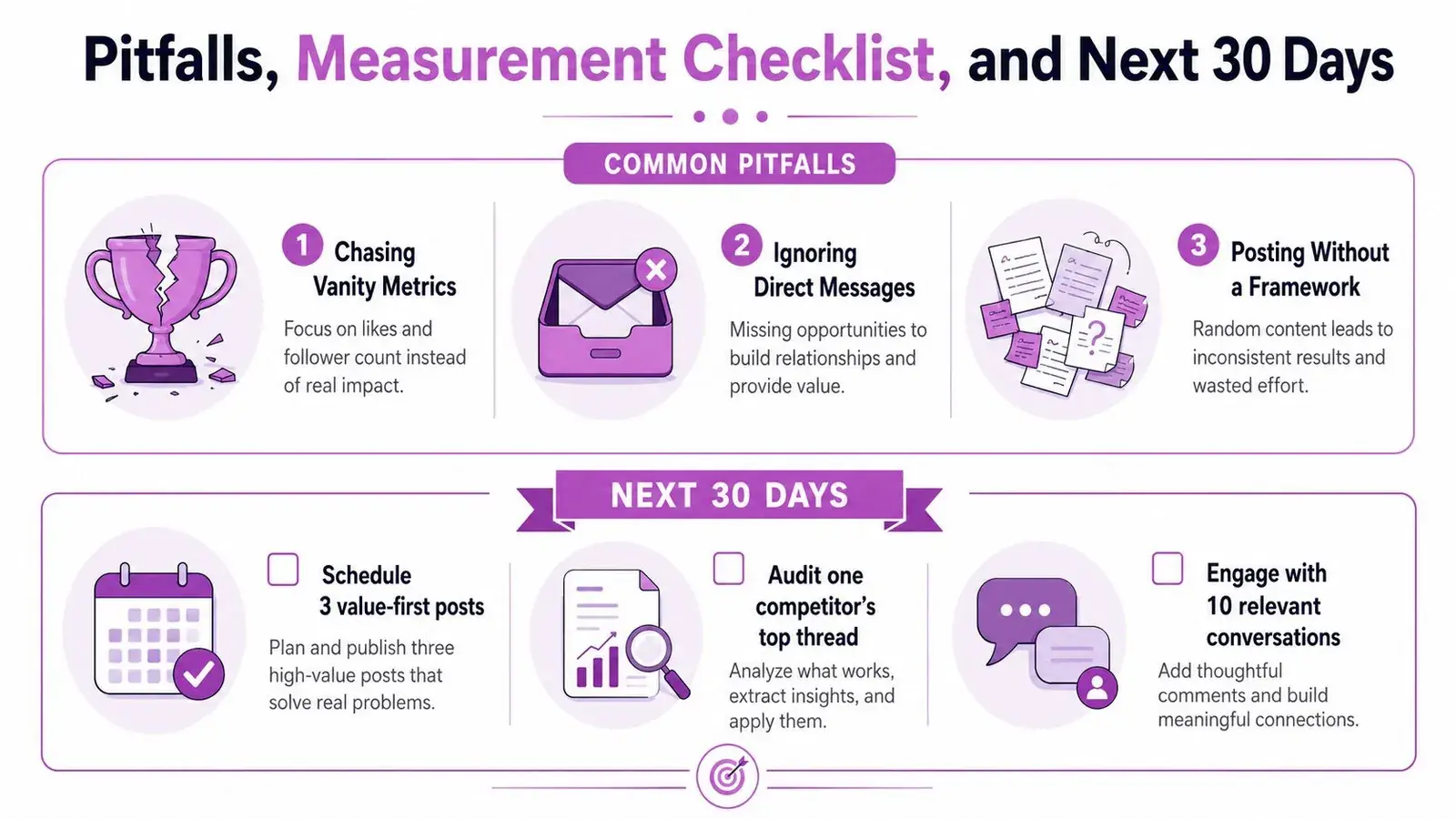
The common mistakes are predictable:
- Chasing vanity metrics: Likes and impressions can look healthy while qualified replies and profile actions remain weak.
- Posting inconsistently: Sporadic bursts make it difficult to learn which topics and formats fit your audience.
- Writing without a business connection: A useful post still needs a logical path toward a demo, trial, waitlist, product question, or relevant conversation.
- Ignoring replies and messages: Broadcasting without responding leaves the most valuable intent signals unused.
- Changing everything at once: You can’t diagnose a cadence problem if you simultaneously rewrite your profile, switch niches, and change formats.
The 30-day operating checklist
Days 1 to 3: Audit your recent posts. Mark each as pulled conversation, passive approval, or dead on arrival. Note the topic, format, hook, profile visits, replies, and link clicks where available.
Days 4 to 7: Rewrite your profile and pinned post around one audience, one painful problem, and one next action. Remove vague positioning that could describe any SaaS founder.
Weeks 2 to 4: Publish one useful original post per day or establish a sustainable weekly cadence. Spend 15 minutes on replies that add examples, qualifications, mechanisms, or thoughtful disagreement.
At day 30: Review which conversations created qualified interest. Compare profile visits with follows, and impressions with engagements. Several 2026 benchmark summaries place platform-wide median engagement rates between roughly 0.12% and 0.70%, so a post above 1% by impressions can already be meaningfully above baseline for educational or niche technical content, according to X engagement-rate benchmark summaries.
Practical rule: Keep the post topics that repeatedly create qualified conversations, not merely the ones that produce the largest impression count.
Run the loop again, changing one major variable at a time. If you want help finding relevant discussions and drafting context-aware replies without surrendering editorial control, Xholic AI uses personalized context and memory to support reply research, post ideas, analysis, remixing, and scheduling. Review every suggestion, keep your voice, and let the system reduce the manual search that usually causes founders to abandon the routine.