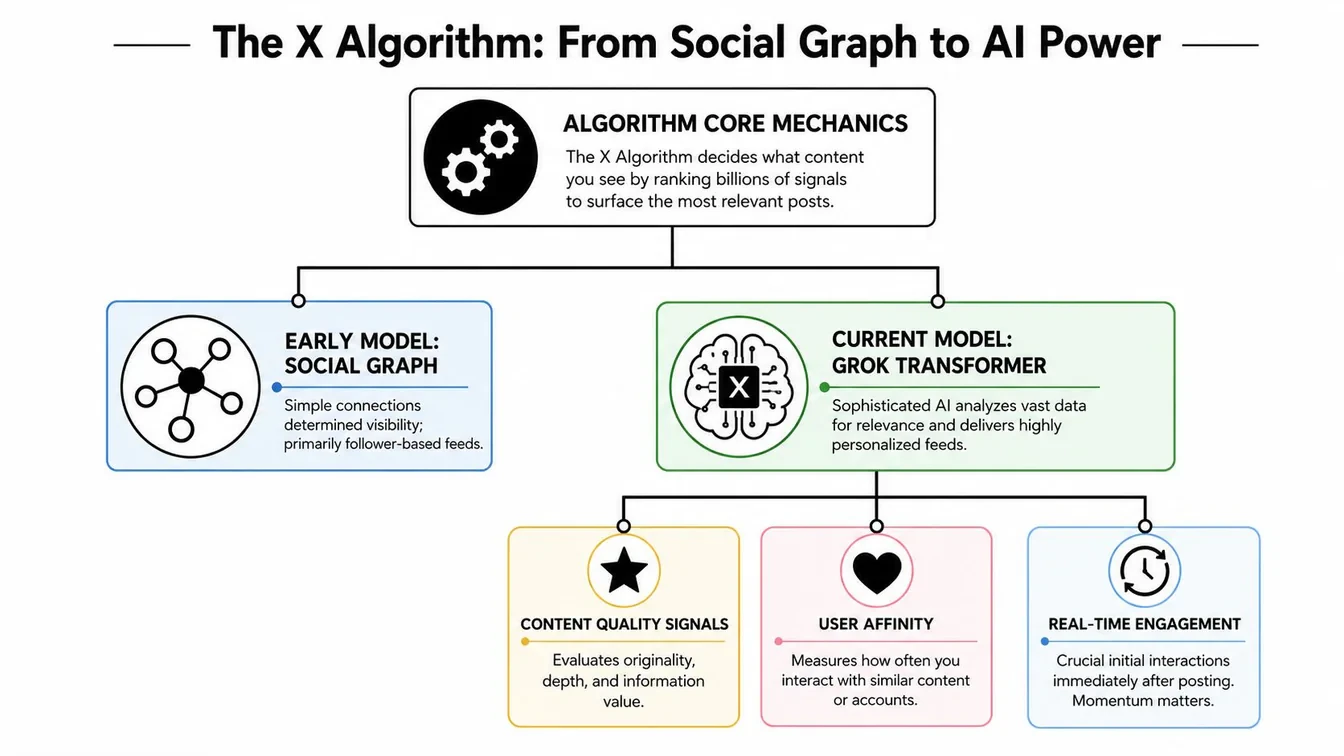
The X algorithm is no longer a follower game. Since January 2026, X has ranked the For You feed with Phoenix, a transformer adapted from xAI’s Grok-1 that predicts how likely you are to like, reply to, repost, or skip each post. In 2023, X said the pipeline ran about five billion times a day in under 1.5 seconds; it hasn’t published newer numbers.
That changes the game for creators. Reach now tends to go to posts that spark meaningful interaction, especially replies. Follower count tricks, hashtag stuffing, and generic consistency advice matter less than many creators assume.
A lot of creators are still playing by the old rules. They obsess over posting times, hashtag strategy, and frequency as if the feed were mostly chronological with a bit of ranking added on top. It is not.
The current system works more like a matching engine. It tries to understand what your post means, who is likely to care, and whether the first wave of reactions signals real interest. That is why bland feature announcements often stall, while sharp opinions, live problems, and developing stories travel further. The algorithm is not looking for polish first. It is looking for posts that people want to respond to.
If you want to grow on X today, write for conversation, stay active after posting, and treat the first stretch after posting as part of the publication itself.
Format still follows the idea, not a presumed ranking bonus. The complete guide to Twitter threads explains when sequence improves understanding and how to evaluate thread exposure without treating views as unique-reader completion data.
What changed in 2026
The fastest way to understand the X algorithm is to stop thinking about it as a follower graph and start thinking about it as a relevance engine.
In the older mental model, distribution depended heavily on who followed you, when you posted, and whether you used the right discovery tricks. In the current model, X predicts how each viewer is likely to react to a post and, since August 2026, also works from a learned representation of the post’s content. Who follows you still matters, but it is no longer the whole story.
What changed for creators
The practical difference shows up in what works.
Generic product posts often get ignored, even when the copy is clean. Strong opinion posts, unresolved challenges, and updates from an ongoing story tend to do better because they give people something to react to. A good post on X now has the right kind of friction. It invites agreement, disagreement, examples, or follow-up questions.
Practical rule: Write posts that make a smart person want to add something.
That also means your work doesn’t end at publishing. Early replies matter because replies carry far more weight than likes in X’s published ranking weights, and a real exchange gives more people a reason to join. If the first comments become a real exchange, reach tends to hold up better than when the post collects passive likes and nothing else.
The operating principle
If you only remember one thing, remember this:
- Write for meaning: X can understand topic and context better than before.
- Write for response: The best posts create a reason to reply.
- Stay present: Replying to early comments keeps the conversation going, which is what the ranking model is trying to predict.
- Prefer specificity: Broad motivational content is easy to scroll past.
Most creators don’t need more posting hacks. They need a repeatable system for creating posts and replies that fit how the feed now evaluates relevance and interaction.
How the X Algorithm Ranks Content
Creators who still treat X like a follower-distribution machine are working from an outdated model. The ranking system now predicts whether a post is likely to earn a specific kind of reaction from a specific user, and since August 2026 it also looks at what the post is about.
In January 2026, the open-sourced “For You” system replaced older hand-built features and most heuristics with a Grok-based transformer called Phoenix (source). Phoenix predicts a probability for each of many actions. X’s repository currently lists 25, from likes, replies and reposts to dwell time, video watch time, mutes, blocks and reports. The January release ranked posts from your engagement history plus hashed post and author IDs; the August 2026 release added the published ranking weights and a learned representation of each post’s content, media included. Underneath that, X uses a two-tower retrieval setup and downstream ranking models to decide what even gets a chance to compete.
The feed is semantic first
That architectural shift matters because it changes what the system can understand. Older feed logic depended more heavily on graph proximity, who followed whom, who interacted with whom, and which accounts already had strong distribution paths. The newer stack can evaluate the post itself with far more context.
In practice, that means the system is better at matching a narrowly relevant post to the right audience, even if the author is smaller. Broad, polished content still has a place, but it often loses to posts with sharper context, clearer stakes, and a stronger topical fit. The algorithm is not just asking, “Do people know this creator?” It is asking, “Is this post about something this user reliably engages with?”
What happens between publish and wider distribution
The operational flow is straightforward once you strip out the jargon:
| Stage | What X does | What it means for creators |
|---|---|---|
| Candidate gathering | X’s 2023 release described pulling about 1,500 candidates per request from accounts you follow and accounts you don’t (X Engineering, 2023) | Your post enters a relevance contest, not a follower-only feed |
| Ranking | Phoenix (it replaced the 2023 Heavy Ranker) scores the candidates | Posts that match user interest and predicted actions rise faster |
| Decision speed | Ranking and ordering happen quickly | The post needs to be legible fast, because the system evaluates it early |
| Final ordering | X weighs engagement quality, topical fit, and author-level trust signals | Small accounts can still break through if the post earns the right response pattern |
For creators, the takeaway is practical. A post has to be easy for the model to classify and easy for the right reader to act on. If the topic is muddy, the audience is unclear, or the framing is too generic, the system has less to work with.
That is why vague motivation usually stalls. “Building is hard, stay consistent” gives the model a weak topic signal and gives readers almost nothing to add. A post like “I stopped posting feature threads because prospects did not trust the product yet. Public build logs worked better because people could watch unresolved problems get fixed in public” performs better for a reason. It has a subject, a conflict, a point of view, and a defined audience. Writing like that every time is easier once you’ve defined your brand voice on Twitter.
If you want a cleaner mental model for distribution, this explanation of how Twitter impressions work is a helpful complement. The key point is simple. X does not rank content by surface polish alone. It ranks based on whether the system can understand what the post is about, who it is for, and what kind of interaction it is likely to create.
The Most Important Ranking Signals for Creators
Creators who optimize only for likes are aiming at a weak target. X’s published weights put far more value on predicted replies and quotes than on likes, so posts that start real interaction have the edge.
Replies carry more ranking weight than approval signals
The practical reason is simple. A like says almost nothing about meaning. A reply gives the system much more to work with. It confirms the post was understood, it reveals the kind of audience it attracted, and it creates more text for the model to classify semantically.
X’s published weights back this up: a predicted reply is weighted 5.0 against 0.66 for a like, and higher still between mutual followers (param.rs). Those weights multiply each viewer’s predicted chance of acting, not raw counts.
| Predicted action | Weight in X’s code |
|---|---|
| Reply | 5.0 |
| Quote | 5.0 |
| Share | 2.0 |
| Repost | 1.0 |
| Like | 0.66 |
Based on X’s open-source release as of October 2026; X updates the repository often.
It also matches what many creators report: posts with a smaller like count but a dense reply section often outlast cleaner-looking posts that people tap and forget.
This changes how to write:
- Make a claim people can react to. Strong posts usually contain a point of view, not a neutral summary.
- Specify the context. “Cold outbound failed for our product until we changed the demo flow” creates better replies than broad advice about marketing.
- Leave one open edge. Readers need a place to add nuance, argue, or bring their own example.
- Answer the first useful replies well. Early thread quality shapes who joins next.
Early replies shape what happens next
X doesn’t publish a time window for early distribution, so treat this as a working habit rather than a rule. The first wave of reactions is the earliest evidence of whether a post lands, and a thread that turns into a real conversation early gives more people a reason to join it.
That is why posting time is only part of the equation. Availability matters more. If the post starts pulling in replies and you are absent for the next hour, you often lose the easiest chance to compound momentum inside the thread.
Two habits help:
- Post when you can stay present. The first replies are part of the post now.
- Seed the right audience from the first sentence. Narrow framing tends to outperform vague “for everyone” writing because the model gets a clearer semantic match.
If you want a starting point for timing, use guides on the best times to post on Twitter as a baseline, then adjust based on when your own followers respond.
Semantic clarity is a ranking signal, not just a writing preference
Since August 2026, X’s model also works from a learned representation of each post’s content, so it isn’t only scoring engagement after the fact. If the subject, audience, and intent are blurry, the system has weaker inputs from the start.
That is why specific nouns beat stylish vagueness.
Compare these two illustrative posts:
- “Consistency matters more than talent.”
- “Our trial-to-paid conversion improved after we replaced feature threads with customer teardown posts.”
The second version gives the model a topic, a business context, an audience, and a likely reply path. It also gives readers something concrete to challenge or extend. Better classification and better discussion usually travel together.
My workflow is straightforward. I draft the post, then check if someone can answer three questions in five seconds: what is this about, who is it for, and what reaction is it inviting? If any answer is fuzzy, I rewrite before posting.
What to watch in analytics after publishing
Total likes are a weak diagnostic. These signals tell more:
- Reply quality: Are people adding examples, objections, or a better frame?
- Profile visits: Did the post create enough curiosity to earn the next click? X’s ranking gives profile clicks no weight today, so read this as a positioning signal, not a reach lever.
- Bookmarks and quote posts: These often point to durable value, not passing agreement.
- Out-of-network participation: New names in the thread usually mean the post passed its first distribution test.
Use the pattern, not any single metric.
| Signal | Usually means | What to do next |
|---|---|---|
| Lots of likes, few replies | The post was agreeable but thin | Sharpen the claim or add a clearer stake next time |
| Fewer likes, strong replies | The post has interpretive depth | Stay active in the thread and turn strong replies into follow-ups |
| Good profile visits, weak follows | Interest exists, positioning is doing part of the job poorly | Tighten the bio, pinned post, and recent post mix |
| Quote posts with commentary | The framing is portable | Expand it into a thread, carousel, or second-angle post |
Broad phrasing can earn easy approval. Clear positions create stronger distribution signals, but they also attract disagreement. For creators who want reach that compounds, that is usually the better trade.
Common Myths and Mistakes That Hurt Your Reach
Bad X advice usually survives for one reason. It produced just enough wins under the old system that people kept repeating it after the system changed.
That is the core mistake now. Creators still optimize for surface features, while X increasingly interprets posts by meaning, context, and the kind of discussion they create around them. If you understand that shift, a lot of stale advice stops making sense fast.
Hashtags are no longer doing the heavy lifting
Hashtags are still useful as labels in a few edge cases, but they are not carrying discovery the way they once did. X’s published ranking code has no hashtag signal; it learns from what people engage with and, since 2026, from a representation of each post’s content. The practical takeaway is simple. The post itself needs to explain the topic clearly.
My check is blunt: remove every hashtag and ask whether the post is still obvious to a stranger.
If the answer is no, the writing is under-specified.
Use concrete nouns, clear stakes, and enough context for both readers and the ranking system to classify the post without extra hints. “Three mistakes I made launching an AI Chrome extension for X creators” gives the model far more to work with than “Big lessons from the journey #buildinpublic #startup #AI.”
Links are not the problem. Weak post structure is.
A lot of creators overcorrect here. Some avoid links completely. Others stuff the link into the opening post and hope the thread survives the drop in distribution.
Many creators report lower reach on posts with an external link in the main post. X hasn’t confirmed a link penalty, and its published code doesn’t show one, so treat this as a cautious default, not a rule:
- Put the full native idea in the main post.
- Put the destination in a reply to your own post.
- Make the click optional, not required for comprehension.
This trade-off matters. The safer assumption is that X wants proof that users got value without leaving immediately. If the first post reads like a billboard, distribution usually stalls. If it delivers a clear argument, lesson, or observation on-platform, the link becomes an extension of the post instead of a tax on it.
For creators who want cleaner diagnostics, good Twitter analytics benchmarks and engagement patterns make this easier to spot after publishing.
“Post and ghost” kills momentum
One of the easiest ways to waste a solid post is to disappear right after publishing.
Replies are among the most heavily weighted predicted actions in X’s ranking, so the conversation around a post matters as much as the post itself. Early replies, follow-up clarification, and thread quality give more people a reason to join. A good post with a dead thread often loses to a slightly weaker post that turns into a real conversation.
That is why generic AI replies backfire so often. They are fast, but they rarely show real reading comprehension. People can feel that immediately. The reply adds no new evidence, no sharper framing, no useful disagreement.
The best reply is usually the one that adds a missing angle.
In practice, one thoughtful reply that extends the original idea usually does more than ten polished filler replies. Semantic ranking raises the value of relevance. It lowers the value of volume for its own sake.
The biggest mistake is writing for tags instead of interpretation
A lot of reach problems start before the post is published. The writer is trying to satisfy old heuristics such as hashtags, templates, post-length myths, or “engagement hacks,” instead of writing something that is easy to classify and worth discussing.
That creates vague posts. Vague posts get polite likes, weak replies, and short distribution runs.
Write so the system can infer topic, audience, and intent from the language itself. Then write so a real person has something to respond to. That is the shift many creators still have not made, and it is why they keep misreading what the algorithm is rewarding.
A Tactical Playbook for Working with the Algorithm
You don’t need a giant content machine. You need a compact loop that fits how X distributes posts: discover early, add value in replies, then turn what works into original posts.

Discovery workflow
Start with momentum, not topics.
Instead of opening X and tweeting whatever comes to mind, scan for posts in your niche that already have signs of life. That could be founders discussing a launch mistake, marketers debating attribution, or creators comparing scheduling workflows. The goal is to find conversations where your input can improve the thread, not just attach yourself to a big account.
I usually look for three conditions:
- The post has motion: People are already reacting.
- The discussion is unfinished: There’s room to add a useful angle.
- The topic overlaps with my expertise: I can say something earned, not decorative.
If you use dedicated tooling, systems that surface high-momentum conversations, semantic search, and in-feed reply drafting can save time. What matters is the workflow, not the gadget. Find live conversations before they peak.
Reply workflow
Once you’ve found the right thread, don’t write a compliment. Write an addition.
The best reply structure is usually simple:
- State what’s true in the original post.
- Add a nuance, exception, or example.
- End in a way that invites a response.
An illustrative reply under a founder post about posting every day:
Daily posting helped less than I expected.
The bigger lever was writing posts that people could argue with or extend.
Consistency matters, but conversation design mattered more for me.
That kind of reply works because it adds context. It gives the author and other readers something to respond to, and a reply that starts its own back-and-forth keeps the whole thread in front of people for longer than a simple agreement reply does.
For ongoing review, I like to pair that kind of reply habit with tighter Twitter analytics workflows so I can see which conversations lead to profile visits, follows, and better future post ideas.
Tip: A useful reply under the right post can outperform a standalone tweet from a small account.
Here’s a walkthrough that shows the reply-and-remix workflow in action:
Creation workflow
Creation gets easier when you stop inventing from scratch every day.
A better process is:
- Save posts with strong structure.
- Break them down into hook, tension, and payoff.
- Swap in your own experience, product context, or lesson.
- Rewrite until it sounds like you.
This is especially useful for founders and marketers who have real observations but weak framing. Good content often isn’t about a brand-new idea. It’s about packaging a true idea in a form that people immediately understand and want to respond to.
A sample post built for the current feed
Here’s an illustrative example of a post built for today’s feed:
I stopped posting polished product updates on X.
They looked good. Nobody cared.
What started working was documenting one live problem each week, what I tried, what failed, and what changed my mind.
Clean marketing got likes. Live tension got replies.
Why this works:
- Hook: clear behavioral change
- Tension: polished updates failed
- Payoff: narrative and problem-solving beat promotion
- Reply trigger: others can compare what worked for them
That’s the pattern to repeat. Don’t just publish information. Publish an angle people can enter.
FAQ About the X Algorithm
The questions below come up constantly, especially from creators trying to decide what to measure and what to ignore.
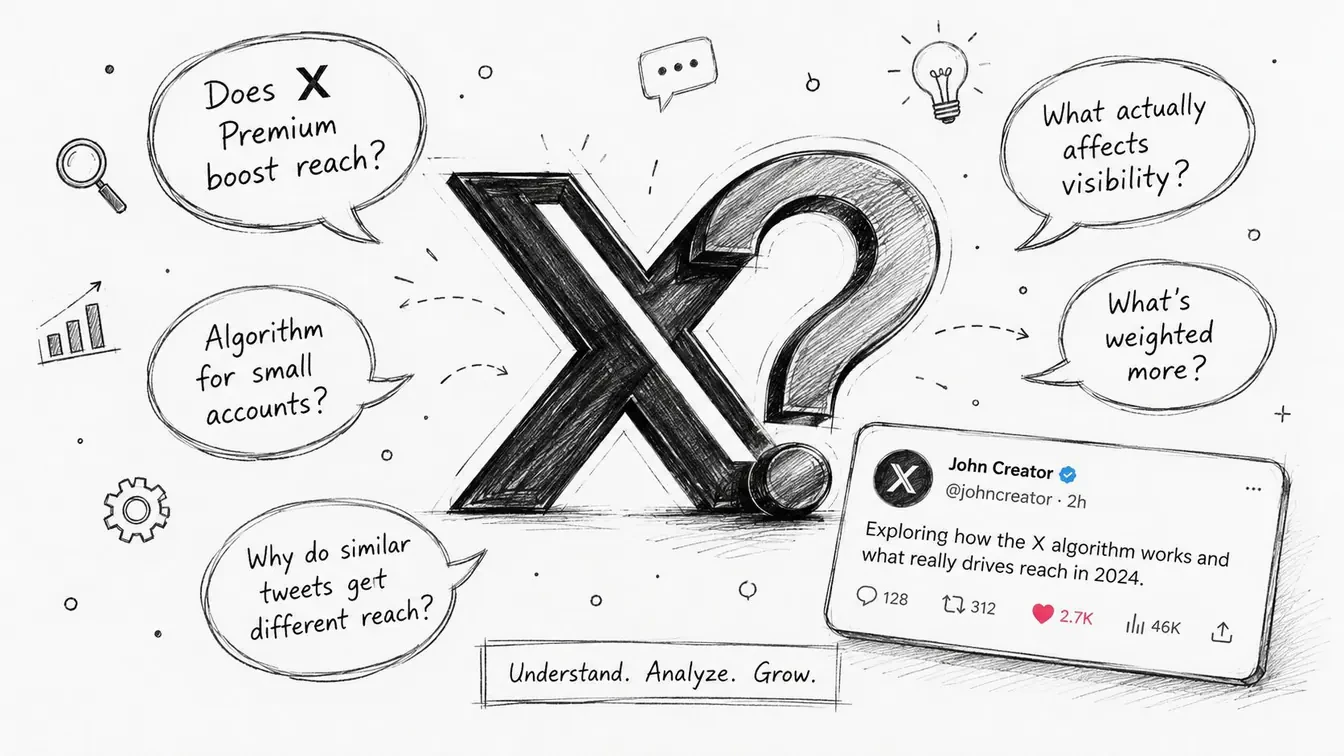
Does follower count still matter
It matters, but much less than people think.
Posts from accounts you follow enter the candidate pool directly, while posts from accounts you don’t follow are discounted, and X’s 2026 code adds a boost for authors with few impressions (source). Followers help with first exposure; they don’t guarantee distribution.
A small account with clear topic fit and strong early conversation can still beat a larger account with passive engagement.
Should you delete underperforming tweets
Usually, no. Underperformance is often a diagnosis problem, not a cleanup problem.
If a tweet flops, ask:
- Was the hook specific enough
- Did the post create a reason to reply
- Was I available after posting
- Was the topic relevant to my audience
Deleting can make sense for errors or off-brand posts. It’s not a growth strategy.
Do threads outperform single posts
There isn’t one universal winner. Threads work when the idea needs progression. Single posts work when the point can land in one hit.
I’d choose based on the job:
| Format | Best use |
|---|---|
| Single post | Sharp opinions, short lessons, one insight |
| Thread | Step-by-step breakdowns, case walk-throughs, evolving arguments |
| Quote post | Continuing a public narrative or reacting with added context |
| Reply-first strategy | Building discovery from larger conversations |
The better question is whether the format increases clarity and response quality.
Do images and videos get special treatment
Media can help if it strengthens the idea. It won’t rescue a weak angle.
X’s 2026 code represents each post, media included, with a learned content embedding, and it predicts video watch time, so a relevant visual can help. But creators still overestimate format and underestimate message design. A strong plain-text post with a real claim can outperform a polished asset if the text creates a better conversation.
Can mockup tools help with X content planning
Yes, especially for approvals, presentations, launch reviews, and creative testing.
Mockups are useful when you need to preview a post, quote tweet, reply chain, block screen, or suspension screen before publishing or sharing internally. For teams, they’re practical for campaign reviews and visual planning. If you need that workflow, a fake tweet generator, quote tweet mockup tool, or reply chain preview workflow can make planning easier.
Use them responsibly. Mockups should be labeled clearly when needed and should never be used to impersonate people, fabricate evidence, or mislead viewers.
For benchmarking, I also recommend keeping your expectations grounded with references like average Twitter engagement rate. It’s easier to make good decisions when you compare posts against meaningful baselines instead of chasing vanity spikes.
What matters most in the end isn’t whether a post looked big. It’s whether it produced the next useful action: more profile visits, better followers, stronger conversations, and clearer feedback on what your market cares about.
If you want a faster way to apply this without living inside the feed all day, try Xholic AI. It helps you find high-momentum conversations, draft contextual replies, remix proven post structures, organize research, and schedule approved posts so you can work with the X algorithm instead of guessing at it.
Related Xholic Resources
Distribution signals work better when the account has a recognizable point of view. Use the guide to personal branding on Twitter to align the profile, topics, voice, and proof behind the content the algorithm surfaces.