An impression on X (Twitter) is counted every time a user’s post is displayed on someone’s screen. It’s a measure of visibility, not unique viewers, meaning the same person seeing your tweet five times generates five impressions.
You’ve probably opened X analytics, seen a big impression number, and wondered whether it means people noticed your post or just scrolled past it. That confusion is normal. Impressions sit at the top of the growth funnel on X, so they matter, but they don’t mean the same thing as attention, engagement, or reach.
If you want to understand what is an impression on twitter in a way that helps you grow, think of impressions as distribution. They tell you how often X put your tweet in front of people. That makes them the hidden engine behind replies, follows, clicks, and everything else you want from the platform.
Introduction
Impressions are easy to dismiss as a vanity metric until you realize nearly every result on X starts with a post being shown. No impression means no chance of a like, no click, no reply, no follow. That’s why smart creators watch impressions closely, not because the number itself is the prize, but because it tells them whether distribution is working.

A founder posting product updates, an indie hacker building in public, and a marketer running a campaign all face the same question. Is X surfacing my content? Impressions answer that question better than almost any other top-line metric.
Practical rule: Treat impressions as proof of delivery, not proof of persuasion.
The Core Definition of a Twitter Impression
A Twitter impression is a display event. If your tweet appears on a screen inside X, that counts as an impression.
That sounds simple because it is simple. The part that trips people up is that impressions are not unique people. They’re total displays. One person can create multiple impressions on the same post if they see it more than once.
The billboard analogy
Think of your tweet like a billboard on a road. Every time a car passes and the billboard is visible, that’s one impression. If the same car drives by again later, that’s another impression. You still don’t know whether the driver cared, read it closely, or took action. You only know the billboard was shown.
That’s how X impressions work. They measure visibility.
According to Quintly’s explanation of Twitter impressions, impressions increase every time a tweet is displayed on a screen, even if the same person sees it repeatedly. Quintly gives a concrete example: if one person sees a tweet 5 times, that creates 5 impressions, and if another person sees it 2 times, the total becomes 7 impressions.
Where impressions can happen
Your tweet can earn impressions when it appears in places like these:
- Home timeline: Someone sees your post while scrolling.
- Search results: Your post shows up when someone searches a phrase or topic.
- Profile view: A person visits your profile and sees the tweet there.
- Other on-platform surfaces: X can resurface posts in different discovery contexts.
That repeated-surface behavior is why impressions often climb faster than follower count. Distribution on X isn’t limited to your existing audience.
If you want to get more comfortable reading these numbers in context, this guide to Twitter analytics is a useful next step.
High impressions mean your content is being surfaced. They do not automatically mean your content is landing.
Impressions vs Reach vs Views vs Engagements
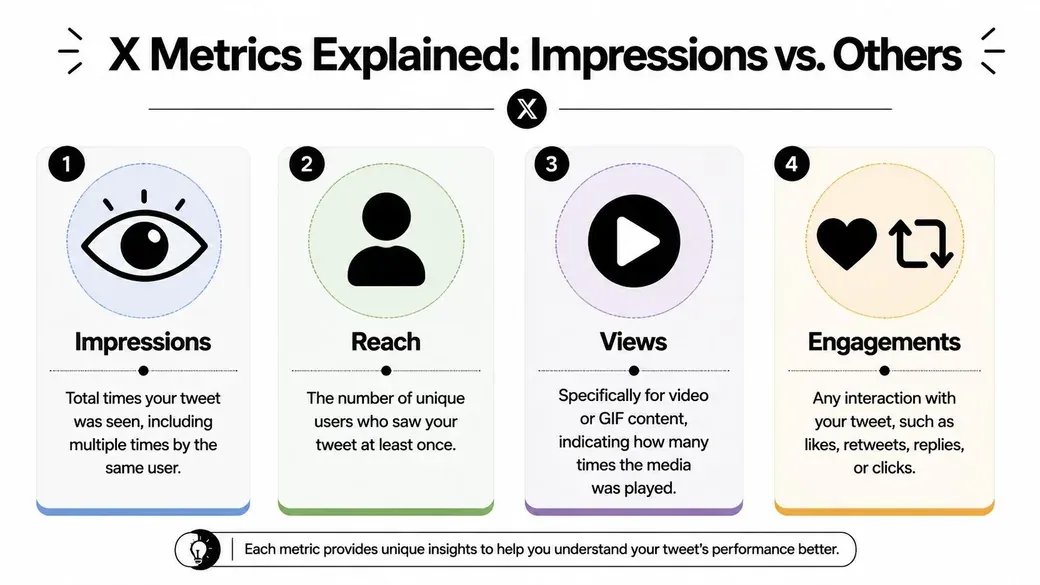
Most confusion happens when people use these metrics as if they mean the same thing. They don’t. Each one answers a different question.
Impressions
Impressions answer this question: How many times was my post shown?
This is your delivery metric. It’s about exposure inside X. A single person can contribute multiple impressions if your tweet keeps resurfacing in their timeline, search, or profile browsing.
Reach
Reach answers a different question: How many unique people saw my post at least once?
That’s why reach is usually smaller than impressions. If one person sees your tweet several times, reach still counts that as one person, while impressions count every display.
Here’s the cleanest way to understand it:
| Metric | What it means |
|---|---|
| Impressions | Total times the tweet was displayed |
| Reach | Unique users who saw it at least once |
Views
Views usually refer to media-specific consumption, not general tweet delivery. If you post a video or GIF, views tell you about the media itself being played or watched. That’s a separate question from whether the post appeared in someone’s feed.
A tweet can have strong impressions and weak media views. That means people saw the post, but the media didn’t pull them in.
Engagements
Engagements answer this question: What did people do after seeing the post?
That includes actions like:
- Likes
- Replies
- Reposts or quote tweets
- Profile clicks
- Link clicks
Many creators misread performance. A post with high impressions but weak engagement didn’t fail at distribution. It failed at conversion.
The simplest way to remember it
Use this mental model:
- Impressions are exposure
- Reach is unique exposure
- Views are media consumption
- Engagements are actions
If impressions are the number of people who walked past your shop window, engagements are the people who opened the door.
Where to Find Your Impression Data in X Analytics
If you don’t know where to look, impression data stays abstract. Once you can pull it up quickly, it becomes useful.
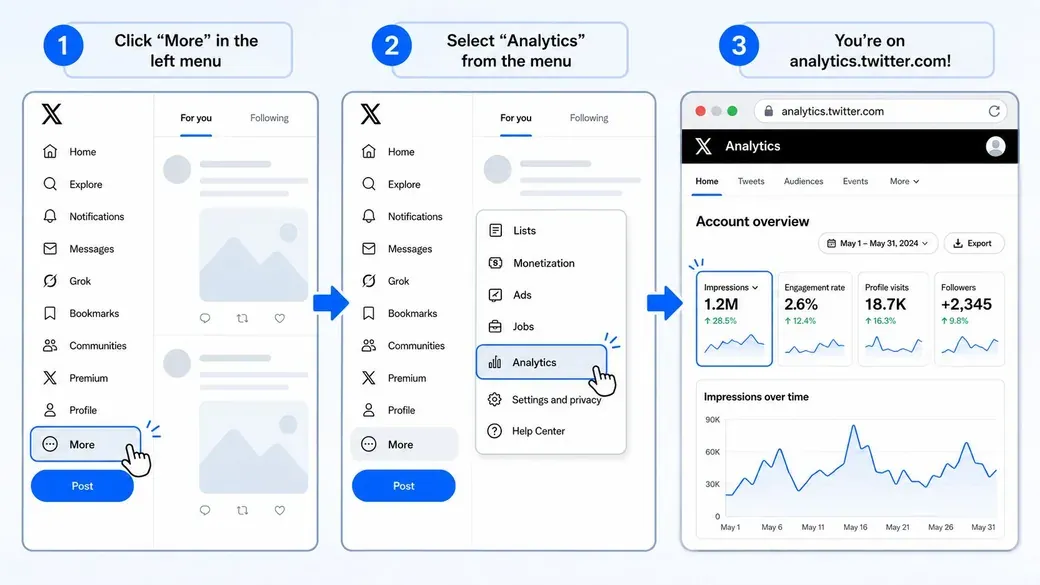
Your account level view
Inside native X analytics, you can review overall performance for a recent period and spot broad trends. That gives you the top-line answer to whether your visibility is rising, flattening, or dropping.
If you need the click path, this walkthrough on how to see Twitter analytics makes it easy to find the dashboard and read the basics.
Look for patterns such as:
- Visibility spikes: Which days got pushed harder
- Flat periods: When posting may have slowed down or content underperformed
- Consistency gaps: Long pauses often show up in weaker distribution
Your tweet level view
Key insight usually lives at the post level. Open an individual tweet and inspect its metrics. That lets you compare posts side by side instead of relying on vague account-level averages.
A practical review might look like this:
| Tweet type | Impression pattern | What it may suggest |
|---|---|---|
| Short opinion post | High impressions, low replies | Strong distribution, weak conversation hook |
| Educational thread opener | Moderate impressions, strong engagement | Good fit for your audience, maybe needs a stronger first line |
| Product update | Decent impressions, weak clicks | Visibility exists, but the offer or framing may be off |
A simple analysis workflow
Use this three-step check every time you review a post:
-
Check impressions first
Did X distribute it at all? -
Check the next action
Did people reply, click, or visit your profile? -
Check the mismatch
Was the problem weak distribution or weak messaging?
If you’re planning content before publishing, mockups can help teams review hooks, layouts, and post formats. For that, the fake tweet generator is useful for planning, internal reviews, and design examples. Mockups should be used responsibly and not to mislead people.
Common Pitfalls in Analyzing Impression Metrics
A big impression number feels good. That’s exactly why it’s easy to misuse.
Impressions are valuable, but only if you read them with the right boundaries. One important limit comes from Tweet Binder’s explanation of X impressions. It notes that X impressions count only when the tweet is seen on X itself, such as in a timeline or search, and do not include views from third-party embeds or text previews.
Mistakes that distort the story
Here are the most common ones.
-
Treating impressions like unique audience size
You may think a post “reached” far more people than it did. Repeated exposure can inflate the number. -
Chasing visibility with low-signal content
Rage bait, shallow controversy, and gimmicks can earn distribution. They can also train the wrong audience to notice you. -
Ignoring what happened after the impression
If impressions are high but replies, clicks, and follows stay weak, the issue may be your hook, your promise, or your post-to-profile alignment. -
Assuming off-platform sharing is included
It isn’t. Someone seeing your tweet in an embedded article or a text preview doesn’t automatically show up in this metric.
What to ask instead
Replace “Did this post get a lot of impressions?” with better questions:
- Did this post get shown in the right context?
- Did it create curiosity or action?
- Did the visibility come from followers, replies, search, or quote tweets?
- Would I want more of this kind of attention?
The right impression isn’t just a bigger number. It’s exposure that attracts the audience you actually want.
How to Systematically Increase Your Tweet Impressions
Impressions rise when your posts enter more surfaces and stay visible longer. That’s the game.
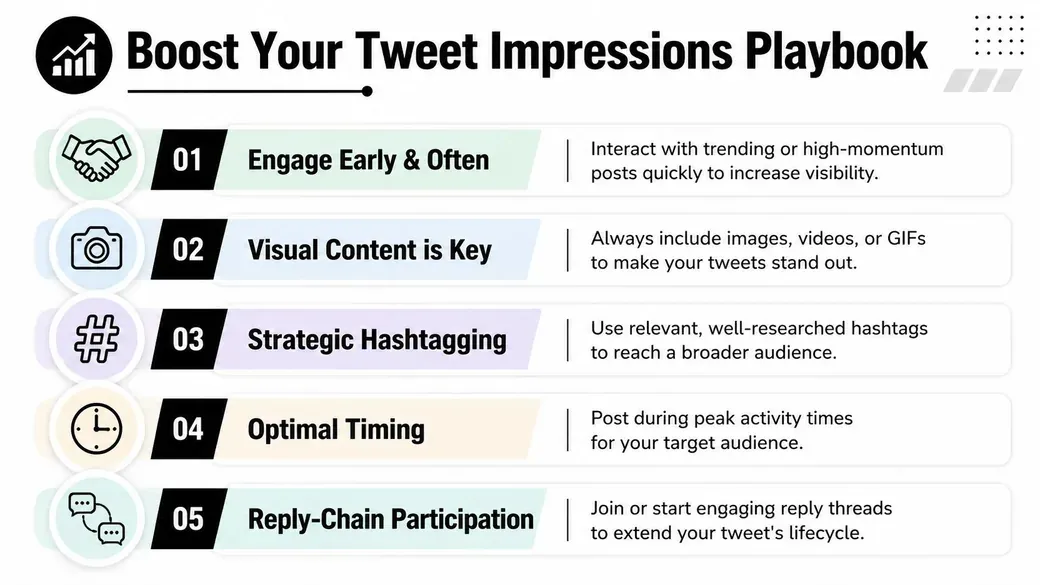
One of the clearest explanations comes from Tweet Archivist’s guide to understanding Twitter impressions. It describes impressions as a delivery-based visibility event and points out that reply visibility, quote-tweet chains, searchable phrasing, and profile-level discovery can compound impressions even when audience size stays flat.
Use distribution loops on purpose
The best creators don’t rely only on posting. They build loops that make a tweet resurface.
Try these:
-
Reply early to relevant posts
A strong reply can get seen by people who never follow you. If the original post keeps circulating, your reply keeps collecting exposure too. -
Write posts that invite quote tweets
Strong takes, useful frameworks, and clear prompts travel better when people add their own angle. -
Use searchable language
Clever writing is fine. Clear phrasing is better if you want discovery. -
Make your profile worth the visit
Profile visits are part of the loop. If people click through from a reply and your profile is sharp, your older posts can pick up more visibility.
Here’s a simple X-specific example:
Sample post
”Most founders don’t need more content ideas. They need 3 repeatable tweet formats they can publish every week without thinking.”
That post can earn timeline impressions on its own, then collect more through replies, quote tweets, and profile clicks if the framing is strong.
A lot of creators use a mix of native analytics, scheduling tools, and research tools to support that process. Xholic AI is one option for finding high-momentum conversations, generating replies, remixing posts, organizing saved tweets, using a Chrome extension workflow, and scheduling drafts with Smart Scheduling. If you want more tool options, this roundup of free Twitter analytics tools is a practical comparison.
Write posts that earn a second look
Some posts get shown once and disappear. Others get resurfaced because people interact, revisit, or share them.
Good candidates for repeat visibility often include:
- Clear hooks: One useful idea, stated plainly
- Visual support: An image, screenshot, or chart can slow the scroll
- Conversation design: End with a take, question, or contrast that invites replies
- Format discipline: Short posts for punch, threads for depth, replies for discovery
A quote-tweet strategy is especially useful for this. If you’re planning campaign concepts or content variations, the quote tweet generator can help with mockups for reviews, presentations, and approvals. As with any mockup tool, use it for planning and education, not deception.
A short video can help make the workflow more concrete.
Build a repeatable workflow
Don’t ask “How do I go viral?” Ask “How do I create more chances for resurfacing?”
A workable weekly rhythm:
- Publish original posts with strong hooks and clear ideas.
- Join live conversations through replies on relevant accounts.
- Review post-level analytics to spot what got surfaced.
- Remix winning formats instead of reinventing everything.
- Schedule consistently so your account stays active.
That’s how impressions become a system instead of a surprise.
Frequently Asked Questions About X Impressions
Do my own views count as impressions?
Your own activity can affect what you see inside the platform, but the useful way to think about impressions is still external delivery. When you analyze performance, focus less on whether you personally added a view and more on whether the post was distributed beyond you.
Are impressions the same as people reached?
No. Impressions are total displays. Reach refers to unique people who saw the post at least once.
Why are my impressions suddenly low?
Usually one of a few things happened. You posted less, your topic had less pull, your hooks got weaker, or your posts didn’t enter enough distribution loops through replies, quote tweets, search, or profile visits.
Can a tweet get high impressions and still perform poorly?
Yes. That usually means X distributed the post, but people didn’t take the next step. The post may need a sharper hook, a clearer point, or a better call to action.
For a deeper look at reading post visibility over time, a Twitter analytics dashboard guide can help.
Conclusion
Impressions are the fuel line of X growth. They aren’t the final goal, but they are the first condition for almost every other outcome you care about. If your tweets don’t get displayed, nothing else happens.
The better way to use this metric is simple. Treat impressions as a signal about distribution, then study what turned that visibility into replies, follows, clicks, and profile visits. When you do that consistently, you stop guessing. You start seeing which formats, hooks, replies, and conversation patterns expand your surface area on X.
If you care about what is an impression on twitter because you want more growth, that’s the right instinct. Visibility is where the compounding starts.
If you want help turning impressions into a repeatable X workflow, try Xholic AI. It’s an AI-powered X growth toolkit for finding high-momentum tweets, generating replies, remixing content, organizing saved posts, tracking consistency, using a Chrome extension inside the feed, and scheduling posts with Smart Scheduling.