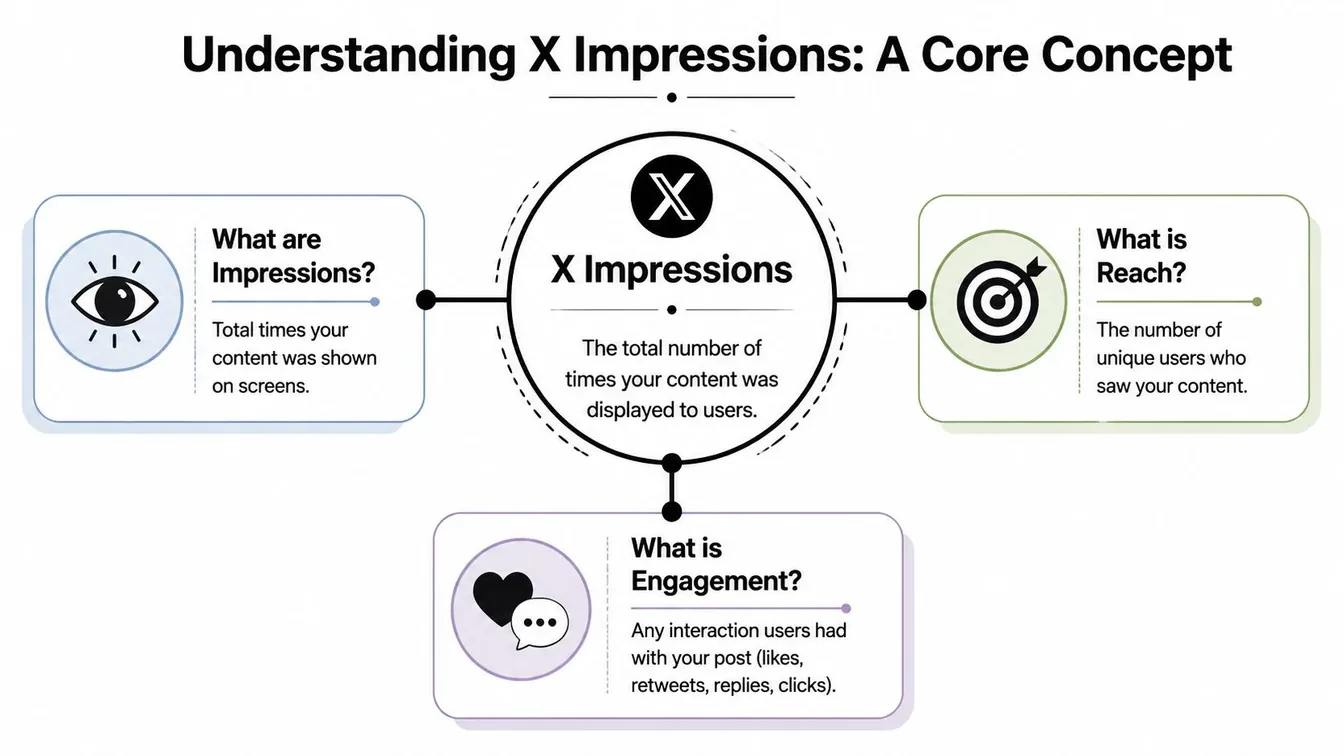
X (Twitter) impressions are the total number of times your tweet is shown inside X, and they are not unique people. If one user sees the same tweet three times, that counts as three impressions, not one.
That distinction is why so many creators feel confused by their analytics. You open X, see a healthy impression number, and assume your audience is expanding. Then follower growth is flat, replies are weak, and clicks don’t move. The problem usually isn’t that the number is useless. It’s that you’re reading a distribution metric like it’s an audience metric.
Used correctly, impressions tell you whether X is putting your content in front of people at all. Used poorly, they become vanity wallpaper. For creators, founders, marketers, and power users, the right question isn’t just what are twitter impressions. It’s what those impressions say about timing, topic, format, and whether your posts are reaching fresh people or just resurfacing to the same group.
Understanding Impressions vs Reach and Engagement
The direct answer to what Twitter impressions are is simple. An impression is counted each time your tweet appears on screen in X’s native experience, and the same user can generate multiple impressions from the same post. According to Quintly’s breakdown of Twitter impressions and reach, impressions can come from timelines, search results, profile pages, and retweets, but they don’t include views on third-party websites or embedded posts.
What impressions actually count
Think of impressions as display events, not confirmed attention.
A tweet can collect impressions when:
- It appears in the home timeline and someone scrolls past it
- It shows in search after a user looks up a topic
- It appears on your profile page when someone checks your account
- It gets surfaced again through retweets or repost-driven discovery
What it doesn’t tell you is whether that person cared, remembered it, or took action.
Practical rule: Impressions answer “Was my content distributed?” They do not answer “How many people cared?” or “How many new people discovered me?”
A simple way to separate the three metrics
The easiest mental model is a storefront.
| Metric | What it means | Storefront analogy |
|---|---|---|
| Impressions | Total displays of your tweet | How many times people passed your window |
| Reach | Unique accounts exposed | How many different people passed by |
| Engagement | Actions taken on the post | How many stopped, entered, or asked a question |
Creators often celebrate the wrong win. A post with high impressions but weak engagement may have gotten distribution without earning interest. A post with lower impressions but strong replies might be resonating with a smaller audience.
If you’re reviewing performance regularly, a dedicated Twitter analytics guide helps organize these metrics into something more useful than a scoreboard.
One more nuance matters. Since impressions are platform-native, they won’t include screenshots shared elsewhere, embeds on websites, or off-platform discussion. So even this metric is narrower than many people assume.
How to Check Your Impressions in X Analytics
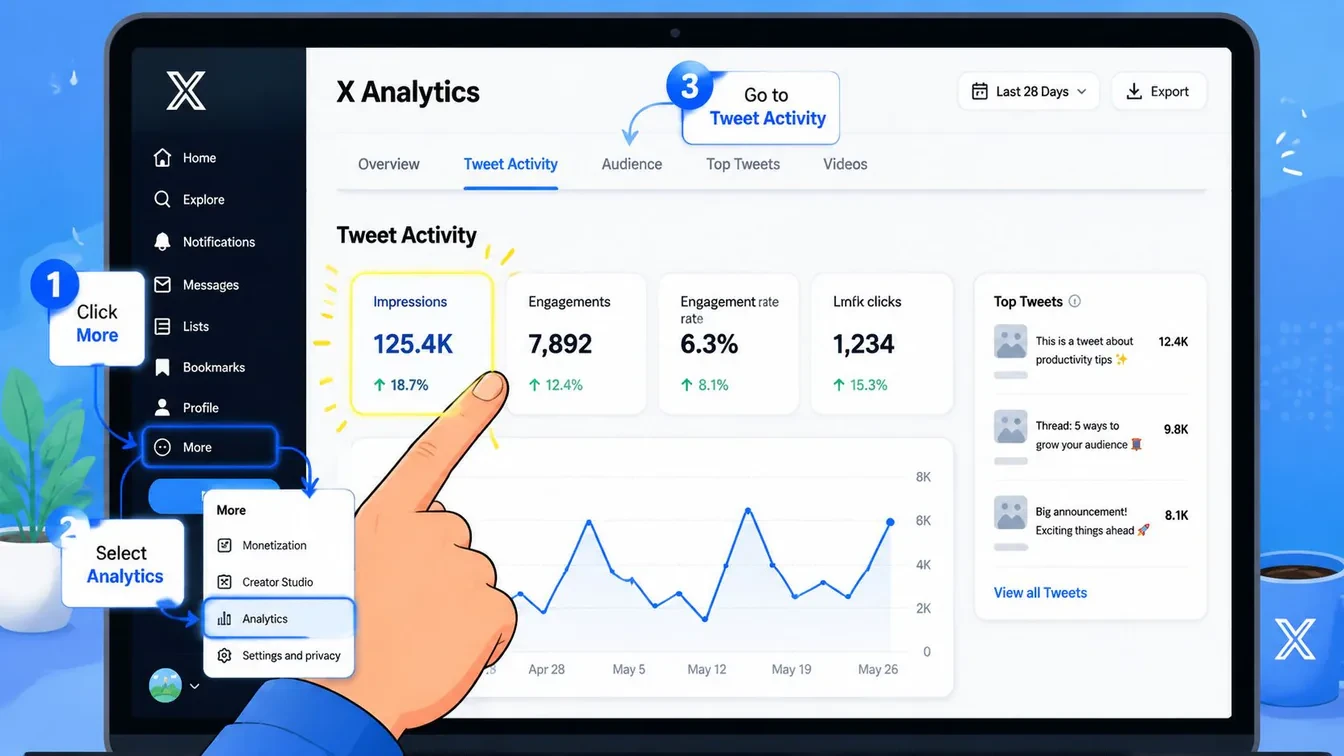
You don’t need a complicated dashboard to find impression data. X surfaces it at the tweet level, and you can also review broader account trends over time.
Check impressions on an individual tweet
This is the fastest way to inspect a post.
- Open your tweet on desktop or mobile.
- Look below the post for the view count or analytics entry point.
- Tap into post analytics to review impressions alongside likes, replies, reposts, and clicks.
- Compare similar posts instead of judging one tweet in isolation.
Tweet-level checking is best when you’re trying to answer a narrow question like: Did this hook work? Did this reply-based post get surfaced? Did posting at this time help?
High impressions on one tweet don’t mean your strategy is working. They mean one piece of content got a better shot at distribution.
Use the main analytics view for trend analysis
For pattern spotting, use the broader dashboard.
- Open X Analytics from the main analytics area on desktop
- Review recent account performance rather than only your latest post
- Look for clusters of posts that earned stronger visibility
- Match those clusters to format, timing, and topic
This view is more useful than many creators realize. One tweet can be noisy. A set of similar tweets tells you what X is consistently willing to distribute from your account.
If you want a walkthrough focused on where the numbers live and how to read them, this guide on how to see Twitter analytics is a practical reference.
A good habit is to review impressions in two modes:
- Daily spot checks for individual tweet diagnostics
- Weekly reviews for trend detection across multiple posts
That split keeps you from overreacting to one outlier.
Interpreting Your Impressions The Right Way
Impressions become useful when you stop treating them as proof of success and start treating them as evidence of distribution behavior.
Why high impressions can still mean small growth
A common frustration on X is this: the post gets seen, but the account doesn’t seem to grow.
That’s normal, because impressions are not unique people. As Tweet Archivist’s explanation of Twitter impressions notes, one user can generate multiple impressions, which means the number can overstate true audience size. That’s especially common when your content gets repeatedly surfaced to the same niche audience.
Here are the most common readings:
-
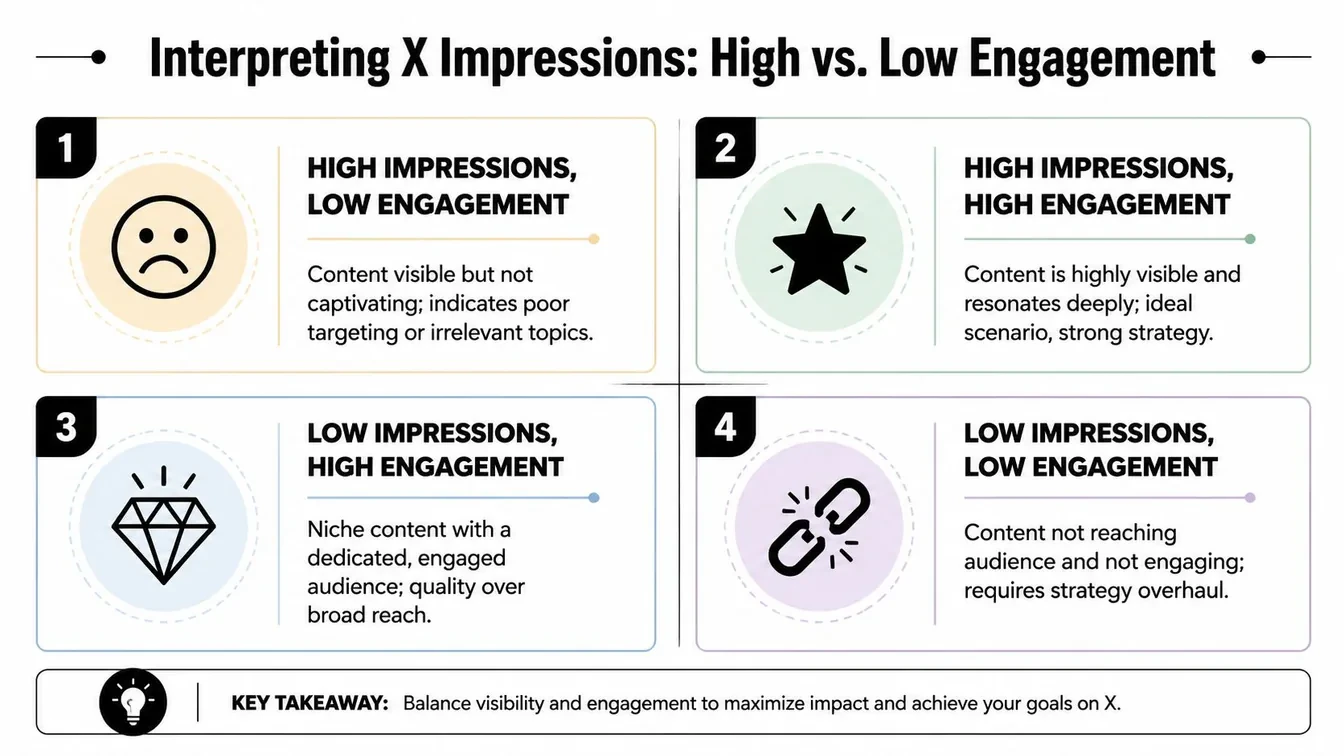
High impressions, low engagement
X distributed the post, but the idea, hook, or audience match was weak. -
High impressions, decent engagement, low follower growth
The content was interesting enough to get reactions, but not strong enough to make people want more from you. -
Low impressions, high engagement
The post resonated with a smaller pocket of people. That’s often a sign to improve distribution, not necessarily the message. -
Low impressions, low engagement
The content likely missed both distribution and resonance.
If your impressions rise while your replies, likes, clicks, and follows stay flat, the issue usually isn’t visibility alone. It’s message fit after the view.
There’s another practical wrinkle. Since engagement rate is commonly calculated using engagements divided by impressions, a bigger impression count without a matching increase in actions will naturally drag that rate down. That’s why some posts look worse on paper even when distribution improved.
Use impressions as a diagnostic workflow
Strong operators read impressions in sequence, not in isolation.
Try this simple review process after posting:
-
Start with impressions Did X distribute the post?
-
Check interaction quality
Did it earn replies, reposts, clicks, or profile visits? -
Review source context
Was visibility driven by replies, retweets, profile traffic, or recirculation inside conversations? -
Decide the fix
If distribution was low, improve timing or topic selection. If distribution was high but engagement weak, rewrite the angle or tighten the hook.
A specialized Twitter analytics dashboard article is useful if you’re trying to move from raw numbers to repeatable decision-making.
The practical takeaway is simple. Impressions aren’t fake. They’re just incomplete. They tell you whether the platform gave your content a chance. They don’t tell you whether you made that chance count.
5 Actionable Strategies to Boost Your X Impressions
In 2022, Twitter started showing real impressions for individual tweets, which made this metric much more useful for post-level analysis. That shift also exposed a hard truth: distribution matters more than raw audience size. As noted in Tweet Binder’s guide to Twitter impressions, an account with 5K followers could generate 15,000 impressions on a strong tweet, while an account with 50K followers might get only 2,000 impressions on a weaker one.
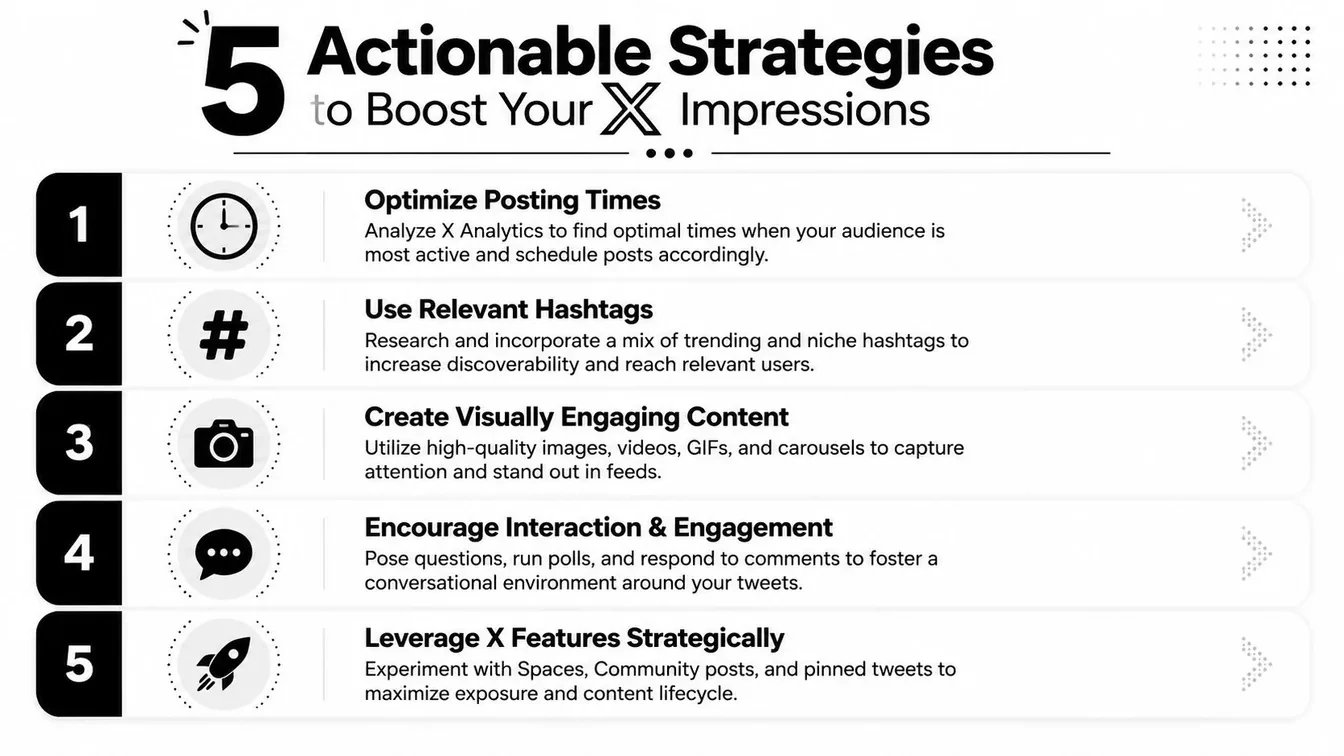
That means your job isn’t to look big. It’s to create posts that travel.
1 Join conversations before they peak
Replies are one of the most practical distribution levers on X. Not random replies. Timely replies on posts that already have momentum.
Look for:
- Relevant creator threads in your niche
- Fresh discussions that are gaining attention
- Posts where your expertise adds something specific
A weak reply says “great point.” A strong reply adds a counterexample, a framework, or a sharper takeaway.
2 Improve the first line and preview
Impressions often begin with a split-second decision in the timeline. If the opening line doesn’t create curiosity or clarity, distribution may happen without meaningful engagement.
A simple rewrite helps:
- Weak: “Some thoughts on building audience.”
- Stronger: “Most X growth advice fails because it confuses visibility with audience expansion.”
The second version gives the reader a reason to stop. That matters when your post is being shown, not yet read in detail.
Better impressions come from better packaging first, better substance second. If nobody stops, the substance doesn’t get a chance.
Here’s a simple tweet format you can test:
Most creators think high impressions mean growth.
Usually it means X showed the post.
Growth starts when that visibility turns into replies, profile visits, and follows.
3 Reuse winning structures instead of guessing
Most creators waste time chasing novelty when they should be studying format.
If a past tweet earned strong distribution, inspect:
- The hook style
- The topic framing
- Whether it used a list, contrast, or strong opinion
- Whether it was original posting or conversation-led distribution
You can also mock up variations before publishing. Tools like the fake tweet generator are useful for planning visuals, decks, approvals, and educational examples. Mockups should be used responsibly and not to mislead people.
4 Test timing like an operator
Timing isn’t magic, but it does affect how much early exposure a post gets.
Instead of asking for the universal best time to post, test your own distribution windows:
- Post the same content style at different times on different days
- Compare impression quality rather than just raw volume
- Separate original tweets from reply-led visibility
- Log what happened in a simple sheet or dashboard
Tooling can be helpful. Xholic AI’s engagement playbook covers practical patterns for pairing timing with stronger content execution, and Xholic AI itself can help users find high-momentum tweets, generate replies, remix proven formats, organize saved posts, and schedule drafts with Smart Scheduling.
5 Extend the life of a good post
Many tweets die too early because the creator posts once and moves on.
A better workflow:
- Turn a good tweet into a thread
- Quote your own post with a deeper angle
- Reply to your own post with an example or objection
- Remix the idea from opinion into checklist, then into story
This doesn’t mean spamming the same line. It means extracting more distribution from an idea that’s already shown some traction.
A quick video can help if you want another perspective on the metric and how people use it in practice.
FAQs About Twitter Impressions
Do your own views count as impressions
X impressions are counted when tweets are shown in the platform’s native experience, but public explanations around self-views are inconsistent. The safer working assumption is this: treat impressions as a platform-reported metric and avoid trying to inflate or interpret them based on your own repeated checking.
Do quote tweets increase impressions
They can contribute to more visibility because they create more surfaces where the original post may be discovered inside X. But the more useful question is whether quote tweets bring new people or just repeated exposure among the same audience.
Why are my impressions high but followers not growing
This usually means the post got distribution without creating enough curiosity, trust, or distinct value to make someone follow. Your content may be visible, but not differentiated.
Are impressions the same as reach
No. Impressions are total displays. Reach refers to unique accounts exposed. If the same person sees a tweet more than once, impressions go up while reach may not.
Are impressions the same as engagement
No. Engagement is what people do after seeing the tweet. Likes, replies, reposts, and clicks are engagement actions. Impressions only tell you the post was shown.
Do embedded tweets or screenshots count as impressions
No. Platform-native explanations note that impressions exclude third-party embeds and external surfaces. If someone sees a screenshot of your tweet elsewhere, that doesn’t show up in X impression data.
Conclusion Turning Impressions into Real Growth
Impressions are useful when you read them as a signal about distribution, not as proof of audience size or business impact. They tell you whether X gave your content placement in the feed, in search, on profiles, or through conversation surfaces inside the platform.
That makes impressions a starting metric. Not an end metric.
For creators and teams trying to grow on X, the practical move is to pair impressions with better questions. Did this post get shown? Did the hook earn attention? Did the topic attract the right people? Did the visibility convert into replies, clicks, profile visits, or follows?
That’s how impressions stop being vanity. They become operational.
If you build around that mindset, your analytics get much easier to read. High impressions with weak results means fix the content. Low impressions with strong reactions means improve distribution. High impressions with strong engagement means you’ve found something worth repeating.
If you want a faster way to turn impression data into actual posting decisions, try Xholic AI. It helps you find high-momentum conversations, generate replies, remix strong tweet structures, organize saved research, track consistency, use an in-feed Chrome extension workflow, and schedule posts with Smart Scheduling so your best ideas have a better chance to reach the right audience.