If you want to grow on X (formerly Twitter), you need to stop thinking of it as a megaphone and start treating it like a dinner party. The fastest way to increase your engagement is to join conversations, add value, and build real connections. This means spending more time writing thoughtful replies to others than you do crafting your own posts. It might feel counterintuitive, but it’s the quickest path to getting noticed by the right people and growing your audience.
Your Quick Guide to Boosting X Engagement
Truly effective engagement comes from seeing X as a “conversation graph” rather than just a content feed. When you reply to other posts, especially early in popular threads, you dramatically increase the odds that both the algorithm and other users will see your profile.
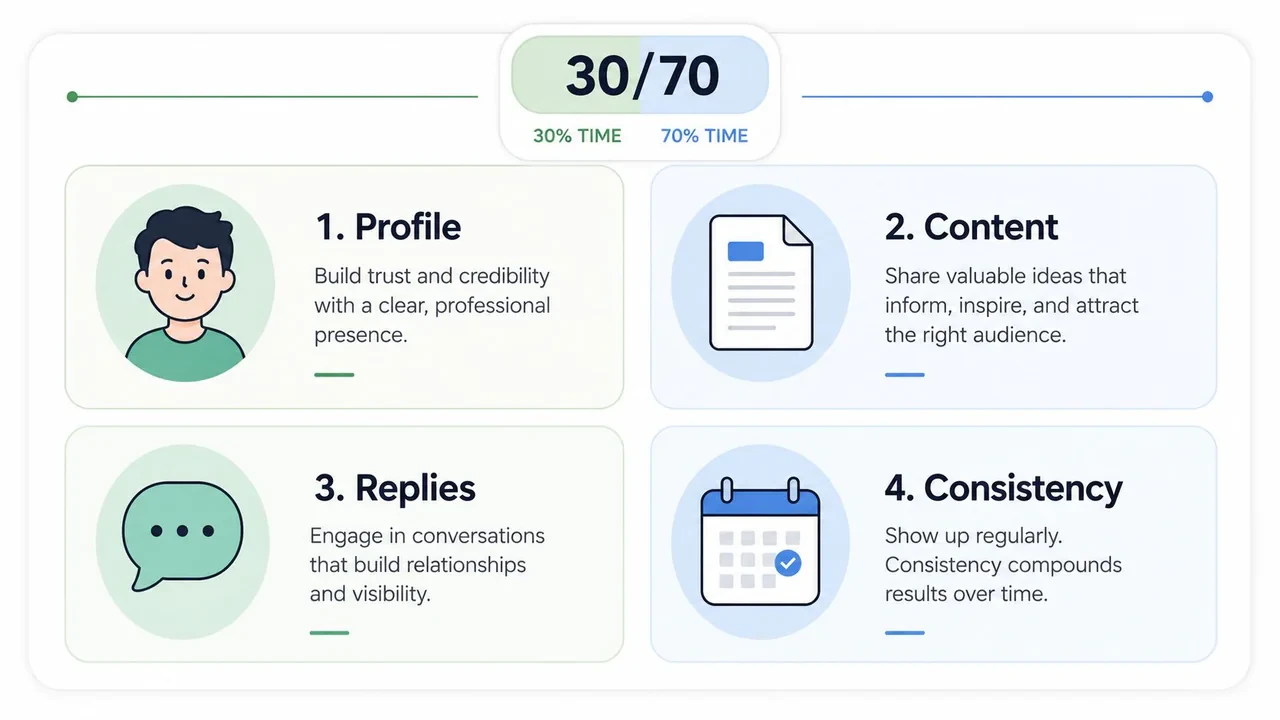
A great rule of thumb is the 30/70 rule: Spend about 30% of your time creating original content and the other 70% engaging directly with others. This simple split keeps you focused on community participation, which is where real growth happens. You can find even more detail on this engagement strategy over at AdEspresso.
While we’ll get into the nitty-gritty of specific tactics later, it’s helpful to have a high-level map of where you should be putting your energy.
The Four Pillars of X Engagement
Think of your X strategy as a structure built on four core pillars. If one is weak, the whole thing can wobble. Use this table to quickly diagnose which area needs your attention first.
| Pillar | Core Principle | Actionable Starting Point |
|---|---|---|
| Profile | Your profile provides context for every interaction. | Craft a bio that clearly states the value you provide. |
| Content | Create posts that stop the scroll and demand a response. | End your posts with a question to invite replies. |
| Replies | Your replies are your highest-leverage growth activity. | Find 10 relevant conversations and add a thoughtful reply. |
| Consistency | The algorithm and audience reward reliable activity. | Set a realistic daily goal for posts and replies, then track it. |
Focusing on these four areas will give you a solid foundation for everything else we’re about to cover. Let’s start by digging into the first pillar: your profile.
Optimize Your Profile to Encourage Interaction
Think of your X profile as your digital handshake. It’s the first impression you make and provides the context for every single tweet and reply you send out. If your profile is confusing or incomplete, you’re actively pushing away the very engagement you’re trying to build. People won’t take that extra second to click through if they can’t immediately grasp who you are.
A well-crafted profile, on the other hand, does the heavy lifting for you, turning curious visitors into engaged followers. The goal is to make the decision to follow you a no-brainer. In the split second a potential follower spends on your page, your bio, profile picture, header, and pinned post must work together to answer three critical questions:
- Who are you? Your role, expertise, or identity.
- What value will you provide? What can they expect if they follow you?
- Why should they trust you? What makes you credible or interesting?
Your bio is the most critical piece of this puzzle. With only 160 characters, you have to be direct and compelling. If you’re looking for inspiration, we have a whole guide on proven X biography ideas to get you started.
Turn Your Profile into an Engagement Magnet
A great profile doesn’t just sit there. It actively converts visitors. Let’s look at a simple before-and-after example for a founder who is building their company in public.
Before:
“Founder & CEO. Building in public. Love SaaS.”
This bio is okay, but it’s generic. It states a few facts, but it doesn’t give anyone a compelling reason to stick around. It lacks personality and a clear promise of value.
After:
“I teach founders how to get their first 100 customers without paid ads. Follow for weekly threads on cold outreach and content that converts. Building @YourSaaS to $1M ARR.”
See the difference? This version is specific and immediately offers value, “get first 100 customers.” It sets clear expectations, “weekly threads,” and builds credibility with a tangible goal, “Building @YourSaaS to $1M ARR.” It’s not just a description. It’s an invitation.
Your pinned post is another piece of prime real estate. Don’t just pin your tweet with the most likes. Pin your most valuable one. Use that space strategically to showcase your best thread, a link to your newsletter, a powerful client testimonial, or a personal story that perfectly captures what you’re all about.

Create Content That People Actually Want to Engage With
Let’s be honest: most content on X gets completely ignored. If you want to build a real audience, you can’t just pump out generic updates. You have to craft posts that genuinely stop the scroll, make people think, and practically beg for a response.
The posts that rack up strong engagement rarely happen by accident. They’re built on proven frameworks designed to hook a reader from the very first word and pull them into a conversation.
Master Your Hooks and Formats
Everything hinges on your first line. That’s your hook. If it doesn’t grab someone’s attention within a couple of seconds, you’ve already lost them. The rest of your brilliant post might as well be invisible.
Think about what makes you stop scrolling:
- A bold, controversial claim: “99% of creators are burning out for no reason.”
- A question that sparks curiosity: “What’s one ‘unpopular’ opinion you’d defend to the end?”
- A clear, desirable promise: “Here’s the exact system I used to gain 1,000 followers last month.”
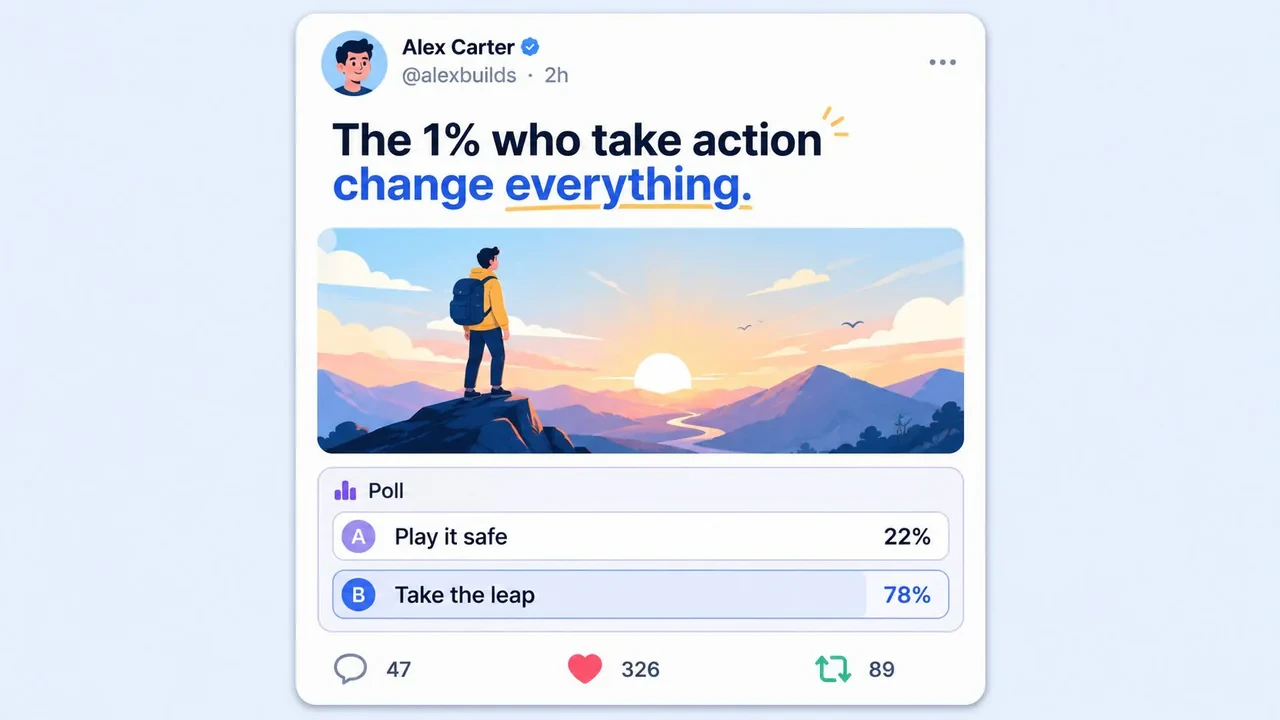
Once you have their attention, the format matters. Long-form threads are perfect for telling a story or breaking down a complex idea to showcase your expertise. But sometimes, a single, powerful image with a punchy caption is all you need for a quick win. And never underestimate polls. They are the easiest, lowest-friction way to get a reaction because it’s just one click.
Use Visuals and Deconstruct What Works
It’s no secret that posts with visuals just perform better. Time and again, data shows that adding a relevant image, a quick GIF, or a short video makes your content stand out in a crowded feed. It gives people a reason to pause, which dramatically increases the odds they’ll actually engage with what you have to say. For a deeper look at this, SmashBalloon has some great tips on boosting engagement with visuals.
My best advice? Don’t just admire what works for others. Deconstruct it. Find a high-performing post in your niche and break it down into its core components. What was the hook? Where was the tension? What was the payoff?
This is where you can really speed up your learning curve. For example, a tool like Xholic AI has a feature called Steal the Structure that does this for you. It analyzes a viral post’s DNA, the hook, body, and call to action, and hands you a reusable template. You just fill in the blanks with your own expertise. It’s like having a cheat code for writing content that you know already resonates with your audience.
To see these winning formulas in practice, take a look at these 10 examples of tweets that actually work.
The Underrated Power of a Great Reply
If I could give you only one piece of advice for growing your X engagement, it would be this: master the art of the reply. Seriously. It’s the single most powerful and overlooked growth strategy on the entire platform.
Think about it. Your own posts primarily reach people who already follow you. But a thoughtful, well-timed reply? That puts your name, your profile picture, and your expertise directly in front of a brand-new, highly engaged audience.
The trick isn’t just to drop a comment and run. The goal is to join valuable conversations while they’re heating up. When you add a unique perspective to a post that’s gaining momentum, you get to borrow that momentum. People scrolling through the comments will see your contribution, and if it’s genuinely good, they’ll be curious enough to click over to your profile.
How to Find and Win Conversations
Success here boils down to two things: finding the right conversations and adding real value once you’re there. Let’s be clear. Generic comments like “Great post!” or “So true!” are a complete waste of your time. They’re invisible. They add zero value.
To actually get noticed, your reply needs to do one of three things:
- Add new, complementary info: Share a relevant statistic, a link to a resource, or a personal story that builds on the original point.
- Offer a fresh perspective or a counterpoint: Don’t be afraid to respectfully disagree or present an alternative angle. This is what sparks real discussion.
- Ask a smart, clarifying question: This shows you’ve actually read and processed the post and are curious to go deeper.
This is where having a system beats just scrolling your feed and hoping for the best. Instead of randomly hunting for opportunities, you can use tools to find these high-momentum conversations for you. For example, the Engage workspace inside Xholic AI is built for exactly this purpose. It lets you track key creators and immediately shows you which of their posts are taking off, so you can jump in before they go viral.
A great reply is a Trojan horse for your expertise. You’re not just commenting. You’re delivering a micro-sample of the value you provide, directly into a feed where your ideal followers are already paying attention.
Once you find a great post to reply to, the quality of your response is everything. This is where you can use a tool like Xholic’s AI Reply Composer, which works via a Chrome Extension right on X. It analyzes the original post and helps you draft a reply that matches your voice and adds real substance. It turns what could be a time-consuming task into a quick, high-impact move. You can see this exact workflow in our guide on how to generate fast, high-quality replies.
Turn Consistency Into a Habit, Not a Chore
If you want to grow on X, you can’t just post whenever you feel like it. Sporadic activity kills your momentum. For both the algorithm and your audience, showing up consistently is a signal that you’re reliable and know your stuff.
The real challenge isn’t posting when inspiration strikes. It’s about maintaining that presence on the days you’re busy, tired, or just plain uninspired. The secret isn’t more willpower. It’s building a sustainable system that makes consistency feel less like a chore and more like a simple, achievable habit.
The best way to start is by ditching vague goals like “post more” and setting clear, trackable targets. This gives you a defined mission for the day.
Here’s a simple, manageable starting point:
- Daily Post Goal: Aim for 1-3 high-quality posts each day.
- Daily Reply Goal: Leave 10-20 thoughtful replies on other people’s posts.
This small shift changes everything. Instead of waking up and wondering, “What am I even going to post today?” you have a clear checklist to work through.
Create a Central Hub for Your Workflow
To keep this habit going long-term, you need a repeatable process. That means having one central place to manage your entire content pipeline, from a random idea jotted down in the morning to a fully scheduled post ready to go live.
An effective engagement strategy is built on more than just good content. It’s built on the systems that support that content’s creation. A smooth workflow removes the friction, making it so much easier to show up every single day.
This is where a tool like Xholic AI can be a game-changer. The Smart Home dashboard puts your whole operation in a single view. You can look over AI-generated ideas from your Daily Pack, drag finished drafts into the Smart Scheduler, and even track your daily activity with the Goals & Streaks feature to keep yourself accountable.
This graphic really drives home how mastering replies, a core part of your daily habit, fuels your account’s growth.
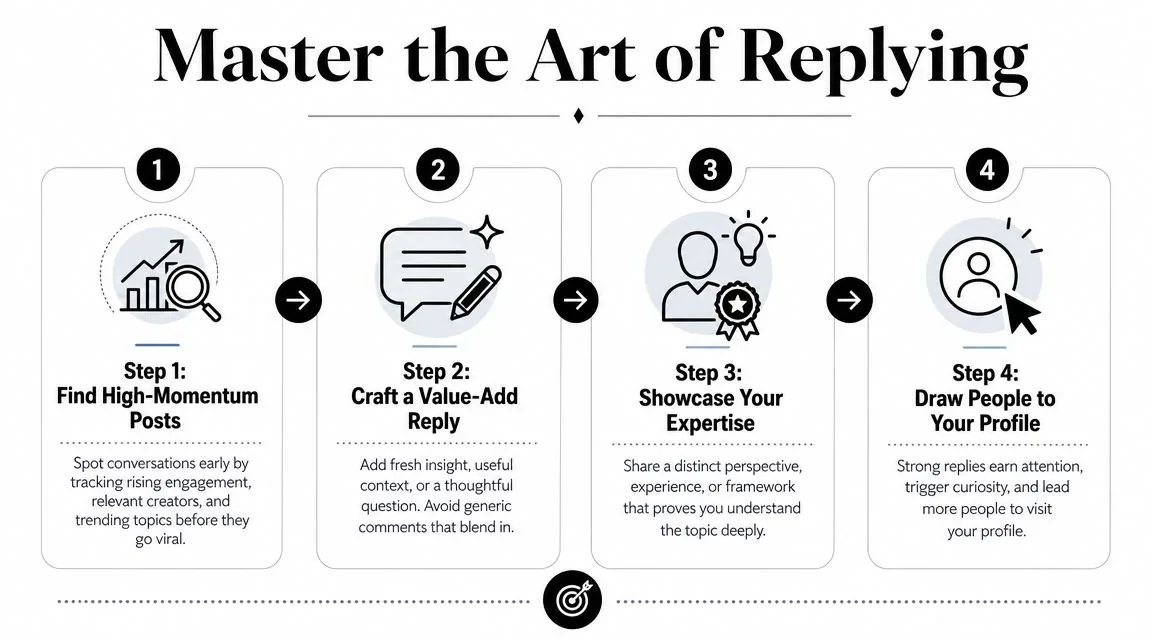
The workflow is simple: every valuable reply you leave is an opportunity to showcase your expertise. This brings curious, relevant people back to check out your profile. By systemizing your posting and engagement, you build momentum that compounds day after day, turning what felt like sporadic effort into a powerful engine for growth.
Measure What Matters to Iterate and Improve Your Strategy
If you’re just throwing content at the wall to see what sticks, you’re going to run out of steam fast. The real secret to sustainable growth on X isn’t posting more. It’s posting smarter. And that starts with understanding what your data is trying to tell you.
Forget chasing vanity metrics like raw impressions. It feels good to see a big number, but it doesn’t tell you if anyone actually cared. The metric that truly matters is your engagement rate. This little number is a direct signal to the X algorithm that your content is valuable, which in turn earns you more reach.
Conduct a Simple Weekly Review
You don’t need a data science degree for this. Just set aside 30 minutes every week to peek under the hood. The goal isn’t to get bogged down in spreadsheets, but to find a few golden nuggets you can act on immediately.
During your weekly check-in, ask yourself these three questions:
- What actually worked? Pinpoint your top 1-3 posts from the week, looking specifically at the engagement rate, not just likes or impressions.
- Why did it work? Get specific here. Was it a compelling hook? A thread format that broke down a complex idea? A controversial take that sparked debate?
- How can I do more of that? Come up with two or three new ideas that lean into the format, topic, or angle that clearly resonated with your audience.
This simple routine shifts you from guessing to making informed decisions based on what your audience has already voted for with their clicks and replies. If you want to go deeper on this, we’ve put together a complete guide on using X/Twitter analytics for growth.
The key takeaway: Stop guessing what your audience wants and start listening to what your data is telling you. Your top-performing posts are a direct roadmap to creating more content that resonates.
Beyond engagement, keep an eye on new followers and profile visits. These two metrics tell a story. Are people intrigued enough by your posts to check you out? And if they are, do they stick around?
If you see a lot of profile visits but your follower count is flat, that’s a huge clue. It often means your bio, pinned post, or the last few things you’ve posted aren’t sealing the deal. It’s a sign that your profile might need a quick tune-up.
FAQ About Growing on X
Let’s tackle some of the most frequent questions I hear from people trying to build momentum on X.
How Many Times a Day Should I Be Posting?
It’s tempting to think more is always better, but it’s not about volume. Focus on quality and consistency. A good rhythm to aim for is 1-3 high-quality posts per day.
Honestly, though, your reply game is even more crucial. Spending your energy on 10-20 thoughtful replies each day will often do more for your growth than just shouting into the void with another standalone post. Replies drive profile visits and build real connections.
Do Hashtags Still Actually Work for Engagement?
They do, but their role has shifted dramatically. The days of “hashtag stuffing” are long gone. Piling on a dozen tags just looks spammy and can even get your post deprioritized by the algorithm.
The smart play now is to use just 1-2 highly relevant hashtags. Think of them as signposts that help X categorize your content and show it to people interested in that specific topic. They give your post a little discovery boost, but only if the content itself is worth discovering.
What’s the Fastest Way to Get More Replies on My Posts?
This one is simple: ask a question.
But not just any question. End your posts with an open-ended question that’s easy for people to answer. Invite them to share opinions, stories, or recommendations. This directly signals that you’re looking for a conversation, not just broadcasting a message.
Should I Post Threads or Single Tweets?
There’s no “better” option here. They’re different tools for different jobs. A healthy content strategy uses both.
- Single Posts: These are your go-to for quick hits of engagement like likes and reposts. A sharp hook and a great visual are a killer combination for stopping the scroll.
- Threads: Use these when you need to go deep. They are perfect for showcasing your expertise, telling a story, or unpacking a complex idea. Threads are magnets for thoughtful replies and attract followers who are genuinely interested in what you have to say.
The Conversation-to-Authority Engagement Loop
Use one connected system instead of treating every tactic as a separate hack:
- Publish a post with one clear claim or useful outcome.
- End with a question only when the answer will deepen the topic.
- Reply quickly to substantive responses and ask a useful follow-up.
- Save recurring objections or questions as future post ideas.
- Review which conversations led to reposts, profile visits, and follows.
This prevents engagement from becoming an empty like-count exercise. The goal is to make the account easier to discover and more credible to the people who should actually follow it.