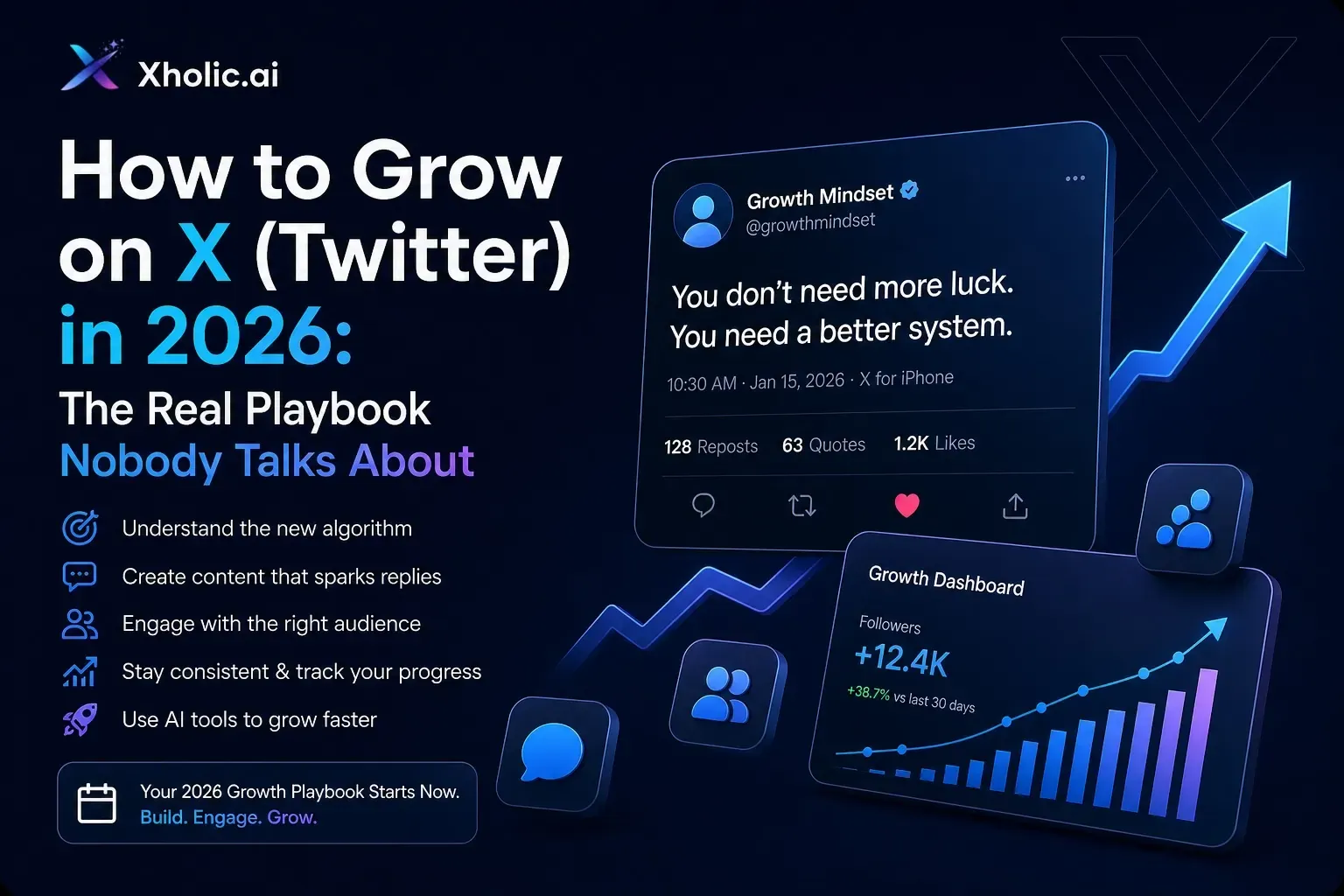
Most people who want to grow on X in 2026 are doing the same thing: posting into the void, watching the numbers barely move, and wondering what they’re missing.
They’ve read the generic advice. Post consistently. Engage with others. Write good hooks. Use hashtags wisely.
And yet, nothing really happens.
Here’s the thing: that advice isn’t wrong. It’s just incomplete. The platform has changed dramatically in the last 18 months. The algorithm is different. The kind of content that gets distributed is different. The way discovery works is different. And if you’re still playing by the old rules, you’re going to keep getting old results.
This guide isn’t going to recycle the same listicle you’ve already seen. Instead, it’s going to walk you through what’s actually happening on X right now, what that means for your strategy, and specifically what you can do differently starting today.
First, Understand What Changed
In January 2026, X handed a significant amount of its content ranking over to Grok, the platform’s in-house AI. This wasn’t a small tweak. It fundamentally changed how posts are surfaced and distributed.
A few things are now true that weren’t true two years ago:
Engagement velocity in the first 30 minutes matters more than almost anything else. If your tweet picks up likes, replies, and retweets quickly after posting, Grok treats that as a signal that the content is worth showing to more people. If it sits quietly, it essentially dies. This means the time you post and the quality of your immediate audience matters enormously.
Replies are weighted more heavily than likes. A tweet with 20 replies now outperforms a tweet with 100 likes but no conversation. This is a meaningful shift. It rewards content that sparks discussion, not just content that people passively double-tap.
Sentiment analysis is real. Grok reads the tone of posts and throttles content it reads as combative, negative, or rage-bait-oriented, even if that content is technically getting engagement. The old strategy of manufacturing outrage to go viral is increasingly a dead end.
X Premium matters. This is the uncomfortable truth nobody wants to say out loud: organic reach for non-premium accounts is genuinely lower. The algorithm gives verified subscribers a meaningful boost in how their replies are ranked and how their posts are distributed. If you’re serious about growth, the $8/month is not optional. It’s infrastructure.
The Single Biggest Mistake People Make
Before we get into tactics, let’s talk about the one thing that kills more X growth journeys than anything else: quitting too soon.
The realistic growth trajectory looks like this. Month one, you’re figuring out what resonates. You’ll get maybe 100 to 300 new followers if you’re consistent. Months two and three, you start finding your voice. A post or two pops. You hit somewhere between 300 and 1,000 new followers. Months three through six, compounding starts. Your replies get noticed. People start recognizing your name. Growth accelerates.
The people who succeed on X are almost never the ones with the best content in month one. They’re the ones who are still posting in month six. Most people quit at month two, right before the algorithm starts rewarding them.
Knowing this doesn’t make it easier to stay consistent. But it does help to understand that the slow early period isn’t a failure. It’s the price of entry.
What Actually Gets You Followers in 2026
Replies First, Posts Second
Here’s a counterintuitive truth: your replies grow your account faster than your original posts do, at least in the early stages.
Why? Because when you reply to a high-momentum tweet from a creator with a large audience, your reply sits under a post that thousands of people are already reading. If your reply is genuinely good, adds context, offers a real perspective, or makes someone laugh, those readers see your name, click your profile, and some of them follow.
This is basically free distribution, and most people aren’t using it strategically. They’re replying with “Great point!” or “100% agree” and wondering why nobody’s clicking through to their profile.
The replies that work are the ones that add something. Share a story that’s related to the original post. Offer a counterpoint with reasoning. Ask a question that deepens the thread. Be the kind of person in the comments that people want to follow.
Your Niche Has to Be Legible
One of the fastest ways to stall your growth is to have a profile that makes people think “I’m not sure what this person is about.” In a fraction of a second, a visitor to your profile decides whether to follow you. If they can’t immediately understand what value you’re going to bring to their feed, they leave.
Your bio needs to answer two questions clearly: who you are, and what you talk about. You don’t need to be clever, you need to be clear. “Indie hacker building in public | SaaS founder | writing about growth, product, and the occasional mistake” is better than “Just a guy figuring things out 🌱.”
Your pinned post should demonstrate the best version of your content. It should give someone who’s never seen your feed a reason to hit follow right now.
Post Formats That Work Right Now
The format matters as much as the content. Some formats are being rewarded by the algorithm in 2026, and others are being throttled.
Long-form posts are performing well. X’s algorithm is rewarding depth. A well-written 400-word post that tells a story or walks through a lesson will generally outperform a one-liner. The days of pure short-form domination are fading.
Threads still work, but the first tweet is everything. A thread only gets read if the opener is compelling enough to make someone tap “Show more.” Spend most of your energy on that first tweet. If it doesn’t stop the scroll on its own, the thread won’t land.
Questions that invite real answers. Not the vague “What do you think?” but a specific question with genuine stakes. “Founders: what’s the one thing you wish you’d built differently in year one?” generates real conversation because it invites specificity.
Data posts with your own numbers. The most shareable content is often not advice, it’s proof. “I went from 200 to 4,000 followers in 90 days. Here’s exactly what I changed” works because it’s real and it’s specific. Screenshots, graphs, and actual metrics get saved and retweeted more than opinion posts.
If you want the distribution side of this broken down further, this companion guide on how to go viral on Twitter in 2026 goes deeper into hooks, momentum, and launch timing.
The Discovery Problem Most People Miss
Growing on X isn’t just about publishing great content. It’s about being seen by the right people at the right time.
Most creators focus almost entirely on what they post and very little on who they’re engaging with. The two go together.
When you consistently engage with a specific set of creators, especially ones who are slightly larger than you and who have an audience that overlaps with yours, the algorithm starts associating you with their cluster. Their audience starts seeing your replies. Some of them follow you. And when you post something good, you have warm eyes on it almost immediately.
This is why finding and tracking the right accounts is not just nice to have, it’s strategic. You want to identify creators whose audience would genuinely benefit from following you, and then become a visible, valuable presence in their comments section.
The problem is that doing this manually is exhausting. You end up with five tabs open, trying to track which accounts have momentum, which posts are worth engaging with, and which conversations are growing fast enough to be worth jumping into.
This is exactly the kind of friction that kills consistency.
The Consistency Problem (And How to Solve It)
One of the most honest data points in X growth research is this: accounts that post more frequently grow faster, and the correlation holds across every niche. Larger accounts post more. This isn’t just correlation. The posting is part of what makes them larger.
But consistency requires more than willpower. It requires removing the friction that makes posting feel like work.
The blank page problem is real. You sit down to post and realize you have nothing to say. Or you have something to say but you’re not sure how to frame it. Or you write three drafts and delete them all because none of them feel right.
This is where having a system, rather than relying on inspiration, changes everything. The creators who grow the fastest aren’t more creative than everyone else. They’re more systematic. They have a process for where content ideas come from, how they’re structured, and how they get published. They’re not starting from zero every day.
Waking up to a feed of ready-to-post content written in your voice, organized by purpose, like growth posts, authority posts, and personal brand posts, turns a three-hour task into a 20-minute editing session. The difference in output over 90 days is staggering.
Remixing What Already Works
Here’s a truth that feels uncomfortable until you understand it: originality is overrated, especially early on.
The best content strategies aren’t built on coming up with brand new ideas every day. They’re built on studying what’s already working in your niche for creators whose audience looks like the one you want, and then bringing your own perspective to those formats.
This is not copying. It’s studying craft the same way a writer studies sentence structure by reading other writers, or a musician learns by playing other people’s songs. The viral tweet structure, the hook, the tension, the payoff, is a reusable pattern. The best practitioners steal the skeleton and rebuild it with their own content.
The problem is most people scroll past a great tweet and move on. They don’t stop to ask: what made that work? What’s the specific structure underneath it? If I applied this format to my niche, what would I say?
Making that analysis a habit, breaking down why high-performing content works and extracting the reusable template, compounds over time into an intuitive sense of what will land before you post it.
Tracking Your Progress (Before You’re Ready To)
One of the biggest mistakes emerging creators make is ignoring their analytics until they feel like they’re “big enough” to bother.
The analytics aren’t vanity. They’re feedback. And the feedback loop is the only way to get better.
After you’ve been posting consistently for a few weeks, you’ll start to see patterns. Certain topics outperform others. Certain hooks consistently get more impressions. Certain post times do better for your specific audience. Certain formats generate replies, while others generate likes but no conversation.
Most people know this in theory and ignore it in practice because looking at the numbers can feel discouraging when they’re small. But the numbers aren’t grading you. They’re telling you which direction to walk. Ignore them and you’re navigating blind.
A 90-day heatmap of your posting history is one of the most clarifying things you can look at. It shows you exactly when you’re consistent and when you’re not. It makes streaks feel like something worth protecting. And it makes the gaps feel like what they are: lost momentum.
If you need a cleaner way to interpret visibility before you optimize it, this guide on what impressions on Twitter actually mean is a useful next read.
What the Best X Creators Actually Have in Common
When you look at the accounts that grew fast and stayed relevant, a few things show up consistently.
They engage more than they post. The ratio isn’t even close. Replies and quote tweets often outnumber original posts two or three to one.
They have a clear, consistent voice. You can read three of their posts and immediately recognize them in a fourth. That recognition is a form of trust, and trust converts to follows.
They’ve studied what works. They can look at a post from someone else and understand why it landed. They’re not guessing, they’re iterating with awareness.
They use tools to remove friction. Almost universally, the creators who are most prolific are using some combination of scheduling, content organization, and discovery tools to reduce the amount of work that goes into staying consistent. They’re not romanticizing the grind. They’re systematizing it.
And perhaps most importantly: they’re still here. They posted through the periods when it felt pointless. They stayed consistent when nothing seemed to work. They treated the early months as the tuition required to get the later months.
Putting It Together: What To Do This Week
If you’ve read this far and you’re wondering where to start, here’s a simple prioritization:
First, clean up your profile. Make your bio legible. Update your pinned post to your best recent content. Add a profile picture that looks like a real person.
Second, identify ten creators in your niche who are slightly larger than you and whose audience you want. Make a list. Commit to engaging thoughtfully with their content every day for the next 30 days.
Third, decide on a posting frequency you can actually sustain. Three times a day is better than seven times a week for two weeks followed by silence. Consistency over volume.
Fourth, study your own analytics after 30 days. Find your two or three best-performing posts. Figure out what they have in common. Do more of that.
Fifth, look for tools that remove friction at the points where you stall. Whether that’s finding posts worth engaging with, generating content ideas, organizing what you’ve saved, or tracking your streaks, the friction points are where consistency dies.
Growing on X in 2026 is not a mystery. It’s a system. And systems, unlike inspiration, show up every day.
FAQs
Should I focus on replies or original posts first?
If you’re still early, replies are usually the faster growth lever because they put you in front of warm audiences that already care about the topic. Original posts matter, but replies often create the first wave of profile visits and follows.
How often should I post if I want to grow on X?
Pick a cadence you can sustain for at least 90 days. A lower frequency you can maintain is better than a burst of high output followed by silence.
Is X Premium worth it for organic growth?
If you’re serious about growth, Premium is closer to infrastructure than a vanity upgrade. The visibility boost on replies and distribution makes it worth treating as part of the operating cost.
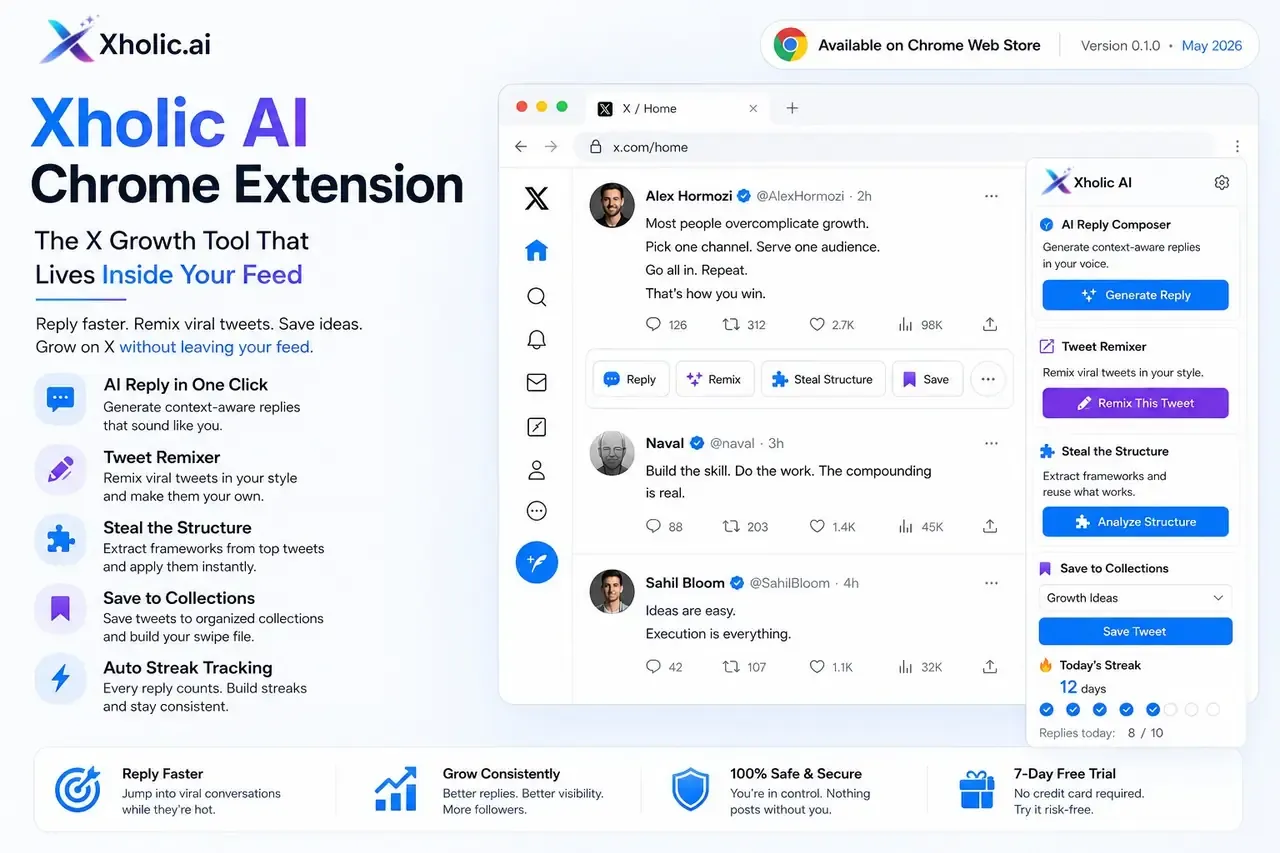
Xholic AI is an AI-powered growth toolkit built specifically for X. It includes a Reply Deck for discovering high-momentum conversations, an AI Reply Composer that learns your voice, a Daily Pack that generates a 20-post mix in your style with optional product-aware posts, a Tweet Remixer, semantic search across 2.5M+ tweets, and a Goals & Streaks system to keep you consistent. Try it free for 7 days at xholic.ai with no credit card required.