You’re probably here because one of two things happened. You signed up for X, saw a box asking for a username, and wondered whether that’s the same thing as your profile name. Or you tried to claim the handle you wanted, found it taken, and realized this tiny field carries a lot more weight than it seems.
That instinct is right. On X, your handle isn’t a cosmetic detail. It’s your identifier, the thing people tag, search, and remember. If you’re a founder, creator, or operator, it works a lot like your call sign. A weak one creates friction. A strong one makes every mention, reply, and profile visit easier.
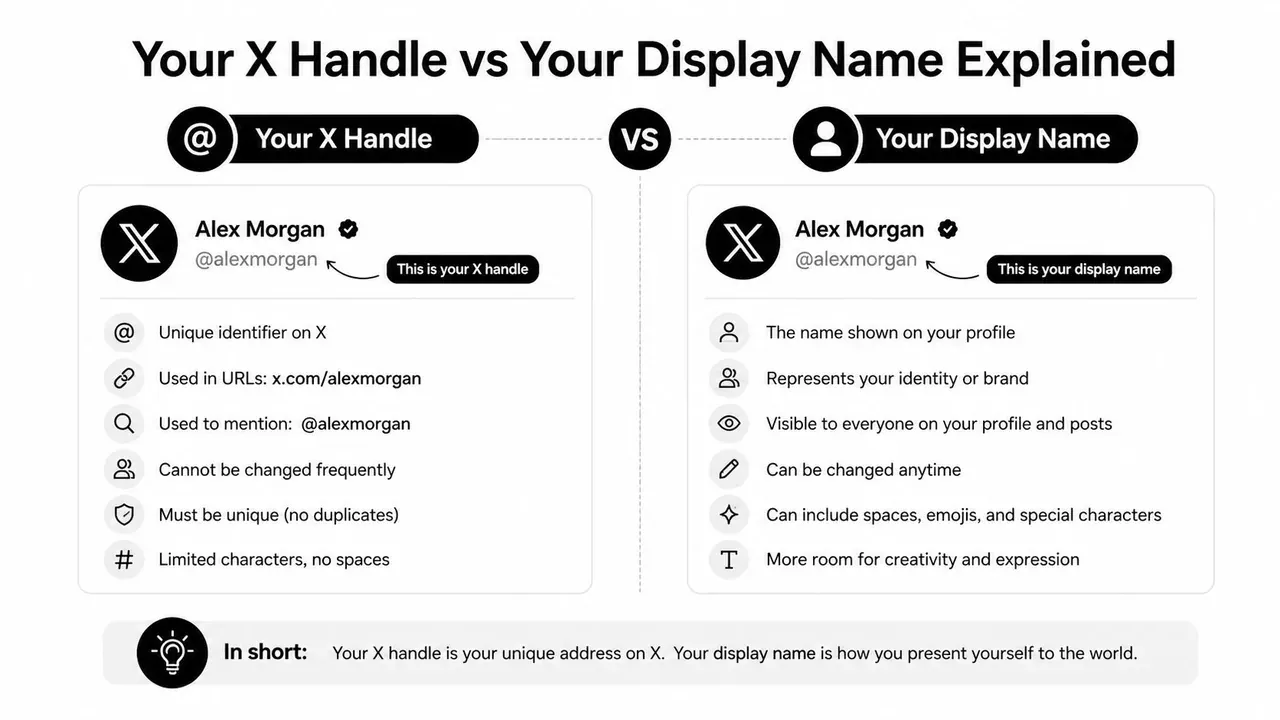
Your X Handle vs Your Display Name Explained
The core answer to what is a handle on twitter is simple. Your handle is your account’s unique username, written with the @ symbol. It’s the identifier X uses to distinguish your account from every other account on the platform.
Your display name is different. That’s the larger name shown on your profile, and it doesn’t have to be unique.
The simplest way to think about it
Your handle is like your street address. Your display name is like the name on the door.
The address has to be unique, because it tells people exactly where to find you. On X, that means your handle forms your profile URL, like x.com/yourhandle. According to Stack Influence’s explanation of Twitter handles, a handle is the unique username preceded by @, it forms the basis of your profile URL, and it must be between 4 and 15 characters, using only letters, numbers, and underscores.
The name on the door can change whenever you want. It can also be the same as someone else’s. Plenty of accounts can use the same display name, which is why searching for a person or brand by display name alone can get messy.
Practical rule: If someone wants to mention you in a post or reply, they need your handle, not your display name.
That’s why handles matter so much more than many new users expect. Mentions, replies, search behavior inside X, and profile links all run through the handle. If someone tags @YourBrand, X knows exactly which account to notify. If they type only your display name, X doesn’t have the same precision.
X Handle vs. Display Name At a Glance
| Attribute | X Handle (@username) | Display Name |
|---|---|---|
| Uniqueness | Must be unique | Doesn’t have to be unique |
| Format | Starts with @ | Plain text name |
| Used in mentions | Yes | No |
| Forms profile URL | Yes | No |
| Can be changed | Yes, if available | Yes |
| Main purpose | Identification and tagging | Presentation and branding |
A quick example makes this click fast. Your profile might show the display name Acme Analytics, while the actual handle is @AcmeAI. People will see both, but when they tag you, link to you, or search your exact username, they’re using the handle.
If you’re refining your broader X identity, this guide on building a stronger social media profile tag strategy can help you think beyond just the username field.
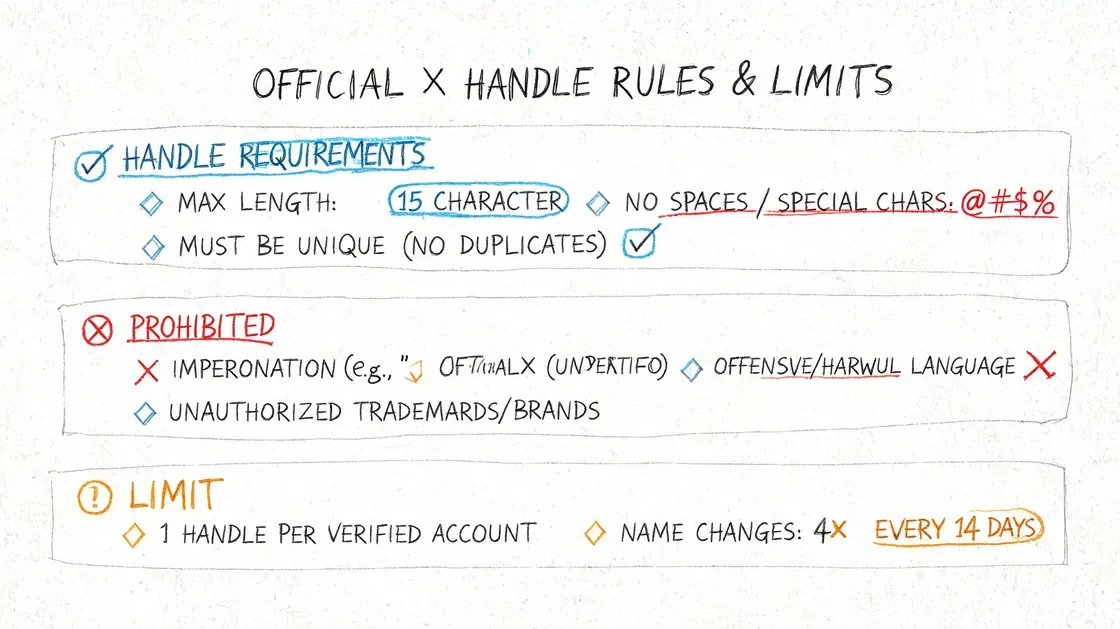
The Official Rules and Limits for X Handles
Before you brainstorm names, it helps to know the hard boundaries. X gives you some flexibility, but not much. A handle has to fit a narrow set of technical rules.
What X allows
Use this as your practical checklist:
- Length matters: your handle must be at least 4 characters and no more than 15 characters.
- Characters are limited: you can use letters, numbers, and underscores.
- Uniqueness is mandatory: no two accounts can share the same handle.
- The @ symbol is part of how people refer to it: but when you edit the field, X treats the username itself as the core value.
These rules are part of what makes handles reliable. If usernames allowed endless symbols and formatting tricks, tagging and search would break down fast.
What trips people up
Most failed handle ideas come from using characters X won’t accept.
No spaces. No hyphens. No punctuation marks beyond the underscore.
So if you want something like my-brand, my brand, or brand!, X won’t accept it. You’d need a version such as mybrand or my_brand.
There’s another practical limit founders run into. Some words that feel generic, official, or platform-sensitive may not be available even if they look valid. X keeps some names blocked or restricted to protect platform integrity and reduce confusion around impersonation or official status.
A few examples of handle choices that usually work better:
- Cleaner brand fit:
AcmeLabs - Readable alternative:
Acme_Labs - Founder-led identity:
JaneBuilds - Harder to share out loud:
Jane_4739
A handle should pass the podcast test. If you say it once out loud, someone should be able to type it correctly on the first try.
That one filter eliminates a surprising amount of clutter.
How to Find and Change Your X Handle
Changing your handle is straightforward inside X. The risk isn’t the click path. It’s making the change without understanding what moves with it and what doesn’t.
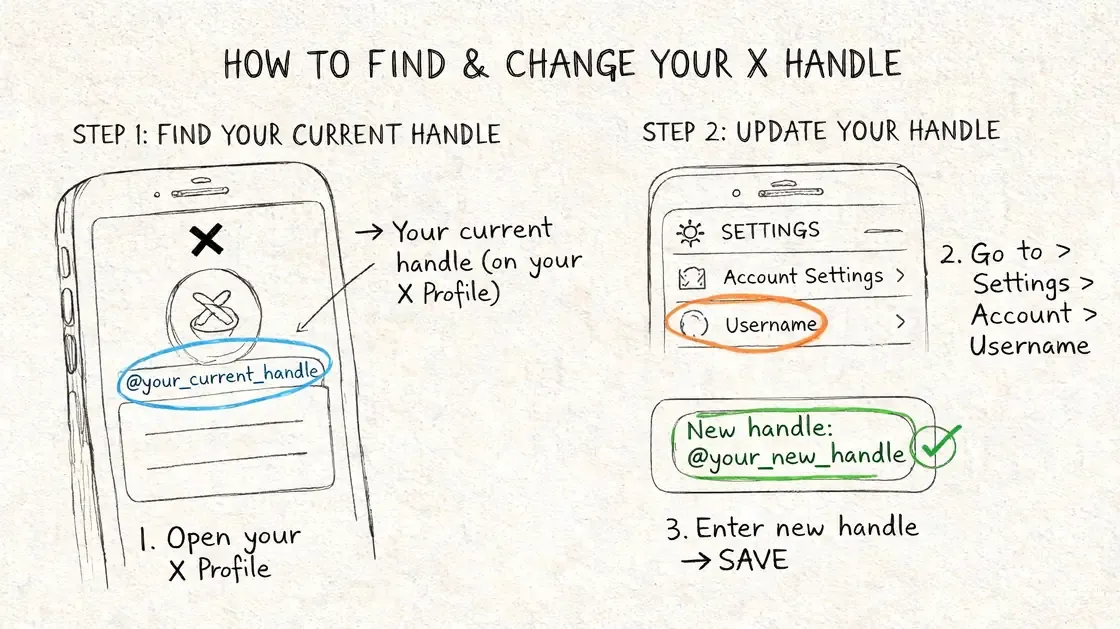
Where to find it
On desktop, go to Settings and privacy, then into Your account, then the account information area where your username appears. On mobile, the path is similar inside the app’s settings. X places the username field with your core account details.
When you edit it, X will usually tell you whether the new option is available. If the handle is taken or invalid, you’ll know before the change goes through.
A practical way to approach this is to prepare a shortlist first. Don’t improvise in the settings screen. Keep a few handle options ready that fit your brand, your name, or your niche.
What changes when you switch it
Your followers, posts, and account history stay with your account. What changes immediately is the public identifier attached to that account.
That means your profile URL changes to match the new handle. It also means old references to the previous username can stop being useful in practice, especially when people are trying to find or tag you under the old name.
- Your new profile address updates right away
- Future mentions need the new handle
- Your existing audience stays with you
- Your off-platform references may need cleanup
This is where many people get caught. They change the handle, then forget to update their website, newsletter footer, LinkedIn bio, product launch pages, and saved creator kits.
If you change your handle, announce it publicly and update every place where people might copy your old username.
For a founder, that includes decks, founder profiles, podcast guest pages, and app store listings. The handle is small, but it’s stitched into more assets than is often appreciated.
Best Practices for Choosing a Powerful Handle
A handle can be available and still be weak. That’s the part many guides miss. The right question isn’t just “Can I claim this?” It’s “Will this make it easier for people to remember, tag, and trust me?”
What makes a handle strong
Start with clarity. A strong handle looks obvious the first time someone sees it. If people hesitate over how to spell it, where to place the underscore, or whether there are hidden numbers, you’ve introduced friction into every mention.
Shorter usually wins. You don’t need the shortest handle on X. You need one that people can type fast in a live conversation, a reply thread, or a recommendation post.
Alignment matters too. If your brand is Northstar Labs but your handle is @GrowthWizard247, you’re making your audience do extra memory work. For founders building in public, the best handle often matches either your personal name or your product name cleanly.
One verified benchmark worth noting comes from ContentStudio’s discussion of Twitter handles. It says consistent @usernames across X, LinkedIn, and Instagram boost recognition by 35%. That’s useful because it turns handle choice into a broader branding decision, not just an X setup task.
A quick filter before you commit
Run your options through these tests:
- Can someone say it out loud easily? If not, mentions will get messy.
- Does it match your brand or real identity? Random handles create distance.
- Can you use it on other platforms too? Consistency compounds recognition.
- Does it avoid clutter? Extra numbers and stacked underscores usually look weaker.
- Will it still make sense in two years? Trendy niche jokes age badly.
Here’s a clean way to compare options:
| Option | Likely impression |
|---|---|
@MayaChen | Personal, credible, portable |
@MayaBuilds | Strong for a public founder brand |
@Maya_4821 | Functional, but forgettable |
@BestCryptoQueenX | Specific, but hard to extend beyond one niche |
If your content strategy includes demos, screenshots, or concept posts, this guide to creating realistic X mockups without misleading anyone is useful for keeping your brand presentation polished while you standardize your identity.
The best handles lower effort for everyone else. That’s the hidden advantage. A clean handle makes it easier for customers to tag you, partners to cite you, and followers to search for you later.
The X Handle Marketplace A New Way to Claim Your Name
This is the part most older guides won’t mention. If the handle you want is unavailable, your only option isn’t waiting forever and hoping the account gets released.
Why this matters now
According to X’s account help information on changing your handle, the X Handle Marketplace allows eligible subscribers to request and purchase previously unavailable handles. That matters because some desirable usernames have been effectively locked away by inactive or suspended accounts for years.
For brands and creators, this changes the mindset completely. A premium handle is no longer only a matter of luck. In some cases, it becomes an asset you may be able to pursue through an official channel.
Some of the best branding decisions on X happen before you write a single post. Securing the right handle is one of them.
This doesn’t mean every dream username is instantly available. It does mean there’s now a legitimate path worth checking before you settle for a compromised version of your name.
Who should pay attention
This matters most if your handle has real branding value:
- Founders using their real names: especially if your name is your public brand
- Startups with a clear product name: where consistency across site, socials, and product matters
- Creators building a long-term identity: not just a throwaway account
- Operators managing company visibility: where polished mentions and profile links matter
If you’ve been using an awkward fallback like @YourBrandHQ_ or @JaneDoeOfficial1, the marketplace introduces a new strategic question. Is the cleaner version available through X’s official process?
That’s a meaningful shift. For serious builders, the handle is no longer just a username field. It can be something you intentionally acquire.
Your Handle Is Your Digital Handshake
Your handle is the first clean identifier people use to interact with you on X. It’s how they tag you, find you, and remember you later. Your display name supports the brand, but your handle carries the routing function.
That’s why the distinction matters. The display name is flexible presentation. The handle is operational identity.
A good handle feels small until you watch how often it appears. It sits in your URL, your mentions, your screenshots, your launch posts, your founder bio, and every recommendation thread where someone says, “Go follow this person.” If you choose it carefully, it reduces friction every single time.
The newer marketplace angle makes this even more important. If the ideal version of your name or brand was once out of reach, there may now be an official path to claim it. That’s worth evaluating before you lock yourself into a compromised identity for another year.
If you’re refining the rest of your profile after choosing a stronger handle, these Twitter biography ideas for 2026 can help you tighten the second piece of the puzzle.
If you want to turn a strong X identity into consistent, high-quality output, Xholic AI helps you find momentum, write sharper replies, and publish in your own voice without sounding automated. It’s built for founders, creators, and operators who want better reach on X without spending all day in the feed.