X can be a valuable business channel, but only when it is run as more than a company announcement feed.
The strongest business accounts use X as a connected system for market listening, public expertise, customer conversations, distribution, lead generation, support, and paid acquisition. The profile is only the front door. The real advantage comes from what the business learns, publishes, discusses, measures, and improves behind it.
This guide is for founders and marketers deciding whether and how to use X for a company. It covers the decisions that matter before you start posting: whether X fits the business, whether the founder or company should lead, which account type you need, how to build a conversion-ready profile, what to publish, how to use replies and DMs without becoming spammy, when to advertise, and how to connect activity on X to pipeline or another business outcome.
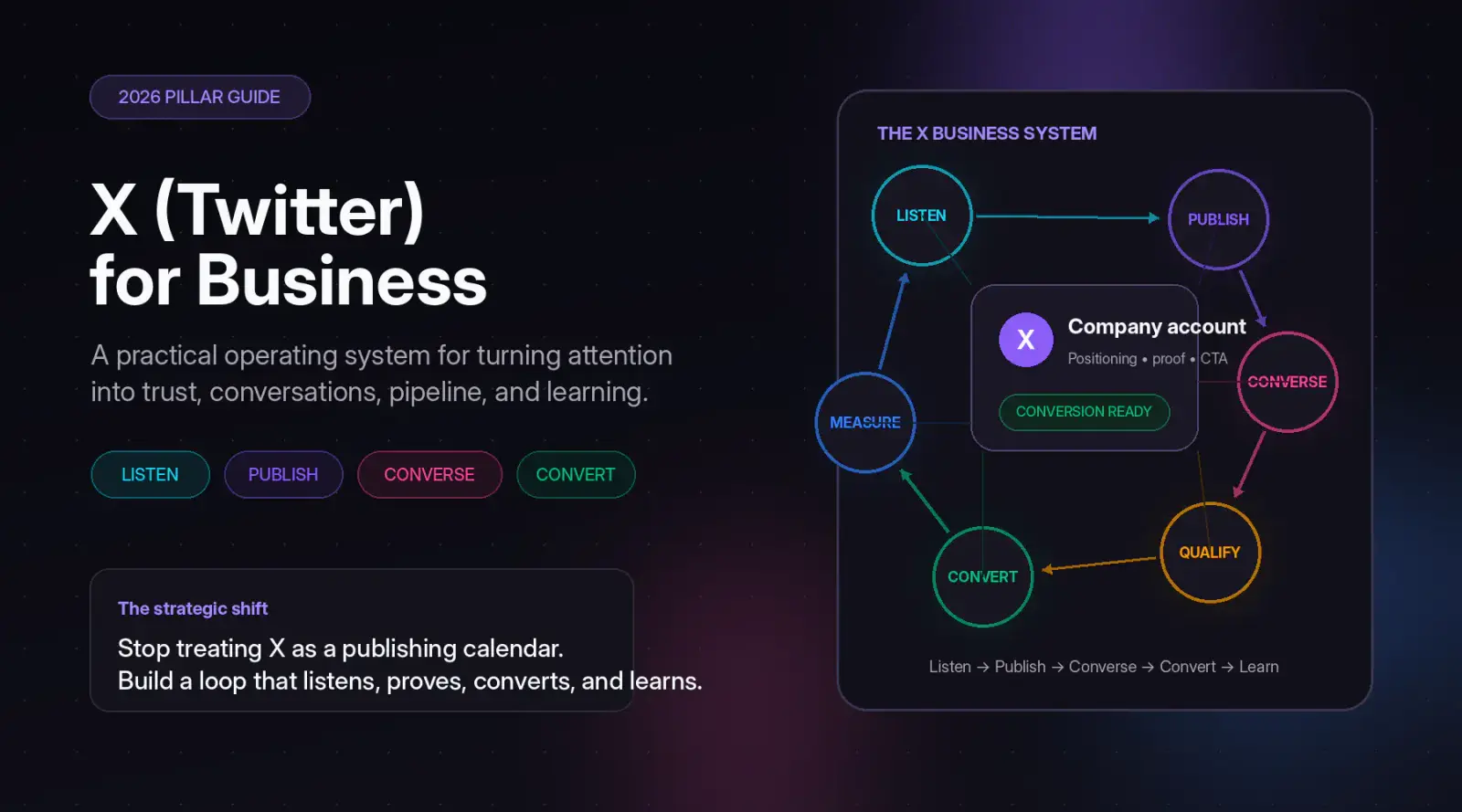
The central idea: A business account is not a content calendar. It is an operating system that turns market signals into useful public communication, conversations, and measurable business outcomes.
Throughout this guide, X and Twitter are used interchangeably. X is the platform’s current name, while many people still search for and refer to it as Twitter.
The quick answer: how should a business use X?
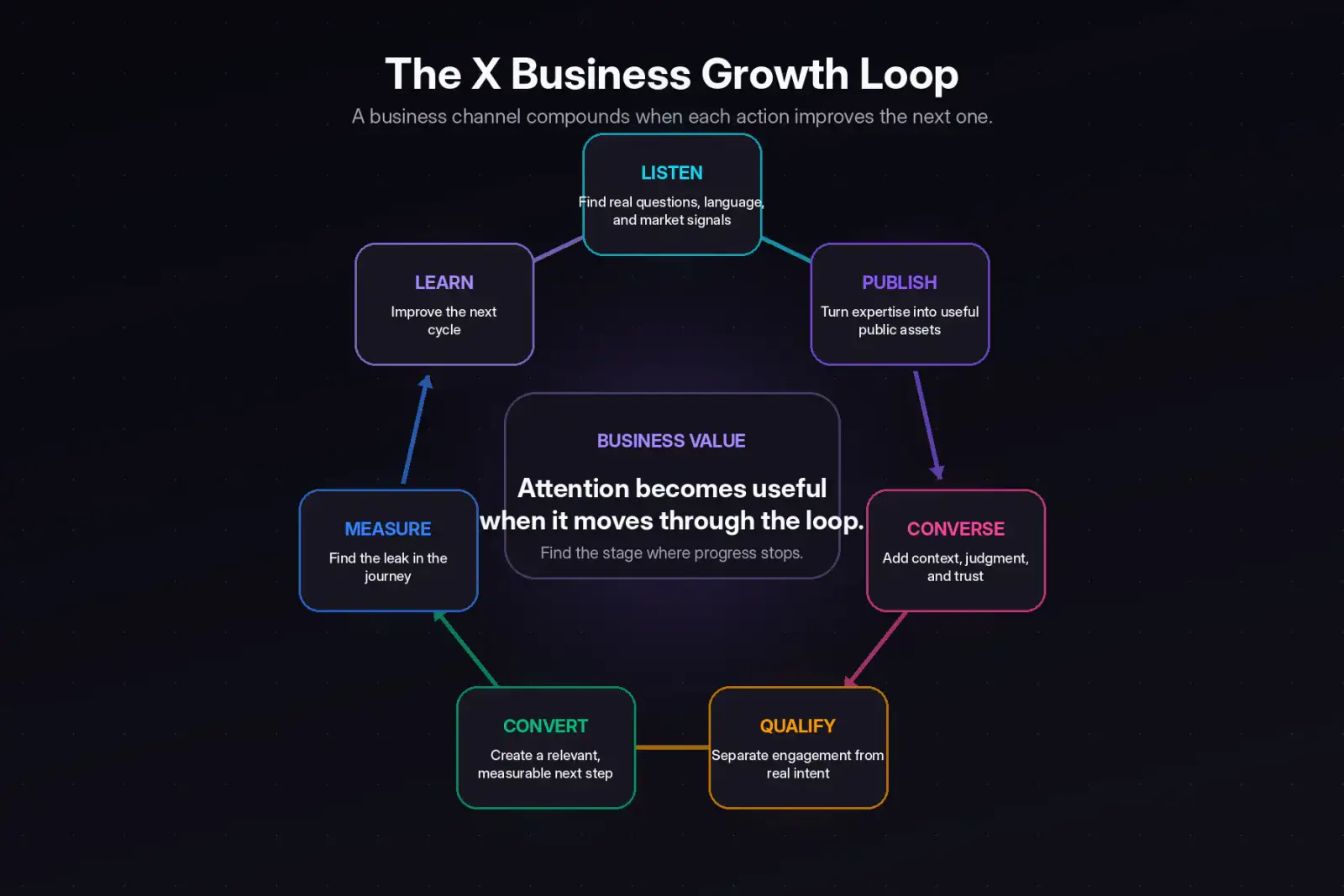
A business should use X to do six things well:
- Listen to customers, prospects, practitioners, competitors, and category conversations.
- Publish useful ideas, evidence, product knowledge, and company updates in a recognizable voice.
- Converse through replies, quote posts, mentions, and customer support.
- Qualify genuine interest before moving a conversation into DMs or another sales channel.
- Convert attention into a relevant next step such as a website visit, trial, demo, signup, purchase, application, or support resolution.
- Measure and learn which people, messages, formats, and offers create business value.
Most companies reverse this sequence. They begin by promoting a product, publish without listening, and then judge the channel by impressions. A better strategy begins with audience presence and business fit, builds a repeatable organic learning loop, and adds paid distribution only when the offer and measurement system are ready.
Is X right for your business?
X is a strong business channel when the people who influence your market are already talking there and your team can contribute something more useful than scheduled promotion.
It is a weaker choice when the audience is absent, the company has no one who can participate consistently, or the only plan is to recycle announcements from another platform.
The first question is therefore not, “How often should we post?” It is:
Does X contain enough relevant people, conversations, and business signals to justify a focused 90-day investment?
The X Business Readiness Score
Score each of the following from 0 to 2:
- 0: not true today
- 1: partly true, inconsistent, or unproven
- 2: clearly true and supported by evidence
| Criterion | The question to ask | What a score of 2 looks like |
|---|---|---|
| Audience presence | Are buyers, partners, practitioners, media, or category influencers visibly active on X? | You can identify relevant people and recurring conversations without guessing. |
| Conversation density | Do useful discussions happen often enough to participate consistently? | Relevant opportunities appear every day or several times a week. |
| Expertise supply | Does the team regularly learn things from customers, product, operations, research, or sales? | There is a recurring supply of specific insight, examples, and evidence. |
| Distinct point of view | Can the company explain what it believes, where it disagrees, and why? | The business has defensible positions that are useful to the market. |
| Response capacity | Can a named owner monitor replies, DMs, mentions, and support questions? | Ownership, handoffs, and response windows are clear. |
| Offer readiness | Is there a relevant next step after attention? | A useful product, demo, tool, guide, event, trial, or purchase path exists. |
| Measurement readiness | Can visits, conversations, leads, pipeline, support, or another objective be tracked? | UTMs, analytics, definitions, and CRM fields are in place. |
| Consistency capacity | Can the team run a disciplined 90-day test? | The team can listen, publish, respond, and review every week. |
Interpret the total:
- 13–16: Strong channel fit. Build a serious operating system around one primary objective.
- 8–12: Worth a controlled test. Use 90 days to prove audience, message, and conversion signals.
- 0–7: Lower priority for now. Fix the missing prerequisites or invest in a channel with stronger audience presence.
Businesses that often have strong X-market fit
X tends to be especially useful when expertise, information, or relationships influence the sale. Examples include:
- B2B software and SaaS
- AI, developer tools, cybersecurity, data, and infrastructure
- Finance, investing, research, and media
- Agencies, consultants, and expert services
- Founder-led companies
- Brands with frequent product launches or industry commentary
- Businesses whose customers already ask questions publicly
- Companies recruiting from a professional or technical community
That does not mean X is only for technology companies. A local business, ecommerce brand, education company, or consumer product can perform well when its audience and category conversations are present. The readiness score matters more than the industry label.
Signs X may be a poor near-term investment
Deprioritize X when:
- You cannot find customers or category conversations after a serious search.
- The team has no capacity to reply or participate.
- Every post requires a long approval process that makes timely conversation impossible.
- The product or offer is not ready for the attention it receives.
- The landing page, signup flow, or sales handoff is broken.
- The only success metric anyone can name is follower count.
- The strategy depends on mass automation, copied posts, or unsolicited DMs.
X cannot repair weak positioning, an unclear offer, or a broken conversion path. It can reveal those problems faster.
Personal account, company account, or both?
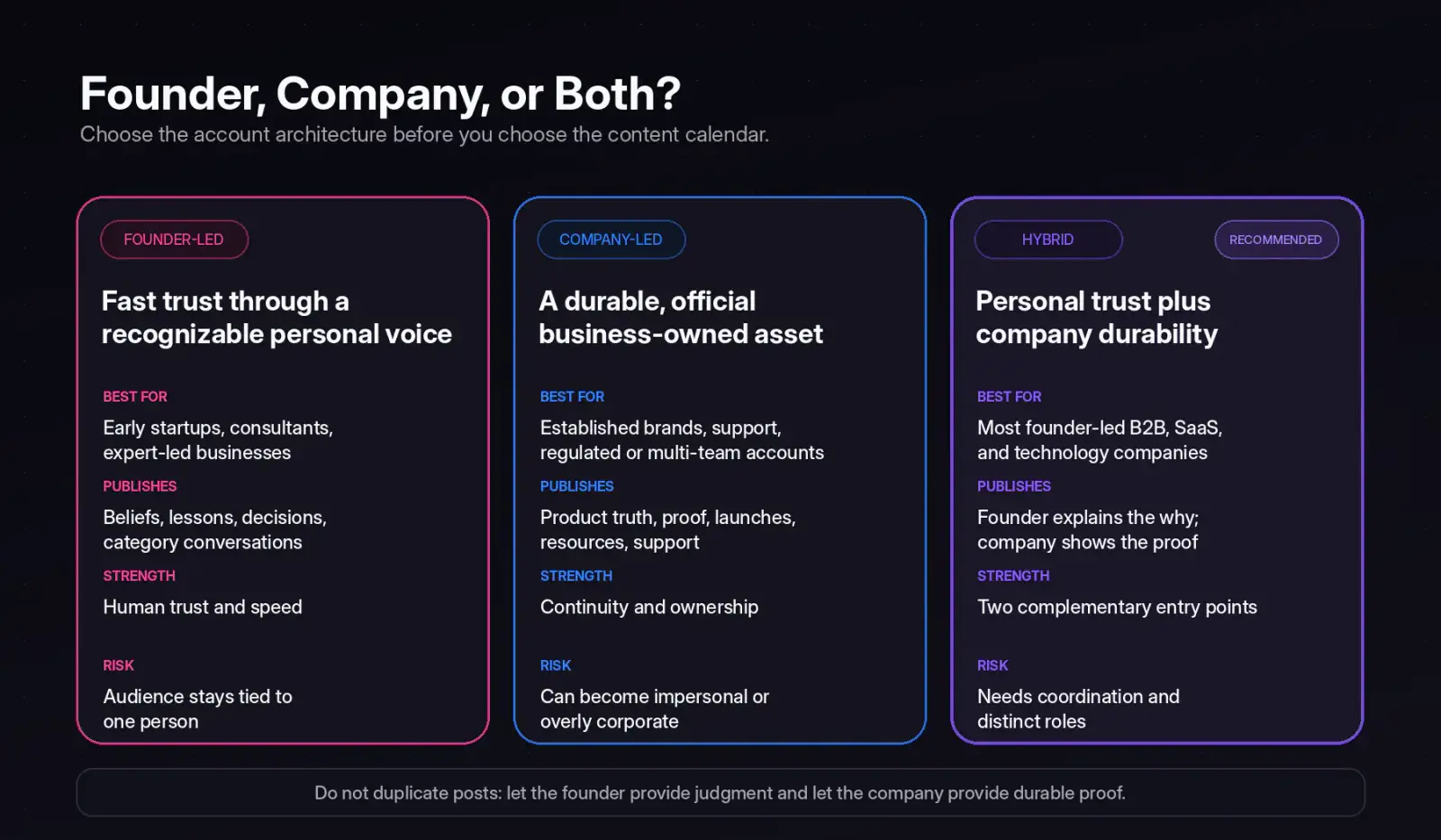
For most founder-led companies, the strongest structure is hybrid: a durable company account supported by founders and relevant team members who communicate in their own voices.
A founder account usually earns trust faster because people respond to people. A company account provides continuity, product context, official information, team ownership, and an asset that remains with the business. The right question is not which one should exist. It is what job each account should do.
The three account models
| Model | Best for | Strengths | Main risk |
|---|---|---|---|
| Founder-led | Early-stage startups, consultancies, experts, and businesses where the founder is the product story | Human voice, faster trust, direct market feedback, strong narrative | The audience and reputation remain concentrated in one person |
| Company-led | Established brands, support-heavy businesses, regulated teams, multi-product companies | Clear ownership, continuity, official communication, easier team handoff | Content can become sterile, promotional, or slow |
| Hybrid | Most founder-led B2B, SaaS, and expertise-driven businesses | Combines personal authority with company durability and proof | Requires role clarity and editorial coordination |
What the founder account should do
A founder account is well suited to:
- Share lessons from building the company.
- Explain the founder’s point of view on the market.
- Join high-context conversations with peers and customers.
- Tell stories that would sound unnatural from a logo.
- Discuss decisions, mistakes, trade-offs, and convictions.
- Humanize launches and company milestones.
- Introduce the people behind the product.
The founder should not become a human press-release distribution system. Their value is interpretation: what happened, what it means, what they learned, and where they disagree.
What the company account should do
The company account is better suited to:
- Explain the product and category clearly.
- Publish customer evidence, use cases, and resources.
- Announce releases, events, research, and official updates.
- Answer product and support questions.
- Curate the best thinking from founders, employees, and customers.
- Maintain a conversion-ready profile and pinned post.
- Act as the durable record of what the business offers and believes.
Avoid the duplicate-account trap
The hybrid model fails when the company account simply reposts the founder or when both accounts publish identical messages.
Give each account a distinct editorial contract:
- Founder: perspective, story, judgment, experience.
- Company: product, proof, education, resources, official context.
- Both: coordinated launches, research, customer stories, and important category moments—but from different angles.
For example, when launching a new feature:
- The company account can explain what changed, who it helps, and how to use it.
- The founder can explain why the team built it, what customer pattern led to the decision, and what trade-off was difficult.
- A product leader can publish a technical or operational lesson.
- A customer can provide independent evidence.
One event becomes a network of useful perspectives instead of four copies of the same announcement.
When company-led is the safer choice
Use a more company-led model when:
- The business operates in a regulated category.
- Public claims need legal, compliance, or security review.
- Several executives represent the company.
- The brand is more recognizable than any one employee.
- Customer support and incident communication are central.
- The company is likely to outlast the founder’s day-to-day public role.
Even then, named experts can participate within clear guardrails. “Company-led” should not mean “personality-free.”
X business account types explained
A common source of confusion is that “business account” can refer to several different things on X. A free Professional Account, an individual X Premium subscription, X Premium Business, and an ads account are not the same product.
Account and subscription comparison
| Option | What it is | Best use | Important note |
|---|---|---|---|
| Standard X account | The basic account foundation | Creating and operating a personal or company handle | Free to create; ownership and profile setup still matter |
| Professional Account | A free conversion for businesses, brands, creators, and publishers | Professional category, Professional Home, profile spotlights, X Shopping access, X Ads, and Quick Promote | Choose Business or Creator during conversion; this is not the same as paid verification |
| X Premium | A paid individual subscription with multiple tiers | Individual premium features and, where eligible, verification | Designed around an individual account rather than organizational management |
| X Premium Business | A paid organizational subscription with Basic and Full Access tiers | Gold checkmark, business support, organization features, and—on Full Access—affiliations | Features and pricing can change; review the current official page before buying |
| X Ads account | The advertising workspace connected to an X handle | Running paid campaigns, billing, audiences, and measurement | X currently requires an eligible advertiser account to be verified |
X says that converting an existing account to a Professional Account is free. Professional Accounts can access tools such as Professional Home, professional categories, profile spotlights, X Shopping, X Ads, and Quick Promote, subject to availability and eligibility.
X Premium Business is a separate organizational subscription. Its Basic and Full Access tiers include different capabilities; affiliations are currently associated with Full Access rather than Basic.
Should a business convert to a Professional Account?
For a legitimate company presence, converting to a free Professional Account is usually sensible when the option is available. It creates clearer professional context and unlocks professional tools without forcing the business into a paid organizational subscription.
Before converting, make sure the profile is complete and authentic. X’s requirements include an account name, bio, profile picture, and a clear identity that does not misleadingly represent another person or organization.
Does every business need X Premium Business?
No.
Premium Business is more defensible when the organization needs one or more of the following:
- A gold checkmark and stronger organization-level identity.
- Affiliation between the main company and founders, employees, sub-brands, or support accounts.
- Impersonation protection.
- Priority or VIP support.
- Organizational hiring or other included business features.
- Verification required for a serious advertising program.
It may be premature when the company is still testing whether X contains a meaningful audience and has no immediate need for verification, affiliations, or organizational support.
Do you need verification to advertise?
At the time this guide was verified, X’s advertiser eligibility policy stated that accounts must be verified through an eligible program to participate in X Ads. Businesses should recheck the policy before planning a campaign because platform requirements can change.
Treat verification as a business decision, not a vanity purchase. Its value depends on advertising, impersonation risk, organizational structure, support needs, and how central X is to the company’s public identity.
How to set up an X business account properly
A company profile is a public interface and a business asset. Set up ownership, security, access, positioning, and measurement before scaling content.
1. Make the company—not an employee—the owner
Use:
- A company-controlled email address.
- A strong, unique password stored in an approved password manager.
- Login verification or another supported security method.
- A company-controlled recovery process.
- A written record of the owner, admins, contributors, and advertising access.
- An offboarding checklist for employees, contractors, and agencies.
Do not build a valuable audience around an employee’s personal email, phone number, or password. The company should be able to recover and govern the account even when the original operator is unavailable.
2. Use delegated access instead of sharing the main password
X Delegate supports owner, admin, and contributor roles with different permissions. This allows authorized people to act on behalf of the account without receiving the owner’s login credentials.
For advertising, X also supports multi-user login, allowing several people to access an ads account with their own credentials and assigned access. Use the platform’s permission system rather than passing passwords through chat or email.
3. Choose a handle people can remember and tag
The ideal handle is:
- As close to the brand name as possible.
- Easy to spell after hearing it once.
- Free from unnecessary numbers or punctuation.
- Consistent with the company domain and other social profiles.
- Broad enough to survive a product expansion or repositioning.
If the exact brand name is unavailable, use a stable qualifier such as get, use, hq, app, or a clear category term. Avoid handles tied to a temporary campaign.
4. Use the name field for identity and discoverability
The display name should make the account immediately recognizable. In some cases, adding a concise category descriptor helps a cold visitor understand the company faster—for example, “Acme | Developer Security.” Do not stuff the field with keywords or slogans.
5. Make the avatar pass the small-size test
Company avatars are displayed at small sizes throughout feeds, replies, notifications, and search. Use a simple mark with strong contrast. Fine text, complex illustrations, and full wordmarks often become unreadable.
Test the avatar at approximately notification size. If the brand cannot be recognized, simplify it.
6. Use the header to add context, not decoration
The header can answer what the avatar cannot:
- What the business helps people do.
- Who the product is for.
- What is launching now.
- A product interface or result.
- A concise proof point.
- A campaign, event, or research report.
Keep the most important information away from areas likely to be obscured by the profile avatar or cropped on smaller screens. Xholic’s free Twitter Banner Maker can help create the standard 1500 × 500 canvas.
7. Write a bio that explains the outcome
A strong business bio answers four questions:
- Category: What are you?
- Audience: Who is it for?
- Outcome: What do you help them achieve?
- Proof or differentiation: Why should they believe or remember you?
A useful structure is:
[Product/category] for [audience] that helps them [outcome]. [Differentiator or proof]. [Clear next step].
Example:
AI growth workspace for founders and creators on X. Personalized replies, ideas, and opportunities shaped by your voice and context. Start free.
Do not turn the bio into a list of vague adjectives. “Innovative solutions for a better future” tells the visitor nothing about the user, problem, or next step.
Use Xholic’s Twitter Bio Generator to produce options, then edit the result to match the actual product and voice.
8. Link to the page that matches the account’s objective
The homepage is not automatically the best destination.
Link to:
- A free trial when product activation is the objective.
- A demo page when the sale requires qualification.
- A category guide when the audience still needs education.
- A free tool or report when the goal is lead generation.
- A product page during a focused launch.
- A support page for a dedicated support account.
Add a consistent UTM structure so the team can distinguish profile traffic from individual post traffic.
9. Audit the cold-visitor experience
Open the profile as though you know nothing about the business. In five seconds, can you answer:
- What does this company do?
- Who is it for?
- Why is it credible?
- What should I read first?
- What should I do next?
Xholic’s free X Profile Audit scores public-facing signals across completeness, positioning clarity, visual consistency, audience shape, and visible engagement. Use it as a diagnostic starting point, then review the profile against the company’s actual conversion objective.
For a detailed profile workflow, see the Twitter Profile Optimization Checklist.
Turn the profile into a conversion path
A business profile should be designed around a sequence, not a collection of fields:
Post or reply → profile visit → positioning → proof → next step
A high-performing post can create thousands of impressions and still produce little business value if the profile does not explain why the company is relevant.
The four-layer profile test
Layer 1: Recognition
The name, handle, avatar, and header should make the account identifiable and legitimate.
Layer 2: Relevance
The bio should help the right visitor recognize themselves, their problem, or their desired outcome.
Layer 3: Proof
The pinned post and recent content should demonstrate that the company can deliver on its promise.
Layer 4: Action
The link, pinned-post CTA, or DM path should offer a clear and proportionate next step.
The action should match the visitor’s level of intent. A person discovering a category may be ready for a guide, not a sales call. A buyer comparing products may be ready for a demo or trial.
The pinned post is the proof layer
The pinned post is often the first substantial piece of content a profile visitor sees. It should not be whichever announcement happened to be pinned six months ago.
Choose a pinned-post type based on the objective:
| Objective | Strong pinned-post format |
|---|---|
| Explain the product | Concise product walkthrough with screenshots or video |
| Establish expertise | A definitive framework, research report, or high-value thread |
| Generate leads | Free tool, template, report, or checklist with a clear benefit |
| Build trust | Customer result, case study, or proof-rich story |
| Support a launch | Launch explanation, use cases, and one next step |
| Orient new followers | “Start here” post linking to the company’s best resources |
A useful pinned post usually includes:
- A strong first line that names the audience or problem.
- A clear explanation of the result.
- Evidence: screenshot, example, demo, customer outcome, or useful framework.
- One next step.
Avoid stacking four calls to action in one post. A visitor should not have to choose between following, booking, subscribing, replying, downloading, and watching a demo at the same time.
See the full pinned-post strategy guide for formats and rotation rules.
Choose a business objective before creating content
A business account can create awareness, authority, demand, leads, sales conversations, customer insight, support, recruitment, or retention. It cannot optimize all of them equally at the same time.
Choose one primary objective for the next 90 days and, at most, one supporting objective.
Match objectives to content and metrics
| Primary objective | Content that supports it | Useful leading indicators | Business outcome |
|---|---|---|---|
| Brand awareness | Distinctive commentary, visual explanations, timely category posts | Qualified reach, relevant profile visits, mentions | More people in the target market recognize the company |
| Category authority | Original research, frameworks, technical explanations, strong opinions | Saves, citations, relevant followers, invitations | The company becomes a trusted source |
| Demand generation | Problem education, comparisons, use cases, lead magnets | Website sessions, return visitors, tool/report signups | More qualified demand enters the funnel |
| Sales and pipeline | Customer proof, demos, objection handling, buyer education | Qualified DMs, meetings, opportunities | Sourced or influenced pipeline and revenue |
| Customer intelligence | Questions, polls, replies, observation, product discussions | Useful insights captured, interviews, recurring language | Better positioning, product, and customer understanding |
| Customer support | Clear updates, answers, troubleshooting, escalation | Response time, resolution time, sentiment recovery | Faster resolution and higher trust |
| Recruitment | Team stories, role context, work samples, employee expertise | Relevant applications and referrals | Better-fit candidates |
Use a metric tree, not one vanity number
Suppose the objective is pipeline. “Grow followers” is not a sufficient strategy or metric.
A better metric tree is:
- Input: relevant posts, replies, conversations, and distribution.
- Attention: qualified impressions and profile visits.
- Consideration: website sessions, repeat visitors, content downloads.
- Conversation: qualified DMs and meetings.
- Commercial: opportunities, pipeline, customers, and revenue.
Followers can be useful, but only as a supporting signal. A smaller audience of buyers, users, partners, and respected practitioners can be more valuable than a much larger audience with no connection to the offer.
Define “qualified” before reporting performance
A qualified profile visit, follower, reply, DM, or lead should have a written definition.
For example, a qualified DM conversation might require at least one of the following:
- The person fits the target customer profile.
- They have a real use case or problem.
- They ask a product, pricing, or implementation question.
- They request a resource, demo, trial, or introduction.
- They are a relevant partner, journalist, candidate, or industry operator.
Without a definition, teams report volume. With a definition, they can report progress.
Build an organic content operating system
Organic content should help the business learn what the market cares about, demonstrate expertise, and create relevant conversations. It should not depend on someone opening a blank composer every morning and hoping for inspiration.
The most reliable content systems begin with inputs, not formats.
Build an evidence supply chain
Collect material from:
- Sales calls and objections.
- Customer-support questions.
- Product decisions and trade-offs.
- Customer results and use cases.
- Research, benchmarks, and internal data.
- Competitor and category changes.
- Founder and operator lessons.
- Relevant posts saved by the team.
- Questions repeated in replies and DMs.
- Things the company believes that the market misunderstands.
Create a lightweight weekly capture process. Ask each customer-facing or product-facing person to submit:
- One question customers asked.
- One misconception they noticed.
- One example or result worth explaining.
- One decision or lesson from the week.
- One market conversation the company should join.
That creates raw material no generic AI system or competitor can reproduce without access to your business.
The Seven Jobs of Business Content
A healthy content portfolio performs seven different jobs.
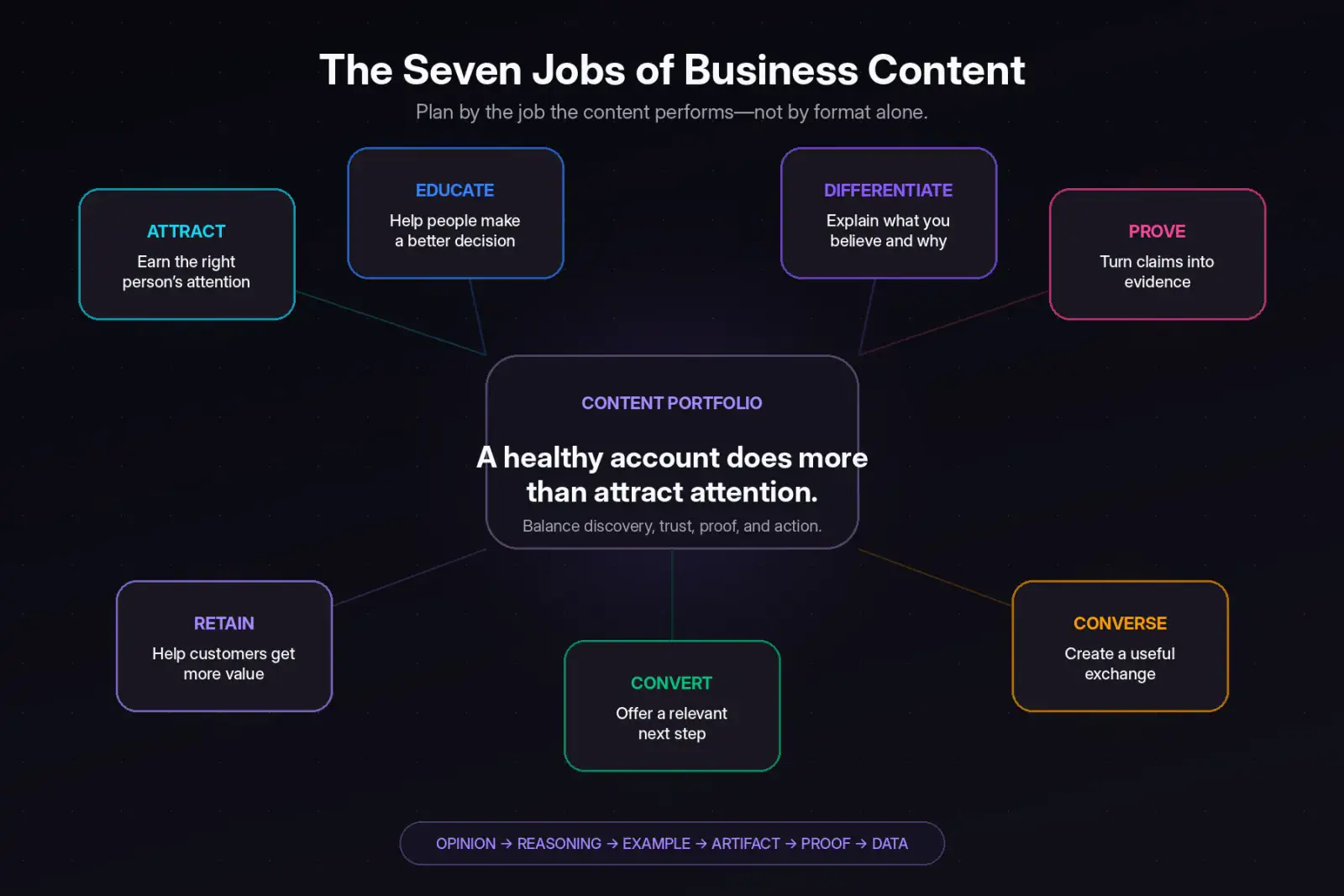
1. Attract
Earn attention from relevant people.
Examples:
- Timely analysis of a category change.
- A surprising observation backed by evidence.
- A visual that simplifies a difficult idea.
- A useful response to an influential conversation.
Measure: qualified reach, relevant profile visits, and new followers from the target market.
2. Educate
Help the audience understand a problem, concept, or workflow.
Examples:
- How-to posts.
- Frameworks and checklists.
- Breakdown threads.
- Before-and-after explanations.
Measure: saves, shares, useful replies, return profile visits, and resource clicks.
3. Differentiate
Explain how the company thinks differently.
Examples:
- A reasoned disagreement with a common practice.
- A clear category point of view.
- A trade-off competitors ignore.
- “We do not optimize for X; we optimize for Y” with evidence.
Measure: thoughtful replies, mentions, direct comparisons, and language repeated by the market.
4. Prove
Reduce risk by showing evidence.
Examples:
- Customer outcomes.
- Product demonstrations.
- Screenshots and artifacts.
- Benchmarks, methodology, or source data.
- A transparent account of what worked and what did not.
Measure: product-page visits, demo interest, sales usage, and qualified questions.
5. Converse
Create or deepen a useful discussion.
Examples:
- Specific questions asked of a defined audience.
- Replies that add missing context.
- Polls used for research rather than easy engagement.
- Requests for examples, counterarguments, or experience.
Measure: relevant replies, expert participation, insights captured, and relationships formed.
6. Convert
Invite an audience to take a sensible next step.
Examples:
- Try a free tool.
- Read the full guide.
- Watch the product walkthrough.
- Start a trial.
- Book a demo.
- Join an event.
Measure: clicks, signups, qualified conversations, meetings, and revenue actions.
7. Retain
Help existing users, customers, or community members succeed.
Examples:
- Feature education.
- Product tips.
- Support updates.
- Customer spotlights.
- Roadmap context.
Measure: support resolution, product adoption, customer feedback, and retention signals.
Do not use a universal content ratio
Advice such as “80% value, 20% promotion” sounds precise but ignores the business stage, buying cycle, audience, and objective.
Instead, create a portfolio for the next 10–20 posts. An early-stage B2B software company focused on demand generation might plan:
- 3 educational posts.
- 2 conversational posts.
- 2 proof posts.
- 1 differentiating point of view.
- 1 attention-oriented category post.
- 1 conversion post.
A company in a major launch week may publish more product and conversion content. A mature support account may prioritize retention and official updates. The right mix is the one that produces the intended audience action without exhausting trust.
Use the Evidence Ladder to avoid generic content
Business content becomes more credible as it moves up this ladder:
- Assertion: “Personalization improves replies.”
- Explanation: Why personalization changes relevance and tone.
- Example: A generic reply compared with a contextual reply.
- Artifact: Screenshot, prompt, workflow, or real before-and-after.
- Outcome: What changed—response quality, time saved, conversion, or another result.
Most commoditized content stops at assertion and explanation. High-value content adds examples, artifacts, methodology, and outcomes.
Before publishing, ask:
- What evidence supports this?
- What did we observe directly?
- Can we show the workflow?
- What limitation or trade-off should we disclose?
- What would make this useful even if the reader never buys from us?
Adapt formats to X instead of cross-posting mechanically
A strong LinkedIn post, email, video, or report can become useful X content, but it should be re-edited for the platform.
On X:
- Lead with the insight, not a long scene-setting introduction.
- Make the first post understandable by itself.
- Use threads only when the idea genuinely needs sequence.
- Use images when they clarify, prove, or compress information.
- Leave room for conversation rather than resolving every possible objection.
- Avoid copy-pasting platform-specific calls to action.
Repurposing is efficient. Mechanical duplication is not.
Use replies and listening as distribution
Publishing is only half of X. The other half is participating in the conversations where the audience already spends attention.
A useful reply can create more qualified profile visits than a standalone post because it appears inside an active, relevant context. The goal is not to “reply under big accounts.” It is to add information that the original post and existing discussion are missing.
Build a listening system with X Lists
X Lists let you organize accounts into focused timelines. A business can use private Lists to monitor important groups without depending on the main feed.
Create at least five:
- Customers and power users — questions, praise, friction, use cases, and language.
- Prospects and target accounts — problems, priorities, launches, and buying signals.
- Category practitioners — what experienced people are learning and debating.
- Competitors and adjacent products — positioning, launches, customer response, and market gaps.
- Media, analysts, partners, and community leaders — stories, research, events, and distribution opportunities.
A List is not a lead database. It is a listening surface. Do not treat every post as an invitation to pitch.
A 20-minute daily listening routine
A practical routine can be simple:
- 5 minutes: scan customer and prospect Lists for questions or important changes.
- 5 minutes: review category discussions and saved searches.
- 5 minutes: write one or two replies where the company has real context.
- 5 minutes: capture content, product, support, or sales signals in a shared system.
The capture step is what turns social activity into organizational learning.
For each useful signal, record:
- Who said it.
- The exact language used.
- The problem or desire expressed.
- Whether it affects content, product, sales, support, or positioning.
- The next owner and action.
The reply value ladder
Not all replies create the same value.
Low value:
Great point.
This adds little information and gives the reader no reason to visit the profile.
Better:
The approval step is usually where this breaks for small teams. The tool is not the bottleneck; unclear ownership is.
This adds a specific interpretation.
Strong:
We saw the same pattern in onboarding: teams with one named approver shipped faster than teams with more automation but unclear ownership. A useful test is to track time from draft to approval, not just time from approval to publish.
This adds an observation, evidence, and a practical diagnostic.
A strong business reply often does one of five things:
- Adds missing context.
- Supplies a concrete example.
- Clarifies a trade-off.
- Challenges the premise respectfully.
- Asks a question that improves the discussion.
Turn repeated conversations into owned assets
When the same question appears three or more times, consider turning it into:
- A post or thread.
- A visual explanation.
- A product document.
- A landing-page clarification.
- A support article.
- A lead magnet or free tool.
- A sales enablement asset.
X is not only a place to distribute content. It is a source of demand language and editorial direction.
Use DMs as a permission-based sales channel
DMs can support sales, partnerships, recruiting, research, and customer success. They work best when they continue a relevant public interaction instead of appearing as an unsolicited pitch from a stranger.
X currently lists a technical limit of 500 DMs per day, but that is not a recommended outreach target. X also warns that duplicate messages sent to multiple accounts can be treated as spam, and its authenticity rules prohibit bulk, aggressive, high-volume unsolicited replies, mentions, or DMs.
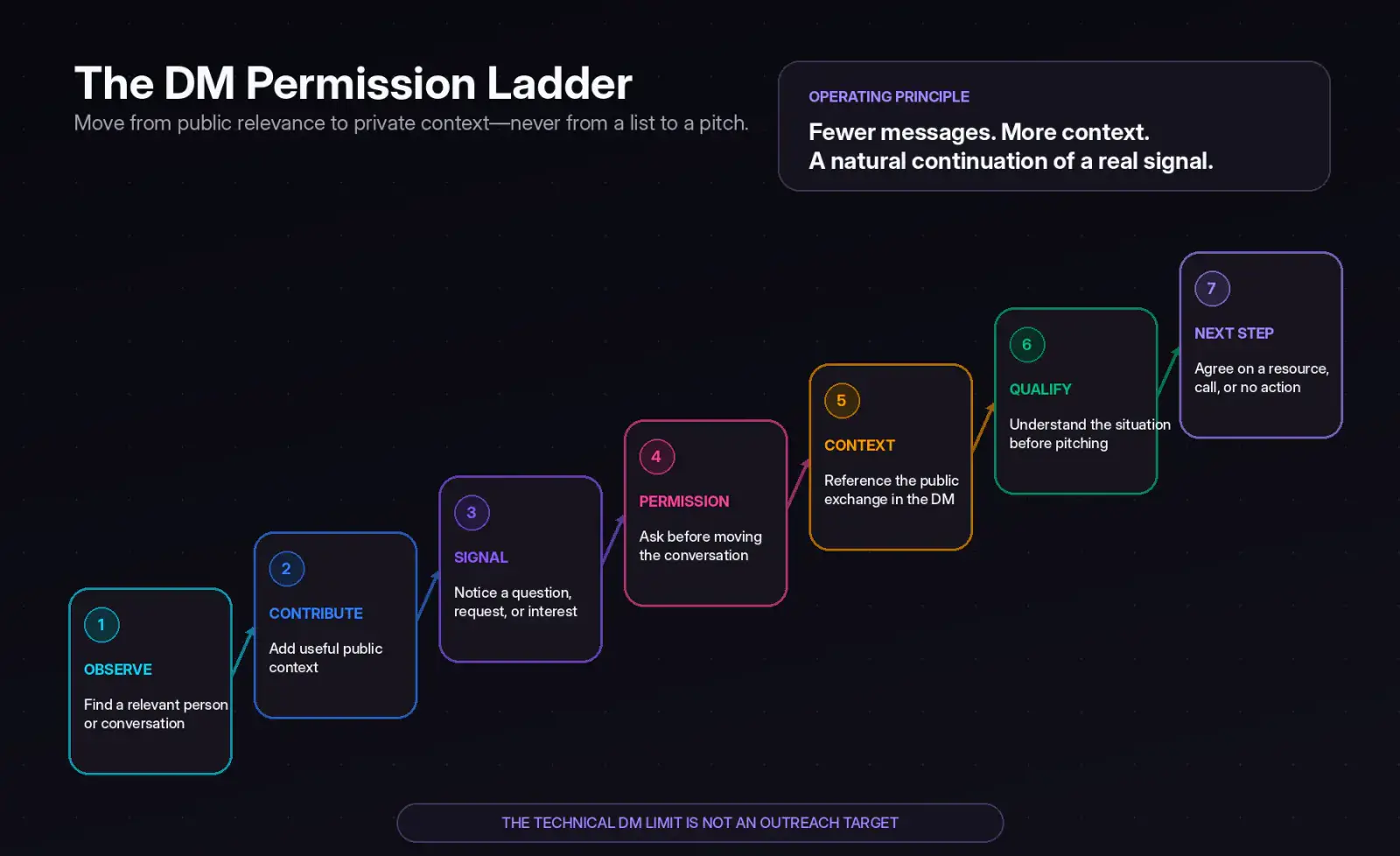
The safest and most effective principle is:
Create context in public, ask permission, then continue privately.
The DM Permission Ladder
Step 1: Identify a real signal
Examples:
- The person asks a question you can answer.
- They describe a problem your product addresses.
- They engage with a relevant product or proof post.
- They request a resource.
- They ask about pricing, implementation, comparison, or availability.
- A mutual contact introduces you.
A like alone is usually a weak signal. Do not interpret every engagement as purchase intent.
Step 2: Add value publicly
Answer the question, share the useful part of the resource, or add context before asking for anything.
Public value gives the person a reason to trust the private conversation and lets other readers benefit.
Step 3: Ask permission to move to DM
For example:
We documented the exact workflow for this. Happy to send it by DM if useful.
Or:
This depends on your current setup. Okay if I ask two questions in DM and point you to the relevant option?
Permission lowers friction and filters out people who are not interested.
Step 4: Open with context, not a generic greeting
A good first DM reminds the person why the conversation exists:
Thanks—here is the checklist I mentioned: [link]. Your point about the approval bottleneck stood out. Is your team solving that with one approver or several stakeholders today?
Do not restart with “Hi, how are you?” and a long company introduction. The public exchange already supplied the context.
Step 5: Qualify before pitching
Ask only what is necessary to determine fit:
- What are they trying to accomplish?
- What is blocking it today?
- What have they already tried?
- How urgent is the problem?
- Who owns the decision or workflow?
Qualification protects both sides from an irrelevant pitch.
Step 6: Offer the smallest sensible next step
Depending on intent, that might be:
- A relevant guide.
- A short product video.
- A free tool.
- A specific answer.
- A trial.
- A 10–15 minute call.
- An introduction to another person.
Do not force a meeting when a link answers the question. Do not send a link when the person clearly needs a tailored conversation.
Step 7: Close the loop respectfully
If there is no response or fit, stop. One concise follow-up may be appropriate when there was clear prior interest. Repeated nudges turn a legitimate conversation into spam.
Track DM quality, not DM volume
Useful DM metrics include:
- Public interactions that contained a real signal.
- Permission-to-DM rate.
- Qualified DM conversations.
- DM-to-meeting rate.
- DM-to-trial or DM-to-opportunity rate.
- Time to first useful response.
- Reasons conversations did not progress.
The goal is not to send more messages. It is to create more relevant, permission-based conversations.
For the wider journey from attention to revenue, see the X sales funnel guide and Twitter lead generation playbook.
Know when to use X Ads
Paid distribution is useful when the business knows what it wants the audience to do, has a credible offer, and can measure the result. Ads do not need to wait for a large organic following, but they should not be used to avoid learning what the market values.
The better sequence is not always “organic first, paid second.” It is:
Learn organically where necessary; use paid distribution when offer maturity and measurement maturity are high enough.
The organic-versus-paid readiness matrix
| Offer maturity | Measurement maturity | Best approach |
|---|---|---|
| Low | Low | Organic listening and message testing. Do not pay to amplify uncertainty. |
| High | Low | Fix analytics, conversion events, and attribution before scaling spend. |
| Low | High | Run small research or awareness tests, but do not expect efficient revenue conversion. |
| High | High | Combine organic insight with paid acquisition, retargeting, and creative testing. |
Paid can make sense early when
- The offer is already validated in another channel.
- The landing page converts qualified traffic.
- The target audience is identifiable on X.
- A launch, event, report, or announcement is time-sensitive.
- The business has enough site traffic for retargeting.
- Conversion tracking is implemented.
- The team can create and review multiple creatives.
Stay organic longer when
- The target customer is still unclear.
- The account has not found a useful point of view.
- The landing page does not explain the offer.
- The business cannot identify a conversion event.
- There is no owner for campaign optimization.
- The plan is simply to boost the latest post for more views.
Choose the campaign objective from the business outcome
X Ads includes objectives designed for different outcomes, such as reach, engagement, video views, website traffic, app activity, and sales or conversion-oriented actions. The objective affects how delivery is optimized.
For example, X describes website traffic campaigns as optimized to drive visits to a website. A traffic objective can be useful when the immediate goal is qualified site visits. It is not the same as optimizing toward a downstream purchase or lead event.
Before launching, write this sentence:
We are paying to reach [audience] with [message/offer] so that they complete [measurable action], and we will continue only if [decision threshold] is met.
If the team cannot complete that sentence, the campaign is not ready.
Install conversion measurement before scaling
X supports website conversion measurement through the X Pixel and Conversions API. The Pixel sends browser-based events; the Conversions API can send server-to-server conversion data. These systems can support attribution, reporting, optimization, and retargeting, subject to X’s terms and applicable privacy requirements.
At minimum:
- Define the conversion events that matter.
- Verify the events are firing correctly.
- Add UTMs to campaign links.
- Reconcile X reporting with website analytics and CRM data.
- Document attribution windows and discrepancies.
- Separate new-customer acquisition from existing-user activity where possible.
Use organic content as a creative research layer
Organic performance does not guarantee paid performance, but it can reveal:
- Hooks that earn attention from the right audience.
- Objections that deserve creative treatment.
- Proof that improves trust.
- Formats that communicate the product clearly.
- Language customers use to describe the problem.
Do not promote a post only because it has many likes. Review whether it attracted relevant profile visits, site actions, replies, or customer language.
Measure X as a business funnel
Impressions are useful for understanding exposure, but they do not tell you whether X is creating business value. Measurement should connect public activity to the next meaningful action.
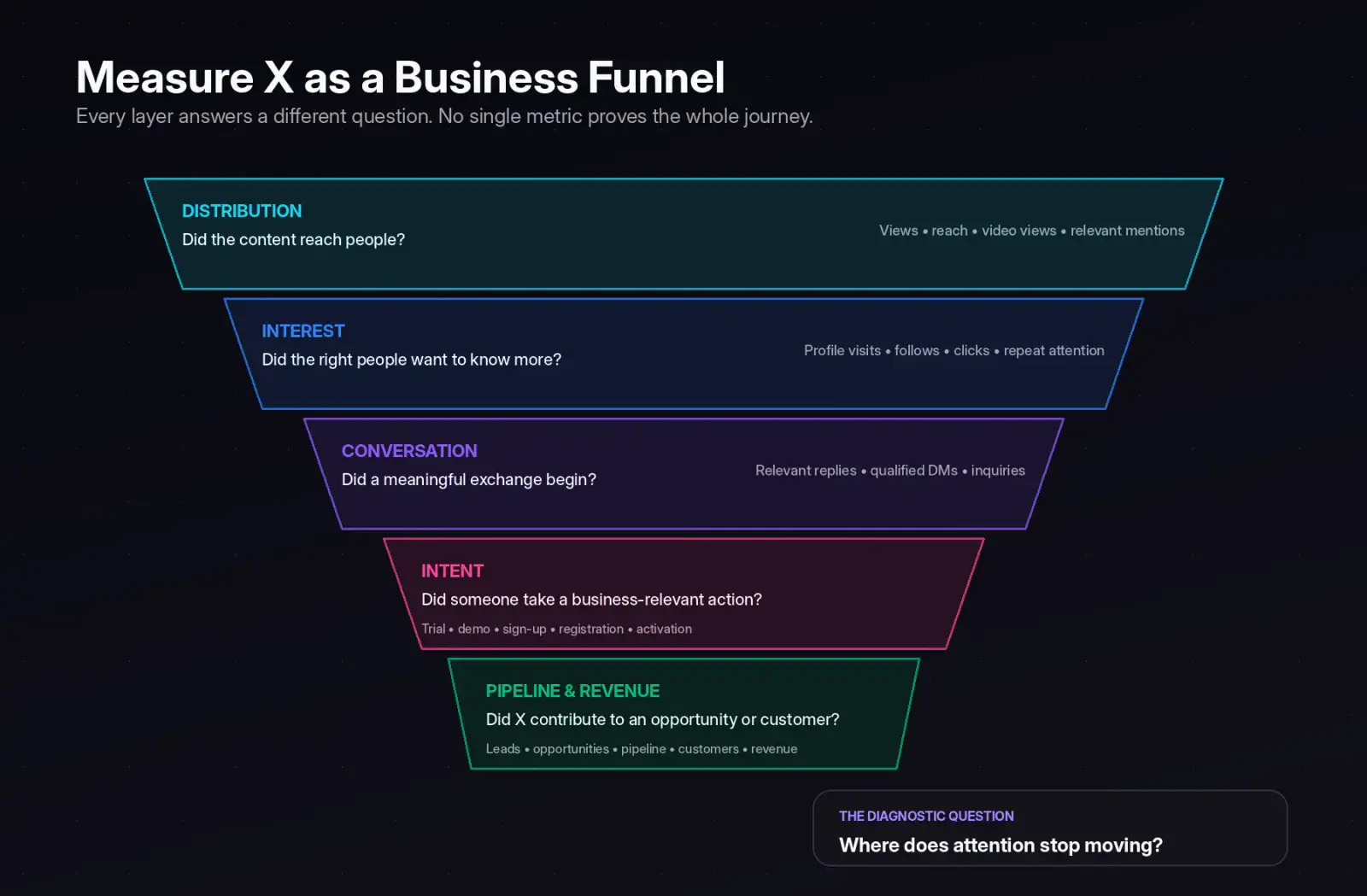
Stage 1: Qualified attention
Track:
- Impressions on relevant content.
- Reach among target accounts where observable.
- Relevant mentions and quote posts.
- Profile visits.
- New followers that fit the intended audience.
The word qualified matters. A post can travel widely among people who will never use, recommend, or influence the product.
Stage 2: Profile conversion
Track:
- Profile-visit rate.
- New follows per profile visit.
- Pinned-post engagement.
- Bio-link clicks.
- Visits to the linked landing page.
A low profile-visit rate may mean the post was entertaining but did not establish relevance. A strong profile-visit rate with weak follow or click activity may indicate a profile-positioning problem.
Stage 3: Website and owned-audience action
Track:
- X-sourced website sessions.
- Engaged sessions and key-page visits.
- Tool, report, or newsletter signups.
- Trial starts, demo requests, purchases, or applications.
- Assisted conversions from people who first encountered the company on X.
Use consistent UTM parameters so traffic from the profile, organic posts, employee posts, and paid campaigns can be separated.
A practical convention:
utm_source=x
utm_medium=organic-social | paid-social | founder | partner
utm_campaign=2026_q3_category_report
utm_content=post_topic_or_creative_id
The exact naming matters less than consistency.
Stage 4: Conversation
Track:
- Relevant public replies.
- Qualified DM conversations.
- Support questions and resolutions.
- Research interviews or customer insights created.
- Meetings or demos booked.
A conversation is not automatically commercial. Label the purpose: sales, partnership, support, research, recruiting, customer success, or community.
Stage 5: Pipeline and revenue
Track:
- X-sourced leads and opportunities.
- X-influenced opportunities.
- Pipeline value.
- Customers and revenue.
- Customer acquisition cost for paid activity.
- Return on ad spend where attribution is appropriate.
- Sales-cycle and win-rate differences for X-influenced opportunities.
Sourced, influenced, and assisted are different
A lead is X-sourced when X created the first attributable entry into the funnel.
An opportunity is X-influenced when meaningful X activity occurred during the buying journey—for example, the buyer repeatedly engaged with founder content or entered a product conversation after discovering the brand elsewhere.
A conversion may be X-assisted when X helped build trust but was not the first or last measurable touch.
Do not force all three into one number. Report them separately and document the rules.
Useful formulas
Profile-visit rate
Profile visits ÷ post impressions × 100Profile-to-follow rate
New followers ÷ profile visits × 100Outbound click-through rate
Link clicks ÷ impressions × 100Public-interaction-to-DM rate
Qualified DM conversations ÷ relevant public interactions × 100DM-to-meeting rate
Meetings booked ÷ qualified DM conversations × 100X session conversion rate
Conversions from X traffic ÷ X website sessions × 100Pipeline per 1,000 impressions
Attributed pipeline value ÷ impressions × 1,000Return on ad spend
Attributed revenue ÷ ad spendDo not chase universal benchmarks
Performance varies by audience size, content job, business model, offer, geography, account maturity, and how X reports the metric.
Use three comparisons:
- Your own baseline over time. Is the system improving?
- By content job. A proof post and a conversation post should not be judged by the same outcome.
- By audience quality. Did the right people respond or convert?
Use the right tool for the right data
Xholic’s free X Profile Analytics can estimate public cadence, content mix, visible engagement averages, and top public posts for your account or a competitor. It uses publicly visible signals and cannot see private impressions, private profile visits, link-click data, DMs, CRM opportunities, or revenue.
Use:
- Public-profile tools for visible benchmarking and competitor research.
- Native account analytics for private metrics available to the account owner.
- Website analytics for sessions and conversions.
- CRM data for leads, opportunities, pipeline, and revenue.
- X Ads measurement for campaign delivery and attributed paid conversions.
Manage team access, approvals, and risk
A business account needs governance because a fast public channel can create both opportunity and risk.
The objective is not to approve every comma. It is to let the team respond quickly within clear boundaries while escalating high-risk communication.
Define account roles
At minimum, name:
- Owner: controls recovery, security, and final accountability.
- Channel lead: owns the strategy, calendar, measurement, and weekly review.
- Publisher or contributor: creates and posts approved content.
- Community owner: monitors replies, mentions, and DMs.
- Subject-matter experts: supply technical, product, customer, or market context.
- Approvers: review specific categories such as legal claims, security incidents, pricing, or partnerships.
One person may hold several roles in a small company. The responsibilities should still be explicit.
Use risk-based approval lanes
Green: publish within guardrails
Examples:
- Educational posts based on approved positioning.
- Routine replies.
- Links to existing resources.
- Product tips.
- Questions and community participation.
These can usually be handled by the channel team without case-by-case executive approval.
Yellow: specialist or manager review
Examples:
- Customer claims or performance outcomes.
- Competitive comparisons.
- Roadmap statements.
- Pricing explanations.
- Sensitive support cases.
- Employee or partner announcements.
These need a defined reviewer and response window.
Red: formal escalation
Examples:
- Security or privacy incidents.
- Legal disputes.
- Regulatory claims.
- Public crises.
- Material company events.
- Statements that could affect customers, investors, or public safety.
Do not improvise these from the social team’s inbox. Maintain a crisis contact tree and approved holding-statement process.
Separate planned publishing from real-time participation
The planned lane covers:
- Campaigns.
- Product education.
- Research.
- Customer stories.
- Launches.
- Evergreen content.
The real-time lane covers:
- Replies.
- Support questions.
- Category news.
- Partner and customer moments.
- Time-sensitive clarification.
Both need guardrails, but only the planned lane should depend on a detailed calendar. If every reply must wait three days, the business loses the advantage of the platform.
Create a minimum operating document
Document:
- Account owner and recovery contacts.
- Access roles and removal process.
- Voice and positioning principles.
- Topics the account can address freely.
- Claims that need evidence or approval.
- Response and escalation windows.
- DM and lead-handoff process.
- Customer-support routing.
- UTM naming and CRM definitions.
- Crisis contacts.
- Monthly review owner.
Review access at least quarterly and whenever an employee, contractor, or agency relationship changes.
A practical 90-day X business plan
A 90-day test is long enough to build a baseline, find recurring audience signals, and run a few conversion experiments. It is short enough to maintain focus.
Do not change the primary objective every week. Improve the system while keeping the business question stable.
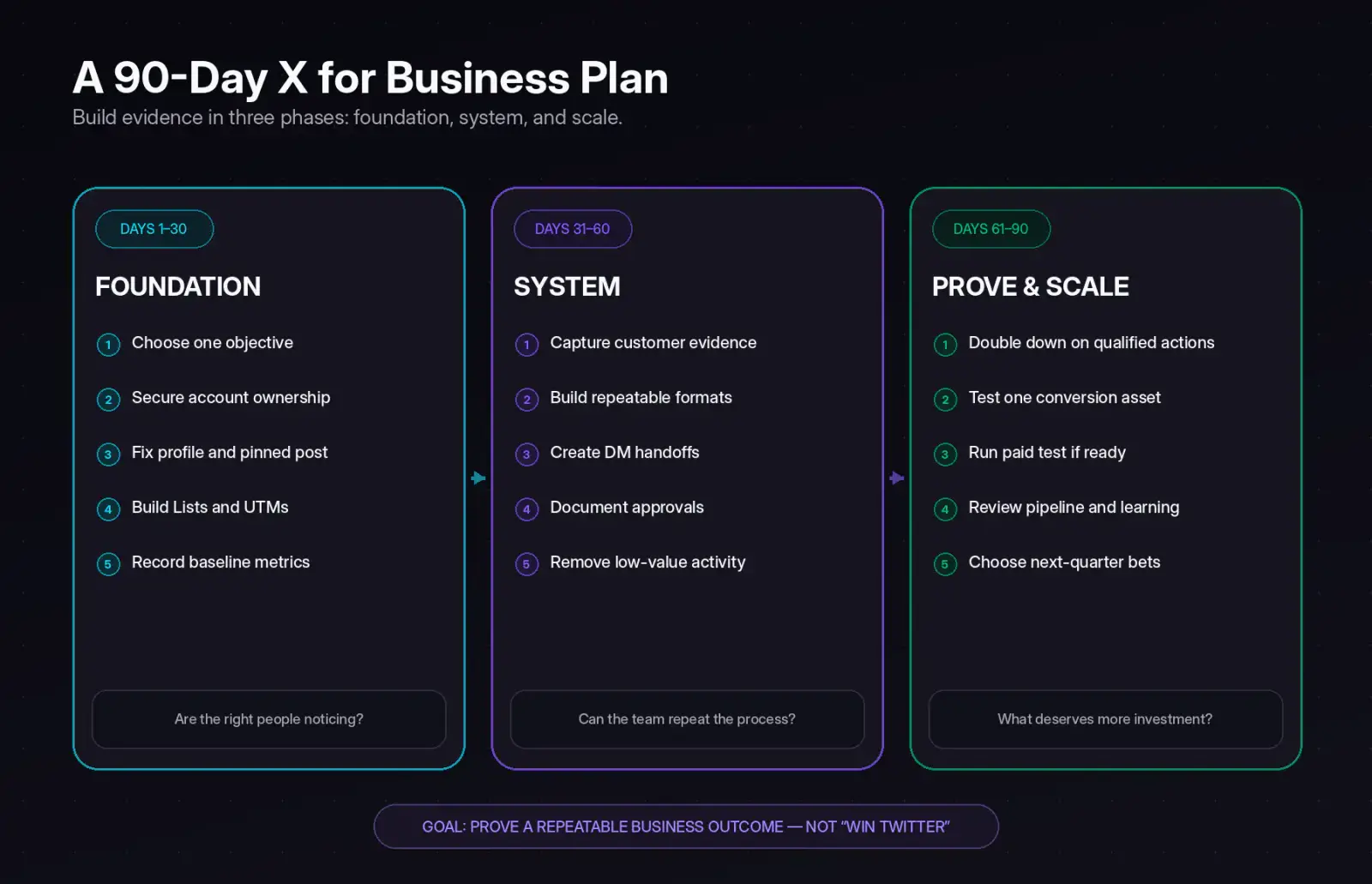
Days 1–30: Foundation and baseline
Week 1: Decide the strategy
- Complete the readiness score.
- Choose the primary business objective.
- Define the target audience and qualified actions.
- Choose founder-led, company-led, or hybrid architecture.
- Assign ownership and access roles.
Output: a one-page channel brief.
Week 2: Build the conversion-ready profile
- Complete the profile and Professional Account setup where appropriate.
- Improve the avatar, header, bio, and link.
- Create or update the pinned post.
- Add UTMs.
- Record baseline account, website, and CRM metrics.
Output: a profile that explains relevance, proof, and next action.
Week 3: Build the listening system
- Create private Lists.
- Define saved searches or monitoring terms.
- Identify 25–50 priority accounts.
- Create the signal-capture workflow.
- Begin the daily listening routine.
Output: a repeatable market-intelligence surface.
Week 4: Establish the first content portfolio
- Choose three to five content pillars.
- Map the Seven Jobs across the next 10–20 posts.
- Publish several formats.
- Reply where the team has genuine context.
- Review profile visits and conversation quality, not only impressions.
Output: the first performance baseline by content job.
Days 31–60: Build the operating system
Weeks 5–6: Find repeatable signals
Review:
- Which questions appear repeatedly?
- Which posts create qualified profile visits?
- Which replies lead to relevant conversations?
- Which claims need stronger evidence?
- Which audience segments respond?
- Where does the profile lose intent?
Turn the findings into two or three repeatable series, such as:
- Weekly customer problem breakdown.
- Product lesson from the build.
- Category myth with evidence.
- Customer workflow or use case.
- “What we learned this week” founder post.
Weeks 7–8: Strengthen proof and conversion
- Publish customer evidence with permission.
- Create one useful downloadable or interactive asset.
- Improve the pinned post based on observed intent.
- Test one clear CTA at a time.
- Implement the DM Permission Ladder.
- Add CRM labels for sourced and influenced activity.
Output: a stronger evidence layer and measurable conversion path.
Days 61–90: Test scale and make a decision
Weeks 9–10: Run focused experiments
Examples:
- Two hooks for the same educational idea.
- A product demo versus customer-result proof.
- Founder-led versus company-led distribution.
- A free tool versus a general homepage link.
- A public reply-to-resource path versus a direct CTA.
Change one meaningful variable at a time.
Weeks 11–12: Consider paid amplification
Only when the offer and measurement are ready:
- Select several relevant creatives.
- Choose the objective from the business action.
- Verify conversion tracking.
- Run a bounded test.
- Compare audience quality and downstream conversion, not just click cost.
Week 13: Conduct the decision review
Answer:
- Is the target audience demonstrably present?
- Did the business find a repeatable point of view or content series?
- Did X create qualified attention, insight, conversations, support value, pipeline, or another intended outcome?
- Where did the funnel leak?
- Which inputs created the strongest evidence?
- What should be stopped, maintained, or scaled next quarter?
The decision can be:
- Scale: the channel has demonstrated strategic and commercial value.
- Continue the experiment: useful signals exist, but the system needs another focused cycle.
- Narrow the use case: use X for listening, support, recruitment, or founder authority rather than broad marketing.
- Deprioritize: another channel has stronger audience presence or economics.
A disciplined “not now” is better than years of low-value activity.
How the strategy changes by business model
The core system is consistent, but the audience, evidence, content, and conversion path should change by business model.
| Business model | Strong primary use | Account architecture | Best proof | Sensible next step |
|---|---|---|---|---|
| Early-stage B2B SaaS | Founder authority, customer discovery, demand generation | Hybrid, with founder leading conversation | Product artifacts, customer workflows, build lessons | Free tool, trial, or contextual demo |
| Established B2B company | Category authority, product education, pipeline influence | Company-led hybrid with subject-matter experts | Research, customer outcomes, implementation expertise | Report, event, demo, or solution page |
| Developer tool | Technical education, community, product feedback | Hybrid with engineers and developer advocates | Code, benchmarks, architecture, reproducible examples | Documentation, repository, sandbox, or trial |
| Ecommerce or consumer brand | Product discovery, community, launches, support | Company-led with creator/customer participation | Demonstrations, customer content, comparisons | Product page, offer, waitlist, or support path |
| Local or service business | Trust, reputation, local relevance, expertise | Owner-led or hybrid | Results, process, local proof, customer stories | Booking, consultation, call, or location page |
| Agency or consultancy | Expertise, relationships, lead generation | Expert-led with company proof layer | Teardowns, frameworks, client outcomes | Audit, guide, or qualified conversation |
| Media or research company | Distribution, source development, authority | Company-led with visible journalists or analysts | Original reporting, data, methodology | Subscription, report, event, or newsletter |
A B2B SaaS example
A weak SaaS account publishes feature announcements and generic productivity tips.
A stronger system:
- Listens to buyers and operators discussing the problem.
- Turns repeated objections into educational posts.
- Shows the product solving a specific workflow.
- Lets the founder explain why the product makes a trade-off.
- Uses customer evidence to reduce risk.
- Offers a trial or demo only after relevance is clear.
- Tracks the path from profile visit to product activation and pipeline.
A local-business example
A local service business does not need to become a global thought leader.
It can:
- Answer local questions.
- Explain how to evaluate the service.
- Show process and proof.
- Participate in local events and conversations.
- Make booking information obvious.
- Use the owner’s account to build personal trust.
The audience may be smaller, but the commercial value per relevant local interaction can be high.
Where Xholic fits in the workflow
Tools should improve the system without replacing judgment, evidence, or human review.
Xholic is designed as a contextual growth workspace for X. Its Brain can learn from a user’s voice, audience, saved posts, product context, niche, watched creators, and feedback, then use that context when suggesting replies, post ideas, remixes, and opportunities.
For a business team, useful applications include:
- Generating contextual reply options inside X, then reviewing and refining them.
- Turning market signals and saved posts into content angles.
- Maintaining product or company context so suggestions are less generic.
- Searching an inspiration library for formats and patterns to adapt—not copy.
- Analyzing a post with X-Ray or remixing a structure into the company’s own evidence.
- Scheduling approved posts and maintaining a consistent workflow.
- Using feedback to improve future suggestions.
The human-in-the-loop rule remains essential:
- Verify claims.
- Add internal evidence.
- Remove generic language.
- Respect account and platform policies.
- Review tone in sensitive conversations.
- Never automate unsolicited outreach or unreviewed public statements.
Generic AI can produce words. A business content system must supply context, judgment, evidence, ownership, and a measurable purpose.
Explore Xholic when the team is ready to turn this strategy into a repeatable operating workflow.
Common mistakes businesses make on X
1. Treating the account like a press-release feed
People rarely follow a company to receive a stream of self-congratulation. Explain what changed for the customer, what was learned, and why the announcement matters.
2. Copying the same content to every platform
Repurpose ideas, not formatting habits. Re-edit for X’s conversational and real-time context.
3. Giving the founder and company account the same job
Duplicate publishing creates internal competition and audience fatigue. Define distinct editorial roles.
4. Optimizing for impressions without checking audience quality
Broad reach can hide weak relevance. Review who visited, replied, clicked, signed up, or entered the funnel.
5. Promoting before building proof
A CTA without education, evidence, or context feels like an interruption. Earn the next step.
6. Running ads without a measurable conversion path
Paid traffic cannot compensate for an unclear landing page or missing event tracking.
7. Treating X’s DM limit as an outreach quota
Technical capacity is not permission. Bulk and duplicate unsolicited messages can be treated as spam and damage the account.
8. Sharing the main password
Use delegated and multi-user access. Remove access as soon as responsibilities change.
9. Leaving the pinned post stale
The pinned post should reflect the current audience, offer, proof, and campaign—not company history alone.
10. Reporting public-profile estimates as private analytics
Public tools cannot see private impressions, profile visits, link clicks, DMs, CRM activity, or revenue. Label sources and limitations.
11. Creating content without an evidence pipeline
Generic content is often a symptom of generic inputs. Bring customer language, product artifacts, internal expertise, and real outcomes into the process.
12. Automating away the part that builds trust
Drafting, organizing, and monitoring can be assisted. Judgment, sensitive replies, qualification, claims, and relationship-building should remain human-led.
13. Changing strategy after every post
A single post is noisy data. Review patterns across content jobs, audiences, and funnel transitions over a meaningful period.
14. Never deciding what X is for
An account trying to be a media brand, support desk, sales rep, founder diary, hiring page, and product feed at once usually performs none of those jobs clearly. Choose a primary objective.
Frequently asked questions
Is X still good for business in 2026?
X can be valuable when customers, practitioners, partners, media, or category influencers are active there and the business can contribute expertise consistently. It is not automatically a priority for every company. Use the readiness score and a focused 90-day test rather than assuming the platform is mandatory.
Is an X business account free?
Creating a standard X account and converting an eligible existing account to a Professional Account are free. X Premium and X Premium Business are separate paid subscriptions. Advertising also has separate eligibility, billing, and campaign costs.
What is the difference between a Professional Account and X Premium Business?
A Professional Account is a free conversion that can provide professional categories, Professional Home, profile spotlights, and access to professional tools. X Premium Business is a paid organizational product with features such as a gold checkmark, business support, and—on eligible tiers—affiliations and other organization tools.
Should a founder use a personal account or a company account?
Most founder-led businesses should use both. The founder account builds trust through perspective and experience; the company account provides product clarity, proof, official information, support, and durable ownership. Give the accounts different jobs rather than duplicating every post.
Does a business need verification?
Not every organic experiment requires paid verification. Verification becomes more important when the company plans to advertise, faces meaningful impersonation risk, needs organizational affiliations, or depends on X for official communication. X currently requires advertiser accounts to be verified through an eligible program.
Can multiple team members manage one X account?
Yes. X Delegate provides owner, admin, and contributor roles for account activity, and X Ads supports multi-user access for advertising. Use role-based access instead of sharing the main password.
How often should a business post on X?
There is no universal cadence. Choose a frequency the team can sustain while maintaining quality, replies, and measurement. A smaller number of specific, evidence-rich posts plus consistent participation can outperform a high-volume schedule of generic content.
What should a business post on X?
A balanced portfolio can attract, educate, differentiate, prove, converse, convert, and retain. The exact mix depends on the primary objective. Strong inputs include customer questions, product decisions, internal expertise, research, use cases, and category observations.
What is the best time to post on X?
The best time depends on the audience’s location, work patterns, and behavior. Start with times when the target audience is likely to be active, then compare your own profile visits, relevant replies, clicks, and conversions by time window. Public timing tools can estimate patterns, but your account’s private data and downstream outcomes are more useful.
Do hashtags help businesses on X?
Hashtags can help when they are genuinely relevant to an event, community, campaign, or topic. Forced or excessive hashtags reduce clarity and can appear spammy. Write for the intended reader first.
Can X DMs generate leads?
Yes, especially when a DM continues a relevant public exchange or responds to a clear signal of interest. Ask permission, preserve context, qualify briefly, and offer a proportionate next step. Avoid bulk, duplicate, or unsolicited sequences.
How do you measure ROI from X?
Connect X activity to profile visits, website sessions, conversions, qualified conversations, opportunities, pipeline, revenue, support outcomes, or another defined objective. Use UTMs, website analytics, native data, and CRM fields. Report sourced, influenced, and assisted outcomes separately.
Is X better for B2B or B2C businesses?
X is often strong for B2B and expertise-driven markets because professionals discuss tools, decisions, and industry changes publicly. B2C businesses can also succeed when the audience, community, product culture, entertainment value, or support need is present. Audience fit matters more than the B2B/B2C label.
How long does it take to see business results from X?
Some conversations and referrals can happen quickly, but a serious evaluation should usually run for roughly 90 days. That gives the team time to build a profile, establish a baseline, learn audience language, test content portfolios, and observe downstream actions. Results are not guaranteed and depend on channel fit and execution.
Should a business reply to every mention?
No. Prioritize customer questions, support needs, meaningful feedback, relevant category conversations, and legitimate relationship opportunities. Acknowledging positive mentions is useful, but forced replies to every interaction can lower quality and overwhelm the team.
Can AI write a company’s X content?
AI can help draft, organize, research, and adapt content, but the business should supply the point of view, evidence, product context, and final judgment. Human review is especially important for claims, customer conversations, sensitive topics, and anything that could affect trust or compliance.
When the channel strategy is clear, use the X Monetization Calculator to model services, sponsorships, affiliates, digital products, memberships, and subscriptions with explicit cost and conversion assumptions.
Final takeaway
The companies that get durable value from X do not merely post more. They build a system that connects market understanding to public expertise and public expertise to a measurable next step.
Start with the order of operations:
- Prove that the audience and conversations are present.
- Choose the founder, company, or hybrid account structure.
- Set up ownership, security, positioning, proof, and measurement.
- Choose one primary business objective.
- Build content from customer, product, and market evidence.
- Participate through valuable replies and structured listening.
- Move to DMs only when context and permission exist.
- Use paid distribution when the offer and measurement system are ready.
- Track funnel transitions, audience quality, and business outcomes.
- Review the system after 90 days and decide what to scale.
When those parts work together, X stops being another feed to maintain. It becomes a source of customer intelligence, authority, relationships, distribution, and growth.
Free resources for implementing this guide
- Open the free X Business Readiness Scorecard and KPI Workbook
- Run a free X Profile Audit
- Analyze visible public profile performance
- Optimize your Twitter profile
- Build a stronger pinned-post strategy
- Create an X sales funnel
- Use X for lead generation
- Increase Twitter engagement
- Learn how to make money on X
Methodology and fact-check note
This guide combines Xholic’s editorial frameworks with facts checked against official X and X Business documentation on July 30, 2026. Platform features, subscription tiers, prices, analytics availability, ad eligibility, and policies can change. Recheck the linked official documentation before making a purchase, launching a campaign, or designing a compliance-sensitive workflow.
Primary platform references: