Most advice about a Twitter sales funnel starts in the wrong place. It tells you to post more, chase impressions, and “engage with your audience,” then acts surprised when the pipeline stays thin. A funnel only works when each step moves the right person forward, from discovery to conversation to a tracked action you can measure.
Stop Chasing Impressions Build a System That Sells
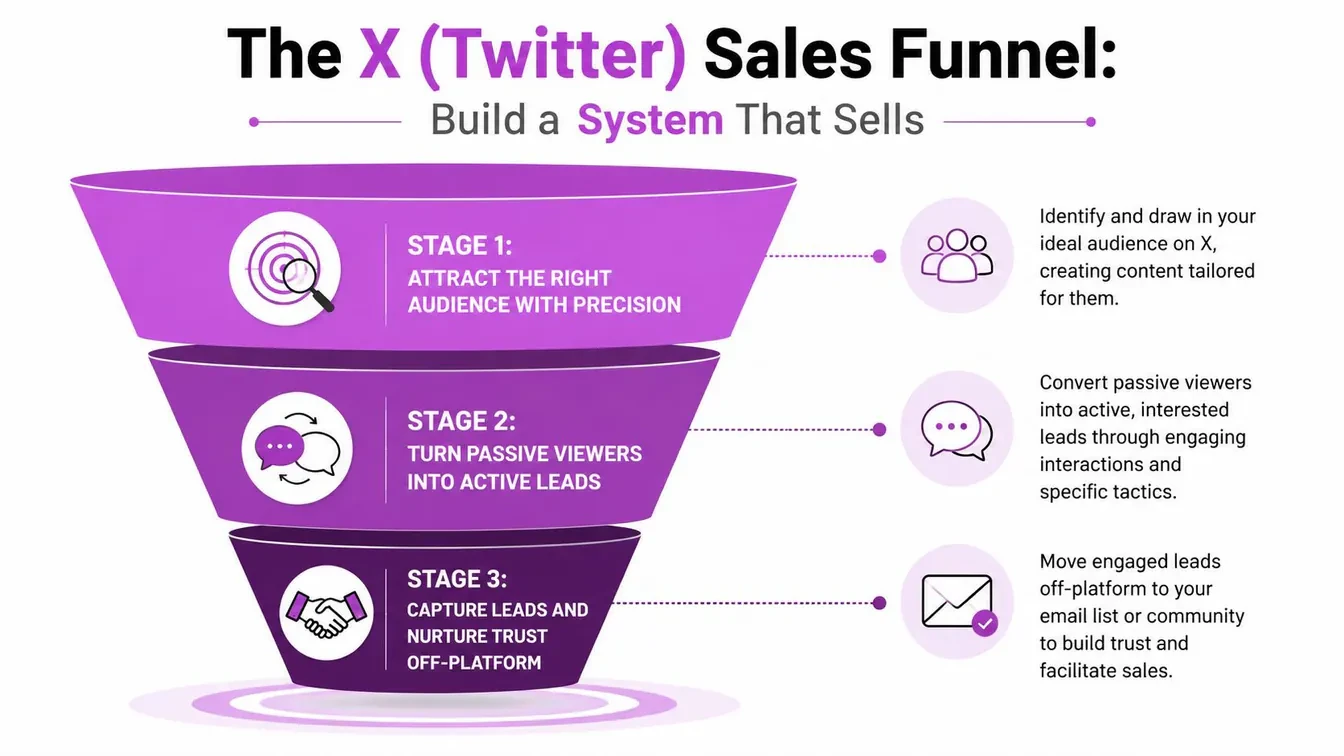
A twitter sales funnel is a system, not a stream of posts. It moves the right people through clear stages, from seeing you, to trusting you, to taking a tracked action. That distinction is critical: most traffic from X fails to convert, even though product-review tweets can lift conversion rates to 6.46%, compared with the platform baseline of 0.77% BlogPros analysis.
The common mistake is optimizing a single metric in isolation. More impressions can look impressive while the funnel leaks at profile visits, site clicks, or onboarding. X works like a storefront, not a billboard. Billboards create awareness. Storefronts create motion.
Practical rule: measure the handoff between stages, not just the size of the crowd.
Twitter’s own sales-funnel guidance centers on awareness, consideration, and action, and recommends Website Cards, website tags, and urgency-based messaging to move people farther down the funnel Twitter sales-funnel guide. If you are mapping the top of the funnel, lead generation on X is a useful adjacent resource because it keeps the focus on qualified leads instead of vanity reach.
For a closer look at why visibility does not automatically become business value, the post on what impressions actually mean on Twitter is worth skimming. The main idea is simple. Build for flow, not for noise. When you treat X as a measurable sales path, you stop asking, “How did this post perform?” and start asking, “Where did this prospect drop off?”
Stage 1 Attract the Right Audience with Precision

The first stage isn’t about reach, it’s about relevance over reach. A successful funnel may have lower engagement but higher downstream conversion if it filters hard through niche replies and product-aware content eClincher guide. That’s the right trade-off for founders, because broad attention from people who will never buy just creates more work.
Start where your buyers already talk
Look for the conversations your ideal customers already follow. If you sell to founders, track founder pain points. If you sell to marketers, watch for posts about content bottlenecks, attribution, or planning. The goal is to join a live discussion with something useful to say, not to drop a generic promo line into the feed.
A good starting workflow looks like this:
- Identify recurring pains: scan replies, quote posts, and complaint threads in your niche.
- Collect repeat phrasing: note how people describe the problem in their own words.
- Match content to intent: publish posts that answer the problem, not just celebrate the outcome.
- Study proven formats: look for hooks, openings, and structures that already work in your category.
If you don’t want to do that manually every day, Xholic’s Reply Deck can surface conversations worth joining, and the Inspiration Library can help you study successful posts without copying them. The useful part isn’t the raw volume of tweets, it’s the ability to spot patterns you can adapt to your own niche and voice.
For profile-level alignment, the Twitter profile optimization guide helps you make sure people who click through immediately understand what you do and who it’s for. That matters because stage one doesn’t end at the post, it ends when the right person decides you’re worth a profile visit.
Write for people who are already problem-aware
Problem-aware content works better than vague thought leadership. Instead of “How I grew on X,” write the post your buyer wishes existed. Lead with the pain, then show a concrete angle, example, or workflow. That’s what creates curiosity without sounding like a pitch.
The best attract content doesn’t try to impress everyone. It tries to be instantly useful to the people already looking for the answer.
Use this stage to filter, not to flatter the algorithm. If a post attracts the wrong crowd, it’s not a funnel asset. It’s just reach.
Stage 2 Turn Passive Viewers into Active Leads
The shift from audience to lead usually happens in the reply box, not in the feed. A lot of accounts miss this because they treat replies as filler engagement. In practice, replies are where you prove judgment, create context, and earn the right to continue the conversation privately.

From generic reply to conversation starter
A low-value reply sounds like this, “Great post,” or “Love this.” It doesn’t move the discussion anywhere. A high-value reply adds a useful angle, names a trade-off, or asks a question that shows you understand the problem.
That’s where a tool like Xholic can help if you’re trying to stay consistent without sounding canned. Its personalized AI replies use the context in Xholic Brain, so the reply is shaped by your voice, niche, product context, and prior feedback instead of a blank prompt. Users still review and edit everything, which keeps the workflow human-in-the-loop.
Here’s the difference in practice:
- Weak: a generic compliment that disappears into the thread.
- Better: a short response that adds a practical constraint, example, or counterpoint.
- Best: a reply that creates a natural next step, like a question, DM, or resource share.
A common funnel mechanic is to make the tweet interactive by asking for a comment, then using that engagement to trigger a DM follow-up. One framework recommends pinning a high-value tweet, asking for comments, and then sending a resource link via DMs to move interested users to a landing page video framework.
If you’re trying to shape the public-to-private handoff, the guide for choosing a link in bio is a good companion read because it helps you avoid sending people to a dead-end destination.
Why the public interaction matters
A reply can do three jobs at once. It can show expertise, create familiarity, and signal whether the person is worth following up with. When someone comments, bookmarks, or replies again, they’re telling you they’re warmer than a passive viewer.
The Twitter thread strategy guide is useful here if your reply work is meant to feed longer-form content. A strong thread can carry a problem forward, then make the next step feel like a natural continuation instead of a hard sell.
Stage 3 Capture Leads and Nurture Trust Off-Platform
Once someone is interested, don’t leave the relationship trapped on X. You want a controlled place to continue the conversation, usually email, a waitlist, or a community. That’s where lead capture matters, because X is an attention layer, not a durable ownership layer.

Make the offer feel like the next logical step
The best lead magnet is specific and immediately useful. Checklists, templates, short videos, and simple calculators usually work because they reduce effort. The point isn’t to create a huge asset. It’s to give someone a reason to keep going.
Progressive disclosure is the most impactful part of the funnel. Experts recommend exposing only 20–30% of a solution publicly, then moving people from content to a bio link, to a waitlist, and then to purchase, and that sequence can produce 3–5x higher conversion rates progressive disclosure guide. Use that as a filter, not as a gimmick. If the public post already gives away the whole answer, there’s no reason to opt in.
Your landing page should continue the same idea the tweet introduced. No sudden repositioning, no surprise promise, no wall of copy that forgets the original problem. Keep the language consistent, show the asset early, and make the call to action obvious.
Save what works and remix it
This stage gets easier when you build a library of winning lead-gen posts and landing page angles. Xholic’s Collections can store strong examples, and Tweet Remixer can adapt the underlying structure to your own offer without cloning the original post. That’s especially helpful when you want to keep the same conversion logic but change the audience, tone, or product angle.
A simple nurture sequence should do two things fast. It should deliver the promised asset immediately, and it should tell the lead what happens next. If people don’t understand what they’ll get from the next email or message, they disengage.
Practical rule: the opt-in is not the finish line. It’s the start of trust-building.
Keep the early follow-up short, useful, and relevant to the original post. That’s how a public interaction turns into a private buying conversation without feeling forced.
Stage 4 Drive Conversions and Measure What Matters
Conversion usually breaks in one of two places. The offer is vague, or the tracking is too thin to show where interest drops. Keep the path visible from the start. If you want a cleaner way to read stage-by-stage performance, the Twitter analytics guide is a useful reference for comparing clicks, visits, and outcomes without getting stuck on vanity metrics.
Track the whole path, not the last click
The cleanest funnel measurement starts with milestones. Profile visits show whether the post created curiosity. Link clicks show whether the profile or tweet made the next step obvious. Sign-ups, trials, and sales show whether the offer matched intent.
If you do not tag the path with UTMs or source-specific landing pages, attribution gets muddy fast. You cannot scale what you cannot identify. A practical X sales funnel needs the tweet ID, the landing page, and the outcome tied together in one reporting view.
Read the numbers stage by stage. A strong top-of-funnel post that drives visits but no clicks points to a weak profile or pinned post. Clicks without sign-ups point to a mismatch between the promise and the landing page. Sign-ups without purchases usually mean the offer or onboarding still leaves too much doubt.
Use proof, then repeat the proven format
At the bottom of the funnel, proof carries the weight. Product walkthroughs, customer screenshots, and specific use cases tend to beat vague claims because they show the product in use. The same applies to posting cadence. A three-stage rhythm with a daily offer post, a weekly thread, and reply-based follow-up keeps the funnel active without turning the account into a billboard.
If consistency is your weak point, Xholic’s Smart Scheduler can keep approved posts moving on a calendar, and its scheduling tools can help you reuse successful content without rebuilding each campaign by hand. That matters when the bottleneck is execution discipline, not ideas.
The key diagnostic question is simple. Which stage leaks first? If posts create profile visits but few site clicks, the profile or pinned content is weak. If site visits happen but trials stall, the landing page or offer is off. If people start onboarding but stop at billing, trust and expectation setting need work.
A funnel only becomes a system when each step is visible. Without that, you are just posting and hoping.
Your Twitter Sales Funnel Checklist
- Define the buyer clearly: write down who you want, what they’re already trying to solve, and what language they use on X.
- Map discovery signals: identify the creators, threads, and reply patterns where your ideal buyer already shows intent.
- Optimize the profile: make the bio, pinned post, and recent tweets explain who you help and why you’re relevant.
- Create problem-first posts: lead with pain, then show a concrete workflow, example, or contrast.
- Use replies as a bridge: answer thoughtfully, add context, and invite a next step when the conversation is warm.
- Add a comment or DM trigger: make at least one post interactive so interested people can raise their hand.
- Build a lead magnet: choose one useful asset that continues the post’s promise.
- Keep the landing page aligned: match the post’s message, tone, and promise on the page.
- Capture attribution: use UTMs, source pages, or tweet IDs so you can tell what converted.
- Review stage-by-stage metrics: compare profile visits, clicks, sign-ups, and sales, not just likes.
- Save winning assets: organize strong posts and angles so you can remix them later.
- Maintain a schedule: keep the funnel alive with consistent posts and follow-up.
For the acquisition work that feeds this funnel, use the practical guide to Twitter lead generation. Once the conversion assumptions are defined, test the commercial model with the X Monetization Calculator.
Frequently Asked Questions
How do you accurately track conversions from X?
Use UTM parameters, dedicated landing pages, and a simple reporting path from post to conversion. If you send different tweets to the same page, tag each one separately so you can see which post created the visit and which one produced the signup or sale. Without that, you’re guessing.
Should I use paid X ads in my funnel?
Yes, but only after a post or angle has already shown demand. A practical playbook recommends promoting organic content that already proved it can draw meaningful attention, then retargeting people who engaged with it. That keeps paid spend focused on warmer users instead of cold traffic.
What are the biggest funnel-killing mistakes to avoid?
The biggest ones are rushing the hard sell, ignoring follow-up, and optimizing for vanity metrics. If you chase impressions without a clear handoff, you create noise. If you collect leads without a nurture path, you waste attention. If you measure likes instead of pipeline movement, you won’t know what to fix.
If you want a workflow that remembers your context, surfaces better conversations, and helps you move from replies to qualified demand without living in the feed, try Xholic AI.