

Sebastian Raschka (@rasbt) X analytics
@rasbt
ML/AI research engineer. Ex stats professor. Author of "Build a Large Language Model From Scratch" (https://t.co/O8LAAMRzzW) & reasoning (https://t.co/5TueQKx2Fk)
@rasbt has 528.9K followers, a median of 47.3K views per post and a 1.80% engagement rate.
Based on 17 recent original posts (medium confidence). Updated October 21, 2026.
At a glance
Key stats
- Followers
- 528.9K528,864 followers on October 21, 2026
- Median views per post
- 47.3K
- Average views per post
- 69.2K
- Engagement rate (by views)
- 1.80%
- Original posts per week
- 2.9
- Average engagements per post
- 1,246
Engagement grade
Strong
This is above the baseline for accounts with 100K-1M followers.
Profile score
83/100
- Profile completeness100
- Audience shape100
- Engagement25
- Consistency91
- Positioning clarity100
Monetization
Estimated X creator earnings
$3–$7 in the last 30 days
From 566K views on @rasbt's original posts in the last 30 days.
Rewards eligibility: likely
Rough estimate. X publishes no payout rate, so this assumes about $5–12 per 1M original-post impressions from reported creator payouts. Only Premium viewers’ impressions count, so real payouts can be much lower.
Free report
How does your account compare with @rasbt?
Get the same report for your own account by email: engagement grade, median views, best times to post and estimated earnings.
Growth
Follower growth
Tracked by Xholic since October 16, 2026.
| Date | Followers | Change |
|---|---|---|
| Oct 21, 2026 | 528,864 | +1,426 |
| Oct 18, 2026 | 527,438 | +324 |
| Oct 16, 2026 | 527,114 | – |
Timing
Best times to post
When @rasbt's recent posts performed best (UTC).
- #1 slot
8:07 PM
Monday · UTC
- #2 slot
8:18 PM
Tuesday · UTC
- #3 slot
7:23 PM
Wednesday · UTC
What worked
Top recent posts
- 01

@rasbt ·
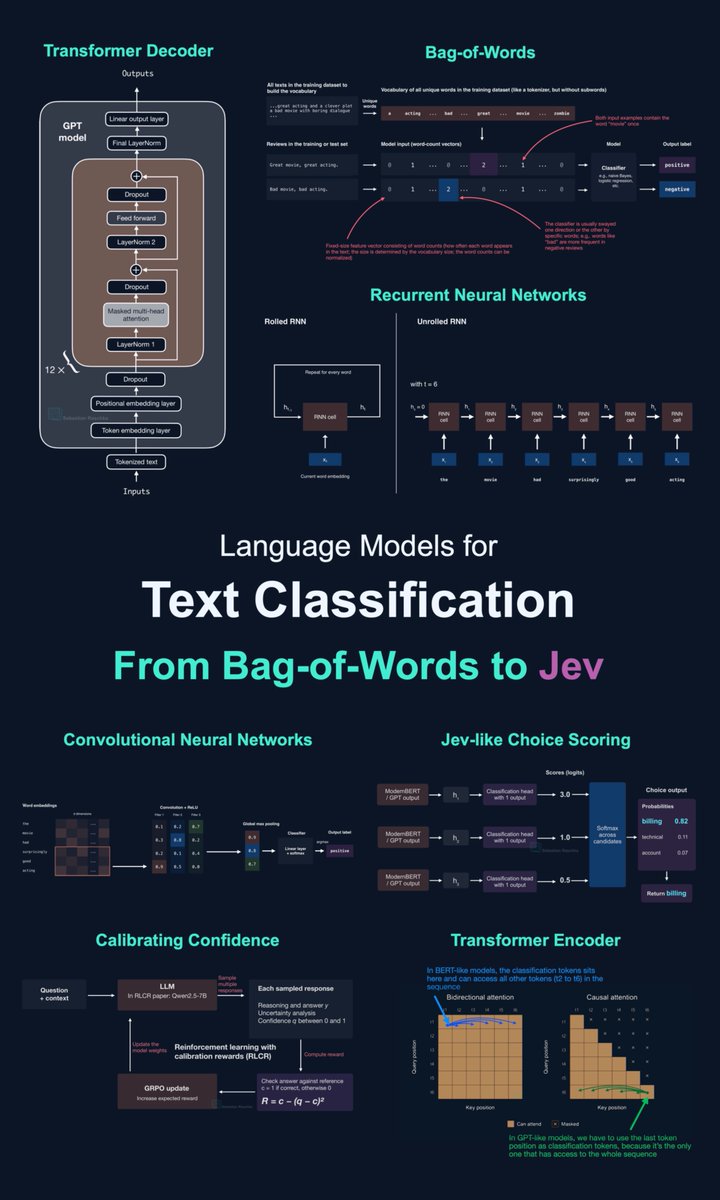
Took a while, but here it is, a mega write-up on language models for text classification and, of course, Jev. It's basically a visual guide to RNNs, CNNs, transformers, and calibration, with hands-on experiments on accuracy and efficiency.
- 78Replies
- 324Reposts
- 2.4KLikes
- 115.9KViews
2.8x average engagementHas an imageLong post (over 200 characters)Posted Tue 13:00 UTC - 02
@rasbt ·
Reasoning from scratch, round number 6! An introduction (and implementation) of Reinforcement Learning with Verifiable Rewards (RLVR) and Group Relative Policy Optimization (GRPO). 00:00 Introduction 01:54 What makes a reasoning model different? 04:25 Reasoning traces and model capability 08:29 Accuracy and format rewards 11:34 Aha moments and DeepSeek-R1 training 14:41 Reasoning effort and answer length 18:38 RLHF and RLVR 23:04 GRPO vs. PPO 26:40 GRPO explained with a cooking analogy 31:43 The KL term and simplified GRPO 35:04 Loading the pretrained model 36:07 Loading the MATH training data 39:26 Sampling model responses 46:30 Computing verifiable rewards 49:55 Computing advantages 51:54 Token and sequence log probabilities 55:29 Implementing sequence log probabilities 57:37 Fixing the inference-mode error 1:02:24 Computing the GRPO loss 1:04:37 Putting the GRPO step together 1:09:19 The GRPO training loop 1:12:57 Training settings, logging, and checkpoints 1:17:24 Running training and inspecting outputs 1:19:28 Loading and evaluating checkpoints 1:22:33 MATH-500 results and training stability 1:24:05 Memory requirements and next steps
 Watch video
- 82Replies
- 199Reposts
- 1.6KLikes
- 74.2KViews
2.0x average engagementHas a videoLong post (over 200 characters)Posted Sat 13:00 UTC - 03
@rasbt ·
It’s easy to dismiss Jev it as “just a classifier”. But people (me included) who have been training encoder-style models for classification for many years know they were usually special-purpose and limited in some way. The breakthrough of Jev is that it generalizes well. And I’d say the secret sauce is probably more in the data than in the training algorithm. (Plus a nice API design on top of it.)
- 135Replies
- 205Reposts
- 2.2KLikes
- 241.2KViews
1.8x average engagementText onlyLong post (over 200 characters)Posted Sun 13:00 UTCQuote post - 04
@rasbt ·
Big overhaul on DeepSeek V4.1 using an encoder-decoder setup. Tbh they should have called it DeepSeek V5! Super cool and refreshing, though!

- 70Replies
- 235Reposts
- 2.4KLikes
- 115.7KViews
1.6x average engagementHas an imageMedium length (100-200 characters)Posted Thu 20:00 UTCQuote post - 05
@rasbt ·
Reasoning From Scratch: Reinforcement Learning with Verifiable Rewards (RLVR) round 2. Covering clipped policy ratios, KL loss term, format rewards, and other GRPO tips & tricks. 00:00 Introduction and recap 01:52 Interpreting basic GRPO training metrics 06:34 Planned improvements to GRPO 08:58 Running longer training jobs with Python scripts 13:39 Running the baseline GRPO training script 17:29 Loading and plotting training logs 19:29 Diagnosing unstable training 23:55 Evaluating checkpoints on MATH-500 26:26 Downloading existing checkpoints 30:09 Tracking advantage statistics 34:53 Understanding entropy 40:32 Computing entropy in PyTorch 44:17 Interpreting entropy values 48:58 Adding entropy tracking to GRPO 53:36 Analyzing advantage and entropy metrics 56:18 Stabilizing GRPO with clipped policy ratios 1:03:27 Implementing the clipped policy loss 1:09:39 Analyzing clipped policy training results 1:11:25 KL divergence and reward hacking 1:15:12 Adding a KL loss term 1:20:34 Limitations of the simplified KL loss 1:23:04 Format rewards and think tags 1:25:47 Adding special tokens to the tokenizer 1:30:29 Implementing the format reward 1:35:56 Analyzing format reward training 1:38:25 Rewarding format only for correct answers 1:40:48 Further GRPO improvements from research 1:45:43 Next steps and distillation
 Watch video
- 80Replies
- 138Reposts
- 1.2KLikes
- 57.2KViews
1.5x average engagementHas a videoLong post (over 200 characters)Posted Sat 13:00 UTC - 06
@rasbt ·
Reasoning from scratch, round number 5! This time, talking about log-probability scoring (also a great fundamental concept for loss functions like cross-entropy in pre-training and distillation) and self-refinement. 00:00 Introduction and inference-time scaling recap 05:02 Loading the pretrained LLM 08:00 Comparing and scoring model answers 10:18 Building a rule-based scorer 17:53 Token probabilities and sequence likelihood 26:47 Computing token probabilities in PyTorch 30:12 Token indexing and shifted targets 37:27 Log probabilities and numerical stability 45:57 Scoring answers with average log probabilities 56:24 How self-refinement works 59:07 Generating critiques and revised answers 1:01:00 Implementing the self-refinement loop 1:05:57 MATH-500 evaluation results 1:07:35 Takeaways and next steps
 Watch video
- 43Replies
- 130Reposts
- 1KLikes
- 59.6KViews
1.2x average engagementHas a videoLong post (over 200 characters)Posted Sat 13:00 UTC
Latest
Recent posts by Sebastian Raschka
The latest 17 original posts from @rasbt, newest first, as of October 21, 2026. Replies and reposts aren't included.
@rasbt ·
Reasoning From Scratch round 8, the finale! This last lecture in the series covers distillation as an efficient alternative to the previous reinforcement learning training runs. (Planning to take a brief break, but I will be back!) 00:00 Introduction and series recap 01:07 Why distill a reasoning model? 02:51 Soft vs. hard distillation 11:06 On-policy vs. off-policy distillation 18:09 Preparing data for reasoning distillation 22:35 Loading the DeepSeek R1 MATH dataset 28:04 Inspecting reasoning traces and final answers 31:27 Tokenization and chat templates 35:58 Pre-tokenizing the training dataset 39:01 Sequence lengths and the 2,048-token limit 42:38 Creating training and validation splits 45:32 Loading the Qwen3-0.6B base model 46:24 Computing answer-token log probabilities 54:10 Cross-entropy loss for distillation 57:25 Training and validation loss helpers 1:02:03 Implementing the distillation training loop 1:07:26 Running the standalone training script 1:09:41 Plotting training…
 Watch video
- 64Replies
- 87Reposts
- 790Likes
- 34.1KViews
@rasbt ·
Reasoning From Scratch: Reinforcement Learning with Verifiable Rewards (RLVR) round 2. Covering clipped policy ratios, KL loss term, format rewards, and other GRPO tips & tricks. 00:00 Introduction and recap 01:52 Interpreting basic GRPO training metrics 06:34 Planned improvements to GRPO 08:58 Running longer training jobs with Python scripts 13:39 Running the baseline GRPO training script 17:29 Loading and plotting training logs 19:29 Diagnosing unstable training 23:55 Evaluating checkpoints on MATH-500 26:26 Downloading existing checkpoints 30:09 Tracking advantage statistics 34:53 Understanding entropy 40:32 Computing entropy in PyTorch 44:17 Interpreting entropy values 48:58 Adding entropy tracking to GRPO 53:36 Analyzing advantage and entropy metrics 56:18 Stabilizing GRPO with clipped policy ratios 1:03:27 Implementing the clipped policy loss 1:09:39 Analyzing clipped policy training results 1:11:25 KL divergence and reward hacking 1:15:12 Adding a KL loss term 1:20:34…
Watch video- 80Replies
- 138Reposts
- 1.2KLikes
- 57.2KViews
@rasbt ·
Spontaneous morning chat with Juergen Schmidhuber and Jake Newfield philosophizing about AI. Sry my mic somehow disconnected but Juergen had the more interesting points anyways!
- 15Replies
- 14Reposts
- 150Likes
- 35.5KViews
@rasbt ·
Reasoning from scratch, round number 6! An introduction (and implementation) of Reinforcement Learning with Verifiable Rewards (RLVR) and Group Relative Policy Optimization (GRPO). 00:00 Introduction 01:54 What makes a reasoning model different? 04:25 Reasoning traces and model capability 08:29 Accuracy and format rewards 11:34 Aha moments and DeepSeek-R1 training 14:41 Reasoning effort and answer length 18:38 RLHF and RLVR 23:04 GRPO vs. PPO 26:40 GRPO explained with a cooking analogy 31:43 The KL term and simplified GRPO 35:04 Loading the pretrained model 36:07 Loading the MATH training data 39:26 Sampling model responses 46:30 Computing verifiable rewards 49:55 Computing advantages 51:54 Token and sequence log probabilities 55:29 Implementing sequence log probabilities 57:37 Fixing the inference-mode error 1:02:24 Computing the GRPO loss 1:04:37 Putting the GRPO step together 1:09:19 The GRPO training loop 1:12:57 Training settings, logging, and checkpoints 1:17:24 Running…
Watch video- 82Replies
- 199Reposts
- 1.6KLikes
- 74.2KViews
@rasbt ·
Took a while, but here it is, a mega write-up on language models for text classification and, of course, Jev. It's basically a visual guide to RNNs, CNNs, transformers, and calibration, with hands-on experiments on accuracy and efficiency.
- 78Replies
- 324Reposts
- 2.4KLikes
- 115.9KViews
@rasbt ·
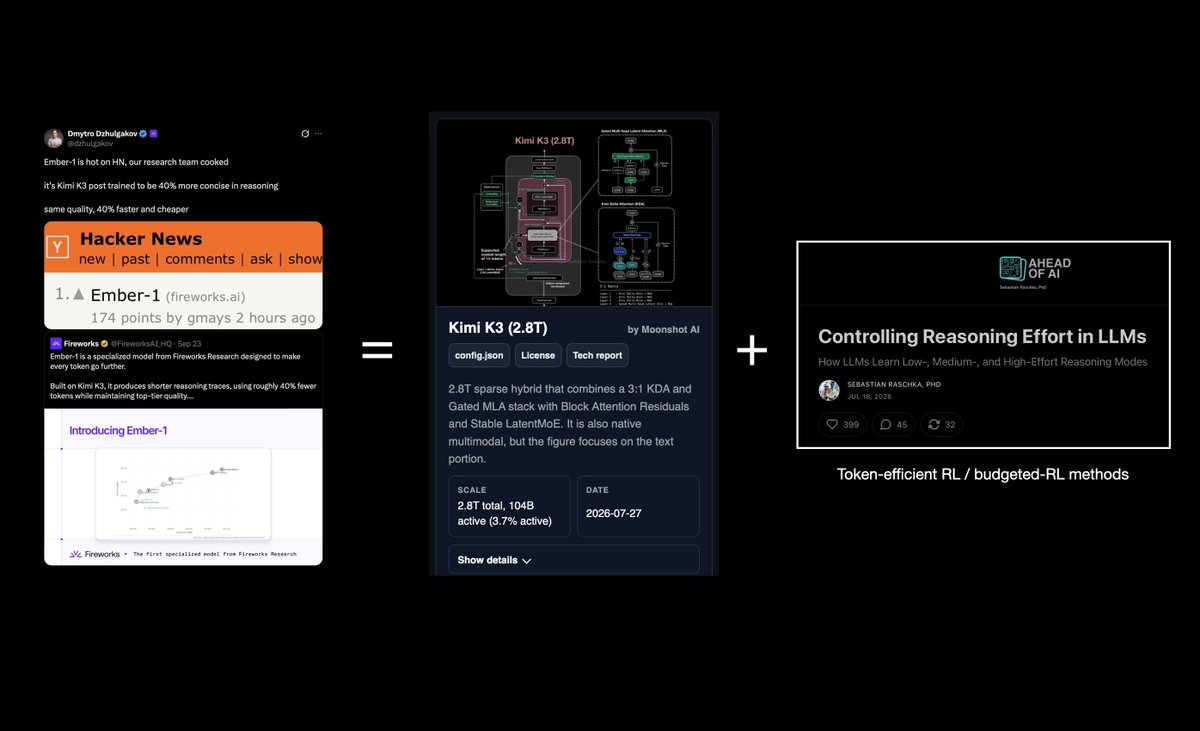
A little Ember-1 tl;dr. Seems like a great model! (Was recently asked on a podcast, given $ xx million, what's the best way to develop a frontier LLM today? My recommendation was: start with an existing one and spend that budget on post-training. Great example here.)
- 52Replies
- 43Reposts
- 437Likes
- 47.3KViews
@rasbt ·
Reasoning from scratch, round number 5! This time, talking about log-probability scoring (also a great fundamental concept for loss functions like cross-entropy in pre-training and distillation) and self-refinement. 00:00 Introduction and inference-time scaling recap 05:02 Loading the pretrained LLM 08:00 Comparing and scoring model answers 10:18 Building a rule-based scorer 17:53 Token probabilities and sequence likelihood 26:47 Computing token probabilities in PyTorch 30:12 Token indexing and shifted targets 37:27 Log probabilities and numerical stability 45:57 Scoring answers with average log probabilities 56:24 How self-refinement works 59:07 Generating critiques and revised answers 1:01:00 Implementing the self-refinement loop 1:05:57 MATH-500 evaluation results 1:07:35 Takeaways and next steps
Watch video- 43Replies
- 130Reposts
- 1KLikes
- 59.6KViews
@rasbt ·
The main appeal of open-source agent harnesses isn't that they are free, but that we can inspect what they are doing on our computers.
- 124Replies
- 80Reposts
- 909Likes
- 39.7KViews
@rasbt ·
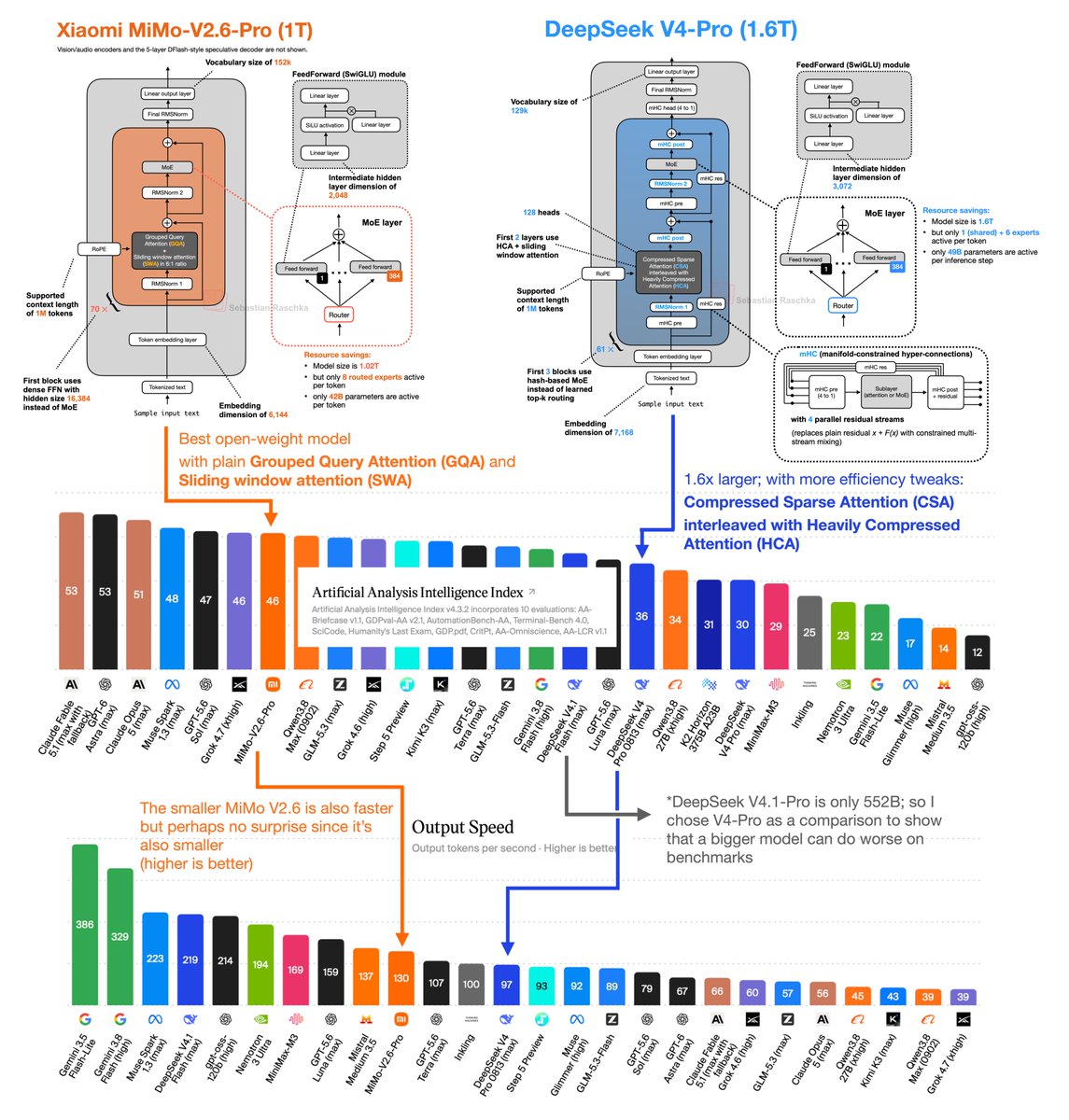
MiMo-V2.6 is "simply" the best (for now). Despite its simple architecture design it's currently No.1 in the open-weight benchmarks (weighted average). With "simple," I mean a classic Grouped Query Attention (GQA) with Sliding Window Attention (SWA) at a tiny 128-token window size. So, that underlines one of the points I've been trying to make in recent months: most of the progress still comes from the data and post-training recipe improvements. Fancy attention variants are just mostly efficiency tweaks. What are some of the training data improvements and recipe improvements? The MiMo team shared a pretty detailed technical report. Lots to carefully digest there, but in short, there are a few things that stood out: 1. An increase in agent tasks; also training across different harnesses (the average DeepSWE pass@1 accuracy on held-out harnesses improved from approximately 50% -> 66%). 2. Better reward signals: they replaced a simple correctness verifier with an agentic grader that…
- 77Replies
- 173Reposts
- 1.5KLikes
- 102.5KViews
@rasbt ·
It’s easy to dismiss Jev it as “just a classifier”. But people (me included) who have been training encoder-style models for classification for many years know they were usually special-purpose and limited in some way. The breakthrough of Jev is that it generalizes well. And I’d say the secret sauce is probably more in the data than in the training algorithm. (Plus a nice API design on top of it.)
- 135Replies
- 205Reposts
- 2.2KLikes
- 241.2KViews
Show all 17Show fewer
@rasbt ·
Inference scaling part 1. Starting with a modded text generation function (temperature scaling, top-p filtering, multinomial sampling) to generate diverse outputs for self-consistency and best-of-N (improving answer accuracy by>2x) 00:00 Introduction and recap 00:31 Training-time and inference-time scaling 07:52 What we'll implement 11:47 Notebook setup and model loading 17:43 Building a flexible text generation function 24:40 Chain-of-thought prompting 28:26 Sampling and output diversity 33:43 Next-token logits and greedy decoding 38:20 Temperature scaling step by step 42:46 Softmax and token probabilities 47:42 Multinomial sampling 54:51 Adding temperature sampling to text generation 59:31 Top-p filtering step by step 1:10:23 Adding top-p filtering to text generation 1:13:43 Sampling and LLM watermarking 1:16:01 Self-consistency and majority voting 1:20:36 Implementing self-consistency 1:29:02 MATH-500 results 1:35:01 Accuracy and compute tradeoffs 1:36:50 Next steps and…
 Watch video
- 42Replies
- 126Reposts
- 951Likes
- 45.2KViews
@rasbt ·
Interesting new insights into the old AdamW vs Muon debate: Muon seems to do better because it reduces memorization.
- 20Replies
- 29Reposts
- 388Likes
- 40.1KViews
@rasbt ·
Some food for thought when designing benchmarks... So, here's a little computer-use (visual) comparison between GPT-5.6 Astra and Qwen3.8 Max. The task here was to recreate the image in the center using the Paint UI. Super interesting how the two different LLMs+Harnesses approached this totally differently by default. I.e., Astra tried to approach this by drawing and layering geometric shapes. Qwen approached this pixel by pixel. (Of course, the pixel-by-pixel result looks closer to the original, it's essentially a low-res version of that by nature.) So, the Qwen-generated image would surely score higher in the sense that it's closer to the original. But I wouldn’t conclude from this example that one LLM generalizes better than the other on other tasks. Also, I wouldn't say Qwen has better compute-use capabilities or better visual understanding than Astra. But it highlights an interesting point about how slippery benchmarks are when they only compare final results.
 Watch video
- 63Replies
- 25Reposts
- 279Likes
- 25KViews
@rasbt ·
Since I had to discuss the "pacing" with a lot of people this weekend, here are my two cents: I don't think pacing literally means that these companies will be "slowing down" training and development in any way. "Pacing" here means adding a framework for more checks. We have seen some of that "pacing" already in recent months, when Mythos wasn't released as-is but instead a delayed, nerfed Fable variant was released. Or when Astra wasn't released right away / there is an existing Astra model that hasn't been released yet. These Mythos/Fable and Astra pacing decisions were ad hoc. If you are a company, you have to weigh the pros and cons of a delayed release in terms of keeping up with the competition, making money, pleasing shareholders, mitigating risks and harms, and so on. I f there is a formal framework that everyone has to abide by, that essentially relieves some of the pressure on a company to rush out its model just to take the top spot on the leaderboard, since it knows…
- 61Replies
- 19Reposts
- 294Likes
- 37.1KViews
@rasbt ·
Reasoning from scratch round 3: This time, I cover generating a verifier for... a) ...evaluation (base model versus any future model improvement) b) ...the reinforcement learning with verifiable rewards (RLVR) training later on 00:00 Introduction 01:21 Four approaches to LLM evaluation 07:20 Verifiers and reinforcement learning with verifiable rewards 10:52 Notebook setup and dependencies 13:43 Section 3.1 Building a math verifier 18:57 Section 3.2 Loading a pre-trained model to generate text 24:34 Generating and displaying model answers 29:23 Section 3.3 Implementing a wrapper for easier text generation 34:00 Section 3.4 Extracting the final answer box 37:29 Handling answers without boxes 43:17 Section 3.5 Normalizing the extracted answer 46:56 Section 3.6 Verifying mathematical equivalence 53:32 Implementing the equality check 57:48 Section 3.7 Grading answers 59:20 Building and testing the answer grader 1:03:18 Section 3.8 Loading the evaluation dataset (MATH-500) 1:07:51 Section…
 Watch video
- 35Replies
- 131Reposts
- 916Likes
- 42.2KViews
@rasbt ·
Big overhaul on DeepSeek V4.1 using an encoder-decoder setup. Tbh they should have called it DeepSeek V5! Super cool and refreshing, though!
- 70Replies
- 235Reposts
- 2.4KLikes
- 115.7KViews
@rasbt ·
Nice showcase that interesting LLM work can be done on single GPU!
- 18Replies
- 25Reposts
- 464Likes
- 63.5KViews
Formats
Content mix
- Text only
- 35%
- With media
- 65%
- With links
- 0 posts
- With hashtags
- 0 posts
Creator style: High-reach broadcaster
See the full app
This creator report is one small part of Xholic
Click through a sample creator's account in the real app. No sign-up, nothing to install.
- Posts written in your voice and scheduled for your best hours
- Buyers found on 𝕏, with a reply drafted for each one
- Analytics that show which posts grow you
No sign-up or login needed · Takes about 2 minutes
Grow your own account
Want numbers like @rasbt's?
Xholic writes posts in your voice, schedules them for the hours your audience is active, and tracks what's working every day.
$0 today · Card required · Cancel anytime
Live demo: no sign-up or login needed · takes about 2 minutes
Keep browsing
More in AI & developers
See all of AI & developers


Keep exploring
Free tools
- Compare Twitter AccountsPut two public accounts head to head and see who leads on views, engagement, grade and posting pace.
- Twitter Engagement Rate CalculatorCalculate engagement rate from your numbers or a public profile and grade it against your tier.
- X Monetization CalculatorChange the assumptions behind six X revenue models and compare gross revenue with direct contribution.
Guides
- X/Twitter Analytics Glossary: Every Metric Explained (2026)Definitions, formulas, benchmarks, and actions for X/Twitter analytics metrics including impressions, reach, engagement, followers, clicks, and revenue.
- How to Write a Tweet With an AI Tweet GeneratorTurn a rough idea into a tweet worth posting: write a specific prompt, pick a tone and length, compare three drafts and make the best one sound like you.
From the blog
- 10 X Analytics API Alternative Options for 2026Compare 10 X analytics API alternatives for 2026, from low-cost data providers and custom scrapers to enterprise listening platforms.
- Twitter API Examples: A Practical Guide for BuildersExplore real Twitter API examples with code, auth flows, rate limits, and patterns for posting, streaming, analytics, and growth workflows on X.
Best tweets on this topic
- Best tweets about Google AI StudioDiscover the best tweets about Google AI Studio, covering Gemini API prototypes, prompting, structured output, model testing, and developer workflows.
- Best tweets about Claude CodeRead the best tweets about Claude Code, covering terminal workflows, agents, hooks, skills, debugging, and real software projects. Updated every two weeks.
- Best tweets about WindsurfBrowse the best tweets about Windsurf AI, including editor workflows, coding agents, product updates, comparisons, and developer experiences. Updated every two weeks.
About this data
- Analytics are inferred from public profile and recent post data. They do not include private impressions, profile visits, link clicks, or follower-source data.
- Deleted, protected, unavailable, or rate-limited posts may be missing from the sample.
- Stats come from public posts Xholic has stored, not private X Analytics. Xholic is not affiliated with X Corp or @rasbt.
- Own this account and want it hidden? Email support@xholic.ai — we verify ownership and handle requests within 2 working days.