If you’re doing Twitter lead generation on X (formerly Twitter) and getting replies but not real pipeline, the problem usually isn’t reach. It’s conversion design. X is excellent for earning attention, spotting intent, and starting conversations, but most founders lose the lead between the first reply and the actual next step. The fix is to treat X as a lead discovery and trust-building channel, then track which conversations turn into DMs, sign-ups, and calls.
Optimizing Your X Profile for Lead Generation
Your profile decides whether a good reply turns into a lead or a dead click. People don’t just read your post and decide. They check your bio, header, pinned tweet, and recent activity to figure out whether you’re credible, relevant, and worth messaging.

Make your profile say who you help
A strong lead-gen profile is specific. It tells the right person, quickly, “this account is for me.”
Focus on four visible elements:
- Display name: Use your real name, brand, or both if that helps recognition.
- Bio: State who you help, what problem you solve, and the kind of outcome or use case you work on.
- Header image: Reinforce the same message visually. Keep it readable on mobile.
- Link and contact path: Give one obvious next step. Homepage, lead magnet, booking page, or product page. Don’t make people hunt.
A weak bio sounds impressive but vague. A useful bio sounds narrow and practical. Founders, creators, and consultants often make the same mistake here. They describe themselves, not the problem they solve.
Your profile doesn’t need to be clever. It needs to remove doubt.
Good profile signals for B2B Twitter lead generation usually include:
- Clear market fit: People can tell whether you help SaaS founders, agencies, operators, recruiters, or another group.
- Topical consistency: Your recent posts match the problem your bio claims you solve.
- Human trust cues: Real photo, active replies, and a profile that looks maintained rather than abandoned.
If you’re reworking your positioning, this guide on Twitter profile optimization is a useful companion.
Turn your pinned tweet into a mini landing page
Most profiles waste the pinned tweet. They pin a random viral post, a company announcement, or something that got vanity engagement but doesn’t convert.
Your pinned tweet should do one of three jobs:
- Explain the problem you solve
- Show proof of thinking
- Offer a next step
That next step could be a guide, a diagnostic, a demo, a waitlist, or a short DM prompt. The key is alignment. If your replies are about attribution, your pinned tweet shouldn’t be about culture takes or unrelated product updates.
A practical pinned tweet structure:
- Line 1: Name the problem clearly
- Line 2: Explain your angle or framework
- Line 3: Offer one action, such as replying, DMing, or clicking through
Profile update checklist
Use this quick audit before you start outreach:
-
Check your bio
- Does it name the audience?
- Does it describe the problem?
- Does it avoid empty labels like “growth enthusiast” or “building cool stuff”?
-
Review your header
- Is the message legible on mobile?
- Does it support your offer rather than distract from it?
-
Rewrite your pinned tweet
- Does it connect to the conversations you want to join?
- Does it include one clear call to action?
-
Scan your recent posts
- Would a prospect see consistency?
- Do your posts make your replies feel credible?
-
Fix your outbound path
- Is your link current?
- Can someone contact you without friction?
Finding Prospects and Gaining Attention
Most Twitter lead generation fails before the first reply because people search for topics instead of intent. Topic search gives you noise. Intent search gives you prospects who are already evaluating options.
Look for intent, not mentions
The best posts to engage with aren’t always the biggest ones. They’re the ones that reveal a real buying signal.
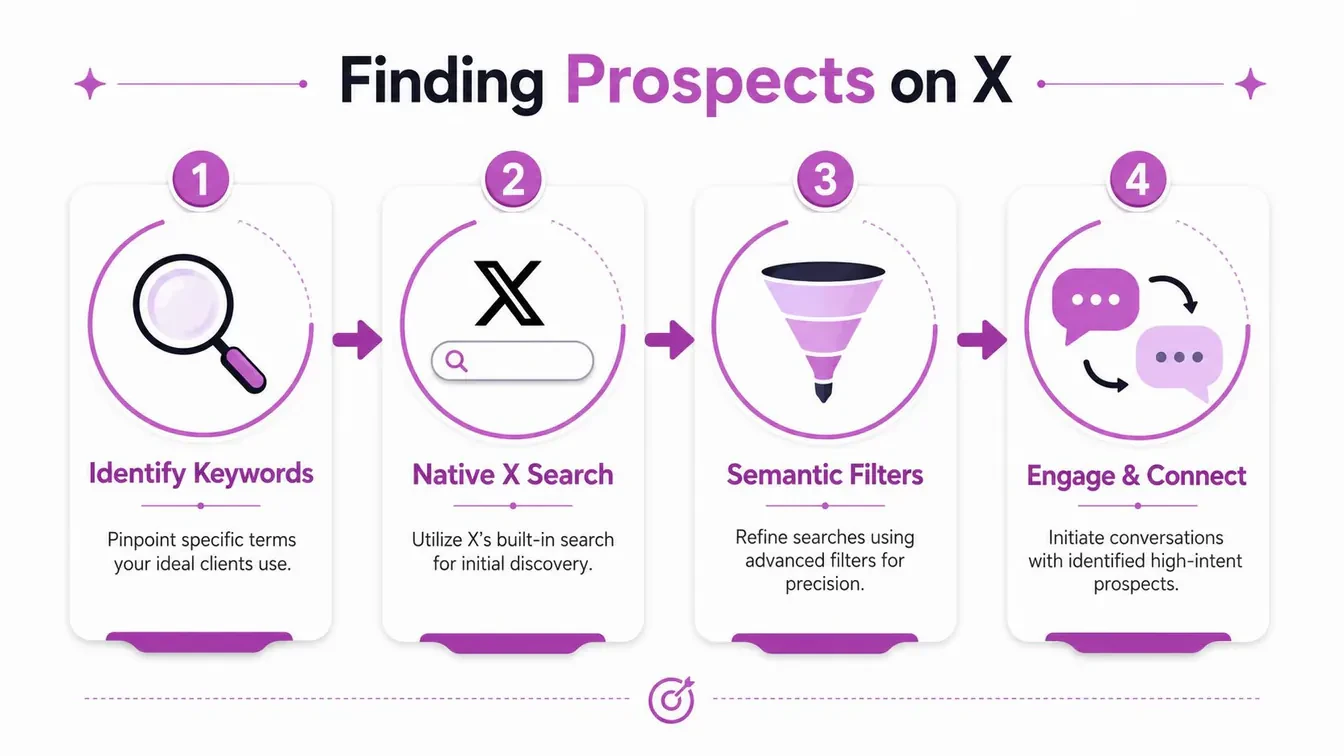
The highest-value signals usually look like this:
- Recommendation requests: Someone asks what people use for a specific workflow.
- Competitor frustration: They complain about cost, missing features, support, or fit.
- Comparison language: They mention alternatives, switching, or evaluating options.
- Budget or timeline hints: They mention urgency, constraints, or the need to decide soon.
When brands monitor those high-intent buying signals, response rates jump to 40 to 50 percent, compared to 1 to 5 percent for unfocused outreach, according to Catch Intent’s Twitter lead generation analysis.
That’s the core trade-off on X. Broad outreach gives you volume and terrible efficiency. Tight intent monitoring gives you fewer conversations, but the conversations matter.
A good way to sharpen your search habits is to use advanced search on Twitter mobile so you can catch live posts without waiting to get back to desktop.
Later in the process, video walkthroughs can help if you want to see this style of prospecting in action.
Use a prospecting workflow you can repeat daily
A manual workflow works better than a “spray and pray” list.
Try this routine:
-
Start with core phrases Search for recommendation requests, alternatives, complaints, and workflow questions in your niche.
-
Check competitor posts Open replies on launch posts, pricing posts, comparison posts, and high-engagement announcements. Comment sections often reveal active evaluation.
-
Prioritize freshness X is fast. A useful reply after the discussion has cooled down is usually wasted effort.
-
Reply publicly first A public reply establishes context and trust before you move to DM.
The first useful responder often gets the conversation. On X, timing isn’t a nice extra. It’s part of the offer.
What deserves a reply and what to skip
Not every relevant keyword is a lead. Use simple judgment.
| Post type | Reply? | Why |
|---|---|---|
| Direct request for a tool or workflow | Yes | Active interest and clear need |
| Complaint about a competitor | Yes | There may be switching intent |
| Broad opinion about the industry | Usually no | Discussion, not buying behavior |
| Viral hot take with no problem stated | No | Attention trap, weak lead quality |
| Question under a competitor launch post | Yes | Often a warm evaluation signal |
If your day is disappearing into search tabs, that’s the point where a conversation triage system matters more than another posting schedule.
Crafting High-Value Engagement Strategies
Replies create leads only when they move the prospect one step closer to trust. Generic activity doesn’t do that. It just creates surface-level engagement.
Why most replies go nowhere
The common mistakes are predictable:
- Low-effort agreement: “Great post” and “Couldn’t agree more” don’t build authority.
- Premature pitching: Dropping a product link before adding value makes you look transactional.
- Ignoring context: If someone is frustrated, a polished sales answer feels tone-deaf.
- Bad sequencing: DMing cold after zero public interaction is weaker than warming the conversation first.
There’s also a growth trade-off here. X growth funnels work best with a 4:1 reply-to-post ratio and a daily cadence. Skipping any component typically stalls follower counts around 500, based on Commeta’s X growth playbook. That matters because stalled audience growth limits the compounding effect of your lead-gen replies.
Use the EEE reply structure
A practical structure for lead-oriented replies is Empathize, Educate, Encourage.
Empathize
Show that you understand the exact friction. Don’t overdo it. One sentence is enough.
Example: “That usually gets messy once the team starts juggling handoffs across multiple tools.”
Educate
Add one useful insight, step, or reframing. Keep it tight.
Example: “If the issue is attribution, I’d separate discovery replies from conversion replies and tag them differently. Otherwise everything looks like ‘engagement’ and nothing looks tied to revenue.”
Encourage
Give the prospect an easy next move.
Example: “If helpful, I can share the way we structure that in practice.”
That final line matters. It opens the door without forcing it.
Reply volume, cadence, and DM timing
Public interaction before the DM usually works better than jumping straight into inboxes. Field data cited by Early Customers on warm X outreach found that prospects who receive a warm DM after 2 to 3 public interactions convert 3.2x higher than those contacted cold.
That doesn’t mean you should endlessly “nurture” in public. It means you should earn recognition first.
A practical engagement standard:
- Daily replies: Keep replying consistently, not in random bursts.
- Public before private: Leave a useful reply before sending a DM.
- Reference specifics: Mention the person’s post, question, or objection.
- Respect limits: Don’t treat DMs like bulk outreach.
If you need message inspiration for another network’s first-touch outreach, these proven LinkedIn templates from hireSDR.io are worth studying for structure. The channel is different, but the lesson is the same. Specificity beats generic personalization every time.
Using Content Templates and Remixing Tactics
Content helps Twitter lead generation when it supports conversations, not when it just fills the feed. The best posts make it easier for the right person to self-identify, reply, and continue the exchange.
Build around formats that naturally create conversations
Some formats are better at lead creation than others:
- Short insight posts: Useful for surfacing a clear point of view
- Threads: Better when the prospect needs education before action
- Visual cards: Helpful when you want saveability and shareability
- Poll plus follow-up: Good for collecting objections or segmenting interest
A lot of founders make the mistake of posting “thought leadership” that’s too polished and too detached from buying questions. If your content never touches implementation pain, switching friction, prioritization, or mistakes people are already making, it may earn likes and still produce weak pipeline.
A simple thread template for lead generation
A thread can work well when you need to bridge awareness and action. One effective X format is a 10-tweet structure with Hook, Context, six concise points, Summary, and CTA, paired with 2 to 3 daily posts and visual cards, according to AutoReach’s Twitter lead generation guide.
That structure works because each tweet has a job. It doesn’t wander.
A practical version:
-
Hook
State a clear claim tied to a painful outcome. -
Context
Explain why the issue matters now. -
Points 1 to 6
Give one idea per tweet. No stuffing. -
Summary
Recap the lesson. -
CTA
Ask for a next action that fits the thread. Reply, DM, download, or sign up.
Good lead-gen content doesn’t try to close the sale in public. It earns the right to continue the conversation.
If you’re stuck staring at a blank draft, a library of blank Twitter post templates can speed up the writing side without forcing you into one tone.
Three templates worth keeping in rotation
Here are three practical formats.
Industry insight thread
Best when your buyer needs a smarter mental model before they’re ready to act.
Structure:
- Clear problem statement
- Common mistake
- Better framework
- Simple CTA
Case-study style breakdown
Use this when you can explain a process or lesson without inventing performance numbers.
Structure:
- Situation
- Mistake or bottleneck
- Change in approach
- What others should copy
Poll plus follow-up post
Polls are useful when you want to surface objections or segment audience pain.
Structure:
- Poll question tied to one workflow problem
- Follow-up post summarizing what each answer suggests
- Invitation to reply or DM if someone wants the detailed process
If you’re exploring workflow support more broadly, HighLevel’s take on AI for business is worth reading as context for how teams are applying AI to repetitive marketing tasks. Just keep the X-specific rule in mind. The output still needs your voice and judgment.
Capturing Leads with DMs and Landing Pages
Public engagement starts the relationship. Private capture closes the loop. Many X strategies, however, break here because they rely on one method for every type of prospect.
Choose the capture method based on buyer intent
There are three practical ways to capture leads from X:
- DMs
- Landing pages
- Lead magnets
The right one depends on where the buyer is in the conversation.
A direct DM works best when the prospect has already shown clear intent and your next step needs context. A landing page works better when you want one clean conversion action. A lead magnet works when the buyer is interested but not ready to talk.
This also connects to the broader funnel reality. The average B2B sale requires 7 or more distinct touchpoints to close, according to Inbox App’s Twitter lead generation overview. That’s why X usually works best as an early touchpoint and conversation starter, not as a one-post conversion machine.
Comparison of lead capture methods
| Method | Pros | Cons | Best Use Case |
|---|---|---|---|
| DM | Personal, fast, easy to tailor | Can feel intrusive if rushed, easy to mishandle | High-intent prospects who already engaged |
| Landing page | Clear conversion path, easier to track | Loses warmth if sent too early | Offers with one obvious CTA |
| Lead magnet | Good bridge between interest and sales | Can attract low-intent signups if too broad | Education-first offers and nurturing |
What good DM and landing page execution looks like
Execution matters more than format choice.
For DMs, keep these rules tight:
- Reference the prior conversation: Mention the exact post, question, or pain point.
- Lead with value: Effective lead-gen content tends to be 80% value and 20% direct promotion, and safe DM limits of 50 to 100 per day per account help avoid throttling and spam flags, based on X AutoDM’s playbook.
- Keep the first message short: Don’t front-load a pitch deck into the inbox.
- Use follow-up carefully: If someone doesn’t respond, a polite follow-up later is better than repeated pressure.
For landing pages, reduce choices:
- Mobile-first layout: Many X clicks happen on mobile.
- One strong CTA: Download, register, book, or request. Pick one.
- Branded continuity: The page should feel like a natural extension of the profile and post.
- Tracking discipline: Use tracking codes so you know which tweet, reply, or DM created the visit.
A/B testing is useful here, especially on headlines and CTA wording. If you’re serious about Twitter lead generation, don’t just ask, “Did this page convert?” Ask, “Which exact conversation path sent the person here?”
Measuring Performance and Scaling Your Efforts
If you only measure likes, replies, and profile visits, you’ll end up optimizing for activity instead of pipeline. The missing piece is attribution.
Build a reply-to-lead attribution system
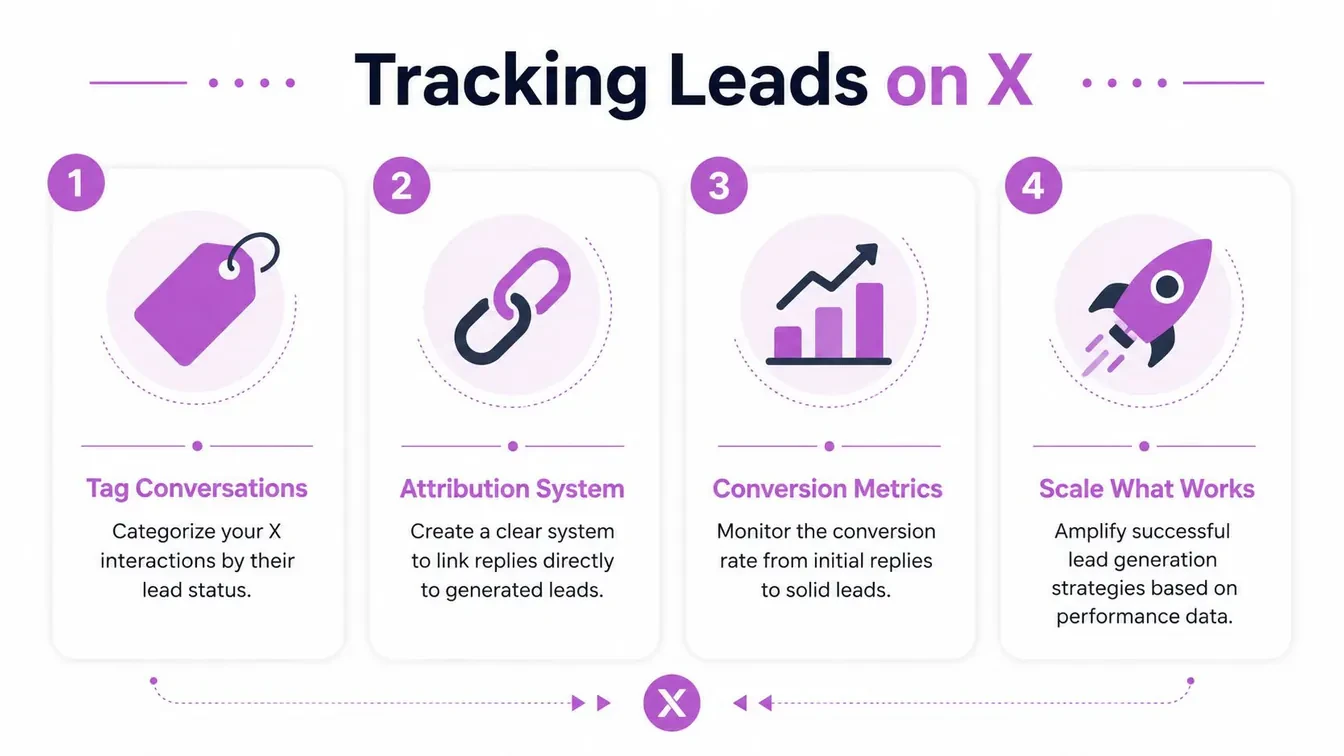
A useful system can stay simple. You don’t need enterprise software to start.
Track these items for each prospect path:
- Conversation source: Which post, reply thread, or competitor conversation started it
- Intent type: Question, complaint, comparison, recommendation request, or objection
- Next action: DM sent, link clicked, form filled, meeting requested
- Outcome: Qualified lead, not a fit, still nurturing, or closed
70% of B2B SaaS founders on X get 50+ replies weekly but only 3 to 5 genuine leads, a metric underscoring why reply-to-lead attribution matters more than raw engagement, according to Leadverse’s analysis of lead quality on Twitter.
If you want a broader framework for tying top-of-funnel work to business outcomes, SourceLoop’s guide on how to connect marketing to revenue is a helpful read.
For channel-specific measurement ideas, this guide to Twitter analytics is a practical next step.
What to scale and what to cut
Once attribution is in place, patterns become obvious.
Keep doing more of:
- Replies that trigger DMs
- Threads that generate qualified inbound questions
- Landing pages tied to one clear audience problem
- Prospecting searches that consistently surface active evaluation
Cut or reduce:
- Replies that get applause but no follow-up
- Broad posts that attract the wrong audience
- Cold DMs with weak context
- Time spent in noisy conversations with no buyer intent
Scaling usually means increasing precision before increasing volume. Add more of what already maps to leads. Don’t just post more and hope the math fixes itself.
If you want help running this workflow without spending your day buried in search tabs, drafts, and scattered notes, Xholic AI is built for that. It helps you decide which conversations are worth joining, what to say next, what successful patterns are worth studying, and how to stay consistent on X while keeping a human review step before anything goes live.
Map each acquisition step into a complete Twitter sales funnel so attention, profile visits, conversations, and qualified opportunities are measured together. The X Monetization Calculator can then test how lead volume and conversion assumptions affect revenue contribution.