If you’re trying to turn scattered engagement on X (formerly Twitter) into something that feels like a real twitter community, the fix isn’t more posting. It’s choosing better conversations, replying with a clearer point of view, and measuring whether the same people come back. X is still operating at major scale, with a history that goes back to its public launch in July 2006, a rebrand from Twitter to X in 2023, and $2.5 billion in revenue in 2024 with 388 million monthly active users reported by Business of Apps, which is plenty of room to build a meaningful community if you’re deliberate about it. Business of Apps’ X statistics
A practical twitter community workflow starts with one simple question, where are the conversations worth joining, and what makes them worth your time? The fastest path is not random scrolling, it’s a repeatable system for finding high-signal threads, contributing in your own voice, and watching which prompts lead to repeat participation. If you want a database-style view of community data, Captapi for Twitter data is a useful reference point for how teams think about structured access.
Getting Started with Twitter Community Growth
A strong twitter community comes from repeated participation, not follower count alone. On X, that means defining a clear niche, spotting the right discussions fast, and replying in a way that gives people a reason to answer. X’s scale matters because it is not a small niche network. It is a globally distributed platform with a large active user base, which makes it a serious place to build attention and relationships.
The practical starting point is to define the people you want around you, then find the conversations they already care about. For founders, creators, marketers, and operators, that usually means choosing one or two topic lanes and consistently joining posts where your perspective adds clarity, context, or a useful counterpoint. A tool like Xholic Brain can help by learning from your approved replies, so when you join conversations, your contributions stay aligned with your core expertise and voice.
Practical rule: If a conversation does not connect to your expertise, your product, or your audience’s real problems, it usually will not compound into community.
You also need a repeatable source of context, not just a feed. If you are studying how other operators structure community data and workflows, Captapi for Twitter data is worth bookmarking because it supports the work of tracking which posts and interactions deserve attention. For a closer look at identifying active discussion patterns, this Xholic guide to Twitter trends is a useful reference. From there, the job is straightforward, build a system for finding the right posts, then show up with replies that sound like you.
Finding High-Momentum Conversations
The best twitter community growth usually starts before you publish anything. First, narrow your niche into a few audience buckets, then search for the language those people already use in public posts, replies, and quote posts. That keeps you from wasting time on broad, low-fit conversations that look active but never lead to meaningful back-and-forth.
A simple discovery workflow
- Start with your audience’s language. Search terms your ideal readers would type, not the terms you’d use in a brand deck.
- Check recent threads. Look for posts that already have replies, quote posts, or visible discussion energy.
- Watch for momentum, not noise. The goal is to find threads that are still moving, not just posts that spiked once and went cold.
- Sort by relevance and role fit. A smaller thread with the right people is often more valuable than a larger one with the wrong crowd.
- Decide whether to reply or start a new thread. If your angle is distinct, opening a fresh post can be better than squeezing into a crowded conversation.
X’s audience is broad enough that the same topic can behave differently across regions and niches. Onclusive cites GWI data showing that as of Q2 2025, 29.2% of global internet users aged 16+ used X monthly, and it reports about 388 million monthly active users with a total potential advertising audience of 557.5 million. It also notes that only 14% of X’s user base is based in the United States, which is a useful reminder that the best conversation for your niche may not be the loudest one in your local market. Onclusive’s X statistics overview
If you want a faster way to find conversations worth joining, use Xholic’s Reply Deck to surface posts connected to your interests, then apply semantic search to narrow by topic and format. For a broader social listening mindset, this guide to social listening for lead generation is a good complement because it helps you think beyond single posts and toward repeatable demand signals. You can also cross-check trend patterns with Xholic’s Twitter trends guide when you want to separate a real discussion from a one-off spike.
Joining and Starting Community Threads
Once you’ve found a conversation, the next move is to enter in a way that feels native to the room. X Communities themselves can be open or members-only, and the setup flow explicitly asks for the community name, purpose, and membership type before creation. After that, admins can personalize the space, invite relevant people, and set rules that shape how discussion works. Metricool’s X Communities guide

How to join without sounding generic
The quickest mistake is replying with a compliment and stopping there. That gets you a polite like, but not much else. Instead, add one of these, a sharp takeaway, a useful example, a respectful disagreement, or a follow-up question that keeps the thread moving.
Keep replies short when the original post is simple, and add depth only when you have something specific to contribute.
For starting threads, think prompt, not broadcast. A question that invites specific experience usually works better than a polished announcement because community participation depends on back-and-forth, not one-way posting. One practical framework recommends at least 4 value posts for every 1 promotional mention so the space doesn’t start feeling like an ad channel. Conbersa on Twitter Communities
This is where product context matters. If you use Xholic’s Product and Context Profiles to store your positioning, audience, and use cases, your opening post can sound far more relevant to the room instead of generic. For thread structure itself, this Twitter thread strategy guide is useful when you want to turn one idea into a sequence that invites replies instead of passively collecting views.
Growing and Sustaining Engagement
The hardest part of a twitter community is what happens after the first burst of replies. Most guides stop at setup, but the primary work is preventing the room from going quiet once the novelty wears off. That’s why you need routines, not just bursts of energy.
What keeps people coming back
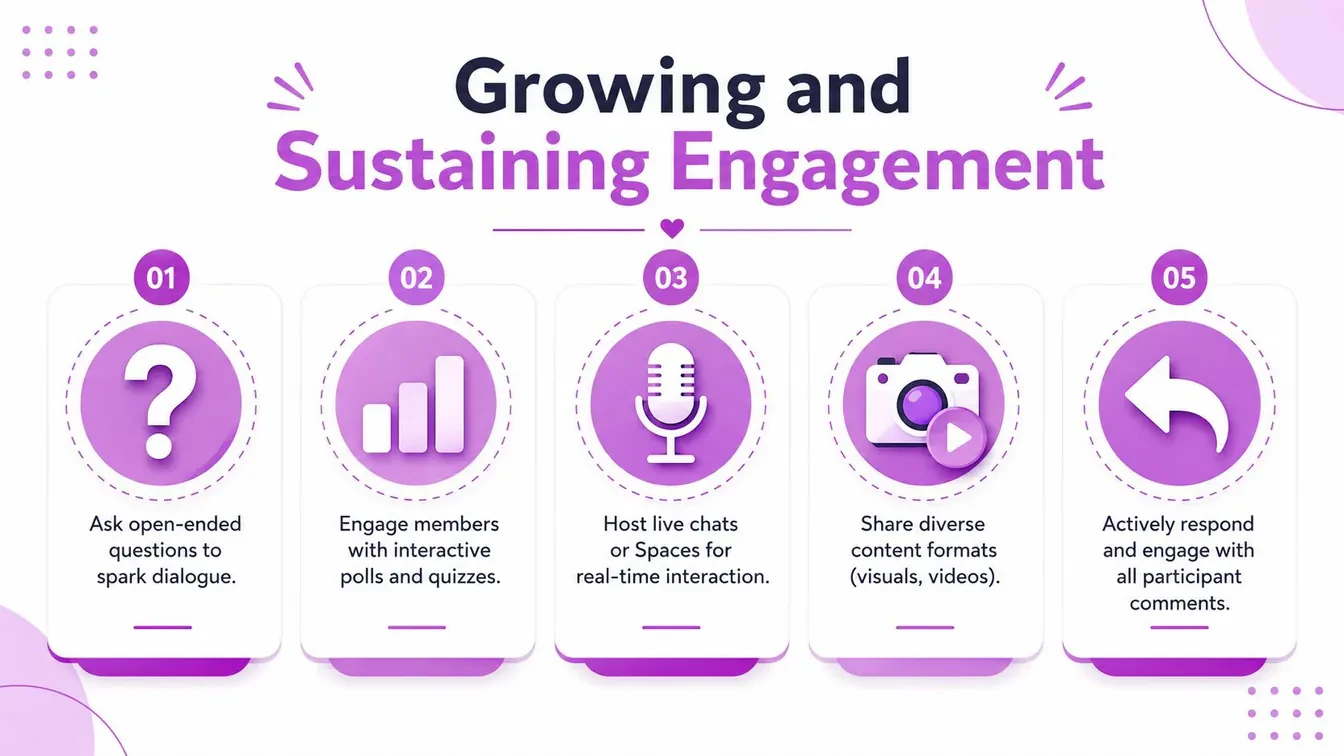
Start by making participation easy. Ask open-ended questions, use polls sparingly when they help decision-making, and respond to the first few replies quickly enough that the conversation feels active. The moment you stop answering, new members assume nobody is listening.
A useful habit is to look for repeat names, not just high like counts. If the same people keep replying, asking follow-ups, or referencing previous threads, that’s a better sign of community health than a single busy post. X’s rules also matter here, since the platform restricts abuse, harassment, threats, promotion of violence, non-consensual intimate imagery, spam, manipulative behavior, and coordinated inauthentic activity, so your growth tactics need to stay well inside those boundaries. X rules and policies
The public conversation around communities often misses the post-launch problem entirely. That gap is why many communities feel full at first and empty later, and why recurring formats matter more than isolated hits. If you want a cleaner overview of that blind spot, Tweet Archivist’s Twitter Communities guide explains why empty-room dynamics show up so often.
Build rituals instead of random posts
A ritual needs a recognizable shape. That could be a weekly reflection prompt, a recurring teardown, or a public build-in-public update that people can follow across time. The key is continuity, because people return when they know what kind of contribution belongs there.
If you want a workflow layer on top of that, Xholic’s goals and streaks can help you stay consistent without turning the account into a content treadmill. The important part is still the same, give members a reason to come back, then reward them by treating their replies like the beginning of a conversation, not the end of one.
Writing Engaging Replies and Original Posts
A good twitter community doesn’t run on “Great post” replies. It runs on posts that give people something specific to react to, challenge, or build on. That means your reply writing and your original posts need the same three ingredients, a clear hook, a useful point of tension, and a payoff that lands in plain language.
Reply structures that actually get traction
A strong reply usually does one of four jobs. It adds missing context, sharpens the original point, gives a real example, or asks a question that opens the next layer of discussion. If you can’t do one of those, the reply probably isn’t worth sending.
For original posts, keep the structure simple enough that people can quote it, respond to it, or disagree with it. That often means one idea per post, a clean opening line, and a final sentence that leaves room for other people to add their view. If you’re repurposing a proven angle into a fresher format, TransClipper’s short-form content repurposing platform is relevant because the same content logic applies when you’re turning one idea into multiple X-native formats.
How to keep your voice intact
Generic AI output fails when it sounds polished but context-free. That’s why the best workflow is to study a post, identify its structure, then rebuild it around your own experience, audience, or product. Xholic’s Tweet X-Ray can break down hook, structure, tension, flow, and payoff, while Tweet Remixer helps you adapt that pattern into a draft that sounds closer to your voice.
Practical rule: Don’t copy a post’s phrasing. Copy its function, then rewrite the idea around your own proof, angle, or opinion.
If you’re building a product-led account, Xholic’s product-aware reply suggestions can help you stay relevant without forcing product mentions into every interaction. The point is not to automate personality, it’s to lower the friction of saying something useful when the right thread appears.
Scheduling Content and Tracking Growth Metrics
Consistency matters more than bursts for a twitter community, but consistency only works when it’s measurable. You need a publishing rhythm that keeps your name visible and an analytics habit that tells you what kind of content people respond to. Without both, you’re guessing.
A practical scheduling setup
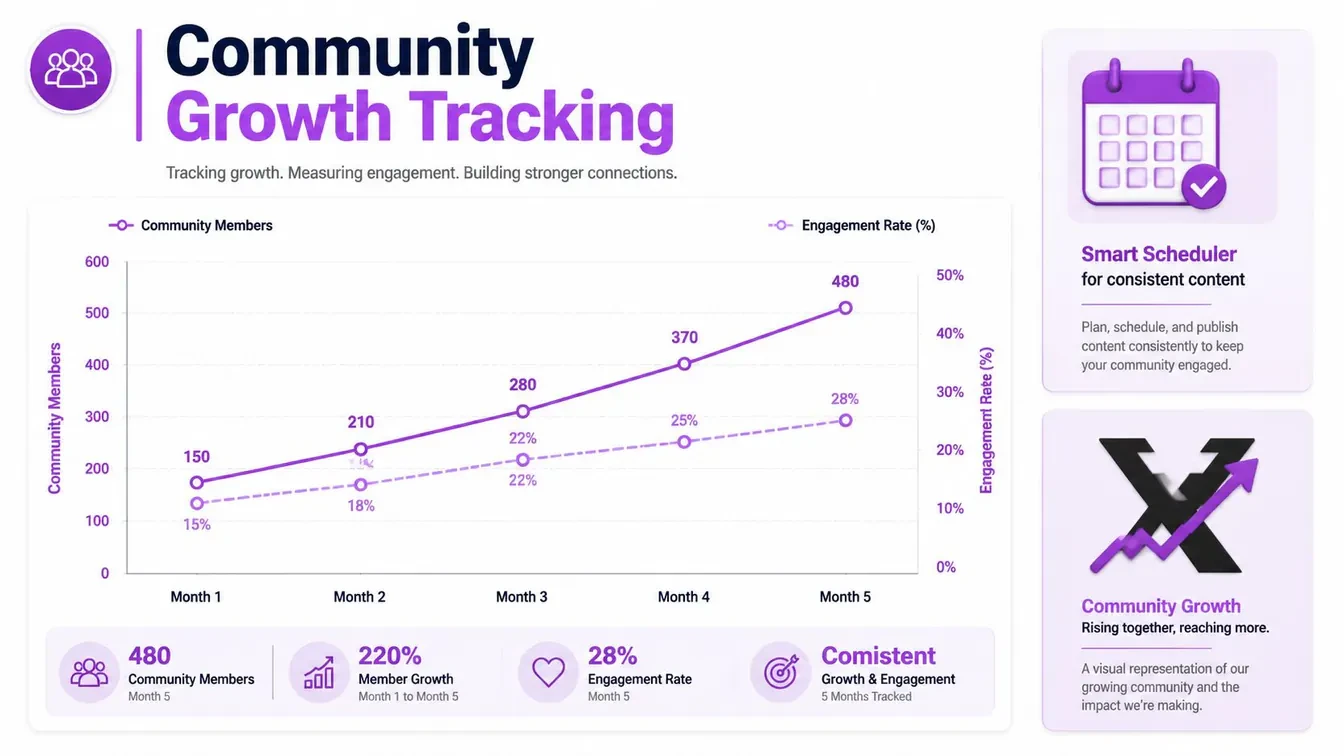
A drag-and-drop calendar makes it easier to see whether you’re balancing replies, original posts, and recurring prompts. With a Smart Scheduler, you can queue approved posts, keep the cadence steady, and use automation carefully for posts that should retweet later or disappear after they’ve served their purpose. The point is to reduce drift, not to remove judgment.
What to measure every month
The cleanest workflow is to export tweet-level data monthly, calculate averages for impressions, engagements, and engagement rate per tweet, then compare the best and worst posts. Social analytics guides recommend period-over-period comparisons and systematic tagging by content type, campaign, and topic, which helps you see stable patterns instead of daily noise. Tweet Archivist’s analytics best practices
A useful benchmark is engagement rate, calculated as (replies + retweets + likes + link clicks) ÷ impressions, with organic X benchmarks often cited at about 0.5% to 2%. Another helpful signal is reply-to-post ratio, and values above 1.0 can indicate unusually strong discussion generation. Improvado on Twitter analytics
For deeper review, Xholic’s Twitter analytics guide can help you organize the numbers without turning the process into spreadsheet theater. The main job is to notice which format, time bucket, and topic combinations lead to repeat participation, then do more of those and less of the rest.
Templates Examples and Next Steps
A simple twitter community playbook beats a messy one. Start with a discovery checklist, then write one prompt post, one high-value reply, and one follow-up question each day so you can see which action draws people in. If you need a blank starting point, Xholic’s blank Twitter post template is a useful companion when your draft needs structure before style.
A lightweight weekly workflow
- Discovery: Search for conversations tied to your niche and save the ones that feel alive.
- Engagement: Reply with context, examples, or a useful challenge, not generic praise.
- Creation: Turn the best thread angle into an original post in your own voice.
- Review: Check which posts brought back the same names, not just the most likes.
- Adjustment: Keep the formats that triggered real back-and-forth and drop the ones that didn’t.
If you want software help, use the complete human-in-the-loop workflow first, then layer tools on top of it. That keeps the account from sounding automated and helps you stay focused on the conversations that matter.