You’re probably here because someone told you X Spaces can help you grow on X (formerly Twitter), and you’re trying to figure out whether that’s true or just another platform tactic that sounds better than it performs. The short answer is that twitter spaces marketing works best when you treat live audio as a relationship tool and a content capture engine, not a vanity broadcast. If you show up hoping for a huge room, you’ll usually be disappointed. If you show up with a narrow topic, the right guest, and a repurposing plan, you can get real value from a small audience.
Why Twitter Spaces Marketing Is Worth the Effort in 2026
A lot of founders learn the hard way that a Space doesn’t magically fill itself. They schedule one, post once from their own account, and end up with four listeners, two of whom are friends. That doesn’t mean the format is broken, it means they used it like a broadcast channel instead of a live relationship surface.
X Spaces became broadly available in May 2021, and Twitter later estimated that more than 185,000 Spaces were created daily in October 2021 VPNAlert. That pace matters because it shows the format was never just a niche experiment. It became a frequent way for people to talk, test ideas, and pull audiences into real-time conversations.
For a small account, the value is rarely “big live audience.” It’s usually one of three things. First, you get a trust signal from speaking live instead of hiding behind posts. Second, you create a reusable source of quotes, angles, and objections that can feed your next round of content. Third, you build familiarity with the same people over time, which is often more useful than a one-time spike.
Practical rule: If your account has fewer than 5,000 followers, judge a Space by relevance, not crowd size.
That’s the honest benchmark. Independent research found that by January 2022, only 12% of U.S. consumers were aware of Twitter Spaces and just 2% of Americans aged 12+ had ever used one VPNAlert. In other words, the channel had scale inside Twitter without mainstream saturation. That’s exactly why a focused account could stand out.
The format also does things threads and short clips can’t do as well. Threads can explain. Video can show. But live audio creates back-and-forth, and that changes how people assess you. When listeners hear how you respond under pressure, they get a better read on your thinking than they do from a polished post.
The strongest case for running Spaces in 2026 is not virality. It’s creating a repeatable asset that helps you earn attention, answer objections, and turn live discussion into durable content. If your real goal is lead generation from X, pairing Spaces with a clear follow-up workflow works better than treating them as isolated events. A useful starting point is this guide to Twitter lead generation, because the best Spaces rarely end at the live session.
Picking a Topic and Guests That Will Fill the Room
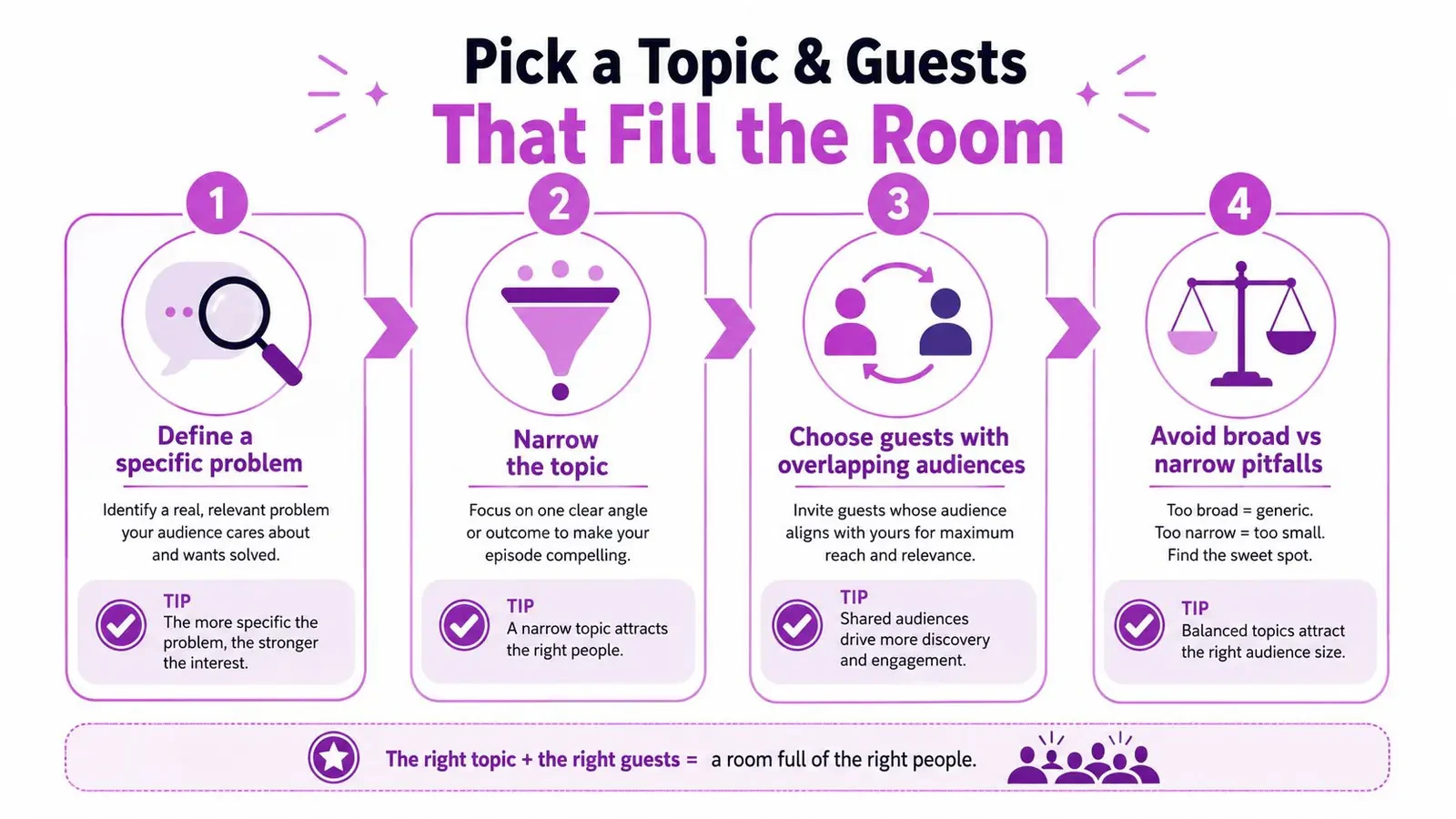
Write a topic people will say yes to
The fastest way to kill attendance is a vague title. “How to grow on X” sounds broad enough to attract everyone, which usually means it attracts no one in particular. A better title starts with a problem people already feel, like how to turn replies into profile visits, how to get product questions from X, or how founders can use Spaces to capture content without pretending to be a big creator.
A good working topic has three parts. It names the problem, signals the audience, and hints at the payoff. For example, a founder-led room might be framed around “How small accounts can use live audio to earn trust, capture objections, and turn one conversation into a week of posts.” That is specific enough to filter in the right people and filter out the wrong ones.
Use three questions to pressure-test the topic:
- What problem is this solving? If you can’t answer in one sentence, the title is still too loose.
- Who is this for? Founders, creators, marketers, analysts, and product builders all want different outcomes.
- What will listeners leave with? A framework, a decision rule, a checklist, or a sharper opinion works better than “general discussion.”
A good title also makes it easier to write the announcement post later. If you can’t explain the Space in one line without sounding like a panel flyer, the topic probably needs to be narrower. A practical way to sharpen it is to write the one sentence you want someone to repeat to a friend. If they can’t repeat it, they probably won’t join.
If you are stuck on subject lines, it helps to study how strong hooks and angles are formed in the first place. A useful place to build that habit is content ideation tools, because the same principle applies here. The room fills when the promise feels concrete.
Choose guests who bring overlap, not duplication
The best guests are not the biggest names. They are the people whose audience overlaps with yours but doesn’t fully duplicate it. A solo Space works when you have a strong point of view and a topic that can stay tight. A co-hosted Space works better when the guest adds credibility, distribution, or a perspective you can’t credibly provide alone.
Before you invite anyone, ask what they’ll bring to the room. Not in ego terms, in practical terms. Will they share the event? Will they contribute a specific angle? Will their audience care about the topic, or are they just a generic social proof name?
Invite guests for a reason, not for a logo.
That matters even more for smaller accounts. One relevant guest can raise the perceived value of the session without drowning out your positioning. The mistake is inviting three people who all say similar things. That makes the conversation flatter, not stronger.
A useful guest check is simple:
- They have a real point of view.
- Their audience is likely to care.
- They can explain one part of the topic better than you can.
- They’ll help promote the event.
That last item matters more than people admit. The best setup is a speaker who can tell their audience exactly why the Space is worth their time. “Join us” is weak. “We’re talking about how small accounts turn live rooms into content systems” is much better. If the guest can’t articulate the value, they probably won’t help fill the room.
Scheduling and Promotion That Brings the Right Listeners
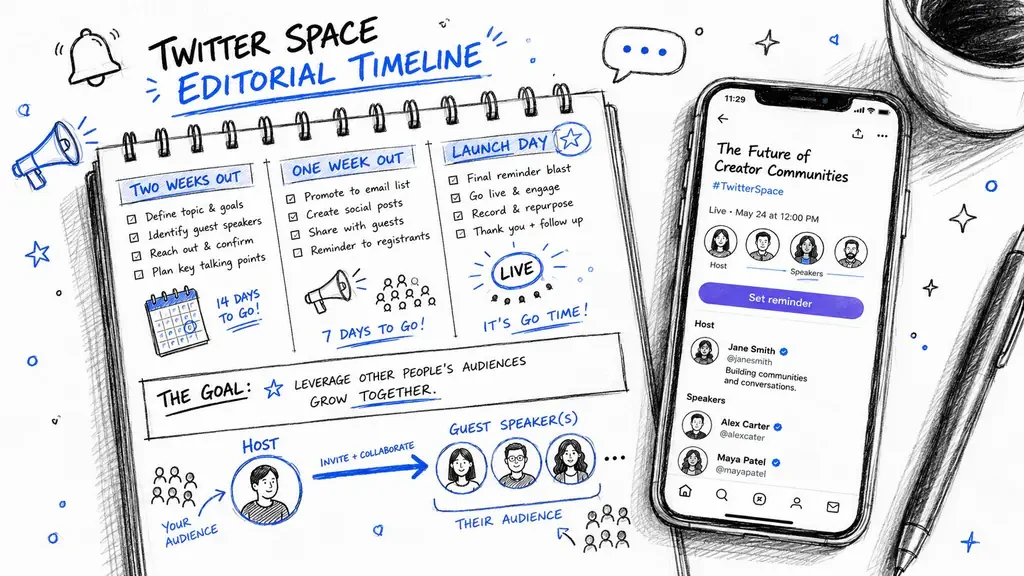
The promotion window matters more than most hosts think. If you only announce a Space on the day it happens, you’re relying on impulse. If you give people time, context, and a reason to care, you’re building attendance from intent instead of luck.
A practical workflow starts two weeks out. First, lock the topic and speakers. Then prepare a short announcement post that leads with the problem, not the event. “We’re hosting a Space” is an announcement. “We’re talking about why small accounts get profile visits but no sign-ups” is a reason to stop scrolling. The best versions read like the opening of the discussion itself.
Build the promotion stack before launch day
The assets don’t need to be fancy, but they do need to exist. Have a pinned context tweet ready, a simple graphic with the working title and speakers, and a follow-up post for people who miss the live session. If you’re using speakers, give each person a specific angle they can share so their post sounds like a contribution, not a calendar reminder.
A useful pre-event checklist looks like this:
- Announcement post: Lead with the problem and who it’s for.
- Question prompt: Ask people to reply with their questions before the Space.
- Context tweet: Pin a post that explains why the room matters.
- Speaker angle posts: Give each co-host a distinct talking point.
- Reminder post: Resurface the room close to start time.
- Replay note: Publish a follow-up for people who missed it.
Asking for questions in the replies is underrated. It does two jobs at once. It gives you research on what the audience wants to hear, and it gives the post a reason to circulate. That’s much better than asking people to “engage” with no clear action.
If your account reach is small, use direct outreach instead of waiting for the algorithm to do the work. A few targeted DMs to relevant founders, creators, or operators can bring in the first listeners who matter. That doesn’t mean spamming people. It means inviting the right people early enough that they can decide whether the topic is worth their time.
For scheduling the companion X posts around the event, this guide on how to schedule Twitter posts is useful because promotion works better when it feels paced, not random. X Spaces also support reminders and scheduled discovery surfaces inside the product itself, and the official Spaces guide explains how live audio, captions, speaker access, and clipping work inside the platform X Business. Use those features as support, not as a substitute for clear promotion.
Hosting the Space for Conversation, Not Broadcast
A Space falls flat the moment the host sounds like they are reading a deck. Open with a real question, one that gives people an easy way to jump in. Ask what they are struggling with right now, or which part of the topic they would challenge first. Early participation matters because a quiet room tends to stay quiet.
A short green room helps more than most hosts expect. Give speakers a few minutes to test audio, agree on the opening question, and decide who covers which part of the conversation. That keeps the live room from turning into a scramble. X lets hosts control who can speak, invite co-hosts, and moderate requests, so use that control to keep the room moving instead of filling every pause.
Keep the pacing visible
Long monologues are the fastest way to lose people. I like to build in audience checkpoints at regular intervals, then pause and ask what listeners think, what they are seeing, or what they want clarified next. That keeps the Space from drifting into a one-way talk.
When listeners request to speak, screen those requests for relevance before you pull them up. A strong question from the audience is often more useful than a polished answer from a speaker. A weak one can drag the session into self-promotion fast. If someone starts pitching, cut it off politely and bring the room back to the topic.
Keep the room useful for the people who showed up to learn, not for the person who wants free airtime.
That matters even more when attendance is lower than you hoped. A small room of twenty relevant people is not a failure. It is often easier to keep that room conversational, and the discussion can be better than a passive crowd. Speak to the room you have, not the room you wanted.
Consent matters if you plan to record. Say it clearly before the Space starts and again during the session if you expect to reuse the audio. X supports recorded Spaces and clipping, and that makes moderation more important because the conversation may live beyond the live moment X Business. If the live discussion is sloppy, the replay will be sloppy too.
If you are building recurring attendance instead of chasing one-off spikes, it also helps to treat the Space as part of a wider community loop. This guide on Twitter community is useful for that structure. The same session can also feed repurposed content, and a practical workflow like ImagineVid AI reuse anime clips for shorts shows how one recording can turn into multiple assets without feeling repetitive.
Repurposing the Space into Weeks of X Content
One Space should not become one giant summary post. That usually reads like a transcript with no point of view, and people skip it. The better approach is to mine the session for a few sharp moments and turn each one into its own asset.
Extract the moments that already carry weight
Look for the parts where someone challenged a common belief, shared a practical process, or answered a question people kept circling back to. Those are your raw materials. A strong opinion can become a short post. A detailed answer can become a thread. A useful exchange can become a clip with written context.
A simple capture workflow helps:
- Record the Space with consent.
- Mark three or four standout moments with timestamps.
- Rewrite each moment into a different format.
- Schedule the follow-ups so they don’t all hit at once.
That gives you more than a recap. It gives you a content system. A founder might pull one pointed takeaway into a single tweet, turn a deeper exchange into a thread, use one quote as the basis for a graphic, and clip one sharp answer into a short video with captions. Add a few reply ideas and you’ve got material for days.
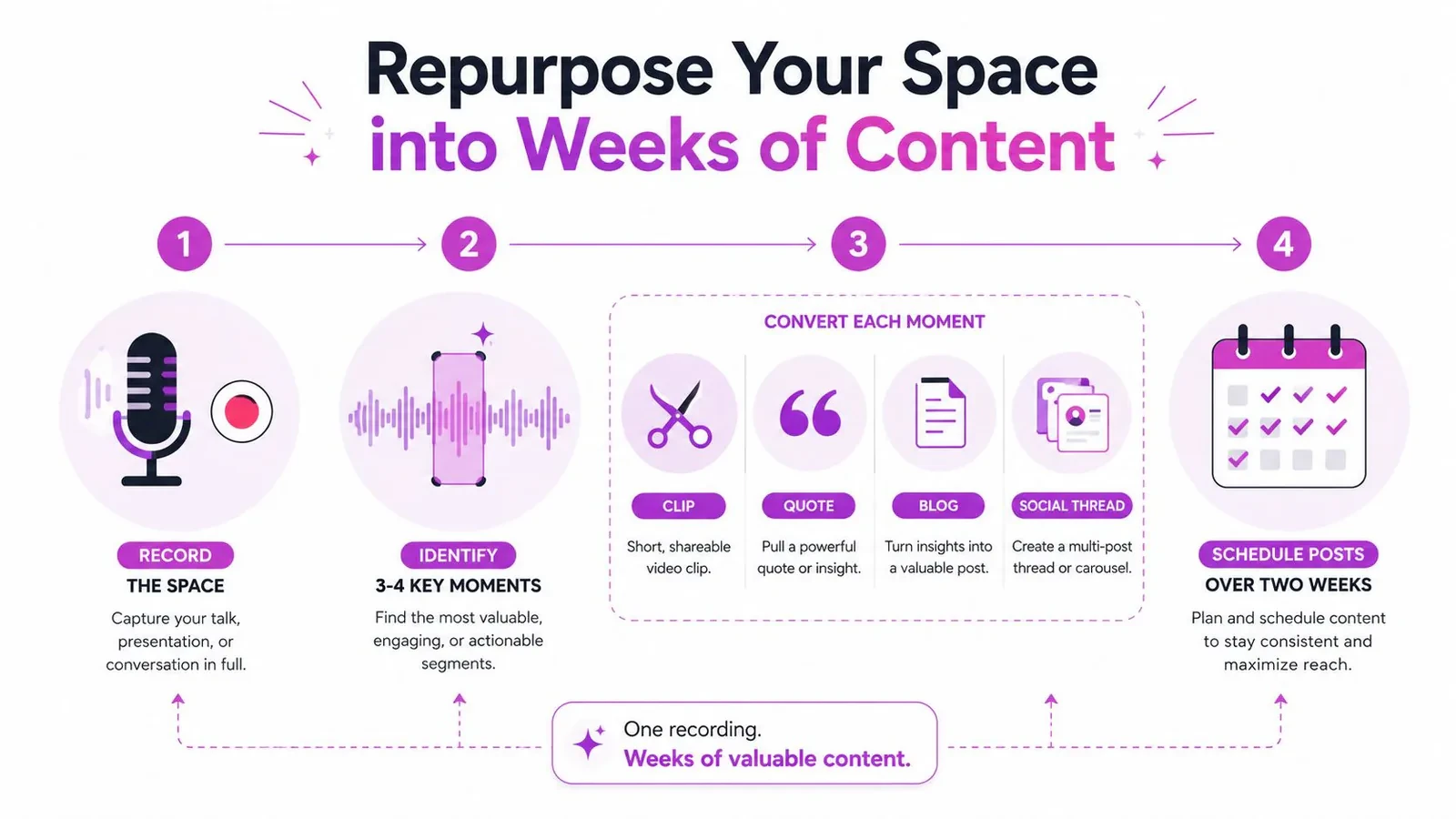
If you want a pattern for how raw media becomes reusable assets, the way short video teams do it is instructive. ImagineVid AI reuse anime clips for shorts is a useful reference point because the same distribution logic applies, one source can feed multiple outputs if you package it differently.
The YouTube embed below is useful if you want a visual reminder of how clip-based repurposing can extend the life of one event.
The key is cadence. Don’t publish everything at once. Spread the content out so the Space keeps surfacing in different formats. That also gives you more chances to see what resonated, which is better research than guessing what the audience remembered. Speaker quotes, audience questions, and recurring objections are all valuable inputs for future posts.
Metrics That Tell You Whether a Space Worked
Attendance alone can mislead you. A room with two hundred passive listeners can be less useful than a room with twenty people asking questions, requesting to speak, and coming back later. If the goal is business development, the success metric has to be clearer than “how many joined.”
A useful measurement stack starts during the Space and continues after it ends. Track who shows up, how many people request the mic, how often the conversation stalls, and whether the room feels active or passive. Then watch what happens next. The central question is whether the Space created signal you can use, not whether it filled a room for a moment.
Measure the conversation and the fallout
The strongest comparisons start with qualitative review. Did people ask product questions? Did the Space lead to DMs? Did anyone mention the event in replies to your follow-up posts? Did new followers come from people who were not already in your circle? Those are stronger signs than a raw listener count.
A simple post-event review keeps the signal visible:
- During the Space: join quality, speaker requests, and how long the room stayed engaged.
- Right after: profile visits, new follows, DMs, and replies on the replay or thread.
- In the following days: product questions, newsletter signups, or trial interest.
- In the following weeks: repeat attendees, relationship depth, and whether the topic deserves another room.
Track overlap honestly. If most attendees already know you, the Space can still be useful, but it is not the same as new audience acquisition.
That distinction matters. A Space with the right people can move conversations forward even when the room is small. If the audience is mostly existing supporters, you are measuring relationship maintenance more than expansion. Both can matter, but they are not the same outcome.
For a broader framework on how to measure content strategy success, the same logic applies here. The specific metrics change, but the principle stays the same. You want to know whether the content changed behavior, not just whether it collected attention.
After each event, use a simple decision rule. Keep the format if the room produced useful conversation and follow-up signals. Change the topic or guest mix if the discussion was flat but the promotion was solid. Drop the format if you keep forcing it and the same people show up without any downstream movement.
Your First Three Spaces and the Workflow That Scales
The cleanest way to start is not to plan a full season. Plan three sessions. Make the first one solo with a sharp, problem-first topic. Make the second one co-hosted with a guest who brings a real audience overlap. Make the third one community-driven, built around listener questions and follow-up discussion.
That sequence teaches you what your audience responds to without overcommitting. It also makes the workflow easier to repeat because each Space gives you new material. Use a scheduler for the announcement posts, a clipping workflow for highlights, and a collections system to save questions, angles, and useful quotes so you’re not starting from scratch every time.
The key advantage comes from keeping your context in one place. If you’re building a consistent voice around the same niche, audience, and product, you don’t want each Space to feel disconnected from the last one. A memory layer that holds your voice, audience, and prior learnings makes the next room easier to prep and easier to keep on-brand.
If you want help turning live audio into a repeatable X growth system, Xholic AI can keep your voice, niche, audience, and Space learnings connected so you’re not rebuilding context every time. It’s built to help you decide what to say next, what conversations are worth joining, and which ideas are worth reusing after the room ends.