Content positioning and formats
Build content pillars, distinctive brand voice, hooks, stories, video demos, and post formats suited to awareness, trust, or conversion.
46%
Best tweets about Social Media Marketing
Explore the best tweets about social media marketing, including content strategy, distribution, creative testing, community, analytics, and campaign results.
Platform-specific social strategy, content, distribution, community, creative testing, analytics, campaigns, and measurable marketing outcomes.
Original Xholic analysis
Across 50 tweets from 39 creators, the conversation favors platform-fit content, useful participation and repeated testing over a single growth hack. Contributors connect social work to leads and customer insight, but disagree on posting frequency and how readily winning formats should be copied. Reported campaign results are individual accounts, not general benchmarks.
66% of posts
All-time engagement
28% of posts
Published in 90 days
Conversation map
Build content pillars, distinctive brand voice, hooks, stories, video demos, and post formats suited to awareness, trust, or conversion.
46%
Grow through useful replies and participation while turning comments, questions, and complaints into audience and product insights.
38%
Use consistent publishing, niche relevance, trends, and knowledge of feed signals to earn reach and followers without relying on ads.
36%
Choose channels by audience and objective, and adapt tactics for X, LinkedIn, TikTok, Instagram, Reddit, and other platforms.
36%
Track performance and meaningful engagement, study winning posts and competitors, test new angles, and use feedback loops to refine content.
30%
Connect social activity to qualified followers, leads, sales calls, sign-ups, trust, and other measurable business results through funnel content and calls to action.
26%
Turn strong ideas and source material into multiple posts and formats, repost evergreen work, and distribute across channels.
26%
Structure announcements and campaigns around attention-worthy framing, timely trends, collaborations, user participation, and shareable creative.
14%
Tone and stance
Performance benchmark
Posts with media make up 44% of this collection. Their median all-time score is 15.2, compared with 18.2 for text-only posts.
Format mix
Consensus and debate
Shared view
Contributors distinguish TikTok discovery, X conversation and LinkedIn credibility; Reddit advice emphasizes answering niche questions before promoting. Cross-posting remains an option, but the message and format should fit the destination.
Shared view
Useful comments can put a brand in relevant conversations. Social managers also describe recurring questions and complaints as inputs for messaging and product teams, rather than merely engagement to count.
Shared view
Posts are framed around discovery, trust or conversion, with LinkedIn examples assigning different content to each stage. Contributors recommend reviewing saves, qualified leads and sales calls alongside reach.
Open debate
One creator argues that more frequent posting supports their sign-ups and leads; another warns that high volume hurts reach, while a SaaS marketer favors fewer, stronger posts. These are conflicting experiences, not a settled algorithm rule.
Open debate
Some recommend studying competitors’ hooks and remixing successful posts. Others warn that recycled templates and borrowed playbooks can obscure a brand’s own voice and audience needs.
What performs
The supplied analytics give platform-specific strategy a median all-time score of 34.52 and organic growth 29.07, versus 10.244 for analytics and creative iteration. These are scores for this evidence set, not proof of which tactic works best.
Media appears in 22 of 50 tweets (44%), yet its median all-time score is 15.2 versus 18.2 for text. The leading outlier, a detailed X tactics post, scores 2860.73; neither observation isolates the effect of format.
Among the supplied format categories, case studies have a median all-time score of 28.514, compared with 7.85 for opinions. Examples report engagement, announcement distribution and LinkedIn sales calls, but those outcomes are self-reported.
Statistical standouts
Creator landscape
The five most represented creators account for 20% of the selected posts.
1. Alex Nguyen
@alexcooldev
2 posts
2. eliane 👾💫
@alieneliane
2 posts
3. Arcadia
@ArcadiaGTM
2 posts
4. Okara
@askOkara
2 posts
5. Hridoy Reh
@hridoyreh
2 posts
6. Nte Daniel || Data Analyst → Engineer
@iam_daniiell
2 posts
The analytics identify 39 creators and a 20% top-five placement share. Alex Nguyen offers channel-specific organic tactics, while Arcadia presents Reddit and announcement examples; both appear twice in the supplied evidence.
Hridoy Reh’s Reddit lists prioritize community participation; Nte Daniel’s dashboard posts focus on cross-platform measurement. Their contributions illustrate different operational sides of social marketing, not validated universal playbooks.
Since the previous snapshot
Themes, sentiment, stance, and post format are classified per tweet. All counts, shares, medians, creator concentration, freshness, and performance comparisons are then calculated directly from the published snapshot.
Xholic's all-time score compares engagement while accounting for reach, post age, and creator consistency. It is used for relative comparisons within this collection.
This report analyzes the exact 50-post snapshot shown below. AI identifies editorial categories and drafts explanations; all statistics are calculated from the snapshot, and every narrative claim is checked against cited posts before publication.
Best Social Media Marketing tweets
Ranked 01–50

@cailynyongyong ·
HOW TO GO VIRAL ON X: complete basics easy mode with first guest as @minmax0501 00:00 Intro 00:50 @getyourmomo 01:16 First guest intro 02:16 Warm up account 02:51 Tip 1: tag communities 04:19 Tip 2: tag famous accounts 05:06 Understanding X audience 06:00 Things that didn’t work 06:28 Linkedin vs X 07:14 Tip 3: post everyday 08:20 Do videos work? 09:03 Tip 4: post successes 09:44 Do multiple channels work? What’s the difference? 10:40 Tip 5: wait for random viral posts 12:00 What’s your brand message? 13:10 Tip 6: Copy viral templates from competitors 13:25 Tip 7: Follow the trend 14:35 How to structure demo videos 15:10 1 second hook 16:13 First 5 seconds matter 17:48 1 feature / video 19:17 Story telling 21:32 Writing good script 22:47 Yeet
 Watch video
@omoalhajaabiola ·
To learn content management and social media marketing, here's a 60-day plan, spending 2 hours per day to develop comprehensive skills. This study plan covers topics such as content strategy, social media platforms, analytics, SEO, and more. Phase 1: Content Management (Days 1–30) Day 1–3: Content Strategy Fundamentals Topics: What is content strategy, setting goals, audience research, content types Resources: https://t.co/DXsx8LYStq https://t.co/K05DNoeNB7 Day 4–6: Creating Content Plans Topics: Editorial calendars, content creation workflows, setting deadlines Resources: https://t.co/zpWHtFZv83 Day 7–9: Content Writing and Copywriting Basics Topics: Copywriting essentials, writing for different platforms, persuasive writing Resources: https://t.co/2gefjOfs5M https://t.co/9CSXYKdpW2 Day 10–12: Visual Content Creation Topics: Basics of graphic design, creating visuals for social media, design tools (Canva) Resources: https://t.co/YYj0fRaSfs Day 13–16: SEO Basics for Content Topics: On-page SEO, keyword research, optimizing blog posts, meta tags Resources: https://t.co/0h6MdBmoW1 https://t.co/b2z2A7dJmk Day 17–20: Content Management Systems (CMS) Topics: Introduction to WordPress, creating blog posts, managing media, themes and plugins Resources: https://t.co/48M4w0v8XB Day 21–23: Content Repurposing and Curation Topics: Repurposing content, using content curation tools, creating value with curated content Resources: https://t.co/oc845NybWE https://t.co/Pp7Esq4At7 Day 24–27: Content Performance and Analytics Topics: Analyzing content performance, setting up Google Analytics, tracking KPIs (engagement, traffic, conversions) Resources: https://t.co/ch5Dz9EADL Day 28–30: Case Study and Practice Topics: Research successful content marketing case studies, create a content plan for a mock brand Resources: https://t.co/8a4QLLDmaf Phase 2: Social Media Marketing (Days 31–60) Day 31–33: Social Media Marketing Basics Topics: Introduction to social media marketing, key platforms (Facebook, Instagram, Twitter, LinkedIn), choosing the right platform Resources: https://t.co/1kdEg17q2a Day 34–37: Audience Building and Engagement Topics: Understanding target audiences, creating engaging content, community building Resources: https://t.co/2rJwx2HzYa https://t.co/9zeEwvOSk9 Day 38–40: Creating Social Media Content Topics: Best practices for different platforms (videos, images, posts), visual content creation tools (Canva) Resources: https://t.co/OVYXjYWROa https://t.co/WD3HPGFi2n Day 41–43: Scheduling and Managing Social Media Topics: Using tools like Hootsuite, Buffer, and Later to schedule posts, social media calendars Resources: https://t.co/KNvRAfmfUb https://t.co/GWXPjWrNgk Day 44–46: Facebook and Instagram Marketing Topics: Creating Facebook and Instagram ads, organic growth strategies, boosting posts Resources: https://t.co/RSYV6JUhIK https://t.co/2fZ0wQXdq5 Day 47–50: LinkedIn and Twitter Marketing Topics: Building professional networks, using LinkedIn for content marketing, Twitter trends, hashtags Resources: https://t.co/GZWoTthcTk Day 51–53: Influencer and Affiliate Marketing Topics: Working with influencers, finding affiliate partners, influencer outreach strategies Resources: https://t.co/FCur9dSxs2 Day 54–57: Paid Social Media Campaigns Topics: Facebook Ads Manager, Google Ads for social media, campaign management, budgeting Resources: https://t.co/AGPIk3aMQP Day 58–60: Social Media Analytics and Reporting Topics: Analyzing social media metrics, using platform analytics tools (Facebook Insights, Twitter Analytics), reporting to clients Resources: https://t.co/srUqE2BLpq

@LoganTGott ·
13 different LinkedIn-style posts you should try: 1. Lead magnet 2. Listicle post 3. Story post 4. Breakdown post 5. Video post 6. Case study 7. Trend/News post 8. Carousel post 9. Infographic post 10. Hot take post 11. Lessons learned post 12. Screenshot post 13. Hard sell post

@alexcooldev ·
Want organic reach without ads? TikTok: – Strong hook in the first 3s – Use trending sounds – Post daily, no excuses – Reply to comments with videos – Hit a clear pain point X (Twitter): – Tweet consistently at peak times – Write value-packed threads – Reply to big accounts in your niche – Use visuals/memes to boost engagement – Ask questions = free interaction boost Simple formula: Be useful. Be loud. Be consistent.

@itsolelehmann ·
how to use perplexity computer to reverse engineer your competitor's social media strategy (in just 1 prompt) you do realize that that person in your niche who consistently goes viral is not *actually* smarter they just figured out which formats, hooks, and topics actually drive engagement in your space. thats literally it and they're running that playbook every single week (while you're manually scrolling their profile trying to reverse engineer it by feel) i used to do this too open a competitor's profile, scroll through their posts, screenshot the ones that popped off, try to spot patterns it took me hours and i'd still miss stuff (v frustrating tbh) but now i have perplexity computer one-shot the whole thing in one prompt here's how: 1. open perplexity computer and give it one prompt: "analyze the last 7 days of posts on X for [competitor handles]. check engagement, bookmark-to-like ratios, hooks, storytelling, product placement. find winning formats, losing formats, and gaps" (add multiple competitors to the same prompt and it cross-references all of them) 2. it spins up sub-agents automatically. • one collects posts • one analyzes engagement metrics • one breaks down topics • one identifies gaps. all running in parallel 3. a few minutes later you get a full analysis doc. • top posts with all the metrics • content mix breakdown by topic • hook analysis showing which openers drove the most results • and how they place their products bookmark-to-like ratio is the one most people sleep on. high ratio means people are saving it because they think it's valuable ( the real signal) and my favorite part is the gap analysis it tells you what none of your competitors are covering. blue ocean. market up for grabs you can also tell it to send you a weekly report via email every monday. connect gmail and the analysis just shows up every week in your inbox so you're always playing with better, up-to-date cards than the people still guessing if you run any kind of brand online and you're still eyeballing competitor accounts manually, this'll save you hours every week
 Watch video
@DeRonin_ ·
X ALGOS: I analyzed 100+ creators this week. what's dead and what wins for bangers: DISCLAIMER: just my personal observations with tracking of new X algorithms [ what's dead ]: - 4+ posts/day (volume is killing reach, not helping it) - generic AI tool roundups (no original take = no reach) - motivational fluff without proof or numbers - "what do you think?" engagement bait closers - text-only posts with no visual hook - recycled viral templates (audience recognizes them now) - thread openers that don't work as standalone posts - vague advice with zero personal experience behind it [ what just won ]: - first-person proof posts ("I built X / I shipped Y / here's what happened") - tactical playbooks with numbered steps and real examples - contrarian takes backed by screenshots, revenue, or data - text + image combos (outperform either alone every time) - long-form posts (4000-char breakdowns get mass-reach) - one strong opinion per post instead of three hedged ones - personal stories with specific numbers ($X → $Y in Z weeks) - responding to your own replies in the first 30 min [ formats that are mass-printing impressions ]: - hook + 5-8 numbered steps + closer (the tactical playbook) - "$X → $Y in Z weeks" + full breakdown (the proof post) - "here's what nobody talks about:" + insider breakdown - short videos (under 90s) showing real work, not promo - greentext-style narratives (> on every line, punchline at the end) - Short or Long form videos with insightful long videos + CTA [ tone that wins ]: - "I built this" over "you should build this" - concrete numbers over vague claims - builder energy over guru energy - direct "you" over generic third person - one specific story over five abstract tips - raw and imperfect over polished and empty [ the play starting today ]: 1. cut posting to 2/day max. quality > volume (especially if you're new creator) 2. every post needs a visual — image, video, or carousel 3. reply to every comment in the first 30 min 4. write from experience, not observation 5. one bold opinion per post, backed by proof 6. stop chasing formats. start chasing stories ofc you can post like 2 quality posts per day + some shit post/memes/quick thoughts but it should contain good thoughts and be creative, most of you couldn't do that screenshot this. algorithm cycles repeat every 6 months.


@ArcadiaGTM ·
X is an echo chamber. Reddit isn’t. For one of the fastest-growing tech companies, we bypassed the noise and spoke directly to the people already using the product. The result: social engagement up 50%, millions of impressions, and a brand-new audience discovering the product. The takeaway: sometimes the most impactful growth comes from knowing where your real audience lives, not where everyone else is talking.


@kzitouni1 ·
you can just - start an account on X - publish 3-4x/day - do 30-40 comments/day - meet and be friends w/ cool founders - grow by 1700 follows in 10 weeks if you don't quit and eventually turn it into a distribution machine best platform ever.

@KevinSzabo14 ·
“Algorithm this” “Algorithm that” It’s changing every 3 days at this point. Honestly I don’t know or care anymore. Over the last 15 months my posting strategy has been the exact same and it works. Some months preform better, and some preform worse. But with consistency you can’t lose. I’m currently posting 20x a day, engaging with 50-100 new accounts and reply to most people on my posts, simple. And anything extra engaging is just for fun. And I don’t plan to stop posting this way. - People are saying to post less and comment more. And on the other I’m hearing post more and comment less. What I do know is when I post less, my business gets cut in half. Through posting more I’ve tripped my daily email sign ups. Through posting more I’ve generated more warm leads either through email or DMs. Through posting more I’ve blown up my brands engagement, thus more conversions. Here’s what I can confidently say: Posting more quality will always better you. Why? Because no algo can determine what is good or bad content. It only considers how many and who interacts with certain content. Which is why one liners do so well. (I’m not saying I don’t do them). —- I guarantee this exact post will get less than 100 likes to prove my point, if not? Great I was wrong! But at least I’ll have people reading. And that’s why I’m on X and love the community :) PS: for the love of everyone’s sake X.. please fix the TL.. it’s horrible for everyone, not just me.
@ArcadiaGTM ·
Algo Hack: We generated 30,000 organic posts for a client's announcement. Here's how: With our content framework, we have been able to consistently land on X’s News section. The focus was positioning. Over the past few months, our team has been refining a content framework built specifically around how people consume posts on X: – stronger hooks – clearer narrative framing – cleaner information flow – formats designed to hold attention longer Small changes in structure completely changed how far the posts travelled. Most content doesn’t underperform because the announcement is weak. It underperforms because the positioning never earns attention in the first place.

@alexcooldev ·
Organic marketing on Tiktok, X, Reddit, IG notes (no ad budget, just hustle): – Post daily, even when no one’s watching (super important) – Comments > posts (engage to grow) – Repurpose old content that worked – Focus on one platform at first – Be funny, be real, be useful – Don’t chase virality, chase consistency – Use notes app like a war room – Talk to your audience, not at them – Show behind the scenes (people love raw) – Write like you talk – Use trending formats, but make it yours – Pin your best post – Treat every post like it could be your first viral – Study what worked for others, then remix it – Add value, don’t just add noise – Don’t ghost after going viral, double down – Momentum > perfection Most underrated growth hack? Outlast everyone.

@robj3d3 ·
Marketing a product isn't "post everywhere". TikTok = discovery X = conversation LinkedIn = credibility If you don't know what each platform is doing, your launch will flop.

@coreyhainesco ·
I updated /social with a listening workflow. Instead of "post more," it asks: which 10 posts should you comment on today? You maintain a `listening-sources.md` file — target accounts, keywords, subreddits, do-not-engage list. The skill pulls fresh posts (Reddit / Hacker News / Bluesky via public APIs, LinkedIn + X via dev-browser), scores each by ICP fit, intent signal, and comment opportunity, then drafts comments matched to the post's tier. Most engagement advice is "be consistent." This is "engage with intent." It's part of Marketing Skills — free, open source, 44 skills for AI agents like Claude Code, Cursor, and Codex. npx skills add coreyhaines31/marketingskills
 Watch video
@DanielSmidstrup ·
I connected X to Google Search Console today. As I have noticed something interesting: Google seems to be crawling X posts as SEO data, especially for its AI-powered search features. That made me rethink posting. Every post might now be doing two jobs: - starting a conversation on X - becoming searchable context for Google’s AI So posting consistently may not just be a social investment. It could become an SEO investment too.


@hridoyreh ·
Reddit marketing that works: 1. Build karma first 2. Answer questions daily 3. Target small subreddits 4. Post at peak times 5. Share case studies 6. Post valuable guides 7. Be early on new posts 8. Use soft CTAs 9. DM only when invited 10. Use storytelling posts 11. Share failures openly 12. Create comparison posts 13. Offer free resources 14. Comment on viral posts 15. Use curiosity hooks 16. Share templates/checklists 17. Ask engaging questions 18. Repurpose old content 19. Engage with every reply

@codyschneider ·
founder led marketing is easy just do this interview people in your industry extract insights from the transcript turn video into long form podcast for yt audio to RSS for podcast upload video twiXer insights turned into posts for twiXer and linkedin film short form videos based on key ideas schedule to all social channels with ordinal MCP

@iam_daniiell ·
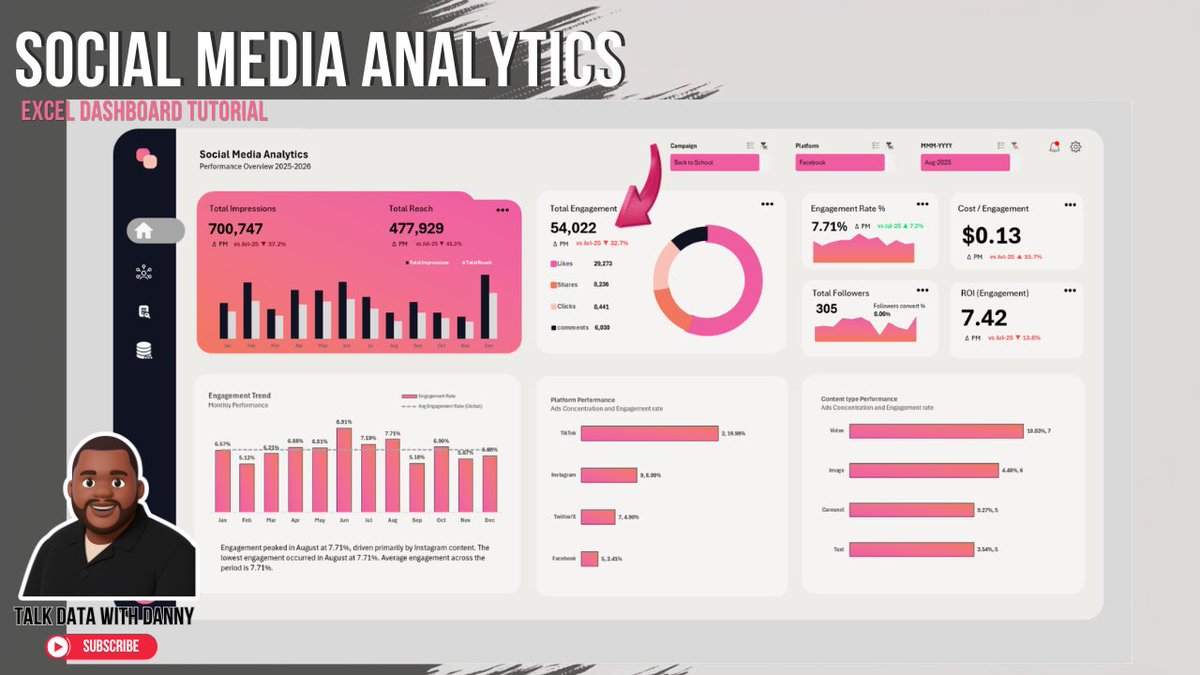
𝗜’𝘃𝗲 𝗯𝗲𝗲𝗻 𝗾𝘂𝗶𝗲𝘁 𝗼𝗻 𝗬𝗼𝘂𝗧𝘂𝗯𝗲 𝗳𝗼𝗿 𝗮 𝘄𝗵𝗶𝗹𝗲. That changes today at 4PM. I’m dropping a full Social Media Analytics Dashboard build in Excel. Not a quick overview. A complete step-by-step build from a blank sheet. Here’s what’s inside: → KPI cards with MoM directional arrows → Dynamic insight text that writes itself → Platform × Content heat map matrix → Connected slicers across two dashboard pages → 39 measures built from scratch TikTok, Instagram, Twitter/X, Facebook — all in one dashboard. Subscribe and turn on notifications so you don’t miss it 👇 https://t.co/cQSfna56jc #Datafam


@dan__rosenthal ·
My team hit 8M+ impressions and booked 100+ sales calls from LinkedIn by sticking to this 12 week content system: (bookmark this) • 3 posts a week. • 36 posts after 12 weeks. 1. TOFU post for reach and discovery 2. MOFU post for authority and credibility 3. BOFU post for conversion and lead gen The 12 weeks split into 3 phases: • Weeks 1-4: Positioning (hero journey, resource lists, tech stack, process breakdowns) • Weeks 5-8: Authority (feature updates, SOPs, case studies, comparisons) • Weeks 9-12: Conversion (handraisers, announcements, playbooks, case study infographics) Try this!

@askOkara ·
some tips on how to create content for your brand's x account 1. export your last 1000 tweets using the twexportly chrome extension, drop them into a doc, upload that doc to okara, ask it to analyze your tone, style, voice etc. then generate new tweets that sound like you 2. check the top tweets that worked well for you and repost them. you can always repost winning content 3. steal your competitors' best tweets. if you open their twitter account in incognito mode, x will show you their top tweets. take inspiration and create similar content 4. ask your team what they shipped this week and announce those features on social media 5. when you see a post from any brand account going viral, take a screenshot of it and save it in a folder. when you're running out of ideas, go through the folder to get inspiration 6. record a lot of demos using screen studio and post them. 7. hop on trends. whenever a trend is going on, see if you can plug your brand into it. if it gets traction, you may get featured in the trending section

@wizofecom ·
Posting good content isn't enough in 2026. Here's how to actually become an authority with your personal brand: The new formula is Content X Distribution X Strategy Phase 1: Content 1. Content that sounds like you talking to a friend, not Claude writing for you 2. Zero AI tells. no em dashes, no "it's not X, it's Y" stacks, no rhetorical openers 3. Posts written in your real voice, not a polished corporate version of it 4. Opinions you actually hold, not the ones that perform well 5. Stories from your own business that nobody else can copy 6. Consistency. one banger every two months will not get you there Phase 2: Distribution 7. Being in the right conversations before the algorithm even sees you 8. A dream 100 list of accounts you want in your network 9. Real replies on the posts your buyers are already reading 10. Qualified views beat raw views. The algorithm is interest-based now, it pushes you to people who already engage with your topic 11. Quote tweets with your actual take, not "this" Phase 3: Strategy 12. Agents hunting the platform every week for the best performing formats in your space 13. Tracking what got bookmarks, DMs, qualified leads. not likes 14. 50% of next week's content is angles on what already worked 15. The other 50% is new tests so you never go stale 16. Weekly feedback loops. better hooks, better structure, better numbers, every single week 17. Content is the product. distribution is the shelf. strategy is the operator running both Anyone can write a post in 2026 but almost nobody runs all three phases. That gap is where the micro authorities get built.
@iam_daniiell ·
𝗜𝘁’𝘀 𝗹𝗶𝘃𝗲. Full Social Media Analytics Dashboard — built in Excel from a blank sheet. Here’s what’s waiting for you: → KPI cards with MoM directional arrows → Dynamic insight text that writes itself → Platform × Content heat map matrix → Connected slicers across two dashboard pages → 39 measures built from scratch TikTok, Instagram, Twitter/X, Facebook — all in one dashboard. 2+ hours. Nothing skipped. Watch it here 👇 https://t.co/XlhAg083Lj #Datafam
@hridoyreh ·
30 Reddit marketing tactics that work: 1. Answer questions in niche subreddits. 2. Share a free tool with the community. 3. Post case studies with real numbers. 4. Comment before posting. 5. Create value-first text posts. 6. Turn FAQs into Reddit threads. 7. Share behind-the-scenes progress. 8. Offer free audits/roasts. 9. Post templates people can copy. 10. Reply within the first hour. 11. Use native images. 12. Cross-post relevant content. 13. Build karma before promoting. 14. Mention competitors naturally. 15. Ask controversial questions. 16. Share mistakes and lessons. 17. Create weekly update threads. 18. Give away free resources. 19. Find pain points in comments. 20. Post data-backed insights. 21. Be active in rising posts. 22. Use storytelling instead of pitching. 23. Create subreddit-specific content. 24. Share useful spreadsheets. 25. Offer beta access. 26. Turn comments into leads. 27. Engage with every reply. 28. Post at peak subreddit hours. 29. Build relationships with moderators. 30. Become known for one topic.
@KevinSzabo14 ·
Social media success requires active, consistent engagement. Reply to every comment on your posts. Respond to others content on the TL. Participate in conversations when they appear. Post frequently and strategically to increase your presence in feeds. Relentless effort drove my brand over the edge.

@semrush ·
The work you put into social media SEO can now shape your brand's visibility across multiple search experiences beyond social platforms, including AI Overviews, AI Mode, ChatGPT, and more. For years, "social media SEO" meant winning in-platform search and appearing in the feed. Brands optimized captions, hashtags, and bios to climb TikTok's For You page or surface in Instagram's Explore. That still matters. But using social media to influence external search visibility and shape how LLMs talk about your brand is now just as important. Our AI visibility study found that Reddit, LinkedIn, YouTube, Facebook, and Instagram are among the top domains LLMs cite. When a buyer asks ChatGPT "which managed WordPress host should I pick," answers are often pulled from Reddit threads, YouTube tutorials, and LinkedIn posts https://t.co/mI3b6Yg5V8.

@wizofecom ·
If you want to build authority with your personal brand on X/Linkedin, try this for 90 days (takes less than 45mins/week) ANALYSIS • Go through your previous week's content • Look at the average likes per post • Find the posts that outperformed your normal avg • Narrow down what made them hit • Come up with new angles around those winning topics • Create iteration posts on top of them. This is the lowest hanging fruit you have access to. FILTERS • Go to X advanced search • Filter by your account name • Set a minimum like threshold that's strong for your account • Make sure the posts are at least 60-90 days old • Find the buried winners • Create fresh content around those topics. 95% of your followers haven't seen your older content. Also as your audience grows the new people have no idea your older posts exist. STUDY • Find 3 accounts in your niche or in a similar space • Run the same advanced filter settings from above on their accounts • Pull their best performing content from at least 60 days ago • Take note of the style and topic of those pieces • Add your own unique twist on top. • Scroll through their recent posts • Flag anything that performed unusually well for their account size. MINE • Go to your website • Scroll through your account • Collect every case study • Log every client result • Write down every transformation you have. • Each one is a content topic waiting to be written These are the posts that build the most trust because they show proof in your expertise. OTHER SOCIALS • Some founders post their best performing content on Instagram • Others on YouTube • Others on LinkedIn • They rarely ever bring it to X • Go to those accounts • Find the winners that already proved they resonate with an audience • Rebuild them for X with a fresh angle INTERVIEW • Ask 1-3 specific questions about what's going on in the business right now • E.g, what problems clients are bringing up • E.g. what lessons were learned this week. • The best content ideas come from conversations • Take those experiences happening in real time and flesh it out in a way people want to hear. TRACK • Identify the news • Look for conversations that accounts in your space are commenting on • When a major platform announces a new feature • Or an industry leader makes a controversial move • Or a trending topic directly relates to your niche • Create an opinion post around it with your unique take. • Make this a part of your weekly process without exception. LEVERAGE • If you're running content for multiple personal brands in your business • Keep a database of winning topics • Go back through that library • See what you can repurpose for the current account • A topic that crushed for one founder in a similar niche can be adapted with a different angle and different proof points for another. Rotate through all 8 every week and you'll have more banger ideas than you know what to do with.

@mark_k ·
I've used to AI to analyze the latest open source 𝕏 algorithm, so you don't have to do it! 🫡 X’s For You algorithm is not just a follower feed anymore. It pulls from two worlds: Posts from accounts you follow Posts from outside your network that match your behavior The key part is prediction. X tries to estimate how likely you are to like, reply, repost, click, watch, dwell, share, quote, or follow the author. But it also predicts negative signals: not interested, block, mute, report, and low dwell time. So reach is not only about getting engagement. It is also about avoiding negative feedback. A few things stand out: Dwell time and video views matter. Replies, reposts, shares, quotes, and profile clicks can all help ranking. Content outside your follower graph can still spread if it matches interest patterns. Repetitive posts from the same author may be downranked for feed diversity. Seen or recently served posts are filtered out. Block, mute, report, and "not interested" signals can suppress distribution. Practical takeaway: Optimize for real engagement depth, not just likes. Posts that make people stop, reply, share, click, watch, or follow are much more valuable than passive impressions. But rage bait is risky. It may get clicks, but if it also creates mutes, blocks, reports, or "not interested" signals, the system has explicit ways to push it down. My read: X is increasingly less a follower feed and more an interest and predicted-engagement marketplace. Your followers help seed distribution, but broader reach depends on whether X predicts strangers will engage positively.

@LoganTGott ·
4 TOF post types that actually grow your LinkedIn audience. 1. Trending news commentary News commentary gets you in front of new audiences because people are already searching for it. 2. Framework or playbook posts Frameworks get saved and shared because they're useful. 3. Data-driven storytelling Data posts stop the scroll because people love specifics. 4. Business or personal stories Stories build trust because they're yours and nobody else can copy them. This is ALL focused on getting you relevant engagement that can then be turned into leads with MOF and BOF content.
@askOkara ·
we've analyzed 1000+ viral campaigns. here are 7 ways to go viral on social media: 1. create something nobody has done before - duolingo announced on social media that duo the owl had passed away. - coinbase spent its entire super bowl ad showing a qr code moving around a blank screen like an old dvd screensaver 2. capitalize on news, memes, or trends - when openai introduced ads, anthropic launched an ad-free campaign declaring that claude would remain ad free. - when whatsapp faced backlash over privacy-policy changes, signal used this moment to run marketing campaigns and showcase its privacy features - recently, two people climbing the empire state building went viral. it became a template almost any startup could use, no matter how big or small 3. borrow someone else’s distribution - collaborate with person/company that has attention. supreme collaborated with oreo to create limited-edition red cookies. dunkin’ created “the charli” drink with charli d’amelio - if you want to do a viral launch with influencers on X, try our influencer agent 4. reverse engineer popular content in your industry - find winning content, study the hook/format, apply it to your brand. are people in your niche going viral with launch vids? try that. are they going viral with lead magnets? try that. are companies in your niche going viral with ugc? try that 5. turn your users into marketing - spotify wrapped, strava stat card, github's year in review, dropbox's referral program, notion pages shared publicly 6. post more to increase your surface area for luck - publish useful, entertaining, or relatable content consistently. you never know which post will take off 7. take a bold stance or make a surprising claim. - our launch video went viral because it was positioned around replacing humans/agencies every viral campaign we've studied fits into one of these buckets what else would you add?

@onlinedopamine ·
for those solely posting to tiktok and/or instagram: always, and i mean always, cross-post your videos to youtube, facebook, X, and threads for example, the youtube views i'm getting on the character swap format i'm testing are higher than both instagram and tiktok combined plus, those videos are also helping me to increase my subscriber count, which will probably benefit the long-form content i am simultaneously creating i also recently talked to a prospective customer who gets the majority of his app sales from facebook reels (we are starting with it now, will report back) moreover, i've seen app founders like cormac from oasis absolutely crush it posting his short-form videos to X this is ultimately why tools like @genviral_ exist and help you save time cross-posting said content btw, we'll be adding bluesky, threads, and X soon because of exactly this observation!


@Nicolascole77 ·
All social platforms go through phases. In 2021, anyone writing X threads went obscenely viral. X also powered 99% of our multi-million dollar business. In 2026, X now drives <20% of our leads and engagement/reach is a fraction of what it used to be (for us). Whereas LinkedIn is driving way more leads and way more reach. Which is why you should just focus on building a LIBRARY of content—that you can copy/paste over to the next-new platform where there is an attention arbitrage opportunity.

@Eli5defi ·
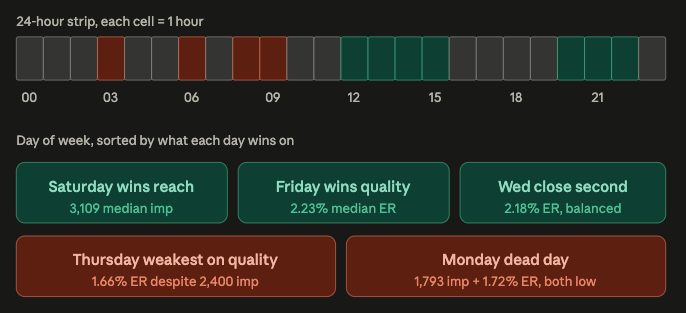
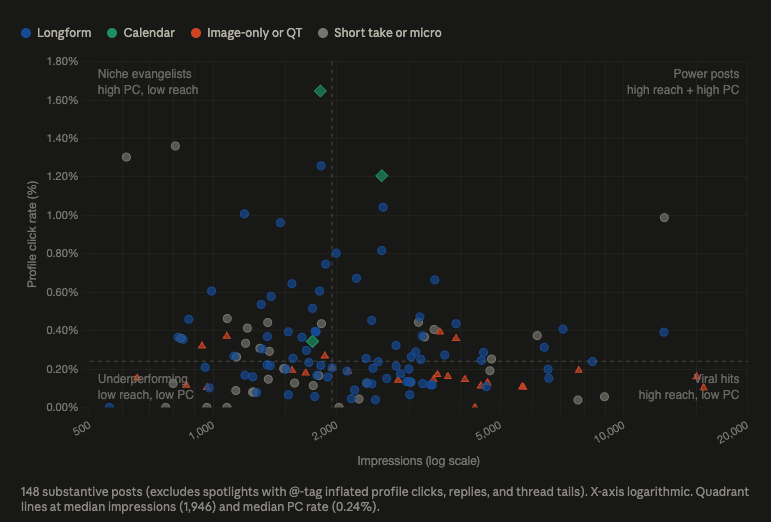
Distribution is king, and that’s never been more true for content creators. If you’re a creator using @typefully and @claudeai, you’re leaving a lot on the table if you’re not using this 3-step method to optimize your posts: - Set up your Typefully MPC in Claude - Ask Claude to run an analytical review of your post using the prompt below - Review and take action as per suggestion --- You are an expert Social Media Strategist and Data Analyst. Objective: Perform a comprehensive performance audit of my [Platform Name, e.g., X, LinkedIn, Threads] account using my exported analytics data from Typefully MCP. Provide a strategy that balances growth with time-efficiency. → Content DNA & ROI The “Stickiness” Factor: Identify which content categories (e.g., Educational, Personal Stories, News Updates, etc.) have the highest Save/Bookmark-to-Reach ratio. Which posts are people keeping for later vs. just scrolling past? The “Show More” Trigger: For long-form text or threads, analyze the hook (the first 2 lines). Which opening styles consistently get users to click and read the full post? Media vs. Message: Compare the performance of text-only posts vs. posts with images/video. Is the extra effort of creating visuals resulting in a proportional increase in Profile Visits or Link Clicks? → Time & Velocity Mapping The High-Engagement Window: Pinpoint the 60-minute windows when my audience is most “reactive.” Don’t just give me a time—explain the Engagement Velocity (how fast interactions happen in the first 30 minutes) and how it affects overall reach. The “Quiet Hour” Opportunity: Are there times when engagement is lower but reach is high? Identify whether I should post during off-peak hours to face less competition in the feed. → Repost/Retweet Spacing Strategy The Frequency Audit: I currently repost my own content at [Insert your intervals, e.g., 1hr - 6hr - 12hr]. Based on the data, is this causing “feed fatigue” (the same people seeing the post too many times), or is it successfully reaching new time zones? The 24-Hour Flywheel: Design an optimized repost schedule that covers three distinct global regions (e.g., morning in the US, EU, and Asia) without overlapping on a single user’s timeline more than once every 8 hours. → Conversion & Growth Funnel Follower Attribution: Which specific posts actually drove New Follows? Distinguish between "Viral Hits" (high views/low follows) and "Community Builders" (low views/high follows). Bio & Call-to-Action (CTA) Check: Based on the spikes in profile visits, suggest 3 ways to optimize my Bio or Pinned Post to convert more visitors into long-term followers. ---

@ProofofIntern ·
social media managers are basically audience researchers with worse job titles. they see what people actually say, not what the brand wishes they said. they see the confusion, repeated questions, complaints, jokes, the weird language customers use, the objections that keep coming up and posts people ignore even though the team thought they were important. that's valuable as hell. but in most companies, social still gets treated like the final step in the content machine. someone writes the campaign then someone approves the messaging then someone builds the deck and only then does the social team get handed the polished version and told to make it work on socials. which is backwards. the person reading the replies all day probably knows where the messaging is unclear. the person watching what people share probably knows which angles actually land. the person seeing the same complaint for the 47th time probably knows what the product page, launch post or campaign is failing. social media managers aren't just there to post the approved words. they're sitting on live audience insight every single day. most brands just don't know how to use it.


@KyennMark ·
Social Media Management Is More Than Posting A lot of founders think the role of a social media manager is just to post content and keep the page active. That is only a small part of the job. The real role of a social media manager is to become the eyes and ears of the internet for the project. You are the closest person to the community. Every day people reply to posts, send messages, complain, suggest ideas, and talk about what they like or don’t like about the product. Your job is to capture those signals. Not just read them and move on. You must document them. For example, imagine the project is a gaming platform and several users start saying the same thing about a character design. Maybe they feel the character doesn’t look strong enough or they prefer another style. Once you start hearing the same complaint from multiple people, that is no longer just a random comment. That becomes valuable product feedback. You take that information and pass it to the developers or the founding team. Now the builders can improve the product based on real user feedback. This applies to any type of project. If it is a trading platform, users may complain about the interface being confusing. If it is a Web2 product, users may complain about a feature not working smoothly. If it is a Web3 project, users may talk about transaction speed, wallet issues, or usability. All these things are signals. Your role is to collect them, organize them, and report them clearly. That alone can help improve the product significantly. Another responsibility is driving engagement. Engagement is how you keep the community alive. Replying to comments, encouraging discussions, asking questions, highlighting community contributions. When people feel heard, they stay longer and become more loyal to the project. In larger companies, the strategy may also include ads and paid promotions. Content builds attention, and ads help push that attention to a wider audience. But the most valuable thing a social media manager can bring to a project is information. Information about what the community is thinking. Information about what the users want improved. Information about what is working and what is not. When you consistently deliver this kind of insight to the team, you are no longer just managing social media. You are helping the project build a better product through community intelligence. And when you reach that level, it becomes very difficult for a project to replace you.

@jakezward ·
X just dropped my new favourite feature: filter any profile's posts by "Most liked." This is a game changer if you create content. 1. Find top accounts in your niche 2. Filter by most liked 3. Study what works 4. Make it your own I grew to 100K on LinkedIn in 10 months doing exactly this. Now X makes it easy.

@ProofofIntern ·
random social content 'hacks': - repost evergreen content regularly, change up view points/media types/copy to keep them fresh. - create multiple variations of the same post, schedule them in the future. - have a schedule, but make it flexible & adaptable for trends/changing narratives. - break down blogs to create social content. what would you add?

@ishverduzco ·
Creating great content is only about half of the game on social. Maybe a little less. You can only ship so many posts in a day until you start becoming annoying on the timeline. But if you’re doing social for a big brand then you likely have hundreds, if not thousands of mentions on any given day across platforms. Community management is the grunt work of the job but is easily one of the best ways to 10x your brand. Not just for impressions and engagements, for improving sentiment, awareness, and building relationships with superfans.

@asmartbear ·
The point of social media marketing for companies is to establish a trust-relationship. If you don’t build that, it’s just more advertising, i.e. broadcasting. I’m not against advertising, but it means you’re using the medium incorrectly, and thus ineffectively.

@MythThrazz ·
First of all welcome to all of my new followers, these last two days were really crazy :) Many of you asked about my marketing methods/strategy and I promised a post instead of replying in the comments, so here goes: >> MARKETING << 1) I've started by creating a dedicated claude code project called 'marketing' 2) Then I've created wide range of marketing skills - for seo, writing, etc. 3) Created marketing materials about all of my products ( name, various lengths of descriptions, colors, url, tagline etc.) I called them 'dossiers' 4) I got a list of catalogs/launchsites from here https://t.co/IPX6yMrd89 (@joncphillips 🙏) 5) Asked Opus to go through this list and filter out paid ones, ones that require captcha etc. 6) Then told Opus to register/launch in all of them, starting with the higest DR ones (managed to get around 40 - a lot of them are either already dead, or very low quality, but plenty are awesome) 7) Meanwhile asked to write advertisment/launch posts for: a) Reddit b) Linkedin c) Facebook group (Each different) 8) Prepared the 'persona' of my ideal customer and started looking for emails of such people/companies for my cold email campaign 9) Send 600+ cold emails (various formats) 10) Meanwhile writing here on X daily - 50-100 replies and 3-10 posts [ ALWAYS MANUALLY 0 AI ! ] 11) Worked on SEO of the sites [ registered in Google Search Console, in Bing Console, in WaybackMachine in Yandex ] 12) Started posting daily on LinkedIn - the series of non-trivial WordPress optimization techniques (non-trivial, original content) 13) Posting content on blogs semi-regularily with syndication to (Blogger, Devto, Medium, Substack) 14) Created a free companion Google Chrome Addon (WP Site Inspector) 15) Posting and commenting daily on: X, Reddit, LinkedIn - trying to be helpful, funny and showing expertise in the field and advertising the product when it fits 16) Recorded some videos on YT (few long forms, few shorts) And that's it. At least at the moment I don't remember anything else.

@ishverduzco ·
With the cost of content basically going to zero, social feeds will only get exponentially more crowded. Bots & AI compound this. I suspect X (and other social platforms) will continue categorizing creators into niche groups in order to provide the best user experience for the average consumer. As for creators, it seems the more consistent you are about posting within a niche topic, the greater the distribution amongst the audience that cares about that topic. (X rolling out Starterpacks further confirms this) Sorta feels like we're going back to the old Twitter. Which is fantastic. I've noticed a huge improvement in my feed. Not as much raigebait, irrelevant news, & AI slop. The playbook is simple: 1) pick a topic 2) post helpful or relatable content about that topic 3) follow other creators within the niche 4) engage with them daily 5) be consistent for months... then years Looking forward to spending a lot more time on this platform this year @nikitabier. Well done.

@alieneliane ·
you can't build a strong social media strategy based on vibes alone there needs to be a structure behind it or else how do you justify your decisions? without systems, clear metrics, and workflows, you start every day staring at a blank page instead of learning from what you've already done

@vali_turbo ·
This article by @hustle_fred is a gold mine. He breaks down X's algorithm from their public code reveal. Here are the top 5 takeaways I took, and how you can apply them throughout your build in public journey👇: 1. Warm up first. No cold posts. - Spend 10-15 mins liking/replying to your network before dropping content - Reminds the system you're connected. Gets those early views from followers 2. Invite more than likes. - Algorithm scores on diverse actions: replies, bookmarks, clicks, profile visits - Ask questions. Share checklists people save. Add links they click and make posts that spark real interaction 3. Leverage social proof. - Tag or reply to bigger accounts in your niche - Their retweet or comment unlocks out-of-network reach (friends of friends) - One nudge from a mutual can 10x impressions 4. Stick to one theme. - Don't jump topics, because the algorithm groups you into "SimClusters" like startups or design - Consistency builds association. Switch too much, and you confuse the system and hide yourself. 5. Spark conversations - End with a question. Respond fast to early comments - Turns a post into a thread of activity. More replies = more push - Mix hot takes, threads, graphics, lists What I will apply: Prime (warm up) → Post (themed content) → Reply (fast) → Amplify (nudge mutuals). Make sure to bookmark this for your next X push. Big thanks again to @hustle_fred for the fantastic article, and I urge everyone to check out @supabird_io; it's such an underrated gem of a tool. Read it below for yourself: https://t.co/BuXJFLllvM

@lukmanAufbau ·
Let's start with the thing nobody wants to hear. You don't have a content problem. You have a format problem. Here's what I mean Most creators on X are writing text. They open the app, type a thought, hit publish, and hope the algorithm does something with it. That's not content. That's journaling in public. Content is different. Content has three things text doesn't: Structure: a deliberate format that shapes how the reader experiences the idea. Direction: a clear job the post is doing in your audience's journey. A conversion goal: attract, build trust, nurture, or sell. Every post should do one of these. Not all four. One. When you write text, results are random. When you write content, results are repeatable. Think about the last post you saw that stopped your scroll. I'd bet it wasn't the most insightful thing you read that day. It was the most structured. The hook was sharp. The format was familiar enough to feel safe but surprising enough to earn attention. The payoff delivered on the promise the first line made. That's not talent. That's a formula. Formulas are learnable. The uncomfortable part Most creators who plateau at 500, 2,000, or even 10,000 followers aren't there because they lack ideas. They're there because they're posting the same type of content over and over without realizing it. There are 15 content format categories. Each one does a different job. Some attract brand new followers. Some build trust. Some warm up followers who are close to buying. Some directly convert. When you know which category you're posting in, and why, your feed stops being random and starts being a funnel. That's what this course is about. Your one action for today Go look at your last 10 posts on X. For each one, ask: what job was this post trying to do? Was it meant to attract new followers? Build trust? Sell something? Or did you just post? If you can't answer that question for most of them, you now know exactly why growth has felt inconsistent. P.S. If this helped, share it with another founder. And if you would rather focus on building while someone else handles your distribution, here are a few ways I can help:https://t.co/N32mnXqH90 Stay Creative, Lukman ✍


@aaliya_va ·
X has released the code behind much of its "For You" feed. In a simple version: it learns from your behaviour, predicts which posts you are likely to enjoyor dislike and ranks your feed around that. Likes help but they are not the main story. The platform values deeper actions more: replying quote posting sharing and especially copying a link to send elsewhere It also watches negative signals closely. If a post makes people mute, block, report or mark it as uninteresting, its reach can fall fast. The system also favours new content, gives some preference to accounts you follow and limits how often the same author appears. so my fellow content creators,founder: do not optimise for empty engagement optimise for relevance,conversation and work worth sharing.


@avijeet_writes ·
I think I have cracked the X algorithm for you. Another client's win case study. In the last 30 days, I've doubled: - the impressions, - engagements, - likes and - profile visits for one of my coaching clients. Earlier, the client had multiple interests, and we tried to focus on everything. The audience got confused, followers didn't see any value, and they stopped interacting with the core expertise of the client. For the past 2 months, we rerouted our strategy. - 75% of content: subject matter expertise only. - 20% of content: content focuses on engagement – well-researched, meaningful comments on similar big accounts. - 5% content: something new – something that the client might want to express his personal opinion on. Every personal brand is unique; no two are alike. You never know what will work for you. There is a simple strategy to that: experiment for 90 days; just try to find what exactly your audience is looking for from you. Find that fast, and then leverage it. If you're a coach who wants to build authority and generate leads for your services, DM me "Personal Brand" and let me help you build one.


@ApTora_ ·
crafting a social media content strategy 𝑑𝑒𝑣𝑒𝑙𝑜𝑝 𝑐𝑜𝑛𝑡𝑒𝑛𝑡 𝑝𝑖𝑙𝑙𝑎𝑟𝑠 > you need to choose your main topics for example; creator growth, on chain insight or brand building 𝑠𝑐ℎ𝑐ℎ𝑒𝑑𝑢𝑙𝑒 𝑐𝑜𝑛𝑡𝑒𝑛𝑡 𝑐𝑎𝑙𝑒𝑛𝑑𝑒𝑟 > plan what you will post and when, this will keep you consistent instead of posting randomly 𝑎𝑑𝑎𝑝𝑡 𝑡𝑜 𝑝𝑙𝑎𝑡𝑓𝑜𝑟𝑚𝑠 > don’t post the same way everywhere what works on x might not work on other platforms adjust your style to fit each 𝑡𝑒𝑙𝑙 𝑣𝑎𝑙𝑢𝑒 𝑑𝑟𝑖𝑣𝑒𝑛 𝑠𝑡𝑜𝑟𝑖𝑒𝑠 > don’t just post info share experiences lessons, and results this is what builds connection and trust 𝑛𝑜𝑡𝑒: it’s good to diversify don’t stay in one platform
@alieneliane ·
good social media marketing is about discovering new ways to transmit the same message without understanding the pain points, the feelings, the why, you're just going to turn your content plan into a printing machine of the same plain message that's too mild for people to care to prevent that: be more curious instead of marrying someone else's success playbook

@ChrisClickUp ·
5 things I wish someone told me before I started running social for a SaaS company: 1. Your competitors' content strategy doesn't matter as much as you think. I used to spend hours studying what other companies posted. Then I realized the posts that performed best for us were the ones that sounded like us. Not like a better version of someone else. Find your voice first. Worry about the competition second. 2. One great post a week beats 7 mid posts. We used to chase volume. Post every day. Fill the calendar. The content was fine. But fine doesn't get shared. When we slowed down and focused on making every post worth someone's time, everything changed. 3. Distribution is the job. Creating content is maybe 40% of the work. The other 60% is getting it in front of the right people. Repurpose everything. One video becomes tweets, LinkedIn posts, email content, community threads. If you made something good, put it everywhere. 4. Your audience will tell you what to make next. Read your comments. Read your DMs. Read your subreddit. The best content ideas don't come from brainstorms. They come from the questions your audience is already asking. 5. Nobody cares about your product as much as you do. And that's fine. Your job is to make them care about the problem your product solves. Lead with the problem. The product is the punchline. Running social for ClickUp taught me that the best marketing doesn't feel like marketing. It feels like help.


@Web3Alex_ ·
The best marketing teams in Web3 treat every campaign as a data point — not a deliverable. What converted. What didn't. Which creator's audience actually engaged versus just viewed. Which narrative angle got replies versus likes. Marketing without a feedback loop is just spending with extra confidence. The teams winning right now are the ones who treat every post as information for the next one.

@bradsmith ·
If you want followers on X (Twitter) try this. Try X ads to show up in front of your ideal customer every single day. Here’s how to launch your first campaign: 1. Claim the $500 ad credit 2. Start with a reach campaign 3. Target follower lookalikes 4. Promote a post most likely to get followers 5. Test 5–10 organic posts 6. Let them run for 1–2 weeks 7. Retarget everyone who engaged The goal isn’t just clicks. It’s getting the right people to follow you, see your content, and remember your brand. Then the hard part - retarget them to they never forget about you. Simple campaign. Clear audience. Better followers.
 Watch video
@sharyph_ ·
Not growing on Twitter? You might be missing these key strategies. ↓ Here are the secrets to growing your audience and transforming followers into real opportunities: 1️⃣ Write every single day for 30 days—consistency builds momentum. 2️⃣ Pick a subtopic within a mega category and commit for at least a year—become the go-to expert. 3️⃣ Craft a bio that’s clear, benefit-driven, and focused on the value you provide—make people hit "Follow" instantly. 4️⃣ Capture email addresses from day one with a relevant pinned asset—own your audience, don’t rent it. 5️⃣ Study and adapt to viral content formats within your niche—play the game the smart way. The secret? Twitter (X) rewards those who show up, stay focused, and provide real value. Which of these are you already doing?
Best Social Media Marketing tweets
Xholic studies what works in your niche, drafts posts in your voice and schedules them for the hours your audience is online.
$0 today · Cancel anytime
Browse all tweet collectionsKeep exploring