Most affiliate marketing advice on X treats the platform like a generic link bucket. That’s the wrong mental model. X (formerly Twitter) works more like a real-time relationship channel, where reply quality, account trust, and link handling can matter as much as the offer itself. If you keep posting clean affiliate links into a cold feed, you’ll usually get less reach than the advice blogs imply, and you’ll miss the faster-moving deal moments that make X useful in the first place.
Affiliate marketing has also been active on Twitter for a long time, which is part of why the channel still matters. Early reporting already showed affiliates averaging about 120,000 tweets per week, with 60% to 70% using social media, and 47% using Twitter specifically, according to MarTech’s discussion of a 2011 dataset (MarTech). That history matters because it shows X isn’t a novelty channel. It’s a mature surface with its own distribution rules, and those rules shape what converts now.
Why X Is Not Just Another Affiliate Channel
Most platforms reward a polished post and a clean click path. X rewards something messier, conversation, timing, and account context. That is why affiliate marketing on Twitter tends to work best when the account behaves like a credible curator or operator, not a billboard. A feed full of direct offers signals low trust fast, while useful replies and useful posts keep the account in circulation longer.
The link distribution reality
The biggest mistake is assuming a link is just a link. On X, link distribution is shaped by how the platform handles outbound posts, so generic “post more links” advice breaks down quickly. The practical problem is not only whether people want the offer, it is whether the post gets enough distribution to earn a click in the first place.
That is why format choice matters. If the link is the whole post, you are asking for clicks before you have earned attention. If the post creates relevance first, the link becomes the next step instead of the only reason to exist.
Practical rule: on X, the post has to earn the click before the click can earn the commission.
Klap’s promote and earn page is a useful reminder that many creators approach affiliate work as distribution design, not just offer selection. That framing fits X much better than the old “drop a link and hope” playbook.
Why the platform still matters
X still has one advantage that slower channels do not, immediacy. Early reporting from 2011 showed Twitter already had a meaningful place in affiliate discussion, and more recent industry commentary from WeCanTrack shows the channel remains part of active affiliate promotion today, even if adoption is uneven. That mix matters for focused operators, because it keeps the feed less crowded than broader social channels and leaves room for sharp positioning.
The historical scale and the current uneven adoption point to the same conclusion. X is not the place for broad, generic affiliate spam. It is the place where specific audiences, timely angles, and credible profiles can still create meaningful response. If you treat it like a relationship channel with link constraints, the tactics start making sense.
A clean profile helps too. If you want the account to convert before the post, use the same trust signals discussed in this guide to Twitter profile optimization, then make the posts do the rest.
Building a Profile That Converts Before You Post
A profile on X has to do the work of a landing page before anyone clicks a post. If a visitor can’t tell who you help, what you talk about, and why they should trust you, they’ll bounce before they ever see an affiliate link. That’s true whether you’re promoting SaaS, finance tools, creator software, or deal alerts.
Make the profile read like a niche signal
Start with the bio. It should explain your niche in plain language, not like a brand deck. “AI tools for solo founders,” “budgeting apps and cash-flow systems,” or “creator workflows for X” is far better than vague identity copy. The goal is to make the profile look specific enough that the right person thinks, “this account is for me.”
The pinned post should reinforce that promise. A pinned post that explains your approach, shows one useful example, or points to a bridge page creates a much cleaner handoff than a random promo. If you need a framework for the profile itself, this guide to Twitter profile optimization is a strong reference point for thinking about trust signals, bio clarity, and profile positioning.
The header and profile link should match the same story. If you’re curating software, show that visually. If you’re sharing finance offers, avoid a playful header that looks unrelated. Consistency matters because people on X decide quickly whether an account is a real source or just another promoter.
A good affiliate profile does not scream “buy now.” It says, “I know this lane, and I’ll save you time.”
Choose the right destination
Direct affiliate links can work when the post itself is highly relevant and the audience already trusts the account. But in many cases, a bridge page, a lead magnet, or a content page makes more sense because it lets you explain the offer, add context, and reduce friction. That’s especially true when the audience is cold or when the product needs explanation before the click.
Profile links can also do more work than post links. If you’re posting repeatedly about the same niche, the profile click becomes a softer conversion path. A visitor who isn’t ready to buy can still learn from the profile, browse your pinned content, or pick up the idea that your recommendations are curated, not random.
The best affiliate profiles on X usually look like editors, operators, or specialists. They don’t feel like funnels until the moment the visitor chooses to click. That’s the threshold you want before any offer appears.
Solving the Link Visibility Problem on X
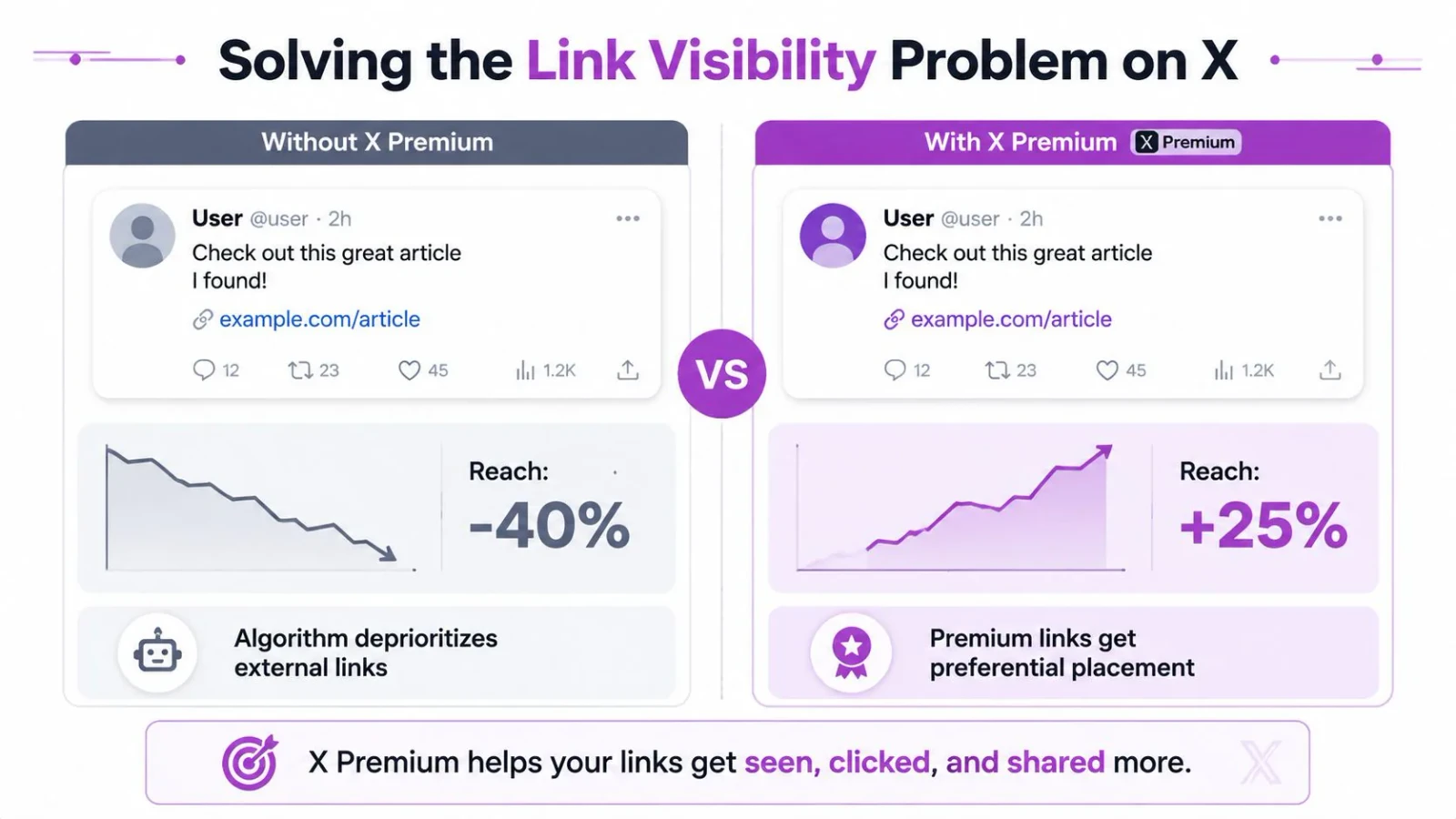
The hard part of affiliate marketing on Twitter is distribution. The offer is usually easy to find. The problem is getting the link in front of people without flattening the post’s reach.
A link in the wrong place can turn a useful post into one that barely moves. That’s why experienced operators test placement, format, and timing instead of treating every promo like it should be published the same way.
The link placement tradeoff
There are five common approaches, and each one gives up something.
- Main post link. Clear and direct, but often the most exposed to weaker distribution.
- First reply link. Better for reach, because the main post can stay cleaner and earn engagement before the click appears.
- Bridge page link. Slower, but useful when the offer needs context, comparisons, or several choices in one place.
- Profile click. Good for softer conversion paths and repeat visitors who still need time.
- Quote post. Useful when you want to add perspective, respond to a trend, or keep the offer inside a wider conversation.
The question is simple. Do you want the best chance of a direct click, or the best chance of the post being seen first? Those are different outcomes, and X does not always reward them equally. If you are testing a new audience, reach may matter more than convenience. If the audience already knows you, a direct link can be worth the distribution cost.
The profile setup from earlier matters here because a profile click only helps if the page looks trustworthy. Without that, you are just moving the same issue one step later.
Use the format that matches intent
A high-intent deal often fits best in the first reply, because the main post can frame the value before the affiliate URL appears. An educational post usually works better with a bridge page, since readers need more context than a tweet can hold. In a thread, the final tweet or a reply can work if the value story is strong enough to justify the ask.
Link placement should be a distribution choice, not a habit. Account tier can change how link posts perform, and the pinned tweet can carry a more permanent offer or hub when you want the profile to do some of the selling. A pinned tweet guide is useful if you are deciding whether your top post should sell directly or just set context.
The practical lesson is to keep the main post easy to engage with, then decide where the URL belongs based on intent, trust, and how much reach you are willing to trade for speed.
Content Formats and Cadence That Build Trust
Affiliate conversions on X usually come from accumulated trust, not one brilliant sales tweet. That means your feed has to give people enough value that the eventual recommendation feels earned. The practical version of that is a content mix that keeps your account useful before it becomes promotional.
What to post more often
A simple ratio recommended by affiliate-focused guidance is about 80% value posts, 10% personal insight, 5% affiliate promotion, and 5% community engagement (Affiliate School). The exact mix can vary, but the principle is right. If every post is a pitch, your audience learns to ignore you. If most posts help them, the recommendation lands with more credibility.
The formats that tend to work best are the ones that feel native to X:
- Standalone posts with a sharp hook. Lead with a useful observation, a quick comparison, or a contrarian point.
- Educational threads. Use the thread to unpack a problem, then naturally point to a product or tool that solves part of it.
- Reply-based visibility. Useful replies build familiarity and often perform better than isolated promotional tweets.
- Quote posts with context. These let you respond to a trend, product launch, or industry conversation without sounding like an ad.
If you need a workflow to keep that cadence steady, this how often to post on Twitter guide helps frame the consistency question without pushing you into spammy volume.
Embed the offer inside the usefulness
A good affiliate post doesn’t announce itself like an ad. It solves something first. For example, a thread about building a lightweight creator stack can end with a tool recommendation that matches the workflow. A post about deal hunting can mention the product only after it has established why the discount matters.
Readers don’t object to affiliate links as much as they object to being interrupted by them.
That distinction matters. You can mention a tool in a way that feels like a recommendation from experience, not a hard sell. That’s especially true in niches where people are already comparing products, such as SaaS, finance, analytics, and creator tools. The more the post sounds like a useful note from an operator, the less it feels like promotional clutter.
For teams using Xholic AI, the workflow tools can support this kind of content without replacing judgment. Features like Reply Deck, personalized replies inside X, and Tweet X-Ray can help identify useful conversations and study the structure of successful posts before you adapt them to your own context. That still leaves the human decision in place, which is exactly what this channel needs.
The Responsive Deal Workflow for Time-Sensitive Offers
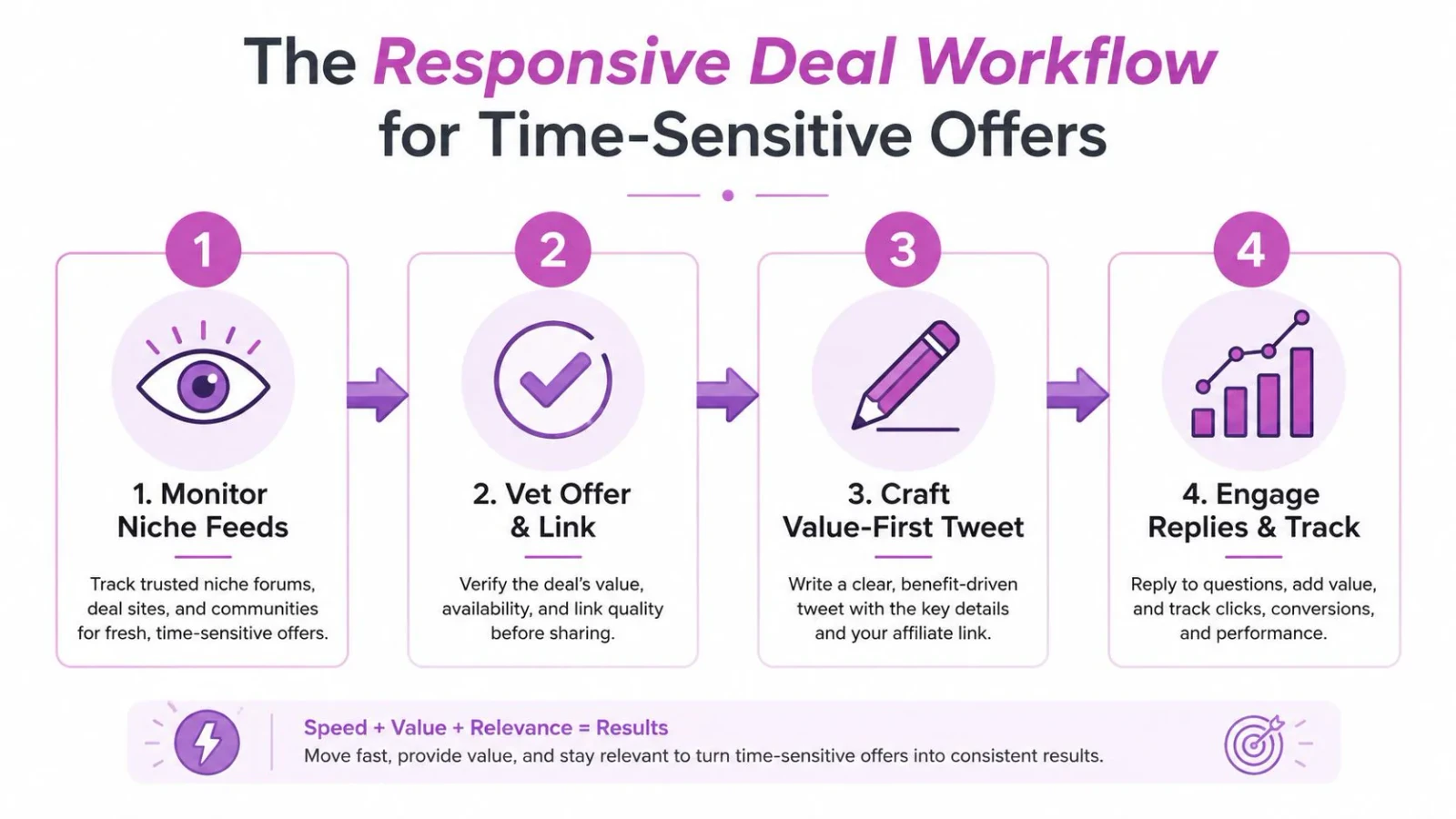
X is unusually good for time-sensitive affiliate work because people are already scanning the feed for deals, launches, and fast-moving recommendations. The trick is to publish quickly without turning the account into a deal dump. A responsive workflow gives you speed and keeps the post useful enough to deserve engagement.
What makes a deal post useful
The strongest deal tweets don’t just say “discount available.” They tell the reader what changed and why it matters. A useful post usually includes the discount, the original price, the sale price, the duration, and the affiliate link, which is the kind of detail a recent guide explicitly recommends for immediate posting around time-sensitive offers (UseArticle).
That structure works best for products people already understand or actively compare. Software trials, creator tools, consumer electronics, and niche ecommerce offers tend to fit better than obscure products that require heavy persuasion. If the audience already has purchase intent, speed becomes more valuable than a polished long-form pitch.
The line between useful curation and spam is frequency plus relevance. If every post is a discount blast, people stop treating the account as a filter. If the feed only lights up when a real opportunity appears, the audience can learn to trust the alerts.
A fast publication loop
The workflow is straightforward. Monitor deal sources daily, follow aggregator accounts, and publish immediately when the offer looks real and relevant. Before you tweet, confirm the terms, check that the link resolves correctly, and decide whether the main post, first reply, or profile link is the cleanest path.
A strong response post usually starts with the practical angle. Why should someone care about this offer now? What problem does it reduce? What’s the deadline? Then, after that framing, the link can do its job.
If reply volume starts to build, don’t ignore it. People often ask about fit, refund policy, feature differences, or whether the discount is still active. In that moment, the comments are part of the conversion path, which is why a resource like Exerta’s cost of ignoring ad comments is relevant even outside classic ad campaigns. The same idea applies here, unanswered questions kill momentum.
The short version is simple. On X, deal posts work when the audience can act immediately and trust the curator enough to do it.
FTC Compliance and Attribution Tracking
Affiliate work on X needs two things most creators underinvest in, disclosure and tracking. Without disclosure, you create legal risk. Without tracking, you can’t tell which posts are worth repeating. Both belong in the setup, not as a cleanup task after the fact.
Disclosure basics
Use clear affiliate language in the tweet itself, not hidden somewhere the reader may never see. The safest approach is to put the disclosure near the start of the post or at least close to the link, so the relationship is obvious before anyone clicks. Phrases like #ad or #sponsored are common disclosure markers, and the checklist should also include making the disclosure visible alongside the offer itself, not buried in a thread reply.
The practical rule is simple. If the post is promoting a product you benefit from, say so plainly. Don’t assume readers will infer it from context, and don’t bury the disclosure where it disappears after expansion. The clearer you are, the less likely the post becomes a compliance problem later.
Tracking that survives X behavior
Tracking starts with a unique URL for every campaign or post variation. Use UTM parameters so traffic can be separated by tweet, thread, or reply. Then connect those URLs to your affiliate network dashboard and, if needed, a link shortener that gives you click-level analytics. That makes it possible to see which creative formats lead to conversions instead of just impressions.
This is also where a focused analytics workflow helps. If you want a more practical setup for reading X data, the Twitter analytics guide is a useful companion for connecting content performance to business results.
A clean tracking checklist looks like this:
- Disclosure first: make the affiliate relationship obvious in the post.
- Unique links: separate each campaign with its own UTM setup.
- Dashboard review: compare click data against affiliate conversions.
- Offer labeling: keep the offer ID in your notes so you can map results later.
The goal isn’t perfect attribution. It’s enough signal to know which formats deserve another run and which ones should be retired. Once that loop is in place, you stop guessing about what works on X and start making decisions from real campaign behavior.
Common Mistakes and Your First 30 Days
Most affiliate marketers on X fail for the same predictable reasons. They post too many promotions, they treat replies like an afterthought, they use generic links with no context, and they expect the account to convert before it has earned trust. The platform is unforgiving when the feed looks like a sales wall.
What to avoid first
The first mistake is overposting promotional content. Even a good offer feels cheap if it’s surrounded by nothing but product links. The second mistake is ignoring replies, because X still rewards back-and-forth more than silent broadcasting. The third is failing to optimize the profile, which means every click has to do extra work to figure out who you are.
There’s also a compliance blind spot. If you’re uncertain about disclosure wording, it’s safer to check a proper legal resource before you start scaling. A tool like the legal AI chatbot from LegesGPT can help you think through language and risk more carefully, especially if you’re operating across multiple offers or jurisdictions.
A 30-day rollout
Use the first month to build the machine, not chase revenue headlines.
- Week one, profile and research. Tighten the bio, pin a useful post, and collect a list of accounts, creators, and deal sources worth watching.
- Week two, posting habits and replies. Publish value-led posts and spend real time in relevant conversations, especially where your audience already talks.
- Week three, introduce recommendations. Add affiliate mentions inside useful posts, not as isolated ads.
- Week four, review and refine. Check which posts earned clicks, which replies drew attention, and which formats felt natural enough to repeat.
The important part is restraint. X rewards accounts that act like informed participants, not aggressive promoters. Build that posture first, and the affiliate layer becomes much easier to sustain.
If you want a faster way to find worthwhile conversations, study successful post structures, and keep your affiliate workflow consistent without living inside the feed, Xholic AI is built for that. It helps with personalized replies, conversation discovery, and context-aware drafting, so you can decide what to say next and keep the affiliate side of X grounded in real context instead of guesswork.
For the broader revenue strategy, start with how to make money on Twitter and compare affiliate income with the other realistic revenue paths. Then use the X Monetization Calculator to test commission rates, conversion assumptions, and contribution before committing to a campaign.