For most X (Twitter) accounts under 10,000 followers, a strong starting point is 3 to 5 original tweets per day plus 15 to 30 replies per day. That number works well as a baseline, but it isn’t a magic number, because the right cadence depends on your goal, your audience size, and how much quality content you can sustain.
The counterintuitive part is that posting more can hurt you. Plenty of people obsess over daily tweet count and ignore the two variables that change outcomes: reply volume and content quality under load. If your posts compete with each other, or your quality drops because you’re forcing volume, your reach can flatten fast. The better way to think about how often to post on Twitter is as a decision framework, not a universal rule.
If you’re a founder building in public, your rhythm should usually look different from a brand account. If you’re a creator chasing follower growth, your mix should look different from an analyst using Twitter to stay top of mind in a niche. The practical question isn’t “What’s the perfect number?” It’s “What posting system can I run every week without burning out or cannibalizing my own reach?”
How Often Should You Post on X (Twitter)
Post often enough to learn fast, but not so often that quality drops or your own posts crowd each other out.
For most accounts, there is no single right number. The better default is a range you can sustain for weeks, not a burst you abandon after four days. On X, frequency only works when it matches your ability to produce strong ideas, stay in conversations, and turn one good post into several useful variations.
That is why a fixed posting rule usually fails. A solo founder, a media brand, and an analyst covering live news are operating with different constraints. The right cadence comes from three inputs:
- Goal: Are you trying to grow reach, build authority, drive leads, or stay top of mind?
- Stage: New and mid-sized accounts usually need more experimentation than established accounts.
- Capacity: How many solid posts, replies, and remixes can you publish each week without slipping into filler?
I use a simple standard with clients. Your ideal frequency is the highest cadence you can maintain while keeping posts distinct, useful, and worth replying to.
Replies matter here more than many guides admit. Posting frequency is not just original tweets on a calendar. If you publish a few strong posts but never join active conversations, growth usually stalls. If you post constantly but every tweet says the same thing in a slightly different format, reach gets noisy and results flatten.
A better way to think about X is as a mix of original posts, replies, and remixed ideas. One sharp opinion can become a short tweet, a follow-up thread, three replies under bigger accounts, and a quote tweet with a fresh angle. That is how active accounts stay visible without writing from scratch all day. If you want a broader system for organic Twitter growth, start there and treat frequency as part of the engine, not the whole strategy.
The essential question is not, “How many times should I post?” It is, “How much quality conversation and repeatable signal can I produce every week?” That answer holds up much better than any universal posting quota.
A Goal-Based Framework for Your Posting Frequency
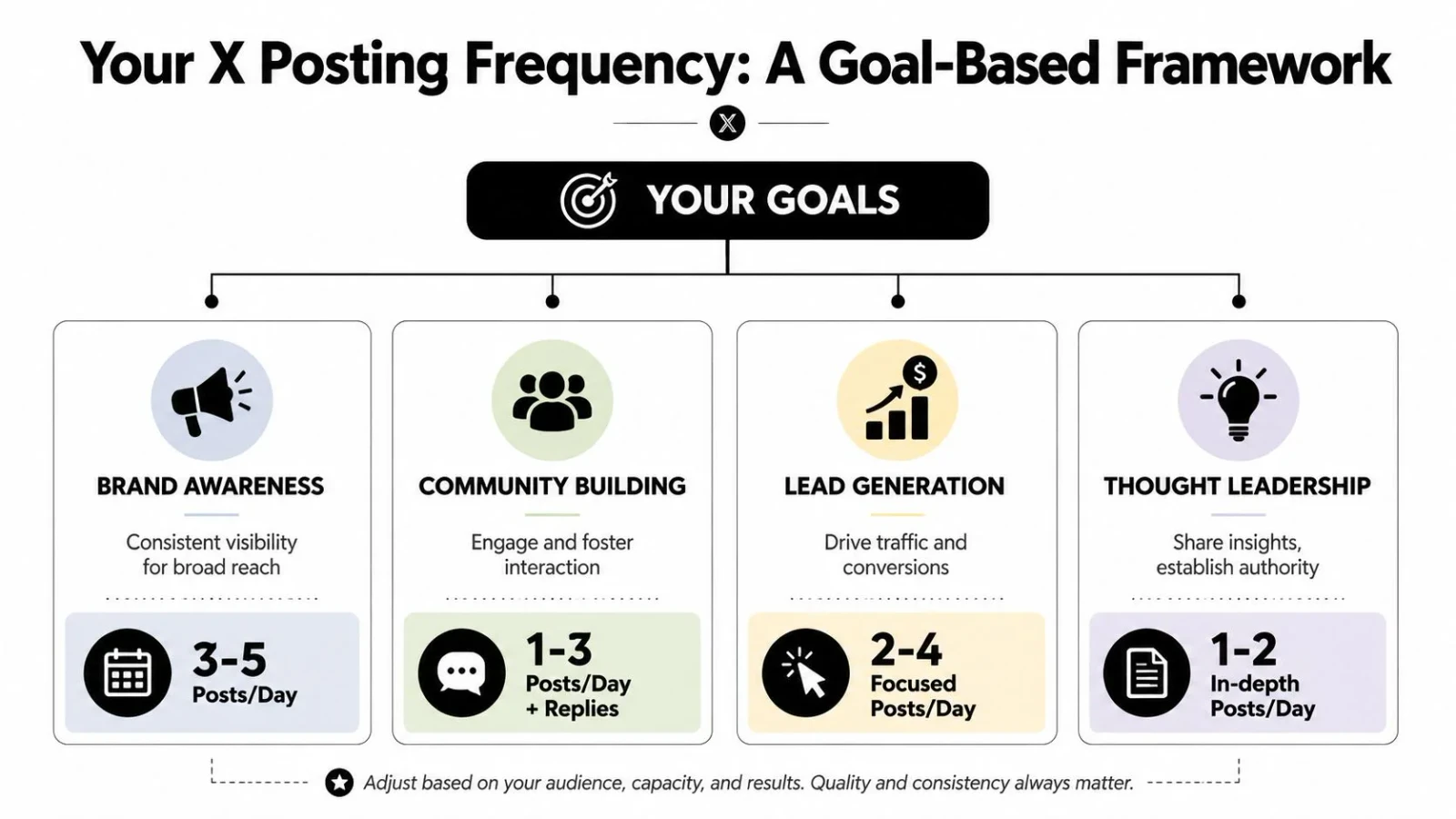
Most advice on Twitter posting frequency fails because it starts with a number instead of an objective. That’s backwards. The right cadence comes from what you’re trying to get the account to do.
Pick the outcome before you pick the number
A founder building in public usually shouldn’t copy a media account. Data cited by Monolit’s founder-focused analysis suggests founders and indie hackers do well at 3 to 7 posts per week, or roughly 5 posts per week, because the constraint is often quality and sustainability. That’s a very different operating model from brands and news-oriented accounts, where 3 to 7 tweets per day can be standard.
Here’s the practical split:
| Primary goal | Better cadence mindset | What usually works |
|---|---|---|
| Brand awareness | More touchpoints across the day | Consistent daily posting |
| Community building | Fewer original posts, more conversation | Replies matter as much as posts |
| Lead generation | Focused posts tied to offers or proof | Clarity beats volume |
| Thought leadership | Fewer, sharper posts with a strong point of view | Depth and consistency |
The mistake is using a growth-account playbook when your real goal is trust. If you’re a founder, one thoughtful post that triggers relevant replies can outperform several generic updates.
A simple way to match cadence to intent
Use this decision filter:
- If your goal is follower growth, lean toward a higher baseline and tighter iteration.
- If your goal is authority, reduce volume and raise standards.
- If your goal is community, put more effort into replies than into cranking out extra originals.
- If your goal is campaign visibility, increase frequency for the duration of the campaign, then normalize.
A creator account often benefits from a “visible every day” rhythm. A founder account often benefits from “worth reading when it appears.” Those are different games.
For a deeper playbook on account-level growth strategy, Xholic has a useful article on organic Twitter growth that pairs well with this framework.
If your content gets weaker as your frequency rises, your posting schedule is too aggressive for your current system.
How Follower Count Changes Your Posting Cadence
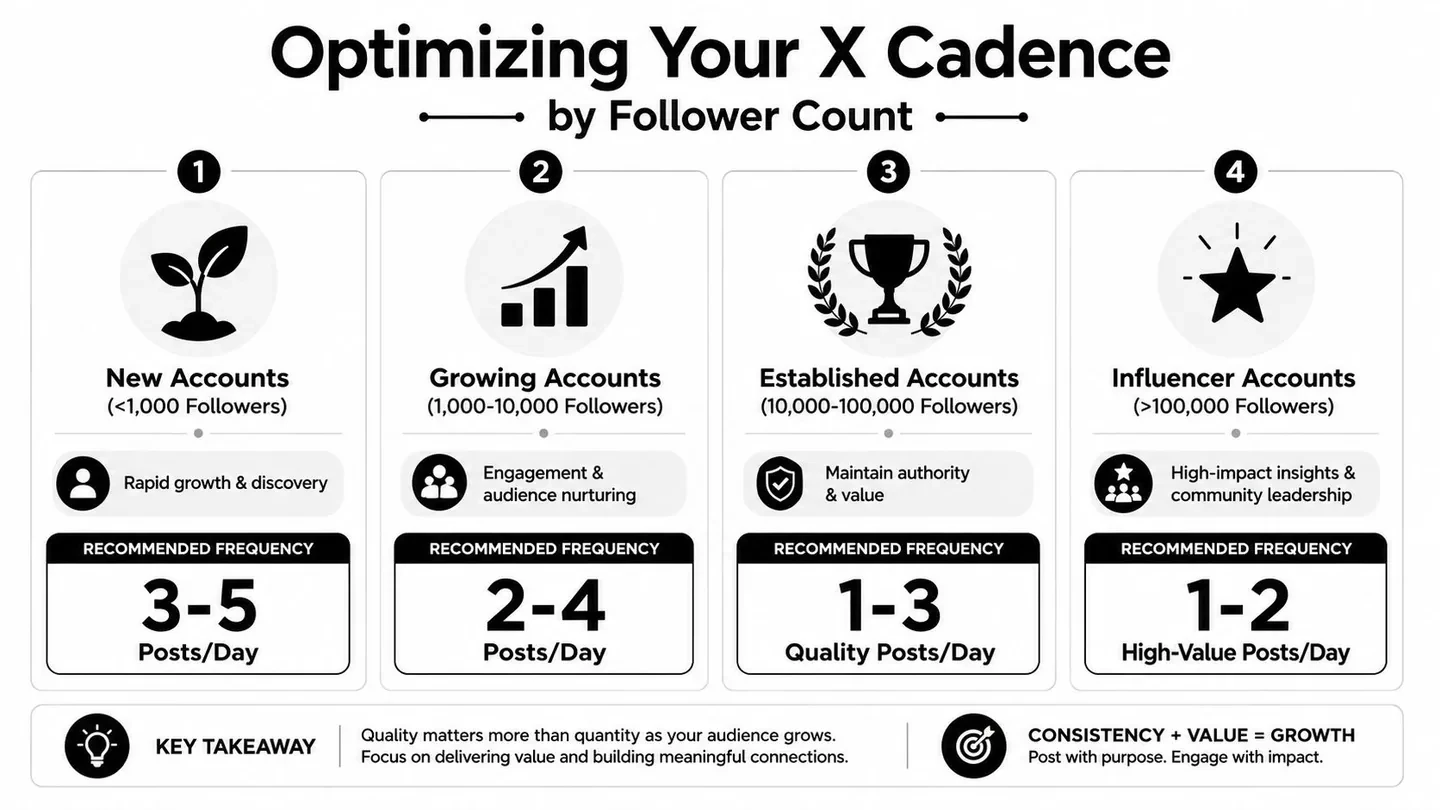
Follower count changes the math fast. Smaller accounts need enough output to earn data and attention. Larger accounts already have distribution, so the job shifts from getting seen to staying worth seeing.
I see two common mistakes. Early-stage accounts post too little to learn. Bigger accounts post too much filler because they assume reach will cover weak content. Both hurt growth.
What to do at each growth stage
For accounts under 1,000 followers, volume still matters because you are trying to find topics, hooks, and formats that get any response at all. TapMyStore’s guidance for creators suggests 3 to 6 posts daily, plus 2 to 3 targeted replies, with consistency over 90 days instead of short posting bursts.
For accounts under 10,000 followers, a practical growth range is usually several original posts per day plus active replies. The point is not to hit an arbitrary number. The point is to create enough surface area for discovery while building repetition around themes that start to work.
Here is the stage-based model I use with clients:
- Under 1,000 followers: post often enough to test positioning, sharpen hooks, and get used to daily feedback.
- 1,000 to 10,000 followers: keep visibility high, but narrow your topic buckets and repeat winning formats more aggressively.
- 10,000 to 100,000 followers: protect quality control. At this stage, replies, quote posts, and remixes usually outperform forcing extra net-new ideas.
- 100,000+ followers: increase output selectively around launches, news cycles, and strong audience demand. More impressions do not excuse weaker posts.
If you want a broader audience-building playbook alongside these frequency benchmarks, this guide to boosting Twitter followers gives useful tactical ideas around profile setup, content positioning, and growth habits.
What actually changes as you grow
The biggest shift is content tolerance.
A small account can get away with imperfect posts because the main goal is learning. A larger account gets judged against its recent standard. If the timeline starts feeling repetitive, vague, or rushed, engagement softens first, then reach usually follows.
That is why cadence should rise with system strength, not ego.
| Account stage | Main risk | Better response |
|---|---|---|
| Under 1,000 | No signal | Post enough to identify topics and hooks worth repeating |
| 1,000 to 10,000 | Scattered content | Build 3 to 5 repeatable themes and remix them |
| 10,000 to 100,000 | Inconsistent quality | Use a steady publishing rhythm and stronger editing |
| 100,000+ | Audience fatigue | Add volume around moments that justify it |
This is also where content remixing changes the equation. Bigger accounts do not need a constant stream of brand-new ideas. They need better packaging. One solid insight can become a short post, a contrarian reply, a quote post, a thread opener, and a follow-up angle later in the week. AI tools help here by speeding up drafts, variations, and thread structure, but they only work if you already know your themes and standards.
If you are diagnosing cadence by account size, audience mix, and engagement quality, Xholic’s article on Twitter follower analytics is useful for checking whether your current posting rhythm fits your stage.
Beyond Posts The High-Leverage Role of Replies and Threads
A lot of bad advice treats tweet frequency as if only original posts matter. That misses one of the strongest levers on the platform.
Replies are part of your posting frequency
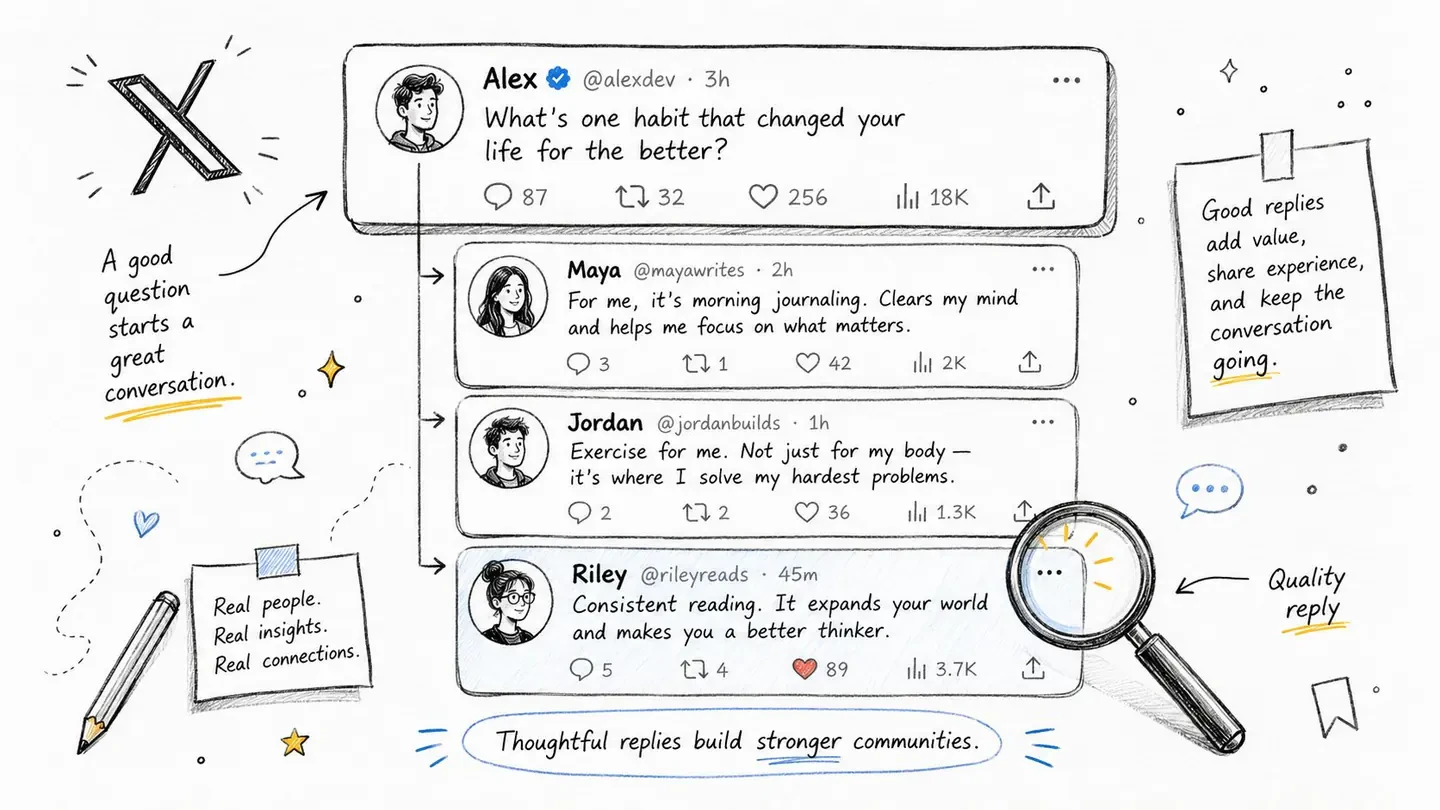
Replies aren’t optional side work. They’re part of the distribution system. Data summarized by Autotweet’s X posting guide says the platform rewards a mix of 3 to 5 original tweets per day plus 10 to 20 replies. That matters because replies put you in front of people who are already paying attention to the topic.
Smaller accounts often waste time, spending hours forcing more original tweets when they’d get better visibility by writing fewer originals and more strong replies to high-momentum conversations.
A useful daily equation is:
Daily volume = original posts + high-quality replies + occasional threads
That changes how you plan your day. Instead of asking, “Can I write five tweets?” ask:
- What’s worth posting from my own account today
- Which conversations are already live and relevant
- Where can I add a specific point, example, or disagreement
Here’s a reply that does more work than a generic compliment:
Original post: “Most founders overcomplicate content. Just share what you’re building.”
Better reply: “True, but the useful version is to share one concrete decision, one trade-off, or one thing that surprised you. ‘We shipped X’ is easy to ignore. ‘We removed X because users kept doing Y’ gets read.”
That kind of reply shows judgment. It earns profile clicks.
Threads work best as depth not filler
Threads are useful when one idea needs steps, examples, or proof. They’re weak when used to inflate output.
A simple pattern works well:
- Start with a sharp claim
- Add the mechanism
- Add one example
- End with a decision rule
If you need a starting point, this Twitter thread template guide is a practical reference for structuring threads without turning them into bloated essays.
A good explainer on thread pacing and attention is worth watching before you overuse them:
Strong accounts don’t just publish. They participate early, reply specifically, and use threads when the idea needs expansion.
Building Your Sustainable X Content Workflow
Knowing your target frequency is the easy part. Maintaining it without turning your feed into filler is the hard part.
A weekly workflow that doesn’t collapse by Wednesday
The best Twitter workflows separate discovery, drafting, replying, and scheduling. If you try to do all four in real time every day, quality drops.
A practical operating system looks like this:
-
Research winning angles
Start with proven topics, hooks, and formats from accounts in your niche. Save examples by theme: contrarian takes, short lessons, product updates, founder notes, data breakdowns. -
Draft in batches
Write several posts when your brain is fresh. Don’t worry about perfect polish on the first pass. The goal is to create options. -
Remix instead of starting from zero
Strong creators reuse structures constantly. They change the insight, the proof, the audience, or the framing. If you need help turning rough thoughts into tighter posts, you can also use RewriteBar for tweets as part of the drafting step. -
Reply inside the feed
Keep a separate block of time for replies so they don’t get squeezed out by publishing. -
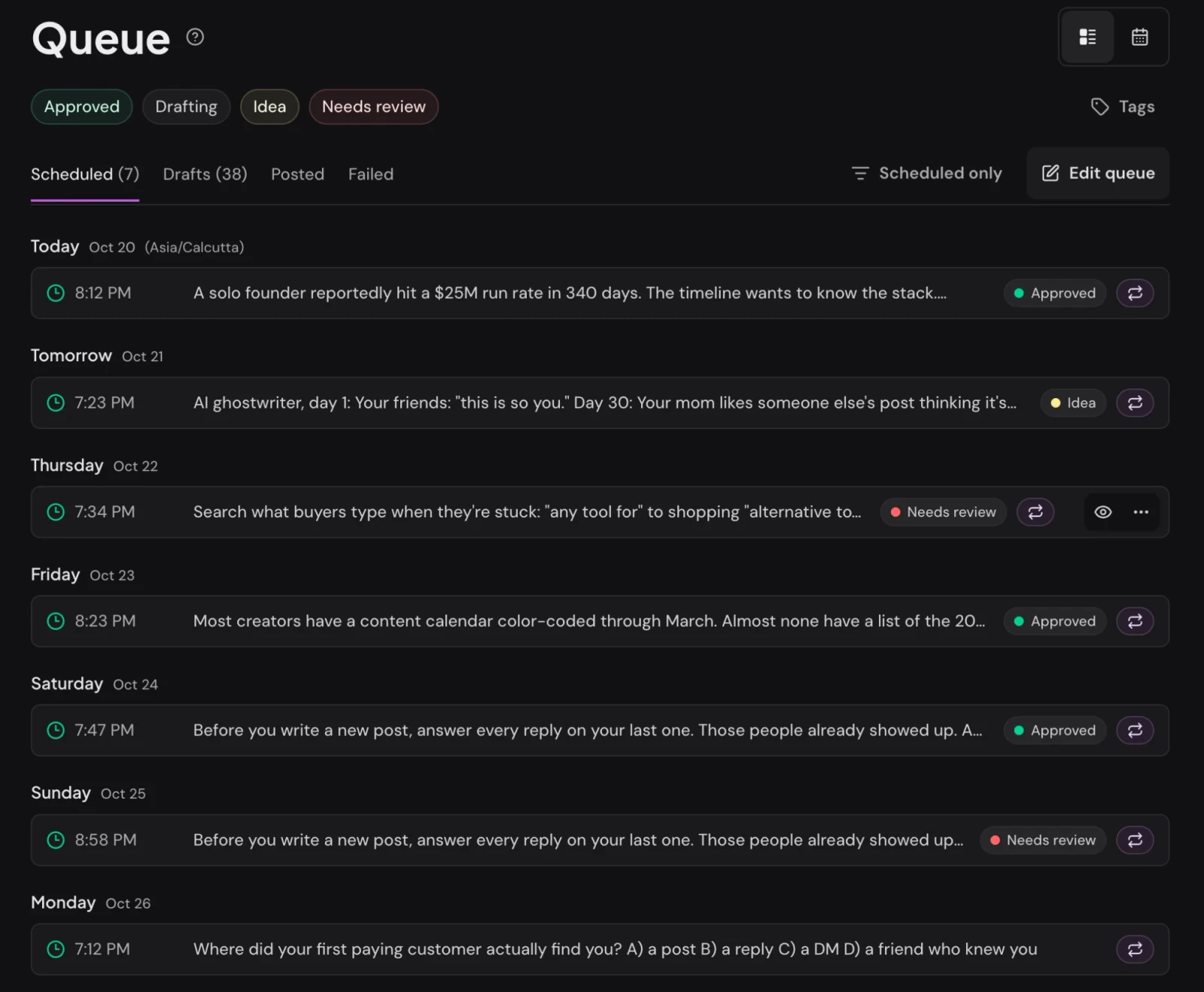
Schedule approved posts
Queue what’s ready, then leave space for reactive posts and live replies.
When people ask whether AI helps with frequency, the answer is yes, but only when it reduces blank-page time without flattening your voice. Strong AI tweet generation still needs human review. Generic drafts are easy to spot.
Xholic AI is a practical example of this workflow. You can use Inspiration Search to explore more than 12 million tweets by meaning, save examples with Saved & Collections, break down patterns with Ask Xholic and turn them into usable drafts with Tweet Remixer, generate batches of options with Workers, and draft replies or remix posts inside X with the Chrome extension. For scheduling, Smart Scheduler queues approved posts into recurring slots or exact times after user review. If you want the scheduling side broken down more clearly, read Xholic’s guide on how to schedule Twitter posts.
A sample content calendar for a small growth account
For an account under 10,000 followers aiming for steady growth, a workable day might look like this:
| Time block | Activity | Output |
|---|---|---|
| Morning | Publish one opinion or lesson post | 1 original post |
| Midday | Reply to relevant creators in your niche | Several contextual replies |
| Afternoon | Publish one practical or example-driven post | 1 original post |
| Evening | Join active conversations and publish one lighter post or observation | 1 original post plus replies |
Example post:
“A simple rule for Twitter growth: if you can’t explain why a post should exist, don’t schedule it. Strong posts usually do one of three things. Teach, sharpen an opinion, or start a useful conversation.”
That kind of post is easy to sustain because it comes from operating knowledge, not forced inspiration.
How to Measure and Optimize Your Frequency
Individuals rarely test their cadence systematically. They post at random, eyeball the results, and then decide the algorithm is unfair. A cleaner approach is to treat posting frequency like an experiment.
Run a clean frequency test
The most usable framework I’ve seen is the 8-week test summarized by Tweet Archivist. It uses Week 1 to 2 at 3 tweets per day to set a baseline, Week 3 to 4 at 5 tweets per day, and Week 5 to 6 at 7 tweets per day to watch for fatigue. The key is holding content quality as steady as possible while tracking what changes.
Track decisions, not vanity metrics:
-
Engagement rate per post
If this falls as frequency rises, your extra posts may be weaker or cannibalizing attention. -
Total impressions Useful for seeing whether more activity expands reach.
-
Profile visits
Good signal that your posts and replies are creating curiosity. -
Net follower growth
This is the easiest reality check. More posting should produce better account-level movement, not just more scattered activity.
If you want cleaner reporting during this test, these social media reporting templates can help you structure the data week by week.
Best practices and common mistakes
The biggest optimization mistakes aren’t dramatic. They’re basic.
- Keep quality stable while testing frequency. If your 7-post week includes rushed filler, you’re not testing frequency. You’re testing lower quality.
- Hold your themes constant so the comparison is fair. Don’t switch from product lessons to memes and blame cadence for the change.
- Watch for fatigue signals in replies, profile visits, and follower movement, not just likes.
- Use scheduling for consistency, not for turning your account into a conveyor belt.
More posting only works when each additional post has a reason to exist.
Another common issue is the quality ceiling. Some accounts gain nothing from pushing volume once posts start competing for the same audience attention. When that happens, the answer usually isn’t “post even more.” It’s “space better, write better, or reduce volume.”
Turn the cadence you choose into a repeatable Twitter content calendar. After the schedule is stable, use the best-time-to-post analysis to refine publishing windows without increasing volume blindly.
FAQ About X Posting Frequency
Do retweets and quote tweets count toward my daily frequency
They count as supporting activity, not your core cadence. If you’re planning your week, build around original posts and replies first. Retweets and quote tweets can add distribution or context, but they shouldn’t become a substitute for having your own point of view.
A quote tweet is strongest when you add interpretation, not when you repeat the original post in slightly different words.
Is it bad to post multiple tweets back-to-back
Usually, yes, unless you’re publishing a single thread. According to SocialNexis, B2B and mid-size accounts with 5k to 50k followers can see impression compression when they exceed 2 posts per day and space them less than 90 minutes apart, because the posts compete for the same early-engagement window.
That doesn’t mean every account should cap at two posts. It means spacing matters. If you’re posting multiple times in a day, give each post room to collect its own engagement.
Does scheduling hurt engagement
No, not by itself. Scheduling is just a publishing method. The main issue is whether the post is good, whether the timing fits your audience, and whether you’re still leaving room for live replies and reactive posts.
Think about the workflow in layers:
- Drafting means writing ideas and rough posts.
- Queueing means placing approved posts into upcoming slots.
- Scheduling means assigning a specific time or recurring slot.
- Automation means applying preset publishing rules to approved content.
That distinction matters because a good scheduler supports consistency. It shouldn’t publish unreviewed AI filler.
Should founders post every day
Not necessarily. If you’re a founder, fewer stronger posts can be better than trying to mimic high-volume creator accounts. What matters is whether your posts carry real decisions, trade-offs, lessons, or observations from the work.
What should I do if my engagement drops when I post more
Reduce volume first. Then tighten topic selection, strengthen hooks, and improve spacing. A drop in engagement after increasing frequency usually means one of two things: the added posts aren’t strong enough, or your posts are competing with each other.
If you want a system for finding better content ideas, drafting contextual replies, remixing proven tweet structures, scheduling approved posts, and staying consistent without living in the timeline, try Xholic AI. It’s built for creators, founders, marketers, analysts, and power users who want a practical workflow for X growth instead of another pile of generic advice.