Most advice on twitter engagement is still wrong. It tells you to post more, use more hashtags, and “be authentic” as if volume alone creates reach. It doesn’t. On X (Twitter), the accounts that keep growing usually do three things well: they measure the right signals, they join the right conversations early, and they turn good ideas into repeatable post and reply formats. If you want more than vanity likes, you need a system.
Redefining Twitter Engagement Beyond Vanity Metrics
If you’re still judging your X account by impressions and likes alone, you’re looking at the wrong scoreboard. The platform has become less predictable, and broad reach doesn’t automatically mean strong response.
According to Statista’s year-over-year X engagement data, 2024 posts saw a 98.24% YoY increase in impressions but a 38.05% drop in overall engagement. The same source notes that Sprout Social’s 2026 data showed the average influencer engagement rate per post improved to 0.39% in 2025 from 0.09% the year before. That mix tells you something important. Attention is concentrating around fewer posts, better timing, and tighter audience fit.
What actually counts as engagement
Likes are the weakest useful signal. They tell you someone noticed the post. They don’t tell you if the post changed anything.
The signals that matter more are:
- Replies from the right people that move a conversation forward
- Quote reposts that carry your idea into another network
- Profile visits from people who fit your niche
- Link clicks when the post has a business goal
- Follow conversions from specific posts or reply threads
A single reply from a customer, founder, journalist, or niche operator can be worth far more than a pile of passive likes. That’s especially true if your business depends on trust, expertise, or deal flow.
Practical rule: Track what creates the next action. If a post gets likes but no profile visits, replies, follows, or clicks, it probably entertained people without growing your account.
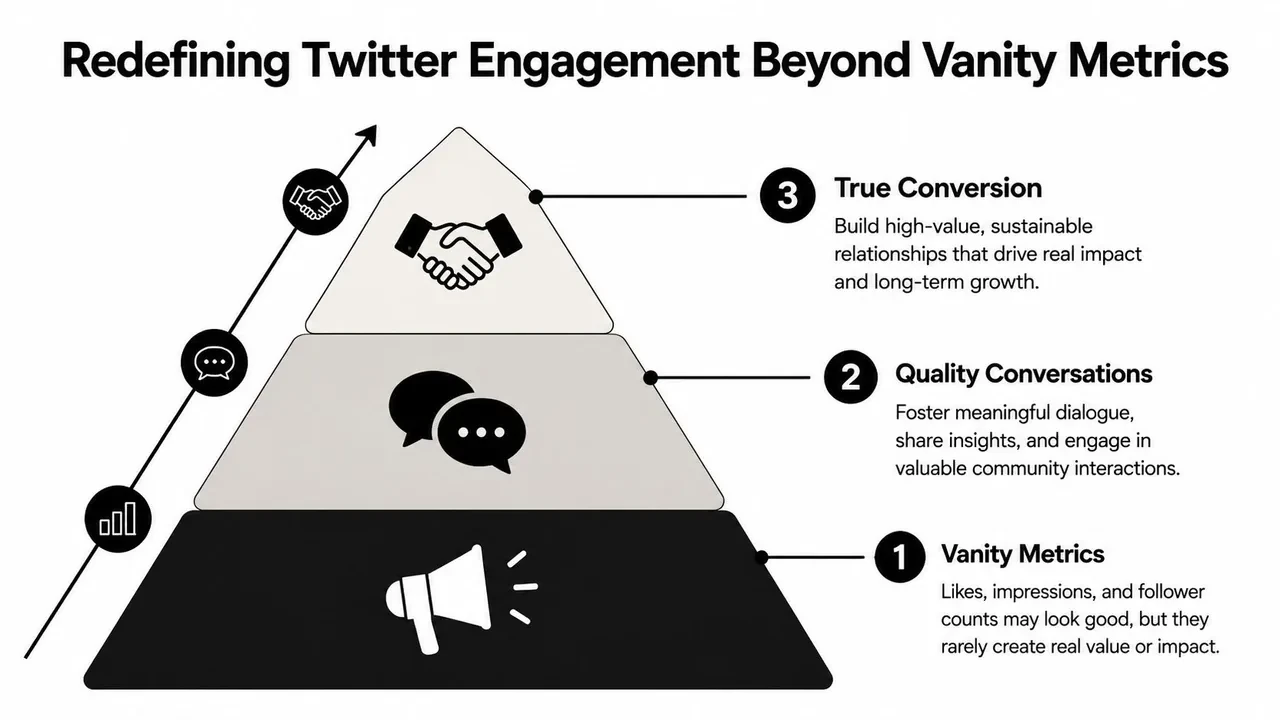
A practical engagement pyramid
I use a simple hierarchy when auditing an account.
| Level | Signal | Why it matters |
|---|---|---|
| Base | Impressions and likes | Useful for awareness, weak for diagnosis |
| Middle | Replies, quote reposts, profile visits | Shows real interest and audience fit |
| Top | Clicks, inbound DMs, qualified followers | Indicates business or relationship value |
This is why raw reach can mislead operators. A post can look “big” while doing almost nothing for growth. Another post can look smaller and still be the one that drives the right follows, conversations, and conversions.
If you want a cleaner way to audit post quality over time, use a post-level review inside this guide to Twitter analytics and compare outcomes by format, topic, and call to action. Don’t ask, “Did this post get attention?” Ask, “Did this post attract the people and actions I want more of?”
How to Discover High-Momentum Conversations Early
Most creators don’t need more courage to reply. They need better timing. The biggest miss on X isn’t writing a weak reply. It’s showing up after the conversation has already peaked.
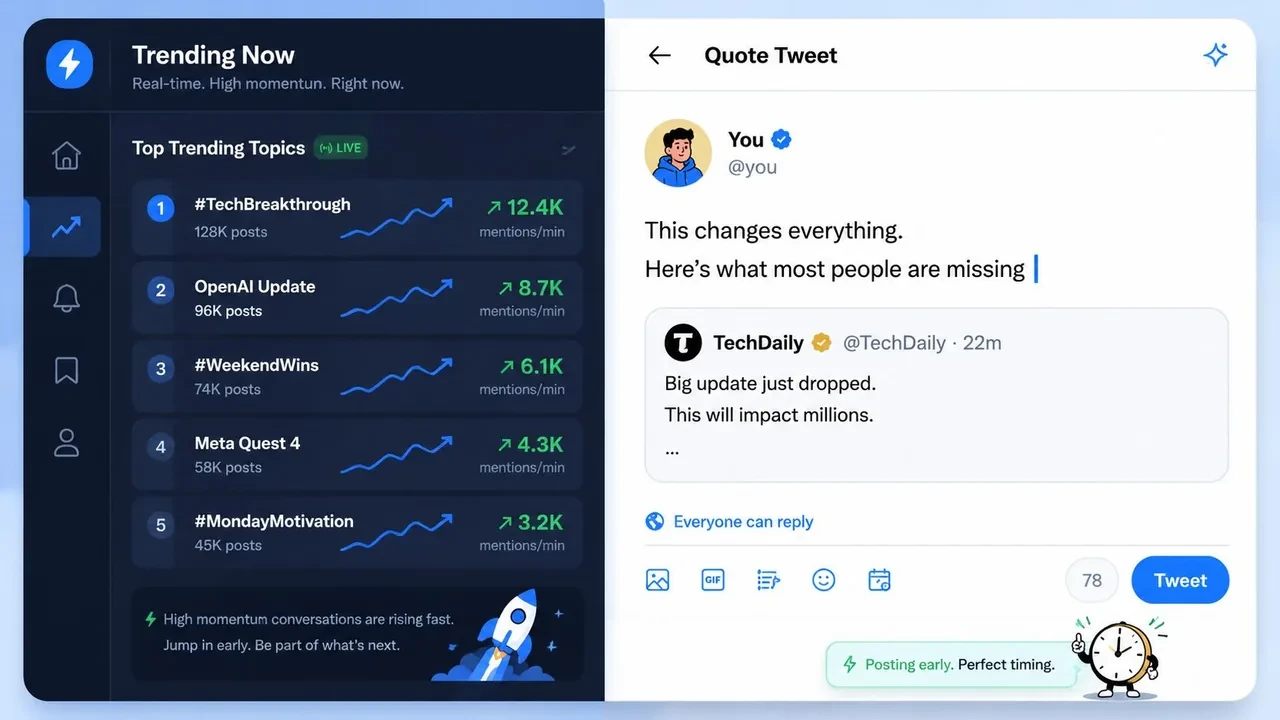
A lot of engagement advice stops at “engage authentically.” That doesn’t solve the underlying problem. As TweetArchivist’s guide to increasing Twitter engagement in 2025 notes, replies and quote reposts are key visibility drivers, but most guidance doesn’t explain how to identify high-momentum conversations early enough to benefit from them.
Popular is not the same as high momentum
A popular tweet is already obvious. It has already broken out.
A high-momentum tweet is different. It’s picking up speed, pulling in relevant replies, and still has room for smart contributors to enter. That is where a lot of practical growth happens.
You can spot these conversations by looking for:
- Fast reply growth in your niche, not just high public engagement
- Recognizable participants joining early
- A sharp opinion, fresh data point, or useful disagreement that invites response
- Quote repost potential because the post gives people something to add to
Join conversations that are still forming. Late replies to fully saturated viral tweets usually become invisible.
A repeatable discovery workflow
Manual discovery still works if you structure it.
-
Build a tight list of accounts
Include niche founders, operators, researchers, customers, competitors, and curators. Avoid giant unfocused lists. You want signal, not noise.
-
Check replies, not just original posts
Some of the best opportunities start in the replies of people your audience already trusts.
-
Sort by relevance to your goals
If you’re selling software, a product pain point matters more than a broad industry joke. If you’re building a creator brand, opinion threads and debates may be more valuable.
-
Choose your move
You have three main options:
- Direct reply when you can add a sharp insight
- Quote repost when you want to add context for your own audience
- Bookmark and remix later when the idea is good but your angle isn’t ready
One way to speed this up is to use a dedicated analysis workflow such as these Twitter analysis tools for better tweets and engagement, then narrow the feed to creators and topics that matter.
Later in the workflow, a tool can help. Xholic AI is one option. It tracks creators, surfaces high-momentum tweets, and uses an Engage workspace and momentum scoring to help decide which conversation is worth joining right now. That matters when you’re managing multiple accounts and can’t live inside the timeline.
A quick walkthrough helps if you’re building this into your daily routine:
Crafting Posts and Replies That Drive Interaction
Most weak tweets fail before the second line. Not because the idea is bad, but because the framing is flat.
Why generic tweets get ignored
Here is a common example:
“Consistency is important on Twitter. Keep posting and engaging every day.”
That isn’t wrong. It’s just disposable. It has no tension, no specificity, and no reason for someone to respond.
Now look at the same idea in stronger formats.
Contrarian post
Most people don’t have a Twitter content problem.
They have a decision problem.
They’re posting into dead conversations instead of joining live ones.
How-to thread opener
If your X engagement is flat, stop posting more.
Audit these 3 variables first:
- Reply timing
- Post format
- Link and hashtag usage
Personal story angle
I used to think low engagement meant bad ideas.
Usually it meant bad packaging.
Same idea, better hook, clearer tension, stronger reply CTA.
Each one gives the reader a reason to stop. The mechanics are simple:
- Hook creates curiosity or disagreement
- Tension shows the gap, mistake, or cost
- Payoff gives the insight, framework, or invitation
A good post doesn’t dump information. It creates a reason to keep reading and a reason to answer.
Tweet remixing template
You don’t need endless new ideas. You need better packaging for the ideas you already have.
| Original Insight | Remix Format 1 The Contrarian Hook | Remix Format 2 The How-To Thread | Remix Format 3 The Personal Story |
|---|---|---|---|
| Most founders post too late into trends | “The problem isn’t that you’re not tweeting enough. You’re joining the wrong conversations after everyone else already arrived.” | “How to find conversations early on X: build lists, monitor replies, sort by relevance, choose reply vs quote repost.” | “I wasted hours replying to big accounts and got nothing. Things changed when I stopped chasing big tweets and started watching niche momentum.” |
| Replies can outperform original posts for reach | “Original tweets are overrated if nobody knows who you are yet.” | “Use replies for discovery, original posts for positioning, quote reposts for distribution.” | “My best audience fit often came from one useful reply, not from a standalone post.” |
| Better framing beats more effort | “You don’t need more content. You need stronger openings.” | “Rewrite one weak tweet into 3 formats before publishing anything new.” | “The moment I started rewriting drafts instead of posting first versions, my timeline got much easier to work.” |
A practical way to learn this faster is to study examples, then rewrite them in your own voice. I like keeping a swipe file of working hooks and using references such as tweet examples that actually work in 2026 when a draft feels too generic.
If you’re planning a launch thread, approval deck, or content experiment, mockups help too. A fake tweet generator is useful for planning, education, presentations, product mockups, and campaign reviews before publishing. Mockups should be used responsibly and not to mislead people.
Reply formats that earn responses
Replies need a different rhythm than posts. The goal isn’t to sound profound. The goal is to advance the conversation.
Three reply formats work consistently:
-
Add a missing layer
“The timing point matters. I’d add one thing: if the audience can’t act on the takeaway, they’ll like it and move on.” -
Sharpen the claim
“Agree with the main point. I’d narrow it to founders under audience pressure. For them, conversation selection matters more than raw posting frequency.” -
Respectful disagreement
“I think this works once you already have audience trust. Earlier-stage accounts usually get more from replies and quote reposts than from broad original takes.”
What doesn’t work is empty agreement, forced jokes, or “great point” replies with no substance. Those burn time and rarely build recall.
Common Mistakes That Quietly Kill Your Engagement
A lot of stalled accounts don’t have a creativity problem. They have a habits problem.
The silent reach killers
The first mistake is overstuffing posts with hashtags because it feels like optimization. It often isn’t. A Twitter engagement-rate regression study found that, after controlling for other variables, tweets with more hashtags and longer text had lower engagement rates, and the authors interpret those patterns as negative marginal drivers of engagement in the final model, which explained 32.3% of the variance in engagement rate with 9 variables remaining after stepwise regression.
The second mistake is dropping links into cold posts with no reason to care. A naked link asks the audience to leave before you’ve earned interest. Give the takeaway first. Then give the click.
The third mistake is reply-guy behavior. High frequency is not the same as high value. If your replies don’t add context, disagreement, evidence, or a useful simplification, people won’t remember you.
A fourth mistake is running your account with no profile logic. People discover you through posts and replies, then check your profile. If the bio, pinned post, and recent timeline don’t explain who you help or what you talk about, your engagement leaks out at the profile visit stage.
What to fix first
Start with the easiest corrections.
- Cut weak hashtags unless one is useful for context or discovery.
- Shorten drafts when extra length doesn’t add a sharper point.
- Add context before links so readers know why they should click.
- Upgrade your bio and pinned post so curious visitors know what following you gets them.
If you need a better diagnostic lens for underperforming posts, compare your timeline against the patterns in this breakdown of Twitter impressions and engagement trade-offs. The point isn’t to copy generic advice. It’s to see which habits are reducing response on your own account.
Measure, Schedule, and Build a Repeatable Growth Habit
Good X growth is boring in the best way. It runs on a loop.
According to TweetArchivist’s Twitter analytics best practices, the reliable approach is a compare-and-iterate loop that segments performance by time, media type, and other variables, using engagement rate as the primary KPI. The same guidance cites a rough average Twitter engagement rate of 0.046% and recommends judging strategy changes over a 60 to 90 day window rather than reacting too quickly.
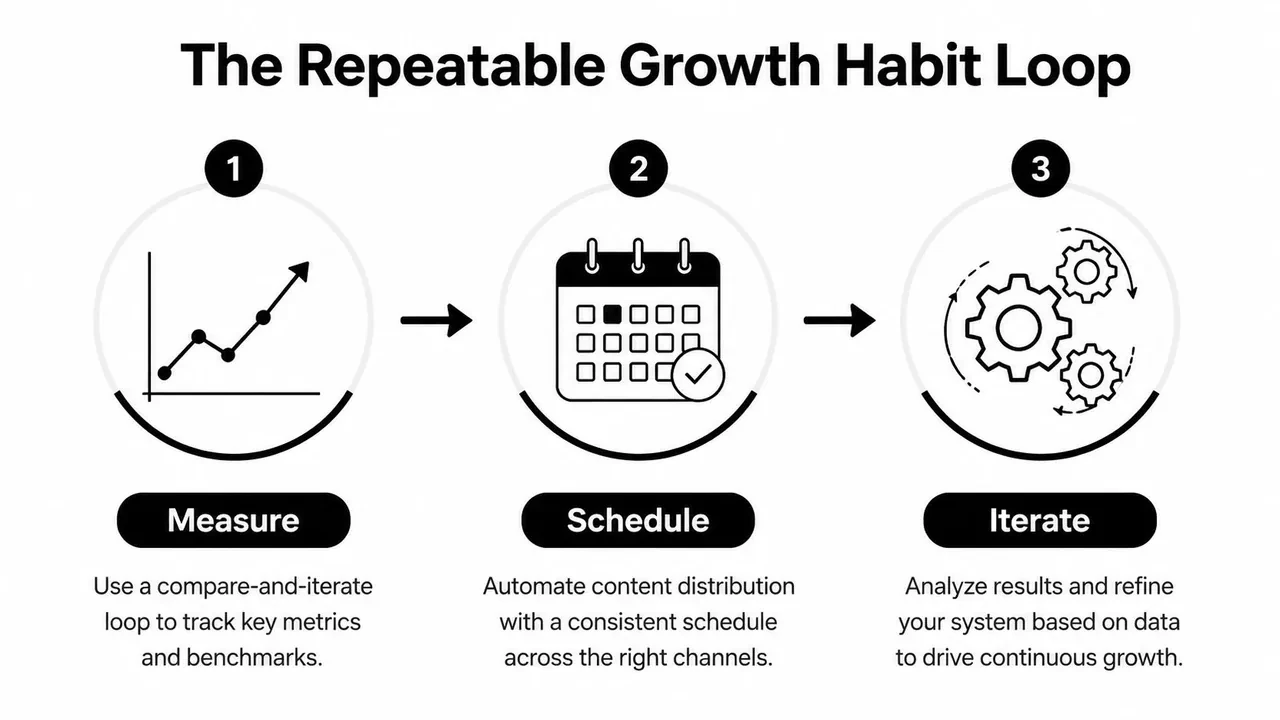
Use a compare-and-iterate loop
Don’t compare every post to every other post blindly. Match like with like.
Segment your posts by:
- Time of day
- Day of week
- Media type
- Link presence
- Hashtag count
- Post type, such as original post, reply, quote repost, question, or thread
Then ask narrower questions. Do short no-link posts beat linked posts for engagement rate? Do quote reposts bring more profile visits than original posts? Do morning educational posts outperform afternoon opinion posts?
Field note: Most accounts improve faster when they stop looking for one magic format and start identifying which format works for which job.
Schedule for attention, not convenience
A lot of people schedule around when they finish writing. That’s understandable, but it’s not the same as scheduling around audience attention.
A better workflow looks like this:
- Draft when ideas hit
- Tag the post by format and goal
- Queue it for the next appropriate time window
- Review performance later against similar posts
Scheduling shifts from being cosmetic to being operational. If you write in bursts but your audience responds at different times, a queue helps you separate creation from distribution.
Consistency beats random bursts
Most accounts don’t need heroic posting sprints. They need a stable operating rhythm.
A practical weekly habit could look like this:
- Daily replies to a small set of relevant conversations
- A few original posts built from tested themes
- A regular review block where you compare winners and losers
- A content library for saving ideas, hooks, and examples worth revisiting
That habit matters more than obsessing over every single post. Over time, the repeatable edge comes from better pattern recognition. You start noticing which hooks earn replies, which formats attract profile visits, and which topics convert attention into follows.
FAQ About Twitter Engagement
How do I increase twitter engagement without posting all day?
Use a narrow system. Focus on three things: one or two original posts worth reading, a set of useful replies to relevant conversations, and a review habit that shows what worked. You don’t need to be online constantly. You need to be present where attention is forming.
How long does it take to improve engagement on X?
Give strategy changes time to mature. A rushed judgment usually leads to bad decisions. The practical benchmark from earlier is to evaluate changes over a 60 to 90 day window, especially when you’re testing formats, timing, and conversation strategy.
Do replies help more than original tweets?
Often, yes, especially for smaller or niche accounts. Replies can put you in front of warmed-up audiences who are already paying attention. Original posts matter for positioning, but replies are frequently the faster path to discovery.
What’s the best way to revive a dead X account?
Don’t start by posting more random content. Start by tightening your profile, choosing a few clear content themes, and joining relevant conversations with useful replies. Then publish a small number of focused original posts that match those same themes. Dead accounts usually come back through consistency and relevance, not volume.
Should I use hashtags on Twitter?
Use them sparingly. If a hashtag adds context, event relevance, or clear discoverability, fine. If it’s there because you think every post needs one, that’s usually a bad reason.
Do longer tweets perform better?
Not automatically. Length only helps when it improves clarity, specificity, or storytelling. If extra words don’t strengthen the point, they usually weaken it.
What should I track besides likes?
Track replies, quote reposts, profile visits, clicks, follow conversions, and which post types drive those outcomes. Those signals tell you more about real growth than surface-level engagement.
If you want a cleaner operating system for X growth, try Xholic AI. It helps with discovering high-momentum tweets, generating replies, remixing posts, organizing saved ideas, tracking consistency, using a Chrome extension inside the feed, and scheduling posts with Smart Scheduling.