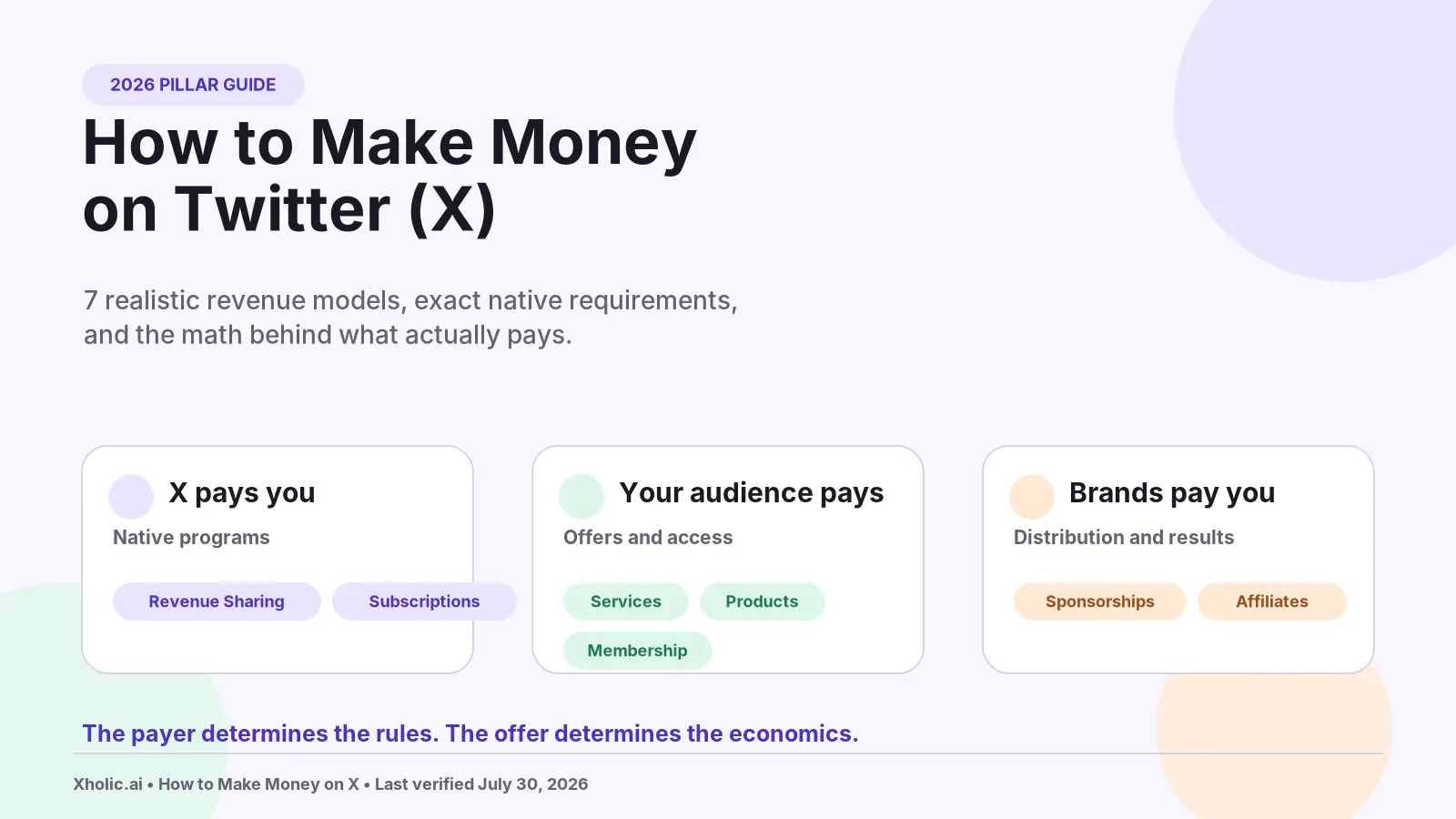
Quick answer: You can make money on X through services and consulting, sponsored posts, affiliate marketing, digital products, paid newsletters or communities, Creator Revenue Sharing, and Creator Subscriptions. X’s native programs have substantial eligibility requirements, so a smaller account will usually earn sooner by turning relevant attention and trusted expertise into a customer, partner, or member—not by waiting for X to pay for impressions.
Last verified: July 30, 2026
Important: Platform rules change. Native-program requirements in this guide were checked against X’s official documentation on the date above. Revenue examples are illustrative, not earnings promises.
Most articles about how to make money on Twitter make one of two mistakes.
The first treats monetization as a switch: reach a follower threshold, turn on a feature, and start getting paid. The second publishes a long list of tactics without explaining which one fits a particular account, how the economics work, or why the tactic usually fails.
In reality, X is not one monetization model. It is an attention and relationship layer that can support several very different businesses. An advertiser buying access to your audience behaves differently from a client buying your expertise. A subscriber paying for ongoing access behaves differently from X calculating a platform payout. The payer changes the requirements, the revenue ceiling, the sales process, and the risk.
That leads to the most useful question in this entire guide:
Who is paying you, and what are they paying for?
Once that is clear, follower count becomes context rather than the whole strategy.
The 3-payer X monetization model
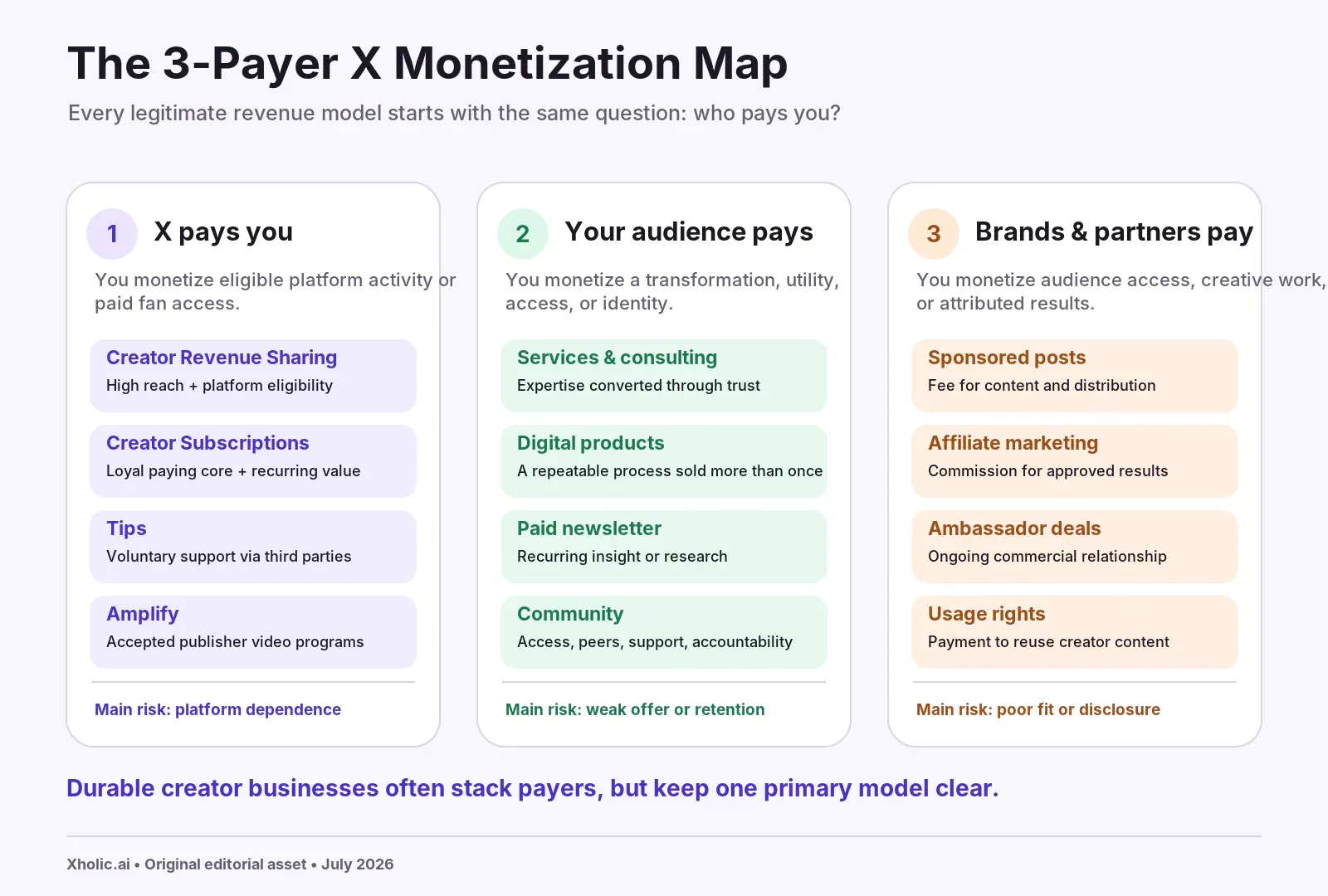
Every legitimate way to make money on X falls into one of three categories.
- X pays you for qualifying platform activity or paid fan access.
- Your audience pays you for expertise, access, transformation, utility, or belonging.
- Brands and partners pay you for creative work, audience access, distribution, or attributable results.
This framework matters because the popular question, “How many followers do I need to make money on Twitter?” is incomplete.
For Creator Revenue Sharing, X currently requires at least 500 verified followers and five million organic impressions in the previous three months. For Creator Subscriptions, the minimum application requirements include at least 2,000 verified followers and five million organic impressions in the previous three months. But a consultant can win a client without meeting either threshold, and an affiliate sale can happen from a small account when the audience and recommendation are unusually well matched.
There is no universal follower number. There is only a threshold for a particular revenue model.
The seven realistic ways to make money on X
The table below orders the methods by how accessible they tend to be for a smaller but credible account—not by maximum theoretical income.
| Method | Who pays you? | Native X eligibility gate | Best suited to | Main bottleneck |
|---|---|---|---|---|
| Services and consulting through warm DMs | Clients | None | Consultants, freelancers, agencies, coaches, founders | Proof, positioning, and qualified conversations |
| Sponsored posts and threads | Brands | None; disclosure rules apply | Niche creators with reliable audience data | Audience fit and commercial terms |
| Affiliate marketing | Merchants or affiliate programs | None; disclosure rules apply | Creators whose audience has purchase intent | Trust, attribution, and product relevance |
| Digital products, templates, and courses | Customers | None | Experts with a repeatable process | Validated demand and conversion |
| Paid newsletters and communities | Readers or members | None | Analysts, educators, operators, niche creators | Recurring value and retention |
| Creator Revenue Sharing | X | Premium, 500 verified followers, 5M organic impressions in three months, and other criteria | High-reach accounts | Eligibility, variable payouts, and platform dependence |
| Creator Subscriptions | Subscribers through X | 2,000 verified followers, 5M organic impressions in three months, and other criteria | Creators with a loyal paying core | Qualification, recurring value, and churn |
Two other X-native options—Tips and Media Studio Amplify programs—are covered later, but they are not primary recommendations for most individual creators.
Before choosing a method, separate reach from commercial value
A large audience is useful, but it is not the same as a monetizable audience.
Commercial value is usually a combination of four assets:
1. Relevant attention
The people seeing your posts overlap with the people who might buy, subscribe, recommend, or sponsor. Ten thousand impressions from the wrong audience can be commercially weaker than 1,000 impressions from likely buyers.
2. Earned trust
Your public work gives people a reason to believe you understand the problem. Trust can come from results, specific analysis, demonstrations, useful replies, consistent judgment, or transparent experience. It does not come from posting generic advice at high volume.
3. A clear offer
The reader understands what they can buy, who it is for, what changes after purchasing, and what to do next. An audience cannot convert into an offer that is vague or invisible.
4. A clean conversion path
A profile visit leads to the right pinned post or link. The landing page matches the promise. The form, checkout, disclosure, booking flow, and tracking work. Many creators assume they have an audience problem when they actually have a broken handoff.
A useful shorthand is:
Commercial attention = relevant reach × trust × offer fit × conversion clarityThis is not an accounting formula. It is a diagnostic model. If any factor is close to zero, more impressions alone may not produce more revenue.
1. Sell services or consulting through warm DMs
For many knowledgeable people with small accounts, services are the most practical first revenue model on X.
A consultant does not need five million impressions. A freelancer does not need 2,000 verified followers. They need a costly problem they can solve, visible evidence that they understand it, and a credible conversation with someone who has that problem.
That is why one qualified DM can be worth more than a month of platform payouts for an account with comparable reach.
What this method actually is
The weak version of “DM selling” is mass outreach: copy the same pitch, send it to hundreds of people, and hope someone responds.
The strong version is a public-to-private trust transfer:
- Your public posts and replies demonstrate relevant expertise.
- A person signals interest by replying, asking a question, visiting repeatedly, downloading something, or describing a relevant problem.
- You ask permission to continue the conversation privately when privacy or detail would improve the discussion.
- The DM diagnoses the situation before presenting an offer.
- The next step is proportional to the interest—a useful resource, a short audit, a call, or a proposal.
X’s Authenticity policy prohibits bulk, aggressive, high-volume unsolicited DMs; repeated link-only messages; and identical direct messages. A warm, contextual conversation is not only more effective—it is safer than treating DMs as a volume channel.
Who this works best for
Services are especially suitable for:
- Consultants with a defined area of expertise
- Freelancers selling writing, design, development, research, or marketing
- Agencies serving a specific type of company
- Coaches with a credible method and appropriate boundaries
- Founders offering implementation, onboarding, or advisory help around a product category
- Operators who can package an internal capability into a productized service
The narrower the buyer and problem, the easier it is to publish content that attracts the right conversations.
“Marketing consultant” is broad. “I help seed-stage B2B SaaS teams turn founder expertise into a weekly content system” is easier to understand, demonstrate, and refer.
Build the conversation before the pitch
A useful content mix for service sellers includes:
- Problem clarity: Explain why a familiar problem happens.
- Process: Show how you diagnose or solve it.
- Proof: Share anonymized outcomes, before-and-after examples, or your own implementation.
- Judgment: Explain trade-offs and when common advice does not apply.
- Tools: Give the audience a checklist, worksheet, calculator, or template that creates a natural next step.
The objective is not to turn every post into a sales post. It is to make the right visitor think, “This person understands the exact problem I have.”
A warm-DM workflow that does not feel automated
A high-quality transition can be simple:
Public reply:
“Your issue may be the handoff between the post and the landing page rather than the post itself. Are people clicking and then dropping, or are they not clicking at all?”
After the person answers:
“That distinction helps. I have a short diagnostic checklist for this. Is it okay if I send it by DM?”
In the DM:
“Here it is. Based on what you said, I would check steps two and four first. What are you currently sending people to?”
Notice what is missing: a generic compliment, an immediate calendar link, and a disguised pitch.
For a deeper implementation of the public-to-private journey, use Xholic’s Twitter sales funnel guide.
The revenue math
Monthly service revenue
= Qualified conversations
× Call-booking rate
× Close rate
× Average initial customer value
Illustrative example:
20 qualified conversations
× 30% book a call
× 25% close
× $1,000 initial value
= $1,500
That is not an expected result. Its purpose is diagnostic. If revenue is low, the equation tells you where to investigate:
- Too few qualified conversations: improve relevance and distribution.
- Low booking rate: improve the transition and perceived value of the call.
- Low close rate: improve qualification, proof, pricing, or offer fit.
- Low customer value: improve packaging, scope, retention, or expansion.
What to measure
Do not judge a service funnel only by likes. Track:
| Stage | Useful metric |
|---|---|
| Relevant attention | Impressions from the target niche, profile visits, repeat engagers |
| Intent | Questions, resource requests, relevant replies, inbound DMs |
| Qualification | Conversations matching buyer, problem, urgency, and budget |
| Conversion | Calls booked, proposals sent, close rate |
| Economics | Average initial value, delivery cost, retention, referrals |
The mistake that kills this method
The most common mistake is asking for a large commitment before earning the right to ask.
A stranger has not yet agreed that the problem is important, that you understand it, or that your solution fits. Sending a calendar link immediately forces them to resolve all three uncertainties alone.
A better principle is:
The next step should feel like the natural continuation of the conversation—not a funnel step imposed on it.
2. Earn through sponsored posts and threads
A sponsorship is not simply a company paying for your follower count. The brand is buying a bundle of assets that may include:
- Your understanding of the audience
- The creative work required to explain the product
- Distribution through your account
- Association with your credibility
- Rights to reuse the content elsewhere
- Category exclusivity that limits your future partnerships
- Reporting, revisions, and campaign coordination
This distinction matters because creators often underprice the work by charging for “one post” while silently giving away strategy, production, usage rights, and exclusivity.
When sponsorships become viable
There is no official X follower threshold for an organic sponsorship. A niche account with modest reach can be valuable when:
- The audience matches the brand’s buyer
- Performance is consistent enough to estimate distribution
- Engagement includes relevant questions and discussion, not only passive likes
- The creator can explain the product accurately
- The account has a clear editorial point of view
- The creator can provide reliable reporting
A 5,000-follower account followed by SaaS buyers may be more useful to a software company than a 100,000-follower entertainment account. The brand is not purchasing followers. It is purchasing a credible route to a particular audience.
Build a media kit around decision-useful evidence
A useful one-page media kit should include:
- Your niche and the problems your audience cares about
- Audience geography and professional context, when available
- Median and average impressions across a representative period
- Engagement rate with a clear calculation method
- Examples of relevant high-performing posts
- Typical deliverables and turnaround time
- Previous partnership examples or outcomes, when available
- A clear contact path
Do not show only your single most viral post. A buyer needs to estimate repeatable performance. Median impressions often provide a more honest baseline than an average distorted by one outlier.
You can calculate and benchmark visible engagement with Xholic’s free Twitter Engagement Rate Calculator and inspect public account patterns with X Profile Analytics. Because public data cannot include every private analytics signal, label the method and date range you use.
Price the whole commercial package
There is no universal “correct rate per follower.” A more defensible pricing model is:
Sponsorship price
= Creative and production fee
+ Distribution fee
+ Usage-rights fee
+ Exclusivity premium
+ Additional revisions or reporting
Some creators use an expected-impressions CPM as one input for the distribution component:
Distribution reference value
= Expected qualified impressions ÷ 1,000 × target CPM
Treat this as a negotiation framework, not a universal rate card. The appropriate number depends on audience value, format, category, geography, campaign objective, creator demand, and the amount of work involved.
Example sponsorship breakdown
Suppose a brand requests one educational thread, two weeks of category exclusivity, and the right to reuse the thread in paid ads for 90 days.
A professional quote could separate:
| Component | What it covers |
|---|---|
| Creative fee | Research, angle development, writing, and revisions |
| Distribution fee | Publishing to your audience |
| Usage-rights fee | Brand reuse beyond the organic post |
| Exclusivity premium | Revenue opportunities you give up during the restricted period |
| Reporting | Agreed post-campaign metrics and screenshots |
The exact price is contextual. The important insight is that each right has value and should be explicit.
Protect audience trust
The fastest way to damage sponsorship revenue is to accept every offer.
A poor-fit promotion may earn once and reduce the trust that makes future promotions valuable. Before accepting, ask:
- Would I discuss this product without payment?
- Does it solve a problem my audience actually has?
- Can I test it or verify its claims?
- Can I state limitations honestly?
- Would I be comfortable leaving the post public after the campaign?
Disclosure is not optional
X defines paid partnerships broadly. Compensation, gifted products, affiliate links, discount codes that generate commission, and ambassador agreements can all qualify. X’s Paid Partnerships Policy requires organic paid-partnership posts to use the Paid Partnership disclosure, and creators remain responsible for applicable advertising law.
A disclosure should be clear before a user has to click through. Do not bury the commercial relationship in a reply or on a separate page.
The mistake that kills this method
The common mistake is optimizing the pitch around account size instead of buyer value.
Brands care about whether your audience overlaps with their market, whether your content can explain the offer, whether the data is credible, and whether working with you will be operationally easy. A polished media kit cannot compensate for an irrelevant audience.
3. Make money with affiliate marketing
Affiliate marketing pays you when an attributed action—usually a purchase, signup, or qualified lead—occurs through your link or code.
It can be accessible to a smaller account because there is no native follower or impression threshold. But “accessible” does not mean easy. Affiliate revenue depends less on broad reach than on commercial relevance and purchase intent.
A creator with 2,000 followers who repeatedly answers implementation questions about a specific software category may outperform a larger account posting generic tool lists.
The strongest affiliate content starts before the link
Weak affiliate content says, “This tool is great. Use my link.”
Strong affiliate content helps the audience make a decision:
- A tutorial that solves a real problem using the product
- A comparison that names who each option is and is not for
- A teardown of a workflow, including limitations
- A migration guide
- A case study with a reproducible process
- A calculator or template that makes the product’s value concrete
- A post answering a high-intent question the audience already asks
The recommendation should be the consequence of useful analysis, not a substitute for it.
Choose programs based on audience economics
Evaluate more than the headline commission rate:
- One-time or recurring commission
- Cookie or attribution window
- First-click, last-click, or other attribution logic
- Approval and clawback rules
- Refund rate
- Payout threshold and timing
- Geographic restrictions
- Whether self-referrals or coupon sites affect attribution
- Product retention and customer support quality
A 40% commission on a poor product can be less valuable than a 15% commission on a product your audience keeps using and recommending.
The revenue math
For a percentage commission:
Affiliate revenue
= Qualified link clicks
× Purchase conversion rate
× Average order value
× Commission rate
Illustrative example:
500 qualified clicks
× 4% purchase conversion
× $200 average order value
× 20% commission
= $800
For a flat commission:
Affiliate revenue
= Approved referred customers × commission per customer
The word qualified is doing most of the work. A viral post can create many clicks with little buying intent. A smaller tutorial viewed by people actively choosing a product may create fewer clicks and more revenue.
Measure the entire decision path
Track:
- Impressions on the relevant content
- Link click-through rate
- Landing-page conversion
- Approved versus rejected conversions
- Revenue per click
- Refunds or clawbacks
- Revenue by content angle
- New versus returning buyers, where the program provides it
Use UTMs when permitted, and avoid URL shorteners or redirects that make the destination unclear.
Disclose the relationship
X’s Paid Partnerships Policy explicitly includes affiliate links and commission-generating discount codes. Use X’s Paid Partnership disclosure when required and make the relationship understandable in the post itself. Also comply with the advertising rules that apply in the markets where you and your audience operate.
The mistake that kills this method
The common mistake is recommending what pays the highest commission rather than what best fits the audience.
Affiliate revenue is borrowed from trust. When the recommendation disappoints, the loss is not limited to one conversion. Future recommendations become less credible.
4. Sell digital products, templates, and courses
A digital product turns a repeatable solution into something that can be sold more than once.
That can mean a template, database, swipe file, workshop, short course, research report, prompt library, operating system, code component, or other useful asset. The format matters less than the job it helps the customer complete.
The common story is “build once, sell infinitely.” The more accurate story is:
Validate once, build deliberately, distribute repeatedly, support appropriately, and keep improving the promise.
Digital products remove some delivery constraints, but they do not remove the need for trust, demand, customer support, positioning, or distribution.
Start with a repeated problem, not a preferred format
Do not begin with “I want to create a course.” Begin with evidence that a particular audience repeatedly wants a particular outcome.
Useful demand signals on X include:
- People ask you the same implementation question
- A practical post receives saves, follow-up questions, or requests for an example
- A free checklist or template gets used and shared
- People pay you to solve a similar problem manually
- Your audience describes an expensive delay, error, or uncertainty
- A waitlist converts from a precise promise rather than a giveaway
A template is suitable when the buyer needs a shortcut or structure. A course is suitable when they need understanding, sequence, and practice. A workshop is suitable when live explanation and feedback matter. A productized service is better when the solution still requires substantial customization.
The product ladder
A useful way to reduce risk is to increase commitment gradually:
Useful public post
→ Free diagnostic or example
→ Low-friction paid asset
→ Deeper course, workshop, or service
→ Recurring support or community
This is not a requirement to create five products. It is a way to match the next offer to the buyer’s current confidence and complexity.
Pre-sell the outcome before overbuilding
A pre-sale does not mean taking money for an undefined promise. It means presenting a specific outcome, scope, format, timeline, refund policy, and delivery plan before investing months in production.
A responsible validation sequence can be:
- Publish the core idea publicly.
- Observe questions and objections.
- Invite qualified people to a waitlist or short interview.
- Offer a small paid pilot with a defined delivery date.
- Build around actual usage rather than imagined preferences.
The objective is not to manufacture scarcity. It is to replace speculation with evidence.
Build a content-to-product pathway
Your X content should teach enough to demonstrate usefulness without making the paid product feel like a withheld secret.
A strong division is:
- Free content: Helps the reader understand the problem, avoid obvious mistakes, and make initial progress.
- Paid product: Saves time, provides sequence, supplies reusable assets, adds depth, or supports implementation.
People rarely pay because the information is impossible to find. They pay because the product reduces search, uncertainty, coordination, or effort.
The revenue math
Digital-product revenue
= Qualified landing-page visitors
× Purchase conversion rate
× Product price
Illustrative example:
1,000 qualified visitors
× 3% purchase conversion
× $49
= $1,470 gross revenue
Then calculate what remains:
Contribution before tax
= Gross revenue
− payment fees
− refunds
− affiliate commissions
− support and fulfilment costs
− paid acquisition costs
A high gross margin does not make every product profitable. Time spent building, updating, supporting, and distributing it still has an economic cost.
What to measure
- Waitlist-to-purchase conversion
- Landing-page conversion by traffic source
- Refund rate
- Support volume
- Completion or usage, when measurable
- Customer outcomes
- Revenue per visitor
- Repeat purchase or upgrade rate
- Which public topics create the highest-intent traffic
The mistake that kills this method
The common mistake is building a large product to prove expertise instead of solving a validated problem.
A polished course with weak demand is still a weak business. A simple template that removes a painful two-hour task can be far more valuable.
5. Build a paid newsletter or community
X is an effective discovery and conversation layer, but it is not an audience-ownership layer. A newsletter or community moves the relationship into a channel with more control over delivery, retention, and customer data.
That does not mean every creator should launch one. Recurring revenue creates a recurring obligation. People continue paying only when the value continues arriving.
Paid newsletter and paid community are different products
A paid newsletter primarily sells recurring insight. The value may be research, curation, analysis, original data, frameworks, or a reliable interpretation of a fast-moving niche.
A paid community primarily sells access and interaction. The value may be peers, accountability, expert access, feedback, deal flow, implementation support, or identity.
Combining them can work, but the primary promise should remain clear. “Access to everything I make” is less compelling than a specific recurring outcome.
Use X as the top of the funnel
A durable path looks like:
Useful X content
→ Profile or post-level call to action
→ Free email or useful resource
→ Repeated proof of value
→ Paid newsletter or community
→ Retention, referral, and expansion
This approach gives the reader a low-risk way to experience your judgment before paying. It also reduces dependence on an algorithm for every future interaction.
The offer should feel like a continuation of the public work. A creator known for detailed weekly analyses has a natural paid-research path. A creator known for tactical replies may have a natural office-hours or peer-community path. A generic audience with no recurring need is harder to convert.
Design the recurring promise
Before setting a price, define:
- Who the membership is for
- The recurring problem it helps solve
- What arrives and how often
- What members can do after receiving it
- What is intentionally not included
- How quickly a new member reaches first value
- Why the value remains useful after month one
An archive can help acquisition, but retention usually comes from future value, habit, identity, or relationships—not access to old files alone.
The revenue math
Monthly recurring revenue
= Active paid members × monthly price
But the more useful operating equation is:
Ending members
= Starting members
+ new paid members
− cancellations
And:
Monthly churn rate
= Cancelled members during the month
÷ members at the start of the month
Illustrative example:
200 members × $10 = $2,000 gross MRRIf 20 members cancel and only 12 join in the next month, revenue is shrinking despite new sales. Acquisition gets attention; retention determines whether recurring revenue is real.
Measure activation before blaming price
When members cancel, the issue may not be the monthly price. Check whether they reached the promised value quickly.
Useful metrics include:
- Free-to-paid conversion
- Time to first useful issue, interaction, or outcome
- Percentage of members who use the core benefit
- Monthly and cohort churn
- Cancellation reasons
- Referral rate
- Revenue per subscriber or member
- Contribution after platform, moderation, and production costs
The mistake that kills this method
The common mistake is charging for proximity without designing a durable reason to stay.
A launch can create a first month. Only a recurring outcome, habit, relationship, or status can create a recurring business.
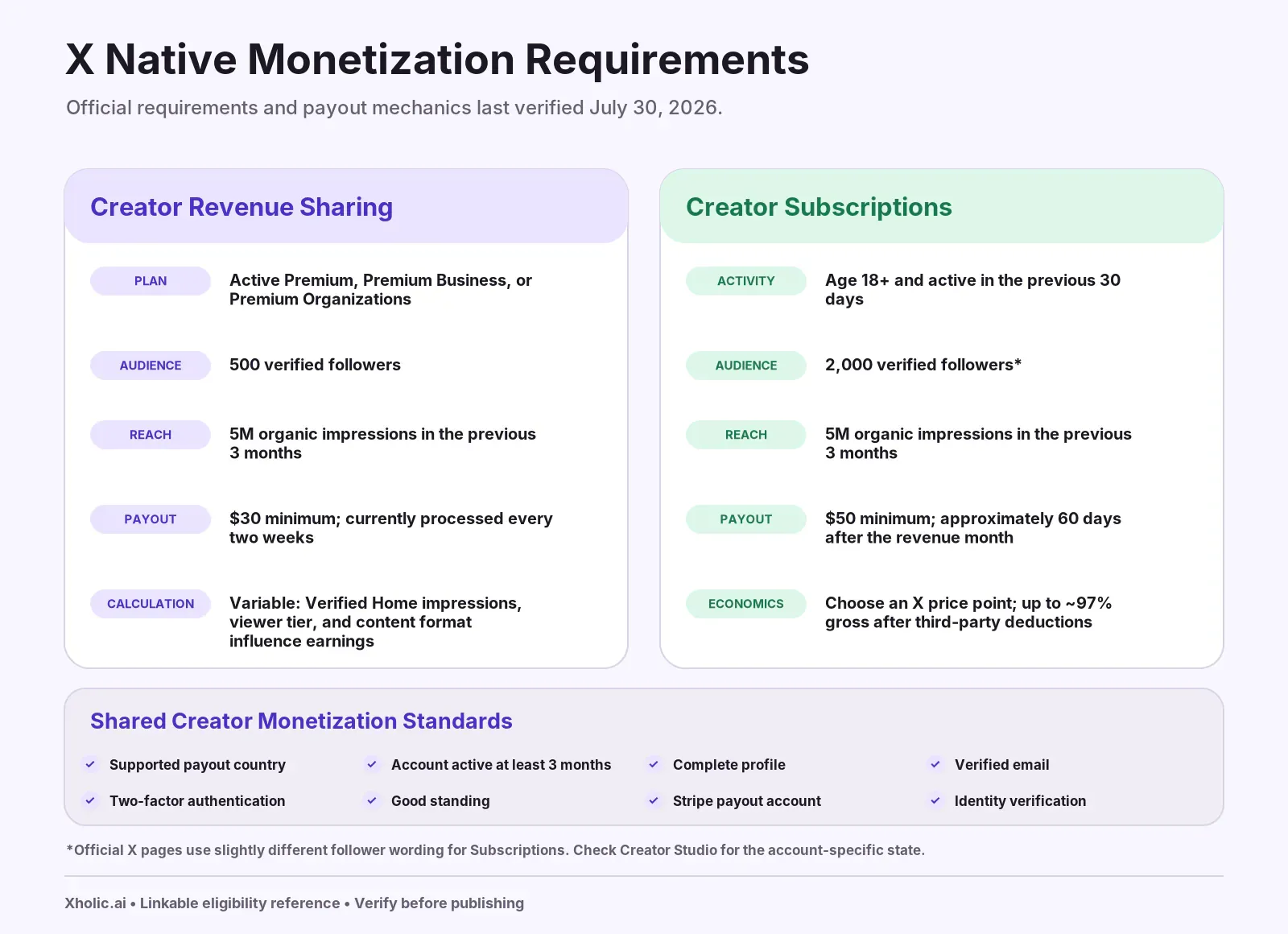
Native X monetization requirements at a glance
X’s two mainstream native creator programs share a high reach requirement, but their payer and economics differ. Use the checklist below as a dated reference and verify the live eligibility screen before acting.
6. Join X’s Creator Revenue Sharing program
Creator Revenue Sharing is the most discussed way to make money directly from X, but it is not the most accessible starting point.
According to X’s current Creator Revenue Sharing documentation, an account must:
- Have an active Premium, Premium Business, or Premium Organizations subscription
- Have at least five million organic impressions in the previous three months
- Have at least 500 verified followers
- Be in a supported country
- Comply with the X User Agreement
After qualifying, the creator must connect a Stripe payout account and complete identity verification. X says payouts are currently processed every two weeks with a $30 minimum. X’s broader Creator Monetization Standards also apply, including being at least 18, having an account active for at least three months, maintaining a complete profile, verifying email, enabling two-factor authentication, and remaining in good standing.
The important distinction most guides miss
The five-million threshold is an eligibility requirement based on organic impressions.
Payout calculation is a separate question. X says earnings are influenced by factors including:
- Verified Home Timeline impressions
- Who views the content, with different subscription tiers potentially carrying different value
- Content format
That means it is inaccurate to collapse the two ideas into “only Premium impressions count toward the five million.” The official page lists five million organic impressions for eligibility, then separately explains how verified-user activity and other factors influence earnings.
Does X pay a fixed amount per view?
No. X does not publish a fixed rate per view or per million impressions.
Any article promising a universal figure such as “X pays exactly $X per million views” is presenting a creator-reported estimate or an unsupported simplification, not an official rate card. Two accounts with the same total impressions can receive different payouts because the composition and context of those impressions may differ.
The most honest answer to “How much does X pay?” is:
X pays eligible creators through a variable calculation. Total impressions alone are not enough to predict the payout reliably.
Why Revenue Sharing should be treated as a bonus layer
The program can be useful when the content strategy already creates substantial eligible reach. But it is a weak foundation for a business because:
- The qualifying threshold is high
- Payouts are variable and not fully predictable from public metrics
- X can modify or cancel the program and can revoke participation
- Platform policy or product changes can alter economics
- Optimizing only for payout-weighted engagement can distort editorial quality
- The creator does not control the payer, calculation, or distribution system
A more resilient model uses Revenue Sharing as incremental income on top of an audience that already supports services, products, partnerships, subscriptions, or another owned business.
What to measure
- Rolling three-month organic impressions
- Verified-follower count
- Eligible payout history
- Revenue per one million total organic impressions as an account-specific historical observation—not a universal benchmark
- Content formats associated with meaningful interaction
- Revenue concentration by a small number of posts
- Whether payout-focused content attracts the audience your main business needs
The mistake that kills this method
The common mistake is building a content strategy around qualifying for a program before deciding what kind of audience is being built.
Five million impressions from people who will never buy, subscribe, refer, or remember you can satisfy a platform threshold while creating little durable commercial value.
7. Offer Creator Subscriptions on X
Creator Subscriptions let followers pay for additional access and exclusive content directly through X. Available features include subscriber-only posts, subscriber badges, subscription links, subscriber-only replies, and subscriber-only Spaces.
The recurring model is attractive, but it is not a small-account shortcut. X’s current Creator Subscriptions documentation lists these minimum application requirements:
- Be at least 18
- Have been active in the previous 30 days
- Have at least 2,000 verified followers
- Have at least five million organic impressions in the previous three months
X’s broader Creator Monetization Standards add requirements such as residing in a supported country, having an account active for at least three months, maintaining a complete profile, verifying email, enabling two-factor authentication, remaining in good standing, holding an active eligible Premium subscription, connecting Stripe, and completing identity verification.
A documentation nuance worth checking: X’s Subscription FAQ currently says “2,000 verified followers,” while the Monetization Standards page phrases the additional criterion as 2,000 active followers with Premium, Premium Business, or Premium Organizations subscriptions. Check Creator Studio for the account-specific eligibility state before relying on either wording. Meeting the minimum criteria does not guarantee approval.
Subscription pricing and payout economics
Creators choose from monthly price points made available by X rather than entering any arbitrary price.
X currently says creators are eligible to earn up to approximately 97% of gross Subscription revenue. X says it does not take a revenue share; deductions can include third-party payment processing or app-store fees, cancellations, refunds, and chargebacks.
The current minimum payout is $50. X says payments are made through Stripe approximately 60 days after the end of the month in which it received the Subscription revenue, typically within the first two weeks of the payment month.
For planning, use net—not headline—revenue:
Estimated net Subscription revenue
= Paying subscribers × monthly price
− app-store or payment-processing deductions
− refunds and chargebacks
− applicable taxes and operating costs
What subscribers will continue paying for
Exclusive posts alone are not a durable promise. The content needs a recurring reason to exist.
Possible subscription propositions include:
- A daily or weekly research brief for a narrow professional niche
- Subscriber-only implementation notes behind public frameworks
- Regular office hours or subscriber-only Spaces
- Early access to tools, reports, or product releases
- A structured learning sequence
- Behind-the-scenes decision logs that teach a repeatable process
- Direct access with clearly defined boundaries
A useful test is:
If a subscriber joined after seeing your best public post, what new value would make them glad to remain subscribed three months later?
Model conversion and retention
Gross monthly subscription revenue
= Eligible audience reached
× Subscription-page visit rate
× Purchase conversion rate
× Monthly price
Then model churn:
Net subscriber change
= New subscribers − cancellations
A creator can grow total follower count while losing paying subscribers. Watch the paid cohort, not only the public audience.
Revenue Sharing or Subscriptions: which is better?
They solve different problems.
| Creator Revenue Sharing | Creator Subscriptions |
|---|---|
| X pays based on a variable platform calculation | Individual subscribers pay a recurring price |
| Depends heavily on eligible scale and interaction | Depends on loyalty, offer clarity, and retention |
| No fixed public rate per view | Price point is visible, but net revenue has deductions |
| Lower direct obligation to each viewer | Creates an ongoing content and access obligation |
| Useful as bonus income | Can be more predictable after a paying base exists |
Subscriptions can be more controllable than Revenue Sharing, but only after qualification and only when the creator can sustain premium value.
The mistake that kills this method
The common mistake is treating exclusivity as value.
Content is not worth paying for merely because it is hidden. It is worth paying for when it is more timely, useful, structured, actionable, scarce, or interactive than the free alternative.
Other X-native monetization options
Tips
X Tips allows eligible users to add supported third-party payment services to their profile so people can send money outside X. X says it does not take a portion of Tips, although payment providers may charge fees. Tips can be useful for voluntary support, but they are usually less predictable than a defined offer or membership.
Treat Tips as a convenience layer, not a complete monetization strategy.
Amplify Pre-roll and Amplify Sponsorships
X’s Media Studio monetization includes Amplify Pre-roll and Amplify Sponsorships. These programs are oriented toward accepted publisher partners with premium video content and sponsorship packages. They are real options, but they are not a mainstream entry point for the average individual creator.
How much can you realistically make on X?
There is no single honest earnings table based only on follower count.
Two creators with the same audience size can have completely different economics because one sells a $3,000 service to a precise buyer while the other depends on variable platform payouts. The relevant question is not “What does a 10,000-follower account earn?” It is “What conversion system and customer value sit behind those 10,000 followers?”
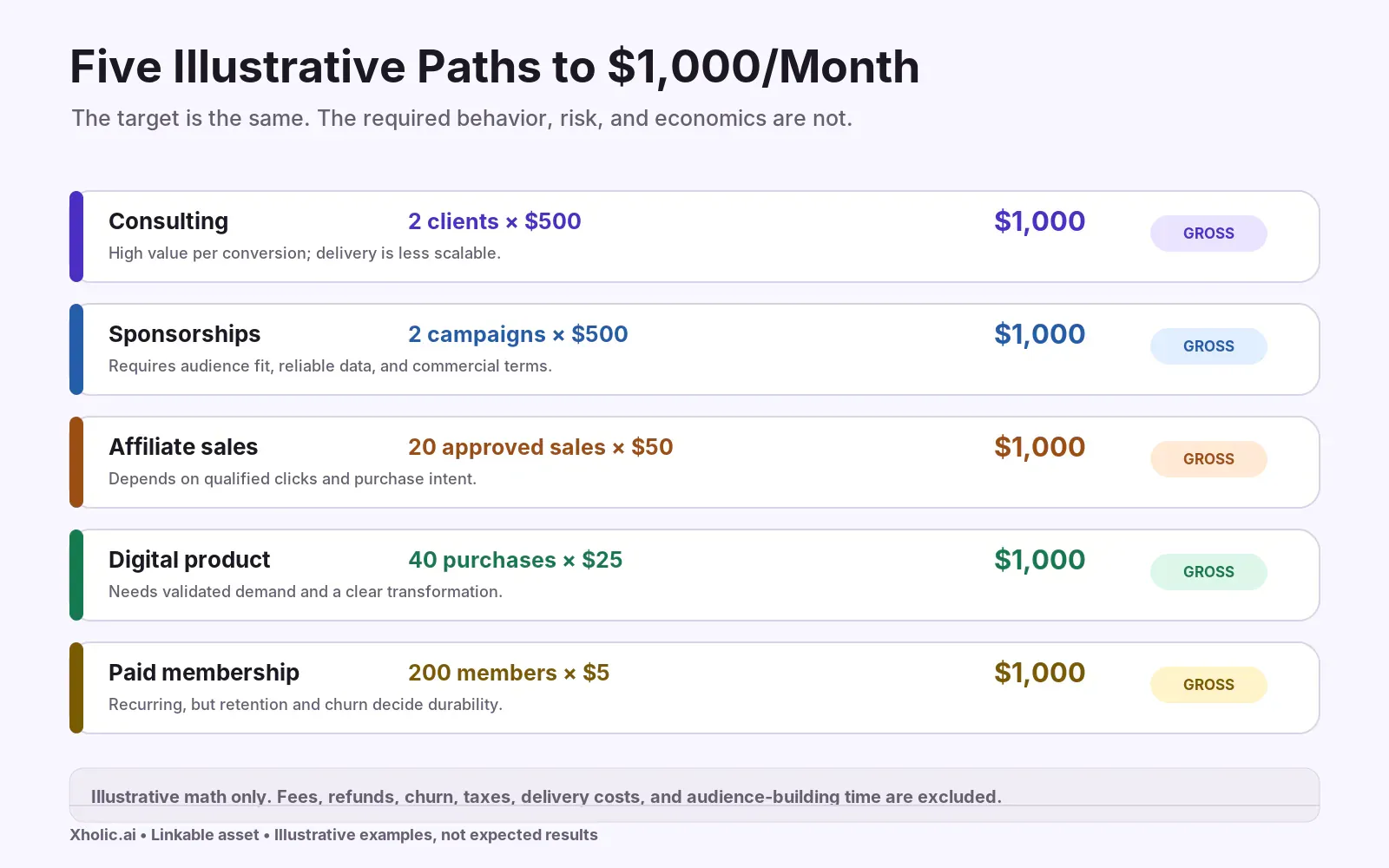
Interactive asset: Open the X Monetization Calculator to change the assumptions for services, sponsorships, affiliate marketing, products, memberships, and Creator Subscriptions. Revenue Sharing is intentionally excluded because X does not publish a fixed payout rate.
The examples below all reach $1,000 in gross monthly revenue, but they require different behaviors:
| Model | Illustrative path to $1,000 gross | Principal constraint |
|---|---|---|
| Consulting | 2 clients × $500 | Qualification and delivery capacity |
| Sponsorships | 2 campaigns × $500 | Audience fit and brand demand |
| Affiliate marketing | 20 approved sales × $50 commission | Purchase intent and attribution |
| Digital product | 40 purchases × $25 | Demand and landing-page conversion |
| Paid membership | 200 members × $5 | Acquisition and retention |
These are arithmetic examples, not typical results. They exclude fees, refunds, taxes, labour, fulfilment, churn, and the time required to build an audience.
Gross revenue is not profit
Always separate:
Gross revenue
− direct fees
− refunds and chargebacks
− affiliate or partner shares
− software and contractor costs
− fulfilment and support costs
− paid acquisition
= contribution before tax and owner compensation
A $1,000 service with 20 hours of delivery is economically different from $1,000 in product revenue with 50 support tickets. A recurring membership with 15% monthly churn is different from one with 3% churn. Revenue is only the first layer of the analysis.
The most useful cross-model metric
For each revenue model, calculate:
Revenue per qualified actionThe action changes by model:
- Service: qualified conversation or call
- Sponsorship: campaign sold
- Affiliate: qualified click or approved conversion
- Product: qualified landing-page visit
- Membership: trial or paid start
- Native X payout: eligible impressions and account-specific historical payout
This metric connects content performance to business performance more clearly than follower count alone.
Which X monetization model should you choose?
Choose the model that uses an asset you already possess or can credibly build—not the model with the most exciting success screenshots.
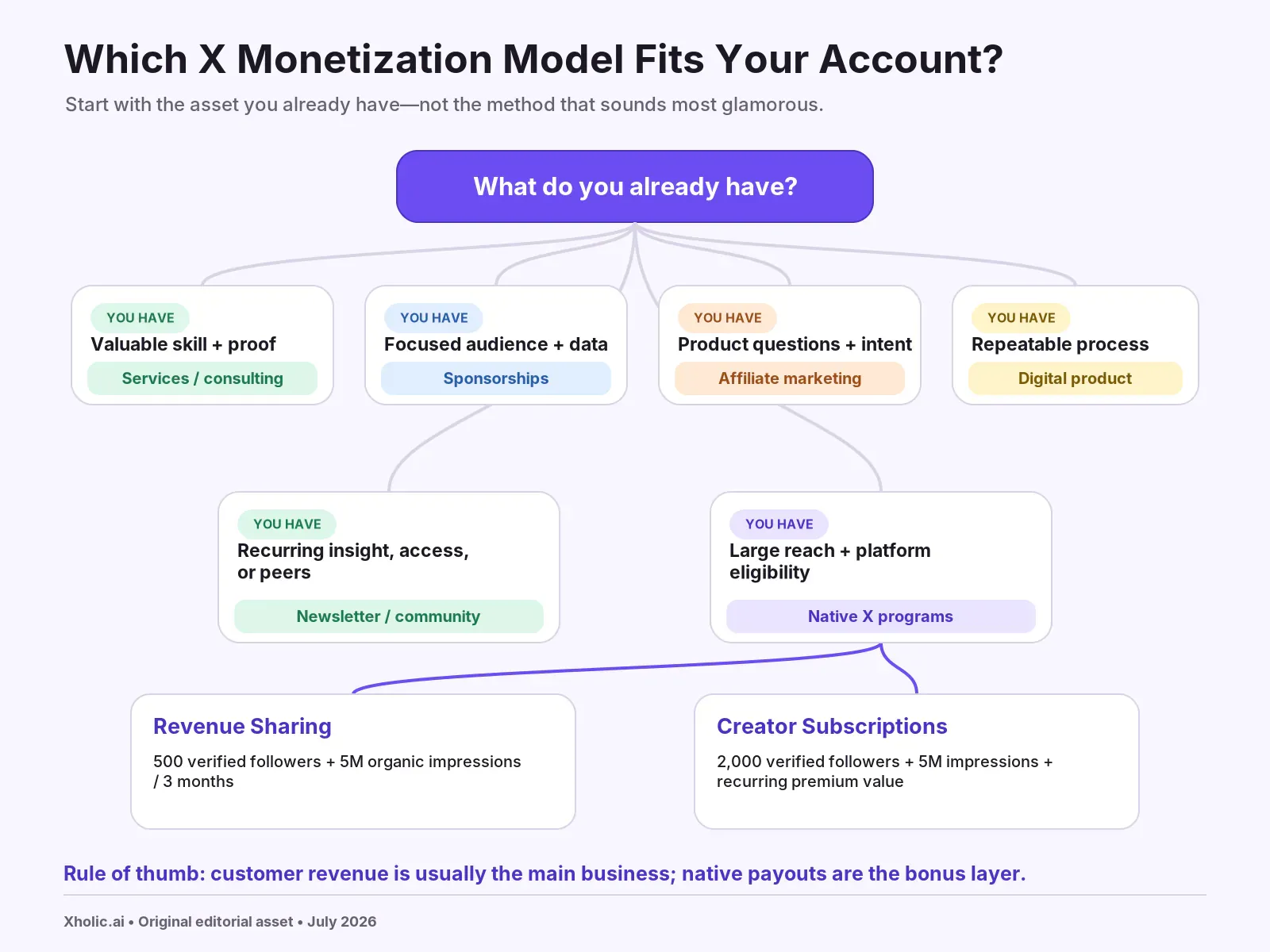
Start with services when you have skill and proof
Services are a strong first model when you can solve an expensive problem but do not yet have a large audience. The audience only needs to be large enough to create qualified conversations.
Start with sponsorships when you have a focused audience and reliable data
Sponsorships fit when brands want access to the people who already pay attention to you. The account needs commercial relevance, not merely visibility.
Start with affiliate marketing when your audience is already choosing products
Affiliate marketing fits naturally when people ask what you use, how tools compare, or how to implement a workflow. It is weaker when recommendations are unrelated to the account’s established purpose.
Start with a digital product when you have a repeatable process
A product is suitable when the same problem can be solved with a reusable asset or structured learning experience. Validate demand before investing heavily.
Start with a newsletter or community when the value is recurring
Recurring products require recurring usefulness. Choose this path when insight, access, peers, research, or accountability naturally renews.
Add native X monetization when you qualify
Revenue Sharing and Creator Subscriptions can become useful layers after the account reaches the current platform thresholds. They should not distract from building a durable customer or member relationship.
Score your monetization readiness
Follower count is one input. The following score is an editorial framework from Xholic—not an X metric or guarantee.
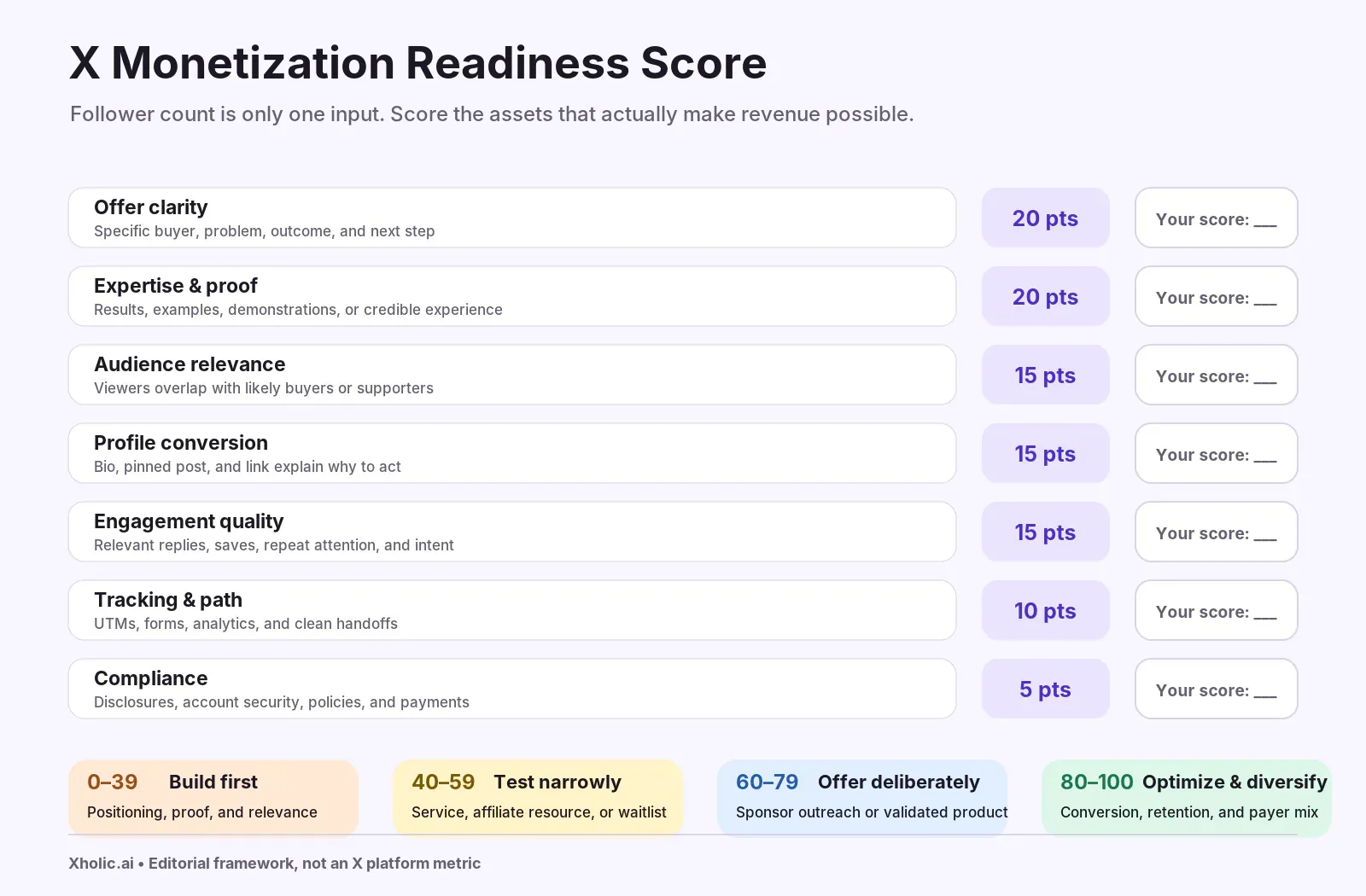
Give yourself a score in each category:
| Category | Maximum | What a high score looks like |
|---|---|---|
| Offer clarity | 20 | A specific buyer, costly problem, outcome, and next action |
| Expertise and proof | 20 | Credible results, examples, demonstrations, or experience |
| Audience relevance | 15 | A meaningful share of viewers resemble buyers or supporters |
| Profile conversion | 15 | Bio, pinned post, proof, and link explain why to act |
| Engagement quality | 15 | Relevant replies, saves, repeat attention, and buying signals |
| Tracking and path | 10 | UTMs, forms, analytics, and handoffs reveal where people drop |
| Compliance | 5 | Disclosures, account security, policies, contracts, and payments are handled |
Interpret the total cautiously:
- 0–39: Build first. Improve positioning, proof, and audience relevance before trying to monetize aggressively.
- 40–59: Test narrowly. Offer a focused service, publish a useful affiliate resource, or validate demand with a waitlist.
- 60–79: Offer deliberately. You may be ready for structured sponsor outreach, a validated product, or a recurring offer.
- 80–100: Optimize and diversify. Focus on conversion, retention, unit economics, and reducing dependence on one payer.
A high score does not guarantee revenue. It means the account has fewer obvious structural gaps.
Can you make money on Twitter with zero or few followers?
You can make money without meeting a native follower threshold. You cannot build a reliable monetization system from zero attention, zero trust, zero proof, zero expertise, and zero relationships.
That distinction matters.
A developer who has years of experience and 150 relevant followers may win a consulting project. A new anonymous account with 20,000 purchased followers may produce no legitimate demand. “Small account” and “no credibility” are not the same condition.
The monetization ladder for a new account
Stage 1: Earn the right audience’s attention
Choose a narrow problem space. Publish specific observations, useful examples, original analysis, and thoughtful replies where the target audience already gathers.
The objective is not raw growth. It is recognizability among the right people.
Stage 2: Build visible proof
Show work. Break down decisions. Demonstrate the process. Create a small tool, audit, teardown, template, or case study. Proof shortens the distance between profile visit and trust.
Stage 3: Test the smallest credible offer
For many new accounts, this is a service, audit, workshop, or narrowly useful product. It should solve one clear problem and require a reasonable next step.
Stage 4: Improve the conversion path
Align the profile, pinned post, landing page, form, call, checkout, and follow-up. Do not assume every failure is a reach problem.
Stage 5: Add scalable and recurring layers
Once the audience repeatedly responds to a problem, consider products, a newsletter, a community, sponsorships, or a better-packaged service.
Stage 6: Activate native programs when eligible
Treat X’s platform payouts as an additional layer rather than the reason the audience exists.
For a complete audience-building system, read How to Grow on Twitter.
A 30-day plan to earn your first meaningful revenue signal
The objective of the first 30 days is not to promise a particular income. It is to build and test one complete path from relevant attention to a measurable commercial action.
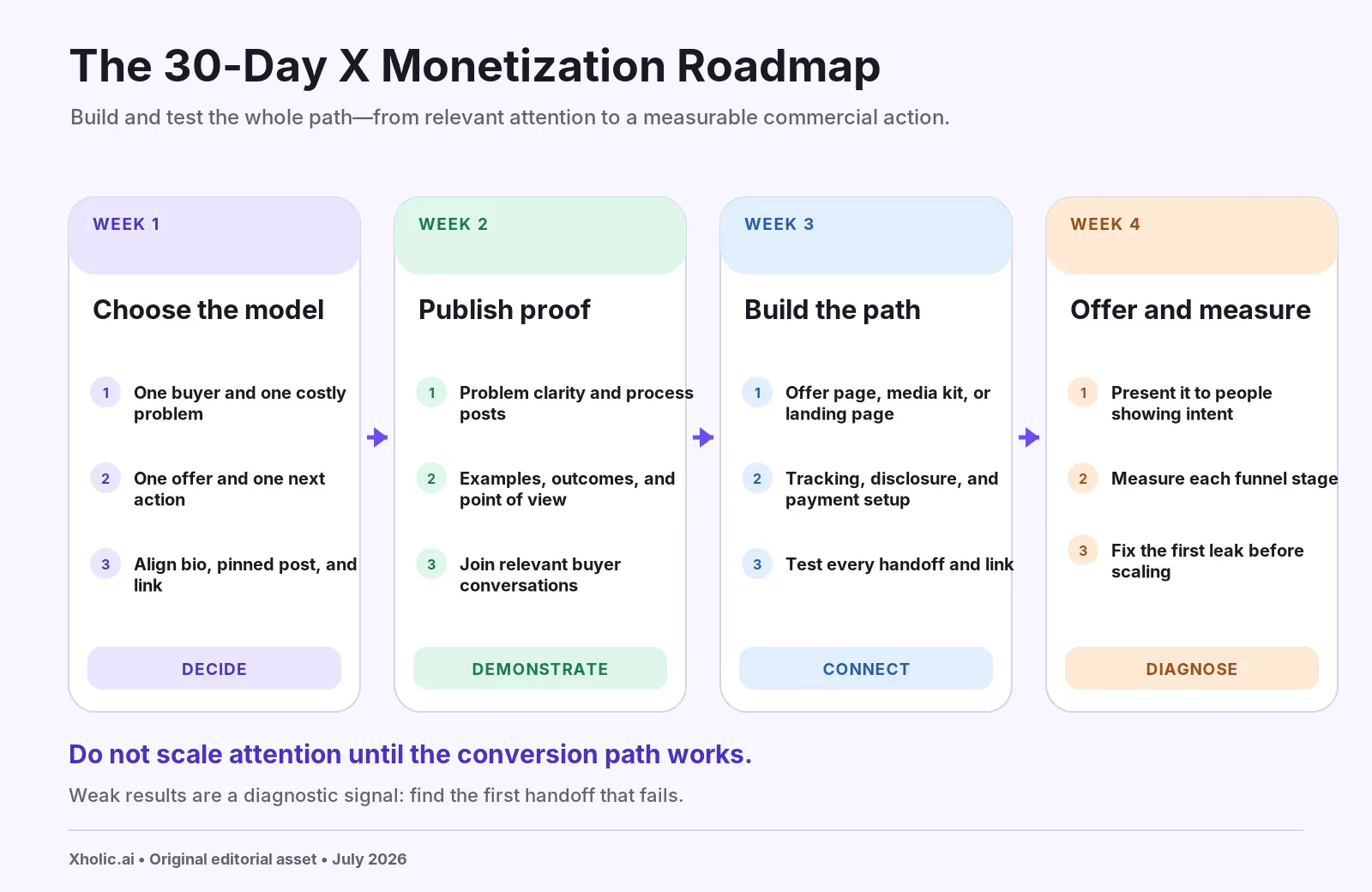
Week 1: Choose one payer, buyer, and offer
Define:
- Who pays you
- What problem or outcome they pay for
- Why you can credibly help
- The smallest useful offer
- The next action you want a qualified person to take
Then align your profile:
- Name and bio: Make the relevant expertise and audience understandable.
- Header: Reinforce the promise or context rather than adding generic decoration.
- Pinned post: Show proof, process, or a high-value resource with a natural next step.
- Link: Send visitors to one destination that matches the current objective.
Test the entire path yourself on mobile and desktop.
Week 2: Publish proof and join relevant conversations
Create content across three functions:
- Clarify the problem. Show why it happens and what people misunderstand.
- Demonstrate the method. Share steps, examples, trade-offs, and tools.
- Establish evidence. Show outcomes, experiments, or well-supported judgment.
Do not spend the week broadcasting alone. Add thoughtful replies where the target audience is already discussing the problem. A useful reply can display expertise, create familiarity, and reveal whether someone has genuine interest.
Week 3: Build the conversion asset
Choose the asset required by the model:
- Service: a clear offer page, qualification form, and booking process
- Sponsorship: a concise media kit and commercial terms
- Affiliate: a tutorial, comparison, or implementation resource
- Product: a validated sales page, waitlist, or paid pilot
- Newsletter: a landing page and useful onboarding sequence
- Community: a clear recurring promise and activation path
- Native programs: complete security, identity, payout, and eligibility steps
Add tracking. Use source-specific links or UTMs where appropriate. Record the baseline before promotion.
Week 4: Make the offer and diagnose the first leak
Present the offer to people who have shown relevant intent. That can mean replying to a question, following up with a resource requester, inviting waitlist members, pitching a well-matched sponsor, or publishing a clear product announcement.
Then inspect the sequence:
Relevant impression
→ Profile visit or click
→ Qualified action
→ Conversation or checkout
→ Purchase
→ Successful delivery or activation
→ Retention or referral
Find the first major drop, not the most emotionally satisfying explanation.
- Impressions but no profile visits: the content may attract curiosity without positioning.
- Profile visits but no clicks: the profile or offer may be unclear.
- Clicks but no action: the landing page may not match the promise.
- Calls but no sales: qualification, proof, urgency, scope, or pricing may be weak.
- Sales but poor retention: the delivery or recurring promise may not hold.
Do not scale attention until the conversion path works. More traffic sent into a broken system produces more evidence of the same failure.
Track four layers of monetization performance
A creator dashboard should separate visibility from economics.
| Layer | Core question | Example metrics |
|---|---|---|
| Visibility | Did the right people see it? | Relevant impressions, profile visits, follower quality |
| Intent | Did they show meaningful interest? | Replies, saves, resource requests, qualified clicks, DMs |
| Conversion | Did they take the commercial action? | Calls, proposals, purchases, paid starts, sponsor inquiries |
| Economics | Was the result worth producing? | Revenue, contribution, acquisition cost, delivery time, churn, lifetime value |
This prevents a common analytical mistake: declaring a post successful because it performed well at the top of the funnel while producing no downstream value.
Use cohort and source data where possible
A single monthly total hides important differences. Compare:
- New versus returning buyers
- Revenue from posts, replies, profile visits, email, and referrals
- Product or sponsor performance by content angle
- Member retention by signup month
- Close rate by lead source
- Customer value by offer
The goal is not to attribute every dollar perfectly. It is to learn which types of attention create durable value.
Nine monetization mistakes to avoid
1. Chasing native payouts before building an offer
Platform revenue feels attractive because it appears to remove selling. But a high threshold and variable calculation make it a poor first business model for most accounts.
2. Confusing impressions with buyer intent
Broad entertainment reach and high-intent professional reach are not commercially interchangeable. Measure who is paying attention and why.
3. Trying to monetize every post
When every observation becomes a pitch, useful content becomes a wrapper around an offer. Trust decays, and the audience learns to ignore calls to action.
4. Sending generic or high-volume DMs
Bulk unsolicited messages, repeated link-only messages, and identical DMs violate X’s authenticity rules and usually perform poorly. Use context, permission, and genuine diagnosis.
5. Pricing sponsorships by follower count alone
Follower count ignores audience fit, expected reach, creative work, usage rights, exclusivity, and operational effort.
6. Hiding affiliate or sponsorship disclosures
A disclosure does not make a strong recommendation weak. Hidden incentives make trust fragile and can violate platform rules or law.
7. Building a product before validating demand
Production can feel like progress because it is under your control. Demand is harder and more important. Validate the problem and willingness to pay first.
8. Buying followers, engagement, or accounts
Purchased metrics do not create buyer trust, and X’s Authenticity policy prohibits account trading, metric inflation, engagement exchanges, and related third-party services. These tactics can damage both eligibility and reputation.
9. Depending on one payer
A business funded entirely by one platform program, one sponsor, or one affiliate partner carries concentration risk. Diversify only after one primary model works, but do not mistake dependence for stability.
How Xholic can support the system without pretending to create income
No writing or scheduling tool can guarantee revenue. Monetization depends on the audience, offer, proof, conversion path, delivery, and market.
Xholic is useful earlier in that chain: helping a creator identify relevant opportunities, stay consistent, learn from what resonates, and build the public evidence that makes an offer credible.
A practical workflow can use:
- Xholic Brain to retain niche, product, voice, saved-post, creator, and feedback context
- Personalized replies to develop useful public conversations without starting from a blank box
- Inspiration and X-Ray to study patterns and understand why a post works
- Remixer to turn an idea or proven structure into a draft that fits the user’s context
- Scheduler to maintain a deliberate cadence with review before publishing
- Collections and feedback to preserve useful material and improve future suggestions
- Free X tools to inspect public-facing engagement and profile signals
The role of the system is not to automate trust. It is to reduce the operational friction involved in earning it.
Explore Xholic or use the free Xholic tools before committing to a workflow.
Frequently asked questions
How do you make money on Twitter or X?
The seven most practical models are services and consulting, sponsored content, affiliate marketing, digital products, paid newsletters or communities, Creator Revenue Sharing, and Creator Subscriptions. The best option depends on who will pay, what they value, your current proof, and whether you meet any native eligibility requirements.
What are the current X Creator Revenue Sharing requirements?
As verified on July 30, 2026, X requires an active Premium, Premium Business, or Premium Organizations subscription; at least five million organic impressions in the previous three months; at least 500 verified followers; a supported country; and compliance with the X User Agreement. Eligible creators must connect Stripe and complete identity verification to receive payouts.
How many followers do you need to make money on Twitter?
There is no universal follower requirement. Creator Revenue Sharing currently requires 500 verified followers plus five million organic impressions in three months. Creator Subscriptions require at least 2,000 verified followers plus the same impression threshold. Services, products, sponsorships, and affiliate offers do not use those native thresholds.
Does X pay per view?
X does not publish a fixed payment per view. Creator Revenue Sharing payouts are influenced by factors such as Verified Home Timeline impressions, who views the content, the viewer’s subscription tier, and content format.
How much does X pay per million impressions?
There is no official universal amount. Creator-reported figures can vary and should not be treated as a rate card. The most relevant estimate for an eligible creator is their own historical payout divided by their own qualifying period’s metrics, with the understanding that future payouts can change.
Can you make money on X without Premium?
Yes. Premium is required for Creator Revenue Sharing and Creator Subscriptions, but it is not required to sell services, products, sponsorships, affiliate offers, a newsletter, or a community. Other platform and legal rules still apply.
Can you make money on Twitter with fewer than 1,000 followers?
Yes, especially through a focused service, a useful affiliate recommendation, a small product, or a niche sponsorship. A small audience must be relevant and trust the creator. The number alone does not create revenue.
What is the fastest legitimate way to make money on X?
For someone with an existing valuable skill and proof, a focused service sold through warm conversations is often the fastest path because one customer can create meaningful revenue without a large audience. “Fastest” still depends on market demand, credibility, and the offer.
Is Creator Revenue Sharing better than Creator Subscriptions?
Neither is universally better. Revenue Sharing rewards eligible platform activity through a variable calculation. Subscriptions create recurring fan revenue but require a continuing premium offer and retention. Subscriptions can be more predictable after a paying base exists, while Revenue Sharing requires less direct fulfilment.
How do you sell through DMs without spamming?
Build context publicly, wait for a relevant signal of interest, ask permission to continue privately, diagnose before pitching, and make the next step proportionate. Avoid bulk unsolicited messages, identical copy, and repeated link-only DMs.
Do affiliate links need to be disclosed on X?
X classifies commission-generating affiliate links and discount codes as paid partnerships. Use X’s Paid Partnership disclosure when required, make the relationship clear in the post, and comply with applicable advertising laws.
How much should you charge for a sponsored post?
There is no universal rate. Price the creative work, expected qualified distribution, usage rights, exclusivity, revisions, reporting, and audience value. Use follower count only as one contextual signal.
Do you need a business account to sell on X?
Not necessarily. Many creators and professionals sell through ordinary accounts. The appropriate business structure, tax registration, contracts, consumer disclosures, and payment setup depend on your location and activity, so obtain professional advice where needed.
Can you sell your X account?
X’s Authenticity policy prohibits trading, buying, selling, or soliciting access to accounts and usernames. Account sales are not a legitimate monetization method for this guide.
Is X monetization available in every country?
X describes Creator Revenue Sharing and Creator Subscriptions as globally available to eligible creators in countries supported by its payment provider, but payout support varies. Check the current official country list and your Creator Studio eligibility screen.
How are X creator payouts processed?
Creator Revenue Sharing payouts are currently processed through Stripe every two weeks with a $30 minimum. Creator Subscription payouts are processed through Stripe, have a $50 minimum, and are generally paid approximately 60 days after the end of the revenue month.
What happens if you stop meeting an X monetization requirement?
X says it can pause or revoke monetization when an account does not meet eligibility, content, or conduct standards. Platform programs should therefore be treated as revocable revenue rather than guaranteed income.
Should you build an audience before monetizing?
Build enough relevant attention and proof to support the chosen offer, but do not wait for an arbitrary follower milestone. Testing a small credible offer can reveal what the audience values and improve the content strategy.
If affiliate income is the model you want to test first, continue with the practical guide to affiliate marketing on Twitter for offer selection, disclosure, tracking, and conversion workflow details.
The honest conclusion
The most reliable way to make money on Twitter is not to chase whichever monetization feature is receiving the most attention.
It is to build a clear connection between:
A specific audience
→ a costly or meaningful problem
→ credible public proof
→ a fitting offer
→ a measurable conversion path
→ successful delivery and retention
X can pay you directly, but its native programs have real thresholds and platform risk. For many smaller accounts, the first meaningful revenue will come from a client, customer, member, sponsor, or affiliate partner.
Start with one payer. Make one offer clear. Measure the complete path. Add other revenue layers only after the first one works.
Research methodology and primary sources
This guide was built around current first-party X documentation rather than fixed payout claims copied from creator screenshots. Requirements were last checked on July 30, 2026. Platform pages can change without notice; recheck them before publishing a major update or making a financial decision.
Primary sources:
- X Creator Revenue Sharing
- X Creator Monetization Standards
- X Creator Subscriptions
- X Paid Partnerships Policy
- X Authenticity policy
- X Tips
- X Media Studio Monetization
Editorial note: All non-platform earnings examples are illustrative models designed to show how revenue equations work. They are not typical-income claims, guarantees, financial advice, tax advice, or legal advice.